CLINICAL STUDY DESIGNS:
An Overview
DR NILESH
Overview of the presentation
I. Introduction to clinical research
II. Types of clinical studies
III. Observational study designs
IV. Experimental study designs
Important issues in Study Design
• Validity: Truth
– External Validity:
• The study can be generalized to the population
– Internal Validity:
• Results are not due to chance, bias or confounders
– Symmetry Principle:
• Groups are similar
Important issues in Study Design
• Confounding: distortion of the effect of one risk factor by
the presence of another
• Bias: Any effect from design, execution, & interpretation
that shifts or influences results
– Confounding bias: failure to account for the effect of one or more
variables that are not distributed equally
– Measurement bias: measurement methods differ between groups
– Sampling (selection) bias: design & execution errors in sampling
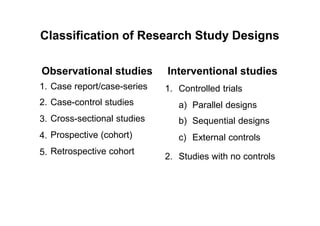
Classification of Research Study Designs
Observational studies Interventional studies
1.
2.
3.
4.
5.
Case report/case-series
Case-control studies
Cross-sectional studies
Prospective (cohort)
Retrospective cohort
1. Controlled trials
a)
b)
c)
Parallel designs
Sequential designs
External controls
2. Studies with no controls
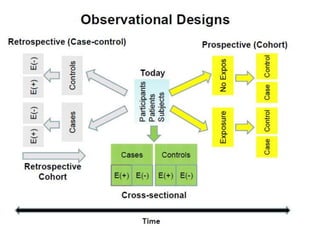
Observational Designs
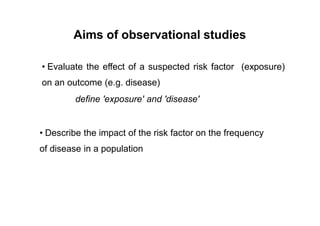
Aims of observational studies
• Evaluate the effect of a suspected risk factor
on an outcome (e.g. disease)
define 'exposure' and 'disease'
(exposure)
• Describe the impact of the risk factor on the frequency
of disease in a population
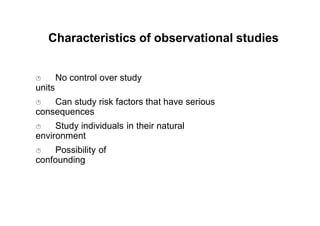
Characteristics of observational studies
 No control over study
units
 Can study risk factors that have serious
consequences
 Study individuals in their natural
environment
 Possibility of
confounding
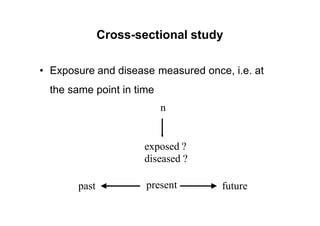
Cross-sectional study
• Exposure and disease measured once, i.e. at
the same point in time
n
exposed ?
diseased ?
presentpast future
Cross-sectional study
• Random sample from population
– i.e. results reflect reference population
• Estimates the frequencies of both exposure
outcome in the population
and
• Measures both exposure & outcome at one
point in time
• Typical example is a survey
Cross-sectional study
• Can study several exposure factors and outcomes
simultaneously
• Determines disease prevalence
• Helpful in public health administration & planning
• Quick and low cost (e.g. mail survey)
• Limitations:
– Does not determine causal relationship
– Not appropriate if either exposure or outcome is rare
Cohort studies
• Follow-up studies: subjects selected on presence or
absence of exposure & absence of disease at one
point in time. Disease is then assessed for all subjects
at another point in time
• Typically
depending
initiation &
prospective but can be retrospective,
on temporal relationship between study
occurrence of disease
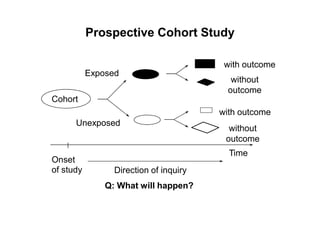
Prospective Cohort Study
with outcome
without
outcome
Exposed
Cohort
with outcome
without
outcome
Time
Unexposed
Onset
of study Direction of inquiry
Q: What will happen?
Cohort studies
• More clearly established temporal sequence
between exposure & disease
• Allows direct measurement of incidence
• Examines multiple effects of a single exposure
(nurses’ health study, oral contraceptives &
breast, ovarian cancers)
Cohort studies
• Limitations:
– time consuming and expensive
– loss to follow-up & unavailability of data
– potential confounding factors
– inefficient for rare diseases
Case-Control Study
• Retrospective
– Can use hospital or health register data
• First identify cases
• Then identify suitable controls
– Hardest part: who is suitable ??
• Then inquire or retrieve previous
– By interview
exposure
– By databases (e.g. hospital, health insurance)
Case-Control Study
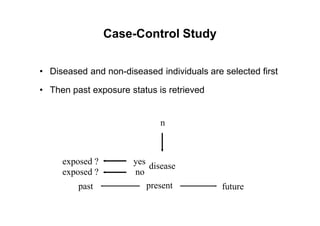
• Diseased and non-diseased individuals are selected first
• Then past exposure status is retrieved
n
exposed ?
exposed ?
past
yes
no
disease
present future
Case-Control Study
• Good for rare disease (e.g. cancer)
• Can study many risk factors at the same time
• Usually low cost (though not always)
• Confounding likely
• Measures Odds Ratio (not Relative Risk !!)
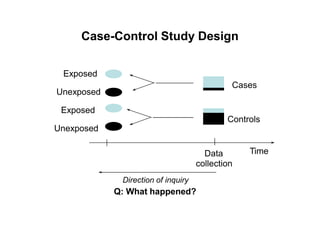
Case-Control Study Design
Exposed
Cases
Unexposed
Exposed
Controls
Unexposed
TimeData
collection
Direction of inquiry
Q: What happened?
Case Selection
•
•
Define source population
Cases
– incident/prevalent
– diagnostic criteria (sensitivity
Controls
+ specificity)
•
– selected from same population as cases
– select independent of exposure status
Control Selection
•
•
Random selection from source population
Hospital based controls:
–
–
convenient selection
controls from variety of diagnostic groups
other than case diagnosis
avoid selection of diagnoses related to
particular risk factors
limit number of diagnoses in individuals
–
–
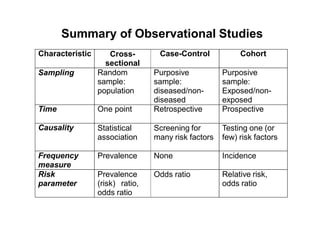
Summary of Observational Studies
Characteristic Cross-
sectional
Case-Control Cohort
Sampling Random
sample:
population
Purposive
sample:
diseased/non-
diseased
Purposive
sample:
Exposed/non-
exposed
Time One point Retrospective Prospective
Causality Statistical
association
Screening for
many risk factors
Testing one (or
few) risk factors
Frequency
measure
Prevalence None Incidence
Risk
parameter
Prevalence
(risk) ratio,
odds ratio
Odds ratio Relative risk,
odds ratio
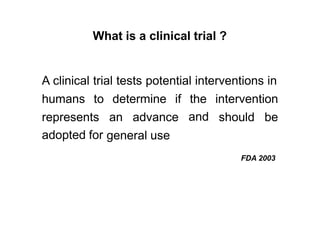
What is a clinical trial ?
A clinical trial tests potential interventions in
humans to determine if the
and
intervention
represents
adopted for
an advance should be
general use
FDA 2003
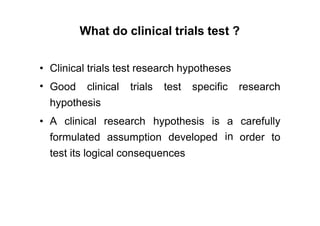
What do clinical trials test ?
•
•
Clinical trials test research hypotheses
Good clinical trials test specific research
hypothesis
• A clinical research hypothesis is a
in
carefully
formulated assumption developed order to
test its logical consequences
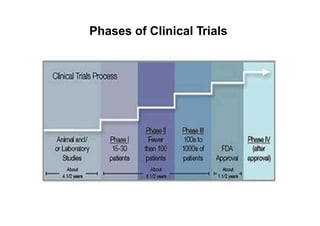
Phases of Clinical Trials
What is a Phase I trial ?
•
•
First evaluation of a new therapy in humans
Classical Goals:
Identify dose limiting toxicities (DLT)
Identify maximum tolerated dose (MTD)
Assess pharmacokinetics (PK)
Assess pharmacodynamic (PD) endpoints
Dose Limiting Toxicity (DLT)
• Toxicity described by standardized grading
criteria considered unacceptable because
of severity or irreversibility
• What is considered unacceptable varies
from situation to situation
DLT is specified for each trial protocol•
Maximum Tolerated Dose (MTD)
• Dose associated with unacceptable toxicity
(DLT) in a pre-specified proportion of
patients (sometimes defined inconsistently)
Generally the dose at which ≥ 33%
patients experience unacceptable
toxicity (eg. DLT in ≥ 2 out of 6 pts)
MTD: 1 dose level below DLT•
Principles of Phase I trial design
•
•
Start with a safe starting dose
Minimize number of patients treated at sub-
therapeutic doses
Escalate doses rapidly in absence of toxicity
Escalate dose slowly in presence of toxicity
•
•
Selection of starting dose
Based on pre-clinical (animal) toxicity data
1/10th LD10 (0.1 MELD10) if mouse
most sensitive species
•
3rd1/ TDL (0.33 DETDL) if dog most
sensitive species
• Conservative dosing based on other
studies if data suggest human tissues
more sensitive and PK data show a steep
dose/toxicity curve
Classical Phase I Trial Design
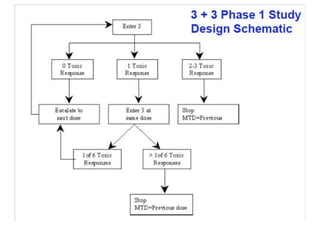
Conventional 3 + 3 design
3-6 pts per cohort
Starting dose 0.1 MELD
Dose escalation using modified
Fibonacci series
100%-66%-50%-40%-33%
MTD achieved
Previous dose level is RPTD
Problems with 3 + 3 design
Empirical and traditional method
Lacks solid statistical foundation
May take too many or too few patients
Takes a long time for dose escalation
•
•
•
•
• Starting dose may significantly under or
overestimate ‘safe’ dose
• Early dose levels far away from optimal and/or
therapeutic doses thus exposing substantial
proportion of patients to low, suboptimal and
ineffective doses
Summary of phase I trial designs
• Phase I clinical trials
drug development
are the gateway for all new cancer
• The traditional 3+3 design though safe, treats large
numbers below therapeutic doses and takes a long time
for escalation
• Alternative phase I designs enable a higher proportion of
patients to be treated at or near MTD, but at an
increased risk of Grade 3-4 toxicities within a shortened
time span
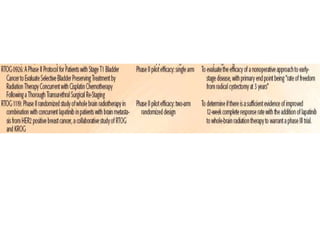
What is a phase II trial ?
Primary goal is to establish efficacy / activity
"Proof-of-principle" for preliminary evidence of efficacy
Generally relies on surrogate end-points
Mostly single arm studies
May be randomized ("pick-a-winner")
Suggests further potential (for phase lll testing)
Documents additional safety information
Objectives of phase II trials
1. To define antitumor activity
2. To further demonstrate safety
3. To gain new insights into the pharmacokinetics,
pharmacodynamics & metabolism of drugs
4. To evaluate biologic correlates which may predict
response or resistance to treatment and/or toxicity
Phase II study designs
• Frequentist • Bayesian
–
–
–
–
–
–
–
–
Gehan 2-Stage
Simon 2-Stage Optimal
Simon 2-Stage Mini-max
Fleming 1-stage
Gehan-Simon 3-Stage
Randomized Phase 2
Constant Arc-Sine
Randomized
Discontinuation
–
–
–
Thall-Simon-Estey
1-Stage Bayesian
2-Stage Bayesian
• Tan Machin
• Heitjan
•
•
Adaptive
Multiple Outcomes
Summary of Phase II studies
• Phase ll trials are exploratory studies and rarely are
definitive
• Efficient to exclude inactive therapies
• Results must be interpreted cautiously, in the
the availability of other therapies
context of
• Estimate clinical activity and provide further safety
information – important in the "go/no go" decision
• Require confirmation in pivotal phase lll trials
What is a phase III trial ?
Comparative Trials with or without controls
Primary goal is to establish actual clinical value
Survival (OAS, EFS,PFS) are primary endpoints
Compares new treatment to current standard of care
Randomized (with allocation concealment) to minimize bias
May be sometimes placebo controlled and even blinded
Phase III Study Designs
•
•
•
Comparative Studies
Experimental Group vs
Establishing a Control
Control Group
1.
2.
3.
Historical
Concurrent
Randomized
• Randomized Control Trial
standard
– Eliminates several sources
(RCT) is the gold
of bias
Why Control Group
• To allow discrimination of patient outcomes
caused by experimental intervention from
those caused by other factors
– Natural progression of disease
– Observer/patient expectations
– Other treatment
• Fair comparisons
– Necessary to be informative
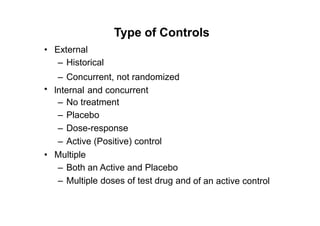
Type of Controls
• External
– Historical
– Concurrent, not randomized
lnternal and concurrent•
–
–
–
–
No treatment
Placebo
Dose-response
Active (Positive) control
• Multiple
– Both an Active and Placebo
– Multiple doses of test drug and of an active control
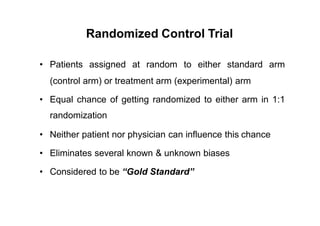
Randomized Control Trial
• Patients assigned at random to either standard arm
(control arm) or treatment arm (experimental) arm
• Equal chance of getting randomized to either
randomization
arm in 1:1
• Neither patient nor physician can influence this chance
• Eliminates several known & unknown biases
• Considered to be “Gold Standard”
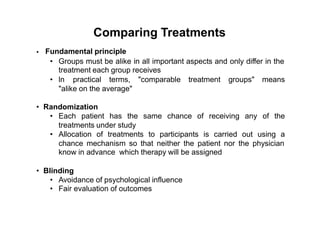
Comparing Treatments
Fundamental principle•
• Groups must be alike in all important aspects and only differ in the
treatment each group receives
• ln practical terms, "comparable treatment groups" means
"alike on the average"
• Randomization
• Each patient has the same chance of receiving any of the
treatments under study
• Allocation of treatments to participants is carried out using a
chance mechanism so that neither the patient nor the physician
know in advance which therapy will be assigned
• Blinding
•
•
Avoidance of psychological influence
Fair evaluation of outcomes
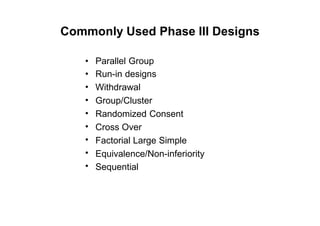
Commonly Used Phase III Designs
•
•
•
•
•
•
•
•
•
Parallel Group
Run-in designs
Withdrawal
Group/Cluster
Randomized Consent
Cross Over
Factorial Large Simple
Equivalence/Non-inferiority
Sequential
Phase IV trials
• Post-marketing surveillance studies
• Assess long-term toxic effects & risk-benefit ratio
• Optimize use of the drug / device / intervention
• Study specific patient population i.e children
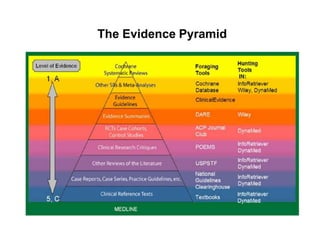
The Evidence Pyramid
• Levels of evidence: U.S. Preventive Services Task
Force (USPSTF)
• Level I: Evidence obtained from at least one properly
designed RCT
• Level II-1: Evidence obtained from well-designed controlled
trials without randomization
• Level II-2: Evidence obtained from well-designed cohort or
case control analytic studies, preferably from more than one
center or research group.
• Level II-3: Evidence obtained from multiple time series with
or without the intervention. Dramatic results in uncontrolled
trials might also be regarded as this type of evidence.
• Level III: Opinions of respected authorities, based on clinical
experience,descriptive studies, or reports of expert
committees.
Categories of recommendation:
• Level A: Good scientific evidence suggests that the benefits of the clinical
service substantially outweigh the potential risks. Clinicians should discuss the
service with eligible patients.
• Level B: At least fair scientific evidence suggests that the benefits of the
clinical service outweighs the potential risks. Clinicians should discuss the
service with eligible patients.
• Level C: At least fair scientific evidence suggests that there are benefits
provided by the clinical service, but the balance between benefits and risks are
too close for making general recommendations. Clinicians need not offer it
unless there are individual considerations.
• Level D: At least fair scientific evidence suggests that the risks of the clinical
service outweighs potential benefits. Clinicians should not routinely offer the
service to asymptomatic patients.
• Level I: Scientific evidence is lacking, of poor quality, or conflicting, such that
the risk versus benefit balance cannot be assessed. Clinicians should help
patients understand the uncertainty surrounding the clinical service.
NCCN Categories of Evidence and Consensus
•Category 1: Based upon high-level evidence, there is uniform NCCN consensus that the
intervention is appropriate.
•Category 2A: Based upon lower-level evidence, there is uniform NCCN consensus that the
intervention is appropriate.
•Category 2B: Based upon lower-level evidence, there is NCCN consensus that the
intervention is appropriate.
•Category 3: Based upon any level of evidence, there is major NCCN disagreement that the
intervention is appropriate.
All recommendations are category 2A unless otherwise indicated.
NCCN Categories of Preference
•Preferred intervention: Interventions that are based on superior efficacy, safety, and
evidence; and, when appropriate, affordability
•Other recommended intervention: Other interventions that may be somewhat less
efficacious, more toxic, or based on less mature data; or significantly less affordable for similar
outcomes
•Useful in certain circumstances: Other interventions that may be used for selected patient
populations (defined with recommendation)
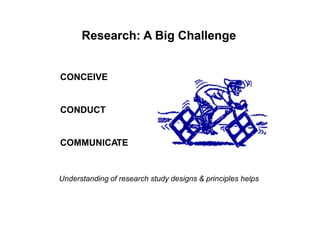
Research: A Big Challenge
CONCEIVE
CONDUCT
COMMUNICATE
Understanding of research study designs & principles helps

Chapter 34 medical stat

  • 1.
    CLINICAL STUDY DESIGNS: AnOverview DR NILESH
  • 2.
    Overview of thepresentation I. Introduction to clinical research II. Types of clinical studies III. Observational study designs IV. Experimental study designs
  • 3.
    Important issues inStudy Design • Validity: Truth – External Validity: • The study can be generalized to the population – Internal Validity: • Results are not due to chance, bias or confounders – Symmetry Principle: • Groups are similar
  • 4.
    Important issues inStudy Design • Confounding: distortion of the effect of one risk factor by the presence of another • Bias: Any effect from design, execution, & interpretation that shifts or influences results – Confounding bias: failure to account for the effect of one or more variables that are not distributed equally – Measurement bias: measurement methods differ between groups – Sampling (selection) bias: design & execution errors in sampling
  • 5.
    Classification of ResearchStudy Designs Observational studies Interventional studies 1. 2. 3. 4. 5. Case report/case-series Case-control studies Cross-sectional studies Prospective (cohort) Retrospective cohort 1. Controlled trials a) b) c) Parallel designs Sequential designs External controls 2. Studies with no controls
  • 6.
  • 7.
    Aims of observationalstudies • Evaluate the effect of a suspected risk factor on an outcome (e.g. disease) define 'exposure' and 'disease' (exposure) • Describe the impact of the risk factor on the frequency of disease in a population
  • 8.
    Characteristics of observationalstudies  No control over study units  Can study risk factors that have serious consequences  Study individuals in their natural environment  Possibility of confounding
  • 9.
    Cross-sectional study • Exposureand disease measured once, i.e. at the same point in time n exposed ? diseased ? presentpast future
  • 10.
    Cross-sectional study • Randomsample from population – i.e. results reflect reference population • Estimates the frequencies of both exposure outcome in the population and • Measures both exposure & outcome at one point in time • Typical example is a survey
  • 11.
    Cross-sectional study • Canstudy several exposure factors and outcomes simultaneously • Determines disease prevalence • Helpful in public health administration & planning • Quick and low cost (e.g. mail survey) • Limitations: – Does not determine causal relationship – Not appropriate if either exposure or outcome is rare
  • 12.
    Cohort studies • Follow-upstudies: subjects selected on presence or absence of exposure & absence of disease at one point in time. Disease is then assessed for all subjects at another point in time • Typically depending initiation & prospective but can be retrospective, on temporal relationship between study occurrence of disease
  • 13.
    Prospective Cohort Study withoutcome without outcome Exposed Cohort with outcome without outcome Time Unexposed Onset of study Direction of inquiry Q: What will happen?
  • 14.
    Cohort studies • Moreclearly established temporal sequence between exposure & disease • Allows direct measurement of incidence • Examines multiple effects of a single exposure (nurses’ health study, oral contraceptives & breast, ovarian cancers)
  • 15.
    Cohort studies • Limitations: –time consuming and expensive – loss to follow-up & unavailability of data – potential confounding factors – inefficient for rare diseases
  • 16.
    Case-Control Study • Retrospective –Can use hospital or health register data • First identify cases • Then identify suitable controls – Hardest part: who is suitable ?? • Then inquire or retrieve previous – By interview exposure – By databases (e.g. hospital, health insurance)
  • 17.
    Case-Control Study • Diseasedand non-diseased individuals are selected first • Then past exposure status is retrieved n exposed ? exposed ? past yes no disease present future
  • 18.
    Case-Control Study • Goodfor rare disease (e.g. cancer) • Can study many risk factors at the same time • Usually low cost (though not always) • Confounding likely • Measures Odds Ratio (not Relative Risk !!)
  • 19.
  • 20.
    Case Selection • • Define sourcepopulation Cases – incident/prevalent – diagnostic criteria (sensitivity Controls + specificity) • – selected from same population as cases – select independent of exposure status
  • 21.
    Control Selection • • Random selectionfrom source population Hospital based controls: – – convenient selection controls from variety of diagnostic groups other than case diagnosis avoid selection of diagnoses related to particular risk factors limit number of diagnoses in individuals – –
  • 22.
    Summary of ObservationalStudies Characteristic Cross- sectional Case-Control Cohort Sampling Random sample: population Purposive sample: diseased/non- diseased Purposive sample: Exposed/non- exposed Time One point Retrospective Prospective Causality Statistical association Screening for many risk factors Testing one (or few) risk factors Frequency measure Prevalence None Incidence Risk parameter Prevalence (risk) ratio, odds ratio Odds ratio Relative risk, odds ratio
  • 23.
    What is aclinical trial ? A clinical trial tests potential interventions in humans to determine if the and intervention represents adopted for an advance should be general use FDA 2003
  • 24.
    What do clinicaltrials test ? • • Clinical trials test research hypotheses Good clinical trials test specific research hypothesis • A clinical research hypothesis is a in carefully formulated assumption developed order to test its logical consequences
  • 25.
  • 26.
    What is aPhase I trial ? • • First evaluation of a new therapy in humans Classical Goals: Identify dose limiting toxicities (DLT) Identify maximum tolerated dose (MTD) Assess pharmacokinetics (PK) Assess pharmacodynamic (PD) endpoints
  • 27.
    Dose Limiting Toxicity(DLT) • Toxicity described by standardized grading criteria considered unacceptable because of severity or irreversibility • What is considered unacceptable varies from situation to situation DLT is specified for each trial protocol•
  • 28.
    Maximum Tolerated Dose(MTD) • Dose associated with unacceptable toxicity (DLT) in a pre-specified proportion of patients (sometimes defined inconsistently) Generally the dose at which ≥ 33% patients experience unacceptable toxicity (eg. DLT in ≥ 2 out of 6 pts) MTD: 1 dose level below DLT•
  • 29.
    Principles of PhaseI trial design • • Start with a safe starting dose Minimize number of patients treated at sub- therapeutic doses Escalate doses rapidly in absence of toxicity Escalate dose slowly in presence of toxicity • •
  • 30.
    Selection of startingdose Based on pre-clinical (animal) toxicity data 1/10th LD10 (0.1 MELD10) if mouse most sensitive species • 3rd1/ TDL (0.33 DETDL) if dog most sensitive species • Conservative dosing based on other studies if data suggest human tissues more sensitive and PK data show a steep dose/toxicity curve
  • 31.
    Classical Phase ITrial Design Conventional 3 + 3 design 3-6 pts per cohort Starting dose 0.1 MELD Dose escalation using modified Fibonacci series 100%-66%-50%-40%-33% MTD achieved Previous dose level is RPTD
  • 32.
    Problems with 3+ 3 design Empirical and traditional method Lacks solid statistical foundation May take too many or too few patients Takes a long time for dose escalation • • • • • Starting dose may significantly under or overestimate ‘safe’ dose • Early dose levels far away from optimal and/or therapeutic doses thus exposing substantial proportion of patients to low, suboptimal and ineffective doses
  • 34.
    Summary of phaseI trial designs • Phase I clinical trials drug development are the gateway for all new cancer • The traditional 3+3 design though safe, treats large numbers below therapeutic doses and takes a long time for escalation • Alternative phase I designs enable a higher proportion of patients to be treated at or near MTD, but at an increased risk of Grade 3-4 toxicities within a shortened time span
  • 35.
    What is aphase II trial ? Primary goal is to establish efficacy / activity "Proof-of-principle" for preliminary evidence of efficacy Generally relies on surrogate end-points Mostly single arm studies May be randomized ("pick-a-winner") Suggests further potential (for phase lll testing) Documents additional safety information
  • 36.
    Objectives of phaseII trials 1. To define antitumor activity 2. To further demonstrate safety 3. To gain new insights into the pharmacokinetics, pharmacodynamics & metabolism of drugs 4. To evaluate biologic correlates which may predict response or resistance to treatment and/or toxicity
  • 37.
    Phase II studydesigns • Frequentist • Bayesian – – – – – – – – Gehan 2-Stage Simon 2-Stage Optimal Simon 2-Stage Mini-max Fleming 1-stage Gehan-Simon 3-Stage Randomized Phase 2 Constant Arc-Sine Randomized Discontinuation – – – Thall-Simon-Estey 1-Stage Bayesian 2-Stage Bayesian • Tan Machin • Heitjan • • Adaptive Multiple Outcomes
  • 38.
    Summary of PhaseII studies • Phase ll trials are exploratory studies and rarely are definitive • Efficient to exclude inactive therapies • Results must be interpreted cautiously, in the the availability of other therapies context of • Estimate clinical activity and provide further safety information – important in the "go/no go" decision • Require confirmation in pivotal phase lll trials
  • 40.
    What is aphase III trial ? Comparative Trials with or without controls Primary goal is to establish actual clinical value Survival (OAS, EFS,PFS) are primary endpoints Compares new treatment to current standard of care Randomized (with allocation concealment) to minimize bias May be sometimes placebo controlled and even blinded
  • 41.
    Phase III StudyDesigns • • • Comparative Studies Experimental Group vs Establishing a Control Control Group 1. 2. 3. Historical Concurrent Randomized • Randomized Control Trial standard – Eliminates several sources (RCT) is the gold of bias
  • 42.
    Why Control Group •To allow discrimination of patient outcomes caused by experimental intervention from those caused by other factors – Natural progression of disease – Observer/patient expectations – Other treatment • Fair comparisons – Necessary to be informative
  • 43.
    Type of Controls •External – Historical – Concurrent, not randomized lnternal and concurrent• – – – – No treatment Placebo Dose-response Active (Positive) control • Multiple – Both an Active and Placebo – Multiple doses of test drug and of an active control
  • 44.
    Randomized Control Trial •Patients assigned at random to either standard arm (control arm) or treatment arm (experimental) arm • Equal chance of getting randomized to either randomization arm in 1:1 • Neither patient nor physician can influence this chance • Eliminates several known & unknown biases • Considered to be “Gold Standard”
  • 45.
    Comparing Treatments Fundamental principle• •Groups must be alike in all important aspects and only differ in the treatment each group receives • ln practical terms, "comparable treatment groups" means "alike on the average" • Randomization • Each patient has the same chance of receiving any of the treatments under study • Allocation of treatments to participants is carried out using a chance mechanism so that neither the patient nor the physician know in advance which therapy will be assigned • Blinding • • Avoidance of psychological influence Fair evaluation of outcomes
  • 46.
    Commonly Used PhaseIII Designs • • • • • • • • • Parallel Group Run-in designs Withdrawal Group/Cluster Randomized Consent Cross Over Factorial Large Simple Equivalence/Non-inferiority Sequential
  • 48.
    Phase IV trials •Post-marketing surveillance studies • Assess long-term toxic effects & risk-benefit ratio • Optimize use of the drug / device / intervention • Study specific patient population i.e children
  • 49.
  • 50.
    • Levels ofevidence: U.S. Preventive Services Task Force (USPSTF) • Level I: Evidence obtained from at least one properly designed RCT • Level II-1: Evidence obtained from well-designed controlled trials without randomization • Level II-2: Evidence obtained from well-designed cohort or case control analytic studies, preferably from more than one center or research group. • Level II-3: Evidence obtained from multiple time series with or without the intervention. Dramatic results in uncontrolled trials might also be regarded as this type of evidence. • Level III: Opinions of respected authorities, based on clinical experience,descriptive studies, or reports of expert committees.
  • 51.
    Categories of recommendation: •Level A: Good scientific evidence suggests that the benefits of the clinical service substantially outweigh the potential risks. Clinicians should discuss the service with eligible patients. • Level B: At least fair scientific evidence suggests that the benefits of the clinical service outweighs the potential risks. Clinicians should discuss the service with eligible patients. • Level C: At least fair scientific evidence suggests that there are benefits provided by the clinical service, but the balance between benefits and risks are too close for making general recommendations. Clinicians need not offer it unless there are individual considerations. • Level D: At least fair scientific evidence suggests that the risks of the clinical service outweighs potential benefits. Clinicians should not routinely offer the service to asymptomatic patients. • Level I: Scientific evidence is lacking, of poor quality, or conflicting, such that the risk versus benefit balance cannot be assessed. Clinicians should help patients understand the uncertainty surrounding the clinical service.
  • 52.
    NCCN Categories ofEvidence and Consensus •Category 1: Based upon high-level evidence, there is uniform NCCN consensus that the intervention is appropriate. •Category 2A: Based upon lower-level evidence, there is uniform NCCN consensus that the intervention is appropriate. •Category 2B: Based upon lower-level evidence, there is NCCN consensus that the intervention is appropriate. •Category 3: Based upon any level of evidence, there is major NCCN disagreement that the intervention is appropriate. All recommendations are category 2A unless otherwise indicated. NCCN Categories of Preference •Preferred intervention: Interventions that are based on superior efficacy, safety, and evidence; and, when appropriate, affordability •Other recommended intervention: Other interventions that may be somewhat less efficacious, more toxic, or based on less mature data; or significantly less affordable for similar outcomes •Useful in certain circumstances: Other interventions that may be used for selected patient populations (defined with recommendation)
  • 54.
    Research: A BigChallenge CONCEIVE CONDUCT COMMUNICATE Understanding of research study designs & principles helps