Management of Febrile Neutropenia
INTRODUCTION —
 Cancer patients receiving cytotoxic antineoplastic therapy sufficient to adversely affect
myelopoiesis .
 Integrity of the GI mucosa are at risk for invasive infection due to colonizing bacteria or fungi that
translocate across intestinal mucosal surfaces.
 Patients with profound prolonged neutropenia are at particularly high risk for serious
infections.
 Profound prolonged neutropenia is most likely to occur in the :
- pre-engraftment phase of BMT
- patients undergoing induction chemotherapy for acute leukemias.
 Because neutropenic patients are unable to mount robust inflammatory
responses, serious infection can occur with minimal symptoms and signs.
 In such patients, fever is often the only sign of infection.
 Infections in neutropenic patients can progress rapidly, leading to
hypotension and/or other life-threatening complications.
 It is critical to recognize neutropenic fever early and to initiate empiric
systemic antibacterial therapy promptly in order to avoid progression to a
sepsis syndrome and possibly death.
Important points
GUIDELINES —
 Guidelines have been developed for the management of fever in
neutropenic patients with cancer
 The recommendations discussed today are generally in keeping
with the 2010 Infectious Diseases Society of America guidelines .
DEFINITIONS
 Fever —
Fever in neutropenic patients is defined as a single oral temperature of
>38.3°C (101°F) or a temperature of >38.0°C (100.4°F) sustained for >1
hour .
 Neutropenia —
an ANC <500 cells/microL.
RISK OF SERIOUS COMPLICATIONS
 The initial clinical evaluation focuses on assessing the risk of serious
complications.
 This risk assessment dictates the approach to therapy, including the need for
inpatient admission, I.V. antibiotics, and prolonged hospitalization .
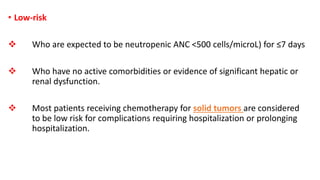
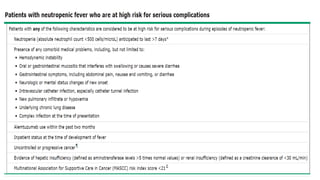
• Low-risk
 Who are expected to be neutropenic ANC <500 cells/microL) for ≤7 days
 Who have no active comorbidities or evidence of significant hepatic or
renal dysfunction.
 Most patients receiving chemotherapy for solid tumors are considered
to be low risk for complications requiring hospitalization or prolonging
hospitalization.
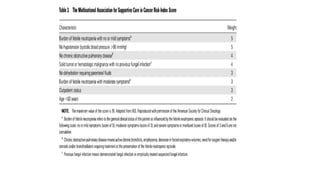
An alternative to using the clinical criteria described above is to use the
Multinational Association for Supportive Care in Cancer (MASCC) risk
index, which is a validated tool for measuring the risk for neutropenic
fever-related medical complications
INITIAL ASSESSMENT —
 In patients presenting with neutropenic fever, a reliable method
for obtaining body temperature must be used,
 and a mechanism for estimating the ANC is mandatory.
 The temperature should always be taken using oral
Identification of sepsis -
 Although the signs and symptoms of infection may be significantly muted in
neutropenic patients , an early part of the clinical assessment at triage should
include an examination for evidence of sepsis, severe sepsis, or septic shock
 Patients presenting with evidence of new organ dysfunction (altered mental
status, hypotension, or hypoxia) should be managed emergently for severe
sepsis.
 Patients with septic shock should be managed in a critical care hospital
environment.
• Febrile neutropenic patients should be monitored frequently with respect to:
- Vital signs (blood pressure, heart rate, respiratory rate, and temperature),
- Performance status (the clinical burden of the neutropenic fever syndrome),
- Ability to achieve adequate oral intake in the presence of oral or
gastrointestinal mucositis.
 Attention to fluid and electrolyte management is important given the
dehydrating effects of fever, vomiting, and/or diarrhea.
 Urine output of >0.5 mL/kg per hour should be maintained.
 Afebrile neutropenic patients with new signs or symptoms that are
consistent with infection should be evaluated and managed as if they are
febrile .
EMPIRIC THERAPY
• General principles —
 Fever in a neutropenic patient should be considered a medical emergency.
 Broad-spectrum antibacterials should be given as soon as possible (within 60 minutes of
triage)
 Antibiotic should be started at full doses, adjust doses for renal and/or hepatic function.
 The aim of empiric therapy is to cover the most likely and most virulent pathogens that may
rapidly cause serious or life-threatening infection in neutropenic patients .
 Initial antibiotic selection should be guided by the patient's history, allergies, symptoms,
signs, recent antibiotic use and culture data.
Timing of antibiotics —
 In all febrile neutropenic patients, empiric broad-spectrum
antibacterial therapy should be initiated immediately after blood
cultures have been obtained and before any other investigations
have been completed .
 Antimicrobial therapy should be administered within 60
minutes of presentation .
Spectrum of coverage —
 It is important to cover broadly for gram-negative pathogens because of their
virulence and association with sepsis
 Gram-negative organisms continue to cause the majority of infections in sites
outside of the bloodstream (eg., respiratory tract, biliary tract, gastrointestinal
tract, urinary tract, and skin).
 Clinicians need to be aware of the current microbiology surveillance data from
their own institution, which can vary widely from center to center and over
time.
 Anerobic and fungal infection coverage should be limited to specific conditions.
Initial regimen —
• The choice of antibiotics is driven by multiple factors :
- Degree of immunocompromise,
- prior antibiotic
- infection history
- local patterns of antibiotic resistance, and
- whether an agent is bactericidal or not .
Initial regimen —
 Some drugs, such as beta-lactams, exhibit time-dependent
killing.
 When using beta-lactams, correct dosing intervals should be
used to ensure that drug concentrations are greater than the
MIC for the pathogen.
 Other antibiotics, such as aminoglycosides and fluoroquinolones,
exhibit concentration-dependent killing and are important in the
treatment of gram-negative sepsis.
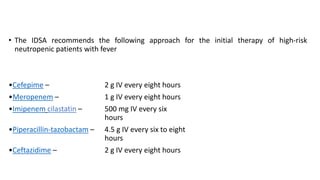
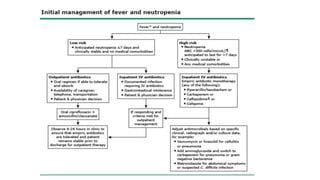
• The IDSA recommends the following approach for the initial therapy of high-risk
neutropenic patients with fever
•Cefepime – 2 g IV every eight hours
•Meropenem – 1 g IV every eight hours
•Imipenem cilastatin – 500 mg IV every six
hours
•Piperacillin-tazobactam – 4.5 g IV every six to eight
hours
•Ceftazidime – 2 g IV every eight hours
 Aminoglycosides may be added to the initial regimen in patients with
complicated presentations :
 Hypotension
 Mental status changes
 Focal findings (eg, pneumonia or cellulitis),
 or if antimicrobial resistance is suspected or proven.
Vancomycin is not recommended as a standard part of the initial regimen
 Anaerobic coverage is suggested to be included if there is evidence
of:
 necrotizing mucositis,
 sinusitis
 periodontal cellulitis
 perirectal cellulitis
 intraabdominal infection
 (including neutropenic enterocolitis [typhlitis]),
 pelvic infection,
 anaerobic bacteremia.
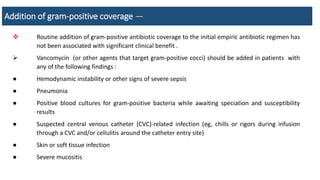
Addition of gram-positive coverage —
 Routine addition of gram-positive antibiotic coverage to the initial empiric antibiotic regimen has
not been associated with significant clinical benefit .
 Vancomycin (or other agents that target gram-positive cocci) should be added in patients with
any of the following findings :
● Hemodynamic instability or other signs of severe sepsis
● Pneumonia
● Positive blood cultures for gram-positive bacteria while awaiting speciation and susceptibility
results
● Suspected central venous catheter (CVC)-related infection (eg, chills or rigors during infusion
through a CVC and/or cellulitis around the catheter entry site)
● Skin or soft tissue infection
● Severe mucositis
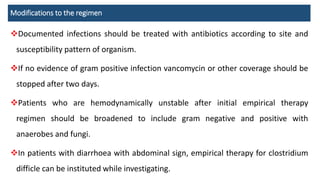
Modifications to the regimen
Documented infections should be treated with antibiotics according to site and
susceptibility pattern of organism.
If no evidence of gram positive infection vancomycin or other coverage should be
stopped after two days.
Patients who are hemodynamically unstable after initial empirical therapy
regimen should be broadened to include gram negative and positive with
anaerobes and fungi.
In patients with diarrhoea with abdominal sign, empirical therapy for clostridium
difficle can be instituted while investigating.
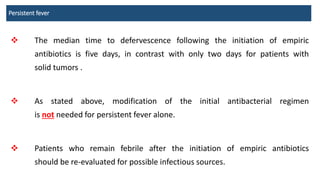
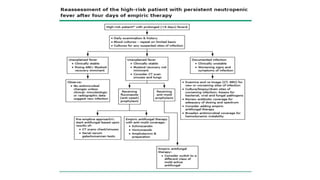
Persistent fever
 The median time to defervescence following the initiation of empiric
antibiotics is five days, in contrast with only two days for patients with
solid tumors .
 As stated above, modification of the initial antibacterial regimen
is not needed for persistent fever alone.
 Patients who remain febrile after the initiation of empiric antibiotics
should be re-evaluated for possible infectious sources.
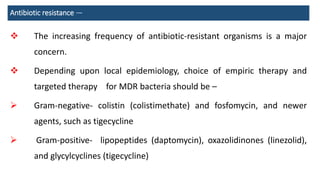
Antibiotic resistance —
 The increasing frequency of antibiotic-resistant organisms is a major
concern.
 Depending upon local epidemiology, choice of empiric therapy and
targeted therapy for MDR bacteria should be –
 Gram-negative- colistin (colistimethate) and fosfomycin, and newer
agents, such as tigecycline
 Gram-positive- lipopeptides (daptomycin), oxazolidinones (linezolid),
and glycylcyclines (tigecycline)
• Addition of an antifungal agent
Indications —
 An empiric antifungal agent should be added after four to seven days in high- risk
neutropenic patients who are expected to have a total duration of neutropenia >7
days who have persistent or recurrent fever and in whom reassessment does not
yield a cause.
 In these patients the incidence of fungal infection (especially those caused
by Candida or Aspergillus) rises.
 In patients who are clinically unstable or have a suspected fungal infection,
antifungal therapy should be considered even earlier.
Choice of anti-fungal drug —
 The choice of agent for empiric antifungal therapy depends upon which fungi
are most likely to becausing infection as well as the toxicity profiles and cost .
 In patients who have not been receiving antifungal prophylaxis, Candida spp
are the most likely cause of invasive fungal infection.
 In patients receiving fluconazole prophylaxis, fluconazole- resistant Candida spp
(eg, C. glabrata and C. Krusei) and invasive mold infections,
particularly Aspergillus spp, are the most likely causes.
Following approach is favoured:
 For persistently febrile patients who have not been receiving antifungal prophylaxis
and who have no obvious site of infection, such as pulmonary nodules,
caspofungin is suggested
 For persistently febrile patients with pulmonary nodules or nodular pulmonary
infiltrates, invasive mold infection should be strongly suspected and treated.
 Prompt assessment frequently requires bronchoscopy with bronchoalveolar lavage
with cultures, stains, and Aspergillus galactomannan antigen testing to distinguish
bacterial from mold pathogens.
 Voriconazole or a lipid formulation of amphotericin B are preferred in patients with
pulmonary findings suggestive of an invasive mold aspergillosis, which is the
most common cause of mold infections .
 For persistently febrile patients who have been receiving anti-mold
prophylaxis, a different class of antifungal agent with activity against
molds should be used for empiric therapy.
 For example, if voriconazole or posaconazole has been used for
prophylaxis, an amphotericin B formulation should be used.
 A lipid formulation of amphotericin B rather than amphotericin B
deoxycholate is suggested in order to minimize toxicity.
• Dosing — The dosing of the various antifungal agents recommended above
is as follows:
• Caspofungin – Loading dose of 70 mg IV on day 1, then 50 mg IV
once daily
• Voriconazole – Loading dose of 6 mg/kg IV every 12 hours on day
1, followed by 4 mg/kg IV every 12 hours
• Amphotericin B lipid complex – 5 mg/kg IV once daily
• Liposomal amphotericin B – 3 to 5 mg/kg IV once daily
Preemptive antifungal therapy —
 An alternative to empiric antifungal therapy is preemptive therapy (or
biomarker-driven therapy).
 This involves serial screening of high-risk patients for markers of fungal
colonization and/or infection in an attempt to prevent invasive infection.
 Such markers include laboratory tests (eg, Aspergillus galactomannan antigen, beta-
D- glucan assay) and imaging tests (HRCT chest).
 If one of these markers suggests a fungal infection, antifungal therapy is started.
 It is best suited for patient receiving prophylaxis for fungal infection as chance of
mold (aspergillosis) are more
• Duration —
 If an infectious source of fever is identified, antibiotics should be continued for at least the
standard duration indicated for the specific infection, maybe switched to oral therapy.
 Antibiotics should also continue at least until the ANC is ≥500 cells/microL or longer if
clinically indicated .
 When no source is identified and cultures are negative, the timing of discontinuation of
antibiotics is usually dependent on resolution of fever and clear evidence of bone marrow
recovery.
 If the patient has been afebrile for at least two days and the ANC is >500 cells/microL and is
showing a consistent increasing trend, antibiotics may be stopped .
• CATHETER REMOVAL —
• CVC removal is recommended for patients with catheter-related bloodstream
infections in which any of the following organisms is implicated :
●S. aureus
●P. aeruginosa
●Candida species
●Other fungi
●Rapidly growing nontuberculous mycobacteria
• Although the Infectious Diseases Society of America guidelines
recommend CVC removal in patients with candidemia, some authors
have suggested that catheter removal may not be necessary in
neutropenic patients with candidemia in whom the source is often
the gastrointestinal tract rather than the CVC.
COLONY STIMULATING FACTORS
 Colony stimulating factors are not recommended for routine use in
patients with established fever and neutropenia.
 TheIDSA guidelines recommend against their use for all patients with
established fever and neutropenia, whereas the American Society of
Clinical Oncology guidelines state that their use can be "considered" for
patients at high risk for infection- associated complications or who have
prognostic factors that are predictive of a poor clinical outcome.
 As the available data do not show a clear benefit, we can agree with the
IDSA guidelines and do not use CSFs in patients with established fever and
neutropenia.
Chapter 30 febrile neutropenia

Chapter 30 febrile neutropenia

  • 1.
  • 2.
    INTRODUCTION —  Cancerpatients receiving cytotoxic antineoplastic therapy sufficient to adversely affect myelopoiesis .  Integrity of the GI mucosa are at risk for invasive infection due to colonizing bacteria or fungi that translocate across intestinal mucosal surfaces.  Patients with profound prolonged neutropenia are at particularly high risk for serious infections.  Profound prolonged neutropenia is most likely to occur in the : - pre-engraftment phase of BMT - patients undergoing induction chemotherapy for acute leukemias.
  • 3.
     Because neutropenicpatients are unable to mount robust inflammatory responses, serious infection can occur with minimal symptoms and signs.  In such patients, fever is often the only sign of infection.  Infections in neutropenic patients can progress rapidly, leading to hypotension and/or other life-threatening complications.  It is critical to recognize neutropenic fever early and to initiate empiric systemic antibacterial therapy promptly in order to avoid progression to a sepsis syndrome and possibly death. Important points
  • 4.
    GUIDELINES —  Guidelineshave been developed for the management of fever in neutropenic patients with cancer  The recommendations discussed today are generally in keeping with the 2010 Infectious Diseases Society of America guidelines .
  • 5.
    DEFINITIONS  Fever — Feverin neutropenic patients is defined as a single oral temperature of >38.3°C (101°F) or a temperature of >38.0°C (100.4°F) sustained for >1 hour .  Neutropenia — an ANC <500 cells/microL.
  • 6.
    RISK OF SERIOUSCOMPLICATIONS  The initial clinical evaluation focuses on assessing the risk of serious complications.  This risk assessment dictates the approach to therapy, including the need for inpatient admission, I.V. antibiotics, and prolonged hospitalization .
  • 7.
    • Low-risk  Whoare expected to be neutropenic ANC <500 cells/microL) for ≤7 days  Who have no active comorbidities or evidence of significant hepatic or renal dysfunction.  Most patients receiving chemotherapy for solid tumors are considered to be low risk for complications requiring hospitalization or prolonging hospitalization.
  • 9.
    An alternative tousing the clinical criteria described above is to use the Multinational Association for Supportive Care in Cancer (MASCC) risk index, which is a validated tool for measuring the risk for neutropenic fever-related medical complications
  • 11.
    INITIAL ASSESSMENT — In patients presenting with neutropenic fever, a reliable method for obtaining body temperature must be used,  and a mechanism for estimating the ANC is mandatory.  The temperature should always be taken using oral
  • 12.
    Identification of sepsis-  Although the signs and symptoms of infection may be significantly muted in neutropenic patients , an early part of the clinical assessment at triage should include an examination for evidence of sepsis, severe sepsis, or septic shock  Patients presenting with evidence of new organ dysfunction (altered mental status, hypotension, or hypoxia) should be managed emergently for severe sepsis.  Patients with septic shock should be managed in a critical care hospital environment.
  • 14.
    • Febrile neutropenicpatients should be monitored frequently with respect to: - Vital signs (blood pressure, heart rate, respiratory rate, and temperature), - Performance status (the clinical burden of the neutropenic fever syndrome), - Ability to achieve adequate oral intake in the presence of oral or gastrointestinal mucositis.  Attention to fluid and electrolyte management is important given the dehydrating effects of fever, vomiting, and/or diarrhea.  Urine output of >0.5 mL/kg per hour should be maintained.  Afebrile neutropenic patients with new signs or symptoms that are consistent with infection should be evaluated and managed as if they are febrile .
  • 15.
    EMPIRIC THERAPY • Generalprinciples —  Fever in a neutropenic patient should be considered a medical emergency.  Broad-spectrum antibacterials should be given as soon as possible (within 60 minutes of triage)  Antibiotic should be started at full doses, adjust doses for renal and/or hepatic function.  The aim of empiric therapy is to cover the most likely and most virulent pathogens that may rapidly cause serious or life-threatening infection in neutropenic patients .  Initial antibiotic selection should be guided by the patient's history, allergies, symptoms, signs, recent antibiotic use and culture data.
  • 16.
    Timing of antibiotics—  In all febrile neutropenic patients, empiric broad-spectrum antibacterial therapy should be initiated immediately after blood cultures have been obtained and before any other investigations have been completed .  Antimicrobial therapy should be administered within 60 minutes of presentation .
  • 17.
    Spectrum of coverage—  It is important to cover broadly for gram-negative pathogens because of their virulence and association with sepsis  Gram-negative organisms continue to cause the majority of infections in sites outside of the bloodstream (eg., respiratory tract, biliary tract, gastrointestinal tract, urinary tract, and skin).  Clinicians need to be aware of the current microbiology surveillance data from their own institution, which can vary widely from center to center and over time.  Anerobic and fungal infection coverage should be limited to specific conditions.
  • 18.
    Initial regimen — •The choice of antibiotics is driven by multiple factors : - Degree of immunocompromise, - prior antibiotic - infection history - local patterns of antibiotic resistance, and - whether an agent is bactericidal or not .
  • 19.
    Initial regimen — Some drugs, such as beta-lactams, exhibit time-dependent killing.  When using beta-lactams, correct dosing intervals should be used to ensure that drug concentrations are greater than the MIC for the pathogen.  Other antibiotics, such as aminoglycosides and fluoroquinolones, exhibit concentration-dependent killing and are important in the treatment of gram-negative sepsis.
  • 20.
    • The IDSArecommends the following approach for the initial therapy of high-risk neutropenic patients with fever •Cefepime – 2 g IV every eight hours •Meropenem – 1 g IV every eight hours •Imipenem cilastatin – 500 mg IV every six hours •Piperacillin-tazobactam – 4.5 g IV every six to eight hours •Ceftazidime – 2 g IV every eight hours
  • 21.
     Aminoglycosides maybe added to the initial regimen in patients with complicated presentations :  Hypotension  Mental status changes  Focal findings (eg, pneumonia or cellulitis),  or if antimicrobial resistance is suspected or proven. Vancomycin is not recommended as a standard part of the initial regimen
  • 22.
     Anaerobic coverageis suggested to be included if there is evidence of:  necrotizing mucositis,  sinusitis  periodontal cellulitis  perirectal cellulitis  intraabdominal infection  (including neutropenic enterocolitis [typhlitis]),  pelvic infection,  anaerobic bacteremia.
  • 23.
    Addition of gram-positivecoverage —  Routine addition of gram-positive antibiotic coverage to the initial empiric antibiotic regimen has not been associated with significant clinical benefit .  Vancomycin (or other agents that target gram-positive cocci) should be added in patients with any of the following findings : ● Hemodynamic instability or other signs of severe sepsis ● Pneumonia ● Positive blood cultures for gram-positive bacteria while awaiting speciation and susceptibility results ● Suspected central venous catheter (CVC)-related infection (eg, chills or rigors during infusion through a CVC and/or cellulitis around the catheter entry site) ● Skin or soft tissue infection ● Severe mucositis
  • 24.
    Modifications to theregimen Documented infections should be treated with antibiotics according to site and susceptibility pattern of organism. If no evidence of gram positive infection vancomycin or other coverage should be stopped after two days. Patients who are hemodynamically unstable after initial empirical therapy regimen should be broadened to include gram negative and positive with anaerobes and fungi. In patients with diarrhoea with abdominal sign, empirical therapy for clostridium difficle can be instituted while investigating.
  • 25.
    Persistent fever  Themedian time to defervescence following the initiation of empiric antibiotics is five days, in contrast with only two days for patients with solid tumors .  As stated above, modification of the initial antibacterial regimen is not needed for persistent fever alone.  Patients who remain febrile after the initiation of empiric antibiotics should be re-evaluated for possible infectious sources.
  • 26.
    Antibiotic resistance — The increasing frequency of antibiotic-resistant organisms is a major concern.  Depending upon local epidemiology, choice of empiric therapy and targeted therapy for MDR bacteria should be –  Gram-negative- colistin (colistimethate) and fosfomycin, and newer agents, such as tigecycline  Gram-positive- lipopeptides (daptomycin), oxazolidinones (linezolid), and glycylcyclines (tigecycline)
  • 27.
    • Addition ofan antifungal agent
  • 28.
    Indications —  Anempiric antifungal agent should be added after four to seven days in high- risk neutropenic patients who are expected to have a total duration of neutropenia >7 days who have persistent or recurrent fever and in whom reassessment does not yield a cause.  In these patients the incidence of fungal infection (especially those caused by Candida or Aspergillus) rises.  In patients who are clinically unstable or have a suspected fungal infection, antifungal therapy should be considered even earlier.
  • 29.
    Choice of anti-fungaldrug —  The choice of agent for empiric antifungal therapy depends upon which fungi are most likely to becausing infection as well as the toxicity profiles and cost .  In patients who have not been receiving antifungal prophylaxis, Candida spp are the most likely cause of invasive fungal infection.  In patients receiving fluconazole prophylaxis, fluconazole- resistant Candida spp (eg, C. glabrata and C. Krusei) and invasive mold infections, particularly Aspergillus spp, are the most likely causes.
  • 30.
    Following approach isfavoured:  For persistently febrile patients who have not been receiving antifungal prophylaxis and who have no obvious site of infection, such as pulmonary nodules, caspofungin is suggested  For persistently febrile patients with pulmonary nodules or nodular pulmonary infiltrates, invasive mold infection should be strongly suspected and treated.  Prompt assessment frequently requires bronchoscopy with bronchoalveolar lavage with cultures, stains, and Aspergillus galactomannan antigen testing to distinguish bacterial from mold pathogens.  Voriconazole or a lipid formulation of amphotericin B are preferred in patients with pulmonary findings suggestive of an invasive mold aspergillosis, which is the most common cause of mold infections .
  • 31.
     For persistentlyfebrile patients who have been receiving anti-mold prophylaxis, a different class of antifungal agent with activity against molds should be used for empiric therapy.  For example, if voriconazole or posaconazole has been used for prophylaxis, an amphotericin B formulation should be used.  A lipid formulation of amphotericin B rather than amphotericin B deoxycholate is suggested in order to minimize toxicity.
  • 32.
    • Dosing —The dosing of the various antifungal agents recommended above is as follows: • Caspofungin – Loading dose of 70 mg IV on day 1, then 50 mg IV once daily • Voriconazole – Loading dose of 6 mg/kg IV every 12 hours on day 1, followed by 4 mg/kg IV every 12 hours • Amphotericin B lipid complex – 5 mg/kg IV once daily • Liposomal amphotericin B – 3 to 5 mg/kg IV once daily
  • 33.
    Preemptive antifungal therapy—  An alternative to empiric antifungal therapy is preemptive therapy (or biomarker-driven therapy).  This involves serial screening of high-risk patients for markers of fungal colonization and/or infection in an attempt to prevent invasive infection.  Such markers include laboratory tests (eg, Aspergillus galactomannan antigen, beta- D- glucan assay) and imaging tests (HRCT chest).  If one of these markers suggests a fungal infection, antifungal therapy is started.  It is best suited for patient receiving prophylaxis for fungal infection as chance of mold (aspergillosis) are more
  • 34.
    • Duration — If an infectious source of fever is identified, antibiotics should be continued for at least the standard duration indicated for the specific infection, maybe switched to oral therapy.  Antibiotics should also continue at least until the ANC is ≥500 cells/microL or longer if clinically indicated .  When no source is identified and cultures are negative, the timing of discontinuation of antibiotics is usually dependent on resolution of fever and clear evidence of bone marrow recovery.  If the patient has been afebrile for at least two days and the ANC is >500 cells/microL and is showing a consistent increasing trend, antibiotics may be stopped .
  • 35.
    • CATHETER REMOVAL— • CVC removal is recommended for patients with catheter-related bloodstream infections in which any of the following organisms is implicated : ●S. aureus ●P. aeruginosa ●Candida species ●Other fungi ●Rapidly growing nontuberculous mycobacteria
  • 36.
    • Although theInfectious Diseases Society of America guidelines recommend CVC removal in patients with candidemia, some authors have suggested that catheter removal may not be necessary in neutropenic patients with candidemia in whom the source is often the gastrointestinal tract rather than the CVC.
  • 37.
    COLONY STIMULATING FACTORS Colony stimulating factors are not recommended for routine use in patients with established fever and neutropenia.  TheIDSA guidelines recommend against their use for all patients with established fever and neutropenia, whereas the American Society of Clinical Oncology guidelines state that their use can be "considered" for patients at high risk for infection- associated complications or who have prognostic factors that are predictive of a poor clinical outcome.  As the available data do not show a clear benefit, we can agree with the IDSA guidelines and do not use CSFs in patients with established fever and neutropenia.