Downloaded 463 times


![clinicaloptions.com/oncology
Immune Checkpoint Inhibitors
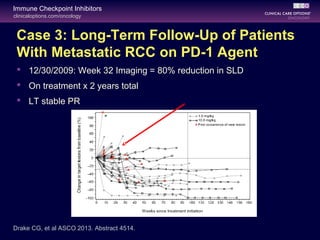
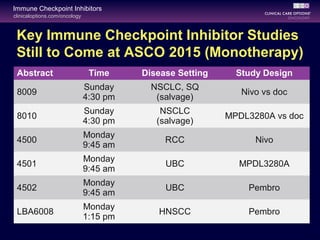
Pts at Risk, n
Ipilimumab 1861 839 370 254 192 170 120 26 15 5 0
ProportionAlive
0
0.2
0.4
0.6
0.8
1.0
Mos
0 12 24 36 48 60 72 84 96 108 120
Median OS: 11.4 mos (95% CI: 10.7-12.1)
Ipilimumab
Censored
Hodi S, et al. 2013 European Cancer Congress. Abstract LBA 24.
Schadendorf D, et al. J Clin Oncol. 2015;[Epub ahead of print].
Ipilimumab: Pooled Survival Analysis From
Phase II/III Trials in Advanced Melanoma
3-yr OS rate: 22% (95% CI: 20-24)](https://image.slidesharecdn.com/ccoimmunecheckpointinhibitorsincancercaredownloadable-150622043412-lva1-app6891/85/CCO-immune-checkpoint_inhibitors_in_cancer_care-9-320.jpg)
![clinicaloptions.com/oncology
Immune Checkpoint Inhibitors
100
80
60
40
20
0
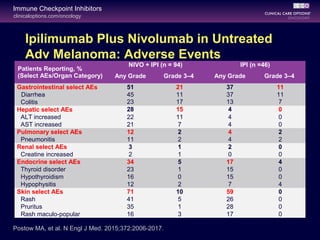
CheckMate 066 and KEYNOTE 006: OS
1. Robert C, et al. N Engl J Med. 2015;372:320-330. 2. Robert C, et al. N Engl J Med. 2015;[Epub ahead
of print].
OS(%)
0 3 6 9 12 15 18
Mos
HR for death: 0.42 (99.79%
CI: 0.25-0.73; P < .001)
Nivolumab
Dacarbazine
Not reached
10.8 mos (9.3-12.1)
mOS (95% CI)
Dacarbazine
Nivolumab
Nivolumab vs DTIC in BRAF-
negative, previously untreated
melanoma[1]
Pembrolizumab vs Ipilimumab in
Advanced Melanoma[2]
100
80
60
40
20
0
OS(%)
2 4
Mos
Ipilimumab
Pembrolizumab q2w
Pembrolizumab q3w
0 8 106 14 1612 18](https://image.slidesharecdn.com/ccoimmunecheckpointinhibitorsincancercaredownloadable-150622043412-lva1-app6891/85/CCO-immune-checkpoint_inhibitors_in_cancer_care-11-320.jpg)
![clinicaloptions.com/oncology
Immune Checkpoint Inhibitors
Pembrolizumab Antitumor Activity
1. Robert C, et al. Lancet. 2014;384:1109-1117. 2. Garon EB, et al. ESMO 2014. LBA43. 3. Chow LQ, et al. ESMO 2014.
LBA31. 4. O’Donnell P, et al. ASCO GU 2015. Abstract 296. 5. Muro K, et al. ASCO GI 2015. Abstract 03. 6. Nanda R, et
al. SABCS 2014. Abstract S1-09. 7. Moskowitz C, et al. ASH 2014. Abstract 290.
100
80
60
40
20
0
-20
-40
-60
-80
-100
ChangeFromBaseline
inSumofLargestDiameter
ofTargetLesions(%)
Melanoma[1]
(N = 411)
KEYNOTE-001
100
80
60
40
20
0
-20
-40
-60
-80
-100
NSCLC[2]
(N = 262)
KEYNOTE-001
100
80
60
40
20
0
-20
-40
-60
-80
-100
HNSCC[3]
(N = 61)
KEYNOTE-012
100
80
60
40
20
0
-20
-40
-60
-80
-100
ChangeFromBaseline
inSumofLargestDiameter
ofTargetLesions(%)
Urothelial Cancer[4]
(N = 33)
KEYNOTE-012
100
80
60
40
20
0
-20
-40
-60
-80
-100
Gastric Cancer[5]
(N = 39)
KEYNOTE-012
100
80
60
40
20
0
-20
-40
-60
-80
-100
TNBC[6]
(N = 32)
KEYNOTE-012 100
80
60
40
20
0
-20
-40
-60
-80
-100
cHL[7]
(N = 29)
KEYNOTE-013](https://image.slidesharecdn.com/ccoimmunecheckpointinhibitorsincancercaredownloadable-150622043412-lva1-app6891/85/CCO-immune-checkpoint_inhibitors_in_cancer_care-24-320.jpg)
![clinicaloptions.com/oncology
Immune Checkpoint Inhibitors
Pembrolizumab Antitumor Activity
1. Robert C, et al. Lancet. 2014;384:1109-1117. 2. Garon EB, et al. ESMO 2014. LBA43. 3. Chow LQ, et al. ESMO 2014.
LBA31. 4. O’Donnell P, et al. ASCO GU 2015. Abstract 296. 5. Muro K, et al. ASCO GI 2015. Abstract 03. 6. Nanda R, et
al. SABCS 2014. Abstract S1-09. 7. Moskowitz C, et al. ASH 2014. Abstract 290.
100
80
60
40
20
0
-20
-40
-60
-80
-100
ChangeFromBaseline
inSumofLargestDiameter
ofTargetLesions(%)
Melanoma[1]
(N = 411)
KEYNOTE-001
100
80
60
40
20
0
-20
-40
-60
-80
-100
NSCLC[2]
(N = 262)
KEYNOTE-001
100
80
60
40
20
0
-20
-40
-60
-80
-100
HNSCC[3]
(N = 61)
KEYNOTE-012
100
80
60
40
20
0
-20
-40
-60
-80
-100
ChangeFromBaseline
inSumofLargestDiameter
ofTargetLesions(%)
Urothelial Cancer[4]
(N = 33)
KEYNOTE-012
100
80
60
40
20
0
-20
-40
-60
-80
-100
Gastric Cancer[5]
(N = 39)
KEYNOTE-012
100
80
60
40
20
0
-20
-40
-60
-80
-100
TNBC[6]
(N = 32)
KEYNOTE-012 100
80
60
40
20
0
-20
-40
-60
-80
-100
cHL[7]
(N = 29)
KEYNOTE-013
Pembrolizumab is FDA approved in unresectable or metastatic
melanoma with disease progression following ipilimumab
(and BRAF inhibitor if BRAF V600+) and
received Breakthrough Therapy designation for
EGFR/ALK-negative NSCLC and disease progression
following platinum-based chemotherapy](https://image.slidesharecdn.com/ccoimmunecheckpointinhibitorsincancercaredownloadable-150622043412-lva1-app6891/85/CCO-immune-checkpoint_inhibitors_in_cancer_care-25-320.jpg)
![clinicaloptions.com/oncology
Immune Checkpoint Inhibitors
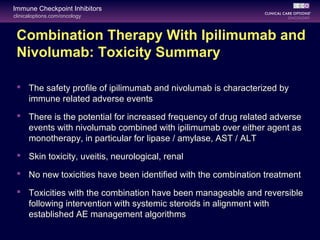
Nivolumab Antitumor Activity
Melanoma
(n = 272)[1]
1. Weber JS, et al. Lancet Oncol. 2015;16:375-384. 2. Rizvi NA, et al. Lancet Oncol. 2015;16:257-265
3. McDermott DF, et al. J Clin Oncol. 2015;[Epub ahead of print]. 4.Ansell SM, et al. N Engl J Med. 2015;372:311-319.
Advanced NSCLC
(N = 117)[2]
Advanced RCC
(N = 34)[3]
Hodgkin’s Lymphoma
(N = 23)[4]
125
100
75
50
25
0
-25
-50
-75
-100
MaxChangeinTarget
LesionsFromBL(%)
Pts
100
75
50
25
0
-25
-50
-75
-100
MaxChangeinTarget
LesionsFromBL(%)
Pts
Alive
Dead
Confirmed responders
100
50
0
-59
-100
MaxChangeinTumor
BurdenFromBL(%)
150
1 mg/kg nivolumab
10 mg/kg nivolumab
Pts
10
0
-50
-60
-40
-70
-80
-90
-100
MaxChangeinTumor
BurdenFromBL(%) -30
-20
-10
Pts
Stable
Disease
Partial Response
Complete
Response](https://image.slidesharecdn.com/ccoimmunecheckpointinhibitorsincancercaredownloadable-150622043412-lva1-app6891/85/CCO-immune-checkpoint_inhibitors_in_cancer_care-26-320.jpg)
![clinicaloptions.com/oncology
Immune Checkpoint Inhibitors
Nivolumab Antitumor Activity
Melanoma
(n = 272)[1]
1. Weber JS, et al. Lancet Oncol. 2015;16:375-384. 2. Rizvi NA, et al. Lancet Oncol. 2015;16:257-265
3. McDermott DF, et al. J Clin Oncol. 2015;[Epub ahead of print]. 4.Ansell SM, et al. N Engl J Med. 2015;372:311-319.
Advanced NSCLC
(N = 117)[2]
Advanced RCC
(N = 34)[3]
Hodgkin’s Lymphoma
(N = 23)[4]
125
100
75
50
25
0
-25
-50
-75
-100
MaxChangeinTarget
LesionsFromBL(%)
Pts
100
75
50
25
0
-25
-50
-75
-100
MaxChangeinTarget
LesionsFromBL(%)
Pts
Alive
Dead
Confirmed responders
100
50
0
-59
-100
MaxChangeinTumor
BurdenFromBL(%)
150
1 mg/kg nivolumab
10 mg/kg nivolumab
Pts
10
0
-50
-60
-40
-70
-80
-90
-100
MaxChangeinTumor
BurdenFromBL(%) -30
-20
-10
Pts
Stable
Disease
Partial Response
Complete
Response
Nivolumab is FDA approved in unresectable or metastatic
melanoma with disease progression following ipilimumab (and
BRAF inhibitor if BRAF V600+) and in metastatic squamous NSCLC
on or after progression with platinum-based chemotherapy and
received Breakthrough Therapy Designation for Hodgkin’s
Lymphoma](https://image.slidesharecdn.com/ccoimmunecheckpointinhibitorsincancercaredownloadable-150622043412-lva1-app6891/85/CCO-immune-checkpoint_inhibitors_in_cancer_care-27-320.jpg)

![clinicaloptions.com/oncology
Immune Checkpoint Inhibitors
Adverse Events Associated With
Checkpoint Inhibitors Are Immune Related
irAE (All Grades), %
Ipilimumab + Dacarbazine[1]
(n = 247)
Ipilimumab + Placebo[2]
(n = 251)
Total 77.7 61.1
Grade 3/4 41.7 14.5
Dermatologic
Pruritus 26.7 24.4
Rash 22.3 19.1
Gastrointestinal
Diarrhea 32.8 27.5
Colitis 4.5 7.6
Hepatic
Increase in ALT 29.1 1.5
Increase in AST 26.7 0.8
Hepatitis 1.6 0.8
1. Robert C, et al. N Engl J Med. 2011;362:2517-2526. 2. Hodi FS, et al. N Engl J Med. 2010;363:711-
723.](https://image.slidesharecdn.com/ccoimmunecheckpointinhibitorsincancercaredownloadable-150622043412-lva1-app6891/85/CCO-immune-checkpoint_inhibitors_in_cancer_care-38-320.jpg)
![clinicaloptions.com/oncology
Immune Checkpoint Inhibitors
Summary of CTLA-4 Blockade Immune-
Mediated Toxicities
Toxicity related to ipilimumab appears to be dose related
Toxicity-related death occurred in < 1% of cases
Common (> 20%)
Rash, pruritus
Fevers, chills, lethargy
Diarrhea/colitis
Occasional (3% to 20%)
Hepatitis/liver enzyme abnormalities
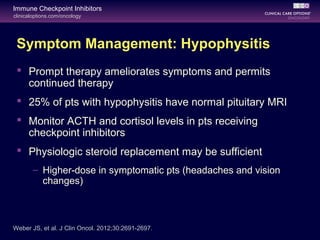
Endocrinopathies: hypophysitis,
thyroiditis, adrenal insufficiency
Rare (< 2%)
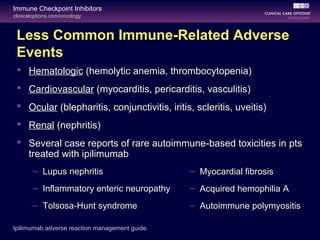
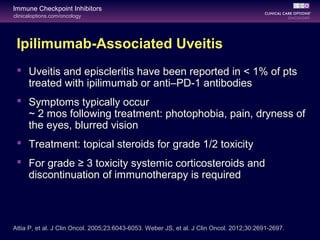
Episcleritis/uveitis
Pancreatitis
Nephritis
Neuropathies, Guillain-Barré, myasthenia
gravis
Lymphadenopathy (sarcoid)
Thrombocytopenia
Toxic epidermal necrolysis, Stevens-
Johnson syndrome
Weber JS, et al. J Clin Oncol. 2012;30:2691-2697.
Weber JS, et al. J Clin Oncol. 2015;[Epub ahead of print].](https://image.slidesharecdn.com/ccoimmunecheckpointinhibitorsincancercaredownloadable-150622043412-lva1-app6891/85/CCO-immune-checkpoint_inhibitors_in_cancer_care-39-320.jpg)
![clinicaloptions.com/oncology
Immune Checkpoint Inhibitors
Summary of PD-1/PD-L1 Blockade
Immune-Mediated Toxicities
Toxicity less common than with anti–CTLA-4 but can be fatal
Occasional (5% to 20%)
Fatigue, headache, arthralgia,
fevers, chills, lethargy
Rash: maculopapular, pruritus,
vitiligo
– Topical treatments
Diarrhea/colitis
– Initiate steroids early, taper slowly
Hepatitis, liver/pancreatic enzyme
abnormalities
Infusion reactions
Endocrinopathies: thyroid, adrenal,
hypophysitis
Rare (< 5%)
Pneumonitis
– Grade 3/4 toxicities uncommon
– Low grade reversible with steroids
and discontinuation
Anemia
Weber JS, et al. J Clin Oncol. 2012;30:2691-2697. Weber JS, et al. J Clin Oncol. 2015;[Epub ahead of
print].](https://image.slidesharecdn.com/ccoimmunecheckpointinhibitorsincancercaredownloadable-150622043412-lva1-app6891/85/CCO-immune-checkpoint_inhibitors_in_cancer_care-40-320.jpg)
![clinicaloptions.com/oncology
Immune Checkpoint Inhibitors
0
Weber JS, et al. J Clin Oncol. 2012;30:2691-2697. Weber JS, et al. J Clin Oncol. 2015;[Epub ahead of print].
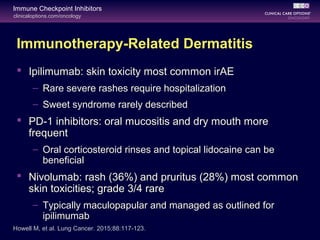
Kinetics of Appearance of irAEs With
Checkpoint Blockade
Data from pts receiving anti–PD-1 antibodies q2w for ≥ 3 yrs show most irAEs occur by
Wk 24 (6 mos)
Toxicities with PD-1/PD-L1 agents may take longer to resolve than with ipilimumab, so
long-term surveillance is recommended
Rash, pruritus
Liver toxicity
Diarrhea, colitis
Hypophysitis
Wks
142 4 6 8 10 12
ToxicityGrade](https://image.slidesharecdn.com/ccoimmunecheckpointinhibitorsincancercaredownloadable-150622043412-lva1-app6891/85/CCO-immune-checkpoint_inhibitors_in_cancer_care-43-320.jpg)
![clinicaloptions.com/oncology
Immune Checkpoint Inhibitors
Prompt Treatment of Colitis
A retrospective analysis of 836 trial pts showed that early
initiation of steroid treatment for colitis led to faster
resolution of symptoms than delayed steroid treatment[1]
Several case studies support use of infliximab to further
blunt immune response in steroid-refractory colitis[2,3]
Bloody diarrhea uncommon but may indicate more severe
colitis[4]
At colonoscopy, colitis typically affects the distal colon with
sparing of rectum[4]
1. O’Day S, et al. ASCO 2011. Abstract 8554. 2. Pagès C, et al. Melanoma Res 2013;23:227-230.
3. Merrill SP, et al. Ann Pharmacother. 2014;48:806-810. 4. Howell M, et al. Lung Cancer. 2015;88:117-
123.](https://image.slidesharecdn.com/ccoimmunecheckpointinhibitorsincancercaredownloadable-150622043412-lva1-app6891/85/CCO-immune-checkpoint_inhibitors_in_cancer_care-47-320.jpg)
![clinicaloptions.com/oncology
Immune Checkpoint Inhibitors
Toxicity Guidelines
TFTs, CBCs, LFTs and metabolic panels should be
obtained at each treatment and q6-12 wks for 6 mos
posttreatment in all pts receiving checkpoint protein
antibodies
ACTH, cortisol should also be checked in pts with fatigue
and nonspecific symptoms, plus testosterone in men
Frequency of follow-up testing should be adjusted to
individual response and AEs that occur
Corticosteroids can reverse nearly all toxicities associated
with these agents, but should be reserved for grade 3/4, or
prolonged grade 2, irAEs
Weber JS, et al. J Clin Oncol. 2015;[Epub ahead of print].](https://image.slidesharecdn.com/ccoimmunecheckpointinhibitorsincancercaredownloadable-150622043412-lva1-app6891/85/CCO-immune-checkpoint_inhibitors_in_cancer_care-54-320.jpg)

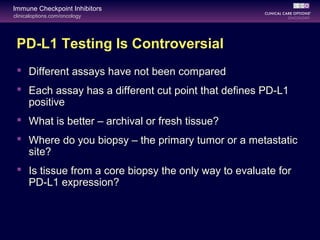
![clinicaloptions.com/oncology
Immune Checkpoint Inhibitors
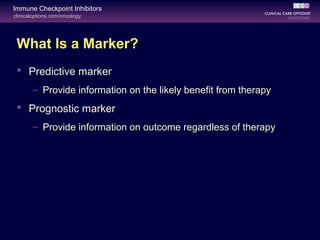
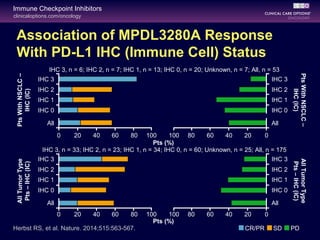
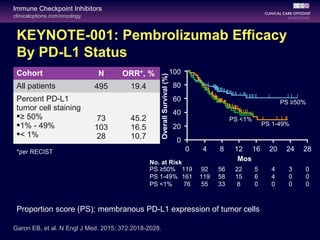
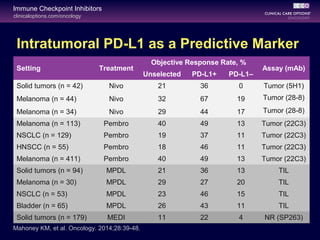
PD-L1 as a Prognostic Marker
PD-L1 expression has been identified as a negative
prognostic marker
– More aggressive phenotype in melanoma[1]
– Increased risk of metastasis and death in RCC and lung
cancer[2,3]
– Increased risk of metastatic disease in gastric cancer[4]
1. Massi D, et al. Ann Oncol. 2014;25:2433-2442. 2. Thompson RH, et al. Proc Natl Acad Sci USA.
2004;101:17174-17179. 3. Mu CY, et al. Med Oncol. 2011;28:682-688. 4. Zheng Z, et al. Chin J Cancer
Res. 2014;26:104-111.](https://image.slidesharecdn.com/ccoimmunecheckpointinhibitorsincancercaredownloadable-150622043412-lva1-app6891/85/CCO-immune-checkpoint_inhibitors_in_cancer_care-61-320.jpg)

![clinicaloptions.com/oncology
Immune Checkpoint Inhibitors
Immunotherapy Effects of BRAF Inhibitors
↑ CD8+ TILs[1]
↑ Melanoma antigen expression[1]
Antitumor activity of combined BRAFi + MEKi plus anti–
PD-1[2]
↑ MHC and melanoma antigen expression[2]
1. Frederick DT, et al. Clin Cancer Res. 2013;19:1225-1231.
2. Hu-Lieskovan S, et al. Sci Transl Med. 2015;7:279ra41.](https://image.slidesharecdn.com/ccoimmunecheckpointinhibitorsincancercaredownloadable-150622043412-lva1-app6891/85/CCO-immune-checkpoint_inhibitors_in_cancer_care-81-320.jpg)
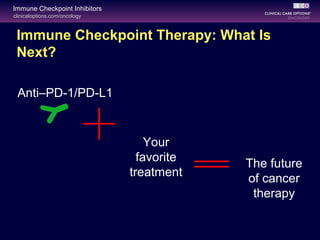
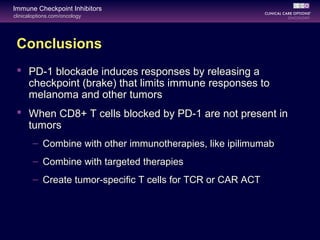


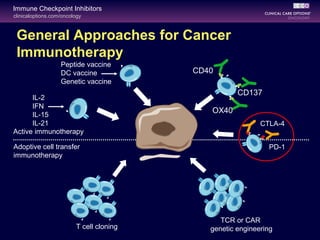
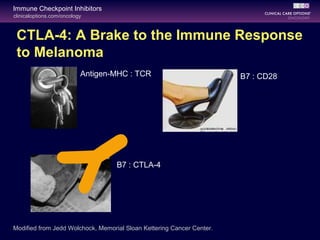
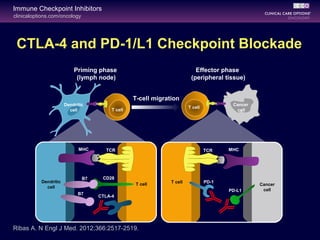
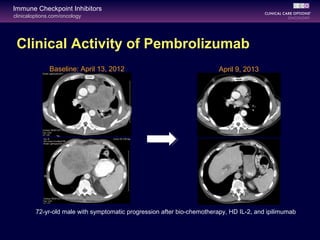
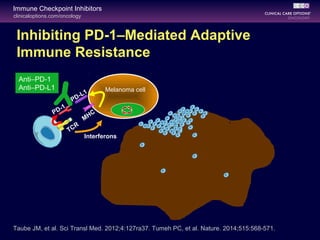
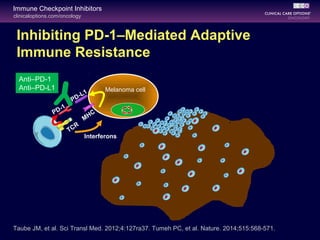
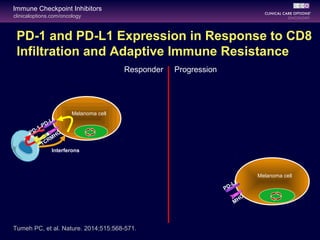
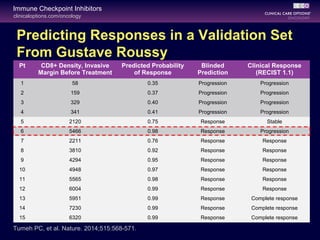
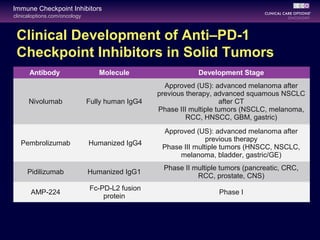
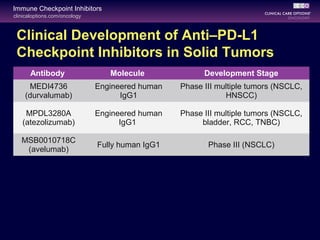
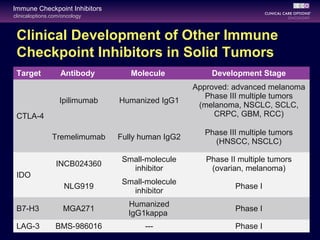
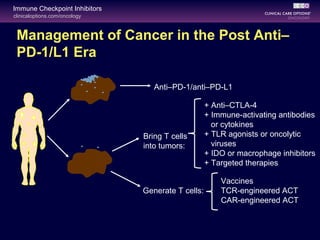
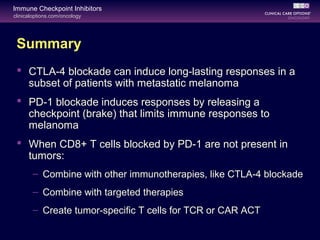
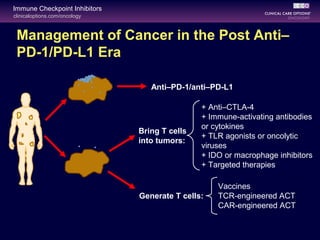
Immune checkpoint inhibitors work by releasing brakes on the immune system called checkpoints that normally limit anti-tumor immune responses. In clinical trials, checkpoint inhibitors have demonstrated the ability to induce long-lasting responses in a subset of patients with various cancers including melanoma. Combining checkpoint inhibitors with other immunotherapies, targeted therapies, or cell-based therapies may help generate anti-tumor immune responses in patients whose tumors do not respond to checkpoint inhibitors alone. Managing cancer in the era of checkpoint inhibitors will likely involve complex combinations of different treatment approaches.


