CANCER BIOMARKERS:
SELECTING THE RIGHT DRUG
FOR THE RIGHT PATIENT
Dr Ravindra Chhabra
Scientist
Molecular Medicine Laboratory
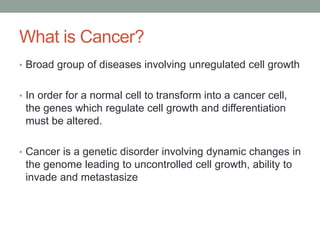
What is Cancer?
• Broad group of diseases involving unregulated cell growth
• In order for a normal cell to transform into a cancer cell,
the genes which regulate cell growth and differentiation
must be altered.
• Cancer is a genetic disorder involving dynamic changes in
the genome leading to uncontrolled cell growth, ability to
invade and metastasize
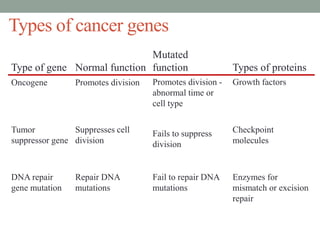
Types of cancer genes
Types of proteins
Mutated
functionNormal functionType of gene
Enzymes for
mismatch or excision
repair
Fail to repair DNA
mutations
Repair DNA
mutations
DNA repair
gene mutation
Checkpoint
molecules
Fails to suppress
division
Suppresses cell
division
Tumor
suppressor gene
Growth factorsPromotes division -
abnormal time or
cell type
Promotes divisionOncogene
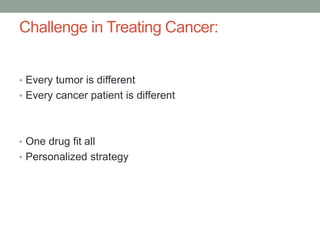
Challenge in Treating Cancer:
• Every tumor is different
• Every cancer patient is different
• One drug fit all
• Personalized strategy
Cancer biomarkers
• There are different types of cancer biomarkers;
• Prognostic,
• Pharmacodynamic
• Predictive
Prognostic Biomarker
• Anticipates the likely outcome of illness
• or dictate whether further therapy is required or not
• Oncotype Dx test: Forecast the probability of Breast
cancer recurring after surgical intervention
(www.oncotypedx.com/)
• Clin Chem. 2007 Jun;53(6):1084-91
Pharmacodynamic Biomarker
• Measure the effect of a drug on the disease
• For example, the level of proliferation and apoptosis in the
tumor upon delivery of a drug,
• or the degree of change on a substrate regulated by an
enzymatic drug target (such as phosphorylation after
inhibition of a protein kinase
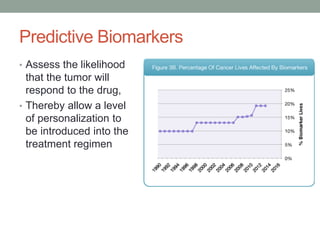
Predictive Biomarkers
• Assess the likelihood
that the tumor will
respond to the drug,
• Thereby allow a level
of personalization to
be introduced into the
treatment regimen
The need for predictive biomarkers
• Cost effectiveness of the therapy, and go hand-in-hand
with improved clinical benefit and safer drugs
• Certain chemotherapy regimens result in death rates in
the range of 0.5–2.0%, and 30–40% of patients
experience grade 3 or 4 toxic effects,
• representing a large burden of morbidity, especially if a
significant fraction of this population do not benefit from
treatment.
• Predictive biomarker-driven cancer therapy reduces the
unnecessary treatment and adverse effects.
CML and BCR-ABL
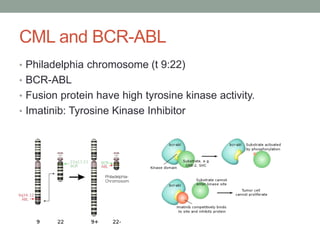
• Philadelphia chromosome (t 9:22)
• BCR-ABL
• Fusion protein have high tyrosine kinase activity.
• Imatinib: Tyrosine Kinase Inhibitor
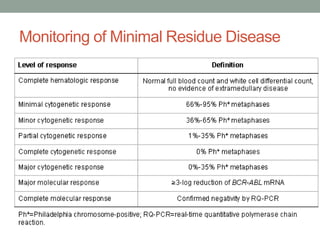
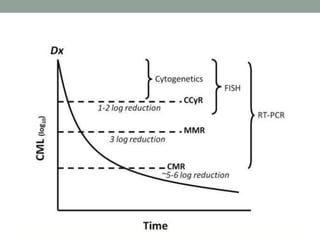
Monitoring of Minimal Residue Disease
• Resistance to imatinib occurs in about 10–15% of patients
• 30–50% of patients with secondary resistance to imatinib
have a catalytic domain mutation
• dasatinib and nilotinib
• The level of resistance to imatinib, nilotinib and dasatinib
depends on the mutation identified
• some mutations that result in amino acid substitutions,
such as Tyr315Ile impart resistance to all three agents
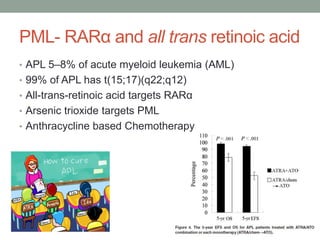
PML- RARα and all trans retinoic acid
• APL 5–8% of acute myeloid leukemia (AML)
• 99% of APL has t(15;17)(q22;q12)
• All-trans-retinoic acid targets RARα
• Arsenic trioxide targets PML
• Anthracycline based Chemotherapy
KRAS in colorectal cancer
• Key element in the MAPK, JAK–STAT and PI3K cell-
signaling pathways
• Mutations in the gene lead to abnormal cellular growth,
proliferation and differentiation
• 35–40% of colorectal tumors
• Activated KRAS mutations are strongly associated with a
resistance to anti–epidermal growth factor receptor
(EGFR) therapies
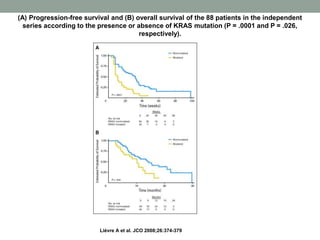
(A) Progression-free survival and (B) overall survival of the 88 patients in the independent
series according to the presence or absence of KRAS mutation (P = .0001 and P = .026,
respectively).
Lièvre A et al. JCO 2008;26:374-379
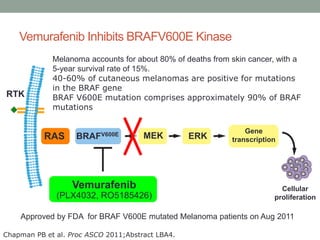
RTK
Vemurafenib
(PLX4032, RO5185426)
RAS BRAFV600E MEK ERK
Gene
transcription
Melanoma accounts for about 80% of deaths from skin cancer, with a
5-year survival rate of 15%.
40-60% of cutaneous melanomas are positive for mutations
in the BRAF gene
BRAF V600E mutation comprises approximately 90% of BRAF
mutations
Chapman PB et al. Proc ASCO 2011;Abstract LBA4.
Cellular
proliferation
Vemurafenib Inhibits BRAFV600E Kinase
Approved by FDA for BRAF V600E mutated Melanoma patients on Aug 2011
Progression-free
survival(%)
Months
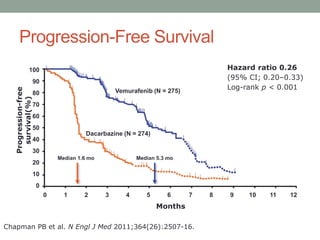
Hazard ratio 0.26
(95% CI; 0.20–0.33)
Log-rank p < 0.001Vemurafenib (N = 275)
Dacarbazine (N = 274)
Median 5.3 moMedian 1.6 mo
100
90
80
70
60
50
40
30
20
10
0
0 1 2 3 4 5 6 7 8 9 10 11 12
Chapman PB et al. N Engl J Med 2011;364(26):2507-16.
Progression-Free Survival
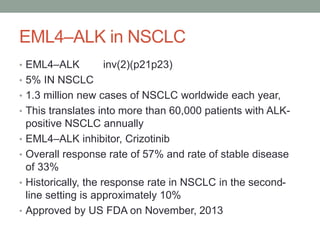
EML4–ALK in NSCLC
• EML4–ALK inv(2)(p21p23)
• 5% IN NSCLC
• 1.3 million new cases of NSCLC worldwide each year,
• This translates into more than 60,000 patients with ALK-
positive NSCLC annually
• EML4–ALK inhibitor, Crizotinib
• Overall response rate of 57% and rate of stable disease
of 33%
• Historically, the response rate in NSCLC in the second-
line setting is approximately 10%
• Approved by US FDA on November, 2013
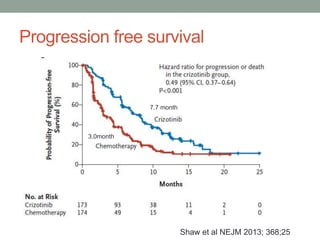
Progression free survival
7.7 month
3.0month
Shaw et al NEJM 2013; 368;25
EGFR And Gefitinib
• EGF receptor (EGFR) is a transmembrane protein
• cytoplasmic kinase activity that
• transduces important growth factor signals
• 10% NSCLC have EGFR Mutation
• EGFR inhibitor----Gefitinib
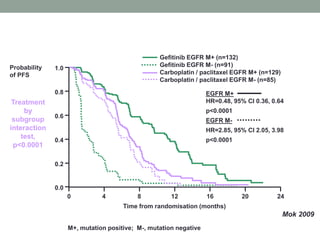
EGFR M+
HR=0.48, 95% CI 0.36, 0.64
p<0.0001
EGFR M-
HR=2.85, 95% CI 2.05, 3.98
p<0.0001
0 4 8 12 16 20 24
Time from randomisation (months)
0.0
0.2
0.4
0.6
0.8
1.0Probability
of PFS
Gefitinib EGFR M+ (n=132)
Gefitinib EGFR M- (n=91)
Carboplatin / paclitaxel EGFR M+ (n=129)
Carboplatin / paclitaxel EGFR M- (n=85)
M+, mutation positive; M-, mutation negative
Treatment
by
subgroup
interaction
test,
p<0.0001
Mok 2009
HER2: breast cancer
• Human epidermal growth factor receptor 2 (HER2) is a
transmembrane protein and part of the HER family of
4 growth factor receptors (HER1 to HER4)
• Overexpression of HER2 and/or amplification of the HER2
gene occurs in up to 30% of breast cancers
• HER2 positivity is associated with aggressive disease
• a high risk of relapse
• poor survival
Trastuzumab: targeting HER2
• Recombinant humanised monoclonal antibody directed against the
extracellular domain of HER2
• Attacks HER2-positive tumours via 4 distinct mechanisms of
action
• Activation of antibody-dependent cellular
cytotoxicity (ADCC)
• Prevention of the formation of p95HER2, a truncated and very
active form of HER2
• Inhibition of cell proliferation by preventing HER2-activated
intracellular signalling
• Inhibition of HER2-regulated angiogenesis
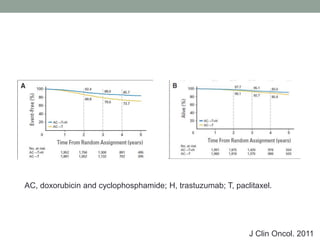
• Multicenter randomized studies have reported significant benefit
from the addition of trastuzumab to adjuvant therapy with up to
50% reduction in the relapse of breast cancer
J Clin Oncol. 2011
AC, doxorubicin and cyclophosphamide; H, trastuzumab; T, paclitaxel.
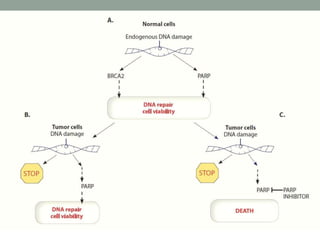
PARP inhibitors and BRCA deficiency
• BRCA1 and BRCA2 encode proteins that are components
of the homologous recombination (HR) DNA-repair
pathway
• poly-ADP(ribose) polymerase (PARP) is a DNA-damage-
sensing nuclear enzyme involved in DNA repair
• inhibitors of PARP in BRCA1/2 deficient tumors
• breast cancer cells defective in BRCA1 or BRCA2 are
highly sensitive to PARP inhibition
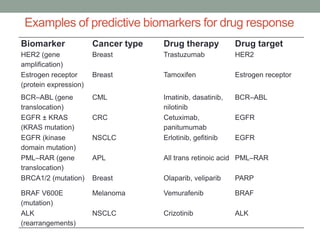
Examples of predictive biomarkers for drug response
Biomarker Cancer type Drug therapy Drug target
HER2 (gene
amplification)
Breast Trastuzumab HER2
Estrogen receptor
(protein expression)
Breast Tamoxifen Estrogen receptor
BCR–ABL (gene
translocation)
CML Imatinib, dasatinib,
nilotinib
BCR–ABL
EGFR ± KRAS
(KRAS mutation)
CRC Cetuximab,
panitumumab
EGFR
EGFR (kinase
domain mutation)
NSCLC Erlotinib, gefitinib EGFR
PML–RAR (gene
translocation)
APL All trans retinoic acid PML–RAR
BRCA1/2 (mutation) Breast Olaparib, veliparib PARP
BRAF V600E
(mutation)
Melanoma Vemurafenib BRAF
ALK
(rearrangements)
NSCLC Crizotinib ALK
Cancer Biomarkers

Cancer Biomarkers

  • 1.
    CANCER BIOMARKERS: SELECTING THERIGHT DRUG FOR THE RIGHT PATIENT Dr Ravindra Chhabra Scientist Molecular Medicine Laboratory
  • 2.
    What is Cancer? •Broad group of diseases involving unregulated cell growth • In order for a normal cell to transform into a cancer cell, the genes which regulate cell growth and differentiation must be altered. • Cancer is a genetic disorder involving dynamic changes in the genome leading to uncontrolled cell growth, ability to invade and metastasize
  • 3.
    Types of cancergenes Types of proteins Mutated functionNormal functionType of gene Enzymes for mismatch or excision repair Fail to repair DNA mutations Repair DNA mutations DNA repair gene mutation Checkpoint molecules Fails to suppress division Suppresses cell division Tumor suppressor gene Growth factorsPromotes division - abnormal time or cell type Promotes divisionOncogene
  • 4.
    Challenge in TreatingCancer: • Every tumor is different • Every cancer patient is different • One drug fit all • Personalized strategy
  • 5.
    Cancer biomarkers • Thereare different types of cancer biomarkers; • Prognostic, • Pharmacodynamic • Predictive
  • 6.
    Prognostic Biomarker • Anticipatesthe likely outcome of illness • or dictate whether further therapy is required or not • Oncotype Dx test: Forecast the probability of Breast cancer recurring after surgical intervention (www.oncotypedx.com/) • Clin Chem. 2007 Jun;53(6):1084-91
  • 7.
    Pharmacodynamic Biomarker • Measurethe effect of a drug on the disease • For example, the level of proliferation and apoptosis in the tumor upon delivery of a drug, • or the degree of change on a substrate regulated by an enzymatic drug target (such as phosphorylation after inhibition of a protein kinase
  • 8.
    Predictive Biomarkers • Assessthe likelihood that the tumor will respond to the drug, • Thereby allow a level of personalization to be introduced into the treatment regimen
  • 9.
    The need forpredictive biomarkers • Cost effectiveness of the therapy, and go hand-in-hand with improved clinical benefit and safer drugs • Certain chemotherapy regimens result in death rates in the range of 0.5–2.0%, and 30–40% of patients experience grade 3 or 4 toxic effects, • representing a large burden of morbidity, especially if a significant fraction of this population do not benefit from treatment. • Predictive biomarker-driven cancer therapy reduces the unnecessary treatment and adverse effects.
  • 10.
    CML and BCR-ABL •Philadelphia chromosome (t 9:22) • BCR-ABL • Fusion protein have high tyrosine kinase activity. • Imatinib: Tyrosine Kinase Inhibitor
  • 11.
    Monitoring of MinimalResidue Disease
  • 13.
    • Resistance toimatinib occurs in about 10–15% of patients • 30–50% of patients with secondary resistance to imatinib have a catalytic domain mutation • dasatinib and nilotinib • The level of resistance to imatinib, nilotinib and dasatinib depends on the mutation identified • some mutations that result in amino acid substitutions, such as Tyr315Ile impart resistance to all three agents
  • 14.
    PML- RARα andall trans retinoic acid • APL 5–8% of acute myeloid leukemia (AML) • 99% of APL has t(15;17)(q22;q12) • All-trans-retinoic acid targets RARα • Arsenic trioxide targets PML • Anthracycline based Chemotherapy
  • 15.
    KRAS in colorectalcancer • Key element in the MAPK, JAK–STAT and PI3K cell- signaling pathways • Mutations in the gene lead to abnormal cellular growth, proliferation and differentiation • 35–40% of colorectal tumors • Activated KRAS mutations are strongly associated with a resistance to anti–epidermal growth factor receptor (EGFR) therapies
  • 16.
    (A) Progression-free survivaland (B) overall survival of the 88 patients in the independent series according to the presence or absence of KRAS mutation (P = .0001 and P = .026, respectively). Lièvre A et al. JCO 2008;26:374-379
  • 17.
    RTK Vemurafenib (PLX4032, RO5185426) RAS BRAFV600EMEK ERK Gene transcription Melanoma accounts for about 80% of deaths from skin cancer, with a 5-year survival rate of 15%. 40-60% of cutaneous melanomas are positive for mutations in the BRAF gene BRAF V600E mutation comprises approximately 90% of BRAF mutations Chapman PB et al. Proc ASCO 2011;Abstract LBA4. Cellular proliferation Vemurafenib Inhibits BRAFV600E Kinase Approved by FDA for BRAF V600E mutated Melanoma patients on Aug 2011
  • 18.
    Progression-free survival(%) Months Hazard ratio 0.26 (95%CI; 0.20–0.33) Log-rank p < 0.001Vemurafenib (N = 275) Dacarbazine (N = 274) Median 5.3 moMedian 1.6 mo 100 90 80 70 60 50 40 30 20 10 0 0 1 2 3 4 5 6 7 8 9 10 11 12 Chapman PB et al. N Engl J Med 2011;364(26):2507-16. Progression-Free Survival
  • 19.
    EML4–ALK in NSCLC •EML4–ALK inv(2)(p21p23) • 5% IN NSCLC • 1.3 million new cases of NSCLC worldwide each year, • This translates into more than 60,000 patients with ALK- positive NSCLC annually • EML4–ALK inhibitor, Crizotinib • Overall response rate of 57% and rate of stable disease of 33% • Historically, the response rate in NSCLC in the second- line setting is approximately 10% • Approved by US FDA on November, 2013
  • 20.
    Progression free survival 7.7month 3.0month Shaw et al NEJM 2013; 368;25
  • 21.
    EGFR And Gefitinib •EGF receptor (EGFR) is a transmembrane protein • cytoplasmic kinase activity that • transduces important growth factor signals • 10% NSCLC have EGFR Mutation • EGFR inhibitor----Gefitinib
  • 22.
    EGFR M+ HR=0.48, 95%CI 0.36, 0.64 p<0.0001 EGFR M- HR=2.85, 95% CI 2.05, 3.98 p<0.0001 0 4 8 12 16 20 24 Time from randomisation (months) 0.0 0.2 0.4 0.6 0.8 1.0Probability of PFS Gefitinib EGFR M+ (n=132) Gefitinib EGFR M- (n=91) Carboplatin / paclitaxel EGFR M+ (n=129) Carboplatin / paclitaxel EGFR M- (n=85) M+, mutation positive; M-, mutation negative Treatment by subgroup interaction test, p<0.0001 Mok 2009
  • 23.
    HER2: breast cancer •Human epidermal growth factor receptor 2 (HER2) is a transmembrane protein and part of the HER family of 4 growth factor receptors (HER1 to HER4) • Overexpression of HER2 and/or amplification of the HER2 gene occurs in up to 30% of breast cancers • HER2 positivity is associated with aggressive disease • a high risk of relapse • poor survival
  • 24.
    Trastuzumab: targeting HER2 •Recombinant humanised monoclonal antibody directed against the extracellular domain of HER2 • Attacks HER2-positive tumours via 4 distinct mechanisms of action • Activation of antibody-dependent cellular cytotoxicity (ADCC) • Prevention of the formation of p95HER2, a truncated and very active form of HER2 • Inhibition of cell proliferation by preventing HER2-activated intracellular signalling • Inhibition of HER2-regulated angiogenesis • Multicenter randomized studies have reported significant benefit from the addition of trastuzumab to adjuvant therapy with up to 50% reduction in the relapse of breast cancer
  • 25.
    J Clin Oncol.2011 AC, doxorubicin and cyclophosphamide; H, trastuzumab; T, paclitaxel.
  • 26.
    PARP inhibitors andBRCA deficiency • BRCA1 and BRCA2 encode proteins that are components of the homologous recombination (HR) DNA-repair pathway • poly-ADP(ribose) polymerase (PARP) is a DNA-damage- sensing nuclear enzyme involved in DNA repair • inhibitors of PARP in BRCA1/2 deficient tumors • breast cancer cells defective in BRCA1 or BRCA2 are highly sensitive to PARP inhibition
  • 28.
    Examples of predictivebiomarkers for drug response Biomarker Cancer type Drug therapy Drug target HER2 (gene amplification) Breast Trastuzumab HER2 Estrogen receptor (protein expression) Breast Tamoxifen Estrogen receptor BCR–ABL (gene translocation) CML Imatinib, dasatinib, nilotinib BCR–ABL EGFR ± KRAS (KRAS mutation) CRC Cetuximab, panitumumab EGFR EGFR (kinase domain mutation) NSCLC Erlotinib, gefitinib EGFR PML–RAR (gene translocation) APL All trans retinoic acid PML–RAR BRCA1/2 (mutation) Breast Olaparib, veliparib PARP BRAF V600E (mutation) Melanoma Vemurafenib BRAF ALK (rearrangements) NSCLC Crizotinib ALK