Sensation and Perception
  Chapter 3
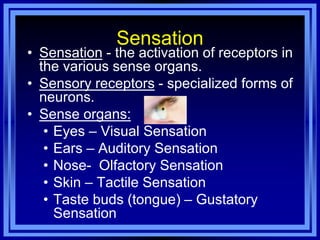
Sensation
• Sensation - the activation of receptors in
  the various sense organs.
• Sensory receptors - specialized forms of
  neurons.
• Sense organs:
   • Eyes – Visual Sensation
   • Ears – Auditory Sensation
   • Nose- Olfactory Sensation
   • Skin – Tactile Sensation
   • Taste buds (tongue) – Gustatory
     Sensation
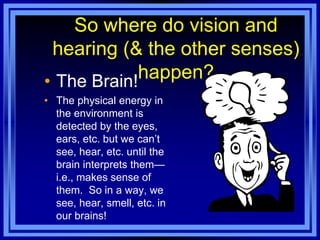
So where do vision and
 hearing (& the other senses)
• The Brain!happen?
• The physical energy in
  the environment is
  detected by the eyes,
  ears, etc. but we can‘t
  see, hear, etc. until the
  brain interprets them—
  i.e., makes sense of
  them. So in a way, we
  see, hear, smell, etc. in
  our brains!
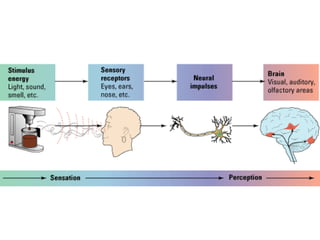
Transduction
• Transforming
  signals into neural
  impulses.
• Information goes
  from the senses to
  the thalamus , then
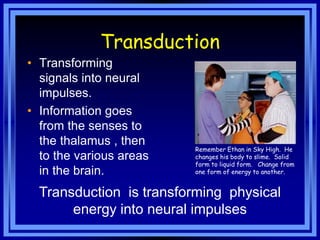
                         Remember Ethan in Sky High. He
  to the various areas   changes his body to slime. Solid
                         form to liquid form. Change from
  in the brain.          one form of energy to another.


  Transduction is transforming physical
       energy into neural impulses
Sensory Thresholds
• Just noticeable difference
  or the difference
  threshold) - the smallest
  difference between two
  stimuli that is detectable
  50 percent of the time.
Sensory Thresholds
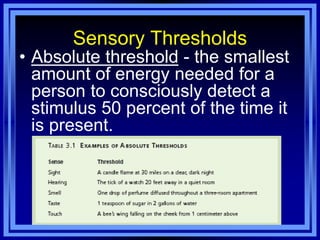
• Absolute threshold - the smallest
  amount of energy needed for a
  person to consciously detect a
  stimulus 50 percent of the time it
  is present.
Subliminal Sensation
• Subliminal stimuli - stimuli that are below
  the level of conscious awareness.
  • Just strong enough to activate the sensory
    receptors but not strong enough for people
    to be consciously aware of them.
  • Limin - ―threshold‖
  • Sublimin - ―below the threshold.‖
• Subliminal perception – process by why
  subliminal stimuli act upon the
  unconscious mind, influencing behavior.
Perception of Minimal Stimuli
• Subliminal Perception
  • The concept of subliminal perception is
    well known to the general public.
    • Subliminal perception is the idea that a stimulus
      can influence behavior even when it is so weak
      or brief that we do not perceive it consciously.
    • There is concern that subliminal perception can
      powerfully manipulate human behavior.
Perception of Minimal Stimuli
• What does ―subliminal‖ mean?
  • When the term ―subliminal‖ is used, it
    refers to the quality of being ―below the
    (sensory) threshold.‖
  • Scientists use it to indicate that the
    stimulus was not consciously detected in a
    given presentation.
  • Because the only way to know if a stimulus
    has been detected is to ask, it is very
    difficult to interpret the results of research
    on subliminal stimuli.
Perception of Minimal Stimuli
• What subliminal perception cannot
  do
  • Claims that subliminal stimuli in
    advertisements can make people buy
    things are unsupportable.
    • This claim has been tested repeatedly
      and no evidence has been found.
    • Advertisements in American culture
      have little need of subliminal stimuli.
      They are overtly and effectively
      manipulative.
Perception of Minimal Stimuli
• What subliminal perception cannot do
  • Messages in music (recorded backwards
    or superimposed) cannot make people do
    anything, evil or otherwise.
    • This claim has also been repeatedly tested
      under controlled conditions.
    • No one listening to the messages can discern
      these messages.
    • No one‘s behavior has been changed after
      listening to music containing messages.
Perception of Minimal Stimuli
• What subliminal perception cannot do
  • Subliminal audiotapes just don‘t work
    • Claims that addictions can be overcome, self-
      esteem can be improved, and general self-
      improvement can be achieved through the use
      of subliminal audiotapes are also unsupported.
    • Any results achieved through the use of these
      tapes can be attributed to the placebo effect or
      to the individual user‘s motivation to improve.
Perception of Minimal Stimuli
• What subliminal perception can do
  • Some subtle effects on subsequent
    perception and emotion have been
    supported
    • ―Priming‖ individuals to see an object in
      subsequent presentations has been achieved
      through repeated presentations (Bar &
      Biederman, 1998)
    • Emotional states can be influenced by
      subliminal presentation of messages that may
      be perceived as emotionally loaded (Masling et
      al., 1991)
Perception of Minimal Stimuli
• Subliminal perception
  • The fact that subliminal perception can
    influence behavior at all is interesting.
  • But the effects overall are much smaller
    than people hope or fear.
Habituation and Sensory
           Adaptation
• Habituation - tendency of the brain
  to stop attending to constant,
  unchanging information.
• Sensory adaptation - tendency of
  sensory receptor cells to become
  less responsive to a stimulus that is
  unchanging.
Somesthetic Senses
• Somesthetic senses - the body senses
  consisting of the skin senses, the kinesthetic
  sense, and the vestibular senses.
  • ―Soma‖ – body
  • ―Esthetic‖ - feeling
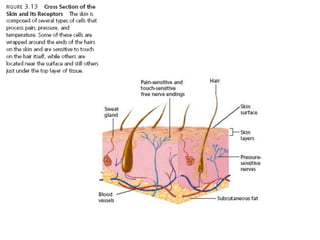
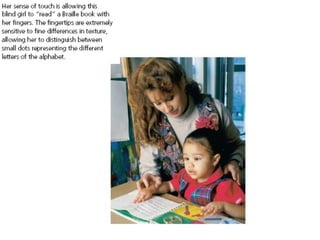
1. Skin senses - the sensations of touch,
  pressure, temperature, and pain.
  • Sensory receptors in the skin
  • Gate-control theory - pain signals must pass through a
    ―gate‖ located in the spinal cord.
Somesthetic Senses
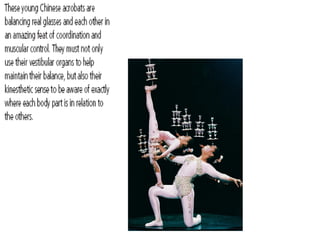
2. Kinestheticsense - sense of the location
  of body parts in relation to the ground
  and each other.
  • Proprioceptive receptors (proprioceptors)


3. Vestibular senses - the sensations of
  movement, balance, and body position.
  Tells us where our body is oriented in
  space.
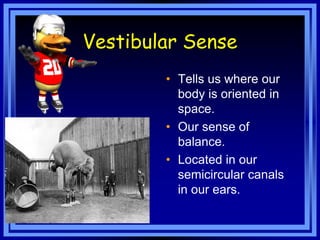
Vestibular Sense
        • Tells us where our
          body is oriented in
          space.
        • Our sense of
          balance.
        • Located in our
          semicircular canals
          in our ears.
Kinesthetic Sense
• Tells us where our
  body parts are.
• Receptors located
  in our muscles and
  joints.
Perception and Constancies
• Perception - the method by which
  the sensations experienced at any
  given moment are interpreted and
  organized in some meaningful
  fashion.

• Mental interpretation of sensation
  results in perception
Perception and Constancies
PERCEPTION = SENSATION +
MEANINGFUL
INTERPRETATION

Ex: Smell we experience due to the
burning of an object is sensation and
understanding that the burning object is
rubber is PERCEPTION
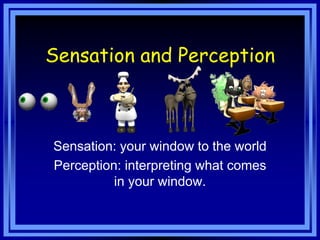
Sensation and Perception


Sensation: your window to the world
Perception: interpreting what comes
          in your window.
Perception and Constancies
• Size constancy - the tendency to interpret an
  object as always being the same actual size,
  regardless of its distance.

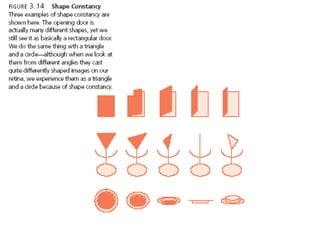
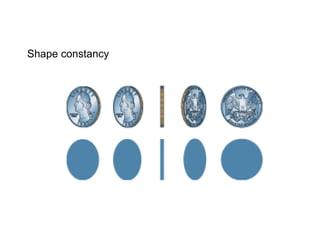
• Shape constancy - the tendency to interpret
  the shape of an object as being constant,
  even when its shape changes on the retina.

• Brightness constancy – the tendency to
  perceive the apparent brightness of an object
  as the same even when the light conditions
  change.
Shape constancy
Gestalt Principles
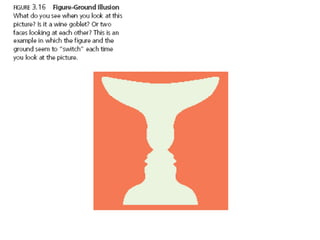
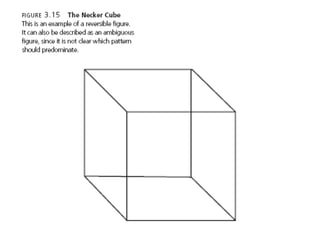
• Figure–ground - the tendency to
  perceive objects, or figures, as
  existing on a background.

• Reversible figures - visual illusions
  in which the figure and ground can
  be reversed.
Do you see
an old lady
or a young
lady?
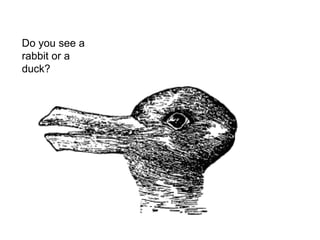
Do you see a
rabbit or a
duck?
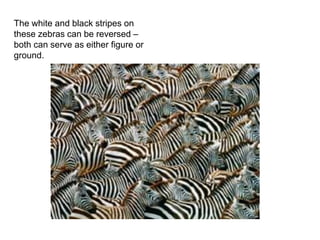
The white and black stripes on
these zebras can be reversed –
both can serve as either figure or
ground.
Some Laws of Perceptual Organization
        Gestalt Principles

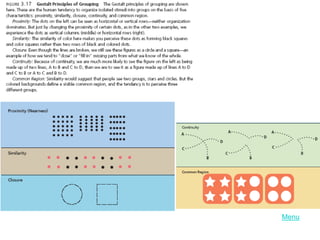
• Closure - the tendency to
  complete figures that are
  incomplete.

 Ex : While proof reading missing
 letters escape from our attention &
 our minds fill up the gap !
Laws of Perceptual Organization
            Gestalt Principles
• Continuity - the tendency to
  perceive things as simply as
  possible with a continuous pattern
  rather than with a complex, broken-
  up     pattern.(    Organization  of
  perception appears to be going
  infinitely in the same direction)
 Ex : Cinema scenes though not individually, when
 they run in a sequence at the rate of 15 frames per
 second, they appear to be one and continuous
Laws of Perceptual Organization
          Gestalt Principles
• Pragnanz – Pragnanz means compact but
  significant. In perceiving we do not add the
  different sensations received and edit them
  so as to get at the meaningful interpretation
  of the object perceived. We always perceive
  anything as a whole configuration or pattern
  so that it is simple, meaningful and stable.

  Ex: On seeing a man riding a cycle, we do not
  perceive the cycle and the rider separately, it appears
  as a whole unit to us. The mental act of ‗organizing‘
  takes place during perception
                                                      Menu
Laws of Perceptual Organization

• Similarity - the tendency to perceive
  things that look similar to each
  other as being part of the same
  group.

• Proximity - the tendency to
  perceive objects that are close to
  each other as part of the same
  grouping.                            Menu
Menu
Depth Perception
• Depth perception - the ability to
  perceive the world in three dimensions.
• Studies of depth perception
  • Visual cliff experiment


                                        Menu
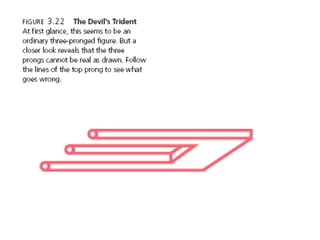
Perceptual Illusions
• Illusions are wrong / mistaken
  perceptions
• Our perceptions are not always
  true and accurate. Sometimes
  errors do creep in our
  perception when our mind
  wrongly interpret the sensory
  input, which is otherwise known
  as ILLUSION
Perceptual Illusions

• Illusion of movement : Ex: A spot of
  light in dark appears to be moving
  around


• Illusion of perceptive : Ex: Two
  parallel lines appears to meet at
  along distance
Perceptual Illusions
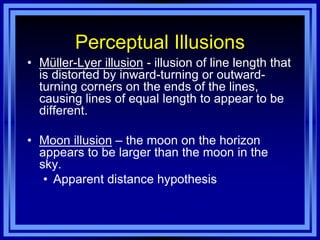
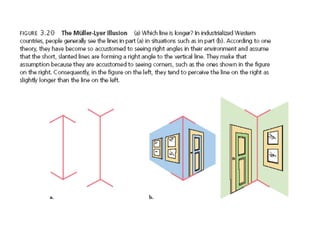
• Müller-Lyer illusion - illusion of line length that
  is distorted by inward-turning or outward-
  turning corners on the ends of the lines,
  causing lines of equal length to appear to be
  different.

• Moon illusion – the moon on the horizon
  appears to be larger than the moon in the
  sky.
   • Apparent distance hypothesis
Factors that Influence Perception
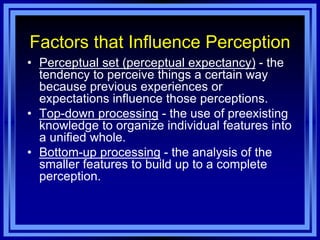
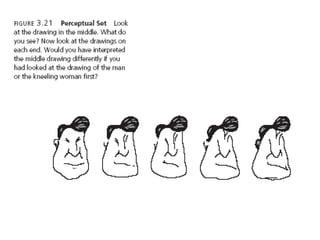
• Perceptual set (perceptual expectancy) - the
  tendency to perceive things a certain way
  because previous experiences or
  expectations influence those perceptions.
• Top-down processing - the use of preexisting
  knowledge to organize individual features into
  a unified whole.
• Bottom-up processing - the analysis of the
  smaller features to build up to a complete
  perception.
Applying Psychology
• Extrasensory Perception (ESP) - claim of
  perception that occurs without the use of
  normal sensory channels such as sight,
  hearing, touch, taste, or smell.
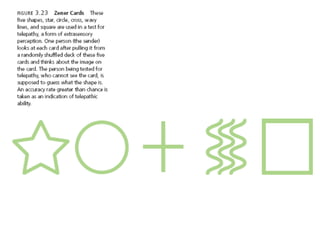
  • Telepathy - claimed ability to read another person‘s thoughts, or
    mind reading.
  • Clairvoyance - supposed ability to ―see‖ things that are not actually
    present.
  • Precognition - supposed ability to know something in advance of its
    occurrence or to predict a future event.
• Parapsychology - the study of ESP, ghosts,
  and other subjects that do not normally fall
  into the realm of ordinary psychology.
The Doorway to Psychology
   You cannot know anything except through
                the senses –
                Anaxagoras


                                             55

Chapter 3 pps edited

  • 1.
  • 2.
    Sensation • Sensation -the activation of receptors in the various sense organs. • Sensory receptors - specialized forms of neurons. • Sense organs: • Eyes – Visual Sensation • Ears – Auditory Sensation • Nose- Olfactory Sensation • Skin – Tactile Sensation • Taste buds (tongue) – Gustatory Sensation
  • 3.
    So where dovision and hearing (& the other senses) • The Brain!happen? • The physical energy in the environment is detected by the eyes, ears, etc. but we can‘t see, hear, etc. until the brain interprets them— i.e., makes sense of them. So in a way, we see, hear, smell, etc. in our brains!
  • 4.
    Transduction • Transforming signals into neural impulses. • Information goes from the senses to the thalamus , then Remember Ethan in Sky High. He to the various areas changes his body to slime. Solid form to liquid form. Change from in the brain. one form of energy to another. Transduction is transforming physical energy into neural impulses
  • 6.
    Sensory Thresholds • Justnoticeable difference or the difference threshold) - the smallest difference between two stimuli that is detectable 50 percent of the time.
  • 7.
    Sensory Thresholds • Absolutethreshold - the smallest amount of energy needed for a person to consciously detect a stimulus 50 percent of the time it is present.
  • 8.
    Subliminal Sensation • Subliminalstimuli - stimuli that are below the level of conscious awareness. • Just strong enough to activate the sensory receptors but not strong enough for people to be consciously aware of them. • Limin - ―threshold‖ • Sublimin - ―below the threshold.‖ • Subliminal perception – process by why subliminal stimuli act upon the unconscious mind, influencing behavior.
  • 9.
    Perception of MinimalStimuli • Subliminal Perception • The concept of subliminal perception is well known to the general public. • Subliminal perception is the idea that a stimulus can influence behavior even when it is so weak or brief that we do not perceive it consciously. • There is concern that subliminal perception can powerfully manipulate human behavior.
  • 10.
    Perception of MinimalStimuli • What does ―subliminal‖ mean? • When the term ―subliminal‖ is used, it refers to the quality of being ―below the (sensory) threshold.‖ • Scientists use it to indicate that the stimulus was not consciously detected in a given presentation. • Because the only way to know if a stimulus has been detected is to ask, it is very difficult to interpret the results of research on subliminal stimuli.
  • 11.
    Perception of MinimalStimuli • What subliminal perception cannot do • Claims that subliminal stimuli in advertisements can make people buy things are unsupportable. • This claim has been tested repeatedly and no evidence has been found. • Advertisements in American culture have little need of subliminal stimuli. They are overtly and effectively manipulative.
  • 12.
    Perception of MinimalStimuli • What subliminal perception cannot do • Messages in music (recorded backwards or superimposed) cannot make people do anything, evil or otherwise. • This claim has also been repeatedly tested under controlled conditions. • No one listening to the messages can discern these messages. • No one‘s behavior has been changed after listening to music containing messages.
  • 13.
    Perception of MinimalStimuli • What subliminal perception cannot do • Subliminal audiotapes just don‘t work • Claims that addictions can be overcome, self- esteem can be improved, and general self- improvement can be achieved through the use of subliminal audiotapes are also unsupported. • Any results achieved through the use of these tapes can be attributed to the placebo effect or to the individual user‘s motivation to improve.
  • 14.
    Perception of MinimalStimuli • What subliminal perception can do • Some subtle effects on subsequent perception and emotion have been supported • ―Priming‖ individuals to see an object in subsequent presentations has been achieved through repeated presentations (Bar & Biederman, 1998) • Emotional states can be influenced by subliminal presentation of messages that may be perceived as emotionally loaded (Masling et al., 1991)
  • 15.
    Perception of MinimalStimuli • Subliminal perception • The fact that subliminal perception can influence behavior at all is interesting. • But the effects overall are much smaller than people hope or fear.
  • 16.
    Habituation and Sensory Adaptation • Habituation - tendency of the brain to stop attending to constant, unchanging information. • Sensory adaptation - tendency of sensory receptor cells to become less responsive to a stimulus that is unchanging.
  • 17.
    Somesthetic Senses • Somestheticsenses - the body senses consisting of the skin senses, the kinesthetic sense, and the vestibular senses. • ―Soma‖ – body • ―Esthetic‖ - feeling 1. Skin senses - the sensations of touch, pressure, temperature, and pain. • Sensory receptors in the skin • Gate-control theory - pain signals must pass through a ―gate‖ located in the spinal cord.
  • 21.
    Somesthetic Senses 2. Kinestheticsense- sense of the location of body parts in relation to the ground and each other. • Proprioceptive receptors (proprioceptors) 3. Vestibular senses - the sensations of movement, balance, and body position. Tells us where our body is oriented in space.
  • 22.
    Vestibular Sense • Tells us where our body is oriented in space. • Our sense of balance. • Located in our semicircular canals in our ears.
  • 23.
    Kinesthetic Sense • Tellsus where our body parts are. • Receptors located in our muscles and joints.
  • 25.
    Perception and Constancies •Perception - the method by which the sensations experienced at any given moment are interpreted and organized in some meaningful fashion. • Mental interpretation of sensation results in perception
  • 26.
    Perception and Constancies PERCEPTION= SENSATION + MEANINGFUL INTERPRETATION Ex: Smell we experience due to the burning of an object is sensation and understanding that the burning object is rubber is PERCEPTION
  • 27.
    Sensation and Perception Sensation:your window to the world Perception: interpreting what comes in your window.
  • 28.
    Perception and Constancies •Size constancy - the tendency to interpret an object as always being the same actual size, regardless of its distance. • Shape constancy - the tendency to interpret the shape of an object as being constant, even when its shape changes on the retina. • Brightness constancy – the tendency to perceive the apparent brightness of an object as the same even when the light conditions change.
  • 30.
  • 31.
    Gestalt Principles • Figure–ground- the tendency to perceive objects, or figures, as existing on a background. • Reversible figures - visual illusions in which the figure and ground can be reversed.
  • 34.
    Do you see anold lady or a young lady?
  • 35.
    Do you seea rabbit or a duck?
  • 36.
    The white andblack stripes on these zebras can be reversed – both can serve as either figure or ground.
  • 37.
    Some Laws ofPerceptual Organization Gestalt Principles • Closure - the tendency to complete figures that are incomplete. Ex : While proof reading missing letters escape from our attention & our minds fill up the gap !
  • 38.
    Laws of PerceptualOrganization Gestalt Principles • Continuity - the tendency to perceive things as simply as possible with a continuous pattern rather than with a complex, broken- up pattern.( Organization of perception appears to be going infinitely in the same direction) Ex : Cinema scenes though not individually, when they run in a sequence at the rate of 15 frames per second, they appear to be one and continuous
  • 39.
    Laws of PerceptualOrganization Gestalt Principles • Pragnanz – Pragnanz means compact but significant. In perceiving we do not add the different sensations received and edit them so as to get at the meaningful interpretation of the object perceived. We always perceive anything as a whole configuration or pattern so that it is simple, meaningful and stable. Ex: On seeing a man riding a cycle, we do not perceive the cycle and the rider separately, it appears as a whole unit to us. The mental act of ‗organizing‘ takes place during perception Menu
  • 40.
    Laws of PerceptualOrganization • Similarity - the tendency to perceive things that look similar to each other as being part of the same group. • Proximity - the tendency to perceive objects that are close to each other as part of the same grouping. Menu
  • 41.
  • 42.
    Depth Perception • Depthperception - the ability to perceive the world in three dimensions. • Studies of depth perception • Visual cliff experiment Menu
  • 43.
    Perceptual Illusions • Illusionsare wrong / mistaken perceptions • Our perceptions are not always true and accurate. Sometimes errors do creep in our perception when our mind wrongly interpret the sensory input, which is otherwise known as ILLUSION
  • 44.
    Perceptual Illusions • Illusionof movement : Ex: A spot of light in dark appears to be moving around • Illusion of perceptive : Ex: Two parallel lines appears to meet at along distance
  • 45.
    Perceptual Illusions • Müller-Lyerillusion - illusion of line length that is distorted by inward-turning or outward- turning corners on the ends of the lines, causing lines of equal length to appear to be different. • Moon illusion – the moon on the horizon appears to be larger than the moon in the sky. • Apparent distance hypothesis
  • 49.
    Factors that InfluencePerception • Perceptual set (perceptual expectancy) - the tendency to perceive things a certain way because previous experiences or expectations influence those perceptions. • Top-down processing - the use of preexisting knowledge to organize individual features into a unified whole. • Bottom-up processing - the analysis of the smaller features to build up to a complete perception.
  • 52.
    Applying Psychology • ExtrasensoryPerception (ESP) - claim of perception that occurs without the use of normal sensory channels such as sight, hearing, touch, taste, or smell. • Telepathy - claimed ability to read another person‘s thoughts, or mind reading. • Clairvoyance - supposed ability to ―see‖ things that are not actually present. • Precognition - supposed ability to know something in advance of its occurrence or to predict a future event. • Parapsychology - the study of ESP, ghosts, and other subjects that do not normally fall into the realm of ordinary psychology.
  • 55.
    The Doorway toPsychology You cannot know anything except through the senses – Anaxagoras 55