Assume that agold bar is hidden in a room where
you are standing. The following information is given
below.
a. It is underneath the sofa 2 meters away from you.
b. It is 2 meters away from where you are standing.
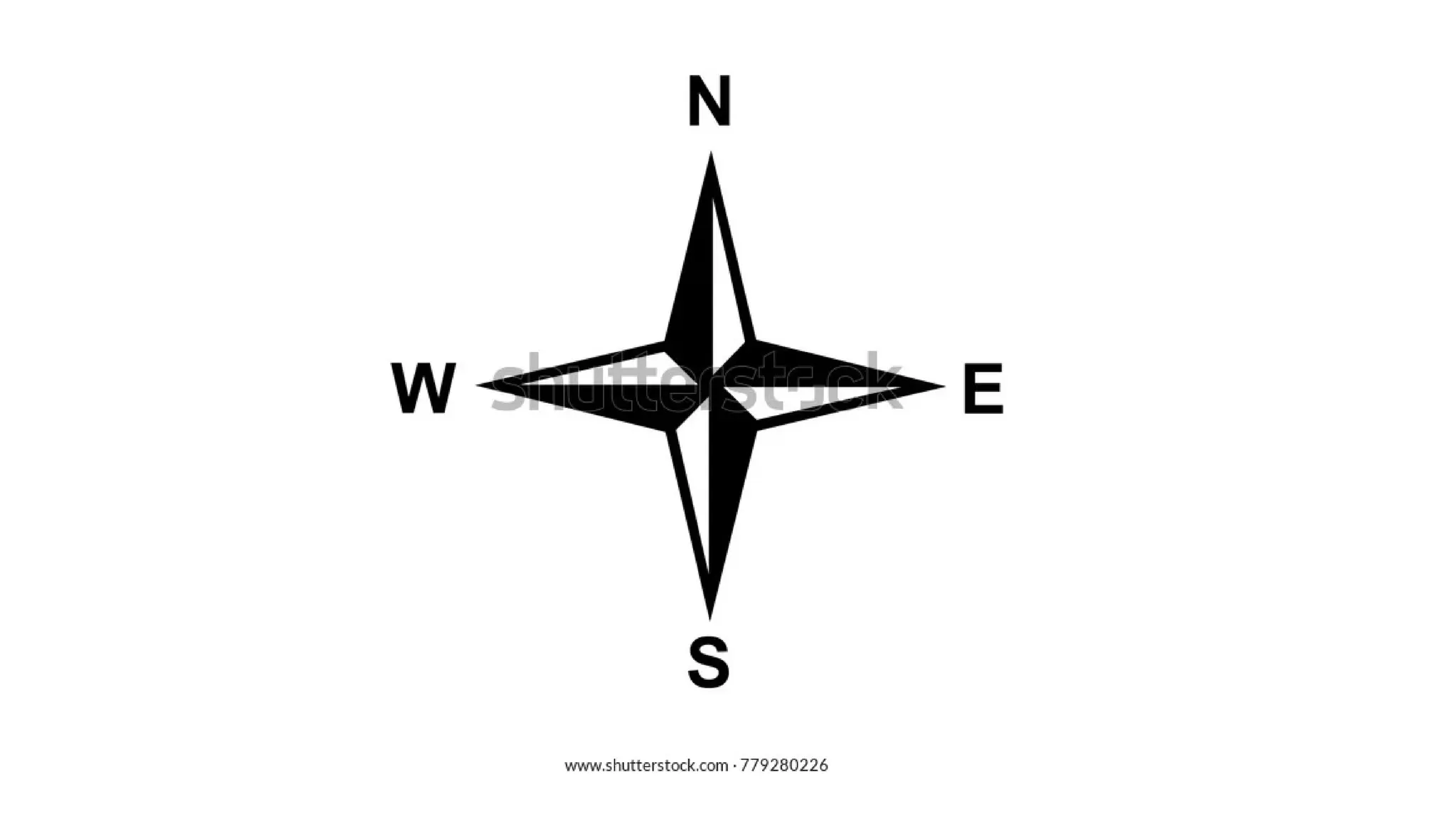
c. It is 2 meters north from where you are standing.
3.
Which of thegiven information would be the most
useful? Which is the least useful?
4.
Let us analyzeeach of the given.
a. You will have to search the whole area of the sofa
starting from you including those above and below
the sofa.
b. You will have to search all points 2 meters away
from you including those above and below the sofa.
c. Provided that you know about the direction of north,
you will be able to find the gold bar quickly.
Vector is aphysical quantity that has both magnitude
and direction.
Examples:
•Displacement of 2.0 m [North]
•Velocity of 60 km/hr [East]
•Force of 40 Newton [West]
7.
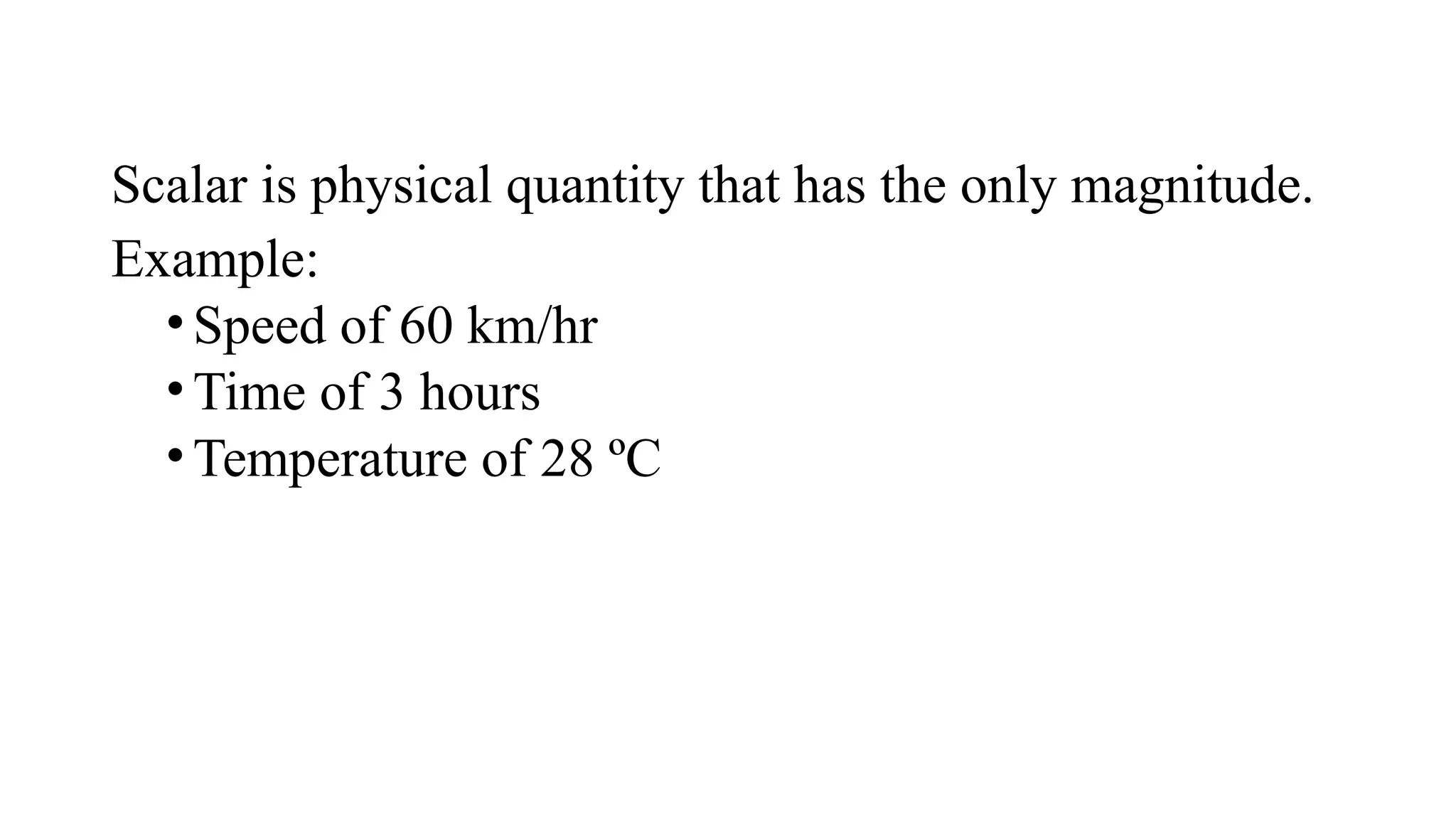
Scalar is physicalquantity that has the only magnitude.
Example:
•Speed of 60 km/hr
•Time of 3 hours
•Temperature of 28 ºC
Displacement
is a changein position, which has both magnitude
and direction. We will use letter d for position and the
symbol delta d (∆d) for displacement. The triangle sign,
∆, is the Greek letter delta and is used to represent
“change.”
We could represent the relationship between
displacement and position as:
12.
Sample Problem (DISPLACEMENT
VECTORS)
Astudent walks 4 meters east from her
house to the nearby store. Then, she
continues walking 3 meters further east to
her friend’s house.
13.
Where: d1 isthe initial point
d2 is the final point
R Resultant displacement
14.
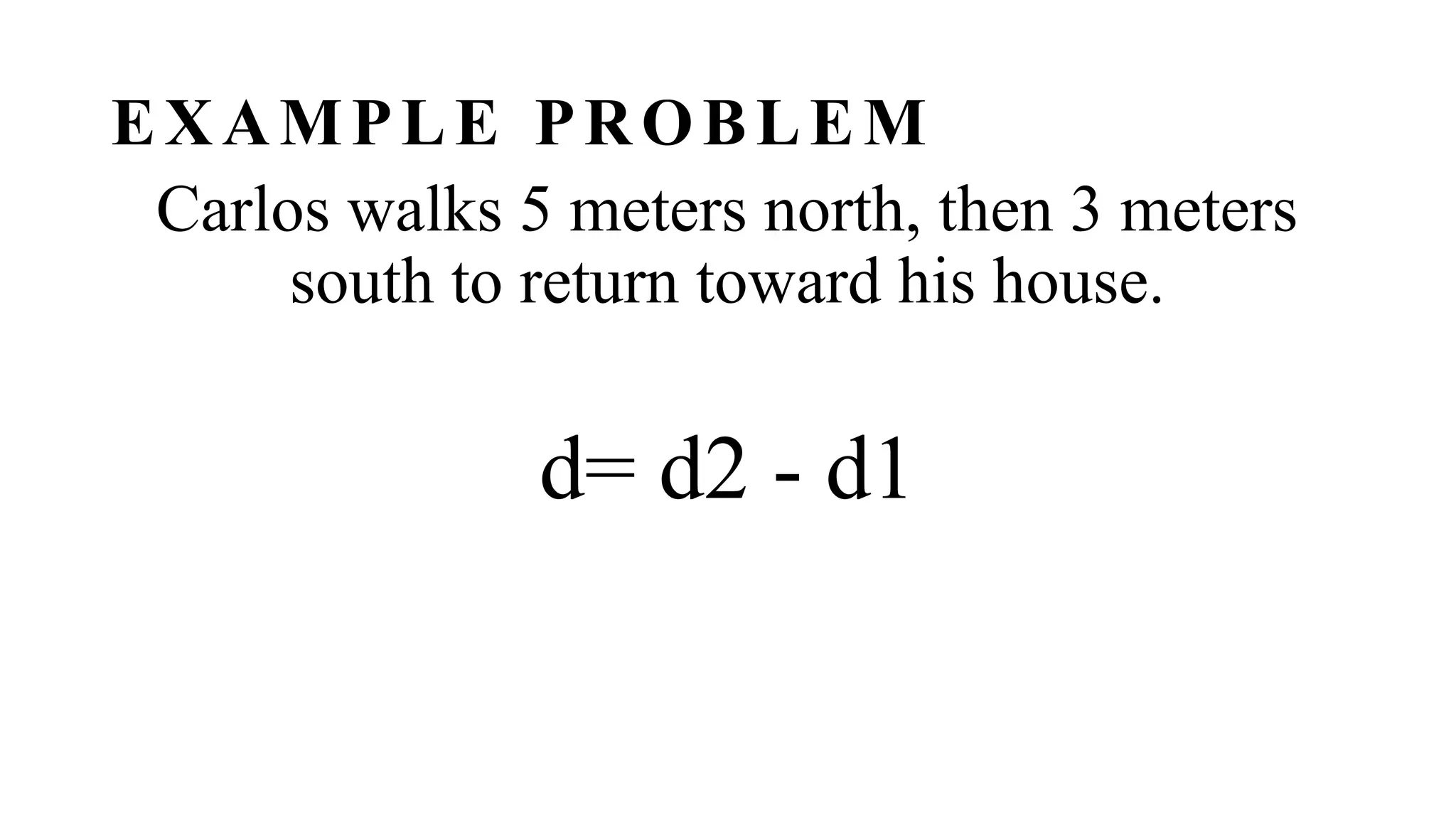
Sample Problem (OPPOSITE
DISPLACEMENTVECTORS)
Marvin walks 14 meters east to a nearby bakery.
After buying bread, he walks 9 meters west toward
his house.
Question:
What is Marvin’s resultant displacement from his
house? In which direction?
15.
Where: d1 isthe initial point
d2 is the final point
R Resultant displacement
16.
Sample Problem (OPPOSITE
DISPLACEMENTVECTORS)
A student walks 5 meters west to meet a friend.
Later, she walks 9 meters east to go to school.
Question:
What is her resultant displacement from her
house? In which direction?
17.
Sample Problem (PerpendicularVectors )
Jessa leaves her house and walks 9 meters east to
buy snacks at a nearby store. After that, she walks
12 meters north to visit a friend.
Question:
What is Jessa’s resultant displacement from her
house? How far and in what direction is she from
her starting point?
18.
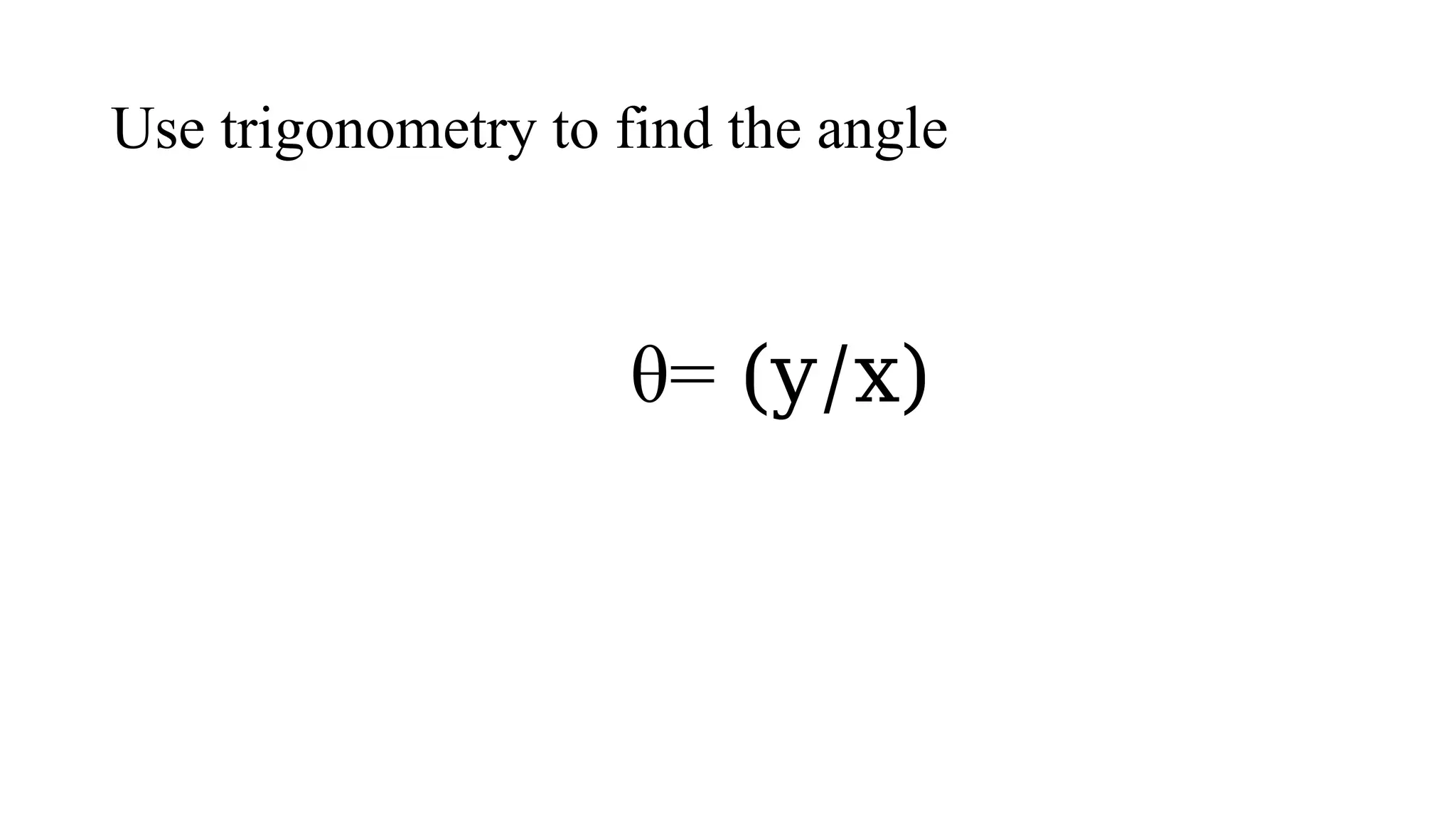
Use the Pythagoreantheorem to find
the resultant displacement
Where: d1 is the initial point
d2 is the final point
R Resultant displacement
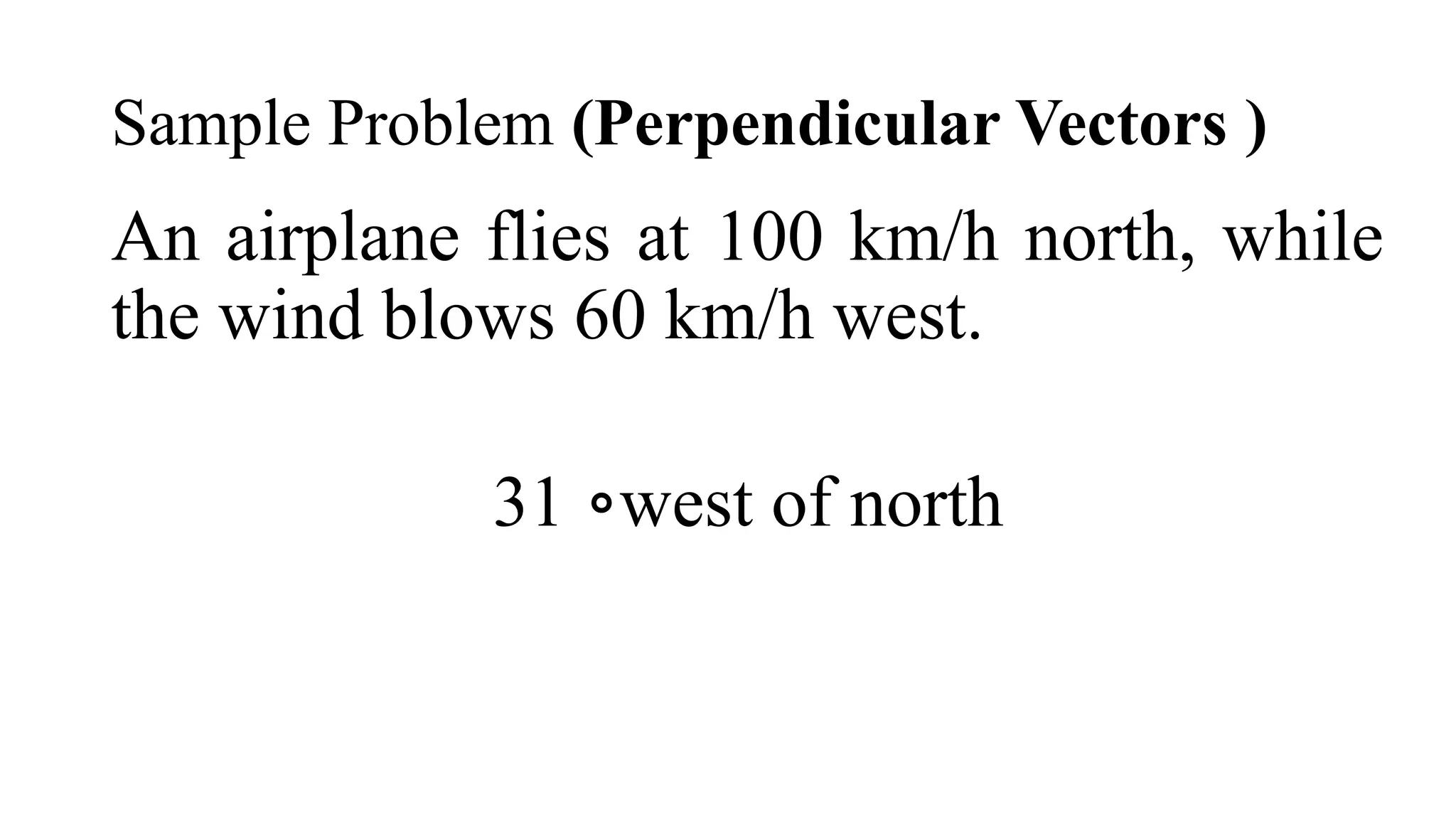
Sample Problem (PerpendicularVectors )
An airplane flies at 100 km/h north, while
the wind blows 60 km/h west.
31 west of north
∘
21.
1. Opposite DisplacementVectors
🔍 Clues/Characteristics:
Vectors point in exactly opposite directions
Example: East vs. West, North vs. South
•Movement is along the same straight line (1D motion)
•Often involves going forward and then backward, or to
and from the same path
•The angle between the vectors is 180°
22.
🧠 How toidentify:
•Check if both vectors are along the same axis (horizontal or vertical)
•See if one is described as going back, returning, or opposite in direction
•Use subtraction of magnitudes (larger minus smaller) to find the resultant
✅ Example:
10 m east, then 4 m west → opposite displacement vectors → Resultant: 6
m east
23.
2. Perpendicular DisplacementVectors
🔍 Clues/Characteristics:
•Vectors form a right angle (90°) between them
•Involves 2D motion — movement in two directions (e.g.,
north then east)
•Describes an L-shaped path or turn
•The vectors are on different axes (e.g., x-axis and y-axis)
24.
🧠 How toidentify:
•Look for direction changes like:
•From north to east
•From right to up
•From forward to sideways
Resultant forms the hypotenuse of a right triangle
Use the Pythagorean Theorem and trigonometric ratios (e.g., tan ¹)
⁻
✅ Example:
6 m north, then 8 m east → perpendicular vectors → Resultant: 10 m northeast
Distance
a scalar quantityin which direction is not
specified.
If the displacement from +2 m to +8 m is +6 m,
what is the distance covered?
The distance covered consists of the total distance
of the path taken and not the change in the initial and
final points.
28.
PRACTICE PROBLEM
1. Annawalks 6 meters east to buy snacks, then
continues walking 4 meters east to visit a friend.What is
Anna’s total displacement from her starting point, and
in what direction?
2. Liza walks 15 meters east from her house to a
grocery store. After shopping, she walks 10 meters west
back toward home.
PRACTICE PROBLEM
1. Annawalks 6 meters east to buy snacks, then
continues walking 4 meters east to visit a friend.What is
Anna’s total displacement from her starting point, and
in what direction?
2. Liza walks 15 meters east from her house to a
grocery store. After shopping, she walks 10 meters west
back toward home. What is Liza’s resultant
displacement from her starting point?
31.
PRACTICE PROBLEM
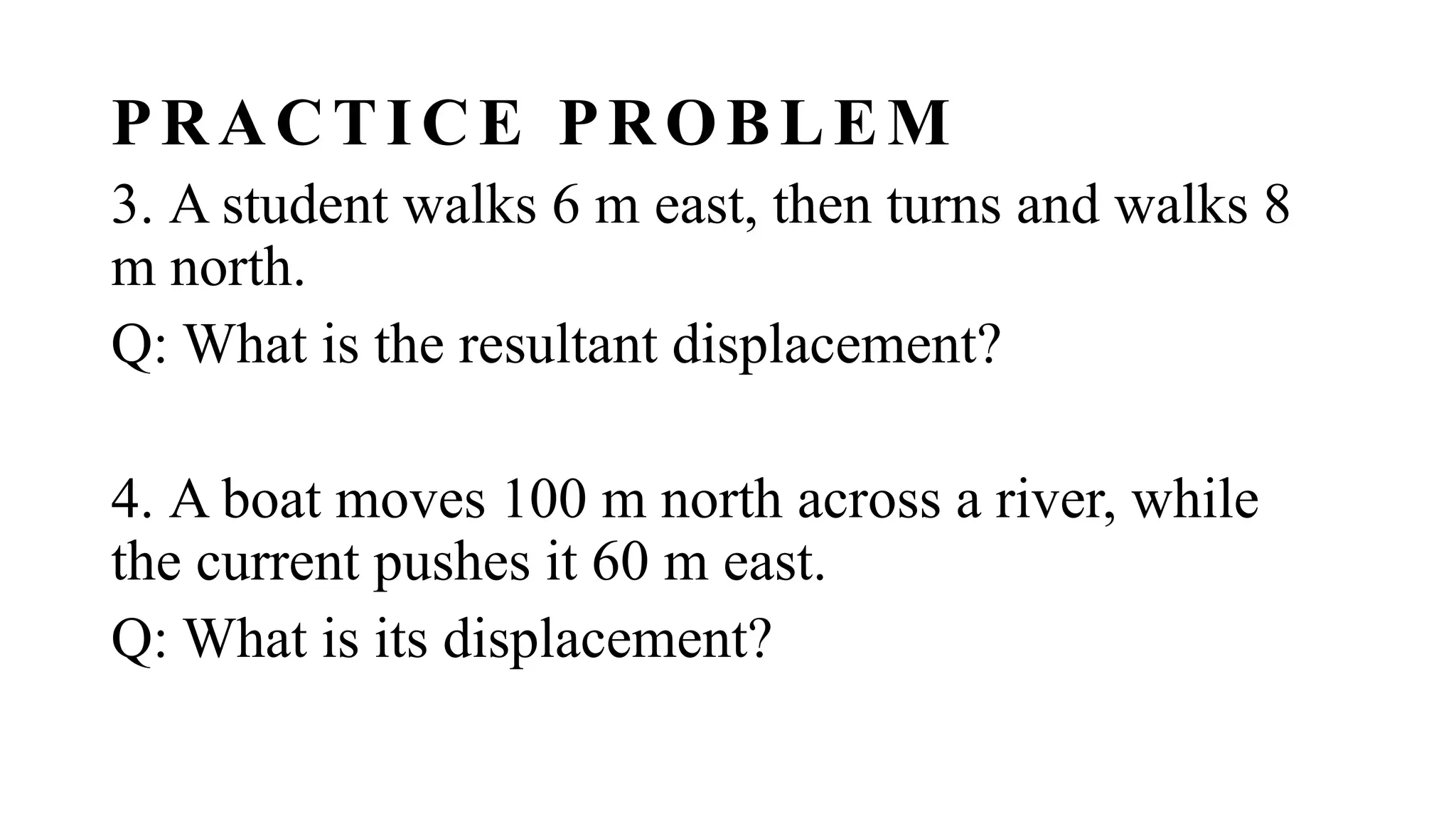
3. Astudent walks 6 m east, then turns and walks 8
m north.
Q: What is the resultant displacement?
4. A boat moves 100 m north across a river, while
the current pushes it 60 m east.
Q: What is its displacement?
32.
PRACTICE PROBLEM
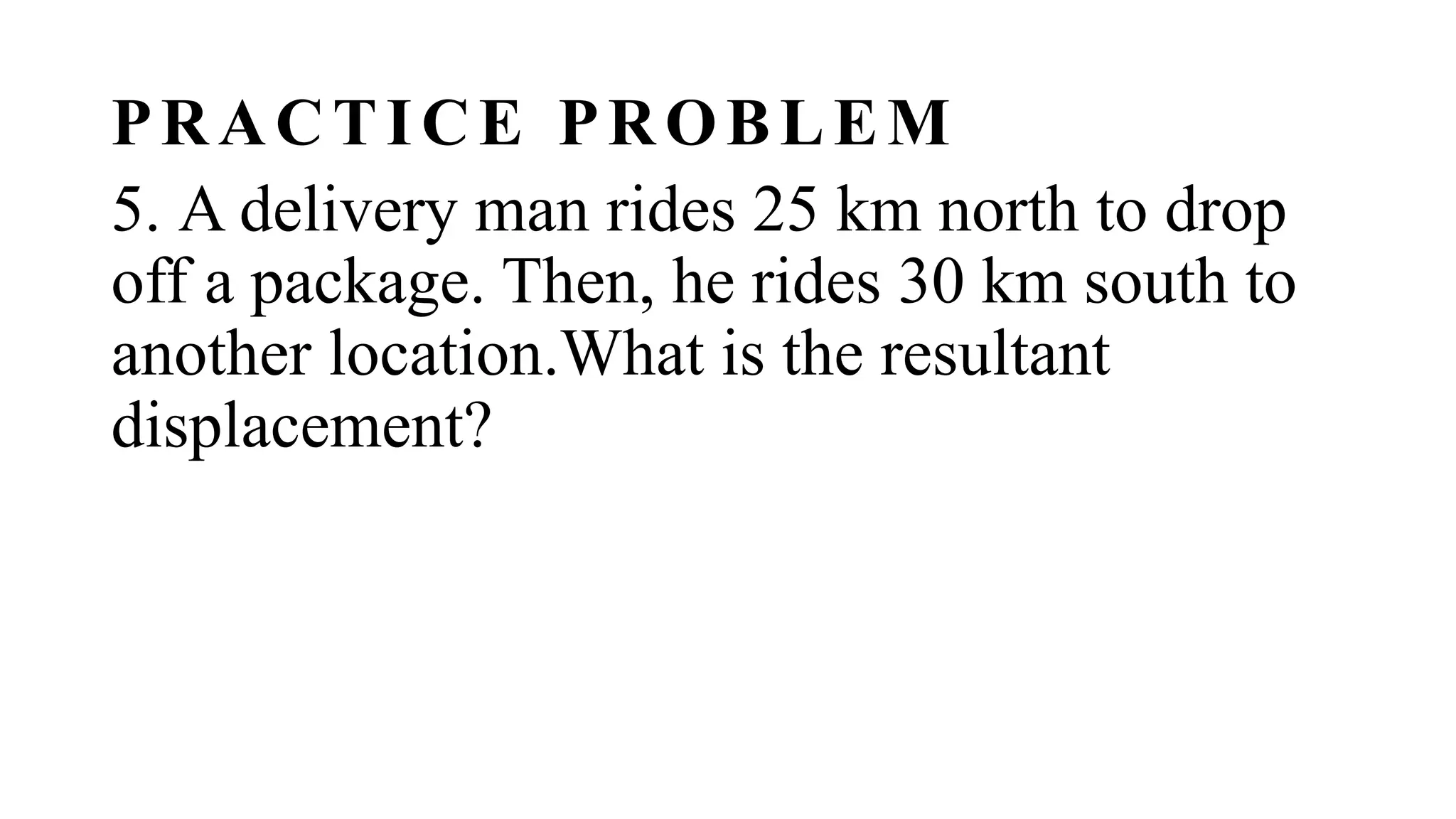
5. Adelivery man rides 25 km north to drop
off a package. Then, he rides 30 km south to
another location.What is the resultant
displacement?
33.
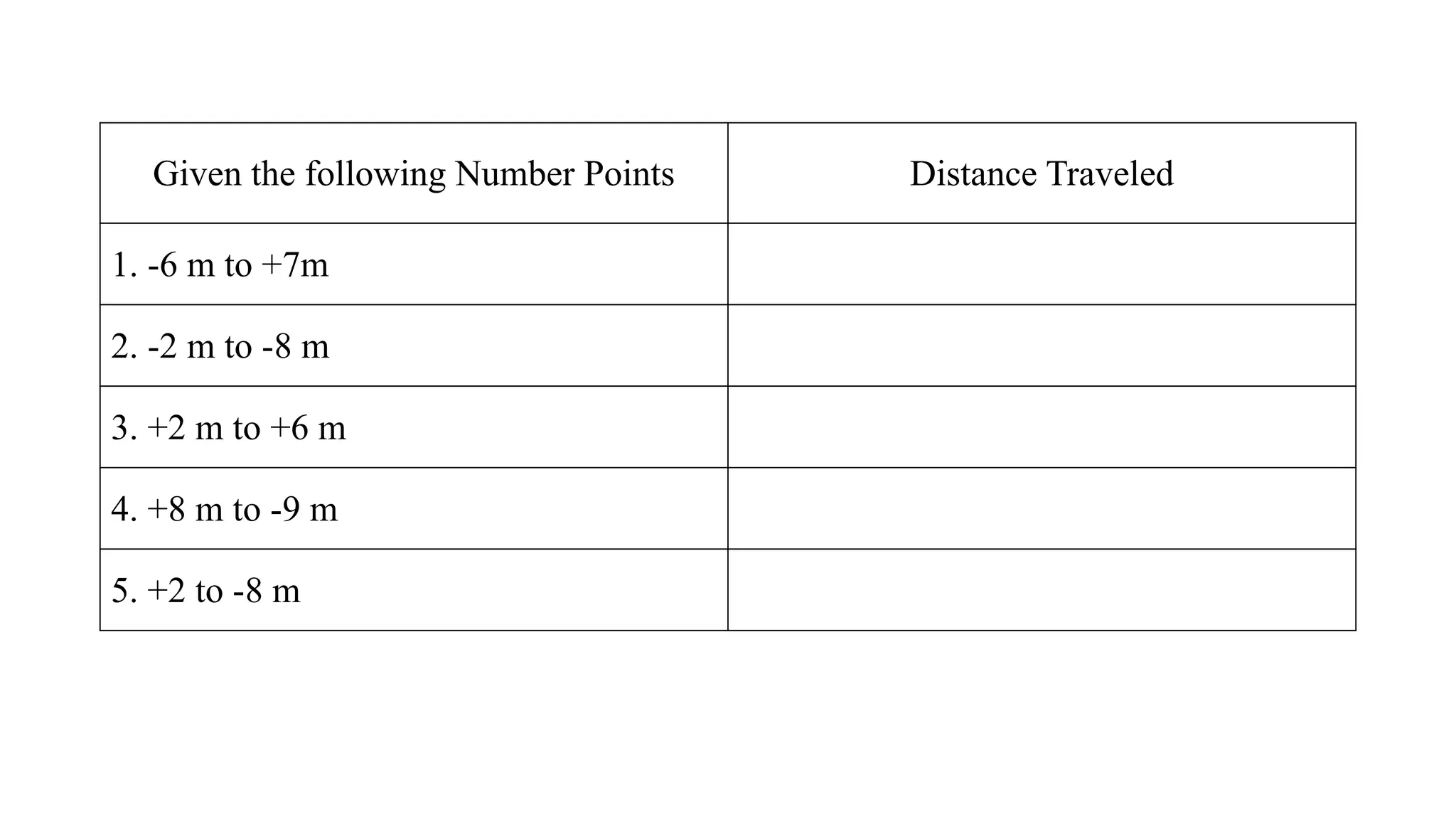
Given the followingNumber Points Distance Traveled
1. -6 m to +7m
2. -2 m to -8 m
3. +2 m to +6 m
4. +8 m to -9 m
5. +2 to -8 m
Vector Components
•Component –part
•The components of a vector mean the parts of a
vector.
•A vector has an x-part and a y-part or an x component
and a y-component
36.
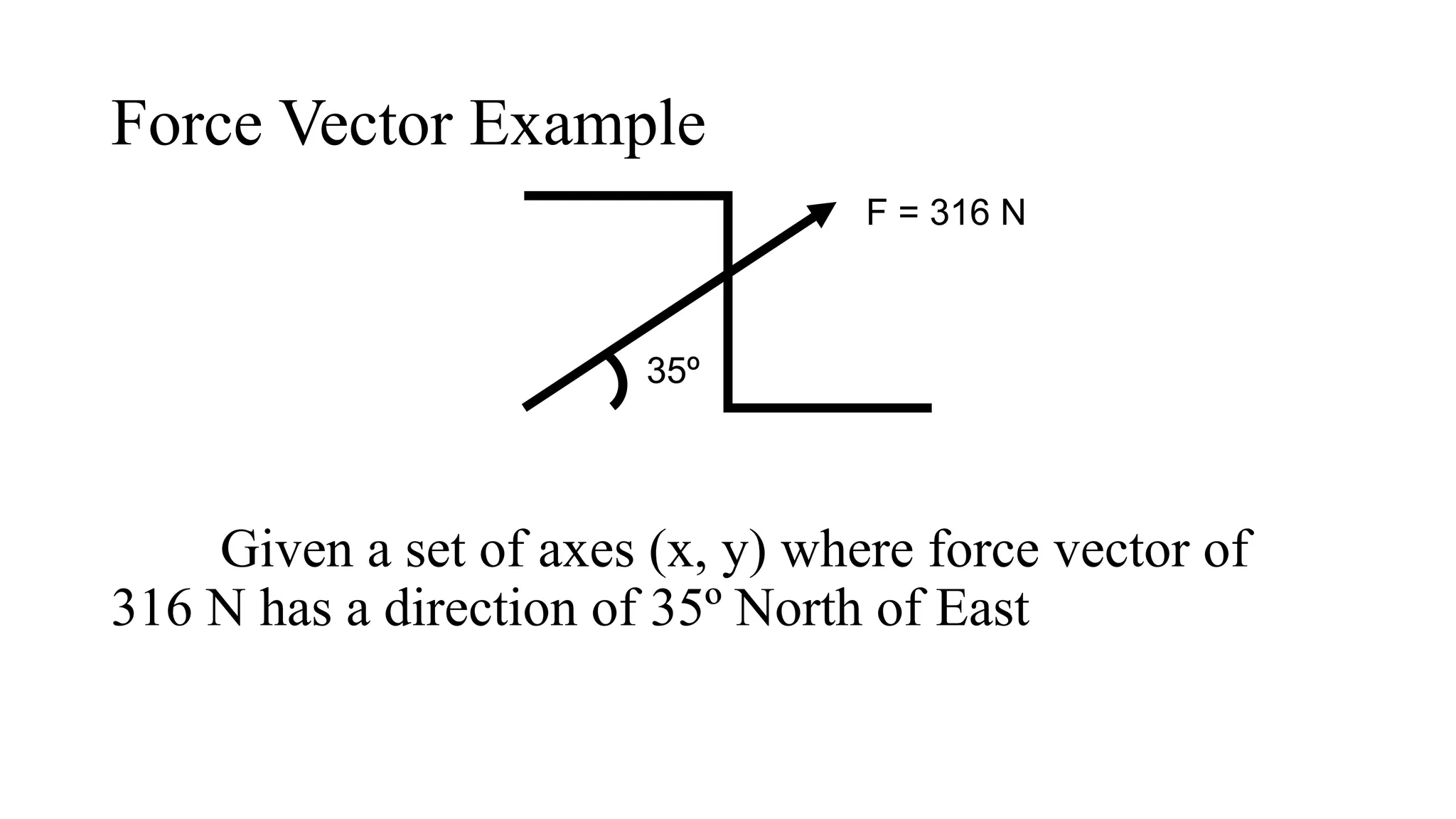
Force Vector Example
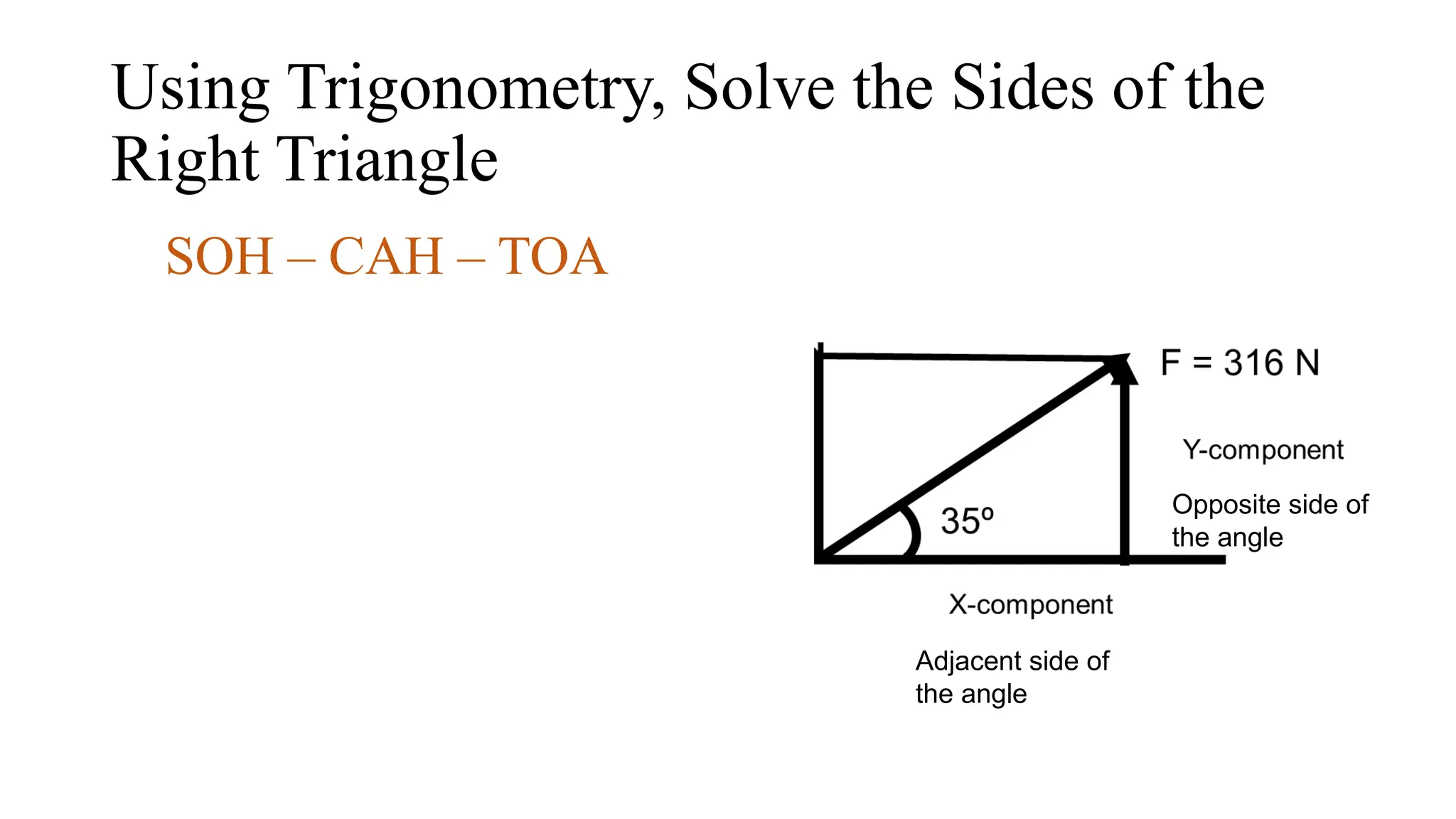
Givena set of axes (x, y) where force vector of
316 N has a direction of 35º North of East
35º
F = 316 N
37.
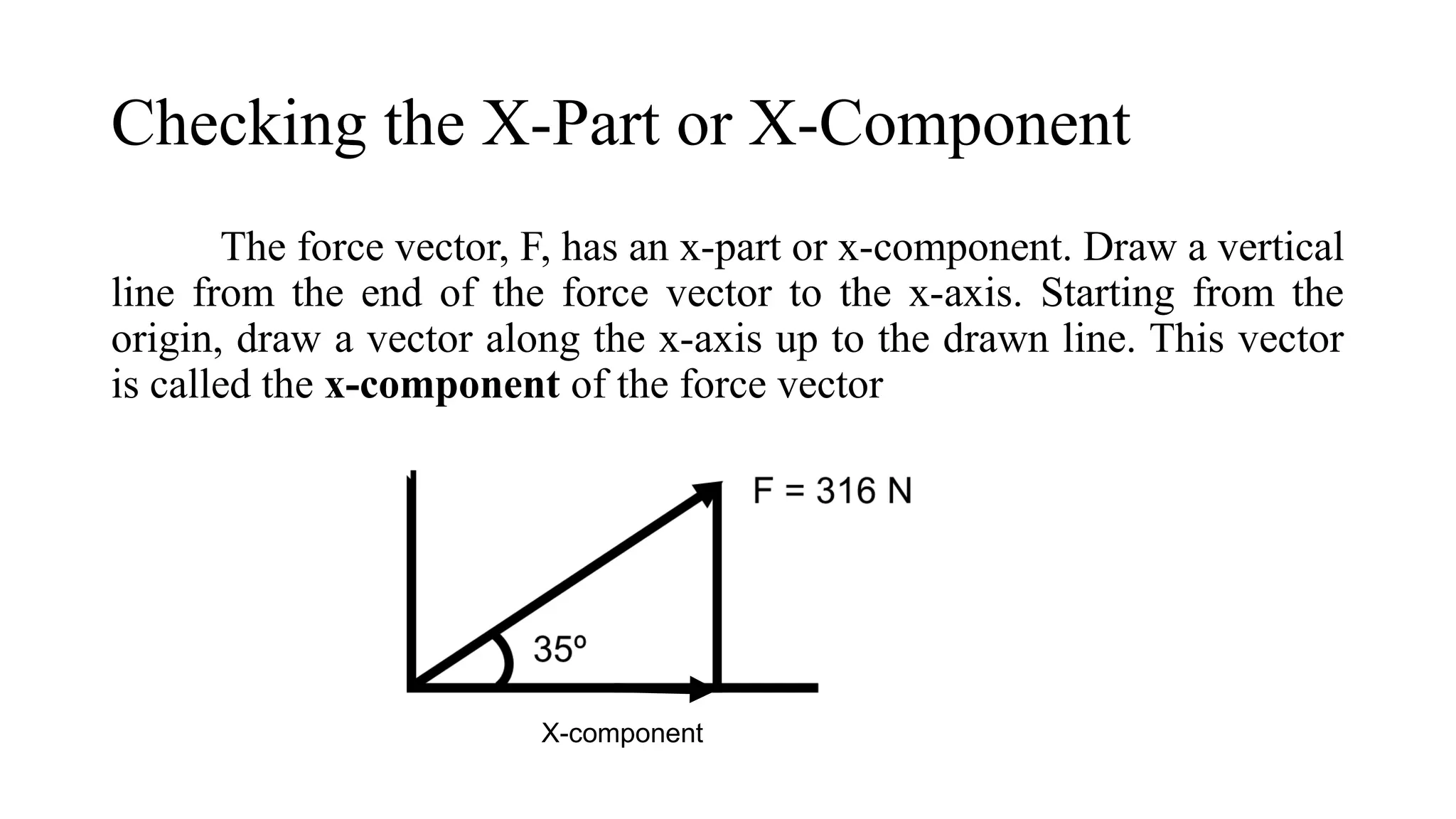
Checking the X-Partor X-Component
The force vector, F, has an x-part or x-component. Draw a vertical
line from the end of the force vector to the x-axis. Starting from the
origin, draw a vector along the x-axis up to the drawn line. This vector
is called the x-component of the force vector
X-component
38.
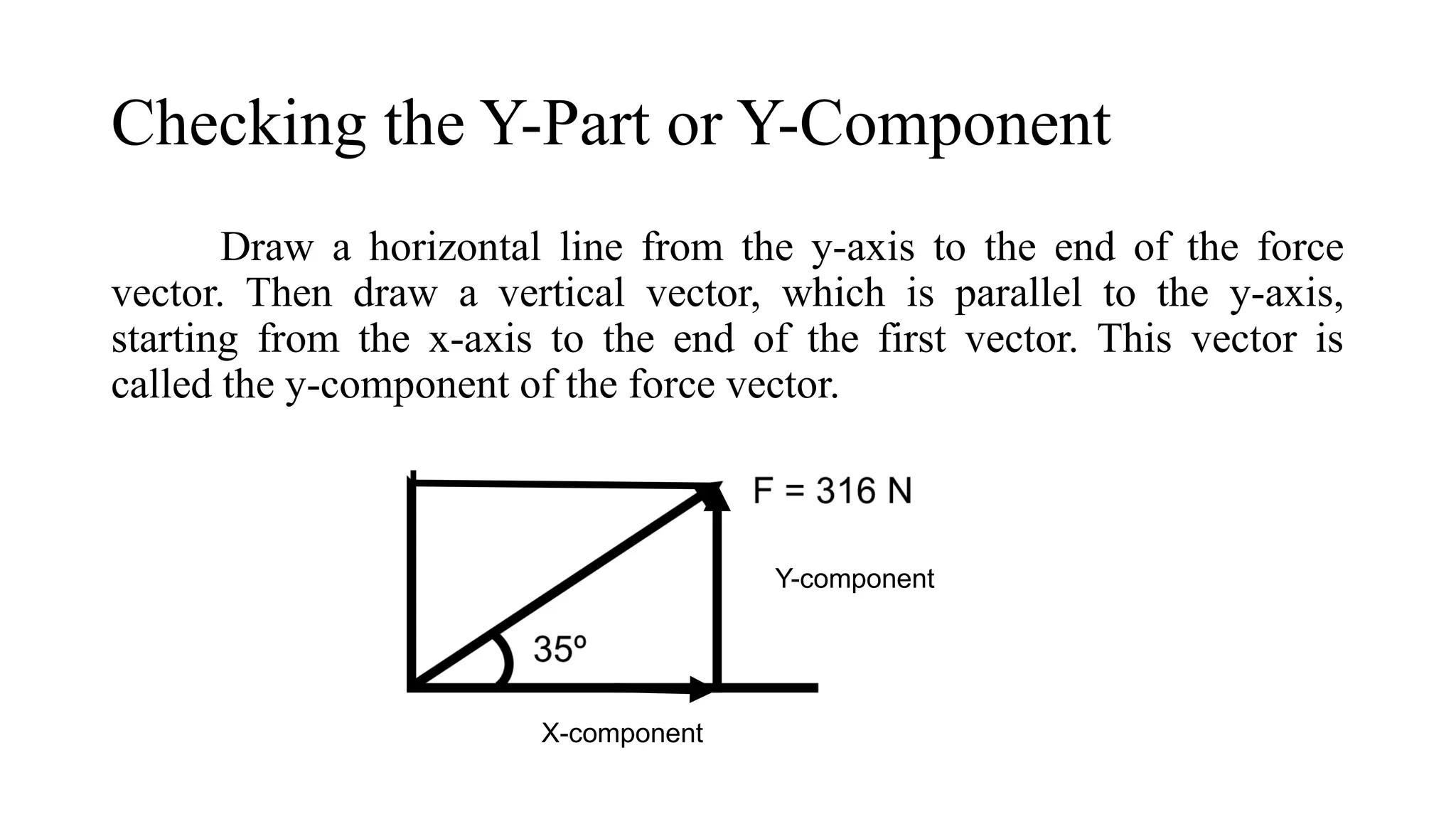
Checking the Y-Partor Y-Component
Draw a horizontal line from the y-axis to the end of the force
vector. Then draw a vertical vector, which is parallel to the y-axis,
starting from the x-axis to the end of the first vector. This vector is
called the y-component of the force vector.
X-component
Y-component
39.
Using Trigonometry, Solvethe Sides of the
Right Triangle
SOH – CAH – TOA
Opposite side of
the angle
Adjacent side of
the angle
40.
The Value ofX-Component
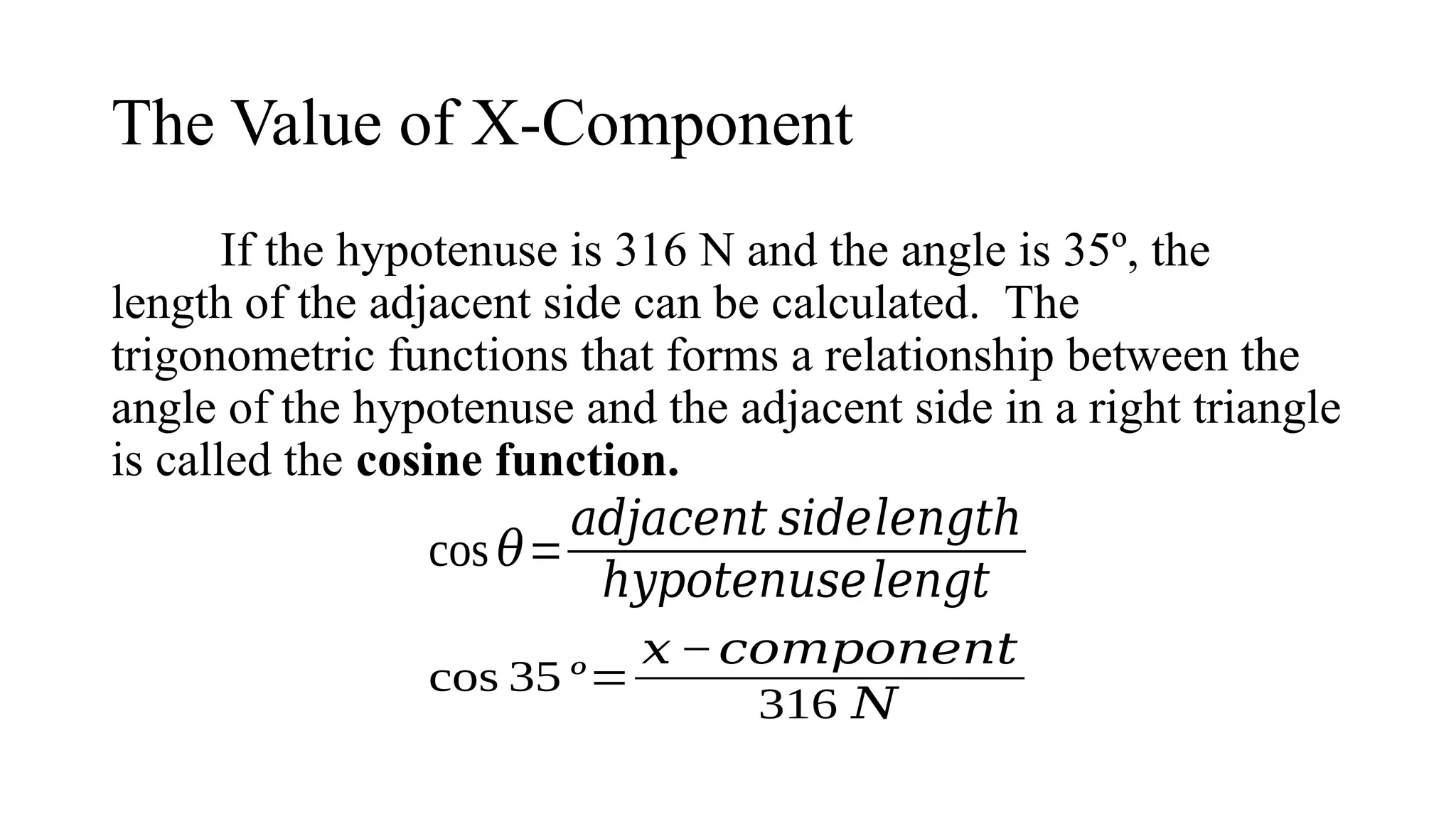
If the hypotenuse is 316 N and the angle is 35º, the
length of the adjacent side can be calculated. The
trigonometric functions that forms a relationship between the
angle of the hypotenuse and the adjacent side in a right triangle
is called the cosine function.
cos 𝜃=
𝑎𝑑𝑗𝑎𝑐𝑒𝑛𝑡 𝑠𝑖𝑑𝑒𝑙𝑒𝑛𝑔𝑡ℎ
ℎ𝑦𝑝𝑜𝑡𝑒𝑛𝑢𝑠𝑒𝑙𝑒𝑛𝑔𝑡
cos 35 º=
𝑥 −𝑐𝑜𝑚𝑝𝑜𝑛𝑒𝑛𝑡
316 𝑁
41.
The Value ofY-Component
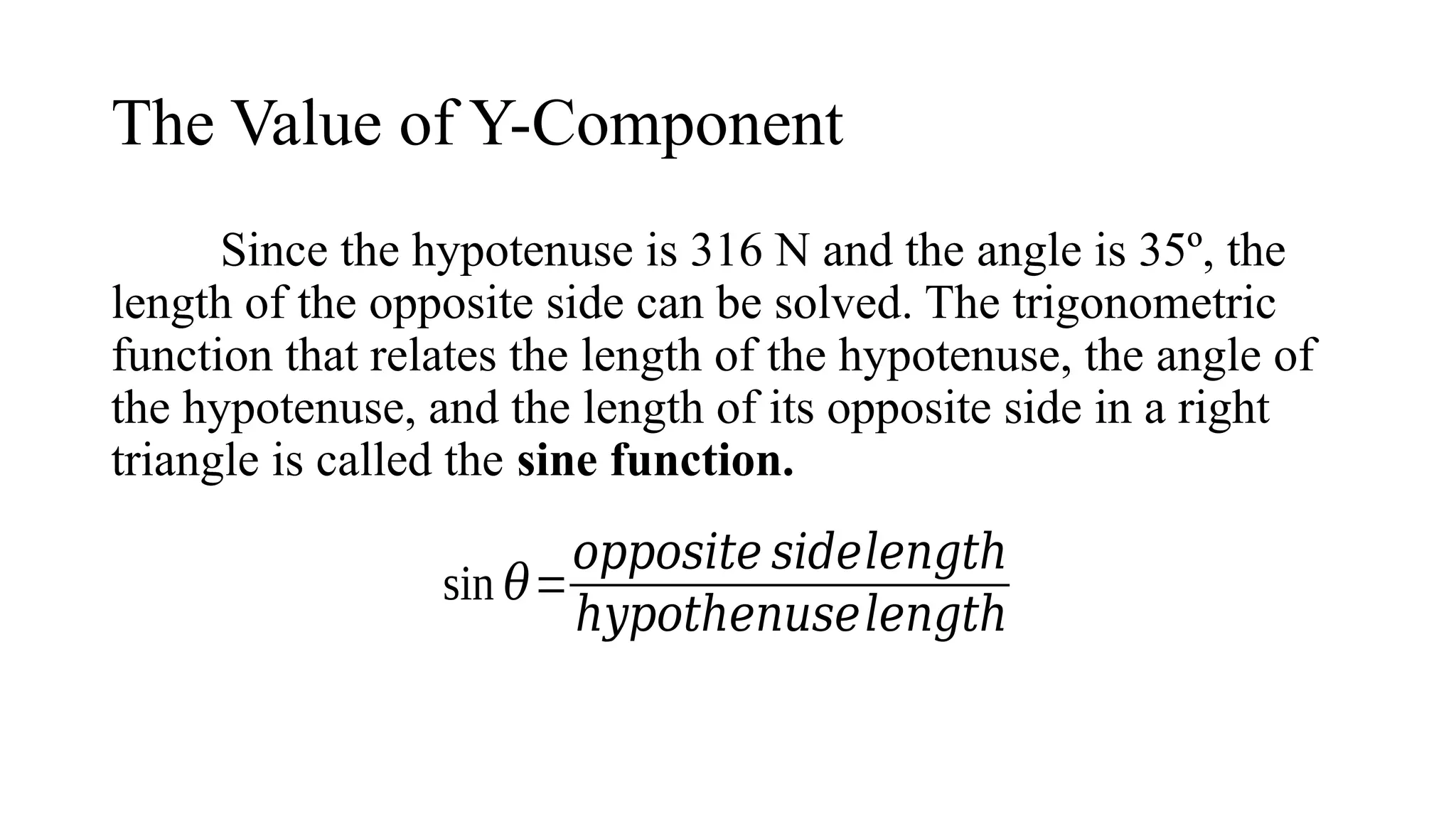
Since the hypotenuse is 316 N and the angle is 35º, the
length of the opposite side can be solved. The trigonometric
function that relates the length of the hypotenuse, the angle of
the hypotenuse, and the length of its opposite side in a right
triangle is called the sine function.
sin 𝜃=
𝑜𝑝𝑝𝑜𝑠𝑖𝑡𝑒 𝑠𝑖𝑑𝑒𝑙𝑒𝑛𝑔𝑡ℎ
ℎ𝑦𝑝𝑜𝑡ℎ𝑒𝑛𝑢𝑠𝑒𝑙𝑒𝑛𝑔𝑡ℎ
42.
Exercise
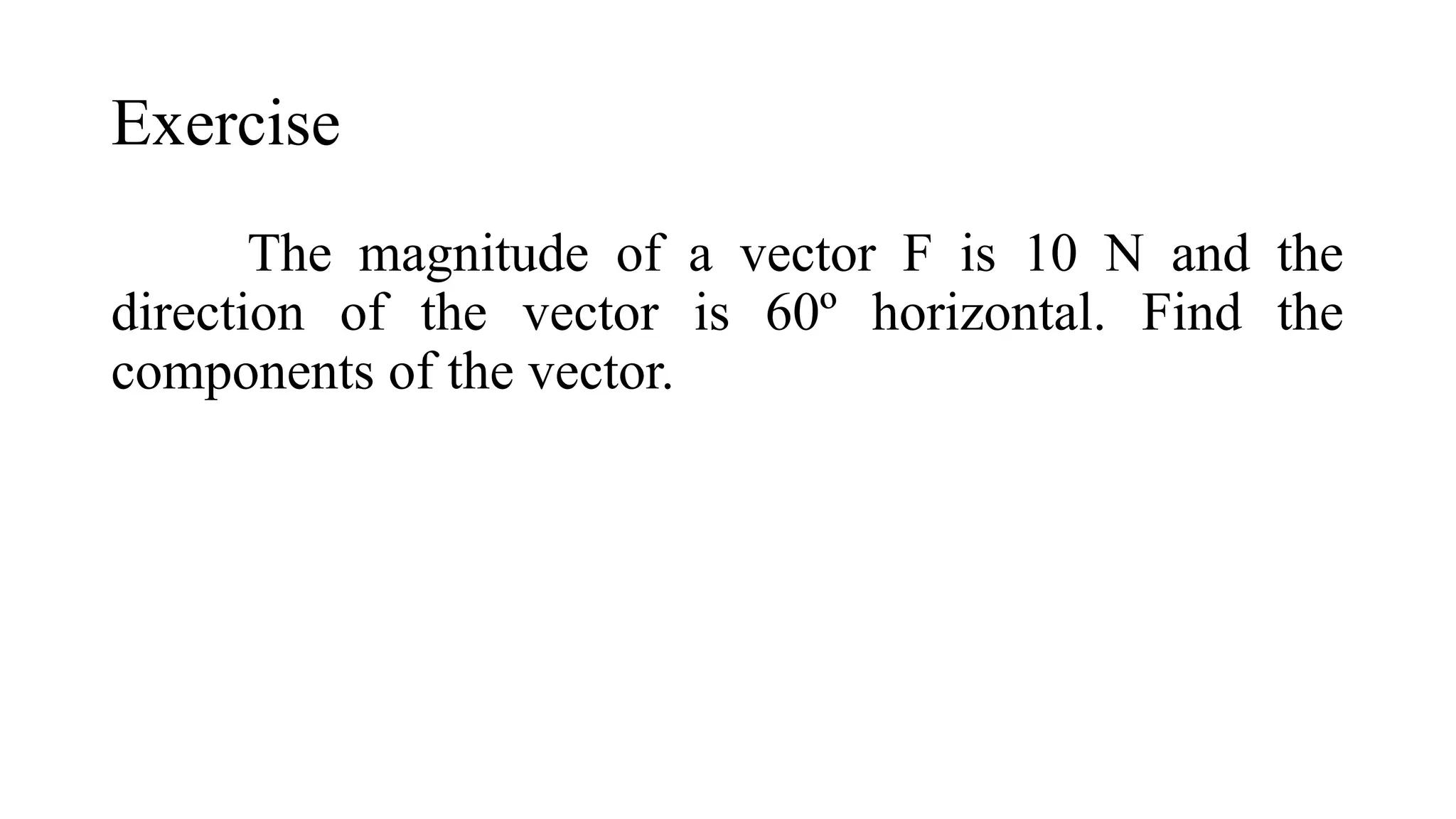
The magnitude ofa vector F is 10 N and the
direction of the vector is 60º horizontal. Find the
components of the vector.

![Vector is a physical quantity that has both magnitude
and direction.
Examples:
•Displacement of 2.0 m [North]
•Velocity of 60 km/hr [East]
•Force of 40 Newton [West]](https://image.slidesharecdn.com/vector-and-scalar-250810150247-aceda875/75/VECTOR-AND-SCALAR-PPT-FOR-GRADE-12-STUDENTS-6-2048.jpg)