To the Instructor iv
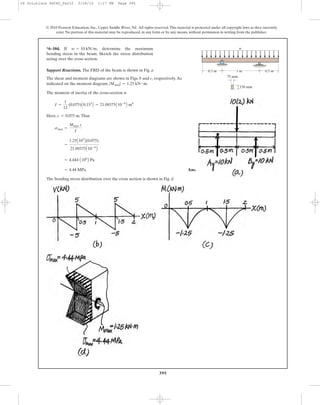
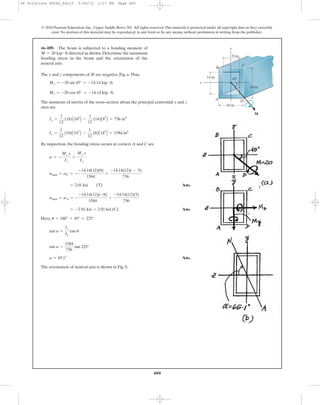
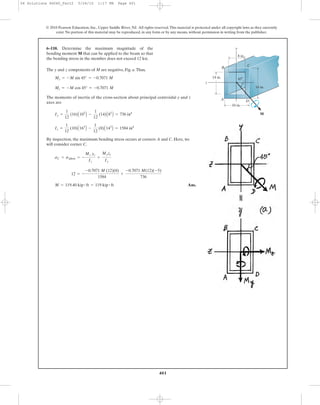
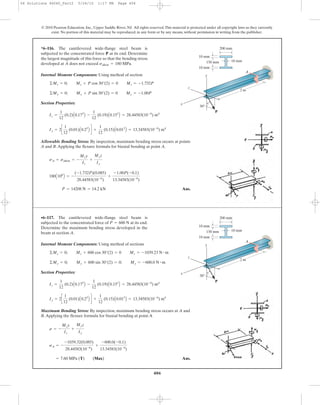
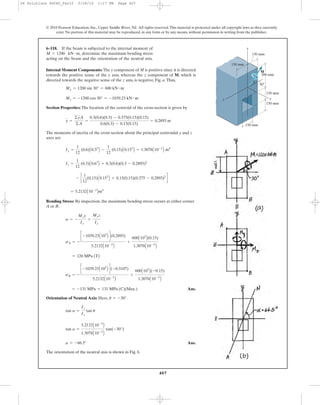
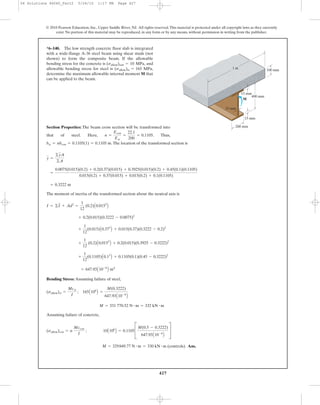
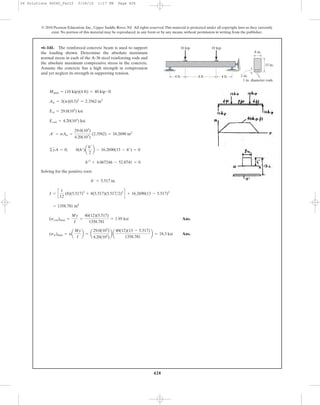
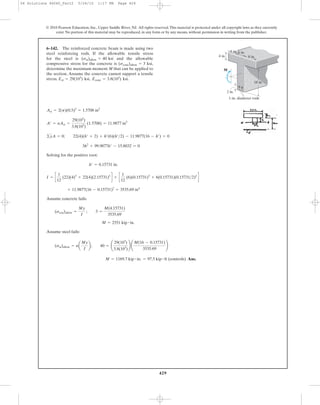
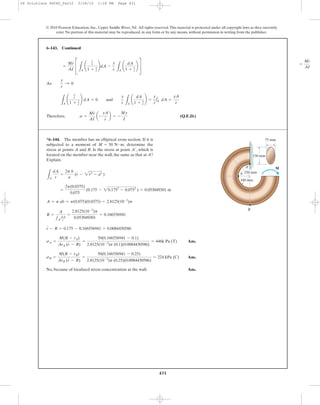
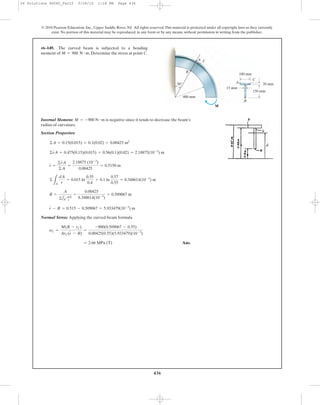
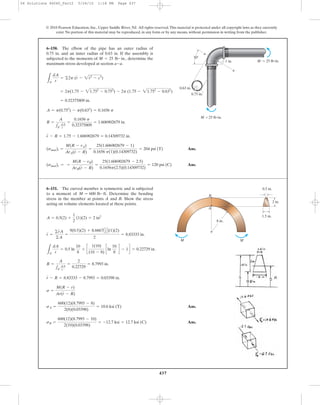
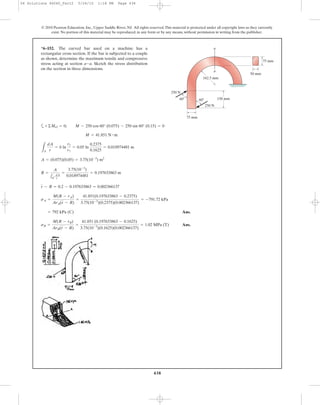
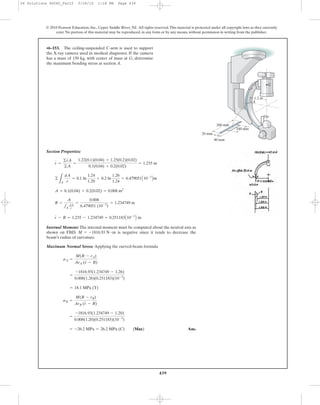
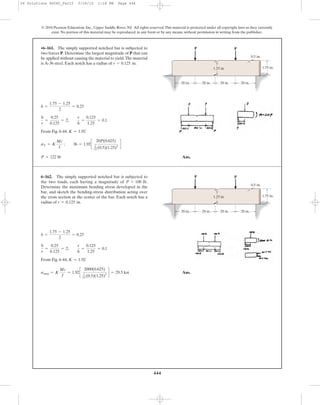
1 Stress 1
2 Strain 73
3 Mechanical Properties of Materials 92
4 Axial Load 122
5 Torsion 214
6 Bending 329
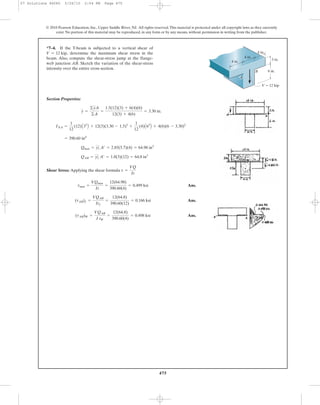
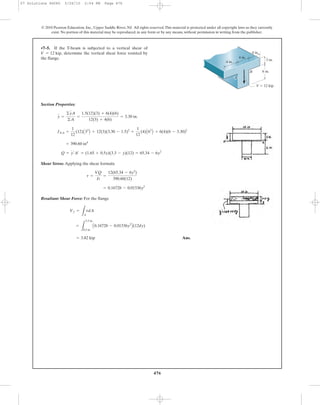
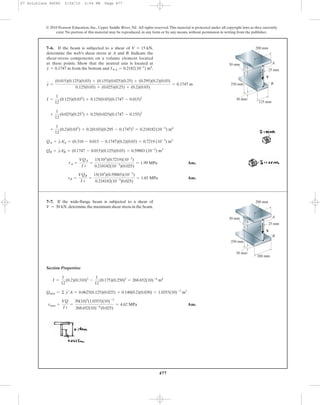
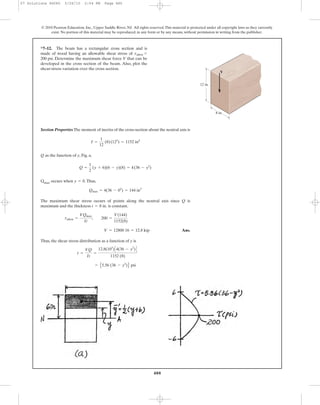
7 Transverse Shear 472
8 Combined Loadings 532
9 Stress Transformation 619
10 Strain Transformation 738
11 Design of Beams and Shafts 830
12 Deflection of Beams and Shafts 883
13 Buckling of Columns 1038
14 Energy Methods 1159
CONTENTS
FM_TOC 46060 6/22/10 11:26 AM Page iii
329
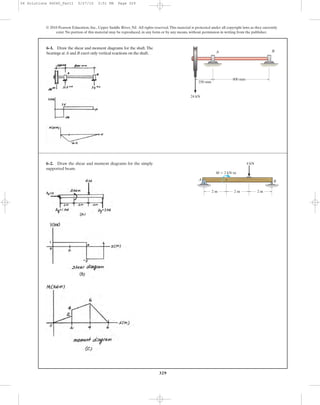
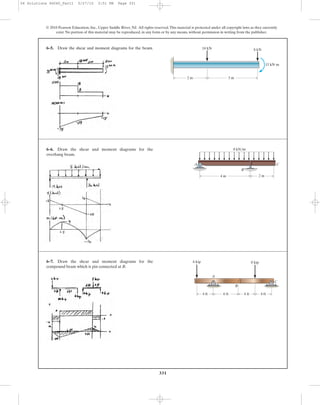
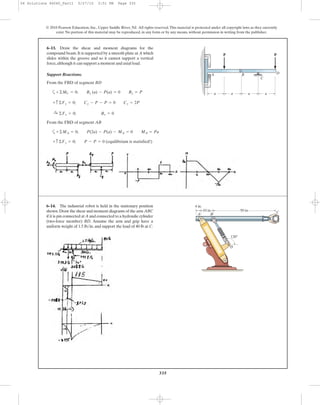
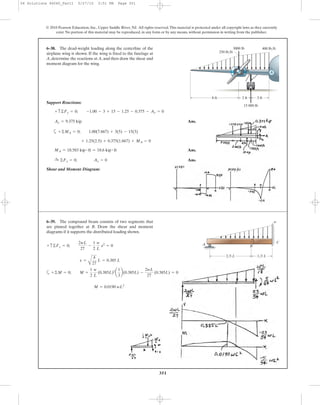
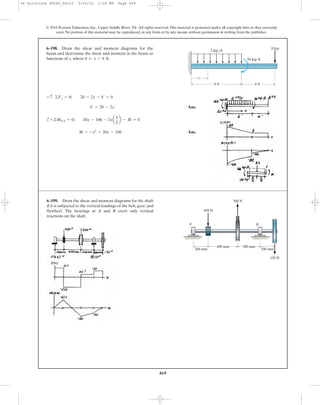
6–1. Draw the shear and moment diagrams for the shaft.The
bearings at A and B exert only vertical reactions on the shaft.
© 2010 Pearson Education, Inc., Upper Saddle River, NJ. All rights reserved.This material is protected under all copyright laws as they currently
exist. No portion of this material may be reproduced, in any form or by any means, without permission in writing from the publisher.
A B
250 mm
800 mm
24 kN
6–2. Draw the shear and moment diagrams for the simply
supported beam.
A B
M ϭ 2 kNиm
4 kN
2 m 2 m 2 m
06 Solutions 46060_Part1 5/27/10 3:51 PM Page 329
330
© 2010 Pearson Education, Inc., Upper Saddle River, NJ. All rights reserved.This material is protected under all copyright laws as they currently
exist. No portion of this material may be reproduced, in any form or by any means, without permission in writing from the publisher.
a
©Fx = 0; Ax -
3
5
(4000) = 0; Ax = 2400 lb;+
+ c ©Fy = 0; -Ay +
4
5
(4000) - 1200 = 0; Ay = 2000 lb
FA = 4000 lb+ ©MA = 0;
4
5
FA(3) - 1200(8) = 0;
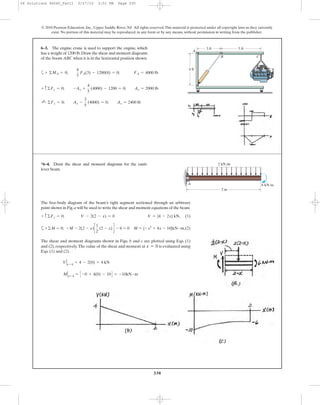
6–3. The engine crane is used to support the engine, which
has a weight of 1200 lb.Draw the shear and moment diagrams
of the boom ABC when it is in the horizontal position shown.
5 ft3 ft
CB
4 ft
A
The free-body diagram of the beam’s right segment sectioned through an arbitrary
point shown in Fig.a will be used to write the shear and moment equations of the beam.
*6–4. Draw the shear and moment diagrams for the canti-
lever beam.
2 kN/m
6 kNиm
2 m
A
‚ (1)
a ‚(2)+©M = 0; -M - 2(2 - x)c
1
2
(2 - x)d - 6 = 0 M = {-x2
+ 4x - 10}kN # m
+ c©Fy = 0; V - 2(2 - x) = 0 V = {4 - 2x} kN
The shear and moment diagrams shown in Figs. b and c are plotted using Eqs. (1)
and (2), respectively.The value of the shear and moment at is evaluated using
Eqs. (1) and (2).
MΗx= 0
= C -0 + 4(0) - 10D = -10kN # m
VΗx = 0
= 4 - 2(0) = 4 kN
x = 0
06 Solutions 46060_Part1 5/27/10 3:51 PM Page 330
331
© 2010 Pearson Education, Inc., Upper Saddle River, NJ. All rights reserved.This material is protected under all copyright laws as they currently
exist. No portion of this material may be reproduced, in any form or by any means, without permission in writing from the publisher.
6–5. Draw the shear and moment diagrams for the beam.
2 m 3 m
10 kN 8 kN
15 kNиm
6–6. Draw the shear and moment diagrams for the
overhang beam.
A
B
C
4 m 2 m
8 kN/m
6–7. Draw the shear and moment diagrams for the
compound beam which is pin connected at B.
4 ft
6 kip 8 kip
A
C
B
6 ft 4 ft 4 ft
06 Solutions 46060_Part1 5/27/10 3:51 PM Page 331
332
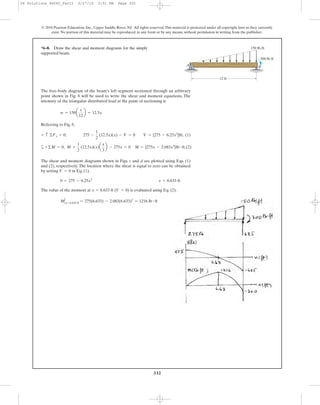
The free-body diagram of the beam’s left segment sectioned through an arbitrary
point shown in Fig. b will be used to write the shear and moment equations. The
intensity of the triangular distributed load at the point of sectioning is
Referring to Fig. b,
w = 150a
x
12
b = 12.5x
*6–8. Draw the shear and moment diagrams for the simply
supported beam.
© 2010 Pearson Education, Inc., Upper Saddle River, NJ. All rights reserved.This material is protected under all copyright laws as they currently
exist. No portion of this material may be reproduced, in any form or by any means, without permission in writing from the publisher.
A B
150 lb/ft
12 ft
300 lbиft
‚ (1)
a ‚(2)+©M = 0; M +
1
2
(12.5x)(x)a
x
3
b - 275x = 0 M = {275x - 2.083x3
}lb # ft
+ c ©Fy = 0; 275 -
1
2
(12.5x)(x) - V = 0 V = {275 - 6.25x2
}lb
The shear and moment diagrams shown in Figs. c and d are plotted using Eqs. (1)
and (2), respectively. The location where the shear is equal to zero can be obtained
by setting in Eq. (1).
The value of the moment at is evaluated using Eq. (2).
MΗx= 6.633 ft = 275(6.633) - 2.083(6.633)3
= 1216 lb # ft
x = 6.633 ft (V = 0)
0 = 275 - 6.25x2
x = 6.633 ft
V = 0
06 Solutions 46060_Part1 5/27/10 3:51 PM Page 332
333
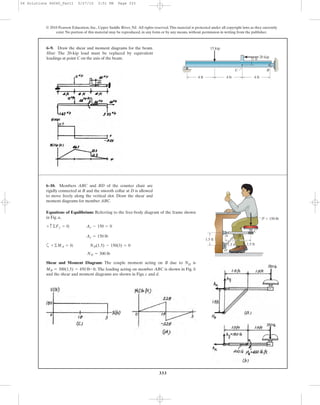
6–9. Draw the shear and moment diagrams for the beam.
Hint: The 20-kip load must be replaced by equivalent
loadings at point C on the axis of the beam.
© 2010 Pearson Education, Inc., Upper Saddle River, NJ. All rights reserved.This material is protected under all copyright laws as they currently
exist. No portion of this material may be reproduced, in any form or by any means, without permission in writing from the publisher.
B
4 ft
A
4 ft 4 ft
15 kip
20 kip
C
1 ft
Equations of Equilibrium: Referring to the free-body diagram of the frame shown
in Fig. a,
a
Shear and Moment Diagram: The couple moment acting on B due to ND is
. The loading acting on member ABC is shown in Fig. b
and the shear and moment diagrams are shown in Figs. c and d.
MB = 300(1.5) = 450 lb # ft
ND = 300 lb
+©MA = 0; ND(1.5) - 150(3) = 0
Ay = 150 lb
+ c ©Fy = 0; Ay - 150 = 0
6–10. Members ABC and BD of the counter chair are
rigidly connected at B and the smooth collar at D is allowed
to move freely along the vertical slot. Draw the shear and
moment diagrams for member ABC.
A
D
B
C
P ϭ 150 lb
1.5 ft1.5 ft
1.5 ft
06 Solutions 46060_Part1 5/27/10 3:51 PM Page 333
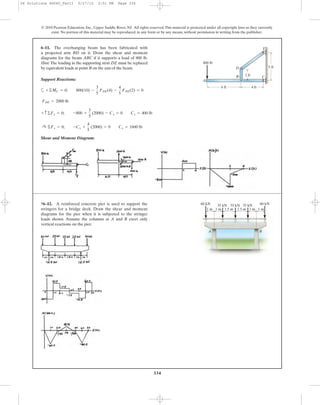
Support Reactions:
a
Shear and Moment Diagram:
©Fx = 0; -Cx +
4
5
(2000) = 0 Cx = 1600 lb:+
+ c ©Fy = 0; -800 +
3
5
(2000) - Cy = 0 Cy = 400 lb
FDE = 2000 lb
+©MC = 0; 800(10) -
3
5
FDE(4) -
4
5
FDE(2) = 0
6–11. The overhanging beam has been fabricated with
a projected arm BD on it. Draw the shear and moment
diagrams for the beam ABC if it supports a load of 800 lb.
Hint: The loading in the supporting strut DE must be replaced
by equivalent loads at point B on the axis of the beam.
334
© 2010 Pearson Education, Inc., Upper Saddle River, NJ. All rights reserved.This material is protected under all copyright laws as they currently
exist. No portion of this material may be reproduced, in any form or by any means, without permission in writing from the publisher.
800 lb
D
B
A
E
C
6 ft 4 ft
5 ft
2 ft
*6–12. A reinforced concrete pier is used to support the
stringers for a bridge deck. Draw the shear and moment
diagrams for the pier when it is subjected to the stringer
loads shown. Assume the columns at A and B exert only
vertical reactions on the pier.
1 m 1 m 1 m 1 m1.5 m
60 kN 60 kN35 kN 35 kN 35 kN
1.5 m
A B
06 Solutions 46060_Part1 5/27/10 3:51 PM Page 334
335
© 2010 Pearson Education, Inc., Upper Saddle River, NJ. All rights reserved.This material is protected under all copyright laws as they currently
exist. No portion of this material may be reproduced, in any form or by any means, without permission in writing from the publisher.
Support Reactions:
From the FBD of segment BD
a
From the FBD of segment AB
a
+ c ©Fy = 0; P - P = 0 (equilibrium is statisfied!)
+©MA = 0; P(2a) - P(a) - MA = 0 MA = Pa
©Fx = 0; Bx = 0:+
+ c ©Fy = 0; Cy - P - P = 0 Cy = 2P
+©MC = 0; By (a) - P(a) = 0 By = P
6–13. Draw the shear and moment diagrams for the
compound beam.It is supported by a smooth plate at A which
slides within the groove and so it cannot support a vertical
force,although it can support a moment and axial load.
a
A B
a a a
P P
C
D
10 in.
4 in.
50 in.
A B
C
D
120Њ
6–14. The industrial robot is held in the stationary position
shown.Draw the shear and moment diagrams of the arm ABC
if it is pin connected at A and connected to a hydraulic cylinder
(two-force member) BD. Assume the arm and grip have a
uniform weight of 1.5 lb͞in. and support the load of 40 lb at C.
06 Solutions 46060_Part1 5/27/10 3:51 PM Page 335
336
© 2010 Pearson Education, Inc., Upper Saddle River, NJ. All rights reserved.This material is protected under all copyright laws as they currently
exist. No portion of this material may be reproduced, in any form or by any means, without permission in writing from the publisher.
For
‚ Ans.
a
‚ Ans.
For
Ans.
a
‚ Ans.
For
‚ Ans.
a
Ans.M = (500x - 3000) lb ft
+©MNA = 0; -M - 500(5.5 - x) - 250 = 0
+ c ©Fy = 0; V - 500 = 0 V = 500 lb
5 ft 6 x … 6 ft
M = {-580x + 2400} lb ft
+©MNA = 0; M + 800(x - 3) - 220x = 0
V = -580 lb
+ c©Fy = 0; 220 - 800 - V = 0
3 ft 6 x 6 5 ft
M = (220x) lb ft
+©MNA = 0. M - 220x = 0
+ c ©Fy = 0. 220 - V = 0 V = 220 lb
0 6 x 6 3 ft
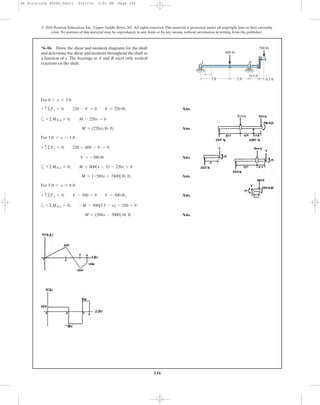
*6–16. Draw the shear and moment diagrams for the shaft
and determine the shear and moment throughout the shaft as
a function of x. The bearings at A and B exert only vertical
reactions on the shaft.
x
BA
800 lb
500 lb
3 ft 2 ft
0.5 ft
0.5 ft
06 Solutions 46060_Part1 5/27/10 3:51 PM Page 336
337
© 2010 Pearson Education, Inc., Upper Saddle River, NJ. All rights reserved.This material is protected under all copyright laws as they currently
exist. No portion of this material may be reproduced, in any form or by any means, without permission in writing from the publisher.
(1)
a (2)+©M = 0; M +
1
2
(33.33x)(x)a
x
3
b + 300x = 0 M = {-300x - 5.556x3
} lb # ft
+ c©Fy = 0; -300 -
1
2
(33.33x)(x) - V = 0 V = {-300 - 16.67x2
} lb
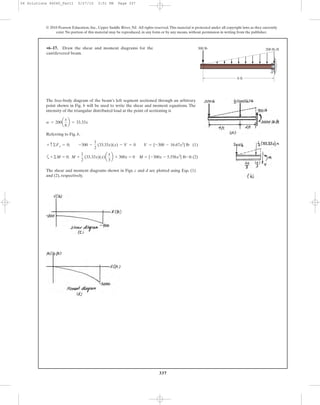
•6–17. Draw the shear and moment diagrams for the
cantilevered beam.
300 lb 200 lb/ft
A
6 ft
The free-body diagram of the beam’s left segment sectioned through an arbitrary
point shown in Fig. b will be used to write the shear and moment equations. The
intensity of the triangular distributed load at the point of sectioning is
Referring to Fig. b,
w = 200a
x
6
b = 33.33x
The shear and moment diagrams shown in Figs. c and d are plotted using Eqs. (1)
and (2), respectively.
06 Solutions 46060_Part1 5/27/10 3:51 PM Page 337
338
© 2010 Pearson Education, Inc., Upper Saddle River, NJ. All rights reserved.This material is protected under all copyright laws as they currently
exist. No portion of this material may be reproduced, in any form or by any means, without permission in writing from the publisher.
Support Reactions: As shown on FBD.
Shear and Moment Function:
For :
Ans.
a
Ans.
For :
Ans.
a
Ans.M = {8.00x - 120} kip # ft
+©MNA = 0; -M - 8(10 - x) - 40 = 0
+ c ©Fy = 0; V - 8 = 0 V = 8.00 kip
6 ft 6 x … 10 ft
M = {-x2
+ 30.0x - 216} kip # ft
+©MNA = 0; M + 216 + 2xa
x
2
b - 30.0x = 0
V = {30.0 - 2x} kip
+ c©Fy = 0; 30.0 - 2x - V = 0
0 … x 6 6 ft
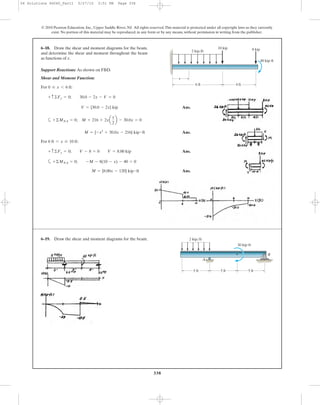
6–18. Draw the shear and moment diagrams for the beam,
and determine the shear and moment throughout the beam
as functions of x.
6 ft 4 ft
2 kip/ft 8 kip
x
10 kip
40 kipиft
A
30 kipиft
B
5 ft 5 ft
2 kip/ft
5 ft
6–19. Draw the shear and moment diagrams for the beam.
06 Solutions 46060_Part1 5/27/10 3:51 PM Page 338
339
© 2010 Pearson Education, Inc., Upper Saddle River, NJ. All rights reserved.This material is protected under all copyright laws as they currently
exist. No portion of this material may be reproduced, in any form or by any means, without permission in writing from the publisher.
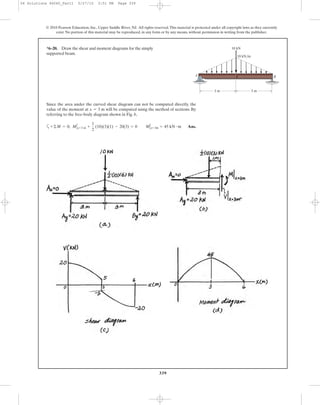
Since the area under the curved shear diagram can not be computed directly, the
value of the moment at will be computed using the method of sections. By
referring to the free-body diagram shown in Fig. b,
a Ans.+©M = 0; MΗx= 3 m +
1
2
(10)(3)(1) - 20(3) = 0 MΗx= 3m = 45 kN # m
x = 3 m
*6–20. Draw the shear and moment diagrams for the simply
supported beam.
10 kN
10 kN/m
3 m
A B
3 m
06 Solutions 46060_Part1 5/27/10 3:51 PM Page 339
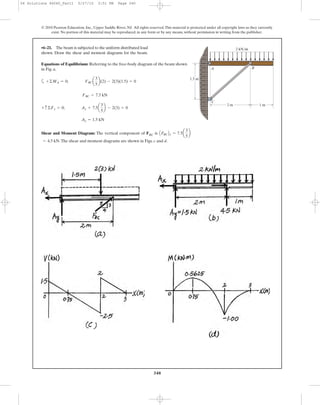
•6–21. The beam is subjected to the uniform distributed load
shown. Draw the shear and moment diagrams for the beam.
340
© 2010 Pearson Education, Inc., Upper Saddle River, NJ. All rights reserved.This material is protected under all copyright laws as they currently
exist. No portion of this material may be reproduced, in any form or by any means, without permission in writing from the publisher.
BA
C
2 m
1.5 m
1 m
2 kN/m
Equations of Equilibrium: Referring to the free-body diagram of the beam shown
in Fig. a,
a
Shear and Moment Diagram: The vertical component of FBC is
.The shear and moment diagrams are shown in Figs. c and d.= 4.5 kN
AFBCBy = 7.5a
3
5
b
Ay = 1.5 kN
+ c ©Fy = 0; Ay + 7.5a
3
5
b - 2(3) = 0
FBC = 7.5 kN
+©MA = 0; FBCa
3
5
b(2) - 2(3)(1.5) = 0
06 Solutions 46060_Part1 5/27/10 3:51 PM Page 340
341
© 2010 Pearson Education, Inc., Upper Saddle River, NJ. All rights reserved.This material is protected under all copyright laws as they currently
exist. No portion of this material may be reproduced, in any form or by any means, without permission in writing from the publisher.
(1)
a (2)
Region , Fig. c
(3)
a (4)+©M = 0; -M - 4(6 - x)c
1
2
(6 - x)d = 0 M = {-2(6 - x)2
}kN # m
+ c ©Fy = 0; V - 4(6 - x) = 0 V = {24 - 4x} kN
3 m 6 x … 6 m
+©M = 0; M +
1
2
a
4
3
xb(x)a
x
3
b + 4x = 0 M = e -
2
9
x3
- 4xf kN # m
+ c ©Fy = 0; -4 -
1
2
a
4
3
xb(x) - V = 0 V = e -
2
3
x2
- 4f kN
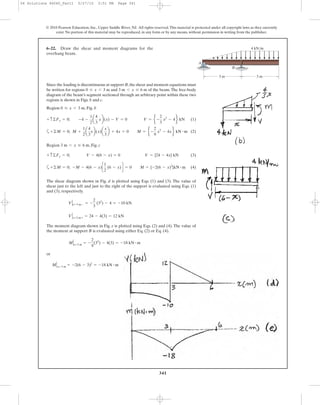
6–22. Draw the shear and moment diagrams for the
overhang beam.
4 kN/m
3 m 3 m
A
B
Since the loading is discontinuous at support B,the shear and moment equations must
be written for regions and of the beam.The free-body
diagram of the beam’s segment sectioned through an arbitrary point within these two
regions is shown in Figs. b and c.
Region , Fig. b0 … x 6 3 m
3 m 6 x … 6 m0 … x 6 3 m
The shear diagram shown in Fig. d is plotted using Eqs. (1) and (3). The value of
shear just to the left and just to the right of the support is evaluated using Eqs. (1)
and (3), respectively.
The moment diagram shown in Fig. e is plotted using Eqs. (2) and (4). The value of
the moment at support B is evaluated using either Eq. (2) or Eq. (4).
or
MΗx= 3 m = -2(6 - 3)2
= -18 kN # m
MΗx=3 m = -
2
9
(33
) - 4(3) = -18 kN # m
VΗx=3 m + = 24 - 4(3) = 12 kN
VΗx= 3 m - = -
2
3
(32
) - 4 = -10 kN
06 Solutions 46060_Part1 5/27/10 3:51 PM Page 341
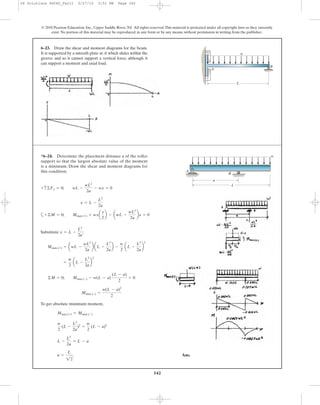
6–23. Draw the shear and moment diagrams for the beam.
It is supported by a smooth plate at A which slides within the
groove and so it cannot support a vertical force, although it
can support a moment and axial load.
342
© 2010 Pearson Education, Inc., Upper Saddle River, NJ. All rights reserved.This material is protected under all copyright laws as they currently
exist. No portion of this material may be reproduced, in any form or by any means, without permission in writing from the publisher.
L
A
B
w
a
Substitute ;
To get absolute minimum moment,
‚ Ans.a =
L
22
L -
L2
2a
= L - a
w
2
(L -
L2
2a
)2
=
w
2
(L - a)2
Mmax (+) = Mmax (-)
Mmax (-) =
w(L - a)2
2
©M = 0; Mmax (-) - w(L - a)
(L - a)
2
= 0
=
w
2
aL -
L2
2a
b
2
Mmax (+) = awL -
wL2
2a
b aL -
L2
2a
b -
w
2
aL -
L2
2a
b
2
x = L -
L2
2a
+©M = 0; Mmax (+) + wxa
x
2
b - awL -
wL2
2a
bx = 0
x = L -
L2
2a
+ c ©Fy = 0; wL -
wL2
2a
- wx = 0
*6–24. Determine the placement distance a of the roller
support so that the largest absolute value of the moment
is a minimum. Draw the shear and moment diagrams for
this condition.
a
w
L
A
B
06 Solutions 46060_Part1 5/27/10 3:51 PM Page 342
343
© 2010 Pearson Education, Inc., Upper Saddle River, NJ. All rights reserved.This material is protected under all copyright laws as they currently
exist. No portion of this material may be reproduced, in any form or by any means, without permission in writing from the publisher.
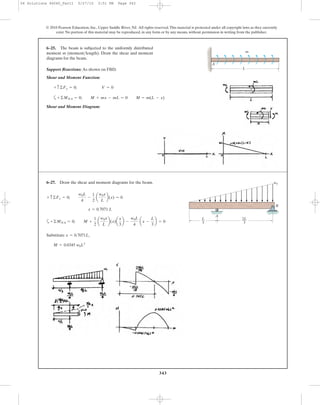
Support Reactions: As shown on FBD.
Shear and Moment Function:
a
Shear and Moment Diagram:
+©MNA = 0; M + mx - mL = 0 M = m(L - x)
+ c ©Fy = 0; V = 0
6–25. The beam is subjected to the uniformly distributed
moment m ( ). Draw the shear and moment
diagrams for the beam.
moment>length
L
A
m
a
Substitute ,
M = 0.0345 w0L2
x = 0.7071L
+©MNA = 0; M +
1
2
a
w0x
L
b(x)a
x
3
b -
w0L
4
ax -
L
3
b = 0
x = 0.7071 L
+ c ©Fy = 0;
w0L
4
-
1
2
a
w0x
L
b(x) = 0
6–27. Draw the shear and moment diagrams for the beam.
B
w0
A
2L
3
L
3
06 Solutions 46060_Part1 5/27/10 3:51 PM Page 343
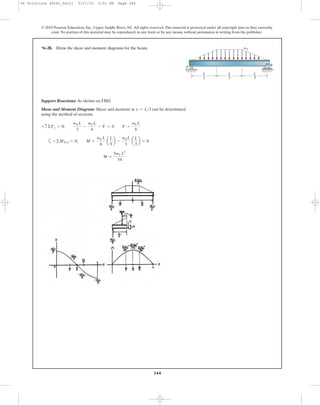
Support Reactions: As shown on FBD.
Shear and Moment Diagram: Shear and moment at can be determined
using the method of sections.
a
M =
5w0 L2
54
+©MNA = 0; M +
w0 L
6
a
L
9
b -
w0 L
3
a
L
3
b = 0
+ c ©Fy = 0;
w0 L
3
-
w0 L
6
- V = 0 V =
w0 L
6
x = L>3
344
© 2010 Pearson Education, Inc., Upper Saddle River, NJ. All rights reserved.This material is protected under all copyright laws as they currently
exist. No portion of this material may be reproduced, in any form or by any means, without permission in writing from the publisher.
*6–28. Draw the shear and moment diagrams for the beam.
–
3
L –
3
L –
3
L
w0
A B
06 Solutions 46060_Part1 5/27/10 3:51 PM Page 344
345
© 2010 Pearson Education, Inc., Upper Saddle River, NJ. All rights reserved.This material is protected under all copyright laws as they currently
exist. No portion of this material may be reproduced, in any form or by any means, without permission in writing from the publisher.
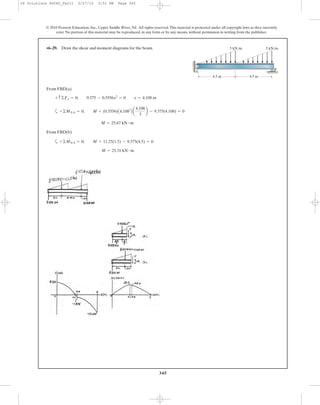
From FBD(a)
a
From FBD(b)
a
M = 25.31 kN # m
+©MNA = 0; M + 11.25(1.5) - 9.375(4.5) = 0
M = 25.67 kN # m
+©MNA = 0; M + (0.5556)A4.1082
B a
4.108
3
b - 9.375(4.108) = 0
+ c©Fy = 0; 9.375 - 0.5556x2
= 0 x = 4.108 m
•6–29. Draw the shear and moment diagrams for the beam.
B
A
4.5 m 4.5 m
5 kN/m5 kN/m
06 Solutions 46060_Part1 5/27/10 3:51 PM Page 345
346
© 2010 Pearson Education, Inc., Upper Saddle River, NJ. All rights reserved.This material is protected under all copyright laws as they currently
exist. No portion of this material may be reproduced, in any form or by any means, without permission in writing from the publisher.
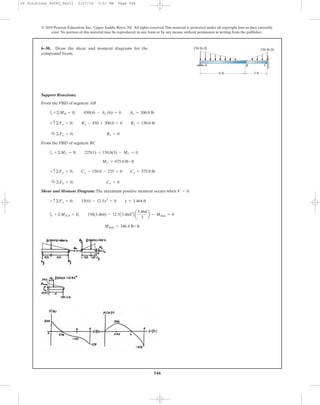
Support Reactions:
From the FBD of segment AB
a
From the FBD of segment BC
a
Shear and Moment Diagram: The maximum positive moment occurs when .
a
Mmax = 346.4 lb # ft
+©MNA = 0; 150(3.464) - 12.5A3.4642
B a
3.464
3
b - Mmax = 0
+ c ©Fy = 0; 150.0 - 12.5x2
= 0 x = 3.464 ft
V = 0
©Fx = 0; Cx = 0:+
+ c ©Fy = 0; Cy - 150.0 - 225 = 0 Cy = 375.0 lb
MC = 675.0 lb # ft
+©MC = 0; 225(1) + 150.0(3) - MC = 0
©Fx = 0; Bx = 0:+
+ c ©Fy = 0; By - 450 + 300.0 = 0 By = 150.0 lb
+©MB = 0; 450(4) - Ay (6) = 0 Ay = 300.0 lb
6–30. Draw the shear and moment diagrams for the
compound beam.
BA
6 ft
150 lb/ft 150 lb/ft
3 ft
C
06 Solutions 46060_Part1 5/27/10 3:51 PM Page 346
347
© 2010 Pearson Education, Inc., Upper Saddle River, NJ. All rights reserved.This material is protected under all copyright laws as they currently
exist. No portion of this material may be reproduced, in any form or by any means, without permission in writing from the publisher.
Support Reactions: As shown on FBD.
Shear and Moment Functions:
For
Ans.
a
Ans.
For
Ans.
a
Ans.M = -
w0
3L
(L - x)3
+©MNA = 0; -M -
1
2
c
2w0
L
(L - x)d(L - x)a
L - x
3
b = 0
V =
w0
L
(L - x)2
+ c©Fy = 0; V -
1
2
c
2w0
L
(L - x)d(L - x) = 0
L>2 6 x … L
M =
w0
24
A -12x2
+ 18Lx - 7L2
)
+©MNA = 0;
7w0 L2
24
-
3w0 L
4
x + w0 xa
x
2
b + M = 0
V =
w0
4
(3L - 4x)
+ c ©Fy = 0;
3w0 L
4
-w0x - V = 0
0 … x 6 L>2
6–31. Draw the shear and moment diagrams for the beam and
determine the shear and moment in the beam as functions of x.
x
BA
w0
L
–
2
L
–
2
06 Solutions 46060_Part1 5/27/10 3:51 PM Page 347
348
Ans.w0 = 1.2 kN>m
+ c©Fy = 0; 2(w0)(20)a
1
2
b - 60(0.4) = 0
*6–32. The smooth pin is supported by two leaves A and B
and subjected to a compressive load of 0.4 kN͞m caused by
bar C. Determine the intensity of the distributed load w0 of
the leaves on the pin and draw the shear and moment diagram
for the pin.
© 2010 Pearson Education, Inc., Upper Saddle River, NJ. All rights reserved.This material is protected under all copyright laws as they currently
exist. No portion of this material may be reproduced, in any form or by any means, without permission in writing from the publisher.
20 mm
0.4 kN/m
w0
20 mm 60 mm
w0
A B
C
Ski:
Ans.
Segment:
a+©M = 0; M - 30(0.5) = 0; M = 15.0 lb # ft
+ c ©Fy = 0; 30 - V = 0; V = 30.0 lb
w = 40.0 lb>ft
+ c ©Fy = 0;
1
2
w(1.5) + 3w +
1
2
w(1.5) - 180 = 0
•6–33. The ski supports the 180-lb weight of the man. If
the snow loading on its bottom surface is trapezoidal as
shown, determine the intensity w, and then draw the shear
and moment diagrams for the ski.
180 lb
w w
1.5 ft 3 ft 1.5 ft
3 ft
06 Solutions 46060_Part1 5/27/10 3:51 PM Page 348
349
© 2010 Pearson Education, Inc., Upper Saddle River, NJ. All rights reserved.This material is protected under all copyright laws as they currently
exist. No portion of this material may be reproduced, in any form or by any means, without permission in writing from the publisher.
6–34. Draw the shear and moment diagrams for the
compound beam.
3 m 3 m
1.5 m 1.5 m
5 kN
3 kN/m
A
B C D
6–35. Draw the shear and moment diagrams for the beam
and determine the shear and moment as functions of x.
3 m 3 m
x
A B
200 N/m
400 N/m
Support Reactions: As shown on FBD.
Shear and Moment Functions:
For :
Ans.
a
Ans.
For :
Ans.
Set ,
a
Ans.
Substitute , M = 691 N # mx = 3.87 m
M = e -
100
9
x3
+ 500x - 600 f N # m
+ 200(x - 3)a
x - 3
2
b - 200x = 0
+©MNA = 0; M +
1
2
c
200
3
(x - 3)d(x - 3)a
x - 3
3
b
x = 3.873 mV = 0
V = e -
100
3
x2
+ 500 f N
+ c©Fy = 0; 200 - 200(x - 3) -
1
2
c
200
3
(x - 3)d(x - 3) - V = 0
3 m 6 x … 6 m
M = (200 x) N # m
+©MNA = 0; M - 200 x = 0
+ c©Fy = 0; 200 - V = 0 V = 200 N
0 … x 6 3 m
06 Solutions 46060_Part1 5/27/10 3:51 PM Page 349
350
*6–36. Draw the shear and moment diagrams for the
overhang beam.
© 2010 Pearson Education, Inc., Upper Saddle River, NJ. All rights reserved.This material is protected under all copyright laws as they currently
exist. No portion of this material may be reproduced, in any form or by any means, without permission in writing from the publisher.
A
B
M ϭ 10 kNиm
2 m 2 m 2 m
6 kN
18 kN
6–37. Draw the shear and moment diagrams for the beam.
B
4.5 m 4.5 m
50 kN/m
A
50 kN/m
A
06 Solutions 46060_Part1 5/27/10 3:51 PM Page 350
351
© 2010 Pearson Education, Inc., Upper Saddle River, NJ. All rights reserved.This material is protected under all copyright laws as they currently
exist. No portion of this material may be reproduced, in any form or by any means, without permission in writing from the publisher.
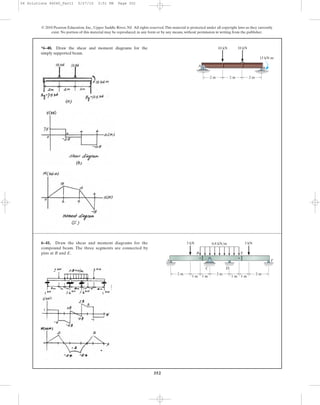
6–38. The dead-weight loading along the centerline of the
airplane wing is shown. If the wing is fixed to the fuselage at
A, determine the reactions at A, and then draw the shear and
moment diagram for the wing.
Support Reactions:
Ans.
a
Ans.
Ans.
Shear and Moment Diagram:
©Fx = 0; Ax = 0:+
MA = 18.583 kip # ft = 18.6 kip # ft
+ 1.25(2.5) + 0.375(1.667) + MA = 0
+©MA = 0; 1.00(7.667) + 3(5) - 15(3)
Ay = 9.375 kip
+ c©Fy = 0; -1.00 - 3 + 15 - 1.25 - 0.375 - Ay = 0
3 ft
400 lb/ft
250 lb/ft
3000 lb
15 000 lb
2 ft8 ft
A
6–39. The compound beam consists of two segments that
are pinned together at B. Draw the shear and moment
diagrams if it supports the distributed loading shown.
2/3 L
A
C
B
1/3 L
w
a
M = 0.0190 wL2
+©M = 0; M +
1
2
w
L
(0.385L)2
a
1
3
b(0.385L) -
2wL
27
(0.385L) = 0
x =
A
4
27
L = 0.385 L
+ c©Fy = 0;
2wL
27
-
1
2
w
L
x2
= 0
06 Solutions 46060_Part1 5/27/10 3:51 PM Page 351
352
© 2010 Pearson Education, Inc., Upper Saddle River, NJ. All rights reserved.This material is protected under all copyright laws as they currently
exist. No portion of this material may be reproduced, in any form or by any means, without permission in writing from the publisher.
A
B
2 m
0.8 kN/m
1 m
2 m
1 m
2 m
1 m1 m
C D
E
F
3 kN 3 kN
A
B
2 m 2 m
10 kN 10 kN
15 kNиm
2 m
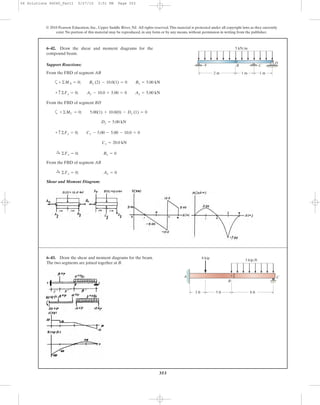
*6–40. Draw the shear and moment diagrams for the
simply supported beam.
6–41. Draw the shear and moment diagrams for the
compound beam. The three segments are connected by
pins at B and E.
06 Solutions 46060_Part1 5/27/10 3:51 PM Page 352
353
© 2010 Pearson Education, Inc., Upper Saddle River, NJ. All rights reserved.This material is protected under all copyright laws as they currently
exist. No portion of this material may be reproduced, in any form or by any means, without permission in writing from the publisher.
Support Reactions:
From the FBD of segment AB
a
From the FBD of segment BD
a
From the FBD of segment AB
Shear and Moment Diagram:
©Fx = 0; Ax = 0:+
©Fx = 0; Bx = 0:+
Cy = 20.0 kN
+ c©Fy = 0; Cy - 5.00 - 5.00 - 10.0 = 0
Dy = 5.00 kN
+©MC = 0; 5.00(1) + 10.0(0) - Dy (1) = 0
+ c©Fy = 0; Ay - 10.0 + 5.00 = 0 Ay = 5.00 kN
+©MA = 0; By (2) - 10.0(1) = 0 By = 5.00 kN
6–42. Draw the shear and moment diagrams for the
compound beam.
BA C
D
2 m 1 m 1 m
5 kN/m
A C
3 ft 8 ft
3 kip/ft
5 ft
B
8 kip6–43. Draw the shear and moment diagrams for the beam.
The two segments are joined together at B.
06 Solutions 46060_Part1 5/27/10 3:51 PM Page 353
354
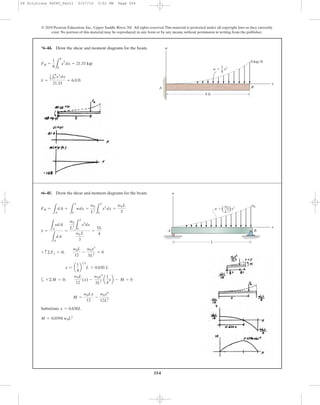
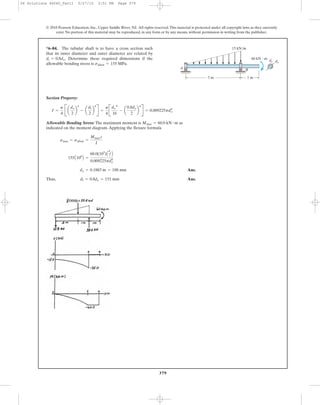
*6–44. Draw the shear and moment diagrams for the beam.
© 2010 Pearson Education, Inc., Upper Saddle River, NJ. All rights reserved.This material is protected under all copyright laws as they currently
exist. No portion of this material may be reproduced, in any form or by any means, without permission in writing from the publisher.
•6–45. Draw the shear and moment diagrams for the beam.
a
Substitute
M = 0.0394 w0L2
x = 0.630L
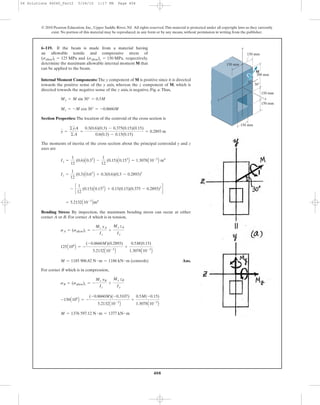
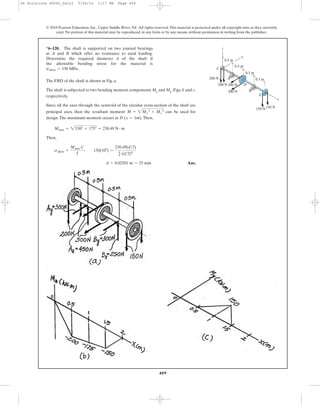
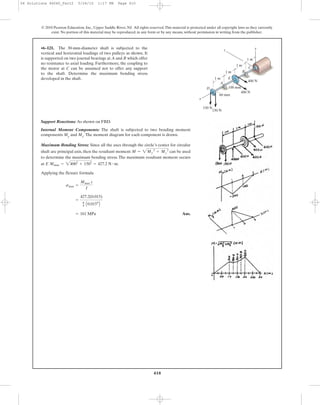
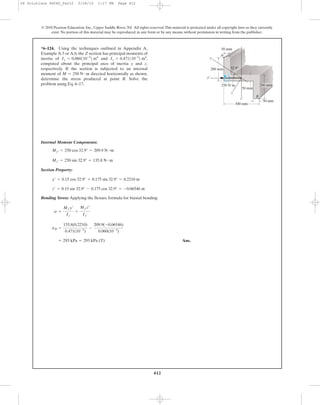
M =
w0Lx
12
-
w0x4
12L2
+©M = 0;
w0L
12
(x) -
w0x3
3L2
a
1
4
xb - M = 0
x = a
1
4
b
1>3
L = 0.630 L
+ c ©Fy = 0;
w0L
12
-
w0x3
3L2
= 0
3L
4
w0
L2
L
L
0
x3
dx
w0 L
3
=x =
LA
xdA
LA
dA
=
FR =
LA
dA =
L
L
0
wdx =
w0
L2
L
L
0
x2
dx =
w0L
3
L
A B
x
w
w0
w ϭ
w0
L2
x2
x =
1
8 1
8
0 x3
dx
21.33
= 6.0 ft
FR =
1
8 L
8
0
x
2
dx = 21.33 kip
8 ft
A B
x
w
w ϭ x2
8 kip/ft
1
8
06 Solutions 46060_Part1 5/27/10 3:51 PM Page 354
355
© 2010 Pearson Education, Inc., Upper Saddle River, NJ. All rights reserved.This material is protected under all copyright laws as they currently
exist. No portion of this material may be reproduced, in any form or by any means, without permission in writing from the publisher.
6–46. Draw the shear and moment diagrams for the beam.
FR =
LA
dA = w0
L
L
0
sina
p
L
xbdx =
2w0 L
p
w0
w ϭ w0 sin x
BA
w
x
L
–
2
p
–
L
L
–
2
The moment of inertia of the cross-section about z and y axes are
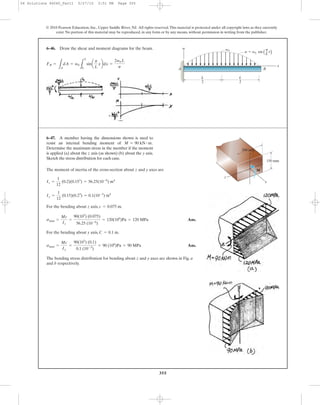
For the bending about z axis, .
Ans.
For the bending about y axis, .
Ans.
The bending stress distribution for bending about z and y axes are shown in Fig. a
and b respectively.
smax =
Mc
Iy
=
90(103
) (0.1)
0.1 (10-3
)
= 90 (106
)Pa = 90 MPa
C = 0.1 m
smax =
Mc
Iz
=
90(103
) (0.075)
56.25 (10-6
)
= 120(106
)Pa = 120 MPa
c = 0.075 m
Iy =
1
12
(0.15)(0.23
) = 0.1(10-3
) m4
Iz =
1
12
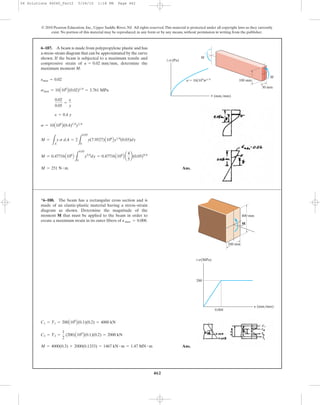
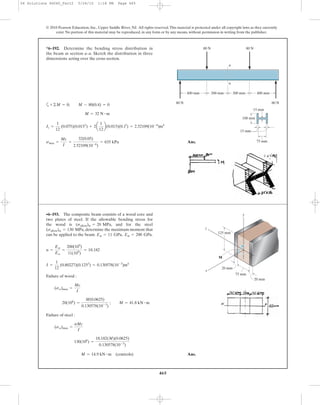
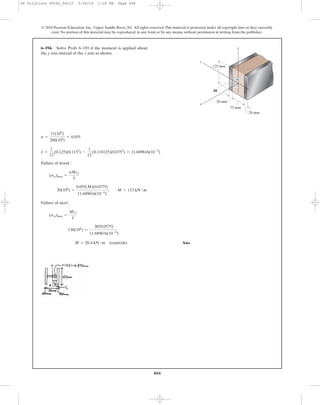
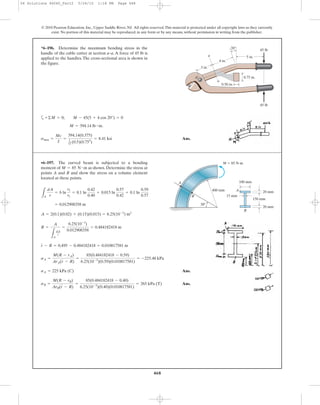
(0.2)(0.153
) = 56.25(10-6
) m4
6–47. A member having the dimensions shown is used to
resist an internal bending moment of
Determine the maximum stress in the member if the moment
is applied (a) about the z axis (as shown) (b) about the y axis.
Sketch the stress distribution for each case.
M = 90 kN # m.
200 mm
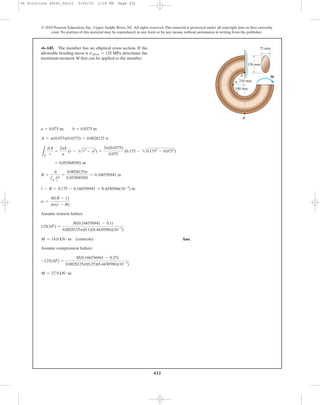
150 mm
z
y
x
M
06 Solutions 46060_Part1 5/27/10 3:51 PM Page 355
356
Section Properties:
Maximum Bending Stress: Applying the flexure formula
Ans.M = 129.2 kip # in = 10.8 kip # ft
10 =
M (10.5 - 3.4)
91.73
smax =
Mc
I
= 91.73 in4
+
1
12
(0.5)A103
B + 0.5(10)(5.5 - 3.40)2
+ 2c
1
12
(0.5)(33
) + 0.5(3)(3.40 - 2)2
d
INA =
1
12
(4)A0.53
B + 4(0.5)(3.40 - 0.25)2
=
0.25(4)(0.5) + 2[2(3)(0.5)] + 5.5(10)(0.5)
4(0.5) + 2[(3)(0.5)] + 10(0.5)
= 3.40 in.
y =
© y A
©A
*6–48. Determine the moment M that will produce a
maximum stress of 10 ksi on the cross section.
© 2010 Pearson Education, Inc., Upper Saddle River, NJ. All rights reserved.This material is protected under all copyright laws as they currently
exist. No portion of this material may be reproduced, in any form or by any means, without permission in writing from the publisher.
3 in.
D
A B
0.5 in.
M
0.5 in.
3 in.
C
10 in.
0.5 in.0.5 in.
06 Solutions 46060_Part1 5/27/10 3:51 PM Page 356
357
Section Properties:
Maximum Bending Stress: Applying the flexure formula
Ans.
Ans.(sc)max =
4(103
)(12)(3.40)
91.73
= 1779.07 psi = 1.78 ksi
(st)max =
4(103
)(12)(10.5 - 3.40)
91.73
= 3715.12 psi = 3.72 ksi
smax =
Mc
I
= 91.73 in4
+
1
12
(0.5)A103
B + 0.5(10)(5.5 - 3.40)2
+ 2c
1
12
(0.5)(33
) + 0.5(3)(3.40 - 2)2
d
INA =
1
12
(4)A0.53
B + 4(0.5)(3.40 - 0.25)2
=
0.25(4)(0.5) + 2[2(3)(0.5)] + 5.5(10)(0.5)
4(0.5) + 2[(3)(0.5)] + 10(0.5)
= 3.40 in.
y =
© y A
©A
•6–49. Determine the maximum tensile and compressive
bending stress in the beam if it is subjected to a moment of
M = 4 kip # ft.
© 2010 Pearson Education, Inc., Upper Saddle River, NJ. All rights reserved.This material is protected under all copyright laws as they currently
exist. No portion of this material may be reproduced, in any form or by any means, without permission in writing from the publisher.
3 in.
D
A B
0.5 in.
M
0.5 in.
3 in.
C
10 in.
0.5 in.0.5 in.
06 Solutions 46060_Part1 5/27/10 3:51 PM Page 357
358
Ans.
Ans.sB =
30(13.24 - 10)(10-3
)
0.095883(10-6
)
= 1.01 MPa
sA =
30(35 - 13.24)(10-3
)
0.095883(10-6
)
= 6.81 MPa
= 0.095883(10-6
) m4
+ 2c
1
12
(5)(203
) + 5(20)(20 - 13.24)2
d + 2c
1
12
(12)(53
) + 12(5)(32.5 - 13.24)2
d
+ c
1
12
(34)(53
) + 34(5)(13.24 - 7.5)2
d
I = c
1
12
(50)(53
) + 50(5)(13.24 - 2.5)2
d
= 13.24 mm
y =
2.5(50)(5) + 7.5(34)(5) + 2[20(5)(20)] + 2[(32.5)(12)(5)]
50(5) + 34(5) + 2[5(20)] + 2[(12)(5)]
Ans.
Ans.M = 771 N # m
s =
Mc
I
; 175(106
) =
M(35 - 13.24)(10-3
)
0.095883(10-6
)
= 0.095883(10-6
) m4
+ 2c
1
12
(5)(203
) + 5(20)(20 - 13.24)2
d + 2c
1
12
(12)(53
) + 12(5)(32.5 - 13.24)2
d
I = c
1
12
(50)(53
) + 50(5)(13.24 - 2.5)2
d + c
1
12
(34)(53
) + 34(5)(13.24 - 7.5)2
d
y =
©y2
A
©A
=
2.5(50)(5) + 7.5(34)(5) + 2[20(5)(20)] + 2[(32.5)(12)(5)]
50(5) + 34(5) + 2[5(20)] + 2[(12)(5)]
= 13.24 mm
sC =
30(13.24)(10-3
)
0.095883(10-6
)
= 4.14 MPa
6–50. The channel strut is used as a guide rail for a trolley.
If the maximum moment in the strut is
determine the bending stress at points A, B, and C.
M = 30 N # m,
6–51. The channel strut is used as a guide rail for a
trolley. If the allowable bending stress for the material is
determine the maximum bending moment
the strut will resist.
sallow = 175 MPa,
© 2010 Pearson Education, Inc., Upper Saddle River, NJ. All rights reserved.This material is protected under all copyright laws as they currently
exist. No portion of this material may be reproduced, in any form or by any means, without permission in writing from the publisher.
50 mm
30 mm
A
B
C
5 mm
5 mm
5 mm
5 mm
5 mm
7 mm 7 mm10 mm
50 mm
30 mm
A
B
C
5 mm
5 mm
5 mm
5 mm
5 mm
7 mm 7 mm10 mm
06 Solutions 46060_Part1 5/27/10 3:51 PM Page 358
359
© 2010 Pearson Education, Inc., Upper Saddle River, NJ. All rights reserved.This material is protected under all copyright laws as they currently
exist. No portion of this material may be reproduced, in any form or by any means, without permission in writing from the publisher.
Section Property:
Bending Stress: Applying the flexure formula
Resultant Force and Moment: For board A or B
Ans.sca
M¿
M
b = 0.8457(100%) = 84.6 %
M¿ = F(0.17619) = 4.80M(0.17619) = 0.8457 M
= 4.800 M
F = 822.857M(0.025)(0.2) +
1
2
(1097.143M - 822.857M)(0.025)(0.2)
sD =
M(0.075)
91.14583(10-6
)
= 822.857 M
sE =
M(0.1)
91.14583(10-6
)
= 1097.143 M
s =
My
I
I =
1
12
(0.2)A0.23
B -
1
12
(0.15)A0.153
B = 91.14583A10-6
B m4
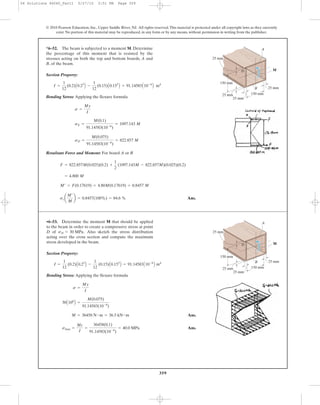
*6–52. The beam is subjected to a moment M. Determine
the percentage of this moment that is resisted by the
stresses acting on both the top and bottom boards, A and
B, of the beam.
150 mm
25 mm
25 mm
150 mm
M
25 mm
25 mm
B
A
D
Section Property:
Bending Stress: Applying the flexure formula
Ans.
Ans.smax =
Mc
I
=
36458(0.1)
91.14583(10-6
)
= 40.0 MPa
M = 36458 N # m = 36.5 kN # m
30A106
B =
M(0.075)
91.14583(10-6
)
s =
My
I
I =
1
12
(0.2)A0.23
B -
1
12
(0.15)A0.153
B = 91.14583A10-6
B m4
•6–53. Determine the moment M that should be applied
to the beam in order to create a compressive stress at point
D of Also sketch the stress distribution
acting over the cross section and compute the maximum
stress developed in the beam.
sD = 30 MPa.
150 mm
25 mm
25 mm
150 mm
M
25 mm
25 mm
B
A
D
06 Solutions 46060_Part1 5/27/10 3:51 PM Page 359
360
Ans.
sC =
My
I
=
600 (0.05625)
34.53125 (10-6
)
= 0.977 MPa
= 2.06 MPa
=
600 (0.175 - 0.05625)
34.53125 (10-6
)
smax = sB =
Mc
I
= 34.53125 (10-6
) m4
+ 2 a
1
12
b(0.02)(0.153
) + 2(0.15)(0.02)(0.043752
)
I =
1
12
(0.24)(0.0253
) + (0.24)(0.025)(0.043752
)
y =
(0.0125)(0.24)(0.025) + 2 (0.1)(0.15)(0.2)
0.24 (0.025) + 2 (0.15)(0.02)
= 0.05625 m
Ans.F =
1
2
(0.025)(0.9774 + 0.5430)(106
)(0.240) = 4.56 kN
sb =
My
I
=
600(0.05625 - 0.025)
34.53125(10-6
)
= 0.5430 MPa
s1 =
My
I
=
600(0.05625)
34.53125(10-6
)
= 0.9774 MPa
= 34.53125 (10-6
) m4
+ 2 a
1
12
b(0.02)(0.153
) + 2(0.15)(0.02)(0.043752
)
I =
1
12
(0.24)(0.0253
) + (0.24)(0.025)(0.043752
)
y =
(0.0125)(0.24)(0.025) + 2 (0.15)(0.1)(0.02)
0.24 (0.025) + 2 (0.15)(0.02)
= 0.05625 m
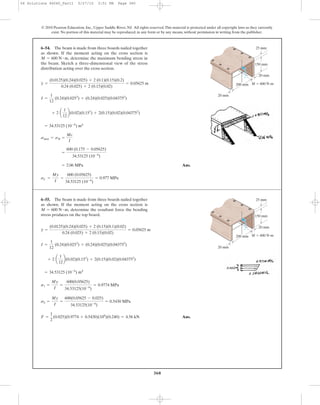
6–54. The beam is made from three boards nailed together
as shown. If the moment acting on the cross section is
determine the maximum bending stress in
the beam. Sketch a three-dimensional view of the stress
distribution acting over the cross section.
M = 600 N # m,
6–55. The beam is made from three boards nailed together
as shown. If the moment acting on the cross section is
determine the resultant force the bending
stress produces on the top board.
M = 600 N # m,
© 2010 Pearson Education, Inc., Upper Saddle River, NJ. All rights reserved.This material is protected under all copyright laws as they currently
exist. No portion of this material may be reproduced, in any form or by any means, without permission in writing from the publisher.
25 mm
200 mm
150 mm
20 mm
20 mm
M ϭ 600 Nиm
25 mm
200 mm
150 mm
20 mm
20 mm
M ϭ 600 Nиm
06 Solutions 46060_Part1 5/27/10 3:51 PM Page 360
361
© 2010 Pearson Education, Inc., Upper Saddle River, NJ. All rights reserved.This material is protected under all copyright laws as they currently
exist. No portion of this material may be reproduced, in any form or by any means, without permission in writing from the publisher.
Section Property:
Bending Stress: Applying the flexure formula
Ans.
Ans.sB =
8(103
)(0.01)
17.8133(10-6
)
= 4.49 MPa (T)
sA =
8(103
)(0.11)
17.8133(10-6
)
= 49.4 MPa (C)
s =
My
I
I =
1
12
(0.02)A0.223
B +
1
12
(0.1)A0.023
B = 17.8133A10-6
B m4
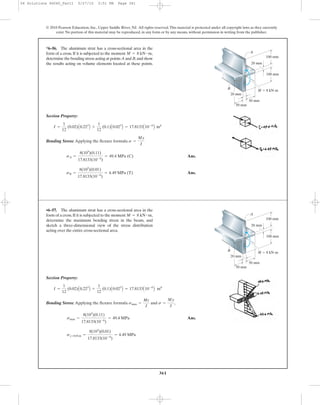
*6–56. The aluminum strut has a cross-sectional area in the
form of a cross. If it is subjected to the moment
determine the bending stress acting at points A and B,and show
the results acting on volume elements located at these points.
M = 8 kN # m, A
20 mm
B
20 mm
100 mm
50 mm
50 mm
100 mm
M ϭ 8 kNиm
Section Property:
Bending Stress: Applying the flexure formula and ,
Ans.
sy=0.01m =
8(103
)(0.01)
17.8133(10-6
)
= 4.49 MPa
smax =
8(103
)(0.11)
17.8133(10-6
)
= 49.4 MPa
s =
My
I
smax =
Mc
I
I =
1
12
(0.02)A0.223
B +
1
12
(0.1)A0.023
B = 17.8133A10-6
B m4
•6–57. The aluminum strut has a cross-sectional area in the
form of a cross.If it is subjected to the moment
determine the maximum bending stress in the beam, and
sketch a three-dimensional view of the stress distribution
acting over the entire cross-sectional area.
M = 8 kN # m, A
20 mm
B
20 mm
100 mm
50 mm
50 mm
100 mm
M ϭ 8 kNиm
06 Solutions 46060_Part1 5/27/10 3:51 PM Page 361
362
Section Properties: The neutral axis passes through centroid C of the cross section
as shown in Fig. a.The location of C is
Thus, the moment of inertia of the cross section about the neutral axis is
Maximum Bending Stress: The maximum compressive and tensile bending stress
occurs at the top and bottom edges of the cross section.
Ans.
Ans.AsmaxBC =
My
I
=
100(12)(8 - 4.3454)
218.87
= 20.0 ksi (C)
AsmaxBT =
Mc
I
=
100(12)(4.3454)
218.87
= 23.8 ksi (T)
= 218.87 in4
=
1
12
(6)a83
b + 6(8)A4.3454 - 4B2
- B
1
4
pa1.54
b + pa1.52
b A4.3454 - 2B2
R
I = ©I + Ad2
y =
©yA
©A
=
4(8)(6) - 2cpA1.52
B d
8(6) - pA1.52
B
= 4.3454 in.
6–58. If the beam is subjected to an internal moment
of determine the maximum tensile and
compressive bending stress in the beam.
M = 100 kip # ft,
© 2010 Pearson Education, Inc., Upper Saddle River, NJ. All rights reserved.This material is protected under all copyright laws as they currently
exist. No portion of this material may be reproduced, in any form or by any means, without permission in writing from the publisher.
6 in.
3 in.
2 in.
3 in.
M
1.5 in.
06 Solutions 46060_Part1 5/27/10 3:51 PM Page 362
363
Section Properties: The neutral axis passes through centroid C of the cross section
as shown in Fig. a.The location of C is
Thus, the moment of inertia of the cross section about the neutral axis is
Allowable Bending Stress: The maximum compressive and tensile bending stress
occurs at the top and bottom edges of the cross section. For the top edge,
For the bottom edge,
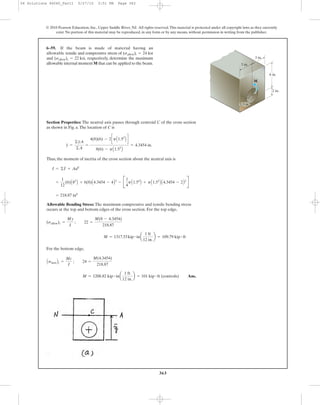
Ans.M = 1208.82 kip # ina
1 ft
12 in.
b = 101 kip # ft (controls)
AsmaxBt =
Mc
I
; 24 =
M(4.3454)
218.87
M = 1317.53kip # ina
1 ft
12 in.
b = 109.79 kip # ft
(sallow)c =
My
I
; 22 =
M(8 - 4.3454)
218.87
= 218.87 in4
=
1
12
(6)A83
B + 6(8)A4.3454 - 4B2
- B
1
4
pA1.54
B + pA1.52
B A4.3454 - 2B2
R
I = ©I + Ad2
y =
©yA
©A
=
4(8)(6) - 2cpA1.52
B d
8(6) - pA1.52
B
= 4.3454 in.
6–59. If the beam is made of material having an
allowable tensile and compressive stress of
and respectively, determine the maximum
allowable internal moment M that can be applied to the beam.
(sallow)c = 22 ksi,
(sallow)t = 24 ksi
© 2010 Pearson Education, Inc., Upper Saddle River, NJ. All rights reserved.This material is protected under all copyright laws as they currently
exist. No portion of this material may be reproduced, in any form or by any means, without permission in writing from the publisher.
6 in.
3 in.
2 in.
3 in.
M
1.5 in.
06 Solutions 46060_Part1 5/27/10 3:51 PM Page 363
•6–61. The beam is constructed from four boards as shown.
If it is subjected to a moment of determine
the resultant force the stress produces on the top board C.
Mz = 16 kip # ft,
364
*6–60. The beam is constructed from four boards as
shown. If it is subjected to a moment of
determine the stress at points A and B. Sketch a
three-dimensional view of the stress distribution.
Mz = 16 kip # ft,
© 2010 Pearson Education, Inc., Upper Saddle River, NJ. All rights reserved.This material is protected under all copyright laws as they currently
exist. No portion of this material may be reproduced, in any form or by any means, without permission in writing from the publisher.
10 in.
10 in.
1 in.
14 in.
1 in.
1 in.
Mz ϭ 16 kipиft
y
z
x
1 in.
A
C
B
10 in.
10 in.
1 in.
14 in.
1 in.
1 in.
Mz ϭ 16 kipиft
y
z
x
1 in.
A
C
B
Ans.
Ans.sB =
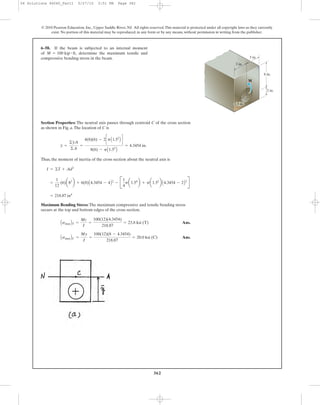
My
I
=
16(12)(9.3043)
1093.07
= 1.63 ksi
sA =
Mc
I
=
16(12)(21 - 9.3043)
1093.07
= 2.05 ksi
+
1
12
(1)(103
) + 1(10)(16 - 9.3043)2
= 1093.07 in4
I = 2c
1
12
(1)(103
) + 1(10)(9.3043 - 5)2
d +
1
12
(16)(13
) + 16(1)(10.5 - 9.3043)2
= 9.3043 in.
y =
2[5(10)(1)] + 10.5(16)(1) + 16(10)(1)
2(10)(1) + 16(1) + 10(1)
Ans.(FR)C =
1
2
(2.0544 + 0.2978)(10)(1) = 11.8 kip
sD =
My
I
=
16(12)(11 - 9.3043)
1093.07
= 0.2978 ksi
sA =
Mc
I
=
16(12)(21 - 9.3043)
1093.07
= 2.0544 ksi
+
1
12
(1)(103
) + 1(10)(16 - 9.3043)2
= 1093.07 in4
I = 2c
1
12
(1)(103
) + (10)(9.3043 - 5)2
d +
1
12
(16)(13
) + 16(1)(10.5 - 9.3043)2
y =
2[5(10)(1)] + 10.5(16)(1) + 16(10)(1)
2(10)(1) + 16(1) + 10(1)
= 9.3043 in.
06 Solutions 46060_Part1 5/27/10 3:51 PM Page 364
365
© 2010 Pearson Education, Inc., Upper Saddle River, NJ. All rights reserved.This material is protected under all copyright laws as they currently
exist. No portion of this material may be reproduced, in any form or by any means, without permission in writing from the publisher.
The moment of inertia of the cross-section about the neutral axis is
.
For point A, .
Ans.
For point B, .
Ans.
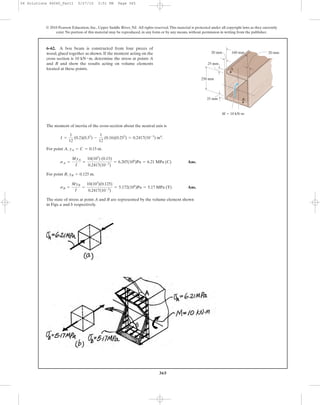
The state of stress at point A and B are represented by the volume element shown
in Figs. a and b respectively.
sB =
MyB
I
=
10(103
)(0.125)
0.2417(10-3
)
= 5.172(106
)Pa = 5.17 MPa (T)
yB = 0.125 m
sA =
MyA
I
=
10(103
) (0.15)
0.2417(10-3
)
= 6.207(106
)Pa = 6.21 MPa (C)
yA = C = 0.15 m
I =
1
12
(0.2)(0.33
) -
1
12
(0.16)(0.253
) = 0.2417(10-3
) m4
6–62. A box beam is constructed from four pieces of
wood, glued together as shown. If the moment acting on the
cross section is 10 kN m, determine the stress at points A
and B and show the results acting on volume elements
located at these points.
#
20 mm 20 mm
250 mm
M ϭ 10 kNиm
160 mm
25 mm
25 mm B
A
06 Solutions 46060_Part1 5/27/10 3:51 PM Page 365
366
Section Properties: The moments of inertia of the square and circular cross sections
about the neutral axis are
Maximum Bending Stress: For the square cross section, .
For the circular cross section, .
It is required that
Ans.a = 1.677r
6M
a3
=
4M
pr3
AsmaxBS = AsmaxBC
AsmaxBc =
Mc
Ic
=
Mr
1
4
pr4
-
4M
pr3
c = r
AsmaxBS =
Mc
IS
=
M(a>2)
a4
>12
=
6M
a3
c = a>2
IS =
1
12
aAa3
B =
a4
12
IC =
1
4
pr4
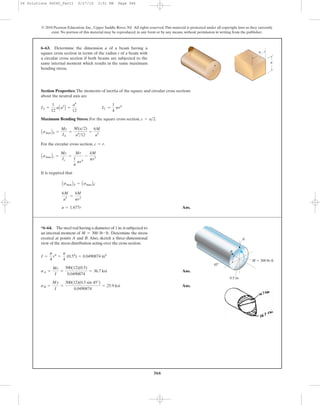
6–63. Determine the dimension a of a beam having a
square cross section in terms of the radius r of a beam with
a circular cross section if both beams are subjected to the
same internal moment which results in the same maximum
bending stress.
© 2010 Pearson Education, Inc., Upper Saddle River, NJ. All rights reserved.This material is protected under all copyright laws as they currently
exist. No portion of this material may be reproduced, in any form or by any means, without permission in writing from the publisher.
a
r
a
Ans.
Ans.sB =
My
I
=
300(12)(0.5 sin 45°)
0.0490874
= 25.9 ksi
sA =
Mc
I
=
300(12)(0.5)
0.0490874
= 36.7 ksi
I =
p
4
r4
=
p
4
(0.54
) = 0.0490874 in4
*6–64. The steel rod having a diameter of 1 in.is subjected to
an internal moment of Determine the stress
created at points A and B. Also, sketch a three-dimensional
view of the stress distribution acting over the cross section.
M = 300 lb # ft.
M ϭ 300 lbиft
A
BB
45Њ
0.5 in.
06 Solutions 46060_Part1 5/27/10 3:51 PM Page 366
367
© 2010 Pearson Education, Inc., Upper Saddle River, NJ. All rights reserved.This material is protected under all copyright laws as they currently
exist. No portion of this material may be reproduced, in any form or by any means, without permission in writing from the publisher.
The moment of inertia of the cross-section about the neutral axis is
Along the top edge of the flange .Thus
Ans.
Along the bottom edge to the flange, .Thus
s =
My
I
=
4(103
)(12)(6)
1863
= 155 psi
y = 6 in
smax =
Mc
I
=
4(103
)(12)(7.5)
1863
= 193 psi
y = c = 7.5 in
I =
1
12
(12)(153
) -
1
12
(10.5)(123
) = 1863 in4
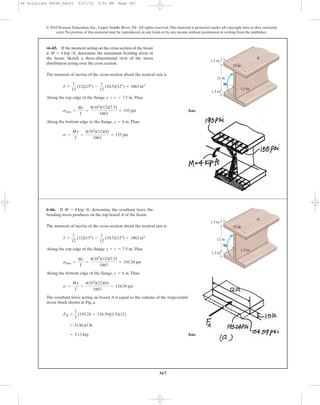
•6–65. If the moment acting on the cross section of the beam
is determine the maximum bending stress in
the beam. Sketch a three-dimensional view of the stress
distribution acting over the cross section.
M = 4 kip # ft,
12 in.
12 in.
1.5 in.
1.5 in.
1.5 in.
M
A
The moment of inertia of the cross-section about the neutral axis is
Along the top edge of the flange .Thus
Along the bottom edge of the flange, .Thus
The resultant force acting on board A is equal to the volume of the trapezoidal
stress block shown in Fig. a.
Ans.= 3.13 kip
= 3130.43 lb
FR =
1
2
(193.24 + 154.59)(1.5)(12)
s =
My
I
=
4(103
)(12)(6)
1863
= 154.59 psi
y = 6 in
smax =
Mc
I
=
4(103
)(12)(7.5)
1863
= 193.24 psi
y = c = 7.5 in
I =
1
12
(12)(153
) -
1
12
(10.5)(123
) = 1863 in4
6–66. If determine the resultant force the
bending stress produces on the top board A of the beam.
M = 4 kip # ft,
12 in.
12 in.
1.5 in.
1.5 in.
1.5 in.
M
A
06 Solutions 46060_Part1 5/27/10 3:51 PM Page 367
368
© 2010 Pearson Education, Inc., Upper Saddle River, NJ. All rights reserved.This material is protected under all copyright laws as they currently
exist. No portion of this material may be reproduced, in any form or by any means, without permission in writing from the publisher.
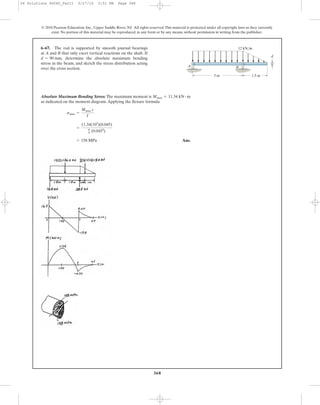
Absolute Maximum Bending Stress: The maximum moment is
as indicated on the moment diagram.Applying the flexure formula
Ans.= 158 MPa
=
11.34(103
)(0.045)
p
4 (0.0454
)
smax =
Mmax c
I
Mmax = 11.34 kN # m
6–67. The rod is supported by smooth journal bearings
at A and B that only exert vertical reactions on the shaft. If
determine the absolute maximum bending
stress in the beam, and sketch the stress distribution acting
over the cross section.
d = 90 mm,
B
d
A
3 m 1.5 m
12 kN/m
06 Solutions 46060_Part1 5/27/10 3:51 PM Page 368
369
© 2010 Pearson Education, Inc., Upper Saddle River, NJ. All rights reserved.This material is protected under all copyright laws as they currently
exist. No portion of this material may be reproduced, in any form or by any means, without permission in writing from the publisher.
Section Property:
For section (a)
For section (b)
Maximum Bending Stress: Applying the flexure formula
For section (a)
For section (b)
Ans.smax =
150(103
)(0.18)
0.36135(10-3
)
= 74.72 MPa = 74.7 MPa
smax =
150(103
)(0.165)
0.21645(10-3
)
= 114.3 MPa
smax =
Mc
I
I =
1
12
(0.2)A0.363
B -
1
12
(0.185)A0.33
B = 0.36135(10-3
) m4
I =
1
12
(0.2)A0.333
B -
1
12
(0.17)(0.3)3
= 0.21645(10-3
) m4
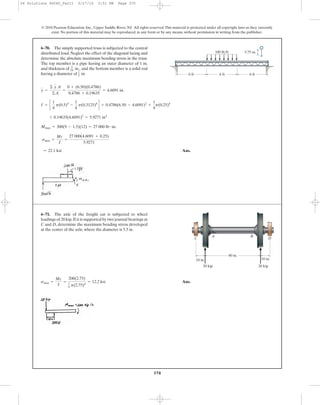
•6–69. Two designs for a beam are to be considered.
Determine which one will support a moment of
with the least amount of bending stress. What is
that stress?
150 kN # m
M = 200 mm
300 mm
(a) (b)
15 mm
30 mm
15 mm
200 mm
300 mm
30 mm
15 mm
30 mm
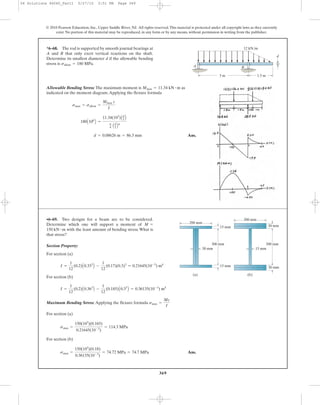
Allowable Bending Stress: The maximum moment is as
indicated on the moment diagram.Applying the flexure formula
Ans.d = 0.08626 m = 86.3 mm
180A106
B =
11.34(103
)Ad
2 B
p
4 Ad
2 B4
smax = sallow =
Mmax c
I
Mmax = 11.34 kN # m
*6–68. The rod is supported by smooth journal bearings at
A and B that only exert vertical reactions on the shaft.
Determine its smallest diameter d if the allowable bending
stress is sallow = 180 MPa.
B
d
A
3 m 1.5 m
12 kN/m
06 Solutions 46060_Part1 5/27/10 3:51 PM Page 369
370
© 2010 Pearson Education, Inc., Upper Saddle River, NJ. All rights reserved.This material is protected under all copyright laws as they currently
exist. No portion of this material may be reproduced, in any form or by any means, without permission in writing from the publisher.
Ans.= 22.1 ksi
smax =
Mc
I
=
27 000(4.6091 + 0.25)
5.9271
Mmax = 300(9 - 1.5)(12) = 27 000 lb # in.
+ 0.19635(4.6091)2
= 5.9271 in4
I = c
1
4
p(0.5)4
-
1
4
p(0.3125)4
d + 0.4786(6.50 - 4.6091)2
+
1
4
p(0.25)4
y =
© y A
©A
=
0 + (6.50)(0.4786)
0.4786 + 0.19635
= 4.6091 in.
6–70. The simply supported truss is subjected to the central
distributed load. Neglect the effect of the diagonal lacing and
determine the absolute maximum bending stress in the truss.
The top member is a pipe having an outer diameter of 1 in.
and thickness of and the bottom member is a solid rod
having a diameter of 1
2 in.
3
16 in.,
6 ft
5.75 in.
6 ft 6 ft
100 lb/ft
Ans.smax =
Mc
I
=
200(2.75)
1
4 p(2.75)4
= 12.2 ksi
6–71. The axle of the freight car is subjected to wheel
loadings of 20 kip.If it is supported by two journal bearings at
C and D, determine the maximum bending stress developed
at the center of the axle, where the diameter is 5.5 in.
C D
A B
20 kip 20 kip
10 in. 10 in.
60 in.
06 Solutions 46060_Part1 5/27/10 3:51 PM Page 370
371
© 2010 Pearson Education, Inc., Upper Saddle River, NJ. All rights reserved.This material is protected under all copyright laws as they currently
exist. No portion of this material may be reproduced, in any form or by any means, without permission in writing from the publisher.
Support Reactions: As shown on FBD.
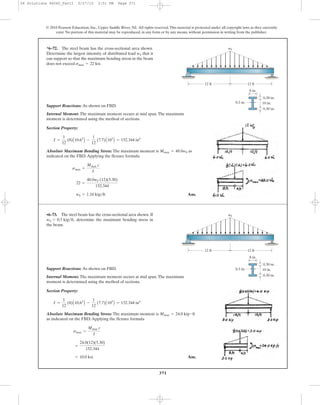
Internal Moment: The maximum moment occurs at mid span.The maximum
moment is determined using the method of sections.
Section Property:
Absolute Maximum Bending Stress: The maximum moment is
as indicated on the FBD.Applying the flexure formula
Ans.= 10.0 ksi
=
24.0(12)(5.30)
152.344
smax =
Mmax c
I
Mmax = 24.0 kip # ft
I =
1
12
(8)A10.63
B -
1
12
(7.7)A103
B = 152.344 in4
*6–72. The steel beam has the cross-sectional area shown.
Determine the largest intensity of distributed load that it
can support so that the maximum bending stress in the beam
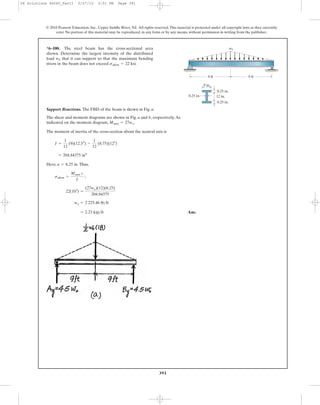
does not exceed smax = 22 ksi.
w0
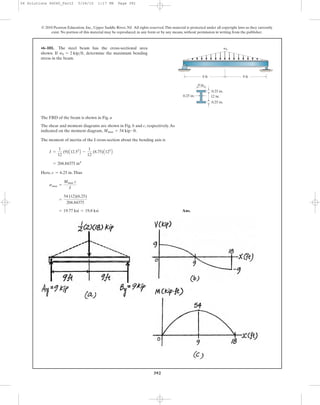
•6–73. The steel beam has the cross-sectional area shown. If
determine the maximum bending stress in
the beam.
w0 = 0.5 kip>ft,
10 in.
8 in.
0.30 in.
12 ft 12 ft
0.30 in.
0.3 in.
w0
10 in.
8 in.
0.30 in.
12 ft 12 ft
0.30 in.
0.3 in.
w0
Support Reactions: As shown on FBD.
Internal Moment: The maximum moment occurs at mid span.The maximum
moment is determined using the method of sections.
Section Property:
Absolute Maximum Bending Stress: The maximum moment is as
indicated on the FBD.Applying the flexure formula
Ans.w0 = 1.10 kip>ft
22 =
48.0w0 (12)(5.30)
152.344
smax =
Mmax c
I
Mmax = 48.0w0
I =
1
12
(8)A10.63
B -
1
12
(7.7)A103
B = 152.344 in4
06 Solutions 46060_Part1 5/27/10 3:51 PM Page 371
372
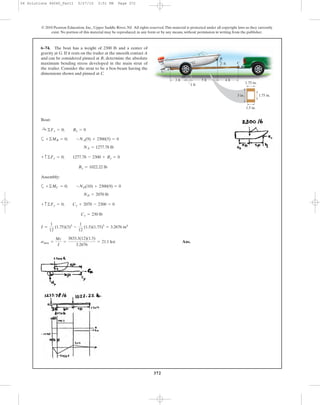
Boat:
a
Assembly:
a
Ans.smax =
Mc
I
=
3833.3(12)(1.5)
3.2676
= 21.1 ksi
I =
1
12
(1.75)(3)3
-
1
12
(1.5)(1.75)3
= 3.2676 in4
Cy = 230 lb
+ c©Fy = 0; Cy + 2070 - 2300 = 0
ND = 2070 lb
+©MC = 0; -ND(10) + 2300(9) = 0
By = 1022.22 lb
+ c ©Fy = 0; 1277.78 - 2300 + By = 0
NA = 1277.78 lb
+©MB = 0; -NA(9) + 2300(5) = 0
:+ ©Fx = 0; Bx = 0
6–74. The boat has a weight of 2300 lb and a center of
gravity at G. If it rests on the trailer at the smooth contact A
and can be considered pinned at B, determine the absolute
maximum bending stress developed in the main strut of
the trailer. Consider the strut to be a box-beam having the
dimensions shown and pinned at C.
© 2010 Pearson Education, Inc., Upper Saddle River, NJ. All rights reserved.This material is protected under all copyright laws as they currently
exist. No portion of this material may be reproduced, in any form or by any means, without permission in writing from the publisher.
1 ft
3 ft
D
A
B
C
1 ft
5 ft 4 ft
G
1.75 in.
3 in. 1.75 in.
1.5 in.
06 Solutions 46060_Part1 5/27/10 3:51 PM Page 372
373
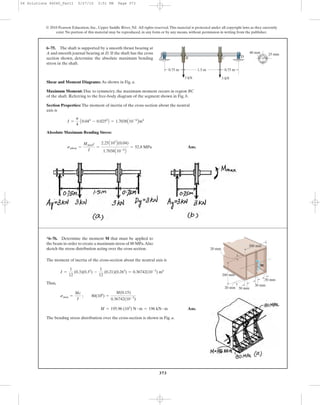
Shear and Moment Diagrams: As shown in Fig. a.
Maximum Moment: Due to symmetry, the maximum moment occurs in region BC
of the shaft. Referring to the free-body diagram of the segment shown in Fig. b.
Section Properties: The moment of inertia of the cross section about the neutral
axis is
Absolute Maximum Bending Stress:
Ans.sallow =
Mmaxc
I
=
2.25A103
B(0.04)
1.7038A10-6
B
= 52.8 MPa
I =
p
4
A0.044
- 0.0254
B = 1.7038A10-6
Bm4
6–75. The shaft is supported by a smooth thrust bearing at
A and smooth journal bearing at D. If the shaft has the cross
section shown, determine the absolute maximum bending
stress in the shaft.
© 2010 Pearson Education, Inc., Upper Saddle River, NJ. All rights reserved.This material is protected under all copyright laws as they currently
exist. No portion of this material may be reproduced, in any form or by any means, without permission in writing from the publisher.
A C DB
3 kN 3 kN
0.75 m 0.75 m1.5 m
40 mm 25 mm
The moment of inertia of the cross-section about the neutral axis is
Thus,
Ans.
The bending stress distribution over the cross-section is shown in Fig. a.
M = 195.96 (103
) N # m = 196 kN # m
smax =
Mc
I
; 80(106
) =
M(0.15)
0.36742(10-3
)
I =
1
12
(0.3)(0.33
) -
1
12
(0.21)(0.263
) = 0.36742(10-3
) m4
*6–76. Determine the moment M that must be applied to
the beam in order to create a maximum stress of 80 MPa.Also
sketch the stress distribution acting over the cross section.
260 mm
20 mm
30 mm
300 mm
M
30 mm
30 mm
20 mm
06 Solutions 46060_Part1 5/27/10 3:51 PM Page 373
374
© 2010 Pearson Education, Inc., Upper Saddle River, NJ. All rights reserved.This material is protected under all copyright laws as they currently
exist. No portion of this material may be reproduced, in any form or by any means, without permission in writing from the publisher.
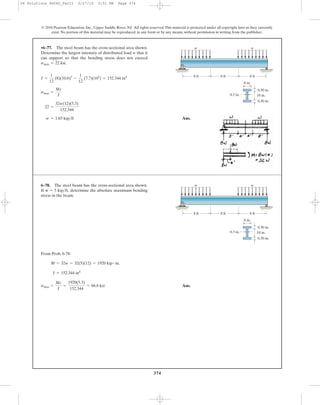
Ans.w = 1.65 kip>ft
22 =
32w(12)(5.3)
152.344
smax =
Mc
I
I =
1
12
(8)(10.6)3
-
1
12
(7.7)(103
) = 152.344 in4
•6–77. The steel beam has the cross-sectional area shown.
Determine the largest intensity of distributed load w that it
can support so that the bending stress does not exceed
smax = 22 ksi.
10 in.
8 in.
0.30 in.
8 ft 8 ft 8 ft
0.30 in.
0.3 in.
w w
From Prob. 6-78:
Ans.smax =
Mc
I
=
1920(5.3)
152.344
= 66.8 ksi
I = 152.344 in4
M = 32w = 32(5)(12) = 1920 kip # in.
6–78. The steel beam has the cross-sectional area shown.
If determine the absolute maximum bending
stress in the beam.
w = 5 kip>ft,
10 in.
8 in.
0.30 in.
8 ft 8 ft 8 ft
0.30 in.
0.3 in.
w w
06 Solutions 46060_Part1 5/27/10 3:51 PM Page 374
375
© 2010 Pearson Education, Inc., Upper Saddle River, NJ. All rights reserved.This material is protected under all copyright laws as they currently
exist. No portion of this material may be reproduced, in any form or by any means, without permission in writing from the publisher.
Ans.smax =
Mc
I
=
46.7(103
)(12)(3)
1
12 (6)(63
)
= 15.6 ksi
Mmax = 46.7 kip # ft
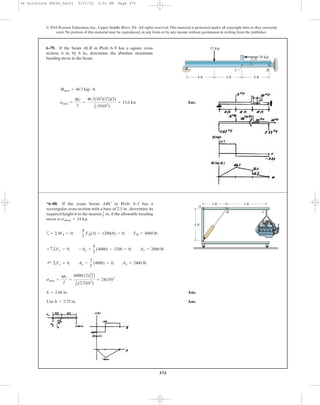
6–79. If the beam ACB in Prob. 6–9 has a square cross
section, 6 in. by 6 in., determine the absolute maximum
bending stress in the beam.
B
4 ft
A
4 ft 4 ft
15 kip
20 kip
C
1 ft
a
Ans.
Ans.Use h = 2.75 in.
h = 2.68 in.
smax =
Mc
I
=
6000(12)Ah
2 B
1
12(2.5)(h3
)
= 24(10)3
;+ ©Fx = 0; Ax -
3
5
(4000) = 0; Ax = 2400 lb
+ c ©Fy = 0; -Ay +
4
5
(4000) - 1200 = 0; Ay = 2000 lb
+ ©MA = 0;
4
5
FB(3) - 1200(8) = 0; FB = 4000 lb
*6–80. If the crane boom ABC in Prob. 6–3 has a
rectangular cross section with a base of 2.5 in., determine its
required height h to the nearest if the allowable bending
stress is sallow = 24 ksi.
1
4 in.
5 ft3 ft
CB
4 ft
A
06 Solutions 46060_Part1 5/27/10 3:51 PM Page 375
376
© 2010 Pearson Education, Inc., Upper Saddle River, NJ. All rights reserved.This material is protected under all copyright laws as they currently
exist. No portion of this material may be reproduced, in any form or by any means, without permission in writing from the publisher.
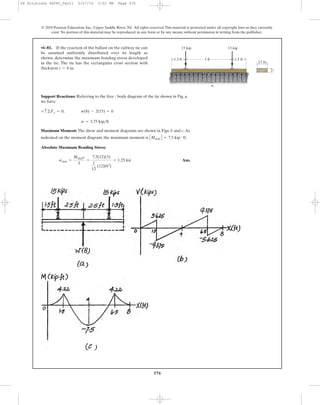
Support Reactions: Referring to the free - body diagram of the tie shown in Fig. a,
we have
Maximum Moment: The shear and moment diagrams are shown in Figs. b and c.As
indicated on the moment diagram, the maximum moment is .
Absolute Maximum Bending Stress:
Ans.smax =
Mmaxc
I
=
7.5(12)(3)
1
12
(12)(63
)
= 1.25 ksi
ΗMmax Η = 7.5 kip # ft
w = 3.75 kip>ft
+ c©Fy = 0; w(8) - 2(15) = 0
•6–81. If the reaction of the ballast on the railway tie can
be assumed uniformly distributed over its length as
shown, determine the maximum bending stress developed
in the tie. The tie has the rectangular cross section with
thickness t = 6 in.
5 ft1.5 ft 1.5 ft
15 kip 15 kip
12 in.
t
w
06 Solutions 46060_Part1 5/27/10 3:51 PM Page 376
377
© 2010 Pearson Education, Inc., Upper Saddle River, NJ. All rights reserved.This material is protected under all copyright laws as they currently
exist. No portion of this material may be reproduced, in any form or by any means, without permission in writing from the publisher.
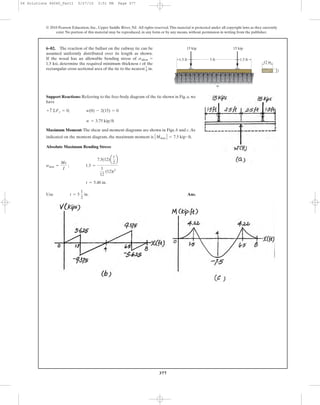
Support Reactions: Referring to the free-body diagram of the tie shown in Fig. a, we
have
Maximum Moment: The shear and moment diagrams are shown in Figs. b and c.As
indicated on the moment diagram, the maximum moment is .
Absolute Maximum Bending Stress:
Ans.Use t = 5
1
2
in.
t = 5.48 in.
smax =
Mc
I
; 1.5 =
7.5(12)a
t
2
b
1
12
(12)t3
ΗMmax Η = 7.5 kip # ft
w = 3.75 kip>ft
+ c©Fy = 0; w(8) - 2(15) = 0
6–82. The reaction of the ballast on the railway tie can be
assumed uniformly distributed over its length as shown.
If the wood has an allowable bending stress of
1.5 ksi, determine the required minimum thickness t of the
rectangular cross sectional area of the tie to the nearest in.1
8
sallow = 5 ft1.5 ft 1.5 ft
15 kip 15 kip
12 in.
t
w
06 Solutions 46060_Part1 5/27/10 3:51 PM Page 377
378
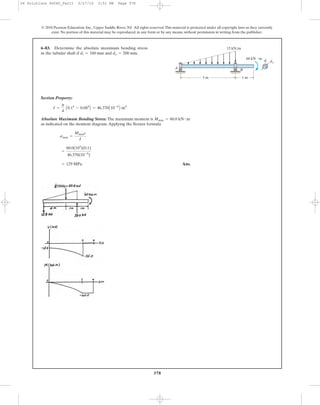
Section Property:
Absolute Maximum Bending Stress: The maximum moment is
as indicated on the moment diagram.Applying the flexure formula
Ans.= 129 MPa
=
60.0(103
)(0.1)
46.370(10-6
)
smax =
Mmaxc
I
Mmax = 60.0 kN # m
I =
p
4
A0.14
- 0.084
B = 46.370A10-6
B m4
6–83. Determine the absolute maximum bending stress
in the tubular shaft if and do = 200 mm.di = 160 mm
© 2010 Pearson Education, Inc., Upper Saddle River, NJ. All rights reserved.This material is protected under all copyright laws as they currently
exist. No portion of this material may be reproduced, in any form or by any means, without permission in writing from the publisher.
A B
di do
3 m 1 m
15 kN/m
60 kN и m
06 Solutions 46060_Part1 5/27/10 3:51 PM Page 378
379
© 2010 Pearson Education, Inc., Upper Saddle River, NJ. All rights reserved.This material is protected under all copyright laws as they currently
exist. No portion of this material may be reproduced, in any form or by any means, without permission in writing from the publisher.
Section Property:
Allowable Bending Stress: The maximum moment is as
indicated on the moment diagram.Applying the flexure formula
Ans.
Thus, Ans.dl = 0.8do = 151 mm
do = 0.1883 m = 188 mm
155A106
B =
60.0(103
)A
do
2 B
0.009225pdo
4
smax = sallow =
Mmax c
I
Mmax = 60.0 kN # m
I =
p
4
B a
do
2
b
4
- a
dl
2
b
4
R =
p
4
B
do
4
16
- a
0.8do
2
b
4
R = 0.009225pdo
4
*6–84. The tubular shaft is to have a cross section such
that its inner diameter and outer diameter are related by
Determine these required dimensions if the
allowable bending stress is sallow = 155 MPa.
di = 0.8do.
A B
di do
3 m 1 m
15 kN/m
60 kN и m
06 Solutions 46060_Part1 5/27/10 3:51 PM Page 379
380
© 2010 Pearson Education, Inc., Upper Saddle River, NJ. All rights reserved.This material is protected under all copyright laws as they currently
exist. No portion of this material may be reproduced, in any form or by any means, without permission in writing from the publisher.
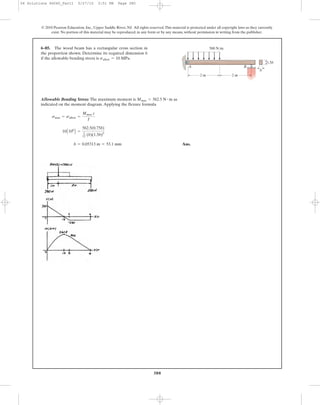
Allowable Bending Stress: The maximum moment is as
indicated on the moment diagram.Applying the flexure formula
Ans.b = 0.05313 m = 53.1 mm
10A106
B =
562.5(0.75b)
1
12 (b)(1.5b)3
smax = sallow =
Mmax c
I
Mmax = 562.5 N # m
6–85. The wood beam has a rectangular cross section in
the proportion shown. Determine its required dimension b
if the allowable bending stress is sallow = 10 MPa.
500 N/m
2 m 2 m
1.5b
b
A B
06 Solutions 46060_Part1 5/27/10 3:51 PM Page 380
381
© 2010 Pearson Education, Inc., Upper Saddle River, NJ. All rights reserved.This material is protected under all copyright laws as they currently
exist. No portion of this material may be reproduced, in any form or by any means, without permission in writing from the publisher.
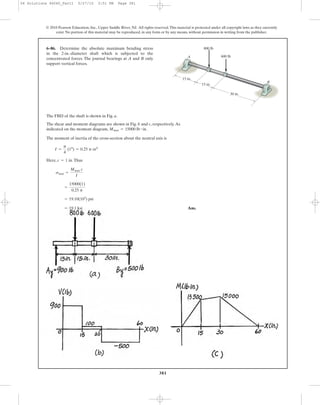
6–86. Determine the absolute maximum bending stress
in the 2-in.-diameter shaft which is subjected to the
concentrated forces. The journal bearings at A and B only
support vertical forces.
15 in.
15 in.
B
A
800 lb
30 in.
600 lb
The FBD of the shaft is shown in Fig. a.
The shear and moment diagrams are shown in Fig. b and c, respectively.As
indicated on the moment diagram, .
The moment of inertia of the cross-section about the neutral axis is
Here, .Thus
Ans.= 19.1 ksi
= 19.10(103
) psi
=
15000(1)
0.25 p
smax =
Mmax c
I
c = 1 in
I =
p
4
(14
) = 0.25 p in4
Mmax = 15000 lb # in
06 Solutions 46060_Part1 5/27/10 3:51 PM Page 381
382
© 2010 Pearson Education, Inc., Upper Saddle River, NJ. All rights reserved.This material is protected under all copyright laws as they currently
exist. No portion of this material may be reproduced, in any form or by any means, without permission in writing from the publisher.
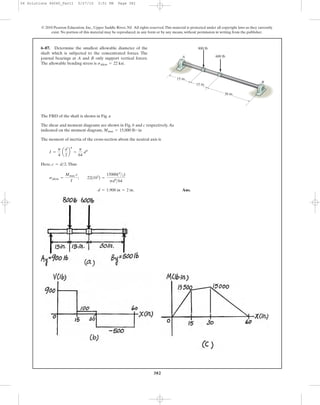
6–87. Determine the smallest allowable diameter of the
shaft which is subjected to the concentrated forces. The
journal bearings at A and B only support vertical forces.
The allowable bending stress is sallow = 22 ksi.
15 in.
15 in.
B
A
800 lb
30 in.
600 lb
The FBD of the shaft is shown in Fig. a
The shear and moment diagrams are shown in Fig. b and c respectively.As
indicated on the moment diagram,
The moment of inertia of the cross-section about the neutral axis is
Here, .Thus
Ans.d = 1.908 in = 2 in.
sallow =
Mmax c
I
; 22(103
) =
15000(d
>2)
pd4
>64
c = d>2
I =
p
4
a
d
2
b
4
=
p
64
d4
Mmax = 15,000 lb # in
06 Solutions 46060_Part1 5/27/10 3:51 PM Page 382
383
© 2010 Pearson Education, Inc., Upper Saddle River, NJ. All rights reserved.This material is protected under all copyright laws as they currently
exist. No portion of this material may be reproduced, in any form or by any means, without permission in writing from the publisher.
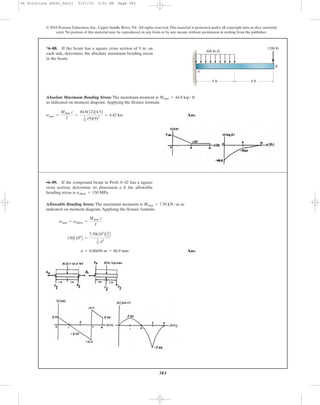
Absolute Maximum Bending Stress: The maximum moment is
as indicated on moment diagram.Applying the flexure formula
Ans.smax =
Mmax c
I
=
44.8(12)(4.5)
1
12 (9)(9)3
= 4.42 ksi
Mmax = 44.8 kip # ft
*6–88. If the beam has a square cross section of 9 in. on
each side, determine the absolute maximum bending stress
in the beam.
A
B
8 ft 8 ft
800 lb/ft
1200 lb
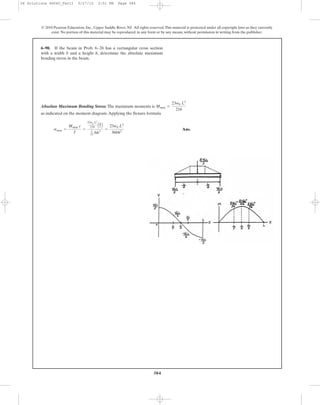
Allowable Bending Stress: The maximum moments is as
indicated on moment diagram.Applying the flexure formula
Ans.a = 0.06694 m = 66.9 mm
150A106
B =
7.50(103
)Aa
2 B
1
12 a4
smax = sallow =
Mmax c
I
Mmax = 7.50 kN # m
•6–89. If the compound beam in Prob. 6–42 has a square
cross section, determine its dimension a if the allowable
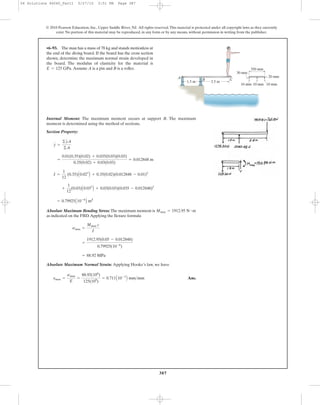
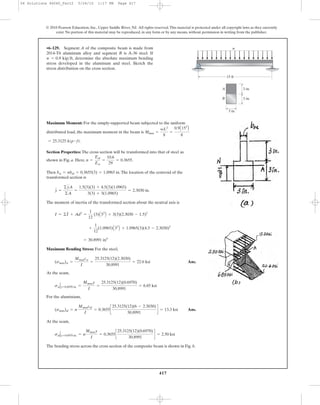
bending stress is sallow = 150 MPa.
06 Solutions 46060_Part1 5/27/10 3:51 PM Page 383
384
6–90. If the beam in Prob. 6–28 has a rectangular cross section
with a width b and a height h, determine the absolute maximum
bending stress in the beam.
© 2010 Pearson Education, Inc., Upper Saddle River, NJ. All rights reserved.This material is protected under all copyright laws as they currently
exist. No portion of this material may be reproduced, in any form or by any means, without permission in writing from the publisher.
Absolute Maximum Bending Stress: The maximum moments is
as indicated on the moment diagram.Applying the flexure formula
Ans.smax =
Mmax c
I
=
23w0
L2
216 Ah
2 B
1
12 bh3
=
23w0 L2
36bh2
Mmax =
23w0 L2
216
06 Solutions 46060_Part1 5/27/10 3:51 PM Page 384
385
The FBD of the shaft is shown in Fig. a
The shear and moment diagrams are shown in Fig. b and c, respectively.As
indicated on the moment diagram, .
The moment of inertia of the cross-section about the neutral axis is
Here, .Thus
Ans.= 119 MPa
= 119.37(106
) Pa
smax =
Mmax c
I
=
6(103
)(0.04)
0.64(10-6
)p
c = 0.04 m
I =
p
4
(0.044
) = 0.64(10-6
)p m4
ΗMmax Η = 6 kN # m
6–91. Determine the absolute maximum bending stress
in the 80-mm-diameter shaft which is subjected to the
concentrated forces. The journal bearings at A and B only
support vertical forces.
© 2010 Pearson Education, Inc., Upper Saddle River, NJ. All rights reserved.This material is protected under all copyright laws as they currently
exist. No portion of this material may be reproduced, in any form or by any means, without permission in writing from the publisher.
0.5 m 0.6 m0.4 m
20 kN
A B
12 kN
06 Solutions 46060_Part1 5/27/10 3:51 PM Page 385
386
The FBD of the shaft is shown in Fig. a.
The shear and moment diagrams are shown in Fig. b and c, respectively.As
indicated on the moment diagram, .
The moment of inertia of the cross-section about the neutral axis is
Here, .Thus
Ans.d = 0.07413 m = 74.13 mm = 75 mm
sallow =
Mmax c
I
; 150(106
) =
6(103
)(d
>2)
pd4
>64
c = d>2
I =
p
4
a
d
2
b
4
=
pd4
64
ΗMmax Η = 6 kN # m
*6–92. Determine the smallest allowable diameter of the
shaft which is subjected to the concentrated forces. The
journal bearings at A and B only support vertical forces.
The allowable bending stress is sallow = 150 MPa.
© 2010 Pearson Education, Inc., Upper Saddle River, NJ. All rights reserved.This material is protected under all copyright laws as they currently
exist. No portion of this material may be reproduced, in any form or by any means, without permission in writing from the publisher.
0.5 m 0.6 m0.4 m
20 kN
A B
12 kN
06 Solutions 46060_Part1 5/27/10 3:51 PM Page 386
387
Internal Moment: The maximum moment occurs at support B. The maximum
moment is determined using the method of sections.
Section Property:
Absolute Maximum Bending Stress: The maximum moment is
as indicated on the FBD.Applying the flexure formula
Absolute Maximum Normal Strain: Applying Hooke’s law, we have
Ans.emax =
smax
E
=
88.92(106
)
125(109
)
= 0.711A10-3
B mm>mm
= 88.92 MPa
=
1912.95(0.05 - 0.012848)
0.79925(10-6
)
smax =
Mmax c
I
Mmax = 1912.95 N # m
= 0.79925A10-6
B m4
+
1
12
(0.03)A0.033
B + 0.03(0.03)(0.035 - 0.012848)2
I =
1
12
(0.35)A0.023
B + 0.35(0.02)(0.012848 - 0.01)2
=
0.01(0.35)(0.02) + 0.035(0.03)(0.03)
0.35(0.02) + 0.03(0.03)
= 0.012848 m
y =
©yA
©A
•6–93. The man has a mass of 78 kg and stands motionless at
the end of the diving board. If the board has the cross section
shown, determine the maximum normal strain developed in
the board. The modulus of elasticity for the material is
Assume A is a pin and B is a roller.E = 125 GPa.
© 2010 Pearson Education, Inc., Upper Saddle River, NJ. All rights reserved.This material is protected under all copyright laws as they currently
exist. No portion of this material may be reproduced, in any form or by any means, without permission in writing from the publisher.
B C
A
1.5 m 2.5 m
350 mm
20 mm
30 mm
10 mm 10 mm 10 mm
06 Solutions 46060_Part1 5/27/10 3:51 PM Page 387
388
Section Property:
Allowable Bending Stress: The maximum moment is as
indicated on moment diagram.Applying the flexure formula
Ans.d = 0.1162 m = 116 mm
130A106
B =
100(103
)(d)
5p
32 d4
smax = sallow =
Mmax c
I
Mmax = 100 kN # m
I = 2B
p
4
a
d
2
b
4
+
p
4
d2
a
d
2
b
2
R =
5p
32
d4
Section Property:
Allowable Bending Stress: The maximum moment is as
indicated on the moment diagram.Applying the flexure formula
Ans.d = 0.1986 m = 199 mm
130A106
B =
100(103
)(d)
p
32 d4
smax = sallow =
Mmax c
I
Mmax = 100 kN # m
I = 2B
p
4
a
d
2
b
4
R =
p
32
d4
6–94. The two solid steel rods are bolted together along
their length and support the loading shown. Assume the
support at A is a pin and B is a roller.Determine the required
diameter d of each of the rods if the allowable bending
stress is sallow = 130 MPa.
6–95. Solve Prob. 6–94 if the rods are rotated so that
both rods rest on the supports at A (pin) and B (roller).
90°
© 2010 Pearson Education, Inc., Upper Saddle River, NJ. All rights reserved.This material is protected under all copyright laws as they currently
exist. No portion of this material may be reproduced, in any form or by any means, without permission in writing from the publisher.
B
A
2 m
80 kN
20 kN/m
2 m
B
A
2 m
80 kN
20 kN/m
2 m
06 Solutions 46060_Part1 5/27/10 3:51 PM Page 388
389
© 2010 Pearson Education, Inc., Upper Saddle River, NJ. All rights reserved.This material is protected under all copyright laws as they currently
exist. No portion of this material may be reproduced, in any form or by any means, without permission in writing from the publisher.
c
Ans.smax =
Mc
I
=
1440 (1.5)
1.59896
= 1.35 ksi
Ix =
1
12
(1)(33
) -
1
12
(0.5)(2.53
) = 1.59896 in4
M = 1440 lb # in.
+ ©M = 0; M - 180(8) = 0
*6–96. The chair is supported by an arm that is hinged so
it rotates about the vertical axis at A. If the load on the chair
is 180 lb and the arm is a hollow tube section having the
dimensions shown, determine the maximum bending stress
at section a–a.
1 in.
3 in.
a
a
A
180 lb
2.5 in.
0.5 in.8 in.
Require
Ans.P = 0.119 kip = 119 lb
1.25 =
2P(1.25>2)
0.11887
smax =
Mc
I
smax = 1.25 ksi
Mmax =
P
2
(4) = 2P
I =
1
4
p C A1.25
2 B4
- A0.375
2 B4
D = 0.11887 in4
•6–97. A portion of the femur can be modeled as a tube
having an inner diameter of 0.375 in. and an outer diameter
of 1.25 in. Determine the maximum elastic static force P
that can be applied to its center. Assume the bone to be
roller supported at its ends. The diagram for the bone
mass is shown and is the same in tension as in compression.
s–P
4 in. 4 in.
2.30
1.25
0.02 0.05
Ps (ksi)
P (in./in.)
06 Solutions 46060_Part1 5/27/10 3:51 PM Page 389
390
Absolute Maximum Bending Stress: The maximum moment is
as indicated on moment diagram.Applying the flexure formula
Ans.smax =
Mmax c
I
=
216(12)(8)
1
12 (8)(163
)
= 7.59 ksi
Mmax = 216 kip # ft
6–98. If the beam in Prob. 6–18 has a rectangular cross
section with a width of 8 in. and a height of 16 in., determine
the absolute maximum bending stress in the beam.
© 2010 Pearson Education, Inc., Upper Saddle River, NJ. All rights reserved.This material is protected under all copyright laws as they currently
exist. No portion of this material may be reproduced, in any form or by any means, without permission in writing from the publisher.
8 in.
16 in.
The maximum moment occurs at the fixed support A. Referring to the FBD shown
in Fig. a,
a
The moment of inertia of the about the neutral axis is .Thus,
Ans.= 5600 psi = 5.60 ksi
smax =
Mc
I
=
16800(12)(3)
108
I =
1
12
(6)(63
) = 108 in4
Mmax = 16800 lb # ft
+©MA = 0; Mmax - 400(6)(3) -
1
2
(400)(6)(8) = 0
6–99. If the beam has a square cross section of 6 in. on
each side, determine the absolute maximum bending stress
in the beam.
A
B
6 ft 6 ft
400 lb/ft
06 Solutions 46060_Part1 5/27/10 3:51 PM Page 390
391
© 2010 Pearson Education, Inc., Upper Saddle River, NJ. All rights reserved.This material is protected under all copyright laws as they currently
exist. No portion of this material may be reproduced, in any form or by any means, without permission in writing from the publisher.
Support Reactions. The FBD of the beam is shown in Fig. a.
The shear and moment diagrams are shown in Fig. a and b, respectively.As
indicated on the moment diagram, .
The moment of inertia of the cross-section about the neutral axis is
Here, .Thus,
Ans.= 2.23 kip>ft
wo = 2 225.46 lb>ft
22(103
) =
(27wo)(12)(6.25)
204.84375
sallow =
Mmax c
I
;
¢ = 6.25 in
= 204.84375 in4
I =
1
12
(9)(12.53
) -
1
12
(8.75)(123
)
Mmax = 27wo
*6–100. The steel beam has the cross-sectional area
shown. Determine the largest intensity of the distributed
load that it can support so that the maximum bending
stress in the beam does not exceed sallow = 22 ksi.
w0
12 in.
9 in.
0.25 in.
9 ft 9 ft
0.25 in.
0.25 in.
w0
06 Solutions 46060_Part1 5/27/10 3:51 PM Page 391
392
© 2010 Pearson Education, Inc., Upper Saddle River, NJ. All rights reserved.This material is protected under all copyright laws as they currently
exist. No portion of this material may be reproduced, in any form or by any means, without permission in writing from the publisher.
The FBD of the beam is shown in Fig. a
The shear and moment diagrams are shown in Fig. b and c, respectively.As
indicated on the moment diagram, .
The moment of inertia of the I cross-section about the bending axis is
Here, .Thus
Ans.= 19.77 ksi = 19.8 ksi
=
54 (12)(6.25)
204.84375
smax =
Mmax c
I
c = 6.25 in
= 204.84375 in4
I =
1
12
(9)A12.53
B -
1
12
(8.75)A123
B
Mmax = 54 kip # ft
•6–101. The steel beam has the cross-sectional area
shown. If determine the maximum bending
stress in the beam.
w0 = 2 kip>ft,
12 in.
9 in.
0.25 in.
9 ft 9 ft
0.25 in.
0.25 in.
w0
06 Solutions 46060_Part2 5/26/10 1:17 PM Page 392
393
© 2010 Pearson Education, Inc., Upper Saddle River, NJ. All rights reserved.This material is protected under all copyright laws as they currently
exist. No portion of this material may be reproduced, in any form or by any means, without permission in writing from the publisher.
Support Reactions: As shown on FBD.
Internal Moment: Using the method of sections.
Section Property:
Bending Stress: Applying the flexure formula
Ans.
Ans.sA =
72.0(12)(6)
438.1875
= 11.8 ksi
sB =
72.0(12)(6.75)
438.1875
= 13.3 ksi
s =
My
I
I =
1
12
(6)A13.53
B -
1
12
(5.5)A123
B = 438.1875 in4
M = 72.0 kip # ft
+©MNA = 0; M + 12.0(4) - 15.0(8) = 0
6–102. The bolster or main supporting girder of a truck
body is subjected to the uniform distributed load.Determine
the bending stress at points A and B.
1.5 kip/ft
12 in.
0.75 in.
0.75 in.
6 in.
0.5 in.
B
8 ft 12 ft
F2
A
A
B
F1
06 Solutions 46060_Part2 5/26/10 1:17 PM Page 393
394
© 2010 Pearson Education, Inc., Upper Saddle River, NJ. All rights reserved.This material is protected under all copyright laws as they currently
exist. No portion of this material may be reproduced, in any form or by any means, without permission in writing from the publisher.
The FBD of the beam is shown in Fig. a
The shear and moment diagrams are shown in Fig. b and c, respectively.As
indicated on the moment diagram, .
The moment of inertia of the cross-section is,
Here, .Thus,
Ans.w = 11250 N>m = 11.25 kN>m
5A106
B =
0.125w(0.075)
21.09375A10-6
B
sallow =
Mmax c
I
;
c = 0.075 w
I =
1
12
(0.075)A0.153
B = 21.09375A10-6
B m4
|Mmax| = 0.125 w
6–103. Determine the largest uniform distributed load w
that can be supported so that the bending stress in the beam
does not exceed sallow = 5 MPa.
0.5 m 0.5 m1 m
75 mm
150 mm
w
06 Solutions 46060_Part2 5/26/10 1:17 PM Page 394
395
© 2010 Pearson Education, Inc., Upper Saddle River, NJ. All rights reserved.This material is protected under all copyright laws as they currently
exist. No portion of this material may be reproduced, in any form or by any means, without permission in writing from the publisher.
Support Reactions. The FBD of the beam is shown in Fig. a
The shear and moment diagrams are shown in Figs. b and c, respectively.As
indicated on the moment diagram, .
The moment of inertia of the cross-section is
Here, .Thus
Ans.
The bending stress distribution over the cross section is shown in Fig. d
= 4.44 MPa
= 4.444 A106
B Pa
=
1.25A103
B(0.075)
21.09375A10-6
B
smax =
Mmax c
I
c = 0.075 m
I =
1
12
(0.075)A0.153
B = 21.09375A10-6
B m4
|Mmax| = 1.25 kN # m
*6–104. If determine the maximum
bending stress in the beam. Sketch the stress distribution
acting over the cross section.
w = 10 kN>m,
0.5 m 0.5 m1 m
75 mm
150 mm
w
06 Solutions 46060_Part2 5/26/10 1:17 PM Page 395
396
© 2010 Pearson Education, Inc., Upper Saddle River, NJ. All rights reserved.This material is protected under all copyright laws as they currently
exist. No portion of this material may be reproduced, in any form or by any means, without permission in writing from the publisher.
The FBD of the beam is shown in Fig. a
The shear and moment diagrams are shown in Figs. b and c, respectively.As
indicated on the moment diagram, .
The moment of inertia of the cross section is
Here, .Thus,
Ans.b = 7.453 in = 7
1
2
in.
150 =
3450(12)(b)
2
>3 b4
sallow =
Mmax c
I
;
c = 2b>2 = b
I =
1
12
(b)(2b)3
=
2
3
b4
Mmax = 3450 lb # ft
•6–105. If the allowable bending stress for the wood beam
is determine the required dimension b to
the nearest in. of its cross section.Assume the support at A
is a pin and B is a roller.
1
4
sallow = 150 psi,
BA
3 ft3 ft3 ft
2b
b
400 lb/ft
06 Solutions 46060_Part2 5/26/10 1:17 PM Page 396
397
© 2010 Pearson Education, Inc., Upper Saddle River, NJ. All rights reserved.This material is protected under all copyright laws as they currently
exist. No portion of this material may be reproduced, in any form or by any means, without permission in writing from the publisher.
The FBD of the beam is shown in Fig. a.
The shear and moment diagrams are shown in Fig. b and c, respectively.As
indicated on the moment diagram, .
The moment of inertia of the cross-section is
Here, .Thus
Ans.smax =
Mmax c
I
=
3450(12)(7.5)
2109.375
= 147 psi
c =
15
2
= 7.5 in
I =
1
12
(7.5)A153
B = 2109.375 in4
Mmax = 3450 lb # ft
6–106. The wood beam has a rectangular cross section in
the proportion shown. If b ϭ 7.5 in., determine the absolute
maximum bending stress in the beam.
BA
3 ft3 ft3 ft
2b
b
400 lb/ft
06 Solutions 46060_Part2 5/26/10 1:17 PM Page 397
398
Location of neutral axis:
[1]
Taking positive root:
[2] Ans.
From Eq. [1].
From Eq. [2]
Ans.(smax)t =
3M
b h2
£
2Et + 2Ec
2Ec
≥
M =
1
3
bc(smax)t (h - c + c) ; (smax)t =
3M
bhc
M =
1
3
(h - c)2
(b)a
c
h - c
b(smax)t +
1
3
c2
b(smax)t
(smax)c =
c
h - c
(smax)t
M =
1
3
(h - c)2
(b)(smax)c +
1
3
c2
b(smax)t
M = c
1
2
(h - c)(smax)c (b)d a
2
3
b(h - c) + c
1
2
(c)(smax)t(b) d a
2
3
b(c)
©MNA = 0;
c =
h
A
Ec
Et
1 +
A
Ec
Et
=
h2Ec
2Et + 2Ec
c
h - c
=
A
Ec
Et
(h - c)Ec (emax)t
(h - c)
c
= cEt (emax)t ; Ec (h - c)2
= Etc2
(h - c)(smax)c = c(smax)t
©F = 0; -
1
2
(h - c)(smax)c (b) +
1
2
(c)(smax)t (b) = 0:+
(smax)c = Ec(emax)c =
Ec(emax)t (h - c)
c
(emax)c =
(emax)t (h - c)
c
6–107. A beam is made of a material that has a modulus of
elasticity in compression different from that given for
tension. Determine the location c of the neutral axis, and
derive an expression for the maximum tensile stress in the
beam having the dimensions shown if it is subjected to the
bending moment M.
© 2010 Pearson Education, Inc., Upper Saddle River, NJ. All rights reserved.This material is protected under all copyright laws as they currently
exist. No portion of this material may be reproduced, in any form or by any means, without permission in writing from the publisher.
h
c
bEt
Ec
M
s
P
06 Solutions 46060_Part2 5/26/10 1:17 PM Page 398
399
© 2010 Pearson Education, Inc., Upper Saddle River, NJ. All rights reserved.This material is protected under all copyright laws as they currently
exist. No portion of this material may be reproduced, in any form or by any means, without permission in writing from the publisher.
*6–108. The beam has a rectangular cross section and is
subjected to a bending moment M. If the material from
which it is made has a different modulus of elasticity for
tension and compression as shown, determine the location c
of the neutral axis and the maximum compressive stress in
the beam.
h
c
bEt
Ec
M
s
P
See the solution to Prob. 6–107
Ans.
Since
Ans.(smax)c =
3M
bh2 ¢
2Et + 2Ec
2Et
≤
(smax)c =
2Ec
2Et
¢
3M
bh2 ≤ ¢
2Et + 2Ec
2Ec
≤
(smax)c =
2Ec
2Et
(smax)t
(smax)c =
c
h - c
(smax)t =
h2Ec
(2Et + 2Ec)ch - a
h1Ec
1Et + 1Ec
b d
(smax)t
c =
h2Ec
2Et + 2Ec
06 Solutions 46060_Part2 5/26/10 1:17 PM Page 399
400
© 2010 Pearson Education, Inc., Upper Saddle River, NJ. All rights reserved.This material is protected under all copyright laws as they currently
exist. No portion of this material may be reproduced, in any form or by any means, without permission in writing from the publisher.
The y and z components of M are negative, Fig. a.Thus,
The moments of inertia of the cross-section about the principal centroidal y and z
axes are
By inspection, the bending stress occurs at corners A and C are
Ans.
Ans.
Here,
Ans.
The orientation of neutral axis is shown in Fig. b.
a = 65.1°
tan a =
1584
736
tan 225°
tan a =
Iz
Iy
tan u
u = 180° + 45° = 225°
= -2.01 ksi = 2.01 ksi (C)
smax = sA = -
-14.14(12)(-8)
1584
+
-14.14(12)(5)
736
= 2.01 ksi (T)
smax = sC = -
-14.14(12)(8)
1584
+
-14.14(12)( - 5)
736
s = -
Mz y
Iz
+
My z
Iy
Iz =
1
12
(10)A163
B -
1
12
(8)A143
B = 1584 in4
Iy =
1
12
(16)A103
B -
1
12
(14)A83
B = 736 in4
Mz = -20 cos 45° = -14.14 kip # ft.
My = -20 sin 45° = -14.14 kip # ft
•6–109. The beam is subjected to a bending moment of
directed as shown. Determine the maximum
bending stress in the beam and the orientation of the
neutral axis.
M = 20 kip # ft
16 in.
10 in.
8 in.
14 in.
y
z
M
B
C
A D
45Њ
06 Solutions 46060_Part2 5/26/10 1:17 PM Page 400
401
© 2010 Pearson Education, Inc., Upper Saddle River, NJ. All rights reserved.This material is protected under all copyright laws as they currently
exist. No portion of this material may be reproduced, in any form or by any means, without permission in writing from the publisher.
The y and z components of M are negative, Fig. a.Thus,
The moments of inertia of the cross-section about principal centroidal y and z
axes are
By inspection, the maximum bending stress occurs at corners A and C. Here, we
will consider corner C.
Ans.M = 119.40 kip # ft = 119 kip # ft
12 = -
-0.7071 M (12)(8)
1584
+
-0.7071 M(12)(-5)
736
sC = sallow = -
Mz yc
Iz
+
Myzc
Iy
Iz =
1
12
(10)A163
B -
1
12
(8)A143
B = 1584 in4
Iy =
1
12
(16)A103
B -
1
12
(14)A83
B = 736 in4
Mz = -M cos 45° = -0.7071 M
My = -M sin 45° = -0.7071 M
6–110. Determine the maximum magnitude of the
bending moment M that can be applied to the beam so that
the bending stress in the member does not exceed 12 ksi.
16 in.
10 in.
8 in.
14 in.
y
z
M
B
C
A D
45Њ
06 Solutions 46060_Part2 5/26/10 1:17 PM Page 401
402
Internal Moment Components:
Section Properties:
Ans.
Maximum Bending Stress: Applying the flexure formula for biaxial at points A
and B
Ans.
Ans.
Orientation of Neutral Axis:
Ans.a = -3.74°
tan a =
57.6014(10-6
)
0.366827(10-3
)
tan (-22.62°)
tan a =
Iz
Iy
tan u
= 0.587 MPa (T)
sB = -
-480(0.057368)
57.6014(10-6
)
+
200(0.2)
0.366827(10-3
)
= -1.298 MPa = 1.30 MPa (C)
sA = -
-480(-0.142632)
57.6014(10-6
)
+
200(-0.2)
0.366827(10-3
)
s = -
Mzy
Iz
+
Myz
Iy
Iy =
1
12
(0.2)A0.43
B -
1
12
(0.18)A0.363
B = 0.366827A10-3
B m4
= 57.6014A10-6
B m4
+
1
12
(0.04)A0.183
B + 0.04(0.18)(0.110 - 0.057368)2
Iz =
1
12
(0.4)A0.023
B + (0.4)(0.02)(0.057368 - 0.01)2
= 0.057368 m = 57.4 mm
y =
©yA
©A
=
0.01(0.4)(0.02) + 2[(0.110)(0.18)(0.02)]
0.4(0.02) + 2(0.18)(0.02)
Mz = -
12
13
(520) = -480 N # m My =
5
13
(520) = 200 N # m
6–111. If the resultant internal moment acting on the
cross section of the aluminum strut has a magnitude of
and is directed as shown, determine the
bending stress at points A and B. The location of the
centroid C of the strut’s cross-sectional area must be
determined.Also, specify the orientation of the neutral axis.
y
M = 520 N # m
© 2010 Pearson Education, Inc., Upper Saddle River, NJ. All rights reserved.This material is protected under all copyright laws as they currently
exist. No portion of this material may be reproduced, in any form or by any means, without permission in writing from the publisher.
20 mm20 mm
z
B
C
–y
200 mm
y
M ϭ 520 Nиm
12
5 13
200 mm 200 mm
A
20 mm
06 Solutions 46060_Part2 5/26/10 1:17 PM Page 402
403
© 2010 Pearson Education, Inc., Upper Saddle River, NJ. All rights reserved.This material is protected under all copyright laws as they currently
exist. No portion of this material may be reproduced, in any form or by any means, without permission in writing from the publisher.
Internal Moment Components:
Section Properties:
Ans.
Maximum Bending Stress: By inspection, the maximum bending stress can occur at
either point A or B. Applying the flexure formula for biaxial bending at points A
and B
Ans.
Orientation of Neutral Axis:
Ans.a = -3.74°
tan a =
57.6014(10-6
)
0.366827(10-3
)
tan (-22.62°)
tan a =
Iz
Iy
tan u
= 0.587 MPa (T)
sB = -
-480(0.057368)
57.6014(10-6
)
+
200(0.2)
0.366827(10-3
)
= -1.298 MPa = 1.30 MPa (C) (Max)
sA = -
-480(-0.142632)
57.6014(10-6
)
+
200(-0.2)
0.366827(10-3
)
s = -
Mz y
Iz
+
My z
Iy
Iy =
1
12
(0.2)A0.43
B -
1
12
(0.18)A0.363
B = 0.366827A10-3
B m4
= 57.6014A10-6
B m4
+
1
12
(0.04)A0.183
B + 0.04(0.18)(0.110 - 0.057368)2
Iz =
1
12
(0.4)A0.023
B + (0.4)(0.02)(0.057368 - 0.01)2
= 0.057368 m = 57.4 mm
y =
© y A
©A
=
0.01(0.4)(0.02) + 2[(0.110)(0.18)(0.02)]
0.4(0.02) + 2(0.18)(0.02)
Mz = -
12
13
(520) = -480 N # m My =
5
13
(520) = 200 N # m
*6–112. The resultant internal moment acting on the
cross section of the aluminum strut has a magnitude of
and is directed as shown. Determine
maximum bending stress in the strut. The location of the
centroid C of the strut’s cross-sectional area must be
determined.Also, specify the orientation of the neutral axis.
y
M = 520 N # m
20 mm20 mm
z
B
C
–y
200 mm
y
M ϭ 520 Nиm
12
5 13
200 mm 200 mm
A
20 mm
06 Solutions 46060_Part2 5/26/10 1:17 PM Page 403
404
© 2010 Pearson Education, Inc., Upper Saddle River, NJ. All rights reserved.This material is protected under all copyright laws as they currently
exist. No portion of this material may be reproduced, in any form or by any means, without permission in writing from the publisher.
Equilibrium Condition:
[1]
[2]
[3]
Section Properties: The integrals are defined in Appendix A. Note that
.Thus,
From Eq. [1]
From Eq. [2]
From Eq. [3]
Solving for a, b, c:
Thus, (Q.E.D.)sx = - ¢
Mz Iy + My Iyz
Iy Iz - Iyz
2 ≤y + ¢
My Iy + MzIyz
Iy Iz - Iyz
2 ≤z
b = - ¢
MzIy + My Iyz
Iy Iz - Iyz
2 ≤ c =
My Iz + Mz Iyz
Iy Iz - Iyz
2
a = 0 (Since A Z 0)
Mz = -bIz - cIyz
My = bIyz + cIy
Aa = 0
LA
y dA =
LA
z dA = 0
= -a
LA
ydA - b
LA
y2
dA - c
LA
yz dA
=
LA
-y(a + by + cz) dA
Mz =
LA
-y sx dA
= a
LA
z dA + b
LA
yz dA + c
LA
z2
dA
=
LA
z(a + by + cz) dA
My =
LA
z sx dA
0 = a
LA
dA + b
LA
y dA + c
LA
z dA
0 =
LA
(a + by + cz) dA
0 =
LA
sx dA
sx = a + by + cz
6–113. Consider the general case of a prismatic beam
subjected to bending-moment components and
as shown, when the x, y, z axes pass through the centroid
of the cross section. If the material is linear-elastic, the
normal stress in the beam is a linear function of position
such that Using the equilibrium con-
ditions
determine the constants a, b, and c, and show that the
normal stress can be determined from the equation
where the moments and products of inertia are defined in
Appendix A.
s = [-1MzIy + MyIyz2y + 1MyIz + MzIyz2z]>1IyIz - Iyz
2
2,
1A - ys dA,Mz =My = 1A zs dA,0 = 1As dA,
s = a + by + cz.
Mz,My
y
y
z x
z
dA
My
C
Mz
s
06 Solutions 46060_Part2 5/26/10 1:17 PM Page 404
405
© 2010 Pearson Education, Inc., Upper Saddle River, NJ. All rights reserved.This material is protected under all copyright laws as they currently
exist. No portion of this material may be reproduced, in any form or by any means, without permission in writing from the publisher.
Using the equation developed in Prob. 6-113.
Ans.= 8.95 ksi
sA =
{-[0 + (4.80)(103
)(1.6875)](1.625) + [(4.80)(103
)(2.970378) + 0](2.125)}
[1.60319(2.970378) - (1.6875)2
]
s = - a
Mz Iy + My Iyz
Iy Iz - Iyz
2
by + a
My Iz + Mz Iyz
Iy Iz - Iyz
2
bz
Iyz = 2[1.5(1.125)(2)(0.25)] = 1.6875 in4
Iz =
1
12
(0.25)(3.25)3
+ 2c
1
12
(2)(0.25)3
+ (0.25)(2)(1.5)2
d = 2.970378 in4
Iy =
1
12
(3.25)(0.25)3
+ 2c
1
12
(0.25)(2)3
+ (0.25)(2)(1.125)2
d = 1.60319 in4
(My)max = 50(3) + 50(5) = 400 lb # ft = 4.80(103
)lb # in.
6–114. The cantilevered beam is made from the Z-section
having the cross-section shown. If it supports the two
loadings, determine the bending stress at the wall in the
beam at point A. Use the result of Prob. 6–113.
2 ft
50 lb
50 lb
3 ft
3 in.
0.25 in.
0.25 in.
0.25 in.
2.25 in.
2 in.
A
B
Using the equation developed in Prob. 6-113.
Ans.= 7.81 ksi
sB =
-[0 + (4.80)(103
)(1.6875)](-1.625) + [(4.80)(103
)(2.976378) + 0](0.125)
[(1.60319)(2.970378) - (1.6875)2
]
s = - a
Mz Iy + My Iyz
Iy Iz - Iyz
2
by + a
My Iz + Mz Iyz
Iy Iz - Iyz
2
bz
Iyz = 2[1.5(1.125)(2)(0.25)] = 1.6875 in4
Iz =
1
12
(0.25)(3.25)3
+ 2c
1
12
(2)(0.25)3
+ (0.25)(2)(1.5)2
d = 2.970378 in4
Iy =
1
12
(3.25)(0.25)3
+ 2c
1
12
(0.25)(2)3
+ (0.25)(2)(1.125)2
d = 1.60319 in4
(My)max = 50(3) + 50(5) = 400 lb # ft = 4.80(103
)lb # in.
6–115. The cantilevered beam is made from the Z-section
having the cross-section shown. If it supports the two
loadings, determine the bending stress at the wall in the
beam at point B. Use the result of Prob. 6–113.
2 ft
50 lb
50 lb
3 ft
3 in.
0.25 in.
0.25 in.
0.25 in.
2.25 in.
2 in.
A
B
06 Solutions 46060_Part2 5/26/10 1:17 PM Page 405
406
© 2010 Pearson Education, Inc., Upper Saddle River, NJ. All rights reserved.This material is protected under all copyright laws as they currently
exist. No portion of this material may be reproduced, in any form or by any means, without permission in writing from the publisher.
Internal Moment Components: Using method of section
Section Properties:
Allowable Bending Stress: By inspection, maximum bending stress occurs at points
A and B.Applying the flexure formula for biaxial bending at point A.
Ans.P = 14208 N = 14.2 kN
180A106
B = -
(-1.732P)(0.085)
28.44583(10-6
)
+
-1.00P(-0.1)
13.34583(10-6
)
sA = sallow = -
Mzy
Iz
+
Myz
Iy
Iy = 2c
1
12
(0.01)A0.23
B d +
1
12
(0.15)A0.013
B = 13.34583(10-6
) m4
Iz =
1
12
(0.2)A0.173
B -
1
12
(0.19)A0.153
B = 28.44583(10-6
) m4
©My = 0; My + P sin 30°(2) = 0 My = -1.00P
©Mz = 0; Mz + P cos 30°(2) = 0 Mz = -1.732P
Internal Moment Components: Using method of sections
Section Properties:
Maximum Bending Stress: By inspection, maximum bending stress occurs at A and
B.Applying the flexure formula for biaxial bending at point A
Ans.= 7.60 MPa (T) (Max)
sA = -
-1039.32(0.085)
28.44583(10-6
)
+
-600.0(-0.1)
13.34583(10-6
)
s = -
Mzy
Iz
+
Myz
Iy
Iy = 2c
1
12
(0.01)A0.23
B d +
1
12
(0.15)A0.013
B = 13.34583(10-6
) m4
Iz =
1
12
(0.2)A0.173
B -
1
12
(0.19)A0.153
B = 28.44583(10-6
) m4
©My = 0; My + 600 sin 30°(2) = 0; My = -600.0 N # m
©Mz = 0; Mz + 600 cos 30°(2) = 0 Mz = -1039.23 N # m
*6–116. The cantilevered wide-flange steel beam is
subjected to the concentrated force P at its end. Determine
the largest magnitude of this force so that the bending stress
developed at A does not exceed sallow = 180 MPa.
•6–117. The cantilevered wide-flange steel beam is
subjected to the concentrated force of at its end.
Determine the maximum bending stress developed in the
beam at section A.
P = 600 N
150 mm
10 mm
10 mm
10 mm
200 mm
30Њ
z
y
x
A
P
2 m
150 mm
10 mm
10 mm
10 mm
200 mm
30Њ
z
y
x
A
P
2 m
06 Solutions 46060_Part2 5/26/10 1:17 PM Page 406
407
© 2010 Pearson Education, Inc., Upper Saddle River, NJ. All rights reserved.This material is protected under all copyright laws as they currently
exist. No portion of this material may be reproduced, in any form or by any means, without permission in writing from the publisher.
Internal Moment Components: The y component of M is positive since it is directed
towards the positive sense of the y axis, whereas the z component of M, which is
directed towards the negative sense of the z axis, is negative, Fig. a.Thus,
Section Properties: The location of the centroid of the cross-section is given by
The moments of inertia of the cross section about the principal centroidal y and z
axes are
Bending Stress: By inspection, the maximum bending stress occurs at either corner
A or B.
Ans.
Orientation of Neutral Axis: Here, .
Ans.
The orientation of the neutral axis is shown in Fig. b.
a = -66.5°
tan a =
5.2132A10-3
B
1.3078A10-3
B
tan(-30°)
tan a =
Iz
Iy
tan u
u = -30°
= -131 MPa = 131 MPa (C)(Max.)
sB = -
c -1039.23A103
B d(-0.3107)
5.2132A10-3
B
+
600A103
B(-0.15)
1.3078A10-3
B
= 126 MPa (T)
sA = -
c -1039.23A103
B d(0.2893)
5.2132A10-3
B
+
600A103
B(0.15)
1.3078A10-3
B
s = -
Mzy
Iz
+
Myz
Iy
= 5.2132A10-3
Bm4
- c
1
12
(0.15)A0.153
B + 0.15(0.15)(0.375 - 0.2893)2
d
Iz =
1
12
(0.3)A0.63
B + 0.3(0.6)(0.3 - 0.2893)2
Iy =
1
12
(0.6)A0.33
B -
1
12
(0.15)A0.153
B = 1.3078A10-3
B m4
y =
©yA
©A
=
0.3(0.6)(0.3) - 0.375(0.15)(0.15)
0.6(0.3) - 0.15(0.15)
= 0.2893 m
Mz = -1200 cos 30° = -1039.23 kN # m
My = 1200 sin 30° = 600 kN # m
6–118. If the beam is subjected to the internal moment of
determine the maximum bending stress
acting on the beam and the orientation of the neutral axis.
M = 1200 kN # m,
150 mm
150 mm
150 mm
150 mm
300 mm
150 mm
y
xz
M
30Њ
06 Solutions 46060_Part2 5/26/10 1:17 PM Page 407
408
© 2010 Pearson Education, Inc., Upper Saddle River, NJ. All rights reserved.This material is protected under all copyright laws as they currently
exist. No portion of this material may be reproduced, in any form or by any means, without permission in writing from the publisher.
Internal Moment Components: The y component of M is positive since it is directed
towards the positive sense of the y axis, whereas the z component of M, which is
directed towards the negative sense of the z axis, is negative, Fig. a.Thus,
Section Properties: The location of the centroid of the cross section is
The moments of inertia of the cross section about the principal centroidal y and z
axes are
Bending Stress: By inspection, the maximum bending stress can occur at either
corner A or B. For corner A which is in tension,
Ans.
For corner B which is in compression,
M = 1376 597.12 N # m = 1377 kN # m
-150A106
B = -
(-0.8660M)(-0.3107)
5.2132A10-3
B
+
0.5M(-0.15)
1.3078A10-3
B
sB = (sallow)c = -
Mz yB
Iz
+
My zB
Iy
M = 1185 906.82 N # m = 1186 kN # m (controls)
125A106
B = -
(-0.8660M)(0.2893)
5.2132A10-3
B
+
0.5M(0.15)
1.3078A10-3
B
sA = (sallow)t = -
Mz yA
Iz
+
My zA
Iy
= 5.2132A10-3
Bm4
- c
1
12
(0.15)A0.153
B + 0.15(0.15)(0.375 - 0.2893)2
d
Iz =
1
12
(0.3)A0.63
B + 0.3(0.6)(0.3 - 0.2893)2
Iy =
1
12
(0.6)A0.33
B -
1
12
(0.15)A0.153
B = 1.3078A10-3
B m4
y =
©yA
©A
=
0.3(0.6)(0.3) - 0.375(0.15)(0.15)
0.6(0.3) - 0.15(0.15)
= 0.2893 m
Mz = -M cos 30° = -0.8660M
My = M sin 30° = 0.5M
6–119. If the beam is made from a material having
an allowable tensile and compressive stress of
and respectively,
determine the maximum allowable internal moment M that
can be applied to the beam.
(sallow)c = 150 MPa,(sallow)t = 125 MPa
150 mm
150 mm
150 mm
150 mm
300 mm
150 mm
y
xz
M
30Њ
06 Solutions 46060_Part2 5/26/10 1:17 PM Page 408
409
© 2010 Pearson Education, Inc., Upper Saddle River, NJ. All rights reserved.This material is protected under all copyright laws as they currently
exist. No portion of this material may be reproduced, in any form or by any means, without permission in writing from the publisher.
The FBD of the shaft is shown in Fig. a.
The shaft is subjected to two bending moment components Mz and My, Figs. b and c,
respectively.
Since all the axes through the centroid of the circular cross-section of the shaft are
principal axes, then the resultant moment can be used for
design.The maximum moment occurs at .Then,
Then,
Ans.d = 0.02501 m = 25 mm
sallow =
Mmax C
I
; 150(106
) =
230.49(d>2)
p
4 (d>2)4
Mmax = 21502
+ 1752
= 230.49 N # m
D (x = 1m)
M = 2My
2
+ Mz
2
*6–120. The shaft is supported on two journal bearings
at A and B which offer no resistance to axial loading.
Determine the required diameter d of the shaft if
the allowable bending stress for the material is
sallow = 150 MPa.
300 N
300 N
150 N150 N
200 N
200 N 0.5 m
0.5 m
0.5 m
0.5 m
A
D
E
C
z
x
B
y
06 Solutions 46060_Part2 5/26/10 1:17 PM Page 409
410
© 2010 Pearson Education, Inc., Upper Saddle River, NJ. All rights reserved.This material is protected under all copyright laws as they currently
exist. No portion of this material may be reproduced, in any form or by any means, without permission in writing from the publisher.
Support Reactions: As shown on FBD.
Internal Moment Components: The shaft is subjected to two bending moment
components My and Mz.The moment diagram for each component is drawn.
Maximum Bending Stress: Since all the axes through the circle’s center for circular
shaft are principal axis, then the resultant moment can be used
to determine the maximum bending stress. The maximum resultant moment occurs
at .
Applying the flexure formula
Ans.= 161 MPa
=
427.2(0.015)
p
4 A0.0154
B
smax =
Mmax c
I
E Mmax = 24002
+ 1502
= 427.2 N # m
M = 2My
2
+ Mz
2
•6–121. The 30-mm-diameter shaft is subjected to the
vertical and horizontal loadings of two pulleys as shown. It
is supported on two journal bearings at A and B which offer
no resistance to axial loading. Furthermore, the coupling to
the motor at C can be assumed not to offer any support
to the shaft. Determine the maximum bending stress
developed in the shaft.
1 m
150 N
400 N
400 N
60 mm
100 mm
150 N
1 m
A
D
E
B
C
yz
x
1 m
1 m
06 Solutions 46060_Part2 5/26/10 1:17 PM Page 410
411
© 2010 Pearson Education, Inc., Upper Saddle River, NJ. All rights reserved.This material is protected under all copyright laws as they currently
exist. No portion of this material may be reproduced, in any form or by any means, without permission in writing from the publisher.
Ans.= -293 kPa = 293 kPa (C)
sA = -
Mzy
Iz
+
Myz
Iy
=
-135.8(0.2210)
0.471(10-3
)
+
209.9(-0.06546)
60.0(10-6
)
z = -(0.175 cos 32.9° - 0.15 sin 32.9°) = -0.06546 m
y = 0.15 cos 32.9° + 0.175 sin 32.9° = 0.2210 m
Mz = 250 sin 32.9° = 135.8 N # m
My = 250 cos 32.9° = 209.9 N # m
Internal Moment Components:
Section Properties:
Bending Stress: Using formula developed in Prob. 6-113
Ans.= -293 kPa = 293 kPa (C)
sA =
-[0 + 250(-0.1875)(10-3
)](0.15) + [250(0.350)(10-3
) + 0](-0.175)
0.18125(10-3
)(0.350)(10-3
) - [0.1875(10-3
)]2
s =
-(Mz Iy + My Iyz)y + (My Iz + MzIyz)z
IyIz - Iyz
2
= -0.1875A10-3
B m4
Iyz = 0.15(0.05)(0.125)(-0.1) + 0.15(0.05)(-0.125)(0.1)
= 0.350(10-3
) m4
Iz =
1
12
(0.05)A0.33
B + 2c
1
12
(0.15)A0.053
B + 0.15(0.05)A0.1252
B d
= 0.18125A10-3
B m4
Iy =
1
12
(0.3)A0.053
B + 2c
1
12
(0.05)A0.153
B + 0.05(0.15)A0.12
B d
My = 250 N # m Mz = 0
6–122. Using the techniques outlined in Appendix A,
Example A.5 or A.6, the Z section has principal moments of
inertia of and
computed about the principal axes of inertia y and z,
respectively. If the section is subjected to an internal
moment of directed horizontally as shown,
determine the stress produced at point A. Solve the
problem using Eq. 6–17.
M = 250 N # m
Iz = 0.471110-3
2 m4
,Iy = 0.060110-3
2 m4
6–123. Solve Prob. 6–122 using the equation developed in
Prob. 6–113.
200 mm
50 mm
50 mm
300 mm
z¿
z
250 Nиm
y
y¿
A
32.9Њ
50 mm
200 mm
B
200 mm
50 mm
50 mm
300 mm
z¿
z
250 Nиm
y
y¿
A
32.9Њ
50 mm
200 mm
B
06 Solutions 46060_Part2 5/26/10 1:17 PM Page 411
412
© 2010 Pearson Education, Inc., Upper Saddle River, NJ. All rights reserved.This material is protected under all copyright laws as they currently
exist. No portion of this material may be reproduced, in any form or by any means, without permission in writing from the publisher.
Internal Moment Components:
Section Property:
Bending Stress: Applying the flexure formula for biaxial bending
Ans.= 293 kPa = 293 kPa (T)
sB =
135.8(0.2210)
0.471(10-3
)
-
209.9(-0.06546)
0.060(10-3
)
s =
Mz¿y¿
Iz¿
+
My¿z¿
Iy¿
z¿ = 0.15 sin 32.9° - 0.175 cos 32.9° = -0.06546 m
y¿ = 0.15 cos 32.9° + 0.175 sin 32.9° = 0.2210 m
Mz¿ = 250 sin 32.9° = 135.8 N # m
My¿ = 250 cos 32.9° = 209.9 N # m
*6–124. Using the techniques outlined in Appendix A,
Example A.5 or A.6, the Z section has principal moments of
inertia of and
computed about the principal axes of inertia y and z,
respectively. If the section is subjected to an internal
moment of directed horizontally as shown,
determine the stress produced at point B. Solve the
problem using Eq. 6–17.
M = 250 N # m
Iz = 0.471110-3
2 m4
,Iy = 0.060110-3
2 m4
200 mm
50 mm
50 mm
300 mm
z¿
z
250 Nиm
y
y¿
A
32.9Њ
50 mm
200 mm
B
06 Solutions 46060_Part2 5/26/10 1:17 PM Page 412
413
© 2010 Pearson Education, Inc., Upper Saddle River, NJ. All rights reserved.This material is protected under all copyright laws as they currently
exist. No portion of this material may be reproduced, in any form or by any means, without permission in writing from the publisher.
•6–125. Determine the bending stress at point A of the
beam, and the orientation of the neutral axis. Using the
method in Appendix A, the principal moments of inertia of
the cross section are and
where and are the principal axes. Solve the problem
using Eq. 6–17.
y¿z¿
I¿y = 2.295 in4
,I¿z = 8.828 in4
4 in.
4 in.
0.5 in.
0.5 in.
1.183 in.
1.183 in.
A
C
z
z¿
y
y′
45Њ
M ϭ 3 kip и ft
Internal Moment Components: Referring to Fig. a, the and components of M
are negative since they are directed towards the negative sense of their respective
axes.Thus,
Section Properties: Referring to the geometry shown in Fig. b,
Bending Stress:
Ans.= -20.97 ksi = 21.0 ksi (C)
= -
(-2.121)(12)(-2.828)
8.828
+
(-2.121)(12)(1.155)
2.295
sA = -
Mz¿yA
œ
Iz¿
+
My¿zA
œ
Iy¿
yA
œ
= -(2.817 sin 45° + 1.183 cos 45°) = -2.828 in.
zA
œ
= 2.817 cos 45° - 1.183 sin 45° = 1.155 in.
z¿y¿
06 Solutions 46060_Part2 5/26/10 1:17 PM Page 413
414
© 2010 Pearson Education, Inc., Upper Saddle River, NJ. All rights reserved.This material is protected under all copyright laws as they currently
exist. No portion of this material may be reproduced, in any form or by any means, without permission in writing from the publisher.
Internal Moment Components: Since M is directed towards the negative sense of the y axis, its
y component is negative and it has no z component.Thus,
Bending Stress:
Ans.= -20.97 ksi = 21.0 ksi
=
- C0(5.561) + (-3)(12)(-3.267)D(-1.183) + C -3(12)(5.561) + 0(-3.267)D(2.817)
5.561(5.561) - (-3.267)2
sA =
- AMzIy + MyIyzByA + AMyIz + MzIyzBzA
IyIz - Iyz
2
My = -3 kip # ft Mz = 0
6–126. Determine the bending stress at point A of the
beam using the result obtained in Prob. 6–113. The moments
of inertia of the cross sectional area about the z and y axes
are and the product of inertia of the
cross sectional area with respect to the z and y axes is
Iyz ϭ Ϫ3.267 in4. (See Appendix A)
Iz = Iy = 5.561 in4
4 in.
4 in.
0.5 in.
0.5 in.
1.183 in.
1.183 in.
A
C
z
z¿
y
y′
45Њ
M ϭ 3 kip и ft
06 Solutions 46060_Part2 5/26/10 1:17 PM Page 414
415
© 2010 Pearson Education, Inc., Upper Saddle River, NJ. All rights reserved.This material is protected under all copyright laws as they currently
exist. No portion of this material may be reproduced, in any form or by any means, without permission in writing from the publisher.
Section Properties:
Ans.
Allowable Bending Stress: Applying the flexure formula
Assume failure of red brass
Ans.
Assume failure of aluminium
M = 29215 N # m = 29.2 kN # m
128A106
B = 0.68218c
M(0.05)
7.7851(10-6
)
d
(sallow)al = n
Mc
INA
M = 6598 N # m = 6.60 kN # m (controls!)
35A106
B =
M(0.04130)
7.7851(10-6
)
(sallow)br =
Mc
INA
= 7.7851A10-6
B m4
+
1
12
(0.15)A0.041303
B + 0.15(0.04130)(0.070649 - 0.05)2
INA =
1
12
(0.10233)A0.053
B + 0.10233(0.05)(0.05 - 0.025)2
h = 0.04130 m = 41.3 mm
0.05 =
0.025(0.10233)(0.05) + (0.05 + 0.5h)(0.15)h
0.10233(0.05) + (0.15)h
y =
©yA
©A
bbr = nbal = 0.68218(0.15) = 0.10233 m
n =
Eal
Ebr
=
68.9(109
)
101(109
)
= 0.68218
6–127. The composite beam is made of 6061-T6 aluminum
(A) and C83400 red brass (B).Determine the dimension h of
the brass strip so that the neutral axis of the beam is located
at the seam of the two metals. What maximum moment will
this beam support if the allowable bending stress for the
aluminum is and for the brass
1sallow2br = 35 MPa?
1sallow2al = 128 MPa
B
A
50 mm
150 mm
h
06 Solutions 46060_Part2 5/26/10 1:17 PM Page 415
416
© 2010 Pearson Education, Inc., Upper Saddle River, NJ. All rights reserved.This material is protected under all copyright laws as they currently
exist. No portion of this material may be reproduced, in any form or by any means, without permission in writing from the publisher.
Section Properties: For transformed section.
Allowable Bending Stress: Applying the flexure formula
Assume failure of red brass
Ans.
Assume failure of aluminium
M = 28391 N # m = 28.4 kN # m
128A106
B = 0.68218c
M(0.049289)
7.45799(10-6
)
d
(sallow)al = n
Mc
INA
M = 6412 N # m = 6.41 kN # m (controls!)
35A106
B =
M(0.09 - 0.049289)
7.45799(10-6
)
(sallow)br =
Mc
INA
= 7.45799A10-6
B m4
+
1
12
(0.15)A0.043
B + 0.15(0.04)(0.07 - 0.049289)2
INA =
1
12
(0.10233)A0.053
B + 0.10233(0.05)(0.049289 - 0.025)2
= 0.049289 m
=
0.025(0.10233)(0.05) + (0.07)(0.15)(0.04)
0.10233(0.05) + 0.15(0.04)
y =
©yA
©A
bbr = nbal = 0.68218(0.15) = 0.10233 m
n =
Eal
Ebr
=
68.9(109
)
101.0(109
)
= 0.68218
*6–128. The composite beam is made of 6061-T6 aluminum
(A) and C83400 red brass (B). If the height
determine the maximum moment that can be applied to the
beam if the allowable bending stress for the aluminum is
and for the brass 1sallow2br = 35 MPa.1sallow2al = 128 MPa
h = 40 mm,
B
A
50 mm
150 mm
h
06 Solutions 46060_Part2 5/26/10 1:17 PM Page 416
417
© 2010 Pearson Education, Inc., Upper Saddle River, NJ. All rights reserved.This material is protected under all copyright laws as they currently
exist. No portion of this material may be reproduced, in any form or by any means, without permission in writing from the publisher.
Maximum Moment: For the simply-supported beam subjected to the uniform
distributed load, the maximum moment in the beam is
.
Section Properties: The cross section will be transformed into that of steel as
shown in Fig. a. Here, .
Then .The location of the centroid of the
transformed section is
The moment of inertia of the transformed section about the neutral axis is
Maximum Bending Stress: For the steel,
Ans.
At the seam,
For the aluminium,
Ans.
At the seam,
The bending stress across the cross section of the composite beam is shown in Fig. b.
salΗy=0.6970 in. = n
Mmaxy
I
= 0.3655c
25.3125(12)(0.6970)
30.8991
d = 2.50 ksi
(smax)al = n
Mmaxcal
I
= 0.3655c
25.3125(12)(6 - 2.3030)
30.8991
d = 13.3 ksi
sstΗy=0.6970 in. =
Mmaxy
I
=
25.3125(12)(0.6970)
30.8991
= 6.85 ksi
(smax)st =
Mmaxcst
I
=
25.3125(12)(2.3030)
30.8991
= 22.6 ksi
= 30.8991 in4
+
1
12
(1.0965)A33
B + 1.0965(3)(4.5 - 2.3030)2
I = ©I + Ad2
=
1
12
(3)A33
B + 3(3)(2.3030 - 1.5)2
y =
©yA
©A
=
1.5(3)(3) + 4.5(3)(1.0965)
3(3) + 3(1.0965)
= 2.3030 in.
bst = nbal = 0.3655(3) = 1.0965 in
n =
Eal
Est
=
10.6
29
= 0.3655
= 25.3125 kip # ft
Mmax =
wL2
8
=
0.9A152
B
8
•6–129. Segment A of the composite beam is made from
2014-T6 aluminum alloy and segment B is A-36 steel. If
, determine the absolute maximum bending
stress developed in the aluminum and steel. Sketch the
stress distribution on the cross section.
w = 0.9 kip>ft
w
A
B
15 ft
3 in.
3 in.
3 in.
06 Solutions 46060_Part2 5/26/10 1:17 PM Page 417
418
© 2010 Pearson Education, Inc., Upper Saddle River, NJ. All rights reserved.This material is protected under all copyright laws as they currently
exist. No portion of this material may be reproduced, in any form or by any means, without permission in writing from the publisher.
Maximum Moment: For the simply-supported beam subjected to the uniform
distributed load, the maximum moment in the beam is
.
Section Properties: The cross section will be transformed into that of steel as
shown in Fig. a. Here, .
Then .The location of the centroid of the
transformed section is
The moment of inertia of the transformed section about the neutral axis is
Bending Stress: Assuming failure of steel,
Ans.
Assuming failure of aluminium alloy,
w = 1.02 kip>ft
(sallow)al = n
Mmax cal
I
; 15 = 0.3655c
(28.125w)(12)(6 - 2.3030)
30.8991
d
w = 0.875 kip>ft (controls)
(sallow)st =
Mmax cst
I
; 22 =
(28.125w)(12)(2.3030)
30.8991
= 30.8991 in4
+ 1.0965A33
B + 1.0965(3)(4.5 - 2.3030)2
I = ©I + Ad2
=
1
12
(3)A33
B + 3(3)(2.3030 - 1.5)2
+
1
12
(1.0965)A33
B
y =
©yA
©A
=
1.5(3)(3) + 4.5(3)(1.0965)
3(3) + 3(1.0965)
= 2.3030 in.
bst = nbal = 0.3655(3) = 1.0965 in
n =
Eal
Est
=
10.6
29
= 0.3655
Mmax =
wL2
8
=
wA152
B
8
= 28.125w
6–130. Segment A of the composite beam is made from
2014-T6 aluminum alloy and segment B is A-36 steel. If
the allowable bending stress for the aluminum and steel
are and , determine
the maximum allowable intensity w of the uniform
distributed load.
(sallow)st = 22 ksi(sallow)al = 15 ksi
w
A
B
15 ft
3 in.
3 in.
3 in.
06 Solutions 46060_Part2 5/26/10 1:17 PM Page 418
419
© 2010 Pearson Education, Inc., Upper Saddle River, NJ. All rights reserved.This material is protected under all copyright laws as they currently
exist. No portion of this material may be reproduced, in any form or by any means, without permission in writing from the publisher.
Section Properties: For the transformed section.
Maximum Bending Stress: Applying the flexure formula
Ans.
Ans.(smax)w = n
Mc
I
= 0.065517c
7.5(12)(3)
31.7172
d = 0.558 ksi
(smax)st =
Mc
I
=
7.5(12)(3)
31.7172
= 8.51 ksi
INA =
1
12
(1.5 + 0.26207)A63
B = 31.7172 in4
bst = nbw = 0.065517(4) = 0.26207 in.
n =
Ew
Est
=
1.90(103
)
29.0(103
)
= 0.065517
6–131. The Douglas fir beam is reinforced with A-36
straps at its center and sides. Determine the maximum
stress developed in the wood and steel if the beam
is subjected to a bending moment of .
Sketch the stress distribution acting over the cross section.
Mz = 7.50 kip # ft
y
z6 in.
0.5 in. 0.5 in.
2 in. 2 in.
0.5 in.
06 Solutions 46060_Part2 5/26/10 1:17 PM Page 419
420
© 2010 Pearson Education, Inc., Upper Saddle River, NJ. All rights reserved.This material is protected under all copyright laws as they currently
exist. No portion of this material may be reproduced, in any form or by any means, without permission in writing from the publisher.
Section Properties:
Maximum Bending Stress: Applying the flexure formula
Ans.
Ans.(smax)k =
Mc
I
=
900(12)(6 - 2.5247)
85.4168
= 439 psi
(smax)al = n
Mc
I
= 0.55789 c
900(12)(6 - 2.5247)
85.4170
d = 245 psi
= 85.4170 in4
+
1
12
(6.6947)A0.53
B + 6.6947(0.5)(5.75 - 2.5247)2
+
1
12
(1)A5.53
B + 1(5.5)(3.25 - 2.5247)2
INA =
1
12
(13)A0.53
B + 13(0.5)(2.5247 - 0.25)2
= 2.5247 in.
y =
©yA
©A
=
0.25(13)(0.5) + 2[(3.25)(5.5)(0.5)] + 5.75(6.6947)(0.5)
13(0.5) + 2(5.5)(0.5) + 6.6947(0.5)
bk = n bal = 0.55789(12) = 6.6947 in.
n =
Eal
Ek
=
10.6(103
)
19.0(103
)
= 0.55789
*6–132. The top plate is made of 2014-T6 aluminum and is
used to reinforce a Kevlar 49 plastic beam. Determine the
maximum stress in the aluminum and in the Kevlar if the
beam is subjected to a moment of M = 900 lb # ft.
0.5 in.
6 in.
0.5 in.
0.5 in.
12 in.
M
0.5 in.
06 Solutions 46060_Part2 5/26/10 1:17 PM Page 420
421
© 2010 Pearson Education, Inc., Upper Saddle River, NJ. All rights reserved.This material is protected under all copyright laws as they currently
exist. No portion of this material may be reproduced, in any form or by any means, without permission in writing from the publisher.
Section Properties:
Maximum Bending Stress: Applying the flexure formula
Assume failure of aluminium
Assume failure of Kevlar 49
Ans.= 16.4 kip # ft (Controls!)
M = 196.62 kip # in
8 =
M(6 - 2.5247)
85.4170
(sallow)k =
Mc
I
M = 1762 kip # in = 146.9 kip # ft
40 = 0.55789 c
M(6 - 2.5247)
85.4170
d
(sallow)al = n
Mc
I
= 85.4170 in4
+
1
12
(6.6947)A0.53
B + 6.6947(0.5)(5.75 - 2.5247)2
+
1
12
(1)A5.53
B + 1(5.5)(3.25 - 2.5247)2
INA =
1
12
(13)A0.53
B + 13(0.5)(2.5247 - 0.25)2
= 2.5247 in.
y =
© yA
©A
=
0.25(13)(0.5) + 2[(3.25)(5.5)(0.5)] + 5.75(6.6947(0.5)
13(0.5) + 2(5.5)(0.5) + 6.6947(0.5)
bk = n bal = 0.55789(12) = 6.6947 in.
n =
Eal
Ek
=
10.6(103
)
19.0(103
)
= 0.55789
•6–133. The top plate made of 2014-T6 aluminum is used
to reinforce a Kevlar 49 plastic beam. If the allowable
bending stress for the aluminum is and
for the Kevlar , determine the maximum
moment M that can be applied to the beam.
(sallow)k = 8 ksi
(sallow)al = 40 ksi
0.5 in.
6 in.
0.5 in.
0.5 in.
12 in.
M
0.5 in.
06 Solutions 46060_Part2 5/26/10 1:17 PM Page 421
422
© 2010 Pearson Education, Inc., Upper Saddle River, NJ. All rights reserved.This material is protected under all copyright laws as they currently
exist. No portion of this material may be reproduced, in any form or by any means, without permission in writing from the publisher.
Maximum stress in steel:
Ans.
Maximum stress in brass:
(sbr)max =
nMc2
I
=
0.5(8)(103
)(0.05)
27.84667(10-6
)
= 7.18 MPa
(sst)max =
Mc1
I
=
8(103
)(0.07)
27.84667(10-6
)
= 20.1 MPa (max)
I =
1
12
(0.14)(0.14)3
-
1
12
(0.05)(0.1)3
= 27.84667(10-6
)m4
n =
Ebr
Est
=
100
200
= 0.5
Maximum stress in steel:
Ans.
Maximum stress in wood:
Ans.= 0.05517(1395) = 77.0 psi
(sw) = n(sst)max
(sst) =
Mc
I
=
850(12)(4 - 1.1386)
20.914
= 1395 psi = 1.40 ksi
+
1
12
(0.8276)(3.53
) + (0.8276)(3.5)(1.11142
) = 20.914 in4
I =
1
12
(16)(0.53
) + (16)(0.5)(0.88862
) + 2a
1
12
b(0.5)(3.53
) + 2(0.5)(3.5)(1.11142
)
y =
(0.5)(16)(0.25) + 2(3.5)(0.5)(2.25) + (0.8276)(3.5)(2.25)
0.5(16) + 2(3.5)(0.5) + (0.8276)(3.5)
= 1.1386 in.
6–134. The member has a brass core bonded to a steel
casing. If a couple moment of is applied at its end,
determine the maximum bending stress in the member.
Ebr = 100 GPa, Est = 200 GPa.
8 kN # m
6–135. The steel channel is used to reinforce the wood
beam. Determine the maximum stress in the steel and in
the wood if the beam is subjected to a moment of
Est = 29(103
) ksi, Ew = 1600 ksi.M = 850 lb # ft.
3 m
100 mm
20 mm
100 mm
20 mm
20 mm 20 mm
8 kNиm
0.5 in.
4 in.
0.5 in.
0.5 in.
15 in.
M ϭ 850 lbиft
06 Solutions 46060_Part2 5/26/10 1:17 PM Page 422
423
© 2010 Pearson Education, Inc., Upper Saddle River, NJ. All rights reserved.This material is protected under all copyright laws as they currently
exist. No portion of this material may be reproduced, in any form or by any means, without permission in writing from the publisher.
Section Properties: For the transformed section.
Allowable Bending Stress: Applying the flexure formula
Assume failure of steel
Ans.
Assume failure of wood
M = 331.9 kip # in = 27.7 kip # ft
2.0 = 0.048276c
M(2)
16.0224
d
(sallow)w = n
My
I
= 11.7 kip # ft (Controls!)
M = 141.0 kip # in
22 =
M(2.5)
16.0224
(sallow)st =
Mc
I
INA =
1
12
(3)A53
B -
1
12
(3 - 0.14483)A43
B = 16.0224 in4
bst = nbw = 0.048276(3) = 0.14483 in.
n =
Ew
Est
=
1.40(103
)
29.0(103
)
= 0.048276
*6–136. A white spruce beam is reinforced with A-36 steel
straps at its top and bottom as shown. Determine the
bending moment M it can support if
.and (sallow)w = 2.0 ksi
(sallow)st = 22 ksi
3 in.
0.5 in.
0.5 in.
4 in.
x
y
z
M
06 Solutions 46060_Part2 5/26/10 1:17 PM Page 423
424
© 2010 Pearson Education, Inc., Upper Saddle River, NJ. All rights reserved.This material is protected under all copyright laws as they currently
exist. No portion of this material may be reproduced, in any form or by any means, without permission in writing from the publisher.
Section Properties: The cross section will be transformed into that of steel as shown in Fig. a.
Here, . Thus, . The
location of the transformed section is
The moment of inertia of the transformed section about the neutral axis is
Maximum Bending Stress: For the steel,
Ans.
For the aluminum alloy,
Ans.(smax)al = n
Mcal
I
= 0.3655 C
45A103
B(0.1882)
18.08A10-6
B
S = 171 MPa
(smax)st =
Mcst
I
=
45A103
B(0.06185)
18.08A10-6
B
= 154 MPa
= 18.08A10-6
B m4
+
1
4
pA0.054
B + pA0.052
B(0.2 - 0.1882)2
I = ©I + Ad2
=
1
12
(0.0054825)A0.153
B + 0.0054825(0.15)(0.1882 - 0.075)2
= 0.1882 m
y =
©yA
©A
=
0.075(0.15)(0.0054825) + 0.2cpA0.052
B d
0.15(0.0054825) + pA0.052
B
bst = nbal = 0.3655(0.015) = 0.0054825 mn =
Eal
Est
=
73.1A109
B
200A109
B
= 0.3655
•6–137. If the beam is subjected to an internal moment of
, determine the maximum bending stress
developed in the A-36 steel section A and the 2014-T6
aluminum alloy section B.
M = 45 kN # m
M
150 mm
15 mm
B
A
50 mm
06 Solutions 46060_Part2 5/26/10 1:17 PM Page 424
425
© 2010 Pearson Education, Inc., Upper Saddle River, NJ. All rights reserved.This material is protected under all copyright laws as they currently
exist. No portion of this material may be reproduced, in any form or by any means, without permission in writing from the publisher.
Bending Stress: The cross section will be transformed into that of concrete as shown
in Fig. a. Here, . It is required that both concrete and steel
achieve their allowable stress simultaneously.Thus,
(1)
(2)
Equating Eqs. (1) and (2),
(3)
Section Properties: The area of the steel bars is .
Thus, the transformed area of concrete from steel is
. Equating the first moment of the area of concrete above and below
the neutral axis about the neutral axis,
(4)
Solving Eqs. (3) and (4),
Ans.
Thus, the moment of inertia of the transformed section is
I =
1
3
(0.2)A0.16593
B + 2.4A10-3
Bp(0.5308 - 0.1659)2
ccon = 0.1659 m
d = 0.5308 m = 531 mm
ccon
2
= 0.024pd - 0.024pccon
0.1ccon
2
= 2.4A10-3
Bpd - 2.4A10-3
Bpccon
0.2(ccon)(ccon>2) = 2.4A10-3
Bp (d - ccon)
= 2.4A10-3
Bp m2
(Acon)t = nAs = 8C0.3A10-3
BpD
Ast = 3c
p
4
A0.022
B d = 0.3A10-3
Bp m2
ccon = 0.3125d (3)
12.5A106
B ¢
I
ccon
≤ = 27.5A106
B ¢
I
d - ccon
≤
M = 27.5A106
B ¢
I
d - ccon
≤
(sallow)st = n
Mcst
I
; 220A106
B = 8B
M(d - ccon)
I
R
M = 12.5A106
B ¢
I
ccon
≤
(sallow)con =
Mccon
I
; 12.5A106
B =
Mccon
I
n =
Est
Econ
=
200
25
= 8
6–138. The concrete beam is reinforced with three 20-mm
diameter steel rods. Assume that the concrete cannot
support tensile stress. If the allowable compressive stress
for concrete is and the allowable
tensile stress for steel is , determine
the required dimension d so that both the concrete and steel
achieve their allowable stress simultaneously.This condition
is said to be ‘balanced’. Also, compute the corresponding
maximum allowable internal moment M that can be applied
to the beam. The moduli of elasticity for concrete and steel
are and , respectively.Est = 200 GPaEcon = 25 GPa
(sallow)st = 220 MPa
(sallow)con = 12.5 MPa
d
200 mm
M
06 Solutions 46060_Part2 5/26/10 1:17 PM Page 425
426
© 2010 Pearson Education, Inc., Upper Saddle River, NJ. All rights reserved.This material is protected under all copyright laws as they currently
exist. No portion of this material may be reproduced, in any form or by any means, without permission in writing from the publisher.
Substituting this result into Eq. (1),
‚ Ans.= 98 594.98 N # m = 98.6 kN # m
M = 12.5A106
B C
1.3084A10-3
B
0.1659
S
= 1.3084A10-3
B m4
6–138. Continued
Ans.= 1.53 ksi
(smax)pvc = n2
Mc
I
= a
450
800
b
1500(12)(3.0654)
20.2495
+
1
12
(1.6875)(13
) + 1.6875(1)(2.56542
) = 20.2495 in4
I =
1
12
(3)(23
) + 3(2)(0.93462
) +
1
12
(0.6)(23
) + 0.6(2)(1.06542
)
y =
©yA
©A
=
(1)(3)(2) + 3(0.6)(2) + 4.5(1.6875)(1)
3(2) + 0.6(2) + 1.6875(1)
= 1.9346 in.
(bbk)2 = n2 bpvc =
450
800
(3) = 1.6875 in.
(bbk)1 = n1 bEs =
160
800
(3) = 0.6 in.
6–139. The beam is made from three types of plastic that
are identified and have the moduli of elasticity shown in the
figure. Determine the maximum bending stress in the PVC.
PVC EPVC ϭ 450 ksi
Escon EE ϭ 160 ksi
Bakelite EB ϭ 800 ksi
3 ft 4 ft
500 lb 500 lb
3 ft
3 in.
1 in.
2 in.
2 in.
06 Solutions 46060_Part2 5/26/10 1:17 PM Page 426
427
© 2010 Pearson Education, Inc., Upper Saddle River, NJ. All rights reserved.This material is protected under all copyright laws as they currently
exist. No portion of this material may be reproduced, in any form or by any means, without permission in writing from the publisher.
Section Properties: The beam cross section will be transformed into
that of steel. Here, . Thus,
.The location of the transformed section is
The moment of inertia of the transformed section about the neutral axis is
Bending Stress: Assuming failure of steel,
Assuming failure of concrete,
Ans.M = 329849.77 N # m = 330 kN # m (controls)
(sallow)con = n
Mccon
I
; 10A106
B = 0.1105C
M(0.5 - 0.3222)
647.93A10-6
B
S
M = 331 770.52 N # m = 332 kN # m
(sallow)st =
Mcst
I
; 165A106
B =
M(0.3222)
647.93A10-6
B
= 647.93A10-6
B m4
+
1
12
(0.1105)A0.13
B + 0.1105(0.1)(0.45 - 0.3222)2
+
1
12
(0.2)A0.0153
B + 0.2(0.015)(0.3925 - 0.3222)2
+
1
12
(0.015)A0.373
B + 0.015(0.37)(0.3222 - 0.2)2
+ 0.2(0.015)(0.3222 - 0.0075)2
I = ©I + Ad2
=
1
12
(0.2)A0.0153
B
= 0.3222 m
=
0.0075(0.015)(0.2) + 0.2(0.37)(0.015) + 0.3925(0.015)(0.2) + 0.45(0.1)(0.1105)
0.015(0.2) + 0.37(0.015) + 0.015(0.2) + 0.1(0.1105)
y =
©yA
©A
bst = nbcon = 0.1105(1) = 0.1105 m
n =
Econ
Est
=
22.1
200
= 0.1105
*6–140. The low strength concrete floor slab is integrated
with a wide-flange A-36 steel beam using shear studs (not
shown) to form the composite beam. If the allowable
bending stress for the concrete is and
allowable bending stress for steel is
determine the maximum allowable internal moment M that
can be applied to the beam.
(sallow)st = 165 MPa,
(sallow)con = 10 MPa,
M
100 mm
400 mm
15 mm
15 mm
15 mm
200 mm
1 m
06 Solutions 46060_Part2 5/26/10 1:17 PM Page 427
428
Solving for the positive root:
Ans.
Ans.(sst)max = na
My
I
b = a
29.0(103
)
4.20(103
)
b a
40(12)(13 - 5.517)
1358.781
b = 18.3 ksi
(scon)max =
My
I
=
40(12)(5.517)
1358.781
= 1.95 ksi
= 1358.781 in4
I = c
1
12
(8)(5.517)3
+ 8(5.517)(5.517>2)2
d + 16.2690(13 - 5.517)2
h¿ = 5.517 in.
h¿2
+ 4.06724h - 52.8741 = 0
©yA = 0; 8(h¿)a
h¿
2
b - 16.2690(13 - h¿) = 0
A¿ = nAst =
29.0(103
)
4.20(103
)
(2.3562) = 16.2690 in2
Econ = 4.20(103
) ksi
Est = 29.0(103
) ksi
Ast = 3(p)(0.5)2
= 2.3562 in2
Mmax = (10 kip)(4 ft) = 40 kip # ft
•6–141. The reinforced concrete beam is used to support
the loading shown. Determine the absolute maximum
normal stress in each of the A-36 steel reinforcing rods and
the absolute maximum compressive stress in the concrete.
Assume the concrete has a high strength in compression
and yet neglect its strength in supporting tension.
© 2010 Pearson Education, Inc., Upper Saddle River, NJ. All rights reserved.This material is protected under all copyright laws as they currently
exist. No portion of this material may be reproduced, in any form or by any means, without permission in writing from the publisher.
15 in.
8 in.
2 in.
1 in. diameter rods
4 ft8 ft4 ft
10 kip10 kip
06 Solutions 46060_Part2 5/26/10 1:17 PM Page 428
429
© 2010 Pearson Education, Inc., Upper Saddle River, NJ. All rights reserved.This material is protected under all copyright laws as they currently
exist. No portion of this material may be reproduced, in any form or by any means, without permission in writing from the publisher.
Solving for the positive root:
Assume concrete fails:
Assume steel fails:
Ans.M = 1169.7 kip # in. = 97.5 kip # ft (controls)
(sst)allow = na
My
I
b; 40 = ¢
29(103
)
3.8(103
)
≤ ¢
M(16 - 0.15731)
3535.69
≤
M = 2551 kip # in.
(scon)allow =
My
I
; 3 =
M(4.15731)
3535.69
+ 11.9877(16 - 0.15731)2
= 3535.69 in4
I = c
1
12
(22)(4)3
+ 22(4)(2.15731)2
d + c
1
12
(6)(0.15731)3
+ 6(0.15731)(0.15731>2)2
d
h¿ = 0.15731 in.
3h2
+ 99.9877h¿ - 15.8032 = 0
©yA = 0; 22(4)(h¿ + 2) + h¿(6)(h¿>2) - 11.9877(16 - h¿) = 0
A¿ = nAst =
29(103
)
3.8(103
)
(1.5708) = 11.9877 in2
Ast = 2(p)(0.5)2
= 1.5708 in2
6–142. The reinforced concrete beam is made using two
steel reinforcing rods. If the allowable tensile stress
for the steel is and the allowable
compressive stress for the concrete is ,
determine the maximum moment M that can be applied to
the section. Assume the concrete cannot support a tensile
stress. Est = 29(103
) ksi, Econc = 3.8(103
) ksi.
(sconc)allow = 3 ksi
(sst)allow = 40 ksi
4 in.
18 in.
8 in.
8 in. 6 in.
2 in.
1-in. diameter rods
M
06 Solutions 46060_Part2 5/26/10 1:17 PM Page 429
430
Normal Stress: Curved-beam formula
[1]
[2]
[3]
Denominator of Eq. [1] becomes,
Using Eq. [2],
But,
Then,
Eq. [1] becomes
Using Eq. [2],
Using Eq. [3],
=
Mr
AI
C
LA
y
r + y
dA - y
LA
dA
r + y
S
s =
Mr
AI
CA - ¢A -
LA
y
r + y
dA≤ - y
LA
dA
r + y
S
s =
Mr
AI
(A - rA¿ - yA¿)
s =
Mr
AI
(A - rA¿)
Ar(rA¿ - A) :
A
r
I
1A y dA = 0, as
y
r
: 0
=
A
r LA
¢
y2
1 + y
r
≤dA - A1A y dA -
Ay
r LA
¢
y
1 + y
r
≤ dA
= A
LA
y2
r + y
dA - A1A y dA - Ay
LA
y
r + y
dA
Ar(rA¿ - A) = -A
LA
¢
ry
r + y
+ y - y≤dA - Ay
LA
y
r + y
dA
Ar(rA¿ - A) = Ar¢A -
LA
y
r + y
dA - A≤ = -Ar
LA
y
r + y
dA
= A -
LA
y
r + y
dA
=
LA
a
r - r - y
r + y
+ 1b dA
rA¿ = r
LA
dA
r
=
LA
a
r
r + y
- 1 + 1bdA
r = r + y
s =
M(A - rA¿)
Ar(rA¿ - A)
s =
M(R - r)
Ar(r - R)
where A¿ =
LA
dA
r
and R =
A
1A
dA
r
=
A
A¿
6–143. For the curved beam in Fig. 6–40a, show that when
the radius of curvature approaches infinity, the curved-beam
formula, Eq. 6–24, reduces to the flexure formula, Eq. 6–13.
© 2010 Pearson Education, Inc., Upper Saddle River, NJ. All rights reserved.This material is protected under all copyright laws as they currently
exist. No portion of this material may be reproduced, in any form or by any means, without permission in writing from the publisher.
06 Solutions 46060_Part2 5/26/10 1:17 PM Page 430
431
© 2010 Pearson Education, Inc., Upper Saddle River, NJ. All rights reserved.This material is protected under all copyright laws as they currently
exist. No portion of this material may be reproduced, in any form or by any means, without permission in writing from the publisher.
As
Therefore, (Q.E.D.)s =
Mr
AI
a -
yA
r
b = -
My
I
LA
¢
y
r
1 + y
r
≤ dA = 0 and
y
r LA
¢
dA
1 + y
r
≤ =
y
r
1A dA =
yA
r
y
r
: 0
=
Mr
AI
C
LA
¢
y
r
1 + y
r
≤dA -
y
r LA
¢
dA
1 + y
r
≤ S
Ans.
Ans.
No, because of localized stress concentration at the wall. Ans.
sB =
M(R - rB)
ArB (r - R)
=
50(0.166556941 - 0.25)
2.8125(10-3
)p (0.25)(0.0084430586)
= 224 kPa (C)
sA =
M(R - rA)
ArA (r - R)
=
50(0.166556941 - 0.1)
2.8125(10-3
)p (0.1)(0.0084430586)
= 446k Pa (T)
r - R = 0.175 - 0.166556941 = 0.0084430586
R =
A
1A
dA
r
=
2.8125(10-3
)p
0.053049301
= 0.166556941
A = p ab = p(0.075)(0.0375) = 2.8125(10-3
)p
=
2p(0.0375)
0.075
(0.175 - 20.1752
- 0.0752
) = 0.053049301 m
LA
dA
r
=
2p b
a
(r - 2r2
- a2
)
6–143. Continued
*6–144. The member has an elliptical cross section. If it is
subjected to a moment of , determine the
stress at points A and B. Is the stress at point , which is
located on the member near the wall, the same as that at A?
Explain.
A¿
M = 50 N # m
B
A¿
A
100 mm
250 mm
150 mm
M
75 mm
=
Mr
AI
06 Solutions 46060_Part2 5/26/10 1:18 PM Page 431
432
© 2010 Pearson Education, Inc., Upper Saddle River, NJ. All rights reserved.This material is protected under all copyright laws as they currently
exist. No portion of this material may be reproduced, in any form or by any means, without permission in writing from the publisher.
B
A¿
A
100 mm
250 mm
150 mm
M
75 mm•6–145. The member has an elliptical cross section. If the
allowable bending stress is determine the
maximum moment M that can be applied to the member.
sallow = 125 MPa
Assume tension failure.
Ans.
Assume compression failure:
M = 27.9 kN # m
-125(106
) =
M(0.166556941 - 0.25)
0.0028125p(0.25)(8.4430586)(10-3
)
M = 14.0 kN # m (controls)
125(106
) =
M(0.166556941 - 0.1)
0.0028125p(0.1)(8.4430586)(10-3
)
s =
M(R - r)
Ar(r - R)
r - R = 0.175 - 0.166556941 = 8.4430586(10-3
) m
R =
A
1A
dA
r
=
0.0028125p
0.053049301
= 0.166556941 m
= 0.053049301 m
LA
dA
r
=
2pb
a
(r - 2r2
- a2
) =
2p(0.0375)
0.075
(0.175 - 20.1752
- 0.0752
)
A = p(0.075)(0.0375) = 0.0028125 p
a = 0.075 m; b = 0.0375 m
06 Solutions 46060_Part2 5/26/10 1:18 PM Page 432
433
© 2010 Pearson Education, Inc., Upper Saddle River, NJ. All rights reserved.This material is protected under all copyright laws as they currently
exist. No portion of this material may be reproduced, in any form or by any means, without permission in writing from the publisher.
Internal Moment: is positive since it tends to increase the beam’s
radius of curvature.
Section Properties:
Allowable Normal Stress: Applying the curved-beam formula
Assume tension failure
Assume compression failure
Ans.P = 55195 N = 55.2 kN (Controls !)
-50A106
B =
0.16P(0.306243 - 0.42)
0.00375(0.42)(0.012757)
(sallow)t =
M(R - r)
Ar(r - R)
P = 159482 N = 159.5 kN
120A106
B =
0.16P(0.306243 - 0.25)
0.00375(0.25)(0.012757)
(sallow)t =
M(R - r)
Ar(r - R)
r - R = 0.319 - 0.306243 = 0.012757 m
R =
A
© 1A
dA
r
=
0.00375
0.012245
= 0.306243 m
= 0.012245 m
©
LA
dA
r
= 0.15 ln
0.26
0.25
+ 0.01 ln
0.41
0.26
+ 0.075 ln
0.42
0.41
A = 0.15(0.01) + 0.15(0.01) + 0.075(0.01) = 0.00375 m2
= 0.3190 m
=
0.255(0.15)(0.01) + 0.335(0.15)(0.01) + 0.415(0.075)(0.01)
0.15(0.01) + 0.15(0.01) + 0.075(0.01)
r =
©yA
©A
M = 0.160P
6–146. Determine the greatest magnitude of the applied
forces P if the allowable bending stress is
in compression and in tension.(sallow)t = 120 MPa
(sallow)c = 50 MPa
75 mm
250 mm
150 mm
10 mm
10 mm
10 mm
150 mm
160 mm
P
P
06 Solutions 46060_Part2 5/26/10 1:18 PM Page 433
434
© 2010 Pearson Education, Inc., Upper Saddle River, NJ. All rights reserved.This material is protected under all copyright laws as they currently
exist. No portion of this material may be reproduced, in any form or by any means, without permission in writing from the publisher.
Internal Moment: is positive since it tends to increase
the beam’s radius of curvature.
Section Properties:
Normal Stress: Applying the curved-beam formula
Ans.
Ans.= -5.44 MPa
=
0.960(103
)(0.306243 - 0.42)
0.00375(0.42)(0.012757)
(smax)c =
M(R - r)
Ar(r - R)
= 4.51 MPa
=
0.960(103
)(0.306243 - 0.25)
0.00375(0.25)(0.012757)
(smax)t =
M(R - r)
Ar(r - R)
r - R = 0.319 - 0.306243 = 0.012757 m
R =
A
©1A
dA
r
=
0.00375
0.012245
= 0.306243 m
= 0.012245 m
©
LA
dA
r
= 0.15 ln
0.26
0.25
+ 0.01 ln
0.41
0.26
+ 0.075 ln
0.42
0.41
A = 0.15(0.01) + 0.15(0.01) + 0.075(0.01) = 0.00375 m2
= 0.3190 m
=
0.255(0.15)(0.01) + 0.335(0.15)(0.01) + 0.415(0.075)(0.01)
0.15(0.01) + 0.15(0.01) + 0.075(0.01)
r =
©yA
©A
M = 0.160(6) = 0.960 kN # m
6–147. If determine the maximum tensile and
compressive bending stresses in the beam.
P = 6 kN, 75 mm
250 mm
150 mm
10 mm
10 mm
10 mm
150 mm
160 mm
P
P
06 Solutions 46060_Part2 5/26/10 1:18 PM Page 434
435
© 2010 Pearson Education, Inc., Upper Saddle River, NJ. All rights reserved.This material is protected under all copyright laws as they currently
exist. No portion of this material may be reproduced, in any form or by any means, without permission in writing from the publisher.
Internal Moment: is negative since it tends to decrease the beam’s
radius curvature.
Section Properties:
Normal Stress: Applying the curved-beam formula
Ans.
Ans.= -9.73 MPa = 9.73 MPa (C)
sB =
M(R - rB)
ArB (r - R)
=
-900(0.509067 - 0.4)
0.00425(0.4)(5.933479)(10-3
)
= 3.82 MPa (T)
sA =
M(R - rA)
ArA (r - R)
=
-900(0.509067 - 0.57)
0.00425(0.57)(5.933479)(10-3
)
r - R = 0.515 - 0.509067 = 5.933479(10-3
) m
R =
A
©1A
dA
r
=
0.00425
8.348614(10-3
)
= 0.509067 m
©
LA
dA
r
= 0.015 ln
0.55
0.4
+ 0.1 ln
0.57
0.55
= 8.348614(10-3
) m
r =
©rA
©A
=
2.18875 (10-3
)
0.00425
= 0.5150 m
©rA = 0.475(0.15)(0.015) + 0.56(0.1)(0.02) = 2.18875(10-3
) m3
©A = 0.15(0.015) + 0.1(0.02) = 0.00425 m2
M = -900 N # m
*6–148. The curved beam is subjected to a bending
moment of as shown. Determine the stress
at points A and B, and show the stress on a volume element
located at each of these points.
M = 900 N # m
30Њ
B
A
100 mm
150 mm
20 mm
15 mm
400 mm
B
A
M
C
C
06 Solutions 46060_Part2 5/26/10 1:18 PM Page 435
436
Internal Moment: is negative since it tends to decrease the beam’s
radius of curvature.
Section Properties:
Normal Stress: Applying the curved-beam formula
Ans.= 2.66 MPa (T)
sC =
M(R - rC)
ArC(r - R)
=
-900(0.509067 - 0.55)
0.00425(0.55)(5.933479)(10-3
)
r - R = 0.515 - 0.509067 = 5.933479(10-3
) m
R =
A
©1A
dA
r
=
0.00425
8.348614(10-3
)
= 0.509067 m
©
LA
dA
r
= 0.015 ln
0.55
0.4
+ 0.1 ln
0.57
0.55
= 8.348614(10-3
) m
r =
©rA
©A
=
2.18875 (10-3
)
0.00425
= 0.5150 m
©rA = 0.475(0.15)(0.015) + 0.56(0.1)(0.02) = 2.18875(10-3
) m
©A = 0.15(0.015) + 0.1(0.02) = 0.00425 m2
M = -900 N # m
•6–149. The curved beam is subjected to a bending
moment of . Determine the stress at point C.M = 900 N # m
© 2010 Pearson Education, Inc., Upper Saddle River, NJ. All rights reserved.This material is protected under all copyright laws as they currently
exist. No portion of this material may be reproduced, in any form or by any means, without permission in writing from the publisher.
30Њ
B
A
100 mm
150 mm
20 mm
15 mm
400 mm
B
A
M
C
C
06 Solutions 46060_Part2 5/26/10 1:18 PM Page 436
437
© 2010 Pearson Education, Inc., Upper Saddle River, NJ. All rights reserved.This material is protected under all copyright laws as they currently
exist. No portion of this material may be reproduced, in any form or by any means, without permission in writing from the publisher.
Ans.
Ans.(smax)c = =
M(R - rB)
ArB(r - R)
=
25(1.606902679 - 2.5)
0.1656p(2.5)(0.14309732)
= 120 psi (C)
(smax)t =
M(R - rA)
ArA(r - R)
=
25(1.606902679 - 1)
0.1656 p(1)(0.14309732)
= 204 psi (T)
r - R = 1.75 - 1.606902679 = 0.14309732 in.
R =
A
1A
dA
r
=
0.1656 p
0.32375809
= 1.606902679 in.
A = p(0.752
) - p(0.632
) = 0.1656 p
= 0.32375809 in.
= 2p(1.75 - 21.752
- 0.752
) - 2p (1.75 - 21.752
- 0.632
)
LA
dA
r
= ©2p (r - 2r2
- c2
)
6–150. The elbow of the pipe has an outer radius of
0.75 in. and an inner radius of 0.63 in. If the assembly is
subjected to the moments of determine the
maximum stress developed at section .a-a
M = 25 lb # in.,
ϭ 25 lbиin.M
= 25 lbиin.M
1 in.
30Њ
a
a
0.75 in.
0.63 in.
Ans.
Ans.sB =
600(12)(8.7993 - 10)
2(10)(0.03398)
= -12.7 ksi = 12.7 ksi (C)
sA =
600(12)(8.7993 - 8)
2(8)(0.03398)
= 10.6 ksi (T)
s =
M(R - r)
Ar(r - R)
r - R = 8.83333 - 8.7993 = 0.03398 in.
R =
A
1A
dA
r
=
2
0.22729
= 8.7993 in.
LA
dA
r
= 0.5 ln
10
8
+ c
1(10)
(10 - 8)
cln
10
8
d - 1d = 0.22729 in.
r =
©rA
©A
=
9(0.5)(2) + 8.6667A1
2 B(1)(2)
2
= 8.83333 in.
A = 0.5(2) +
1
2
(1)(2) = 2 in2
6–151. The curved member is symmetric and is subjected
to a moment of Determine the bending
stress in the member at points A and B. Show the stress
acting on volume elements located at these points.
M = 600 lb # ft.
8 in.
A
MM
B
2 in.
1.5 in.
0.5 in.
06 Solutions 46060_Part2 5/26/10 1:18 PM Page 437
438
© 2010 Pearson Education, Inc., Upper Saddle River, NJ. All rights reserved.This material is protected under all copyright laws as they currently
exist. No portion of this material may be reproduced, in any form or by any means, without permission in writing from the publisher.
a
Ans.
Ans.sB =
M(R - rB)
ArB(r - R)
=
41.851 (0.197633863 - 0.1625)
3.75(10-3
)(0.1625)(0.002366137)
= 1.02 MPa (T)
= 792 kPa (C)
sA =
M(R - rA)
ArA(r - R)
=
41.851(0.197633863 - 0.2375)
3.75(10-3
)(0.2375)(0.002366137)
= -791.72 kPa
r - R = 0.2 - 0.197633863 = 0.002366137
R =
A
1A
dA
r
=
3.75(10-3
)
0.018974481
= 0.197633863 m
A = (0.075)(0.05) = 3.75(10-3
) m2
LA
dA
r
= b ln
r2
r1
= 0.05 ln
0.2375
0.1625
= 0.018974481 m
M = 41.851 N # m
+©MO = 0; M - 250 cos 60° (0.075) - 250 sin 60° (0.15) = 0
*6–152. The curved bar used on a machine has a
rectangular cross section. If the bar is subjected to a couple
as shown, determine the maximum tensile and compressive
stress acting at section . Sketch the stress distribution
on the section in three dimensions.
a-a
75 mm
50 mm
150 mm
162.5 mm
a
a
60Њ 60Њ
250 N
250 N
75 mm
06 Solutions 46060_Part2 5/26/10 1:18 PM Page 438
439
© 2010 Pearson Education, Inc., Upper Saddle River, NJ. All rights reserved.This material is protected under all copyright laws as they currently
exist. No portion of this material may be reproduced, in any form or by any means, without permission in writing from the publisher.
Section Properties:
Internal Moment: The internal moment must be computed about the neutral axis as
shown on FBD. is negative since it tends to decrease the
beam’s radius of curvature.
Maximum Normal Stress: Applying the curved-beam formula
Ans.= -26.2 MPa = 26.2 MPa (C) (Max)
=
-1816.93(1.234749 - 1.20)
0.008(1.20)(0.251183)(10-3
)
sB =
M(R - rB)
ArB (r - R)
= 18.1 MPa (T)
=
-1816.93(1.234749 - 1.26)
0.008(1.26)(0.251183)(10-3
)
sA =
M(R - rA)
ArA (r - R)
M = -1816.93 N # m
r - R = 1.235 - 1.234749 = 0.251183A10-3
B m
R =
A
1A
dA
r
=
0.008
6.479051 (10-3
)
= 1.234749 m
A = 0.1(0.04) + 0.2(0.02) = 0.008 m2
©
LA
dA
r
= 0.1 ln
1.24
1.20
+ 0.2 ln
1.26
1.24
= 6.479051A10-3
Bm
r =
©rA
©A
=
1.22(0.1)(0.04) + 1.25(0.2)(0.02)
0.1(0.04) + 0.2(0.02)
= 1.235 m
•6–153. The ceiling-suspended C-arm is used to support
the X-ray camera used in medical diagnoses. If the camera
has a mass of 150 kg, with center of mass at G, determine
the maximum bending stress at section A.
A
G
20 mm
100 mm
200 mm
40 mm
1.2 m
06 Solutions 46060_Part2 5/26/10 1:18 PM Page 439
440
© 2010 Pearson Education, Inc., Upper Saddle River, NJ. All rights reserved.This material is protected under all copyright laws as they currently
exist. No portion of this material may be reproduced, in any form or by any means, without permission in writing from the publisher.
Internal Moment: As shown on FBD, is positive since it tends to
increase the beam’s radius of curvature.
Section Properties:
Maximum Normal Stress: Applying the curved-beam formula
Ans.= 2.01 MPa (T) (Max)
=
0.660(0.204959343 - 0.2)
0.200(10-3
)(0.2)(0.040657)(10-3
)
st =
M(R - r1)
Ar1 (r - R)
= -1.95MPa = 1.95 MPa (C)
=
0.660(0.204959343 - 0.21)
0.200(10-3
)(0.21)(0.040657)(10-3
)
sC =
M(R - r2)
Ar2(r - R)
r - R = 0.205 - 0.204959343 = 0.040657A10-3
B m
R =
A
1A
dA
r
=
0.200(10-3
)
0.97580328(10-3
)
= 0.204959343 m
A = (0.01)(0.02) = 0.200A10-3
B m2
LA
dA
r
= b ln
r2
r1
= 0.02 ln
0.21
0.20
= 0.97580328A10-3
B m
r =
0.200 + 0.210
2
= 0.205 m
M = 0.660 N # m
6–154. The circular spring clamp produces a compressive
force of 3 N on the plates. Determine the maximum bending
stress produced in the spring at A. The spring has a
rectangular cross section as shown.
200 mm210 mm
220 mm
10 mm
20 mm
A
06 Solutions 46060_Part2 5/26/10 1:18 PM Page 440
441
© 2010 Pearson Education, Inc., Upper Saddle River, NJ. All rights reserved.This material is protected under all copyright laws as they currently
exist. No portion of this material may be reproduced, in any form or by any means, without permission in writing from the publisher.
Section Properties:
Internal Moment: The internal moment must be computed about the neutral axis as
shown on FBD. is positive since it tends to increase the beam’s
radius of curvature.
Allowable Normal Stress: Applying the curved-beam formula
Assume compression failure
Assume tension failure
Ans.P = 3.09 N (Controls !)
4A106
B =
0.424959P(0.204959 - 0.2)
0.200(10-3
)(0.2)(0.040657)(10-3
)
st = sallow =
M(R - r1)
Ar1 (r - R)
P = 3.189 N
-4A106
B =
0.424959P(0.204959 - 0.21)
0.200(10-3
)(0.21)(0.040657)(10-3
)
sc = sallow =
M(R - r2)
Ar2(r - R)
Mmax = 0.424959P
r - R = 0.205 - 0.204959343 = 0.040657A10-3
B m
R =
A
1A
dA
r
=
0.200(10-3
)
0.97580328(10-3
)
= 0.204959 m
A = (0.01)(0.02) = 0.200A10-3
B m2
LA
dA
r
= b ln
r2
r1
= 0.02 ln
0.21
0.20
= 0.97580328A10-3
B m
r =
0.200 + 0.210
2
= 0.205 m
6–155. Determine the maximum compressive force the
spring clamp can exert on the plates if the allowable
bending stress for the clamp is sallow = 4 MPa.
200 mm210 mm
220 mm
10 mm
20 mm
A
06 Solutions 46060_Part2 5/26/10 1:18 PM Page 441
442
© 2010 Pearson Education, Inc., Upper Saddle River, NJ. All rights reserved.This material is protected under all copyright laws as they currently
exist. No portion of this material may be reproduced, in any form or by any means, without permission in writing from the publisher.
From Fig. 6-44:
Ans.M = 180 288 lb # in. = 15.0 kip # ft
18(103
) = 2.60c
(M)(6.25)
1
12 (1)(12.5)3
d
smax = K
Mc
I
K = 2.60
b
r
=
1
0.5
= 2.0
r
h
=
0.5
12.5
= 0.04
b =
14.5 - 12.5
2
= 1.0 in.
*6–156. While in flight, the curved rib on the jet plane is
subjected to an anticipated moment of at the
section. Determine the maximum bending stress in the rib
at this section, and sketch a two-dimensional view of the
stress distribution.
M = 16 N # m
•6–157. If the radius of each notch on the plate is
determine the largest moment that can be applied. The
allowable bending stress for the material is sallow = 18 ksi.
r = 0.5 in.,
0.6 m
5 mm
20 mm
5 mm
30 mm
5 mm
16 Nиm
12.5 in.
14.5 in.
1 in.
MM
Ans.(ss)max =
M(R - rs)
ArA(r - R)
=
16(0.6147933 - 0.6)
0.4(10-3
)(0.6)(0.615 - 0.6147933)
= 4.77 MPa
(sc)max =
M(R - rc)
ArA(r - R)
=
16(0.6147933 - 0.630)
0.4(10-3
)(0.630)(0.615 - 0.6147933)
= -4.67 MPa
R =
A
1A dA>r
=
0.4(10-3
)
0.650625(10-3
)
= 0.6147933
A = 2(0.005)(0.03) + (0.02)(0.005) = 0.4(10-3
) in2
LA
dA>r = (0.03)ln
0.605
0.6
+ (0.005)ln
0.625
0.605
+ (0.03)ln
0.630
0.625
= 0.650625(10-3
) in.
06 Solutions 46060_Part2 5/26/10 1:18 PM Page 442
443
© 2010 Pearson Education, Inc., Upper Saddle River, NJ. All rights reserved.This material is protected under all copyright laws as they currently
exist. No portion of this material may be reproduced, in any form or by any means, without permission in writing from the publisher.
From Fig. 6-44:
Ans.smax = K
Mc
I
= 2.60c
(10)(12)(6.25)
1
12(1)(12.5)3
d = 12.0 ksi
K = 2.60
b
r
=
1
0.5
= 2.0
r
h
=
0.5
12.5
= 0.04
6–158. The symmetric notched plate is subjected to
bending. If the radius of each notch is and the
applied moment is determine the maximum
bending stress in the plate.
M = 10 kip # ft,
r = 0.5 in.
12.5 in.
14.5 in.
1 in.
MM
Allowable Bending Stress:
Stress Concentration Factor: From the graph in the text
with and , then .
Ans.r = 5.00 mm
r
20
= 0.25
r
h
= 0.25K = 1.45
w
h
=
80
20
= 4
K = 1.45
124A106
B = KB
40(0.01)
1
12 (0.007)(0.023
)
R
sallow = K
Mc
I
6–159. The bar is subjected to a moment of
Determine the smallest radius r of the fillets so that
an allowable bending stress of is not
exceeded.
sallow = 124 MPa
M = 40 N # m. 80 mm
20 mm
7 mm
M
M
r
r
Stress Concentration Factor: From the graph in the text with
and , then .
Maximum Bending Stress:
Ans.= 54.4 MPa
= 1.45B
17.5(0.01)
1
12 (0.007)(0.023
)
R
smax = K
Mc
I
K = 1.45
r
h
=
5
20
= 0.25
w
h
=
80
20
= 4
*6–160. The bar is subjected to a moment of
If determine the maximum bending
stress in the material.
r = 5 mm,17.5 N # m.
M = 80 mm
20 mm
7 mm
M
M
r
r
06 Solutions 46060_Part2 5/26/10 1:18 PM Page 443
444
© 2010 Pearson Education, Inc., Upper Saddle River, NJ. All rights reserved.This material is protected under all copyright laws as they currently
exist. No portion of this material may be reproduced, in any form or by any means, without permission in writing from the publisher.
From Fig. 6-44.
Ans.P = 122 lb
sY = K
Mc
I
; 36 = 1.92c
20P(0.625)
1
12 (0.5)(1.25)3
d
K = 1.92
b
r
=
0.25
0.125
= 2;
r
h
=
0.125
1.25
= 0.1
b =
1.75 - 1.25
2
= 0.25
•6–161. The simply supported notched bar is subjected to
two forces P. Determine the largest magnitude of P that can
be applied without causing the material to yield.The material
is A-36 steel. Each notch has a radius of r = 0.125 in.
20 in. 20 in.
1.75 in.
0.5 in.
P P
1.25 in.
20 in. 20 in.
From Fig. 6-44,
Ans.smax = K
Mc
I
= 1.92c
2000(0.625)
1
12 (0.5)(1.25)3
d = 29.5 ksi
K = 1.92
b
r
=
0.25
0.125
= 2;
r
h
=
0.125
1.25
= 0.1
b =
1.75 - 1.25
2
= 0.25
6–162. The simply supported notched bar is subjected to
the two loads, each having a magnitude of
Determine the maximum bending stress developed in the
bar, and sketch the bending-stress distribution acting over
the cross section at the center of the bar. Each notch has a
radius of r = 0.125 in.
P = 100 lb.
20 in. 20 in.
1.75 in.
0.5 in.
P P
1.25 in.
20 in. 20 in.
06 Solutions 46060_Part2 5/26/10 1:18 PM Page 444
445
© 2010 Pearson Education, Inc., Upper Saddle River, NJ. All rights reserved.This material is protected under all copyright laws as they currently
exist. No portion of this material may be reproduced, in any form or by any means, without permission in writing from the publisher.
From Fig. 6-43,
Ans.L = 0.95 m = 950 mm
19.6875(106
) =
175(0.2 + L
2)(0.03)
1
12 (0.01)(0.063
)
(sB)max = (sA)max =
MBc
I
(sA)max = K
MAc
I
= 1.5c
(35)(0.02)
1
12(0.01)(0.043
)
d = 19.6875 MPa
K = 1.5
w
h
=
60
40
= 1.5
r
h
=
7
40
= 0.175
6–163. Determine the length L of the center portion of
the bar so that the maximum bending stress at A, B, and C is
the same.The bar has a thickness of 10 mm.
200 mm 200 mm
7 mm
40 mm60 mm
350 N
BA C
7 mm
L
2
L
2
Stress Concentration Factor:
For the smaller section with and , we have
obtained from the graph in the text.
For the larger section with and , we have
obtained from the graph in the text.
Allowable Bending Stress:
For the smaller section
Ans.
For the larger section
M = 257 N # m
200A106
B = 1.75B
M(0.015)
1
12 (0.015)(0.033
)
R
smax = sallow = K
Mc
I
;
M = 41.7 N # m (Controls !)
200A106
B = 1.2B
M(0.005)
1
12 (0.015)(0.013
)
R
smax = sallow = K
Mc
I
;
K = 1.75
r
h
=
3
30
= 0.1
w
h
=
45
30
= 1.5
K = 1.2
r
h
=
6
10
= 0.6
w
h
=
30
10
= 3
*6–164. The stepped bar has a thickness of 15 mm.
Determine the maximum moment that can be applied to its
ends if it is made of a material having an allowable bending
stress of .sallow = 200 MPa
M
10 mm
M
30 mm
45 mm
3 mm
6 mm
06 Solutions 46060_Part2 5/26/10 1:18 PM Page 445
446
© 2010 Pearson Education, Inc., Upper Saddle River, NJ. All rights reserved.This material is protected under all copyright laws as they currently
exist. No portion of this material may be reproduced, in any form or by any means, without permission in writing from the publisher.
Ans.stop = sbottom = 293.5 - 250 = 43.5 MPa
y
250
=
0.115
293.5
; y = 0.09796 m = 98.0 mm
s =
Mp c
I
=
211.25(103
)(0.115)
82.78333(10-6
)
= 293.5 MPa
= 0.000845(250)(106
) = 211.25 kN # m
Mp = 0.003sY (0.215) + 0.002sY (0.1) = 0.000845 sY
C2 = T2 = sY (0.1)(0.02) = 0.002sY
C1 = T1 = sY (0.2)(0.015) = 0.003sY
Ix =
1
12
(0.2)(0.23)3
-
1
12
(0.18)(0.2)3
= 82.78333(10-6
)m4
•6–165. The beam is made of an elastic plastic material for
which Determine the residual stress in the
beam at its top and bottom after the plastic moment is
applied and then released.
Mp
sY = 250 MPa.
200 mm
15 mm
15 mm
20 mm
200 mm
Mp
Plastic analysis:
Elastic analysis:
Shape factor:
Ans.=
3h
2
c
4bt(h - t) + t(h - 2t)2
bh3
- (b - t)(h - 2t)3
d
k =
MP
MY
=
[bt(h - t) + t
4 (h - 2t)2
]sY
bh3
- (b - t)(h - 2t)3
6h sY
=
bh3
- (b - t)(h - 2t)3
6h
sY
MY =
sy I
c
=
sYA 1
12 B[bh3
- (b - t)(h - 2t)3
]
h
2
=
1
12
[bh3
- (b - t)(h - 2 t)3
]
I =
1
12
bh3
-
1
12
(b - t)(h - 2t)3
= sYcbt(h - t) +
t
4
(h - 2t)2
d
MP = sY bt(h - t) + sY a
h - 2t
2
b(t)a
h - 2t
2
b
T1 = C1 = sY bt; T2 = C2 = sY a
h - 2t
2
bt
6–166. The wide-flange member is made from an elastic-
plastic material. Determine the shape factor.
t
b
h
t
t
06 Solutions 46060_Part2 5/26/10 1:18 PM Page 446
447
© 2010 Pearson Education, Inc., Upper Saddle River, NJ. All rights reserved.This material is protected under all copyright laws as they currently
exist. No portion of this material may be reproduced, in any form or by any means, without permission in writing from the publisher.
Maximum Elastic Moment: The moment of inertia about neutral axis must be
determined first.
Applying the flexure formula with , we have
Plastic Moment:
Shape Factor:
Ans.k =
MP
MY
=
2.75a3
sY
1.6111a3
sY
= 1.71
= 2.75a3
sY
MP = sY (a)(a)(2a) + sY (0.5a)(3a)(0.5a)
MY =
sYI
c
=
sY (2.41667a4
)
1.5a
= 1.6111a3
sY
sY =
MY c
I
s = sY
INA =
1
12
(a)(3a)3
+
1
12
(2a)Aa3
B = 2.41667a4
6–167. Determine the shape factor for the cross section.
a
a
a
a
a
a
Maximum Elastic Moment: The moment of inertia about neutral axis must be
determined first.
Applying the flexure formula with , we have
Ans.
Plastic Moment:
Ans.= 792 kip # in = 66.0 kip # ft
MP = 36(2)(2)(4) + 36(1)(6)(1)
= 464 kip # in = 38.7 kip # ft
MY =
sY I
c
=
36(38.667)
3
sY = =
MY c
I
s = sY
INA =
1
12
(2)A63
B +
1
12
(4)A23
B = 38.667 in4
*6–168. The beam is made of elastic perfectly plastic
material. Determine the maximum elastic moment and the
plastic moment that can be applied to the cross section.
Take and sY = 36 ksi.a = 2 in.
a
a
a
a
a
a
06 Solutions 46060_Part2 5/26/10 1:18 PM Page 447
448
Plastic Moment:
Modulus of Rupture: The modulus of rupture can be determined using the flexure
formula with the application of reverse, plastic moment .
Residual Bending Stress: As shown on the diagram.
Ans.= 317.14 - 250 = 67.1 MPa
sœ
top = sœ
bot = sr - sY
sr =
MP c
I
=
289062.5 (0.1)
91.14583A10-6
B
= 317.41 MPa
= 91.14583 A10-6
B m4
I =
1
12
(0.2)A0.23
B -
1
12
(0.15)A0.153
B
MP = 289062.5 N # m
sr
= 289062.5 N # m
MP = 250A106
B (0.2)(0.025)(0.175) + 250A106
B (0.075)(0.05)(0.075)
•6–169. The box beam is made of an elastic perfectly
plastic material for which Determine the
residual stress in the top and bottom of the beam after the
plastic moment is applied and then released.Mp
sY = 250 MPa.
© 2010 Pearson Education, Inc., Upper Saddle River, NJ. All rights reserved.This material is protected under all copyright laws as they currently
exist. No portion of this material may be reproduced, in any form or by any means, without permission in writing from the publisher.
25 mm
150 mm
150 mm
25 mm 25 mm
25 mm
Ans.k =
Mp
MY
=
0.000845sY
0.000719855sY
= 1.17
MY =
sY A82.78333)10-6
B
0.115
= 0.000719855 sY
sY =
MY c
I
Mp = 0.003sY(0.215) + 0.002sY(0.1) = 0.000845 sY
C2 = T2 = sY(0.1)(0.02) = 0.002sY
C1 = T1 = sY(0.2)(0.015) = 0.003sY
Ix =
1
12
(0.2)(0.23)3
-
1
12
(0.18)(0.2)3
= 82.78333A10-6
B m4
6–170. Determine the shape factor for the wide-
flange beam.
200 mm
15 mm
15 mm
20 mm
200 mm
Mp
06 Solutions 46060_Part2 5/26/10 1:18 PM Page 448
449
© 2010 Pearson Education, Inc., Upper Saddle River, NJ. All rights reserved.This material is protected under all copyright laws as they currently
exist. No portion of this material may be reproduced, in any form or by any means, without permission in writing from the publisher.
Referring to Fig. a, the location of centroid of the cross-section is
The moment of inertia of the cross-section about the neutral axis is
Here and .Thus
Referring to the stress block shown in Fig. b,
Since , , Fig. c. Here
Thus,
Thus,
Ans.k =
MP
MY
=
81 sY
47.571 sY
= 1.70
MP = T(4.5) = 18 sY (4.5) = 81 sY
T = C = 3(6) sY = 18 sY
c1 = 0d = 6 in.
d = 6 in.
d(3)sY - (6 - d)(3)sY - 3(6)sY = 0
LA
sdA = 0; T - C1 - C2 = 0
MY = 47.571sY
smax =
Mc
I
; sY =
MY (5.25)
249.75
c = y = 5.25 insmax = sY
= 249.75 in4
I =
1
12
(3)A63
B + 3(6)(5.25 - 3)2
+
1
12
(6)A33
B + 6(3)(7.5 - 5.25)2
y =
©yA
©A
=
7.5(3)(6) + 3(6)(3)
3(6) + 6(3)
= 5.25 in.
6–171. Determine the shape factor of the beam’s cross
section.
3 in.
3 in.
1.5 in.
1.5 in.
6 in.
06 Solutions 46060_Part2 5/26/10 1:18 PM Page 449
450
Referring to Fig. a, the location of centroid of the cross-section is
The moment of inertia of the cross-section about the neutral axis is
Here, and .Then
Ans.
Referring to the stress block shown in Fig. b,
Since , ,
Here,
Thus,
Ans.MP = T(4.5) = 648(4.5) = 2916 kip # in = 243 kip # ft
T = C = 3(6)(36) = 648 kip
c1 = 0d = 6 in.
d = 6 in.
d(3) (36) - (6 - d)(3)(36) - 3(6) (36) = 0
LA
sdA = 0; T - C1 - C2 = 0
MY = 1712.57 kip # in = 143 kip # ft
smax =
Mc
I
; 36 =
MY (5.25)
249.75
¢ = y = 5.25 insmax = sY = 36 ksi
= 249.75 in4
I =
1
12
(3)(63
) + 3(6)(5.25 - 3)2
+
1
12
(6)(33
) + 6(3)(7.5 - 5.25)2
y =
©yA
©A
=
7.5(3)(6) + 3(6)(3)
3(6) + 6(3)
= 5.25 in.
*6–172. The beam is made of elastic-perfectly plastic
material. Determine the maximum elastic moment and the
plastic moment that can be applied to the cross section.
Take .sY = 36 ksi
© 2010 Pearson Education, Inc., Upper Saddle River, NJ. All rights reserved.This material is protected under all copyright laws as they currently
exist. No portion of this material may be reproduced, in any form or by any means, without permission in writing from the publisher.
3 in.
3 in.
1.5 in.
1.5 in.
6 in.
06 Solutions 46060_Part2 5/26/10 1:18 PM Page 450
451
Ans.k =
Mp
MY
=
0.00042sY
0.000268sY
= 1.57
MY =
sY(26.8)(10-6
)
0.1
= 0.000268sY
sY =
MYc
I
Mp = 0.0036sY(0.11) + 0.0024sY(0.01) = 0.00042sY
C2 = T2 = sY(0.01)(0.24) = 0.0024sy
C1 = T1 = sY(2)(0.09)(0.02) = 0.0036sy
Ix =
1
12
(0.2)(0.023
) + 2a
1
12
b(0.02)(0.23
) = 26.8(10-6
)m4
•6–173. Determine the shape factor for the cross section
of the H-beam.
© 2010 Pearson Education, Inc., Upper Saddle River, NJ. All rights reserved.This material is protected under all copyright laws as they currently
exist. No portion of this material may be reproduced, in any form or by any means, without permission in writing from the publisher.
200 mm
Mp 20 mm
20 mm
200 mm
20 mm
Ans.sT = sB = 392 - 250 = 142 MPa
y
250
=
0.1
392
; y = 0.0638 = 63.8 mm
s¿ =
Mp c
I
=
105(103
)(0.1)
26.8(10-6
)
= 392 MPa
Mp = 0.00042(250)A106
B = 105 kN # m
Mp = 0.0036sY(0.11) + 0.0024sY(0.01) = 0.00042sY
C2 = T2 = sY(0.01)(0.24) = 0.0024sy
C1 = T1 = sY(2)(0.09)(0.02) = 0.0036sy
Ix =
1
12
(0.2)(0.023
) + 2a
1
12
b(0.02)(0.23
) = 26.8(10-6
)m4
6–174. The H-beam is made of an elastic-plastic material
for which . Determine the residual stress in
the top and bottom of the beam after the plastic moment
is applied and then released.Mp
sY = 250 MPa
200 mm
Mp 20 mm
20 mm
200 mm
20 mm
06 Solutions 46060_Part2 5/26/10 1:18 PM Page 451
452
The moment of inertia of the cross-section about the neutral axis is
Here, and .Then
Referring to the stress block shown in Fig. a,
Thus,
Ans.k =
MP
MY
=
74.25 sY
43.5 sY
= 1.71
= 9sY(6) + 13.5sY(1.5) = 74.25 sY
MP = T1(6) + T2(1.5)
T2 = C2 = 1.5(9)sY = 13.5 sY
T1 = C1 = 3(3)sY = 9 sY
MY = 43.5 sY
smax =
Mc
I
; sY =
MY(4.5)
195.75
c = 4.5 insmax = sY
I =
1
12
(3)(93
) +
1
12
(6) (33
) = 195.75 in4
6–175. Determine the shape factor of the cross section.
© 2010 Pearson Education, Inc., Upper Saddle River, NJ. All rights reserved.This material is protected under all copyright laws as they currently
exist. No portion of this material may be reproduced, in any form or by any means, without permission in writing from the publisher.
3 in.
3 in.
3 in.
3 in. 3 in.
3 in.
06 Solutions 46060_Part2 5/26/10 1:18 PM Page 452
453
© 2010 Pearson Education, Inc., Upper Saddle River, NJ. All rights reserved.This material is protected under all copyright laws as they currently
exist. No portion of this material may be reproduced, in any form or by any means, without permission in writing from the publisher.
The moment of inertia of the cross-section about the neutral axis is
Here, and .Then
Ans.
Referring to the stress block shown in Fig. a,
Thus,
Ans.= 2673 kip # in. = 222.75 kip # ft = 223 kip # ft
= 324(6) + 486(1.5)
MP = T1(6) + T2(1.5)
T2 = C2 = 1.5(9)(36) = 486 kip
T1 = C1 = 3(3)(36) = 324 kip
MY = 1566 kip # in = 130.5 kip # ft
smax =
Mc
I
; 36 =
MY (4.5)
195.75
c = 4.5 insmax = sY = 36 ksi
I =
1
12
(3)(93
) +
1
12
(6)(33
) = 195.75 in4
*6–176. The beam is made of elastic-perfectly plastic
material. Determine the maximum elastic moment and the
plastic moment that can be applied to the cross section.
Take sY = 36 ksi.
3 in.
3 in.
3 in.
3 in. 3 in.
3 in.
06 Solutions 46060_Part2 5/26/10 1:18 PM Page 453
454
The moment of inertia of the tube’s cross-section about the neutral axis is
Here, and ,
The plastic Moment of the table’s cross-section can be determined by super posing
the moment of the stress block of the solid circular cross-section with radius
and as shown in Figure a, Here,
Thus,
Ans.k =
MP
MY
=
121.33 sY
87.83 sY
= 1.38
= 121.33 sY
= (18psY)a
16
p
b - 12.5psYa
40
3p
b
MP = T1b2c
4(6)
3p
d r - T2b2c
4(5)
3p
d r
T2 = C2 =
1
2
p(52
)sY = 12.5p sY
T1 = C1 =
1
2
p(62
)sY = 18psY
ri = 5 in.ro = 6 in
MY = 87.83 sY
smax =
Mc
I
; sY =
MY (6)
167.75 p
C = ro = 6 insmax = sY
I =
p
4
Aro
4
- ri
4
B =
p
4
A64
- 54
B = 167.75 p in4
•6–177. Determine the shape factor of the cross section
for the tube.
© 2010 Pearson Education, Inc., Upper Saddle River, NJ. All rights reserved.This material is protected under all copyright laws as they currently
exist. No portion of this material may be reproduced, in any form or by any means, without permission in writing from the publisher.
6 in.
5 in.
06 Solutions 46060_Part2 5/26/10 1:18 PM Page 454
455
© 2010 Pearson Education, Inc., Upper Saddle River, NJ. All rights reserved.This material is protected under all copyright laws as they currently
exist. No portion of this material may be reproduced, in any form or by any means, without permission in writing from the publisher.
Maximum Elastic Moment. The moment of inertia of the cross-section about the
neutral axis is
With and ,
Plastic Moment. The plastic moment of the cross section can be determined by
superimposing the moment of the stress block of the solid beam with radius r0 and ri
as shown in Fig. a, Referring to the stress block shown in Fig. a,
Shape Factor.
Ans.k =
MP
MY
=
4
3
Aro
3
- ri
3
BsY
p
4ro
Aro
4
- ri
4
BsY
=
16roAro
3
- ri
3
B
3pAro
4
- ri
4
B
=
4
3
Aro
3
- ri
3
BsY
=
p
2
ro
2
sYa
8ro
3p
b -
p
2
ri
2
sYa
8ri
3p
b
MP = T1c2a
4ro
3p
b d - T2c2a
4ri
3p
b d
T2 = c2 =
p
2
ri
2
sY
T1 = c1 =
p
2
ro
2
sY
MY =
p
4ro
Aro
4
- ri
4
BsY
smax =
Mc
I
; sY =
MY(ro)
p
4
Aro
4
- ri
4
B
smax = sYc = ro
I =
p
4
Aro
4
- ri
4
B
6–178. The beam is made from elastic-perfectly plastic
material.Determine the shape factor for the thick-walled tube.
ri
ro
06 Solutions 46060_Part2 5/26/10 1:18 PM Page 455
456
Plastic analysis:
Elastic analysis:
Shape factor:
Ans.k =
Mp
MY
=
bh2
12 sY
bh2
24 sY
= 2
MY =
sYI
c
=
sYAbh3
48 B
h
2
=
b h2
24
sY
I = 2c
1
12
(b)a
h
2
b
3
d =
b h3
48
MP =
b h
4
sYa
h
3
b =
b h2
12
sY
T = C =
1
2
(b)a
h
2
bsY =
b h
4
sY
6–179. Determine the shape factor for the member.
© 2010 Pearson Education, Inc., Upper Saddle River, NJ. All rights reserved.This material is protected under all copyright laws as they currently
exist. No portion of this material may be reproduced, in any form or by any means, without permission in writing from the publisher.
–
2
–
2
h
b
h
Elastic analysis:
Ans.
Plastic analysis:
Ans.Mp = 2160a
6
3
b = 432 kip # in. = 36 kip # ft
T = C =
1
2
(4)(3)(36) = 216 kip
MY =
sYI
c
=
36(18)
3
= 216 kip # in. = 18 kip # ft
I = 2c
1
12
(4)(3)3
d = 18 in4
*6–180. The member is made from an elastic-plastic
material. Determine the maximum elastic moment and the
plastic moment that can be applied to the cross section.
Take sY = 36 ksi.h = 6 in.,b = 4 in.,
–
2
–
2
h
b
h
06 Solutions 46060_Part2 5/26/10 1:18 PM Page 456
457
© 2010 Pearson Education, Inc., Upper Saddle River, NJ. All rights reserved.This material is protected under all copyright laws as they currently
exist. No portion of this material may be reproduced, in any form or by any means, without permission in writing from the publisher.
Ans.M =
1
2
sYa
2
3
hb(a)a
11
18
hb =
11a h2
54
sY
d =
2
3
h
1
2
sY(d)(a) - sY(h - d)a = 0
LA
sdA = 0; C - T = 0
•6–181. The beam is made of a material that can be
assumed perfectly plastic in tension and elastic perfectly
plastic in compression. Determine the maximum bending
moment M that can be supported by the beam so that the
compressive material at the outer edge starts to yield.
⑀
h
a
M
sY
ϪsY
Elastic analysis:
Ans.
Plastic analysis:
Ans.w0 = 22.8 kip>ft
27w0(12) = 7400
MP = 400(14) + 300(6) = 7400 kip # in.
C2 = T2 = 25(6)(2) = 300 kip
C1 = T1 = 25(8)(2) = 400 kip
w0 = 18.0 kip>ft
Mmax =
sYI
c
; 27w0(12) =
25(1866.67)
8
I =
1
12
(8)(163
) -
1
12
(6)(123
) = 1866.67 in4
6–182. The box beam is made from an elastic-plastic
material for which . Determine the intensity of
the distributed load that will cause the moment to be
(a) the largest elastic moment and (b) the largest plastic
moment.
w0
sY = 25 ksi
9 ft
16 in.12 in.
8 in.
w0
6 in.
9 ft
06 Solutions 46060_Part2 5/26/10 1:18 PM Page 457
458
From the moment diagram shown in Fig. a, .
The moment of inertia of the beam’s cross-section about the neutral axis is
Here, and
It is required that
Ans.
Referring to the stress block shown in Fig. b,
Thus,
It is required that
Ans.P = 45.5 kip
6P = 273
Mmax = MP
= 3276 kip # in = 273 kip # ft
= 216(11) + 180(5)
MP = T1(11) + T2(5)
T2 = C2 = 5(1)(36) = 180 kip
T1 = C1 = 6(1)(36) = 216 kip
P = 37.28 kip = 37.3 kip
6P = 223.67
Mmax = MY
MY = 2684 kip # in = 223.67 kip # ft
smax =
Mc
I
; 36 =
MY (6)
447.33
c = 6 in.smax = sY = 36 ksi
I =
1
12
(6)(123
) -
1
12
(5)(103
) = 447.33 in4
Mmax = 6 P
6–183. The box beam is made from an elastic-plastic
material for which . Determine the magnitude
of each concentrated force P that will cause the moment to
be (a) the largest elastic moment and (b) the largest plastic
moment.
sY = 36 ksi
© 2010 Pearson Education, Inc., Upper Saddle River, NJ. All rights reserved.This material is protected under all copyright laws as they currently
exist. No portion of this material may be reproduced, in any form or by any means, without permission in writing from the publisher.
6 ft 8 ft
12 in.10 in.
6 in.
5 in.
6 ft
PP
06 Solutions 46060_Part2 5/26/10 1:18 PM Page 458
459
© 2010 Pearson Education, Inc., Upper Saddle River, NJ. All rights reserved.This material is protected under all copyright laws as they currently
exist. No portion of this material may be reproduced, in any form or by any means, without permission in writing from the publisher.
Maximum Internal Moment: The maximum internal moment occurs at
the mid span as shown on FBD.
Stress–Strain Relationship: Using the stress–strain relationship. the bending stress
can be expressed in terms of y using .
When , and
Resultant Internal Moment: The resultant internal moment M can be evaluated
from the integal .
Equating
Ans.P = 0.100 kip = 100 lb
M = 4.00P(12) = 4.798
= 4.798 kip # in
= 80B
1 + (0.0225)2
y2
2(0.0225)2
tan-1
(0.0225y) -
y
2(0.0225)
R 2
2in.
0
= 80
L
2in
0
y tan-1
(0.0225y) dy
= 2
L
2in
0
yC20 tan
-1
(0.0225y)D(2dy)
M = 2
LA
ysdA
LA
ysdA
smax = 0.8994 ksiy = 2 in.emax = 0.003 in.>in.
= 20 tan-1
(0.0225y)
= 20 tan-1
[15(0.0015y)]
s = 20 tan-1
(15e)
e = 0.0015y
M = 4.00P
*6–184. The beam is made of a polyester that has the
stress–strain curve shown. If the curve can be represented
by the equation where
is in radians, determine the magnitude of the force P that
can be applied to the beam without causing the maximum
strain in its fibers at the critical section to exceed
Pmax = 0.003 in.>in.
tan-1
115P2s = [20 tan-1
115P2] ksi,
8 ft 8 ft
P
2 in.
4 in.
P(in./in.)
Ϯs(ksi)
s ϭ 20 tanϪ1
(15 P)
06 Solutions 46060_Part2 5/26/10 1:18 PM Page 459
460
Ultimate Moment:
Assume. ;
From the strain diagram,
From the stress–strain diagram,
(OK! Close to assumed value)
Therefore,
Ans.= 94.7 N # m
M = 7233.59(0.0064442) + 2066.74(0.0034445) + 5166.85(0.0079255)
y3 =
0.010334
2
+ c1 -
1
3
a
2(40) + 60
40 + 60
b d a
0.010334
2
b = 0.0079225m
y2 =
2
3
a
0.010334
2
b = 0.0034445 m
y1 =
2
3
(0.02 - 0.010334) = 0.0064442 m
T2 = 40A106
B c
1
2
(0.02)a
0.010334
2
b d = 2066.74 N
T1 =
1
2
(60 + 40) A106
B c(0.02)a
0.010334
2
b d = 5166.85 N
C = 74.833 A106
B c
1
2
(0.02 - 0.010334)(0.02)d = 7233.59 N
s
0.037417
=
80
0.04
s = 74.833 MPa
e
0.02 - 0.010334
=
0.04
0.010334
e = 0.037417 mm>mm
d = 0.010334 ms = 74.833 MPa
s - 50s d - 3500(106
)d = 0
sc
1
2
(0.02 - d)(0.02)d - 40A106
B c
1
2
a
d
2
b(0.02)d -
1
2
(60 + 40)A106
B c(0.02)
d
2
d = 0
LA
s dA = 0; C - T2 - T1 = 0
•6–185. The plexiglass bar has a stress–strain curve that
can be approximated by the straight-line segments shown.
Determine the largest moment M that can be applied to the
bar before it fails.
© 2010 Pearson Education, Inc., Upper Saddle River, NJ. All rights reserved.This material is protected under all copyright laws as they currently
exist. No portion of this material may be reproduced, in any form or by any means, without permission in writing from the publisher.
20 mm
20 mm
M
Ϫ0.06 Ϫ0.04
0.02 0.04
60
Ϫ80
compression
tension
failure
s (MPa)
P (mm/mm)
Ϫ100
40
06 Solutions 46060_Part2 5/26/10 1:18 PM Page 460
461
© 2010 Pearson Education, Inc., Upper Saddle River, NJ. All rights reserved.This material is protected under all copyright laws as they currently
exist. No portion of this material may be reproduced, in any form or by any means, without permission in writing from the publisher.
a) Maximum Elastic Moment : Since the stress is linearly related to strain up to
point A, the flexure formula can be applied.
Ans.
b) The Ultimate Moment :
Ans.
Note: The centroid of a trapezodial area was used in calculation of moment.
= 718.125 kip # in = 59.8 kip # ft
M = 360(1.921875) + 52.5(0.5)
C2 = T2 =
1
2
(140)(0.375)(2) = 52.5 kip
C1 = T1 =
1
2
(140 + 180)(1.125)(2) = 360 kip
= 420 kip # in = 35.0 kip # ft
=
140C 1
12 (2)(33
)D
1.5
M =
sAI
c
sA =
Mc
I
6–186. The stress–strain diagram for a titanium alloy can
be approximated by the two straight lines. If a strut made of
this material is subjected to bending, determine the moment
resisted by the strut if the maximum stress reaches a value
of (a) and (b) .sBsA 3 in.
M
2 in.
0.040.01
sB
ϭ 180
sA
ϭ 140
B
A
P (in./in.)
Ϯs (ksi)
06 Solutions 46060_Part2 5/26/10 1:18 PM Page 461
462
Ans.M = 251 N # m
M = 0.47716A106
B
L
0.05
0
y5>4
dy = 0.47716A106
B a
4
5
b(0.05)9>4
M =
LA
y s dA = 2
L
0.05
0
y(7.9527)A106
By1>4
(0.03)dy
s = 10A106
B(0.4)1>4
y1>4
e = 0.4 y
0.02
0.05
=
e
y
smax = 10A106
B(0.02)1>4
= 3.761 MPa
emax = 0.02
6–187. A beam is made from polypropylene plastic and has
a stress–strain diagram that can be approximated by the curve
shown. If the beam is subjected to a maximum tensile and
compressive strain of determine the
maximum moment M.
P = 0.02 mm>mm,
© 2010 Pearson Education, Inc., Upper Saddle River, NJ. All rights reserved.This material is protected under all copyright laws as they currently
exist. No portion of this material may be reproduced, in any form or by any means, without permission in writing from the publisher.
P (mm/mm)
M
M
100 mm
30 mm
Ϯs(Pa)
sϭ 10(106
)P1/4
Ans.M = 4000(0.3) + 2000(0.1333) = 1467 kN # m = 1.47 MN # m
C2 = T2 =
1
2
(200)A106
B(0.1)(0.2) = 2000 kN
C1 = T1 = 200A106
B(0.1)(0.2) = 4000 kN
*6–188. The beam has a rectangular cross section and is
made of an elastic-plastic material having a stress–strain
diagram as shown. Determine the magnitude of the
moment M that must be applied to the beam in order to
create a maximum strain in its outer fibers of Pmax = 0.008.
400 mm
200 mm
M
0.004
200
P (mm/mm)
Ϯs(MPa)
06 Solutions 46060_Part2 5/26/10 1:18 PM Page 462
463
© 2010 Pearson Education, Inc., Upper Saddle River, NJ. All rights reserved.This material is protected under all copyright laws as they currently
exist. No portion of this material may be reproduced, in any form or by any means, without permission in writing from the publisher.
Ans.
Note:The centroid of a trapezodial area was used in calculation of moment areas.
= 882.09 kip # in. = 73.5 kip # ft
M = 81(3.6680) + 266(2.1270) + 36(0.5333)
C3 = T3 =
1
2
(0.4)(60)(3) = 36 kip
C2 = T2 =
1
2
(1.2666)(60 + 80)(3) = 266 kip
C1 = T1 =
1
2
(0.3333)(80 + 82)(3) = 81 kip
s - 80
0.03 - 0.025
=
90 - 80
0.05 - 0.025
; s = 82 ksi
•6–189. The bar is made of an aluminum alloy having a
stress–strain diagram that can be approximated by the
straight line segments shown.Assuming that this diagram is
the same for both tension and compression, determine the
moment the bar will support if the maximum strain at the
top and bottom fibers of the beam is Pmax = 0.03.
90
0.050.006 0.025
80
60
4 in. M
3 in.
P(in./in.)
Ϯs(ksi)
Section Properties:
Bending Stress: Applying the flexure formula
Resultant Force:
Ans.= 5883 N = 5.88 kN
FR =
1
2
(1.0815 + 1.6234)A106
B (0.015)(0.29)
sA =
650(0.044933)
17.99037(10-6
)
= 1.6234 MPa
sB =
650(0.044933 - 0.015)
17.99037(10-6
)
= 1.0815 MPa
s =
My
I
= 17.99037 A10-6
B m4
+
1
12
(0.04)A0.1253
B + 0.04(0.125)(0.0775 - 0.044933)2
INA =
1
12
(0.29)A0.0153
B + 0.29(0.015)(0.044933 - 0.0075)2
= 0.044933 m
y =
0.0075(0.29)(0.015) + 2[0.0775(0.125)(0.02)]
0.29(0.015) + 2(0.125)(0.02)
6–190. The beam is made from three boards nailed together
as shown. If the moment acting on the cross section is
determine the resultant force the bending
stress produces on the top board.
M = 650 N # m,
M ϭ 650 Nиm
250 mm
15 mm
125 mm 20 mm
20 mm
06 Solutions 46060_Part2 5/26/10 1:18 PM Page 463
464
© 2010 Pearson Education, Inc., Upper Saddle River, NJ. All rights reserved.This material is protected under all copyright laws as they currently
exist. No portion of this material may be reproduced, in any form or by any means, without permission in writing from the publisher.
Section Properties:
Maximum Bending Stress: Applying the flexure formula
Ans.
Ans.(smax)c =
650(0.044933)
17.99037(10-6
)
= 1.62 MPa (C)
(smax)t =
650(0.14 - 0.044933)
17.99037(10-6
)
= 3.43 MPa (T)
s =
My
I
= 17.99037A10-6
B m4
+
1
12
(0.04)A0.1253
B + 0.04(0.125)(0.0775 - 0.044933)2
INA =
1
12
(0.29)A0.0153
B + 0.29(0.015)(0.044933 - 0.0075)2
= 0.044933 m
y =
0.0075(0.29)(0.015) + 2[0.0775(0.125)(0.02)]
0.29(0.015) + 2(0.125)(0.02)
6–191. The beam is made from three boards nailed together
as shown. Determine the maximum tensile and compressive
stresses in the beam.
M ϭ 650 Nиm
250 mm
15 mm
125 mm 20 mm
20 mm
06 Solutions 46060_Part2 5/26/10 1:18 PM Page 464
465
© 2010 Pearson Education, Inc., Upper Saddle River, NJ. All rights reserved.This material is protected under all copyright laws as they currently
exist. No portion of this material may be reproduced, in any form or by any means, without permission in writing from the publisher.
a
Ans.smax =
Mc
I
=
32(0.05)
2.52109(10-6
)
= 635 kPa
Iz =
1
12
(0.075)(0.0153
) + 2a
1
12
b(0.015)(0.13
) = 2.52109(10-6
)m4
M = 32 N # m
+©M = 0; M - 80(0.4) = 0
*6–192. Determine the bending stress distribution in
the beam at section a–a. Sketch the distribution in three
dimensions acting over the cross section.
15 mm
400 mm
80 N80 N
15 mm
100 mm
75 mm
80 N 80 N
400 mm300 mm300 mm
a
a
Failure of wood :
Failure of steel :
Ans.M = 14.9 kN # m (controls)
130(106
) =
18.182(M)(0.0625)
0.130578(10-3
)
(sst)max =
nMc
I
20(106
) =
M(0.0625)
0.130578(10-3
)
; M = 41.8 kN # m
(sw)max =
Mc
I
I =
1
12
(0.80227)(0.1253
) = 0.130578(10-3
)m4
n =
Est
Ew
=
200(109
)
11(109
)
= 18.182
•6–193. The composite beam consists of a wood core and
two plates of steel. If the allowable bending stress for
the wood is , and for the steel
, determine the maximum moment that
can be applied to the beam. Ew = 11 GPa, Est = 200 GPa.
(sallow)st = 130 MPa
(sallow)w = 20 MPa
125 mm
20 mm
20 mm
75 mm
z
x
y
M
06 Solutions 46060_Part2 5/26/10 1:18 PM Page 465
466
© 2010 Pearson Education, Inc., Upper Saddle River, NJ. All rights reserved.This material is protected under all copyright laws as they currently
exist. No portion of this material may be reproduced, in any form or by any means, without permission in writing from the publisher.
Failure of wood :
Failure of steel :
Ans.M = 26.4 kN # m (controls)
130(106
) =
M(0.0575)
11.689616(10-6
)
(sst)max =
Mc1
I
20(106
) =
0.055(M)(0.0375)
11.689616(10-6
)
; M = 113 kN # m
(sw)max =
nMc2
I
I =
1
12
(0.125)(0.1153
) -
1
12
(0.118125)(0.0753
) = 11.689616(10-6
)
n =
11(109
)
200(104
)
= 0.055
6–194. Solve Prob. 6–193 if the moment is applied about
the y axis instead of the z axis as shown.
125 mm
20 mm
20 mm
75 mm
z
x
y
M
06 Solutions 46060_Part2 5/26/10 1:18 PM Page 466
467
© 2010 Pearson Education, Inc., Upper Saddle River, NJ. All rights reserved.This material is protected under all copyright laws as they currently
exist. No portion of this material may be reproduced, in any form or by any means, without permission in writing from the publisher.
Maximum Bending Stress: The moment of inertia about y axis must be
determined first in order to use Flexure Formula
Thus,
Ans.
Maximum Bending Stress: Using integration
Ans.smax = 0.410 N>mm2
= 0.410 MPa
125A103
B =
smax
5
(1.5238) A106
B
125A103
B =
smax
5
B -
3
2
y2
(100 - y)
3
2 -
8
15
y(100 - y)
5
2 -
16
105
(100 - y)
7
2 R 2
100mm
0
M =
smax
5 L
100mm
0
y2
2100 - y dy
dM = 2[y(s dA)] = 2byc a
smax
100
byd(2z dy)r
smax =
Mc
I
=
125(0.1)
30.4762(10-6
)
= 0.410 MPa
= 30.4762 A10-6
B mm4
= 30.4762 A10-6
B m4
= 20B -
3
2
y2
(100 - y)
3
2 -
8
15
y(100 - y)
5
2 -
16
105
(100 - y)
7
2 R 2
100mm
0
= 20
L
100mm
0
y2
2100 - y dy
= 2
L
100mm
0
y2
(2z) dy
I =
LA
y2
dA
6–195. A shaft is made of a polymer having a parabolic
cross section. If it resists an internal moment of
, determine the maximum bending stress
developed in the material (a) using the flexure formula and
(b) using integration. Sketch a three-dimensional view of
the stress distribution acting over the cross-sectional area.
Hint: The moment of inertia is determined using Eq.A–3 of
Appendix A.
M = 125 N # m
y
z
x
M ϭ 125 N·m
50 mm
100 mm
50 mm
y ϭ 100 – z2
/25
06 Solutions 46060_Part2 5/26/10 1:18 PM Page 467
468
a
Ans.smax =
Mc
I
=
394.14(0.375)
1
12 (0.5)(0.753
)
= 8.41 ksi
M = 394.14 lb # in.
+©M = 0; M - 45(5 + 4 cos 20°) = 0
*6–196. Determine the maximum bending stress in the
handle of the cable cutter at section a–a. A force of 45 lb is
applied to the handles. The cross-sectional area is shown in
the figure.
© 2010 Pearson Education, Inc., Upper Saddle River, NJ. All rights reserved.This material is protected under all copyright laws as they currently
exist. No portion of this material may be reproduced, in any form or by any means, without permission in writing from the publisher.
4 in.
45 lb20Њ
a
a
3 in.
5 in.
A
45 lb
0.75 in.
0.50 in.
Ans.
Ans.sB =
M(R - rB)
ArB(r - R)
=
85(0.484182418 - 0.40)
6.25(10-3
)(0.40)(0.010817581)
= 265 kPa (T)
sA = 225 kPa (C)
sA =
M(R - rA)
ArA(r - R)
=
85(0.484182418 - 0.59)
6.25(10-3
)(0.59)(0.010817581)
= -225.48 kPa
r - R = 0.495 - 0.484182418 = 0.010817581 m
R =
A
LA
dA
r
=
6.25(10-3
)
0.012908358
= 0.484182418 m
A = 2(0.1)(0.02) + (0.15)(0.015) = 6.25(10-3
) m2
= 0.012908358 m
LA
dA
r
= b ln
r2
r1
= 0.1 ln
0.42
0.40
+ 0.015 ln
0.57
0.42
+ 0.1 ln
0.59
0.57
•6–197. The curved beam is subjected to a bending
moment of as shown. Determine the stress at
points A and B and show the stress on a volume element
located at these points.
M = 85 N # m
30Њ
M ϭ 85 Nиm
B
A
100 mm
150 mm
20 mm
20 mm
15 mm
400 mm
B
A
06 Solutions 46060_Part2 5/26/10 1:18 PM Page 468
469
© 2010 Pearson Education, Inc., Upper Saddle River, NJ. All rights reserved.This material is protected under all copyright laws as they currently
exist. No portion of this material may be reproduced, in any form or by any means, without permission in writing from the publisher.
Ans.
c
Ans.M = -x2
+ 20x - 166
+©MNA = 0; 20x - 166 - 2xa
x
2
b - M = 0
V = 20 - 2x
+ c ©Fy = 0; 20 - 2x - V = 0
6–198. Draw the shear and moment diagrams for the
beam and determine the shear and moment in the beam as
functions of x, where 0 … x 6 6 ft.
6 ft 4 ft
2 kip/ft
50 kipиft
8 kip
x
6–199. Draw the shear and moment diagrams for the shaft
if it is subjected to the vertical loadings of the belt, gear, and
flywheel. The bearings at A and B exert only vertical
reactions on the shaft.
A B
200 mm
450 N
150 N
300 N
200 mm
400 mm 300 mm
06 Solutions 46060_Part2 5/26/10 1:18 PM Page 469
470
Assume failure due to tensile stress :
Assume failure due to compressive stress:
Ans.M = 30.0 kip # in. = 2.50 kip # ft (controls)
smax =
Mc
I
; 15 =
M(3.4641 - 1.1547)
4.6188
M = 88.0 kip # in. = 7.33 kip # ft
smax =
My
I
; 22 =
M(1.1547)
4.6188
I =
1
36
(4)(242
- 22
)3
= 4.6188 in4
y (From base) =
1
3
242
- 22
= 1.1547 in.
*6–200. A member has the triangular cross section
shown. Determine the largest internal moment M that can
be applied to the cross section without exceeding allowable
tensile and compressive stresses of and
, respectively.(sallow)c = 15 ksi
(sallow)t = 22 ksi
© 2010 Pearson Education, Inc., Upper Saddle River, NJ. All rights reserved.This material is protected under all copyright laws as they currently
exist. No portion of this material may be reproduced, in any form or by any means, without permission in writing from the publisher.
2 in.
2 in.
4 in.
M
4 in.
06 Solutions 46060_Part2 5/26/10 1:18 PM Page 470
471
Internal Moment Components:
Section Property:
Maximum Bending Stress: By Inspection, Maximum bending stress occurs at A
and B.Applying the flexure formula for biaxial bending at point A
Ans.
Ans.
Orientation of Neutral Axis:
Ans.a = 45°
tan a = (1) tan(45°)
tan a =
Iz
Iy
tan u
u = 45°
cos u - sin u = 0
ds
du
=
6M
a3
(-sin u + cos u) = 0
=
6M
a3
(cos u + sin u)
= -
-M cos u (a
2)
1
12 a4
+
-Msin u (-a
2)
1
12 a4
s = -
Mzy
Iz
+
My z
Iy
Iy = Iz =
1
12
a4
Mz = -M cos u My = -M sin u
•6–201. The strut has a square cross section a by a and is
subjected to the bending moment M applied at an angle
as shown. Determine the maximum bending stress in terms
of a, M, and . What angle will give the largest bending
stress in the strut? Specify the orientation of the neutral
axis for this case.
uu
u
© 2010 Pearson Education, Inc., Upper Saddle River, NJ. All rights reserved.This material is protected under all copyright laws as they currently
exist. No portion of this material may be reproduced, in any form or by any means, without permission in writing from the publisher.
M
x
z
y
a
a
␪
06 Solutions 46060_Part2 5/26/10 1:18 PM Page 471
472
© 2010 Pearson Education, Inc., Upper Saddle River, NJ. All rights reserved.This material is protected under all copyright laws as they currently
exist. No portion of this material may be reproduced, in any form or by any means, without permission in writing from the publisher.
The moment of inertia of the cross-section about the neutral axis is
From Fig. a,
Applying the shear formula,
Ans.
The shear stress component at A is represented by the volume element shown in
Fig. b.
= 2.559(106
) Pa = 2.56 MPa
tA =
VQA
It
=
20(103
)[0.64(10-3
)]
0.2501(10-3
)(0.02)
QA = y¿A¿ = 0.16 (0.02)(0.2) = 0.64(10-3
) m3
I =
1
12
(0.2)(0.343
) -
1
12
(0.18)(0.33
) = 0.2501(10-3
) m4
•7–1. If the wide-flange beam is subjected to a shear of
determine the shear stress on the web at A.
Indicate the shear-stress components on a volume element
located at this point.
V = 20 kN,
A
B
V
20 mm
20 mm
20 mm
300 mm
200 mm
200 mm
07 Solutions 46060 5/26/10 2:04 PM Page 472
473
© 2010 Pearson Education, Inc., Upper Saddle River, NJ. All rights reserved.This material is protected under all copyright laws as they currently
exist. No portion of this material may be reproduced, in any form or by any means, without permission in writing from the publisher.
The moment of inertia of the cross-section about the neutral axis is
From Fig. a.
The maximum shear stress occurs at the points along neutral axis since Q is
maximum and thicknest t is the smallest.
Ans.= 3.459(106
) Pa = 3.46 MPa
tmax =
VQmax
It
=
20(103
) [0.865(10-3
)]
0.2501(10-3
) (0.02)
Qmax = ©y¿A¿ = 0.16 (0.02)(0.2) + 0.075 (0.15)(0.02) = 0.865(10-3
) m3
I =
1
12
(0.2)(0.343
) -
1
12
(0.18)(0.33
) = 0.2501(10-3
) m4
7–2. If the wide-flange beam is subjected to a shear of
determine the maximum shear stress in the beam.V = 20 kN,
A
B
V
20 mm
20 mm
20 mm
300 mm
200 mm
200 mm
07 Solutions 46060 5/26/10 2:04 PM Page 473
The moment of inertia of the cross-section about the neutral axis is
For , Fig. a, Q as a function of y is
For , .Thus.
The sheer force resisted by the web is,
Ans.= 18.95 (103
) N = 19.0 kN
Vw = 2
L
0.15 m
0
tdA = 2
L
0.15 m
0
C3.459(10
6
) - 39.99(10
6
) y
2
D (0.02 dy)
= E3.459(106
) - 39.99(106
) y2
F Pa.
t =
VQ
It
=
20(103
) C0.865(10-3
) - 0.01y2
D
0.2501(10-3
) (0.02)
t = 0.02 m0 … y 6 0.15 m
= 0.865(10-3
) - 0.01y2
Q = ©y¿A¿ = 0.16 (0.02)(0.2) +
1
2
(y + 0.15)(0.15 - y)(0.02)
0 … y 6 0.15 m
I =
1
12
(0.2)(0.343
) -
1
12
(0.18)(0.33
) = 0.2501(10-3
) m4
7–3. If the wide-flange beam is subjected to a shear of
determine the shear force resisted by the web
of the beam.
V = 20 kN,
474
© 2010 Pearson Education, Inc., Upper Saddle River, NJ. All rights reserved.This material is protected under all copyright laws as they currently
exist. No portion of this material may be reproduced, in any form or by any means, without permission in writing from the publisher.
A
B
V
20 mm
20 mm
20 mm
300 mm
200 mm
200 mm
07 Solutions 46060 5/26/10 2:04 PM Page 474
475
© 2010 Pearson Education, Inc., Upper Saddle River, NJ. All rights reserved.This material is protected under all copyright laws as they currently
exist. No portion of this material may be reproduced, in any form or by any means, without permission in writing from the publisher.
Section Properties:
Shear Stress: Applying the shear formula
Ans.
Ans.
Ans.(tAB)W =
VQAB
I tW
=
12(64.8)
390.60(4)
= 0.498 ksi
(tAB)f =
VQAB
Itf
=
12(64.8)
390.60(12)
= 0.166 ksi
tmax =
VQmax
It
=
12(64.98)
390.60(4)
= 0.499 ksi
t =
VQ
It
QAB = yœ
2 A¿ = 1.8(3)(12) = 64.8 in3
Qmax = yœ
1 A¿ = 2.85(5.7)(4) = 64.98 in3
= 390.60 in4
INA =
1
12
(12)A33
B + 12(3)(3.30 - 1.5)2
+
1
12
(4)A63
B + 4(6)(6 - 3.30)2
y =
©yA
©A
=
1.5(12)(3) + 6(4)(6)
12(3) + 4(6)
= 3.30 in.
*7–4. If the T-beam is subjected to a vertical shear of
determine the maximum shear stress in the
beam. Also, compute the shear-stress jump at the flange-
web junction AB. Sketch the variation of the shear-stress
intensity over the entire cross section.
V = 12 kip,
BB
V ϭ 12 kip
6 in.
3 in.
4 in.
4 in.
4 in.
A
07 Solutions 46060 5/26/10 2:04 PM Page 475
Section Properties:
Shear Stress: Applying the shear formula
Resultant Shear Force: For the flange
Ans.= 3.82 kip
=
L
3.3 in
0.3 in
A0.16728 - 0.01536y2
B(12dy)
Vf =
LA
tdA
= 0.16728 - 0.01536y2
t =
VQ
It
=
12(65.34 - 6y2
)
390.60(12)
Q = y¿A¿ = (1.65 + 0.5y)(3.3 - y)(12) = 65.34 - 6y2
= 390.60 in4
INA =
1
12
(12)A33
B + 12(3)(3.30 - 1.5)2
+
1
12
(4)A63
B + 6(4)(6 - 3.30)2
y =
©yA
©A
=
1.5(12)(3) + 6(4)(6)
12(3) + 4(6)
= 3.30 in.
•7–5. If the T-beam is subjected to a vertical shear of
determine the vertical shear force resisted by
the flange.
V = 12 kip,
476
© 2010 Pearson Education, Inc., Upper Saddle River, NJ. All rights reserved.This material is protected under all copyright laws as they currently
exist. No portion of this material may be reproduced, in any form or by any means, without permission in writing from the publisher.
BB
V ϭ 12 kip
6 in.
3 in.
4 in.
4 in.
4 in.
A
07 Solutions 46060 5/26/10 2:04 PM Page 476
477
© 2010 Pearson Education, Inc., Upper Saddle River, NJ. All rights reserved.This material is protected under all copyright laws as they currently
exist. No portion of this material may be reproduced, in any form or by any means, without permission in writing from the publisher.
Ans.
Ans.tB =
VQB
I t
=
15(103
)(0.59883)(10-3
)
0.218182(10-3
)0.025)
= 1.65 MPa
tA =
VQA
I t
=
15(103
)(0.7219)(10-3
)
0.218182(10-3
)(0.025)
= 1.99 MPa
QB = yAœ
B = (0.1747 - 0.015)(0.125)(0.03) = 0.59883 (10-3
) m3
QA = yAœ
A = (0.310 - 0.015 - 0.1747)(0.2)(0.03) = 0.7219 (10-3
) m3
+
1
12
(0.2)(0.033
) + 0.2(0.03)(0.295 - 0.1747)2
= 0.218182(10-3
) m4
+
1
12
(0.025)(0.253
) + 0.25(0.025)(0.1747 - 0.155)2
I =
1
12
(0.125)(0.033
) + 0.125(0.03)(0.1747 - 0.015)2
y =
(0.015)(0.125)(0.03) + (0.155)(0.025)(0.25) + (0.295)(0.2)(0.03)
0.125(0.03) + (0.025)(0.25) + (0.2)(0.03)
= 0.1747 m
7–6. If the beam is subjected to a shear of
determine the web’s shear stress at A and B. Indicate the
shear-stress components on a volume element located
at these points. Show that the neutral axis is located at
from the bottom and INA = 0.2182110-3
2 m4
.y = 0.1747 m
V = 15 kN,
A
B
V
30 mm
25 mm
30 mm
250 mm
200 mm
125 mm
A
B
V
30 mm
25 mm
30 mm
250 mm
200 mm
200 mm
Section Properties:
Ans.tmax =
VQ
I t
=
30(10)3
(1.0353)(10)-3
268.652(10)-6
(0.025)
= 4.62 MPa
Qmax = © y¿A = 0.0625(0.125)(0.025) + 0.140(0.2)(0.030) = 1.0353(10)-3
m3
I =
1
12
(0.2)(0.310)3
-
1
12
(0.175)(0.250)3
= 268.652(10)-6
m4
7–7. If the wide-flange beam is subjected to a shear of
determine the maximum shear stress in the beam.V = 30 kN,
07 Solutions 46060 5/26/10 2:04 PM Page 477
478
© 2010 Pearson Education, Inc., Upper Saddle River, NJ. All rights reserved.This material is protected under all copyright laws as they currently
exist. No portion of this material may be reproduced, in any form or by any means, without permission in writing from the publisher.
Ans.Vw = 30 - 2(1.457) = 27.1 kN
Vf = 1.457 kN
= 11.1669(10)6
[ 0.024025y -
1
2
y3
]
0.155
0.125
Vf =
L
tf dA = 55.8343(10)6
L
0.155
0.125
(0.024025 - y2
)(0.2 dy)
tf =
30(10)3
(0.1)(0.024025 - y2
)
268.652(10)-6
(0.2)
Q = a
0.155 + y
2
b(0.155 - y)(0.2) = 0.1(0.024025 - y2
)
I =
1
12
(0.2)(0.310)3
-
1
12
(0.175)(0.250)3
= 268.652(10)-6
m4
*7–8. If the wide-flange beam is subjected to a shear of
determine the shear force resisted by the web
of the beam.
V = 30 kN,
A
B
V
30 mm
25 mm
30 mm
250 mm
200 mm
200 mm
Ans.V = 32132 lb = 32.1 kip
8(103
) = -
V(3.3611)
6.75(2)(1)
tmax = tallow =
VQmax
I t
Qmax = ©y¿A¿ = 2 (0.91665)(1.8333)(1) = 3.3611 in3
+ 2 a
1
12
b(1)(23
) + 2(1)(2)(2 - 1.1667)2
= 6.75 in4
I =
1
12
(5)(13
) + 5 (1)(1.1667 - 0.5)2
y =
(0.5)(1)(5) + 2 [(2)(1)(2)]
1 (5) + 2(1)(2)
= 1.1667 in.
•7–9. Determine the largest shear force V that the member
can sustain if the allowable shear stress is tallow = 8 ksi.
V
3 in. 1 in.
1 in.
1 in.
3 in.
07 Solutions 46060 5/26/10 2:04 PM Page 478
479
© 2010 Pearson Education, Inc., Upper Saddle River, NJ. All rights reserved.This material is protected under all copyright laws as they currently
exist. No portion of this material may be reproduced, in any form or by any means, without permission in writing from the publisher.
Ans.tmax =
VQmax
I t
=
18(3.3611)
6.75(2)(1)
= 4.48 ksi
Qmax = ©y¿A¿ = 2(0.91665)(1.8333)(1) = 3.3611 in3
+ 2 a
1
12
b(1)(23
) + 2(1)(2)(2 - 1.1667) = 6.75 in4
I =
1
12
(5)(13
) + 5(1)(1.1667 - 0.5)2
y =
(0.5)(1)(5) + 2 [(2)(1)(2)]
1 (5) + 2(1)(2)
= 1.1667 in.
7–10. If the applied shear force determine the
maximum shear stress in the member.
V = 18 kip,
V
3 in. 1 in.
1 in.
1 in.
3 in.
Ans.V = 100 kN
7(106
) =
V[(0.075)(0.1)(0.05) + 2(0.05)(0.1)(0.05)]
125(10-6
)(0.1)
tallow =
VQmax
It
I =
1
12
(0.2)(0.2)3
-
1
12
(0.1)(0.1)3
= 125(10-6
) m4
7–11. The wood beam has an allowable shear stress of
Determine the maximum shear force V that
can be applied to the cross section.
tallow = 7 MPa.
50 mm
50 mm
200 mm
100 mm
50 mm
V
50 mm
07 Solutions 46060 5/26/10 2:04 PM Page 479
480
© 2010 Pearson Education, Inc., Upper Saddle River, NJ. All rights reserved.This material is protected under all copyright laws as they currently
exist. No portion of this material may be reproduced, in any form or by any means, without permission in writing from the publisher.
Section Properties The moment of inertia of the cross-section about the neutral axis is
Q as the function of y, Fig. a,
Qmax occurs when .Thus,
The maximum shear stress occurs of points along the neutral axis since Q is
maximum and the thickness is constant.
Ans.
Thus, the shear stress distribution as a function of y is
= E5.56 (36 - y2
)F psi
t =
VQ
It
=
12.8(103
)C4(36 - y2
)D
1152 (8)
V = 12800 16 = 12.8 kip
tallow =
VQmax
It
; 200 =
V(144)
1152(8)
t = 8 in.
Qmax = 4(36 - 02
) = 144 in3
y = 0
Q =
1
2
(y + 6)(6 - y)(8) = 4(36 - y2
)
I =
1
12
(8)(123
) = 1152 in4
*7–12. The beam has a rectangular cross section and is
made of wood having an allowable shear stress of
200 psi. Determine the maximum shear force V that can be
developed in the cross section of the beam. Also, plot the
shear-stress variation over the cross section.
tallow =
V
12 in.
8 in.
07 Solutions 46060 5/26/10 2:04 PM Page 480
481
© 2010 Pearson Education, Inc., Upper Saddle River, NJ. All rights reserved.This material is protected under all copyright laws as they currently
exist. No portion of this material may be reproduced, in any form or by any means, without permission in writing from the publisher.
Section Properties:
Maximum Shear Stress: Maximum shear stress occurs at the point where the
neutral axis passes through the section.
Applying the shear formula
Ans.= 4 22 MPa
=
20(103
)(87.84)(10-6
)
5.20704(10-6
)(0.08)
tmax =
VQmax
It
= 87.84A10-6
B m3
= 0.015(0.08)(0.03) + 0.036(0.012)(0.12)
Qmax = ©y¿A¿
= 5.20704 A10-6
B m4
INA =
1
12
(0.12)A0.0843
B -
1
12
(0.04)A0.063
B
7–13. Determine the maximum shear stress in the strut if
it is subjected to a shear force of V = 20 kN.
V
60 mm
12 mm
20 mm
20 mm
80 mm
12 mm
Section Properties:
Allowable shear stress: Maximum shear stress occurs at the point where the neutral
axis passes through the section.
Applying the shear formula
Ans.V = 189 692 N = 190 kN
40A 106
B =
V(87.84)(10-6
)
5.20704(10-6
)(0.08)
tmax = tallow =
VQmax
It
= 87.84A 10-6
B m3
= 0.015(0.08)(0.03) + 0.036(0.012)(0.12)
Qmax = ©y¿A¿
= 5.20704A 10-6
B m4
INA =
1
12
(0.12)A0.0843
B -
1
12
(0.04)A0.063
B
7–14. Determine the maximum shear force V that the
strut can support if the allowable shear stress for the
material is tallow = 40 MPa.
V
60 mm
12 mm
20 mm
20 mm
80 mm
12 mm
07 Solutions 46060 5/26/10 2:04 PM Page 481
482
© 2010 Pearson Education, Inc., Upper Saddle River, NJ. All rights reserved.This material is protected under all copyright laws as they currently
exist. No portion of this material may be reproduced, in any form or by any means, without permission in writing from the publisher.
The maximum shear stress occur when
Ans.The faector =
tmax
tavg
=
4V
3 pc2
V
pc2
=
4
3
tavg =
V
A
=
V
p c2
tmax =
4V
3 pc2
y = 0
t =
VQ
I t
=
V[2
3 (c2
- y2
)
3
2]
(p
4 c4
)(22c2
- y2
)
=
4V
3pc4
[c2
- y2
)
Q =
L
x
y
2y2c2
- y2
dy = -
2
3
(c2
- y2
)
3
2 |
x
y =
2
3
(c2
- y2
)
2
3
dQ = ydA = 2y2c2
- y2
dy
dA = 2xdy = 22c2
- y2
dy
t = 2x = 22c2
- y2
x = 2c2
- y2
; I =
p
4
c4
7–15. Plot the shear-stress distribution over the cross
section of a rod that has a radius c. By what factor is the
maximum shear stress greater than the average shear stress
acting over the cross section?
c
V
y
07 Solutions 46060 5/26/10 2:04 PM Page 482
483
© 2010 Pearson Education, Inc., Upper Saddle River, NJ. All rights reserved.This material is protected under all copyright laws as they currently
exist. No portion of this material may be reproduced, in any form or by any means, without permission in writing from the publisher.
Ans.
No, because the shear stress is not perpendicular to the boundary. See Sec. 7-3.
tmax =
3V
ah
tmax =
24V
a2
h
a
a
4
b a1 -
2
a
a
a
4
b b
y =
2h
a
a
a
4
b =
h
2
At x =
a
4
dt
dx
=
24V
a2
h2
a1 -
4
a
xb = 0
t =
24V(x - 2
a x2
)
a2
h
t =
VQ
It
=
V(4h2
>3a)(x2
)(1 - 2x
a )
((1>36)(a)(h3
))(2x)
t = 2x
Q = a
4h2
3a
b(x2
)a1 -
2x
a
b
Q =
LA¿
y dA = 2c a
1
2
b(x)(y)a
2
3
h -
2
3
yb d
y
x
=
h
a>2
; y =
2h
a
x
I =
1
36
(a)(h)3
*7–16. A member has a cross section in the form of an
equilateral triangle. If it is subjected to a shear force V,
determine the maximum average shear stress in the member
using the shear formula. Should the shear formula actually be
used to predict this value? Explain. V
a
h
07 Solutions 46060 5/26/10 2:04 PM Page 483
484
© 2010 Pearson Education, Inc., Upper Saddle River, NJ. All rights reserved.This material is protected under all copyright laws as they currently
exist. No portion of this material may be reproduced, in any form or by any means, without permission in writing from the publisher.
The moment of inertia of the cross-section about the neutral axis is
From Fig. a,
The maximum shear stress occurs at the points along the neutral axis since Q is
maximum and thickness is the smallest.
Ans.= 37.36(106
) Pa = 37.4 MPa
tmax =
VQmax
It
=
600(103
)[1.09125(10-3
)]
0.175275(10-3
) (0.1)
t = 0.1 m
= 1.09125(10-3
) m3
Qmax = ©y¿A¿ = 0.09(0.03)(0.3) + 0.0375(0.075)(0.1)
I =
1
12
(0.3)(0.213
) -
1
12
(0.2)(0.153
) = 0.175275(10-3
) m4
•7–17. Determine the maximum shear stress in the strut if
it is subjected to a shear force of V = 600 kN.
V
150 mm
30 mm
100 mm
100 mm
100 mm
30 mm
07 Solutions 46060 5/26/10 2:04 PM Page 484
485
© 2010 Pearson Education, Inc., Upper Saddle River, NJ. All rights reserved.This material is protected under all copyright laws as they currently
exist. No portion of this material may be reproduced, in any form or by any means, without permission in writing from the publisher.
The moment of inertia of the cross-section about the neutral axis is
From Fig. a
The maximum shear stress occeurs at the points along the neutral axis since Q is
maximum and thickness is the smallest.
Ans.V = 722.78(103
)N = 723 kN
tallow =
VQmax
It
; 45(106
) =
V C1.09125(10-3
)D
0.175275(10-3
)(0.1)
t = 0.1 m
= 1.09125 (10-3
) m3
Qmax = ©y¿A¿ = 0.09(0.03)(0.3) + 0.0375 (0.075)(0.1)
I =
1
12
(0.3)(0.213
) -
1
12
(0.2)(0.153
) = 0.175275 (10-3
) m4
7–18. Determine the maximum shear force V that the strut
can support if the allowable shear stress for the material is
tallow = 45 MPa.
V
150 mm
30 mm
100 mm
100 mm
100 mm
30 mm
07 Solutions 46060 5/26/10 2:04 PM Page 485
486
© 2010 Pearson Education, Inc., Upper Saddle River, NJ. All rights reserved.This material is protected under all copyright laws as they currently
exist. No portion of this material may be reproduced, in any form or by any means, without permission in writing from the publisher.
The moment of inertia of the cross-section about the neutral axis is
For , Fig. a, Q as a function of y is
For , Fig. b, Q as a function of y is0 … y 6 0.075 m
Q = y¿A¿ =
1
2
(0.105 + y) (0.105 - y)(0.3) = 1.65375(10-3
) - 0.15y2
0.075 m 6 y … 0.105 m
I =
1
12
(0.3)(0.213
) -
1
12
(0.2)(0.153
) = 0.175275(10-3
) m4
7–19. Plot the intensity of the shear stress distributed over
the cross section of the strut if it is subjected to a shear force
of V = 600 kN.
V
150 mm
30 mm
100 mm
100 mm
100 mm
30 mm
Q = ©y¿A¿ = 0.09 (0.03)(0.3) +
1
2
(0.075 + y)(0.075 - y)(0.1) = 1.09125(10-3
) - 0.05 y2
For , .Thus,
At and ,
For , .Thus,
At and ,
The plot shear stress distribution over the cross-section is shown in Fig. c.
t|y=0 = 37.4 MPa ty=0.075 m = 27.7 MPa
y = 0.075 my = 0
t =
VQ
It
=
600(103
) [1.09125(10-3
) - 0.05y2
]
0.175275(10-3
) (0.1)
= (37.3556 - 1711.60 y2
) MPa
t = 0.1 m0 … y 6 0.075 m
t|y=0.015 m = 9.24 MPa ty=0.105 m = 0
y = 0.105 my = 0.075 m
t =
VQ
It
=
600(103
) C1.65375(10-3
) - 0.15y2
D
0.175275(10-3
) (0.3)
= (18.8703 - 1711.60y2
) MPa
t = 0.3 m0.075 m 6 y … 0.105 m
07 Solutions 46060 5/26/10 2:04 PM Page 486
487
© 2010 Pearson Education, Inc., Upper Saddle River, NJ. All rights reserved.This material is protected under all copyright laws as they currently
exist. No portion of this material may be reproduced, in any form or by any means, without permission in writing from the publisher.
The moment of inertia of the ciralor cross-section about the neutral axis (x axis) is
Q for the differential area shown shaded in Fig. a is
However, from the equation of the circle, ,Then
Thus, Q for the area above y is
Here, .Thus
By inspecting this equation, at .Thus
Ans.tmax¿ =
20
2p
=
10
p
= 3.18 ksi
y = 0t = tmax
t =
5
2p
(4 - y2
) ksi
t =
VQ
It
=
30C2
3 (4 - y2
)
3
2
D
4p C2(4 - y2
)
1
2
D
t = 2x = 2(4 - y2
)
1
2
=
2
3
(4 - y2
)
3
2
= -
2
3
(4 - y2
)
3
2
Η
2 in
y
Q =
L
2 in
y
2y (4 - y2
)
1
2 dy
dQ = 2y(4 - y2
)
1
2 dy
x = (4 - y2
)
1
2
dQ = ydA = y(2xdy) = 2xy dy
I =
p
4
r4
=
p
4
(24
) = 4 p in4
*7–20. The steel rod is subjected to a shear of 30 kip.
Determine the maximum shear stress in the rod.
30 kip
2 in.
1 in.
A
07 Solutions 46060 5/26/10 2:04 PM Page 487
The moment of inertia of the circular cross-section about the neutral axis (x axis) is
Q for the differential area shown in Fig. a is
However, from the equation of the circle, ,Then
Thus, Q for the area above y is
Here .Thus,
For point A, .Thus
Ans.
The state of shear stress at point A can be represented by the volume element
shown in Fig. b.
tA =
5
2p
(4 - 12
) = 2.39 ksi
y = 1 in
t =
5
2p
(4 - y2
) ksi
t =
VQ
It
=
30 C2
3 (4 - y2
)
3
2
D
4p C2(4 - y2
)
1
2
D
t = 2x = 2(4 - y2
)
1
2
= -
2
3
(4 - y2
)
3
2
`
2 in.
y
=
2
3
(4 - y2
)
3
2
Q =
L
2 in.
y
2y (4 - y2
)
1
2 dy
dQ = 2y (4 - y2
)
1
2 dy
x = (4 - y2
)
1
2
dQ = ydA = y (2xdy) = 2xy dy
I =
p
4
r4
=
p
4
(24
) = 4p in4
•7–21. The steel rod is subjected to a shear of 30 kip.
Determine the shear stress at point A. Show the result on a
volume element at this point.
488
© 2010 Pearson Education, Inc., Upper Saddle River, NJ. All rights reserved.This material is protected under all copyright laws as they currently
exist. No portion of this material may be reproduced, in any form or by any means, without permission in writing from the publisher.
30 kip
2 in.
1 in.
A
07 Solutions 46060 5/26/10 2:04 PM Page 488
489
© 2010 Pearson Education, Inc., Upper Saddle River, NJ. All rights reserved.This material is protected under all copyright laws as they currently
exist. No portion of this material may be reproduced, in any form or by any means, without permission in writing from the publisher.
y =
(0.01)(0.05)(0.02) + (0.055)(0.07)(0.02)
(0.05)(0.02) + (0.07)(0.02)
= 0.03625 m
7–22. Determine the shear stress at point B on the web of
the cantilevered strut at section a–a.
a
a
2 kN 4 kN
250 mm 250 mm 300 mm
20 mm
50 mm
70 mm
20 mm
B
Ans.= 4.41 MPa
tB =
VQB
I t
=
6(103
)(26.25)(10-6
)
1.78622(10-6
)(0.02)
QB = (0.02)(0.05)(0.02625) = 26.25(10-6
) m3
yœ
B = 0.03625 - 0.01 = 0.02625 m
+
1
12
(0.02)(0.073
) + (0.02)(0.07)(0.055 - 0.03625)2
= 1.78625(10-6
) m4
I =
1
12
(0.05)(0.023
) + (0.05)(0.02)(0.03625 - 0.01)2
Ans.= 4.85 MPa
tmax =
VQmax
It
=
6(103
)(28.8906)(10-6
)
1.78625(10-6
)(0.02)
Qmax = y¿A¿ = (0.026875)(0.05375)(0.02) = 28.8906(10-6
) m3
+
1
12
(0.02)(0.073
) + (0.02)(0.07)(0.055 - 0.03625)2
= 1.78625(10-6
) m4
I =
1
12
(0.05)(0.023
) + (0.05)(0.02)(0.03625 - 0.01)2
y =
(0.01)(0.05)(0.02) + (0.055)(0.07)(0.02)
(0.05)(0.02) + (0.07)(0.02)
= 0.03625 m
7–23. Determine the maximum shear stress acting at
section a–a of the cantilevered strut.
a
a
2 kN 4 kN
250 mm 250 mm 300 mm
20 mm
50 mm
70 mm
20 mm
B
07 Solutions 46060 5/26/10 2:04 PM Page 489
490
© 2010 Pearson Education, Inc., Upper Saddle River, NJ. All rights reserved.This material is protected under all copyright laws as they currently
exist. No portion of this material may be reproduced, in any form or by any means, without permission in writing from the publisher.
*7–24. Determine the maximum shear stress in the T-beam
at the critical section where the internal shear force is
maximum.
3 m 1.5 m1.5 m
10 kN/m
A
150 mm
150 mm 30 mm
30 mm
B
C
The FBD of the beam is shown in Fig. a,
The shear diagram is shown in Fig. b.As indicated,
The neutral axis passes through centroid c of the cross-section, Fig. c.
From Fig. d,
The maximum shear stress occurs at points on the neutral axis since Q is maximum
and thickness is the smallest.
Ans.= 7.33 MPa
= 7.333(106
) Pa
tmax =
VmaxQmax
It
=
27.5(103
)C0.216(10-3
)D
27.0(10-6
)(0.03)
t = 0.03 m
= 0.216 (10-3
) m3
Qmax = y¿A¿ = 0.06(0.12)(0.03)
= 27.0(10-6
) m4
+
1
12
(0.15)(0.033
) + 0.15(0.03)(0.165 - 0.12)2
I =
1
12
(0.03)(0.153
) + 0.03(0.15)(0.12 - 0.075)2
= 0.12 m
y =
©
'
y A
©A
=
0.075(0.15)(0.03) + 0.165(0.03)(0.15)
0.15(0.03) + 0.03(0.15)
Vmax = 27.5 kN
07 Solutions 46060 5/26/10 2:04 PM Page 490
491
© 2010 Pearson Education, Inc., Upper Saddle River, NJ. All rights reserved.This material is protected under all copyright laws as they currently
exist. No portion of this material may be reproduced, in any form or by any means, without permission in writing from the publisher.
using the method of sections,
The neutral axis passes through centroid C of the cross-section,
490
The maximum shear stress occurs at points on the neutral axis since Q is maximum
and thickness t = 0.03 m is the smallest.
Ans.= 3.667(106
) Pa = 3.67 MPa
tmax =
VC Qmax
It
=
13.75(103
) C0.216(10-3
)D
27.0(10-6
) (0.03)
= 0.216 (10-3
) m3
Qmax = y¿A¿ = 0.06 (0.12)(0.03)
= 27.0 (10-6
) m4
+
1
12
(0.15)(0.033
) + 0.15(0.03)(0.165 - 0.12)2
I =
1
12
(0.03)(0.15) + 0.03(0.15)(0.12 - 0.075)2
= 0.12 m
y =
©yA
©A
=
0.075 (0.15)(0.03) + 0.165(0.03)(0.15)
0.15(0.03) + 0.03(0.15)
VC = -13.75 kN
+ c©Fy = 0; VC + 17.5 -
1
2
(5)(1.5) = 0
•7–25. Determine the maximum shear stress in the
T-beam at point C. Show the result on a volume element
at this point.
3 m 1.5 m1.5 m
10 kN/m
A
150 mm
150 mm 30 mm
30 mm
B
C
07 Solutions 46060 5/26/10 2:04 PM Page 491
492
© 2010 Pearson Education, Inc., Upper Saddle River, NJ. All rights reserved.This material is protected under all copyright laws as they currently
exist. No portion of this material may be reproduced, in any form or by any means, without permission in writing from the publisher.
Support Reactions: As shown on FBD.
Internal Shear Force: As shown on shear diagram, .
Section Properties:
Maximum Shear Stress: Maximum shear stress occurs at the point where the
neutral axis passes through the section.
Applying the shear formula
Ans.=
878.57(12.375)
77.625(0.5)
= 280 psi
tmax =
VQmax
It
= 3.375(4)(0.75) + 1.5(3)(0.5) = 12.375 in3
Qmax = ©y¿A¿
INA =
1
12
(4) A7.53
B -
1
12
(3.5) A63
B = 77.625 in4
Vmax = 878.57 lb
7–26. Determine the maximum shear stress acting in the
fiberglass beam at the section where the internal shear
force is maximum.
A
150 lb/ft
D
0.75 in.
0.75 in.4 in.
6 in.
2 ft
6 ft6 ft
0.5 in.
200 lb/ft
4 in.
07 Solutions 46060 5/26/10 2:04 PM Page 492
493
© 2010 Pearson Education, Inc., Upper Saddle River, NJ. All rights reserved.This material is protected under all copyright laws as they currently
exist. No portion of this material may be reproduced, in any form or by any means, without permission in writing from the publisher.
The FBD is shown in Fig. a.
Using the method of sections, Fig. b,
The moment of inertia of the beam’s cross section about the neutral axis is
QC and QD can be computed by refering to Fig. c.
Shear Stress. since points C and D are on the web, .
Ans.
Ans.tD =
VQD
It
=
9.00 (27)
276 (0.75)
= 1.17 ksi
tC =
VQC
It
=
9.00 (33)
276 (0.75)
= 1.43 ksi
t = 0.75 in
QD = yœ
3A¿ = 4.5 (1)(6) = 27 in3
= 33 in3
QC = ©y¿A¿ = 4.5 (1)(6) + 2 (4)(0.75)
I =
1
12
(6)(103
) -
1
12
(5.25)(83
) = 276 in4
V = 9.00 kip.
+ c©Fy = 0; 18 -
1
2
(3)(6) - V = 0
7–27. Determine the shear stress at points C and D
located on the web of the beam.
A
3 kip/ft
D
D
C
C
B
1 in.
1 in.6 in.
4 in.
4 in.
6 ft 6 ft6 ft
0.75 in.
6 in.
07 Solutions 46060 5/26/10 2:04 PM Page 493
494
© 2010 Pearson Education, Inc., Upper Saddle River, NJ. All rights reserved.This material is protected under all copyright laws as they currently
exist. No portion of this material may be reproduced, in any form or by any means, without permission in writing from the publisher.
The FBD is shown in Fig. a.
The shear diagram is shown in Fig. b, .
The moment of inertia of the beam’s cross-section about the neutral axis is
From Fig. c
The maximum shear stress occurs at points on the neutral axis since Q is the
maximum and thickness is the smallest
Ans.tmax =
Vmax Qmax
It
=
18.0 (33)
276 (0.75)
= 2.87 ksi
t = 0.75 in
= 33 in3
Qmax = ©y¿A¿ = 4.5 (1)(6) + 2(4)(0.75)
= 276 in4
I =
1
12
(6)(103
) -
1
12
(5.25)(83
)
Vmax = 18.0 kip
*7–28. Determine the maximum shear stress acting in the
beam at the critical section where the internal shear force
is maximum.
A
3 kip/ft
D
D
C
C
B
1 in.
1 in.6 in.
4 in.
4 in.
6 ft 6 ft6 ft
0.75 in.
6 in.
07 Solutions 46060 5/26/10 2:04 PM Page 494
495
© 2010 Pearson Education, Inc., Upper Saddle River, NJ. All rights reserved.This material is protected under all copyright laws as they currently
exist. No portion of this material may be reproduced, in any form or by any means, without permission in writing from the publisher.
Force Equilibrium: The shaded area indicares the plastic zone. Isolate an element in
the plastic zone and write the equation of equilibrium.
This proves that the longitudinal shear stress. , is equal to zero. Hence the
corresponding transverse stress, , is also equal to zero in the plastic zone.
Therefore, the shear force is carried by the malerial only in the elastic zone.
Section Properties:
Maximum Shear Stress: Applying the shear formula
However, hence
‚ (Q.E.D.)tmax =
3P
2A¿
A¿ = 2by¿
tmax =
VQmax
It
=
VAy¿3
b
2 B
A2
3 by¿3
B(b)
=
3P
4by¿
Qmax = y¿ A¿ =
y¿
2
(y¿)(b) =
y¿2
b
2
INA =
1
12
(b)(2y¿)3
=
2
3
b y¿3
V = P
tmax
tlong
tlong = 0
;©Fx = 0; tlong A2 + sgA1 - sg A1 = 0
7–30. The beam has a rectangular cross section and is
subjected to a load P that is just large enough to develop a
fully plastic moment at the fixed support. If the
material is elastic-plastic, then at a distance the
moment creates a region of plastic yielding with
an associated elastic core having a height This situation
has been described by Eq. 6–30 and the moment M is
distributed over the cross section as shown in Fig. 6–48e.
Prove that the maximum shear stress developed in the beam
is given by where the cross-
sectional area of the elastic core.
A¿ = 2y¿b,tmax = 3
21P>A¿2,
2y¿.
M = Px
x 6 L
Mp = PL
h
b L
P
x
Plastic region
2y¿
Elastic region
07 Solutions 46060 5/26/10 2:04 PM Page 495
496
© 2010 Pearson Education, Inc., Upper Saddle River, NJ. All rights reserved.This material is protected under all copyright laws as they currently
exist. No portion of this material may be reproduced, in any form or by any means, without permission in writing from the publisher.
Force Equilibrium: If a fully plastic moment acts on the cross section, then an
element of the material taken from the top or bottom of the cross section is
subjected to the loading shown. For equilibrium
Thus no shear stress is developed on the longitudinal or transverse plane of the
element. (Q. E. D.)
tlong = 0
; ©Fx = 0; sg A1 + tlong A2 - sg A1 = 0
7–31. The beam in Fig. 6–48f is subjected to a fully plastic
moment Prove that the longitudinal and transverse
shear stresses in the beam are zero.Hint: Consider an element
of the beam as shown in Fig. 7–4c.
Mp.
Section Properties:
Shear Flow: There are two rows of nails. Hence, the allowable shear flow
.
Ans.V = 444 lb
166.67 =
V(12.0)
32.0
q =
VQ
I
q =
2(500)
6
= 166.67 lb>in
Q = y¿A¿ = 1(6)(2) = 12.0 in4
I =
1
12
(6)A43
B = 32.0 in4
*7–32. The beam is constructed from two boards fastened
together at the top and bottom with two rows of nails
spaced every 6 in. If each nail can support a 500-lb shear
force, determine the maximum shear force V that can be
applied to the beam.
V
2 in.
6 in.
6 in.
6 in.
2 in.
h
b L
P
x
Plastic region
2y¿
Elastic region
07 Solutions 46060 5/26/10 2:04 PM Page 496
497
© 2010 Pearson Education, Inc., Upper Saddle River, NJ. All rights reserved.This material is protected under all copyright laws as they currently
exist. No portion of this material may be reproduced, in any form or by any means, without permission in writing from the publisher.
Section Properties:
Shear Flow:
There are two rows of nails. Hence, the shear force resisted by each nail is
Ans.F = a
q
2
bs = a
225 lb>in.
2
b(6 in.) = 675 lb
q =
VQ
I
=
600(12.0)
32.0
= 225 lb>in.
Q = y¿A¿ = 1(6)(2) = 12.0 in4
I =
1
12
(6)A43
B = 32.0 in4
•7–33. The beam is constructed from two boards
fastened together at the top and bottom with two rows of
nails spaced every 6 in. If an internal shear force of
is applied to the boards, determine the shear
force resisted by each nail.
V = 600 lb
V
2 in.
6 in.
6 in.
6 in.
2 in.
7–34. The beam is constructed from two boards fastened
together with three rows of nails spaced If
each nail can support a 450-lb shear force, determine the
maximum shear force V that can be applied to the beam.The
allowable shear stress for the wood is tallow = 300 psi.
s = 2 in. apart.
V
1.5 in.
s
s
6 in.
1.5 in.The moment of inertia of the cross-section about the neutral axis is
Refering to Fig. a,
The maximum shear stress occurs at the points on the neutral axis where Q is
maximum and .
Shear Flow: Since there are three rows of nails,
Ans.V = 1350 lb = 1.35 kip
qallow =
VQA
I
; 675 =
V(6.75)
13.5
qallow = 3a
F
s
b = 3a
450
2
b = 675 lb>in.
V = 3600 lb = 3.60 kips
tallow =
VQmax
It
; 300 =
V(6.75)
13.5(6)
t = 6 in
QA = Qmax = y¿A¿ = 0.75(1.5)(6) = 6.75 in3
I =
1
12
(6)(33
) = 13.5 in4
07 Solutions 46060 5/26/10 2:04 PM Page 497
498
© 2010 Pearson Education, Inc., Upper Saddle River, NJ. All rights reserved.This material is protected under all copyright laws as they currently
exist. No portion of this material may be reproduced, in any form or by any means, without permission in writing from the publisher.
The moment of inertia of the cross-section about the neutral axis is
Refering to Fig. a,
The maximum shear stress occurs at the points on the neutral axis where Q is
maximum and .
Ans.
Since there are three rows of nails,
Ans.s = 2.167 in = 2
1
8
in
qallow =
VQA
I
;
1950
s
=
1800(6.75)
13.5
qallow = 3a
F
s
b = 3¢
650
s
≤ = a
1950
s
b
lb
in.
V = 1800 lb = 1.80 kip
tallow =
VQmax
It
; 150 =
V(6.75)
13.5(6)
t = 6 in
QA = Qmax = y¿A¿ = 0.75(1.5)(6) = 6.75 in3
I =
1
12
(6)(33
) = 13.5 in4
7–35. The beam is constructed from two boards fastened
together with three rows of nails. If the allowable shear
stress for the wood is determine the
maximum shear force V that can be applied to the beam.
Also, find the maximum spacing s of the nails if each nail
can resist 650 lb in shear.
tallow = 150 psi,
V
1.5 in.
s
s
6 in.
1.5 in.
07 Solutions 46060 5/26/10 2:04 PM Page 498
499
© 2010 Pearson Education, Inc., Upper Saddle River, NJ. All rights reserved.This material is protected under all copyright laws as they currently
exist. No portion of this material may be reproduced, in any form or by any means, without permission in writing from the publisher.
Section Properties:
Shear Flow: Since there are two shear planes on the bolt, the allowable shear flow is
.
Ans.s = 5.53 in.
30
s
=
50(10.125)
93.25
q =
VQ
I
q =
2(15)
s
=
30
s
Q = ©y¿A¿ = 2.5(3)(0.5) + 4.25(3)(0.5) = 10.125 in3
= 93.25 in4
-
1
12
(0.5)A23
B +
1
12
(1)A63
B
INA =
1
12
(3)A93
B -
1
12
(2.5)A83
B
*7–36. The beam is fabricated from two equivalent
structural tees and two plates. Each plate has a height of
6 in. and a thickness of 0.5 in. If a shear of is
applied to the cross section, determine the maximum spacing
of the bolts. Each bolt can resist a shear force of 15 kip.
V = 50 kip
3 in.
3 in.
A
V
0.5 in.
1 in.
0.5 in.
6 in.
ss
NN
Section Properties:
Shear Flow: Since there are two shear planes on the bolt, the allowable shear flow is
.
Ans.y = 34.5 kip
3.75 =
V(10.125)
93.25
q =
VQ
I
q =
2(15)
8
= 3.75 kip>in
Q = ©y¿A¿ = 2.5(3)(0.5) + 4.25(3)(0.5) = 10.125 in3
= 93.25 in4
-
1
12
(0.5)A23
B +
1
12
(1)A63
B
INA =
1
12
(3)A93
B -
1
12
(2.5)A83
B
•7–37. The beam is fabricated from two equivalent
structural tees and two plates. Each plate has a height of
6 in. and a thickness of 0.5 in. If the bolts are spaced at
determine the maximum shear force V that can
be applied to the cross section. Each bolt can resist a
shear force of 15 kip.
s = 8 in.,
3 in.
3 in.
A
V
0.5 in.
1 in.
0.5 in.
6 in.
ss
NN
07 Solutions 46060 5/26/10 2:04 PM Page 499
500
© 2010 Pearson Education, Inc., Upper Saddle River, NJ. All rights reserved.This material is protected under all copyright laws as they currently
exist. No portion of this material may be reproduced, in any form or by any means, without permission in writing from the publisher.
The neutral axis passes through centroid C of the cross-section as shown in Fig. a.
Thus,
Q for the shaded area shown in Fig. b is
Since there are two rows of nails .
Thus, the shear stress developed in the nail is
Ans.tn =
F
A
=
442.62
p
4
(0.0042
)
= 35.22(106
)Pa = 35.2 MPa
F = 442.62 N
q =
VQ
I
; 26.67 F =
2000 C0.375 (10-3
)D
63.5417 (10-6
)
q = 2a
F
s
b =
2F
0.075
= (26.67 F) N>m
Q = y¿A¿ = 0.0375 (0.05)(0.2) = 0.375(10-3
) m3
= 63.5417(10-6
) m4
+
1
12
(0.05)(0.23
) + 0.05(0.2)(0.1375 - 0.1)2
I =
1
12
(0.2)(0.053
) + 0.2 (0.05)(0.175 - 0.1375)2
y =
©
'
y A
©A
=
0.175(0.05)(0.2) + 0.1(0.2)(0.05)
0.05(0.2) + 0.2(0.05)
= 0.1375 m
7–38. The beam is subjected to a shear of
Determine the average shear stress developed in each nail
if the nails are spaced 75 mm apart on each side of the
beam. Each nail has a diameter of 4 mm.
V = 2 kN.
75 mm
75 mm
50 mm
25 mm
200 mm
200 mm
25 mm V
07 Solutions 46060 5/26/10 2:04 PM Page 500
501
© 2010 Pearson Education, Inc., Upper Saddle River, NJ. All rights reserved.This material is protected under all copyright laws as they currently
exist. No portion of this material may be reproduced, in any form or by any means, without permission in writing from the publisher.
Ans.F = q(s) = 49.997 (0.25) = 12.5 kN
q =
VQ
I
=
35 (0.386)(10-3
)
0.270236 (10-3
)
= 49.997 kN>m
Q = y¿A¿ = 0.06176(0.025)(0.25) = 0.386(10-3
) m3
= 0.270236 (10-3
) m4
+
1
12
(0.025)(0.35)3
+ (0.025)(0.35)(0.275 - 0.18676)2
I = (2)a
1
12
b(0.025)(0.253
) + 2 (0.025)(0.25)(0.18676 - 0.125)2
y =
2 (0.125)(0.25)(0.025) + 0.275 (0.35)(0.025)
2 (0.25)(0.025) + 0.35 (0.025)
= 0.18676 m
7–39. A beam is constructed from three boards bolted
together as shown. Determine the shear force developed
in each bolt if the bolts are spaced apart and the
applied shear is V = 35 kN.
s = 250 mm
s = 250 mm
250 mm100 mm
25 mm
25 mm
25 mm
350 mm
V
Support Reactions: As shown on FBD.
Internal Shear Force: As shown on shear diagram, .
Section Properties:
Shear Flow: Since there are two shear planes on the bolt, the allowable shear flow is
.
Ans.s = 13.8 in.
1200
s
=
1500(168)
2902
q =
VQ
I
q =
2(600)
s
=
1200
s
Q = y¿A¿ = 7(4)(6) = 168 in3
INA =
1
12
(7)A183
B -
1
12
(6)A103
B = 2902 in4
Vmax = 1500 lb
*7–40. The double-web girder is constructed from two
plywood sheets that are secured to wood members at its top
and bottom. If each fastener can support 600 lb in single
shear, determine the required spacing s of the fasteners
needed to support the loading Assume A is
pinned and B is a roller.
P = 3000 lb.
P
B
s
A
2 in.
2 in.
10 in.
6 in.
0.5 in. 0.5 in.
2 in.
2 in.
4 ft 4 ft
07 Solutions 46060 5/26/10 2:04 PM Page 501
502
© 2010 Pearson Education, Inc., Upper Saddle River, NJ. All rights reserved.This material is protected under all copyright laws as they currently
exist. No portion of this material may be reproduced, in any form or by any means, without permission in writing from the publisher.
Support Reactions: As shown on FBD.
Internal Shear Force and Moment: As shown on shear and moment diagram,
and .
Section Properties:
Shear Flow: Assume bolt failure. Since there are two shear planes on the bolt, the
allowable shear flow is .
kip (Controls !) Ans.
Shear Stress: Assume failure due to shear stress.
Bending Stress: Assume failure due to bending stress.
P = 107 ksi
8(103
) =
2.00P(12)(9)
2902
smax = sallow =
Mc
I
P = 22270 lb = 83.5 kip
3000 =
0.500P(208.5)
2902(1)
tmax = tallow =
VQmax
It
P = 6910 lb = 6.91
200 =
0.500P(168)
2902
q =
VQ
I
q =
2(600)
6
= 200 lb>in
Qmax = ©y¿A¿ = 7(4)(6) + 4.5(9)(1) = 208.5 in3
Q = yœ
2A¿ = 7(4)(6) = 168 in3
INA =
1
12
(7)A183
B -
1
12
(6)A103
B = 2902 in4
Mmax = 2.00PVmax = 0.500P
•7–41. The double-web girder is constructed from two
plywood sheets that are secured to wood members at its top
and bottom. The allowable bending stress for the wood is
and the allowable shear stress is
If the fasteners are spaced and each fastener can
support 600 lb in single shear, determine the maximum load
P that can be applied to the beam.
s = 6 in.
tallow = 3 ksi.sallow = 8 ksi
P
B
s
A
2 in.
2 in.
10 in.
6 in.
0.5 in. 0.5 in.
2 in.
2 in.
4 ft 4 ft
07 Solutions 46060 5/26/10 2:04 PM Page 502
503
© 2010 Pearson Education, Inc., Upper Saddle River, NJ. All rights reserved.This material is protected under all copyright laws as they currently
exist. No portion of this material may be reproduced, in any form or by any means, without permission in writing from the publisher.
The neutral axis passes through the centroid c of the cross-section as shown in Fig. a.
Refering to Fig. a, Qmax and QA are
The maximum shear stress occurs at the points on the neutral axis where Q is
maximum and .
Ans.
Here, .Then
Ans.s = 1.134 in = 1
1
8
in
qallow =
VQA
I
;
950
s
=
8815.51(84)
884
qallow =
F
s
=
950
s
lb>in
V = 8815.51 lb = 8.82 kip
tallow =
VQmax
It
; 450 =
V (90.25)
884 (2)
t = 2 in
QA = y2
œ
A2
œ
= 3.5 (2)(12) = 84 in3
Qmax = y1
œ
A1
œ
= 4.75(9.5)(2) = 90.25 in3
= 884 in4
+
1
12
(12)(23
) + 12(2)(13 - 9.5)2
I =
1
12
(2)(123
) + 2(12)(9.5 - 6)2
y =
©
'
y A
©A
=
13(2)(12) + 6(12)(2)
2(12) + 12(2)
= 9.5 in.
7–42. The T-beam is nailed together as shown. If the nails
can each support a shear force of 950 lb, determine the
maximum shear force V that the beam can support and the
corresponding maximum nail spacing s to the nearest in.
The allowable shear stress for the wood is .tallow = 450 psi
1
8
12 in.
12 in.2 in.
2 in.
V
s
s
07 Solutions 46060 5/26/10 2:04 PM Page 503
504
© 2010 Pearson Education, Inc., Upper Saddle River, NJ. All rights reserved.This material is protected under all copyright laws as they currently
exist. No portion of this material may be reproduced, in any form or by any means, without permission in writing from the publisher.
7–43. Determine the average shear stress developed in the
nails within region AB of the beam.The nails are located on
each side of the beam and are spaced 100 mm apart. Each
nail has a diameter of 4 mm.Take P = 2 kN.
The FBD is shown in Fig. a.
As indicated in Fig. b, the internal shear force on the cross-section within region AB
is constant that is .
The neutral axis passes through centroid C of the cross section as shown in Fig. c.
Q for the shaded area shown in Fig. d is
Since there are two rows of nail, .
Thus, the average shear stress developed in each nail is
Ans.AtnailBavg =
F
Anail
=
1500
p
4
(0.0042
)
= 119.37(106
)Pa = 119 MPa
F = 1500 N
q =
VAB Q
I
; 20F =
5(103
)C0.32(10-3
)D
53.333(10-6
)
q = 2 a
F
s
b = 2 a
F
0.1
b = 20F N>m
Q = y¿A¿ = 0.04(0.04)(0.2) = 0.32(10-3
) m3
= 53.333(10-6
) m4
+
1
12
(0.2)(0.043
) + 0.2(0.04)(0.18 - 0.14)2
I =
1
12
(0.04)(0.23
) + 0.04(0.2)(0.14 - 0.1)2
= 0.14 m
y =
©
'
y A
©A
=
0.18(0.04)(0.2) + 0.1(0.2)(0.04)
0.04(0.2) + 0.2(0.04)
VAB = 5 kN
P
1.5 m 1.5 m
B CA
40 mm
20 mm
20 mm
100 mm
200 mm
200 mm
2 kN/m
07 Solutions 46060 5/26/10 2:04 PM Page 504
505
© 2010 Pearson Education, Inc., Upper Saddle River, NJ. All rights reserved.This material is protected under all copyright laws as they currently
exist. No portion of this material may be reproduced, in any form or by any means, without permission in writing from the publisher.
The FBD is shown in Fig. a.
As indicated the shear diagram, Fig. b, the maximum shear occurs in region AB of
Constant value, .
The neutral axis passes through Centroid C of the cross-section as shown in Fig. c.
Refering to Fig. d,
The maximum shear stress occurs at the points on Neutral axis where Q is maximum
and .
Since there are two rows of nails .
Ans.P = 3.67 kN (Controls!)
qallow =
Vmax QA
I
; 40 000 =
(P + 3)(103
)C0.32(10-3
)D
53.333(10-6
)
qallow = 2 a
F
s
b = 2 c
2(103
)
0.1
d = 40 000 N>m
P = 13.33 kN
tallow =
Vmax Qmax
It
; 3(106
) =
(P + 3)(103
)C0.392(10-3
)D
53.333(10-6
)(0.04)
t = 0.04 m
QA = y2
œ
A2
œ
= 0.04(0.04)(0.2) = 0.32(10-3
) m3
Qmax = y1
œ
A1
œ
= 0.07(0.14)(0.04) = 0.392(10-3
) m3
= 53.333(10-6
) m4
+
1
12
(0.2)(0.043
) + 0.2(0.04)(0.18 - 0.142
)
I =
1
12
(0.04)(0.23
) + 0.04(0.2)(0.14 - 0.1)2
= 0.14 m
y =
©
'
y A
©A
=
0.18(0.04)(0.2) + 0.1(0.2)(0.04)
0.04(0.2) + 0.2(0.04)
Vmax = (P + 3) kN
*7–44. The nails are on both sides of the beam and each
can resist a shear of 2 kN. In addition to the distributed
loading, determine the maximum load P that can be applied
to the end of the beam. The nails are spaced 100 mm apart
and the allowable shear stress for the wood is .tallow = 3 MPa
P
1.5 m 1.5 m
B CA
40 mm
20 mm
20 mm
100 mm
200 mm
200 mm
2 kN/m
07 Solutions 46060 5/26/10 2:04 PM Page 505
506
© 2010 Pearson Education, Inc., Upper Saddle River, NJ. All rights reserved.This material is protected under all copyright laws as they currently
exist. No portion of this material may be reproduced, in any form or by any means, without permission in writing from the publisher.
7–44. Continued
07 Solutions 46060 5/26/10 2:04 PM Page 506
507
© 2010 Pearson Education, Inc., Upper Saddle River, NJ. All rights reserved.This material is protected under all copyright laws as they currently
exist. No portion of this material may be reproduced, in any form or by any means, without permission in writing from the publisher.
Support Reactions: As shown on FBD.
Internal Shear Force: As shown on shear diagram, .
Section Properties:
Shear Flow: There are two rows of nails. Hence the allowable shear flow is
.
Ans.P = 6.60 kN
60.0A103
B =
(P + 3)(103
)0.450(10-3
)
72.0(10-6
)
q =
VQ
I
q =
3(2)
0.1
= 60.0 kN>m
Q = y¿A¿ = 0.06(0.25)(0.03) = 0.450A10-3
B m3
= 72.0A10-6
B m4
INA =
1
12
(0.31)A0.153
B -
1
12
(0.25)A0.093
B
VAB = (P + 3) kN
•7–45. The beam is constructed from four boards which
are nailed together. If the nails are on both sides of the beam
and each can resist a shear of 3 kN, determine the maximum
load P that can be applied to the end of the beam.
P
2 m 2 m
3 kN
B CA
30 mm
30 mm
30 mm
100 mm
250 mm30 mm
150 mm
07 Solutions 46060 5/26/10 2:04 PM Page 507
508
© 2010 Pearson Education, Inc., Upper Saddle River, NJ. All rights reserved.This material is protected under all copyright laws as they currently
exist. No portion of this material may be reproduced, in any form or by any means, without permission in writing from the publisher.
Section Properties:
Shear Flow: The allowable shear flow at points C and D is and
, respectively.
Ans.
Ans.s¿ = 1.21 in.
100
s¿
=
700(39.6774)
337.43
qD =
VQD
I
s = 8.66 in.
100
s
=
700(5.5645)
337.43
qC =
VQC
I
qB =
100
s¿
qC =
100
s
QD = y2¿A¿ = (3.3548 - 0.5)(10)(1) + 2 C(3.3548 - 1.5)(3)(1)D = 39.6774 in3
QC = y1¿A¿ = 1.8548(3)(1) = 5.5645 in3
= 337.43 in4
+
1
12
(2)A33
B + 2(3)(3.3548 - 1.5)2
INA =
1
12
(10)A13
B + 10(1)(3.3548 - 0.5)2
= 3.3548 in
y =
©yA
©A
=
0.5(10)(1) + 1.5(2)(3) + 6(1.5)(10)
10(1) + 2(3) + 1.5(10)
7–47. The beam is made from four boards nailed together
as shown. If the nails can each support a shear force of
100 lb., determine their required spacing sЈ and s if the beam
is subjected to a shear of .V = 700 lb
1.5 in.
10 in.
2 in.
B
V
1 in.
10 in.
1 in.
A
1 in.
C
s
s
D
s¿
s¿
07 Solutions 46060 5/26/10 2:04 PM Page 508
509
© 2010 Pearson Education, Inc., Upper Saddle River, NJ. All rights reserved.This material is protected under all copyright laws as they currently
exist. No portion of this material may be reproduced, in any form or by any means, without permission in writing from the publisher.
Ans.
V = 485 lb
qA s = 0.0516V(2) = 50
qA =
1
2
a
VQA
I
b =
V(20.4)
2(197.7)
= 0.0516 V
QA = y2
œ
A¿ = 3.4(6)(1) = 20.4 in3
V = 317 lb (controls)
qB s = 0.0789V(2) = 50
qB =
1
2
a
VQB
I
b =
V(31.2)
2(197.7)
= 0.0789 V
QB = y1
œ
A¿ = 2.6(12)(1) = 31.2 in3
+
1
12
(6)(13
) + 6(1)(6.5 - 3.1)2
= 197.7 in4
+ 2a
1
12
b(1)(63
) + 2(1)(6)(4 - 3.1)2
I =
1
12
(12)(13
) + 12(1)(3.1 - 0.5)2
y =
©yA
©A
=
0.5 (12)(1) + 2 (4)(6)(1) + (6.5)(6)(1)
12(1) + 2(6)(1) + (6)(1)
= 3.1 in.
*7–48. The box beam is constructed from four boards that
are fastened together using nails spaced along the beam
every 2 in. If each nail can resist a shear of 50 lb, determine
the greatest shear V that can be applied to the beam without
causing failure of the nails.
6 in.
1 in.
1 in.
1 in.
5 in.
V
12 in.
2 in.
07 Solutions 46060 5/26/10 2:04 PM Page 509
510510
© 2010 Pearson Education, Inc., Upper Saddle River, NJ. All rights reserved.This material is protected under all copyright laws as they currently
exist. No portion of this material may be reproduced, in any form or by any means, without permission in writing from the publisher.
The moment of inertia of the cross-section about the neutral axis is
Refering to Fig. a Fig. b,
Due to symmety, the shear flow at points A and , Fig. a, and at points B and ,
Fig. b, are the same.Thus
Ans.
Ans.= 462.46(103
) N>m = 462 kN>m
qB =
1
2
a
VQB
I
b =
1
2
c
300(103
) C0.751(10-3
)D
0.24359(10-3
)
s
= 228.15(103
) N>m = 228 kN>m
qA =
1
2
a
VQA
I
b =
1
2
c
300(103
) C0.3705(10-3
)D
0.24359(10-3
)
s
B¿A¿
QB = 2yœ
zA2
œ
+ y3
œ
A3
œ
= 2[0.1(0.2)(0.01)] + 0.195(0.01)(0.18) = 0.751(10-3
) m3
QA = y1
œ
A1
œ
= 0.195 (0.01)(0.19) = 0.3705 (10-3
) m3
I =
1
12
(0.2)(0.43
) -
1
12
(0.18)(0.383
) = 0.24359(10-3
) m4
7–50. A shear force of is applied to the box
girder. Determine the shear flow at points A and B.
V = 300 kN
100 mm
90 mm90 mm
200 mm
200 mm
180 mm
190 mm
10 mm
10 mm
V
A D
C
B
07 Solutions 46060 5/26/10 2:04 PM Page 510
© 2010 Pearson Education, Inc., Upper Saddle River, NJ. All rights reserved.This material is protected under all copyright laws as they currently
exist. No portion of this material may be reproduced, in any form or by any means, without permission in writing from the publisher.
The moment of inertia of the cross-section about the neutral axis is
Refering to Fig. a, due to symmetry .Thus
Then refering to Fig. b,
Thus,
Ans.
Ans.= 601.33(103
) N>m = 601 kN>m
qD =
VQD
I
=
450(103
) C0.3255(10-3
)D
0.24359(10-3
)
qC =
VQC
I
= 0
= 0.3255(10-3
) m3
QD = y1
œ
A1
œ
+ y2
œ
A2
œ
= 0.195 (0.01)(0.09) + 0.15(0.1)(0.01)
QC = 0
AC
œ
= 0
I =
1
12
(0.2)(0.43
) -
1
12
(0.18)(0.383
) = 0.24359(10-3
) m4
7–51. A shear force of is applied to the box
girder. Determine the shear flow at points C and D.
V = 450 kN
100 mm
90 mm90 mm
200 mm
200 mm
180 mm
190 mm
10 mm
10 mm
V
A D
C
B
07 Solutions 46060 5/26/10 2:04 PM Page 511
512
© 2010 Pearson Education, Inc., Upper Saddle River, NJ. All rights reserved.This material is protected under all copyright laws as they currently
exist. No portion of this material may be reproduced, in any form or by any means, without permission in writing from the publisher.
Section Properties:
Shear Flow:
Ans.
Ans.= 9437 N>m = 9.44 kN>m
=
1
2
c
18(103
)(0.13125)(10-3
)
125.17(10-6
)
d
qB =
1
2
c
VQB
I
d
= 13033 N>m = 13.0 kN>m
=
1
2
c
18(103
)(0.18125)(10-3
)
125.17(10-6
)
d
qA =
1
2
c
VQA
I
d
QB = y1
œ
A¿ = 0.105(0.125)(0.01) = 0.13125A10-3
B m3
QA = y2
œ
A¿ = 0.145(0.125)(0.01) = 0.18125A10-3
B m3
= 125.17A10-6
B m4
+ 2c
1
12
(0.125)A0.013
B + 0.125(0.01)A0.1052
B d
INA =
1
12
(0.145)A0.33
B -
1
12
(0.125)A0.283
B
*7–52. A shear force of is applied to the
symmetric box girder. Determine the shear flow at A and B.
V = 18 kN
C
A
150 mm
10 mm
10 mm
100 mm
100 mm
10 mm
10 mm
125 mm
150 mm
10 mm
30 mm
B
V10 mm
07 Solutions 46060 5/26/10 2:04 PM Page 512
513
© 2010 Pearson Education, Inc., Upper Saddle River, NJ. All rights reserved.This material is protected under all copyright laws as they currently
exist. No portion of this material may be reproduced, in any form or by any means, without permission in writing from the publisher.
Section Properties:
Shear Flow:
Ans.= 38648 N>m = 38.6 kN>m
=
1
2
c
18(103
)(0.5375)(10-3
)
125.17(10-4
)
d
qC =
1
2
c
VQC
I
d
= 0.5375A10-3
B m3
= 0.145(0.125)(0.01) + 0.105(0.125)(0.01) + 0.075(0.15)(0.02)
QC = ©y¿A¿
= 125.17A10-6
B m4
+2c
1
12
(0.125)A0.013
B + 0.125(0.01)A0.1052
B d
INA =
1
12
(0.145)A0.33
B -
1
12
(0.125)A0.283
B
•7–53. A shear force of is applied to the box
girder. Determine the shear flow at C.
V = 18 kN
C
A
150 mm
10 mm
10 mm
100 mm
100 mm
10 mm
10 mm
125 mm
150 mm
10 mm
30 mm
B
V10 mm
07 Solutions 46060 5/26/10 2:04 PM Page 513
514
© 2010 Pearson Education, Inc., Upper Saddle River, NJ. All rights reserved.This material is protected under all copyright laws as they currently
exist. No portion of this material may be reproduced, in any form or by any means, without permission in writing from the publisher.
Ans.
Ans.qB =
VQB
I
=
150(8.1818)(10-6
)
0.98197(10-6
)
= 1.25 kN>m
qA =
VQA
I
=
150(9.0909)(10-6
)
0.98197(10-6
)
= 1.39 kN>m
QB = yB¿A¿ = 0.027272(0.03)(0.01) = 8.1818(10-6
) m3
QA = yA¿A¿ = 0.022727(0.04)(0.01) = 9.0909(10-6
) m3
yA¿ = 0.027727 - 0.005 = 0.022727 m
yB¿ = 0.055 - 0.027727 = 0.027272 m
+
1
12
(0.04)(0.01)3
+ 0.04(0.01)(0.055 - 0.027727)2
= 0.98197(10-6
) m4
+ 2c
1
12
(0.01)(0.06)3
+ 0.01(0.06)(0.03 - 0.027727)2
d
I = 2c
1
12
(0.03)(0.01)3
+ 0.03(0.01)(0.027727 - 0.005)2
d
y =
2[0.005(0.03)(0.01)] + 2[0.03(0.06)(0.01)] + 0.055(0.04)(0.01)
2(0.03)(0.01) + 2(0.06)(0.01) + 0.04(0.01)
= 0.027727 m
7–54. The aluminum strut is 10 mm thick and has the cross
section shown. If it is subjected to a shear of, ,
determine the shear flow at points A and B.
V = 150 N
30 mm
40 mm
30 mm
V
A
B40 mm
10 mm
10 mm
10 mm10 mm
= 0.98197(10-6
) m4
+
1
12
(0.04)(0.01)3
+ 0.04(0.01)(0.055 - 0.027727)2
+ 2c
1
12
(0.01)(0.06)3
+ 0.01(0.06)(0.03 - 0.027727)2
d
I = 2c
1
12
(0.03)(0.01)3
+ 0.03(0.01)(0.027727 - 0.005)2
d
= 0.027727 m
y =
2[0.005(0.03)(0.01)] + 2[0.03(0.06)(0.01)] + 0.055(0.04)(0.01)
2(0.03)(0.01) + 2(0.06)(0.01) + 0.04(0.01)
7–55. The aluminum strut is 10 mm thick and has the cross
section shown. If it is subjected to a shear of ,
determine the maximum shear flow in the strut.
V = 150 N
30 mm
40 mm
30 mm
V
A
B40 mm
10 mm
10 mm
10 mm10 mm
Qmax = (0.055 - 0.027727)(0.04)(0.01) + 2[(0.06 - 0.027727)(0.01)]a
0.06 - 0.0277
2
b
Ans.qmax =
1
2
a
VQmax
I
b =
1
2
a
150(21.3(10-6
))
0.98197(10-6
)
b = 1.63 kN>m
= 21.3(10-6
) m3
07 Solutions 46060 5/26/10 2:04 PM Page 514
515
© 2010 Pearson Education, Inc., Upper Saddle River, NJ. All rights reserved.This material is protected under all copyright laws as they currently
exist. No portion of this material may be reproduced, in any form or by any means, without permission in writing from the publisher.
y =
©yA
©A
=
0.25(11)(0.5) + 2[4.5(8)(0.5)] + 6.25(10)(0.5)
11(0.5) + 2(8)(0.5) + 10(0.5)
= 3.70946 in.
*7–56. The beam is subjected to a shear force of
. Determine the shear flow at points A and B.V = 5 kip
A
V
0.5 in.
0.5 in.
5 in.
5 in.
0.5 in.
2 in. 0.5 in.
8 in.
B
A
C
D
I =
1
12
(11)(0.53
) + 11(0.5)(3.70946 - 0.25)2
+ 2c
1
12
(0.5)(83
) + 0.5(8)(4.5 - 3.70946)2
d
Ans.
Ans.qB =
1
2
a
VQB
I
b =
1
2
a
5(103
)(12.7027)
145.98
b = 218 lb>in.
qA =
1
2
a
VQA
I
b =
1
2
a
5(103
)(19.02703)
145.98
b = 326 lb>in.
QB = yB
œ
A¿ = 2.54054(10)(0.5) = 12.7027 in3
QA = yA
œ
A¿ = 3.45946(11)(0.5) = 19.02703 in3
yB
œ
= 6.25 - 3.70946 = 2.54054 in.
yA
œ
= 3.70946 - 0.25 = 3.45946 in.
= 145.98 in4
+
1
12
(10)(0.53
) + 10(0.5)(6.25 - 3.70946)2
Ans.= 414 lb>in.
qmax =
1
2
a
VQmax
I
b =
1
2
a
5(103
)(24.177)
145.98
b
= 24.177 in3
Qmax = 3.4594 (11)(0.5) + 2[(1.6047)(0.5)(3.7094 - 0.5)]
= 145.98 in4
+
1
12
(10)(0.53
) + 10(0.5)(2.54052
)
I =
1
12
(11)(0.53
) + 11(0.5)(3.45952
) + 2c
1
12
(0.5)(83
) + 0.5(8)(0.79052
)d
y =
©yA
©A
=
0.25(11)(0.5) + 2[4.5(8)(0.5)] + 6.25(10)(0.5)
11(0.5) + 2(8)(0.5) + 10(0.5)
= 3.70946 in.
•7–57. The beam is constructed from four plates and is
subjected to a shear force of . Determine the
maximum shear flow in the cross section.
V = 5 kip
A
V
0.5 in.
0.5 in.
5 in.
5 in.
0.5 in.
2 in. 0.5 in.
8 in.
B
A
C
D
07 Solutions 46060 5/26/10 2:04 PM Page 515
516
© 2010 Pearson Education, Inc., Upper Saddle River, NJ. All rights reserved.This material is protected under all copyright laws as they currently
exist. No portion of this material may be reproduced, in any form or by any means, without permission in writing from the publisher.
Ans.qA =
75(103
)(0.3450)(10-3
)
0.12025(10-3
)
= 215 kN>m
q =
VQ
I
QA = yA
œ
A¿ = 0.0575(0.2)(0.03) = 0.3450(10-3
) m3
+ 2c
1
12
(0.03)(0.23
) + 0.03(0.2)(0.13 - 0.0725)2
d = 0.12025(10-3
) m4
I =
1
12
(0.4)(0.033
) + 0.4(0.03)(0.0725 - 0.015)2
y =
©yA
©A
=
0.015(0.4)(0.03) + 2[0.13(0.2)(0.03)]
0.4(0.03) + 2(0.2)(0.03)
= 0.0725 m
7–58. The channel is subjected to a shear of .
Determine the shear flow developed at point A.
V = 75 kN
200 mm
30 mm
30 mm
V ϭ 75 kN
30 mm
400 mm
A
Ans.qmax =
75(103
)(0.37209)(10-3
)
0.12025(10-3
)
= 232 kN>m
Qmax = y¿A¿ = 0.07875(0.1575)(0.03) = 0.37209(10-3
) m3
= 0.12025(10-3
) m4
+ 2c
1
12
(0.03)(0.23
) + 0.03(0.2)(0.13 - 0.0725)2
d
I =
1
12
(0.4)(0.033
) + 0.4(0.03)(0.0725 - 0.015)2
= 0.0725 m
y =
©yA
©A
=
0.015(0.4)(0.03) + 2[0.13(0.2)(0.03)]
0.4(0.03) + 2(0.2)(0.03)
7–59. The channel is subjected to a shear of .
Determine the maximum shear flow in the channel.
V = 75 kN
200 mm
30 mm
30 mm
V ϭ 75 kN
30 mm
400 mm
A
07 Solutions 46060 5/26/10 2:04 PM Page 516
517
© 2010 Pearson Education, Inc., Upper Saddle River, NJ. All rights reserved.This material is protected under all copyright laws as they currently
exist. No portion of this material may be reproduced, in any form or by any means, without permission in writing from the publisher.
Section Properties:
Shear Flow:
Ans.
At Ans.y = 0, q = qmax = 424 lb>in.
= {424 - 136y2
} lb>in.
=
2(103
)(0.55243 - 0.17678y2
)
2.604167
q =
VQ
I
= 0.55243 - 0.17678y2
Q = y¿A¿ = [0.25(3.53553) + 0.5y]a2.5 -
y
sin 45°
b(0.25)
INA = 2c
1
12
(0.35355)A3.535533
B d = 2.604167 in4
h = 5 cos 45° = 3.53553 in.
b =
0.25
sin 45°
= 0.35355 in.
*7–60. The angle is subjected to a shear of .
Sketch the distribution of shear flow along the leg AB.
Indicate numerical values at all peaks.
V = 2 kip
45Њ 45Њ
V
A
B
5 in.
5 in.
0.25 in.
07 Solutions 46060 5/26/10 2:04 PM Page 517
518
© 2010 Pearson Education, Inc., Upper Saddle River, NJ. All rights reserved.This material is protected under all copyright laws as they currently
exist. No portion of this material may be reproduced, in any form or by any means, without permission in writing from the publisher.
y =
©yA
©A
=
(0.25)(11)(0.5) + 2(3.25)(5.5)(0.5) + 6.25(7)(0.5)
0.5(11) + 2(0.5)(5.5) + 7(0.5)
= 2.8362 in.
•7–61. The assembly is subjected to a vertical shear of
. Determine the shear flow at points A and B and
the maximum shear flow in the cross section.
V = 7 kip
6 in.
0.5 in.
2 in.
2 in.
6 in.
0.5 in.
V
A
B
0.5 in.
0.5 in.
0.5 in.
I =
1
12
(11)(0.53
) + 11(0.5)(2.8362 - 0.25)2
+ 2a
1
12
b(0.5)(5.53
) + 2(0.5)(5.5)(3.25 - 2.8362)2
Ans.
Ans.
Ans.qmax =
1
2
a
7(103
)(16.9531)
92.569
b = 641 lb>in.
qB =
1
2
a
7(103
)(11.9483)
92.569
b = 452 lb>in.
qA =
7(103
)(2.5862)
92.569
= 196 lb>in.
q =
VQ
I
Qmax = ©y¿A¿ = (3.4138)(7)(0.5) + 2(1.5819)(3.1638)(0.5) = 16.9531 in3
QB = y2¿A2¿ = (3.4138)(7)(0.5) = 11.9483 in3
QA = y1¿A1¿ = (2.5862)(2)(0.5) = 2.5862 in3
+
1
12
(7)(0.53
) + (0.5)(7)(6.25 - 2.8362)2
= 92.569 in4
07 Solutions 46060 5/26/10 2:04 PM Page 518
519
© 2010 Pearson Education, Inc., Upper Saddle River, NJ. All rights reserved.This material is protected under all copyright laws as they currently
exist. No portion of this material may be reproduced, in any form or by any means, without permission in writing from the publisher.
Here
Therefore
Here
Ans.
occurs at ; therefore
; therefore
QEDtmax =
2V
A
A = 2pRt
tmax =
V
pR t
y = 0tmax
t =
V
pR2
t
2R2
- y2
cos u =
2R2
- y2
R
t =
VQ
I t
=
V(2R2
t cos u)
pR3
t(2t)
=
V cosu
pR t
=
R3
t
2
[u -
sin 2u
2
] Η
2p
0
=
R3
t
2
[2p - 0] = pR3
t
I =
L
2p
0
R3
t sin2
u du = R3
t
L
2p
0
(1 - cos 2u)
2
du
dI = y2
dA = y2
R t du = R3
t sin2
u du
= R2
t [-cos (p - u) - (-cosu)] = 2R2
t cosu
Q =
L
p-u
u
R2
t sin u du = R2
t(-cosu) |
p- u
u
dQ = R2
t sin u du
y = R sin u
dQ = y dA = yR t du
dA = R t du
7–62. Determine the shear-stress variation over the cross
section of the thin-walled tube as a function of elevation y and
show that , where Hint: Choose a
differential area element . Using
formulate Q for a circular section from to and show
that where cos u = 2R2
- y2
>R.Q = 2R2
t cos u,
(p - u)u
dQ = ydA,dA = Rt du
A = 2prt.tmax = 2V>A
t
y
du
ds
R
u
07 Solutions 46060 5/26/10 2:04 PM Page 519
520
© 2010 Pearson Education, Inc., Upper Saddle River, NJ. All rights reserved.This material is protected under all copyright laws as they currently
exist. No portion of this material may be reproduced, in any form or by any means, without permission in writing from the publisher.
Section Properties:
Shear Flow Resultant:
Shear Center: Summing moment about point A.
Ans.
Note that if , (I shape).e = 0b2 = b1
e =
3(b2
2
- b1
2
)
h + 6(b1 + b2)
Pe =
3Pb2
2
hCh + 6(b1 + b2)D
(h) -
3Pb1
2
hCh + 6(b1 + b2)D
(h)
Pe = AFfB2 h - AFfB1 h
=
3Pb2
2
hCh + 6(b1 + b2)D
(Ff)2 =
L
b2
0
q2 dx2 =
6P
hCh + 6(b1 + b2)D L
b2
0
x2 dx2
=
3Pb1
2
hCh + 6(b1 + b2)D
(Ff)1 =
L
b1
0
q1 dx1 =
6P
hCh + 6(b1 + b2)D L
b1
0
x1 dx1
q2 =
VQ2
I
=
PAht
2 x2B
t h2
12 Ch + 6(b1 + b2)D
=
6P
hCh + 6(b1 + b2)D
x2
q1 =
VQ1
I
=
PAht
2 x1B
t h2
12 Ch + 6(b1 + b2)D
=
6P
hCh + 6(b1 + b2)D
x1
Q2 = y¿A¿ =
h
2
(x2)t =
h t
2
x2
Q1 = y¿A¿ =
h
2
(x1)t =
h t
2
x1
I =
1
12
t h3
+ 2c(b1 + b2)ta
h
2
b
2
d =
t h2
12
Ch + 6(b1 + b2)D
7–63. Determine the location e of the shear center,
point O, for the thin-walled member having the cross
section shown where . The member segments have
the same thickness t.
b2 7 b1
Oh
b2 b1
t
e
07 Solutions 46060 5/26/10 2:04 PM Page 520
521
© 2010 Pearson Education, Inc., Upper Saddle River, NJ. All rights reserved.This material is protected under all copyright laws as they currently
exist. No portion of this material may be reproduced, in any form or by any means, without permission in writing from the publisher.
Section Properties:
Shear Flow Resultant:
Shear Center: Summing moments about point A,
Ans.e =
3b2
2(d + 3b)
Pe = c
3b2
sin 45°
2d(d + 3b)
Pd(2d sin 45°)
Pe = Ff(2d sin 45°)
Ff =
L
b
0
qfdx =
3P sin 45°
d(d + 3b) L
b
0
xdx =
3b
2
sin 45°
2d(d + 3b)
P
qf =
VQ
I
=
P(td sin 45°)x
td2
3 (d + 3b)
=
3P sin 45°
d(d + 3b)
x
Q = y¿A¿ = d sin 45° (xt) = (td sin 45°)x
=
td2
3
(d + 3b)
I =
1
12
a
t
sin 45°
b(2d sin 45°)3
+ 2Cbt(d sin 45°)2
D
*7–64. Determine the location e of the shear center,
point O, for the thin-walled member having the cross
section shown. The member segments have the same
thickness t.
45Њ
45Њ
d
O
b
e
07 Solutions 46060 5/26/10 2:04 PM Page 521
522
© 2010 Pearson Education, Inc., Upper Saddle River, NJ. All rights reserved.This material is protected under all copyright laws as they currently
exist. No portion of this material may be reproduced, in any form or by any means, without permission in writing from the publisher.
Section Properties:
Shear Flow Resultant:
Shear Center: Summing moments about point A.
Ans.e =
7
10
a
Pe = 2a
P
20
ba + a
3
10
Pb2a
Pe = 2(Fw)1 (a) + Ff(2a)
Ff =
L
a
0
q2 dx =
3P
20a2
L
a
0
(a + 2x)dx =
3
10
P
(Fw)1 =
L
a
0
q1 dy =
3P
20a3
L
a
0
y2
dy =
P
20
q2 =
VQ2
I
=
PCat
2 (a + 2x)D
10
3 a3
t
=
3P
20a2
(a + 2x)
q1 =
VQ1
I
=
PA1
2 y2
B
10
3 a3
t
=
3P
20a3
y2
Q2 = ©y¿A¿ =
a
2
(at) + a(xt) =
at
2
(a + 2x)
Q1 = y1
œ
A¿ =
y
2
(yt) =
t
2
y2
I =
1
12
(2t)(2a)3
+ 2CatAa2
B D =
10
3
a3
t
•7–65. Determine the location e of the shear center,
point O, for the thin-walled member having a slit along its
side. Each element has a constant thickness t.
t
a
e
a
a
O
07 Solutions 46060 5/26/10 2:04 PM Page 522
523
© 2010 Pearson Education, Inc., Upper Saddle River, NJ. All rights reserved.This material is protected under all copyright laws as they currently
exist. No portion of this material may be reproduced, in any form or by any means, without permission in writing from the publisher.
Summing moments about A.
Ans.e =
223
3
a
F2 =
V
a
(a) +
2
3
a
V
2a
b(a) =
4V
3
q2 = q1 +
V(a>2)(t)(a>4)
1
4 t a3
= q1 +
V
2a
q1 =
V(a)(t)(a>4)
1
4 t a3
=
V
a
I =
1
12
(t)(a)3
+
1
12
a
t
sin 30°
b(a)3
=
1
4
t a3
Pe = F2 a
13
2
ab
7–66. Determine the location e of the shear center,
point O, for the thin-walled member having the cross
section shown. a
a
a
60Њ
60Њ
O
e
07 Solutions 46060 5/26/10 2:04 PM Page 523
524
© 2010 Pearson Education, Inc., Upper Saddle River, NJ. All rights reserved.This material is protected under all copyright laws as they currently
exist. No portion of this material may be reproduced, in any form or by any means, without permission in writing from the publisher.
Shear Flow Resultant: The shear force flows through as Indicated by F1, F2, and F3
on FBD (b). Hence, The horizontal force equilibrium is not satisfied . In
order to satisfy this equilibrium requirement. F1 and F2 must be equal to zero.
Shear Center: Summing moments about point A.
Ans.
Also,
The shear flows through the section as indicated by F1, F2, F3.
However,
To satisfy this equation, the section must tip so that the resultant of
Also, due to the geometry, for calculating F1 and F3, we require .
Hence, Ans.e = 0
F1 = F3
= P
:
+ F3
:
+ F2
:
F1
:
+
:©Fx Z 0
Pe = F2(0) e = 0
(©Fx Z 0)
7–67. Determine the location e of the shear center,
point O, for the thin-walled member having the cross
section shown. The member segments have the same
thickness t.
b
b
O
t
e
h
2
h
2
07 Solutions 46060 5/26/10 2:04 PM Page 524
525
© 2010 Pearson Education, Inc., Upper Saddle River, NJ. All rights reserved.This material is protected under all copyright laws as they currently
exist. No portion of this material may be reproduced, in any form or by any means, without permission in writing from the publisher.
Thus,
Summing moments about A:
Ans.e = 1.26 r
e =
r (1.9634 + 2)
3.15413
Pe =
Pr
3.15413 L
p>2
-p>2
(0.625 + cos u)du
Pe =
L
p>2
-p>2
(q r du)r
q =
VQ
I
=
P(0.625 + cos u)t r2
3.15413 t r3
Q = 0.625 t r2
+ t r2
cos u
Q = a
r
2
bt a
r
4
+ rb +
L
p>2
u
r sin u(t r du)
I = 1.583333t r3
+ t r3
a
p
2
b = 3.15413t r3
Isemi-circle = t r3
a
p
2
b
Isemi-circle =
L
p>2
-p>2
(r sin u)
2
t r du = t r3
L
p>2
-p>2
sin2
u du
= 1.583333t r3
+ Isemi-circle
I = (2)c
1
12
(t)(r>2)3
+ (r>2)(t)ar +
r
4
b
2
d + Isemi-circle
*7–68. Determine the location e of the shear center,
point O, for the beam having the cross section shown. The
thickness is t.
e
O
r
1
—
2
r
1
—
2
r
07 Solutions 46060 5/26/10 2:04 PM Page 525
526
© 2010 Pearson Education, Inc., Upper Saddle River, NJ. All rights reserved.This material is protected under all copyright laws as they currently
exist. No portion of this material may be reproduced, in any form or by any means, without permission in writing from the publisher.
Summing moments about A.
(1)
From Eq, (1).
Ans.e =
t
12I
(6h1 h2
b + 3h2
b2
- 8h1
3
b) =
b(6h1 h2
+ 3h2
b - 8h1
3
)
2h3
+ 6bh2
- (h - 2h1)3
I =
t
12
(2h3
+ 6bh2
- (h - 2h1)3
)
Pe =
Pt
2I
[h1 h2
b - h1
2
hb +
h2
b2
2
+ hh1
2
b -
4
3
h1
3
b]
F =
L
q2 dx =
Pt
2I L
b
0
[h1 (h - h1) + hx]dx =
Pt
2I
ah1 hb - h1
2
b +
hb2
2
b
q2 =
VQ2
I
=
Pt
2I
(h1 (h - h1) + hx)
Q2 = ©y¿A¿ =
1
2
(h - h1)h1 t +
h
2
(x)(t) =
1
2
t[h1 (h - h1) + hx]
V =
L
q1 dy =
Pt
2I L
h1
0
(hy - 2h1 y + y2
)dy =
Pt
2I
c
hh1
2
2
-
2
3
h1
3
d
q1 =
VQ
I
=
Pt(hy - 2h1 y + y2
)
2I
Q1 = y¿A¿ =
1
2
(h - 2h1 + y)yt =
t(hy - 2h1 y + y2
)
2
=
th3
6
+
bth2
2
-
t(h - 2h1)3
12
I =
1
12
(t)(h3
) + 2b(t)a
h
2
b
2
+
1
12
(t)[h3
- (h - 2h1)3
]
Pe = F(h) + 2V(b)
•7–69. Determine the location e of the shear center,
point O, for the thin-walled member having the cross
section shown. The member segments have the same
thickness t.
h
b
e
O
h1
h1
07 Solutions 46060 5/26/10 2:04 PM Page 526
527
© 2010 Pearson Education, Inc., Upper Saddle River, NJ. All rights reserved.This material is protected under all copyright laws as they currently
exist. No portion of this material may be reproduced, in any form or by any means, without permission in writing from the publisher.
Summing moments about A.
(1)
dQ = y dA = r sinu(t r du) = r2
t sin u du
=
r3
t
2
2 (2a - 2 sina cosa) =
r3
t
2
(2a - sin 2a)
=
r3
t
2
c ap + a -
sin 2(p + a)
2
b - ap - a -
sin 2(p - a)
2
b d
=
r3
t
2
(u -
sin 2u
2
) Η
p+a
p-a
I = r3
t
L
sin2
u du = r3
t
L
p+a
p-a
1 - cos 2u
2
du
dI = y2
dA = r2
sin2
u(t r du) = r3
t sin2
udu
y = r sin u
dA = t ds = t r du
P e = r
L
dF
7–70. Determine the location e of the shear center, point O,
for the thin-walled member having the cross section shown.
e
r O
a
a
t
Q = r2
t
L
u
p-a
sinu du = r2
t (-cosu)|
u
p-a
= r2
t(-cosu - cosa) = -r2
t(cosu + cosa)
L
dF =
L
q ds =
L
q r du
q =
VQ
I
=
P(-r2
t)(cosu + cosa)
r3
t
2 (2a - sin 2a)
=
-2P(cosu + cosa)
r(2a - sin 2a)
L
dF =
2P r
r(2a - sin 2a) L
p+p
p-a
(cosu + cosa) du =
-2P
2a - sin 2a
(2a cosa - 2 sina)
From Eq. (1);
Ans.e =
4r (sina - a cosa)
2a - sin 2a
P e = r c
4P
2a - sin 2a
(sina - a cosa)d
=
4P
2a - sin 2a
(sina - a cosa)
07 Solutions 46060 5/26/10 2:04 PM Page 527
528
© 2010 Pearson Education, Inc., Upper Saddle River, NJ. All rights reserved.This material is protected under all copyright laws as they currently
exist. No portion of this material may be reproduced, in any form or by any means, without permission in writing from the publisher.
Section Properties:
(Q.E.D)
Shear Stress: Applying the shear formula ,
At
At
At
Resultant Shear Force: For segment AB.
Ans.= 9957 lb = 9.96 kip
=
L
0.8947 in
2.8947 in
A3173.76 - 40.12y2
2
B dy
=
L
0.8947 in
2.8947 in
A1586.88 - 20.06y2
2
B (2dy)
VAB =
L
tAB dA
y2 = 2.8947 in. tAB = 1419 psi
= {1586.88 - 20.06y2
2
} psi
tAB =
VQ2
It
=
35(103
)(79.12 - y2
2
)
872.49(2)
y1 = -2.8947 in. tCB = 355 psi
y1 = 0, tCB = 523 psi
= {522.77 - 20.06y1
2
} psi
tCB =
VQ1
It
=
35(103
)(104.25 - 4y1
2
)
872.49(8)
t =
VQ
It
= 79.12 - y2
2
Q2 = y2
œ
A¿ = (4.44735 + 0.5y2)(8.8947 - y2)(2)
= 104.25 - 4y1
2
Q1 = y1
œ
A¿ = (2.55265 + 0.5y1)(5.1053 - y1)(8)
= 872.49 in4
+
1
12
(2)A63
B + 2(6)(11 - 5.1053)2
INA =
1
12
(8)A83
B + 8(8)(5.1053 - 4)2
y =
©yA
©A
=
4(8)(8) + 11(6)(2)
8(8) + 6(2)
= 5.1053 in.
7–71. Sketch the intensity of the shear-stress distribution
acting over the beam’s cross-sectional area, and determine
the resultant shear force acting on the segment AB. The
shear acting at the section is . Show that
INA = 872.49 in4
.
V = 35 kip
2 in.
3 in.
3 in.
6 in.
8 in.
A
B
C
V
07 Solutions 46060 5/26/10 2:04 PM Page 528
529
© 2010 Pearson Education, Inc., Upper Saddle River, NJ. All rights reserved.This material is protected under all copyright laws as they currently
exist. No portion of this material may be reproduced, in any form or by any means, without permission in writing from the publisher.
Section Properties:
Shear Flow:
Hence, the shear force resisted by each nail is
Ans.
Ans.FD = qDs = (460.41 lb>in.)(3 in.) = 1.38 kip
FC = qCs = (65.773 lb>in.)(3 in.) = 197 lb
qD =
VQD
I
=
4.5(103
)(42.0)
410.5
= 460.41 lb>in.
qC =
VQC
I
=
4.5(103
)(6.00)
410.5
= 65.773 lb>in.
QD = yœ
2A¿ = 3.50(12)(1) = 42.0 in2
QC = yœ
1A¿ = 1.5(4)(1) = 6.00 in2
= 410.5 in4
+
1
12
(1)A123
B + 1(12)(7 - 3.50)2
+
1
12
(2)A43
B + 2(4)(3.50 - 2)2
INA =
1
12
(10)A13
B + (10)(1)(3.50 - 0.5)2
y =
© yA
©A
=
0.5(10)(1) + 2(4)(2) + 7(12)(1)
10(1) + 4(2) + 12(1)
= 3.50 in.
*7–72. The beam is fabricated from four boards nailed
together as shown. Determine the shear force each nail
along the sides C and the top D must resist if the nails are
uniformly spaced at The beam is subjected to a
shear of V = 4.5 kip.
s = 3 in.
1 in.
12 in.
3 in.
B
V
1 in.
10 in.
A
1 in.
1 in.
07 Solutions 46060 5/26/10 2:04 PM Page 529
530
© 2010 Pearson Education, Inc., Upper Saddle River, NJ. All rights reserved.This material is protected under all copyright laws as they currently
exist. No portion of this material may be reproduced, in any form or by any means, without permission in writing from the publisher.
Section Properties:
Ans.
Shear Flow:
Ans.
Ans.
Ans.qC =
VQC
I
=
2(103
)(0.16424)(10-3
)
86.93913(10-6
)
= 3.78 kN>m
qB =
VQB
I
=
2(103
)(52.57705)(10-6
)
86.93913(10-6
)
= 1.21 kN>m
qA =
VQA
I
= 0
= 0.16424A10-3
B m3
= 0.03048(0.115)(0.015) + 0.08048(0.0925)(0.015)
QC = ©y¿A¿
QB =
'
y œ
1A¿ = 0.03048(0.115)(0.015) = 52.57705A10-6
B m3
QA = 0
= 86.93913A10-6
B m4
+
1
12
(0.015)A0.33
B + 0.015(0.3)(0.165 - 0.08798)2
+
1
12
(0.03)A0.1153
B + 0.03(0.115)(0.08798 - 0.0575)2
INA =
1
12
(0.2)A0.0153
B + 0.2(0.015)(0.08798 - 0.0075)2
= 0.08798 m
=
0.0075(0.2)(0.015) + 0.0575(0.115)(0.03) + 0.165(0.3)(0.015)
0.2(0.015) + 0.115(0.03) + 0.3(0.015)
y =
© yA
©A
•7–73. The member is subjected to a shear force of
. Determine the shear flow at points A, B, and C.
The thickness of each thin-walled segment is 15 mm.
V = 2 kN
300 mm
A
B
C
100 mm
200 mm
V ϭ 2 kN
07 Solutions 46060 5/26/10 2:04 PM Page 530
531
© 2010 Pearson Education, Inc., Upper Saddle River, NJ. All rights reserved.This material is protected under all copyright laws as they currently
exist. No portion of this material may be reproduced, in any form or by any means, without permission in writing from the publisher.
Section Properties:
Shear Flow: There are two glue joints in this case, hence the allowable shear flow is
.
Ans.V = 4100 lb = 4.10 kip
150 =
V(3.50)
95.667
q =
VQ
I
2(75) = 150 lb>in
Q = y¿A¿ = 1.75(4)(0.5) = 3.50 in3
= 95.667 in4
INA =
1
12
(1)A103
B + 2c
1
12
(4)A0.53
B + 4(0.5)A1.752
B d
7–74. The beam is constructed from four boards glued
together at their seams. If the glue can withstand
what is the maximum vertical shear V that the
beam can support?
75 lb>in.,
3 in.
4 in.
3 in.
3 in.
0.5 in.
0.5 in.
0.5 in.0.5 in.
V
Section Properties:
Shear Flow: There are two glue joints in this case, hence the allowable shear flow is
.
Ans.V = 749 lb
150 =
V(11.25)
56.167
q =
VQ
I
2(75) = 150 lb>in
Q = y¿A¿ = 2.25(10)(0.5) = 11.25 in3
INA =
1
12
(10)A53
B -
1
12
(9)A43
B = 56.167 in4
7–75. Solve Prob. 7–74 if the beam is rotated 90° from the
position shown.
3 in.
4 in.
3 in.
3 in.
0.5 in.
0.5 in.
0.5 in.0.5 in.
V
07 Solutions 46060 5/26/10 2:04 PM Page 531

Ch06 07 pure bending & transverse shear

  • 1.
    To the Instructoriv 1 Stress 1 2 Strain 73 3 Mechanical Properties of Materials 92 4 Axial Load 122 5 Torsion 214 6 Bending 329 7 Transverse Shear 472 8 Combined Loadings 532 9 Stress Transformation 619 10 Strain Transformation 738 11 Design of Beams and Shafts 830 12 Deflection of Beams and Shafts 883 13 Buckling of Columns 1038 14 Energy Methods 1159 CONTENTS FM_TOC 46060 6/22/10 11:26 AM Page iii
  • 2.
    329 6–1. Draw theshear and moment diagrams for the shaft.The bearings at A and B exert only vertical reactions on the shaft. © 2010 Pearson Education, Inc., Upper Saddle River, NJ. All rights reserved.This material is protected under all copyright laws as they currently exist. No portion of this material may be reproduced, in any form or by any means, without permission in writing from the publisher. A B 250 mm 800 mm 24 kN 6–2. Draw the shear and moment diagrams for the simply supported beam. A B M ϭ 2 kNиm 4 kN 2 m 2 m 2 m 06 Solutions 46060_Part1 5/27/10 3:51 PM Page 329
  • 3.
    330 © 2010 PearsonEducation, Inc., Upper Saddle River, NJ. All rights reserved.This material is protected under all copyright laws as they currently exist. No portion of this material may be reproduced, in any form or by any means, without permission in writing from the publisher. a ©Fx = 0; Ax - 3 5 (4000) = 0; Ax = 2400 lb;+ + c ©Fy = 0; -Ay + 4 5 (4000) - 1200 = 0; Ay = 2000 lb FA = 4000 lb+ ©MA = 0; 4 5 FA(3) - 1200(8) = 0; 6–3. The engine crane is used to support the engine, which has a weight of 1200 lb.Draw the shear and moment diagrams of the boom ABC when it is in the horizontal position shown. 5 ft3 ft CB 4 ft A The free-body diagram of the beam’s right segment sectioned through an arbitrary point shown in Fig.a will be used to write the shear and moment equations of the beam. *6–4. Draw the shear and moment diagrams for the canti- lever beam. 2 kN/m 6 kNиm 2 m A ‚ (1) a ‚(2)+©M = 0; -M - 2(2 - x)c 1 2 (2 - x)d - 6 = 0 M = {-x2 + 4x - 10}kN # m + c©Fy = 0; V - 2(2 - x) = 0 V = {4 - 2x} kN The shear and moment diagrams shown in Figs. b and c are plotted using Eqs. (1) and (2), respectively.The value of the shear and moment at is evaluated using Eqs. (1) and (2). MΗx= 0 = C -0 + 4(0) - 10D = -10kN # m VΗx = 0 = 4 - 2(0) = 4 kN x = 0 06 Solutions 46060_Part1 5/27/10 3:51 PM Page 330
  • 4.
    331 © 2010 PearsonEducation, Inc., Upper Saddle River, NJ. All rights reserved.This material is protected under all copyright laws as they currently exist. No portion of this material may be reproduced, in any form or by any means, without permission in writing from the publisher. 6–5. Draw the shear and moment diagrams for the beam. 2 m 3 m 10 kN 8 kN 15 kNиm 6–6. Draw the shear and moment diagrams for the overhang beam. A B C 4 m 2 m 8 kN/m 6–7. Draw the shear and moment diagrams for the compound beam which is pin connected at B. 4 ft 6 kip 8 kip A C B 6 ft 4 ft 4 ft 06 Solutions 46060_Part1 5/27/10 3:51 PM Page 331
  • 5.
    332 The free-body diagramof the beam’s left segment sectioned through an arbitrary point shown in Fig. b will be used to write the shear and moment equations. The intensity of the triangular distributed load at the point of sectioning is Referring to Fig. b, w = 150a x 12 b = 12.5x *6–8. Draw the shear and moment diagrams for the simply supported beam. © 2010 Pearson Education, Inc., Upper Saddle River, NJ. All rights reserved.This material is protected under all copyright laws as they currently exist. No portion of this material may be reproduced, in any form or by any means, without permission in writing from the publisher. A B 150 lb/ft 12 ft 300 lbиft ‚ (1) a ‚(2)+©M = 0; M + 1 2 (12.5x)(x)a x 3 b - 275x = 0 M = {275x - 2.083x3 }lb # ft + c ©Fy = 0; 275 - 1 2 (12.5x)(x) - V = 0 V = {275 - 6.25x2 }lb The shear and moment diagrams shown in Figs. c and d are plotted using Eqs. (1) and (2), respectively. The location where the shear is equal to zero can be obtained by setting in Eq. (1). The value of the moment at is evaluated using Eq. (2). MΗx= 6.633 ft = 275(6.633) - 2.083(6.633)3 = 1216 lb # ft x = 6.633 ft (V = 0) 0 = 275 - 6.25x2 x = 6.633 ft V = 0 06 Solutions 46060_Part1 5/27/10 3:51 PM Page 332
  • 6.
    333 6–9. Draw theshear and moment diagrams for the beam. Hint: The 20-kip load must be replaced by equivalent loadings at point C on the axis of the beam. © 2010 Pearson Education, Inc., Upper Saddle River, NJ. All rights reserved.This material is protected under all copyright laws as they currently exist. No portion of this material may be reproduced, in any form or by any means, without permission in writing from the publisher. B 4 ft A 4 ft 4 ft 15 kip 20 kip C 1 ft Equations of Equilibrium: Referring to the free-body diagram of the frame shown in Fig. a, a Shear and Moment Diagram: The couple moment acting on B due to ND is . The loading acting on member ABC is shown in Fig. b and the shear and moment diagrams are shown in Figs. c and d. MB = 300(1.5) = 450 lb # ft ND = 300 lb +©MA = 0; ND(1.5) - 150(3) = 0 Ay = 150 lb + c ©Fy = 0; Ay - 150 = 0 6–10. Members ABC and BD of the counter chair are rigidly connected at B and the smooth collar at D is allowed to move freely along the vertical slot. Draw the shear and moment diagrams for member ABC. A D B C P ϭ 150 lb 1.5 ft1.5 ft 1.5 ft 06 Solutions 46060_Part1 5/27/10 3:51 PM Page 333
  • 7.
    Support Reactions: a Shear andMoment Diagram: ©Fx = 0; -Cx + 4 5 (2000) = 0 Cx = 1600 lb:+ + c ©Fy = 0; -800 + 3 5 (2000) - Cy = 0 Cy = 400 lb FDE = 2000 lb +©MC = 0; 800(10) - 3 5 FDE(4) - 4 5 FDE(2) = 0 6–11. The overhanging beam has been fabricated with a projected arm BD on it. Draw the shear and moment diagrams for the beam ABC if it supports a load of 800 lb. Hint: The loading in the supporting strut DE must be replaced by equivalent loads at point B on the axis of the beam. 334 © 2010 Pearson Education, Inc., Upper Saddle River, NJ. All rights reserved.This material is protected under all copyright laws as they currently exist. No portion of this material may be reproduced, in any form or by any means, without permission in writing from the publisher. 800 lb D B A E C 6 ft 4 ft 5 ft 2 ft *6–12. A reinforced concrete pier is used to support the stringers for a bridge deck. Draw the shear and moment diagrams for the pier when it is subjected to the stringer loads shown. Assume the columns at A and B exert only vertical reactions on the pier. 1 m 1 m 1 m 1 m1.5 m 60 kN 60 kN35 kN 35 kN 35 kN 1.5 m A B 06 Solutions 46060_Part1 5/27/10 3:51 PM Page 334
  • 8.
    335 © 2010 PearsonEducation, Inc., Upper Saddle River, NJ. All rights reserved.This material is protected under all copyright laws as they currently exist. No portion of this material may be reproduced, in any form or by any means, without permission in writing from the publisher. Support Reactions: From the FBD of segment BD a From the FBD of segment AB a + c ©Fy = 0; P - P = 0 (equilibrium is statisfied!) +©MA = 0; P(2a) - P(a) - MA = 0 MA = Pa ©Fx = 0; Bx = 0:+ + c ©Fy = 0; Cy - P - P = 0 Cy = 2P +©MC = 0; By (a) - P(a) = 0 By = P 6–13. Draw the shear and moment diagrams for the compound beam.It is supported by a smooth plate at A which slides within the groove and so it cannot support a vertical force,although it can support a moment and axial load. a A B a a a P P C D 10 in. 4 in. 50 in. A B C D 120Њ 6–14. The industrial robot is held in the stationary position shown.Draw the shear and moment diagrams of the arm ABC if it is pin connected at A and connected to a hydraulic cylinder (two-force member) BD. Assume the arm and grip have a uniform weight of 1.5 lb͞in. and support the load of 40 lb at C. 06 Solutions 46060_Part1 5/27/10 3:51 PM Page 335
  • 9.
    336 © 2010 PearsonEducation, Inc., Upper Saddle River, NJ. All rights reserved.This material is protected under all copyright laws as they currently exist. No portion of this material may be reproduced, in any form or by any means, without permission in writing from the publisher. For ‚ Ans. a ‚ Ans. For Ans. a ‚ Ans. For ‚ Ans. a Ans.M = (500x - 3000) lb ft +©MNA = 0; -M - 500(5.5 - x) - 250 = 0 + c ©Fy = 0; V - 500 = 0 V = 500 lb 5 ft 6 x … 6 ft M = {-580x + 2400} lb ft +©MNA = 0; M + 800(x - 3) - 220x = 0 V = -580 lb + c©Fy = 0; 220 - 800 - V = 0 3 ft 6 x 6 5 ft M = (220x) lb ft +©MNA = 0. M - 220x = 0 + c ©Fy = 0. 220 - V = 0 V = 220 lb 0 6 x 6 3 ft *6–16. Draw the shear and moment diagrams for the shaft and determine the shear and moment throughout the shaft as a function of x. The bearings at A and B exert only vertical reactions on the shaft. x BA 800 lb 500 lb 3 ft 2 ft 0.5 ft 0.5 ft 06 Solutions 46060_Part1 5/27/10 3:51 PM Page 336
  • 10.
    337 © 2010 PearsonEducation, Inc., Upper Saddle River, NJ. All rights reserved.This material is protected under all copyright laws as they currently exist. No portion of this material may be reproduced, in any form or by any means, without permission in writing from the publisher. (1) a (2)+©M = 0; M + 1 2 (33.33x)(x)a x 3 b + 300x = 0 M = {-300x - 5.556x3 } lb # ft + c©Fy = 0; -300 - 1 2 (33.33x)(x) - V = 0 V = {-300 - 16.67x2 } lb •6–17. Draw the shear and moment diagrams for the cantilevered beam. 300 lb 200 lb/ft A 6 ft The free-body diagram of the beam’s left segment sectioned through an arbitrary point shown in Fig. b will be used to write the shear and moment equations. The intensity of the triangular distributed load at the point of sectioning is Referring to Fig. b, w = 200a x 6 b = 33.33x The shear and moment diagrams shown in Figs. c and d are plotted using Eqs. (1) and (2), respectively. 06 Solutions 46060_Part1 5/27/10 3:51 PM Page 337
  • 11.
    338 © 2010 PearsonEducation, Inc., Upper Saddle River, NJ. All rights reserved.This material is protected under all copyright laws as they currently exist. No portion of this material may be reproduced, in any form or by any means, without permission in writing from the publisher. Support Reactions: As shown on FBD. Shear and Moment Function: For : Ans. a Ans. For : Ans. a Ans.M = {8.00x - 120} kip # ft +©MNA = 0; -M - 8(10 - x) - 40 = 0 + c ©Fy = 0; V - 8 = 0 V = 8.00 kip 6 ft 6 x … 10 ft M = {-x2 + 30.0x - 216} kip # ft +©MNA = 0; M + 216 + 2xa x 2 b - 30.0x = 0 V = {30.0 - 2x} kip + c©Fy = 0; 30.0 - 2x - V = 0 0 … x 6 6 ft 6–18. Draw the shear and moment diagrams for the beam, and determine the shear and moment throughout the beam as functions of x. 6 ft 4 ft 2 kip/ft 8 kip x 10 kip 40 kipиft A 30 kipиft B 5 ft 5 ft 2 kip/ft 5 ft 6–19. Draw the shear and moment diagrams for the beam. 06 Solutions 46060_Part1 5/27/10 3:51 PM Page 338
  • 12.
    339 © 2010 PearsonEducation, Inc., Upper Saddle River, NJ. All rights reserved.This material is protected under all copyright laws as they currently exist. No portion of this material may be reproduced, in any form or by any means, without permission in writing from the publisher. Since the area under the curved shear diagram can not be computed directly, the value of the moment at will be computed using the method of sections. By referring to the free-body diagram shown in Fig. b, a Ans.+©M = 0; MΗx= 3 m + 1 2 (10)(3)(1) - 20(3) = 0 MΗx= 3m = 45 kN # m x = 3 m *6–20. Draw the shear and moment diagrams for the simply supported beam. 10 kN 10 kN/m 3 m A B 3 m 06 Solutions 46060_Part1 5/27/10 3:51 PM Page 339
  • 13.
    •6–21. The beamis subjected to the uniform distributed load shown. Draw the shear and moment diagrams for the beam. 340 © 2010 Pearson Education, Inc., Upper Saddle River, NJ. All rights reserved.This material is protected under all copyright laws as they currently exist. No portion of this material may be reproduced, in any form or by any means, without permission in writing from the publisher. BA C 2 m 1.5 m 1 m 2 kN/m Equations of Equilibrium: Referring to the free-body diagram of the beam shown in Fig. a, a Shear and Moment Diagram: The vertical component of FBC is .The shear and moment diagrams are shown in Figs. c and d.= 4.5 kN AFBCBy = 7.5a 3 5 b Ay = 1.5 kN + c ©Fy = 0; Ay + 7.5a 3 5 b - 2(3) = 0 FBC = 7.5 kN +©MA = 0; FBCa 3 5 b(2) - 2(3)(1.5) = 0 06 Solutions 46060_Part1 5/27/10 3:51 PM Page 340
  • 14.
    341 © 2010 PearsonEducation, Inc., Upper Saddle River, NJ. All rights reserved.This material is protected under all copyright laws as they currently exist. No portion of this material may be reproduced, in any form or by any means, without permission in writing from the publisher. (1) a (2) Region , Fig. c (3) a (4)+©M = 0; -M - 4(6 - x)c 1 2 (6 - x)d = 0 M = {-2(6 - x)2 }kN # m + c ©Fy = 0; V - 4(6 - x) = 0 V = {24 - 4x} kN 3 m 6 x … 6 m +©M = 0; M + 1 2 a 4 3 xb(x)a x 3 b + 4x = 0 M = e - 2 9 x3 - 4xf kN # m + c ©Fy = 0; -4 - 1 2 a 4 3 xb(x) - V = 0 V = e - 2 3 x2 - 4f kN 6–22. Draw the shear and moment diagrams for the overhang beam. 4 kN/m 3 m 3 m A B Since the loading is discontinuous at support B,the shear and moment equations must be written for regions and of the beam.The free-body diagram of the beam’s segment sectioned through an arbitrary point within these two regions is shown in Figs. b and c. Region , Fig. b0 … x 6 3 m 3 m 6 x … 6 m0 … x 6 3 m The shear diagram shown in Fig. d is plotted using Eqs. (1) and (3). The value of shear just to the left and just to the right of the support is evaluated using Eqs. (1) and (3), respectively. The moment diagram shown in Fig. e is plotted using Eqs. (2) and (4). The value of the moment at support B is evaluated using either Eq. (2) or Eq. (4). or MΗx= 3 m = -2(6 - 3)2 = -18 kN # m MΗx=3 m = - 2 9 (33 ) - 4(3) = -18 kN # m VΗx=3 m + = 24 - 4(3) = 12 kN VΗx= 3 m - = - 2 3 (32 ) - 4 = -10 kN 06 Solutions 46060_Part1 5/27/10 3:51 PM Page 341
  • 15.
    6–23. Draw theshear and moment diagrams for the beam. It is supported by a smooth plate at A which slides within the groove and so it cannot support a vertical force, although it can support a moment and axial load. 342 © 2010 Pearson Education, Inc., Upper Saddle River, NJ. All rights reserved.This material is protected under all copyright laws as they currently exist. No portion of this material may be reproduced, in any form or by any means, without permission in writing from the publisher. L A B w a Substitute ; To get absolute minimum moment, ‚ Ans.a = L 22 L - L2 2a = L - a w 2 (L - L2 2a )2 = w 2 (L - a)2 Mmax (+) = Mmax (-) Mmax (-) = w(L - a)2 2 ©M = 0; Mmax (-) - w(L - a) (L - a) 2 = 0 = w 2 aL - L2 2a b 2 Mmax (+) = awL - wL2 2a b aL - L2 2a b - w 2 aL - L2 2a b 2 x = L - L2 2a +©M = 0; Mmax (+) + wxa x 2 b - awL - wL2 2a bx = 0 x = L - L2 2a + c ©Fy = 0; wL - wL2 2a - wx = 0 *6–24. Determine the placement distance a of the roller support so that the largest absolute value of the moment is a minimum. Draw the shear and moment diagrams for this condition. a w L A B 06 Solutions 46060_Part1 5/27/10 3:51 PM Page 342
  • 16.
    343 © 2010 PearsonEducation, Inc., Upper Saddle River, NJ. All rights reserved.This material is protected under all copyright laws as they currently exist. No portion of this material may be reproduced, in any form or by any means, without permission in writing from the publisher. Support Reactions: As shown on FBD. Shear and Moment Function: a Shear and Moment Diagram: +©MNA = 0; M + mx - mL = 0 M = m(L - x) + c ©Fy = 0; V = 0 6–25. The beam is subjected to the uniformly distributed moment m ( ). Draw the shear and moment diagrams for the beam. moment>length L A m a Substitute , M = 0.0345 w0L2 x = 0.7071L +©MNA = 0; M + 1 2 a w0x L b(x)a x 3 b - w0L 4 ax - L 3 b = 0 x = 0.7071 L + c ©Fy = 0; w0L 4 - 1 2 a w0x L b(x) = 0 6–27. Draw the shear and moment diagrams for the beam. B w0 A 2L 3 L 3 06 Solutions 46060_Part1 5/27/10 3:51 PM Page 343
  • 17.
    Support Reactions: Asshown on FBD. Shear and Moment Diagram: Shear and moment at can be determined using the method of sections. a M = 5w0 L2 54 +©MNA = 0; M + w0 L 6 a L 9 b - w0 L 3 a L 3 b = 0 + c ©Fy = 0; w0 L 3 - w0 L 6 - V = 0 V = w0 L 6 x = L>3 344 © 2010 Pearson Education, Inc., Upper Saddle River, NJ. All rights reserved.This material is protected under all copyright laws as they currently exist. No portion of this material may be reproduced, in any form or by any means, without permission in writing from the publisher. *6–28. Draw the shear and moment diagrams for the beam. – 3 L – 3 L – 3 L w0 A B 06 Solutions 46060_Part1 5/27/10 3:51 PM Page 344
  • 18.
    345 © 2010 PearsonEducation, Inc., Upper Saddle River, NJ. All rights reserved.This material is protected under all copyright laws as they currently exist. No portion of this material may be reproduced, in any form or by any means, without permission in writing from the publisher. From FBD(a) a From FBD(b) a M = 25.31 kN # m +©MNA = 0; M + 11.25(1.5) - 9.375(4.5) = 0 M = 25.67 kN # m +©MNA = 0; M + (0.5556)A4.1082 B a 4.108 3 b - 9.375(4.108) = 0 + c©Fy = 0; 9.375 - 0.5556x2 = 0 x = 4.108 m •6–29. Draw the shear and moment diagrams for the beam. B A 4.5 m 4.5 m 5 kN/m5 kN/m 06 Solutions 46060_Part1 5/27/10 3:51 PM Page 345
  • 19.
    346 © 2010 PearsonEducation, Inc., Upper Saddle River, NJ. All rights reserved.This material is protected under all copyright laws as they currently exist. No portion of this material may be reproduced, in any form or by any means, without permission in writing from the publisher. Support Reactions: From the FBD of segment AB a From the FBD of segment BC a Shear and Moment Diagram: The maximum positive moment occurs when . a Mmax = 346.4 lb # ft +©MNA = 0; 150(3.464) - 12.5A3.4642 B a 3.464 3 b - Mmax = 0 + c ©Fy = 0; 150.0 - 12.5x2 = 0 x = 3.464 ft V = 0 ©Fx = 0; Cx = 0:+ + c ©Fy = 0; Cy - 150.0 - 225 = 0 Cy = 375.0 lb MC = 675.0 lb # ft +©MC = 0; 225(1) + 150.0(3) - MC = 0 ©Fx = 0; Bx = 0:+ + c ©Fy = 0; By - 450 + 300.0 = 0 By = 150.0 lb +©MB = 0; 450(4) - Ay (6) = 0 Ay = 300.0 lb 6–30. Draw the shear and moment diagrams for the compound beam. BA 6 ft 150 lb/ft 150 lb/ft 3 ft C 06 Solutions 46060_Part1 5/27/10 3:51 PM Page 346
  • 20.
    347 © 2010 PearsonEducation, Inc., Upper Saddle River, NJ. All rights reserved.This material is protected under all copyright laws as they currently exist. No portion of this material may be reproduced, in any form or by any means, without permission in writing from the publisher. Support Reactions: As shown on FBD. Shear and Moment Functions: For Ans. a Ans. For Ans. a Ans.M = - w0 3L (L - x)3 +©MNA = 0; -M - 1 2 c 2w0 L (L - x)d(L - x)a L - x 3 b = 0 V = w0 L (L - x)2 + c©Fy = 0; V - 1 2 c 2w0 L (L - x)d(L - x) = 0 L>2 6 x … L M = w0 24 A -12x2 + 18Lx - 7L2 ) +©MNA = 0; 7w0 L2 24 - 3w0 L 4 x + w0 xa x 2 b + M = 0 V = w0 4 (3L - 4x) + c ©Fy = 0; 3w0 L 4 -w0x - V = 0 0 … x 6 L>2 6–31. Draw the shear and moment diagrams for the beam and determine the shear and moment in the beam as functions of x. x BA w0 L – 2 L – 2 06 Solutions 46060_Part1 5/27/10 3:51 PM Page 347
  • 21.
    348 Ans.w0 = 1.2kN>m + c©Fy = 0; 2(w0)(20)a 1 2 b - 60(0.4) = 0 *6–32. The smooth pin is supported by two leaves A and B and subjected to a compressive load of 0.4 kN͞m caused by bar C. Determine the intensity of the distributed load w0 of the leaves on the pin and draw the shear and moment diagram for the pin. © 2010 Pearson Education, Inc., Upper Saddle River, NJ. All rights reserved.This material is protected under all copyright laws as they currently exist. No portion of this material may be reproduced, in any form or by any means, without permission in writing from the publisher. 20 mm 0.4 kN/m w0 20 mm 60 mm w0 A B C Ski: Ans. Segment: a+©M = 0; M - 30(0.5) = 0; M = 15.0 lb # ft + c ©Fy = 0; 30 - V = 0; V = 30.0 lb w = 40.0 lb>ft + c ©Fy = 0; 1 2 w(1.5) + 3w + 1 2 w(1.5) - 180 = 0 •6–33. The ski supports the 180-lb weight of the man. If the snow loading on its bottom surface is trapezoidal as shown, determine the intensity w, and then draw the shear and moment diagrams for the ski. 180 lb w w 1.5 ft 3 ft 1.5 ft 3 ft 06 Solutions 46060_Part1 5/27/10 3:51 PM Page 348
  • 22.
    349 © 2010 PearsonEducation, Inc., Upper Saddle River, NJ. All rights reserved.This material is protected under all copyright laws as they currently exist. No portion of this material may be reproduced, in any form or by any means, without permission in writing from the publisher. 6–34. Draw the shear and moment diagrams for the compound beam. 3 m 3 m 1.5 m 1.5 m 5 kN 3 kN/m A B C D 6–35. Draw the shear and moment diagrams for the beam and determine the shear and moment as functions of x. 3 m 3 m x A B 200 N/m 400 N/m Support Reactions: As shown on FBD. Shear and Moment Functions: For : Ans. a Ans. For : Ans. Set , a Ans. Substitute , M = 691 N # mx = 3.87 m M = e - 100 9 x3 + 500x - 600 f N # m + 200(x - 3)a x - 3 2 b - 200x = 0 +©MNA = 0; M + 1 2 c 200 3 (x - 3)d(x - 3)a x - 3 3 b x = 3.873 mV = 0 V = e - 100 3 x2 + 500 f N + c©Fy = 0; 200 - 200(x - 3) - 1 2 c 200 3 (x - 3)d(x - 3) - V = 0 3 m 6 x … 6 m M = (200 x) N # m +©MNA = 0; M - 200 x = 0 + c©Fy = 0; 200 - V = 0 V = 200 N 0 … x 6 3 m 06 Solutions 46060_Part1 5/27/10 3:51 PM Page 349
  • 23.
    350 *6–36. Draw theshear and moment diagrams for the overhang beam. © 2010 Pearson Education, Inc., Upper Saddle River, NJ. All rights reserved.This material is protected under all copyright laws as they currently exist. No portion of this material may be reproduced, in any form or by any means, without permission in writing from the publisher. A B M ϭ 10 kNиm 2 m 2 m 2 m 6 kN 18 kN 6–37. Draw the shear and moment diagrams for the beam. B 4.5 m 4.5 m 50 kN/m A 50 kN/m A 06 Solutions 46060_Part1 5/27/10 3:51 PM Page 350
  • 24.
    351 © 2010 PearsonEducation, Inc., Upper Saddle River, NJ. All rights reserved.This material is protected under all copyright laws as they currently exist. No portion of this material may be reproduced, in any form or by any means, without permission in writing from the publisher. 6–38. The dead-weight loading along the centerline of the airplane wing is shown. If the wing is fixed to the fuselage at A, determine the reactions at A, and then draw the shear and moment diagram for the wing. Support Reactions: Ans. a Ans. Ans. Shear and Moment Diagram: ©Fx = 0; Ax = 0:+ MA = 18.583 kip # ft = 18.6 kip # ft + 1.25(2.5) + 0.375(1.667) + MA = 0 +©MA = 0; 1.00(7.667) + 3(5) - 15(3) Ay = 9.375 kip + c©Fy = 0; -1.00 - 3 + 15 - 1.25 - 0.375 - Ay = 0 3 ft 400 lb/ft 250 lb/ft 3000 lb 15 000 lb 2 ft8 ft A 6–39. The compound beam consists of two segments that are pinned together at B. Draw the shear and moment diagrams if it supports the distributed loading shown. 2/3 L A C B 1/3 L w a M = 0.0190 wL2 +©M = 0; M + 1 2 w L (0.385L)2 a 1 3 b(0.385L) - 2wL 27 (0.385L) = 0 x = A 4 27 L = 0.385 L + c©Fy = 0; 2wL 27 - 1 2 w L x2 = 0 06 Solutions 46060_Part1 5/27/10 3:51 PM Page 351
  • 25.
    352 © 2010 PearsonEducation, Inc., Upper Saddle River, NJ. All rights reserved.This material is protected under all copyright laws as they currently exist. No portion of this material may be reproduced, in any form or by any means, without permission in writing from the publisher. A B 2 m 0.8 kN/m 1 m 2 m 1 m 2 m 1 m1 m C D E F 3 kN 3 kN A B 2 m 2 m 10 kN 10 kN 15 kNиm 2 m *6–40. Draw the shear and moment diagrams for the simply supported beam. 6–41. Draw the shear and moment diagrams for the compound beam. The three segments are connected by pins at B and E. 06 Solutions 46060_Part1 5/27/10 3:51 PM Page 352
  • 26.
    353 © 2010 PearsonEducation, Inc., Upper Saddle River, NJ. All rights reserved.This material is protected under all copyright laws as they currently exist. No portion of this material may be reproduced, in any form or by any means, without permission in writing from the publisher. Support Reactions: From the FBD of segment AB a From the FBD of segment BD a From the FBD of segment AB Shear and Moment Diagram: ©Fx = 0; Ax = 0:+ ©Fx = 0; Bx = 0:+ Cy = 20.0 kN + c©Fy = 0; Cy - 5.00 - 5.00 - 10.0 = 0 Dy = 5.00 kN +©MC = 0; 5.00(1) + 10.0(0) - Dy (1) = 0 + c©Fy = 0; Ay - 10.0 + 5.00 = 0 Ay = 5.00 kN +©MA = 0; By (2) - 10.0(1) = 0 By = 5.00 kN 6–42. Draw the shear and moment diagrams for the compound beam. BA C D 2 m 1 m 1 m 5 kN/m A C 3 ft 8 ft 3 kip/ft 5 ft B 8 kip6–43. Draw the shear and moment diagrams for the beam. The two segments are joined together at B. 06 Solutions 46060_Part1 5/27/10 3:51 PM Page 353
  • 27.
    354 *6–44. Draw theshear and moment diagrams for the beam. © 2010 Pearson Education, Inc., Upper Saddle River, NJ. All rights reserved.This material is protected under all copyright laws as they currently exist. No portion of this material may be reproduced, in any form or by any means, without permission in writing from the publisher. •6–45. Draw the shear and moment diagrams for the beam. a Substitute M = 0.0394 w0L2 x = 0.630L M = w0Lx 12 - w0x4 12L2 +©M = 0; w0L 12 (x) - w0x3 3L2 a 1 4 xb - M = 0 x = a 1 4 b 1>3 L = 0.630 L + c ©Fy = 0; w0L 12 - w0x3 3L2 = 0 3L 4 w0 L2 L L 0 x3 dx w0 L 3 =x = LA xdA LA dA = FR = LA dA = L L 0 wdx = w0 L2 L L 0 x2 dx = w0L 3 L A B x w w0 w ϭ w0 L2 x2 x = 1 8 1 8 0 x3 dx 21.33 = 6.0 ft FR = 1 8 L 8 0 x 2 dx = 21.33 kip 8 ft A B x w w ϭ x2 8 kip/ft 1 8 06 Solutions 46060_Part1 5/27/10 3:51 PM Page 354
  • 28.
    355 © 2010 PearsonEducation, Inc., Upper Saddle River, NJ. All rights reserved.This material is protected under all copyright laws as they currently exist. No portion of this material may be reproduced, in any form or by any means, without permission in writing from the publisher. 6–46. Draw the shear and moment diagrams for the beam. FR = LA dA = w0 L L 0 sina p L xbdx = 2w0 L p w0 w ϭ w0 sin x BA w x L – 2 p – L L – 2 The moment of inertia of the cross-section about z and y axes are For the bending about z axis, . Ans. For the bending about y axis, . Ans. The bending stress distribution for bending about z and y axes are shown in Fig. a and b respectively. smax = Mc Iy = 90(103 ) (0.1) 0.1 (10-3 ) = 90 (106 )Pa = 90 MPa C = 0.1 m smax = Mc Iz = 90(103 ) (0.075) 56.25 (10-6 ) = 120(106 )Pa = 120 MPa c = 0.075 m Iy = 1 12 (0.15)(0.23 ) = 0.1(10-3 ) m4 Iz = 1 12 (0.2)(0.153 ) = 56.25(10-6 ) m4 6–47. A member having the dimensions shown is used to resist an internal bending moment of Determine the maximum stress in the member if the moment is applied (a) about the z axis (as shown) (b) about the y axis. Sketch the stress distribution for each case. M = 90 kN # m. 200 mm 150 mm z y x M 06 Solutions 46060_Part1 5/27/10 3:51 PM Page 355
  • 29.
    356 Section Properties: Maximum BendingStress: Applying the flexure formula Ans.M = 129.2 kip # in = 10.8 kip # ft 10 = M (10.5 - 3.4) 91.73 smax = Mc I = 91.73 in4 + 1 12 (0.5)A103 B + 0.5(10)(5.5 - 3.40)2 + 2c 1 12 (0.5)(33 ) + 0.5(3)(3.40 - 2)2 d INA = 1 12 (4)A0.53 B + 4(0.5)(3.40 - 0.25)2 = 0.25(4)(0.5) + 2[2(3)(0.5)] + 5.5(10)(0.5) 4(0.5) + 2[(3)(0.5)] + 10(0.5) = 3.40 in. y = © y A ©A *6–48. Determine the moment M that will produce a maximum stress of 10 ksi on the cross section. © 2010 Pearson Education, Inc., Upper Saddle River, NJ. All rights reserved.This material is protected under all copyright laws as they currently exist. No portion of this material may be reproduced, in any form or by any means, without permission in writing from the publisher. 3 in. D A B 0.5 in. M 0.5 in. 3 in. C 10 in. 0.5 in.0.5 in. 06 Solutions 46060_Part1 5/27/10 3:51 PM Page 356
  • 30.
    357 Section Properties: Maximum BendingStress: Applying the flexure formula Ans. Ans.(sc)max = 4(103 )(12)(3.40) 91.73 = 1779.07 psi = 1.78 ksi (st)max = 4(103 )(12)(10.5 - 3.40) 91.73 = 3715.12 psi = 3.72 ksi smax = Mc I = 91.73 in4 + 1 12 (0.5)A103 B + 0.5(10)(5.5 - 3.40)2 + 2c 1 12 (0.5)(33 ) + 0.5(3)(3.40 - 2)2 d INA = 1 12 (4)A0.53 B + 4(0.5)(3.40 - 0.25)2 = 0.25(4)(0.5) + 2[2(3)(0.5)] + 5.5(10)(0.5) 4(0.5) + 2[(3)(0.5)] + 10(0.5) = 3.40 in. y = © y A ©A •6–49. Determine the maximum tensile and compressive bending stress in the beam if it is subjected to a moment of M = 4 kip # ft. © 2010 Pearson Education, Inc., Upper Saddle River, NJ. All rights reserved.This material is protected under all copyright laws as they currently exist. No portion of this material may be reproduced, in any form or by any means, without permission in writing from the publisher. 3 in. D A B 0.5 in. M 0.5 in. 3 in. C 10 in. 0.5 in.0.5 in. 06 Solutions 46060_Part1 5/27/10 3:51 PM Page 357
  • 31.
    358 Ans. Ans.sB = 30(13.24 -10)(10-3 ) 0.095883(10-6 ) = 1.01 MPa sA = 30(35 - 13.24)(10-3 ) 0.095883(10-6 ) = 6.81 MPa = 0.095883(10-6 ) m4 + 2c 1 12 (5)(203 ) + 5(20)(20 - 13.24)2 d + 2c 1 12 (12)(53 ) + 12(5)(32.5 - 13.24)2 d + c 1 12 (34)(53 ) + 34(5)(13.24 - 7.5)2 d I = c 1 12 (50)(53 ) + 50(5)(13.24 - 2.5)2 d = 13.24 mm y = 2.5(50)(5) + 7.5(34)(5) + 2[20(5)(20)] + 2[(32.5)(12)(5)] 50(5) + 34(5) + 2[5(20)] + 2[(12)(5)] Ans. Ans.M = 771 N # m s = Mc I ; 175(106 ) = M(35 - 13.24)(10-3 ) 0.095883(10-6 ) = 0.095883(10-6 ) m4 + 2c 1 12 (5)(203 ) + 5(20)(20 - 13.24)2 d + 2c 1 12 (12)(53 ) + 12(5)(32.5 - 13.24)2 d I = c 1 12 (50)(53 ) + 50(5)(13.24 - 2.5)2 d + c 1 12 (34)(53 ) + 34(5)(13.24 - 7.5)2 d y = ©y2 A ©A = 2.5(50)(5) + 7.5(34)(5) + 2[20(5)(20)] + 2[(32.5)(12)(5)] 50(5) + 34(5) + 2[5(20)] + 2[(12)(5)] = 13.24 mm sC = 30(13.24)(10-3 ) 0.095883(10-6 ) = 4.14 MPa 6–50. The channel strut is used as a guide rail for a trolley. If the maximum moment in the strut is determine the bending stress at points A, B, and C. M = 30 N # m, 6–51. The channel strut is used as a guide rail for a trolley. If the allowable bending stress for the material is determine the maximum bending moment the strut will resist. sallow = 175 MPa, © 2010 Pearson Education, Inc., Upper Saddle River, NJ. All rights reserved.This material is protected under all copyright laws as they currently exist. No portion of this material may be reproduced, in any form or by any means, without permission in writing from the publisher. 50 mm 30 mm A B C 5 mm 5 mm 5 mm 5 mm 5 mm 7 mm 7 mm10 mm 50 mm 30 mm A B C 5 mm 5 mm 5 mm 5 mm 5 mm 7 mm 7 mm10 mm 06 Solutions 46060_Part1 5/27/10 3:51 PM Page 358
  • 32.
    359 © 2010 PearsonEducation, Inc., Upper Saddle River, NJ. All rights reserved.This material is protected under all copyright laws as they currently exist. No portion of this material may be reproduced, in any form or by any means, without permission in writing from the publisher. Section Property: Bending Stress: Applying the flexure formula Resultant Force and Moment: For board A or B Ans.sca M¿ M b = 0.8457(100%) = 84.6 % M¿ = F(0.17619) = 4.80M(0.17619) = 0.8457 M = 4.800 M F = 822.857M(0.025)(0.2) + 1 2 (1097.143M - 822.857M)(0.025)(0.2) sD = M(0.075) 91.14583(10-6 ) = 822.857 M sE = M(0.1) 91.14583(10-6 ) = 1097.143 M s = My I I = 1 12 (0.2)A0.23 B - 1 12 (0.15)A0.153 B = 91.14583A10-6 B m4 *6–52. The beam is subjected to a moment M. Determine the percentage of this moment that is resisted by the stresses acting on both the top and bottom boards, A and B, of the beam. 150 mm 25 mm 25 mm 150 mm M 25 mm 25 mm B A D Section Property: Bending Stress: Applying the flexure formula Ans. Ans.smax = Mc I = 36458(0.1) 91.14583(10-6 ) = 40.0 MPa M = 36458 N # m = 36.5 kN # m 30A106 B = M(0.075) 91.14583(10-6 ) s = My I I = 1 12 (0.2)A0.23 B - 1 12 (0.15)A0.153 B = 91.14583A10-6 B m4 •6–53. Determine the moment M that should be applied to the beam in order to create a compressive stress at point D of Also sketch the stress distribution acting over the cross section and compute the maximum stress developed in the beam. sD = 30 MPa. 150 mm 25 mm 25 mm 150 mm M 25 mm 25 mm B A D 06 Solutions 46060_Part1 5/27/10 3:51 PM Page 359
  • 33.
    360 Ans. sC = My I = 600 (0.05625) 34.53125(10-6 ) = 0.977 MPa = 2.06 MPa = 600 (0.175 - 0.05625) 34.53125 (10-6 ) smax = sB = Mc I = 34.53125 (10-6 ) m4 + 2 a 1 12 b(0.02)(0.153 ) + 2(0.15)(0.02)(0.043752 ) I = 1 12 (0.24)(0.0253 ) + (0.24)(0.025)(0.043752 ) y = (0.0125)(0.24)(0.025) + 2 (0.1)(0.15)(0.2) 0.24 (0.025) + 2 (0.15)(0.02) = 0.05625 m Ans.F = 1 2 (0.025)(0.9774 + 0.5430)(106 )(0.240) = 4.56 kN sb = My I = 600(0.05625 - 0.025) 34.53125(10-6 ) = 0.5430 MPa s1 = My I = 600(0.05625) 34.53125(10-6 ) = 0.9774 MPa = 34.53125 (10-6 ) m4 + 2 a 1 12 b(0.02)(0.153 ) + 2(0.15)(0.02)(0.043752 ) I = 1 12 (0.24)(0.0253 ) + (0.24)(0.025)(0.043752 ) y = (0.0125)(0.24)(0.025) + 2 (0.15)(0.1)(0.02) 0.24 (0.025) + 2 (0.15)(0.02) = 0.05625 m 6–54. The beam is made from three boards nailed together as shown. If the moment acting on the cross section is determine the maximum bending stress in the beam. Sketch a three-dimensional view of the stress distribution acting over the cross section. M = 600 N # m, 6–55. The beam is made from three boards nailed together as shown. If the moment acting on the cross section is determine the resultant force the bending stress produces on the top board. M = 600 N # m, © 2010 Pearson Education, Inc., Upper Saddle River, NJ. All rights reserved.This material is protected under all copyright laws as they currently exist. No portion of this material may be reproduced, in any form or by any means, without permission in writing from the publisher. 25 mm 200 mm 150 mm 20 mm 20 mm M ϭ 600 Nиm 25 mm 200 mm 150 mm 20 mm 20 mm M ϭ 600 Nиm 06 Solutions 46060_Part1 5/27/10 3:51 PM Page 360
  • 34.
    361 © 2010 PearsonEducation, Inc., Upper Saddle River, NJ. All rights reserved.This material is protected under all copyright laws as they currently exist. No portion of this material may be reproduced, in any form or by any means, without permission in writing from the publisher. Section Property: Bending Stress: Applying the flexure formula Ans. Ans.sB = 8(103 )(0.01) 17.8133(10-6 ) = 4.49 MPa (T) sA = 8(103 )(0.11) 17.8133(10-6 ) = 49.4 MPa (C) s = My I I = 1 12 (0.02)A0.223 B + 1 12 (0.1)A0.023 B = 17.8133A10-6 B m4 *6–56. The aluminum strut has a cross-sectional area in the form of a cross. If it is subjected to the moment determine the bending stress acting at points A and B,and show the results acting on volume elements located at these points. M = 8 kN # m, A 20 mm B 20 mm 100 mm 50 mm 50 mm 100 mm M ϭ 8 kNиm Section Property: Bending Stress: Applying the flexure formula and , Ans. sy=0.01m = 8(103 )(0.01) 17.8133(10-6 ) = 4.49 MPa smax = 8(103 )(0.11) 17.8133(10-6 ) = 49.4 MPa s = My I smax = Mc I I = 1 12 (0.02)A0.223 B + 1 12 (0.1)A0.023 B = 17.8133A10-6 B m4 •6–57. The aluminum strut has a cross-sectional area in the form of a cross.If it is subjected to the moment determine the maximum bending stress in the beam, and sketch a three-dimensional view of the stress distribution acting over the entire cross-sectional area. M = 8 kN # m, A 20 mm B 20 mm 100 mm 50 mm 50 mm 100 mm M ϭ 8 kNиm 06 Solutions 46060_Part1 5/27/10 3:51 PM Page 361
  • 35.
    362 Section Properties: Theneutral axis passes through centroid C of the cross section as shown in Fig. a.The location of C is Thus, the moment of inertia of the cross section about the neutral axis is Maximum Bending Stress: The maximum compressive and tensile bending stress occurs at the top and bottom edges of the cross section. Ans. Ans.AsmaxBC = My I = 100(12)(8 - 4.3454) 218.87 = 20.0 ksi (C) AsmaxBT = Mc I = 100(12)(4.3454) 218.87 = 23.8 ksi (T) = 218.87 in4 = 1 12 (6)a83 b + 6(8)A4.3454 - 4B2 - B 1 4 pa1.54 b + pa1.52 b A4.3454 - 2B2 R I = ©I + Ad2 y = ©yA ©A = 4(8)(6) - 2cpA1.52 B d 8(6) - pA1.52 B = 4.3454 in. 6–58. If the beam is subjected to an internal moment of determine the maximum tensile and compressive bending stress in the beam. M = 100 kip # ft, © 2010 Pearson Education, Inc., Upper Saddle River, NJ. All rights reserved.This material is protected under all copyright laws as they currently exist. No portion of this material may be reproduced, in any form or by any means, without permission in writing from the publisher. 6 in. 3 in. 2 in. 3 in. M 1.5 in. 06 Solutions 46060_Part1 5/27/10 3:51 PM Page 362
  • 36.
    363 Section Properties: Theneutral axis passes through centroid C of the cross section as shown in Fig. a.The location of C is Thus, the moment of inertia of the cross section about the neutral axis is Allowable Bending Stress: The maximum compressive and tensile bending stress occurs at the top and bottom edges of the cross section. For the top edge, For the bottom edge, Ans.M = 1208.82 kip # ina 1 ft 12 in. b = 101 kip # ft (controls) AsmaxBt = Mc I ; 24 = M(4.3454) 218.87 M = 1317.53kip # ina 1 ft 12 in. b = 109.79 kip # ft (sallow)c = My I ; 22 = M(8 - 4.3454) 218.87 = 218.87 in4 = 1 12 (6)A83 B + 6(8)A4.3454 - 4B2 - B 1 4 pA1.54 B + pA1.52 B A4.3454 - 2B2 R I = ©I + Ad2 y = ©yA ©A = 4(8)(6) - 2cpA1.52 B d 8(6) - pA1.52 B = 4.3454 in. 6–59. If the beam is made of material having an allowable tensile and compressive stress of and respectively, determine the maximum allowable internal moment M that can be applied to the beam. (sallow)c = 22 ksi, (sallow)t = 24 ksi © 2010 Pearson Education, Inc., Upper Saddle River, NJ. All rights reserved.This material is protected under all copyright laws as they currently exist. No portion of this material may be reproduced, in any form or by any means, without permission in writing from the publisher. 6 in. 3 in. 2 in. 3 in. M 1.5 in. 06 Solutions 46060_Part1 5/27/10 3:51 PM Page 363
  • 37.
    •6–61. The beamis constructed from four boards as shown. If it is subjected to a moment of determine the resultant force the stress produces on the top board C. Mz = 16 kip # ft, 364 *6–60. The beam is constructed from four boards as shown. If it is subjected to a moment of determine the stress at points A and B. Sketch a three-dimensional view of the stress distribution. Mz = 16 kip # ft, © 2010 Pearson Education, Inc., Upper Saddle River, NJ. All rights reserved.This material is protected under all copyright laws as they currently exist. No portion of this material may be reproduced, in any form or by any means, without permission in writing from the publisher. 10 in. 10 in. 1 in. 14 in. 1 in. 1 in. Mz ϭ 16 kipиft y z x 1 in. A C B 10 in. 10 in. 1 in. 14 in. 1 in. 1 in. Mz ϭ 16 kipиft y z x 1 in. A C B Ans. Ans.sB = My I = 16(12)(9.3043) 1093.07 = 1.63 ksi sA = Mc I = 16(12)(21 - 9.3043) 1093.07 = 2.05 ksi + 1 12 (1)(103 ) + 1(10)(16 - 9.3043)2 = 1093.07 in4 I = 2c 1 12 (1)(103 ) + 1(10)(9.3043 - 5)2 d + 1 12 (16)(13 ) + 16(1)(10.5 - 9.3043)2 = 9.3043 in. y = 2[5(10)(1)] + 10.5(16)(1) + 16(10)(1) 2(10)(1) + 16(1) + 10(1) Ans.(FR)C = 1 2 (2.0544 + 0.2978)(10)(1) = 11.8 kip sD = My I = 16(12)(11 - 9.3043) 1093.07 = 0.2978 ksi sA = Mc I = 16(12)(21 - 9.3043) 1093.07 = 2.0544 ksi + 1 12 (1)(103 ) + 1(10)(16 - 9.3043)2 = 1093.07 in4 I = 2c 1 12 (1)(103 ) + (10)(9.3043 - 5)2 d + 1 12 (16)(13 ) + 16(1)(10.5 - 9.3043)2 y = 2[5(10)(1)] + 10.5(16)(1) + 16(10)(1) 2(10)(1) + 16(1) + 10(1) = 9.3043 in. 06 Solutions 46060_Part1 5/27/10 3:51 PM Page 364
  • 38.
    365 © 2010 PearsonEducation, Inc., Upper Saddle River, NJ. All rights reserved.This material is protected under all copyright laws as they currently exist. No portion of this material may be reproduced, in any form or by any means, without permission in writing from the publisher. The moment of inertia of the cross-section about the neutral axis is . For point A, . Ans. For point B, . Ans. The state of stress at point A and B are represented by the volume element shown in Figs. a and b respectively. sB = MyB I = 10(103 )(0.125) 0.2417(10-3 ) = 5.172(106 )Pa = 5.17 MPa (T) yB = 0.125 m sA = MyA I = 10(103 ) (0.15) 0.2417(10-3 ) = 6.207(106 )Pa = 6.21 MPa (C) yA = C = 0.15 m I = 1 12 (0.2)(0.33 ) - 1 12 (0.16)(0.253 ) = 0.2417(10-3 ) m4 6–62. A box beam is constructed from four pieces of wood, glued together as shown. If the moment acting on the cross section is 10 kN m, determine the stress at points A and B and show the results acting on volume elements located at these points. # 20 mm 20 mm 250 mm M ϭ 10 kNиm 160 mm 25 mm 25 mm B A 06 Solutions 46060_Part1 5/27/10 3:51 PM Page 365
  • 39.
    366 Section Properties: Themoments of inertia of the square and circular cross sections about the neutral axis are Maximum Bending Stress: For the square cross section, . For the circular cross section, . It is required that Ans.a = 1.677r 6M a3 = 4M pr3 AsmaxBS = AsmaxBC AsmaxBc = Mc Ic = Mr 1 4 pr4 - 4M pr3 c = r AsmaxBS = Mc IS = M(a>2) a4 >12 = 6M a3 c = a>2 IS = 1 12 aAa3 B = a4 12 IC = 1 4 pr4 6–63. Determine the dimension a of a beam having a square cross section in terms of the radius r of a beam with a circular cross section if both beams are subjected to the same internal moment which results in the same maximum bending stress. © 2010 Pearson Education, Inc., Upper Saddle River, NJ. All rights reserved.This material is protected under all copyright laws as they currently exist. No portion of this material may be reproduced, in any form or by any means, without permission in writing from the publisher. a r a Ans. Ans.sB = My I = 300(12)(0.5 sin 45°) 0.0490874 = 25.9 ksi sA = Mc I = 300(12)(0.5) 0.0490874 = 36.7 ksi I = p 4 r4 = p 4 (0.54 ) = 0.0490874 in4 *6–64. The steel rod having a diameter of 1 in.is subjected to an internal moment of Determine the stress created at points A and B. Also, sketch a three-dimensional view of the stress distribution acting over the cross section. M = 300 lb # ft. M ϭ 300 lbиft A BB 45Њ 0.5 in. 06 Solutions 46060_Part1 5/27/10 3:51 PM Page 366
  • 40.
    367 © 2010 PearsonEducation, Inc., Upper Saddle River, NJ. All rights reserved.This material is protected under all copyright laws as they currently exist. No portion of this material may be reproduced, in any form or by any means, without permission in writing from the publisher. The moment of inertia of the cross-section about the neutral axis is Along the top edge of the flange .Thus Ans. Along the bottom edge to the flange, .Thus s = My I = 4(103 )(12)(6) 1863 = 155 psi y = 6 in smax = Mc I = 4(103 )(12)(7.5) 1863 = 193 psi y = c = 7.5 in I = 1 12 (12)(153 ) - 1 12 (10.5)(123 ) = 1863 in4 •6–65. If the moment acting on the cross section of the beam is determine the maximum bending stress in the beam. Sketch a three-dimensional view of the stress distribution acting over the cross section. M = 4 kip # ft, 12 in. 12 in. 1.5 in. 1.5 in. 1.5 in. M A The moment of inertia of the cross-section about the neutral axis is Along the top edge of the flange .Thus Along the bottom edge of the flange, .Thus The resultant force acting on board A is equal to the volume of the trapezoidal stress block shown in Fig. a. Ans.= 3.13 kip = 3130.43 lb FR = 1 2 (193.24 + 154.59)(1.5)(12) s = My I = 4(103 )(12)(6) 1863 = 154.59 psi y = 6 in smax = Mc I = 4(103 )(12)(7.5) 1863 = 193.24 psi y = c = 7.5 in I = 1 12 (12)(153 ) - 1 12 (10.5)(123 ) = 1863 in4 6–66. If determine the resultant force the bending stress produces on the top board A of the beam. M = 4 kip # ft, 12 in. 12 in. 1.5 in. 1.5 in. 1.5 in. M A 06 Solutions 46060_Part1 5/27/10 3:51 PM Page 367
  • 41.
    368 © 2010 PearsonEducation, Inc., Upper Saddle River, NJ. All rights reserved.This material is protected under all copyright laws as they currently exist. No portion of this material may be reproduced, in any form or by any means, without permission in writing from the publisher. Absolute Maximum Bending Stress: The maximum moment is as indicated on the moment diagram.Applying the flexure formula Ans.= 158 MPa = 11.34(103 )(0.045) p 4 (0.0454 ) smax = Mmax c I Mmax = 11.34 kN # m 6–67. The rod is supported by smooth journal bearings at A and B that only exert vertical reactions on the shaft. If determine the absolute maximum bending stress in the beam, and sketch the stress distribution acting over the cross section. d = 90 mm, B d A 3 m 1.5 m 12 kN/m 06 Solutions 46060_Part1 5/27/10 3:51 PM Page 368
  • 42.
    369 © 2010 PearsonEducation, Inc., Upper Saddle River, NJ. All rights reserved.This material is protected under all copyright laws as they currently exist. No portion of this material may be reproduced, in any form or by any means, without permission in writing from the publisher. Section Property: For section (a) For section (b) Maximum Bending Stress: Applying the flexure formula For section (a) For section (b) Ans.smax = 150(103 )(0.18) 0.36135(10-3 ) = 74.72 MPa = 74.7 MPa smax = 150(103 )(0.165) 0.21645(10-3 ) = 114.3 MPa smax = Mc I I = 1 12 (0.2)A0.363 B - 1 12 (0.185)A0.33 B = 0.36135(10-3 ) m4 I = 1 12 (0.2)A0.333 B - 1 12 (0.17)(0.3)3 = 0.21645(10-3 ) m4 •6–69. Two designs for a beam are to be considered. Determine which one will support a moment of with the least amount of bending stress. What is that stress? 150 kN # m M = 200 mm 300 mm (a) (b) 15 mm 30 mm 15 mm 200 mm 300 mm 30 mm 15 mm 30 mm Allowable Bending Stress: The maximum moment is as indicated on the moment diagram.Applying the flexure formula Ans.d = 0.08626 m = 86.3 mm 180A106 B = 11.34(103 )Ad 2 B p 4 Ad 2 B4 smax = sallow = Mmax c I Mmax = 11.34 kN # m *6–68. The rod is supported by smooth journal bearings at A and B that only exert vertical reactions on the shaft. Determine its smallest diameter d if the allowable bending stress is sallow = 180 MPa. B d A 3 m 1.5 m 12 kN/m 06 Solutions 46060_Part1 5/27/10 3:51 PM Page 369
  • 43.
    370 © 2010 PearsonEducation, Inc., Upper Saddle River, NJ. All rights reserved.This material is protected under all copyright laws as they currently exist. No portion of this material may be reproduced, in any form or by any means, without permission in writing from the publisher. Ans.= 22.1 ksi smax = Mc I = 27 000(4.6091 + 0.25) 5.9271 Mmax = 300(9 - 1.5)(12) = 27 000 lb # in. + 0.19635(4.6091)2 = 5.9271 in4 I = c 1 4 p(0.5)4 - 1 4 p(0.3125)4 d + 0.4786(6.50 - 4.6091)2 + 1 4 p(0.25)4 y = © y A ©A = 0 + (6.50)(0.4786) 0.4786 + 0.19635 = 4.6091 in. 6–70. The simply supported truss is subjected to the central distributed load. Neglect the effect of the diagonal lacing and determine the absolute maximum bending stress in the truss. The top member is a pipe having an outer diameter of 1 in. and thickness of and the bottom member is a solid rod having a diameter of 1 2 in. 3 16 in., 6 ft 5.75 in. 6 ft 6 ft 100 lb/ft Ans.smax = Mc I = 200(2.75) 1 4 p(2.75)4 = 12.2 ksi 6–71. The axle of the freight car is subjected to wheel loadings of 20 kip.If it is supported by two journal bearings at C and D, determine the maximum bending stress developed at the center of the axle, where the diameter is 5.5 in. C D A B 20 kip 20 kip 10 in. 10 in. 60 in. 06 Solutions 46060_Part1 5/27/10 3:51 PM Page 370
  • 44.
    371 © 2010 PearsonEducation, Inc., Upper Saddle River, NJ. All rights reserved.This material is protected under all copyright laws as they currently exist. No portion of this material may be reproduced, in any form or by any means, without permission in writing from the publisher. Support Reactions: As shown on FBD. Internal Moment: The maximum moment occurs at mid span.The maximum moment is determined using the method of sections. Section Property: Absolute Maximum Bending Stress: The maximum moment is as indicated on the FBD.Applying the flexure formula Ans.= 10.0 ksi = 24.0(12)(5.30) 152.344 smax = Mmax c I Mmax = 24.0 kip # ft I = 1 12 (8)A10.63 B - 1 12 (7.7)A103 B = 152.344 in4 *6–72. The steel beam has the cross-sectional area shown. Determine the largest intensity of distributed load that it can support so that the maximum bending stress in the beam does not exceed smax = 22 ksi. w0 •6–73. The steel beam has the cross-sectional area shown. If determine the maximum bending stress in the beam. w0 = 0.5 kip>ft, 10 in. 8 in. 0.30 in. 12 ft 12 ft 0.30 in. 0.3 in. w0 10 in. 8 in. 0.30 in. 12 ft 12 ft 0.30 in. 0.3 in. w0 Support Reactions: As shown on FBD. Internal Moment: The maximum moment occurs at mid span.The maximum moment is determined using the method of sections. Section Property: Absolute Maximum Bending Stress: The maximum moment is as indicated on the FBD.Applying the flexure formula Ans.w0 = 1.10 kip>ft 22 = 48.0w0 (12)(5.30) 152.344 smax = Mmax c I Mmax = 48.0w0 I = 1 12 (8)A10.63 B - 1 12 (7.7)A103 B = 152.344 in4 06 Solutions 46060_Part1 5/27/10 3:51 PM Page 371
  • 45.
    372 Boat: a Assembly: a Ans.smax = Mc I = 3833.3(12)(1.5) 3.2676 = 21.1ksi I = 1 12 (1.75)(3)3 - 1 12 (1.5)(1.75)3 = 3.2676 in4 Cy = 230 lb + c©Fy = 0; Cy + 2070 - 2300 = 0 ND = 2070 lb +©MC = 0; -ND(10) + 2300(9) = 0 By = 1022.22 lb + c ©Fy = 0; 1277.78 - 2300 + By = 0 NA = 1277.78 lb +©MB = 0; -NA(9) + 2300(5) = 0 :+ ©Fx = 0; Bx = 0 6–74. The boat has a weight of 2300 lb and a center of gravity at G. If it rests on the trailer at the smooth contact A and can be considered pinned at B, determine the absolute maximum bending stress developed in the main strut of the trailer. Consider the strut to be a box-beam having the dimensions shown and pinned at C. © 2010 Pearson Education, Inc., Upper Saddle River, NJ. All rights reserved.This material is protected under all copyright laws as they currently exist. No portion of this material may be reproduced, in any form or by any means, without permission in writing from the publisher. 1 ft 3 ft D A B C 1 ft 5 ft 4 ft G 1.75 in. 3 in. 1.75 in. 1.5 in. 06 Solutions 46060_Part1 5/27/10 3:51 PM Page 372
  • 46.
    373 Shear and MomentDiagrams: As shown in Fig. a. Maximum Moment: Due to symmetry, the maximum moment occurs in region BC of the shaft. Referring to the free-body diagram of the segment shown in Fig. b. Section Properties: The moment of inertia of the cross section about the neutral axis is Absolute Maximum Bending Stress: Ans.sallow = Mmaxc I = 2.25A103 B(0.04) 1.7038A10-6 B = 52.8 MPa I = p 4 A0.044 - 0.0254 B = 1.7038A10-6 Bm4 6–75. The shaft is supported by a smooth thrust bearing at A and smooth journal bearing at D. If the shaft has the cross section shown, determine the absolute maximum bending stress in the shaft. © 2010 Pearson Education, Inc., Upper Saddle River, NJ. All rights reserved.This material is protected under all copyright laws as they currently exist. No portion of this material may be reproduced, in any form or by any means, without permission in writing from the publisher. A C DB 3 kN 3 kN 0.75 m 0.75 m1.5 m 40 mm 25 mm The moment of inertia of the cross-section about the neutral axis is Thus, Ans. The bending stress distribution over the cross-section is shown in Fig. a. M = 195.96 (103 ) N # m = 196 kN # m smax = Mc I ; 80(106 ) = M(0.15) 0.36742(10-3 ) I = 1 12 (0.3)(0.33 ) - 1 12 (0.21)(0.263 ) = 0.36742(10-3 ) m4 *6–76. Determine the moment M that must be applied to the beam in order to create a maximum stress of 80 MPa.Also sketch the stress distribution acting over the cross section. 260 mm 20 mm 30 mm 300 mm M 30 mm 30 mm 20 mm 06 Solutions 46060_Part1 5/27/10 3:51 PM Page 373
  • 47.
    374 © 2010 PearsonEducation, Inc., Upper Saddle River, NJ. All rights reserved.This material is protected under all copyright laws as they currently exist. No portion of this material may be reproduced, in any form or by any means, without permission in writing from the publisher. Ans.w = 1.65 kip>ft 22 = 32w(12)(5.3) 152.344 smax = Mc I I = 1 12 (8)(10.6)3 - 1 12 (7.7)(103 ) = 152.344 in4 •6–77. The steel beam has the cross-sectional area shown. Determine the largest intensity of distributed load w that it can support so that the bending stress does not exceed smax = 22 ksi. 10 in. 8 in. 0.30 in. 8 ft 8 ft 8 ft 0.30 in. 0.3 in. w w From Prob. 6-78: Ans.smax = Mc I = 1920(5.3) 152.344 = 66.8 ksi I = 152.344 in4 M = 32w = 32(5)(12) = 1920 kip # in. 6–78. The steel beam has the cross-sectional area shown. If determine the absolute maximum bending stress in the beam. w = 5 kip>ft, 10 in. 8 in. 0.30 in. 8 ft 8 ft 8 ft 0.30 in. 0.3 in. w w 06 Solutions 46060_Part1 5/27/10 3:51 PM Page 374
  • 48.
    375 © 2010 PearsonEducation, Inc., Upper Saddle River, NJ. All rights reserved.This material is protected under all copyright laws as they currently exist. No portion of this material may be reproduced, in any form or by any means, without permission in writing from the publisher. Ans.smax = Mc I = 46.7(103 )(12)(3) 1 12 (6)(63 ) = 15.6 ksi Mmax = 46.7 kip # ft 6–79. If the beam ACB in Prob. 6–9 has a square cross section, 6 in. by 6 in., determine the absolute maximum bending stress in the beam. B 4 ft A 4 ft 4 ft 15 kip 20 kip C 1 ft a Ans. Ans.Use h = 2.75 in. h = 2.68 in. smax = Mc I = 6000(12)Ah 2 B 1 12(2.5)(h3 ) = 24(10)3 ;+ ©Fx = 0; Ax - 3 5 (4000) = 0; Ax = 2400 lb + c ©Fy = 0; -Ay + 4 5 (4000) - 1200 = 0; Ay = 2000 lb + ©MA = 0; 4 5 FB(3) - 1200(8) = 0; FB = 4000 lb *6–80. If the crane boom ABC in Prob. 6–3 has a rectangular cross section with a base of 2.5 in., determine its required height h to the nearest if the allowable bending stress is sallow = 24 ksi. 1 4 in. 5 ft3 ft CB 4 ft A 06 Solutions 46060_Part1 5/27/10 3:51 PM Page 375
  • 49.
    376 © 2010 PearsonEducation, Inc., Upper Saddle River, NJ. All rights reserved.This material is protected under all copyright laws as they currently exist. No portion of this material may be reproduced, in any form or by any means, without permission in writing from the publisher. Support Reactions: Referring to the free - body diagram of the tie shown in Fig. a, we have Maximum Moment: The shear and moment diagrams are shown in Figs. b and c.As indicated on the moment diagram, the maximum moment is . Absolute Maximum Bending Stress: Ans.smax = Mmaxc I = 7.5(12)(3) 1 12 (12)(63 ) = 1.25 ksi ΗMmax Η = 7.5 kip # ft w = 3.75 kip>ft + c©Fy = 0; w(8) - 2(15) = 0 •6–81. If the reaction of the ballast on the railway tie can be assumed uniformly distributed over its length as shown, determine the maximum bending stress developed in the tie. The tie has the rectangular cross section with thickness t = 6 in. 5 ft1.5 ft 1.5 ft 15 kip 15 kip 12 in. t w 06 Solutions 46060_Part1 5/27/10 3:51 PM Page 376
  • 50.
    377 © 2010 PearsonEducation, Inc., Upper Saddle River, NJ. All rights reserved.This material is protected under all copyright laws as they currently exist. No portion of this material may be reproduced, in any form or by any means, without permission in writing from the publisher. Support Reactions: Referring to the free-body diagram of the tie shown in Fig. a, we have Maximum Moment: The shear and moment diagrams are shown in Figs. b and c.As indicated on the moment diagram, the maximum moment is . Absolute Maximum Bending Stress: Ans.Use t = 5 1 2 in. t = 5.48 in. smax = Mc I ; 1.5 = 7.5(12)a t 2 b 1 12 (12)t3 ΗMmax Η = 7.5 kip # ft w = 3.75 kip>ft + c©Fy = 0; w(8) - 2(15) = 0 6–82. The reaction of the ballast on the railway tie can be assumed uniformly distributed over its length as shown. If the wood has an allowable bending stress of 1.5 ksi, determine the required minimum thickness t of the rectangular cross sectional area of the tie to the nearest in.1 8 sallow = 5 ft1.5 ft 1.5 ft 15 kip 15 kip 12 in. t w 06 Solutions 46060_Part1 5/27/10 3:51 PM Page 377
  • 51.
    378 Section Property: Absolute MaximumBending Stress: The maximum moment is as indicated on the moment diagram.Applying the flexure formula Ans.= 129 MPa = 60.0(103 )(0.1) 46.370(10-6 ) smax = Mmaxc I Mmax = 60.0 kN # m I = p 4 A0.14 - 0.084 B = 46.370A10-6 B m4 6–83. Determine the absolute maximum bending stress in the tubular shaft if and do = 200 mm.di = 160 mm © 2010 Pearson Education, Inc., Upper Saddle River, NJ. All rights reserved.This material is protected under all copyright laws as they currently exist. No portion of this material may be reproduced, in any form or by any means, without permission in writing from the publisher. A B di do 3 m 1 m 15 kN/m 60 kN и m 06 Solutions 46060_Part1 5/27/10 3:51 PM Page 378
  • 52.
    379 © 2010 PearsonEducation, Inc., Upper Saddle River, NJ. All rights reserved.This material is protected under all copyright laws as they currently exist. No portion of this material may be reproduced, in any form or by any means, without permission in writing from the publisher. Section Property: Allowable Bending Stress: The maximum moment is as indicated on the moment diagram.Applying the flexure formula Ans. Thus, Ans.dl = 0.8do = 151 mm do = 0.1883 m = 188 mm 155A106 B = 60.0(103 )A do 2 B 0.009225pdo 4 smax = sallow = Mmax c I Mmax = 60.0 kN # m I = p 4 B a do 2 b 4 - a dl 2 b 4 R = p 4 B do 4 16 - a 0.8do 2 b 4 R = 0.009225pdo 4 *6–84. The tubular shaft is to have a cross section such that its inner diameter and outer diameter are related by Determine these required dimensions if the allowable bending stress is sallow = 155 MPa. di = 0.8do. A B di do 3 m 1 m 15 kN/m 60 kN и m 06 Solutions 46060_Part1 5/27/10 3:51 PM Page 379
  • 53.
    380 © 2010 PearsonEducation, Inc., Upper Saddle River, NJ. All rights reserved.This material is protected under all copyright laws as they currently exist. No portion of this material may be reproduced, in any form or by any means, without permission in writing from the publisher. Allowable Bending Stress: The maximum moment is as indicated on the moment diagram.Applying the flexure formula Ans.b = 0.05313 m = 53.1 mm 10A106 B = 562.5(0.75b) 1 12 (b)(1.5b)3 smax = sallow = Mmax c I Mmax = 562.5 N # m 6–85. The wood beam has a rectangular cross section in the proportion shown. Determine its required dimension b if the allowable bending stress is sallow = 10 MPa. 500 N/m 2 m 2 m 1.5b b A B 06 Solutions 46060_Part1 5/27/10 3:51 PM Page 380
  • 54.
    381 © 2010 PearsonEducation, Inc., Upper Saddle River, NJ. All rights reserved.This material is protected under all copyright laws as they currently exist. No portion of this material may be reproduced, in any form or by any means, without permission in writing from the publisher. 6–86. Determine the absolute maximum bending stress in the 2-in.-diameter shaft which is subjected to the concentrated forces. The journal bearings at A and B only support vertical forces. 15 in. 15 in. B A 800 lb 30 in. 600 lb The FBD of the shaft is shown in Fig. a. The shear and moment diagrams are shown in Fig. b and c, respectively.As indicated on the moment diagram, . The moment of inertia of the cross-section about the neutral axis is Here, .Thus Ans.= 19.1 ksi = 19.10(103 ) psi = 15000(1) 0.25 p smax = Mmax c I c = 1 in I = p 4 (14 ) = 0.25 p in4 Mmax = 15000 lb # in 06 Solutions 46060_Part1 5/27/10 3:51 PM Page 381
  • 55.
    382 © 2010 PearsonEducation, Inc., Upper Saddle River, NJ. All rights reserved.This material is protected under all copyright laws as they currently exist. No portion of this material may be reproduced, in any form or by any means, without permission in writing from the publisher. 6–87. Determine the smallest allowable diameter of the shaft which is subjected to the concentrated forces. The journal bearings at A and B only support vertical forces. The allowable bending stress is sallow = 22 ksi. 15 in. 15 in. B A 800 lb 30 in. 600 lb The FBD of the shaft is shown in Fig. a The shear and moment diagrams are shown in Fig. b and c respectively.As indicated on the moment diagram, The moment of inertia of the cross-section about the neutral axis is Here, .Thus Ans.d = 1.908 in = 2 in. sallow = Mmax c I ; 22(103 ) = 15000(d >2) pd4 >64 c = d>2 I = p 4 a d 2 b 4 = p 64 d4 Mmax = 15,000 lb # in 06 Solutions 46060_Part1 5/27/10 3:51 PM Page 382
  • 56.
    383 © 2010 PearsonEducation, Inc., Upper Saddle River, NJ. All rights reserved.This material is protected under all copyright laws as they currently exist. No portion of this material may be reproduced, in any form or by any means, without permission in writing from the publisher. Absolute Maximum Bending Stress: The maximum moment is as indicated on moment diagram.Applying the flexure formula Ans.smax = Mmax c I = 44.8(12)(4.5) 1 12 (9)(9)3 = 4.42 ksi Mmax = 44.8 kip # ft *6–88. If the beam has a square cross section of 9 in. on each side, determine the absolute maximum bending stress in the beam. A B 8 ft 8 ft 800 lb/ft 1200 lb Allowable Bending Stress: The maximum moments is as indicated on moment diagram.Applying the flexure formula Ans.a = 0.06694 m = 66.9 mm 150A106 B = 7.50(103 )Aa 2 B 1 12 a4 smax = sallow = Mmax c I Mmax = 7.50 kN # m •6–89. If the compound beam in Prob. 6–42 has a square cross section, determine its dimension a if the allowable bending stress is sallow = 150 MPa. 06 Solutions 46060_Part1 5/27/10 3:51 PM Page 383
  • 57.
    384 6–90. If thebeam in Prob. 6–28 has a rectangular cross section with a width b and a height h, determine the absolute maximum bending stress in the beam. © 2010 Pearson Education, Inc., Upper Saddle River, NJ. All rights reserved.This material is protected under all copyright laws as they currently exist. No portion of this material may be reproduced, in any form or by any means, without permission in writing from the publisher. Absolute Maximum Bending Stress: The maximum moments is as indicated on the moment diagram.Applying the flexure formula Ans.smax = Mmax c I = 23w0 L2 216 Ah 2 B 1 12 bh3 = 23w0 L2 36bh2 Mmax = 23w0 L2 216 06 Solutions 46060_Part1 5/27/10 3:51 PM Page 384
  • 58.
    385 The FBD ofthe shaft is shown in Fig. a The shear and moment diagrams are shown in Fig. b and c, respectively.As indicated on the moment diagram, . The moment of inertia of the cross-section about the neutral axis is Here, .Thus Ans.= 119 MPa = 119.37(106 ) Pa smax = Mmax c I = 6(103 )(0.04) 0.64(10-6 )p c = 0.04 m I = p 4 (0.044 ) = 0.64(10-6 )p m4 ΗMmax Η = 6 kN # m 6–91. Determine the absolute maximum bending stress in the 80-mm-diameter shaft which is subjected to the concentrated forces. The journal bearings at A and B only support vertical forces. © 2010 Pearson Education, Inc., Upper Saddle River, NJ. All rights reserved.This material is protected under all copyright laws as they currently exist. No portion of this material may be reproduced, in any form or by any means, without permission in writing from the publisher. 0.5 m 0.6 m0.4 m 20 kN A B 12 kN 06 Solutions 46060_Part1 5/27/10 3:51 PM Page 385
  • 59.
    386 The FBD ofthe shaft is shown in Fig. a. The shear and moment diagrams are shown in Fig. b and c, respectively.As indicated on the moment diagram, . The moment of inertia of the cross-section about the neutral axis is Here, .Thus Ans.d = 0.07413 m = 74.13 mm = 75 mm sallow = Mmax c I ; 150(106 ) = 6(103 )(d >2) pd4 >64 c = d>2 I = p 4 a d 2 b 4 = pd4 64 ΗMmax Η = 6 kN # m *6–92. Determine the smallest allowable diameter of the shaft which is subjected to the concentrated forces. The journal bearings at A and B only support vertical forces. The allowable bending stress is sallow = 150 MPa. © 2010 Pearson Education, Inc., Upper Saddle River, NJ. All rights reserved.This material is protected under all copyright laws as they currently exist. No portion of this material may be reproduced, in any form or by any means, without permission in writing from the publisher. 0.5 m 0.6 m0.4 m 20 kN A B 12 kN 06 Solutions 46060_Part1 5/27/10 3:51 PM Page 386
  • 60.
    387 Internal Moment: Themaximum moment occurs at support B. The maximum moment is determined using the method of sections. Section Property: Absolute Maximum Bending Stress: The maximum moment is as indicated on the FBD.Applying the flexure formula Absolute Maximum Normal Strain: Applying Hooke’s law, we have Ans.emax = smax E = 88.92(106 ) 125(109 ) = 0.711A10-3 B mm>mm = 88.92 MPa = 1912.95(0.05 - 0.012848) 0.79925(10-6 ) smax = Mmax c I Mmax = 1912.95 N # m = 0.79925A10-6 B m4 + 1 12 (0.03)A0.033 B + 0.03(0.03)(0.035 - 0.012848)2 I = 1 12 (0.35)A0.023 B + 0.35(0.02)(0.012848 - 0.01)2 = 0.01(0.35)(0.02) + 0.035(0.03)(0.03) 0.35(0.02) + 0.03(0.03) = 0.012848 m y = ©yA ©A •6–93. The man has a mass of 78 kg and stands motionless at the end of the diving board. If the board has the cross section shown, determine the maximum normal strain developed in the board. The modulus of elasticity for the material is Assume A is a pin and B is a roller.E = 125 GPa. © 2010 Pearson Education, Inc., Upper Saddle River, NJ. All rights reserved.This material is protected under all copyright laws as they currently exist. No portion of this material may be reproduced, in any form or by any means, without permission in writing from the publisher. B C A 1.5 m 2.5 m 350 mm 20 mm 30 mm 10 mm 10 mm 10 mm 06 Solutions 46060_Part1 5/27/10 3:51 PM Page 387
  • 61.
    388 Section Property: Allowable BendingStress: The maximum moment is as indicated on moment diagram.Applying the flexure formula Ans.d = 0.1162 m = 116 mm 130A106 B = 100(103 )(d) 5p 32 d4 smax = sallow = Mmax c I Mmax = 100 kN # m I = 2B p 4 a d 2 b 4 + p 4 d2 a d 2 b 2 R = 5p 32 d4 Section Property: Allowable Bending Stress: The maximum moment is as indicated on the moment diagram.Applying the flexure formula Ans.d = 0.1986 m = 199 mm 130A106 B = 100(103 )(d) p 32 d4 smax = sallow = Mmax c I Mmax = 100 kN # m I = 2B p 4 a d 2 b 4 R = p 32 d4 6–94. The two solid steel rods are bolted together along their length and support the loading shown. Assume the support at A is a pin and B is a roller.Determine the required diameter d of each of the rods if the allowable bending stress is sallow = 130 MPa. 6–95. Solve Prob. 6–94 if the rods are rotated so that both rods rest on the supports at A (pin) and B (roller). 90° © 2010 Pearson Education, Inc., Upper Saddle River, NJ. All rights reserved.This material is protected under all copyright laws as they currently exist. No portion of this material may be reproduced, in any form or by any means, without permission in writing from the publisher. B A 2 m 80 kN 20 kN/m 2 m B A 2 m 80 kN 20 kN/m 2 m 06 Solutions 46060_Part1 5/27/10 3:51 PM Page 388
  • 62.
    389 © 2010 PearsonEducation, Inc., Upper Saddle River, NJ. All rights reserved.This material is protected under all copyright laws as they currently exist. No portion of this material may be reproduced, in any form or by any means, without permission in writing from the publisher. c Ans.smax = Mc I = 1440 (1.5) 1.59896 = 1.35 ksi Ix = 1 12 (1)(33 ) - 1 12 (0.5)(2.53 ) = 1.59896 in4 M = 1440 lb # in. + ©M = 0; M - 180(8) = 0 *6–96. The chair is supported by an arm that is hinged so it rotates about the vertical axis at A. If the load on the chair is 180 lb and the arm is a hollow tube section having the dimensions shown, determine the maximum bending stress at section a–a. 1 in. 3 in. a a A 180 lb 2.5 in. 0.5 in.8 in. Require Ans.P = 0.119 kip = 119 lb 1.25 = 2P(1.25>2) 0.11887 smax = Mc I smax = 1.25 ksi Mmax = P 2 (4) = 2P I = 1 4 p C A1.25 2 B4 - A0.375 2 B4 D = 0.11887 in4 •6–97. A portion of the femur can be modeled as a tube having an inner diameter of 0.375 in. and an outer diameter of 1.25 in. Determine the maximum elastic static force P that can be applied to its center. Assume the bone to be roller supported at its ends. The diagram for the bone mass is shown and is the same in tension as in compression. s–P 4 in. 4 in. 2.30 1.25 0.02 0.05 Ps (ksi) P (in./in.) 06 Solutions 46060_Part1 5/27/10 3:51 PM Page 389
  • 63.
    390 Absolute Maximum BendingStress: The maximum moment is as indicated on moment diagram.Applying the flexure formula Ans.smax = Mmax c I = 216(12)(8) 1 12 (8)(163 ) = 7.59 ksi Mmax = 216 kip # ft 6–98. If the beam in Prob. 6–18 has a rectangular cross section with a width of 8 in. and a height of 16 in., determine the absolute maximum bending stress in the beam. © 2010 Pearson Education, Inc., Upper Saddle River, NJ. All rights reserved.This material is protected under all copyright laws as they currently exist. No portion of this material may be reproduced, in any form or by any means, without permission in writing from the publisher. 8 in. 16 in. The maximum moment occurs at the fixed support A. Referring to the FBD shown in Fig. a, a The moment of inertia of the about the neutral axis is .Thus, Ans.= 5600 psi = 5.60 ksi smax = Mc I = 16800(12)(3) 108 I = 1 12 (6)(63 ) = 108 in4 Mmax = 16800 lb # ft +©MA = 0; Mmax - 400(6)(3) - 1 2 (400)(6)(8) = 0 6–99. If the beam has a square cross section of 6 in. on each side, determine the absolute maximum bending stress in the beam. A B 6 ft 6 ft 400 lb/ft 06 Solutions 46060_Part1 5/27/10 3:51 PM Page 390
  • 64.
    391 © 2010 PearsonEducation, Inc., Upper Saddle River, NJ. All rights reserved.This material is protected under all copyright laws as they currently exist. No portion of this material may be reproduced, in any form or by any means, without permission in writing from the publisher. Support Reactions. The FBD of the beam is shown in Fig. a. The shear and moment diagrams are shown in Fig. a and b, respectively.As indicated on the moment diagram, . The moment of inertia of the cross-section about the neutral axis is Here, .Thus, Ans.= 2.23 kip>ft wo = 2 225.46 lb>ft 22(103 ) = (27wo)(12)(6.25) 204.84375 sallow = Mmax c I ; ¢ = 6.25 in = 204.84375 in4 I = 1 12 (9)(12.53 ) - 1 12 (8.75)(123 ) Mmax = 27wo *6–100. The steel beam has the cross-sectional area shown. Determine the largest intensity of the distributed load that it can support so that the maximum bending stress in the beam does not exceed sallow = 22 ksi. w0 12 in. 9 in. 0.25 in. 9 ft 9 ft 0.25 in. 0.25 in. w0 06 Solutions 46060_Part1 5/27/10 3:51 PM Page 391
  • 65.
    392 © 2010 PearsonEducation, Inc., Upper Saddle River, NJ. All rights reserved.This material is protected under all copyright laws as they currently exist. No portion of this material may be reproduced, in any form or by any means, without permission in writing from the publisher. The FBD of the beam is shown in Fig. a The shear and moment diagrams are shown in Fig. b and c, respectively.As indicated on the moment diagram, . The moment of inertia of the I cross-section about the bending axis is Here, .Thus Ans.= 19.77 ksi = 19.8 ksi = 54 (12)(6.25) 204.84375 smax = Mmax c I c = 6.25 in = 204.84375 in4 I = 1 12 (9)A12.53 B - 1 12 (8.75)A123 B Mmax = 54 kip # ft •6–101. The steel beam has the cross-sectional area shown. If determine the maximum bending stress in the beam. w0 = 2 kip>ft, 12 in. 9 in. 0.25 in. 9 ft 9 ft 0.25 in. 0.25 in. w0 06 Solutions 46060_Part2 5/26/10 1:17 PM Page 392
  • 66.
    393 © 2010 PearsonEducation, Inc., Upper Saddle River, NJ. All rights reserved.This material is protected under all copyright laws as they currently exist. No portion of this material may be reproduced, in any form or by any means, without permission in writing from the publisher. Support Reactions: As shown on FBD. Internal Moment: Using the method of sections. Section Property: Bending Stress: Applying the flexure formula Ans. Ans.sA = 72.0(12)(6) 438.1875 = 11.8 ksi sB = 72.0(12)(6.75) 438.1875 = 13.3 ksi s = My I I = 1 12 (6)A13.53 B - 1 12 (5.5)A123 B = 438.1875 in4 M = 72.0 kip # ft +©MNA = 0; M + 12.0(4) - 15.0(8) = 0 6–102. The bolster or main supporting girder of a truck body is subjected to the uniform distributed load.Determine the bending stress at points A and B. 1.5 kip/ft 12 in. 0.75 in. 0.75 in. 6 in. 0.5 in. B 8 ft 12 ft F2 A A B F1 06 Solutions 46060_Part2 5/26/10 1:17 PM Page 393
  • 67.
    394 © 2010 PearsonEducation, Inc., Upper Saddle River, NJ. All rights reserved.This material is protected under all copyright laws as they currently exist. No portion of this material may be reproduced, in any form or by any means, without permission in writing from the publisher. The FBD of the beam is shown in Fig. a The shear and moment diagrams are shown in Fig. b and c, respectively.As indicated on the moment diagram, . The moment of inertia of the cross-section is, Here, .Thus, Ans.w = 11250 N>m = 11.25 kN>m 5A106 B = 0.125w(0.075) 21.09375A10-6 B sallow = Mmax c I ; c = 0.075 w I = 1 12 (0.075)A0.153 B = 21.09375A10-6 B m4 |Mmax| = 0.125 w 6–103. Determine the largest uniform distributed load w that can be supported so that the bending stress in the beam does not exceed sallow = 5 MPa. 0.5 m 0.5 m1 m 75 mm 150 mm w 06 Solutions 46060_Part2 5/26/10 1:17 PM Page 394
  • 68.
    395 © 2010 PearsonEducation, Inc., Upper Saddle River, NJ. All rights reserved.This material is protected under all copyright laws as they currently exist. No portion of this material may be reproduced, in any form or by any means, without permission in writing from the publisher. Support Reactions. The FBD of the beam is shown in Fig. a The shear and moment diagrams are shown in Figs. b and c, respectively.As indicated on the moment diagram, . The moment of inertia of the cross-section is Here, .Thus Ans. The bending stress distribution over the cross section is shown in Fig. d = 4.44 MPa = 4.444 A106 B Pa = 1.25A103 B(0.075) 21.09375A10-6 B smax = Mmax c I c = 0.075 m I = 1 12 (0.075)A0.153 B = 21.09375A10-6 B m4 |Mmax| = 1.25 kN # m *6–104. If determine the maximum bending stress in the beam. Sketch the stress distribution acting over the cross section. w = 10 kN>m, 0.5 m 0.5 m1 m 75 mm 150 mm w 06 Solutions 46060_Part2 5/26/10 1:17 PM Page 395
  • 69.
    396 © 2010 PearsonEducation, Inc., Upper Saddle River, NJ. All rights reserved.This material is protected under all copyright laws as they currently exist. No portion of this material may be reproduced, in any form or by any means, without permission in writing from the publisher. The FBD of the beam is shown in Fig. a The shear and moment diagrams are shown in Figs. b and c, respectively.As indicated on the moment diagram, . The moment of inertia of the cross section is Here, .Thus, Ans.b = 7.453 in = 7 1 2 in. 150 = 3450(12)(b) 2 >3 b4 sallow = Mmax c I ; c = 2b>2 = b I = 1 12 (b)(2b)3 = 2 3 b4 Mmax = 3450 lb # ft •6–105. If the allowable bending stress for the wood beam is determine the required dimension b to the nearest in. of its cross section.Assume the support at A is a pin and B is a roller. 1 4 sallow = 150 psi, BA 3 ft3 ft3 ft 2b b 400 lb/ft 06 Solutions 46060_Part2 5/26/10 1:17 PM Page 396
  • 70.
    397 © 2010 PearsonEducation, Inc., Upper Saddle River, NJ. All rights reserved.This material is protected under all copyright laws as they currently exist. No portion of this material may be reproduced, in any form or by any means, without permission in writing from the publisher. The FBD of the beam is shown in Fig. a. The shear and moment diagrams are shown in Fig. b and c, respectively.As indicated on the moment diagram, . The moment of inertia of the cross-section is Here, .Thus Ans.smax = Mmax c I = 3450(12)(7.5) 2109.375 = 147 psi c = 15 2 = 7.5 in I = 1 12 (7.5)A153 B = 2109.375 in4 Mmax = 3450 lb # ft 6–106. The wood beam has a rectangular cross section in the proportion shown. If b ϭ 7.5 in., determine the absolute maximum bending stress in the beam. BA 3 ft3 ft3 ft 2b b 400 lb/ft 06 Solutions 46060_Part2 5/26/10 1:17 PM Page 397
  • 71.
    398 Location of neutralaxis: [1] Taking positive root: [2] Ans. From Eq. [1]. From Eq. [2] Ans.(smax)t = 3M b h2 £ 2Et + 2Ec 2Ec ≥ M = 1 3 bc(smax)t (h - c + c) ; (smax)t = 3M bhc M = 1 3 (h - c)2 (b)a c h - c b(smax)t + 1 3 c2 b(smax)t (smax)c = c h - c (smax)t M = 1 3 (h - c)2 (b)(smax)c + 1 3 c2 b(smax)t M = c 1 2 (h - c)(smax)c (b)d a 2 3 b(h - c) + c 1 2 (c)(smax)t(b) d a 2 3 b(c) ©MNA = 0; c = h A Ec Et 1 + A Ec Et = h2Ec 2Et + 2Ec c h - c = A Ec Et (h - c)Ec (emax)t (h - c) c = cEt (emax)t ; Ec (h - c)2 = Etc2 (h - c)(smax)c = c(smax)t ©F = 0; - 1 2 (h - c)(smax)c (b) + 1 2 (c)(smax)t (b) = 0:+ (smax)c = Ec(emax)c = Ec(emax)t (h - c) c (emax)c = (emax)t (h - c) c 6–107. A beam is made of a material that has a modulus of elasticity in compression different from that given for tension. Determine the location c of the neutral axis, and derive an expression for the maximum tensile stress in the beam having the dimensions shown if it is subjected to the bending moment M. © 2010 Pearson Education, Inc., Upper Saddle River, NJ. All rights reserved.This material is protected under all copyright laws as they currently exist. No portion of this material may be reproduced, in any form or by any means, without permission in writing from the publisher. h c bEt Ec M s P 06 Solutions 46060_Part2 5/26/10 1:17 PM Page 398
  • 72.
    399 © 2010 PearsonEducation, Inc., Upper Saddle River, NJ. All rights reserved.This material is protected under all copyright laws as they currently exist. No portion of this material may be reproduced, in any form or by any means, without permission in writing from the publisher. *6–108. The beam has a rectangular cross section and is subjected to a bending moment M. If the material from which it is made has a different modulus of elasticity for tension and compression as shown, determine the location c of the neutral axis and the maximum compressive stress in the beam. h c bEt Ec M s P See the solution to Prob. 6–107 Ans. Since Ans.(smax)c = 3M bh2 ¢ 2Et + 2Ec 2Et ≤ (smax)c = 2Ec 2Et ¢ 3M bh2 ≤ ¢ 2Et + 2Ec 2Ec ≤ (smax)c = 2Ec 2Et (smax)t (smax)c = c h - c (smax)t = h2Ec (2Et + 2Ec)ch - a h1Ec 1Et + 1Ec b d (smax)t c = h2Ec 2Et + 2Ec 06 Solutions 46060_Part2 5/26/10 1:17 PM Page 399
  • 73.
    400 © 2010 PearsonEducation, Inc., Upper Saddle River, NJ. All rights reserved.This material is protected under all copyright laws as they currently exist. No portion of this material may be reproduced, in any form or by any means, without permission in writing from the publisher. The y and z components of M are negative, Fig. a.Thus, The moments of inertia of the cross-section about the principal centroidal y and z axes are By inspection, the bending stress occurs at corners A and C are Ans. Ans. Here, Ans. The orientation of neutral axis is shown in Fig. b. a = 65.1° tan a = 1584 736 tan 225° tan a = Iz Iy tan u u = 180° + 45° = 225° = -2.01 ksi = 2.01 ksi (C) smax = sA = - -14.14(12)(-8) 1584 + -14.14(12)(5) 736 = 2.01 ksi (T) smax = sC = - -14.14(12)(8) 1584 + -14.14(12)( - 5) 736 s = - Mz y Iz + My z Iy Iz = 1 12 (10)A163 B - 1 12 (8)A143 B = 1584 in4 Iy = 1 12 (16)A103 B - 1 12 (14)A83 B = 736 in4 Mz = -20 cos 45° = -14.14 kip # ft. My = -20 sin 45° = -14.14 kip # ft •6–109. The beam is subjected to a bending moment of directed as shown. Determine the maximum bending stress in the beam and the orientation of the neutral axis. M = 20 kip # ft 16 in. 10 in. 8 in. 14 in. y z M B C A D 45Њ 06 Solutions 46060_Part2 5/26/10 1:17 PM Page 400
  • 74.
    401 © 2010 PearsonEducation, Inc., Upper Saddle River, NJ. All rights reserved.This material is protected under all copyright laws as they currently exist. No portion of this material may be reproduced, in any form or by any means, without permission in writing from the publisher. The y and z components of M are negative, Fig. a.Thus, The moments of inertia of the cross-section about principal centroidal y and z axes are By inspection, the maximum bending stress occurs at corners A and C. Here, we will consider corner C. Ans.M = 119.40 kip # ft = 119 kip # ft 12 = - -0.7071 M (12)(8) 1584 + -0.7071 M(12)(-5) 736 sC = sallow = - Mz yc Iz + Myzc Iy Iz = 1 12 (10)A163 B - 1 12 (8)A143 B = 1584 in4 Iy = 1 12 (16)A103 B - 1 12 (14)A83 B = 736 in4 Mz = -M cos 45° = -0.7071 M My = -M sin 45° = -0.7071 M 6–110. Determine the maximum magnitude of the bending moment M that can be applied to the beam so that the bending stress in the member does not exceed 12 ksi. 16 in. 10 in. 8 in. 14 in. y z M B C A D 45Њ 06 Solutions 46060_Part2 5/26/10 1:17 PM Page 401
  • 75.
    402 Internal Moment Components: SectionProperties: Ans. Maximum Bending Stress: Applying the flexure formula for biaxial at points A and B Ans. Ans. Orientation of Neutral Axis: Ans.a = -3.74° tan a = 57.6014(10-6 ) 0.366827(10-3 ) tan (-22.62°) tan a = Iz Iy tan u = 0.587 MPa (T) sB = - -480(0.057368) 57.6014(10-6 ) + 200(0.2) 0.366827(10-3 ) = -1.298 MPa = 1.30 MPa (C) sA = - -480(-0.142632) 57.6014(10-6 ) + 200(-0.2) 0.366827(10-3 ) s = - Mzy Iz + Myz Iy Iy = 1 12 (0.2)A0.43 B - 1 12 (0.18)A0.363 B = 0.366827A10-3 B m4 = 57.6014A10-6 B m4 + 1 12 (0.04)A0.183 B + 0.04(0.18)(0.110 - 0.057368)2 Iz = 1 12 (0.4)A0.023 B + (0.4)(0.02)(0.057368 - 0.01)2 = 0.057368 m = 57.4 mm y = ©yA ©A = 0.01(0.4)(0.02) + 2[(0.110)(0.18)(0.02)] 0.4(0.02) + 2(0.18)(0.02) Mz = - 12 13 (520) = -480 N # m My = 5 13 (520) = 200 N # m 6–111. If the resultant internal moment acting on the cross section of the aluminum strut has a magnitude of and is directed as shown, determine the bending stress at points A and B. The location of the centroid C of the strut’s cross-sectional area must be determined.Also, specify the orientation of the neutral axis. y M = 520 N # m © 2010 Pearson Education, Inc., Upper Saddle River, NJ. All rights reserved.This material is protected under all copyright laws as they currently exist. No portion of this material may be reproduced, in any form or by any means, without permission in writing from the publisher. 20 mm20 mm z B C –y 200 mm y M ϭ 520 Nиm 12 5 13 200 mm 200 mm A 20 mm 06 Solutions 46060_Part2 5/26/10 1:17 PM Page 402
  • 76.
    403 © 2010 PearsonEducation, Inc., Upper Saddle River, NJ. All rights reserved.This material is protected under all copyright laws as they currently exist. No portion of this material may be reproduced, in any form or by any means, without permission in writing from the publisher. Internal Moment Components: Section Properties: Ans. Maximum Bending Stress: By inspection, the maximum bending stress can occur at either point A or B. Applying the flexure formula for biaxial bending at points A and B Ans. Orientation of Neutral Axis: Ans.a = -3.74° tan a = 57.6014(10-6 ) 0.366827(10-3 ) tan (-22.62°) tan a = Iz Iy tan u = 0.587 MPa (T) sB = - -480(0.057368) 57.6014(10-6 ) + 200(0.2) 0.366827(10-3 ) = -1.298 MPa = 1.30 MPa (C) (Max) sA = - -480(-0.142632) 57.6014(10-6 ) + 200(-0.2) 0.366827(10-3 ) s = - Mz y Iz + My z Iy Iy = 1 12 (0.2)A0.43 B - 1 12 (0.18)A0.363 B = 0.366827A10-3 B m4 = 57.6014A10-6 B m4 + 1 12 (0.04)A0.183 B + 0.04(0.18)(0.110 - 0.057368)2 Iz = 1 12 (0.4)A0.023 B + (0.4)(0.02)(0.057368 - 0.01)2 = 0.057368 m = 57.4 mm y = © y A ©A = 0.01(0.4)(0.02) + 2[(0.110)(0.18)(0.02)] 0.4(0.02) + 2(0.18)(0.02) Mz = - 12 13 (520) = -480 N # m My = 5 13 (520) = 200 N # m *6–112. The resultant internal moment acting on the cross section of the aluminum strut has a magnitude of and is directed as shown. Determine maximum bending stress in the strut. The location of the centroid C of the strut’s cross-sectional area must be determined.Also, specify the orientation of the neutral axis. y M = 520 N # m 20 mm20 mm z B C –y 200 mm y M ϭ 520 Nиm 12 5 13 200 mm 200 mm A 20 mm 06 Solutions 46060_Part2 5/26/10 1:17 PM Page 403
  • 77.
    404 © 2010 PearsonEducation, Inc., Upper Saddle River, NJ. All rights reserved.This material is protected under all copyright laws as they currently exist. No portion of this material may be reproduced, in any form or by any means, without permission in writing from the publisher. Equilibrium Condition: [1] [2] [3] Section Properties: The integrals are defined in Appendix A. Note that .Thus, From Eq. [1] From Eq. [2] From Eq. [3] Solving for a, b, c: Thus, (Q.E.D.)sx = - ¢ Mz Iy + My Iyz Iy Iz - Iyz 2 ≤y + ¢ My Iy + MzIyz Iy Iz - Iyz 2 ≤z b = - ¢ MzIy + My Iyz Iy Iz - Iyz 2 ≤ c = My Iz + Mz Iyz Iy Iz - Iyz 2 a = 0 (Since A Z 0) Mz = -bIz - cIyz My = bIyz + cIy Aa = 0 LA y dA = LA z dA = 0 = -a LA ydA - b LA y2 dA - c LA yz dA = LA -y(a + by + cz) dA Mz = LA -y sx dA = a LA z dA + b LA yz dA + c LA z2 dA = LA z(a + by + cz) dA My = LA z sx dA 0 = a LA dA + b LA y dA + c LA z dA 0 = LA (a + by + cz) dA 0 = LA sx dA sx = a + by + cz 6–113. Consider the general case of a prismatic beam subjected to bending-moment components and as shown, when the x, y, z axes pass through the centroid of the cross section. If the material is linear-elastic, the normal stress in the beam is a linear function of position such that Using the equilibrium con- ditions determine the constants a, b, and c, and show that the normal stress can be determined from the equation where the moments and products of inertia are defined in Appendix A. s = [-1MzIy + MyIyz2y + 1MyIz + MzIyz2z]>1IyIz - Iyz 2 2, 1A - ys dA,Mz =My = 1A zs dA,0 = 1As dA, s = a + by + cz. Mz,My y y z x z dA My C Mz s 06 Solutions 46060_Part2 5/26/10 1:17 PM Page 404
  • 78.
    405 © 2010 PearsonEducation, Inc., Upper Saddle River, NJ. All rights reserved.This material is protected under all copyright laws as they currently exist. No portion of this material may be reproduced, in any form or by any means, without permission in writing from the publisher. Using the equation developed in Prob. 6-113. Ans.= 8.95 ksi sA = {-[0 + (4.80)(103 )(1.6875)](1.625) + [(4.80)(103 )(2.970378) + 0](2.125)} [1.60319(2.970378) - (1.6875)2 ] s = - a Mz Iy + My Iyz Iy Iz - Iyz 2 by + a My Iz + Mz Iyz Iy Iz - Iyz 2 bz Iyz = 2[1.5(1.125)(2)(0.25)] = 1.6875 in4 Iz = 1 12 (0.25)(3.25)3 + 2c 1 12 (2)(0.25)3 + (0.25)(2)(1.5)2 d = 2.970378 in4 Iy = 1 12 (3.25)(0.25)3 + 2c 1 12 (0.25)(2)3 + (0.25)(2)(1.125)2 d = 1.60319 in4 (My)max = 50(3) + 50(5) = 400 lb # ft = 4.80(103 )lb # in. 6–114. The cantilevered beam is made from the Z-section having the cross-section shown. If it supports the two loadings, determine the bending stress at the wall in the beam at point A. Use the result of Prob. 6–113. 2 ft 50 lb 50 lb 3 ft 3 in. 0.25 in. 0.25 in. 0.25 in. 2.25 in. 2 in. A B Using the equation developed in Prob. 6-113. Ans.= 7.81 ksi sB = -[0 + (4.80)(103 )(1.6875)](-1.625) + [(4.80)(103 )(2.976378) + 0](0.125) [(1.60319)(2.970378) - (1.6875)2 ] s = - a Mz Iy + My Iyz Iy Iz - Iyz 2 by + a My Iz + Mz Iyz Iy Iz - Iyz 2 bz Iyz = 2[1.5(1.125)(2)(0.25)] = 1.6875 in4 Iz = 1 12 (0.25)(3.25)3 + 2c 1 12 (2)(0.25)3 + (0.25)(2)(1.5)2 d = 2.970378 in4 Iy = 1 12 (3.25)(0.25)3 + 2c 1 12 (0.25)(2)3 + (0.25)(2)(1.125)2 d = 1.60319 in4 (My)max = 50(3) + 50(5) = 400 lb # ft = 4.80(103 )lb # in. 6–115. The cantilevered beam is made from the Z-section having the cross-section shown. If it supports the two loadings, determine the bending stress at the wall in the beam at point B. Use the result of Prob. 6–113. 2 ft 50 lb 50 lb 3 ft 3 in. 0.25 in. 0.25 in. 0.25 in. 2.25 in. 2 in. A B 06 Solutions 46060_Part2 5/26/10 1:17 PM Page 405
  • 79.
    406 © 2010 PearsonEducation, Inc., Upper Saddle River, NJ. All rights reserved.This material is protected under all copyright laws as they currently exist. No portion of this material may be reproduced, in any form or by any means, without permission in writing from the publisher. Internal Moment Components: Using method of section Section Properties: Allowable Bending Stress: By inspection, maximum bending stress occurs at points A and B.Applying the flexure formula for biaxial bending at point A. Ans.P = 14208 N = 14.2 kN 180A106 B = - (-1.732P)(0.085) 28.44583(10-6 ) + -1.00P(-0.1) 13.34583(10-6 ) sA = sallow = - Mzy Iz + Myz Iy Iy = 2c 1 12 (0.01)A0.23 B d + 1 12 (0.15)A0.013 B = 13.34583(10-6 ) m4 Iz = 1 12 (0.2)A0.173 B - 1 12 (0.19)A0.153 B = 28.44583(10-6 ) m4 ©My = 0; My + P sin 30°(2) = 0 My = -1.00P ©Mz = 0; Mz + P cos 30°(2) = 0 Mz = -1.732P Internal Moment Components: Using method of sections Section Properties: Maximum Bending Stress: By inspection, maximum bending stress occurs at A and B.Applying the flexure formula for biaxial bending at point A Ans.= 7.60 MPa (T) (Max) sA = - -1039.32(0.085) 28.44583(10-6 ) + -600.0(-0.1) 13.34583(10-6 ) s = - Mzy Iz + Myz Iy Iy = 2c 1 12 (0.01)A0.23 B d + 1 12 (0.15)A0.013 B = 13.34583(10-6 ) m4 Iz = 1 12 (0.2)A0.173 B - 1 12 (0.19)A0.153 B = 28.44583(10-6 ) m4 ©My = 0; My + 600 sin 30°(2) = 0; My = -600.0 N # m ©Mz = 0; Mz + 600 cos 30°(2) = 0 Mz = -1039.23 N # m *6–116. The cantilevered wide-flange steel beam is subjected to the concentrated force P at its end. Determine the largest magnitude of this force so that the bending stress developed at A does not exceed sallow = 180 MPa. •6–117. The cantilevered wide-flange steel beam is subjected to the concentrated force of at its end. Determine the maximum bending stress developed in the beam at section A. P = 600 N 150 mm 10 mm 10 mm 10 mm 200 mm 30Њ z y x A P 2 m 150 mm 10 mm 10 mm 10 mm 200 mm 30Њ z y x A P 2 m 06 Solutions 46060_Part2 5/26/10 1:17 PM Page 406
  • 80.
    407 © 2010 PearsonEducation, Inc., Upper Saddle River, NJ. All rights reserved.This material is protected under all copyright laws as they currently exist. No portion of this material may be reproduced, in any form or by any means, without permission in writing from the publisher. Internal Moment Components: The y component of M is positive since it is directed towards the positive sense of the y axis, whereas the z component of M, which is directed towards the negative sense of the z axis, is negative, Fig. a.Thus, Section Properties: The location of the centroid of the cross-section is given by The moments of inertia of the cross section about the principal centroidal y and z axes are Bending Stress: By inspection, the maximum bending stress occurs at either corner A or B. Ans. Orientation of Neutral Axis: Here, . Ans. The orientation of the neutral axis is shown in Fig. b. a = -66.5° tan a = 5.2132A10-3 B 1.3078A10-3 B tan(-30°) tan a = Iz Iy tan u u = -30° = -131 MPa = 131 MPa (C)(Max.) sB = - c -1039.23A103 B d(-0.3107) 5.2132A10-3 B + 600A103 B(-0.15) 1.3078A10-3 B = 126 MPa (T) sA = - c -1039.23A103 B d(0.2893) 5.2132A10-3 B + 600A103 B(0.15) 1.3078A10-3 B s = - Mzy Iz + Myz Iy = 5.2132A10-3 Bm4 - c 1 12 (0.15)A0.153 B + 0.15(0.15)(0.375 - 0.2893)2 d Iz = 1 12 (0.3)A0.63 B + 0.3(0.6)(0.3 - 0.2893)2 Iy = 1 12 (0.6)A0.33 B - 1 12 (0.15)A0.153 B = 1.3078A10-3 B m4 y = ©yA ©A = 0.3(0.6)(0.3) - 0.375(0.15)(0.15) 0.6(0.3) - 0.15(0.15) = 0.2893 m Mz = -1200 cos 30° = -1039.23 kN # m My = 1200 sin 30° = 600 kN # m 6–118. If the beam is subjected to the internal moment of determine the maximum bending stress acting on the beam and the orientation of the neutral axis. M = 1200 kN # m, 150 mm 150 mm 150 mm 150 mm 300 mm 150 mm y xz M 30Њ 06 Solutions 46060_Part2 5/26/10 1:17 PM Page 407
  • 81.
    408 © 2010 PearsonEducation, Inc., Upper Saddle River, NJ. All rights reserved.This material is protected under all copyright laws as they currently exist. No portion of this material may be reproduced, in any form or by any means, without permission in writing from the publisher. Internal Moment Components: The y component of M is positive since it is directed towards the positive sense of the y axis, whereas the z component of M, which is directed towards the negative sense of the z axis, is negative, Fig. a.Thus, Section Properties: The location of the centroid of the cross section is The moments of inertia of the cross section about the principal centroidal y and z axes are Bending Stress: By inspection, the maximum bending stress can occur at either corner A or B. For corner A which is in tension, Ans. For corner B which is in compression, M = 1376 597.12 N # m = 1377 kN # m -150A106 B = - (-0.8660M)(-0.3107) 5.2132A10-3 B + 0.5M(-0.15) 1.3078A10-3 B sB = (sallow)c = - Mz yB Iz + My zB Iy M = 1185 906.82 N # m = 1186 kN # m (controls) 125A106 B = - (-0.8660M)(0.2893) 5.2132A10-3 B + 0.5M(0.15) 1.3078A10-3 B sA = (sallow)t = - Mz yA Iz + My zA Iy = 5.2132A10-3 Bm4 - c 1 12 (0.15)A0.153 B + 0.15(0.15)(0.375 - 0.2893)2 d Iz = 1 12 (0.3)A0.63 B + 0.3(0.6)(0.3 - 0.2893)2 Iy = 1 12 (0.6)A0.33 B - 1 12 (0.15)A0.153 B = 1.3078A10-3 B m4 y = ©yA ©A = 0.3(0.6)(0.3) - 0.375(0.15)(0.15) 0.6(0.3) - 0.15(0.15) = 0.2893 m Mz = -M cos 30° = -0.8660M My = M sin 30° = 0.5M 6–119. If the beam is made from a material having an allowable tensile and compressive stress of and respectively, determine the maximum allowable internal moment M that can be applied to the beam. (sallow)c = 150 MPa,(sallow)t = 125 MPa 150 mm 150 mm 150 mm 150 mm 300 mm 150 mm y xz M 30Њ 06 Solutions 46060_Part2 5/26/10 1:17 PM Page 408
  • 82.
    409 © 2010 PearsonEducation, Inc., Upper Saddle River, NJ. All rights reserved.This material is protected under all copyright laws as they currently exist. No portion of this material may be reproduced, in any form or by any means, without permission in writing from the publisher. The FBD of the shaft is shown in Fig. a. The shaft is subjected to two bending moment components Mz and My, Figs. b and c, respectively. Since all the axes through the centroid of the circular cross-section of the shaft are principal axes, then the resultant moment can be used for design.The maximum moment occurs at .Then, Then, Ans.d = 0.02501 m = 25 mm sallow = Mmax C I ; 150(106 ) = 230.49(d>2) p 4 (d>2)4 Mmax = 21502 + 1752 = 230.49 N # m D (x = 1m) M = 2My 2 + Mz 2 *6–120. The shaft is supported on two journal bearings at A and B which offer no resistance to axial loading. Determine the required diameter d of the shaft if the allowable bending stress for the material is sallow = 150 MPa. 300 N 300 N 150 N150 N 200 N 200 N 0.5 m 0.5 m 0.5 m 0.5 m A D E C z x B y 06 Solutions 46060_Part2 5/26/10 1:17 PM Page 409
  • 83.
    410 © 2010 PearsonEducation, Inc., Upper Saddle River, NJ. All rights reserved.This material is protected under all copyright laws as they currently exist. No portion of this material may be reproduced, in any form or by any means, without permission in writing from the publisher. Support Reactions: As shown on FBD. Internal Moment Components: The shaft is subjected to two bending moment components My and Mz.The moment diagram for each component is drawn. Maximum Bending Stress: Since all the axes through the circle’s center for circular shaft are principal axis, then the resultant moment can be used to determine the maximum bending stress. The maximum resultant moment occurs at . Applying the flexure formula Ans.= 161 MPa = 427.2(0.015) p 4 A0.0154 B smax = Mmax c I E Mmax = 24002 + 1502 = 427.2 N # m M = 2My 2 + Mz 2 •6–121. The 30-mm-diameter shaft is subjected to the vertical and horizontal loadings of two pulleys as shown. It is supported on two journal bearings at A and B which offer no resistance to axial loading. Furthermore, the coupling to the motor at C can be assumed not to offer any support to the shaft. Determine the maximum bending stress developed in the shaft. 1 m 150 N 400 N 400 N 60 mm 100 mm 150 N 1 m A D E B C yz x 1 m 1 m 06 Solutions 46060_Part2 5/26/10 1:17 PM Page 410
  • 84.
    411 © 2010 PearsonEducation, Inc., Upper Saddle River, NJ. All rights reserved.This material is protected under all copyright laws as they currently exist. No portion of this material may be reproduced, in any form or by any means, without permission in writing from the publisher. Ans.= -293 kPa = 293 kPa (C) sA = - Mzy Iz + Myz Iy = -135.8(0.2210) 0.471(10-3 ) + 209.9(-0.06546) 60.0(10-6 ) z = -(0.175 cos 32.9° - 0.15 sin 32.9°) = -0.06546 m y = 0.15 cos 32.9° + 0.175 sin 32.9° = 0.2210 m Mz = 250 sin 32.9° = 135.8 N # m My = 250 cos 32.9° = 209.9 N # m Internal Moment Components: Section Properties: Bending Stress: Using formula developed in Prob. 6-113 Ans.= -293 kPa = 293 kPa (C) sA = -[0 + 250(-0.1875)(10-3 )](0.15) + [250(0.350)(10-3 ) + 0](-0.175) 0.18125(10-3 )(0.350)(10-3 ) - [0.1875(10-3 )]2 s = -(Mz Iy + My Iyz)y + (My Iz + MzIyz)z IyIz - Iyz 2 = -0.1875A10-3 B m4 Iyz = 0.15(0.05)(0.125)(-0.1) + 0.15(0.05)(-0.125)(0.1) = 0.350(10-3 ) m4 Iz = 1 12 (0.05)A0.33 B + 2c 1 12 (0.15)A0.053 B + 0.15(0.05)A0.1252 B d = 0.18125A10-3 B m4 Iy = 1 12 (0.3)A0.053 B + 2c 1 12 (0.05)A0.153 B + 0.05(0.15)A0.12 B d My = 250 N # m Mz = 0 6–122. Using the techniques outlined in Appendix A, Example A.5 or A.6, the Z section has principal moments of inertia of and computed about the principal axes of inertia y and z, respectively. If the section is subjected to an internal moment of directed horizontally as shown, determine the stress produced at point A. Solve the problem using Eq. 6–17. M = 250 N # m Iz = 0.471110-3 2 m4 ,Iy = 0.060110-3 2 m4 6–123. Solve Prob. 6–122 using the equation developed in Prob. 6–113. 200 mm 50 mm 50 mm 300 mm z¿ z 250 Nиm y y¿ A 32.9Њ 50 mm 200 mm B 200 mm 50 mm 50 mm 300 mm z¿ z 250 Nиm y y¿ A 32.9Њ 50 mm 200 mm B 06 Solutions 46060_Part2 5/26/10 1:17 PM Page 411
  • 85.
    412 © 2010 PearsonEducation, Inc., Upper Saddle River, NJ. All rights reserved.This material is protected under all copyright laws as they currently exist. No portion of this material may be reproduced, in any form or by any means, without permission in writing from the publisher. Internal Moment Components: Section Property: Bending Stress: Applying the flexure formula for biaxial bending Ans.= 293 kPa = 293 kPa (T) sB = 135.8(0.2210) 0.471(10-3 ) - 209.9(-0.06546) 0.060(10-3 ) s = Mz¿y¿ Iz¿ + My¿z¿ Iy¿ z¿ = 0.15 sin 32.9° - 0.175 cos 32.9° = -0.06546 m y¿ = 0.15 cos 32.9° + 0.175 sin 32.9° = 0.2210 m Mz¿ = 250 sin 32.9° = 135.8 N # m My¿ = 250 cos 32.9° = 209.9 N # m *6–124. Using the techniques outlined in Appendix A, Example A.5 or A.6, the Z section has principal moments of inertia of and computed about the principal axes of inertia y and z, respectively. If the section is subjected to an internal moment of directed horizontally as shown, determine the stress produced at point B. Solve the problem using Eq. 6–17. M = 250 N # m Iz = 0.471110-3 2 m4 ,Iy = 0.060110-3 2 m4 200 mm 50 mm 50 mm 300 mm z¿ z 250 Nиm y y¿ A 32.9Њ 50 mm 200 mm B 06 Solutions 46060_Part2 5/26/10 1:17 PM Page 412
  • 86.
    413 © 2010 PearsonEducation, Inc., Upper Saddle River, NJ. All rights reserved.This material is protected under all copyright laws as they currently exist. No portion of this material may be reproduced, in any form or by any means, without permission in writing from the publisher. •6–125. Determine the bending stress at point A of the beam, and the orientation of the neutral axis. Using the method in Appendix A, the principal moments of inertia of the cross section are and where and are the principal axes. Solve the problem using Eq. 6–17. y¿z¿ I¿y = 2.295 in4 ,I¿z = 8.828 in4 4 in. 4 in. 0.5 in. 0.5 in. 1.183 in. 1.183 in. A C z z¿ y y′ 45Њ M ϭ 3 kip и ft Internal Moment Components: Referring to Fig. a, the and components of M are negative since they are directed towards the negative sense of their respective axes.Thus, Section Properties: Referring to the geometry shown in Fig. b, Bending Stress: Ans.= -20.97 ksi = 21.0 ksi (C) = - (-2.121)(12)(-2.828) 8.828 + (-2.121)(12)(1.155) 2.295 sA = - Mz¿yA œ Iz¿ + My¿zA œ Iy¿ yA œ = -(2.817 sin 45° + 1.183 cos 45°) = -2.828 in. zA œ = 2.817 cos 45° - 1.183 sin 45° = 1.155 in. z¿y¿ 06 Solutions 46060_Part2 5/26/10 1:17 PM Page 413
  • 87.
    414 © 2010 PearsonEducation, Inc., Upper Saddle River, NJ. All rights reserved.This material is protected under all copyright laws as they currently exist. No portion of this material may be reproduced, in any form or by any means, without permission in writing from the publisher. Internal Moment Components: Since M is directed towards the negative sense of the y axis, its y component is negative and it has no z component.Thus, Bending Stress: Ans.= -20.97 ksi = 21.0 ksi = - C0(5.561) + (-3)(12)(-3.267)D(-1.183) + C -3(12)(5.561) + 0(-3.267)D(2.817) 5.561(5.561) - (-3.267)2 sA = - AMzIy + MyIyzByA + AMyIz + MzIyzBzA IyIz - Iyz 2 My = -3 kip # ft Mz = 0 6–126. Determine the bending stress at point A of the beam using the result obtained in Prob. 6–113. The moments of inertia of the cross sectional area about the z and y axes are and the product of inertia of the cross sectional area with respect to the z and y axes is Iyz ϭ Ϫ3.267 in4. (See Appendix A) Iz = Iy = 5.561 in4 4 in. 4 in. 0.5 in. 0.5 in. 1.183 in. 1.183 in. A C z z¿ y y′ 45Њ M ϭ 3 kip и ft 06 Solutions 46060_Part2 5/26/10 1:17 PM Page 414
  • 88.
    415 © 2010 PearsonEducation, Inc., Upper Saddle River, NJ. All rights reserved.This material is protected under all copyright laws as they currently exist. No portion of this material may be reproduced, in any form or by any means, without permission in writing from the publisher. Section Properties: Ans. Allowable Bending Stress: Applying the flexure formula Assume failure of red brass Ans. Assume failure of aluminium M = 29215 N # m = 29.2 kN # m 128A106 B = 0.68218c M(0.05) 7.7851(10-6 ) d (sallow)al = n Mc INA M = 6598 N # m = 6.60 kN # m (controls!) 35A106 B = M(0.04130) 7.7851(10-6 ) (sallow)br = Mc INA = 7.7851A10-6 B m4 + 1 12 (0.15)A0.041303 B + 0.15(0.04130)(0.070649 - 0.05)2 INA = 1 12 (0.10233)A0.053 B + 0.10233(0.05)(0.05 - 0.025)2 h = 0.04130 m = 41.3 mm 0.05 = 0.025(0.10233)(0.05) + (0.05 + 0.5h)(0.15)h 0.10233(0.05) + (0.15)h y = ©yA ©A bbr = nbal = 0.68218(0.15) = 0.10233 m n = Eal Ebr = 68.9(109 ) 101(109 ) = 0.68218 6–127. The composite beam is made of 6061-T6 aluminum (A) and C83400 red brass (B).Determine the dimension h of the brass strip so that the neutral axis of the beam is located at the seam of the two metals. What maximum moment will this beam support if the allowable bending stress for the aluminum is and for the brass 1sallow2br = 35 MPa? 1sallow2al = 128 MPa B A 50 mm 150 mm h 06 Solutions 46060_Part2 5/26/10 1:17 PM Page 415
  • 89.
    416 © 2010 PearsonEducation, Inc., Upper Saddle River, NJ. All rights reserved.This material is protected under all copyright laws as they currently exist. No portion of this material may be reproduced, in any form or by any means, without permission in writing from the publisher. Section Properties: For transformed section. Allowable Bending Stress: Applying the flexure formula Assume failure of red brass Ans. Assume failure of aluminium M = 28391 N # m = 28.4 kN # m 128A106 B = 0.68218c M(0.049289) 7.45799(10-6 ) d (sallow)al = n Mc INA M = 6412 N # m = 6.41 kN # m (controls!) 35A106 B = M(0.09 - 0.049289) 7.45799(10-6 ) (sallow)br = Mc INA = 7.45799A10-6 B m4 + 1 12 (0.15)A0.043 B + 0.15(0.04)(0.07 - 0.049289)2 INA = 1 12 (0.10233)A0.053 B + 0.10233(0.05)(0.049289 - 0.025)2 = 0.049289 m = 0.025(0.10233)(0.05) + (0.07)(0.15)(0.04) 0.10233(0.05) + 0.15(0.04) y = ©yA ©A bbr = nbal = 0.68218(0.15) = 0.10233 m n = Eal Ebr = 68.9(109 ) 101.0(109 ) = 0.68218 *6–128. The composite beam is made of 6061-T6 aluminum (A) and C83400 red brass (B). If the height determine the maximum moment that can be applied to the beam if the allowable bending stress for the aluminum is and for the brass 1sallow2br = 35 MPa.1sallow2al = 128 MPa h = 40 mm, B A 50 mm 150 mm h 06 Solutions 46060_Part2 5/26/10 1:17 PM Page 416
  • 90.
    417 © 2010 PearsonEducation, Inc., Upper Saddle River, NJ. All rights reserved.This material is protected under all copyright laws as they currently exist. No portion of this material may be reproduced, in any form or by any means, without permission in writing from the publisher. Maximum Moment: For the simply-supported beam subjected to the uniform distributed load, the maximum moment in the beam is . Section Properties: The cross section will be transformed into that of steel as shown in Fig. a. Here, . Then .The location of the centroid of the transformed section is The moment of inertia of the transformed section about the neutral axis is Maximum Bending Stress: For the steel, Ans. At the seam, For the aluminium, Ans. At the seam, The bending stress across the cross section of the composite beam is shown in Fig. b. salΗy=0.6970 in. = n Mmaxy I = 0.3655c 25.3125(12)(0.6970) 30.8991 d = 2.50 ksi (smax)al = n Mmaxcal I = 0.3655c 25.3125(12)(6 - 2.3030) 30.8991 d = 13.3 ksi sstΗy=0.6970 in. = Mmaxy I = 25.3125(12)(0.6970) 30.8991 = 6.85 ksi (smax)st = Mmaxcst I = 25.3125(12)(2.3030) 30.8991 = 22.6 ksi = 30.8991 in4 + 1 12 (1.0965)A33 B + 1.0965(3)(4.5 - 2.3030)2 I = ©I + Ad2 = 1 12 (3)A33 B + 3(3)(2.3030 - 1.5)2 y = ©yA ©A = 1.5(3)(3) + 4.5(3)(1.0965) 3(3) + 3(1.0965) = 2.3030 in. bst = nbal = 0.3655(3) = 1.0965 in n = Eal Est = 10.6 29 = 0.3655 = 25.3125 kip # ft Mmax = wL2 8 = 0.9A152 B 8 •6–129. Segment A of the composite beam is made from 2014-T6 aluminum alloy and segment B is A-36 steel. If , determine the absolute maximum bending stress developed in the aluminum and steel. Sketch the stress distribution on the cross section. w = 0.9 kip>ft w A B 15 ft 3 in. 3 in. 3 in. 06 Solutions 46060_Part2 5/26/10 1:17 PM Page 417
  • 91.
    418 © 2010 PearsonEducation, Inc., Upper Saddle River, NJ. All rights reserved.This material is protected under all copyright laws as they currently exist. No portion of this material may be reproduced, in any form or by any means, without permission in writing from the publisher. Maximum Moment: For the simply-supported beam subjected to the uniform distributed load, the maximum moment in the beam is . Section Properties: The cross section will be transformed into that of steel as shown in Fig. a. Here, . Then .The location of the centroid of the transformed section is The moment of inertia of the transformed section about the neutral axis is Bending Stress: Assuming failure of steel, Ans. Assuming failure of aluminium alloy, w = 1.02 kip>ft (sallow)al = n Mmax cal I ; 15 = 0.3655c (28.125w)(12)(6 - 2.3030) 30.8991 d w = 0.875 kip>ft (controls) (sallow)st = Mmax cst I ; 22 = (28.125w)(12)(2.3030) 30.8991 = 30.8991 in4 + 1.0965A33 B + 1.0965(3)(4.5 - 2.3030)2 I = ©I + Ad2 = 1 12 (3)A33 B + 3(3)(2.3030 - 1.5)2 + 1 12 (1.0965)A33 B y = ©yA ©A = 1.5(3)(3) + 4.5(3)(1.0965) 3(3) + 3(1.0965) = 2.3030 in. bst = nbal = 0.3655(3) = 1.0965 in n = Eal Est = 10.6 29 = 0.3655 Mmax = wL2 8 = wA152 B 8 = 28.125w 6–130. Segment A of the composite beam is made from 2014-T6 aluminum alloy and segment B is A-36 steel. If the allowable bending stress for the aluminum and steel are and , determine the maximum allowable intensity w of the uniform distributed load. (sallow)st = 22 ksi(sallow)al = 15 ksi w A B 15 ft 3 in. 3 in. 3 in. 06 Solutions 46060_Part2 5/26/10 1:17 PM Page 418
  • 92.
    419 © 2010 PearsonEducation, Inc., Upper Saddle River, NJ. All rights reserved.This material is protected under all copyright laws as they currently exist. No portion of this material may be reproduced, in any form or by any means, without permission in writing from the publisher. Section Properties: For the transformed section. Maximum Bending Stress: Applying the flexure formula Ans. Ans.(smax)w = n Mc I = 0.065517c 7.5(12)(3) 31.7172 d = 0.558 ksi (smax)st = Mc I = 7.5(12)(3) 31.7172 = 8.51 ksi INA = 1 12 (1.5 + 0.26207)A63 B = 31.7172 in4 bst = nbw = 0.065517(4) = 0.26207 in. n = Ew Est = 1.90(103 ) 29.0(103 ) = 0.065517 6–131. The Douglas fir beam is reinforced with A-36 straps at its center and sides. Determine the maximum stress developed in the wood and steel if the beam is subjected to a bending moment of . Sketch the stress distribution acting over the cross section. Mz = 7.50 kip # ft y z6 in. 0.5 in. 0.5 in. 2 in. 2 in. 0.5 in. 06 Solutions 46060_Part2 5/26/10 1:17 PM Page 419
  • 93.
    420 © 2010 PearsonEducation, Inc., Upper Saddle River, NJ. All rights reserved.This material is protected under all copyright laws as they currently exist. No portion of this material may be reproduced, in any form or by any means, without permission in writing from the publisher. Section Properties: Maximum Bending Stress: Applying the flexure formula Ans. Ans.(smax)k = Mc I = 900(12)(6 - 2.5247) 85.4168 = 439 psi (smax)al = n Mc I = 0.55789 c 900(12)(6 - 2.5247) 85.4170 d = 245 psi = 85.4170 in4 + 1 12 (6.6947)A0.53 B + 6.6947(0.5)(5.75 - 2.5247)2 + 1 12 (1)A5.53 B + 1(5.5)(3.25 - 2.5247)2 INA = 1 12 (13)A0.53 B + 13(0.5)(2.5247 - 0.25)2 = 2.5247 in. y = ©yA ©A = 0.25(13)(0.5) + 2[(3.25)(5.5)(0.5)] + 5.75(6.6947)(0.5) 13(0.5) + 2(5.5)(0.5) + 6.6947(0.5) bk = n bal = 0.55789(12) = 6.6947 in. n = Eal Ek = 10.6(103 ) 19.0(103 ) = 0.55789 *6–132. The top plate is made of 2014-T6 aluminum and is used to reinforce a Kevlar 49 plastic beam. Determine the maximum stress in the aluminum and in the Kevlar if the beam is subjected to a moment of M = 900 lb # ft. 0.5 in. 6 in. 0.5 in. 0.5 in. 12 in. M 0.5 in. 06 Solutions 46060_Part2 5/26/10 1:17 PM Page 420
  • 94.
    421 © 2010 PearsonEducation, Inc., Upper Saddle River, NJ. All rights reserved.This material is protected under all copyright laws as they currently exist. No portion of this material may be reproduced, in any form or by any means, without permission in writing from the publisher. Section Properties: Maximum Bending Stress: Applying the flexure formula Assume failure of aluminium Assume failure of Kevlar 49 Ans.= 16.4 kip # ft (Controls!) M = 196.62 kip # in 8 = M(6 - 2.5247) 85.4170 (sallow)k = Mc I M = 1762 kip # in = 146.9 kip # ft 40 = 0.55789 c M(6 - 2.5247) 85.4170 d (sallow)al = n Mc I = 85.4170 in4 + 1 12 (6.6947)A0.53 B + 6.6947(0.5)(5.75 - 2.5247)2 + 1 12 (1)A5.53 B + 1(5.5)(3.25 - 2.5247)2 INA = 1 12 (13)A0.53 B + 13(0.5)(2.5247 - 0.25)2 = 2.5247 in. y = © yA ©A = 0.25(13)(0.5) + 2[(3.25)(5.5)(0.5)] + 5.75(6.6947(0.5) 13(0.5) + 2(5.5)(0.5) + 6.6947(0.5) bk = n bal = 0.55789(12) = 6.6947 in. n = Eal Ek = 10.6(103 ) 19.0(103 ) = 0.55789 •6–133. The top plate made of 2014-T6 aluminum is used to reinforce a Kevlar 49 plastic beam. If the allowable bending stress for the aluminum is and for the Kevlar , determine the maximum moment M that can be applied to the beam. (sallow)k = 8 ksi (sallow)al = 40 ksi 0.5 in. 6 in. 0.5 in. 0.5 in. 12 in. M 0.5 in. 06 Solutions 46060_Part2 5/26/10 1:17 PM Page 421
  • 95.
    422 © 2010 PearsonEducation, Inc., Upper Saddle River, NJ. All rights reserved.This material is protected under all copyright laws as they currently exist. No portion of this material may be reproduced, in any form or by any means, without permission in writing from the publisher. Maximum stress in steel: Ans. Maximum stress in brass: (sbr)max = nMc2 I = 0.5(8)(103 )(0.05) 27.84667(10-6 ) = 7.18 MPa (sst)max = Mc1 I = 8(103 )(0.07) 27.84667(10-6 ) = 20.1 MPa (max) I = 1 12 (0.14)(0.14)3 - 1 12 (0.05)(0.1)3 = 27.84667(10-6 )m4 n = Ebr Est = 100 200 = 0.5 Maximum stress in steel: Ans. Maximum stress in wood: Ans.= 0.05517(1395) = 77.0 psi (sw) = n(sst)max (sst) = Mc I = 850(12)(4 - 1.1386) 20.914 = 1395 psi = 1.40 ksi + 1 12 (0.8276)(3.53 ) + (0.8276)(3.5)(1.11142 ) = 20.914 in4 I = 1 12 (16)(0.53 ) + (16)(0.5)(0.88862 ) + 2a 1 12 b(0.5)(3.53 ) + 2(0.5)(3.5)(1.11142 ) y = (0.5)(16)(0.25) + 2(3.5)(0.5)(2.25) + (0.8276)(3.5)(2.25) 0.5(16) + 2(3.5)(0.5) + (0.8276)(3.5) = 1.1386 in. 6–134. The member has a brass core bonded to a steel casing. If a couple moment of is applied at its end, determine the maximum bending stress in the member. Ebr = 100 GPa, Est = 200 GPa. 8 kN # m 6–135. The steel channel is used to reinforce the wood beam. Determine the maximum stress in the steel and in the wood if the beam is subjected to a moment of Est = 29(103 ) ksi, Ew = 1600 ksi.M = 850 lb # ft. 3 m 100 mm 20 mm 100 mm 20 mm 20 mm 20 mm 8 kNиm 0.5 in. 4 in. 0.5 in. 0.5 in. 15 in. M ϭ 850 lbиft 06 Solutions 46060_Part2 5/26/10 1:17 PM Page 422
  • 96.
    423 © 2010 PearsonEducation, Inc., Upper Saddle River, NJ. All rights reserved.This material is protected under all copyright laws as they currently exist. No portion of this material may be reproduced, in any form or by any means, without permission in writing from the publisher. Section Properties: For the transformed section. Allowable Bending Stress: Applying the flexure formula Assume failure of steel Ans. Assume failure of wood M = 331.9 kip # in = 27.7 kip # ft 2.0 = 0.048276c M(2) 16.0224 d (sallow)w = n My I = 11.7 kip # ft (Controls!) M = 141.0 kip # in 22 = M(2.5) 16.0224 (sallow)st = Mc I INA = 1 12 (3)A53 B - 1 12 (3 - 0.14483)A43 B = 16.0224 in4 bst = nbw = 0.048276(3) = 0.14483 in. n = Ew Est = 1.40(103 ) 29.0(103 ) = 0.048276 *6–136. A white spruce beam is reinforced with A-36 steel straps at its top and bottom as shown. Determine the bending moment M it can support if .and (sallow)w = 2.0 ksi (sallow)st = 22 ksi 3 in. 0.5 in. 0.5 in. 4 in. x y z M 06 Solutions 46060_Part2 5/26/10 1:17 PM Page 423
  • 97.
    424 © 2010 PearsonEducation, Inc., Upper Saddle River, NJ. All rights reserved.This material is protected under all copyright laws as they currently exist. No portion of this material may be reproduced, in any form or by any means, without permission in writing from the publisher. Section Properties: The cross section will be transformed into that of steel as shown in Fig. a. Here, . Thus, . The location of the transformed section is The moment of inertia of the transformed section about the neutral axis is Maximum Bending Stress: For the steel, Ans. For the aluminum alloy, Ans.(smax)al = n Mcal I = 0.3655 C 45A103 B(0.1882) 18.08A10-6 B S = 171 MPa (smax)st = Mcst I = 45A103 B(0.06185) 18.08A10-6 B = 154 MPa = 18.08A10-6 B m4 + 1 4 pA0.054 B + pA0.052 B(0.2 - 0.1882)2 I = ©I + Ad2 = 1 12 (0.0054825)A0.153 B + 0.0054825(0.15)(0.1882 - 0.075)2 = 0.1882 m y = ©yA ©A = 0.075(0.15)(0.0054825) + 0.2cpA0.052 B d 0.15(0.0054825) + pA0.052 B bst = nbal = 0.3655(0.015) = 0.0054825 mn = Eal Est = 73.1A109 B 200A109 B = 0.3655 •6–137. If the beam is subjected to an internal moment of , determine the maximum bending stress developed in the A-36 steel section A and the 2014-T6 aluminum alloy section B. M = 45 kN # m M 150 mm 15 mm B A 50 mm 06 Solutions 46060_Part2 5/26/10 1:17 PM Page 424
  • 98.
    425 © 2010 PearsonEducation, Inc., Upper Saddle River, NJ. All rights reserved.This material is protected under all copyright laws as they currently exist. No portion of this material may be reproduced, in any form or by any means, without permission in writing from the publisher. Bending Stress: The cross section will be transformed into that of concrete as shown in Fig. a. Here, . It is required that both concrete and steel achieve their allowable stress simultaneously.Thus, (1) (2) Equating Eqs. (1) and (2), (3) Section Properties: The area of the steel bars is . Thus, the transformed area of concrete from steel is . Equating the first moment of the area of concrete above and below the neutral axis about the neutral axis, (4) Solving Eqs. (3) and (4), Ans. Thus, the moment of inertia of the transformed section is I = 1 3 (0.2)A0.16593 B + 2.4A10-3 Bp(0.5308 - 0.1659)2 ccon = 0.1659 m d = 0.5308 m = 531 mm ccon 2 = 0.024pd - 0.024pccon 0.1ccon 2 = 2.4A10-3 Bpd - 2.4A10-3 Bpccon 0.2(ccon)(ccon>2) = 2.4A10-3 Bp (d - ccon) = 2.4A10-3 Bp m2 (Acon)t = nAs = 8C0.3A10-3 BpD Ast = 3c p 4 A0.022 B d = 0.3A10-3 Bp m2 ccon = 0.3125d (3) 12.5A106 B ¢ I ccon ≤ = 27.5A106 B ¢ I d - ccon ≤ M = 27.5A106 B ¢ I d - ccon ≤ (sallow)st = n Mcst I ; 220A106 B = 8B M(d - ccon) I R M = 12.5A106 B ¢ I ccon ≤ (sallow)con = Mccon I ; 12.5A106 B = Mccon I n = Est Econ = 200 25 = 8 6–138. The concrete beam is reinforced with three 20-mm diameter steel rods. Assume that the concrete cannot support tensile stress. If the allowable compressive stress for concrete is and the allowable tensile stress for steel is , determine the required dimension d so that both the concrete and steel achieve their allowable stress simultaneously.This condition is said to be ‘balanced’. Also, compute the corresponding maximum allowable internal moment M that can be applied to the beam. The moduli of elasticity for concrete and steel are and , respectively.Est = 200 GPaEcon = 25 GPa (sallow)st = 220 MPa (sallow)con = 12.5 MPa d 200 mm M 06 Solutions 46060_Part2 5/26/10 1:17 PM Page 425
  • 99.
    426 © 2010 PearsonEducation, Inc., Upper Saddle River, NJ. All rights reserved.This material is protected under all copyright laws as they currently exist. No portion of this material may be reproduced, in any form or by any means, without permission in writing from the publisher. Substituting this result into Eq. (1), ‚ Ans.= 98 594.98 N # m = 98.6 kN # m M = 12.5A106 B C 1.3084A10-3 B 0.1659 S = 1.3084A10-3 B m4 6–138. Continued Ans.= 1.53 ksi (smax)pvc = n2 Mc I = a 450 800 b 1500(12)(3.0654) 20.2495 + 1 12 (1.6875)(13 ) + 1.6875(1)(2.56542 ) = 20.2495 in4 I = 1 12 (3)(23 ) + 3(2)(0.93462 ) + 1 12 (0.6)(23 ) + 0.6(2)(1.06542 ) y = ©yA ©A = (1)(3)(2) + 3(0.6)(2) + 4.5(1.6875)(1) 3(2) + 0.6(2) + 1.6875(1) = 1.9346 in. (bbk)2 = n2 bpvc = 450 800 (3) = 1.6875 in. (bbk)1 = n1 bEs = 160 800 (3) = 0.6 in. 6–139. The beam is made from three types of plastic that are identified and have the moduli of elasticity shown in the figure. Determine the maximum bending stress in the PVC. PVC EPVC ϭ 450 ksi Escon EE ϭ 160 ksi Bakelite EB ϭ 800 ksi 3 ft 4 ft 500 lb 500 lb 3 ft 3 in. 1 in. 2 in. 2 in. 06 Solutions 46060_Part2 5/26/10 1:17 PM Page 426
  • 100.
    427 © 2010 PearsonEducation, Inc., Upper Saddle River, NJ. All rights reserved.This material is protected under all copyright laws as they currently exist. No portion of this material may be reproduced, in any form or by any means, without permission in writing from the publisher. Section Properties: The beam cross section will be transformed into that of steel. Here, . Thus, .The location of the transformed section is The moment of inertia of the transformed section about the neutral axis is Bending Stress: Assuming failure of steel, Assuming failure of concrete, Ans.M = 329849.77 N # m = 330 kN # m (controls) (sallow)con = n Mccon I ; 10A106 B = 0.1105C M(0.5 - 0.3222) 647.93A10-6 B S M = 331 770.52 N # m = 332 kN # m (sallow)st = Mcst I ; 165A106 B = M(0.3222) 647.93A10-6 B = 647.93A10-6 B m4 + 1 12 (0.1105)A0.13 B + 0.1105(0.1)(0.45 - 0.3222)2 + 1 12 (0.2)A0.0153 B + 0.2(0.015)(0.3925 - 0.3222)2 + 1 12 (0.015)A0.373 B + 0.015(0.37)(0.3222 - 0.2)2 + 0.2(0.015)(0.3222 - 0.0075)2 I = ©I + Ad2 = 1 12 (0.2)A0.0153 B = 0.3222 m = 0.0075(0.015)(0.2) + 0.2(0.37)(0.015) + 0.3925(0.015)(0.2) + 0.45(0.1)(0.1105) 0.015(0.2) + 0.37(0.015) + 0.015(0.2) + 0.1(0.1105) y = ©yA ©A bst = nbcon = 0.1105(1) = 0.1105 m n = Econ Est = 22.1 200 = 0.1105 *6–140. The low strength concrete floor slab is integrated with a wide-flange A-36 steel beam using shear studs (not shown) to form the composite beam. If the allowable bending stress for the concrete is and allowable bending stress for steel is determine the maximum allowable internal moment M that can be applied to the beam. (sallow)st = 165 MPa, (sallow)con = 10 MPa, M 100 mm 400 mm 15 mm 15 mm 15 mm 200 mm 1 m 06 Solutions 46060_Part2 5/26/10 1:17 PM Page 427
  • 101.
    428 Solving for thepositive root: Ans. Ans.(sst)max = na My I b = a 29.0(103 ) 4.20(103 ) b a 40(12)(13 - 5.517) 1358.781 b = 18.3 ksi (scon)max = My I = 40(12)(5.517) 1358.781 = 1.95 ksi = 1358.781 in4 I = c 1 12 (8)(5.517)3 + 8(5.517)(5.517>2)2 d + 16.2690(13 - 5.517)2 h¿ = 5.517 in. h¿2 + 4.06724h - 52.8741 = 0 ©yA = 0; 8(h¿)a h¿ 2 b - 16.2690(13 - h¿) = 0 A¿ = nAst = 29.0(103 ) 4.20(103 ) (2.3562) = 16.2690 in2 Econ = 4.20(103 ) ksi Est = 29.0(103 ) ksi Ast = 3(p)(0.5)2 = 2.3562 in2 Mmax = (10 kip)(4 ft) = 40 kip # ft •6–141. The reinforced concrete beam is used to support the loading shown. Determine the absolute maximum normal stress in each of the A-36 steel reinforcing rods and the absolute maximum compressive stress in the concrete. Assume the concrete has a high strength in compression and yet neglect its strength in supporting tension. © 2010 Pearson Education, Inc., Upper Saddle River, NJ. All rights reserved.This material is protected under all copyright laws as they currently exist. No portion of this material may be reproduced, in any form or by any means, without permission in writing from the publisher. 15 in. 8 in. 2 in. 1 in. diameter rods 4 ft8 ft4 ft 10 kip10 kip 06 Solutions 46060_Part2 5/26/10 1:17 PM Page 428
  • 102.
    429 © 2010 PearsonEducation, Inc., Upper Saddle River, NJ. All rights reserved.This material is protected under all copyright laws as they currently exist. No portion of this material may be reproduced, in any form or by any means, without permission in writing from the publisher. Solving for the positive root: Assume concrete fails: Assume steel fails: Ans.M = 1169.7 kip # in. = 97.5 kip # ft (controls) (sst)allow = na My I b; 40 = ¢ 29(103 ) 3.8(103 ) ≤ ¢ M(16 - 0.15731) 3535.69 ≤ M = 2551 kip # in. (scon)allow = My I ; 3 = M(4.15731) 3535.69 + 11.9877(16 - 0.15731)2 = 3535.69 in4 I = c 1 12 (22)(4)3 + 22(4)(2.15731)2 d + c 1 12 (6)(0.15731)3 + 6(0.15731)(0.15731>2)2 d h¿ = 0.15731 in. 3h2 + 99.9877h¿ - 15.8032 = 0 ©yA = 0; 22(4)(h¿ + 2) + h¿(6)(h¿>2) - 11.9877(16 - h¿) = 0 A¿ = nAst = 29(103 ) 3.8(103 ) (1.5708) = 11.9877 in2 Ast = 2(p)(0.5)2 = 1.5708 in2 6–142. The reinforced concrete beam is made using two steel reinforcing rods. If the allowable tensile stress for the steel is and the allowable compressive stress for the concrete is , determine the maximum moment M that can be applied to the section. Assume the concrete cannot support a tensile stress. Est = 29(103 ) ksi, Econc = 3.8(103 ) ksi. (sconc)allow = 3 ksi (sst)allow = 40 ksi 4 in. 18 in. 8 in. 8 in. 6 in. 2 in. 1-in. diameter rods M 06 Solutions 46060_Part2 5/26/10 1:17 PM Page 429
  • 103.
    430 Normal Stress: Curved-beamformula [1] [2] [3] Denominator of Eq. [1] becomes, Using Eq. [2], But, Then, Eq. [1] becomes Using Eq. [2], Using Eq. [3], = Mr AI C LA y r + y dA - y LA dA r + y S s = Mr AI CA - ¢A - LA y r + y dA≤ - y LA dA r + y S s = Mr AI (A - rA¿ - yA¿) s = Mr AI (A - rA¿) Ar(rA¿ - A) : A r I 1A y dA = 0, as y r : 0 = A r LA ¢ y2 1 + y r ≤dA - A1A y dA - Ay r LA ¢ y 1 + y r ≤ dA = A LA y2 r + y dA - A1A y dA - Ay LA y r + y dA Ar(rA¿ - A) = -A LA ¢ ry r + y + y - y≤dA - Ay LA y r + y dA Ar(rA¿ - A) = Ar¢A - LA y r + y dA - A≤ = -Ar LA y r + y dA = A - LA y r + y dA = LA a r - r - y r + y + 1b dA rA¿ = r LA dA r = LA a r r + y - 1 + 1bdA r = r + y s = M(A - rA¿) Ar(rA¿ - A) s = M(R - r) Ar(r - R) where A¿ = LA dA r and R = A 1A dA r = A A¿ 6–143. For the curved beam in Fig. 6–40a, show that when the radius of curvature approaches infinity, the curved-beam formula, Eq. 6–24, reduces to the flexure formula, Eq. 6–13. © 2010 Pearson Education, Inc., Upper Saddle River, NJ. All rights reserved.This material is protected under all copyright laws as they currently exist. No portion of this material may be reproduced, in any form or by any means, without permission in writing from the publisher. 06 Solutions 46060_Part2 5/26/10 1:17 PM Page 430
  • 104.
    431 © 2010 PearsonEducation, Inc., Upper Saddle River, NJ. All rights reserved.This material is protected under all copyright laws as they currently exist. No portion of this material may be reproduced, in any form or by any means, without permission in writing from the publisher. As Therefore, (Q.E.D.)s = Mr AI a - yA r b = - My I LA ¢ y r 1 + y r ≤ dA = 0 and y r LA ¢ dA 1 + y r ≤ = y r 1A dA = yA r y r : 0 = Mr AI C LA ¢ y r 1 + y r ≤dA - y r LA ¢ dA 1 + y r ≤ S Ans. Ans. No, because of localized stress concentration at the wall. Ans. sB = M(R - rB) ArB (r - R) = 50(0.166556941 - 0.25) 2.8125(10-3 )p (0.25)(0.0084430586) = 224 kPa (C) sA = M(R - rA) ArA (r - R) = 50(0.166556941 - 0.1) 2.8125(10-3 )p (0.1)(0.0084430586) = 446k Pa (T) r - R = 0.175 - 0.166556941 = 0.0084430586 R = A 1A dA r = 2.8125(10-3 )p 0.053049301 = 0.166556941 A = p ab = p(0.075)(0.0375) = 2.8125(10-3 )p = 2p(0.0375) 0.075 (0.175 - 20.1752 - 0.0752 ) = 0.053049301 m LA dA r = 2p b a (r - 2r2 - a2 ) 6–143. Continued *6–144. The member has an elliptical cross section. If it is subjected to a moment of , determine the stress at points A and B. Is the stress at point , which is located on the member near the wall, the same as that at A? Explain. A¿ M = 50 N # m B A¿ A 100 mm 250 mm 150 mm M 75 mm = Mr AI 06 Solutions 46060_Part2 5/26/10 1:18 PM Page 431
  • 105.
    432 © 2010 PearsonEducation, Inc., Upper Saddle River, NJ. All rights reserved.This material is protected under all copyright laws as they currently exist. No portion of this material may be reproduced, in any form or by any means, without permission in writing from the publisher. B A¿ A 100 mm 250 mm 150 mm M 75 mm•6–145. The member has an elliptical cross section. If the allowable bending stress is determine the maximum moment M that can be applied to the member. sallow = 125 MPa Assume tension failure. Ans. Assume compression failure: M = 27.9 kN # m -125(106 ) = M(0.166556941 - 0.25) 0.0028125p(0.25)(8.4430586)(10-3 ) M = 14.0 kN # m (controls) 125(106 ) = M(0.166556941 - 0.1) 0.0028125p(0.1)(8.4430586)(10-3 ) s = M(R - r) Ar(r - R) r - R = 0.175 - 0.166556941 = 8.4430586(10-3 ) m R = A 1A dA r = 0.0028125p 0.053049301 = 0.166556941 m = 0.053049301 m LA dA r = 2pb a (r - 2r2 - a2 ) = 2p(0.0375) 0.075 (0.175 - 20.1752 - 0.0752 ) A = p(0.075)(0.0375) = 0.0028125 p a = 0.075 m; b = 0.0375 m 06 Solutions 46060_Part2 5/26/10 1:18 PM Page 432
  • 106.
    433 © 2010 PearsonEducation, Inc., Upper Saddle River, NJ. All rights reserved.This material is protected under all copyright laws as they currently exist. No portion of this material may be reproduced, in any form or by any means, without permission in writing from the publisher. Internal Moment: is positive since it tends to increase the beam’s radius of curvature. Section Properties: Allowable Normal Stress: Applying the curved-beam formula Assume tension failure Assume compression failure Ans.P = 55195 N = 55.2 kN (Controls !) -50A106 B = 0.16P(0.306243 - 0.42) 0.00375(0.42)(0.012757) (sallow)t = M(R - r) Ar(r - R) P = 159482 N = 159.5 kN 120A106 B = 0.16P(0.306243 - 0.25) 0.00375(0.25)(0.012757) (sallow)t = M(R - r) Ar(r - R) r - R = 0.319 - 0.306243 = 0.012757 m R = A © 1A dA r = 0.00375 0.012245 = 0.306243 m = 0.012245 m © LA dA r = 0.15 ln 0.26 0.25 + 0.01 ln 0.41 0.26 + 0.075 ln 0.42 0.41 A = 0.15(0.01) + 0.15(0.01) + 0.075(0.01) = 0.00375 m2 = 0.3190 m = 0.255(0.15)(0.01) + 0.335(0.15)(0.01) + 0.415(0.075)(0.01) 0.15(0.01) + 0.15(0.01) + 0.075(0.01) r = ©yA ©A M = 0.160P 6–146. Determine the greatest magnitude of the applied forces P if the allowable bending stress is in compression and in tension.(sallow)t = 120 MPa (sallow)c = 50 MPa 75 mm 250 mm 150 mm 10 mm 10 mm 10 mm 150 mm 160 mm P P 06 Solutions 46060_Part2 5/26/10 1:18 PM Page 433
  • 107.
    434 © 2010 PearsonEducation, Inc., Upper Saddle River, NJ. All rights reserved.This material is protected under all copyright laws as they currently exist. No portion of this material may be reproduced, in any form or by any means, without permission in writing from the publisher. Internal Moment: is positive since it tends to increase the beam’s radius of curvature. Section Properties: Normal Stress: Applying the curved-beam formula Ans. Ans.= -5.44 MPa = 0.960(103 )(0.306243 - 0.42) 0.00375(0.42)(0.012757) (smax)c = M(R - r) Ar(r - R) = 4.51 MPa = 0.960(103 )(0.306243 - 0.25) 0.00375(0.25)(0.012757) (smax)t = M(R - r) Ar(r - R) r - R = 0.319 - 0.306243 = 0.012757 m R = A ©1A dA r = 0.00375 0.012245 = 0.306243 m = 0.012245 m © LA dA r = 0.15 ln 0.26 0.25 + 0.01 ln 0.41 0.26 + 0.075 ln 0.42 0.41 A = 0.15(0.01) + 0.15(0.01) + 0.075(0.01) = 0.00375 m2 = 0.3190 m = 0.255(0.15)(0.01) + 0.335(0.15)(0.01) + 0.415(0.075)(0.01) 0.15(0.01) + 0.15(0.01) + 0.075(0.01) r = ©yA ©A M = 0.160(6) = 0.960 kN # m 6–147. If determine the maximum tensile and compressive bending stresses in the beam. P = 6 kN, 75 mm 250 mm 150 mm 10 mm 10 mm 10 mm 150 mm 160 mm P P 06 Solutions 46060_Part2 5/26/10 1:18 PM Page 434
  • 108.
    435 © 2010 PearsonEducation, Inc., Upper Saddle River, NJ. All rights reserved.This material is protected under all copyright laws as they currently exist. No portion of this material may be reproduced, in any form or by any means, without permission in writing from the publisher. Internal Moment: is negative since it tends to decrease the beam’s radius curvature. Section Properties: Normal Stress: Applying the curved-beam formula Ans. Ans.= -9.73 MPa = 9.73 MPa (C) sB = M(R - rB) ArB (r - R) = -900(0.509067 - 0.4) 0.00425(0.4)(5.933479)(10-3 ) = 3.82 MPa (T) sA = M(R - rA) ArA (r - R) = -900(0.509067 - 0.57) 0.00425(0.57)(5.933479)(10-3 ) r - R = 0.515 - 0.509067 = 5.933479(10-3 ) m R = A ©1A dA r = 0.00425 8.348614(10-3 ) = 0.509067 m © LA dA r = 0.015 ln 0.55 0.4 + 0.1 ln 0.57 0.55 = 8.348614(10-3 ) m r = ©rA ©A = 2.18875 (10-3 ) 0.00425 = 0.5150 m ©rA = 0.475(0.15)(0.015) + 0.56(0.1)(0.02) = 2.18875(10-3 ) m3 ©A = 0.15(0.015) + 0.1(0.02) = 0.00425 m2 M = -900 N # m *6–148. The curved beam is subjected to a bending moment of as shown. Determine the stress at points A and B, and show the stress on a volume element located at each of these points. M = 900 N # m 30Њ B A 100 mm 150 mm 20 mm 15 mm 400 mm B A M C C 06 Solutions 46060_Part2 5/26/10 1:18 PM Page 435
  • 109.
    436 Internal Moment: isnegative since it tends to decrease the beam’s radius of curvature. Section Properties: Normal Stress: Applying the curved-beam formula Ans.= 2.66 MPa (T) sC = M(R - rC) ArC(r - R) = -900(0.509067 - 0.55) 0.00425(0.55)(5.933479)(10-3 ) r - R = 0.515 - 0.509067 = 5.933479(10-3 ) m R = A ©1A dA r = 0.00425 8.348614(10-3 ) = 0.509067 m © LA dA r = 0.015 ln 0.55 0.4 + 0.1 ln 0.57 0.55 = 8.348614(10-3 ) m r = ©rA ©A = 2.18875 (10-3 ) 0.00425 = 0.5150 m ©rA = 0.475(0.15)(0.015) + 0.56(0.1)(0.02) = 2.18875(10-3 ) m ©A = 0.15(0.015) + 0.1(0.02) = 0.00425 m2 M = -900 N # m •6–149. The curved beam is subjected to a bending moment of . Determine the stress at point C.M = 900 N # m © 2010 Pearson Education, Inc., Upper Saddle River, NJ. All rights reserved.This material is protected under all copyright laws as they currently exist. No portion of this material may be reproduced, in any form or by any means, without permission in writing from the publisher. 30Њ B A 100 mm 150 mm 20 mm 15 mm 400 mm B A M C C 06 Solutions 46060_Part2 5/26/10 1:18 PM Page 436
  • 110.
    437 © 2010 PearsonEducation, Inc., Upper Saddle River, NJ. All rights reserved.This material is protected under all copyright laws as they currently exist. No portion of this material may be reproduced, in any form or by any means, without permission in writing from the publisher. Ans. Ans.(smax)c = = M(R - rB) ArB(r - R) = 25(1.606902679 - 2.5) 0.1656p(2.5)(0.14309732) = 120 psi (C) (smax)t = M(R - rA) ArA(r - R) = 25(1.606902679 - 1) 0.1656 p(1)(0.14309732) = 204 psi (T) r - R = 1.75 - 1.606902679 = 0.14309732 in. R = A 1A dA r = 0.1656 p 0.32375809 = 1.606902679 in. A = p(0.752 ) - p(0.632 ) = 0.1656 p = 0.32375809 in. = 2p(1.75 - 21.752 - 0.752 ) - 2p (1.75 - 21.752 - 0.632 ) LA dA r = ©2p (r - 2r2 - c2 ) 6–150. The elbow of the pipe has an outer radius of 0.75 in. and an inner radius of 0.63 in. If the assembly is subjected to the moments of determine the maximum stress developed at section .a-a M = 25 lb # in., ϭ 25 lbиin.M = 25 lbиin.M 1 in. 30Њ a a 0.75 in. 0.63 in. Ans. Ans.sB = 600(12)(8.7993 - 10) 2(10)(0.03398) = -12.7 ksi = 12.7 ksi (C) sA = 600(12)(8.7993 - 8) 2(8)(0.03398) = 10.6 ksi (T) s = M(R - r) Ar(r - R) r - R = 8.83333 - 8.7993 = 0.03398 in. R = A 1A dA r = 2 0.22729 = 8.7993 in. LA dA r = 0.5 ln 10 8 + c 1(10) (10 - 8) cln 10 8 d - 1d = 0.22729 in. r = ©rA ©A = 9(0.5)(2) + 8.6667A1 2 B(1)(2) 2 = 8.83333 in. A = 0.5(2) + 1 2 (1)(2) = 2 in2 6–151. The curved member is symmetric and is subjected to a moment of Determine the bending stress in the member at points A and B. Show the stress acting on volume elements located at these points. M = 600 lb # ft. 8 in. A MM B 2 in. 1.5 in. 0.5 in. 06 Solutions 46060_Part2 5/26/10 1:18 PM Page 437
  • 111.
    438 © 2010 PearsonEducation, Inc., Upper Saddle River, NJ. All rights reserved.This material is protected under all copyright laws as they currently exist. No portion of this material may be reproduced, in any form or by any means, without permission in writing from the publisher. a Ans. Ans.sB = M(R - rB) ArB(r - R) = 41.851 (0.197633863 - 0.1625) 3.75(10-3 )(0.1625)(0.002366137) = 1.02 MPa (T) = 792 kPa (C) sA = M(R - rA) ArA(r - R) = 41.851(0.197633863 - 0.2375) 3.75(10-3 )(0.2375)(0.002366137) = -791.72 kPa r - R = 0.2 - 0.197633863 = 0.002366137 R = A 1A dA r = 3.75(10-3 ) 0.018974481 = 0.197633863 m A = (0.075)(0.05) = 3.75(10-3 ) m2 LA dA r = b ln r2 r1 = 0.05 ln 0.2375 0.1625 = 0.018974481 m M = 41.851 N # m +©MO = 0; M - 250 cos 60° (0.075) - 250 sin 60° (0.15) = 0 *6–152. The curved bar used on a machine has a rectangular cross section. If the bar is subjected to a couple as shown, determine the maximum tensile and compressive stress acting at section . Sketch the stress distribution on the section in three dimensions. a-a 75 mm 50 mm 150 mm 162.5 mm a a 60Њ 60Њ 250 N 250 N 75 mm 06 Solutions 46060_Part2 5/26/10 1:18 PM Page 438
  • 112.
    439 © 2010 PearsonEducation, Inc., Upper Saddle River, NJ. All rights reserved.This material is protected under all copyright laws as they currently exist. No portion of this material may be reproduced, in any form or by any means, without permission in writing from the publisher. Section Properties: Internal Moment: The internal moment must be computed about the neutral axis as shown on FBD. is negative since it tends to decrease the beam’s radius of curvature. Maximum Normal Stress: Applying the curved-beam formula Ans.= -26.2 MPa = 26.2 MPa (C) (Max) = -1816.93(1.234749 - 1.20) 0.008(1.20)(0.251183)(10-3 ) sB = M(R - rB) ArB (r - R) = 18.1 MPa (T) = -1816.93(1.234749 - 1.26) 0.008(1.26)(0.251183)(10-3 ) sA = M(R - rA) ArA (r - R) M = -1816.93 N # m r - R = 1.235 - 1.234749 = 0.251183A10-3 B m R = A 1A dA r = 0.008 6.479051 (10-3 ) = 1.234749 m A = 0.1(0.04) + 0.2(0.02) = 0.008 m2 © LA dA r = 0.1 ln 1.24 1.20 + 0.2 ln 1.26 1.24 = 6.479051A10-3 Bm r = ©rA ©A = 1.22(0.1)(0.04) + 1.25(0.2)(0.02) 0.1(0.04) + 0.2(0.02) = 1.235 m •6–153. The ceiling-suspended C-arm is used to support the X-ray camera used in medical diagnoses. If the camera has a mass of 150 kg, with center of mass at G, determine the maximum bending stress at section A. A G 20 mm 100 mm 200 mm 40 mm 1.2 m 06 Solutions 46060_Part2 5/26/10 1:18 PM Page 439
  • 113.
    440 © 2010 PearsonEducation, Inc., Upper Saddle River, NJ. All rights reserved.This material is protected under all copyright laws as they currently exist. No portion of this material may be reproduced, in any form or by any means, without permission in writing from the publisher. Internal Moment: As shown on FBD, is positive since it tends to increase the beam’s radius of curvature. Section Properties: Maximum Normal Stress: Applying the curved-beam formula Ans.= 2.01 MPa (T) (Max) = 0.660(0.204959343 - 0.2) 0.200(10-3 )(0.2)(0.040657)(10-3 ) st = M(R - r1) Ar1 (r - R) = -1.95MPa = 1.95 MPa (C) = 0.660(0.204959343 - 0.21) 0.200(10-3 )(0.21)(0.040657)(10-3 ) sC = M(R - r2) Ar2(r - R) r - R = 0.205 - 0.204959343 = 0.040657A10-3 B m R = A 1A dA r = 0.200(10-3 ) 0.97580328(10-3 ) = 0.204959343 m A = (0.01)(0.02) = 0.200A10-3 B m2 LA dA r = b ln r2 r1 = 0.02 ln 0.21 0.20 = 0.97580328A10-3 B m r = 0.200 + 0.210 2 = 0.205 m M = 0.660 N # m 6–154. The circular spring clamp produces a compressive force of 3 N on the plates. Determine the maximum bending stress produced in the spring at A. The spring has a rectangular cross section as shown. 200 mm210 mm 220 mm 10 mm 20 mm A 06 Solutions 46060_Part2 5/26/10 1:18 PM Page 440
  • 114.
    441 © 2010 PearsonEducation, Inc., Upper Saddle River, NJ. All rights reserved.This material is protected under all copyright laws as they currently exist. No portion of this material may be reproduced, in any form or by any means, without permission in writing from the publisher. Section Properties: Internal Moment: The internal moment must be computed about the neutral axis as shown on FBD. is positive since it tends to increase the beam’s radius of curvature. Allowable Normal Stress: Applying the curved-beam formula Assume compression failure Assume tension failure Ans.P = 3.09 N (Controls !) 4A106 B = 0.424959P(0.204959 - 0.2) 0.200(10-3 )(0.2)(0.040657)(10-3 ) st = sallow = M(R - r1) Ar1 (r - R) P = 3.189 N -4A106 B = 0.424959P(0.204959 - 0.21) 0.200(10-3 )(0.21)(0.040657)(10-3 ) sc = sallow = M(R - r2) Ar2(r - R) Mmax = 0.424959P r - R = 0.205 - 0.204959343 = 0.040657A10-3 B m R = A 1A dA r = 0.200(10-3 ) 0.97580328(10-3 ) = 0.204959 m A = (0.01)(0.02) = 0.200A10-3 B m2 LA dA r = b ln r2 r1 = 0.02 ln 0.21 0.20 = 0.97580328A10-3 B m r = 0.200 + 0.210 2 = 0.205 m 6–155. Determine the maximum compressive force the spring clamp can exert on the plates if the allowable bending stress for the clamp is sallow = 4 MPa. 200 mm210 mm 220 mm 10 mm 20 mm A 06 Solutions 46060_Part2 5/26/10 1:18 PM Page 441
  • 115.
    442 © 2010 PearsonEducation, Inc., Upper Saddle River, NJ. All rights reserved.This material is protected under all copyright laws as they currently exist. No portion of this material may be reproduced, in any form or by any means, without permission in writing from the publisher. From Fig. 6-44: Ans.M = 180 288 lb # in. = 15.0 kip # ft 18(103 ) = 2.60c (M)(6.25) 1 12 (1)(12.5)3 d smax = K Mc I K = 2.60 b r = 1 0.5 = 2.0 r h = 0.5 12.5 = 0.04 b = 14.5 - 12.5 2 = 1.0 in. *6–156. While in flight, the curved rib on the jet plane is subjected to an anticipated moment of at the section. Determine the maximum bending stress in the rib at this section, and sketch a two-dimensional view of the stress distribution. M = 16 N # m •6–157. If the radius of each notch on the plate is determine the largest moment that can be applied. The allowable bending stress for the material is sallow = 18 ksi. r = 0.5 in., 0.6 m 5 mm 20 mm 5 mm 30 mm 5 mm 16 Nиm 12.5 in. 14.5 in. 1 in. MM Ans.(ss)max = M(R - rs) ArA(r - R) = 16(0.6147933 - 0.6) 0.4(10-3 )(0.6)(0.615 - 0.6147933) = 4.77 MPa (sc)max = M(R - rc) ArA(r - R) = 16(0.6147933 - 0.630) 0.4(10-3 )(0.630)(0.615 - 0.6147933) = -4.67 MPa R = A 1A dA>r = 0.4(10-3 ) 0.650625(10-3 ) = 0.6147933 A = 2(0.005)(0.03) + (0.02)(0.005) = 0.4(10-3 ) in2 LA dA>r = (0.03)ln 0.605 0.6 + (0.005)ln 0.625 0.605 + (0.03)ln 0.630 0.625 = 0.650625(10-3 ) in. 06 Solutions 46060_Part2 5/26/10 1:18 PM Page 442
  • 116.
    443 © 2010 PearsonEducation, Inc., Upper Saddle River, NJ. All rights reserved.This material is protected under all copyright laws as they currently exist. No portion of this material may be reproduced, in any form or by any means, without permission in writing from the publisher. From Fig. 6-44: Ans.smax = K Mc I = 2.60c (10)(12)(6.25) 1 12(1)(12.5)3 d = 12.0 ksi K = 2.60 b r = 1 0.5 = 2.0 r h = 0.5 12.5 = 0.04 6–158. The symmetric notched plate is subjected to bending. If the radius of each notch is and the applied moment is determine the maximum bending stress in the plate. M = 10 kip # ft, r = 0.5 in. 12.5 in. 14.5 in. 1 in. MM Allowable Bending Stress: Stress Concentration Factor: From the graph in the text with and , then . Ans.r = 5.00 mm r 20 = 0.25 r h = 0.25K = 1.45 w h = 80 20 = 4 K = 1.45 124A106 B = KB 40(0.01) 1 12 (0.007)(0.023 ) R sallow = K Mc I 6–159. The bar is subjected to a moment of Determine the smallest radius r of the fillets so that an allowable bending stress of is not exceeded. sallow = 124 MPa M = 40 N # m. 80 mm 20 mm 7 mm M M r r Stress Concentration Factor: From the graph in the text with and , then . Maximum Bending Stress: Ans.= 54.4 MPa = 1.45B 17.5(0.01) 1 12 (0.007)(0.023 ) R smax = K Mc I K = 1.45 r h = 5 20 = 0.25 w h = 80 20 = 4 *6–160. The bar is subjected to a moment of If determine the maximum bending stress in the material. r = 5 mm,17.5 N # m. M = 80 mm 20 mm 7 mm M M r r 06 Solutions 46060_Part2 5/26/10 1:18 PM Page 443
  • 117.
    444 © 2010 PearsonEducation, Inc., Upper Saddle River, NJ. All rights reserved.This material is protected under all copyright laws as they currently exist. No portion of this material may be reproduced, in any form or by any means, without permission in writing from the publisher. From Fig. 6-44. Ans.P = 122 lb sY = K Mc I ; 36 = 1.92c 20P(0.625) 1 12 (0.5)(1.25)3 d K = 1.92 b r = 0.25 0.125 = 2; r h = 0.125 1.25 = 0.1 b = 1.75 - 1.25 2 = 0.25 •6–161. The simply supported notched bar is subjected to two forces P. Determine the largest magnitude of P that can be applied without causing the material to yield.The material is A-36 steel. Each notch has a radius of r = 0.125 in. 20 in. 20 in. 1.75 in. 0.5 in. P P 1.25 in. 20 in. 20 in. From Fig. 6-44, Ans.smax = K Mc I = 1.92c 2000(0.625) 1 12 (0.5)(1.25)3 d = 29.5 ksi K = 1.92 b r = 0.25 0.125 = 2; r h = 0.125 1.25 = 0.1 b = 1.75 - 1.25 2 = 0.25 6–162. The simply supported notched bar is subjected to the two loads, each having a magnitude of Determine the maximum bending stress developed in the bar, and sketch the bending-stress distribution acting over the cross section at the center of the bar. Each notch has a radius of r = 0.125 in. P = 100 lb. 20 in. 20 in. 1.75 in. 0.5 in. P P 1.25 in. 20 in. 20 in. 06 Solutions 46060_Part2 5/26/10 1:18 PM Page 444
  • 118.
    445 © 2010 PearsonEducation, Inc., Upper Saddle River, NJ. All rights reserved.This material is protected under all copyright laws as they currently exist. No portion of this material may be reproduced, in any form or by any means, without permission in writing from the publisher. From Fig. 6-43, Ans.L = 0.95 m = 950 mm 19.6875(106 ) = 175(0.2 + L 2)(0.03) 1 12 (0.01)(0.063 ) (sB)max = (sA)max = MBc I (sA)max = K MAc I = 1.5c (35)(0.02) 1 12(0.01)(0.043 ) d = 19.6875 MPa K = 1.5 w h = 60 40 = 1.5 r h = 7 40 = 0.175 6–163. Determine the length L of the center portion of the bar so that the maximum bending stress at A, B, and C is the same.The bar has a thickness of 10 mm. 200 mm 200 mm 7 mm 40 mm60 mm 350 N BA C 7 mm L 2 L 2 Stress Concentration Factor: For the smaller section with and , we have obtained from the graph in the text. For the larger section with and , we have obtained from the graph in the text. Allowable Bending Stress: For the smaller section Ans. For the larger section M = 257 N # m 200A106 B = 1.75B M(0.015) 1 12 (0.015)(0.033 ) R smax = sallow = K Mc I ; M = 41.7 N # m (Controls !) 200A106 B = 1.2B M(0.005) 1 12 (0.015)(0.013 ) R smax = sallow = K Mc I ; K = 1.75 r h = 3 30 = 0.1 w h = 45 30 = 1.5 K = 1.2 r h = 6 10 = 0.6 w h = 30 10 = 3 *6–164. The stepped bar has a thickness of 15 mm. Determine the maximum moment that can be applied to its ends if it is made of a material having an allowable bending stress of .sallow = 200 MPa M 10 mm M 30 mm 45 mm 3 mm 6 mm 06 Solutions 46060_Part2 5/26/10 1:18 PM Page 445
  • 119.
    446 © 2010 PearsonEducation, Inc., Upper Saddle River, NJ. All rights reserved.This material is protected under all copyright laws as they currently exist. No portion of this material may be reproduced, in any form or by any means, without permission in writing from the publisher. Ans.stop = sbottom = 293.5 - 250 = 43.5 MPa y 250 = 0.115 293.5 ; y = 0.09796 m = 98.0 mm s = Mp c I = 211.25(103 )(0.115) 82.78333(10-6 ) = 293.5 MPa = 0.000845(250)(106 ) = 211.25 kN # m Mp = 0.003sY (0.215) + 0.002sY (0.1) = 0.000845 sY C2 = T2 = sY (0.1)(0.02) = 0.002sY C1 = T1 = sY (0.2)(0.015) = 0.003sY Ix = 1 12 (0.2)(0.23)3 - 1 12 (0.18)(0.2)3 = 82.78333(10-6 )m4 •6–165. The beam is made of an elastic plastic material for which Determine the residual stress in the beam at its top and bottom after the plastic moment is applied and then released. Mp sY = 250 MPa. 200 mm 15 mm 15 mm 20 mm 200 mm Mp Plastic analysis: Elastic analysis: Shape factor: Ans.= 3h 2 c 4bt(h - t) + t(h - 2t)2 bh3 - (b - t)(h - 2t)3 d k = MP MY = [bt(h - t) + t 4 (h - 2t)2 ]sY bh3 - (b - t)(h - 2t)3 6h sY = bh3 - (b - t)(h - 2t)3 6h sY MY = sy I c = sYA 1 12 B[bh3 - (b - t)(h - 2t)3 ] h 2 = 1 12 [bh3 - (b - t)(h - 2 t)3 ] I = 1 12 bh3 - 1 12 (b - t)(h - 2t)3 = sYcbt(h - t) + t 4 (h - 2t)2 d MP = sY bt(h - t) + sY a h - 2t 2 b(t)a h - 2t 2 b T1 = C1 = sY bt; T2 = C2 = sY a h - 2t 2 bt 6–166. The wide-flange member is made from an elastic- plastic material. Determine the shape factor. t b h t t 06 Solutions 46060_Part2 5/26/10 1:18 PM Page 446
  • 120.
    447 © 2010 PearsonEducation, Inc., Upper Saddle River, NJ. All rights reserved.This material is protected under all copyright laws as they currently exist. No portion of this material may be reproduced, in any form or by any means, without permission in writing from the publisher. Maximum Elastic Moment: The moment of inertia about neutral axis must be determined first. Applying the flexure formula with , we have Plastic Moment: Shape Factor: Ans.k = MP MY = 2.75a3 sY 1.6111a3 sY = 1.71 = 2.75a3 sY MP = sY (a)(a)(2a) + sY (0.5a)(3a)(0.5a) MY = sYI c = sY (2.41667a4 ) 1.5a = 1.6111a3 sY sY = MY c I s = sY INA = 1 12 (a)(3a)3 + 1 12 (2a)Aa3 B = 2.41667a4 6–167. Determine the shape factor for the cross section. a a a a a a Maximum Elastic Moment: The moment of inertia about neutral axis must be determined first. Applying the flexure formula with , we have Ans. Plastic Moment: Ans.= 792 kip # in = 66.0 kip # ft MP = 36(2)(2)(4) + 36(1)(6)(1) = 464 kip # in = 38.7 kip # ft MY = sY I c = 36(38.667) 3 sY = = MY c I s = sY INA = 1 12 (2)A63 B + 1 12 (4)A23 B = 38.667 in4 *6–168. The beam is made of elastic perfectly plastic material. Determine the maximum elastic moment and the plastic moment that can be applied to the cross section. Take and sY = 36 ksi.a = 2 in. a a a a a a 06 Solutions 46060_Part2 5/26/10 1:18 PM Page 447
  • 121.
    448 Plastic Moment: Modulus ofRupture: The modulus of rupture can be determined using the flexure formula with the application of reverse, plastic moment . Residual Bending Stress: As shown on the diagram. Ans.= 317.14 - 250 = 67.1 MPa sœ top = sœ bot = sr - sY sr = MP c I = 289062.5 (0.1) 91.14583A10-6 B = 317.41 MPa = 91.14583 A10-6 B m4 I = 1 12 (0.2)A0.23 B - 1 12 (0.15)A0.153 B MP = 289062.5 N # m sr = 289062.5 N # m MP = 250A106 B (0.2)(0.025)(0.175) + 250A106 B (0.075)(0.05)(0.075) •6–169. The box beam is made of an elastic perfectly plastic material for which Determine the residual stress in the top and bottom of the beam after the plastic moment is applied and then released.Mp sY = 250 MPa. © 2010 Pearson Education, Inc., Upper Saddle River, NJ. All rights reserved.This material is protected under all copyright laws as they currently exist. No portion of this material may be reproduced, in any form or by any means, without permission in writing from the publisher. 25 mm 150 mm 150 mm 25 mm 25 mm 25 mm Ans.k = Mp MY = 0.000845sY 0.000719855sY = 1.17 MY = sY A82.78333)10-6 B 0.115 = 0.000719855 sY sY = MY c I Mp = 0.003sY(0.215) + 0.002sY(0.1) = 0.000845 sY C2 = T2 = sY(0.1)(0.02) = 0.002sY C1 = T1 = sY(0.2)(0.015) = 0.003sY Ix = 1 12 (0.2)(0.23)3 - 1 12 (0.18)(0.2)3 = 82.78333A10-6 B m4 6–170. Determine the shape factor for the wide- flange beam. 200 mm 15 mm 15 mm 20 mm 200 mm Mp 06 Solutions 46060_Part2 5/26/10 1:18 PM Page 448
  • 122.
    449 © 2010 PearsonEducation, Inc., Upper Saddle River, NJ. All rights reserved.This material is protected under all copyright laws as they currently exist. No portion of this material may be reproduced, in any form or by any means, without permission in writing from the publisher. Referring to Fig. a, the location of centroid of the cross-section is The moment of inertia of the cross-section about the neutral axis is Here and .Thus Referring to the stress block shown in Fig. b, Since , , Fig. c. Here Thus, Thus, Ans.k = MP MY = 81 sY 47.571 sY = 1.70 MP = T(4.5) = 18 sY (4.5) = 81 sY T = C = 3(6) sY = 18 sY c1 = 0d = 6 in. d = 6 in. d(3)sY - (6 - d)(3)sY - 3(6)sY = 0 LA sdA = 0; T - C1 - C2 = 0 MY = 47.571sY smax = Mc I ; sY = MY (5.25) 249.75 c = y = 5.25 insmax = sY = 249.75 in4 I = 1 12 (3)A63 B + 3(6)(5.25 - 3)2 + 1 12 (6)A33 B + 6(3)(7.5 - 5.25)2 y = ©yA ©A = 7.5(3)(6) + 3(6)(3) 3(6) + 6(3) = 5.25 in. 6–171. Determine the shape factor of the beam’s cross section. 3 in. 3 in. 1.5 in. 1.5 in. 6 in. 06 Solutions 46060_Part2 5/26/10 1:18 PM Page 449
  • 123.
    450 Referring to Fig.a, the location of centroid of the cross-section is The moment of inertia of the cross-section about the neutral axis is Here, and .Then Ans. Referring to the stress block shown in Fig. b, Since , , Here, Thus, Ans.MP = T(4.5) = 648(4.5) = 2916 kip # in = 243 kip # ft T = C = 3(6)(36) = 648 kip c1 = 0d = 6 in. d = 6 in. d(3) (36) - (6 - d)(3)(36) - 3(6) (36) = 0 LA sdA = 0; T - C1 - C2 = 0 MY = 1712.57 kip # in = 143 kip # ft smax = Mc I ; 36 = MY (5.25) 249.75 ¢ = y = 5.25 insmax = sY = 36 ksi = 249.75 in4 I = 1 12 (3)(63 ) + 3(6)(5.25 - 3)2 + 1 12 (6)(33 ) + 6(3)(7.5 - 5.25)2 y = ©yA ©A = 7.5(3)(6) + 3(6)(3) 3(6) + 6(3) = 5.25 in. *6–172. The beam is made of elastic-perfectly plastic material. Determine the maximum elastic moment and the plastic moment that can be applied to the cross section. Take .sY = 36 ksi © 2010 Pearson Education, Inc., Upper Saddle River, NJ. All rights reserved.This material is protected under all copyright laws as they currently exist. No portion of this material may be reproduced, in any form or by any means, without permission in writing from the publisher. 3 in. 3 in. 1.5 in. 1.5 in. 6 in. 06 Solutions 46060_Part2 5/26/10 1:18 PM Page 450
  • 124.
    451 Ans.k = Mp MY = 0.00042sY 0.000268sY = 1.57 MY= sY(26.8)(10-6 ) 0.1 = 0.000268sY sY = MYc I Mp = 0.0036sY(0.11) + 0.0024sY(0.01) = 0.00042sY C2 = T2 = sY(0.01)(0.24) = 0.0024sy C1 = T1 = sY(2)(0.09)(0.02) = 0.0036sy Ix = 1 12 (0.2)(0.023 ) + 2a 1 12 b(0.02)(0.23 ) = 26.8(10-6 )m4 •6–173. Determine the shape factor for the cross section of the H-beam. © 2010 Pearson Education, Inc., Upper Saddle River, NJ. All rights reserved.This material is protected under all copyright laws as they currently exist. No portion of this material may be reproduced, in any form or by any means, without permission in writing from the publisher. 200 mm Mp 20 mm 20 mm 200 mm 20 mm Ans.sT = sB = 392 - 250 = 142 MPa y 250 = 0.1 392 ; y = 0.0638 = 63.8 mm s¿ = Mp c I = 105(103 )(0.1) 26.8(10-6 ) = 392 MPa Mp = 0.00042(250)A106 B = 105 kN # m Mp = 0.0036sY(0.11) + 0.0024sY(0.01) = 0.00042sY C2 = T2 = sY(0.01)(0.24) = 0.0024sy C1 = T1 = sY(2)(0.09)(0.02) = 0.0036sy Ix = 1 12 (0.2)(0.023 ) + 2a 1 12 b(0.02)(0.23 ) = 26.8(10-6 )m4 6–174. The H-beam is made of an elastic-plastic material for which . Determine the residual stress in the top and bottom of the beam after the plastic moment is applied and then released.Mp sY = 250 MPa 200 mm Mp 20 mm 20 mm 200 mm 20 mm 06 Solutions 46060_Part2 5/26/10 1:18 PM Page 451
  • 125.
    452 The moment ofinertia of the cross-section about the neutral axis is Here, and .Then Referring to the stress block shown in Fig. a, Thus, Ans.k = MP MY = 74.25 sY 43.5 sY = 1.71 = 9sY(6) + 13.5sY(1.5) = 74.25 sY MP = T1(6) + T2(1.5) T2 = C2 = 1.5(9)sY = 13.5 sY T1 = C1 = 3(3)sY = 9 sY MY = 43.5 sY smax = Mc I ; sY = MY(4.5) 195.75 c = 4.5 insmax = sY I = 1 12 (3)(93 ) + 1 12 (6) (33 ) = 195.75 in4 6–175. Determine the shape factor of the cross section. © 2010 Pearson Education, Inc., Upper Saddle River, NJ. All rights reserved.This material is protected under all copyright laws as they currently exist. No portion of this material may be reproduced, in any form or by any means, without permission in writing from the publisher. 3 in. 3 in. 3 in. 3 in. 3 in. 3 in. 06 Solutions 46060_Part2 5/26/10 1:18 PM Page 452
  • 126.
    453 © 2010 PearsonEducation, Inc., Upper Saddle River, NJ. All rights reserved.This material is protected under all copyright laws as they currently exist. No portion of this material may be reproduced, in any form or by any means, without permission in writing from the publisher. The moment of inertia of the cross-section about the neutral axis is Here, and .Then Ans. Referring to the stress block shown in Fig. a, Thus, Ans.= 2673 kip # in. = 222.75 kip # ft = 223 kip # ft = 324(6) + 486(1.5) MP = T1(6) + T2(1.5) T2 = C2 = 1.5(9)(36) = 486 kip T1 = C1 = 3(3)(36) = 324 kip MY = 1566 kip # in = 130.5 kip # ft smax = Mc I ; 36 = MY (4.5) 195.75 c = 4.5 insmax = sY = 36 ksi I = 1 12 (3)(93 ) + 1 12 (6)(33 ) = 195.75 in4 *6–176. The beam is made of elastic-perfectly plastic material. Determine the maximum elastic moment and the plastic moment that can be applied to the cross section. Take sY = 36 ksi. 3 in. 3 in. 3 in. 3 in. 3 in. 3 in. 06 Solutions 46060_Part2 5/26/10 1:18 PM Page 453
  • 127.
    454 The moment ofinertia of the tube’s cross-section about the neutral axis is Here, and , The plastic Moment of the table’s cross-section can be determined by super posing the moment of the stress block of the solid circular cross-section with radius and as shown in Figure a, Here, Thus, Ans.k = MP MY = 121.33 sY 87.83 sY = 1.38 = 121.33 sY = (18psY)a 16 p b - 12.5psYa 40 3p b MP = T1b2c 4(6) 3p d r - T2b2c 4(5) 3p d r T2 = C2 = 1 2 p(52 )sY = 12.5p sY T1 = C1 = 1 2 p(62 )sY = 18psY ri = 5 in.ro = 6 in MY = 87.83 sY smax = Mc I ; sY = MY (6) 167.75 p C = ro = 6 insmax = sY I = p 4 Aro 4 - ri 4 B = p 4 A64 - 54 B = 167.75 p in4 •6–177. Determine the shape factor of the cross section for the tube. © 2010 Pearson Education, Inc., Upper Saddle River, NJ. All rights reserved.This material is protected under all copyright laws as they currently exist. No portion of this material may be reproduced, in any form or by any means, without permission in writing from the publisher. 6 in. 5 in. 06 Solutions 46060_Part2 5/26/10 1:18 PM Page 454
  • 128.
    455 © 2010 PearsonEducation, Inc., Upper Saddle River, NJ. All rights reserved.This material is protected under all copyright laws as they currently exist. No portion of this material may be reproduced, in any form or by any means, without permission in writing from the publisher. Maximum Elastic Moment. The moment of inertia of the cross-section about the neutral axis is With and , Plastic Moment. The plastic moment of the cross section can be determined by superimposing the moment of the stress block of the solid beam with radius r0 and ri as shown in Fig. a, Referring to the stress block shown in Fig. a, Shape Factor. Ans.k = MP MY = 4 3 Aro 3 - ri 3 BsY p 4ro Aro 4 - ri 4 BsY = 16roAro 3 - ri 3 B 3pAro 4 - ri 4 B = 4 3 Aro 3 - ri 3 BsY = p 2 ro 2 sYa 8ro 3p b - p 2 ri 2 sYa 8ri 3p b MP = T1c2a 4ro 3p b d - T2c2a 4ri 3p b d T2 = c2 = p 2 ri 2 sY T1 = c1 = p 2 ro 2 sY MY = p 4ro Aro 4 - ri 4 BsY smax = Mc I ; sY = MY(ro) p 4 Aro 4 - ri 4 B smax = sYc = ro I = p 4 Aro 4 - ri 4 B 6–178. The beam is made from elastic-perfectly plastic material.Determine the shape factor for the thick-walled tube. ri ro 06 Solutions 46060_Part2 5/26/10 1:18 PM Page 455
  • 129.
    456 Plastic analysis: Elastic analysis: Shapefactor: Ans.k = Mp MY = bh2 12 sY bh2 24 sY = 2 MY = sYI c = sYAbh3 48 B h 2 = b h2 24 sY I = 2c 1 12 (b)a h 2 b 3 d = b h3 48 MP = b h 4 sYa h 3 b = b h2 12 sY T = C = 1 2 (b)a h 2 bsY = b h 4 sY 6–179. Determine the shape factor for the member. © 2010 Pearson Education, Inc., Upper Saddle River, NJ. All rights reserved.This material is protected under all copyright laws as they currently exist. No portion of this material may be reproduced, in any form or by any means, without permission in writing from the publisher. – 2 – 2 h b h Elastic analysis: Ans. Plastic analysis: Ans.Mp = 2160a 6 3 b = 432 kip # in. = 36 kip # ft T = C = 1 2 (4)(3)(36) = 216 kip MY = sYI c = 36(18) 3 = 216 kip # in. = 18 kip # ft I = 2c 1 12 (4)(3)3 d = 18 in4 *6–180. The member is made from an elastic-plastic material. Determine the maximum elastic moment and the plastic moment that can be applied to the cross section. Take sY = 36 ksi.h = 6 in.,b = 4 in., – 2 – 2 h b h 06 Solutions 46060_Part2 5/26/10 1:18 PM Page 456
  • 130.
    457 © 2010 PearsonEducation, Inc., Upper Saddle River, NJ. All rights reserved.This material is protected under all copyright laws as they currently exist. No portion of this material may be reproduced, in any form or by any means, without permission in writing from the publisher. Ans.M = 1 2 sYa 2 3 hb(a)a 11 18 hb = 11a h2 54 sY d = 2 3 h 1 2 sY(d)(a) - sY(h - d)a = 0 LA sdA = 0; C - T = 0 •6–181. The beam is made of a material that can be assumed perfectly plastic in tension and elastic perfectly plastic in compression. Determine the maximum bending moment M that can be supported by the beam so that the compressive material at the outer edge starts to yield. ⑀ h a M sY ϪsY Elastic analysis: Ans. Plastic analysis: Ans.w0 = 22.8 kip>ft 27w0(12) = 7400 MP = 400(14) + 300(6) = 7400 kip # in. C2 = T2 = 25(6)(2) = 300 kip C1 = T1 = 25(8)(2) = 400 kip w0 = 18.0 kip>ft Mmax = sYI c ; 27w0(12) = 25(1866.67) 8 I = 1 12 (8)(163 ) - 1 12 (6)(123 ) = 1866.67 in4 6–182. The box beam is made from an elastic-plastic material for which . Determine the intensity of the distributed load that will cause the moment to be (a) the largest elastic moment and (b) the largest plastic moment. w0 sY = 25 ksi 9 ft 16 in.12 in. 8 in. w0 6 in. 9 ft 06 Solutions 46060_Part2 5/26/10 1:18 PM Page 457
  • 131.
    458 From the momentdiagram shown in Fig. a, . The moment of inertia of the beam’s cross-section about the neutral axis is Here, and It is required that Ans. Referring to the stress block shown in Fig. b, Thus, It is required that Ans.P = 45.5 kip 6P = 273 Mmax = MP = 3276 kip # in = 273 kip # ft = 216(11) + 180(5) MP = T1(11) + T2(5) T2 = C2 = 5(1)(36) = 180 kip T1 = C1 = 6(1)(36) = 216 kip P = 37.28 kip = 37.3 kip 6P = 223.67 Mmax = MY MY = 2684 kip # in = 223.67 kip # ft smax = Mc I ; 36 = MY (6) 447.33 c = 6 in.smax = sY = 36 ksi I = 1 12 (6)(123 ) - 1 12 (5)(103 ) = 447.33 in4 Mmax = 6 P 6–183. The box beam is made from an elastic-plastic material for which . Determine the magnitude of each concentrated force P that will cause the moment to be (a) the largest elastic moment and (b) the largest plastic moment. sY = 36 ksi © 2010 Pearson Education, Inc., Upper Saddle River, NJ. All rights reserved.This material is protected under all copyright laws as they currently exist. No portion of this material may be reproduced, in any form or by any means, without permission in writing from the publisher. 6 ft 8 ft 12 in.10 in. 6 in. 5 in. 6 ft PP 06 Solutions 46060_Part2 5/26/10 1:18 PM Page 458
  • 132.
    459 © 2010 PearsonEducation, Inc., Upper Saddle River, NJ. All rights reserved.This material is protected under all copyright laws as they currently exist. No portion of this material may be reproduced, in any form or by any means, without permission in writing from the publisher. Maximum Internal Moment: The maximum internal moment occurs at the mid span as shown on FBD. Stress–Strain Relationship: Using the stress–strain relationship. the bending stress can be expressed in terms of y using . When , and Resultant Internal Moment: The resultant internal moment M can be evaluated from the integal . Equating Ans.P = 0.100 kip = 100 lb M = 4.00P(12) = 4.798 = 4.798 kip # in = 80B 1 + (0.0225)2 y2 2(0.0225)2 tan-1 (0.0225y) - y 2(0.0225) R 2 2in. 0 = 80 L 2in 0 y tan-1 (0.0225y) dy = 2 L 2in 0 yC20 tan -1 (0.0225y)D(2dy) M = 2 LA ysdA LA ysdA smax = 0.8994 ksiy = 2 in.emax = 0.003 in.>in. = 20 tan-1 (0.0225y) = 20 tan-1 [15(0.0015y)] s = 20 tan-1 (15e) e = 0.0015y M = 4.00P *6–184. The beam is made of a polyester that has the stress–strain curve shown. If the curve can be represented by the equation where is in radians, determine the magnitude of the force P that can be applied to the beam without causing the maximum strain in its fibers at the critical section to exceed Pmax = 0.003 in.>in. tan-1 115P2s = [20 tan-1 115P2] ksi, 8 ft 8 ft P 2 in. 4 in. P(in./in.) Ϯs(ksi) s ϭ 20 tanϪ1 (15 P) 06 Solutions 46060_Part2 5/26/10 1:18 PM Page 459
  • 133.
    460 Ultimate Moment: Assume. ; Fromthe strain diagram, From the stress–strain diagram, (OK! Close to assumed value) Therefore, Ans.= 94.7 N # m M = 7233.59(0.0064442) + 2066.74(0.0034445) + 5166.85(0.0079255) y3 = 0.010334 2 + c1 - 1 3 a 2(40) + 60 40 + 60 b d a 0.010334 2 b = 0.0079225m y2 = 2 3 a 0.010334 2 b = 0.0034445 m y1 = 2 3 (0.02 - 0.010334) = 0.0064442 m T2 = 40A106 B c 1 2 (0.02)a 0.010334 2 b d = 2066.74 N T1 = 1 2 (60 + 40) A106 B c(0.02)a 0.010334 2 b d = 5166.85 N C = 74.833 A106 B c 1 2 (0.02 - 0.010334)(0.02)d = 7233.59 N s 0.037417 = 80 0.04 s = 74.833 MPa e 0.02 - 0.010334 = 0.04 0.010334 e = 0.037417 mm>mm d = 0.010334 ms = 74.833 MPa s - 50s d - 3500(106 )d = 0 sc 1 2 (0.02 - d)(0.02)d - 40A106 B c 1 2 a d 2 b(0.02)d - 1 2 (60 + 40)A106 B c(0.02) d 2 d = 0 LA s dA = 0; C - T2 - T1 = 0 •6–185. The plexiglass bar has a stress–strain curve that can be approximated by the straight-line segments shown. Determine the largest moment M that can be applied to the bar before it fails. © 2010 Pearson Education, Inc., Upper Saddle River, NJ. All rights reserved.This material is protected under all copyright laws as they currently exist. No portion of this material may be reproduced, in any form or by any means, without permission in writing from the publisher. 20 mm 20 mm M Ϫ0.06 Ϫ0.04 0.02 0.04 60 Ϫ80 compression tension failure s (MPa) P (mm/mm) Ϫ100 40 06 Solutions 46060_Part2 5/26/10 1:18 PM Page 460
  • 134.
    461 © 2010 PearsonEducation, Inc., Upper Saddle River, NJ. All rights reserved.This material is protected under all copyright laws as they currently exist. No portion of this material may be reproduced, in any form or by any means, without permission in writing from the publisher. a) Maximum Elastic Moment : Since the stress is linearly related to strain up to point A, the flexure formula can be applied. Ans. b) The Ultimate Moment : Ans. Note: The centroid of a trapezodial area was used in calculation of moment. = 718.125 kip # in = 59.8 kip # ft M = 360(1.921875) + 52.5(0.5) C2 = T2 = 1 2 (140)(0.375)(2) = 52.5 kip C1 = T1 = 1 2 (140 + 180)(1.125)(2) = 360 kip = 420 kip # in = 35.0 kip # ft = 140C 1 12 (2)(33 )D 1.5 M = sAI c sA = Mc I 6–186. The stress–strain diagram for a titanium alloy can be approximated by the two straight lines. If a strut made of this material is subjected to bending, determine the moment resisted by the strut if the maximum stress reaches a value of (a) and (b) .sBsA 3 in. M 2 in. 0.040.01 sB ϭ 180 sA ϭ 140 B A P (in./in.) Ϯs (ksi) 06 Solutions 46060_Part2 5/26/10 1:18 PM Page 461
  • 135.
    462 Ans.M = 251N # m M = 0.47716A106 B L 0.05 0 y5>4 dy = 0.47716A106 B a 4 5 b(0.05)9>4 M = LA y s dA = 2 L 0.05 0 y(7.9527)A106 By1>4 (0.03)dy s = 10A106 B(0.4)1>4 y1>4 e = 0.4 y 0.02 0.05 = e y smax = 10A106 B(0.02)1>4 = 3.761 MPa emax = 0.02 6–187. A beam is made from polypropylene plastic and has a stress–strain diagram that can be approximated by the curve shown. If the beam is subjected to a maximum tensile and compressive strain of determine the maximum moment M. P = 0.02 mm>mm, © 2010 Pearson Education, Inc., Upper Saddle River, NJ. All rights reserved.This material is protected under all copyright laws as they currently exist. No portion of this material may be reproduced, in any form or by any means, without permission in writing from the publisher. P (mm/mm) M M 100 mm 30 mm Ϯs(Pa) sϭ 10(106 )P1/4 Ans.M = 4000(0.3) + 2000(0.1333) = 1467 kN # m = 1.47 MN # m C2 = T2 = 1 2 (200)A106 B(0.1)(0.2) = 2000 kN C1 = T1 = 200A106 B(0.1)(0.2) = 4000 kN *6–188. The beam has a rectangular cross section and is made of an elastic-plastic material having a stress–strain diagram as shown. Determine the magnitude of the moment M that must be applied to the beam in order to create a maximum strain in its outer fibers of Pmax = 0.008. 400 mm 200 mm M 0.004 200 P (mm/mm) Ϯs(MPa) 06 Solutions 46060_Part2 5/26/10 1:18 PM Page 462
  • 136.
    463 © 2010 PearsonEducation, Inc., Upper Saddle River, NJ. All rights reserved.This material is protected under all copyright laws as they currently exist. No portion of this material may be reproduced, in any form or by any means, without permission in writing from the publisher. Ans. Note:The centroid of a trapezodial area was used in calculation of moment areas. = 882.09 kip # in. = 73.5 kip # ft M = 81(3.6680) + 266(2.1270) + 36(0.5333) C3 = T3 = 1 2 (0.4)(60)(3) = 36 kip C2 = T2 = 1 2 (1.2666)(60 + 80)(3) = 266 kip C1 = T1 = 1 2 (0.3333)(80 + 82)(3) = 81 kip s - 80 0.03 - 0.025 = 90 - 80 0.05 - 0.025 ; s = 82 ksi •6–189. The bar is made of an aluminum alloy having a stress–strain diagram that can be approximated by the straight line segments shown.Assuming that this diagram is the same for both tension and compression, determine the moment the bar will support if the maximum strain at the top and bottom fibers of the beam is Pmax = 0.03. 90 0.050.006 0.025 80 60 4 in. M 3 in. P(in./in.) Ϯs(ksi) Section Properties: Bending Stress: Applying the flexure formula Resultant Force: Ans.= 5883 N = 5.88 kN FR = 1 2 (1.0815 + 1.6234)A106 B (0.015)(0.29) sA = 650(0.044933) 17.99037(10-6 ) = 1.6234 MPa sB = 650(0.044933 - 0.015) 17.99037(10-6 ) = 1.0815 MPa s = My I = 17.99037 A10-6 B m4 + 1 12 (0.04)A0.1253 B + 0.04(0.125)(0.0775 - 0.044933)2 INA = 1 12 (0.29)A0.0153 B + 0.29(0.015)(0.044933 - 0.0075)2 = 0.044933 m y = 0.0075(0.29)(0.015) + 2[0.0775(0.125)(0.02)] 0.29(0.015) + 2(0.125)(0.02) 6–190. The beam is made from three boards nailed together as shown. If the moment acting on the cross section is determine the resultant force the bending stress produces on the top board. M = 650 N # m, M ϭ 650 Nиm 250 mm 15 mm 125 mm 20 mm 20 mm 06 Solutions 46060_Part2 5/26/10 1:18 PM Page 463
  • 137.
    464 © 2010 PearsonEducation, Inc., Upper Saddle River, NJ. All rights reserved.This material is protected under all copyright laws as they currently exist. No portion of this material may be reproduced, in any form or by any means, without permission in writing from the publisher. Section Properties: Maximum Bending Stress: Applying the flexure formula Ans. Ans.(smax)c = 650(0.044933) 17.99037(10-6 ) = 1.62 MPa (C) (smax)t = 650(0.14 - 0.044933) 17.99037(10-6 ) = 3.43 MPa (T) s = My I = 17.99037A10-6 B m4 + 1 12 (0.04)A0.1253 B + 0.04(0.125)(0.0775 - 0.044933)2 INA = 1 12 (0.29)A0.0153 B + 0.29(0.015)(0.044933 - 0.0075)2 = 0.044933 m y = 0.0075(0.29)(0.015) + 2[0.0775(0.125)(0.02)] 0.29(0.015) + 2(0.125)(0.02) 6–191. The beam is made from three boards nailed together as shown. Determine the maximum tensile and compressive stresses in the beam. M ϭ 650 Nиm 250 mm 15 mm 125 mm 20 mm 20 mm 06 Solutions 46060_Part2 5/26/10 1:18 PM Page 464
  • 138.
    465 © 2010 PearsonEducation, Inc., Upper Saddle River, NJ. All rights reserved.This material is protected under all copyright laws as they currently exist. No portion of this material may be reproduced, in any form or by any means, without permission in writing from the publisher. a Ans.smax = Mc I = 32(0.05) 2.52109(10-6 ) = 635 kPa Iz = 1 12 (0.075)(0.0153 ) + 2a 1 12 b(0.015)(0.13 ) = 2.52109(10-6 )m4 M = 32 N # m +©M = 0; M - 80(0.4) = 0 *6–192. Determine the bending stress distribution in the beam at section a–a. Sketch the distribution in three dimensions acting over the cross section. 15 mm 400 mm 80 N80 N 15 mm 100 mm 75 mm 80 N 80 N 400 mm300 mm300 mm a a Failure of wood : Failure of steel : Ans.M = 14.9 kN # m (controls) 130(106 ) = 18.182(M)(0.0625) 0.130578(10-3 ) (sst)max = nMc I 20(106 ) = M(0.0625) 0.130578(10-3 ) ; M = 41.8 kN # m (sw)max = Mc I I = 1 12 (0.80227)(0.1253 ) = 0.130578(10-3 )m4 n = Est Ew = 200(109 ) 11(109 ) = 18.182 •6–193. The composite beam consists of a wood core and two plates of steel. If the allowable bending stress for the wood is , and for the steel , determine the maximum moment that can be applied to the beam. Ew = 11 GPa, Est = 200 GPa. (sallow)st = 130 MPa (sallow)w = 20 MPa 125 mm 20 mm 20 mm 75 mm z x y M 06 Solutions 46060_Part2 5/26/10 1:18 PM Page 465
  • 139.
    466 © 2010 PearsonEducation, Inc., Upper Saddle River, NJ. All rights reserved.This material is protected under all copyright laws as they currently exist. No portion of this material may be reproduced, in any form or by any means, without permission in writing from the publisher. Failure of wood : Failure of steel : Ans.M = 26.4 kN # m (controls) 130(106 ) = M(0.0575) 11.689616(10-6 ) (sst)max = Mc1 I 20(106 ) = 0.055(M)(0.0375) 11.689616(10-6 ) ; M = 113 kN # m (sw)max = nMc2 I I = 1 12 (0.125)(0.1153 ) - 1 12 (0.118125)(0.0753 ) = 11.689616(10-6 ) n = 11(109 ) 200(104 ) = 0.055 6–194. Solve Prob. 6–193 if the moment is applied about the y axis instead of the z axis as shown. 125 mm 20 mm 20 mm 75 mm z x y M 06 Solutions 46060_Part2 5/26/10 1:18 PM Page 466
  • 140.
    467 © 2010 PearsonEducation, Inc., Upper Saddle River, NJ. All rights reserved.This material is protected under all copyright laws as they currently exist. No portion of this material may be reproduced, in any form or by any means, without permission in writing from the publisher. Maximum Bending Stress: The moment of inertia about y axis must be determined first in order to use Flexure Formula Thus, Ans. Maximum Bending Stress: Using integration Ans.smax = 0.410 N>mm2 = 0.410 MPa 125A103 B = smax 5 (1.5238) A106 B 125A103 B = smax 5 B - 3 2 y2 (100 - y) 3 2 - 8 15 y(100 - y) 5 2 - 16 105 (100 - y) 7 2 R 2 100mm 0 M = smax 5 L 100mm 0 y2 2100 - y dy dM = 2[y(s dA)] = 2byc a smax 100 byd(2z dy)r smax = Mc I = 125(0.1) 30.4762(10-6 ) = 0.410 MPa = 30.4762 A10-6 B mm4 = 30.4762 A10-6 B m4 = 20B - 3 2 y2 (100 - y) 3 2 - 8 15 y(100 - y) 5 2 - 16 105 (100 - y) 7 2 R 2 100mm 0 = 20 L 100mm 0 y2 2100 - y dy = 2 L 100mm 0 y2 (2z) dy I = LA y2 dA 6–195. A shaft is made of a polymer having a parabolic cross section. If it resists an internal moment of , determine the maximum bending stress developed in the material (a) using the flexure formula and (b) using integration. Sketch a three-dimensional view of the stress distribution acting over the cross-sectional area. Hint: The moment of inertia is determined using Eq.A–3 of Appendix A. M = 125 N # m y z x M ϭ 125 N·m 50 mm 100 mm 50 mm y ϭ 100 – z2 /25 06 Solutions 46060_Part2 5/26/10 1:18 PM Page 467
  • 141.
    468 a Ans.smax = Mc I = 394.14(0.375) 1 12 (0.5)(0.753 ) =8.41 ksi M = 394.14 lb # in. +©M = 0; M - 45(5 + 4 cos 20°) = 0 *6–196. Determine the maximum bending stress in the handle of the cable cutter at section a–a. A force of 45 lb is applied to the handles. The cross-sectional area is shown in the figure. © 2010 Pearson Education, Inc., Upper Saddle River, NJ. All rights reserved.This material is protected under all copyright laws as they currently exist. No portion of this material may be reproduced, in any form or by any means, without permission in writing from the publisher. 4 in. 45 lb20Њ a a 3 in. 5 in. A 45 lb 0.75 in. 0.50 in. Ans. Ans.sB = M(R - rB) ArB(r - R) = 85(0.484182418 - 0.40) 6.25(10-3 )(0.40)(0.010817581) = 265 kPa (T) sA = 225 kPa (C) sA = M(R - rA) ArA(r - R) = 85(0.484182418 - 0.59) 6.25(10-3 )(0.59)(0.010817581) = -225.48 kPa r - R = 0.495 - 0.484182418 = 0.010817581 m R = A LA dA r = 6.25(10-3 ) 0.012908358 = 0.484182418 m A = 2(0.1)(0.02) + (0.15)(0.015) = 6.25(10-3 ) m2 = 0.012908358 m LA dA r = b ln r2 r1 = 0.1 ln 0.42 0.40 + 0.015 ln 0.57 0.42 + 0.1 ln 0.59 0.57 •6–197. The curved beam is subjected to a bending moment of as shown. Determine the stress at points A and B and show the stress on a volume element located at these points. M = 85 N # m 30Њ M ϭ 85 Nиm B A 100 mm 150 mm 20 mm 20 mm 15 mm 400 mm B A 06 Solutions 46060_Part2 5/26/10 1:18 PM Page 468
  • 142.
    469 © 2010 PearsonEducation, Inc., Upper Saddle River, NJ. All rights reserved.This material is protected under all copyright laws as they currently exist. No portion of this material may be reproduced, in any form or by any means, without permission in writing from the publisher. Ans. c Ans.M = -x2 + 20x - 166 +©MNA = 0; 20x - 166 - 2xa x 2 b - M = 0 V = 20 - 2x + c ©Fy = 0; 20 - 2x - V = 0 6–198. Draw the shear and moment diagrams for the beam and determine the shear and moment in the beam as functions of x, where 0 … x 6 6 ft. 6 ft 4 ft 2 kip/ft 50 kipиft 8 kip x 6–199. Draw the shear and moment diagrams for the shaft if it is subjected to the vertical loadings of the belt, gear, and flywheel. The bearings at A and B exert only vertical reactions on the shaft. A B 200 mm 450 N 150 N 300 N 200 mm 400 mm 300 mm 06 Solutions 46060_Part2 5/26/10 1:18 PM Page 469
  • 143.
    470 Assume failure dueto tensile stress : Assume failure due to compressive stress: Ans.M = 30.0 kip # in. = 2.50 kip # ft (controls) smax = Mc I ; 15 = M(3.4641 - 1.1547) 4.6188 M = 88.0 kip # in. = 7.33 kip # ft smax = My I ; 22 = M(1.1547) 4.6188 I = 1 36 (4)(242 - 22 )3 = 4.6188 in4 y (From base) = 1 3 242 - 22 = 1.1547 in. *6–200. A member has the triangular cross section shown. Determine the largest internal moment M that can be applied to the cross section without exceeding allowable tensile and compressive stresses of and , respectively.(sallow)c = 15 ksi (sallow)t = 22 ksi © 2010 Pearson Education, Inc., Upper Saddle River, NJ. All rights reserved.This material is protected under all copyright laws as they currently exist. No portion of this material may be reproduced, in any form or by any means, without permission in writing from the publisher. 2 in. 2 in. 4 in. M 4 in. 06 Solutions 46060_Part2 5/26/10 1:18 PM Page 470
  • 144.
    471 Internal Moment Components: SectionProperty: Maximum Bending Stress: By Inspection, Maximum bending stress occurs at A and B.Applying the flexure formula for biaxial bending at point A Ans. Ans. Orientation of Neutral Axis: Ans.a = 45° tan a = (1) tan(45°) tan a = Iz Iy tan u u = 45° cos u - sin u = 0 ds du = 6M a3 (-sin u + cos u) = 0 = 6M a3 (cos u + sin u) = - -M cos u (a 2) 1 12 a4 + -Msin u (-a 2) 1 12 a4 s = - Mzy Iz + My z Iy Iy = Iz = 1 12 a4 Mz = -M cos u My = -M sin u •6–201. The strut has a square cross section a by a and is subjected to the bending moment M applied at an angle as shown. Determine the maximum bending stress in terms of a, M, and . What angle will give the largest bending stress in the strut? Specify the orientation of the neutral axis for this case. uu u © 2010 Pearson Education, Inc., Upper Saddle River, NJ. All rights reserved.This material is protected under all copyright laws as they currently exist. No portion of this material may be reproduced, in any form or by any means, without permission in writing from the publisher. M x z y a a ␪ 06 Solutions 46060_Part2 5/26/10 1:18 PM Page 471
  • 145.
    472 © 2010 PearsonEducation, Inc., Upper Saddle River, NJ. All rights reserved.This material is protected under all copyright laws as they currently exist. No portion of this material may be reproduced, in any form or by any means, without permission in writing from the publisher. The moment of inertia of the cross-section about the neutral axis is From Fig. a, Applying the shear formula, Ans. The shear stress component at A is represented by the volume element shown in Fig. b. = 2.559(106 ) Pa = 2.56 MPa tA = VQA It = 20(103 )[0.64(10-3 )] 0.2501(10-3 )(0.02) QA = y¿A¿ = 0.16 (0.02)(0.2) = 0.64(10-3 ) m3 I = 1 12 (0.2)(0.343 ) - 1 12 (0.18)(0.33 ) = 0.2501(10-3 ) m4 •7–1. If the wide-flange beam is subjected to a shear of determine the shear stress on the web at A. Indicate the shear-stress components on a volume element located at this point. V = 20 kN, A B V 20 mm 20 mm 20 mm 300 mm 200 mm 200 mm 07 Solutions 46060 5/26/10 2:04 PM Page 472
  • 146.
    473 © 2010 PearsonEducation, Inc., Upper Saddle River, NJ. All rights reserved.This material is protected under all copyright laws as they currently exist. No portion of this material may be reproduced, in any form or by any means, without permission in writing from the publisher. The moment of inertia of the cross-section about the neutral axis is From Fig. a. The maximum shear stress occurs at the points along neutral axis since Q is maximum and thicknest t is the smallest. Ans.= 3.459(106 ) Pa = 3.46 MPa tmax = VQmax It = 20(103 ) [0.865(10-3 )] 0.2501(10-3 ) (0.02) Qmax = ©y¿A¿ = 0.16 (0.02)(0.2) + 0.075 (0.15)(0.02) = 0.865(10-3 ) m3 I = 1 12 (0.2)(0.343 ) - 1 12 (0.18)(0.33 ) = 0.2501(10-3 ) m4 7–2. If the wide-flange beam is subjected to a shear of determine the maximum shear stress in the beam.V = 20 kN, A B V 20 mm 20 mm 20 mm 300 mm 200 mm 200 mm 07 Solutions 46060 5/26/10 2:04 PM Page 473
  • 147.
    The moment ofinertia of the cross-section about the neutral axis is For , Fig. a, Q as a function of y is For , .Thus. The sheer force resisted by the web is, Ans.= 18.95 (103 ) N = 19.0 kN Vw = 2 L 0.15 m 0 tdA = 2 L 0.15 m 0 C3.459(10 6 ) - 39.99(10 6 ) y 2 D (0.02 dy) = E3.459(106 ) - 39.99(106 ) y2 F Pa. t = VQ It = 20(103 ) C0.865(10-3 ) - 0.01y2 D 0.2501(10-3 ) (0.02) t = 0.02 m0 … y 6 0.15 m = 0.865(10-3 ) - 0.01y2 Q = ©y¿A¿ = 0.16 (0.02)(0.2) + 1 2 (y + 0.15)(0.15 - y)(0.02) 0 … y 6 0.15 m I = 1 12 (0.2)(0.343 ) - 1 12 (0.18)(0.33 ) = 0.2501(10-3 ) m4 7–3. If the wide-flange beam is subjected to a shear of determine the shear force resisted by the web of the beam. V = 20 kN, 474 © 2010 Pearson Education, Inc., Upper Saddle River, NJ. All rights reserved.This material is protected under all copyright laws as they currently exist. No portion of this material may be reproduced, in any form or by any means, without permission in writing from the publisher. A B V 20 mm 20 mm 20 mm 300 mm 200 mm 200 mm 07 Solutions 46060 5/26/10 2:04 PM Page 474
  • 148.
    475 © 2010 PearsonEducation, Inc., Upper Saddle River, NJ. All rights reserved.This material is protected under all copyright laws as they currently exist. No portion of this material may be reproduced, in any form or by any means, without permission in writing from the publisher. Section Properties: Shear Stress: Applying the shear formula Ans. Ans. Ans.(tAB)W = VQAB I tW = 12(64.8) 390.60(4) = 0.498 ksi (tAB)f = VQAB Itf = 12(64.8) 390.60(12) = 0.166 ksi tmax = VQmax It = 12(64.98) 390.60(4) = 0.499 ksi t = VQ It QAB = yœ 2 A¿ = 1.8(3)(12) = 64.8 in3 Qmax = yœ 1 A¿ = 2.85(5.7)(4) = 64.98 in3 = 390.60 in4 INA = 1 12 (12)A33 B + 12(3)(3.30 - 1.5)2 + 1 12 (4)A63 B + 4(6)(6 - 3.30)2 y = ©yA ©A = 1.5(12)(3) + 6(4)(6) 12(3) + 4(6) = 3.30 in. *7–4. If the T-beam is subjected to a vertical shear of determine the maximum shear stress in the beam. Also, compute the shear-stress jump at the flange- web junction AB. Sketch the variation of the shear-stress intensity over the entire cross section. V = 12 kip, BB V ϭ 12 kip 6 in. 3 in. 4 in. 4 in. 4 in. A 07 Solutions 46060 5/26/10 2:04 PM Page 475
  • 149.
    Section Properties: Shear Stress:Applying the shear formula Resultant Shear Force: For the flange Ans.= 3.82 kip = L 3.3 in 0.3 in A0.16728 - 0.01536y2 B(12dy) Vf = LA tdA = 0.16728 - 0.01536y2 t = VQ It = 12(65.34 - 6y2 ) 390.60(12) Q = y¿A¿ = (1.65 + 0.5y)(3.3 - y)(12) = 65.34 - 6y2 = 390.60 in4 INA = 1 12 (12)A33 B + 12(3)(3.30 - 1.5)2 + 1 12 (4)A63 B + 6(4)(6 - 3.30)2 y = ©yA ©A = 1.5(12)(3) + 6(4)(6) 12(3) + 4(6) = 3.30 in. •7–5. If the T-beam is subjected to a vertical shear of determine the vertical shear force resisted by the flange. V = 12 kip, 476 © 2010 Pearson Education, Inc., Upper Saddle River, NJ. All rights reserved.This material is protected under all copyright laws as they currently exist. No portion of this material may be reproduced, in any form or by any means, without permission in writing from the publisher. BB V ϭ 12 kip 6 in. 3 in. 4 in. 4 in. 4 in. A 07 Solutions 46060 5/26/10 2:04 PM Page 476
  • 150.
    477 © 2010 PearsonEducation, Inc., Upper Saddle River, NJ. All rights reserved.This material is protected under all copyright laws as they currently exist. No portion of this material may be reproduced, in any form or by any means, without permission in writing from the publisher. Ans. Ans.tB = VQB I t = 15(103 )(0.59883)(10-3 ) 0.218182(10-3 )0.025) = 1.65 MPa tA = VQA I t = 15(103 )(0.7219)(10-3 ) 0.218182(10-3 )(0.025) = 1.99 MPa QB = yAœ B = (0.1747 - 0.015)(0.125)(0.03) = 0.59883 (10-3 ) m3 QA = yAœ A = (0.310 - 0.015 - 0.1747)(0.2)(0.03) = 0.7219 (10-3 ) m3 + 1 12 (0.2)(0.033 ) + 0.2(0.03)(0.295 - 0.1747)2 = 0.218182(10-3 ) m4 + 1 12 (0.025)(0.253 ) + 0.25(0.025)(0.1747 - 0.155)2 I = 1 12 (0.125)(0.033 ) + 0.125(0.03)(0.1747 - 0.015)2 y = (0.015)(0.125)(0.03) + (0.155)(0.025)(0.25) + (0.295)(0.2)(0.03) 0.125(0.03) + (0.025)(0.25) + (0.2)(0.03) = 0.1747 m 7–6. If the beam is subjected to a shear of determine the web’s shear stress at A and B. Indicate the shear-stress components on a volume element located at these points. Show that the neutral axis is located at from the bottom and INA = 0.2182110-3 2 m4 .y = 0.1747 m V = 15 kN, A B V 30 mm 25 mm 30 mm 250 mm 200 mm 125 mm A B V 30 mm 25 mm 30 mm 250 mm 200 mm 200 mm Section Properties: Ans.tmax = VQ I t = 30(10)3 (1.0353)(10)-3 268.652(10)-6 (0.025) = 4.62 MPa Qmax = © y¿A = 0.0625(0.125)(0.025) + 0.140(0.2)(0.030) = 1.0353(10)-3 m3 I = 1 12 (0.2)(0.310)3 - 1 12 (0.175)(0.250)3 = 268.652(10)-6 m4 7–7. If the wide-flange beam is subjected to a shear of determine the maximum shear stress in the beam.V = 30 kN, 07 Solutions 46060 5/26/10 2:04 PM Page 477
  • 151.
    478 © 2010 PearsonEducation, Inc., Upper Saddle River, NJ. All rights reserved.This material is protected under all copyright laws as they currently exist. No portion of this material may be reproduced, in any form or by any means, without permission in writing from the publisher. Ans.Vw = 30 - 2(1.457) = 27.1 kN Vf = 1.457 kN = 11.1669(10)6 [ 0.024025y - 1 2 y3 ] 0.155 0.125 Vf = L tf dA = 55.8343(10)6 L 0.155 0.125 (0.024025 - y2 )(0.2 dy) tf = 30(10)3 (0.1)(0.024025 - y2 ) 268.652(10)-6 (0.2) Q = a 0.155 + y 2 b(0.155 - y)(0.2) = 0.1(0.024025 - y2 ) I = 1 12 (0.2)(0.310)3 - 1 12 (0.175)(0.250)3 = 268.652(10)-6 m4 *7–8. If the wide-flange beam is subjected to a shear of determine the shear force resisted by the web of the beam. V = 30 kN, A B V 30 mm 25 mm 30 mm 250 mm 200 mm 200 mm Ans.V = 32132 lb = 32.1 kip 8(103 ) = - V(3.3611) 6.75(2)(1) tmax = tallow = VQmax I t Qmax = ©y¿A¿ = 2 (0.91665)(1.8333)(1) = 3.3611 in3 + 2 a 1 12 b(1)(23 ) + 2(1)(2)(2 - 1.1667)2 = 6.75 in4 I = 1 12 (5)(13 ) + 5 (1)(1.1667 - 0.5)2 y = (0.5)(1)(5) + 2 [(2)(1)(2)] 1 (5) + 2(1)(2) = 1.1667 in. •7–9. Determine the largest shear force V that the member can sustain if the allowable shear stress is tallow = 8 ksi. V 3 in. 1 in. 1 in. 1 in. 3 in. 07 Solutions 46060 5/26/10 2:04 PM Page 478
  • 152.
    479 © 2010 PearsonEducation, Inc., Upper Saddle River, NJ. All rights reserved.This material is protected under all copyright laws as they currently exist. No portion of this material may be reproduced, in any form or by any means, without permission in writing from the publisher. Ans.tmax = VQmax I t = 18(3.3611) 6.75(2)(1) = 4.48 ksi Qmax = ©y¿A¿ = 2(0.91665)(1.8333)(1) = 3.3611 in3 + 2 a 1 12 b(1)(23 ) + 2(1)(2)(2 - 1.1667) = 6.75 in4 I = 1 12 (5)(13 ) + 5(1)(1.1667 - 0.5)2 y = (0.5)(1)(5) + 2 [(2)(1)(2)] 1 (5) + 2(1)(2) = 1.1667 in. 7–10. If the applied shear force determine the maximum shear stress in the member. V = 18 kip, V 3 in. 1 in. 1 in. 1 in. 3 in. Ans.V = 100 kN 7(106 ) = V[(0.075)(0.1)(0.05) + 2(0.05)(0.1)(0.05)] 125(10-6 )(0.1) tallow = VQmax It I = 1 12 (0.2)(0.2)3 - 1 12 (0.1)(0.1)3 = 125(10-6 ) m4 7–11. The wood beam has an allowable shear stress of Determine the maximum shear force V that can be applied to the cross section. tallow = 7 MPa. 50 mm 50 mm 200 mm 100 mm 50 mm V 50 mm 07 Solutions 46060 5/26/10 2:04 PM Page 479
  • 153.
    480 © 2010 PearsonEducation, Inc., Upper Saddle River, NJ. All rights reserved.This material is protected under all copyright laws as they currently exist. No portion of this material may be reproduced, in any form or by any means, without permission in writing from the publisher. Section Properties The moment of inertia of the cross-section about the neutral axis is Q as the function of y, Fig. a, Qmax occurs when .Thus, The maximum shear stress occurs of points along the neutral axis since Q is maximum and the thickness is constant. Ans. Thus, the shear stress distribution as a function of y is = E5.56 (36 - y2 )F psi t = VQ It = 12.8(103 )C4(36 - y2 )D 1152 (8) V = 12800 16 = 12.8 kip tallow = VQmax It ; 200 = V(144) 1152(8) t = 8 in. Qmax = 4(36 - 02 ) = 144 in3 y = 0 Q = 1 2 (y + 6)(6 - y)(8) = 4(36 - y2 ) I = 1 12 (8)(123 ) = 1152 in4 *7–12. The beam has a rectangular cross section and is made of wood having an allowable shear stress of 200 psi. Determine the maximum shear force V that can be developed in the cross section of the beam. Also, plot the shear-stress variation over the cross section. tallow = V 12 in. 8 in. 07 Solutions 46060 5/26/10 2:04 PM Page 480
  • 154.
    481 © 2010 PearsonEducation, Inc., Upper Saddle River, NJ. All rights reserved.This material is protected under all copyright laws as they currently exist. No portion of this material may be reproduced, in any form or by any means, without permission in writing from the publisher. Section Properties: Maximum Shear Stress: Maximum shear stress occurs at the point where the neutral axis passes through the section. Applying the shear formula Ans.= 4 22 MPa = 20(103 )(87.84)(10-6 ) 5.20704(10-6 )(0.08) tmax = VQmax It = 87.84A10-6 B m3 = 0.015(0.08)(0.03) + 0.036(0.012)(0.12) Qmax = ©y¿A¿ = 5.20704 A10-6 B m4 INA = 1 12 (0.12)A0.0843 B - 1 12 (0.04)A0.063 B 7–13. Determine the maximum shear stress in the strut if it is subjected to a shear force of V = 20 kN. V 60 mm 12 mm 20 mm 20 mm 80 mm 12 mm Section Properties: Allowable shear stress: Maximum shear stress occurs at the point where the neutral axis passes through the section. Applying the shear formula Ans.V = 189 692 N = 190 kN 40A 106 B = V(87.84)(10-6 ) 5.20704(10-6 )(0.08) tmax = tallow = VQmax It = 87.84A 10-6 B m3 = 0.015(0.08)(0.03) + 0.036(0.012)(0.12) Qmax = ©y¿A¿ = 5.20704A 10-6 B m4 INA = 1 12 (0.12)A0.0843 B - 1 12 (0.04)A0.063 B 7–14. Determine the maximum shear force V that the strut can support if the allowable shear stress for the material is tallow = 40 MPa. V 60 mm 12 mm 20 mm 20 mm 80 mm 12 mm 07 Solutions 46060 5/26/10 2:04 PM Page 481
  • 155.
    482 © 2010 PearsonEducation, Inc., Upper Saddle River, NJ. All rights reserved.This material is protected under all copyright laws as they currently exist. No portion of this material may be reproduced, in any form or by any means, without permission in writing from the publisher. The maximum shear stress occur when Ans.The faector = tmax tavg = 4V 3 pc2 V pc2 = 4 3 tavg = V A = V p c2 tmax = 4V 3 pc2 y = 0 t = VQ I t = V[2 3 (c2 - y2 ) 3 2] (p 4 c4 )(22c2 - y2 ) = 4V 3pc4 [c2 - y2 ) Q = L x y 2y2c2 - y2 dy = - 2 3 (c2 - y2 ) 3 2 | x y = 2 3 (c2 - y2 ) 2 3 dQ = ydA = 2y2c2 - y2 dy dA = 2xdy = 22c2 - y2 dy t = 2x = 22c2 - y2 x = 2c2 - y2 ; I = p 4 c4 7–15. Plot the shear-stress distribution over the cross section of a rod that has a radius c. By what factor is the maximum shear stress greater than the average shear stress acting over the cross section? c V y 07 Solutions 46060 5/26/10 2:04 PM Page 482
  • 156.
    483 © 2010 PearsonEducation, Inc., Upper Saddle River, NJ. All rights reserved.This material is protected under all copyright laws as they currently exist. No portion of this material may be reproduced, in any form or by any means, without permission in writing from the publisher. Ans. No, because the shear stress is not perpendicular to the boundary. See Sec. 7-3. tmax = 3V ah tmax = 24V a2 h a a 4 b a1 - 2 a a a 4 b b y = 2h a a a 4 b = h 2 At x = a 4 dt dx = 24V a2 h2 a1 - 4 a xb = 0 t = 24V(x - 2 a x2 ) a2 h t = VQ It = V(4h2 >3a)(x2 )(1 - 2x a ) ((1>36)(a)(h3 ))(2x) t = 2x Q = a 4h2 3a b(x2 )a1 - 2x a b Q = LA¿ y dA = 2c a 1 2 b(x)(y)a 2 3 h - 2 3 yb d y x = h a>2 ; y = 2h a x I = 1 36 (a)(h)3 *7–16. A member has a cross section in the form of an equilateral triangle. If it is subjected to a shear force V, determine the maximum average shear stress in the member using the shear formula. Should the shear formula actually be used to predict this value? Explain. V a h 07 Solutions 46060 5/26/10 2:04 PM Page 483
  • 157.
    484 © 2010 PearsonEducation, Inc., Upper Saddle River, NJ. All rights reserved.This material is protected under all copyright laws as they currently exist. No portion of this material may be reproduced, in any form or by any means, without permission in writing from the publisher. The moment of inertia of the cross-section about the neutral axis is From Fig. a, The maximum shear stress occurs at the points along the neutral axis since Q is maximum and thickness is the smallest. Ans.= 37.36(106 ) Pa = 37.4 MPa tmax = VQmax It = 600(103 )[1.09125(10-3 )] 0.175275(10-3 ) (0.1) t = 0.1 m = 1.09125(10-3 ) m3 Qmax = ©y¿A¿ = 0.09(0.03)(0.3) + 0.0375(0.075)(0.1) I = 1 12 (0.3)(0.213 ) - 1 12 (0.2)(0.153 ) = 0.175275(10-3 ) m4 •7–17. Determine the maximum shear stress in the strut if it is subjected to a shear force of V = 600 kN. V 150 mm 30 mm 100 mm 100 mm 100 mm 30 mm 07 Solutions 46060 5/26/10 2:04 PM Page 484
  • 158.
    485 © 2010 PearsonEducation, Inc., Upper Saddle River, NJ. All rights reserved.This material is protected under all copyright laws as they currently exist. No portion of this material may be reproduced, in any form or by any means, without permission in writing from the publisher. The moment of inertia of the cross-section about the neutral axis is From Fig. a The maximum shear stress occeurs at the points along the neutral axis since Q is maximum and thickness is the smallest. Ans.V = 722.78(103 )N = 723 kN tallow = VQmax It ; 45(106 ) = V C1.09125(10-3 )D 0.175275(10-3 )(0.1) t = 0.1 m = 1.09125 (10-3 ) m3 Qmax = ©y¿A¿ = 0.09(0.03)(0.3) + 0.0375 (0.075)(0.1) I = 1 12 (0.3)(0.213 ) - 1 12 (0.2)(0.153 ) = 0.175275 (10-3 ) m4 7–18. Determine the maximum shear force V that the strut can support if the allowable shear stress for the material is tallow = 45 MPa. V 150 mm 30 mm 100 mm 100 mm 100 mm 30 mm 07 Solutions 46060 5/26/10 2:04 PM Page 485
  • 159.
    486 © 2010 PearsonEducation, Inc., Upper Saddle River, NJ. All rights reserved.This material is protected under all copyright laws as they currently exist. No portion of this material may be reproduced, in any form or by any means, without permission in writing from the publisher. The moment of inertia of the cross-section about the neutral axis is For , Fig. a, Q as a function of y is For , Fig. b, Q as a function of y is0 … y 6 0.075 m Q = y¿A¿ = 1 2 (0.105 + y) (0.105 - y)(0.3) = 1.65375(10-3 ) - 0.15y2 0.075 m 6 y … 0.105 m I = 1 12 (0.3)(0.213 ) - 1 12 (0.2)(0.153 ) = 0.175275(10-3 ) m4 7–19. Plot the intensity of the shear stress distributed over the cross section of the strut if it is subjected to a shear force of V = 600 kN. V 150 mm 30 mm 100 mm 100 mm 100 mm 30 mm Q = ©y¿A¿ = 0.09 (0.03)(0.3) + 1 2 (0.075 + y)(0.075 - y)(0.1) = 1.09125(10-3 ) - 0.05 y2 For , .Thus, At and , For , .Thus, At and , The plot shear stress distribution over the cross-section is shown in Fig. c. t|y=0 = 37.4 MPa ty=0.075 m = 27.7 MPa y = 0.075 my = 0 t = VQ It = 600(103 ) [1.09125(10-3 ) - 0.05y2 ] 0.175275(10-3 ) (0.1) = (37.3556 - 1711.60 y2 ) MPa t = 0.1 m0 … y 6 0.075 m t|y=0.015 m = 9.24 MPa ty=0.105 m = 0 y = 0.105 my = 0.075 m t = VQ It = 600(103 ) C1.65375(10-3 ) - 0.15y2 D 0.175275(10-3 ) (0.3) = (18.8703 - 1711.60y2 ) MPa t = 0.3 m0.075 m 6 y … 0.105 m 07 Solutions 46060 5/26/10 2:04 PM Page 486
  • 160.
    487 © 2010 PearsonEducation, Inc., Upper Saddle River, NJ. All rights reserved.This material is protected under all copyright laws as they currently exist. No portion of this material may be reproduced, in any form or by any means, without permission in writing from the publisher. The moment of inertia of the ciralor cross-section about the neutral axis (x axis) is Q for the differential area shown shaded in Fig. a is However, from the equation of the circle, ,Then Thus, Q for the area above y is Here, .Thus By inspecting this equation, at .Thus Ans.tmax¿ = 20 2p = 10 p = 3.18 ksi y = 0t = tmax t = 5 2p (4 - y2 ) ksi t = VQ It = 30C2 3 (4 - y2 ) 3 2 D 4p C2(4 - y2 ) 1 2 D t = 2x = 2(4 - y2 ) 1 2 = 2 3 (4 - y2 ) 3 2 = - 2 3 (4 - y2 ) 3 2 Η 2 in y Q = L 2 in y 2y (4 - y2 ) 1 2 dy dQ = 2y(4 - y2 ) 1 2 dy x = (4 - y2 ) 1 2 dQ = ydA = y(2xdy) = 2xy dy I = p 4 r4 = p 4 (24 ) = 4 p in4 *7–20. The steel rod is subjected to a shear of 30 kip. Determine the maximum shear stress in the rod. 30 kip 2 in. 1 in. A 07 Solutions 46060 5/26/10 2:04 PM Page 487
  • 161.
    The moment ofinertia of the circular cross-section about the neutral axis (x axis) is Q for the differential area shown in Fig. a is However, from the equation of the circle, ,Then Thus, Q for the area above y is Here .Thus, For point A, .Thus Ans. The state of shear stress at point A can be represented by the volume element shown in Fig. b. tA = 5 2p (4 - 12 ) = 2.39 ksi y = 1 in t = 5 2p (4 - y2 ) ksi t = VQ It = 30 C2 3 (4 - y2 ) 3 2 D 4p C2(4 - y2 ) 1 2 D t = 2x = 2(4 - y2 ) 1 2 = - 2 3 (4 - y2 ) 3 2 ` 2 in. y = 2 3 (4 - y2 ) 3 2 Q = L 2 in. y 2y (4 - y2 ) 1 2 dy dQ = 2y (4 - y2 ) 1 2 dy x = (4 - y2 ) 1 2 dQ = ydA = y (2xdy) = 2xy dy I = p 4 r4 = p 4 (24 ) = 4p in4 •7–21. The steel rod is subjected to a shear of 30 kip. Determine the shear stress at point A. Show the result on a volume element at this point. 488 © 2010 Pearson Education, Inc., Upper Saddle River, NJ. All rights reserved.This material is protected under all copyright laws as they currently exist. No portion of this material may be reproduced, in any form or by any means, without permission in writing from the publisher. 30 kip 2 in. 1 in. A 07 Solutions 46060 5/26/10 2:04 PM Page 488
  • 162.
    489 © 2010 PearsonEducation, Inc., Upper Saddle River, NJ. All rights reserved.This material is protected under all copyright laws as they currently exist. No portion of this material may be reproduced, in any form or by any means, without permission in writing from the publisher. y = (0.01)(0.05)(0.02) + (0.055)(0.07)(0.02) (0.05)(0.02) + (0.07)(0.02) = 0.03625 m 7–22. Determine the shear stress at point B on the web of the cantilevered strut at section a–a. a a 2 kN 4 kN 250 mm 250 mm 300 mm 20 mm 50 mm 70 mm 20 mm B Ans.= 4.41 MPa tB = VQB I t = 6(103 )(26.25)(10-6 ) 1.78622(10-6 )(0.02) QB = (0.02)(0.05)(0.02625) = 26.25(10-6 ) m3 yœ B = 0.03625 - 0.01 = 0.02625 m + 1 12 (0.02)(0.073 ) + (0.02)(0.07)(0.055 - 0.03625)2 = 1.78625(10-6 ) m4 I = 1 12 (0.05)(0.023 ) + (0.05)(0.02)(0.03625 - 0.01)2 Ans.= 4.85 MPa tmax = VQmax It = 6(103 )(28.8906)(10-6 ) 1.78625(10-6 )(0.02) Qmax = y¿A¿ = (0.026875)(0.05375)(0.02) = 28.8906(10-6 ) m3 + 1 12 (0.02)(0.073 ) + (0.02)(0.07)(0.055 - 0.03625)2 = 1.78625(10-6 ) m4 I = 1 12 (0.05)(0.023 ) + (0.05)(0.02)(0.03625 - 0.01)2 y = (0.01)(0.05)(0.02) + (0.055)(0.07)(0.02) (0.05)(0.02) + (0.07)(0.02) = 0.03625 m 7–23. Determine the maximum shear stress acting at section a–a of the cantilevered strut. a a 2 kN 4 kN 250 mm 250 mm 300 mm 20 mm 50 mm 70 mm 20 mm B 07 Solutions 46060 5/26/10 2:04 PM Page 489
  • 163.
    490 © 2010 PearsonEducation, Inc., Upper Saddle River, NJ. All rights reserved.This material is protected under all copyright laws as they currently exist. No portion of this material may be reproduced, in any form or by any means, without permission in writing from the publisher. *7–24. Determine the maximum shear stress in the T-beam at the critical section where the internal shear force is maximum. 3 m 1.5 m1.5 m 10 kN/m A 150 mm 150 mm 30 mm 30 mm B C The FBD of the beam is shown in Fig. a, The shear diagram is shown in Fig. b.As indicated, The neutral axis passes through centroid c of the cross-section, Fig. c. From Fig. d, The maximum shear stress occurs at points on the neutral axis since Q is maximum and thickness is the smallest. Ans.= 7.33 MPa = 7.333(106 ) Pa tmax = VmaxQmax It = 27.5(103 )C0.216(10-3 )D 27.0(10-6 )(0.03) t = 0.03 m = 0.216 (10-3 ) m3 Qmax = y¿A¿ = 0.06(0.12)(0.03) = 27.0(10-6 ) m4 + 1 12 (0.15)(0.033 ) + 0.15(0.03)(0.165 - 0.12)2 I = 1 12 (0.03)(0.153 ) + 0.03(0.15)(0.12 - 0.075)2 = 0.12 m y = © ' y A ©A = 0.075(0.15)(0.03) + 0.165(0.03)(0.15) 0.15(0.03) + 0.03(0.15) Vmax = 27.5 kN 07 Solutions 46060 5/26/10 2:04 PM Page 490
  • 164.
    491 © 2010 PearsonEducation, Inc., Upper Saddle River, NJ. All rights reserved.This material is protected under all copyright laws as they currently exist. No portion of this material may be reproduced, in any form or by any means, without permission in writing from the publisher. using the method of sections, The neutral axis passes through centroid C of the cross-section, 490 The maximum shear stress occurs at points on the neutral axis since Q is maximum and thickness t = 0.03 m is the smallest. Ans.= 3.667(106 ) Pa = 3.67 MPa tmax = VC Qmax It = 13.75(103 ) C0.216(10-3 )D 27.0(10-6 ) (0.03) = 0.216 (10-3 ) m3 Qmax = y¿A¿ = 0.06 (0.12)(0.03) = 27.0 (10-6 ) m4 + 1 12 (0.15)(0.033 ) + 0.15(0.03)(0.165 - 0.12)2 I = 1 12 (0.03)(0.15) + 0.03(0.15)(0.12 - 0.075)2 = 0.12 m y = ©yA ©A = 0.075 (0.15)(0.03) + 0.165(0.03)(0.15) 0.15(0.03) + 0.03(0.15) VC = -13.75 kN + c©Fy = 0; VC + 17.5 - 1 2 (5)(1.5) = 0 •7–25. Determine the maximum shear stress in the T-beam at point C. Show the result on a volume element at this point. 3 m 1.5 m1.5 m 10 kN/m A 150 mm 150 mm 30 mm 30 mm B C 07 Solutions 46060 5/26/10 2:04 PM Page 491
  • 165.
    492 © 2010 PearsonEducation, Inc., Upper Saddle River, NJ. All rights reserved.This material is protected under all copyright laws as they currently exist. No portion of this material may be reproduced, in any form or by any means, without permission in writing from the publisher. Support Reactions: As shown on FBD. Internal Shear Force: As shown on shear diagram, . Section Properties: Maximum Shear Stress: Maximum shear stress occurs at the point where the neutral axis passes through the section. Applying the shear formula Ans.= 878.57(12.375) 77.625(0.5) = 280 psi tmax = VQmax It = 3.375(4)(0.75) + 1.5(3)(0.5) = 12.375 in3 Qmax = ©y¿A¿ INA = 1 12 (4) A7.53 B - 1 12 (3.5) A63 B = 77.625 in4 Vmax = 878.57 lb 7–26. Determine the maximum shear stress acting in the fiberglass beam at the section where the internal shear force is maximum. A 150 lb/ft D 0.75 in. 0.75 in.4 in. 6 in. 2 ft 6 ft6 ft 0.5 in. 200 lb/ft 4 in. 07 Solutions 46060 5/26/10 2:04 PM Page 492
  • 166.
    493 © 2010 PearsonEducation, Inc., Upper Saddle River, NJ. All rights reserved.This material is protected under all copyright laws as they currently exist. No portion of this material may be reproduced, in any form or by any means, without permission in writing from the publisher. The FBD is shown in Fig. a. Using the method of sections, Fig. b, The moment of inertia of the beam’s cross section about the neutral axis is QC and QD can be computed by refering to Fig. c. Shear Stress. since points C and D are on the web, . Ans. Ans.tD = VQD It = 9.00 (27) 276 (0.75) = 1.17 ksi tC = VQC It = 9.00 (33) 276 (0.75) = 1.43 ksi t = 0.75 in QD = yœ 3A¿ = 4.5 (1)(6) = 27 in3 = 33 in3 QC = ©y¿A¿ = 4.5 (1)(6) + 2 (4)(0.75) I = 1 12 (6)(103 ) - 1 12 (5.25)(83 ) = 276 in4 V = 9.00 kip. + c©Fy = 0; 18 - 1 2 (3)(6) - V = 0 7–27. Determine the shear stress at points C and D located on the web of the beam. A 3 kip/ft D D C C B 1 in. 1 in.6 in. 4 in. 4 in. 6 ft 6 ft6 ft 0.75 in. 6 in. 07 Solutions 46060 5/26/10 2:04 PM Page 493
  • 167.
    494 © 2010 PearsonEducation, Inc., Upper Saddle River, NJ. All rights reserved.This material is protected under all copyright laws as they currently exist. No portion of this material may be reproduced, in any form or by any means, without permission in writing from the publisher. The FBD is shown in Fig. a. The shear diagram is shown in Fig. b, . The moment of inertia of the beam’s cross-section about the neutral axis is From Fig. c The maximum shear stress occurs at points on the neutral axis since Q is the maximum and thickness is the smallest Ans.tmax = Vmax Qmax It = 18.0 (33) 276 (0.75) = 2.87 ksi t = 0.75 in = 33 in3 Qmax = ©y¿A¿ = 4.5 (1)(6) + 2(4)(0.75) = 276 in4 I = 1 12 (6)(103 ) - 1 12 (5.25)(83 ) Vmax = 18.0 kip *7–28. Determine the maximum shear stress acting in the beam at the critical section where the internal shear force is maximum. A 3 kip/ft D D C C B 1 in. 1 in.6 in. 4 in. 4 in. 6 ft 6 ft6 ft 0.75 in. 6 in. 07 Solutions 46060 5/26/10 2:04 PM Page 494
  • 168.
    495 © 2010 PearsonEducation, Inc., Upper Saddle River, NJ. All rights reserved.This material is protected under all copyright laws as they currently exist. No portion of this material may be reproduced, in any form or by any means, without permission in writing from the publisher. Force Equilibrium: The shaded area indicares the plastic zone. Isolate an element in the plastic zone and write the equation of equilibrium. This proves that the longitudinal shear stress. , is equal to zero. Hence the corresponding transverse stress, , is also equal to zero in the plastic zone. Therefore, the shear force is carried by the malerial only in the elastic zone. Section Properties: Maximum Shear Stress: Applying the shear formula However, hence ‚ (Q.E.D.)tmax = 3P 2A¿ A¿ = 2by¿ tmax = VQmax It = VAy¿3 b 2 B A2 3 by¿3 B(b) = 3P 4by¿ Qmax = y¿ A¿ = y¿ 2 (y¿)(b) = y¿2 b 2 INA = 1 12 (b)(2y¿)3 = 2 3 b y¿3 V = P tmax tlong tlong = 0 ;©Fx = 0; tlong A2 + sgA1 - sg A1 = 0 7–30. The beam has a rectangular cross section and is subjected to a load P that is just large enough to develop a fully plastic moment at the fixed support. If the material is elastic-plastic, then at a distance the moment creates a region of plastic yielding with an associated elastic core having a height This situation has been described by Eq. 6–30 and the moment M is distributed over the cross section as shown in Fig. 6–48e. Prove that the maximum shear stress developed in the beam is given by where the cross- sectional area of the elastic core. A¿ = 2y¿b,tmax = 3 21P>A¿2, 2y¿. M = Px x 6 L Mp = PL h b L P x Plastic region 2y¿ Elastic region 07 Solutions 46060 5/26/10 2:04 PM Page 495
  • 169.
    496 © 2010 PearsonEducation, Inc., Upper Saddle River, NJ. All rights reserved.This material is protected under all copyright laws as they currently exist. No portion of this material may be reproduced, in any form or by any means, without permission in writing from the publisher. Force Equilibrium: If a fully plastic moment acts on the cross section, then an element of the material taken from the top or bottom of the cross section is subjected to the loading shown. For equilibrium Thus no shear stress is developed on the longitudinal or transverse plane of the element. (Q. E. D.) tlong = 0 ; ©Fx = 0; sg A1 + tlong A2 - sg A1 = 0 7–31. The beam in Fig. 6–48f is subjected to a fully plastic moment Prove that the longitudinal and transverse shear stresses in the beam are zero.Hint: Consider an element of the beam as shown in Fig. 7–4c. Mp. Section Properties: Shear Flow: There are two rows of nails. Hence, the allowable shear flow . Ans.V = 444 lb 166.67 = V(12.0) 32.0 q = VQ I q = 2(500) 6 = 166.67 lb>in Q = y¿A¿ = 1(6)(2) = 12.0 in4 I = 1 12 (6)A43 B = 32.0 in4 *7–32. The beam is constructed from two boards fastened together at the top and bottom with two rows of nails spaced every 6 in. If each nail can support a 500-lb shear force, determine the maximum shear force V that can be applied to the beam. V 2 in. 6 in. 6 in. 6 in. 2 in. h b L P x Plastic region 2y¿ Elastic region 07 Solutions 46060 5/26/10 2:04 PM Page 496
  • 170.
    497 © 2010 PearsonEducation, Inc., Upper Saddle River, NJ. All rights reserved.This material is protected under all copyright laws as they currently exist. No portion of this material may be reproduced, in any form or by any means, without permission in writing from the publisher. Section Properties: Shear Flow: There are two rows of nails. Hence, the shear force resisted by each nail is Ans.F = a q 2 bs = a 225 lb>in. 2 b(6 in.) = 675 lb q = VQ I = 600(12.0) 32.0 = 225 lb>in. Q = y¿A¿ = 1(6)(2) = 12.0 in4 I = 1 12 (6)A43 B = 32.0 in4 •7–33. The beam is constructed from two boards fastened together at the top and bottom with two rows of nails spaced every 6 in. If an internal shear force of is applied to the boards, determine the shear force resisted by each nail. V = 600 lb V 2 in. 6 in. 6 in. 6 in. 2 in. 7–34. The beam is constructed from two boards fastened together with three rows of nails spaced If each nail can support a 450-lb shear force, determine the maximum shear force V that can be applied to the beam.The allowable shear stress for the wood is tallow = 300 psi. s = 2 in. apart. V 1.5 in. s s 6 in. 1.5 in.The moment of inertia of the cross-section about the neutral axis is Refering to Fig. a, The maximum shear stress occurs at the points on the neutral axis where Q is maximum and . Shear Flow: Since there are three rows of nails, Ans.V = 1350 lb = 1.35 kip qallow = VQA I ; 675 = V(6.75) 13.5 qallow = 3a F s b = 3a 450 2 b = 675 lb>in. V = 3600 lb = 3.60 kips tallow = VQmax It ; 300 = V(6.75) 13.5(6) t = 6 in QA = Qmax = y¿A¿ = 0.75(1.5)(6) = 6.75 in3 I = 1 12 (6)(33 ) = 13.5 in4 07 Solutions 46060 5/26/10 2:04 PM Page 497
  • 171.
    498 © 2010 PearsonEducation, Inc., Upper Saddle River, NJ. All rights reserved.This material is protected under all copyright laws as they currently exist. No portion of this material may be reproduced, in any form or by any means, without permission in writing from the publisher. The moment of inertia of the cross-section about the neutral axis is Refering to Fig. a, The maximum shear stress occurs at the points on the neutral axis where Q is maximum and . Ans. Since there are three rows of nails, Ans.s = 2.167 in = 2 1 8 in qallow = VQA I ; 1950 s = 1800(6.75) 13.5 qallow = 3a F s b = 3¢ 650 s ≤ = a 1950 s b lb in. V = 1800 lb = 1.80 kip tallow = VQmax It ; 150 = V(6.75) 13.5(6) t = 6 in QA = Qmax = y¿A¿ = 0.75(1.5)(6) = 6.75 in3 I = 1 12 (6)(33 ) = 13.5 in4 7–35. The beam is constructed from two boards fastened together with three rows of nails. If the allowable shear stress for the wood is determine the maximum shear force V that can be applied to the beam. Also, find the maximum spacing s of the nails if each nail can resist 650 lb in shear. tallow = 150 psi, V 1.5 in. s s 6 in. 1.5 in. 07 Solutions 46060 5/26/10 2:04 PM Page 498
  • 172.
    499 © 2010 PearsonEducation, Inc., Upper Saddle River, NJ. All rights reserved.This material is protected under all copyright laws as they currently exist. No portion of this material may be reproduced, in any form or by any means, without permission in writing from the publisher. Section Properties: Shear Flow: Since there are two shear planes on the bolt, the allowable shear flow is . Ans.s = 5.53 in. 30 s = 50(10.125) 93.25 q = VQ I q = 2(15) s = 30 s Q = ©y¿A¿ = 2.5(3)(0.5) + 4.25(3)(0.5) = 10.125 in3 = 93.25 in4 - 1 12 (0.5)A23 B + 1 12 (1)A63 B INA = 1 12 (3)A93 B - 1 12 (2.5)A83 B *7–36. The beam is fabricated from two equivalent structural tees and two plates. Each plate has a height of 6 in. and a thickness of 0.5 in. If a shear of is applied to the cross section, determine the maximum spacing of the bolts. Each bolt can resist a shear force of 15 kip. V = 50 kip 3 in. 3 in. A V 0.5 in. 1 in. 0.5 in. 6 in. ss NN Section Properties: Shear Flow: Since there are two shear planes on the bolt, the allowable shear flow is . Ans.y = 34.5 kip 3.75 = V(10.125) 93.25 q = VQ I q = 2(15) 8 = 3.75 kip>in Q = ©y¿A¿ = 2.5(3)(0.5) + 4.25(3)(0.5) = 10.125 in3 = 93.25 in4 - 1 12 (0.5)A23 B + 1 12 (1)A63 B INA = 1 12 (3)A93 B - 1 12 (2.5)A83 B •7–37. The beam is fabricated from two equivalent structural tees and two plates. Each plate has a height of 6 in. and a thickness of 0.5 in. If the bolts are spaced at determine the maximum shear force V that can be applied to the cross section. Each bolt can resist a shear force of 15 kip. s = 8 in., 3 in. 3 in. A V 0.5 in. 1 in. 0.5 in. 6 in. ss NN 07 Solutions 46060 5/26/10 2:04 PM Page 499
  • 173.
    500 © 2010 PearsonEducation, Inc., Upper Saddle River, NJ. All rights reserved.This material is protected under all copyright laws as they currently exist. No portion of this material may be reproduced, in any form or by any means, without permission in writing from the publisher. The neutral axis passes through centroid C of the cross-section as shown in Fig. a. Thus, Q for the shaded area shown in Fig. b is Since there are two rows of nails . Thus, the shear stress developed in the nail is Ans.tn = F A = 442.62 p 4 (0.0042 ) = 35.22(106 )Pa = 35.2 MPa F = 442.62 N q = VQ I ; 26.67 F = 2000 C0.375 (10-3 )D 63.5417 (10-6 ) q = 2a F s b = 2F 0.075 = (26.67 F) N>m Q = y¿A¿ = 0.0375 (0.05)(0.2) = 0.375(10-3 ) m3 = 63.5417(10-6 ) m4 + 1 12 (0.05)(0.23 ) + 0.05(0.2)(0.1375 - 0.1)2 I = 1 12 (0.2)(0.053 ) + 0.2 (0.05)(0.175 - 0.1375)2 y = © ' y A ©A = 0.175(0.05)(0.2) + 0.1(0.2)(0.05) 0.05(0.2) + 0.2(0.05) = 0.1375 m 7–38. The beam is subjected to a shear of Determine the average shear stress developed in each nail if the nails are spaced 75 mm apart on each side of the beam. Each nail has a diameter of 4 mm. V = 2 kN. 75 mm 75 mm 50 mm 25 mm 200 mm 200 mm 25 mm V 07 Solutions 46060 5/26/10 2:04 PM Page 500
  • 174.
    501 © 2010 PearsonEducation, Inc., Upper Saddle River, NJ. All rights reserved.This material is protected under all copyright laws as they currently exist. No portion of this material may be reproduced, in any form or by any means, without permission in writing from the publisher. Ans.F = q(s) = 49.997 (0.25) = 12.5 kN q = VQ I = 35 (0.386)(10-3 ) 0.270236 (10-3 ) = 49.997 kN>m Q = y¿A¿ = 0.06176(0.025)(0.25) = 0.386(10-3 ) m3 = 0.270236 (10-3 ) m4 + 1 12 (0.025)(0.35)3 + (0.025)(0.35)(0.275 - 0.18676)2 I = (2)a 1 12 b(0.025)(0.253 ) + 2 (0.025)(0.25)(0.18676 - 0.125)2 y = 2 (0.125)(0.25)(0.025) + 0.275 (0.35)(0.025) 2 (0.25)(0.025) + 0.35 (0.025) = 0.18676 m 7–39. A beam is constructed from three boards bolted together as shown. Determine the shear force developed in each bolt if the bolts are spaced apart and the applied shear is V = 35 kN. s = 250 mm s = 250 mm 250 mm100 mm 25 mm 25 mm 25 mm 350 mm V Support Reactions: As shown on FBD. Internal Shear Force: As shown on shear diagram, . Section Properties: Shear Flow: Since there are two shear planes on the bolt, the allowable shear flow is . Ans.s = 13.8 in. 1200 s = 1500(168) 2902 q = VQ I q = 2(600) s = 1200 s Q = y¿A¿ = 7(4)(6) = 168 in3 INA = 1 12 (7)A183 B - 1 12 (6)A103 B = 2902 in4 Vmax = 1500 lb *7–40. The double-web girder is constructed from two plywood sheets that are secured to wood members at its top and bottom. If each fastener can support 600 lb in single shear, determine the required spacing s of the fasteners needed to support the loading Assume A is pinned and B is a roller. P = 3000 lb. P B s A 2 in. 2 in. 10 in. 6 in. 0.5 in. 0.5 in. 2 in. 2 in. 4 ft 4 ft 07 Solutions 46060 5/26/10 2:04 PM Page 501
  • 175.
    502 © 2010 PearsonEducation, Inc., Upper Saddle River, NJ. All rights reserved.This material is protected under all copyright laws as they currently exist. No portion of this material may be reproduced, in any form or by any means, without permission in writing from the publisher. Support Reactions: As shown on FBD. Internal Shear Force and Moment: As shown on shear and moment diagram, and . Section Properties: Shear Flow: Assume bolt failure. Since there are two shear planes on the bolt, the allowable shear flow is . kip (Controls !) Ans. Shear Stress: Assume failure due to shear stress. Bending Stress: Assume failure due to bending stress. P = 107 ksi 8(103 ) = 2.00P(12)(9) 2902 smax = sallow = Mc I P = 22270 lb = 83.5 kip 3000 = 0.500P(208.5) 2902(1) tmax = tallow = VQmax It P = 6910 lb = 6.91 200 = 0.500P(168) 2902 q = VQ I q = 2(600) 6 = 200 lb>in Qmax = ©y¿A¿ = 7(4)(6) + 4.5(9)(1) = 208.5 in3 Q = yœ 2A¿ = 7(4)(6) = 168 in3 INA = 1 12 (7)A183 B - 1 12 (6)A103 B = 2902 in4 Mmax = 2.00PVmax = 0.500P •7–41. The double-web girder is constructed from two plywood sheets that are secured to wood members at its top and bottom. The allowable bending stress for the wood is and the allowable shear stress is If the fasteners are spaced and each fastener can support 600 lb in single shear, determine the maximum load P that can be applied to the beam. s = 6 in. tallow = 3 ksi.sallow = 8 ksi P B s A 2 in. 2 in. 10 in. 6 in. 0.5 in. 0.5 in. 2 in. 2 in. 4 ft 4 ft 07 Solutions 46060 5/26/10 2:04 PM Page 502
  • 176.
    503 © 2010 PearsonEducation, Inc., Upper Saddle River, NJ. All rights reserved.This material is protected under all copyright laws as they currently exist. No portion of this material may be reproduced, in any form or by any means, without permission in writing from the publisher. The neutral axis passes through the centroid c of the cross-section as shown in Fig. a. Refering to Fig. a, Qmax and QA are The maximum shear stress occurs at the points on the neutral axis where Q is maximum and . Ans. Here, .Then Ans.s = 1.134 in = 1 1 8 in qallow = VQA I ; 950 s = 8815.51(84) 884 qallow = F s = 950 s lb>in V = 8815.51 lb = 8.82 kip tallow = VQmax It ; 450 = V (90.25) 884 (2) t = 2 in QA = y2 œ A2 œ = 3.5 (2)(12) = 84 in3 Qmax = y1 œ A1 œ = 4.75(9.5)(2) = 90.25 in3 = 884 in4 + 1 12 (12)(23 ) + 12(2)(13 - 9.5)2 I = 1 12 (2)(123 ) + 2(12)(9.5 - 6)2 y = © ' y A ©A = 13(2)(12) + 6(12)(2) 2(12) + 12(2) = 9.5 in. 7–42. The T-beam is nailed together as shown. If the nails can each support a shear force of 950 lb, determine the maximum shear force V that the beam can support and the corresponding maximum nail spacing s to the nearest in. The allowable shear stress for the wood is .tallow = 450 psi 1 8 12 in. 12 in.2 in. 2 in. V s s 07 Solutions 46060 5/26/10 2:04 PM Page 503
  • 177.
    504 © 2010 PearsonEducation, Inc., Upper Saddle River, NJ. All rights reserved.This material is protected under all copyright laws as they currently exist. No portion of this material may be reproduced, in any form or by any means, without permission in writing from the publisher. 7–43. Determine the average shear stress developed in the nails within region AB of the beam.The nails are located on each side of the beam and are spaced 100 mm apart. Each nail has a diameter of 4 mm.Take P = 2 kN. The FBD is shown in Fig. a. As indicated in Fig. b, the internal shear force on the cross-section within region AB is constant that is . The neutral axis passes through centroid C of the cross section as shown in Fig. c. Q for the shaded area shown in Fig. d is Since there are two rows of nail, . Thus, the average shear stress developed in each nail is Ans.AtnailBavg = F Anail = 1500 p 4 (0.0042 ) = 119.37(106 )Pa = 119 MPa F = 1500 N q = VAB Q I ; 20F = 5(103 )C0.32(10-3 )D 53.333(10-6 ) q = 2 a F s b = 2 a F 0.1 b = 20F N>m Q = y¿A¿ = 0.04(0.04)(0.2) = 0.32(10-3 ) m3 = 53.333(10-6 ) m4 + 1 12 (0.2)(0.043 ) + 0.2(0.04)(0.18 - 0.14)2 I = 1 12 (0.04)(0.23 ) + 0.04(0.2)(0.14 - 0.1)2 = 0.14 m y = © ' y A ©A = 0.18(0.04)(0.2) + 0.1(0.2)(0.04) 0.04(0.2) + 0.2(0.04) VAB = 5 kN P 1.5 m 1.5 m B CA 40 mm 20 mm 20 mm 100 mm 200 mm 200 mm 2 kN/m 07 Solutions 46060 5/26/10 2:04 PM Page 504
  • 178.
    505 © 2010 PearsonEducation, Inc., Upper Saddle River, NJ. All rights reserved.This material is protected under all copyright laws as they currently exist. No portion of this material may be reproduced, in any form or by any means, without permission in writing from the publisher. The FBD is shown in Fig. a. As indicated the shear diagram, Fig. b, the maximum shear occurs in region AB of Constant value, . The neutral axis passes through Centroid C of the cross-section as shown in Fig. c. Refering to Fig. d, The maximum shear stress occurs at the points on Neutral axis where Q is maximum and . Since there are two rows of nails . Ans.P = 3.67 kN (Controls!) qallow = Vmax QA I ; 40 000 = (P + 3)(103 )C0.32(10-3 )D 53.333(10-6 ) qallow = 2 a F s b = 2 c 2(103 ) 0.1 d = 40 000 N>m P = 13.33 kN tallow = Vmax Qmax It ; 3(106 ) = (P + 3)(103 )C0.392(10-3 )D 53.333(10-6 )(0.04) t = 0.04 m QA = y2 œ A2 œ = 0.04(0.04)(0.2) = 0.32(10-3 ) m3 Qmax = y1 œ A1 œ = 0.07(0.14)(0.04) = 0.392(10-3 ) m3 = 53.333(10-6 ) m4 + 1 12 (0.2)(0.043 ) + 0.2(0.04)(0.18 - 0.142 ) I = 1 12 (0.04)(0.23 ) + 0.04(0.2)(0.14 - 0.1)2 = 0.14 m y = © ' y A ©A = 0.18(0.04)(0.2) + 0.1(0.2)(0.04) 0.04(0.2) + 0.2(0.04) Vmax = (P + 3) kN *7–44. The nails are on both sides of the beam and each can resist a shear of 2 kN. In addition to the distributed loading, determine the maximum load P that can be applied to the end of the beam. The nails are spaced 100 mm apart and the allowable shear stress for the wood is .tallow = 3 MPa P 1.5 m 1.5 m B CA 40 mm 20 mm 20 mm 100 mm 200 mm 200 mm 2 kN/m 07 Solutions 46060 5/26/10 2:04 PM Page 505
  • 179.
    506 © 2010 PearsonEducation, Inc., Upper Saddle River, NJ. All rights reserved.This material is protected under all copyright laws as they currently exist. No portion of this material may be reproduced, in any form or by any means, without permission in writing from the publisher. 7–44. Continued 07 Solutions 46060 5/26/10 2:04 PM Page 506
  • 180.
    507 © 2010 PearsonEducation, Inc., Upper Saddle River, NJ. All rights reserved.This material is protected under all copyright laws as they currently exist. No portion of this material may be reproduced, in any form or by any means, without permission in writing from the publisher. Support Reactions: As shown on FBD. Internal Shear Force: As shown on shear diagram, . Section Properties: Shear Flow: There are two rows of nails. Hence the allowable shear flow is . Ans.P = 6.60 kN 60.0A103 B = (P + 3)(103 )0.450(10-3 ) 72.0(10-6 ) q = VQ I q = 3(2) 0.1 = 60.0 kN>m Q = y¿A¿ = 0.06(0.25)(0.03) = 0.450A10-3 B m3 = 72.0A10-6 B m4 INA = 1 12 (0.31)A0.153 B - 1 12 (0.25)A0.093 B VAB = (P + 3) kN •7–45. The beam is constructed from four boards which are nailed together. If the nails are on both sides of the beam and each can resist a shear of 3 kN, determine the maximum load P that can be applied to the end of the beam. P 2 m 2 m 3 kN B CA 30 mm 30 mm 30 mm 100 mm 250 mm30 mm 150 mm 07 Solutions 46060 5/26/10 2:04 PM Page 507
  • 181.
    508 © 2010 PearsonEducation, Inc., Upper Saddle River, NJ. All rights reserved.This material is protected under all copyright laws as they currently exist. No portion of this material may be reproduced, in any form or by any means, without permission in writing from the publisher. Section Properties: Shear Flow: The allowable shear flow at points C and D is and , respectively. Ans. Ans.s¿ = 1.21 in. 100 s¿ = 700(39.6774) 337.43 qD = VQD I s = 8.66 in. 100 s = 700(5.5645) 337.43 qC = VQC I qB = 100 s¿ qC = 100 s QD = y2¿A¿ = (3.3548 - 0.5)(10)(1) + 2 C(3.3548 - 1.5)(3)(1)D = 39.6774 in3 QC = y1¿A¿ = 1.8548(3)(1) = 5.5645 in3 = 337.43 in4 + 1 12 (2)A33 B + 2(3)(3.3548 - 1.5)2 INA = 1 12 (10)A13 B + 10(1)(3.3548 - 0.5)2 = 3.3548 in y = ©yA ©A = 0.5(10)(1) + 1.5(2)(3) + 6(1.5)(10) 10(1) + 2(3) + 1.5(10) 7–47. The beam is made from four boards nailed together as shown. If the nails can each support a shear force of 100 lb., determine their required spacing sЈ and s if the beam is subjected to a shear of .V = 700 lb 1.5 in. 10 in. 2 in. B V 1 in. 10 in. 1 in. A 1 in. C s s D s¿ s¿ 07 Solutions 46060 5/26/10 2:04 PM Page 508
  • 182.
    509 © 2010 PearsonEducation, Inc., Upper Saddle River, NJ. All rights reserved.This material is protected under all copyright laws as they currently exist. No portion of this material may be reproduced, in any form or by any means, without permission in writing from the publisher. Ans. V = 485 lb qA s = 0.0516V(2) = 50 qA = 1 2 a VQA I b = V(20.4) 2(197.7) = 0.0516 V QA = y2 œ A¿ = 3.4(6)(1) = 20.4 in3 V = 317 lb (controls) qB s = 0.0789V(2) = 50 qB = 1 2 a VQB I b = V(31.2) 2(197.7) = 0.0789 V QB = y1 œ A¿ = 2.6(12)(1) = 31.2 in3 + 1 12 (6)(13 ) + 6(1)(6.5 - 3.1)2 = 197.7 in4 + 2a 1 12 b(1)(63 ) + 2(1)(6)(4 - 3.1)2 I = 1 12 (12)(13 ) + 12(1)(3.1 - 0.5)2 y = ©yA ©A = 0.5 (12)(1) + 2 (4)(6)(1) + (6.5)(6)(1) 12(1) + 2(6)(1) + (6)(1) = 3.1 in. *7–48. The box beam is constructed from four boards that are fastened together using nails spaced along the beam every 2 in. If each nail can resist a shear of 50 lb, determine the greatest shear V that can be applied to the beam without causing failure of the nails. 6 in. 1 in. 1 in. 1 in. 5 in. V 12 in. 2 in. 07 Solutions 46060 5/26/10 2:04 PM Page 509
  • 183.
    510510 © 2010 PearsonEducation, Inc., Upper Saddle River, NJ. All rights reserved.This material is protected under all copyright laws as they currently exist. No portion of this material may be reproduced, in any form or by any means, without permission in writing from the publisher. The moment of inertia of the cross-section about the neutral axis is Refering to Fig. a Fig. b, Due to symmety, the shear flow at points A and , Fig. a, and at points B and , Fig. b, are the same.Thus Ans. Ans.= 462.46(103 ) N>m = 462 kN>m qB = 1 2 a VQB I b = 1 2 c 300(103 ) C0.751(10-3 )D 0.24359(10-3 ) s = 228.15(103 ) N>m = 228 kN>m qA = 1 2 a VQA I b = 1 2 c 300(103 ) C0.3705(10-3 )D 0.24359(10-3 ) s B¿A¿ QB = 2yœ zA2 œ + y3 œ A3 œ = 2[0.1(0.2)(0.01)] + 0.195(0.01)(0.18) = 0.751(10-3 ) m3 QA = y1 œ A1 œ = 0.195 (0.01)(0.19) = 0.3705 (10-3 ) m3 I = 1 12 (0.2)(0.43 ) - 1 12 (0.18)(0.383 ) = 0.24359(10-3 ) m4 7–50. A shear force of is applied to the box girder. Determine the shear flow at points A and B. V = 300 kN 100 mm 90 mm90 mm 200 mm 200 mm 180 mm 190 mm 10 mm 10 mm V A D C B 07 Solutions 46060 5/26/10 2:04 PM Page 510
  • 184.
    © 2010 PearsonEducation, Inc., Upper Saddle River, NJ. All rights reserved.This material is protected under all copyright laws as they currently exist. No portion of this material may be reproduced, in any form or by any means, without permission in writing from the publisher. The moment of inertia of the cross-section about the neutral axis is Refering to Fig. a, due to symmetry .Thus Then refering to Fig. b, Thus, Ans. Ans.= 601.33(103 ) N>m = 601 kN>m qD = VQD I = 450(103 ) C0.3255(10-3 )D 0.24359(10-3 ) qC = VQC I = 0 = 0.3255(10-3 ) m3 QD = y1 œ A1 œ + y2 œ A2 œ = 0.195 (0.01)(0.09) + 0.15(0.1)(0.01) QC = 0 AC œ = 0 I = 1 12 (0.2)(0.43 ) - 1 12 (0.18)(0.383 ) = 0.24359(10-3 ) m4 7–51. A shear force of is applied to the box girder. Determine the shear flow at points C and D. V = 450 kN 100 mm 90 mm90 mm 200 mm 200 mm 180 mm 190 mm 10 mm 10 mm V A D C B 07 Solutions 46060 5/26/10 2:04 PM Page 511
  • 185.
    512 © 2010 PearsonEducation, Inc., Upper Saddle River, NJ. All rights reserved.This material is protected under all copyright laws as they currently exist. No portion of this material may be reproduced, in any form or by any means, without permission in writing from the publisher. Section Properties: Shear Flow: Ans. Ans.= 9437 N>m = 9.44 kN>m = 1 2 c 18(103 )(0.13125)(10-3 ) 125.17(10-6 ) d qB = 1 2 c VQB I d = 13033 N>m = 13.0 kN>m = 1 2 c 18(103 )(0.18125)(10-3 ) 125.17(10-6 ) d qA = 1 2 c VQA I d QB = y1 œ A¿ = 0.105(0.125)(0.01) = 0.13125A10-3 B m3 QA = y2 œ A¿ = 0.145(0.125)(0.01) = 0.18125A10-3 B m3 = 125.17A10-6 B m4 + 2c 1 12 (0.125)A0.013 B + 0.125(0.01)A0.1052 B d INA = 1 12 (0.145)A0.33 B - 1 12 (0.125)A0.283 B *7–52. A shear force of is applied to the symmetric box girder. Determine the shear flow at A and B. V = 18 kN C A 150 mm 10 mm 10 mm 100 mm 100 mm 10 mm 10 mm 125 mm 150 mm 10 mm 30 mm B V10 mm 07 Solutions 46060 5/26/10 2:04 PM Page 512
  • 186.
    513 © 2010 PearsonEducation, Inc., Upper Saddle River, NJ. All rights reserved.This material is protected under all copyright laws as they currently exist. No portion of this material may be reproduced, in any form or by any means, without permission in writing from the publisher. Section Properties: Shear Flow: Ans.= 38648 N>m = 38.6 kN>m = 1 2 c 18(103 )(0.5375)(10-3 ) 125.17(10-4 ) d qC = 1 2 c VQC I d = 0.5375A10-3 B m3 = 0.145(0.125)(0.01) + 0.105(0.125)(0.01) + 0.075(0.15)(0.02) QC = ©y¿A¿ = 125.17A10-6 B m4 +2c 1 12 (0.125)A0.013 B + 0.125(0.01)A0.1052 B d INA = 1 12 (0.145)A0.33 B - 1 12 (0.125)A0.283 B •7–53. A shear force of is applied to the box girder. Determine the shear flow at C. V = 18 kN C A 150 mm 10 mm 10 mm 100 mm 100 mm 10 mm 10 mm 125 mm 150 mm 10 mm 30 mm B V10 mm 07 Solutions 46060 5/26/10 2:04 PM Page 513
  • 187.
    514 © 2010 PearsonEducation, Inc., Upper Saddle River, NJ. All rights reserved.This material is protected under all copyright laws as they currently exist. No portion of this material may be reproduced, in any form or by any means, without permission in writing from the publisher. Ans. Ans.qB = VQB I = 150(8.1818)(10-6 ) 0.98197(10-6 ) = 1.25 kN>m qA = VQA I = 150(9.0909)(10-6 ) 0.98197(10-6 ) = 1.39 kN>m QB = yB¿A¿ = 0.027272(0.03)(0.01) = 8.1818(10-6 ) m3 QA = yA¿A¿ = 0.022727(0.04)(0.01) = 9.0909(10-6 ) m3 yA¿ = 0.027727 - 0.005 = 0.022727 m yB¿ = 0.055 - 0.027727 = 0.027272 m + 1 12 (0.04)(0.01)3 + 0.04(0.01)(0.055 - 0.027727)2 = 0.98197(10-6 ) m4 + 2c 1 12 (0.01)(0.06)3 + 0.01(0.06)(0.03 - 0.027727)2 d I = 2c 1 12 (0.03)(0.01)3 + 0.03(0.01)(0.027727 - 0.005)2 d y = 2[0.005(0.03)(0.01)] + 2[0.03(0.06)(0.01)] + 0.055(0.04)(0.01) 2(0.03)(0.01) + 2(0.06)(0.01) + 0.04(0.01) = 0.027727 m 7–54. The aluminum strut is 10 mm thick and has the cross section shown. If it is subjected to a shear of, , determine the shear flow at points A and B. V = 150 N 30 mm 40 mm 30 mm V A B40 mm 10 mm 10 mm 10 mm10 mm = 0.98197(10-6 ) m4 + 1 12 (0.04)(0.01)3 + 0.04(0.01)(0.055 - 0.027727)2 + 2c 1 12 (0.01)(0.06)3 + 0.01(0.06)(0.03 - 0.027727)2 d I = 2c 1 12 (0.03)(0.01)3 + 0.03(0.01)(0.027727 - 0.005)2 d = 0.027727 m y = 2[0.005(0.03)(0.01)] + 2[0.03(0.06)(0.01)] + 0.055(0.04)(0.01) 2(0.03)(0.01) + 2(0.06)(0.01) + 0.04(0.01) 7–55. The aluminum strut is 10 mm thick and has the cross section shown. If it is subjected to a shear of , determine the maximum shear flow in the strut. V = 150 N 30 mm 40 mm 30 mm V A B40 mm 10 mm 10 mm 10 mm10 mm Qmax = (0.055 - 0.027727)(0.04)(0.01) + 2[(0.06 - 0.027727)(0.01)]a 0.06 - 0.0277 2 b Ans.qmax = 1 2 a VQmax I b = 1 2 a 150(21.3(10-6 )) 0.98197(10-6 ) b = 1.63 kN>m = 21.3(10-6 ) m3 07 Solutions 46060 5/26/10 2:04 PM Page 514
  • 188.
    515 © 2010 PearsonEducation, Inc., Upper Saddle River, NJ. All rights reserved.This material is protected under all copyright laws as they currently exist. No portion of this material may be reproduced, in any form or by any means, without permission in writing from the publisher. y = ©yA ©A = 0.25(11)(0.5) + 2[4.5(8)(0.5)] + 6.25(10)(0.5) 11(0.5) + 2(8)(0.5) + 10(0.5) = 3.70946 in. *7–56. The beam is subjected to a shear force of . Determine the shear flow at points A and B.V = 5 kip A V 0.5 in. 0.5 in. 5 in. 5 in. 0.5 in. 2 in. 0.5 in. 8 in. B A C D I = 1 12 (11)(0.53 ) + 11(0.5)(3.70946 - 0.25)2 + 2c 1 12 (0.5)(83 ) + 0.5(8)(4.5 - 3.70946)2 d Ans. Ans.qB = 1 2 a VQB I b = 1 2 a 5(103 )(12.7027) 145.98 b = 218 lb>in. qA = 1 2 a VQA I b = 1 2 a 5(103 )(19.02703) 145.98 b = 326 lb>in. QB = yB œ A¿ = 2.54054(10)(0.5) = 12.7027 in3 QA = yA œ A¿ = 3.45946(11)(0.5) = 19.02703 in3 yB œ = 6.25 - 3.70946 = 2.54054 in. yA œ = 3.70946 - 0.25 = 3.45946 in. = 145.98 in4 + 1 12 (10)(0.53 ) + 10(0.5)(6.25 - 3.70946)2 Ans.= 414 lb>in. qmax = 1 2 a VQmax I b = 1 2 a 5(103 )(24.177) 145.98 b = 24.177 in3 Qmax = 3.4594 (11)(0.5) + 2[(1.6047)(0.5)(3.7094 - 0.5)] = 145.98 in4 + 1 12 (10)(0.53 ) + 10(0.5)(2.54052 ) I = 1 12 (11)(0.53 ) + 11(0.5)(3.45952 ) + 2c 1 12 (0.5)(83 ) + 0.5(8)(0.79052 )d y = ©yA ©A = 0.25(11)(0.5) + 2[4.5(8)(0.5)] + 6.25(10)(0.5) 11(0.5) + 2(8)(0.5) + 10(0.5) = 3.70946 in. •7–57. The beam is constructed from four plates and is subjected to a shear force of . Determine the maximum shear flow in the cross section. V = 5 kip A V 0.5 in. 0.5 in. 5 in. 5 in. 0.5 in. 2 in. 0.5 in. 8 in. B A C D 07 Solutions 46060 5/26/10 2:04 PM Page 515
  • 189.
    516 © 2010 PearsonEducation, Inc., Upper Saddle River, NJ. All rights reserved.This material is protected under all copyright laws as they currently exist. No portion of this material may be reproduced, in any form or by any means, without permission in writing from the publisher. Ans.qA = 75(103 )(0.3450)(10-3 ) 0.12025(10-3 ) = 215 kN>m q = VQ I QA = yA œ A¿ = 0.0575(0.2)(0.03) = 0.3450(10-3 ) m3 + 2c 1 12 (0.03)(0.23 ) + 0.03(0.2)(0.13 - 0.0725)2 d = 0.12025(10-3 ) m4 I = 1 12 (0.4)(0.033 ) + 0.4(0.03)(0.0725 - 0.015)2 y = ©yA ©A = 0.015(0.4)(0.03) + 2[0.13(0.2)(0.03)] 0.4(0.03) + 2(0.2)(0.03) = 0.0725 m 7–58. The channel is subjected to a shear of . Determine the shear flow developed at point A. V = 75 kN 200 mm 30 mm 30 mm V ϭ 75 kN 30 mm 400 mm A Ans.qmax = 75(103 )(0.37209)(10-3 ) 0.12025(10-3 ) = 232 kN>m Qmax = y¿A¿ = 0.07875(0.1575)(0.03) = 0.37209(10-3 ) m3 = 0.12025(10-3 ) m4 + 2c 1 12 (0.03)(0.23 ) + 0.03(0.2)(0.13 - 0.0725)2 d I = 1 12 (0.4)(0.033 ) + 0.4(0.03)(0.0725 - 0.015)2 = 0.0725 m y = ©yA ©A = 0.015(0.4)(0.03) + 2[0.13(0.2)(0.03)] 0.4(0.03) + 2(0.2)(0.03) 7–59. The channel is subjected to a shear of . Determine the maximum shear flow in the channel. V = 75 kN 200 mm 30 mm 30 mm V ϭ 75 kN 30 mm 400 mm A 07 Solutions 46060 5/26/10 2:04 PM Page 516
  • 190.
    517 © 2010 PearsonEducation, Inc., Upper Saddle River, NJ. All rights reserved.This material is protected under all copyright laws as they currently exist. No portion of this material may be reproduced, in any form or by any means, without permission in writing from the publisher. Section Properties: Shear Flow: Ans. At Ans.y = 0, q = qmax = 424 lb>in. = {424 - 136y2 } lb>in. = 2(103 )(0.55243 - 0.17678y2 ) 2.604167 q = VQ I = 0.55243 - 0.17678y2 Q = y¿A¿ = [0.25(3.53553) + 0.5y]a2.5 - y sin 45° b(0.25) INA = 2c 1 12 (0.35355)A3.535533 B d = 2.604167 in4 h = 5 cos 45° = 3.53553 in. b = 0.25 sin 45° = 0.35355 in. *7–60. The angle is subjected to a shear of . Sketch the distribution of shear flow along the leg AB. Indicate numerical values at all peaks. V = 2 kip 45Њ 45Њ V A B 5 in. 5 in. 0.25 in. 07 Solutions 46060 5/26/10 2:04 PM Page 517
  • 191.
    518 © 2010 PearsonEducation, Inc., Upper Saddle River, NJ. All rights reserved.This material is protected under all copyright laws as they currently exist. No portion of this material may be reproduced, in any form or by any means, without permission in writing from the publisher. y = ©yA ©A = (0.25)(11)(0.5) + 2(3.25)(5.5)(0.5) + 6.25(7)(0.5) 0.5(11) + 2(0.5)(5.5) + 7(0.5) = 2.8362 in. •7–61. The assembly is subjected to a vertical shear of . Determine the shear flow at points A and B and the maximum shear flow in the cross section. V = 7 kip 6 in. 0.5 in. 2 in. 2 in. 6 in. 0.5 in. V A B 0.5 in. 0.5 in. 0.5 in. I = 1 12 (11)(0.53 ) + 11(0.5)(2.8362 - 0.25)2 + 2a 1 12 b(0.5)(5.53 ) + 2(0.5)(5.5)(3.25 - 2.8362)2 Ans. Ans. Ans.qmax = 1 2 a 7(103 )(16.9531) 92.569 b = 641 lb>in. qB = 1 2 a 7(103 )(11.9483) 92.569 b = 452 lb>in. qA = 7(103 )(2.5862) 92.569 = 196 lb>in. q = VQ I Qmax = ©y¿A¿ = (3.4138)(7)(0.5) + 2(1.5819)(3.1638)(0.5) = 16.9531 in3 QB = y2¿A2¿ = (3.4138)(7)(0.5) = 11.9483 in3 QA = y1¿A1¿ = (2.5862)(2)(0.5) = 2.5862 in3 + 1 12 (7)(0.53 ) + (0.5)(7)(6.25 - 2.8362)2 = 92.569 in4 07 Solutions 46060 5/26/10 2:04 PM Page 518
  • 192.
    519 © 2010 PearsonEducation, Inc., Upper Saddle River, NJ. All rights reserved.This material is protected under all copyright laws as they currently exist. No portion of this material may be reproduced, in any form or by any means, without permission in writing from the publisher. Here Therefore Here Ans. occurs at ; therefore ; therefore QEDtmax = 2V A A = 2pRt tmax = V pR t y = 0tmax t = V pR2 t 2R2 - y2 cos u = 2R2 - y2 R t = VQ I t = V(2R2 t cos u) pR3 t(2t) = V cosu pR t = R3 t 2 [u - sin 2u 2 ] Η 2p 0 = R3 t 2 [2p - 0] = pR3 t I = L 2p 0 R3 t sin2 u du = R3 t L 2p 0 (1 - cos 2u) 2 du dI = y2 dA = y2 R t du = R3 t sin2 u du = R2 t [-cos (p - u) - (-cosu)] = 2R2 t cosu Q = L p-u u R2 t sin u du = R2 t(-cosu) | p- u u dQ = R2 t sin u du y = R sin u dQ = y dA = yR t du dA = R t du 7–62. Determine the shear-stress variation over the cross section of the thin-walled tube as a function of elevation y and show that , where Hint: Choose a differential area element . Using formulate Q for a circular section from to and show that where cos u = 2R2 - y2 >R.Q = 2R2 t cos u, (p - u)u dQ = ydA,dA = Rt du A = 2prt.tmax = 2V>A t y du ds R u 07 Solutions 46060 5/26/10 2:04 PM Page 519
  • 193.
    520 © 2010 PearsonEducation, Inc., Upper Saddle River, NJ. All rights reserved.This material is protected under all copyright laws as they currently exist. No portion of this material may be reproduced, in any form or by any means, without permission in writing from the publisher. Section Properties: Shear Flow Resultant: Shear Center: Summing moment about point A. Ans. Note that if , (I shape).e = 0b2 = b1 e = 3(b2 2 - b1 2 ) h + 6(b1 + b2) Pe = 3Pb2 2 hCh + 6(b1 + b2)D (h) - 3Pb1 2 hCh + 6(b1 + b2)D (h) Pe = AFfB2 h - AFfB1 h = 3Pb2 2 hCh + 6(b1 + b2)D (Ff)2 = L b2 0 q2 dx2 = 6P hCh + 6(b1 + b2)D L b2 0 x2 dx2 = 3Pb1 2 hCh + 6(b1 + b2)D (Ff)1 = L b1 0 q1 dx1 = 6P hCh + 6(b1 + b2)D L b1 0 x1 dx1 q2 = VQ2 I = PAht 2 x2B t h2 12 Ch + 6(b1 + b2)D = 6P hCh + 6(b1 + b2)D x2 q1 = VQ1 I = PAht 2 x1B t h2 12 Ch + 6(b1 + b2)D = 6P hCh + 6(b1 + b2)D x1 Q2 = y¿A¿ = h 2 (x2)t = h t 2 x2 Q1 = y¿A¿ = h 2 (x1)t = h t 2 x1 I = 1 12 t h3 + 2c(b1 + b2)ta h 2 b 2 d = t h2 12 Ch + 6(b1 + b2)D 7–63. Determine the location e of the shear center, point O, for the thin-walled member having the cross section shown where . The member segments have the same thickness t. b2 7 b1 Oh b2 b1 t e 07 Solutions 46060 5/26/10 2:04 PM Page 520
  • 194.
    521 © 2010 PearsonEducation, Inc., Upper Saddle River, NJ. All rights reserved.This material is protected under all copyright laws as they currently exist. No portion of this material may be reproduced, in any form or by any means, without permission in writing from the publisher. Section Properties: Shear Flow Resultant: Shear Center: Summing moments about point A, Ans.e = 3b2 2(d + 3b) Pe = c 3b2 sin 45° 2d(d + 3b) Pd(2d sin 45°) Pe = Ff(2d sin 45°) Ff = L b 0 qfdx = 3P sin 45° d(d + 3b) L b 0 xdx = 3b 2 sin 45° 2d(d + 3b) P qf = VQ I = P(td sin 45°)x td2 3 (d + 3b) = 3P sin 45° d(d + 3b) x Q = y¿A¿ = d sin 45° (xt) = (td sin 45°)x = td2 3 (d + 3b) I = 1 12 a t sin 45° b(2d sin 45°)3 + 2Cbt(d sin 45°)2 D *7–64. Determine the location e of the shear center, point O, for the thin-walled member having the cross section shown. The member segments have the same thickness t. 45Њ 45Њ d O b e 07 Solutions 46060 5/26/10 2:04 PM Page 521
  • 195.
    522 © 2010 PearsonEducation, Inc., Upper Saddle River, NJ. All rights reserved.This material is protected under all copyright laws as they currently exist. No portion of this material may be reproduced, in any form or by any means, without permission in writing from the publisher. Section Properties: Shear Flow Resultant: Shear Center: Summing moments about point A. Ans.e = 7 10 a Pe = 2a P 20 ba + a 3 10 Pb2a Pe = 2(Fw)1 (a) + Ff(2a) Ff = L a 0 q2 dx = 3P 20a2 L a 0 (a + 2x)dx = 3 10 P (Fw)1 = L a 0 q1 dy = 3P 20a3 L a 0 y2 dy = P 20 q2 = VQ2 I = PCat 2 (a + 2x)D 10 3 a3 t = 3P 20a2 (a + 2x) q1 = VQ1 I = PA1 2 y2 B 10 3 a3 t = 3P 20a3 y2 Q2 = ©y¿A¿ = a 2 (at) + a(xt) = at 2 (a + 2x) Q1 = y1 œ A¿ = y 2 (yt) = t 2 y2 I = 1 12 (2t)(2a)3 + 2CatAa2 B D = 10 3 a3 t •7–65. Determine the location e of the shear center, point O, for the thin-walled member having a slit along its side. Each element has a constant thickness t. t a e a a O 07 Solutions 46060 5/26/10 2:04 PM Page 522
  • 196.
    523 © 2010 PearsonEducation, Inc., Upper Saddle River, NJ. All rights reserved.This material is protected under all copyright laws as they currently exist. No portion of this material may be reproduced, in any form or by any means, without permission in writing from the publisher. Summing moments about A. Ans.e = 223 3 a F2 = V a (a) + 2 3 a V 2a b(a) = 4V 3 q2 = q1 + V(a>2)(t)(a>4) 1 4 t a3 = q1 + V 2a q1 = V(a)(t)(a>4) 1 4 t a3 = V a I = 1 12 (t)(a)3 + 1 12 a t sin 30° b(a)3 = 1 4 t a3 Pe = F2 a 13 2 ab 7–66. Determine the location e of the shear center, point O, for the thin-walled member having the cross section shown. a a a 60Њ 60Њ O e 07 Solutions 46060 5/26/10 2:04 PM Page 523
  • 197.
    524 © 2010 PearsonEducation, Inc., Upper Saddle River, NJ. All rights reserved.This material is protected under all copyright laws as they currently exist. No portion of this material may be reproduced, in any form or by any means, without permission in writing from the publisher. Shear Flow Resultant: The shear force flows through as Indicated by F1, F2, and F3 on FBD (b). Hence, The horizontal force equilibrium is not satisfied . In order to satisfy this equilibrium requirement. F1 and F2 must be equal to zero. Shear Center: Summing moments about point A. Ans. Also, The shear flows through the section as indicated by F1, F2, F3. However, To satisfy this equation, the section must tip so that the resultant of Also, due to the geometry, for calculating F1 and F3, we require . Hence, Ans.e = 0 F1 = F3 = P : + F3 : + F2 : F1 : + :©Fx Z 0 Pe = F2(0) e = 0 (©Fx Z 0) 7–67. Determine the location e of the shear center, point O, for the thin-walled member having the cross section shown. The member segments have the same thickness t. b b O t e h 2 h 2 07 Solutions 46060 5/26/10 2:04 PM Page 524
  • 198.
    525 © 2010 PearsonEducation, Inc., Upper Saddle River, NJ. All rights reserved.This material is protected under all copyright laws as they currently exist. No portion of this material may be reproduced, in any form or by any means, without permission in writing from the publisher. Thus, Summing moments about A: Ans.e = 1.26 r e = r (1.9634 + 2) 3.15413 Pe = Pr 3.15413 L p>2 -p>2 (0.625 + cos u)du Pe = L p>2 -p>2 (q r du)r q = VQ I = P(0.625 + cos u)t r2 3.15413 t r3 Q = 0.625 t r2 + t r2 cos u Q = a r 2 bt a r 4 + rb + L p>2 u r sin u(t r du) I = 1.583333t r3 + t r3 a p 2 b = 3.15413t r3 Isemi-circle = t r3 a p 2 b Isemi-circle = L p>2 -p>2 (r sin u) 2 t r du = t r3 L p>2 -p>2 sin2 u du = 1.583333t r3 + Isemi-circle I = (2)c 1 12 (t)(r>2)3 + (r>2)(t)ar + r 4 b 2 d + Isemi-circle *7–68. Determine the location e of the shear center, point O, for the beam having the cross section shown. The thickness is t. e O r 1 — 2 r 1 — 2 r 07 Solutions 46060 5/26/10 2:04 PM Page 525
  • 199.
    526 © 2010 PearsonEducation, Inc., Upper Saddle River, NJ. All rights reserved.This material is protected under all copyright laws as they currently exist. No portion of this material may be reproduced, in any form or by any means, without permission in writing from the publisher. Summing moments about A. (1) From Eq, (1). Ans.e = t 12I (6h1 h2 b + 3h2 b2 - 8h1 3 b) = b(6h1 h2 + 3h2 b - 8h1 3 ) 2h3 + 6bh2 - (h - 2h1)3 I = t 12 (2h3 + 6bh2 - (h - 2h1)3 ) Pe = Pt 2I [h1 h2 b - h1 2 hb + h2 b2 2 + hh1 2 b - 4 3 h1 3 b] F = L q2 dx = Pt 2I L b 0 [h1 (h - h1) + hx]dx = Pt 2I ah1 hb - h1 2 b + hb2 2 b q2 = VQ2 I = Pt 2I (h1 (h - h1) + hx) Q2 = ©y¿A¿ = 1 2 (h - h1)h1 t + h 2 (x)(t) = 1 2 t[h1 (h - h1) + hx] V = L q1 dy = Pt 2I L h1 0 (hy - 2h1 y + y2 )dy = Pt 2I c hh1 2 2 - 2 3 h1 3 d q1 = VQ I = Pt(hy - 2h1 y + y2 ) 2I Q1 = y¿A¿ = 1 2 (h - 2h1 + y)yt = t(hy - 2h1 y + y2 ) 2 = th3 6 + bth2 2 - t(h - 2h1)3 12 I = 1 12 (t)(h3 ) + 2b(t)a h 2 b 2 + 1 12 (t)[h3 - (h - 2h1)3 ] Pe = F(h) + 2V(b) •7–69. Determine the location e of the shear center, point O, for the thin-walled member having the cross section shown. The member segments have the same thickness t. h b e O h1 h1 07 Solutions 46060 5/26/10 2:04 PM Page 526
  • 200.
    527 © 2010 PearsonEducation, Inc., Upper Saddle River, NJ. All rights reserved.This material is protected under all copyright laws as they currently exist. No portion of this material may be reproduced, in any form or by any means, without permission in writing from the publisher. Summing moments about A. (1) dQ = y dA = r sinu(t r du) = r2 t sin u du = r3 t 2 2 (2a - 2 sina cosa) = r3 t 2 (2a - sin 2a) = r3 t 2 c ap + a - sin 2(p + a) 2 b - ap - a - sin 2(p - a) 2 b d = r3 t 2 (u - sin 2u 2 ) Η p+a p-a I = r3 t L sin2 u du = r3 t L p+a p-a 1 - cos 2u 2 du dI = y2 dA = r2 sin2 u(t r du) = r3 t sin2 udu y = r sin u dA = t ds = t r du P e = r L dF 7–70. Determine the location e of the shear center, point O, for the thin-walled member having the cross section shown. e r O a a t Q = r2 t L u p-a sinu du = r2 t (-cosu)| u p-a = r2 t(-cosu - cosa) = -r2 t(cosu + cosa) L dF = L q ds = L q r du q = VQ I = P(-r2 t)(cosu + cosa) r3 t 2 (2a - sin 2a) = -2P(cosu + cosa) r(2a - sin 2a) L dF = 2P r r(2a - sin 2a) L p+p p-a (cosu + cosa) du = -2P 2a - sin 2a (2a cosa - 2 sina) From Eq. (1); Ans.e = 4r (sina - a cosa) 2a - sin 2a P e = r c 4P 2a - sin 2a (sina - a cosa)d = 4P 2a - sin 2a (sina - a cosa) 07 Solutions 46060 5/26/10 2:04 PM Page 527
  • 201.
    528 © 2010 PearsonEducation, Inc., Upper Saddle River, NJ. All rights reserved.This material is protected under all copyright laws as they currently exist. No portion of this material may be reproduced, in any form or by any means, without permission in writing from the publisher. Section Properties: (Q.E.D) Shear Stress: Applying the shear formula , At At At Resultant Shear Force: For segment AB. Ans.= 9957 lb = 9.96 kip = L 0.8947 in 2.8947 in A3173.76 - 40.12y2 2 B dy = L 0.8947 in 2.8947 in A1586.88 - 20.06y2 2 B (2dy) VAB = L tAB dA y2 = 2.8947 in. tAB = 1419 psi = {1586.88 - 20.06y2 2 } psi tAB = VQ2 It = 35(103 )(79.12 - y2 2 ) 872.49(2) y1 = -2.8947 in. tCB = 355 psi y1 = 0, tCB = 523 psi = {522.77 - 20.06y1 2 } psi tCB = VQ1 It = 35(103 )(104.25 - 4y1 2 ) 872.49(8) t = VQ It = 79.12 - y2 2 Q2 = y2 œ A¿ = (4.44735 + 0.5y2)(8.8947 - y2)(2) = 104.25 - 4y1 2 Q1 = y1 œ A¿ = (2.55265 + 0.5y1)(5.1053 - y1)(8) = 872.49 in4 + 1 12 (2)A63 B + 2(6)(11 - 5.1053)2 INA = 1 12 (8)A83 B + 8(8)(5.1053 - 4)2 y = ©yA ©A = 4(8)(8) + 11(6)(2) 8(8) + 6(2) = 5.1053 in. 7–71. Sketch the intensity of the shear-stress distribution acting over the beam’s cross-sectional area, and determine the resultant shear force acting on the segment AB. The shear acting at the section is . Show that INA = 872.49 in4 . V = 35 kip 2 in. 3 in. 3 in. 6 in. 8 in. A B C V 07 Solutions 46060 5/26/10 2:04 PM Page 528
  • 202.
    529 © 2010 PearsonEducation, Inc., Upper Saddle River, NJ. All rights reserved.This material is protected under all copyright laws as they currently exist. No portion of this material may be reproduced, in any form or by any means, without permission in writing from the publisher. Section Properties: Shear Flow: Hence, the shear force resisted by each nail is Ans. Ans.FD = qDs = (460.41 lb>in.)(3 in.) = 1.38 kip FC = qCs = (65.773 lb>in.)(3 in.) = 197 lb qD = VQD I = 4.5(103 )(42.0) 410.5 = 460.41 lb>in. qC = VQC I = 4.5(103 )(6.00) 410.5 = 65.773 lb>in. QD = yœ 2A¿ = 3.50(12)(1) = 42.0 in2 QC = yœ 1A¿ = 1.5(4)(1) = 6.00 in2 = 410.5 in4 + 1 12 (1)A123 B + 1(12)(7 - 3.50)2 + 1 12 (2)A43 B + 2(4)(3.50 - 2)2 INA = 1 12 (10)A13 B + (10)(1)(3.50 - 0.5)2 y = © yA ©A = 0.5(10)(1) + 2(4)(2) + 7(12)(1) 10(1) + 4(2) + 12(1) = 3.50 in. *7–72. The beam is fabricated from four boards nailed together as shown. Determine the shear force each nail along the sides C and the top D must resist if the nails are uniformly spaced at The beam is subjected to a shear of V = 4.5 kip. s = 3 in. 1 in. 12 in. 3 in. B V 1 in. 10 in. A 1 in. 1 in. 07 Solutions 46060 5/26/10 2:04 PM Page 529
  • 203.
    530 © 2010 PearsonEducation, Inc., Upper Saddle River, NJ. All rights reserved.This material is protected under all copyright laws as they currently exist. No portion of this material may be reproduced, in any form or by any means, without permission in writing from the publisher. Section Properties: Ans. Shear Flow: Ans. Ans. Ans.qC = VQC I = 2(103 )(0.16424)(10-3 ) 86.93913(10-6 ) = 3.78 kN>m qB = VQB I = 2(103 )(52.57705)(10-6 ) 86.93913(10-6 ) = 1.21 kN>m qA = VQA I = 0 = 0.16424A10-3 B m3 = 0.03048(0.115)(0.015) + 0.08048(0.0925)(0.015) QC = ©y¿A¿ QB = ' y œ 1A¿ = 0.03048(0.115)(0.015) = 52.57705A10-6 B m3 QA = 0 = 86.93913A10-6 B m4 + 1 12 (0.015)A0.33 B + 0.015(0.3)(0.165 - 0.08798)2 + 1 12 (0.03)A0.1153 B + 0.03(0.115)(0.08798 - 0.0575)2 INA = 1 12 (0.2)A0.0153 B + 0.2(0.015)(0.08798 - 0.0075)2 = 0.08798 m = 0.0075(0.2)(0.015) + 0.0575(0.115)(0.03) + 0.165(0.3)(0.015) 0.2(0.015) + 0.115(0.03) + 0.3(0.015) y = © yA ©A •7–73. The member is subjected to a shear force of . Determine the shear flow at points A, B, and C. The thickness of each thin-walled segment is 15 mm. V = 2 kN 300 mm A B C 100 mm 200 mm V ϭ 2 kN 07 Solutions 46060 5/26/10 2:04 PM Page 530
  • 204.
    531 © 2010 PearsonEducation, Inc., Upper Saddle River, NJ. All rights reserved.This material is protected under all copyright laws as they currently exist. No portion of this material may be reproduced, in any form or by any means, without permission in writing from the publisher. Section Properties: Shear Flow: There are two glue joints in this case, hence the allowable shear flow is . Ans.V = 4100 lb = 4.10 kip 150 = V(3.50) 95.667 q = VQ I 2(75) = 150 lb>in Q = y¿A¿ = 1.75(4)(0.5) = 3.50 in3 = 95.667 in4 INA = 1 12 (1)A103 B + 2c 1 12 (4)A0.53 B + 4(0.5)A1.752 B d 7–74. The beam is constructed from four boards glued together at their seams. If the glue can withstand what is the maximum vertical shear V that the beam can support? 75 lb>in., 3 in. 4 in. 3 in. 3 in. 0.5 in. 0.5 in. 0.5 in.0.5 in. V Section Properties: Shear Flow: There are two glue joints in this case, hence the allowable shear flow is . Ans.V = 749 lb 150 = V(11.25) 56.167 q = VQ I 2(75) = 150 lb>in Q = y¿A¿ = 2.25(10)(0.5) = 11.25 in3 INA = 1 12 (10)A53 B - 1 12 (9)A43 B = 56.167 in4 7–75. Solve Prob. 7–74 if the beam is rotated 90° from the position shown. 3 in. 4 in. 3 in. 3 in. 0.5 in. 0.5 in. 0.5 in.0.5 in. V 07 Solutions 46060 5/26/10 2:04 PM Page 531