Earth´s interior
           and Plate tectonics
               QUIZZES

•http://www.geography4kids.com/extras/quiz_earthtecton/index.html
•http://geology.about.com/library/nosearch/blt500q.htm
•http://www2.fiu.edu/~srimal/intqz.htm
•http://hs-staffserver.stjames.k12.mn.us/~fraken/Earth%20Science%20Files/Grade%208%20Practice%20Quizzes/earth%27sinteriorq.html
•http://orgs.usd.edu/esci/exams/interior.html
•http://orgs.usd.edu/esci/exams/tectonics.html
• The Gutenberg discontinuity lies at the
  boundary of what two layers?
  -Crust and mantle
  -Crust and outer core
  -Mantle and inner core
  -Mantle and outer core
  -Outer core and inner core
• The Gutenberg discontinuity lies at the
  boundary of what two layers?
  -Crust and mantle
  -Crust and outer core
  -Mantle and inner core
  -Mantle and outer core
  -Outer core and inner core
• Which of the following statements is false?
  -Compression waves travel through solids as well
  as liquids
  -In all materials S-waves travel faster than P-
  waves
  -Seismic waves always slow down when reaching
  a liquid or partially liquid layer
  -The speed of seismic waves generally increases
  with depth in a layer
  -When seismic waves pass from one material to
  another, the path of the waves is refracted
• Which of the following statements is false?
  -Compression waves travel through solids as well
  as liquids
  -In all materials S-waves travel faster than P-
  waves
  -Seismic waves always slow down when reaching
  a liquid or partially liquid layer
  -The speed of seismic waves generally increases
  with depth in a layer
  -When seismic waves pass from one material to
  another, the path of the waves is refracted
• What keeps the inner core solid (in contrast
  to the outer core)?
  Cool temperatures
  Distance from the sun
  High pressures
  Low pressures
  Minerals with higher melting temperatures
• What keeps the inner core solid (in contrast
  to the outer core)?
  Cool temperatures
  Distance from the sun
  High pressures
  Low pressures
  Minerals with higher melting temperatures
• The original land mass of the Earth, before
  continents, was called...

  Managua
  Pangaea
  Panacea
  None of the Above
• The original land mass of the Earth, before
  continents, was called...
                      Pangaea was the name of the original
  Managua             landmass that covered the planet. As the
                      centuries passed, Pangaea broke apart into
  Pangaea             plates that now drift across the surface of the
                      Earth.
  Panacea
  None of the Above
• What is the approximate distance from the
  surface to the center of the Earth?
  A.700 km
  B.2900 km
  C.6400 km
  D.10,000 km
• What is the approximate distance from the
  surface to the center of the Earth?
  A.700 km
  B.2900 km
  C.6400 km
  D.10,000 km
• The crust of the earth is made mostly of
  A. oxygen & silicon
  B. iron & silicon
  C. iron & nickel
  D. copper & nickel
• The crust of the earth is made mostly of
  A. oxygen & silicon
  B. iron & silicon
  C. iron & nickel
  D. copper & nickel
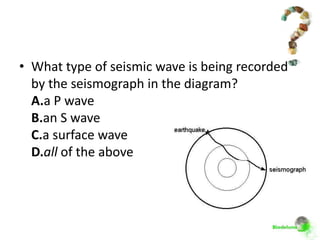
• What type of seismic wave is being recorded
  by the seismograph in the diagram?
  A.a P wave
  B.an S wave
  C.a surface wave
  D.all of the above
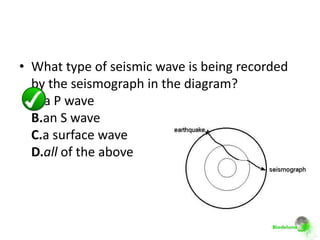
• What type of seismic wave is being recorded
  by the seismograph in the diagram?
  A.a P wave
  B.an S wave
  C.a surface wave
  D.all of the above
• The layer that makes up most of the earth's
  mass and volume is the
  A. mantle
  B. magma
  C. crust
  D. core
• The layer that makes up most of the earth's
  mass and volume is the
  A. mantle
  B. magma
  C. crust
  D. core
• What name did Alfred Wegener give to his
  theory of horizontal crustal movements?
  -Continental drift
  -Isostasy
  -Plate tectonics
  -Rifting
  -Seafloor spreading
• What name did Alfred Wegener give to his
  theory of horizontal crustal movements?
  -Continental drift
  -Isostasy
  -Plate tectonics
  -Rifting
  -Seafloor spreading
• What is the character of magnetic anomalies on the
  seafloor?
  -They occur in stripes that parallel mid-ocean ridges
  and are offset along transform faults.
  -They occur in stripes that run perpendicular to mid-
  ocean ridges and parallel transform faults.
  -They occur in stripes that parallel continental margins
  and transform faults.
  -They occur in stripes that run perpendicular to
  continental margins and parallel to transform faults.
  -They occur in stripes that parallel transform faults and
  end at mid-oceanic ridges.
• What is the character of magnetic anomalies on the
  seafloor?
  -They occur in stripes that parallel mid-ocean ridges
  and are offset along transform faults.
  -They occur in stripes that run perpendicular to mid-
  ocean ridges and parallel transform faults.
  -They occur in stripes that parallel continental margins
  and transform faults.
  -They occur in stripes that run perpendicular to
  continental margins and parallel to transform faults.
  -They occur in stripes that parallel transform faults and
  end at mid-oceanic ridges.
• What is the east coast of the United States an
  example of?
  Active continental margin
  Convergent plate boundary
  Divergent plate boundary
  Passive continental margin
  Transform plate boundary
• What is the east coast of the United States an
  example of?
  Active continental margin
  Convergent plate boundary
  Divergent plate boundary
  Passive continental margin
  Transform plate boundary
• How did non-believers in Wegener's theory
  explain plant and animal distributions in the
  southern hemisphere?
  -Dispersal by the will of God
  -Dispersal by winds
  -Dispersal via northern continents
  -Dispersal via now-sunken land bridges
  -Dispersal via rafting on logs
• How did non-believers in Wegener's theory
  explain plant and animal distributions in the
  southern hemisphere?
  -Dispersal by the will of God
  -Dispersal by winds
  -Dispersal via northern continents
  -Dispersal via now-sunken land bridges
  -Dispersal via rafting on logs
• What is the concept that adding or removing
  a weight from the earth's crust causes it to
  depress or rebound?
  -Continental drift
  -Isostasy
  -Plate tectonics
  -Rifting
  -Seafloor spreading
• What is the concept that adding or removing
  a weight from the earth's crust causes it to
  depress or rebound?
  -Continental drift
  -Isostasy
  -Plate tectonics
  -Rifting
  -Seafloor spreading
• The partially molten layer beneath the
  lithosphere is called the ______.
  A.asthenosphere
  B.crust
  C.lower mantle
  D.outer core
• The partially molten layer beneath the
  lithosphere is called the ______.
  A.asthenosphere
  B.crust
  C.lower mantle
  D.outer core
• The slabs of rock known as continents make
  up the complete lithosphere.

 True
 False
• The slabs of rock known as continents make
  up the complete lithosphere.

 True
 False

              The lithosphere is the entire surface of the
              Earth. That surface includes the floating plates
              and floor of the ocean. It's everything that
              floats on the asthenosphere.
• How thick is the oceanic crust?
  A. approximately 5 km
  B. approximately 40 km
  C. approximately 100 km
  D. approximately 670 km
• How thick is the oceanic crust?
  A. approximately 5 km
  B. approximately 40 km
  C. approximately 100 km
  D. approximately 670 km
• Which of the following statements about the
  Moho (Mohovoricic discontinuity) is false?
  A. Seismic waves speed up as they pass down
  through the Moho.
  B. The Moho separates denser rocks below
  from less dense rocks above.
  C. The Moho separates the crust from the
  mantle.
  D. The Moho marks the top of a partially
  molten layer.
• Which of the following statements about the
  Moho (Mohovoricic discontinuity) is false?
  A. Seismic waves speed up as they pass down
  through the Moho.
  B. The Moho separates denser rocks below
  from less dense rocks above.
  C. The Moho separates the crust from the
  mantle.
  D. The Moho marks the top of a partially
  molten layer.
• The boundary between the mantle and the
  core lies at a depth of approximately ______.
  A. 300 kilometers
  B. 1000 kilometers
  C. 3000 kilometers
  D. 10,000 kilometers
• The boundary between the mantle and the
  core lies at a depth of approximately ______.
  A. 300 kilometers
  B. 1000 kilometers
  C. 3000 kilometers
  D. 10,000 kilometers
• Tectonic plates float on the...

  Atmosphere
  Hydrosphere
  Asthenosphere
• Tectonic plates float on the...

  Atmosphere        Tectonic plates float on the asthenosphere.
  Hydrosphere       The asthenosphere is a region of molten rock
                    beneath the surface of the planet. The
  Asthenosphere     atmosphere is the layer of gases that creates
                    and envelope around the planet. The
                    hydrosphere includes all water as it circulates
                    through the Earth's different locations.
• Convergent movement of two plates often
  results in one plate pushing under another.

  True
  False
• Convergent movement of two plates often
  results in one plate pushing under another.

            Convergent movement often results in one
  True      plate moving under another. When two plates
  False     come together, one plate usually moves on top
            of the other one. The lower (with higher
            density) one is pushed into the
            asthenosphere= it is subduction.
• Scientists think continental plates move
  because of circulating liquid rock below the
  plates.

  True
  False
• Scientists think continental plates move
  because of circulating liquid rock below the
  plates.

  True         Current theories explain plate tectonics as a
               molten asthenosphere movement (convection
  False        currents) with floating plates of solid rock on
               top. Those floating plates move across the
               surface of the Earth like a raft on a pool.
• In what layer of the Earth does plate
  tectonics occur?
• a) Asthenosphere
• b) Lithosphere
• c) Mesosphere
• d) Tectosphere
• In what layer of the Earth does plate
  tectonics occur?
• a) Asthenosphere
• b) Lithosphere
                       The lithosphere includes the crust and the
• c) Mesosphere        uppermost part of the mantle beneath it. The
                       asthenosphere is the hotter, softer layer of
• d) Tectosphere       rock below the lithosphere. The mesosphere is
                       the next layer down. The tectosphere is a zone
                               defined in various ways, but lately it has been
                               used to refer to the deep root of a continent.
•   Which is the largest lithospheric plate?
•   a) African
•   b) Antarctic
•   c) Eurasian
•   d) Pacific
•   Which is the largest lithospheric plate?
•   a) African
•   b) Antarctic
•   c) Eurasian       There are six major plates—seven if you
                      consider the Indian and Australian plates to be
                      separate—and the Pacific plate is the largest.
•   d) Pacific        Only slivers of it are dry land, part of South
                              Island in New Zealand and a bit of North
                              America extending from Baja California to
                              Point Reyes, just north of San Francisco.
•   Where are most volcanoes found?
•   a) Above subduction zones
•   b) In Wadati-Benioff zones
•   c) Near hotspots
•   d) On spreading ridges
•   Where are most volcanoes found?
•   a) Above subduction zones
•   b) In Wadati-Benioff zones
•   c) Near hotspots         Subduction zones account for the
                             vast majority of volcanoes. There
•   d) On spreading ridges fluids from the plate and trigger rise
                             into the upper
                                             downgoing plate

                                      magma formation (more detail here
                                      on the subduction factory). Spreading
                                      ridges produce more volcanism as
                                      magma rises to create new crust, but
                                      they are not volcanoes in the
                                      ordinary sense. Hotspots, for all their
                                      prominence, are minor parts of the
                                      world's inventory of volcanoes.
•   Where do the largest earthquakes occur?
•   a) Convergent zones
•   b) Divergent zones
•   c) Hotspots
•   d) Transforms
•   Where do the largest earthquakes occur?
•   a) Convergent zones
•   b) Divergent zones
•   c) Hotspots
•   d) Transforms All these elements of plate tectonics are
                          associated with earthquakes, but by far the
                          greatest accumulations of seismic energy occur
                          where plates converge. Essentially every event
                          larger than magnitude 8 is a convergent quake.
•   Which ocean has no trenches?
•   a) Antarctic
•   b) Arctic
•   c) Atlantic
•   d) Indian
•   Which ocean has no trenches?
•   a) Antarctic
•   b) Arctic     The Arctic basin contains the northward
                  extension of the Mid-Atlantic Ridge, which is
•   c) Atlantic   spreading very slowly there, and no
                  subduction zones. The Antarctic has only the
•   d) Indian     small South Sandwich Trench, southeast of
                          South America. The Atlantic has the Lesser
                          Antilles Trench bordering the Caribbean, and
                          the Indian Ocean has the great Java Trench
                          next to the Indonesian arc. The Pacific is the
                          champion of trenches with at least eight.
•   Where are the most transform faults found?
•   a) Hotspot tracks
•   b) Spreading ridges
•   c) Subduction zones
•   d) Transform margins
•   Where are the most transform faults found?
•
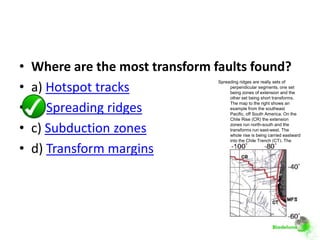
                                  Spreading ridges are really sets of
    a) Hotspot tracks                  perpendicular segments, one set
                                       being zones of extension and the
                                       other set being short transforms.

•   b) Spreading ridges
                                       The map to the right shows an
                                       example from the southeast
                                       Pacific, off South America. On the
                                       Chile Rise (CR) the extension

•   c) Subduction zones                zones run north-south and the
                                       transforms run east-west. The
                                       whole rise is being carried eastward
                                       into the Chile Trench (CT). The

•   d) Transform margins               Magellanes-Fagnano fault system
                                       (MFS) is a transform boundary
                                       between the South American and
                                       Scotia plates. Transform
                                       boundaries like it are not very
                                       common, especially compared to
                                       the multitudes of small transform
                                       faults on the spreading ridges.
                                       (Image derived from David Völker's
                                       seafloor maps.)
•   What cycle is the result of plate tectonics?
•   a) The Bowen cycle
•   b) The Carnot cycle
•   c) The Davis cycle
•   d) The Wilson cycle
•   What cycle is the result of plate tectonics?
                         This cycle is named for the Canadian
•   a) The Bowen cycle geophysicist J. Tuzo Wilson, who proposed that
                         plate motions lead periodically to the
•   b) The Carnot cycle continents all coming together in a
                         supercontinent, which then breaks up into
•   c) The Davis cycle many pieces again. Each cycle takes about 500
                         million years.
•   d) The Wilson cycle The Davis cycle Davis (1850-1934), whose
                         William Morris
                                          comes from geomorphologist

                                general theory of landscapes included an
                                erosional progression from youthful to mature.
                                Today it's considered simplistic and is no longer
                                taught. The Carnot cycle, describing the
                                thermodynamics of turning energy into
                                work, is fundamental to physics. There is no
                                Bowen cycle, only the Bowen reaction series
                                that describes how minerals form out of a
• What is the San Andreas Fault in southern
  California an example of?
  Active continental margin
  Convergent plate boundary
  Divergent plate boundary
  Passive continental margin
  Transform plate boundary
• What is the San Andreas Fault in southern
  California an example of?
  Active continental margin
  Convergent plate boundary
  Divergent plate boundary
  Passive continental margin
  Transform plate boundary
Plate tectonics quiz-fernando

Plate tectonics quiz-fernando

  • 1.
    Earth´s interior and Plate tectonics QUIZZES •http://www.geography4kids.com/extras/quiz_earthtecton/index.html •http://geology.about.com/library/nosearch/blt500q.htm •http://www2.fiu.edu/~srimal/intqz.htm •http://hs-staffserver.stjames.k12.mn.us/~fraken/Earth%20Science%20Files/Grade%208%20Practice%20Quizzes/earth%27sinteriorq.html •http://orgs.usd.edu/esci/exams/interior.html •http://orgs.usd.edu/esci/exams/tectonics.html
  • 2.
    • The Gutenbergdiscontinuity lies at the boundary of what two layers? -Crust and mantle -Crust and outer core -Mantle and inner core -Mantle and outer core -Outer core and inner core
  • 3.
    • The Gutenbergdiscontinuity lies at the boundary of what two layers? -Crust and mantle -Crust and outer core -Mantle and inner core -Mantle and outer core -Outer core and inner core
  • 4.
    • Which ofthe following statements is false? -Compression waves travel through solids as well as liquids -In all materials S-waves travel faster than P- waves -Seismic waves always slow down when reaching a liquid or partially liquid layer -The speed of seismic waves generally increases with depth in a layer -When seismic waves pass from one material to another, the path of the waves is refracted
  • 5.
    • Which ofthe following statements is false? -Compression waves travel through solids as well as liquids -In all materials S-waves travel faster than P- waves -Seismic waves always slow down when reaching a liquid or partially liquid layer -The speed of seismic waves generally increases with depth in a layer -When seismic waves pass from one material to another, the path of the waves is refracted
  • 6.
    • What keepsthe inner core solid (in contrast to the outer core)? Cool temperatures Distance from the sun High pressures Low pressures Minerals with higher melting temperatures
  • 7.
    • What keepsthe inner core solid (in contrast to the outer core)? Cool temperatures Distance from the sun High pressures Low pressures Minerals with higher melting temperatures
  • 8.
    • The originalland mass of the Earth, before continents, was called... Managua Pangaea Panacea None of the Above
  • 9.
    • The originalland mass of the Earth, before continents, was called... Pangaea was the name of the original Managua landmass that covered the planet. As the centuries passed, Pangaea broke apart into Pangaea plates that now drift across the surface of the Earth. Panacea None of the Above
  • 10.
    • What isthe approximate distance from the surface to the center of the Earth? A.700 km B.2900 km C.6400 km D.10,000 km
  • 11.
    • What isthe approximate distance from the surface to the center of the Earth? A.700 km B.2900 km C.6400 km D.10,000 km
  • 12.
    • The crustof the earth is made mostly of A. oxygen & silicon B. iron & silicon C. iron & nickel D. copper & nickel
  • 13.
    • The crustof the earth is made mostly of A. oxygen & silicon B. iron & silicon C. iron & nickel D. copper & nickel
  • 14.
    • What typeof seismic wave is being recorded by the seismograph in the diagram? A.a P wave B.an S wave C.a surface wave D.all of the above
  • 15.
    • What typeof seismic wave is being recorded by the seismograph in the diagram? A.a P wave B.an S wave C.a surface wave D.all of the above
  • 16.
    • The layerthat makes up most of the earth's mass and volume is the A. mantle B. magma C. crust D. core
  • 17.
    • The layerthat makes up most of the earth's mass and volume is the A. mantle B. magma C. crust D. core
  • 18.
    • What namedid Alfred Wegener give to his theory of horizontal crustal movements? -Continental drift -Isostasy -Plate tectonics -Rifting -Seafloor spreading
  • 19.
    • What namedid Alfred Wegener give to his theory of horizontal crustal movements? -Continental drift -Isostasy -Plate tectonics -Rifting -Seafloor spreading
  • 20.
    • What isthe character of magnetic anomalies on the seafloor? -They occur in stripes that parallel mid-ocean ridges and are offset along transform faults. -They occur in stripes that run perpendicular to mid- ocean ridges and parallel transform faults. -They occur in stripes that parallel continental margins and transform faults. -They occur in stripes that run perpendicular to continental margins and parallel to transform faults. -They occur in stripes that parallel transform faults and end at mid-oceanic ridges.
  • 21.
    • What isthe character of magnetic anomalies on the seafloor? -They occur in stripes that parallel mid-ocean ridges and are offset along transform faults. -They occur in stripes that run perpendicular to mid- ocean ridges and parallel transform faults. -They occur in stripes that parallel continental margins and transform faults. -They occur in stripes that run perpendicular to continental margins and parallel to transform faults. -They occur in stripes that parallel transform faults and end at mid-oceanic ridges.
  • 22.
    • What isthe east coast of the United States an example of? Active continental margin Convergent plate boundary Divergent plate boundary Passive continental margin Transform plate boundary
  • 23.
    • What isthe east coast of the United States an example of? Active continental margin Convergent plate boundary Divergent plate boundary Passive continental margin Transform plate boundary
  • 24.
    • How didnon-believers in Wegener's theory explain plant and animal distributions in the southern hemisphere? -Dispersal by the will of God -Dispersal by winds -Dispersal via northern continents -Dispersal via now-sunken land bridges -Dispersal via rafting on logs
  • 25.
    • How didnon-believers in Wegener's theory explain plant and animal distributions in the southern hemisphere? -Dispersal by the will of God -Dispersal by winds -Dispersal via northern continents -Dispersal via now-sunken land bridges -Dispersal via rafting on logs
  • 26.
    • What isthe concept that adding or removing a weight from the earth's crust causes it to depress or rebound? -Continental drift -Isostasy -Plate tectonics -Rifting -Seafloor spreading
  • 27.
    • What isthe concept that adding or removing a weight from the earth's crust causes it to depress or rebound? -Continental drift -Isostasy -Plate tectonics -Rifting -Seafloor spreading
  • 28.
    • The partiallymolten layer beneath the lithosphere is called the ______. A.asthenosphere B.crust C.lower mantle D.outer core
  • 29.
    • The partiallymolten layer beneath the lithosphere is called the ______. A.asthenosphere B.crust C.lower mantle D.outer core
  • 30.
    • The slabsof rock known as continents make up the complete lithosphere. True False
  • 31.
    • The slabsof rock known as continents make up the complete lithosphere. True False The lithosphere is the entire surface of the Earth. That surface includes the floating plates and floor of the ocean. It's everything that floats on the asthenosphere.
  • 32.
    • How thickis the oceanic crust? A. approximately 5 km B. approximately 40 km C. approximately 100 km D. approximately 670 km
  • 33.
    • How thickis the oceanic crust? A. approximately 5 km B. approximately 40 km C. approximately 100 km D. approximately 670 km
  • 34.
    • Which ofthe following statements about the Moho (Mohovoricic discontinuity) is false? A. Seismic waves speed up as they pass down through the Moho. B. The Moho separates denser rocks below from less dense rocks above. C. The Moho separates the crust from the mantle. D. The Moho marks the top of a partially molten layer.
  • 35.
    • Which ofthe following statements about the Moho (Mohovoricic discontinuity) is false? A. Seismic waves speed up as they pass down through the Moho. B. The Moho separates denser rocks below from less dense rocks above. C. The Moho separates the crust from the mantle. D. The Moho marks the top of a partially molten layer.
  • 36.
    • The boundarybetween the mantle and the core lies at a depth of approximately ______. A. 300 kilometers B. 1000 kilometers C. 3000 kilometers D. 10,000 kilometers
  • 37.
    • The boundarybetween the mantle and the core lies at a depth of approximately ______. A. 300 kilometers B. 1000 kilometers C. 3000 kilometers D. 10,000 kilometers
  • 38.
    • Tectonic platesfloat on the... Atmosphere Hydrosphere Asthenosphere
  • 39.
    • Tectonic platesfloat on the... Atmosphere Tectonic plates float on the asthenosphere. Hydrosphere The asthenosphere is a region of molten rock beneath the surface of the planet. The Asthenosphere atmosphere is the layer of gases that creates and envelope around the planet. The hydrosphere includes all water as it circulates through the Earth's different locations.
  • 40.
    • Convergent movementof two plates often results in one plate pushing under another. True False
  • 41.
    • Convergent movementof two plates often results in one plate pushing under another. Convergent movement often results in one True plate moving under another. When two plates False come together, one plate usually moves on top of the other one. The lower (with higher density) one is pushed into the asthenosphere= it is subduction.
  • 42.
    • Scientists thinkcontinental plates move because of circulating liquid rock below the plates. True False
  • 43.
    • Scientists thinkcontinental plates move because of circulating liquid rock below the plates. True Current theories explain plate tectonics as a molten asthenosphere movement (convection False currents) with floating plates of solid rock on top. Those floating plates move across the surface of the Earth like a raft on a pool.
  • 44.
    • In whatlayer of the Earth does plate tectonics occur? • a) Asthenosphere • b) Lithosphere • c) Mesosphere • d) Tectosphere
  • 45.
    • In whatlayer of the Earth does plate tectonics occur? • a) Asthenosphere • b) Lithosphere The lithosphere includes the crust and the • c) Mesosphere uppermost part of the mantle beneath it. The asthenosphere is the hotter, softer layer of • d) Tectosphere rock below the lithosphere. The mesosphere is the next layer down. The tectosphere is a zone defined in various ways, but lately it has been used to refer to the deep root of a continent.
  • 46.
    Which is the largest lithospheric plate? • a) African • b) Antarctic • c) Eurasian • d) Pacific
  • 47.
    Which is the largest lithospheric plate? • a) African • b) Antarctic • c) Eurasian There are six major plates—seven if you consider the Indian and Australian plates to be separate—and the Pacific plate is the largest. • d) Pacific Only slivers of it are dry land, part of South Island in New Zealand and a bit of North America extending from Baja California to Point Reyes, just north of San Francisco.
  • 48.
    Where are most volcanoes found? • a) Above subduction zones • b) In Wadati-Benioff zones • c) Near hotspots • d) On spreading ridges
  • 49.
    Where are most volcanoes found? • a) Above subduction zones • b) In Wadati-Benioff zones • c) Near hotspots Subduction zones account for the vast majority of volcanoes. There • d) On spreading ridges fluids from the plate and trigger rise into the upper downgoing plate magma formation (more detail here on the subduction factory). Spreading ridges produce more volcanism as magma rises to create new crust, but they are not volcanoes in the ordinary sense. Hotspots, for all their prominence, are minor parts of the world's inventory of volcanoes.
  • 50.
    Where do the largest earthquakes occur? • a) Convergent zones • b) Divergent zones • c) Hotspots • d) Transforms
  • 51.
    Where do the largest earthquakes occur? • a) Convergent zones • b) Divergent zones • c) Hotspots • d) Transforms All these elements of plate tectonics are associated with earthquakes, but by far the greatest accumulations of seismic energy occur where plates converge. Essentially every event larger than magnitude 8 is a convergent quake.
  • 52.
    Which ocean has no trenches? • a) Antarctic • b) Arctic • c) Atlantic • d) Indian
  • 53.
    Which ocean has no trenches? • a) Antarctic • b) Arctic The Arctic basin contains the northward extension of the Mid-Atlantic Ridge, which is • c) Atlantic spreading very slowly there, and no subduction zones. The Antarctic has only the • d) Indian small South Sandwich Trench, southeast of South America. The Atlantic has the Lesser Antilles Trench bordering the Caribbean, and the Indian Ocean has the great Java Trench next to the Indonesian arc. The Pacific is the champion of trenches with at least eight.
  • 54.
    Where are the most transform faults found? • a) Hotspot tracks • b) Spreading ridges • c) Subduction zones • d) Transform margins
  • 55.
    Where are the most transform faults found? • Spreading ridges are really sets of a) Hotspot tracks perpendicular segments, one set being zones of extension and the other set being short transforms. • b) Spreading ridges The map to the right shows an example from the southeast Pacific, off South America. On the Chile Rise (CR) the extension • c) Subduction zones zones run north-south and the transforms run east-west. The whole rise is being carried eastward into the Chile Trench (CT). The • d) Transform margins Magellanes-Fagnano fault system (MFS) is a transform boundary between the South American and Scotia plates. Transform boundaries like it are not very common, especially compared to the multitudes of small transform faults on the spreading ridges. (Image derived from David Völker's seafloor maps.)
  • 56.
    What cycle is the result of plate tectonics? • a) The Bowen cycle • b) The Carnot cycle • c) The Davis cycle • d) The Wilson cycle
  • 57.
    What cycle is the result of plate tectonics? This cycle is named for the Canadian • a) The Bowen cycle geophysicist J. Tuzo Wilson, who proposed that plate motions lead periodically to the • b) The Carnot cycle continents all coming together in a supercontinent, which then breaks up into • c) The Davis cycle many pieces again. Each cycle takes about 500 million years. • d) The Wilson cycle The Davis cycle Davis (1850-1934), whose William Morris comes from geomorphologist general theory of landscapes included an erosional progression from youthful to mature. Today it's considered simplistic and is no longer taught. The Carnot cycle, describing the thermodynamics of turning energy into work, is fundamental to physics. There is no Bowen cycle, only the Bowen reaction series that describes how minerals form out of a
  • 58.
    • What isthe San Andreas Fault in southern California an example of? Active continental margin Convergent plate boundary Divergent plate boundary Passive continental margin Transform plate boundary
  • 59.
    • What isthe San Andreas Fault in southern California an example of? Active continental margin Convergent plate boundary Divergent plate boundary Passive continental margin Transform plate boundary