TRAFFIC SURVEYS CONDUCTED DURING
URBAN TRANSPORTATION PLANNING
BY-D P NITHIN
IMPORTANCE OF TRAFFIC SURVEYS
• In transportation survey it is necessary to know the exact origin and destination of
the trips. The information yielded by O-D survey includes land use of zone of
origin and destination, household characteristics of trip making.
• Origin is defined as the place where the trip begins and destination is the place
where trips ends.
• OD (Origin and destination) studies are conducted to understand the pattern of
movement of persons and goods in particular area of interest.
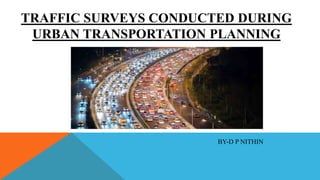
Fig. Serious problem-Traffic Congestion
 TYPES OF O&D SURVEY:
 HOME INTERVIEW SURVEY
 ROAD SIDE INTERVIEW SURVEY
 POST CARD QUESTIONNAIRE SURVEY
 REGISTRATION NUMBER METHOD
 TAG ON VEHICLE METHOD
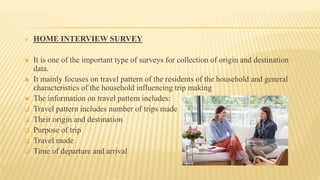
 HOME INTERVIEW SURVEY
 It is one of the important type of surveys for collection of origin and destination
data.
 It mainly focuses on travel pattern of the residents of the household and general
characteristics of the household influencing trip making
 The information on travel pattern includes:
 Travel pattern includes number of trips made
 Their origin and destination
 Purpose of trip
 Travel mode
 Time of departure and arrival
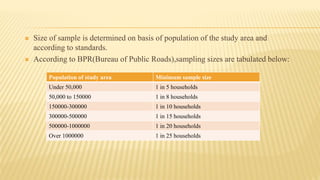
 Size of sample is determined on basis of population of the study area and
according to standards.
 According to BPR(Bureau of Public Roads),sampling sizes are tabulated below:
Population of study area Minimum sample size
Under 50,000 1 in 5 households
50,000 to 150000 1 in 8 households
150000-300000 1 in 10 households
300000-500000 1 in 15 households
500000-1000000 1 in 20 households
Over 1000000 1 in 25 households
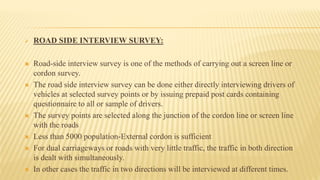
 The information to be collected from home interview survey can be broadly
classified under two groups:
 Household characteristics:
 Address
 Size of household.
 Age and sex of household.
 Earning members
 Number of motor vehicles owned.
 Household income
 Journey data:
 All journey made during the pervious 24 hour period.
 Purpose of trip.
 Mode of travel etc.
 ROAD SIDE INTERVIEW SURVEY:
 Road-side interview survey is one of the methods of carrying out a screen line or
cordon survey.
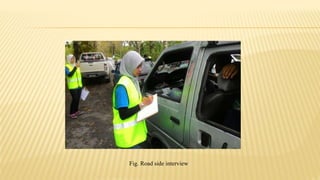
 The road side interview survey can be done either directly interviewing drivers of
vehicles at selected survey points or by issuing prepaid post cards containing
questionnaire to all or sample of drivers.
 The survey points are selected along the junction of the cordon line or screen line
with the roads
 Less than 5000 population-External cordon is sufficient
 For dual carriageways or roads with very little traffic, the traffic in both direction
is dealt with simultaneously.
 In other cases the traffic in two directions will be interviewed at different times.
Fig. Road side interview
 POST CARD QUESTIONNAIRE SURVEY:
 In this method, reply–paid questionnaires are handed over to each of the drivers
or a sample of them at the survey points and requesting them to complete the
information and return by post.
 The method avoids delay caused to the drivers by direct road-side interview
method but had a disadvantage that the response may not be good.
 REGISTRATION NUMBER PLATE SURVEY:
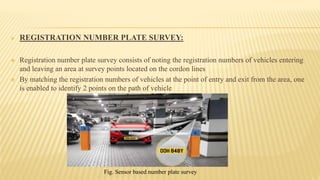
 Registration number plate survey consists of noting the registration numbers of vehicles entering
and leaving an area at survey points located on the cordon lines
 By matching the registration numbers of vehicles at the point of entry and exit from the area, one
is enabled to identify 2 points on the path of vehicle
Fig. Sensor based number plate survey
 TAG ON VEHICLE SURVEY:
 In this method, at each point where the roads cross the cordon line, vehicles are stopped
and a tag is affixed, usually under a windscreen wiper.
 The tags for different survey stations have different shapes/color to identify the survey
stations.
 The vehicles are stopped again at the exit points where the tags are removed
 The time of entering and leaving the area is marked on the tags in order to enable the
journey times to be determined.
Fig. Tags on vehicle
THANK YOU

Traffic surveys seminar

  • 1.
    TRAFFIC SURVEYS CONDUCTEDDURING URBAN TRANSPORTATION PLANNING BY-D P NITHIN
  • 2.
    IMPORTANCE OF TRAFFICSURVEYS • In transportation survey it is necessary to know the exact origin and destination of the trips. The information yielded by O-D survey includes land use of zone of origin and destination, household characteristics of trip making. • Origin is defined as the place where the trip begins and destination is the place where trips ends. • OD (Origin and destination) studies are conducted to understand the pattern of movement of persons and goods in particular area of interest. Fig. Serious problem-Traffic Congestion
  • 3.
     TYPES OFO&D SURVEY:  HOME INTERVIEW SURVEY  ROAD SIDE INTERVIEW SURVEY  POST CARD QUESTIONNAIRE SURVEY  REGISTRATION NUMBER METHOD  TAG ON VEHICLE METHOD
  • 4.
     HOME INTERVIEWSURVEY  It is one of the important type of surveys for collection of origin and destination data.  It mainly focuses on travel pattern of the residents of the household and general characteristics of the household influencing trip making  The information on travel pattern includes:  Travel pattern includes number of trips made  Their origin and destination  Purpose of trip  Travel mode  Time of departure and arrival
  • 5.
     Size ofsample is determined on basis of population of the study area and according to standards.  According to BPR(Bureau of Public Roads),sampling sizes are tabulated below: Population of study area Minimum sample size Under 50,000 1 in 5 households 50,000 to 150000 1 in 8 households 150000-300000 1 in 10 households 300000-500000 1 in 15 households 500000-1000000 1 in 20 households Over 1000000 1 in 25 households
  • 6.
     The informationto be collected from home interview survey can be broadly classified under two groups:  Household characteristics:  Address  Size of household.  Age and sex of household.  Earning members  Number of motor vehicles owned.  Household income  Journey data:  All journey made during the pervious 24 hour period.  Purpose of trip.  Mode of travel etc.
  • 7.
     ROAD SIDEINTERVIEW SURVEY:  Road-side interview survey is one of the methods of carrying out a screen line or cordon survey.  The road side interview survey can be done either directly interviewing drivers of vehicles at selected survey points or by issuing prepaid post cards containing questionnaire to all or sample of drivers.  The survey points are selected along the junction of the cordon line or screen line with the roads  Less than 5000 population-External cordon is sufficient  For dual carriageways or roads with very little traffic, the traffic in both direction is dealt with simultaneously.  In other cases the traffic in two directions will be interviewed at different times.
  • 8.
    Fig. Road sideinterview
  • 9.
     POST CARDQUESTIONNAIRE SURVEY:  In this method, reply–paid questionnaires are handed over to each of the drivers or a sample of them at the survey points and requesting them to complete the information and return by post.  The method avoids delay caused to the drivers by direct road-side interview method but had a disadvantage that the response may not be good.
  • 10.
     REGISTRATION NUMBERPLATE SURVEY:  Registration number plate survey consists of noting the registration numbers of vehicles entering and leaving an area at survey points located on the cordon lines  By matching the registration numbers of vehicles at the point of entry and exit from the area, one is enabled to identify 2 points on the path of vehicle Fig. Sensor based number plate survey
  • 11.
     TAG ONVEHICLE SURVEY:  In this method, at each point where the roads cross the cordon line, vehicles are stopped and a tag is affixed, usually under a windscreen wiper.  The tags for different survey stations have different shapes/color to identify the survey stations.  The vehicles are stopped again at the exit points where the tags are removed  The time of entering and leaving the area is marked on the tags in order to enable the journey times to be determined. Fig. Tags on vehicle
  • 12.