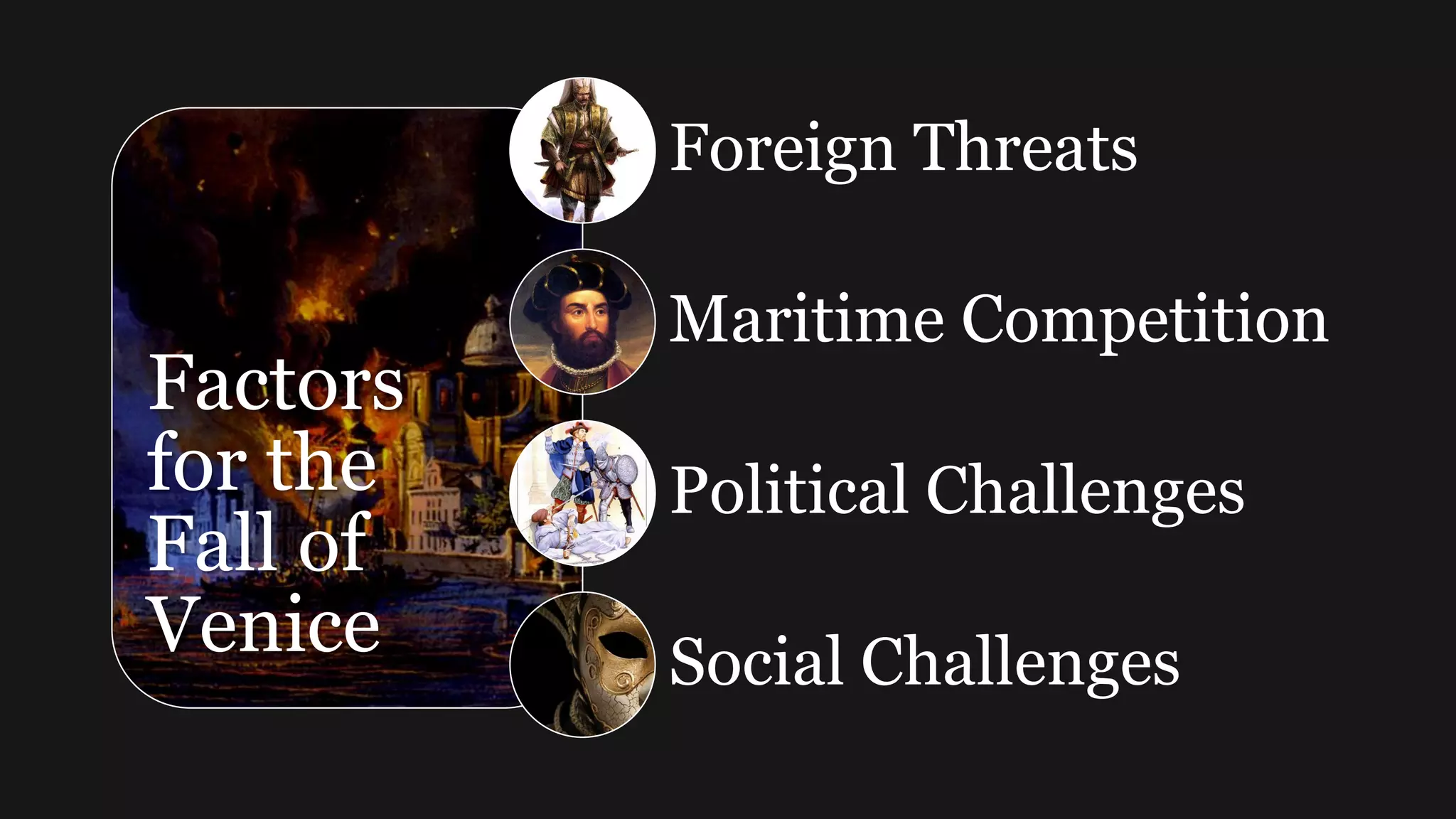
Factors
for the
Fall of
Venice
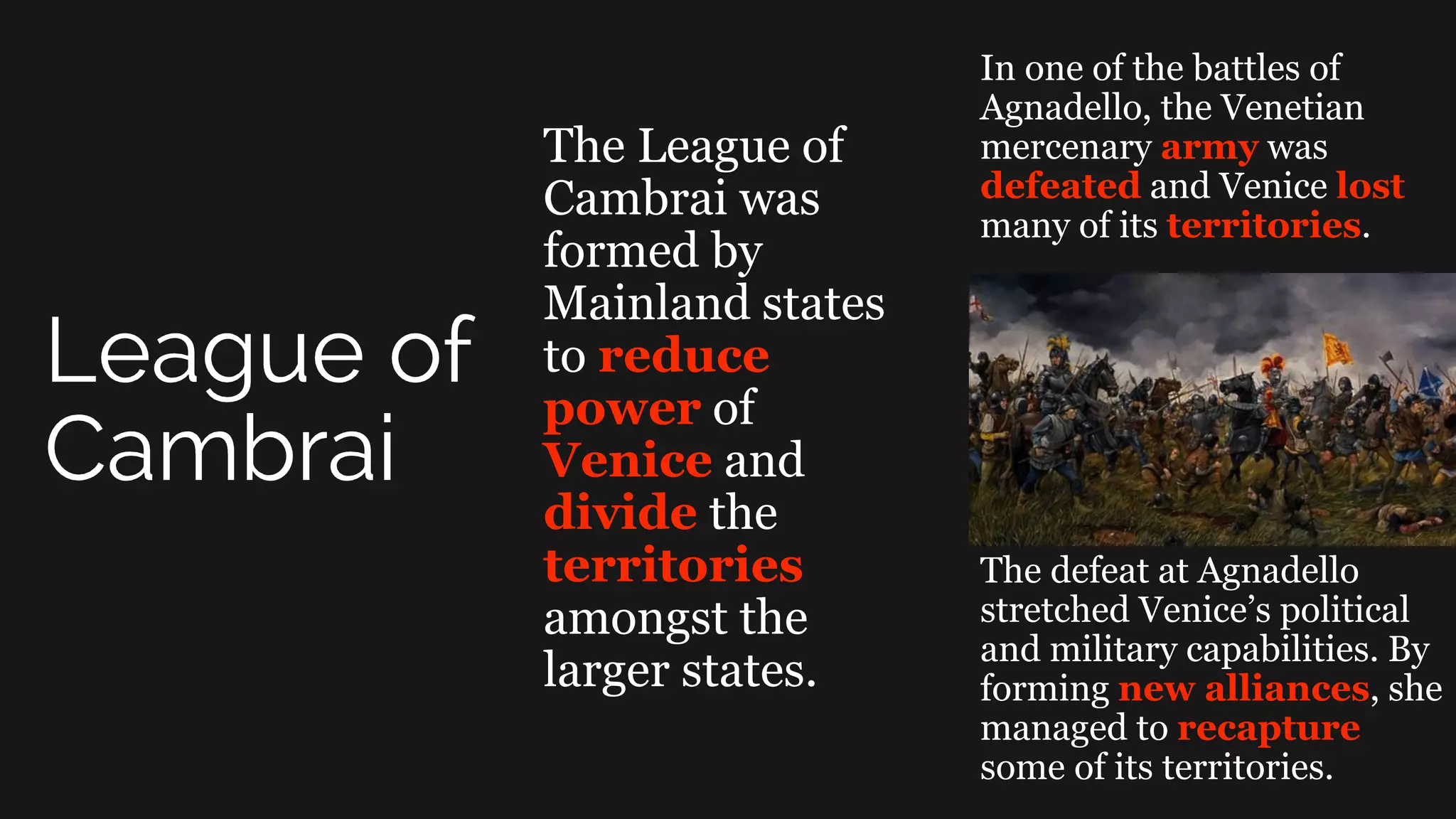
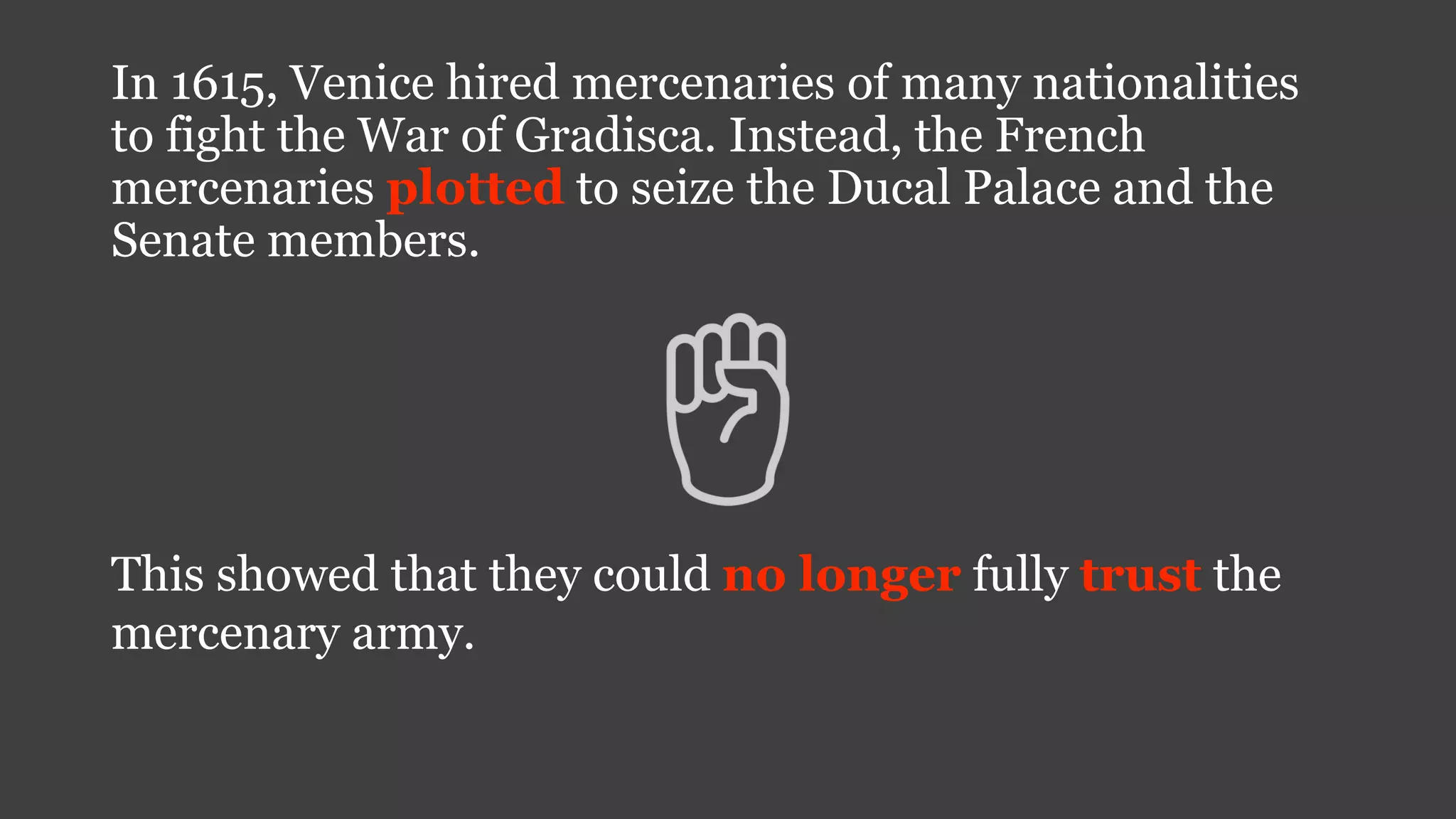
Foreign Threats
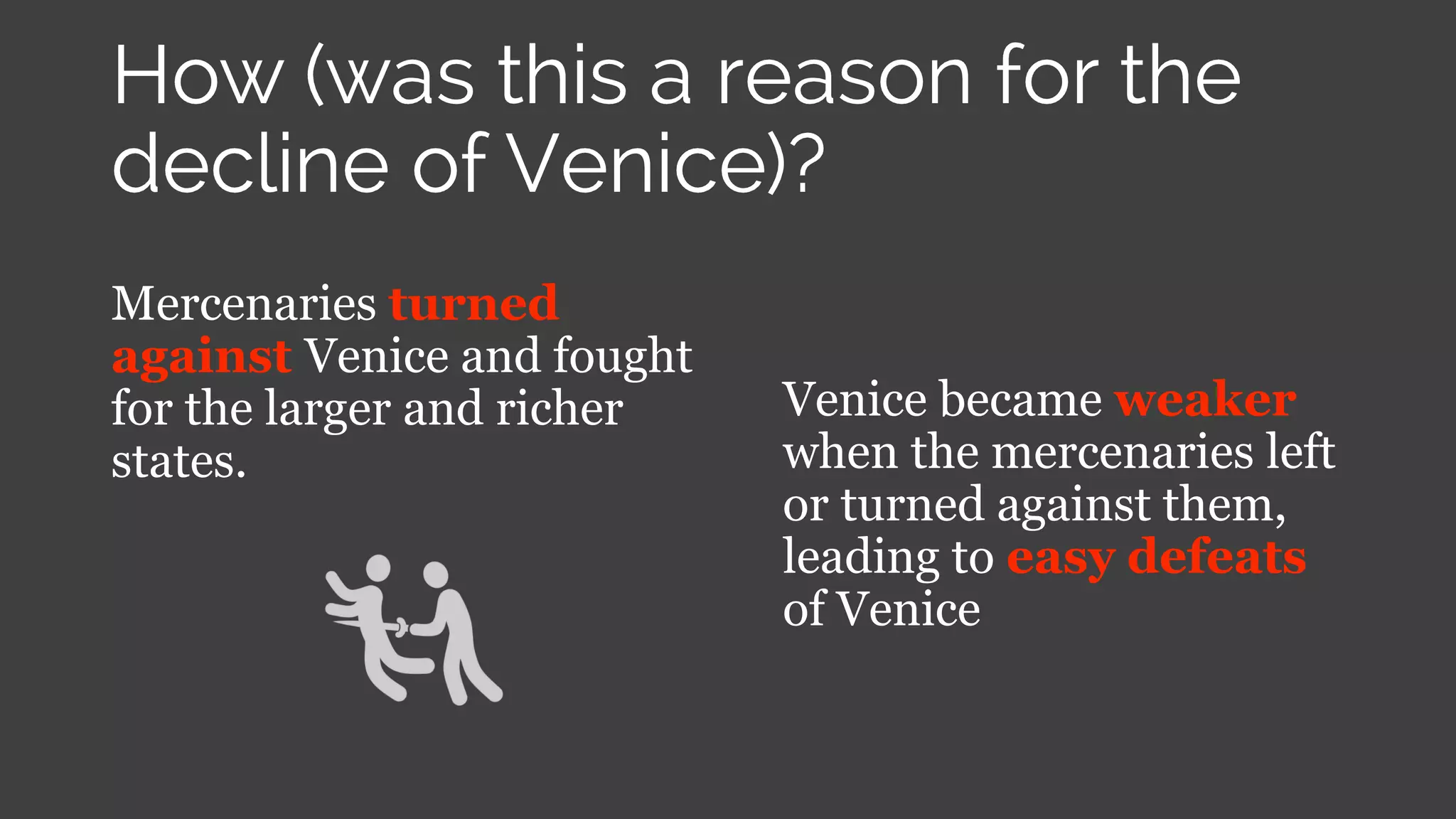
Maritime Competition
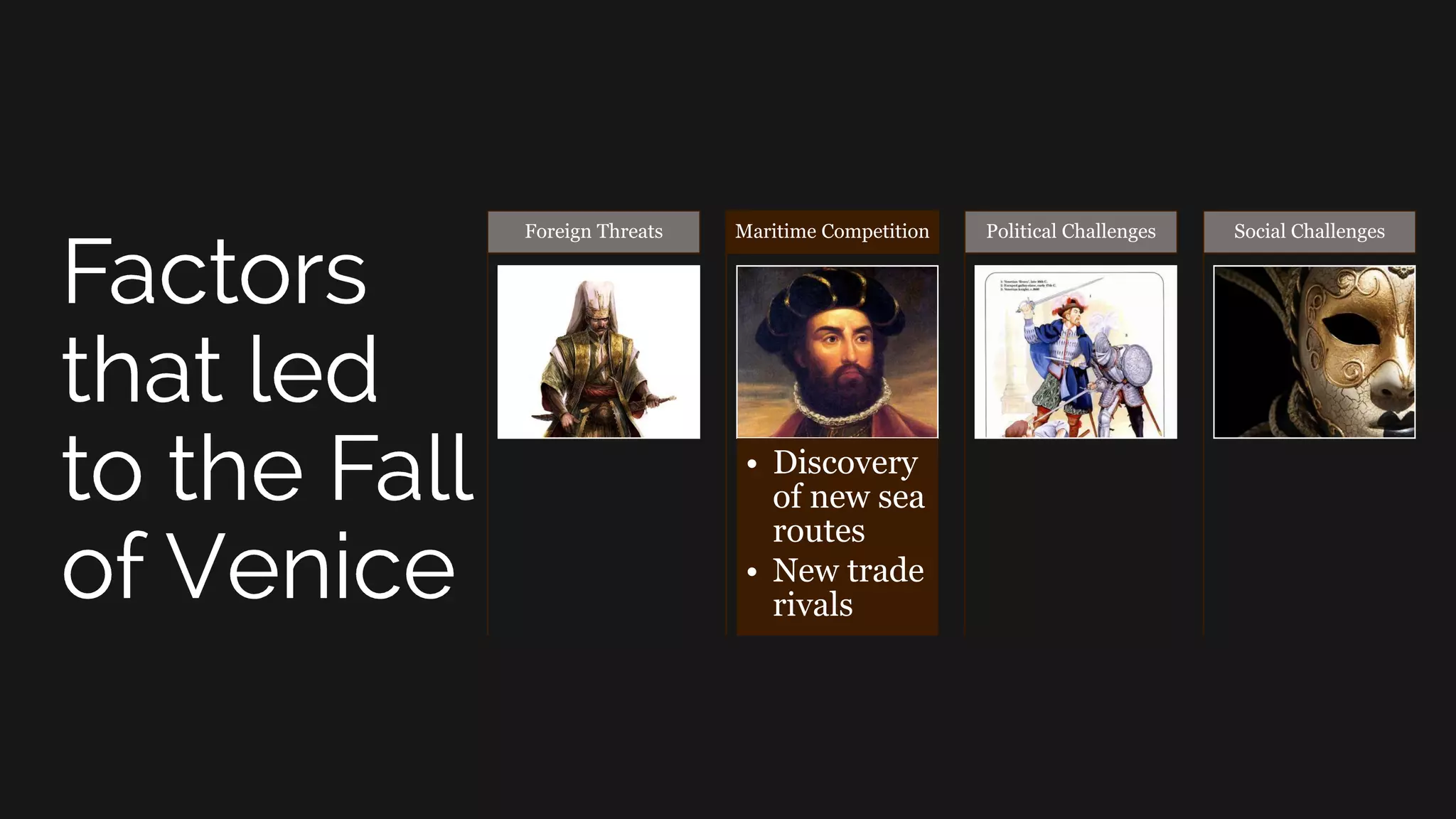
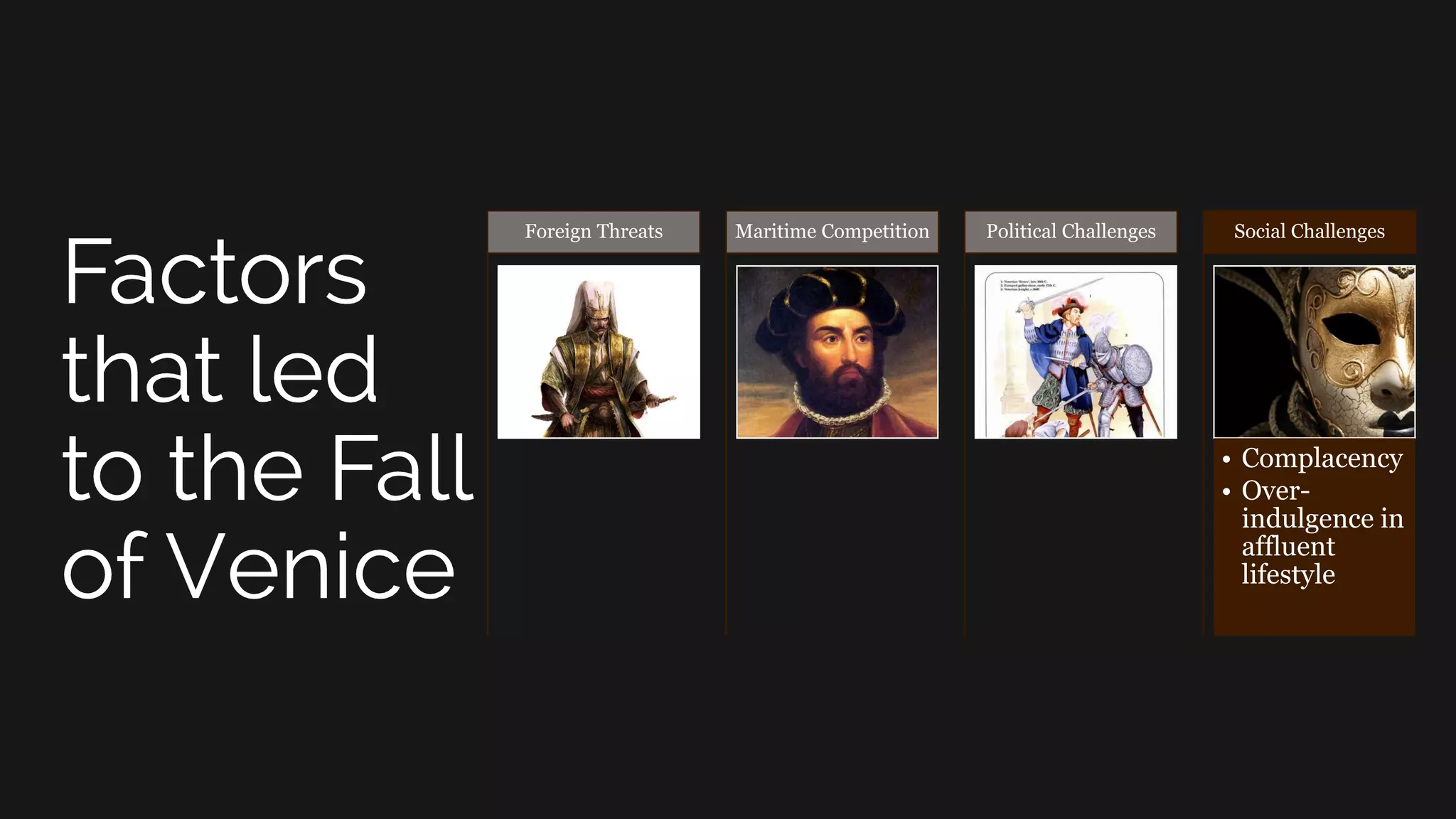
Political Challenges
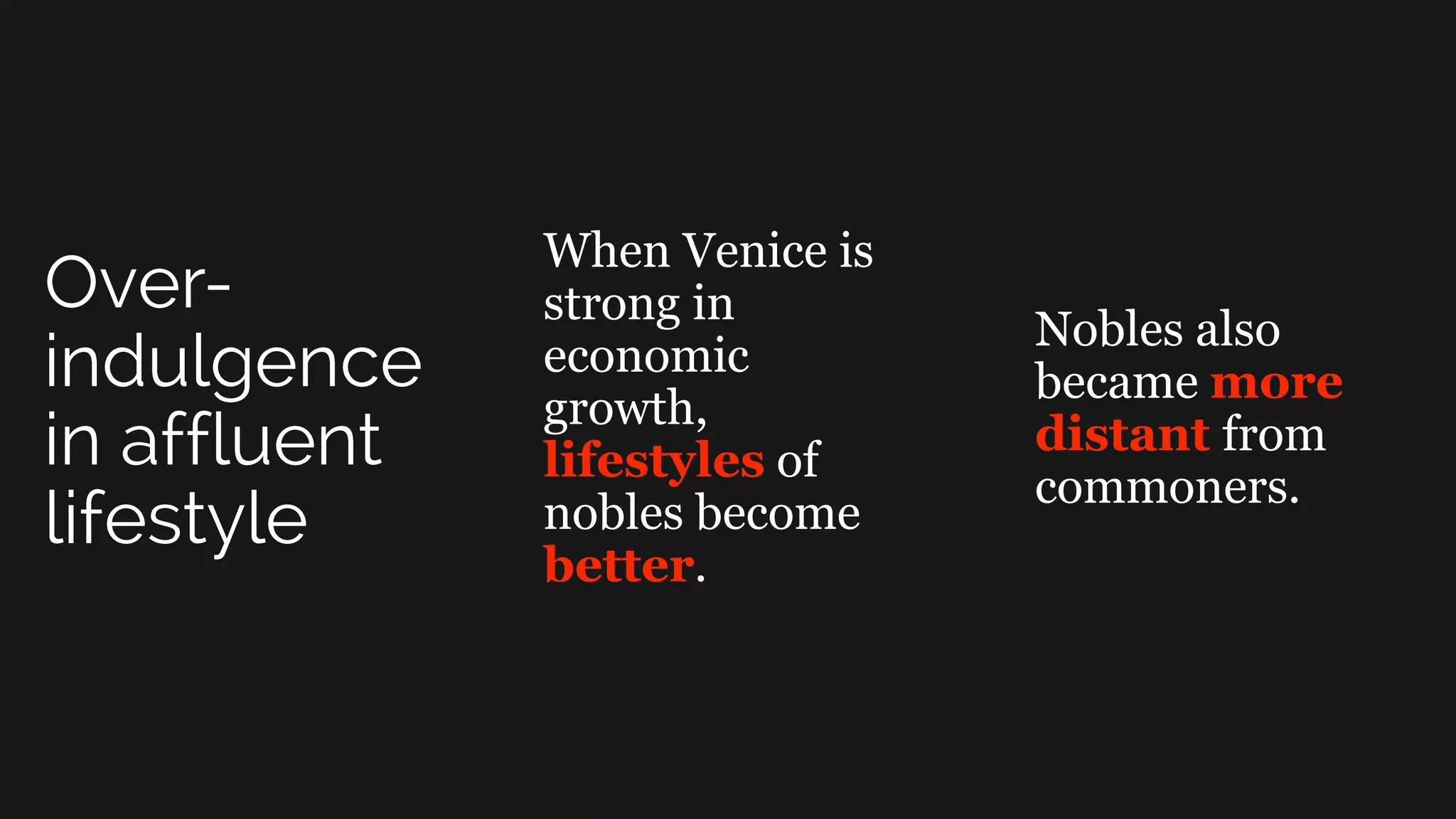
Social Challenges
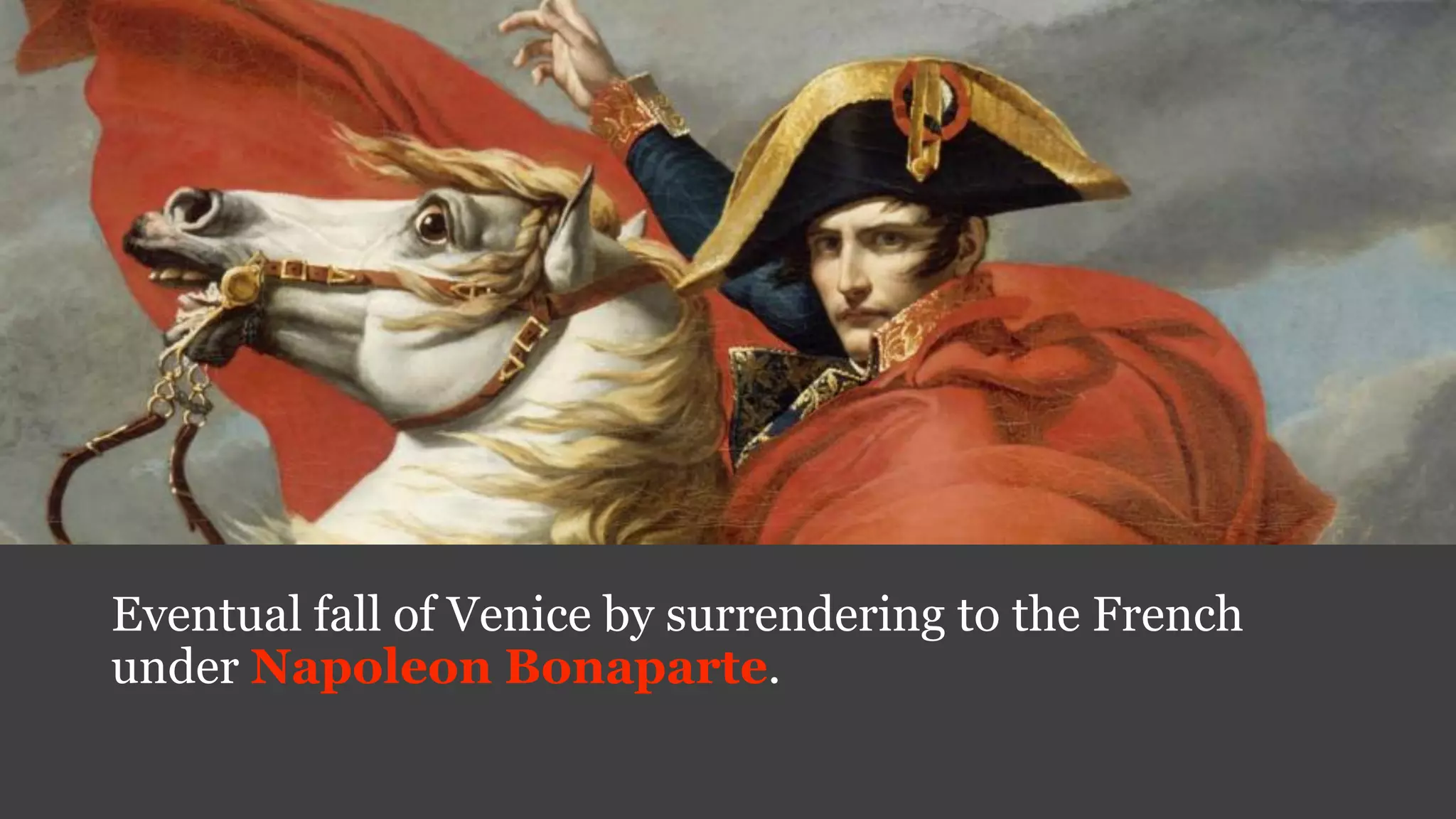
Eventual fall of Venice by surrendering to the French
under Napoleon Bonaparte.
Which of these factors was the most important
reason for the decline of Venice?
• Involvement
in Mainland
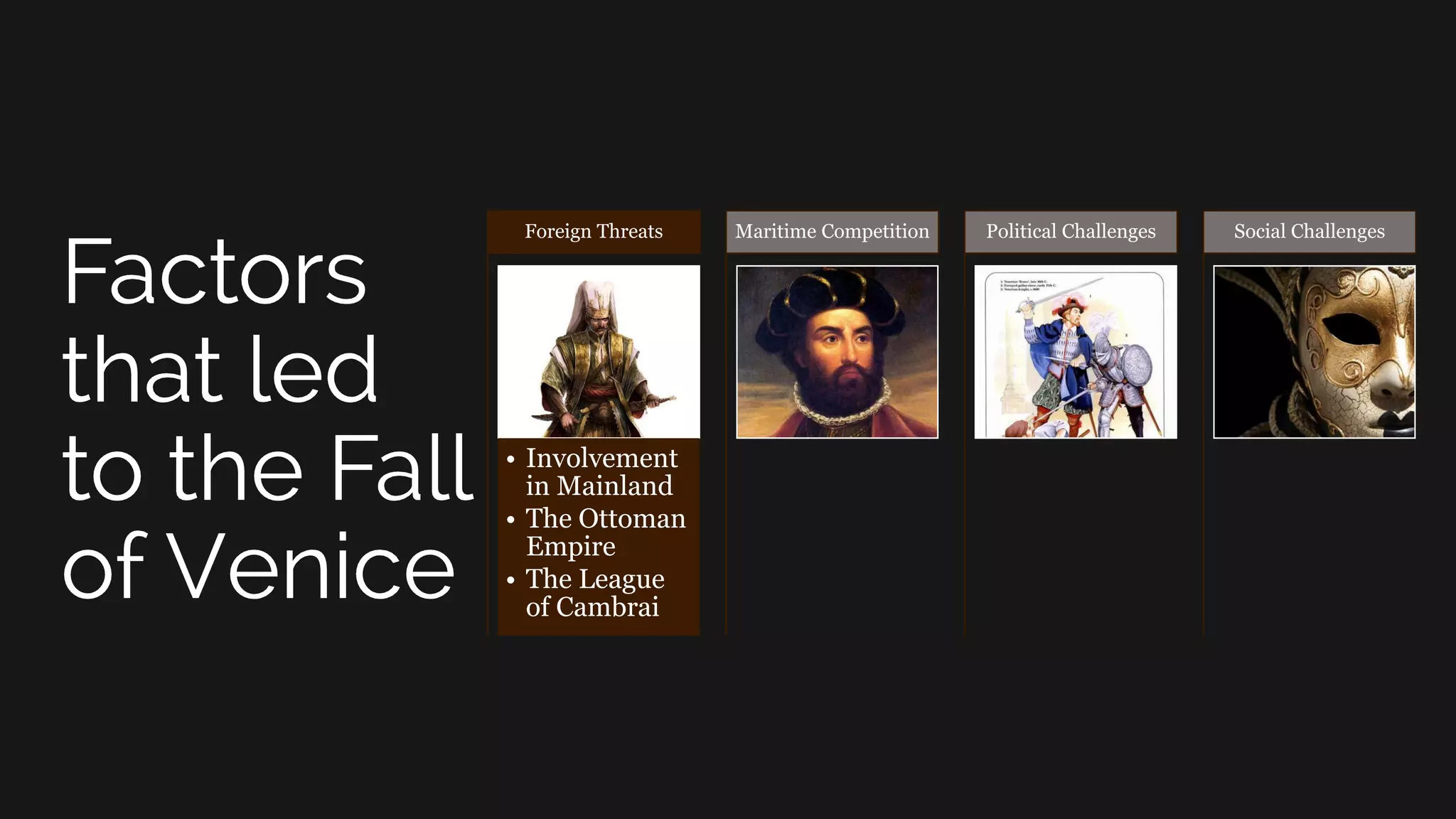
• The Ottoman
Empire
• The League
of Cambrai
Foreign Threats Maritime Competition Political Challenges Social Challenges
Venice created
alliances with
larger and more
powerful states in
Mainland Europe
against other rival
states
• to protect her
territories and
commercial
interests
These mainland
states were Venice’s
source of water
and food for her
growing population
and expanding
industries.
Venice tried to take advantage of rivalry among the
mainland states by taking sides.
the only way was to build own strong army by
recruiting mercenaries to fight the wars.
To overcome the possibility that negotiations could put
Venetians at risk,
By switching
alliances with
different opposing
states, Venice was
creating fragile
relations with larger
states – putting
Venice at risk.
Venice could be
attacked should
negotiations fail.
The rivalry among
the mainland states
also made the
overland trade route
unsafe as constant
battles were fought
in the region.
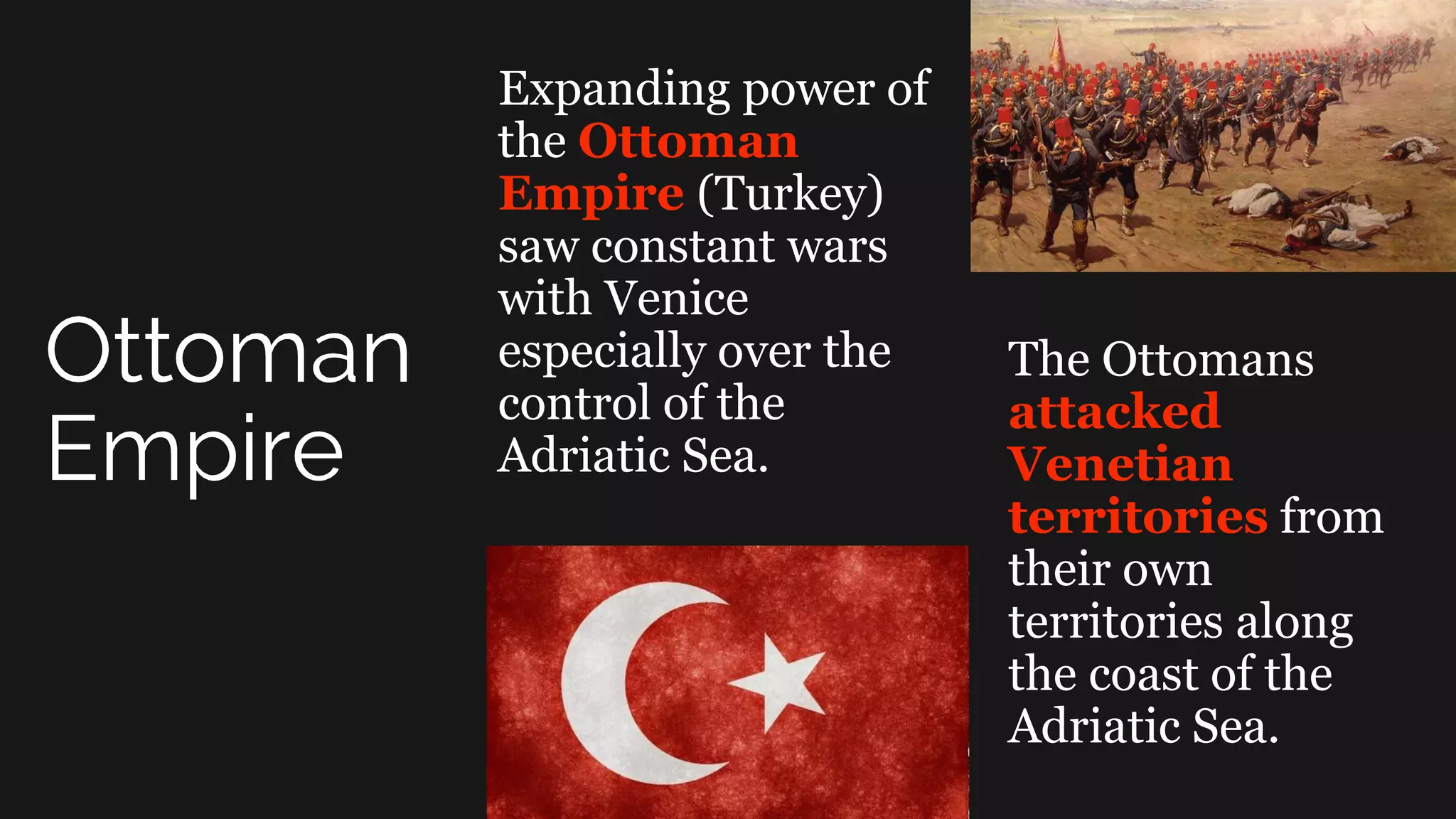
Expanding power of
the Ottoman
Empire (Turkey)
saw constant wars
with Venice
especially over the
control of the
Adriatic Sea.
The Ottomans
attacked
Venetian
territories from
their own
territories along
the coast of the
Adriatic Sea.
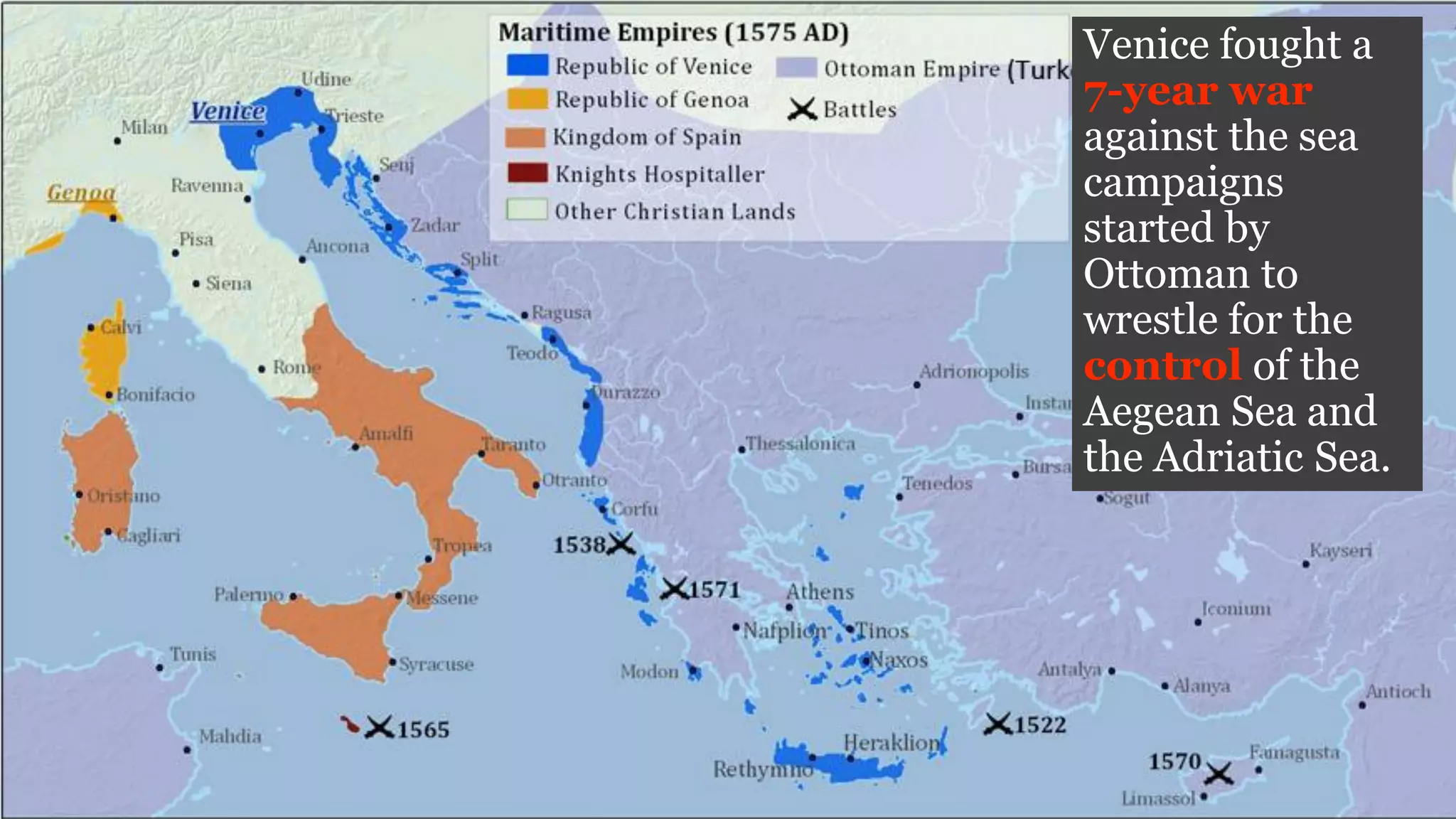
Venice fought a
7-year war
against the sea
campaigns
started by
Ottoman to
wrestle for the
control of the
Aegean Sea and
the Adriatic Sea.
The Venetians tried to strike a balance of power with
the Ottomans and their European neighbours.
In 1463, the European states
launched a military
campaign against the
Ottomans.
Due to resentment, Venice
fought the Ottomans on
their own and lost
Negroponte, an important
Eastern trade outpost.
Conflicting actions such
as concessions made to the
Ottomans, and military aid
sent to European states to
fight the Ottomans in
defence of their territories
led to a deep hostility for
Venice.
The wars with Venice and
expansion of the Ottoman
empire resulted in Venice
losing some territories.
Venice’s poor relations with
other European states left
Venice to defend against the
Ottoman Empire alone.
This severely weakened Venice, and trade in the Adriatic
Sea was disrupted.
Venice was forced to give up some of the mainland
territories to avoid being involved in mainland wars.
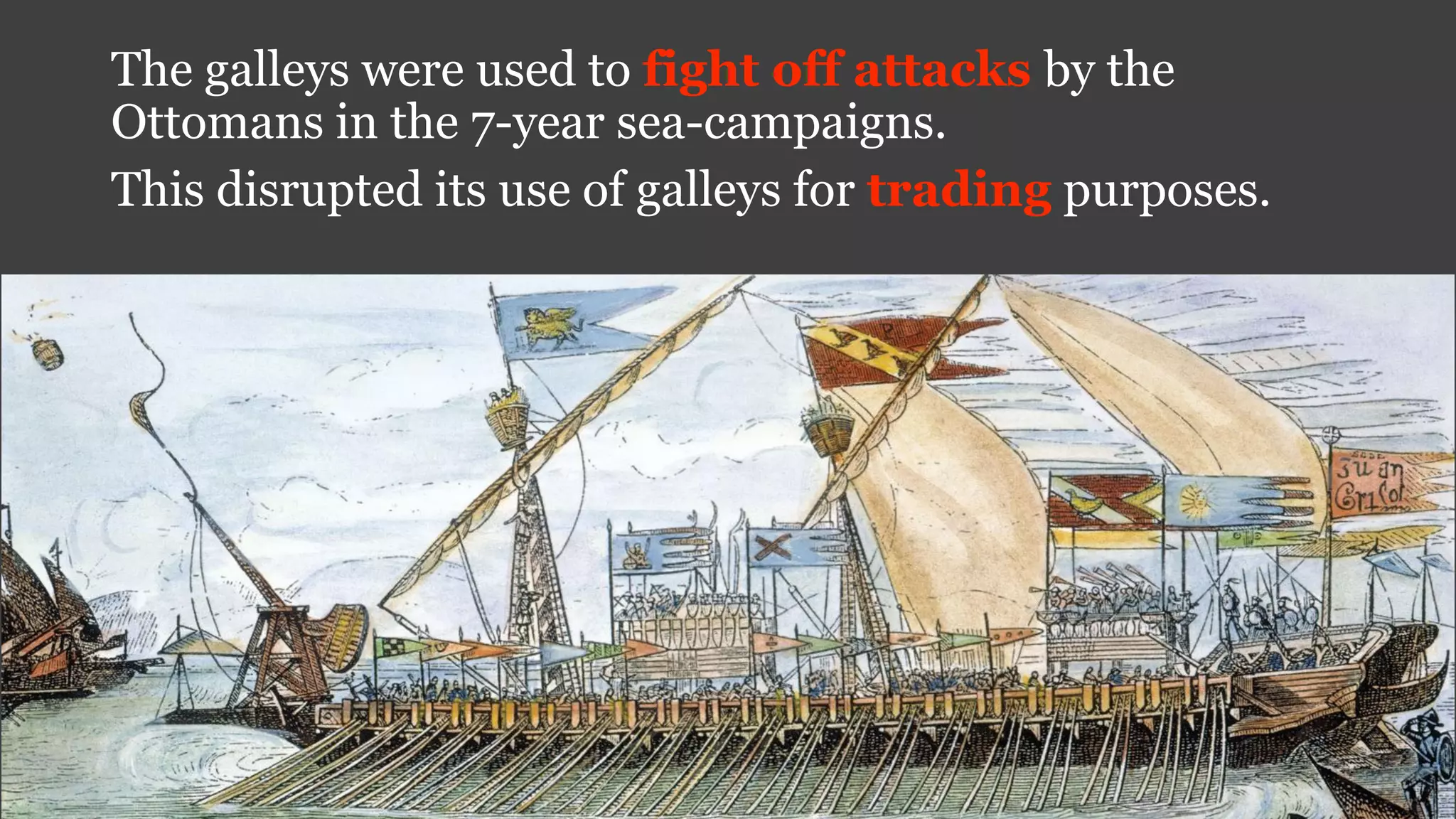
The galleys were used to fight off attacks by the
Ottomans in the 7-year sea-campaigns.
This disrupted its use of galleys for trading purposes.
The League of
Cambrai was
formed by
Mainland states
to reduce
power of
Venice and
divide the
territories
amongst the
larger states.
In one of the battles of
Agnadello, the Venetian
mercenary army was
defeated and Venice lost
many of its territories.
The defeat at Agnadello
stretched Venice’s political
and military capabilities. By
forming new alliances, she
managed to recapture
some of its territories.
Venice lost
more territories.
She had to raise
taxes to finance
the employment
of its mercenary
armies as well as
to replenish
supply of
weaponry.
Renewed campaigns results
in Venice weakened due to
the high cost of wars and the
drain of resources
Foreign Threats
• Discovery
of new sea
routes
• New trade
rivals
Maritime Competition Political Challenges Social Challenges
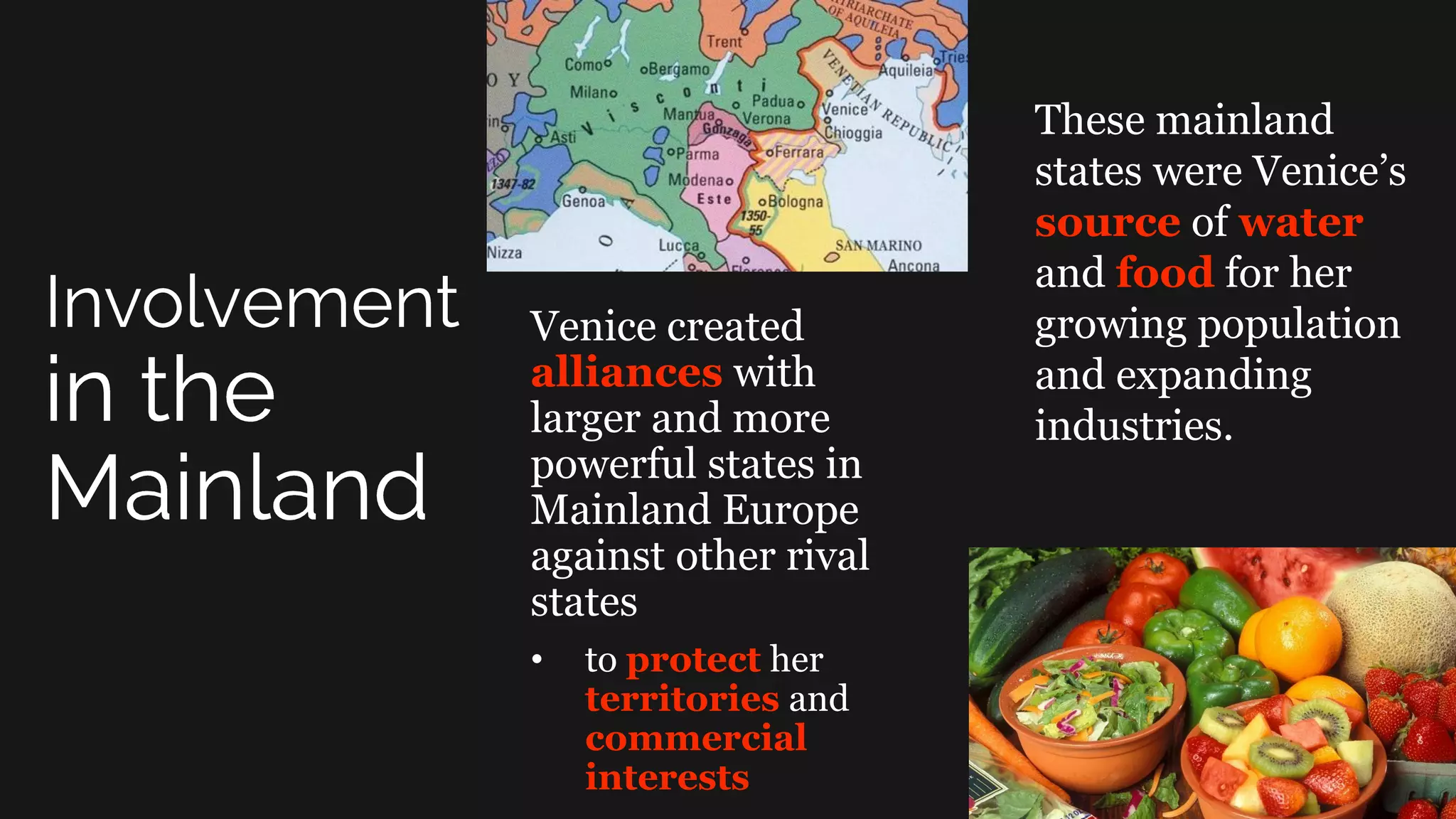
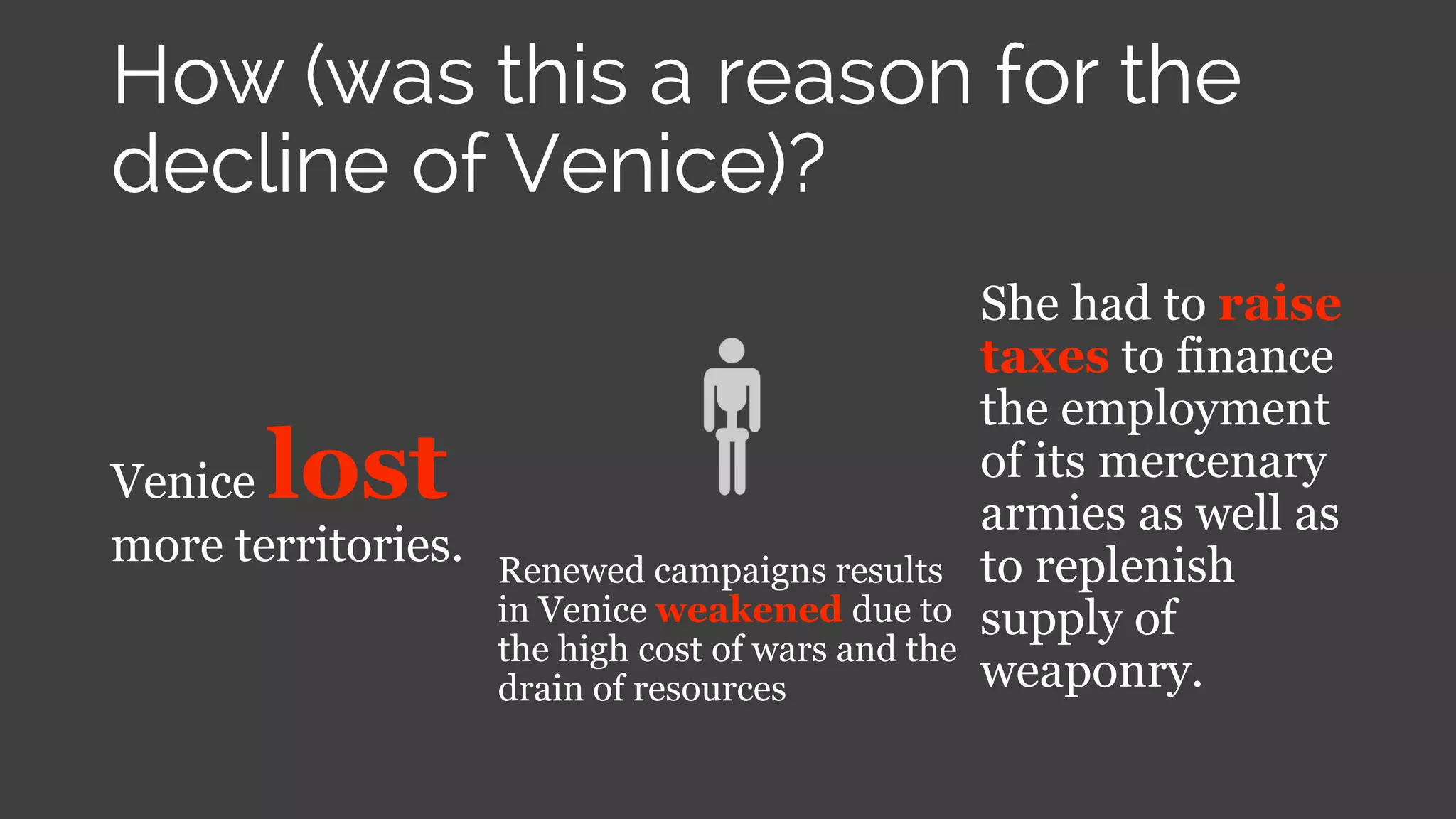
Vasco da
Gama
(Portuguese
explorer)
discovered a new
sea route to
India.
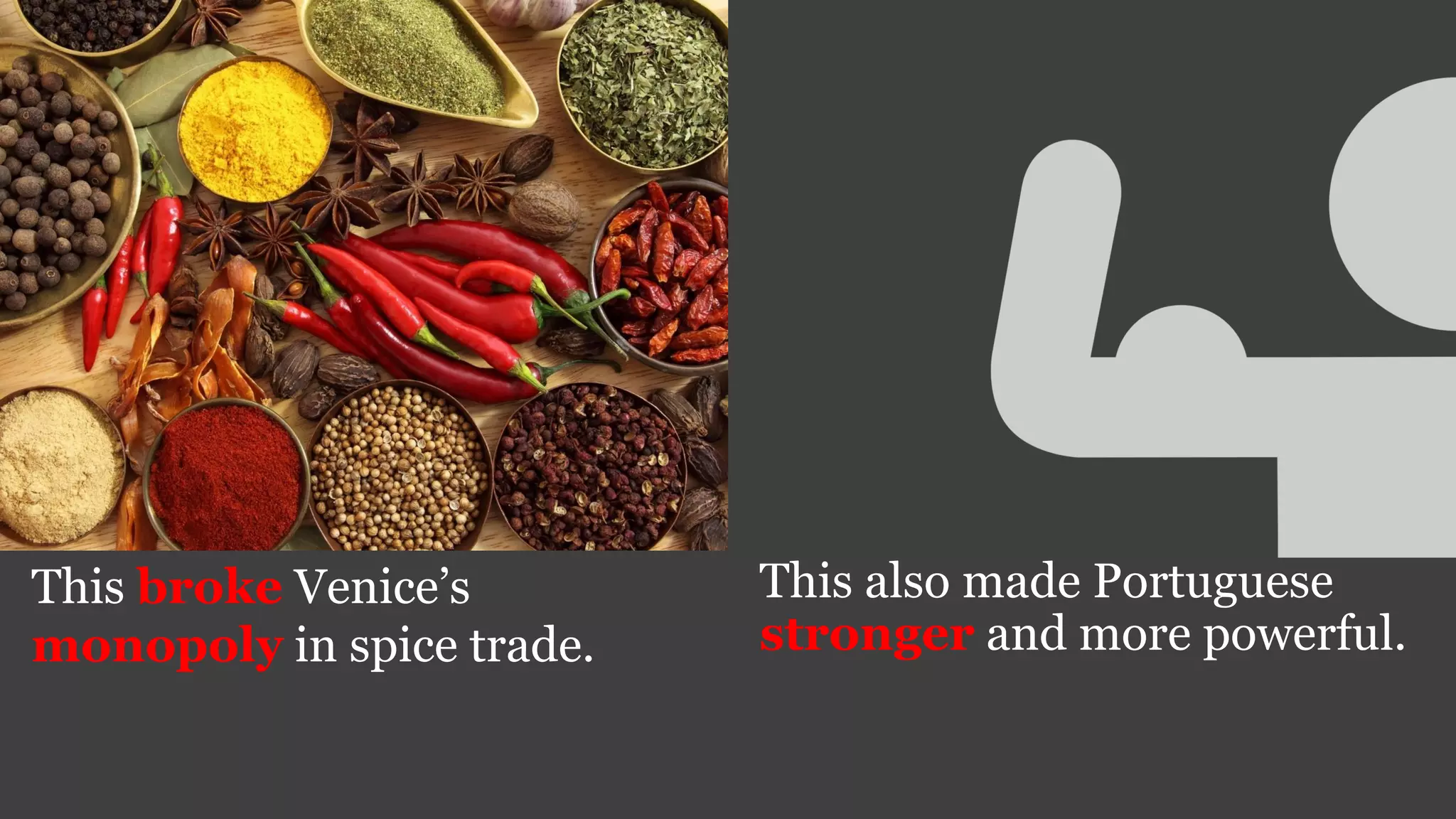
This broke Venice’s
monopoly in spice trade.
This also made Portuguese
stronger and more powerful.
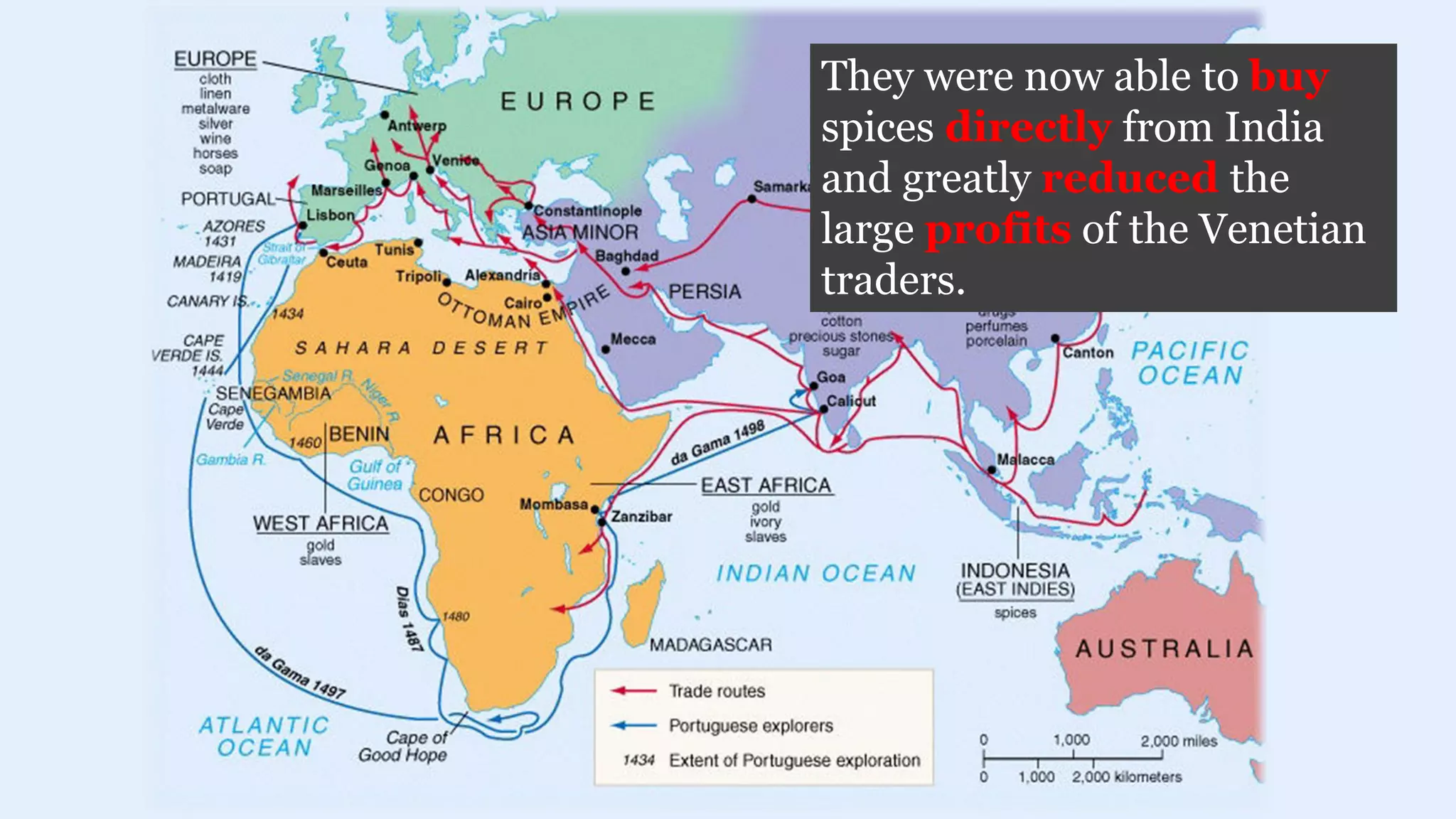
They were now able to buy
spices directly from India
and greatly reduced the
large profits of the Venetian
traders.
Venice lost monopoly
in spice trade and suffered losses
in their economy.
Portuguese become stronger
which provided strong
competition to Venice’s
trade.
Although Venice’s
traditional route to the East
by the Mediterranean was
shorter, it was time-
consuming.
The overland route to Hormuz
was also considered risky
because of robbers and
plunderers.
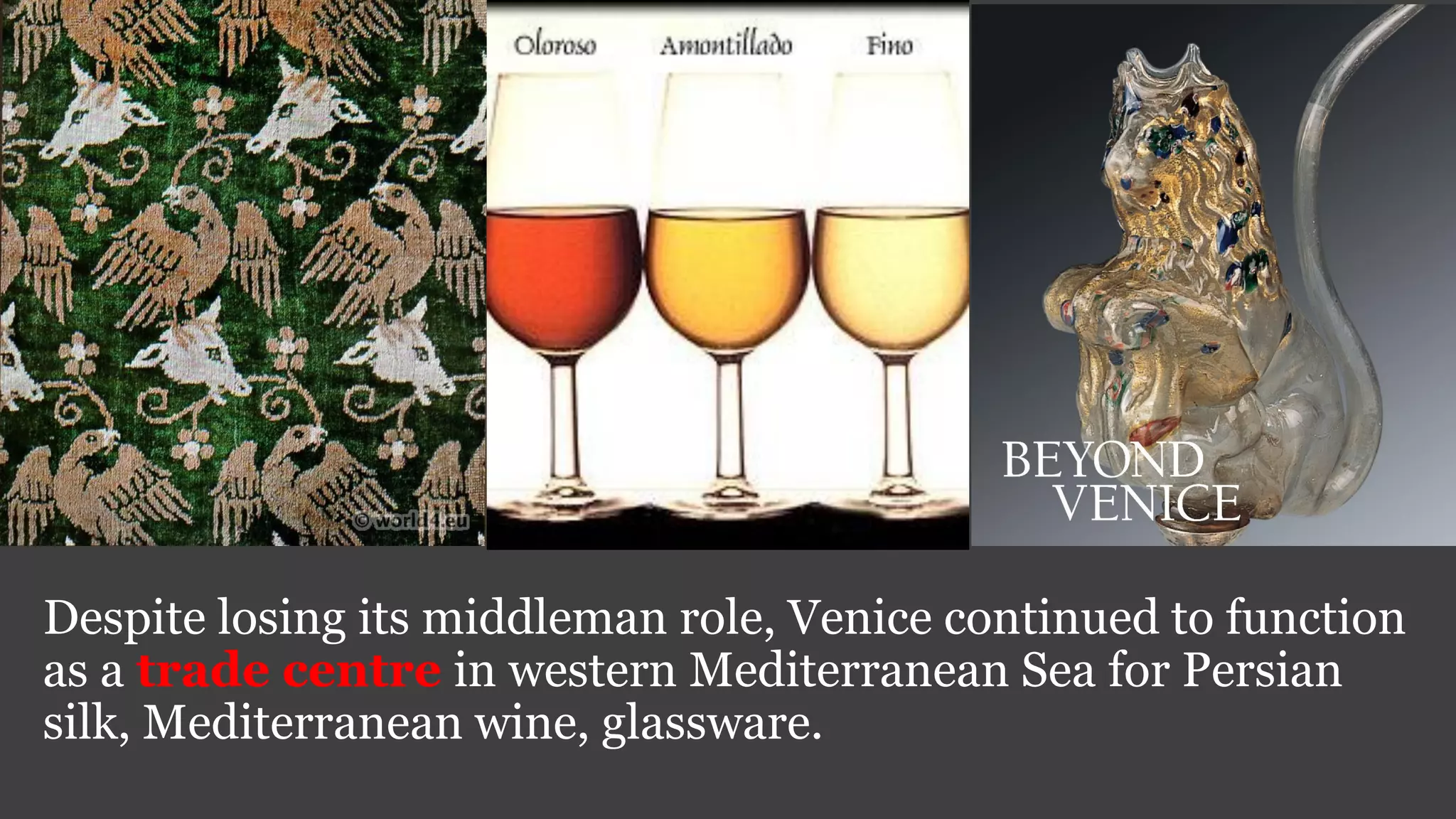
Despite losing its middleman role, Venice continued to function
as a trade centre in western Mediterranean Sea for Persian
silk, Mediterranean wine, glassware.
Venice also expanded its trade to the North Sea region and
maintained trade links with England.
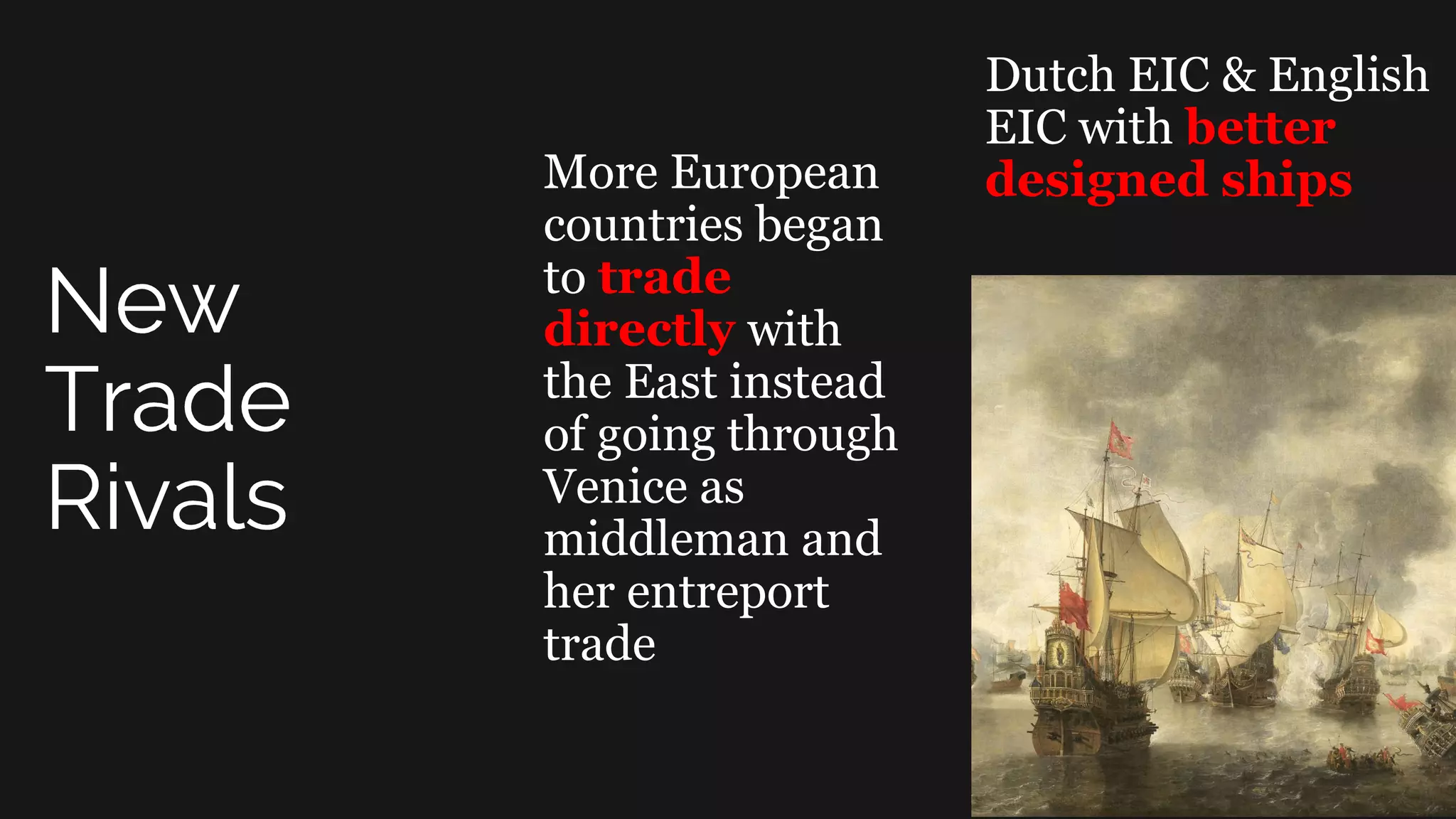
More European
countries began
to trade
directly with
the East instead
of going through
Venice as
middleman and
her entreport
trade
Dutch EIC & English
EIC with better
designed ships
Larger states such as England and Holland were more
successful in negotiating for favourable trading
rights in new ports.
Venice lost
trade as a
middleman
as European
countries no
longer use
Venice a source
of goods from
the East
Venice became
economically
irrelevant.
Venetians
responded by
imposing
protectionist
policy on
foreign traders.
This made it
costly to trade
with Venetians.
Foreign Threats Maritime Competition
• Incapable
leadership
• Corruption in
government
• Over-
dependence on
mercenaries
Political Challenges Social Challenges
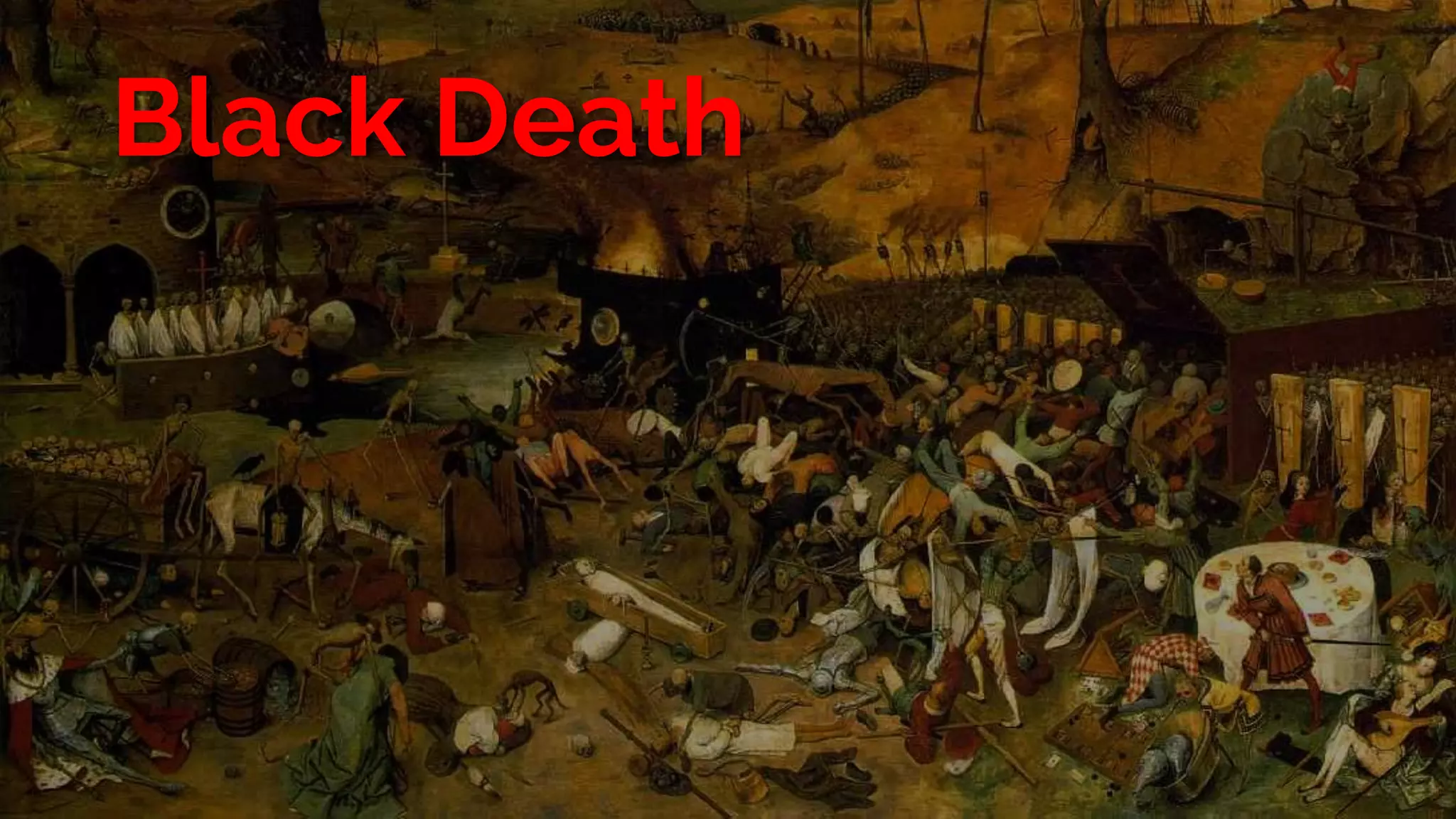
From 16th
century
, many of the
military leaders
were not
competent.
The shrinking
number of the
nobility as older
families died;
decline in the
nobility was
worsened by the
17th
century
plague.
Most of the policies focused
on preserving power,
prestige and wealth of
nobles rather than for the
good of the city-state.
Rotation of duties led to
incompetent officers
taking up positions by
default, even in leading the
naval warfare against the
Ottomans.
With a shrinking pool of
nobility to select leaders from,
the choice of able leaders was
thus limited
With weak military
leaders, Venice could not
compete with enemies led by
capable and qualified leaders,
this led to many losses and
the decline of Venice.
Nobles sought to retain their
family wealth, property and
power, resulting in
domination of a small group
of rich nobles in the
government.
With power in the hands of a few, corruption was
inevitable in the higher offices.
Due to the wars
with Ottoman
Empire and the
large European
states and the
disruption of
trade, civil
servants’
salaries were
suspended.
Some members
of the nobility
lost their source
of income.
Nobles bought votes to gain
position.
Nobles also sold positions
to raise funds.
100, 000 ducats
(S$15 million)
Because of loss of wealth, nobles sold their votes to those
who wanted to gain position and also sold positions to
raise funds
This led to corruption in
the government.
This also led to the rise of a group of nobles in the
Venetians who made policies to serve their own
nobility interests more than for the interests of the
city- state.
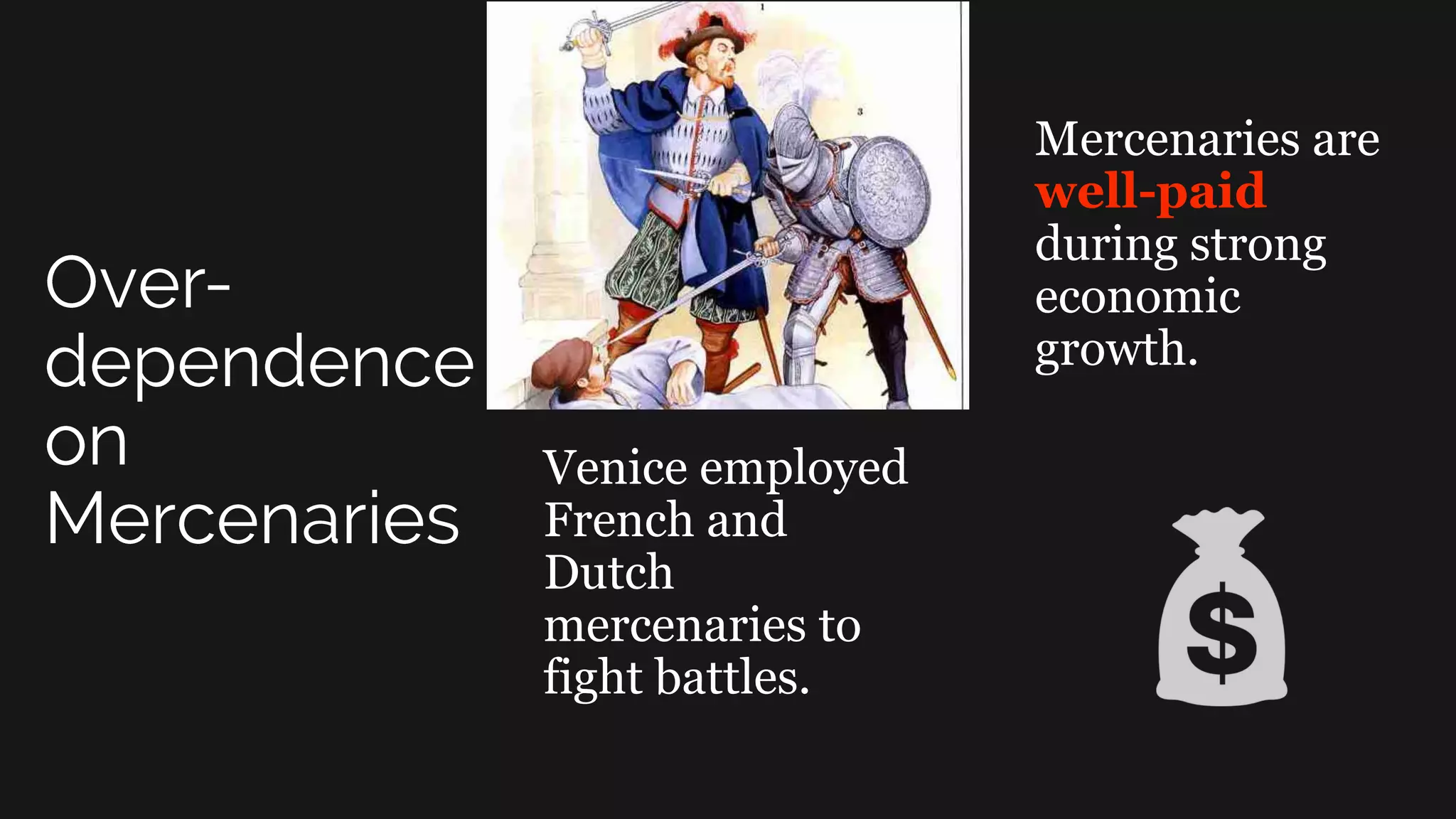
Venice employed
French and
Dutch
mercenaries to
fight battles.
Mercenaries are
well-paid
during strong
economic
growth.
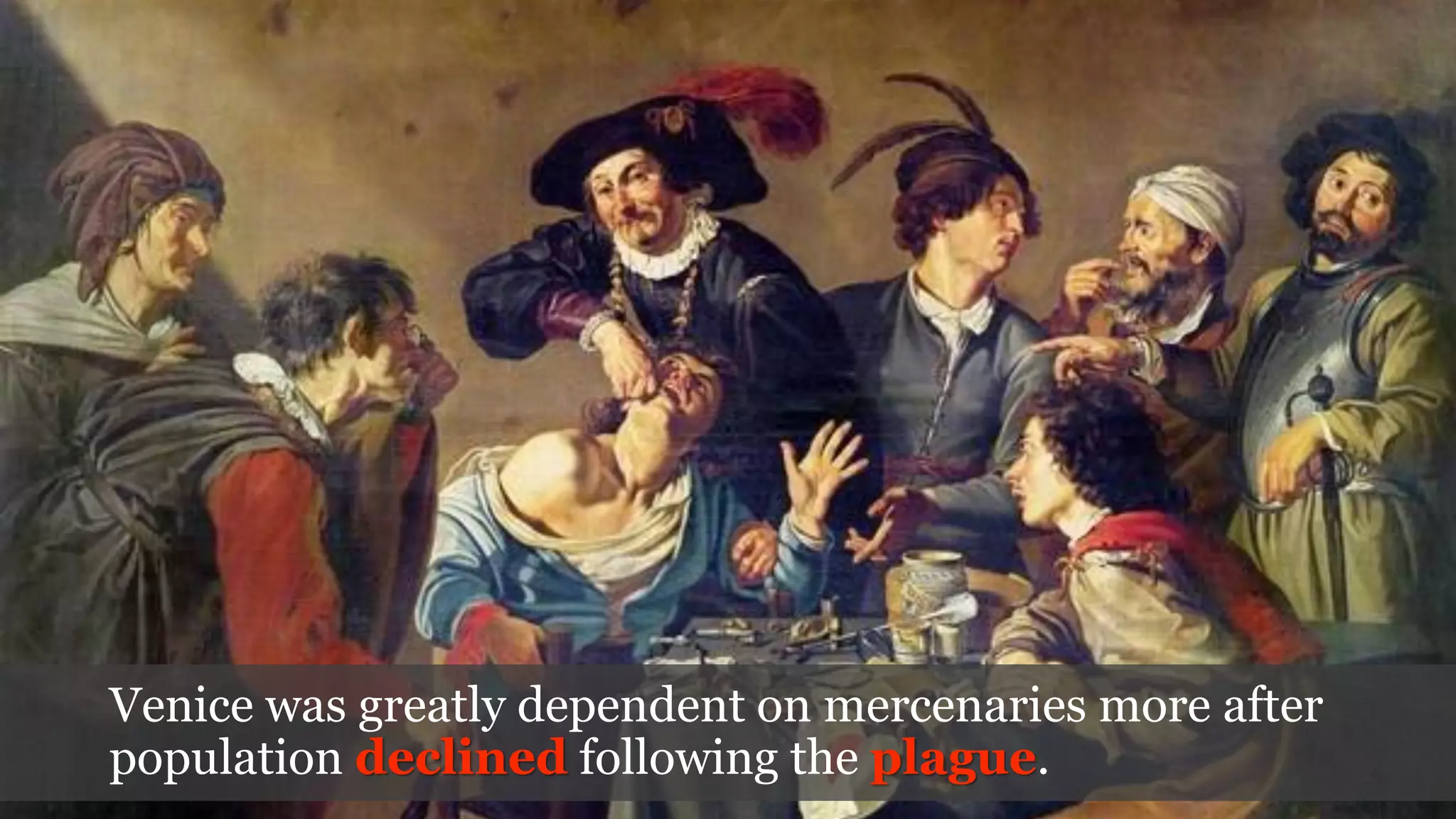
Venice was greatly dependent on mercenaries more after
population declined following the plague.
In 1615, Venice hired mercenaries of many nationalities
to fight the War of Gradisca. Instead, the French
mercenaries plotted to seize the Ducal Palace and the
Senate members.
This showed that they could no longer fully trust the
mercenary army.
Mercenaries turned
against Venice and fought
for the larger and richer
states.
Venice became weaker
when the mercenaries left
or turned against them,
leading to easy defeats
of Venice
Foreign Threats Maritime Competition Political Challenges
• Complacency
• Over-
indulgence in
affluent
lifestyle
Social Challenges
Nobles became richer and less interested and prepared for
war and security matters.
When Venice is
strong in
economic
growth,
lifestyles of
nobles become
better.
Nobles also
became more
distant from
commoners.
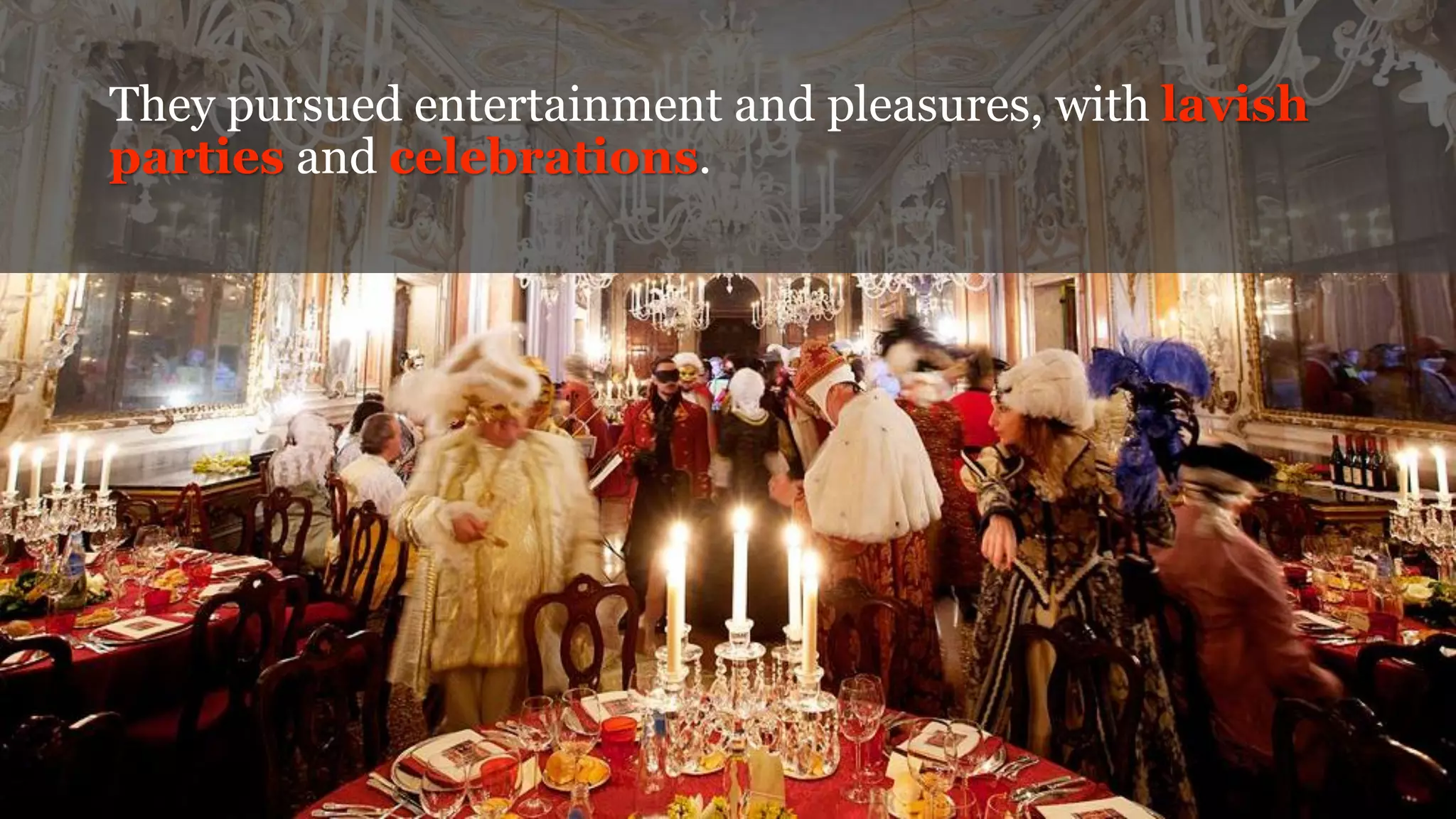
They pursued entertainment and pleasures, with lavish
parties and celebrations.
Nobles who were entrusted with the affairs of the
state became complacent about territorial issues.
It was only a matter of time that they would be
proven to have outdated fortresses and army.
Nobles were not alert to changes in the political
scene in the region eg. France’s growing power
under the leadership of Napoleon Bonaparte.
There were no capable nobles to lead and
organise an army to defeat Napolean.
Instead, a small number of Venetians, aided by the
French, plotted to overthrow Venetian ruling
government.
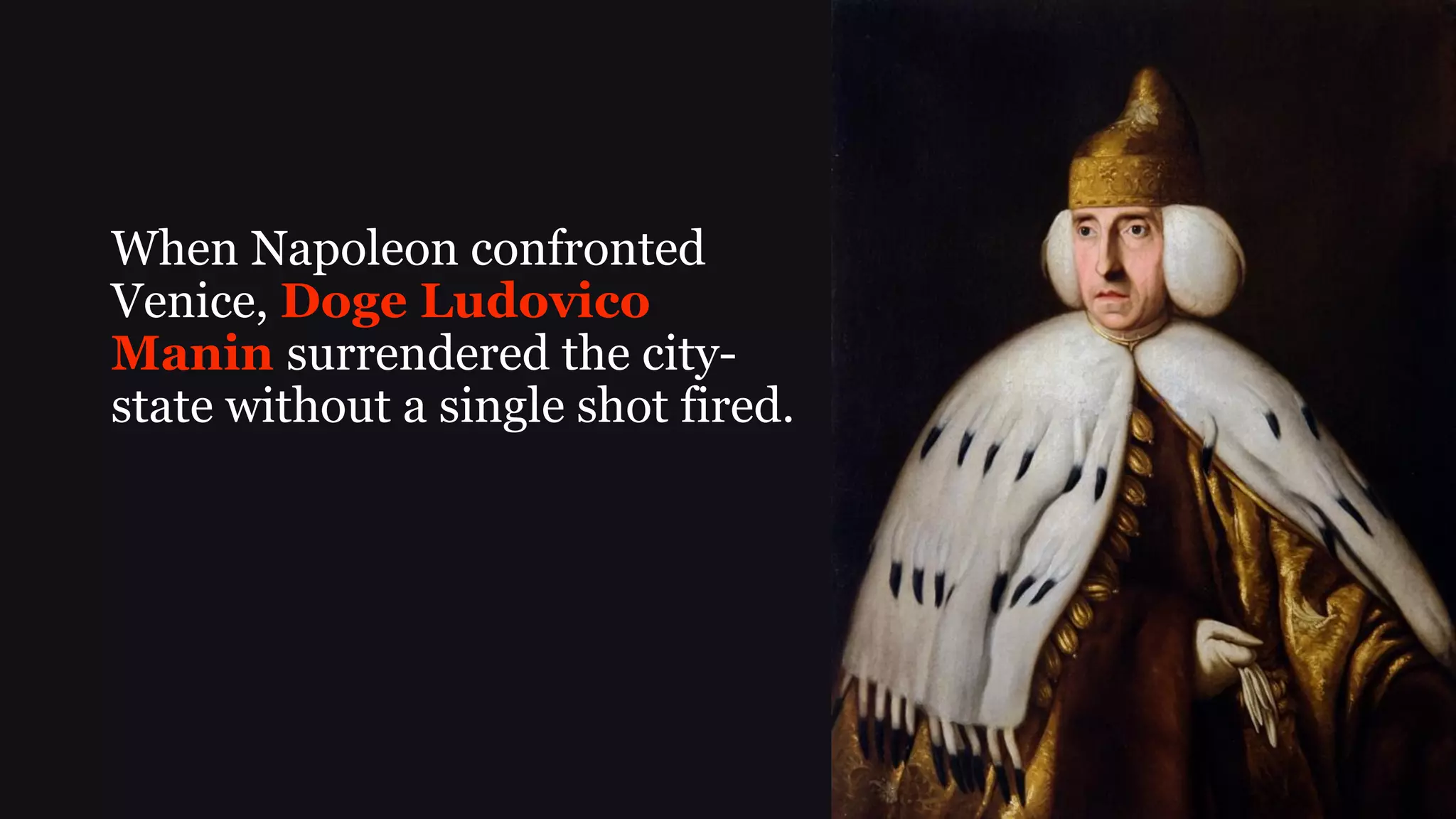
When Napoleon confronted
Venice, Doge Ludovico
Manin surrendered the city-
state without a single shot fired.
The decline of Venice was
COMPLETE.
Goh Bang Rui
on
@slideshare.
@gohbangrui
bit.ly/gohbangrui

Chapter 3 - Fall of Venice

  • 2.
    Factors for the Fall of Venice ForeignThreats Maritime Competition Political Challenges Social Challenges
  • 3.
    Eventual fall ofVenice by surrendering to the French under Napoleon Bonaparte.
  • 4.
    Which of thesefactors was the most important reason for the decline of Venice?
  • 5.
    • Involvement in Mainland •The Ottoman Empire • The League of Cambrai Foreign Threats Maritime Competition Political Challenges Social Challenges
  • 7.
    Venice created alliances with largerand more powerful states in Mainland Europe against other rival states • to protect her territories and commercial interests These mainland states were Venice’s source of water and food for her growing population and expanding industries.
  • 8.
    Venice tried totake advantage of rivalry among the mainland states by taking sides.
  • 9.
    the only waywas to build own strong army by recruiting mercenaries to fight the wars. To overcome the possibility that negotiations could put Venetians at risk,
  • 10.
    By switching alliances with differentopposing states, Venice was creating fragile relations with larger states – putting Venice at risk. Venice could be attacked should negotiations fail. The rivalry among the mainland states also made the overland trade route unsafe as constant battles were fought in the region.
  • 11.
    Expanding power of theOttoman Empire (Turkey) saw constant wars with Venice especially over the control of the Adriatic Sea. The Ottomans attacked Venetian territories from their own territories along the coast of the Adriatic Sea.
  • 12.
    Venice fought a 7-yearwar against the sea campaigns started by Ottoman to wrestle for the control of the Aegean Sea and the Adriatic Sea.
  • 13.
    The Venetians triedto strike a balance of power with the Ottomans and their European neighbours.
  • 14.
    In 1463, theEuropean states launched a military campaign against the Ottomans. Due to resentment, Venice fought the Ottomans on their own and lost Negroponte, an important Eastern trade outpost. Conflicting actions such as concessions made to the Ottomans, and military aid sent to European states to fight the Ottomans in defence of their territories led to a deep hostility for Venice.
  • 15.
    The wars withVenice and expansion of the Ottoman empire resulted in Venice losing some territories. Venice’s poor relations with other European states left Venice to defend against the Ottoman Empire alone.
  • 16.
    This severely weakenedVenice, and trade in the Adriatic Sea was disrupted.
  • 17.
    Venice was forcedto give up some of the mainland territories to avoid being involved in mainland wars.
  • 18.
    The galleys wereused to fight off attacks by the Ottomans in the 7-year sea-campaigns. This disrupted its use of galleys for trading purposes.
  • 19.
    The League of Cambraiwas formed by Mainland states to reduce power of Venice and divide the territories amongst the larger states. In one of the battles of Agnadello, the Venetian mercenary army was defeated and Venice lost many of its territories. The defeat at Agnadello stretched Venice’s political and military capabilities. By forming new alliances, she managed to recapture some of its territories.
  • 20.
    Venice lost more territories. Shehad to raise taxes to finance the employment of its mercenary armies as well as to replenish supply of weaponry. Renewed campaigns results in Venice weakened due to the high cost of wars and the drain of resources
  • 21.
    Foreign Threats • Discovery ofnew sea routes • New trade rivals Maritime Competition Political Challenges Social Challenges
  • 22.
  • 23.
    This broke Venice’s monopolyin spice trade. This also made Portuguese stronger and more powerful.
  • 24.
    They were nowable to buy spices directly from India and greatly reduced the large profits of the Venetian traders.
  • 25.
    Venice lost monopoly inspice trade and suffered losses in their economy.
  • 26.
    Portuguese become stronger whichprovided strong competition to Venice’s trade. Although Venice’s traditional route to the East by the Mediterranean was shorter, it was time- consuming. The overland route to Hormuz was also considered risky because of robbers and plunderers.
  • 27.
    Despite losing itsmiddleman role, Venice continued to function as a trade centre in western Mediterranean Sea for Persian silk, Mediterranean wine, glassware.
  • 28.
    Venice also expandedits trade to the North Sea region and maintained trade links with England.
  • 29.
    More European countries began totrade directly with the East instead of going through Venice as middleman and her entreport trade Dutch EIC & English EIC with better designed ships
  • 30.
    Larger states suchas England and Holland were more successful in negotiating for favourable trading rights in new ports.
  • 31.
    Venice lost trade asa middleman as European countries no longer use Venice a source of goods from the East Venice became economically irrelevant. Venetians responded by imposing protectionist policy on foreign traders. This made it costly to trade with Venetians.
  • 32.
    Foreign Threats MaritimeCompetition • Incapable leadership • Corruption in government • Over- dependence on mercenaries Political Challenges Social Challenges
  • 33.
    From 16th century , manyof the military leaders were not competent. The shrinking number of the nobility as older families died; decline in the nobility was worsened by the 17th century plague.
  • 35.
    Most of thepolicies focused on preserving power, prestige and wealth of nobles rather than for the good of the city-state. Rotation of duties led to incompetent officers taking up positions by default, even in leading the naval warfare against the Ottomans.
  • 36.
    With a shrinkingpool of nobility to select leaders from, the choice of able leaders was thus limited With weak military leaders, Venice could not compete with enemies led by capable and qualified leaders, this led to many losses and the decline of Venice. Nobles sought to retain their family wealth, property and power, resulting in domination of a small group of rich nobles in the government.
  • 37.
    With power inthe hands of a few, corruption was inevitable in the higher offices.
  • 38.
    Due to thewars with Ottoman Empire and the large European states and the disruption of trade, civil servants’ salaries were suspended. Some members of the nobility lost their source of income.
  • 39.
    Nobles bought votesto gain position. Nobles also sold positions to raise funds.
  • 40.
  • 41.
    Because of lossof wealth, nobles sold their votes to those who wanted to gain position and also sold positions to raise funds
  • 42.
    This led tocorruption in the government.
  • 43.
    This also ledto the rise of a group of nobles in the Venetians who made policies to serve their own nobility interests more than for the interests of the city- state.
  • 44.
    Venice employed French and Dutch mercenariesto fight battles. Mercenaries are well-paid during strong economic growth.
  • 45.
    Venice was greatlydependent on mercenaries more after population declined following the plague.
  • 46.
    In 1615, Venicehired mercenaries of many nationalities to fight the War of Gradisca. Instead, the French mercenaries plotted to seize the Ducal Palace and the Senate members. This showed that they could no longer fully trust the mercenary army.
  • 47.
    Mercenaries turned against Veniceand fought for the larger and richer states. Venice became weaker when the mercenaries left or turned against them, leading to easy defeats of Venice
  • 48.
    Foreign Threats MaritimeCompetition Political Challenges • Complacency • Over- indulgence in affluent lifestyle Social Challenges
  • 49.
    Nobles became richerand less interested and prepared for war and security matters.
  • 50.
    When Venice is strongin economic growth, lifestyles of nobles become better. Nobles also became more distant from commoners.
  • 51.
    They pursued entertainmentand pleasures, with lavish parties and celebrations.
  • 52.
    Nobles who wereentrusted with the affairs of the state became complacent about territorial issues. It was only a matter of time that they would be proven to have outdated fortresses and army. Nobles were not alert to changes in the political scene in the region eg. France’s growing power under the leadership of Napoleon Bonaparte. There were no capable nobles to lead and organise an army to defeat Napolean.
  • 53.
    Instead, a smallnumber of Venetians, aided by the French, plotted to overthrow Venetian ruling government.
  • 54.
    When Napoleon confronted Venice,Doge Ludovico Manin surrendered the city- state without a single shot fired.
  • 55.
    The decline ofVenice was COMPLETE.
  • 56.