CHAPTER 3
Learnin
g
Outcom
es
1. Define hazards
2. Give examples of the types of
hazards
3. Explain the impact of various
hazards on different exposed
elements
The severity of the
impacts of disasters
and other extreme
weather and climate
events depends
strongly on the level
of vulnerability and
exposure to these
WHAT IS
EXPOSURE?
refers to the
‘elements at risk’
from a natural or
man-made hazard
event. Element at
risk include the
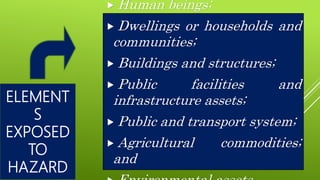
ELEMENT
S
EXPOSED
TO
HAZARD
 Human beings;
 Dwellings or households and
communities;
 Buildings and structures;
 Public facilities and
infrastructure assets;
 Public and transport system;
 Agricultural commodities;
and
WHAT IS
VULNERABILITY?defined as “the
characteristics and
circumstances of a
community, system, or
asset that make it
susceptible to the
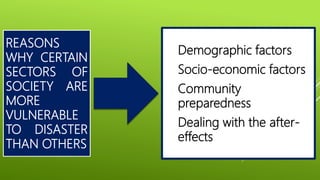
REASONS
WHY CERTAIN
SECTORS OF
SOCIETY ARE
MORE
VULNERABLE
TO DISASTER
THAN OTHERS
1. Demographic factors
2. Socio-economic factors
3. Community
preparedness
4. Dealing with the after-
effects
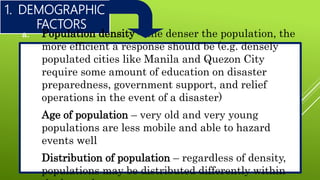
1. DEMOGRAPHIC
FACTORS
a. Population density – the denser the population, the
more efficient a response should be (e.g. densely
populated cities like Manila and Quezon City
require some amount of education on disaster
preparedness, government support, and relief
operations in the event of a disaster)
b. Age of population – very old and very young
populations are less mobile and able to hazard
events well
c. Distribution of population – regardless of density,
populations may be distributed differently within
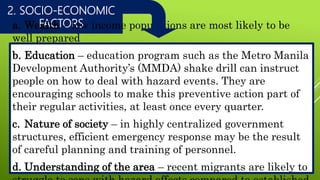
2. SOCIO-ECONOMIC
FACTORSa. Wealth – low income populations are most likely to be
well prepared
b. Education – education program such as the Metro Manila
Development Authority’s (MMDA) shake drill can instruct
people on how to deal with hazard events. They are
encouraging schools to make this preventive action part of
their regular activities, at least once every quarter.
c. Nature of society – in highly centralized government
structures, efficient emergency response may be the result
of careful planning and training of personnel.
d. Understanding of the area – recent migrants are likely to
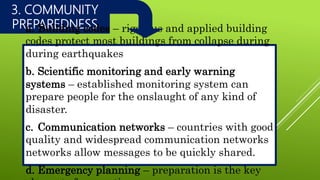
3. COMMUNITY
PREPAREDNESSa. Building codes – rigorous and applied building
codes protect most buildings from collapse during
during earthquakes
b. Scientific monitoring and early warning
systems – established monitoring system can
prepare people for the onslaught of any kind of
disaster.
c. Communication networks – countries with good
quality and widespread communication networks
networks allow messages to be quickly shared.
d. Emergency planning – preparation is the key
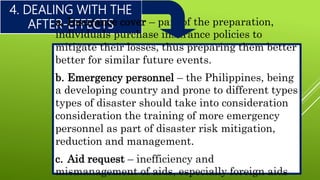
4. DEALING WITH THE
AFTER-EFFECTSa. Insurance cover – part of the preparation,
individuals purchase insurance policies to
mitigate their losses, thus preparing them better
better for similar future events.
b. Emergency personnel – the Philippines, being
a developing country and prone to different types
types of disaster should take into consideration
consideration the training of more emergency
personnel as part of disaster risk mitigation,
reduction and management.
c. Aid request – inefficiency and
mismanagement of aids, especially foreign aids
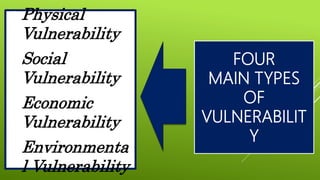
FOUR
MAIN TYPES
OF
VULNERABILIT
Y
1. Physical
Vulnerability
2. Social
Vulnerability
3. Economic
Vulnerability
4. Environmenta
l Vulnerability
1. PHYSICAL
VULNERABILITY- May be determined by aspects such as
population density levels, remoteness of a
settlement, the site, design and materials
used for critical infrastructure and for
housing United Nations International
Strategy for Disaster Reduction (UNISDR).
Example: Wooden homes are less likely
to collapse in an earthquake but are
more vulnerable to fire. Houses built
with light materials may not be a
2. SOCIAL
VULNERABILITY
- refers to the inability of people, organizations and societies
to withstand adverse impacts to hazards due to
characteristics inherent in social interactions, institutions,
and systems of cultural values. It includes aspects related to
levels of literacy and education, the existence of peace and
security, access to basic human rights, systems of good
governance, social equity, positive traditional values, customs
and ideological beliefs and overall collective organizational
systems (UNISDR).
Example: When flooding occurs some citizens, such as
children, elderly and persons with disability (PWD’s), may be
unable to protect themselves or evacuate if necessary.
Educated and well-informed are more likely to survive when
disaster strikes. There would be lesser casualty in
3. ECONOMIC
VULNERABILITY
- the level of vulnerability is highly dependent upon the
economic status of individuals, communities, and nations.
The poor are usually more vulnerable to disasters because
they lack the resources to build sturdy structures and put
other engineering measures in place to protect themselves
from being negatively impacted by disasters. The same
people are the least prepared due to lack of access to
education and information.
Example: Poorer families may live in squatter
settlements because they cannot afford to live in safer
(more expensive) areas. In Metro Manila the so-called
“urban poor” build their shanties or improvised houses
4. ENVIRONMENTAL
VULNERABILITY- natural resource depletion and resource degradation are
key of aspects of environmental vulnerability. This is one
aspect that both communities and government must be
sensitive about. Mitigation measures like reforestation
and natural resource protection and conservation must be
undertaken to reduce natural risk and vulnerability.
Example: Wetlands, such as Agusan Marsh, are
sensitive to increasing salinity from sea water, and
pollution from storm water runoff containing
agricultural chemicals, eroded soils, etc.
Deforestation of mountains due to illegal logging is
END OF
CHAPTER 2

Chapter 3 (basic concept of hazard)

  • 1.
  • 2.
    Learnin g Outcom es 1. Define hazards 2.Give examples of the types of hazards 3. Explain the impact of various hazards on different exposed elements
  • 3.
    The severity ofthe impacts of disasters and other extreme weather and climate events depends strongly on the level of vulnerability and exposure to these
  • 4.
    WHAT IS EXPOSURE? refers tothe ‘elements at risk’ from a natural or man-made hazard event. Element at risk include the
  • 5.
    ELEMENT S EXPOSED TO HAZARD  Human beings; Dwellings or households and communities;  Buildings and structures;  Public facilities and infrastructure assets;  Public and transport system;  Agricultural commodities; and
  • 6.
    WHAT IS VULNERABILITY?defined as“the characteristics and circumstances of a community, system, or asset that make it susceptible to the
  • 7.
    REASONS WHY CERTAIN SECTORS OF SOCIETYARE MORE VULNERABLE TO DISASTER THAN OTHERS 1. Demographic factors 2. Socio-economic factors 3. Community preparedness 4. Dealing with the after- effects
  • 8.
    1. DEMOGRAPHIC FACTORS a. Populationdensity – the denser the population, the more efficient a response should be (e.g. densely populated cities like Manila and Quezon City require some amount of education on disaster preparedness, government support, and relief operations in the event of a disaster) b. Age of population – very old and very young populations are less mobile and able to hazard events well c. Distribution of population – regardless of density, populations may be distributed differently within
  • 9.
    2. SOCIO-ECONOMIC FACTORSa. Wealth– low income populations are most likely to be well prepared b. Education – education program such as the Metro Manila Development Authority’s (MMDA) shake drill can instruct people on how to deal with hazard events. They are encouraging schools to make this preventive action part of their regular activities, at least once every quarter. c. Nature of society – in highly centralized government structures, efficient emergency response may be the result of careful planning and training of personnel. d. Understanding of the area – recent migrants are likely to
  • 10.
    3. COMMUNITY PREPAREDNESSa. Buildingcodes – rigorous and applied building codes protect most buildings from collapse during during earthquakes b. Scientific monitoring and early warning systems – established monitoring system can prepare people for the onslaught of any kind of disaster. c. Communication networks – countries with good quality and widespread communication networks networks allow messages to be quickly shared. d. Emergency planning – preparation is the key
  • 11.
    4. DEALING WITHTHE AFTER-EFFECTSa. Insurance cover – part of the preparation, individuals purchase insurance policies to mitigate their losses, thus preparing them better better for similar future events. b. Emergency personnel – the Philippines, being a developing country and prone to different types types of disaster should take into consideration consideration the training of more emergency personnel as part of disaster risk mitigation, reduction and management. c. Aid request – inefficiency and mismanagement of aids, especially foreign aids
  • 12.
    FOUR MAIN TYPES OF VULNERABILIT Y 1. Physical Vulnerability 2.Social Vulnerability 3. Economic Vulnerability 4. Environmenta l Vulnerability
  • 13.
    1. PHYSICAL VULNERABILITY- Maybe determined by aspects such as population density levels, remoteness of a settlement, the site, design and materials used for critical infrastructure and for housing United Nations International Strategy for Disaster Reduction (UNISDR). Example: Wooden homes are less likely to collapse in an earthquake but are more vulnerable to fire. Houses built with light materials may not be a
  • 14.
    2. SOCIAL VULNERABILITY - refersto the inability of people, organizations and societies to withstand adverse impacts to hazards due to characteristics inherent in social interactions, institutions, and systems of cultural values. It includes aspects related to levels of literacy and education, the existence of peace and security, access to basic human rights, systems of good governance, social equity, positive traditional values, customs and ideological beliefs and overall collective organizational systems (UNISDR). Example: When flooding occurs some citizens, such as children, elderly and persons with disability (PWD’s), may be unable to protect themselves or evacuate if necessary. Educated and well-informed are more likely to survive when disaster strikes. There would be lesser casualty in
  • 15.
    3. ECONOMIC VULNERABILITY - thelevel of vulnerability is highly dependent upon the economic status of individuals, communities, and nations. The poor are usually more vulnerable to disasters because they lack the resources to build sturdy structures and put other engineering measures in place to protect themselves from being negatively impacted by disasters. The same people are the least prepared due to lack of access to education and information. Example: Poorer families may live in squatter settlements because they cannot afford to live in safer (more expensive) areas. In Metro Manila the so-called “urban poor” build their shanties or improvised houses
  • 16.
    4. ENVIRONMENTAL VULNERABILITY- naturalresource depletion and resource degradation are key of aspects of environmental vulnerability. This is one aspect that both communities and government must be sensitive about. Mitigation measures like reforestation and natural resource protection and conservation must be undertaken to reduce natural risk and vulnerability. Example: Wetlands, such as Agusan Marsh, are sensitive to increasing salinity from sea water, and pollution from storm water runoff containing agricultural chemicals, eroded soils, etc. Deforestation of mountains due to illegal logging is
  • 17.