Disaster Readiness
and Risk Reduction
2ND SEM Q1 Lesson 1
Key Concepts of
Disaster, Hazard,
Vulnerability and
Capacity
Basic concept
of disaster and
disaster risk
Learning Objective:
1. Explain the meaning of disaster;
2. Differentiate the risk factors underlying
disasters;
3. Describe the effects of disasters on one’
life
4. Analyze disaster from the
different perspectives (physical,
psychological, socio-cultural,
economic, political, and
biological).
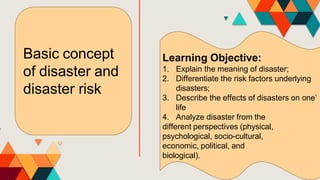
A
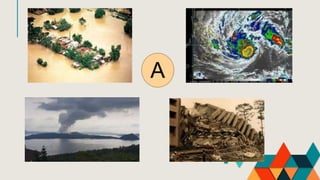
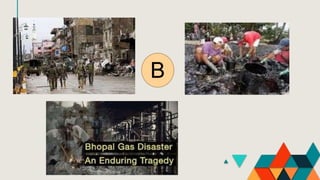
B
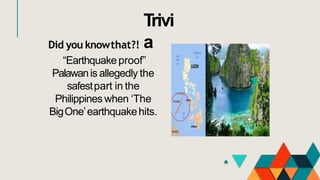
Did you knowthat?!
“Earthquake proof”
Palawanis allegedly the
safestpart in the
Philippines when ‘The
BigOne’earthquakehits.
Trivi
a
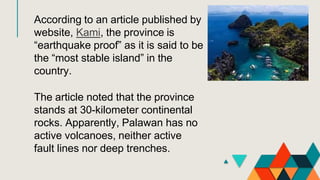
According to an article published by
website, Kami, the province is
“earthquake proof” as it is said to be
the “most stable island” in the
country.
The article noted that the province
stands at 30-kilometer continental
rocks. Apparently, Palawan has no
active volcanoes, neither active
fault lines nor deep trenches.
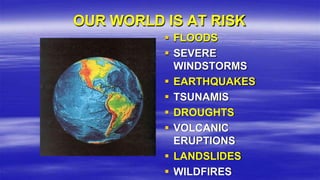
OUR WORLD IS AT RISK
 FLOODS
 SEVERE
WINDSTORMS
 EARTHQUAKES
 TSUNAMIS
 DROUGHTS
 VOLCANIC
ERUPTIONS
 LANDSLIDES
 WILDFIRES
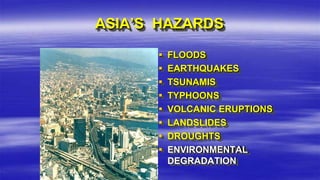
ASIA’S HAZARDS
 FLOODS
 EARTHQUAKES
 TSUNAMIS
 TYPHOONS
 VOLCANIC ERUPTIONS
 LANDSLIDES
 DROUGHTS
 ENVIRONMENTAL
DEGRADATION
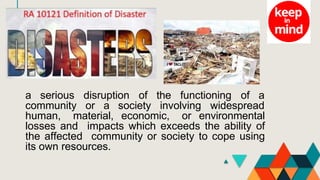
a serious disruption of the functioning of a
community or a society involving widespread
human, material, economic, or environmental
losses and impacts which exceeds the ability of
the affected community or society to cope using
its own resources.
When is an event a disaster?
 At least 20% of the population emergency assistance or those
destroyed.
 A great number or at least 40% of the means of livelihood such
as bananas, fishing boats, vehicles and the like are destroyed.
 Major roads and bridges are destroyed and impassable for at
least a week, thus disrupting the flow of transport and
commerce.
destruction of fishponds, crops, poultry and
and other agricultural products, and
 Widespread
livestock,
 Epidemics
Basic Concept in Understanding a
Disaster
Disaster are frequently described as a result
of the combination of
1.The exposure to a hazard
2.The conditions of vulnerability that present
3.Insufficient capacity or measures to
reduce or cope with the potential negative
consequences
a dangerous phenomenon, potentially damaging
physical event, phenomenon or human activity that
may cause loss of life, injury or other health
impacts, property damage, loss of livelihoods and
services, social and economic disruption, or
environmental damage.
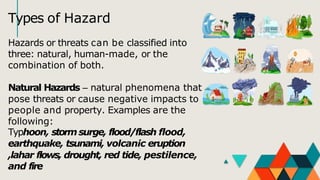
Types of Hazard
Hazards or threats can be classified into
three: natural, human-made, or the
combination of both.
Natural Hazards – natural phenomena that
pose threats or cause negative impacts to
people and property. Examples are the
following:
Typhoon, storm surge, flood/flash flood,
earthquake, tsunami, volcanic eruption
,lahar flows, drought, red tide, pestilence,
and fire
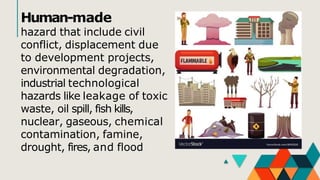
Human-made
hazard that include civil
conflict, displacement due
to development projects,
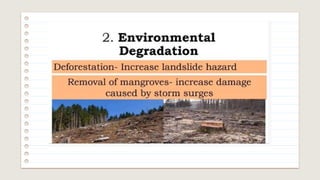
environmental degradation,
industrial technological
hazards like leakage of toxic
waste, oil spill, fish kills,
nuclear, gaseous, chemical
contamination, famine,
drought, fires, and flood
Combination or Socionatural
Hazards
Flooding and drought can fall
under this category if these are due
to deforestation
Which of the three types of
hazards can be prevented and
can be anticipated and why?
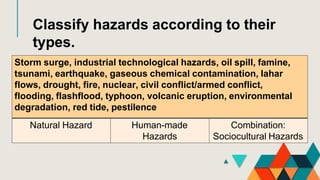
Classify hazards according to their
types.
Storm surge, industrial technological hazards, oil spill, famine,
tsunami, earthquake, gaseous chemical contamination, lahar
flows, drought, fire, nuclear, civil conflict/armed conflict,
flooding, flashflood, typhoon, volcanic eruption, environmental
degradation, red tide, pestilence
Natural Hazard Human-made
Hazards
Combination:
Sociocultural Hazards
Basic mapping of disaster in the
Philippines
Your task is to identify disasters that have taken place in the Philippines in the
past five years, and analyze their causes and impacts on the communities
directly affected and the country in general
In your analysis, please highlight the following
1. The type disaster that has taken place, that is whether it is natural, man-
made, technological or a combination of sociocultural hazards
2. The causes and effect of the disaster, for example, effects on the livelihood
of the people and on the country’s economy
Displaced Populations
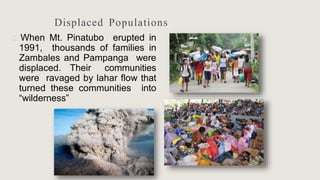
🞂 When Mt. Pinatubo erupted in
1991, thousands of families in
Zambales and Pampanga were
displaced. Their communities
were ravaged by lahar flow that
turned these communities into
“wilderness”
Health Risk
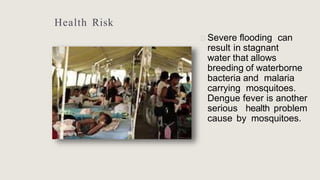
🞂 Severe flooding can
result in stagnant
water that allows
breeding of waterborne
bacteria and malaria
carrying mosquitoes.
Dengue fever is another
serious health problem
cause by mosquitoes.
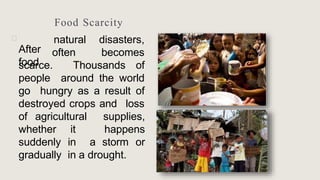
Food Scarcity
🞂
After
food
natural
often
disasters,
becomes
Thousands of
scarce.
people around the world
go hungry as a result of
destroyed crops and loss
of agricultural
whether it
suddenly in
supplies,
happens
a storm or
gradually in a drought.
Emotional Aftershocks
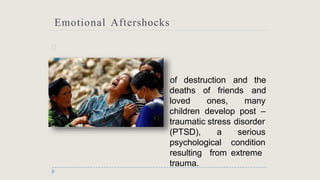
🞂 n
of destruction and the
and
deaths of friends
loved ones, many
children develop post –
traumatic stress disorder
(PTSD), a
psychological
serious
condition
from extreme
resulting
trauma.
Areas and LocationsExposedto
Disaster
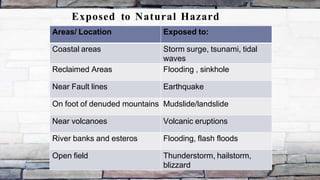
Exposed to Natural Hazard
Areas/ Location Exposed to:
Coastal areas Storm surge, tsunami, tidal
waves
Reclaimed Areas Flooding , sinkhole
Near Fault lines Earthquake
On foot of denuded mountains Mudslide/landslide
Near volcanoes Volcanic eruptions
River banks and esteros Flooding, flash floods
Open field Thunderstorm, hailstorm,
blizzard
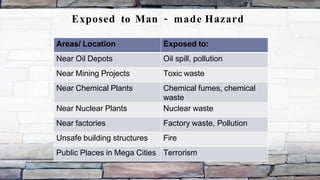
Exposed to Man – made Hazard
Areas/ Location Exposed to:
Near Oil Depots Oil spill, pollution
Near Mining Projects Toxic waste
Near Chemical Plants Chemical fumes, chemical
waste
Near Nuclear Plants Nuclear waste
Near factories Factory waste, Pollution
Unsafe building structures Fire
Public Places in Mega Cities Terrorism
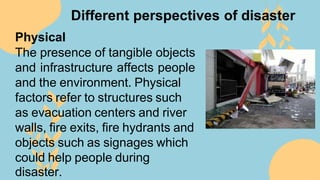
Different perspectives of disaster
Physical
The presence of tangible objects
and infrastructure affects people
and the environment. Physical
factors refer to structures such
as evacuation centers and river
walls, fire exits, fire hydrants and
objects such as signages which
could help people during
disaster.
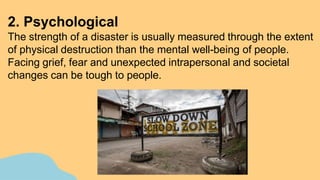
2. Psychological
The strength of a disaster is usually measured through the extent
of physical destruction than the mental well-being of people.
Facing grief, fear and unexpected intrapersonal and societal
changes can be tough to people.
3. Sociocultural
Culture and tradition are rarely seen to change
because of the occurrence of disasters but
various socio-cultural actions and disaster risk
are related. Socio-cultural factors of disaster
include religion and faith, societal traditions,
perceptions and social standings.
4. Economic
Physical damages on assets,
machineries and livestock in addition to
property loss, environmental damage,
trauma, health, loss of lives and
disruption of communities can severely
affect economic activity in periods
depending on the extent of damage..
5. Political
Politics can be affected in the time of a disaster.
Government
structure and political actions can change depending
on the need. Political actions during and after a
disaster can be ways to update existing laws, rules
and physical aspects of the government. Resources
and funds can be realigned to focus on building local
resilience and for rehabilitation and reconstruction.
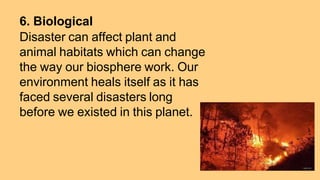
6. Biological
Disaster can affect plant and
animal habitats which can change
the way our biosphere work. Our
environment heals itself as it has
faced several disasters long
before we existed in this planet.
Disaster Readiness
and Risk Reduction
2ND SEM Q1 Lesson 2
Exposure
and
Vulnerability
Topics:
Concept of
Vulnerability
Learning Objective:
1. Explain the meaning of vulnerability;
2. Explain why certain sectors of
society are more vulnerable to
disaster than others;
3. Analyze why certain structures are
more vulnerable to specific hazards
than others;
 What is Exposure?
 What is Vulnerability
 What is What is the
effect of vulnerability
to disaster?
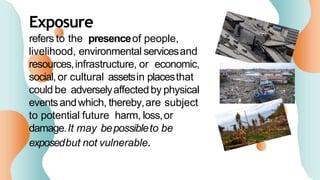
Exposure
refers to the presenceof people,
livelihood, environmental servicesand
resources,infrastructure, or economic,
social,or cultural assetsin placesthat
could be adverselyaffectedby physical
eventsandwhich, thereby,are subject
to potential future harm, loss,or
damage.It may bepossibleto be
exposedbut not vulnerable.
The concept of VULNERABILITY comes from
many aspect, especially, those that arise from
various social, economic, physical and
environmental factors
Example:
 Poor Design
 Construction of buildings
 Inadequate protection of assets
 Lack of public awareness, limited
official recognition of risk and
preparedness measures
 Disregards for wise environmental
management (OPDM2013)
● Vulnerability can be seen as the result of a
process in which various different things a
population to be more vulnerable. These
can be split into DEMOGRAPHIC and
SOCIO- ECONOMIC. They can also be
discussed through the level of
COMMUNITY PREPAREDNESS and the
ability of a community to MANAGE THE
AFTER EFFECTS
● 1. Population
Density- the more
dense the
population, the more
efficient a response
should be,
considering the
number of people
● 2. Age of
Population very
old and very
young populations
are less mobile
and able to
respond to hazard
● Wealth – Low income
populations are less
likely to be well
prepared. Part of
preparation is having a
SURVIVAL KIT that
includes tools to be
used. Emergency food
stock and water that
could last for at least 3 to
● Education –
Education programs
such as the Metro
Manila
Development
Authority’s (MMDA)
shake drill can instruct
populations on how to
deal with hazard
events
● Building Codes
– rigorous and
applied building
codes protect
most buildings
from collapse
during
earthquake.
● Scientific monitoring
and early warning
systems – Established
monitoring system can
prepare people for the
onslaught of any kind
of disaster.
● Communication
Networks –
Countries with good
quality and
widespread
communication
networks allow
messages to be
quickly shared.
● Emergency
Planning –
Preparation is the
key element of
prevention.
Preparation for a
disaster is embodied
in an Emergency
D. Dealing with the
After - Effects
1. Insurance cover
2. Emergency
personnel
3. Aid Request
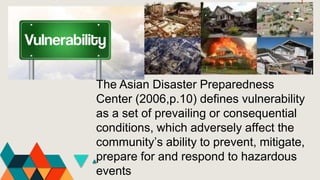
The Asian Disaster Preparedness
Center (2006,p.10) defines vulnerability
as a set of prevailing or consequential
conditions, which adversely affect the
community’s ability to prevent, mitigate,
prepare for and respond to hazardous
events
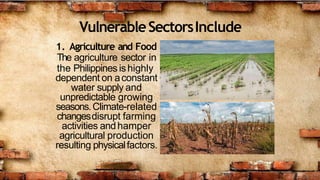
VulnerableSectorsInclude
1. Agriculture and Food
The agriculture sector in
the Philippines ishighly
dependent on aconstant
water supply and
unpredictable growing
seasons.Climate-related
changesdisrupt farming
activities andhamper
agricultural production
resulting physicalfactors.
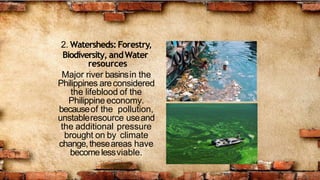
2. Watersheds:Forestry,
Biodiversity, andWater
resources
Major river basinsin the
Philippines areconsidered
the lifeblood of the
Philippine economy.
becauseof the pollution,
unstableresource useand
the additional pressure
brought on by climate
change,theseareas have
becomelessviable.
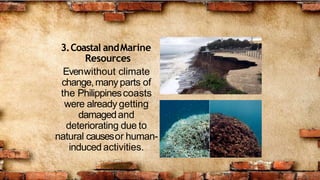
3.Coastal andMarine
Resources
Evenwithout climate
change,manyparts of
the Philippinescoasts
were already getting
damagedand
deteriorating due to
natural causesor human-
induced activities.
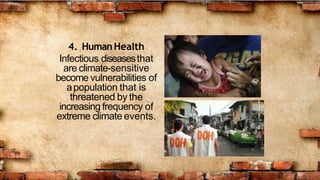
4. HumanHealth
Infectious diseasesthat
are climate-sensitive
become vulnerabilities of
apopulation that is
threatened by the
increasing frequency of
extreme climate events.
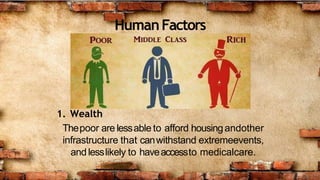
HumanFactors
1. Wealth
Thepoor are lessable to afford housingandother
infrastructure that canwithstand extremeevents,
andlesslikely to haveaccessto medicalcare.
HumanFactors
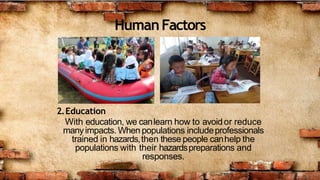
2.Education
With education, we canlearn how to avoidor reduce
manyimpacts. When populations includeprofessionals
trained in hazards,then these people canhelp the
populations with their hazardspreparations and
responses.
3.Governance
They can advance policies that reduce vulnerability. They can
support education and awareness efforts, as well as economic
development to reduce poverty. They can foster social
networks and empower individuals and communities to help
themselves to prepare for and respondtohazards.
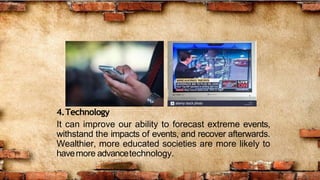
4.Technology
It can improve our ability to forecast extreme events,
withstand the impacts of events, and recover afterwards.
Wealthier, more educated societies are more likely to
havemore advancetechnology.
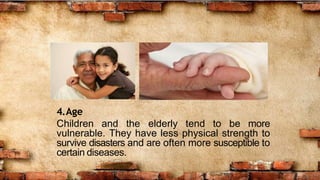
4.Age
Children and the elderly tend to be more
vulnerable. They have less physical strength to
survive disasters and are often more susceptible to
certain diseases.
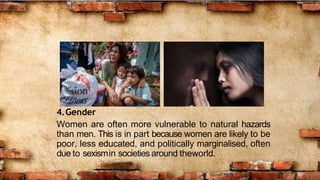
4.Gender
Women are often more vulnerable to natural hazards
than men. This is in part because women are likely to be
poor, less educated, and politically marginalised, often
due to sexismin societies around theworld.
Who are so called Most Vulnerable
Sectors?
 They are the community members whose
capacities are low and not sufficient to
withstand and overcome the damaging
and adverse effects of disasters
 They are composed of farmers, the urban
poor, laborers, indigenous people,
persons with disabilities (PWDs), women
and children
 In addition, they are so called abused sector
and at the lowest levels of society
Who are the so called Less Vulnerable
Sectors?
 They are the community members whose capacities start from
their own ability to acquire material resources: skills and
trainings and position in society
 Their capacities are higher than those in the vulnerable
sector to overcome the adverse effects of disasters
 They are composed of professionals, small entrepreneurs and
others similar to those who belong to the higher levels of society
 Their role in disaster management activities is to extend
assistance and support to vulnerable sectors
Who are the so called Not Vulnerable
Sectors?
 They are sectors in society having high
position in the community
 Most of the time, they are the targets of the
vulnerable and less vulnerable sectors in
advocacy work relating disaster issue to the
structure and policies implemented by the
government that are the root causes of the
vulnerability of the community
Categories of Vulnerabilities
According to Anderson and Woodrow (1990), there are
three areas of vulnerability, which are the following
Physical/ Material Vulnerability
 Location and type of housing/building materials
 Land, water, animals, capital, other means of
production (access and control)
 Infrastructure and services: roads, health facilities,
schools, electricity, communications, transport,
housing, etc..
 Human capital: population,
morality, diseases, nutritional status,
literacy, numeracy, poverty levels
 Environment factors: forestation, soil
quality and erosion
 Social/Organizational
 Family structure (weak/strong)
 Leadership qualities and structure
 Legislation
 Administrative structures and institutional
arrangements
 Decision-making structures (who is left out,
who is in, effectiveness)
Participation levels
Divisions and conflicts: ethnic,
class, caste, religion, ideology,
political groups, language groups,
and structures for mediating
conflicts
Degree of justice, equality, access
to political processes
 Community organizations: formal,
informal, traditional, governmental,
progressive
Relationship to government,
administrative structures
Isolation or connectedness
Attitudinal/Motivational Vulnerability
 • Attitude toward change
 • Sense of ability to affect their world,
environment, get things done
 • Initiative
 • Faith, determination, fighting spirit
 • Religious beliefs, ideology
 • Fatalism, hopelessness,
discouragement
 • Dependent/independent (self-reliant)
 • Consciousness, awareness
 • Unity, solidarity, cooperation
 • Orientation toward past, present, and
future
The concept of vulnerability comes from
many aspects, specifically, those that arise
from various
 social,
 economic,
 physical, and
 environmental factors.
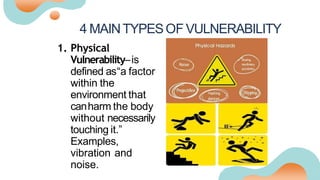
4 MAINTYPESOF VULNERABILITY
1. Physical
Vulnerability–is
defined as“a factor
within the
environment that
canharm the body
without necessarily
touching it.”
Examples,
vibration and
noise.
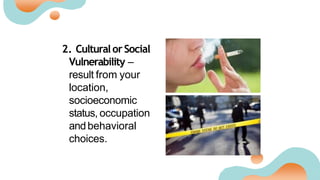
2. CulturalorSocial
Vulnerability –
result from your
location,
socioeconomic
status, occupation
andbehavioral
choices.
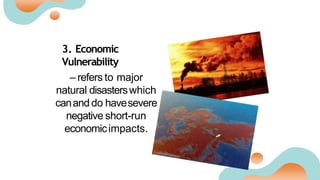
3. Economic
Vulnerability
– refers to major
natural disasterswhich
canand do havesevere
negative short-run
economicimpacts.
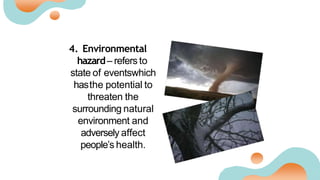
4. Environmental
hazard– refers to
state of eventswhich
hasthe potential to
threaten the
surrounding natural
environment and
adversely affect
people’s health.
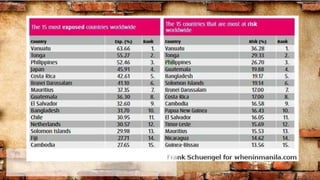
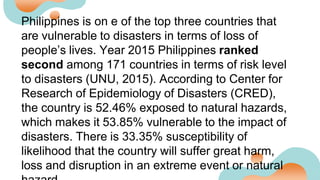
Philippines is on e of the top three countries that
are vulnerable to disasters in terms of loss of
people’s lives. Year 2015 Philippines ranked
second among 171 countries in terms of risk level
to disasters (UNU, 2015). According to Center for
Research of Epidemiology of Disasters (CRED),
the country is 52.46% exposed to natural hazards,
which makes it 53.85% vulnerable to the impact of
disasters. There is 33.35% susceptibility of
likelihood that the country will suffer great harm,
loss and disruption in an extreme event or natural
The Philippines has 48.17% adaptive
capacities for long-term strategies in
dealing with and attempting to address the
negative impact of natural hazards and
climate change. The country lacks 80.03%
coping capacity to minimize the negative
consequences of natural hazards and
climate change through direct action and
the resources available
Disaster Readiness
and Risk Reduction
2ND SEM Q1 Lesson 3
Key Concepts of
Disaster, Hazard,
Vulnerability and
Capacity
Topics:
 Concept of
Vulnerability
 Concept of
Capacity
Learning Objective:
1. Determine the elements that are
exposed to a particular hazard;
2. Recognize vulnerabilities of different
elements exposed to specific hazards;
and
3. Differentiate among hazards, exposure,
and vulnerabilities and give examples
from actual situations.
What is Capacity?
According to the United Nations International
Strategy for Disaster Reduction or UNISDR
(2009), capacity refers to all the strengths,
attributes, and resources available within a
community, organization, or society that can
be used to achieve an agreed goal.
The Concept of Capacity
The United Nations Development
Programme or UNDP(2009)
Defines capacity development as the process
through which individuals, organizations, and
societies obtain, strengthen, and maintain the
capabilities to set and achieve their own
development objectives overtime
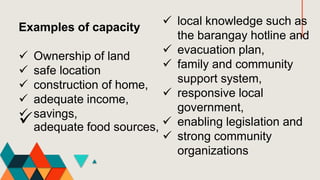
Examples of capacity
 Ownership of land
 safe location
 construction of home,
 adequate income,
 savings,
 local knowledge such as
the barangay hotline and
 evacuation plan,
 family and community
support system,
 responsive local
government,
adequate food sources,  enabling legislation and
 strong community
organizations
How does capacity
contribute to lessening or
mitigating impacts of
disasters?
Community members and groups have different
vulnerabilities and capacities.
 age,
 gender,
 class,
 social class,
 ethnicity,
 language,
 religion, and
 physical condition.
Disaster Risk
Is the chance or likelihood of suffering
harm and loss as a result of a hazardous
event
Also define as the probability of harmful
consequences or expected losses
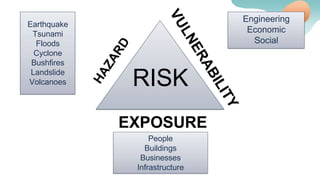
RISK
EXPOSURE
Engineering
Economic
Social
Earthquake
Tsunami
Floods
Cyclone
Bushfires
Landslide
Volcanoes
People
Buildings
Businesses
Infrastructure
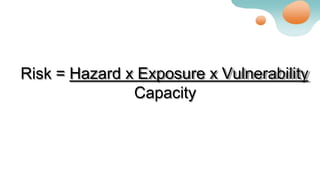
Risk = Hazard x Exposure x Vulnerability
Capacity

PPT_DRRR_LESSON_1_TO_3_CONCEPT_OF_DHRV_AND_EXPOSURE_VULNERABILITY.pdf.pptx

  • 1.
    Disaster Readiness and RiskReduction 2ND SEM Q1 Lesson 1 Key Concepts of Disaster, Hazard, Vulnerability and Capacity
  • 2.
    Basic concept of disasterand disaster risk Learning Objective: 1. Explain the meaning of disaster; 2. Differentiate the risk factors underlying disasters; 3. Describe the effects of disasters on one’ life 4. Analyze disaster from the different perspectives (physical, psychological, socio-cultural, economic, political, and biological).
  • 3.
  • 4.
  • 5.
    Did you knowthat?! “Earthquakeproof” Palawanis allegedly the safestpart in the Philippines when ‘The BigOne’earthquakehits. Trivi a
  • 6.
    According to anarticle published by website, Kami, the province is “earthquake proof” as it is said to be the “most stable island” in the country. The article noted that the province stands at 30-kilometer continental rocks. Apparently, Palawan has no active volcanoes, neither active fault lines nor deep trenches.
  • 7.
    OUR WORLD ISAT RISK  FLOODS  SEVERE WINDSTORMS  EARTHQUAKES  TSUNAMIS  DROUGHTS  VOLCANIC ERUPTIONS  LANDSLIDES  WILDFIRES
  • 8.
    ASIA’S HAZARDS  FLOODS EARTHQUAKES  TSUNAMIS  TYPHOONS  VOLCANIC ERUPTIONS  LANDSLIDES  DROUGHTS  ENVIRONMENTAL DEGRADATION
  • 9.
    a serious disruptionof the functioning of a community or a society involving widespread human, material, economic, or environmental losses and impacts which exceeds the ability of the affected community or society to cope using its own resources.
  • 10.
    When is anevent a disaster?  At least 20% of the population emergency assistance or those destroyed.  A great number or at least 40% of the means of livelihood such as bananas, fishing boats, vehicles and the like are destroyed.  Major roads and bridges are destroyed and impassable for at least a week, thus disrupting the flow of transport and commerce. destruction of fishponds, crops, poultry and and other agricultural products, and  Widespread livestock,  Epidemics
  • 11.
    Basic Concept inUnderstanding a Disaster Disaster are frequently described as a result of the combination of 1.The exposure to a hazard 2.The conditions of vulnerability that present 3.Insufficient capacity or measures to reduce or cope with the potential negative consequences
  • 12.
    a dangerous phenomenon,potentially damaging physical event, phenomenon or human activity that may cause loss of life, injury or other health impacts, property damage, loss of livelihoods and services, social and economic disruption, or environmental damage.
  • 13.
    Types of Hazard Hazardsor threats can be classified into three: natural, human-made, or the combination of both. Natural Hazards – natural phenomena that pose threats or cause negative impacts to people and property. Examples are the following: Typhoon, storm surge, flood/flash flood, earthquake, tsunami, volcanic eruption ,lahar flows, drought, red tide, pestilence, and fire
  • 14.
    Human-made hazard that includecivil conflict, displacement due to development projects, environmental degradation, industrial technological hazards like leakage of toxic waste, oil spill, fish kills, nuclear, gaseous, chemical contamination, famine, drought, fires, and flood
  • 15.
    Combination or Socionatural Hazards Floodingand drought can fall under this category if these are due to deforestation
  • 16.
    Which of thethree types of hazards can be prevented and can be anticipated and why?
  • 17.
    Classify hazards accordingto their types. Storm surge, industrial technological hazards, oil spill, famine, tsunami, earthquake, gaseous chemical contamination, lahar flows, drought, fire, nuclear, civil conflict/armed conflict, flooding, flashflood, typhoon, volcanic eruption, environmental degradation, red tide, pestilence Natural Hazard Human-made Hazards Combination: Sociocultural Hazards
  • 18.
    Basic mapping ofdisaster in the Philippines Your task is to identify disasters that have taken place in the Philippines in the past five years, and analyze their causes and impacts on the communities directly affected and the country in general In your analysis, please highlight the following 1. The type disaster that has taken place, that is whether it is natural, man- made, technological or a combination of sociocultural hazards 2. The causes and effect of the disaster, for example, effects on the livelihood of the people and on the country’s economy
  • 32.
    Displaced Populations 🞂 WhenMt. Pinatubo erupted in 1991, thousands of families in Zambales and Pampanga were displaced. Their communities were ravaged by lahar flow that turned these communities into “wilderness”
  • 33.
    Health Risk 🞂 Severeflooding can result in stagnant water that allows breeding of waterborne bacteria and malaria carrying mosquitoes. Dengue fever is another serious health problem cause by mosquitoes.
  • 34.
    Food Scarcity 🞂 After food natural often disasters, becomes Thousands of scarce. peoplearound the world go hungry as a result of destroyed crops and loss of agricultural whether it suddenly in supplies, happens a storm or gradually in a drought.
  • 35.
    Emotional Aftershocks 🞂 n ofdestruction and the and deaths of friends loved ones, many children develop post – traumatic stress disorder (PTSD), a psychological serious condition from extreme resulting trauma.
  • 37.
  • 38.
    Exposed to NaturalHazard Areas/ Location Exposed to: Coastal areas Storm surge, tsunami, tidal waves Reclaimed Areas Flooding , sinkhole Near Fault lines Earthquake On foot of denuded mountains Mudslide/landslide Near volcanoes Volcanic eruptions River banks and esteros Flooding, flash floods Open field Thunderstorm, hailstorm, blizzard
  • 39.
    Exposed to Man– made Hazard Areas/ Location Exposed to: Near Oil Depots Oil spill, pollution Near Mining Projects Toxic waste Near Chemical Plants Chemical fumes, chemical waste Near Nuclear Plants Nuclear waste Near factories Factory waste, Pollution Unsafe building structures Fire Public Places in Mega Cities Terrorism
  • 40.
    Different perspectives ofdisaster Physical The presence of tangible objects and infrastructure affects people and the environment. Physical factors refer to structures such as evacuation centers and river walls, fire exits, fire hydrants and objects such as signages which could help people during disaster.
  • 41.
    2. Psychological The strengthof a disaster is usually measured through the extent of physical destruction than the mental well-being of people. Facing grief, fear and unexpected intrapersonal and societal changes can be tough to people.
  • 42.
    3. Sociocultural Culture andtradition are rarely seen to change because of the occurrence of disasters but various socio-cultural actions and disaster risk are related. Socio-cultural factors of disaster include religion and faith, societal traditions, perceptions and social standings.
  • 44.
    4. Economic Physical damageson assets, machineries and livestock in addition to property loss, environmental damage, trauma, health, loss of lives and disruption of communities can severely affect economic activity in periods depending on the extent of damage..
  • 45.
    5. Political Politics canbe affected in the time of a disaster. Government structure and political actions can change depending on the need. Political actions during and after a disaster can be ways to update existing laws, rules and physical aspects of the government. Resources and funds can be realigned to focus on building local resilience and for rehabilitation and reconstruction.
  • 46.
    6. Biological Disaster canaffect plant and animal habitats which can change the way our biosphere work. Our environment heals itself as it has faced several disasters long before we existed in this planet.
  • 48.
    Disaster Readiness and RiskReduction 2ND SEM Q1 Lesson 2 Exposure and Vulnerability
  • 49.
    Topics: Concept of Vulnerability Learning Objective: 1.Explain the meaning of vulnerability; 2. Explain why certain sectors of society are more vulnerable to disaster than others; 3. Analyze why certain structures are more vulnerable to specific hazards than others;
  • 50.
     What isExposure?  What is Vulnerability  What is What is the effect of vulnerability to disaster?
  • 51.
    Exposure refers to thepresenceof people, livelihood, environmental servicesand resources,infrastructure, or economic, social,or cultural assetsin placesthat could be adverselyaffectedby physical eventsandwhich, thereby,are subject to potential future harm, loss,or damage.It may bepossibleto be exposedbut not vulnerable.
  • 52.
    The concept ofVULNERABILITY comes from many aspect, especially, those that arise from various social, economic, physical and environmental factors Example:  Poor Design  Construction of buildings  Inadequate protection of assets
  • 53.
     Lack ofpublic awareness, limited official recognition of risk and preparedness measures  Disregards for wise environmental management (OPDM2013)
  • 54.
    ● Vulnerability canbe seen as the result of a process in which various different things a population to be more vulnerable. These can be split into DEMOGRAPHIC and SOCIO- ECONOMIC. They can also be discussed through the level of COMMUNITY PREPAREDNESS and the ability of a community to MANAGE THE AFTER EFFECTS
  • 55.
    ● 1. Population Density-the more dense the population, the more efficient a response should be, considering the number of people ● 2. Age of Population very old and very young populations are less mobile and able to respond to hazard
  • 56.
    ● Wealth –Low income populations are less likely to be well prepared. Part of preparation is having a SURVIVAL KIT that includes tools to be used. Emergency food stock and water that could last for at least 3 to ● Education – Education programs such as the Metro Manila Development Authority’s (MMDA) shake drill can instruct populations on how to deal with hazard events
  • 57.
    ● Building Codes –rigorous and applied building codes protect most buildings from collapse during earthquake. ● Scientific monitoring and early warning systems – Established monitoring system can prepare people for the onslaught of any kind of disaster.
  • 58.
    ● Communication Networks – Countrieswith good quality and widespread communication networks allow messages to be quickly shared. ● Emergency Planning – Preparation is the key element of prevention. Preparation for a disaster is embodied in an Emergency
  • 59.
    D. Dealing withthe After - Effects 1. Insurance cover 2. Emergency personnel 3. Aid Request
  • 60.
    The Asian DisasterPreparedness Center (2006,p.10) defines vulnerability as a set of prevailing or consequential conditions, which adversely affect the community’s ability to prevent, mitigate, prepare for and respond to hazardous events
  • 61.
    VulnerableSectorsInclude 1. Agriculture andFood The agriculture sector in the Philippines ishighly dependent on aconstant water supply and unpredictable growing seasons.Climate-related changesdisrupt farming activities andhamper agricultural production resulting physicalfactors.
  • 62.
    2. Watersheds:Forestry, Biodiversity, andWater resources Majorriver basinsin the Philippines areconsidered the lifeblood of the Philippine economy. becauseof the pollution, unstableresource useand the additional pressure brought on by climate change,theseareas have becomelessviable.
  • 63.
    3.Coastal andMarine Resources Evenwithout climate change,manypartsof the Philippinescoasts were already getting damagedand deteriorating due to natural causesor human- induced activities.
  • 64.
    4. HumanHealth Infectious diseasesthat areclimate-sensitive become vulnerabilities of apopulation that is threatened by the increasing frequency of extreme climate events.
  • 65.
    HumanFactors 1. Wealth Thepoor arelessable to afford housingandother infrastructure that canwithstand extremeevents, andlesslikely to haveaccessto medicalcare.
  • 66.
    HumanFactors 2.Education With education, wecanlearn how to avoidor reduce manyimpacts. When populations includeprofessionals trained in hazards,then these people canhelp the populations with their hazardspreparations and responses.
  • 67.
    3.Governance They can advancepolicies that reduce vulnerability. They can support education and awareness efforts, as well as economic development to reduce poverty. They can foster social networks and empower individuals and communities to help themselves to prepare for and respondtohazards.
  • 68.
    4.Technology It can improveour ability to forecast extreme events, withstand the impacts of events, and recover afterwards. Wealthier, more educated societies are more likely to havemore advancetechnology.
  • 69.
    4.Age Children and theelderly tend to be more vulnerable. They have less physical strength to survive disasters and are often more susceptible to certain diseases.
  • 70.
    4.Gender Women are oftenmore vulnerable to natural hazards than men. This is in part because women are likely to be poor, less educated, and politically marginalised, often due to sexismin societies around theworld.
  • 71.
    Who are socalled Most Vulnerable Sectors?  They are the community members whose capacities are low and not sufficient to withstand and overcome the damaging and adverse effects of disasters  They are composed of farmers, the urban poor, laborers, indigenous people, persons with disabilities (PWDs), women and children  In addition, they are so called abused sector and at the lowest levels of society
  • 72.
    Who are theso called Less Vulnerable Sectors?  They are the community members whose capacities start from their own ability to acquire material resources: skills and trainings and position in society  Their capacities are higher than those in the vulnerable sector to overcome the adverse effects of disasters  They are composed of professionals, small entrepreneurs and others similar to those who belong to the higher levels of society  Their role in disaster management activities is to extend assistance and support to vulnerable sectors
  • 73.
    Who are theso called Not Vulnerable Sectors?  They are sectors in society having high position in the community  Most of the time, they are the targets of the vulnerable and less vulnerable sectors in advocacy work relating disaster issue to the structure and policies implemented by the government that are the root causes of the vulnerability of the community
  • 74.
    Categories of Vulnerabilities Accordingto Anderson and Woodrow (1990), there are three areas of vulnerability, which are the following Physical/ Material Vulnerability  Location and type of housing/building materials  Land, water, animals, capital, other means of production (access and control)  Infrastructure and services: roads, health facilities, schools, electricity, communications, transport, housing, etc..
  • 75.
     Human capital:population, morality, diseases, nutritional status, literacy, numeracy, poverty levels  Environment factors: forestation, soil quality and erosion
  • 76.
     Social/Organizational  Familystructure (weak/strong)  Leadership qualities and structure  Legislation  Administrative structures and institutional arrangements  Decision-making structures (who is left out, who is in, effectiveness)
  • 77.
    Participation levels Divisions andconflicts: ethnic, class, caste, religion, ideology, political groups, language groups, and structures for mediating conflicts Degree of justice, equality, access to political processes
  • 78.
     Community organizations:formal, informal, traditional, governmental, progressive Relationship to government, administrative structures Isolation or connectedness
  • 79.
    Attitudinal/Motivational Vulnerability  •Attitude toward change  • Sense of ability to affect their world, environment, get things done  • Initiative  • Faith, determination, fighting spirit
  • 80.
     • Religiousbeliefs, ideology  • Fatalism, hopelessness, discouragement  • Dependent/independent (self-reliant)  • Consciousness, awareness  • Unity, solidarity, cooperation  • Orientation toward past, present, and future
  • 81.
    The concept ofvulnerability comes from many aspects, specifically, those that arise from various  social,  economic,  physical, and  environmental factors.
  • 82.
    4 MAINTYPESOF VULNERABILITY 1.Physical Vulnerability–is defined as“a factor within the environment that canharm the body without necessarily touching it.” Examples, vibration and noise.
  • 83.
    2. CulturalorSocial Vulnerability – resultfrom your location, socioeconomic status, occupation andbehavioral choices.
  • 84.
    3. Economic Vulnerability – refersto major natural disasterswhich canand do havesevere negative short-run economicimpacts.
  • 85.
    4. Environmental hazard– refersto state of eventswhich hasthe potential to threaten the surrounding natural environment and adversely affect people’s health.
  • 87.
    Philippines is one of the top three countries that are vulnerable to disasters in terms of loss of people’s lives. Year 2015 Philippines ranked second among 171 countries in terms of risk level to disasters (UNU, 2015). According to Center for Research of Epidemiology of Disasters (CRED), the country is 52.46% exposed to natural hazards, which makes it 53.85% vulnerable to the impact of disasters. There is 33.35% susceptibility of likelihood that the country will suffer great harm, loss and disruption in an extreme event or natural
  • 88.
    The Philippines has48.17% adaptive capacities for long-term strategies in dealing with and attempting to address the negative impact of natural hazards and climate change. The country lacks 80.03% coping capacity to minimize the negative consequences of natural hazards and climate change through direct action and the resources available
  • 90.
    Disaster Readiness and RiskReduction 2ND SEM Q1 Lesson 3 Key Concepts of Disaster, Hazard, Vulnerability and Capacity
  • 91.
    Topics:  Concept of Vulnerability Concept of Capacity Learning Objective: 1. Determine the elements that are exposed to a particular hazard; 2. Recognize vulnerabilities of different elements exposed to specific hazards; and 3. Differentiate among hazards, exposure, and vulnerabilities and give examples from actual situations.
  • 92.
    What is Capacity? Accordingto the United Nations International Strategy for Disaster Reduction or UNISDR (2009), capacity refers to all the strengths, attributes, and resources available within a community, organization, or society that can be used to achieve an agreed goal. The Concept of Capacity
  • 93.
    The United NationsDevelopment Programme or UNDP(2009) Defines capacity development as the process through which individuals, organizations, and societies obtain, strengthen, and maintain the capabilities to set and achieve their own development objectives overtime
  • 94.
    Examples of capacity Ownership of land  safe location  construction of home,  adequate income,  savings,  local knowledge such as the barangay hotline and  evacuation plan,  family and community support system,  responsive local government, adequate food sources,  enabling legislation and  strong community organizations
  • 95.
    How does capacity contributeto lessening or mitigating impacts of disasters?
  • 96.
    Community members andgroups have different vulnerabilities and capacities.  age,  gender,  class,  social class,  ethnicity,  language,  religion, and  physical condition.
  • 97.
    Disaster Risk Is thechance or likelihood of suffering harm and loss as a result of a hazardous event Also define as the probability of harmful consequences or expected losses
  • 98.
  • 99.
    Risk = Hazardx Exposure x Vulnerability Capacity