Exposure and Vulnerability
DISASTER READINESS AND RISK
REDUCTION
CLASS RECAP
Overview
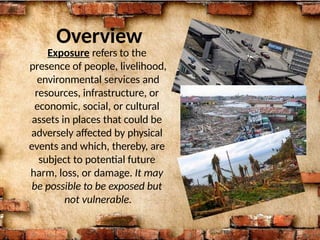
Exposure refers to the
presence of people, livelihood,
environmental services and
resources, infrastructure, or
economic, social, or cultural
assets in places that could be
adversely affected by physical
events and which, thereby, are
subject to potential future
harm, loss, or damage. It may
be possible to be exposed but
not vulnerable.
Various Elements Exposed to Hazards
1. Physical
hazard – is defined
as “a factor
within the
environment that
can harm the body
without necessarily
touching it.” For the
examples, vibration
and noise.
Various Elements Exposed to Hazards
1. Cultural
hazard – also
known as social
hazards, result from
your location,
socioeconomic
status, occupation
and behavioral
choices.
Various Elements Exposed to Hazards
1. Economic hazard
– refers to major
natural disasters which
can and do have severe
negative short-run
economic
impacts.
Various Elements Exposed to Hazards
1.
Environmental
hazard – refers to
state of events which
has the potential to
threaten the
surrounding natural
environment and
adversely affect
people’s health.
Defining Vulnerability
• Vulnerability is the state of susceptibility to
harm from exposure to stresses associated
with environmental and social change and
from the absence of capacity to adapt.
Vulnerable Sectors Include
1. Agriculture and
Food
The agriculture sector in
the Philippines is highly
dependent on a constant
water supply and
unpredictable growing
seasons. Climate-related
changes disrupt farming
activities and hamper
agricultural production
resulting physical factors.
Vulnerable Sectors Include
2. Watersheds: Forestry,
Biodiversity, and Water
resources
Major river basins in the
Philippines are considered
the lifeblood of the
Philippine economy.
However, because of the
pollution, unstable resource
use and the additional
pressure brought on by
climate change, these areas
have become less viable.
Vulnerable Sectors Include
3. Coastal and Marine
Resources
Even without climate
change, many parts of
the Philippines coasts
were already getting
damaged and
deteriorating due to
natural causes or human-
induced activities.
Vulnerable Sectors Include
4. Human Health
Infectious diseases that
are climate-sensitive
become vulnerabilities of
a population that is
threatened by the
increasing frequency of
extreme climate events.
Other diseases have re-
emerged or have
become harder to treat.
Human Factors
1. Wealth
The poor are less able to afford housing and other
infrastructure that can withstand extreme events,
and less likely to have access to medical care.
Human Factors
2. Education
With education, we can learn how to avoid or reduce
many impacts. When populations include professionals
trained in hazards, then these people can help the
populations with their hazards preparations and
responses.
Human Factors
3. Governance
They can advance policies that reduce vulnerability. They can
support education and awareness efforts, as well as economic
development to reduce poverty. They can foster social
networks and empower individuals and communities to help
themselves to prepare for and respond to hazards.
Human Factors
4. Technology
It can improve our ability to forecast extreme events,
withstand the impacts of events, and recover afterwards.
Wealthier, more educated societies are more likely to have
more advance technology.
Human Factors
4. Age
Children and the elderly tend to be more
vulnerable. They have less physical strength to
survive disasters and are often more susceptible to
certain diseases.
Human Factors
4. Gender
Women are often more vulnerable to natural hazards than
men. This is in part because women are likely to be poor,
less educated, and politically marginalised, often due to
sexism in societies around the world.
RISK
Earthquak
e Tsunami
Floods
Cyclones
Bushfires
Landslides
Volcanoes
Engineering
Economic
Social
Exposure
People
Buildings
Business
Infrastructur
e
Risk = Hazard x Exposure
x Vulnerability
Capa
city
Triagram of Disaster Risk
Performance Task #3
“The Role of Urbanization in
Amplifying Vulnerability
and Exposure to Natural
Disaster”
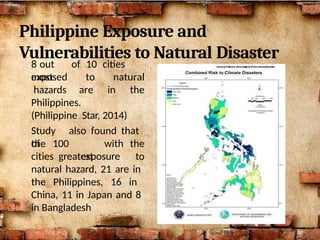
Philippine Exposure and
Vulnerabilities to Natural Disaster
• 8 out of 10 cities
most
exposed
hazards
to natural
are in the
Philippines.
(Philippine Star, 2014)
• Study also found that
of
the 100
cities greatest
exposure
with the
to
natural hazard, 21 are in
the Philippines, 16 in
China, 11 in Japan and 8
in Bangladesh
10 World Cities Most at Risk
1. Port Villa in Vanuatu
2. Tuguegarao in Cagayan
3. Lucena in Quezon
4. Manila
5. San Fernando Pampanga
6. Cabanatuan in Nueva Ecija
7. Batangas
8. Taipei
9. San Carlos , Pangasinan
10. Naga in Camarines sur
Philippine Vulnerability to
Natural Disaster
• The Philippines lies in the Pacific typhoon belt and we
are visited by an average of 20 typhoons every year.
• The rugged nature of our landscape makes our
communities very vulnerable to landslides, mudflows
and other disasters.
• The Philippines is an archipelagic country with many
small island.
• Many of our areas are also at below sea level
• With one of the longest in the world at 32,400 km, we
have many areas that are vulnerable to storm surges.
• The Philippines is still a primary agricultural and fishing
economy.
• Natural hazard risk is compounded in the Philippines by
poor institutional and social capacity to mange, respond
and recover from natural hazard events.
• The Philippines is considered “high risk” in terms of the
country’s ability to manage and mitigate the impacts of
natural hazard and in part due to ‘entrenched corruption
and high levels of poverty’.
• Aside from being at risk to typhoons, the Philippines is
also at risk to volcanic, quakes and floods.
Philippine Vulnerability to
Natural Disaster

exposure and vulnerability.pptx........................

  • 1.
    Exposure and Vulnerability DISASTERREADINESS AND RISK REDUCTION
  • 2.
  • 3.
    Overview Exposure refers tothe presence of people, livelihood, environmental services and resources, infrastructure, or economic, social, or cultural assets in places that could be adversely affected by physical events and which, thereby, are subject to potential future harm, loss, or damage. It may be possible to be exposed but not vulnerable.
  • 4.
    Various Elements Exposedto Hazards 1. Physical hazard – is defined as “a factor within the environment that can harm the body without necessarily touching it.” For the examples, vibration and noise.
  • 5.
    Various Elements Exposedto Hazards 1. Cultural hazard – also known as social hazards, result from your location, socioeconomic status, occupation and behavioral choices.
  • 6.
    Various Elements Exposedto Hazards 1. Economic hazard – refers to major natural disasters which can and do have severe negative short-run economic impacts.
  • 7.
    Various Elements Exposedto Hazards 1. Environmental hazard – refers to state of events which has the potential to threaten the surrounding natural environment and adversely affect people’s health.
  • 8.
    Defining Vulnerability • Vulnerabilityis the state of susceptibility to harm from exposure to stresses associated with environmental and social change and from the absence of capacity to adapt.
  • 9.
    Vulnerable Sectors Include 1.Agriculture and Food The agriculture sector in the Philippines is highly dependent on a constant water supply and unpredictable growing seasons. Climate-related changes disrupt farming activities and hamper agricultural production resulting physical factors.
  • 10.
    Vulnerable Sectors Include 2.Watersheds: Forestry, Biodiversity, and Water resources Major river basins in the Philippines are considered the lifeblood of the Philippine economy. However, because of the pollution, unstable resource use and the additional pressure brought on by climate change, these areas have become less viable.
  • 11.
    Vulnerable Sectors Include 3.Coastal and Marine Resources Even without climate change, many parts of the Philippines coasts were already getting damaged and deteriorating due to natural causes or human- induced activities.
  • 12.
    Vulnerable Sectors Include 4.Human Health Infectious diseases that are climate-sensitive become vulnerabilities of a population that is threatened by the increasing frequency of extreme climate events. Other diseases have re- emerged or have become harder to treat.
  • 13.
    Human Factors 1. Wealth Thepoor are less able to afford housing and other infrastructure that can withstand extreme events, and less likely to have access to medical care.
  • 14.
    Human Factors 2. Education Witheducation, we can learn how to avoid or reduce many impacts. When populations include professionals trained in hazards, then these people can help the populations with their hazards preparations and responses.
  • 15.
    Human Factors 3. Governance Theycan advance policies that reduce vulnerability. They can support education and awareness efforts, as well as economic development to reduce poverty. They can foster social networks and empower individuals and communities to help themselves to prepare for and respond to hazards.
  • 16.
    Human Factors 4. Technology Itcan improve our ability to forecast extreme events, withstand the impacts of events, and recover afterwards. Wealthier, more educated societies are more likely to have more advance technology.
  • 17.
    Human Factors 4. Age Childrenand the elderly tend to be more vulnerable. They have less physical strength to survive disasters and are often more susceptible to certain diseases.
  • 18.
    Human Factors 4. Gender Womenare often more vulnerable to natural hazards than men. This is in part because women are likely to be poor, less educated, and politically marginalised, often due to sexism in societies around the world.
  • 19.
  • 20.
    Performance Task #3 “TheRole of Urbanization in Amplifying Vulnerability and Exposure to Natural Disaster”
  • 21.
    Philippine Exposure and Vulnerabilitiesto Natural Disaster • 8 out of 10 cities most exposed hazards to natural are in the Philippines. (Philippine Star, 2014) • Study also found that of the 100 cities greatest exposure with the to natural hazard, 21 are in the Philippines, 16 in China, 11 in Japan and 8 in Bangladesh
  • 22.
    10 World CitiesMost at Risk 1. Port Villa in Vanuatu 2. Tuguegarao in Cagayan 3. Lucena in Quezon 4. Manila 5. San Fernando Pampanga 6. Cabanatuan in Nueva Ecija 7. Batangas 8. Taipei 9. San Carlos , Pangasinan 10. Naga in Camarines sur
  • 23.
    Philippine Vulnerability to NaturalDisaster • The Philippines lies in the Pacific typhoon belt and we are visited by an average of 20 typhoons every year. • The rugged nature of our landscape makes our communities very vulnerable to landslides, mudflows and other disasters. • The Philippines is an archipelagic country with many small island. • Many of our areas are also at below sea level • With one of the longest in the world at 32,400 km, we have many areas that are vulnerable to storm surges. • The Philippines is still a primary agricultural and fishing economy.
  • 24.
    • Natural hazardrisk is compounded in the Philippines by poor institutional and social capacity to mange, respond and recover from natural hazard events. • The Philippines is considered “high risk” in terms of the country’s ability to manage and mitigate the impacts of natural hazard and in part due to ‘entrenched corruption and high levels of poverty’. • Aside from being at risk to typhoons, the Philippines is also at risk to volcanic, quakes and floods. Philippine Vulnerability to Natural Disaster