Dear Lord, we thank You for another day to learn.
We appreciate your kindness.
Thank you for opening my eyes today.
We are hoping that as we open our eyes, good things might
happen.
Lord, forgive us in our sins.
And as we will be enlightened with the new discussion,
We ask Your Holy Spirit to be with our side today.
In the name of the Lord Jesus Christ, Amen.
Disaster Readiness and Risk Reduction: Module 3
Reported By: Mr. Delfin, Mr. Haberle, Mr. Hablo, and Miss Apines
Hazards may cause disaster.
They either increase or decrease the risk of
disasters in a certain community.
Hazards are events that post threat, danger, or
risk to any element exposed of them.
They can strike anywhere and anytime.
Hazards result in disasters if a community is left
both exposed and vulnerable to that hazard.
It should be remembered that extreme hazards
events are not always associated with disaster.
It is actually the circumstance of that
community that causes a hazard to bring in
disaster.
Natural Hazards are those that are caused by
physical and biological elements in the
environment. These are natural events that
may not be controlled by humans such as
earthquakes, floods, landslides, tornadoes,
tsunamis, typhoons, and wildfires.
Natural Hazards are inevitable.
They are the part of the natural process of
Earth operating throughout Earth’s history.
Geologic process such as earthquakes, as an
example of natural hazard, had been continuously
shaping and sculpting Earth’s surface.
They are natural events that are considered
natural hazards because of the risk of destroying
the surroundings and jeopardizing people’s lives.
Other examples of natural hazards include
volcanic eruptions, flashfloods, storm surges, and
asteroid impacts.
Man-made hazards, also called technological
hazards, are those caused by factors that are
generally traced to human errors, intent or
negligence, or glitches in technology.
These include bomb explosions, chemical
spills, nuclear plant blast, radioactive
emissions, and wars.
If you have noticed, these operations are all
products of the advancing technology and
lifestyle of humans.
The continuous development of technology
poses more hazards not just to creators
themselves, but also to their environment.
What is the difference between the two types of
hazards?
Most hazards have caused disasters in human
history.
Typhoons are considered one of the most
powerful of the natural hazards because they
travel across a wide area last for a longer time,
and thus create more destruction.
Tornadoes and earthquakes likewise cause great
loss and damage but they generally happen in a
certain place and only last for a short time.
 Typhoon Yolanda | November 6, 2013 | Philippines | Natural Hazard
Map showing Range of Typhoon Yolanda in the Philippines
 Sulfur-laden Fire | June 24, 2003 | Al-Mishraq | Man-made Hazard
The sulfur-laden fire that raged at Al-Mishraq
What would happen if both natural and
anthropogenic hazards occur at the same time?
Not all typhoons and fires bring about such
disastrous impact.
Accurate warnings about the strength of a
typhoon or immediate action on putting out a
fire can greatly diminish the grave potential
effects of these events.
So how and when does an event turn into
disaster?
Profiling hazards is important in predicting the
possible disasters that a certain hazard can bring.
They are useful in planning for a disaster especially if
the same impacts are likely to brought by a hazard
that frequents a certain place.
Hazards can be profiled in different ways; magnitude
of event (high-scale or low-scale), frequency (number
of times in a year), duration (short-term or long-term),
and causality effects (direct or indirect).
The magnitude of the hazard can be assessed by the
measurements obtained from scientific instruments.
Sometimes, scaling can vary depending on the reference
tables used per country.
For example, magnitude 5.0 above is considered high scale
in earthquakes based on the Philippine Institute of
Volcanology and Seismology (PHIVOLCS).
Floods reaching 1.0 meter is likewise considered high-scale.
Typhoons with winds up to 150 kph are deemed strong and
powerful.
The frequency of the hazard to occur in an area is
important because it tells its proneness to that
hazard.
This is usually, but not always, associated with the
area’s geographical location. On Earth or its
topographical condition.
For example, a coastal community may be frequented
by storm surges if it belongs to the typhoon belt.
coastal community may be frequented by
flooding, and not storm surges, if its topography
or level of ground is lower than the sea level.
Usually, government agencies record
frequencies of natural hazard occurrences to
see any patterns to serve as tools in preparing
for a disaster.
The impact of hazards varies in duration.
The assessment of the duration is either short
or long.
In earthquakes for example, the length of
shaking, trembling, and even the after-shocks
are recorded.
If this event happened in a span of more than a
minute, the earthquake is deemed to be long.
Another example is the volcanic eruption that
can last for days.
The assessment of this duration can have
implications on how extensive preparatory
activities should be and even the post disaster
plans.
The impact of hazards can also be assessed based
on the causality of events, that is, whether the
exposed element receives the likely disaster directly
or indirectly.
Sometimes, other elements that are not visibly
present in the site of event also suffer some degree of
consequences because all communities interact
within and outside their territory.
Communities and nature are dynamic such that
interrelationship and mobility make possible a
chain reaction of varying effects.
Because the impacts of hazards vary from
place to place and season to season, it is
important to assess the impact of every hazard
so that similar events in the future may be
prevented.
A hazard-prone area is a location where a
natural hazard is likely to happen if preventive
measures are not implemented.
Due mainly to its geography, the Philippines is
considered prone to natural hazards, and
hence natural disasters as well.
It is situated along the Pacific Ring of Fire, an
area surrounding the basin of the Pacific Ocean
where many volcanoes have formed. Thus,
seismic activities such as earthquakes and
volcanic eruptions frequently occur in the
region.
Around 90 percent of the world’s earthquakes
occur in this region.
Map showing Pacific Ring of Fire
Another reason the Philippines is considered prone to
disasters is its major tectonic feature, the Philippine
Fault Zone (PFZ).
A fault is a crack or break Earth’s crust along which
rocks have moved.
A rapid or sudden movement of rocks releases a
large amount of seismic waves, which cause the
ground to move or to shake.
This sudden shaking of the ground is called an
earthquake.
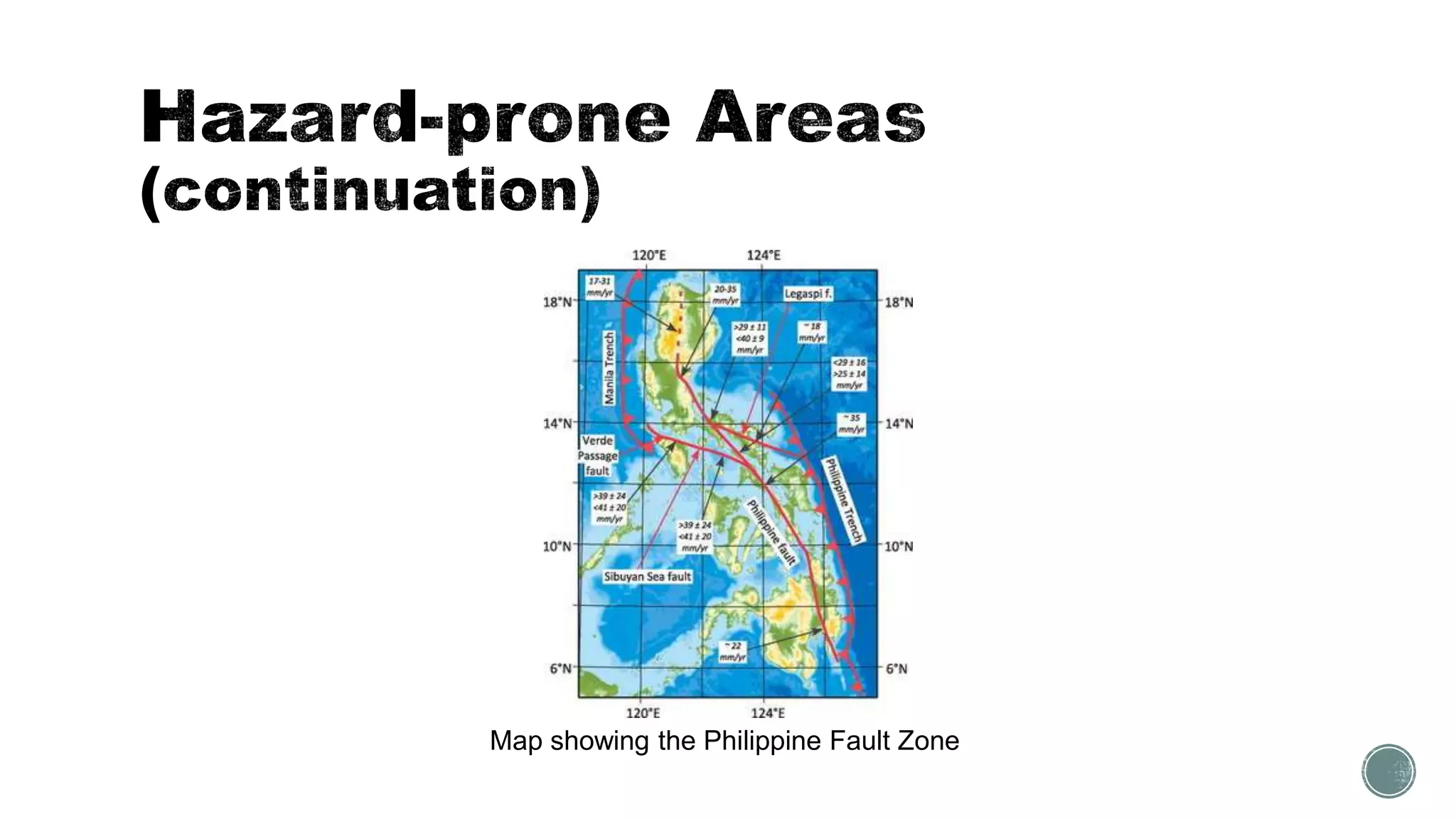
The PFZ is a series of interrelated faults that
cut across the country from northwestern Luzon
to southern Mindanao.
Some of the disastrous earthquakes in the
Philippines are located in the PFZ.
Map showing the Philippine Fault Zone
Another reason the Philippines is considered as
hazard-prone area is its location in the Western
Pacific Basin, the part of the world that is most
often visited by typhoons.
The region is also called the typhoon belt.
This explains why an average of 20 typhoons
hit the country every year.
What makes the Philippine prone to natural
hazards?
Visit NeoK12, an online site that provides
games, quizzes , and interactive activities that
supplement the broad discussion of natural
hazards.
You can click on any natural hazard and learn
how it happens.
Check out their Web site at:
http://www.neok12.com/Natural-Disasters.htm
The impacts of hazards are the likely outcome
of disaster.
The exposed elements will initially receive all
the negative impacts.
In some cases, however, not all the impacts of
hazards are adverse.
Some natural hazards result in changes that
may be beneficial or supportive of the other
existing elements:
1. Physical Elements
2. Socioeconomic Elements
3. Environmental Elements
People, buildings, roads, poles, bridges and all
other material objects may be ruined by
hazards.
Volcanic eruptions, explosions, fire, or lightning
may instantly burn or incinerate objects that it
comes in contact with.
Cracks, fissures, or total damage may happen if
tremors, explosions, and landslides take place.
All these, again, are responsibilities still
depending on many factors that increase the
disaster risk of a community.
The positive impacts of hazards on the
socioeconomic elements may be in the form of
introducing new habits, practices, systems, or
values that may be geared toward the values of
resiliency and recovery.
The impacts will induce adaptation on the part
of the affected community.
They will tend to create new operations or ways
of living that can withstand the next possible
occurrence of the same hazard.
Hazards can also bring negative impacts to
these types of elements.
In the economic point of view, areas most
frequented by hazards usually would have lower
standards of living or poor living conditions.
One reason is their inability to join in market
competitions given limited or constrained
resources.
They may not be considered in the network of
trade because of their proneness to a hazard.
Just like other exposed elements, perhaps the
initial impact of hazard to the ecosystems and
other organisms in them may be disastrous.
However, in some cases, again due to
adaptation, or because natural hazards are
natural events and hence part of the natural
cycles on Earth, the occurrence may benefit
certain components of Earth.
For instance, the ashes spewed out during the
eruption of Mt. Pinatubo revealed to have made
some soils in Zamabales fertile.
Using the exposed elements listed previously, assess
the impact of Typhoon Sendong (international name:
Washi) in Northern Mindanao as narrated in this news
article entitled, “Hundreds Due as Tropical Storm
Washi Sweeps across Philippines”:
http://www.telegraph/co.uk/news/worldnews/asia/Phili
ppines/8963157/Hundreds-die-as-tropical-storm-
Washi-sweeps-across-Philippines.html (accessed on
17 March 2015).
The Natural Disaster Risk Reduction and Management
Council (NDRRMC) was established in the Philippines to
closely monitor hazard events, to provide advisories
regarding the status of implementing hazards, and to
coordinate and facilitate effective humanitarian assistance to
disaster victims.
Check out the latest advisories on natural hazards in
Philippines at
http://www.ndrrmc.gov.ph (accessed on 12 May 2015)
Hazards are a part of life and they are usually
the source of disasters for humans and nature.
They are, by definition, harmful or may cause
adverse effects to all exposed elements.
Natural hazards are inevitable, in that they are
part of nature and by that sense, no one can
really control it technically.
But a part from natural hazards, some man-
made structures and activities (technological
hazards) can also be a source of disaster.
So, it is important to profile hazards based on
their magnitude, frequency, duration, and
causality so that their likely impacts may be
reduced or prevented.
Name all the acronyms: 5 points each! = 20 points!
1. NDRRMC
2. PHIVOLCS
3. PFZ
4. PAR
Identification: 2 points each! = 10 points!
1. Are events that pose threat, danger, or risk to any element
exposed to them.
2. A type of hazard that caused by physical and biological
elements in the environment.
3. A type of hazard that is also called technological hazards.
4. A (blank) is a crack or break in Earth’s crust along which
rocks have moved.
5. It is the outcome of disaster.
Enumeration: 2 points each + 1 point! = 15 points!
1. Some natural hazards result in changes that may be
beneficial or supportive of the other existing elements:
a.
b.
c.
2. Different ways of hazards can be profiled
a.
b.
c.
d.
Essay: 10 points each questions! = 30 points!
1. Why natural hazards are inevitable?
2. When does hazards happen?
3. Why is that, Philippine is an area prone to hazard? You can
choose the reasons why among the three possible answers
stated below and elaborate your answer.
o Because of Pacific Ring of Fire…
o Due to the Philippine Fault Zone …
o Because of the Western Pacific Basin…
Name all the acronyms: 5 points each! = 20 points!
1. NDRRMC - National Disaster Risk Reduction and
Management Council
2. PHIVOLCS - Philippine Institute of Volcanology
and Seismology
3. PFZ - Philippine Fault Zone
4. PAR - Philippine Area of Responsibility
Identification: 2 points each! = 10 points!
1. Hazards
2. Natural hazards
3. Man-made hazards
4. fault
5. Impact of hazards
Enumeration: 2 points each + 1 point! = 15 points!
1. Some natural hazards result in changes that may be
beneficial or supportive of the other existing elements:
a. Physical elements
b. Socioeconomic elements
c. Environmental elements
2. Different ways of hazards can be profiled
a. Magnitude or Strength of the Event
b. Frequency
c. Duration Impact
d. Causality of Events
Essay: 10 points each questions! = 30 points!
1. Why natural hazards are inevitable? (slides #5 and #6)
2. When does hazards happen? (own)
3. Why is that, Philippine is an area prone to hazard? You can
choose the reasons why among the three possible answers
stated below and elaborate your answer. (slides #23 - #29)
o Because of Pacific Ring of Fire…
o Due to the Philippine Fault Zone …
o Because of the Western Pacific Basin…
 Source of Information: Disaster Readiness and Risk Reduction Book
 Source of the Photo, slide #7: https://www.rappler.com/nation/special-
coverage/weather-alert/43183-20131108-yolanda-am-update
 Source of the Photo, slide #8: https://www.timetoast.com/timelines/atmosphere-
timeline
 Source of the Photo, slide #17: https://www.thoughtco.com/ring-of-fire-1433460
 Source of the Photo, slide #19: https://tectonicsofasia.weebly.com/philippine-sea-
plate.html

basic concept of hazard

  • 1.
    Dear Lord, wethank You for another day to learn. We appreciate your kindness. Thank you for opening my eyes today. We are hoping that as we open our eyes, good things might happen. Lord, forgive us in our sins. And as we will be enlightened with the new discussion, We ask Your Holy Spirit to be with our side today. In the name of the Lord Jesus Christ, Amen.
  • 2.
    Disaster Readiness andRisk Reduction: Module 3 Reported By: Mr. Delfin, Mr. Haberle, Mr. Hablo, and Miss Apines
  • 3.
    Hazards may causedisaster. They either increase or decrease the risk of disasters in a certain community. Hazards are events that post threat, danger, or risk to any element exposed of them. They can strike anywhere and anytime.
  • 4.
    Hazards result indisasters if a community is left both exposed and vulnerable to that hazard. It should be remembered that extreme hazards events are not always associated with disaster. It is actually the circumstance of that community that causes a hazard to bring in disaster.
  • 5.
    Natural Hazards arethose that are caused by physical and biological elements in the environment. These are natural events that may not be controlled by humans such as earthquakes, floods, landslides, tornadoes, tsunamis, typhoons, and wildfires. Natural Hazards are inevitable. They are the part of the natural process of Earth operating throughout Earth’s history.
  • 6.
    Geologic process suchas earthquakes, as an example of natural hazard, had been continuously shaping and sculpting Earth’s surface. They are natural events that are considered natural hazards because of the risk of destroying the surroundings and jeopardizing people’s lives. Other examples of natural hazards include volcanic eruptions, flashfloods, storm surges, and asteroid impacts.
  • 7.
    Man-made hazards, alsocalled technological hazards, are those caused by factors that are generally traced to human errors, intent or negligence, or glitches in technology. These include bomb explosions, chemical spills, nuclear plant blast, radioactive emissions, and wars.
  • 8.
    If you havenoticed, these operations are all products of the advancing technology and lifestyle of humans. The continuous development of technology poses more hazards not just to creators themselves, but also to their environment.
  • 9.
    What is thedifference between the two types of hazards?
  • 10.
    Most hazards havecaused disasters in human history. Typhoons are considered one of the most powerful of the natural hazards because they travel across a wide area last for a longer time, and thus create more destruction. Tornadoes and earthquakes likewise cause great loss and damage but they generally happen in a certain place and only last for a short time.
  • 11.
     Typhoon Yolanda| November 6, 2013 | Philippines | Natural Hazard Map showing Range of Typhoon Yolanda in the Philippines
  • 12.
     Sulfur-laden Fire| June 24, 2003 | Al-Mishraq | Man-made Hazard The sulfur-laden fire that raged at Al-Mishraq
  • 13.
    What would happenif both natural and anthropogenic hazards occur at the same time?
  • 14.
    Not all typhoonsand fires bring about such disastrous impact. Accurate warnings about the strength of a typhoon or immediate action on putting out a fire can greatly diminish the grave potential effects of these events. So how and when does an event turn into disaster?
  • 15.
    Profiling hazards isimportant in predicting the possible disasters that a certain hazard can bring. They are useful in planning for a disaster especially if the same impacts are likely to brought by a hazard that frequents a certain place. Hazards can be profiled in different ways; magnitude of event (high-scale or low-scale), frequency (number of times in a year), duration (short-term or long-term), and causality effects (direct or indirect).
  • 16.
    The magnitude ofthe hazard can be assessed by the measurements obtained from scientific instruments. Sometimes, scaling can vary depending on the reference tables used per country. For example, magnitude 5.0 above is considered high scale in earthquakes based on the Philippine Institute of Volcanology and Seismology (PHIVOLCS). Floods reaching 1.0 meter is likewise considered high-scale. Typhoons with winds up to 150 kph are deemed strong and powerful.
  • 17.
    The frequency ofthe hazard to occur in an area is important because it tells its proneness to that hazard. This is usually, but not always, associated with the area’s geographical location. On Earth or its topographical condition. For example, a coastal community may be frequented by storm surges if it belongs to the typhoon belt.
  • 18.
    coastal community maybe frequented by flooding, and not storm surges, if its topography or level of ground is lower than the sea level. Usually, government agencies record frequencies of natural hazard occurrences to see any patterns to serve as tools in preparing for a disaster.
  • 19.
    The impact ofhazards varies in duration. The assessment of the duration is either short or long. In earthquakes for example, the length of shaking, trembling, and even the after-shocks are recorded.
  • 20.
    If this eventhappened in a span of more than a minute, the earthquake is deemed to be long. Another example is the volcanic eruption that can last for days. The assessment of this duration can have implications on how extensive preparatory activities should be and even the post disaster plans.
  • 21.
    The impact ofhazards can also be assessed based on the causality of events, that is, whether the exposed element receives the likely disaster directly or indirectly. Sometimes, other elements that are not visibly present in the site of event also suffer some degree of consequences because all communities interact within and outside their territory.
  • 22.
    Communities and natureare dynamic such that interrelationship and mobility make possible a chain reaction of varying effects. Because the impacts of hazards vary from place to place and season to season, it is important to assess the impact of every hazard so that similar events in the future may be prevented.
  • 23.
    A hazard-prone areais a location where a natural hazard is likely to happen if preventive measures are not implemented. Due mainly to its geography, the Philippines is considered prone to natural hazards, and hence natural disasters as well.
  • 24.
    It is situatedalong the Pacific Ring of Fire, an area surrounding the basin of the Pacific Ocean where many volcanoes have formed. Thus, seismic activities such as earthquakes and volcanic eruptions frequently occur in the region. Around 90 percent of the world’s earthquakes occur in this region.
  • 25.
    Map showing PacificRing of Fire
  • 26.
    Another reason thePhilippines is considered prone to disasters is its major tectonic feature, the Philippine Fault Zone (PFZ). A fault is a crack or break Earth’s crust along which rocks have moved. A rapid or sudden movement of rocks releases a large amount of seismic waves, which cause the ground to move or to shake.
  • 27.
    This sudden shakingof the ground is called an earthquake. The PFZ is a series of interrelated faults that cut across the country from northwestern Luzon to southern Mindanao. Some of the disastrous earthquakes in the Philippines are located in the PFZ.
  • 28.
    Map showing thePhilippine Fault Zone
  • 29.
    Another reason thePhilippines is considered as hazard-prone area is its location in the Western Pacific Basin, the part of the world that is most often visited by typhoons. The region is also called the typhoon belt. This explains why an average of 20 typhoons hit the country every year.
  • 30.
    What makes thePhilippine prone to natural hazards?
  • 31.
    Visit NeoK12, anonline site that provides games, quizzes , and interactive activities that supplement the broad discussion of natural hazards. You can click on any natural hazard and learn how it happens. Check out their Web site at: http://www.neok12.com/Natural-Disasters.htm
  • 32.
    The impacts ofhazards are the likely outcome of disaster. The exposed elements will initially receive all the negative impacts. In some cases, however, not all the impacts of hazards are adverse.
  • 33.
    Some natural hazardsresult in changes that may be beneficial or supportive of the other existing elements: 1. Physical Elements 2. Socioeconomic Elements 3. Environmental Elements
  • 34.
    People, buildings, roads,poles, bridges and all other material objects may be ruined by hazards. Volcanic eruptions, explosions, fire, or lightning may instantly burn or incinerate objects that it comes in contact with.
  • 35.
    Cracks, fissures, ortotal damage may happen if tremors, explosions, and landslides take place. All these, again, are responsibilities still depending on many factors that increase the disaster risk of a community.
  • 36.
    The positive impactsof hazards on the socioeconomic elements may be in the form of introducing new habits, practices, systems, or values that may be geared toward the values of resiliency and recovery. The impacts will induce adaptation on the part of the affected community.
  • 37.
    They will tendto create new operations or ways of living that can withstand the next possible occurrence of the same hazard. Hazards can also bring negative impacts to these types of elements. In the economic point of view, areas most frequented by hazards usually would have lower standards of living or poor living conditions.
  • 38.
    One reason istheir inability to join in market competitions given limited or constrained resources. They may not be considered in the network of trade because of their proneness to a hazard.
  • 39.
    Just like otherexposed elements, perhaps the initial impact of hazard to the ecosystems and other organisms in them may be disastrous. However, in some cases, again due to adaptation, or because natural hazards are natural events and hence part of the natural cycles on Earth, the occurrence may benefit certain components of Earth.
  • 40.
    For instance, theashes spewed out during the eruption of Mt. Pinatubo revealed to have made some soils in Zamabales fertile.
  • 41.
    Using the exposedelements listed previously, assess the impact of Typhoon Sendong (international name: Washi) in Northern Mindanao as narrated in this news article entitled, “Hundreds Due as Tropical Storm Washi Sweeps across Philippines”: http://www.telegraph/co.uk/news/worldnews/asia/Phili ppines/8963157/Hundreds-die-as-tropical-storm- Washi-sweeps-across-Philippines.html (accessed on 17 March 2015).
  • 42.
    The Natural DisasterRisk Reduction and Management Council (NDRRMC) was established in the Philippines to closely monitor hazard events, to provide advisories regarding the status of implementing hazards, and to coordinate and facilitate effective humanitarian assistance to disaster victims. Check out the latest advisories on natural hazards in Philippines at http://www.ndrrmc.gov.ph (accessed on 12 May 2015)
  • 43.
    Hazards are apart of life and they are usually the source of disasters for humans and nature. They are, by definition, harmful or may cause adverse effects to all exposed elements. Natural hazards are inevitable, in that they are part of nature and by that sense, no one can really control it technically.
  • 44.
    But a partfrom natural hazards, some man- made structures and activities (technological hazards) can also be a source of disaster. So, it is important to profile hazards based on their magnitude, frequency, duration, and causality so that their likely impacts may be reduced or prevented.
  • 45.
    Name all theacronyms: 5 points each! = 20 points! 1. NDRRMC 2. PHIVOLCS 3. PFZ 4. PAR
  • 46.
    Identification: 2 pointseach! = 10 points! 1. Are events that pose threat, danger, or risk to any element exposed to them. 2. A type of hazard that caused by physical and biological elements in the environment. 3. A type of hazard that is also called technological hazards. 4. A (blank) is a crack or break in Earth’s crust along which rocks have moved. 5. It is the outcome of disaster.
  • 47.
    Enumeration: 2 pointseach + 1 point! = 15 points! 1. Some natural hazards result in changes that may be beneficial or supportive of the other existing elements: a. b. c. 2. Different ways of hazards can be profiled a. b. c. d.
  • 48.
    Essay: 10 pointseach questions! = 30 points! 1. Why natural hazards are inevitable? 2. When does hazards happen? 3. Why is that, Philippine is an area prone to hazard? You can choose the reasons why among the three possible answers stated below and elaborate your answer. o Because of Pacific Ring of Fire… o Due to the Philippine Fault Zone … o Because of the Western Pacific Basin…
  • 49.
    Name all theacronyms: 5 points each! = 20 points! 1. NDRRMC - National Disaster Risk Reduction and Management Council 2. PHIVOLCS - Philippine Institute of Volcanology and Seismology 3. PFZ - Philippine Fault Zone 4. PAR - Philippine Area of Responsibility
  • 50.
    Identification: 2 pointseach! = 10 points! 1. Hazards 2. Natural hazards 3. Man-made hazards 4. fault 5. Impact of hazards
  • 51.
    Enumeration: 2 pointseach + 1 point! = 15 points! 1. Some natural hazards result in changes that may be beneficial or supportive of the other existing elements: a. Physical elements b. Socioeconomic elements c. Environmental elements 2. Different ways of hazards can be profiled a. Magnitude or Strength of the Event b. Frequency c. Duration Impact d. Causality of Events
  • 52.
    Essay: 10 pointseach questions! = 30 points! 1. Why natural hazards are inevitable? (slides #5 and #6) 2. When does hazards happen? (own) 3. Why is that, Philippine is an area prone to hazard? You can choose the reasons why among the three possible answers stated below and elaborate your answer. (slides #23 - #29) o Because of Pacific Ring of Fire… o Due to the Philippine Fault Zone … o Because of the Western Pacific Basin…
  • 53.
     Source ofInformation: Disaster Readiness and Risk Reduction Book  Source of the Photo, slide #7: https://www.rappler.com/nation/special- coverage/weather-alert/43183-20131108-yolanda-am-update  Source of the Photo, slide #8: https://www.timetoast.com/timelines/atmosphere- timeline  Source of the Photo, slide #17: https://www.thoughtco.com/ring-of-fire-1433460  Source of the Photo, slide #19: https://tectonicsofasia.weebly.com/philippine-sea- plate.html