Chapter 2
Group 1
BEED1A
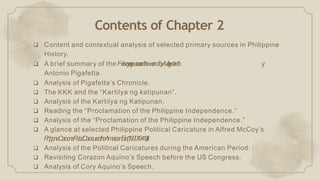
Contents of Chapter 2
 Content and contextual analysis of selected primary sources in Philippine
History.
 A brief summary of theFr
s
tv
o
y
a
g
ea
r
o
u
n
dt
h
ew
o
rdb
yM
a
g
el
a
nb
l
l
i y
Antonio Pigafetta.
 Analysis of Pigafetta’s Chronicle.
 The KKK and the “Kartilya ng katipunan”.
 Analysis of the Kartilya ng Katipunan.
 Reading the “Proclamation of the Philippine Independence.”
 Analysis of the “Proclamation of the Philippine Independence.”
 A glance at selected Philippine Political Caricature in Alfred McCoy’s
P
h
l
p
p
n
e
C
a
r
o
o
n
s
:
P
o
i
i
c
a
l
C
a
r
c
a
u
r
e
o
f
t
h
e
A
m
e
r
c
a
n
E
r
a
(
1
9
0
0
1
9
4
1
.
)
-
i
t
i
t
l
t
i
i
i
 Analysis of the Political Caricatures during the American Period.
 Revisiting Corazon Aquino’s Speech before the US Congress.
 Analysis of Cory Aquino’s Speech.
Content and contextual
analysis of selected
primary sources in
Philippine History.
Primary Sources
Primary Sources
in the
Philippines
Letters
Diaries
Newspapers
Photographs
Objectives
Using primary sources in historical
research entails two kinds of criticism.
Antonio Pigafetta’s First voyage
around the world.
Emilio
Jacinto’s
“Kartilya ng
Katipunan”
The 1898 declaration of Philippine
Independence
Political Cartoon’s
Alfred McCoy’s
Philippine Cartoons:
Political Caricature of
the American Era
(1900-1941)
Corazon Aquino’s
speech before the U.S.
Congress
“First Voyage around the
world by Magellan” by
Antonio Pigafetta

Chronicles of
Antonio Pigafetta
Analysis of Pigafetta’s
Chronicle
Pigafetta’s Work
Who is Antonio
Pigafetta?
Antonio Pigafetta
Pigafetta
Pigafetta’s Travelogue
Antonio Pigafetta
Reading of the KKK
and the “Kartilya ng
Katipunan”
The kataastaasan,
kagalanggalangang katipunan ng
mga anak ng bayan. (KKK) is
arguably the most important
organization formed in the
Philippine History.
Kartilya ng
Katipunan
The Kartilya
ng
Katipunan
ni Emilio
Jacinto
1.
6.
12.
Analysis of the
Kartilya ng Katipunan
Reading the
“Proclamation of the
Philippine
Independence.”
 JUNE 12, 1898 The Philippine
declaration of independence
was proclaimed in Cavite el
Viejo (present day Kawit Cavite)
 Filipino revolutionary forces
under General Emilio Aguinaldo
proclaimed the sovereignty and
independence of the Philippine
Islands from the colonial rule of
Spain.
HISTORY
 1896 The Philippine Revolution
began. Eventually, the Spanish
signed an agreement with the
revolutionaries.
 Emilio Aguinaldo went into exile in
Hongkong. At the outbreak of the
Spanish-American war.
 Commodore George Dewey- sailed
from Hong kong to Manila Bay
leading a squadron to U.S. Navy
ships.
 May 1, 1898 the united states
defeated the Spanish in the battle
of Manila Bay.
 The U.S. Navy transported
Aguinaldo back to the Philippines.
The Proclamation on June 12
Who sew the Philippine Flag?
The flag was sewn
by Dona Marcela Marino
de Agoncillo with the
help of her daughter
Lorenza and Mrs. Delfina
Herbosa de Natividad
(niece of the Philippine
National Hero - Dr. Jose
P. Rizal).
What does the Philippine Flag symbolize?
The Philippine
national flag has a
rectangular design that
consists of a white
equilateral triangle,
symbolizing liberty, equality
and fraternity; a horizontal
blue stripe for peace, truth,
and justice; and a horizontal
red stripe for patriotism and
valor.
Analysis of the
“Proclamation of the
Philippine
Independence.”
Every year on June 12th, we
commemorate the declaration
of Philippine independence
from Spain, which we call
"Araw ng Kalayaan" in Tagalog.
Aglance at Selected Philippine
Political Caricature in Alfred
McCoy’s Philippine Cartoons:
Political Caricature of the American
Era (1900-1941)
Caricature
Philippine Cartoons
Political Caricature of the American Era 1900-1941
Alfred "Al" William McCoy
Alfredo Roces
A Public Post is not a
Hereditary Crown
War Against The
Speculators
Death Cars
Flaming Youth
The Independent on 27
November 1915
Lipang Kalabaw
24 August 1907
Analysis of the
“Political Caricatures
during the American
Period.”
Revisiting Corazon
Aquino’s speech
before the U.S.
congress
Context and content analysis:
Speech of President Corazon
Aquino during the joint
session of the U.S. congress
September 18,1986
What was the country’s
situation during that time?
What was the country’s situation during that time?
The intent of the speech.
Perspective
The Relevant of the speech
Analysis of Cory Aquino’s
Speech
“Don’t regret from
the past, just learn
from it.”
-BEN IPOCK-

Chapter 2.pptx