READING THE PROCLAMATION
OF THE PHILIPPINE
INDEPENDENCE
JAYZEL ANNE AGUSTIN
&
WAREN CALARA
THEAUTHOROF
DECLARATIONOF
PHILIPPINE
INDEPENDENCE
AMBROSIO RIANZARES
BAUTISTA Y ALTAMIRA
Ambrosio Riazares Bautista also known as “Don
Bosyong” born December 7, 1830 in Biñan La
Laguna, Captaincy, General of the Philippine. A
Filipino lawyer and author of The Declaration of
Philippine Independence. Distant relative of the
“Rizal Family” He attended preparatory school in
Biñan and studied Law at the University of Santo
Tomas UST obtaining a degree in 1865 then he
practice law in Manila and offered free legal
services to the poor clients. He also one of the
officers of Liga Filipina.
PHILIPPINE
REVOLUTION
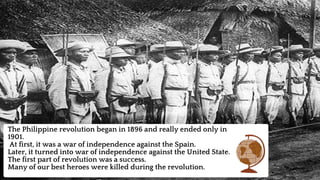
The Philippine revolution began in 1896 and really ended only in
1901.
At first, it was a war of independence against the Spain.
Later, it turned into war of independence against the United State.
The first part of revolution was a success.
Many of our best heroes were killed during the revolution.
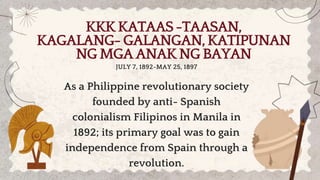
KKKKATAAS-TAASAN,
KAGALANG-GALANGAN,KATIPUNAN
NGMGAANAKNGBAYAN
As a Philippine revolutionary society
founded by anti- Spanish
colonialism Filipinos in Manila in
1892; its primary goal was to gain
independence from Spain through a
revolution.
JULY 7, 1892-MAY 25, 1897
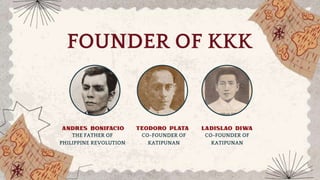
ANDRES BONIFACIO
THE FATHER OF
PHILIPPINE REVOLUTION
FOUNDER OF KKK
TEODORO PLATA LADISLAO DIWA
CO-FOUNDER OF
KATIPUNAN
CO-FOUNDER OF
KATIPUNAN
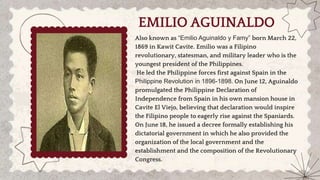
EMILIO AGUINALDO
EMILIO AGUINALDO
Also known as “Emilio Aguinaldo y Famy” born March 22,
1869 in Kawit Cavite. Emilio was a Filipino
revolutionary, statesman, and military leader who is the
youngest president of the Philippines.
He led the Philippine forces first against Spain in the
Philippine Revolution in 1896-1898. On June 12, Aguinaldo
promulgated the Philippine Declaration of
Independence from Spain in his own mansion house in
Cavite El Viejo, believing that declaration would inspire
the Filipino people to eagerly rise against the Spaniards.
On June 18, he issued a decree formally establishing his
dictatorial government in which he also provided the
organization of the local government and the
establishment and the composition of the Revolutionary
Congress.
GEN. EMILIO
AGUINALDO EXILED
IN HONGKONG
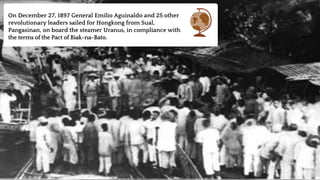
On December 27, 1897 General Emilio Aguinaldo and 25 other
revolutionary leaders sailed for Hongkong from Sual,
Pangasinan, on board the steamer Uranus, in compliance with
the terms of the Pact of Biak-na-Bato.
PHILIPPINE
AMERICAN WAR
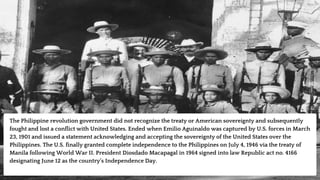
The Philippine revolution government did not recognize the treaty or American sovereignty and subsequently
fought and lost a conflict with United States. Ended when Emilio Aguinaldo was captured by U.S. forces in March
23, 1901 and issued a statement acknowledging and accepting the sovereignty of the United States over the
Philippines. The U.S. finally granted complete independence to the Philippines on July 4, 1946 via the treaty of
Manila following World War II. President Diosdado Macapagal in 1964 signed into law Republic act no. 4166
designating June 12 as the country’s Independence Day.
THE PROCLAMATION OF
PHILIPPINE
INDEPENDENCE
THE PROCLAMATION OF THE
PHILIPPINE INDEPENDENCE
•It is a short 2,000 word document
•It summarized the reason behind the revolution against Spain
•It also summarized the subsequent war for independence, as well as the future
of the new republic under the leadership of Emilio Aguinaldo.
THE PROCLAMATION COMMENCED WITH A CHARACTERIZATION OF THE
CONDITION OF THE PHILIPPINE DURING SPANISH COLONIAL PERIOD.
•It specifically mentioned the abuses and inequalities existing in the colony.
THE DECLARATION OF
PHILIPPINE
INDEPENDENCE
THE DECLARATION SAYS:
“ Taking into consideration, that their inhabitants being
already weary of bearing the ominous yoke of Spanish
domination, on account of the arbitrary arrests and harsh
treatment practiced by the Civil Guard to the extent of
causing death with the connivance and even with the express
orders of their commanders, who sometimes went to the
extreme of ordering the shooting of prisoners under the
pretext that they were attempting to escape, in violation of
the provisions of the regulations of their corps, which abuses
were unpunished and on account of the unjust deportations,
especially those decreed by General Blanco, of eminent
personages and of high social position, at the instigation of
the Archbishop and friars interested in keeping them out of
the way for their own selfish and avaricious purpose,
deportations which are quickly brought about by a method
of procedure more execrable than that of the inquisition and
which every civilized nation rejects on account of a decision
being rendered without a hearing of the persons accused. “
The passage demonstrates the justifications behind
the revolution against Spain.
Specifically cited are the abuses by the Civil Guards
and the unlawful shooting of prisoners whom they
alleged as “attempting to escape”.
It also condemns the unequal protection of the law
between the Filipino people and the “eminent
personages”
Moreover, the line mentions the avarice and greed
of the clergy like the friars and the Archbishop
himself.
The passages also condemns what they saw as the
unjust deportation and rendering of other decisions
without proper bearing, of expected any civilized
nation.
THE HISTORICAL
OVERVIEW
EVENT 1 EVENT 2 EVENT 3 EVENT 4
•The proclamation
proceeded with a brief
historical overview of the
Spanish occupation since
Magellan’s arrival in
Visayas until the
Philippine Revolution,
with specific details about
the letter, especially after
the Pack of Biak-na-Bato
had collapsed.
•The document narrates the
spread of the movement “like
an electric spark” through
different towns and provinces
like Bataan, Pampanga,
Batangas, Bulacan, Laguna and
Morong, and the quick decline
of Spanish forces in the same
provinces.
•The revolt also reached
Visayas; thus, the independence
of the country was ensured.
•He document also mention
Rizal’s execution, calling
itunjust.
The execution was done
“please the greedy body offriars
in their insatiable desire to seek
revenge upon and exterminate
all those who are opposed to
their Machiavellian purposes,
which tramples upon the penal
code prescribed for these
islands.”
•The documents it also
narrates the Cavite Mutiny of
January 1872 that caused the
infamous execution of the
martyred native priests Jose
Burgos, Mariano Gomez, and
Jacinto Zamora, “whose
innocent blood was shed
through the intrigues of those
so-called religious orders”
that incited the three secular
priests in the said mutiny.
HISTORICAL OVERVIEW
EMILIO AGUINALDO’S
DICTATORSHIP
IT STATED:
“In the town of El Viejo, in this province ofCavite, on the twelfth day of June eighteen
hundred and ninety-eight, before me, Don Ambrosio Rianzares Bautista, Auditor of warand
special commissioner appointed to proclaim andsolemnize
this actby the DictatorialGovernment of thesePhilippine islands, for the purpose and by
virtue of the circular addressed by the Eminent Dictatorof the same Don Emilio Aguinaldo y
Famy.”
EMILIO AGUINALDO
DICTATORSHIP
It states:
“We acknowledge, approve and confirm together with the orders that have been
issued therefrom, the Dictatorship established by Don Emilion Aguinaldo, whom
we honor as the supreme Chief of this Nation, which this day commences to have
a life of its own, in the belief that he is the instrument selected by God, in spite of
his humble origin, to effect the redemption of this unfortunate people, as foretold
by Doctor Jose Rizal in the magnificent verses which he composed when he was
preparing to be shot, liberating the, from the yoke of Spanish domination in
punishment of the impunity with which their Government allowed the
commission of abuses by its subordinates.”
THE PHILIPPINE
FLAG
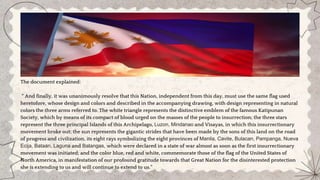
The document explained:
“ And finally, it was unanimously resolve that this Nation, independent from this day, must use the same flag used
heretofore, whose design and colors and described in the accompanying drawing, with design representing in natural
colors the three arms referred to. The white triangle represents the distinctive emblem of the famous Katipunan
Society, which by means of its compact of blood urged on the masses of the people to insurrection; the three stars
represent the three principal Islands of this Archipelago, Luzon, Mindanao and Visayas, in which this insurrectionary
movement broke out; the sun represents the gigantic strides that have been made by the sons of this land on the road
of progress and civilization, its eight rays symbolizing the eight provinces of Manila, Cavite, Bulacan, Pampanga, Nueva
Ecija, Bataan, Laguna and Batangas, which were declared in a state of war almost as soon as the first insurrectionary
movement was initiated; and the color blue, red and white, commemorate those of the flag of the United States of
North America, in manifestation of our profound gratitude towards that Great Nation for the disinterested protection
she is extending to us and will continue to extend to us.”
Our basic education omits the fact that those colors were
taken from the flag of the United States. While it can always
be argued that symbolic meaning can always change and be
reinterpreted, the original symbolic meaning of something
presents us several historical truths that can explain the
subsequent events, which unfolded after the declaration of
independence of the 12th day of June 1898.

PHILIPPINE-INDEPENDENCE

  • 1.
    READING THE PROCLAMATION OFTHE PHILIPPINE INDEPENDENCE JAYZEL ANNE AGUSTIN & WAREN CALARA
  • 2.
  • 3.
    AMBROSIO RIANZARES BAUTISTA YALTAMIRA Ambrosio Riazares Bautista also known as “Don Bosyong” born December 7, 1830 in Biñan La Laguna, Captaincy, General of the Philippine. A Filipino lawyer and author of The Declaration of Philippine Independence. Distant relative of the “Rizal Family” He attended preparatory school in Biñan and studied Law at the University of Santo Tomas UST obtaining a degree in 1865 then he practice law in Manila and offered free legal services to the poor clients. He also one of the officers of Liga Filipina.
  • 4.
  • 5.
    The Philippine revolutionbegan in 1896 and really ended only in 1901. At first, it was a war of independence against the Spain. Later, it turned into war of independence against the United State. The first part of revolution was a success. Many of our best heroes were killed during the revolution.
  • 6.
    KKKKATAAS-TAASAN, KAGALANG-GALANGAN,KATIPUNAN NGMGAANAKNGBAYAN As a Philippinerevolutionary society founded by anti- Spanish colonialism Filipinos in Manila in 1892; its primary goal was to gain independence from Spain through a revolution. JULY 7, 1892-MAY 25, 1897
  • 7.
    ANDRES BONIFACIO THE FATHEROF PHILIPPINE REVOLUTION FOUNDER OF KKK TEODORO PLATA LADISLAO DIWA CO-FOUNDER OF KATIPUNAN CO-FOUNDER OF KATIPUNAN
  • 8.
  • 9.
    EMILIO AGUINALDO Also knownas “Emilio Aguinaldo y Famy” born March 22, 1869 in Kawit Cavite. Emilio was a Filipino revolutionary, statesman, and military leader who is the youngest president of the Philippines. He led the Philippine forces first against Spain in the Philippine Revolution in 1896-1898. On June 12, Aguinaldo promulgated the Philippine Declaration of Independence from Spain in his own mansion house in Cavite El Viejo, believing that declaration would inspire the Filipino people to eagerly rise against the Spaniards. On June 18, he issued a decree formally establishing his dictatorial government in which he also provided the organization of the local government and the establishment and the composition of the Revolutionary Congress.
  • 10.
  • 11.
    On December 27,1897 General Emilio Aguinaldo and 25 other revolutionary leaders sailed for Hongkong from Sual, Pangasinan, on board the steamer Uranus, in compliance with the terms of the Pact of Biak-na-Bato.
  • 12.
  • 13.
    The Philippine revolutiongovernment did not recognize the treaty or American sovereignty and subsequently fought and lost a conflict with United States. Ended when Emilio Aguinaldo was captured by U.S. forces in March 23, 1901 and issued a statement acknowledging and accepting the sovereignty of the United States over the Philippines. The U.S. finally granted complete independence to the Philippines on July 4, 1946 via the treaty of Manila following World War II. President Diosdado Macapagal in 1964 signed into law Republic act no. 4166 designating June 12 as the country’s Independence Day.
  • 14.
  • 15.
    THE PROCLAMATION OFTHE PHILIPPINE INDEPENDENCE •It is a short 2,000 word document •It summarized the reason behind the revolution against Spain •It also summarized the subsequent war for independence, as well as the future of the new republic under the leadership of Emilio Aguinaldo. THE PROCLAMATION COMMENCED WITH A CHARACTERIZATION OF THE CONDITION OF THE PHILIPPINE DURING SPANISH COLONIAL PERIOD. •It specifically mentioned the abuses and inequalities existing in the colony.
  • 16.
  • 17.
    THE DECLARATION SAYS: “Taking into consideration, that their inhabitants being already weary of bearing the ominous yoke of Spanish domination, on account of the arbitrary arrests and harsh treatment practiced by the Civil Guard to the extent of causing death with the connivance and even with the express orders of their commanders, who sometimes went to the extreme of ordering the shooting of prisoners under the pretext that they were attempting to escape, in violation of the provisions of the regulations of their corps, which abuses were unpunished and on account of the unjust deportations, especially those decreed by General Blanco, of eminent personages and of high social position, at the instigation of the Archbishop and friars interested in keeping them out of the way for their own selfish and avaricious purpose, deportations which are quickly brought about by a method of procedure more execrable than that of the inquisition and which every civilized nation rejects on account of a decision being rendered without a hearing of the persons accused. “ The passage demonstrates the justifications behind the revolution against Spain. Specifically cited are the abuses by the Civil Guards and the unlawful shooting of prisoners whom they alleged as “attempting to escape”. It also condemns the unequal protection of the law between the Filipino people and the “eminent personages” Moreover, the line mentions the avarice and greed of the clergy like the friars and the Archbishop himself. The passages also condemns what they saw as the unjust deportation and rendering of other decisions without proper bearing, of expected any civilized nation.
  • 18.
  • 19.
    EVENT 1 EVENT2 EVENT 3 EVENT 4 •The proclamation proceeded with a brief historical overview of the Spanish occupation since Magellan’s arrival in Visayas until the Philippine Revolution, with specific details about the letter, especially after the Pack of Biak-na-Bato had collapsed. •The document narrates the spread of the movement “like an electric spark” through different towns and provinces like Bataan, Pampanga, Batangas, Bulacan, Laguna and Morong, and the quick decline of Spanish forces in the same provinces. •The revolt also reached Visayas; thus, the independence of the country was ensured. •He document also mention Rizal’s execution, calling itunjust. The execution was done “please the greedy body offriars in their insatiable desire to seek revenge upon and exterminate all those who are opposed to their Machiavellian purposes, which tramples upon the penal code prescribed for these islands.” •The documents it also narrates the Cavite Mutiny of January 1872 that caused the infamous execution of the martyred native priests Jose Burgos, Mariano Gomez, and Jacinto Zamora, “whose innocent blood was shed through the intrigues of those so-called religious orders” that incited the three secular priests in the said mutiny. HISTORICAL OVERVIEW
  • 20.
  • 21.
    IT STATED: “In thetown of El Viejo, in this province ofCavite, on the twelfth day of June eighteen hundred and ninety-eight, before me, Don Ambrosio Rianzares Bautista, Auditor of warand special commissioner appointed to proclaim andsolemnize this actby the DictatorialGovernment of thesePhilippine islands, for the purpose and by virtue of the circular addressed by the Eminent Dictatorof the same Don Emilio Aguinaldo y Famy.” EMILIO AGUINALDO DICTATORSHIP
  • 22.
    It states: “We acknowledge,approve and confirm together with the orders that have been issued therefrom, the Dictatorship established by Don Emilion Aguinaldo, whom we honor as the supreme Chief of this Nation, which this day commences to have a life of its own, in the belief that he is the instrument selected by God, in spite of his humble origin, to effect the redemption of this unfortunate people, as foretold by Doctor Jose Rizal in the magnificent verses which he composed when he was preparing to be shot, liberating the, from the yoke of Spanish domination in punishment of the impunity with which their Government allowed the commission of abuses by its subordinates.”
  • 23.
  • 24.
    The document explained: “And finally, it was unanimously resolve that this Nation, independent from this day, must use the same flag used heretofore, whose design and colors and described in the accompanying drawing, with design representing in natural colors the three arms referred to. The white triangle represents the distinctive emblem of the famous Katipunan Society, which by means of its compact of blood urged on the masses of the people to insurrection; the three stars represent the three principal Islands of this Archipelago, Luzon, Mindanao and Visayas, in which this insurrectionary movement broke out; the sun represents the gigantic strides that have been made by the sons of this land on the road of progress and civilization, its eight rays symbolizing the eight provinces of Manila, Cavite, Bulacan, Pampanga, Nueva Ecija, Bataan, Laguna and Batangas, which were declared in a state of war almost as soon as the first insurrectionary movement was initiated; and the color blue, red and white, commemorate those of the flag of the United States of North America, in manifestation of our profound gratitude towards that Great Nation for the disinterested protection she is extending to us and will continue to extend to us.”
  • 25.
    Our basic educationomits the fact that those colors were taken from the flag of the United States. While it can always be argued that symbolic meaning can always change and be reinterpreted, the original symbolic meaning of something presents us several historical truths that can explain the subsequent events, which unfolded after the declaration of independence of the 12th day of June 1898.