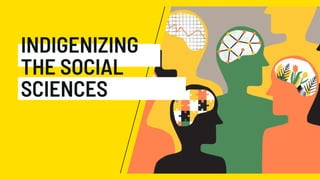
INDIGENIZING
THE SOCIAL
SCIENCES
Social Sciences
is a category of academic discipline concerned with society and the
relationships among indiviuals within a society.
Indigenizing
is a process of making something or someone more native to suit a
local culture, especially through the used of more indigenous
people.
Indigenization in Social
Science
The indigenization crisis currently happening in the social
sciences stems from the inability of a researcher to
observe and interpret social phenomena from the
perspective and the meaning systems of the culture within
which the research is taking place and from which data is
to be gathered.
(Filipino: Filipinolohiya)
or Philippine studies
refers to the study of the
Phillipines and the
Filipino people.
Filipinology
1 2
Filipinology was
developed in the
University of the
Philippines.
Did you know?
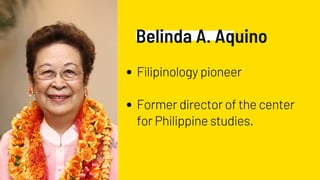
Belinda A. Aquino
Filipinology pioneer
Former director of the center
for Philippine studies.
Learning goals of Filipinology include the comprehension,
appreciation, and critical evaluation of the Philippines
through Philippine History, contemporary issues in
Philippine community, and Philippine Humanities such as
Filipino philosophy, Filipino music, Filipino art, Philippine
literature, and Philippine dance.
Purpose
The incorporation of Philippine Humanities
through literary readings, listening to musical
recordings, film viewings, and field trips provide
development of cultural acceptance and
aesthetic sense.
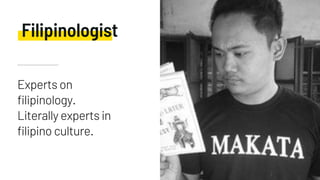
Experts on
filipinology.
Literally experts in
filipino culture.
Filipinologist
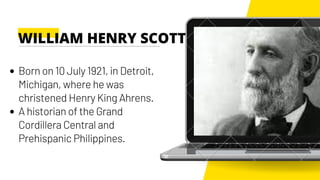
Born on 10 July 1921, in Detroit,
Michigan, where he was
christened Henry King Ahrens.
A historian of the Grand
Cordillera Central and
Prehispanic Philippines.
WILLIAM HENRY SCOTT
Born in Eureka,
California, on May
30, 1924.
He lived in Humboldt
County during the
first twenty-six years
of his life.
He was a prominent
American historian,
writer, researcher,
publisher,
autobiographer, dean,
history professor, and
filipinologist.
HOWARD BRETT
MELENDY
He was a prominent
American historian,
writer, researcher,
publisher,
autobiographer, dean,
history professor, and
filipinologist.
HOWARD BRETT
MELENDY
Melendy was a professor
and administrator at the
San José State University in
California and the University
of Hawai'i.
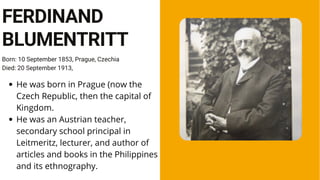
Born: 10 September 1853, Prague, Czechia
Died: 20 September 1913,
FERDINAND
BLUMENTRITT
He was born in Prague (now the
Czech Republic, then the capital of
Kingdom.
He was an Austrian teacher,
secondary school principal in
Leitmeritz, lecturer, and author of
articles and books in the Philippines
and its ethnography.
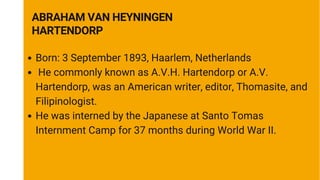
Born: 3 September 1893, Haarlem, Netherlands
He commonly known as A.V.H. Hartendorp or A.V.
Hartendorp, was an American writer, editor, Thomasite, and
Filipinologist.
He was interned by the Japanese at Santo Tomas
Internment Camp for 37 months during World War II.
ABRAHAM VAN HEYNINGEN
HARTENDORP
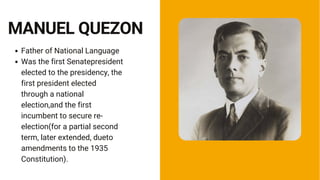
Father of National Language
Was the first Senatepresident
elected to the presidency, the
first president elected
through a national
election,and the first
incumbent to secure re-
election(for a partial second
term, later extended, dueto
amendments to the 1935
Constitution).
MANUEL QUEZON
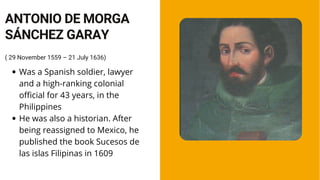
Was a Spanish soldier, lawyer
and a high-ranking colonial
official for 43 years, in the
Philippines
He was also a historian. After
being reassigned to Mexico, he
published the book Sucesos de
las islas Filipinas in 1609
( 29 November 1559 – 21 July 1636)
ANTONIO DE MORGA
SÁNCHEZ GARAY
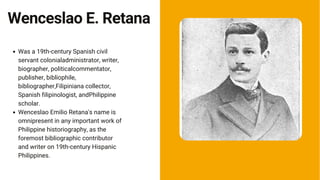
Was a 19th-century Spanish civil
servant colonialadministrator, writer,
biographer, politicalcommentator,
publisher, bibliophile,
bibliographer,Filipiniana collector,
Spanish filipinologist, andPhilippine
scholar.
Wenceslao Emilio Retana's name is
omnipresent in any important work of
Philippine historiography, as the
foremost bibliographic contributor
and writer on 19th-century Hispanic
Philippines.
Wenceslao E. Retana
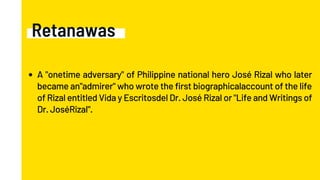
Retanawas
A "onetime adversary" of Philippine national hero José Rizal who later
became an"admirer" who wrote the first biographicalaccount of the life
of Rizal entitled Vida y Escritosdel Dr. José Rizal or "Life and Writings of
Dr. JoséRizal".
Philippine Studies-University of
San Francisco
One of the few programs in the United States and one of
the largest in the world, the Yuchengco Philippine
Studies Program (YPSP) is an interdisciplinary minor
specializing in Philippine, Pilipino, and/or Filipino
American history, literature, sociology, politics, religion,
art, and language.
Philippine National
Historical Society
In 1941, through the efforts of Rodriguez and Eufronio
M. Alip, this mere student club evovled into a national
organization, named Philippine Historical Society which
aimed to encourge and undertake the study of
Philippine History.
Philippine Social Sciences Council
The Philippine Social Science Council, Inc. (PSSC) is a non-
stock, non-profit organization of professional social science
associations and social science research and instructional
institutions in the Philippines
Philippine Historical Association
The Philippine Historical Association is a professional association of
historians in the Philippines. It was founded on September 18, 1955 by
a group of prominent historians at Carbungco Restaurant located at
Lepanto St. Manila
The National Historical
Commission of the Philippines
Is a government agency of the Philippines. Its mission is
"the promotion of Philippine history and cultural heritage
through research, dissemination, conservation, sites
management and heraldry works.
The Filipinas
Heritage Library
A division of the Ayala Foundation, Inc. (AFI), is a one-stop
electronic research center on the Philippines. The Library provides
access to the wealth of Filipino heritage through the latest in
information technology and telecommunications.
The National Library of the
Philippines
(Filipino: Pambansang Aklatan ng Pilipinas or Aklatang Pambansa ng
Pilipinas, abbreviated NLP) is the official national library of the Philippines.
The complex is located in Ermita on a portion of Rizal Park facing T. M.
Kalaw Avenue, neighboring culturally significant buildings such as the
Museum of Philippine Political History and the National Historical
Commission. Like its neighbors, it is under the jurisdiction of the National
Commission for Culture and the Arts (NCCA).
The Cebuano
Studies Center
Is a center of research on all aspects of Cebuano culture.
It functions as a special library to house source materials
pertaining to Cebu, as well as the predominantly Cebuano-
speaking areas in the country
The Center is administered by the Office of the President of the
University of San Carlos, and is officially affiliated with the
College of Arts and Sciences.
Thank you!
GROUP 9

9. Indigenizing-the-Social-Sciences-1.pdf

  • 1.
  • 2.
    Social Sciences is acategory of academic discipline concerned with society and the relationships among indiviuals within a society. Indigenizing is a process of making something or someone more native to suit a local culture, especially through the used of more indigenous people.
  • 3.
    Indigenization in Social Science Theindigenization crisis currently happening in the social sciences stems from the inability of a researcher to observe and interpret social phenomena from the perspective and the meaning systems of the culture within which the research is taking place and from which data is to be gathered.
  • 4.
    (Filipino: Filipinolohiya) or Philippinestudies refers to the study of the Phillipines and the Filipino people. Filipinology
  • 5.
    1 2 Filipinology was developedin the University of the Philippines. Did you know?
  • 6.
    Belinda A. Aquino Filipinologypioneer Former director of the center for Philippine studies.
  • 7.
    Learning goals ofFilipinology include the comprehension, appreciation, and critical evaluation of the Philippines through Philippine History, contemporary issues in Philippine community, and Philippine Humanities such as Filipino philosophy, Filipino music, Filipino art, Philippine literature, and Philippine dance. Purpose
  • 8.
    The incorporation ofPhilippine Humanities through literary readings, listening to musical recordings, film viewings, and field trips provide development of cultural acceptance and aesthetic sense.
  • 9.
    Experts on filipinology. Literally expertsin filipino culture. Filipinologist
  • 10.
    Born on 10July 1921, in Detroit, Michigan, where he was christened Henry King Ahrens. A historian of the Grand Cordillera Central and Prehispanic Philippines. WILLIAM HENRY SCOTT
  • 11.
    Born in Eureka, California,on May 30, 1924. He lived in Humboldt County during the first twenty-six years of his life. He was a prominent American historian, writer, researcher, publisher, autobiographer, dean, history professor, and filipinologist. HOWARD BRETT MELENDY
  • 12.
    He was aprominent American historian, writer, researcher, publisher, autobiographer, dean, history professor, and filipinologist. HOWARD BRETT MELENDY Melendy was a professor and administrator at the San José State University in California and the University of Hawai'i.
  • 13.
    Born: 10 September1853, Prague, Czechia Died: 20 September 1913, FERDINAND BLUMENTRITT He was born in Prague (now the Czech Republic, then the capital of Kingdom. He was an Austrian teacher, secondary school principal in Leitmeritz, lecturer, and author of articles and books in the Philippines and its ethnography.
  • 14.
    Born: 3 September1893, Haarlem, Netherlands He commonly known as A.V.H. Hartendorp or A.V. Hartendorp, was an American writer, editor, Thomasite, and Filipinologist. He was interned by the Japanese at Santo Tomas Internment Camp for 37 months during World War II. ABRAHAM VAN HEYNINGEN HARTENDORP
  • 15.
    Father of NationalLanguage Was the first Senatepresident elected to the presidency, the first president elected through a national election,and the first incumbent to secure re- election(for a partial second term, later extended, dueto amendments to the 1935 Constitution). MANUEL QUEZON
  • 16.
    Was a Spanishsoldier, lawyer and a high-ranking colonial official for 43 years, in the Philippines He was also a historian. After being reassigned to Mexico, he published the book Sucesos de las islas Filipinas in 1609 ( 29 November 1559 – 21 July 1636) ANTONIO DE MORGA SÁNCHEZ GARAY
  • 17.
    Was a 19th-centurySpanish civil servant colonialadministrator, writer, biographer, politicalcommentator, publisher, bibliophile, bibliographer,Filipiniana collector, Spanish filipinologist, andPhilippine scholar. Wenceslao Emilio Retana's name is omnipresent in any important work of Philippine historiography, as the foremost bibliographic contributor and writer on 19th-century Hispanic Philippines. Wenceslao E. Retana
  • 18.
    Retanawas A "onetime adversary"of Philippine national hero José Rizal who later became an"admirer" who wrote the first biographicalaccount of the life of Rizal entitled Vida y Escritosdel Dr. José Rizal or "Life and Writings of Dr. JoséRizal".
  • 19.
    Philippine Studies-University of SanFrancisco One of the few programs in the United States and one of the largest in the world, the Yuchengco Philippine Studies Program (YPSP) is an interdisciplinary minor specializing in Philippine, Pilipino, and/or Filipino American history, literature, sociology, politics, religion, art, and language.
  • 20.
    Philippine National Historical Society In1941, through the efforts of Rodriguez and Eufronio M. Alip, this mere student club evovled into a national organization, named Philippine Historical Society which aimed to encourge and undertake the study of Philippine History.
  • 21.
    Philippine Social SciencesCouncil The Philippine Social Science Council, Inc. (PSSC) is a non- stock, non-profit organization of professional social science associations and social science research and instructional institutions in the Philippines
  • 22.
    Philippine Historical Association ThePhilippine Historical Association is a professional association of historians in the Philippines. It was founded on September 18, 1955 by a group of prominent historians at Carbungco Restaurant located at Lepanto St. Manila
  • 23.
    The National Historical Commissionof the Philippines Is a government agency of the Philippines. Its mission is "the promotion of Philippine history and cultural heritage through research, dissemination, conservation, sites management and heraldry works.
  • 24.
    The Filipinas Heritage Library Adivision of the Ayala Foundation, Inc. (AFI), is a one-stop electronic research center on the Philippines. The Library provides access to the wealth of Filipino heritage through the latest in information technology and telecommunications.
  • 25.
    The National Libraryof the Philippines (Filipino: Pambansang Aklatan ng Pilipinas or Aklatang Pambansa ng Pilipinas, abbreviated NLP) is the official national library of the Philippines. The complex is located in Ermita on a portion of Rizal Park facing T. M. Kalaw Avenue, neighboring culturally significant buildings such as the Museum of Philippine Political History and the National Historical Commission. Like its neighbors, it is under the jurisdiction of the National Commission for Culture and the Arts (NCCA).
  • 26.
    The Cebuano Studies Center Isa center of research on all aspects of Cebuano culture. It functions as a special library to house source materials pertaining to Cebu, as well as the predominantly Cebuano- speaking areas in the country The Center is administered by the Office of the President of the University of San Carlos, and is officially affiliated with the College of Arts and Sciences.
  • 27.