PHILIPPINE HISTORY:
THE VOYAGE AROUND THE WORLD OF
FERDINAND MAGELLAN
by Antonio Pigafetta
Objectives:
At the end of the lecture, we should able to:
i. Understand the history of Antonio Pigafetta’s first voyage
around the world
ii. Name the ships they used to circumnavigate the world and
iii. Classify the driving factors of European exploration
iv. Summarize the main accomplishments of the first voyage
of Pigafetta and Magellan during the time exploration
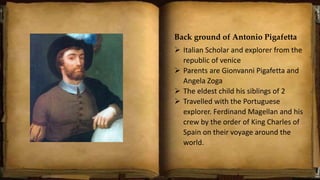
Back ground of Antonio Pigafetta
 Italian Scholar and explorer from the
republic of venice
 Parents are Gionvanni Pigafetta and
Angela Zoga
 The eldest child his siblings of 2
 Travelled with the Portuguese
explorer. Ferdinand Magellan and his
crew by the order of King Charles of
Spain on their voyage around the
world.
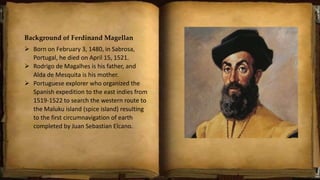
Background of Ferdinand Magellan
 Born on February 3, 1480, in Sabrosa,
Portugal, he died on April 15, 1521.
 Rodrigo de Magalhes is his father, and
Alda de Mesquita is his mother.
 Portuguese explorer who organized the
Spanish expedition to the east indies from
1519-1522 to search the western route to
the Maluku island (spice island) resulting
to the first circumnavigation of earth
completed by Juan Sebastian Elcano.
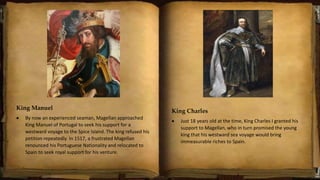
King Manuel
 By now an experienced seaman, Magellan approached
King Manuel of Portugal to seek his support for a
westward voyage to the Spice Island. The king refused his
petition repeatedly. In 1517, a frustrated Magellan
renounced his Portuguese Nationality and relocated to
Spain to seek royal support for his venture.
King Charles
 Just 18 years old at the time, King Charles I granted his
support to Magellan, who in turn promised the young
king that his westward sea voyage would bring
immeasurable riches to Spain.
The age of Exploration (also called the age of
Discovery) began in the 1400s and continued
through the 1600s. It was a period of time when
the European nations began exploring the world.
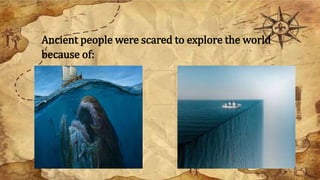
Ancient people were scared to explore the world
because of:
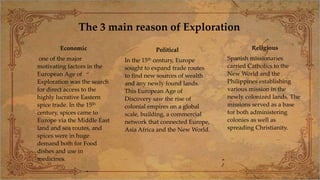
The 3 main reason of Exploration
Economic
one of the major
motivating factors in the
European Age of
Exploration was the search
for direct access to the
highly lucrative Eastern
spice trade. In the 15th
century, spices came to
Europe via the Middle East
land and sea routes, and
spices were in huge
demand both for Food
dishes and use in
medicines.
Political
In the 15th century, Europe
sought to expand trade routes
to find new sources of wealth
and any newly found lands.
This European Age of
Discovery saw the rise of
colonial empires on a global
scale, building, a commercial
network that connected Europe,
Asia Africa and the New World.
Religious
Spanish missionaries
carried Catholics to the
New World and the
Philippines establishing
various mission in the
newly colonized lands. The
missions served as a base
for both administering
colonies as well as
spreading Christianity.
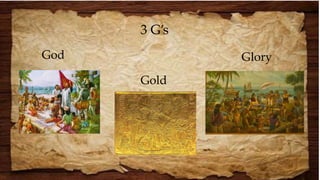
3 G’s
God
Gold
Glory
On September 20, 1519, Magellan set
sail from Spain in an effort to find a
western route to the rich Spice Islands
of Indonesia. In command of five ships
and 270 men, Magellan sailed to West
Africa and then to Brazil, where he
searched the South American coast for a
strait that would take him to the Pacific.
The Voyage of Ferdinand Magellan
The fleet under Ferdinand Magellan sailed
across the Atlantic Ocean to South America and
Rio de Janeiro. Magellan then started to search
for a passage to the Pacific Ocean on November
21, 1520. Ferdinand Magellan entered the
straits which would be forever named in his
honour- The Magellan Straits- they were to be
the first Europeans ever to sail across the
Pacific. The names of the five Ships of
Ferdinand Magellan and their commanders
were as follows:
Magellan started the
exploration with 270
crews
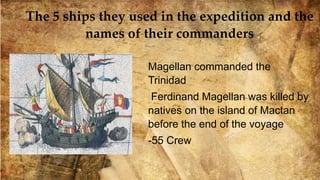
The 5 ships they used in the expedition and the
names of their commanders
Magellan commanded the
Trinidad
Ferdinand Magellan was killed by
natives on the island of Mactan
before the end of the voyage
-55 Crew
Magellan started the
exploration with 270
crews
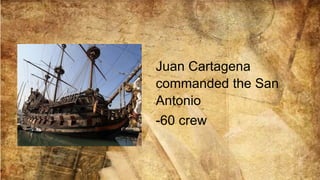
Juan Cartagena
commanded the San
Antonio
-60 crew
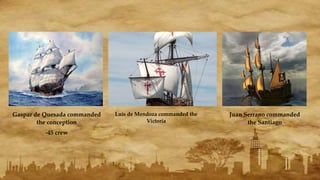
Gaspar de Quesada commanded
the conception
-45 crew
Luis de Mendoza commanded the
Victoria
Juan Serrano commanded
the Santiago
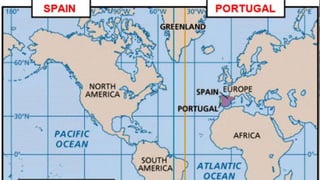
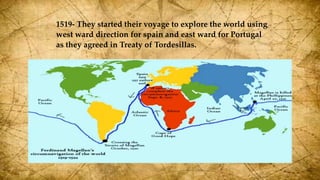
1519- They started their voyage to explore the world using
west ward direction for spain and east ward for Portugal
as they agreed in Treaty of Tordesillas.
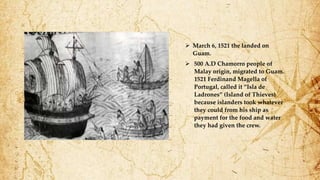
 March 6, 1521 the landed on
Guam.
 500 A.D Chamorro people of
Malay origin, migrated to Guam.
1521 Ferdinand Magella of
Portugal, called it “Isla de
Ladrones” (Island of Thieves)
because islanders took whatever
they could from his ship as
payment for the food and water
they had given the crew.
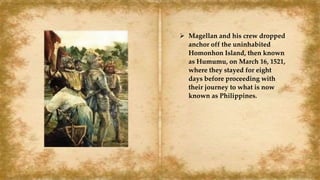
 Magellan and his crew dropped
anchor off the uninhabited
Homonhon Island, then known
as Humumu, on March 16, 1521,
where they stayed for eight
days before proceeding with
their journey to what is now
known as Philippines.
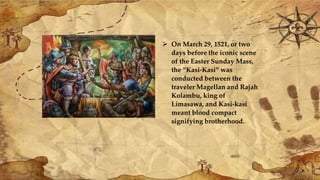
 On March 29, 1521, or two
days before the iconic scene
of the Easter Sunday Mass,
the “Kasi-Kasi” was
conducted between the
traveler Magellan and Rajah
Kolambu, king of
Limasawa, and Kasi-kasi
meant blood compact
signifying brotherhood.
 On April 7, 1521
Magellan and his crews landed on
Cebu island, a native chief, Rajah
Humabon, met and befriended
him. Rajah Humabon, his wife and
hundreds of his native warriors
agreed to accept Christianity and
were consequently baptized.
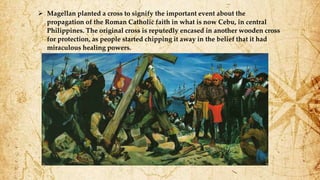
 Magellan planted a cross to signify the important event about the
propagation of the Roman Catholic faith in what is now Cebu, in central
Philippines. The original cross is reputedly encased in another wooden cross
for protection, as people started chipping it away in the belief that it had
miraculous healing powers.
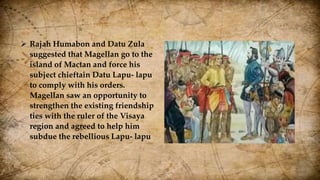
 Rajah Humabon and Datu Zula
suggested that Magellan go to the
island of Mactan and force his
subject chieftain Datu Lapu- lapu
to comply with his orders.
Magellan saw an opportunity to
strengthen the existing friendship
ties with the ruler of the Visaya
region and agreed to help him
subdue the rebellious Lapu- lapu
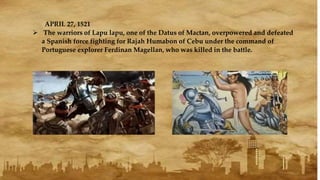
APRIL 27, 1521
 The warriors of Lapu lapu, one of the Datus of Mactan, overpowered and defeated
a Spanish force fighting for Rajah Humabon of Cebu under the command of
Portuguese explorer Ferdinan Magellan, who was killed in the battle.
September 6, 1522
 After Magellan’s death, his crew continued in the single
ship that remained, captained by Juan Sebastian Elcano, a
Basque. They returned to Spain in spetember 1522. Along
the way, they had encountered a new ocean, mapped new
routes for European trade, and set the stage for modern
globalism.
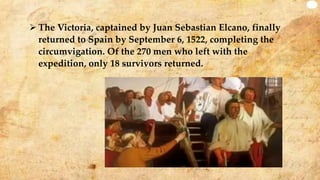
 The Victoria, captained by Juan Sebastian Elcano, finally
returned to Spain by September 6, 1522, completing the
circumvigation. Of the 270 men who left with the
expedition, only 18 survivors returned.
PHILIPPINE HISTORY:
THE VOYAGE AROUND THE WORLD OF
FERDINAND MAGELLAN
by Antonio Pigafetta

The-voyage-around-the-world-of-Ferdinand-Magellan.pptx

  • 1.
    PHILIPPINE HISTORY: THE VOYAGEAROUND THE WORLD OF FERDINAND MAGELLAN by Antonio Pigafetta
  • 2.
    Objectives: At the endof the lecture, we should able to: i. Understand the history of Antonio Pigafetta’s first voyage around the world ii. Name the ships they used to circumnavigate the world and iii. Classify the driving factors of European exploration iv. Summarize the main accomplishments of the first voyage of Pigafetta and Magellan during the time exploration
  • 3.
    Back ground ofAntonio Pigafetta  Italian Scholar and explorer from the republic of venice  Parents are Gionvanni Pigafetta and Angela Zoga  The eldest child his siblings of 2  Travelled with the Portuguese explorer. Ferdinand Magellan and his crew by the order of King Charles of Spain on their voyage around the world.
  • 4.
    Background of FerdinandMagellan  Born on February 3, 1480, in Sabrosa, Portugal, he died on April 15, 1521.  Rodrigo de Magalhes is his father, and Alda de Mesquita is his mother.  Portuguese explorer who organized the Spanish expedition to the east indies from 1519-1522 to search the western route to the Maluku island (spice island) resulting to the first circumnavigation of earth completed by Juan Sebastian Elcano.
  • 5.
    King Manuel  Bynow an experienced seaman, Magellan approached King Manuel of Portugal to seek his support for a westward voyage to the Spice Island. The king refused his petition repeatedly. In 1517, a frustrated Magellan renounced his Portuguese Nationality and relocated to Spain to seek royal support for his venture. King Charles  Just 18 years old at the time, King Charles I granted his support to Magellan, who in turn promised the young king that his westward sea voyage would bring immeasurable riches to Spain.
  • 6.
    The age ofExploration (also called the age of Discovery) began in the 1400s and continued through the 1600s. It was a period of time when the European nations began exploring the world.
  • 7.
    Ancient people werescared to explore the world because of:
  • 8.
    The 3 mainreason of Exploration Economic one of the major motivating factors in the European Age of Exploration was the search for direct access to the highly lucrative Eastern spice trade. In the 15th century, spices came to Europe via the Middle East land and sea routes, and spices were in huge demand both for Food dishes and use in medicines. Political In the 15th century, Europe sought to expand trade routes to find new sources of wealth and any newly found lands. This European Age of Discovery saw the rise of colonial empires on a global scale, building, a commercial network that connected Europe, Asia Africa and the New World. Religious Spanish missionaries carried Catholics to the New World and the Philippines establishing various mission in the newly colonized lands. The missions served as a base for both administering colonies as well as spreading Christianity.
  • 9.
  • 10.
    On September 20,1519, Magellan set sail from Spain in an effort to find a western route to the rich Spice Islands of Indonesia. In command of five ships and 270 men, Magellan sailed to West Africa and then to Brazil, where he searched the South American coast for a strait that would take him to the Pacific.
  • 11.
    The Voyage ofFerdinand Magellan The fleet under Ferdinand Magellan sailed across the Atlantic Ocean to South America and Rio de Janeiro. Magellan then started to search for a passage to the Pacific Ocean on November 21, 1520. Ferdinand Magellan entered the straits which would be forever named in his honour- The Magellan Straits- they were to be the first Europeans ever to sail across the Pacific. The names of the five Ships of Ferdinand Magellan and their commanders were as follows:
  • 13.
    Magellan started the explorationwith 270 crews The 5 ships they used in the expedition and the names of their commanders Magellan commanded the Trinidad Ferdinand Magellan was killed by natives on the island of Mactan before the end of the voyage -55 Crew
  • 14.
    Magellan started the explorationwith 270 crews Juan Cartagena commanded the San Antonio -60 crew
  • 15.
    Gaspar de Quesadacommanded the conception -45 crew Luis de Mendoza commanded the Victoria Juan Serrano commanded the Santiago
  • 16.
    1519- They startedtheir voyage to explore the world using west ward direction for spain and east ward for Portugal as they agreed in Treaty of Tordesillas.
  • 17.
     March 6,1521 the landed on Guam.  500 A.D Chamorro people of Malay origin, migrated to Guam. 1521 Ferdinand Magella of Portugal, called it “Isla de Ladrones” (Island of Thieves) because islanders took whatever they could from his ship as payment for the food and water they had given the crew.
  • 18.
     Magellan andhis crew dropped anchor off the uninhabited Homonhon Island, then known as Humumu, on March 16, 1521, where they stayed for eight days before proceeding with their journey to what is now known as Philippines.
  • 19.
     On March29, 1521, or two days before the iconic scene of the Easter Sunday Mass, the “Kasi-Kasi” was conducted between the traveler Magellan and Rajah Kolambu, king of Limasawa, and Kasi-kasi meant blood compact signifying brotherhood.
  • 20.
     On April7, 1521 Magellan and his crews landed on Cebu island, a native chief, Rajah Humabon, met and befriended him. Rajah Humabon, his wife and hundreds of his native warriors agreed to accept Christianity and were consequently baptized.
  • 21.
     Magellan planteda cross to signify the important event about the propagation of the Roman Catholic faith in what is now Cebu, in central Philippines. The original cross is reputedly encased in another wooden cross for protection, as people started chipping it away in the belief that it had miraculous healing powers.
  • 22.
     Rajah Humabonand Datu Zula suggested that Magellan go to the island of Mactan and force his subject chieftain Datu Lapu- lapu to comply with his orders. Magellan saw an opportunity to strengthen the existing friendship ties with the ruler of the Visaya region and agreed to help him subdue the rebellious Lapu- lapu
  • 23.
    APRIL 27, 1521 The warriors of Lapu lapu, one of the Datus of Mactan, overpowered and defeated a Spanish force fighting for Rajah Humabon of Cebu under the command of Portuguese explorer Ferdinan Magellan, who was killed in the battle.
  • 24.
    September 6, 1522 After Magellan’s death, his crew continued in the single ship that remained, captained by Juan Sebastian Elcano, a Basque. They returned to Spain in spetember 1522. Along the way, they had encountered a new ocean, mapped new routes for European trade, and set the stage for modern globalism.
  • 25.
     The Victoria,captained by Juan Sebastian Elcano, finally returned to Spain by September 6, 1522, completing the circumvigation. Of the 270 men who left with the expedition, only 18 survivors returned.
  • 26.
    PHILIPPINE HISTORY: THE VOYAGEAROUND THE WORLD OF FERDINAND MAGELLAN by Antonio Pigafetta