CHAPTER 2:
CONTENT AND CONTEXTUAL
ANALYSIS OF SELECTED PRIMARY
SOURCES IN PHILIPPINE HISTORY
Group 1
L EAR N IN G OBJ EC TIVES
 To familiarize oneself with the primary documents in
different historical periods of the philippines.
 To learn history through primary sources.
 To properly interpret primary sources though examining
the contact and context of the document.
 To understand the context behind each selected
document.
The historian’s primary tool of understanding and
interpreting the past is the historical sources. Historical
facts. Such facts are then analyzed and interpreted by
historian to weave historical narrative.
Using primary sources in historical research entails two
kinds of criticism. The first one is EXTERNAL CRTICISM
examines the authenticity of the document or the
evidence being used while INTER CRITICISM examines
the truthfulness of the content of the evidence.
A Brief Summary of the First Voyage Around the
World Magellan by Antonio Pigafetta
W H O I S A N TO N I O P I G A F E T TA ?
- famous italian traveller born in Vicenza around 1940 and died in the
same city in 1534, who is also known by the name of Antonio Lombardo
or Francisco Antonio Pigafetta. Initially linked to the Rhodes, which was
knight, went to Spain in 1519, accompanied by Monsignor Francisco
Chiericato, and was made available from Carlos V to promote the
company initiated by the Catholic Monarchs in the Atlantic. Soon he
became a great friendship with Magallanes, who accompanied, together
with Juan Sebastian Elcano, in the famous expedition to the Moluccas
begun in August of 1519 and finished in September 1522.
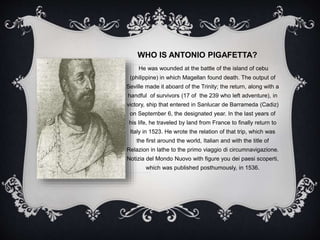
WHO IS ANTONIO PIGAFETTA?
He was wounded at the battle of the island of cebu
(philippine) in which Magellan found death. The output of
Seville made it aboard of the Trinity; the return, along with a
handful of survivors (17 of the 239 who left adventure), in
victory, ship that entered in Sanlucar de Barrameda (Cadiz)
on September 6, the designated year. In the last years of
his life, he traveled by land from France to finally return to
Italy in 1523. He wrote the relation of that trip, which was
the first around the world, Italian and with the title of
Relazion in lathe to the primo viaggio di circumnavigazione.
Notizia del Mondo Nuovo with figure you dei paesi scoperti,
which was published posthumously, in 1536.
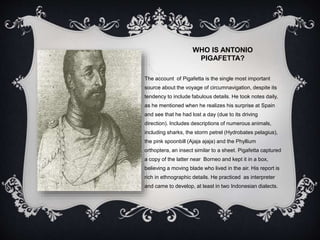
WHO IS ANTONIO
PIGAFETTA?
The account of Pigafetta is the single most important
source about the voyage of circumnavigation, despite its
tendency to include fabulous details. He took notes daily,
as he mentioned when he realizes his surprise at Spain
and see that he had lost a day (due to its driving
direction). Includes descriptions of numerous animals,
including sharks, the storm petrel (Hydrobates pelagius),
the pink spoonbill (Ajaja ajaja) and the Phyllium
orthoptera, an insect similar to a sheet. Pigafetta captured
a copy of the latter near Borneo and kept it in a box,
believing a moving blade who lived in the air. His report is
rich in ethnographic details. He practiced as interpreter
and came to develop, at least in two Indonesian dialects.
Pigafetta’s work instantly became a classic that prominent
literary men in the West like WILLIAM SHAKESPEARE,
MICHEL de MONTAIGNE, and GIAMBATTISTA VICO
reffered to the book in their interpretation of the New
World. Pigafetta’s travelogue is one of the most important
primary sources in the study of the precolonial
Philippines.
In Pigafetta’s account, their reached what he called the
LADRONES ISLANDS or the “Island of the Thieves”.
He recounted:
“These people have no arms, but use sticks, which have
a finish bone at the end. They are poor, but ingenious,
and great thieves, and for the sake of that we call these
three islands the Ladrones Islands”.
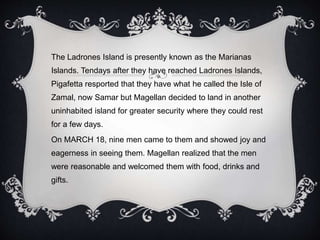
T H E L A D R O N E S I S L A N D S
The Ladrones Island is presently known as the Marianas
Islands. Tendays after they have reached Ladrones Islands,
Pigafetta resported that they have what he called the Isle of
Zamal, now Samar but Magellan decided to land in another
uninhabited island for greater security where they could rest
for a few days.
On MARCH 18, nine men came to them and showed joy and
eagerness in seeing them. Magellan realized that the men
were reasonable and welcomed them with food, drinks and
gifts.
Pigafetta detailed in amazement and fascination the
palm tree which bore fruits called cochos and wine.
He characterized the people as ‘’very familiar and
friendly’’ and willingly showed them different islands and
the names of these islands. The fleet went to Humunu
Island (Homonhon ) and there they found what he
reffered to as the “Watering Place of Good Signs”. for it is
in this place that they found the first signs of gold in the
island. They named the island together with a nearby
island as the archipelago of St. lazarus.
On March 25th , Pigafetta recountend that they saw two (balangay), a
long boat full of people in Mazzava /Mazaus , The leader whom he
reffered to the king became closely bonded with Magellan as they
both exchange gifts to one another .
After a few days, Magellan was introduced to the king’s brother who
was also a king of another island where Pigafetta reported that they
saw mines of gold. The gold was. This king was named Raia
Calambu, king of Zuluan and Calagan (Butuan and Caragua), and the
first king was Raia Siagu.
On March 31st (Easter Sunday ), Magellan ordered the chaplain to preside a
Mass by the shore. The king heard about this plan and sent two dead pigs and
attended the Mass with the other king Pigafetta then wrote:
“… when the offertory of the mass came, the two kings, went to kiss the cross
like us, but they offered nothing, and at the elevation of the body of our Lord
they were kneeling like us, and adored our Lord with joined hands.”
This was the first Mass in the Philippines, and the cross would be famed
Magellan’s Cross which is still preserved at present day. This was the same
cross which Magellan explained to the kings as a sign of emperor who ordered
him to plan it in the places were he would reach and further explained that
once other Spaniards saw this cross, then they would know that they had
been in this islands and would not cause them troubles.
By April 7th, Magellan and his men reached the port of Zzubu
(Cebu) with the help of Raia Calambu who offered to pilot them in
going to the island. The kind of Cebu demanded that they pay tribute
as it was customary but Magellan refused. By the next day, Magellan’s
men and the king of Cebu, together with other principal men of
Cebu, ,et in an open space, There the king offered a bit of his blood
and demanded that Magellan do the same.
On April 14, Magellan spoke to the kind and encouraged him to be a
good Christian by burning all of the idols and worship the cross
instead. The king of Cebu was then baptized as a Christian. After 8
days, all of the islans’s inhabitant were already baptized.
When the quuen came to the Mass one day, Magellan gave her an
image of the Infant Jesus made by Pigafetta himself.
On 26th of April, Zula, a principal man from the Island of Matan (Mactan)
went to see Magellan and asked him for a boat full of men so that he
would be able to fight the chief name Silapulapu (Lapulapu). Magellan
offered 3 boats instead and went to Mactan to fight the said chief.
They numbered 49 in total and the Islanders of Mactan were estimated to
number 1,500. Magellan died in battle. He was pierced with a poison
arrow in his right leg. The king of Cebu who was baptized offered help but
Magellan refused so that he could see how they fought.
The kind also offered the people of Mactan gifts of any value and amount
in exchange of Magellan’s body but the chief refused and wantend to
keep Magellan’s body as a memento of their victory.
Magellan’s men then elected Duarte Barsosa as the new
captain
Pigafetta also accounted how Magellan’s slave and
interpreter named Henry betrayed them and told the king
of Cebu that they intended to leave as soon as possible.
Henry and king of Cebu conspired and betrayed what was
left of Magellan’s men. The king invited these men to a
gathering where he said he would present the jewels that
he would send for the king of Spain.
Pigafetta was left on board the ship and was not able to
join the 24 men who went to the gathering because he
was nursing his wounds.
The natives had slain all the men except the interpreter
and Juan Serrano who shouted at the men on this ship to
pay ransom so that he would be spared but he was left on
the island for they refused to go back to shore.
The fleet abandoned Serrano and departed. They left
Cebu and continued their journey around the world.
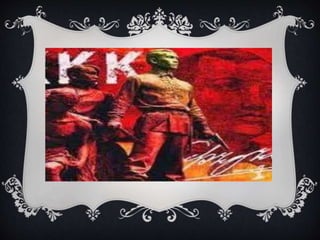
THE KKK and the “Kartilya ng Katipunan”
 The Kataastaasan, Kagalanggalang Katipunan ng
mga Anak ng Bayan (KKK) or Katipunan is arguably the
most important organization formed in the Philippine
history.
 The two principal aims of the KKK as gathered from
the writings of Bonifacio:
1. Unity of the filipino people
2. Separation from spain by means of revolution
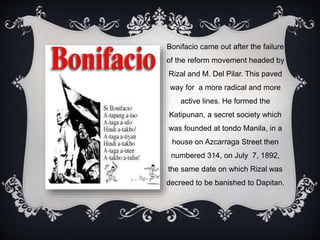
Bonifacio came out after the failure
of the reform movement headed by
Rizal and M. Del Pilar. This paved
way for a more radical and more
active lines. He formed the
Katipunan, a secret society which
was founded at tondo Manila, in a
house on Azcarraga Street then
numbered 314, on July 7, 1892,
the same date on which Rizal was
decreed to be banished to Dapitan.
Rizal doubtless approved the first aim but refused to
accept the second and this was the reason that he
refused to go along with the “Katipuneros” (soldier’s of
the Katipunan) and voluntarily surrendered that leads
him to prison and death.
To achieve unity of the Filipinos, propaganda work must
be done and this was though massive education and civic
trainings of the Katipuneros. To that end, Bonifacio
prepared his now well-known decalogoue, and Jacinto
his famous “Kartilya ng Katipunan’’(Primer of the
Katipunan)
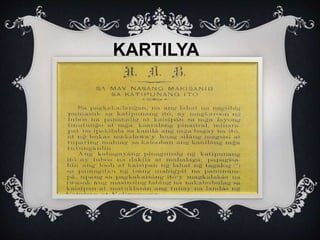
KARTILYA
These are the rules in Kartilya. The
Kartilya can be treated as the
Katipunan’s Code of conduct which
contains 14 rules that instruct the way
a Katipunero should behave.
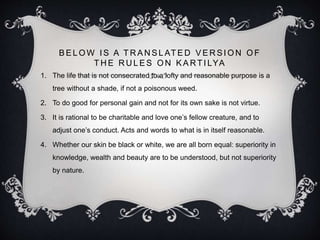
B E L O W I S A T R A N S L AT E D V E R S I O N O F
T H E R U L E S O N K A RT I LYA
1. The life that is not consecrated to a lofty and reasonable purpose is a
tree without a shade, if not a poisonous weed.
2. To do good for personal gain and not for its own sake is not virtue.
3. It is rational to be charitable and love one’s fellow creature, and to
adjust one’s conduct. Acts and words to what is in itself reasonable.
4. Whether our skin be black or white, we are all born equal: superiority in
knowledge, wealth and beauty are to be understood, but not superiority
by nature.
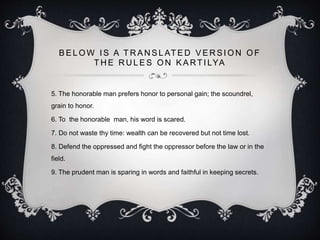
B E L O W I S A T R A N S L AT E D V E R S I O N O F
T H E R U L E S O N K A RT I LYA
5. The honorable man prefers honor to personal gain; the scoundrel,
grain to honor.
6. To the honorable man, his word is scared.
7. Do not waste thy time: wealth can be recovered but not time lost.
8. Defend the oppressed and fight the oppressor before the law or in the
field.
9. The prudent man is sparing in words and faithful in keeping secrets.
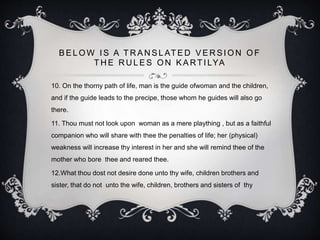
B E L O W I S A T R A N S L AT E D V E R S I O N O F
T H E R U L E S O N K A RT I LYA
10. On the thorny path of life, man is the guide ofwoman and the children,
and if the guide leads to the precipe, those whom he guides will also go
there.
11. Thou must not look upon woman as a mere plaything , but as a faithful
companion who will share with thee the penalties of life; her (physical)
weakness will increase thy interest in her and she will remind thee of the
mother who bore thee and reared thee.
12.What thou dost not desire done unto thy wife, children brothers and
sister, that do not unto the wife, children, brothers and sisters of thy
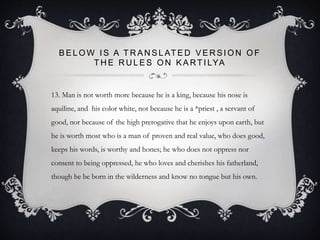
B E L O W I S A T R A N S L AT E D V E R S I O N O F
T H E R U L E S O N K A RT I LYA
13. Man is not worth more because he is a king, because his nose is
aquiline, and his color white, not because he is a *priest , a servant of
good, nor because of the high prerogative that he enjoys upon earth, but
he is worth most who is a man of proven and real value, who does good,
keeps his words, is worthy and hones; he who does not oppress nor
consent to being oppressed, he who loves and cherishes his fatherland,
though he be born in the wilderness and know no tongue but his own.
B E L O W I S A T R A N S L AT E D V E R S I O N O F
T H E R U L E S O N K A RT I LYA
14.When these rules of conduct shall be known to all, the longed-for
sun of liberty shall rise brialliant over this most unhappy portion of
the globe and its rays shall diffuse everlasting joy among the
confederated brethren of the same rays, the lives of those who have
gone before, the fatigues and the well-paid sufferings will remain. If
he who desires to enter (the katipunan) has informed himself of all
this and believes he will be able to perform what will be his duties,
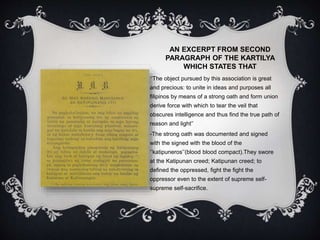
AN EXCERPT FROM SECOND
PARAGRAPH OF THE KARTILYA
WHICH STATES THAT
‘’The object pursued by this association is great
and precious: to unite in ideas and purposes all
filipinos by means of a strong oath and form union
derive force with which to tear the veil that
obscures intelligence and thus find the true path of
reason and light’’
-The strong oath was documented and signed
with the signed with the blood of the
‘’katipuneros’’(blood blood compact).They swore
at the Katipunan creed; Katipunan creed; to
defined the oppressed, fight the fight the
oppressor even to the extent of supreme self-
supreme self-sacrifice.
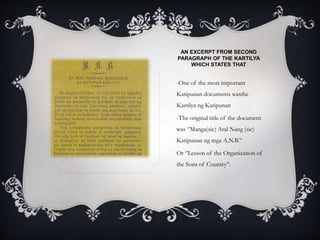
AN EXCERPT FROM SECOND
PARAGRAPH OF THE KARTILYA
WHICH STATES THAT
-One of the most important
Katipunan documents wasthe
Kartilya ng Katipunan
-The original title of the document
was ‘’Manga(sic) Aral Nang (sic)
Katipunan ng mga A.N.B.’’
Or ‘’Lesson of the Organization of
the Sons of Country’’.
R EAD IN G “ TH E PR OC LAMATION OF TH E
PH ILIPPIN E IN D EPEN D EN C E’’
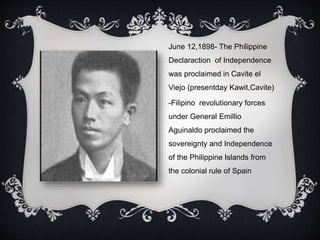
June 12,1898- The Philippine
Declaraction of Independence
was proclaimed in Cavite el
Viejo (presentday Kawit,Cavite)
-Filipino revolutionary forces
under General Emillio
Aguinaldo proclaimed the
sovereignty and Independence
of the Philippine Islands from
the colonial rule of Spain
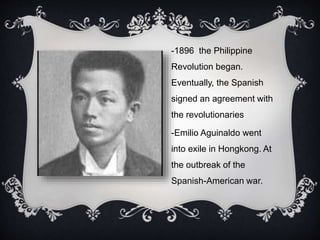
-1896 the Philippine
Revolution began.
Eventually, the Spanish
signed an agreement with
the revolutionaries
-Emilio Aguinaldo went
into exile in Hongkong. At
the outbreak of the
Spanish-American war.
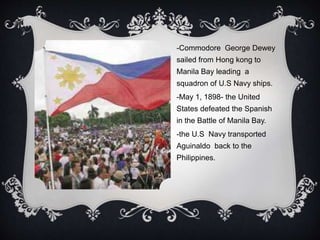
-Commodore George Dewey
sailed from Hong kong to
Manila Bay leading a
squadron of U.S Navy ships.
-May 1, 1898- the United
States defeated the Spanish
in the Battle of Manila Bay.
-the U.S Navy transported
Aguinaldo back to the
Philippines.
THE PROCLAMATION ON JUNE 12
Independece was proclaimed on June 12, 1898 between four
and five in the afternoon in Cavite at the ancestral home of
General Emilio Aguinaldo.
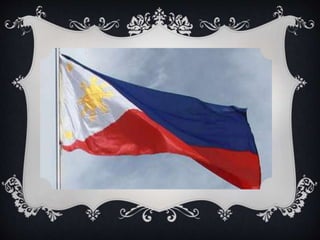
-The event saw the unfurling of the National Flag of the
Philippines, made in Hong kong by Marcela Agoncillio ,
Lorenza Agoncillio and Delfina Herboza.
THE PROCLAMATION ON JUNE 12
And the performance of the Marcha Filipina Magdalo, as the national
anthem, now known as Lupang Hinirang,which was composed by
Julián Felipe and played by the San Francisco de Malabon marching
band.
-The Act of the Declaration of Independence was prepared, written,
and read by Ambrosio Rianzares Bautista in Spanish.
THE PROCLAMATION ON JUNE 12
The Declaration was signed by ninety-eight people, among them an
American army officer who witnessed the proclamation who
attended the proceedings , Mr. L. M. Johnson, a Coronel of Artillery.
-The proclamation of the Philippines independence was, however,
promulgated on 1 August, when many towns had already been
organized under the rules laid down by the Dictional Government of
General Aguinaldo
THE PROCLAMATION ON JUNE 12
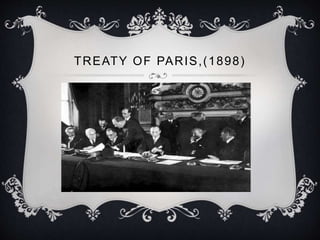
The declaration was not recognized by the U.S nor Spain later sold
the Philippines to the United States in the 1898 Treaty of Paris
ended the Spanish-American War-
Philippine-American War – The Philippine Revolutionary
Government did not recognize the treaty or American sovereignty,
and subsequently fought and lost a conflict with United States.
THE PROCLAMATION ON JUNE 12
Ended when EmilioAguinaldo was captured by U.S
forces, ang issued a statement acknowledge and
accepting the sovereignty of the United States over the
Philippines.
Following Worl War II, the US granted independence to
Philippines on July 4, 1946 via the Treaty of Manila.
TREATY OF PARIS,(1898)
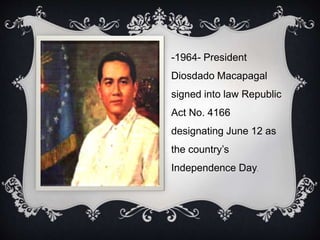
-1964- President
Diosdado Macapagal
signed into law Republic
Act No. 4166
designating June 12 as
the country’s
Independence Day.
HISTORY FINAL PPT.pptx

HISTORY FINAL PPT.pptx

  • 1.
    CHAPTER 2: CONTENT ANDCONTEXTUAL ANALYSIS OF SELECTED PRIMARY SOURCES IN PHILIPPINE HISTORY Group 1
  • 2.
    L EAR NIN G OBJ EC TIVES  To familiarize oneself with the primary documents in different historical periods of the philippines.  To learn history through primary sources.  To properly interpret primary sources though examining the contact and context of the document.  To understand the context behind each selected document.
  • 3.
    The historian’s primarytool of understanding and interpreting the past is the historical sources. Historical facts. Such facts are then analyzed and interpreted by historian to weave historical narrative. Using primary sources in historical research entails two kinds of criticism. The first one is EXTERNAL CRTICISM examines the authenticity of the document or the evidence being used while INTER CRITICISM examines the truthfulness of the content of the evidence.
  • 4.
    A Brief Summaryof the First Voyage Around the World Magellan by Antonio Pigafetta
  • 5.
    W H OI S A N TO N I O P I G A F E T TA ? - famous italian traveller born in Vicenza around 1940 and died in the same city in 1534, who is also known by the name of Antonio Lombardo or Francisco Antonio Pigafetta. Initially linked to the Rhodes, which was knight, went to Spain in 1519, accompanied by Monsignor Francisco Chiericato, and was made available from Carlos V to promote the company initiated by the Catholic Monarchs in the Atlantic. Soon he became a great friendship with Magallanes, who accompanied, together with Juan Sebastian Elcano, in the famous expedition to the Moluccas begun in August of 1519 and finished in September 1522.
  • 6.
    WHO IS ANTONIOPIGAFETTA? He was wounded at the battle of the island of cebu (philippine) in which Magellan found death. The output of Seville made it aboard of the Trinity; the return, along with a handful of survivors (17 of the 239 who left adventure), in victory, ship that entered in Sanlucar de Barrameda (Cadiz) on September 6, the designated year. In the last years of his life, he traveled by land from France to finally return to Italy in 1523. He wrote the relation of that trip, which was the first around the world, Italian and with the title of Relazion in lathe to the primo viaggio di circumnavigazione. Notizia del Mondo Nuovo with figure you dei paesi scoperti, which was published posthumously, in 1536.
  • 7.
    WHO IS ANTONIO PIGAFETTA? Theaccount of Pigafetta is the single most important source about the voyage of circumnavigation, despite its tendency to include fabulous details. He took notes daily, as he mentioned when he realizes his surprise at Spain and see that he had lost a day (due to its driving direction). Includes descriptions of numerous animals, including sharks, the storm petrel (Hydrobates pelagius), the pink spoonbill (Ajaja ajaja) and the Phyllium orthoptera, an insect similar to a sheet. Pigafetta captured a copy of the latter near Borneo and kept it in a box, believing a moving blade who lived in the air. His report is rich in ethnographic details. He practiced as interpreter and came to develop, at least in two Indonesian dialects.
  • 8.
    Pigafetta’s work instantlybecame a classic that prominent literary men in the West like WILLIAM SHAKESPEARE, MICHEL de MONTAIGNE, and GIAMBATTISTA VICO reffered to the book in their interpretation of the New World. Pigafetta’s travelogue is one of the most important primary sources in the study of the precolonial Philippines.
  • 9.
    In Pigafetta’s account,their reached what he called the LADRONES ISLANDS or the “Island of the Thieves”. He recounted: “These people have no arms, but use sticks, which have a finish bone at the end. They are poor, but ingenious, and great thieves, and for the sake of that we call these three islands the Ladrones Islands”.
  • 10.
    T H EL A D R O N E S I S L A N D S
  • 11.
    The Ladrones Islandis presently known as the Marianas Islands. Tendays after they have reached Ladrones Islands, Pigafetta resported that they have what he called the Isle of Zamal, now Samar but Magellan decided to land in another uninhabited island for greater security where they could rest for a few days. On MARCH 18, nine men came to them and showed joy and eagerness in seeing them. Magellan realized that the men were reasonable and welcomed them with food, drinks and gifts.
  • 12.
    Pigafetta detailed inamazement and fascination the palm tree which bore fruits called cochos and wine. He characterized the people as ‘’very familiar and friendly’’ and willingly showed them different islands and the names of these islands. The fleet went to Humunu Island (Homonhon ) and there they found what he reffered to as the “Watering Place of Good Signs”. for it is in this place that they found the first signs of gold in the island. They named the island together with a nearby island as the archipelago of St. lazarus.
  • 13.
    On March 25th, Pigafetta recountend that they saw two (balangay), a long boat full of people in Mazzava /Mazaus , The leader whom he reffered to the king became closely bonded with Magellan as they both exchange gifts to one another . After a few days, Magellan was introduced to the king’s brother who was also a king of another island where Pigafetta reported that they saw mines of gold. The gold was. This king was named Raia Calambu, king of Zuluan and Calagan (Butuan and Caragua), and the first king was Raia Siagu.
  • 14.
    On March 31st(Easter Sunday ), Magellan ordered the chaplain to preside a Mass by the shore. The king heard about this plan and sent two dead pigs and attended the Mass with the other king Pigafetta then wrote: “… when the offertory of the mass came, the two kings, went to kiss the cross like us, but they offered nothing, and at the elevation of the body of our Lord they were kneeling like us, and adored our Lord with joined hands.” This was the first Mass in the Philippines, and the cross would be famed Magellan’s Cross which is still preserved at present day. This was the same cross which Magellan explained to the kings as a sign of emperor who ordered him to plan it in the places were he would reach and further explained that once other Spaniards saw this cross, then they would know that they had been in this islands and would not cause them troubles.
  • 15.
    By April 7th,Magellan and his men reached the port of Zzubu (Cebu) with the help of Raia Calambu who offered to pilot them in going to the island. The kind of Cebu demanded that they pay tribute as it was customary but Magellan refused. By the next day, Magellan’s men and the king of Cebu, together with other principal men of Cebu, ,et in an open space, There the king offered a bit of his blood and demanded that Magellan do the same. On April 14, Magellan spoke to the kind and encouraged him to be a good Christian by burning all of the idols and worship the cross instead. The king of Cebu was then baptized as a Christian. After 8 days, all of the islans’s inhabitant were already baptized.
  • 16.
    When the quuencame to the Mass one day, Magellan gave her an image of the Infant Jesus made by Pigafetta himself. On 26th of April, Zula, a principal man from the Island of Matan (Mactan) went to see Magellan and asked him for a boat full of men so that he would be able to fight the chief name Silapulapu (Lapulapu). Magellan offered 3 boats instead and went to Mactan to fight the said chief. They numbered 49 in total and the Islanders of Mactan were estimated to number 1,500. Magellan died in battle. He was pierced with a poison arrow in his right leg. The king of Cebu who was baptized offered help but Magellan refused so that he could see how they fought. The kind also offered the people of Mactan gifts of any value and amount in exchange of Magellan’s body but the chief refused and wantend to keep Magellan’s body as a memento of their victory.
  • 17.
    Magellan’s men thenelected Duarte Barsosa as the new captain Pigafetta also accounted how Magellan’s slave and interpreter named Henry betrayed them and told the king of Cebu that they intended to leave as soon as possible. Henry and king of Cebu conspired and betrayed what was left of Magellan’s men. The king invited these men to a gathering where he said he would present the jewels that he would send for the king of Spain.
  • 18.
    Pigafetta was lefton board the ship and was not able to join the 24 men who went to the gathering because he was nursing his wounds. The natives had slain all the men except the interpreter and Juan Serrano who shouted at the men on this ship to pay ransom so that he would be spared but he was left on the island for they refused to go back to shore. The fleet abandoned Serrano and departed. They left Cebu and continued their journey around the world.
  • 19.
    THE KKK andthe “Kartilya ng Katipunan”
  • 21.
     The Kataastaasan,Kagalanggalang Katipunan ng mga Anak ng Bayan (KKK) or Katipunan is arguably the most important organization formed in the Philippine history.  The two principal aims of the KKK as gathered from the writings of Bonifacio: 1. Unity of the filipino people 2. Separation from spain by means of revolution
  • 22.
    Bonifacio came outafter the failure of the reform movement headed by Rizal and M. Del Pilar. This paved way for a more radical and more active lines. He formed the Katipunan, a secret society which was founded at tondo Manila, in a house on Azcarraga Street then numbered 314, on July 7, 1892, the same date on which Rizal was decreed to be banished to Dapitan.
  • 23.
    Rizal doubtless approvedthe first aim but refused to accept the second and this was the reason that he refused to go along with the “Katipuneros” (soldier’s of the Katipunan) and voluntarily surrendered that leads him to prison and death. To achieve unity of the Filipinos, propaganda work must be done and this was though massive education and civic trainings of the Katipuneros. To that end, Bonifacio prepared his now well-known decalogoue, and Jacinto his famous “Kartilya ng Katipunan’’(Primer of the Katipunan)
  • 24.
  • 25.
    These are therules in Kartilya. The Kartilya can be treated as the Katipunan’s Code of conduct which contains 14 rules that instruct the way a Katipunero should behave.
  • 26.
    B E LO W I S A T R A N S L AT E D V E R S I O N O F T H E R U L E S O N K A RT I LYA 1. The life that is not consecrated to a lofty and reasonable purpose is a tree without a shade, if not a poisonous weed. 2. To do good for personal gain and not for its own sake is not virtue. 3. It is rational to be charitable and love one’s fellow creature, and to adjust one’s conduct. Acts and words to what is in itself reasonable. 4. Whether our skin be black or white, we are all born equal: superiority in knowledge, wealth and beauty are to be understood, but not superiority by nature.
  • 27.
    B E LO W I S A T R A N S L AT E D V E R S I O N O F T H E R U L E S O N K A RT I LYA 5. The honorable man prefers honor to personal gain; the scoundrel, grain to honor. 6. To the honorable man, his word is scared. 7. Do not waste thy time: wealth can be recovered but not time lost. 8. Defend the oppressed and fight the oppressor before the law or in the field. 9. The prudent man is sparing in words and faithful in keeping secrets.
  • 28.
    B E LO W I S A T R A N S L AT E D V E R S I O N O F T H E R U L E S O N K A RT I LYA 10. On the thorny path of life, man is the guide ofwoman and the children, and if the guide leads to the precipe, those whom he guides will also go there. 11. Thou must not look upon woman as a mere plaything , but as a faithful companion who will share with thee the penalties of life; her (physical) weakness will increase thy interest in her and she will remind thee of the mother who bore thee and reared thee. 12.What thou dost not desire done unto thy wife, children brothers and sister, that do not unto the wife, children, brothers and sisters of thy
  • 29.
    B E LO W I S A T R A N S L AT E D V E R S I O N O F T H E R U L E S O N K A RT I LYA 13. Man is not worth more because he is a king, because his nose is aquiline, and his color white, not because he is a *priest , a servant of good, nor because of the high prerogative that he enjoys upon earth, but he is worth most who is a man of proven and real value, who does good, keeps his words, is worthy and hones; he who does not oppress nor consent to being oppressed, he who loves and cherishes his fatherland, though he be born in the wilderness and know no tongue but his own.
  • 30.
    B E LO W I S A T R A N S L AT E D V E R S I O N O F T H E R U L E S O N K A RT I LYA 14.When these rules of conduct shall be known to all, the longed-for sun of liberty shall rise brialliant over this most unhappy portion of the globe and its rays shall diffuse everlasting joy among the confederated brethren of the same rays, the lives of those who have gone before, the fatigues and the well-paid sufferings will remain. If he who desires to enter (the katipunan) has informed himself of all this and believes he will be able to perform what will be his duties,
  • 31.
    AN EXCERPT FROMSECOND PARAGRAPH OF THE KARTILYA WHICH STATES THAT ‘’The object pursued by this association is great and precious: to unite in ideas and purposes all filipinos by means of a strong oath and form union derive force with which to tear the veil that obscures intelligence and thus find the true path of reason and light’’ -The strong oath was documented and signed with the signed with the blood of the ‘’katipuneros’’(blood blood compact).They swore at the Katipunan creed; Katipunan creed; to defined the oppressed, fight the fight the oppressor even to the extent of supreme self- supreme self-sacrifice.
  • 32.
    AN EXCERPT FROMSECOND PARAGRAPH OF THE KARTILYA WHICH STATES THAT -One of the most important Katipunan documents wasthe Kartilya ng Katipunan -The original title of the document was ‘’Manga(sic) Aral Nang (sic) Katipunan ng mga A.N.B.’’ Or ‘’Lesson of the Organization of the Sons of Country’’.
  • 33.
    R EAD ING “ TH E PR OC LAMATION OF TH E PH ILIPPIN E IN D EPEN D EN C E’’
  • 35.
    June 12,1898- ThePhilippine Declaraction of Independence was proclaimed in Cavite el Viejo (presentday Kawit,Cavite) -Filipino revolutionary forces under General Emillio Aguinaldo proclaimed the sovereignty and Independence of the Philippine Islands from the colonial rule of Spain
  • 36.
    -1896 the Philippine Revolutionbegan. Eventually, the Spanish signed an agreement with the revolutionaries -Emilio Aguinaldo went into exile in Hongkong. At the outbreak of the Spanish-American war.
  • 37.
    -Commodore George Dewey sailedfrom Hong kong to Manila Bay leading a squadron of U.S Navy ships. -May 1, 1898- the United States defeated the Spanish in the Battle of Manila Bay. -the U.S Navy transported Aguinaldo back to the Philippines.
  • 38.
    THE PROCLAMATION ONJUNE 12 Independece was proclaimed on June 12, 1898 between four and five in the afternoon in Cavite at the ancestral home of General Emilio Aguinaldo. -The event saw the unfurling of the National Flag of the Philippines, made in Hong kong by Marcela Agoncillio , Lorenza Agoncillio and Delfina Herboza.
  • 39.
    THE PROCLAMATION ONJUNE 12 And the performance of the Marcha Filipina Magdalo, as the national anthem, now known as Lupang Hinirang,which was composed by Julián Felipe and played by the San Francisco de Malabon marching band. -The Act of the Declaration of Independence was prepared, written, and read by Ambrosio Rianzares Bautista in Spanish.
  • 40.
    THE PROCLAMATION ONJUNE 12 The Declaration was signed by ninety-eight people, among them an American army officer who witnessed the proclamation who attended the proceedings , Mr. L. M. Johnson, a Coronel of Artillery. -The proclamation of the Philippines independence was, however, promulgated on 1 August, when many towns had already been organized under the rules laid down by the Dictional Government of General Aguinaldo
  • 41.
    THE PROCLAMATION ONJUNE 12 The declaration was not recognized by the U.S nor Spain later sold the Philippines to the United States in the 1898 Treaty of Paris ended the Spanish-American War- Philippine-American War – The Philippine Revolutionary Government did not recognize the treaty or American sovereignty, and subsequently fought and lost a conflict with United States.
  • 42.
    THE PROCLAMATION ONJUNE 12 Ended when EmilioAguinaldo was captured by U.S forces, ang issued a statement acknowledge and accepting the sovereignty of the United States over the Philippines. Following Worl War II, the US granted independence to Philippines on July 4, 1946 via the Treaty of Manila.
  • 43.
  • 44.
    -1964- President Diosdado Macapagal signedinto law Republic Act No. 4166 designating June 12 as the country’s Independence Day.