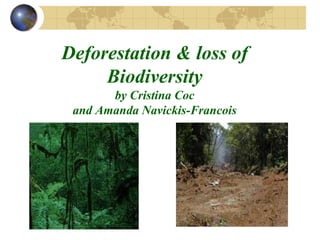
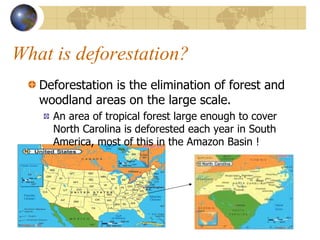
Deforestation & loss of
     Biodiversity
     Biodiversity
       by Cristina Coc
        by Cristina Coc
 and Amanda Navickis-Francois
 and Amanda Navickis-Francois
What is deforestation?
   Deforestation is the elimination of forest and
   woodland areas on the large scale.
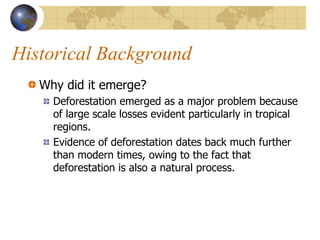
     An area of tropical forest large enough to cover
     North Carolina is deforested each year in South
     America, most of this in the Amazon Basin !
Historical Background
   Why did it emerge?
     Deforestation emerged as a major problem because
     of large scale losses evident particularly in tropical
     regions.
     Evidence of deforestation dates back much further
     than modern times, owing to the fact that
     deforestation is also a natural process.
Historical Background (continued)
   Why is it a problem?
     Deforestation causes problems on both the
     evolutionary, social, and ecological scales.
      • Ecological: Deforestation eliminates key habitats that
        support highly specialized and sensitive species, and
        eliminates the Forests ability to act as natural water and
        air filters
      • Evolutionary: With habitat loss comes the loss of
        highly specialized species, eliminating continued
        speciation, and often causing widespread extinctions
Historical Background (continued)
      • Social: In many developing countries
        deforestation is committed in an attempt to
        sustain local human populations on the local
        and global economic scale.
         – Slash and burn
         – Urbanization
         – Boundary Waters and Old Growth
Current status
   Where is deforestation still a problem?
     Developing countries.
     Tropical regions are at highest risk.
     Developed countries.
Causes
  Commercial Logging
  Agriculture
  Roads & Railways
  Forest fires
  Mining and drilling
  Fuel-wood collection
  Residential living
  space
Two most commonly sited causes
   Shifting Cultivation            Commercial Logging
      Indigenous farming of          Business & trade
      Rainforest
                                     Minor disturbances
      Grazing space
      Rotation
      No threat!
                                     Exceed carrying
                                     capacity
      Sustainability
                                     Intensive
                                     mechanized logging
      Insufficient recovery time
      Intensive/ commercial
                                     Accessibility to
      farming                        remote areas
Effects of deforestation
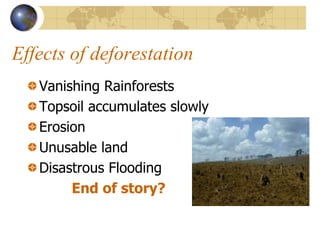
   Vanishing Rainforests
   Topsoil accumulates slowly
   Erosion
   Unusable land
   Disastrous Flooding
        End of story?
NOT!!! Effects Continued…
  Clearance = limited food and shelter
  Desertification
  Disappearance of ways of life
  Negative impact on the climate
  Global warming
  Green house effect
  Build up of CO2
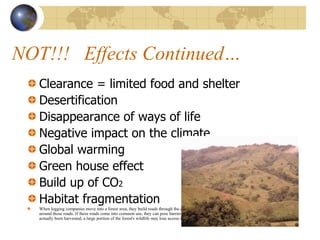
  Habitat fragmentation
  When logging companies move into a forest area, they build roads through the center of the forest and then perform their logging operations
  around those roads. If these roads come into common use, they can pose barriers for wildlife. As such, while only a small area may have
  actually been harvested, a large portion of the forest's wildlife may lose access to certain essential nearby habitats.
Wait there is more…
   Loss Scientific
   possibilities
   Identification of
   species
   Cures for deadly
   diseases
“Good Reasons for…”
  Economic benefits
  Sustenance
  development
  Fertility
  Services provided
  Habitation
Striving for a Balance
   Ecological function                 “Forest management with
   O2 bank                             a focus and intention that
   Replenish nutrient in               it be used in the
   land                                combination that will best
   Prevent desertification             meet the needs of people
   Source of timber                    and not necessarily the
   Effective use of renewable energy
                                       combination of uses that
   resources,                          will give the greatest
   Alleviate use of wood as            dollar return.”
   fuel
Current status (belatedly
continued)
   Key points needing further investigation
   and study:
     Connections between atmospheric CO2
     concentrations and amount of global
     forested regions
     Deforestation as linked to Desertification
     Solving economic and ecological problems
     using more than short term solutions.
“certain species may live in a forest but depend on
a nearby grassland or wetland for a food source –”
                                   ~Elizabeth Brown


    “While logging is, of course, necessary it should be done in a
carefully controlled, certified manner in order to ensure that it doesn't
 destroy essential wildlife habitats – and, more obviously, in order to
 ensure that we don't eventually completely run out of wood to log!”
Do the immediate benefits outweigh
the long-term costs? We don’t
think so…
So it’s bad, so what do you do
             about it?
   Stop cutting           Suitably enforce
   Sustainable logging    legislation
   Proper management      Education and
   FSC                    awareness
   Indigenous people      Life style changes
   Forest capacity        Greater appreciation
                          for Mother Nature
   Sensitive regions as
   protected areas
Citations
 http://www.botany.uwc.ac.za/Envfacts/facts/defore
 station.htm
 http://www.nationalgeographic.com/eye/deforestati
 on/deforestation.html
 http://earthobservatory.nasa.gov/Library/Deforestat
 ion/deforestation_3.html
 http://www.globaled.org/issues/152/a.html
 http://www.oxfam.org.uk/coolplanet/ontheline/expl
 ore/nature/rainforest/deforest

Deforestation

  • 1.
    Deforestation & lossof Deforestation & loss of Biodiversity Biodiversity by Cristina Coc by Cristina Coc and Amanda Navickis-Francois and Amanda Navickis-Francois
  • 2.
    What is deforestation? Deforestation is the elimination of forest and woodland areas on the large scale. An area of tropical forest large enough to cover North Carolina is deforested each year in South America, most of this in the Amazon Basin !
  • 3.
    Historical Background Why did it emerge? Deforestation emerged as a major problem because of large scale losses evident particularly in tropical regions. Evidence of deforestation dates back much further than modern times, owing to the fact that deforestation is also a natural process.
  • 4.
    Historical Background (continued) Why is it a problem? Deforestation causes problems on both the evolutionary, social, and ecological scales. • Ecological: Deforestation eliminates key habitats that support highly specialized and sensitive species, and eliminates the Forests ability to act as natural water and air filters • Evolutionary: With habitat loss comes the loss of highly specialized species, eliminating continued speciation, and often causing widespread extinctions
  • 5.
    Historical Background (continued) • Social: In many developing countries deforestation is committed in an attempt to sustain local human populations on the local and global economic scale. – Slash and burn – Urbanization – Boundary Waters and Old Growth
  • 6.
    Current status Where is deforestation still a problem? Developing countries. Tropical regions are at highest risk. Developed countries.
  • 7.
    Causes CommercialLogging Agriculture Roads & Railways Forest fires Mining and drilling Fuel-wood collection Residential living space
  • 8.
    Two most commonlysited causes Shifting Cultivation Commercial Logging Indigenous farming of Business & trade Rainforest Minor disturbances Grazing space Rotation No threat! Exceed carrying capacity Sustainability Intensive mechanized logging Insufficient recovery time Intensive/ commercial Accessibility to farming remote areas
  • 9.
    Effects of deforestation Vanishing Rainforests Topsoil accumulates slowly Erosion Unusable land Disastrous Flooding End of story?
  • 10.
    NOT!!! Effects Continued… Clearance = limited food and shelter Desertification Disappearance of ways of life Negative impact on the climate Global warming Green house effect Build up of CO2 Habitat fragmentation When logging companies move into a forest area, they build roads through the center of the forest and then perform their logging operations around those roads. If these roads come into common use, they can pose barriers for wildlife. As such, while only a small area may have actually been harvested, a large portion of the forest's wildlife may lose access to certain essential nearby habitats.
  • 11.
    Wait there ismore… Loss Scientific possibilities Identification of species Cures for deadly diseases
  • 12.
    “Good Reasons for…” Economic benefits Sustenance development Fertility Services provided Habitation
  • 13.
    Striving for aBalance Ecological function “Forest management with O2 bank a focus and intention that Replenish nutrient in it be used in the land combination that will best Prevent desertification meet the needs of people Source of timber and not necessarily the Effective use of renewable energy combination of uses that resources, will give the greatest Alleviate use of wood as dollar return.” fuel
  • 14.
    Current status (belatedly continued) Key points needing further investigation and study: Connections between atmospheric CO2 concentrations and amount of global forested regions Deforestation as linked to Desertification Solving economic and ecological problems using more than short term solutions.
  • 15.
    “certain species maylive in a forest but depend on a nearby grassland or wetland for a food source –” ~Elizabeth Brown “While logging is, of course, necessary it should be done in a carefully controlled, certified manner in order to ensure that it doesn't destroy essential wildlife habitats – and, more obviously, in order to ensure that we don't eventually completely run out of wood to log!”
  • 16.
    Do the immediatebenefits outweigh the long-term costs? We don’t think so…
  • 17.
    So it’s bad,so what do you do about it? Stop cutting Suitably enforce Sustainable logging legislation Proper management Education and FSC awareness Indigenous people Life style changes Forest capacity Greater appreciation for Mother Nature Sensitive regions as protected areas
  • 18.
    Citations http://www.botany.uwc.ac.za/Envfacts/facts/defore station.htm http://www.nationalgeographic.com/eye/deforestati on/deforestation.html http://earthobservatory.nasa.gov/Library/Deforestat ion/deforestation_3.html http://www.globaled.org/issues/152/a.html http://www.oxfam.org.uk/coolplanet/ontheline/expl ore/nature/rainforest/deforest