DEBRE MARKOS UNIVERSITY
INSTITUTE OF TECHNOLOGY
SCHOOL OF CIVIL AND WATER RESOURCE ENGINEERING
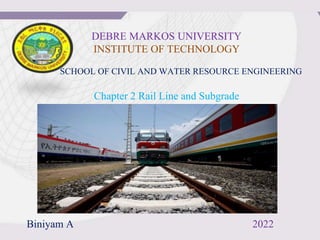
Chapter 2 Rail Line and Subgrade
Biniyam A 2022
Contents
• Economic survey and route selection of railway line
• Plane section design
• Longitudinal section design
Introduction
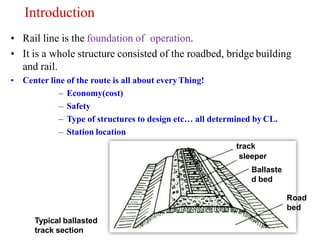
• Rail line is the foundation of operation.
• It is a whole structure consisted of the roadbed, bridge building
and rail.
• Center line of the route is all about everyThing!
– Economy(cost)
– Safety
– Type of structures to design etc… all determined by CL.
– Station location
track
sleeper
Ballaste
d bed
Road
bed
Typical ballasted
track section
Economic survey and route selection
Three stages:
Study and design
Feedback & evaluation
1. Earlier stage: research, survey and preliminary design work.
2. Basic construction stage :first to do the measurement,
technical design and construction design, then begin to
construct it, finally check it into production.
3. Effect of feedback:several years later, to evaluate the
design and construction quality by investigate the engineering
quality, technical index and economic benefits.
Construction + maintenance
Route selection…
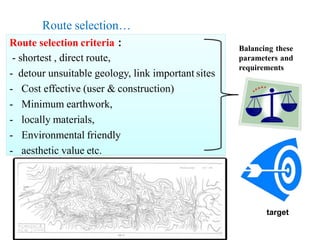
Route selection criteria:
- shortest , direct route,
- detour unsuitable geology, link important sites
- Cost effective (user & construction)
- Minimum earthwork,
- locally materials,
- Environmental friendly
- aesthetic value etc.
Balancing these
parameters and
requirements
target
Track geometry components
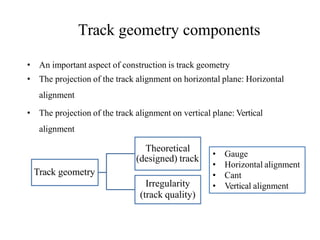
• An important aspect of construction is track geometry
• The projection of the track alignment on horizontal plane: Horizontal
alignment
• The projection of the track alignment on vertical plane: Vertical
alignment
Track geometry
Theoretical
(designed) track
Irregularity
(track quality)
• Gauge
• Horizontal alignment
• Cant
• Vertical alignment
Track alignment
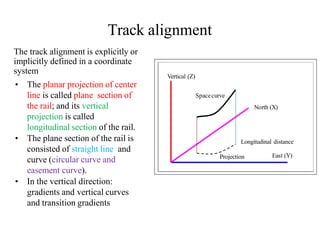
The track alignment is explicitly or
implicitly defined in a coordinate
system
• The planar projection of center
line is called plane section of
the rail; and its vertical
projection is called
longitudinal section of the rail.
• The plane section of the rail is
consisted of straight line and
curve (circular curve and
easement curve).
• In the vertical direction:
gradients and vertical curves
and transition gradients
Vertical (Z)
North (X)
East (Y)
Longitudinal distance
Spacecurve
Projection
Locus of center of gravity position
of car body exists will take three
trajectories:
① curvature is zero: straight line;
② curvature is constant: circle curve;
③ curvature is variable: transition curve.
The main components of
Plane design:
1. Curves
2. Tangent/ straight lines
3. Easement/spiral curves
4. superelevation
1. Plane design
8
The curve is set when the line turns or
when two straight lines intersect.
curve radius (R),
corner curve (α),
curve length (L)
Tangent length (T),
easement curve length (Lo) .
Constituent parts of the curve
Types of curves
- simple/single
- common
Single curve
tangent length:
curve length:
External length:
9
𝐿 =
𝜋 𝛼 − 2𝛽𝑜 𝑅
180
+ 2𝑙𝑜 ≈
𝜋𝛼𝑅
180
+ 𝑙𝑜 𝑚
𝐸 = 𝑅 + 𝑃 𝑠𝑒𝑐
𝛼
2
− 𝑅 𝑚
𝑇 = 𝑅 + 𝑃 𝑡𝑎𝑛
𝛼
2
+ 𝑚 𝑚
𝑚 =
𝑙𝑜
2
−
𝑙𝑜
3
240𝑅2
≈
𝑙𝑜
2 𝑚
𝑝 =
𝑙𝑜
2
24𝑅
(𝑚)
Common curve
10
When considering Easement curve:
Straight tracks (tangent tracks)
Straight tracks (sometimes “tangent tracks”)
• Horizontal curvature (change of direction
per unit length of the track) is zero
• Shortest length between two points
• No quasi-static lateral acceleration, no
need for cant
• Smallest possible gap between a train and
a platform
• Easy to check the train doors at a platform
• Possible to guide tamping machines with
laser beams
• Easy to install switches and crossings
Straight tracks
• There is no requirement for limiting
the length of straight track, only
minimum length
• The world’s longest straight track:
Australia, 478 km
• The longest straight track in Norway:
Kvineshei tunnel, 9020 m
(www.jernbaneverket.no)
Circular curve
Circular curves (sometimes “full curves”) with constant curve radius, R
• Constant horizontal curvature (change of direction per unit length of
the track)
• Constant quasi-static lateral acceleration (if the train runs at constant
speed)
Sign rules: Track standards use to have no sign rules. Software use
minus values for left hand curves (in the direction of the chainage).
Hence: -20000 meter is a larger radius than -200 meter
Circular curve
• The minimum radius is determined by the speed
– 30-60 m for tramways/metro lines
‐ 60-90 m on industrial railways
‐ Line speed for tramways/metro varies between 40 to 80 km/h
Recommended and minimum horizontal curve radius for v > 200 km/h:
Speed [km/h] 200 250 280 300 330 350
Recommended radius [m] 3200 5000 6300 7200 8700 9800
Minimum radius [m] 1888 2950 3700 4248 5140 5782
Note: use integer values for radius and not
larger than 99999 m
Circular curve
• There area also speed-independent criteria
– There is a minimum radius for tracks in platforms and turnouts
(Minimum radius for platform tracks R = 300
All vehicles must be able to run on R = 150 m (UIC)
– Minimum radius for no gauge widening R = 200 m
– Minimum radius for CWR R = 250 - 300 m
• Minimum length of curves and tangent tracks - Lmin > 0.4v
• Minimum radius for mainline tracks R ≥ 300 m
Circular curve
• The choice of the curve radius also depends on the characteristic of the
bogie
Tight curves and wide curve
Soft and rigid bogie suspension
Principal figure on how rails wear in curves
Circular curve effects
A vehicle running in a curve with radius R and speed v
experiences a centrifugal lateral acceleration a = v2/R this results
undesirable effects:
• possible passenger discomfort and noise nuisance
• possible displacement of wagon loads
• risk of vehicles overturning
• risk of derailment by wheel climbing or loosening of rail fastenings
Circular curve effects
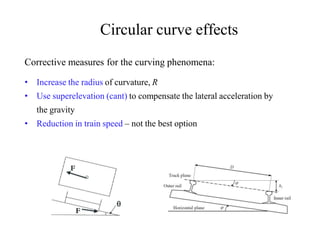
Corrective measures for the curving phenomena:
• Increase the radius of curvature, R
• Use superelevation (cant) to compensate the lateral acceleration by
the gravity
• Reduction in train speed – not the best option
SUPERELEVATION (CANT)
Superelevation (cant)
• Cant is a corrective measure for the curving phenomena to compensate the
lateral acceleration
α
Applied cant (sometimes “superelevation”) is the amount of which one
running rail is raised above the other inner rail
• On curves, positive cant indicates that the outer rail is raised above
the inner rail
Superelevation (cant)
Equilibrium cant
m.v2
R
x
y
m.g
α
Fc
Fg
g = gravity = 9.81 (m/s/s)
R = curve radius (m)
α = cant angle (rad)
v = vehicle speed (m/s)
s = track width (1500 mm)
m = total mass of the vehicle
Fnet
h mv2
sv2
;
Therefore at balanced speed the cant
mv2
mgh
The equilibrium cant expressed in mm
net c g
mv2
F  F  F ;
Fc  cos; Fg  mg sin;
R
mgh
R
For small angle   ; F 
s c
; Fg 
s
gh
R s
v2
R s
At balanced speed Fnet  0 so
h 
gR
  
11.8v2
(km/h)
hth (mm) 
R(m)
Track plane acceleration
𝑣2
ℎ
𝑎𝑦 ≈
𝑅
− 𝑔 ∙
𝑠
• In case of quasistatic curving: track plane acceleration is 𝑎𝑦, and the
acceleration normal to the track plane is 𝑎𝑧
𝑣2
𝑎𝑦 =
𝑅
∙ 𝑐𝑜𝑠𝛼 − 𝑔 ∙ 𝑠𝑖𝑛𝛼
𝑣𝑒𝑞 =
• For a given cant an equilibrium
or balanced speed 𝑣𝑒𝑞, (𝑎𝑦 = 0)
𝑅𝑔ℎ
𝑠
Maximum speed in curves
• The important formula
𝑣2
− 𝑔 ∙ ℎ
= 𝑎 ≤ 𝑎
𝑅 𝑠 𝑦 𝑦,𝑚𝑎𝑥
 𝑣𝑚𝑎𝑥 =
𝑠
𝑔ℎ
+ 𝑎𝑦 ,𝑚𝑎
𝑥
∙ 𝑅
𝑎𝑦,𝑚𝑎𝑥 Maximum allowed uncompensated lateral acceleration
Applied cant limits
• Maximum applied cant on normal lines for high speed lines
Applied cant & cant deficiency
• For a number of trains the cant is
either too much or not enough
• Too much cant wear the inner wheel-
rail and increase friction on wheel
flange and increases the tractive
power required
• Too less cant causes large increase in
wear on the high rail
• Not enough cant creates transvers
force which is detrimental for both
safety and comfort (risk for
derailment and track displacement)
Cant deficiency (hd)
• Cant deficiency exists when the vehicle is travelling above balancing speed,
insufficient cant angle to cancel out lateral curving force
• The difference between the theoretical value of cant for maximum speed and the
applied value of cant
hd = ht (vmax) - ha < hd_all
𝑣2
𝑅
ℎ
𝑠
− 𝑔 ∙ 𝑎
= 𝑎𝑦
h +h
𝑣2
𝑅 𝑠
− 𝑔 ∙ 𝑎 d = 0
• The non compensated acceleration will be: ay = hd g/s
• With a non compensated acceleration of 1 m/s2 (maximum limit) and axle load
of 22.5 t, the quasi-static lateral load on the track is 22.5 kN
Cant deficiency and maximum speed
• The maximum non compensated acceleration ad,𝑚𝑎𝑥 expressed in terms of
maximum cant deficiency hd_max
ay,𝑚𝑎𝑥 = 𝑔 hd,max
𝑠
Gives the maximum speed in circular curve expressed with hd_max
𝑔
𝑠
ℎ + hd,𝑚𝑎𝑥
𝑣 = ∙ 𝑅
hd,𝑚𝑎𝑥 Maximum allowable cant deficiency
Example
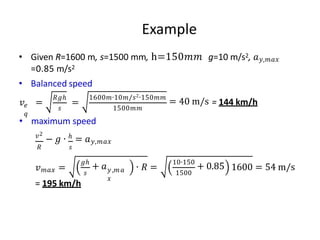
• Given R=1600 m, s=1500 mm, h=150𝑚𝑚 g=10 m/s2, 𝑎𝑦,𝑚𝑎𝑥
=0.85 m/s2
• Balanced speed
𝑒
𝑞
𝑣 =
𝑅𝑔ℎ
𝑠
=
1500𝑚𝑚
1600𝑚∙10𝑚/𝑠2
∙150𝑚𝑚
= 40 m/s = 144 km/h
• maximum speed
𝑣2 ℎ
− 𝑔 ∙ = 𝑎𝑦,𝑚𝑎𝑥
𝑅 𝑠
𝑣𝑚𝑎𝑥 = 𝑠
𝑔ℎ
+ 𝑎𝑦 ,𝑚𝑎
𝑥
∙ 𝑅 =
1500
10∙150
+ 0.85 1600 = 54 m/s
= 195 km/h
Example
• Given v=240 km/h, s=1500 mm, h = 150 mm, g=10m/s2,
𝑎𝑦,𝑚𝑎𝑥=0.85 m/s2
𝑣2
− 𝑔 ∙ ℎ𝑚𝑎𝑥
= 𝑎
𝑅 𝑠 𝑦,𝑚𝑎𝑥
𝑣2
𝑅 = 𝑔ℎ𝑚𝑎𝑥
+ 𝑎𝑦,𝑚𝑎𝑥
240
3.6
2
= 10*150
𝑠 1500
+ 0.85
= 𝟐𝟒𝟎𝟎 𝐦
 High speed – large curve radius
Cant deficiency limits
• Limits for cant deficiency 𝑎𝑦,𝑚𝑎𝑥 𝑜𝑟 ℎ𝑑,𝑚𝑎𝑥 takes into account forces in
the wheel/rail interface as well as comfort or load displacements and safety
against derailment
• Avehicle must be tested and approved for its permissible cant deficiency,
according to procedures in UIC 518 or EN 14363
• Limits for train categories in Europe ranges from 92 mm (certain freight
cars) to 300 mm (tilting trains)
Santiago de Compostela, Spania, 24.
juli 2013
Santiago de Compostela, Spania, 24.
juli 2013
Geometry parameters and speed:
• Given: R = 300 m, h = 150 mm
• Recommended speed: V = 80 km/t  hd = 100 mm
• Real speed: V = 190 km/t  hd = 1271 mm ;
This corresponds to the lateral acceleration of ay ≈ 9,3 m/s2
The consequence 
Cant excess (he)
• Cant excess exists when the vehicle speed is lower than the balanced speed
• This can result in reduced passenger comfort but also a risk of roll-over for
vehicles with a high centre of gravity travelling at low speed, such as freight
vehicles
• The difference between the applied value of cant and the theoretical value
of cant for minimum speed
he = ha - hth (Vmin)
Cant excess he limits:
• Tracks with radius > 1000 m : Max. 100 mm
• Tracks with radius < 1000 m : Max. 70 mm
TRANSITION CURVES
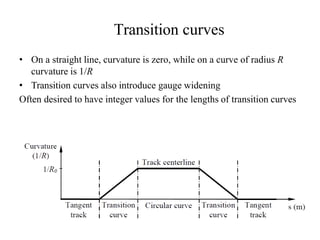
• On a straight line, curvature is zero, while on a curve of radius R
curvature is 1/R
• Transition curves also introduce gauge widening
Often desired to have integer values for the lengths of transition curves
Transition curves
CANT TRANSITION
Cant transitions
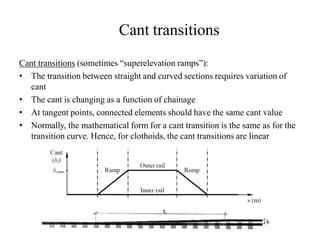
Cant transitions (sometimes “superelevation ramps”):
• The transition between straight and curved sections requires variation of
cant
• The cant is changing as a function of chainage
• At tangent points, connected elements should have the same cant value
• Normally, the mathematical form for a cant transition is the same as for the
transition curve. Hence, for clothoids, the cant transitions are linear
Cant transitions
Cant transitions (sometimes “superelevation ramps”):
• Cant is introduced by means of transition gradients 𝜌 = ∆ℎ
∆𝐿
• In many railways the maximum cant is limited to 150-160 mm
• As to the alignment, the cant variation is one of the major causes for lateral
vibration in railway vehicle
In many countries, cant transitions on straight tracks and circular curves are
acceptable only in diverging tracks near a canted turnout
Cant transitions
• Cant transitions should normally coincide with transition curves (having
the same length and tangent points)
Criteria for cant transitions:
• Ageneral maximum limit of cant gradient ∆h/∆L < 1/400 (2.5%0) taking
into account wheel unloading ---- for h=150mm, min Lt = 60 m
Rate of change of cant ∆𝑫 will occur instead of an abrupt change of
applied cant, where transition curves are used
Rate of change of cant is defined as change in cant per time ∆𝐷 = ∆ℎ
∆𝑡
• Alimit for rate of change of cant (in mm/s),
dh/dt = ∆ha * V / (Lh * 3.6) ≤ (dha/dt)lim= ∆𝐷𝑚𝑎𝑥
Lh≥ ha* V / ∆𝑫𝒎𝒂𝒙
– Typical values for the limit is in the range 28-70 mm/s
Rate of change of cant
Rate of change of lateral acceleration
Rate of change of lateral acceleration (jerk) 𝛙:
Jerk is defined as change in non-compensated acceleration per time
𝜓 =
day
d𝑡
∆ay/∆t =ay*v/Lh ≤ (day/dt)lim= 𝜓𝑚𝑎𝑥
Lh≥ ay*v/𝜓𝑚𝑎𝑥
Transition curve and cant transition length
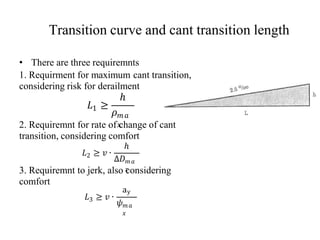
• There are three requiremnts
1. Requirment for maximum cant transition,
considering risk for derailment
1
𝐿 ≥
ℎ
𝜌𝑚𝑎
𝑥
2. Requiremnt for rate of change of cant
transition, considering comfort
2
𝐿 ≥ 𝑣 ∙
ℎ
∆𝐷𝑚𝑎
𝑥
3. Requiremnt to jerk, also considering
comfort
3
𝐿 ≥ 𝑣 ∙
ay
𝜓𝑚𝑎
𝑥
Example: Transition curve length
Given V= 180 km/h (50 m/s), h= 100 mm, 𝑎𝑦 = 𝑎𝑦,𝑚𝑎𝑥=0.65 m/s2
• Requirment 1
1
𝐿 ≥
ℎ
𝜌𝑚𝑎
𝑥
100
= = 40.0 m
2.5
• Requirment 2
2
𝐿 ≥ 𝑣 ∙
ℎ
∆𝐷𝑚𝑎
𝑥
100
= 50 ∙ = 178.6 m
28
• Requirment 3
3
𝐿 ≥ 𝑣 ∙
𝑎𝑦
𝜓𝑚𝑎
𝑥
0.65
= 50 ∙ = 203.1 m
0.16
The rquirment for jerk will govern the design L=203.1 m
Example: Transition curve length when 𝑎𝑦 is
not given
Given R = 1000 m, V= 90 km/h (25 m/s), h= 60 mm
• Requirment 1
1
𝐿 ≥
ℎ
𝜌𝑚𝑎
𝑥
60
= = 24.0 m
2.5
• Requirment 2
2
𝐿 ≥ 𝑣 ∙
ℎ
∆𝐷𝑚𝑎
𝑥
60
= 25 ∙ = 53.6 m
28
• Requirment 3 msut be calculated
𝑣2
𝑅
𝑎𝑦 = − 𝑔 ∙ =
ℎ 252
𝑠 1000
− 9.81 ∙
60
1500
= 0.233 m/s2 ≤ 𝑎𝑦,𝑚𝑎𝑥 − 𝑂𝐾!
3
𝐿 ≥ 𝑣 ∙
𝑎𝑦
𝜓𝑚𝑎
𝑥
0.233
= 25 ∙ = 36.3 m
0.16
L= 53.6 m

Chapter 2 Track Geometry.pptx

  • 1.
    DEBRE MARKOS UNIVERSITY INSTITUTEOF TECHNOLOGY SCHOOL OF CIVIL AND WATER RESOURCE ENGINEERING Chapter 2 Rail Line and Subgrade Biniyam A 2022
  • 2.
    Contents • Economic surveyand route selection of railway line • Plane section design • Longitudinal section design
  • 3.
    Introduction • Rail lineis the foundation of operation. • It is a whole structure consisted of the roadbed, bridge building and rail. • Center line of the route is all about everyThing! – Economy(cost) – Safety – Type of structures to design etc… all determined by CL. – Station location track sleeper Ballaste d bed Road bed Typical ballasted track section
  • 4.
    Economic survey androute selection Three stages: Study and design Feedback & evaluation 1. Earlier stage: research, survey and preliminary design work. 2. Basic construction stage :first to do the measurement, technical design and construction design, then begin to construct it, finally check it into production. 3. Effect of feedback:several years later, to evaluate the design and construction quality by investigate the engineering quality, technical index and economic benefits. Construction + maintenance
  • 5.
    Route selection… Route selectioncriteria: - shortest , direct route, - detour unsuitable geology, link important sites - Cost effective (user & construction) - Minimum earthwork, - locally materials, - Environmental friendly - aesthetic value etc. Balancing these parameters and requirements target
  • 6.
    Track geometry components •An important aspect of construction is track geometry • The projection of the track alignment on horizontal plane: Horizontal alignment • The projection of the track alignment on vertical plane: Vertical alignment Track geometry Theoretical (designed) track Irregularity (track quality) • Gauge • Horizontal alignment • Cant • Vertical alignment
  • 7.
    Track alignment The trackalignment is explicitly or implicitly defined in a coordinate system • The planar projection of center line is called plane section of the rail; and its vertical projection is called longitudinal section of the rail. • The plane section of the rail is consisted of straight line and curve (circular curve and easement curve). • In the vertical direction: gradients and vertical curves and transition gradients Vertical (Z) North (X) East (Y) Longitudinal distance Spacecurve Projection
  • 8.
    Locus of centerof gravity position of car body exists will take three trajectories: ① curvature is zero: straight line; ② curvature is constant: circle curve; ③ curvature is variable: transition curve. The main components of Plane design: 1. Curves 2. Tangent/ straight lines 3. Easement/spiral curves 4. superelevation 1. Plane design 8
  • 9.
    The curve isset when the line turns or when two straight lines intersect. curve radius (R), corner curve (α), curve length (L) Tangent length (T), easement curve length (Lo) . Constituent parts of the curve Types of curves - simple/single - common Single curve tangent length: curve length: External length: 9
  • 10.
    𝐿 = 𝜋 𝛼− 2𝛽𝑜 𝑅 180 + 2𝑙𝑜 ≈ 𝜋𝛼𝑅 180 + 𝑙𝑜 𝑚 𝐸 = 𝑅 + 𝑃 𝑠𝑒𝑐 𝛼 2 − 𝑅 𝑚 𝑇 = 𝑅 + 𝑃 𝑡𝑎𝑛 𝛼 2 + 𝑚 𝑚 𝑚 = 𝑙𝑜 2 − 𝑙𝑜 3 240𝑅2 ≈ 𝑙𝑜 2 𝑚 𝑝 = 𝑙𝑜 2 24𝑅 (𝑚) Common curve 10 When considering Easement curve:
  • 11.
    Straight tracks (tangenttracks) Straight tracks (sometimes “tangent tracks”) • Horizontal curvature (change of direction per unit length of the track) is zero • Shortest length between two points • No quasi-static lateral acceleration, no need for cant • Smallest possible gap between a train and a platform • Easy to check the train doors at a platform • Possible to guide tamping machines with laser beams • Easy to install switches and crossings
  • 12.
    Straight tracks • Thereis no requirement for limiting the length of straight track, only minimum length • The world’s longest straight track: Australia, 478 km • The longest straight track in Norway: Kvineshei tunnel, 9020 m (www.jernbaneverket.no)
  • 13.
    Circular curve Circular curves(sometimes “full curves”) with constant curve radius, R • Constant horizontal curvature (change of direction per unit length of the track) • Constant quasi-static lateral acceleration (if the train runs at constant speed) Sign rules: Track standards use to have no sign rules. Software use minus values for left hand curves (in the direction of the chainage). Hence: -20000 meter is a larger radius than -200 meter
  • 14.
    Circular curve • Theminimum radius is determined by the speed – 30-60 m for tramways/metro lines ‐ 60-90 m on industrial railways ‐ Line speed for tramways/metro varies between 40 to 80 km/h Recommended and minimum horizontal curve radius for v > 200 km/h: Speed [km/h] 200 250 280 300 330 350 Recommended radius [m] 3200 5000 6300 7200 8700 9800 Minimum radius [m] 1888 2950 3700 4248 5140 5782 Note: use integer values for radius and not larger than 99999 m
  • 15.
    Circular curve • Therearea also speed-independent criteria – There is a minimum radius for tracks in platforms and turnouts (Minimum radius for platform tracks R = 300 All vehicles must be able to run on R = 150 m (UIC) – Minimum radius for no gauge widening R = 200 m – Minimum radius for CWR R = 250 - 300 m • Minimum length of curves and tangent tracks - Lmin > 0.4v • Minimum radius for mainline tracks R ≥ 300 m
  • 16.
    Circular curve • Thechoice of the curve radius also depends on the characteristic of the bogie Tight curves and wide curve Soft and rigid bogie suspension Principal figure on how rails wear in curves
  • 17.
    Circular curve effects Avehicle running in a curve with radius R and speed v experiences a centrifugal lateral acceleration a = v2/R this results undesirable effects: • possible passenger discomfort and noise nuisance • possible displacement of wagon loads • risk of vehicles overturning • risk of derailment by wheel climbing or loosening of rail fastenings
  • 18.
    Circular curve effects Correctivemeasures for the curving phenomena: • Increase the radius of curvature, R • Use superelevation (cant) to compensate the lateral acceleration by the gravity • Reduction in train speed – not the best option
  • 19.
  • 20.
    Superelevation (cant) • Cantis a corrective measure for the curving phenomena to compensate the lateral acceleration α
  • 21.
    Applied cant (sometimes“superelevation”) is the amount of which one running rail is raised above the other inner rail • On curves, positive cant indicates that the outer rail is raised above the inner rail Superelevation (cant)
  • 22.
    Equilibrium cant m.v2 R x y m.g α Fc Fg g =gravity = 9.81 (m/s/s) R = curve radius (m) α = cant angle (rad) v = vehicle speed (m/s) s = track width (1500 mm) m = total mass of the vehicle Fnet h mv2 sv2 ; Therefore at balanced speed the cant mv2 mgh The equilibrium cant expressed in mm net c g mv2 F  F  F ; Fc  cos; Fg  mg sin; R mgh R For small angle   ; F  s c ; Fg  s gh R s v2 R s At balanced speed Fnet  0 so h  gR    11.8v2 (km/h) hth (mm)  R(m)
  • 23.
    Track plane acceleration 𝑣2 ℎ 𝑎𝑦≈ 𝑅 − 𝑔 ∙ 𝑠 • In case of quasistatic curving: track plane acceleration is 𝑎𝑦, and the acceleration normal to the track plane is 𝑎𝑧 𝑣2 𝑎𝑦 = 𝑅 ∙ 𝑐𝑜𝑠𝛼 − 𝑔 ∙ 𝑠𝑖𝑛𝛼 𝑣𝑒𝑞 = • For a given cant an equilibrium or balanced speed 𝑣𝑒𝑞, (𝑎𝑦 = 0) 𝑅𝑔ℎ 𝑠
  • 24.
    Maximum speed incurves • The important formula 𝑣2 − 𝑔 ∙ ℎ = 𝑎 ≤ 𝑎 𝑅 𝑠 𝑦 𝑦,𝑚𝑎𝑥  𝑣𝑚𝑎𝑥 = 𝑠 𝑔ℎ + 𝑎𝑦 ,𝑚𝑎 𝑥 ∙ 𝑅 𝑎𝑦,𝑚𝑎𝑥 Maximum allowed uncompensated lateral acceleration
  • 25.
    Applied cant limits •Maximum applied cant on normal lines for high speed lines
  • 26.
    Applied cant &cant deficiency • For a number of trains the cant is either too much or not enough • Too much cant wear the inner wheel- rail and increase friction on wheel flange and increases the tractive power required • Too less cant causes large increase in wear on the high rail • Not enough cant creates transvers force which is detrimental for both safety and comfort (risk for derailment and track displacement)
  • 27.
    Cant deficiency (hd) •Cant deficiency exists when the vehicle is travelling above balancing speed, insufficient cant angle to cancel out lateral curving force • The difference between the theoretical value of cant for maximum speed and the applied value of cant hd = ht (vmax) - ha < hd_all 𝑣2 𝑅 ℎ 𝑠 − 𝑔 ∙ 𝑎 = 𝑎𝑦 h +h 𝑣2 𝑅 𝑠 − 𝑔 ∙ 𝑎 d = 0 • The non compensated acceleration will be: ay = hd g/s • With a non compensated acceleration of 1 m/s2 (maximum limit) and axle load of 22.5 t, the quasi-static lateral load on the track is 22.5 kN
  • 28.
    Cant deficiency andmaximum speed • The maximum non compensated acceleration ad,𝑚𝑎𝑥 expressed in terms of maximum cant deficiency hd_max ay,𝑚𝑎𝑥 = 𝑔 hd,max 𝑠 Gives the maximum speed in circular curve expressed with hd_max 𝑔 𝑠 ℎ + hd,𝑚𝑎𝑥 𝑣 = ∙ 𝑅 hd,𝑚𝑎𝑥 Maximum allowable cant deficiency
  • 29.
    Example • Given R=1600m, s=1500 mm, h=150𝑚𝑚 g=10 m/s2, 𝑎𝑦,𝑚𝑎𝑥 =0.85 m/s2 • Balanced speed 𝑒 𝑞 𝑣 = 𝑅𝑔ℎ 𝑠 = 1500𝑚𝑚 1600𝑚∙10𝑚/𝑠2 ∙150𝑚𝑚 = 40 m/s = 144 km/h • maximum speed 𝑣2 ℎ − 𝑔 ∙ = 𝑎𝑦,𝑚𝑎𝑥 𝑅 𝑠 𝑣𝑚𝑎𝑥 = 𝑠 𝑔ℎ + 𝑎𝑦 ,𝑚𝑎 𝑥 ∙ 𝑅 = 1500 10∙150 + 0.85 1600 = 54 m/s = 195 km/h
  • 30.
    Example • Given v=240km/h, s=1500 mm, h = 150 mm, g=10m/s2, 𝑎𝑦,𝑚𝑎𝑥=0.85 m/s2 𝑣2 − 𝑔 ∙ ℎ𝑚𝑎𝑥 = 𝑎 𝑅 𝑠 𝑦,𝑚𝑎𝑥 𝑣2 𝑅 = 𝑔ℎ𝑚𝑎𝑥 + 𝑎𝑦,𝑚𝑎𝑥 240 3.6 2 = 10*150 𝑠 1500 + 0.85 = 𝟐𝟒𝟎𝟎 𝐦  High speed – large curve radius
  • 31.
    Cant deficiency limits •Limits for cant deficiency 𝑎𝑦,𝑚𝑎𝑥 𝑜𝑟 ℎ𝑑,𝑚𝑎𝑥 takes into account forces in the wheel/rail interface as well as comfort or load displacements and safety against derailment • Avehicle must be tested and approved for its permissible cant deficiency, according to procedures in UIC 518 or EN 14363 • Limits for train categories in Europe ranges from 92 mm (certain freight cars) to 300 mm (tilting trains)
  • 32.
    Santiago de Compostela,Spania, 24. juli 2013
  • 33.
    Santiago de Compostela,Spania, 24. juli 2013 Geometry parameters and speed: • Given: R = 300 m, h = 150 mm • Recommended speed: V = 80 km/t  hd = 100 mm • Real speed: V = 190 km/t  hd = 1271 mm ; This corresponds to the lateral acceleration of ay ≈ 9,3 m/s2 The consequence 
  • 34.
    Cant excess (he) •Cant excess exists when the vehicle speed is lower than the balanced speed • This can result in reduced passenger comfort but also a risk of roll-over for vehicles with a high centre of gravity travelling at low speed, such as freight vehicles • The difference between the applied value of cant and the theoretical value of cant for minimum speed he = ha - hth (Vmin) Cant excess he limits: • Tracks with radius > 1000 m : Max. 100 mm • Tracks with radius < 1000 m : Max. 70 mm
  • 35.
  • 36.
    • On astraight line, curvature is zero, while on a curve of radius R curvature is 1/R • Transition curves also introduce gauge widening Often desired to have integer values for the lengths of transition curves Transition curves
  • 37.
  • 38.
    Cant transitions Cant transitions(sometimes “superelevation ramps”): • The transition between straight and curved sections requires variation of cant • The cant is changing as a function of chainage • At tangent points, connected elements should have the same cant value • Normally, the mathematical form for a cant transition is the same as for the transition curve. Hence, for clothoids, the cant transitions are linear
  • 39.
    Cant transitions Cant transitions(sometimes “superelevation ramps”): • Cant is introduced by means of transition gradients 𝜌 = ∆ℎ ∆𝐿 • In many railways the maximum cant is limited to 150-160 mm • As to the alignment, the cant variation is one of the major causes for lateral vibration in railway vehicle In many countries, cant transitions on straight tracks and circular curves are acceptable only in diverging tracks near a canted turnout
  • 40.
    Cant transitions • Canttransitions should normally coincide with transition curves (having the same length and tangent points) Criteria for cant transitions: • Ageneral maximum limit of cant gradient ∆h/∆L < 1/400 (2.5%0) taking into account wheel unloading ---- for h=150mm, min Lt = 60 m
  • 41.
    Rate of changeof cant ∆𝑫 will occur instead of an abrupt change of applied cant, where transition curves are used Rate of change of cant is defined as change in cant per time ∆𝐷 = ∆ℎ ∆𝑡 • Alimit for rate of change of cant (in mm/s), dh/dt = ∆ha * V / (Lh * 3.6) ≤ (dha/dt)lim= ∆𝐷𝑚𝑎𝑥 Lh≥ ha* V / ∆𝑫𝒎𝒂𝒙 – Typical values for the limit is in the range 28-70 mm/s Rate of change of cant
  • 42.
    Rate of changeof lateral acceleration Rate of change of lateral acceleration (jerk) 𝛙: Jerk is defined as change in non-compensated acceleration per time 𝜓 = day d𝑡 ∆ay/∆t =ay*v/Lh ≤ (day/dt)lim= 𝜓𝑚𝑎𝑥 Lh≥ ay*v/𝜓𝑚𝑎𝑥
  • 43.
    Transition curve andcant transition length • There are three requiremnts 1. Requirment for maximum cant transition, considering risk for derailment 1 𝐿 ≥ ℎ 𝜌𝑚𝑎 𝑥 2. Requiremnt for rate of change of cant transition, considering comfort 2 𝐿 ≥ 𝑣 ∙ ℎ ∆𝐷𝑚𝑎 𝑥 3. Requiremnt to jerk, also considering comfort 3 𝐿 ≥ 𝑣 ∙ ay 𝜓𝑚𝑎 𝑥
  • 44.
    Example: Transition curvelength Given V= 180 km/h (50 m/s), h= 100 mm, 𝑎𝑦 = 𝑎𝑦,𝑚𝑎𝑥=0.65 m/s2 • Requirment 1 1 𝐿 ≥ ℎ 𝜌𝑚𝑎 𝑥 100 = = 40.0 m 2.5 • Requirment 2 2 𝐿 ≥ 𝑣 ∙ ℎ ∆𝐷𝑚𝑎 𝑥 100 = 50 ∙ = 178.6 m 28 • Requirment 3 3 𝐿 ≥ 𝑣 ∙ 𝑎𝑦 𝜓𝑚𝑎 𝑥 0.65 = 50 ∙ = 203.1 m 0.16 The rquirment for jerk will govern the design L=203.1 m
  • 45.
    Example: Transition curvelength when 𝑎𝑦 is not given Given R = 1000 m, V= 90 km/h (25 m/s), h= 60 mm • Requirment 1 1 𝐿 ≥ ℎ 𝜌𝑚𝑎 𝑥 60 = = 24.0 m 2.5 • Requirment 2 2 𝐿 ≥ 𝑣 ∙ ℎ ∆𝐷𝑚𝑎 𝑥 60 = 25 ∙ = 53.6 m 28 • Requirment 3 msut be calculated 𝑣2 𝑅 𝑎𝑦 = − 𝑔 ∙ = ℎ 252 𝑠 1000 − 9.81 ∙ 60 1500 = 0.233 m/s2 ≤ 𝑎𝑦,𝑚𝑎𝑥 − 𝑂𝐾! 3 𝐿 ≥ 𝑣 ∙ 𝑎𝑦 𝜓𝑚𝑎 𝑥 0.233 = 25 ∙ = 36.3 m 0.16 L= 53.6 m