
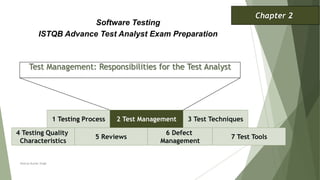

Test Management: Responsibilities for the Test Analyst
1 Testing Process 2 Test Management 3 Test Techniques
Software Testing
ISTQB Advance Test Analyst Exam Preparation
Chapter 2
Neeraj Kumar Singh
4 Testing Quality
Characteristics
5 Reviews
6 Defect
Management
7 Test Tools
Test Management
Contents
2.1 Introduction
2.2 Test Progress, Monitoring and Control
2.3 Distributed, Outsourced and Insourced Testing
2.4 Test Analyst’s Tasks in Risk-Based Testing
Neeraj Kumar Singh
Test Management
Introduction
 While there are many areas in which the Test Analyst interacts with and supplies data for the Test
Manager, this section concentrates on the specific areas of the testing process in which the Test
Analyst is a major contributor. It is expected that the Test Manager will seek the information
needed from the Test Analyst.
Neeraj Kumar Singh
Test Management
Test Progress Monitoring and Control
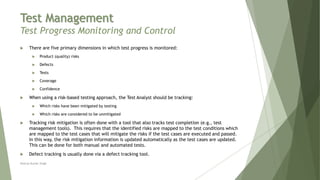
 There are five primary dimensions in which test progress is monitored:
 Product (quality) risks
 Defects
 Tests
 Coverage
 Confidence
 When using a risk-based testing approach, the Test Analyst should be tracking:
 Which risks have been mitigated by testing
 Which risks are considered to be unmitigated
 Tracking risk mitigation is often done with a tool that also tracks test completion (e.g., test
management tools). This requires that the identified risks are mapped to the test conditions which
are mapped to the test cases that will mitigate the risks if the test cases are executed and passed.
In this way, the risk mitigation information is updated automatically as the test cases are updated.
This can be done for both manual and automated tests.
 Defect tracking is usually done via a defect tracking tool.
Neeraj Kumar Singh
Test Management
Test Progress Monitoring and Control
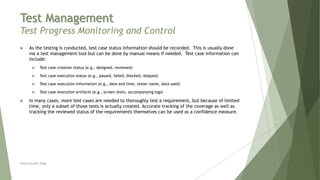
 As the testing is conducted, test case status information should be recorded. This is usually done
via a test management tool but can be done by manual means if needed. Test case information can
include:
 Test case creation status (e.g., designed, reviewed)
 Test case execution status (e.g., passed, failed, blocked, skipped)
 Test case execution information (e.g., date and time, tester name, data used)
 Test case execution artifacts (e.g., screen shots, accompanying logs)
 In many cases, more test cases are needed to thoroughly test a requirement, but because of limited
time, only a subset of those tests is actually created. Accurate tracking of the coverage as well as
tracking the reviewed status of the requirements themselves can be used as a confidence measure.
Neeraj Kumar Singh
Test Management: Responsibilities for the Test Analyst
1 Testing Process 2 Test Management 3 Test Techniques
Software Testing
ISTQB Advance Test Analyst Exam Preparation
Chapter 2
Neeraj Kumar Singh
4 Testing Quality
Characteristics
5 Reviews
6 Defect
Management
7 Test Tools
Test Management
Contents
2.1 Introduction
2.2 Test Progress, Monitoring and Control
2.3 Distributed, Outsourced and Insourced Testing
2.4 Test Analyst’s Tasks in Risk-Based Testing
Neeraj Kumar Singh
Test Management
Distributed, Outsourced and Insourced
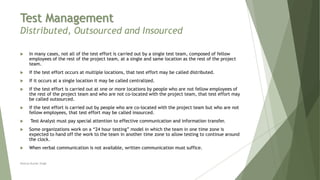
 In many cases, not all of the test effort is carried out by a single test team, composed of fellow
employees of the rest of the project team, at a single and same location as the rest of the project
team.
 If the test effort occurs at multiple locations, that test effort may be called distributed.
 If it occurs at a single location it may be called centralized.
 If the test effort is carried out at one or more locations by people who are not fellow employees of
the rest of the project team and who are not co-located with the project team, that test effort may
be called outsourced.
 If the test effort is carried out by people who are co-located with the project team but who are not
fellow employees, that test effort may be called insourced.
 Test Analyst must pay special attention to effective communication and information transfer.
 Some organizations work on a “24 hour testing” model in which the team in one time zone is
expected to hand off the work to the team in another time zone to allow testing to continue around
the clock.
 When verbal communication is not available, written communication must suffice.
Neeraj Kumar Singh
Test Management: Responsibilities for the Test Analyst
1 Testing Process 2 Test Management 3 Test Techniques
Software Testing
ISTQB Advance Test Analyst Exam Preparation
Chapter 2
Neeraj Kumar Singh
4 Testing Quality
Characteristics
5 Reviews
6 Defect
Management
7 Test Tools
Test Management
Contents
2.1 Introduction
2.2 Test Progress, Monitoring and Control
2.3 Distributed, Outsourced and Insourced Testing
2.4 Test Analyst’s Tasks in Risk-Based Testing
Neeraj Kumar Singh
Test Management
Test Analyst’s Tasks in Risk-Based Testing
 The Test Manager often has overall responsibility for establishing and managing a risk-based testing
strategy. The Test Manager usually will request the involvement of the Test Analyst to ensure the
risk-based approach is implemented correctly.
 The Test Analyst should be actively involved in the following risk-based testing tasks:
 Risk identification
 Risk assessment
 Risk mitigation.
Neeraj Kumar Singh
Test Management
Test Analyst’s Tasks in Risk-Based Testing
Risk Identification
 Th risk identification process is most likely to detect the largest possible number of significant risks,
by involving the broadest possible sample of stakeholders.
 As, Test Analysts often possess unique knowledge regarding the particular business domain of the
system under test, they are particularly well-suited for conducting expert interviews with the
domain experts and users, conducting independent assessments, using and facilitating the use of risk
templates, conducting risk workshops, conducting brainstorming sessions with potential and current
users, defining testing checklists and calling on past experience with similar systems or projects.
 Sample risks that might be identified in a project include:
 Accuracy issues with the software functionality, e.g., incorrect calculations
 Usability issues, e.g., insufficient keyboard shortcuts
 Learnability issues, e.g., lack of instructions for the user at key decision points
Neeraj Kumar Singh
Test Management
Test Analyst’s Tasks in Risk-Based Testing
Risk Assessment
 While risk identification is about identifying as many pertinent risks as possible, risk assessment is
the study of these identified risks. Specifically, categorizing each risk and determining the likelihood
and impact associated with each risk
 The impact upon occurrence is often interpreted as the severity of the effect on the users,
customers, or other stakeholders. In other words, it arises from business risk. The Test Analyst
should contribute to identifying and assessing the potential business domain or user impact for each
risk item. Factors influencing business risk include:
 Frequency of use of the affected feature
 Business loss
 Safety concerns
 Lack of reasonable workarounds
 Visibility of the feature
 Visibility of failure leading to negative publicity and potential image damage
 Loss of customers
Neeraj Kumar Singh
Test Management
Test Analyst’s Tasks in Risk-Based Testing
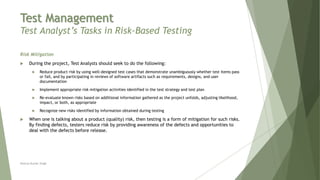
Risk Mitigation
 During the project, Test Analysts should seek to do the following:
 Reduce product risk by using well-designed test cases that demonstrate unambiguously whether test items pass
or fail, and by participating in reviews of software artifacts such as requirements, designs, and user
documentation
 Implement appropriate risk mitigation activities identified in the test strategy and test plan
 Re-evaluate known risks based on additional information gathered as the project unfolds, adjusting likelihood,
impact, or both, as appropriate
 Recognize new risks identified by information obtained during testing
 When one is talking about a product (quality) risk, then testing is a form of mitigation for such risks.
By finding defects, testers reduce risk by providing awareness of the defects and opportunities to
deal with the defects before release.
Neeraj Kumar Singh
Test Management
Test Analyst’s Tasks in Risk-Based Testing
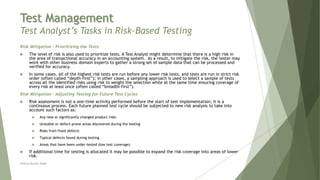
Risk Mitigation – Prioritizing the Tests
 The level of risk is also used to prioritize tests. A Test Analyst might determine that there is a high risk in
the area of transactional accuracy in an accounting system. As a result, to mitigate the risk, the tester may
work with other business domain experts to gather a strong set of sample data that can be processed and
verified for accuracy.
 In some cases, all of the highest risk tests are run before any lower risk tests, and tests are run in strict risk
order (often called “depth-first”); in other cases, a sampling approach is used to select a sample of tests
across all the identified risks using risk to weight the selection while at the same time ensuring coverage of
every risk at least once (often called “breadth-first”).
Risk Mitigation – Adjusting Testing for Future Test Cycles
 Risk assessment is not a one-time activity performed before the start of test implementation; it is a
continuous process. Each future planned test cycle should be subjected to new risk analysis to take into
account such factors as:
 Any new or significantly changed product risks
 Unstable or defect-prone areas discovered during the testing
 Risks from fixed defects
 Typical defects found during testing
 Areas that have been under-tested (low test coverage)
 If additional time for testing is allocated it may be possible to expand the risk coverage into areas of lower
risk.
Neeraj Kumar Singh
Test Management: Responsibilities for the Test Analyst
1 Testing Process 2 Test Management 3 Test Techniques
Software Testing
ISTQB Advance Test Analyst Exam Preparation
Chapter 2
Neeraj Kumar Singh
4 Testing Quality
Characteristics
5 Reviews
6 Defect
Management
7 Test Tools
Test Management
Sample Questions
1. Which of the following statements best expresses the types of information that must be tracked
during testing to enable adequate monitoring and controlling of the testing project?
a) How many defects were introduced by each developer so adequate steps may be taken.
b) How many test cases were passed by each tester, so it can be used to motivate to be more
effective.
c) The percentage of passed and failed test cases at given points in time whereas the number of
executed versus not-executed test cases is less relevant.
d) The tracking and measurement of defects, tests, coverage as well as product risks.
Select ONE option.
Neeraj Kumar Singh
Test Management
Sample Questions
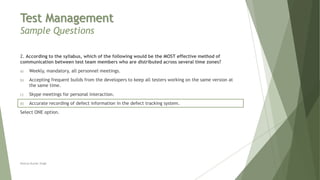
2. According to the syllabus, which of the following would be the MOST effective method of
communication between test team members who are distributed across several time zones?
a) Weekly, mandatory, all personnel meetings.
b) Accepting frequent builds from the developers to keep all testers working on the same version at
the same time.
c) Skype meetings for personal interaction.
d) Accurate recording of defect information in the defect tracking system.
Select ONE option.
Neeraj Kumar Singh
Test Management
Sample Questions
3. A project to develop a foreign exchange Automated Telling Machine for an airport has been planned
and a risk assessment has shown that there are 3 key risks:
There is a risk that usability will be a problem for visually impaired users because the operation requires
viewing several screens in sequence with relatively small text. This has been assessed as medium
likelihood with high impact.
There is a risk that response will be relatively slow because the foreign exchange rates will be checked
before each transaction; this has been assessed as medium likelihood with medium impact.
There is a risk that accuracy of calculations could lead to cumulative errors. This has been assessed as
low likelihood with high impact.
The test strategy currently requires performance testing during system test, usability testing during User
Acceptance Test and accuracy tests at every test level. The project schedule is under time pressure.
Which of the following possible risk mitigation actions should be prioritized highest?
a) Review the calculation algorithms and work with specialists to define a data set for calculation tests.
b) Defer usability testing until UAT and recruit visually impaired testers to join the UAT team.
c) Allow access to the system for usability testing during integration.
d) Spend time with developers to Identify operational scenarios to test performance.
Select ONE option.
Neeraj Kumar Singh

Chapter 2 - Test Management

  • 1.
    Test Management: Responsibilitiesfor the Test Analyst 1 Testing Process 2 Test Management 3 Test Techniques Software Testing ISTQB Advance Test Analyst Exam Preparation Chapter 2 Neeraj Kumar Singh 4 Testing Quality Characteristics 5 Reviews 6 Defect Management 7 Test Tools
  • 2.
    Test Management Contents 2.1 Introduction 2.2Test Progress, Monitoring and Control 2.3 Distributed, Outsourced and Insourced Testing 2.4 Test Analyst’s Tasks in Risk-Based Testing Neeraj Kumar Singh
  • 3.
    Test Management Introduction  Whilethere are many areas in which the Test Analyst interacts with and supplies data for the Test Manager, this section concentrates on the specific areas of the testing process in which the Test Analyst is a major contributor. It is expected that the Test Manager will seek the information needed from the Test Analyst. Neeraj Kumar Singh
  • 4.
    Test Management Test ProgressMonitoring and Control  There are five primary dimensions in which test progress is monitored:  Product (quality) risks  Defects  Tests  Coverage  Confidence  When using a risk-based testing approach, the Test Analyst should be tracking:  Which risks have been mitigated by testing  Which risks are considered to be unmitigated  Tracking risk mitigation is often done with a tool that also tracks test completion (e.g., test management tools). This requires that the identified risks are mapped to the test conditions which are mapped to the test cases that will mitigate the risks if the test cases are executed and passed. In this way, the risk mitigation information is updated automatically as the test cases are updated. This can be done for both manual and automated tests.  Defect tracking is usually done via a defect tracking tool. Neeraj Kumar Singh
  • 5.
    Test Management Test ProgressMonitoring and Control  As the testing is conducted, test case status information should be recorded. This is usually done via a test management tool but can be done by manual means if needed. Test case information can include:  Test case creation status (e.g., designed, reviewed)  Test case execution status (e.g., passed, failed, blocked, skipped)  Test case execution information (e.g., date and time, tester name, data used)  Test case execution artifacts (e.g., screen shots, accompanying logs)  In many cases, more test cases are needed to thoroughly test a requirement, but because of limited time, only a subset of those tests is actually created. Accurate tracking of the coverage as well as tracking the reviewed status of the requirements themselves can be used as a confidence measure. Neeraj Kumar Singh
  • 6.
    Test Management: Responsibilitiesfor the Test Analyst 1 Testing Process 2 Test Management 3 Test Techniques Software Testing ISTQB Advance Test Analyst Exam Preparation Chapter 2 Neeraj Kumar Singh 4 Testing Quality Characteristics 5 Reviews 6 Defect Management 7 Test Tools
  • 7.
    Test Management Contents 2.1 Introduction 2.2Test Progress, Monitoring and Control 2.3 Distributed, Outsourced and Insourced Testing 2.4 Test Analyst’s Tasks in Risk-Based Testing Neeraj Kumar Singh
  • 8.
    Test Management Distributed, Outsourcedand Insourced  In many cases, not all of the test effort is carried out by a single test team, composed of fellow employees of the rest of the project team, at a single and same location as the rest of the project team.  If the test effort occurs at multiple locations, that test effort may be called distributed.  If it occurs at a single location it may be called centralized.  If the test effort is carried out at one or more locations by people who are not fellow employees of the rest of the project team and who are not co-located with the project team, that test effort may be called outsourced.  If the test effort is carried out by people who are co-located with the project team but who are not fellow employees, that test effort may be called insourced.  Test Analyst must pay special attention to effective communication and information transfer.  Some organizations work on a “24 hour testing” model in which the team in one time zone is expected to hand off the work to the team in another time zone to allow testing to continue around the clock.  When verbal communication is not available, written communication must suffice. Neeraj Kumar Singh
  • 9.
    Test Management: Responsibilitiesfor the Test Analyst 1 Testing Process 2 Test Management 3 Test Techniques Software Testing ISTQB Advance Test Analyst Exam Preparation Chapter 2 Neeraj Kumar Singh 4 Testing Quality Characteristics 5 Reviews 6 Defect Management 7 Test Tools
  • 10.
    Test Management Contents 2.1 Introduction 2.2Test Progress, Monitoring and Control 2.3 Distributed, Outsourced and Insourced Testing 2.4 Test Analyst’s Tasks in Risk-Based Testing Neeraj Kumar Singh
  • 11.
    Test Management Test Analyst’sTasks in Risk-Based Testing  The Test Manager often has overall responsibility for establishing and managing a risk-based testing strategy. The Test Manager usually will request the involvement of the Test Analyst to ensure the risk-based approach is implemented correctly.  The Test Analyst should be actively involved in the following risk-based testing tasks:  Risk identification  Risk assessment  Risk mitigation. Neeraj Kumar Singh
  • 12.
    Test Management Test Analyst’sTasks in Risk-Based Testing Risk Identification  Th risk identification process is most likely to detect the largest possible number of significant risks, by involving the broadest possible sample of stakeholders.  As, Test Analysts often possess unique knowledge regarding the particular business domain of the system under test, they are particularly well-suited for conducting expert interviews with the domain experts and users, conducting independent assessments, using and facilitating the use of risk templates, conducting risk workshops, conducting brainstorming sessions with potential and current users, defining testing checklists and calling on past experience with similar systems or projects.  Sample risks that might be identified in a project include:  Accuracy issues with the software functionality, e.g., incorrect calculations  Usability issues, e.g., insufficient keyboard shortcuts  Learnability issues, e.g., lack of instructions for the user at key decision points Neeraj Kumar Singh
  • 13.
    Test Management Test Analyst’sTasks in Risk-Based Testing Risk Assessment  While risk identification is about identifying as many pertinent risks as possible, risk assessment is the study of these identified risks. Specifically, categorizing each risk and determining the likelihood and impact associated with each risk  The impact upon occurrence is often interpreted as the severity of the effect on the users, customers, or other stakeholders. In other words, it arises from business risk. The Test Analyst should contribute to identifying and assessing the potential business domain or user impact for each risk item. Factors influencing business risk include:  Frequency of use of the affected feature  Business loss  Safety concerns  Lack of reasonable workarounds  Visibility of the feature  Visibility of failure leading to negative publicity and potential image damage  Loss of customers Neeraj Kumar Singh
  • 14.
    Test Management Test Analyst’sTasks in Risk-Based Testing Risk Mitigation  During the project, Test Analysts should seek to do the following:  Reduce product risk by using well-designed test cases that demonstrate unambiguously whether test items pass or fail, and by participating in reviews of software artifacts such as requirements, designs, and user documentation  Implement appropriate risk mitigation activities identified in the test strategy and test plan  Re-evaluate known risks based on additional information gathered as the project unfolds, adjusting likelihood, impact, or both, as appropriate  Recognize new risks identified by information obtained during testing  When one is talking about a product (quality) risk, then testing is a form of mitigation for such risks. By finding defects, testers reduce risk by providing awareness of the defects and opportunities to deal with the defects before release. Neeraj Kumar Singh
  • 15.
    Test Management Test Analyst’sTasks in Risk-Based Testing Risk Mitigation – Prioritizing the Tests  The level of risk is also used to prioritize tests. A Test Analyst might determine that there is a high risk in the area of transactional accuracy in an accounting system. As a result, to mitigate the risk, the tester may work with other business domain experts to gather a strong set of sample data that can be processed and verified for accuracy.  In some cases, all of the highest risk tests are run before any lower risk tests, and tests are run in strict risk order (often called “depth-first”); in other cases, a sampling approach is used to select a sample of tests across all the identified risks using risk to weight the selection while at the same time ensuring coverage of every risk at least once (often called “breadth-first”). Risk Mitigation – Adjusting Testing for Future Test Cycles  Risk assessment is not a one-time activity performed before the start of test implementation; it is a continuous process. Each future planned test cycle should be subjected to new risk analysis to take into account such factors as:  Any new or significantly changed product risks  Unstable or defect-prone areas discovered during the testing  Risks from fixed defects  Typical defects found during testing  Areas that have been under-tested (low test coverage)  If additional time for testing is allocated it may be possible to expand the risk coverage into areas of lower risk. Neeraj Kumar Singh
  • 16.
    Test Management: Responsibilitiesfor the Test Analyst 1 Testing Process 2 Test Management 3 Test Techniques Software Testing ISTQB Advance Test Analyst Exam Preparation Chapter 2 Neeraj Kumar Singh 4 Testing Quality Characteristics 5 Reviews 6 Defect Management 7 Test Tools
  • 17.
    Test Management Sample Questions 1.Which of the following statements best expresses the types of information that must be tracked during testing to enable adequate monitoring and controlling of the testing project? a) How many defects were introduced by each developer so adequate steps may be taken. b) How many test cases were passed by each tester, so it can be used to motivate to be more effective. c) The percentage of passed and failed test cases at given points in time whereas the number of executed versus not-executed test cases is less relevant. d) The tracking and measurement of defects, tests, coverage as well as product risks. Select ONE option. Neeraj Kumar Singh
  • 18.
    Test Management Sample Questions 2.According to the syllabus, which of the following would be the MOST effective method of communication between test team members who are distributed across several time zones? a) Weekly, mandatory, all personnel meetings. b) Accepting frequent builds from the developers to keep all testers working on the same version at the same time. c) Skype meetings for personal interaction. d) Accurate recording of defect information in the defect tracking system. Select ONE option. Neeraj Kumar Singh
  • 19.
    Test Management Sample Questions 3.A project to develop a foreign exchange Automated Telling Machine for an airport has been planned and a risk assessment has shown that there are 3 key risks: There is a risk that usability will be a problem for visually impaired users because the operation requires viewing several screens in sequence with relatively small text. This has been assessed as medium likelihood with high impact. There is a risk that response will be relatively slow because the foreign exchange rates will be checked before each transaction; this has been assessed as medium likelihood with medium impact. There is a risk that accuracy of calculations could lead to cumulative errors. This has been assessed as low likelihood with high impact. The test strategy currently requires performance testing during system test, usability testing during User Acceptance Test and accuracy tests at every test level. The project schedule is under time pressure. Which of the following possible risk mitigation actions should be prioritized highest? a) Review the calculation algorithms and work with specialists to define a data set for calculation tests. b) Defer usability testing until UAT and recruit visually impaired testers to join the UAT team. c) Allow access to the system for usability testing during integration. d) Spend time with developers to Identify operational scenarios to test performance. Select ONE option. Neeraj Kumar Singh