Defect Management
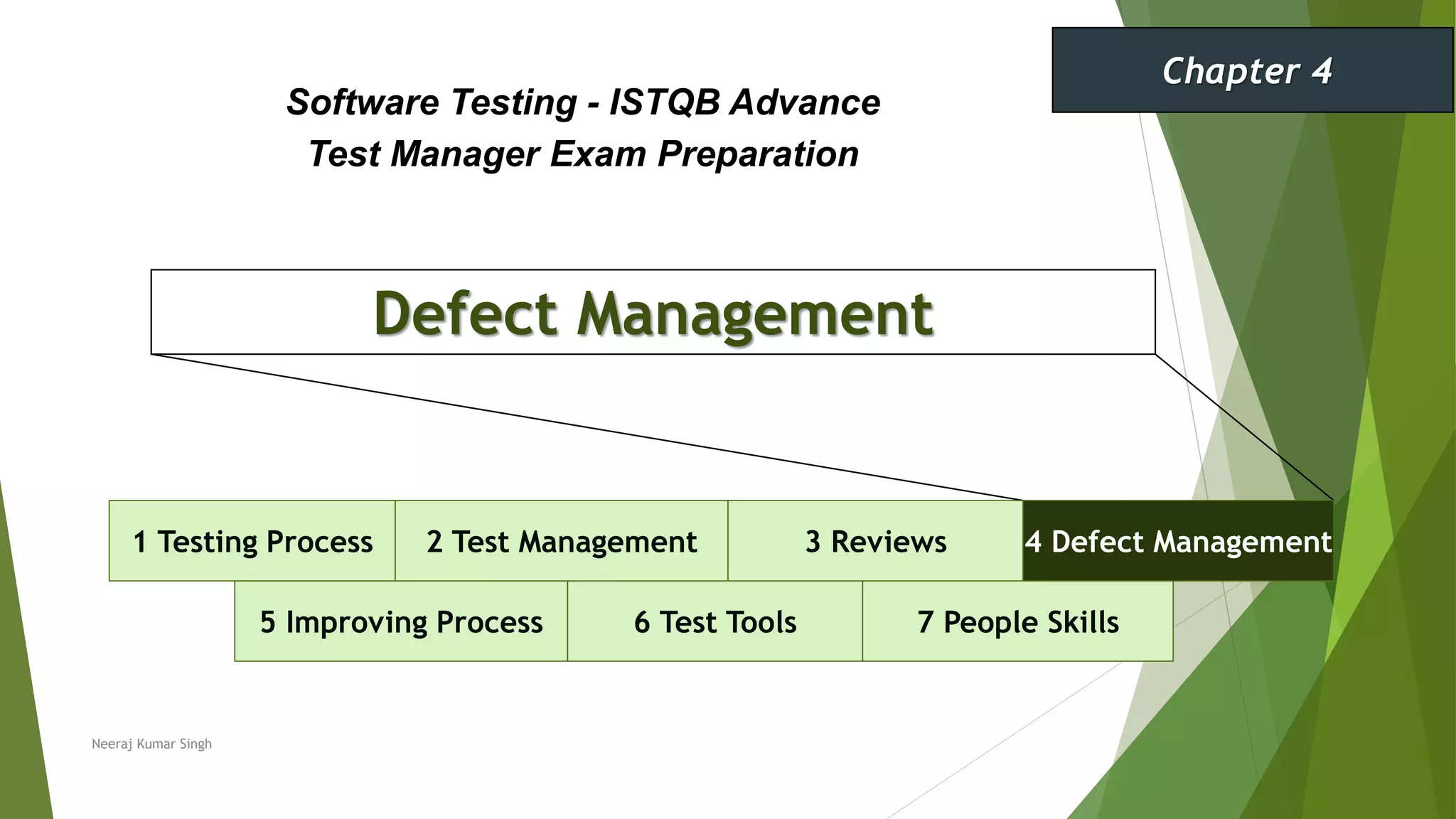
1 Testing Process 2 Test Management 3 Reviews
Software Testing - ISTQB Advance
Test Manager Exam Preparation
Chapter 4
Neeraj Kumar Singh
4 Defect Management
5 Improving Process 6 Test Tools 7 People Skills
Defect Management
Contents
4.1 Introduction
4.2 The Defect Lifecycle and the Software
Development Lifecycle
4.3 Defect Report Information
4.4 Assessing Process Capability with
Defect Report Information
Neeraj Kumar Singh
An organization’s defect management process and the tool used to manage this work are of critical importance not
only to the test team but to all teams involved in the development of software.
Information gathered by the effective management of defects allows the Test Manager and other project
stakeholders to gain insight on the state of a project throughout the development lifecycle, and by collecting and
analyzing data over time, can help locate areas of potential improvement for testing and development processes.
In addition to understanding the overall defect lifecycle and how it is used to monitor and control both the testing
and software development processes, the Test Manager must also be familiar with what data is critical to capture
and must be an advocate of proper usage of both the process and the selected defect management tool.
Neeraj Kumar Singh
Defect Management
Introduction
Defect Management
Contents
4.1 Introduction
4.2 The Defect Lifecycle and the Software
Development Lifecycle
4.3 Defect Report Information
4.4 Assessing Process Capability with
Defect Report Information
Neeraj Kumar Singh
As explained in the Foundation Level syllabus, defects are introduced when a person makes a mistake during the
creation of a work product. This work product can be a requirements specification, a user story, a technical
document, a test case, the program code, or any other work product produced during a software development or
maintenance process.
Defects may be introduced at any point in the software development lifecycle and in any software related work
product. Therefore, each phase of the software development lifecycle should include activities to detect and
remove potential defects.
The earlier each defect is detected and removed, the lower the overall cost of quality for the system; cost of
quality for a given level of defects is minimized when each defect is removed in the same phase in which it was
introduced.
Furthermore, static testing finds defects directly, rather than finding failures, and thus the cost of removing the
defect is lower because debugging activities are not required to isolate the defect.
During dynamic testing activities such as unit testing, integration testing, and system testing, the presence of a
defect is revealed when it causes a failure, which results in a discrepancy between the actual results and the
expected results of a test.
In some cases, a false-negative result occurs when the tester does not observe the anomaly.
Neeraj Kumar Singh
Defect Management
The Defect Lifecycle and the SDLC
Most testing organizations use a tool to manage defect reports through the defect lifecycle. A defect report
typically progresses through a workflow and moves through a sequence of states as it continues through the defect
lifecycle.
In most of these states, a single defect lifecycle participant owns the report and is responsible for carrying out a
task which, when completed, will cause the defect report to be moved to the next state (and assigned to the next
responsible party). In terminal states, such as when the defect report is closed (usually meaning that the
underlying defect is fixed and the fix verified through a confirmation test), cancelled (usually meaning that the
defect report is invalid), irreproducible (usually meaning that the anomaly can no longer be observed), or deferred
(usually meaning that the anomaly relates to a real defect, but that defect will not be fixed during the project),
the report does not have an owner, because no further actions are required.
Neeraj Kumar Singh
Defect Management
Defect Workflow and States
For defects discovered by testers during testing, there are three states in particular where the action resides with the test
team:
The initial state
 In this state, one or more testers gather the information necessary for the person responsible for resolving the defect
to reproduce the anomaly.
 This may also be referred to as the “open” or “new” state.
The returned state
 In this state, the receiver of the report has rejected the report or is asking the tester to supply further information.
This state may indicate a shortfall in the initial information gathering process or of the testing itself, and Test
Managers should monitor for excessive rates of return. The tester(s) must provide the additional information, or
confirm that the report indeed should be rejected.
 This may also be referred to as the “rejected” or “clarification” state.
The confirmation test state
 In this state, the tester will run a confirmation test (often following the steps to reproduce the failure from the defect
report itself) to determine whether the fix has indeed solved the problem. If the confirmation test indicates that the
defect is repaired, the tester should close the report. If the confirmation test indicates that the defect is not repaired,
the tester should re-open the report, causing it to be reassigned to the previous owner, who can then complete the
work necessary to repair the defect.
 This may also be referred to as the “resolved” or “verification” state.
Neeraj Kumar Singh
Defect Management
Defect Workflow and States
In some cases, an anomaly occurs not as the symptom of a defect, but rather due to a problem with the test
environment, the test data, some other element of the testware, or the tester’s own misunderstanding. If the
tester opens a defect report that subsequently is found not to relate to a defect in the work product under test,
that is a false-positive result. Such reports are typically cancelled or closed as invalid defect reports.
In addition, in some cases a defect can exhibit different symptoms which may appear to the tester(s) as being
entirely unrelated. If two or more defect reports are filed which subsequently are found to relate to the same root
cause, one of the defect reports is typically retained while the others are closed as duplicate defect reports.
While invalid and duplicate defect reports represent a certain level of inefficiency, some amount of such reports is
inevitable and should be accepted as such by the Test Manager. When managers attempt to eliminate all invalid
and duplicate defect reports, the number of false-negatives typically increases, since testers are being
discouraged from filing defect reports. This decreases the testing organization’s defect detection effectiveness,
which is related to a key testing organization objective in most cases.
Neeraj Kumar Singh
Defect Management
Managing Invalid and Duplicate Defect Reports
Although the testing organization and Test Manager typically own the overall defect management process and the
defect management tool, a cross-functional team is generally responsible for managing the reported defects for a
given project. In addition to the Test Manager, participants in the defect management (or defect triage) committee
typically include development, project management, product management and other stakeholders who have an
interest in the software under development.
As anomalies are discovered and entered into the defect management tool, the defect management committee
should meet to determine whether each defect report represents a valid defect, and whether it should be fixed or
deferred. This decision requires the defect management committee to consider the benefits, risks and costs
associated with fixing or not fixing the defect.
If the defect is to be fixed, the team should establish the priority of fixing the defect relative to other project
tasks. The Test Manager and test team may be consulted regarding the relative importance of a defect and should
provide available objective information.
A defect tracking tool should not be used as a substitute for good communication nor should defect management
committee meetings be used as a substitute for effective use of a good defect tracking tool. Communication,
adequate tool support, a well-defined defect lifecycle, and an engaged defect management committee are all
necessary for effective and efficient defect management.
Neeraj Kumar Singh
Defect Management
Cross-Functional Defect Management
Defect Management
Contents
4.1 Introduction
4.2 The Defect Lifecycle and the Software
Development Lifecycle
4.3 Defect Report Information
4.4 Assessing Process Capability with
Defect Report Information
Neeraj Kumar Singh
When a defect is detected (as part of static testing), or a failure is observed (as part of dynamic testing), data
should be gathered by the person(s) involved and included in the defect report.
This information should suffice for three purposes:
 Management of the report through the defect lifecycle
 Assessment of project status, especially in terms of product quality, and test progress
 Assessment of process capability
The data needed for defect report management and project status can vary depending on when the defect is
detected in the lifecycle, typically with less information needed earlier (e.g., requirements reviews and unit test).
However, the core information gathered should be consistent across the lifecycle and ideally across all projects to
allow for meaningful comparison of process defect data throughout the project and across all projects.
Neeraj Kumar Singh
Defect Management
Defect Report Information
Defect data to be collected may include the following:
 The name of the person who discovered the defect
 The role of the person (e.g., end user, business analyst, developer, technical support person)
 The type of testing being performed (e.g., usability testing, performance testing, regression testing )
 A summary of the problem
 A detailed description of the problem
 Steps to reproduce the failure (for a defect), along with the actual and expected results (highlighting the
anomaly), including screen shots, database dumps, and logs where applicable
 The lifecycle phase of introduction, detection, and removal for the defect, including the test level if
applicable
 The work product in which the defect was introduced
 The severity of the impact on the system and/or the product stakeholders (usually determined by the
technical behavior of the system)
 The priority to fix the problem (usually determined by the business impact of the failure) The subsystem or
component in which the defect lies (for defect cluster analysis)
Neeraj Kumar Singh
Defect Management
Defect Report Information
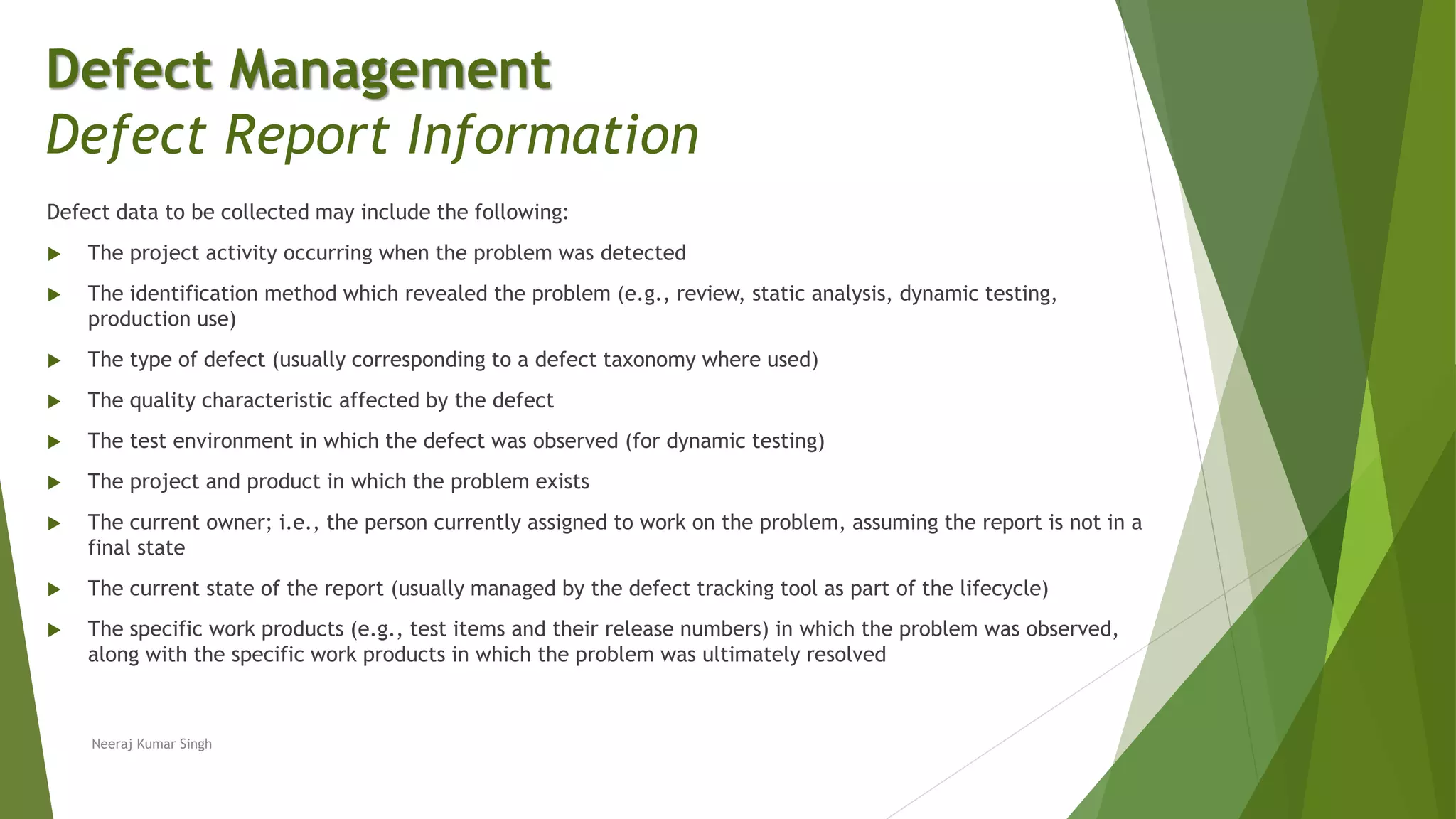
Defect data to be collected may include the following:
 The project activity occurring when the problem was detected
 The identification method which revealed the problem (e.g., review, static analysis, dynamic testing,
production use)
 The type of defect (usually corresponding to a defect taxonomy where used)
 The quality characteristic affected by the defect
 The test environment in which the defect was observed (for dynamic testing)
 The project and product in which the problem exists
 The current owner; i.e., the person currently assigned to work on the problem, assuming the report is not in a
final state
 The current state of the report (usually managed by the defect tracking tool as part of the lifecycle)
 The specific work products (e.g., test items and their release numbers) in which the problem was observed,
along with the specific work products in which the problem was ultimately resolved
Neeraj Kumar Singh
Defect Management
Defect Report Information
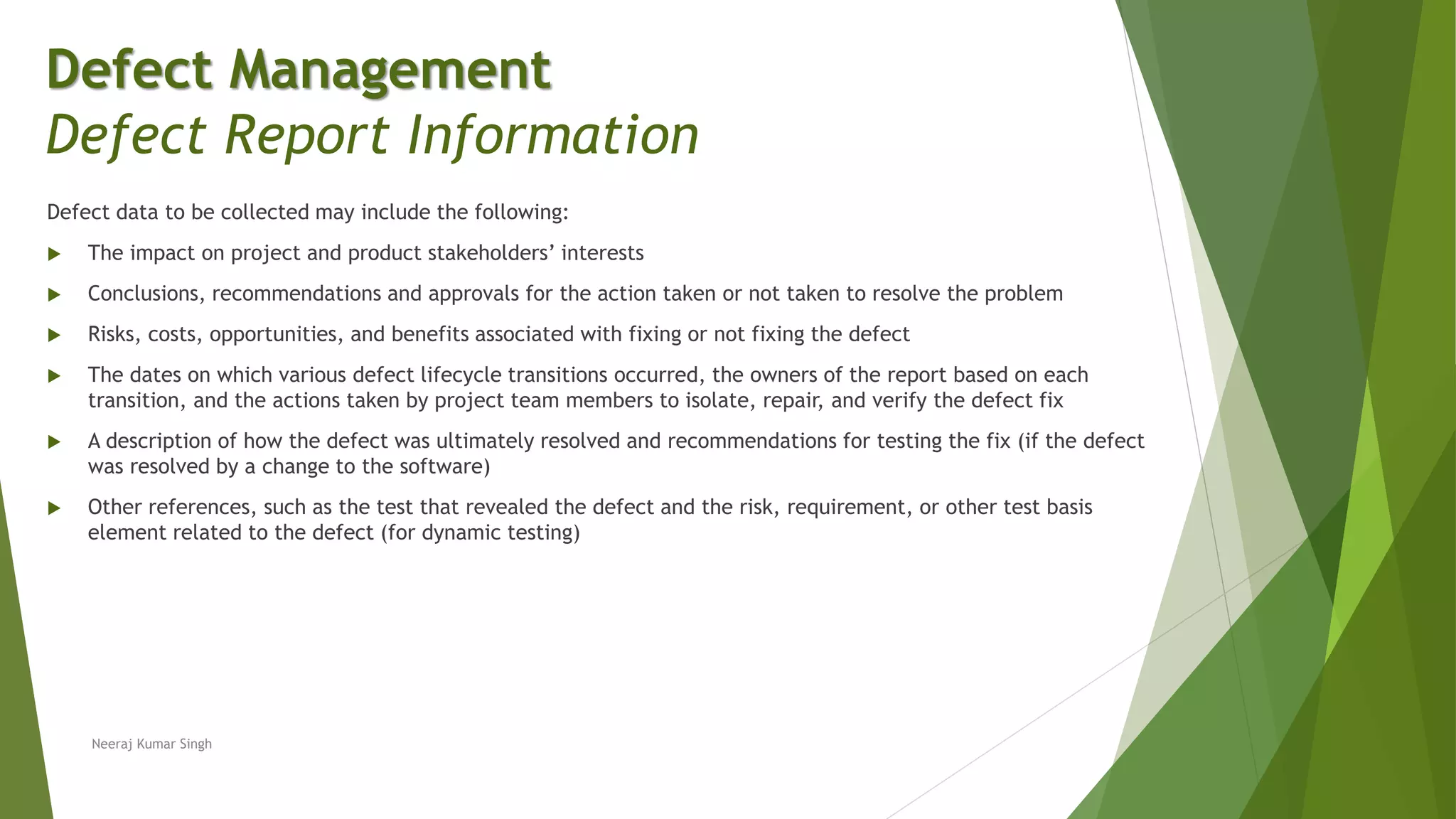
Defect data to be collected may include the following:
 The impact on project and product stakeholders’ interests
 Conclusions, recommendations and approvals for the action taken or not taken to resolve the problem
 Risks, costs, opportunities, and benefits associated with fixing or not fixing the defect
 The dates on which various defect lifecycle transitions occurred, the owners of the report based on each
transition, and the actions taken by project team members to isolate, repair, and verify the defect fix
 A description of how the defect was ultimately resolved and recommendations for testing the fix (if the defect
was resolved by a change to the software)
 Other references, such as the test that revealed the defect and the risk, requirement, or other test basis
element related to the defect (for dynamic testing)
Neeraj Kumar Singh
Defect Management
Defect Report Information
Defect Management
Contents
4.1 Introduction
4.2 The Defect Lifecycle and the Software
Development Lifecycle
4.3 Defect Report Information
4.4 Assessing Process Capability with
Defect Report Information
Neeraj Kumar Singh
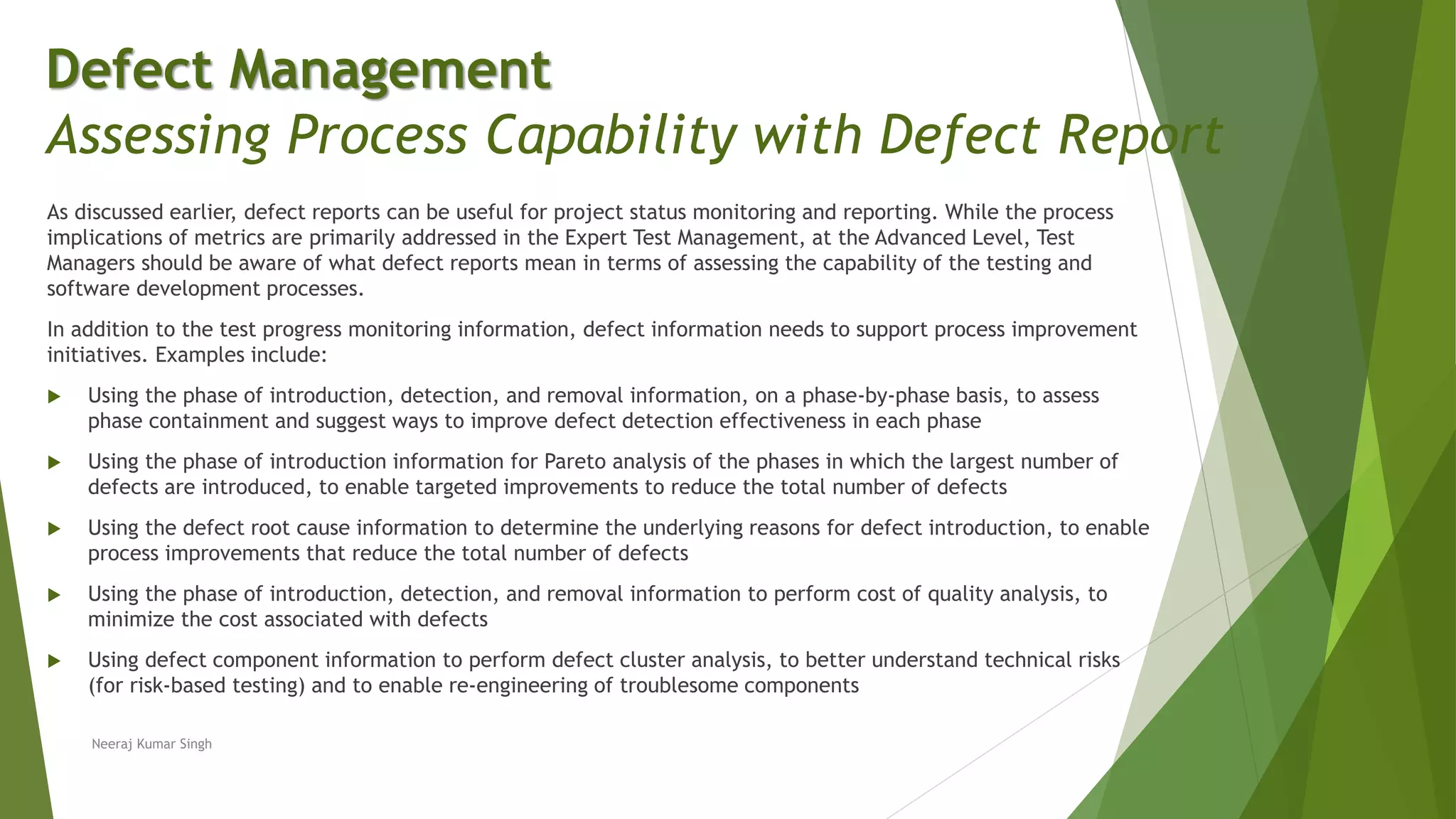
As discussed earlier, defect reports can be useful for project status monitoring and reporting. While the process
implications of metrics are primarily addressed in the Expert Test Management, at the Advanced Level, Test
Managers should be aware of what defect reports mean in terms of assessing the capability of the testing and
software development processes.
In addition to the test progress monitoring information, defect information needs to support process improvement
initiatives. Examples include:
 Using the phase of introduction, detection, and removal information, on a phase-by-phase basis, to assess
phase containment and suggest ways to improve defect detection effectiveness in each phase
 Using the phase of introduction information for Pareto analysis of the phases in which the largest number of
defects are introduced, to enable targeted improvements to reduce the total number of defects
 Using the defect root cause information to determine the underlying reasons for defect introduction, to enable
process improvements that reduce the total number of defects
 Using the phase of introduction, detection, and removal information to perform cost of quality analysis, to
minimize the cost associated with defects
 Using defect component information to perform defect cluster analysis, to better understand technical risks
(for risk-based testing) and to enable re-engineering of troublesome components
Neeraj Kumar Singh
Defect Management
Assessing Process Capability with Defect Report
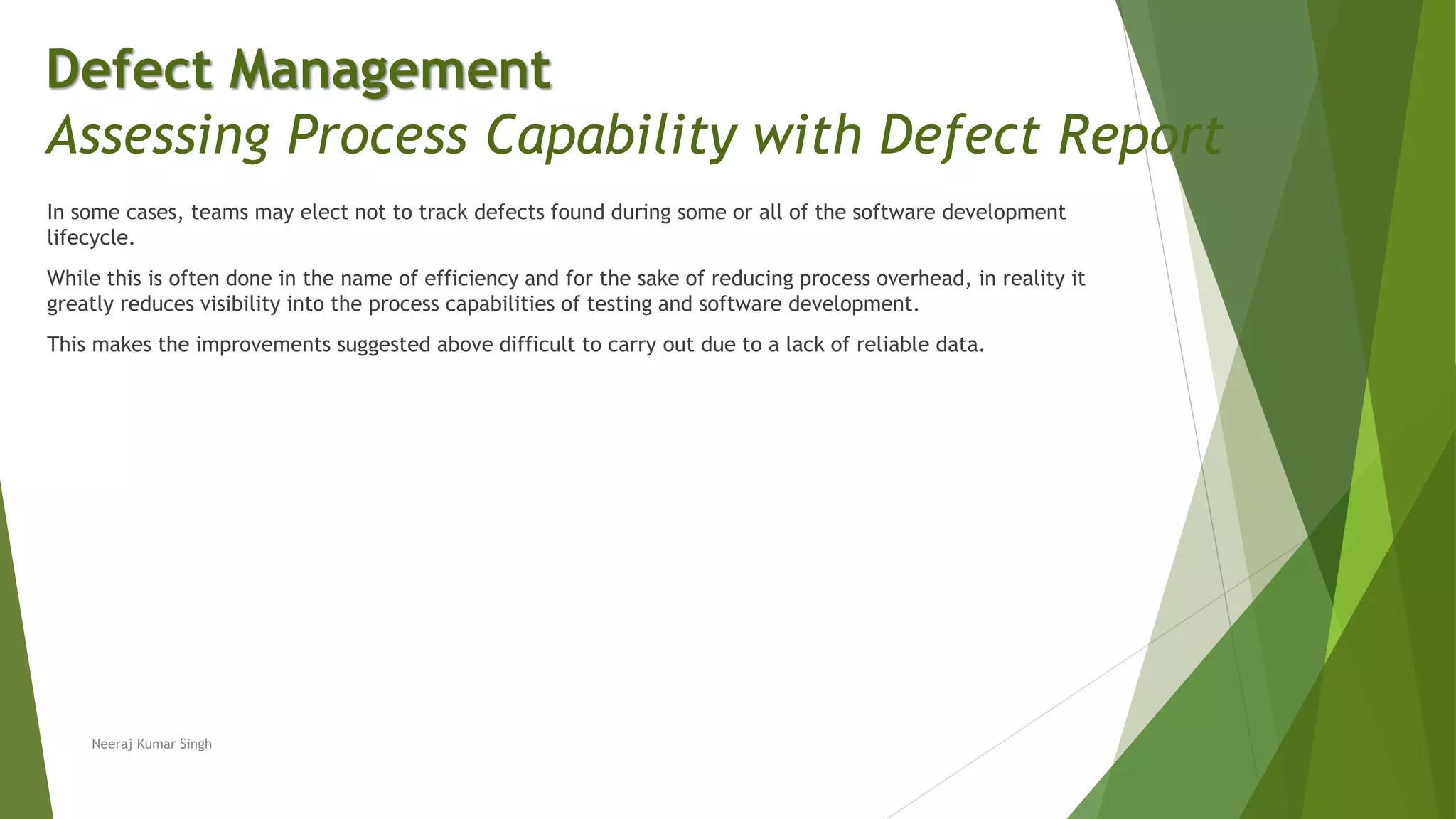
In some cases, teams may elect not to track defects found during some or all of the software development
lifecycle.
While this is often done in the name of efficiency and for the sake of reducing process overhead, in reality it
greatly reduces visibility into the process capabilities of testing and software development.
This makes the improvements suggested above difficult to carry out due to a lack of reliable data.
Neeraj Kumar Singh
Defect Management
Assessing Process Capability with Defect Report
Defect Management
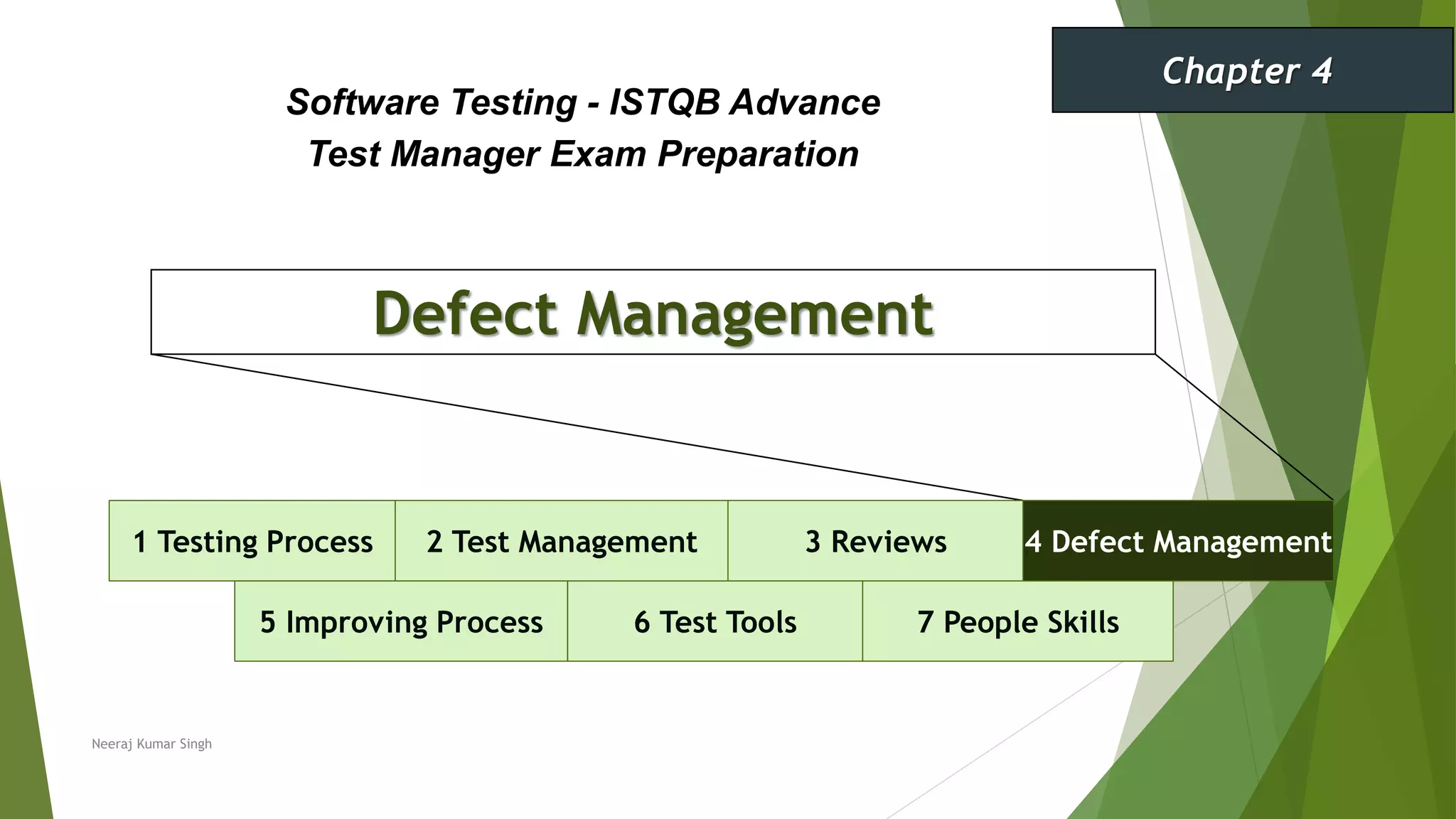
1 Testing Process 2 Test Management 3 Reviews
Software Testing - ISTQB Advance
Test Manager Exam Preparation
Chapter 4
Neeraj Kumar Singh
4 Defect Management
5 Improving Process 6 Test Tools 7 People Skills
Neeraj Kumar Singh
Defect Management
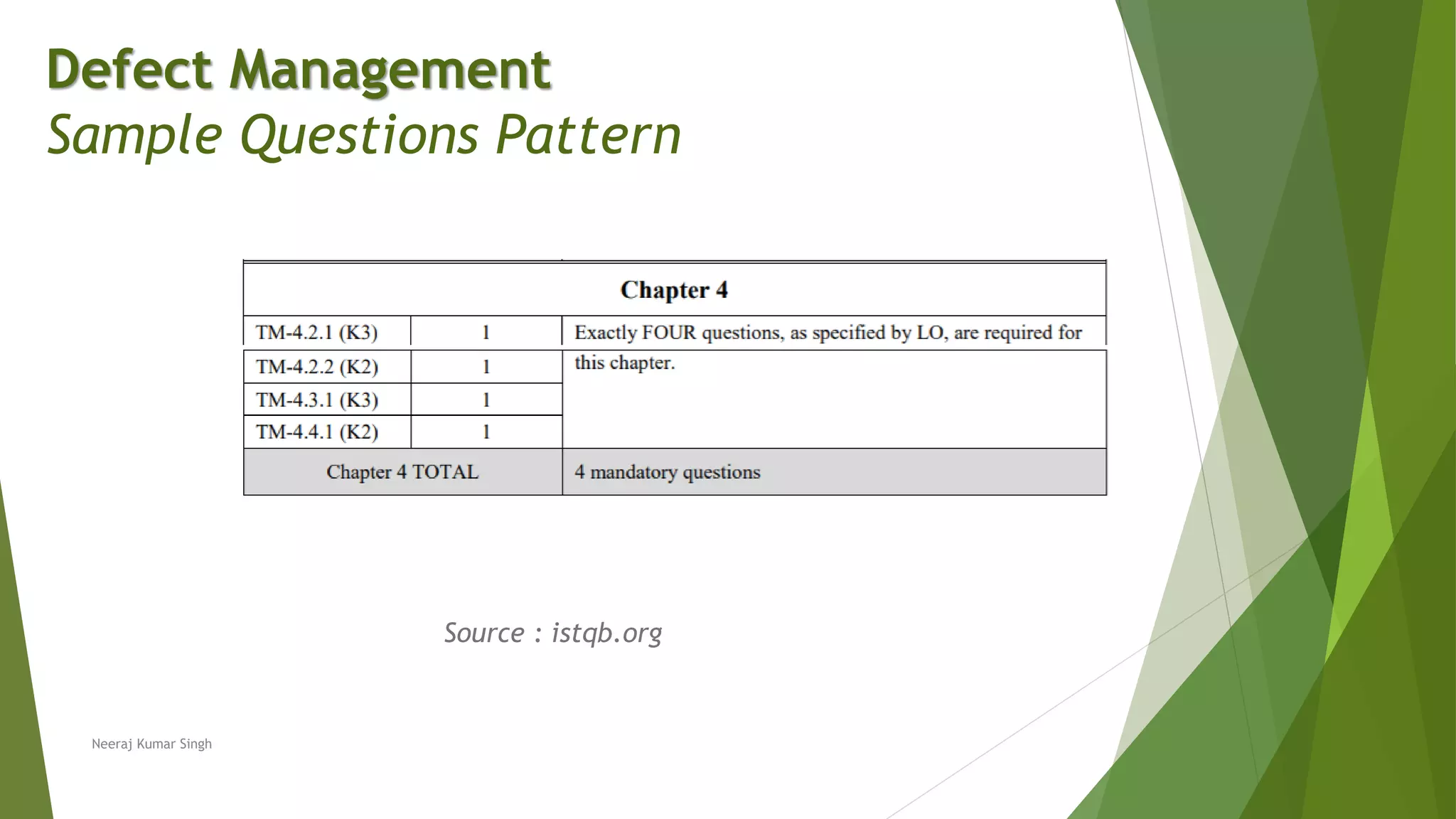
Sample Questions Pattern
Source : istqb.org
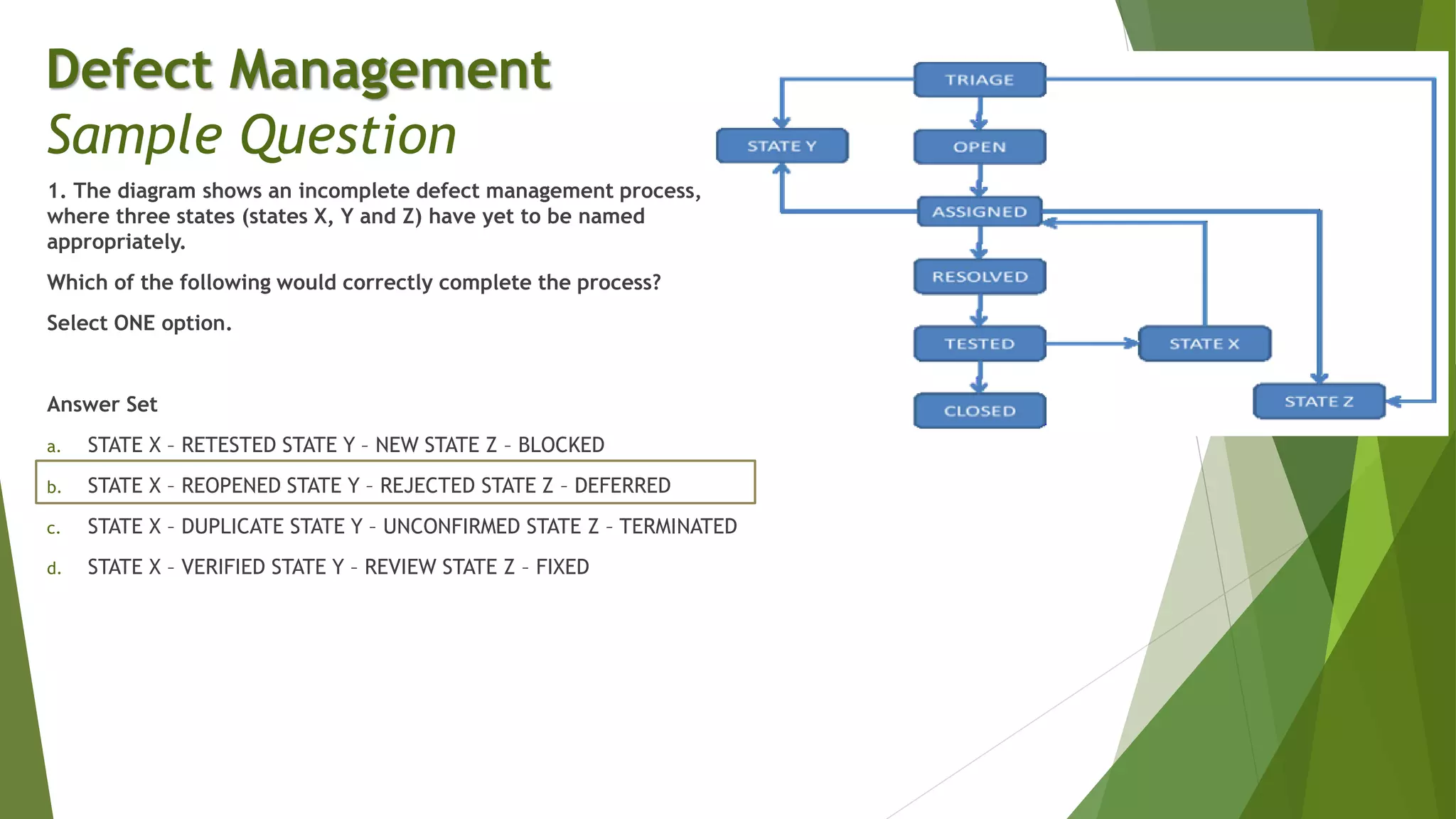
1. The diagram shows an incomplete defect management process,
where three states (states X, Y and Z) have yet to be named
appropriately.
Which of the following would correctly complete the process?
Select ONE option.
Answer Set
a. STATE X – RETESTED STATE Y – NEW STATE Z – BLOCKED
b. STATE X – REOPENED STATE Y – REJECTED STATE Z – DEFERRED
c. STATE X – DUPLICATE STATE Y – UNCONFIRMED STATE Z – TERMINATED
d. STATE X – VERIFIED STATE Y – REVIEW STATE Z – FIXED
Defect Management
Sample Question
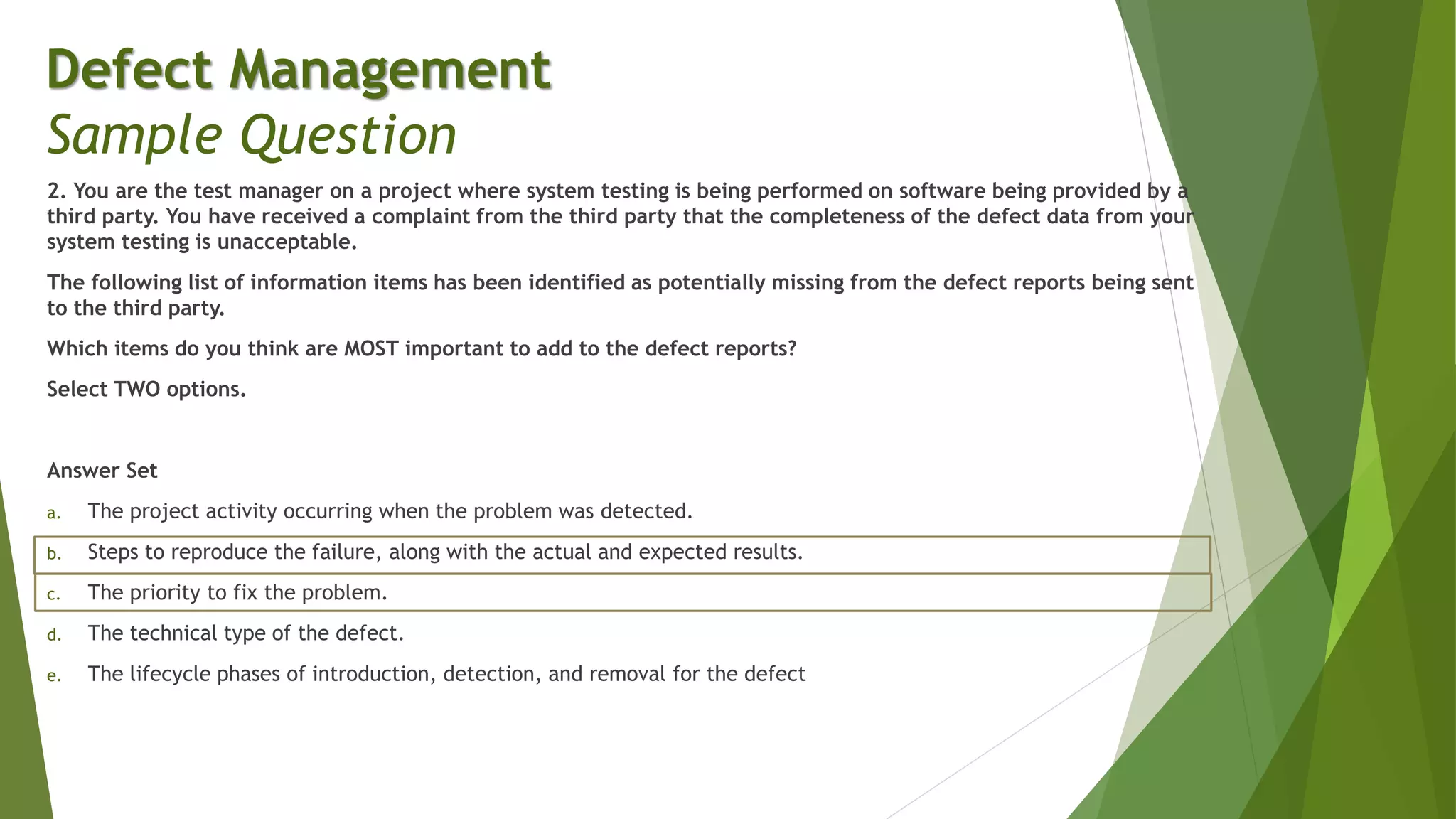
2. You are the test manager on a project where system testing is being performed on software being provided by a
third party. You have received a complaint from the third party that the completeness of the defect data from your
system testing is unacceptable.
The following list of information items has been identified as potentially missing from the defect reports being sent
to the third party.
Which items do you think are MOST important to add to the defect reports?
Select TWO options.
Answer Set
a. The project activity occurring when the problem was detected.
b. Steps to reproduce the failure, along with the actual and expected results.
c. The priority to fix the problem.
d. The technical type of the defect.
e. The lifecycle phases of introduction, detection, and removal for the defect
Defect Management
Sample Question
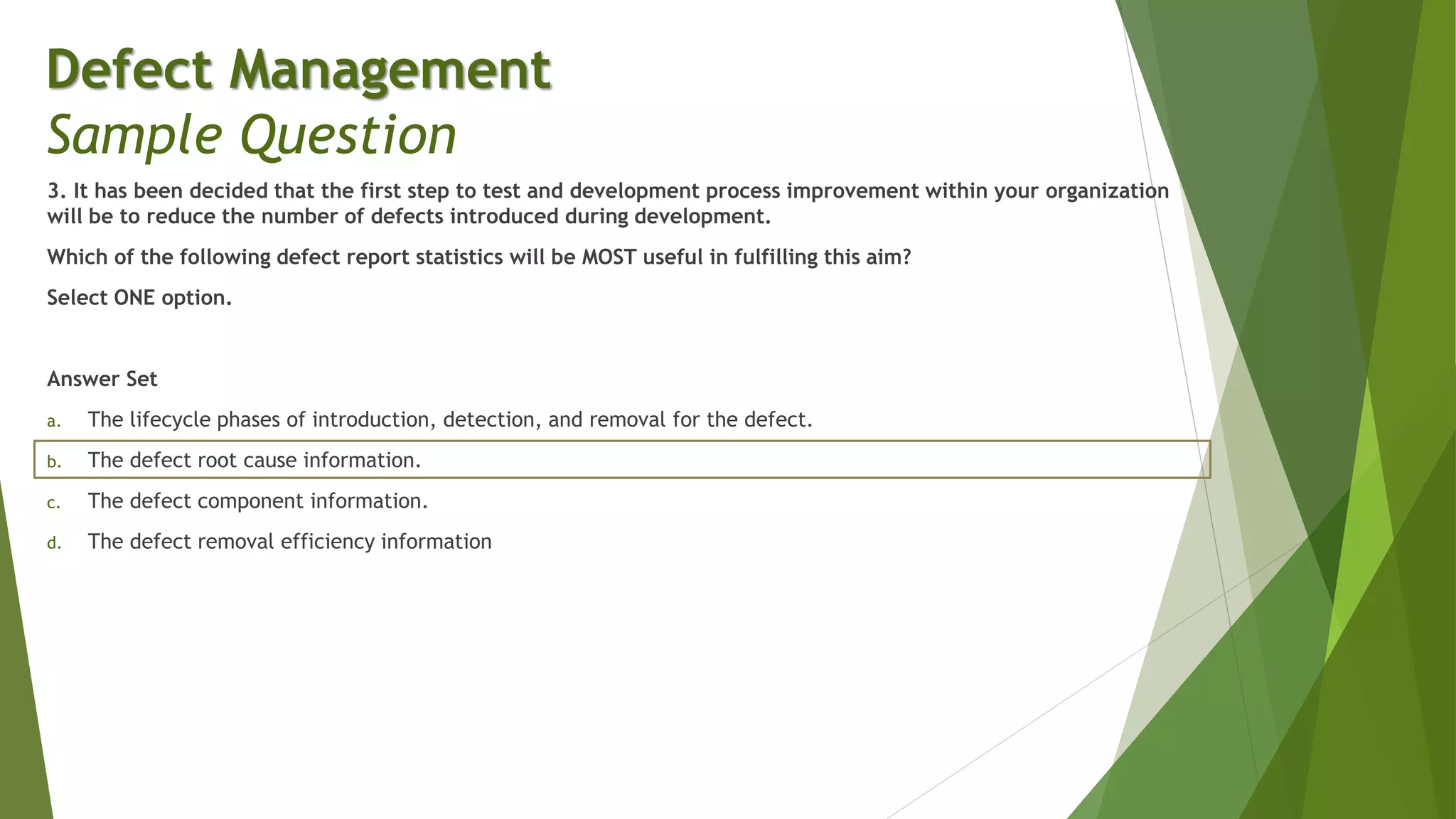
3. It has been decided that the first step to test and development process improvement within your organization
will be to reduce the number of defects introduced during development.
Which of the following defect report statistics will be MOST useful in fulfilling this aim?
Select ONE option.
Answer Set
a. The lifecycle phases of introduction, detection, and removal for the defect.
b. The defect root cause information.
c. The defect component information.
d. The defect removal efficiency information
Defect Management
Sample Question

Chapter 4 - Defect Management

  • 1.
    Defect Management 1 TestingProcess 2 Test Management 3 Reviews Software Testing - ISTQB Advance Test Manager Exam Preparation Chapter 4 Neeraj Kumar Singh 4 Defect Management 5 Improving Process 6 Test Tools 7 People Skills
  • 2.
    Defect Management Contents 4.1 Introduction 4.2The Defect Lifecycle and the Software Development Lifecycle 4.3 Defect Report Information 4.4 Assessing Process Capability with Defect Report Information Neeraj Kumar Singh
  • 3.
    An organization’s defectmanagement process and the tool used to manage this work are of critical importance not only to the test team but to all teams involved in the development of software. Information gathered by the effective management of defects allows the Test Manager and other project stakeholders to gain insight on the state of a project throughout the development lifecycle, and by collecting and analyzing data over time, can help locate areas of potential improvement for testing and development processes. In addition to understanding the overall defect lifecycle and how it is used to monitor and control both the testing and software development processes, the Test Manager must also be familiar with what data is critical to capture and must be an advocate of proper usage of both the process and the selected defect management tool. Neeraj Kumar Singh Defect Management Introduction
  • 4.
    Defect Management Contents 4.1 Introduction 4.2The Defect Lifecycle and the Software Development Lifecycle 4.3 Defect Report Information 4.4 Assessing Process Capability with Defect Report Information Neeraj Kumar Singh
  • 5.
    As explained inthe Foundation Level syllabus, defects are introduced when a person makes a mistake during the creation of a work product. This work product can be a requirements specification, a user story, a technical document, a test case, the program code, or any other work product produced during a software development or maintenance process. Defects may be introduced at any point in the software development lifecycle and in any software related work product. Therefore, each phase of the software development lifecycle should include activities to detect and remove potential defects. The earlier each defect is detected and removed, the lower the overall cost of quality for the system; cost of quality for a given level of defects is minimized when each defect is removed in the same phase in which it was introduced. Furthermore, static testing finds defects directly, rather than finding failures, and thus the cost of removing the defect is lower because debugging activities are not required to isolate the defect. During dynamic testing activities such as unit testing, integration testing, and system testing, the presence of a defect is revealed when it causes a failure, which results in a discrepancy between the actual results and the expected results of a test. In some cases, a false-negative result occurs when the tester does not observe the anomaly. Neeraj Kumar Singh Defect Management The Defect Lifecycle and the SDLC
  • 6.
    Most testing organizationsuse a tool to manage defect reports through the defect lifecycle. A defect report typically progresses through a workflow and moves through a sequence of states as it continues through the defect lifecycle. In most of these states, a single defect lifecycle participant owns the report and is responsible for carrying out a task which, when completed, will cause the defect report to be moved to the next state (and assigned to the next responsible party). In terminal states, such as when the defect report is closed (usually meaning that the underlying defect is fixed and the fix verified through a confirmation test), cancelled (usually meaning that the defect report is invalid), irreproducible (usually meaning that the anomaly can no longer be observed), or deferred (usually meaning that the anomaly relates to a real defect, but that defect will not be fixed during the project), the report does not have an owner, because no further actions are required. Neeraj Kumar Singh Defect Management Defect Workflow and States
  • 7.
    For defects discoveredby testers during testing, there are three states in particular where the action resides with the test team: The initial state  In this state, one or more testers gather the information necessary for the person responsible for resolving the defect to reproduce the anomaly.  This may also be referred to as the “open” or “new” state. The returned state  In this state, the receiver of the report has rejected the report or is asking the tester to supply further information. This state may indicate a shortfall in the initial information gathering process or of the testing itself, and Test Managers should monitor for excessive rates of return. The tester(s) must provide the additional information, or confirm that the report indeed should be rejected.  This may also be referred to as the “rejected” or “clarification” state. The confirmation test state  In this state, the tester will run a confirmation test (often following the steps to reproduce the failure from the defect report itself) to determine whether the fix has indeed solved the problem. If the confirmation test indicates that the defect is repaired, the tester should close the report. If the confirmation test indicates that the defect is not repaired, the tester should re-open the report, causing it to be reassigned to the previous owner, who can then complete the work necessary to repair the defect.  This may also be referred to as the “resolved” or “verification” state. Neeraj Kumar Singh Defect Management Defect Workflow and States
  • 8.
    In some cases,an anomaly occurs not as the symptom of a defect, but rather due to a problem with the test environment, the test data, some other element of the testware, or the tester’s own misunderstanding. If the tester opens a defect report that subsequently is found not to relate to a defect in the work product under test, that is a false-positive result. Such reports are typically cancelled or closed as invalid defect reports. In addition, in some cases a defect can exhibit different symptoms which may appear to the tester(s) as being entirely unrelated. If two or more defect reports are filed which subsequently are found to relate to the same root cause, one of the defect reports is typically retained while the others are closed as duplicate defect reports. While invalid and duplicate defect reports represent a certain level of inefficiency, some amount of such reports is inevitable and should be accepted as such by the Test Manager. When managers attempt to eliminate all invalid and duplicate defect reports, the number of false-negatives typically increases, since testers are being discouraged from filing defect reports. This decreases the testing organization’s defect detection effectiveness, which is related to a key testing organization objective in most cases. Neeraj Kumar Singh Defect Management Managing Invalid and Duplicate Defect Reports
  • 9.
    Although the testingorganization and Test Manager typically own the overall defect management process and the defect management tool, a cross-functional team is generally responsible for managing the reported defects for a given project. In addition to the Test Manager, participants in the defect management (or defect triage) committee typically include development, project management, product management and other stakeholders who have an interest in the software under development. As anomalies are discovered and entered into the defect management tool, the defect management committee should meet to determine whether each defect report represents a valid defect, and whether it should be fixed or deferred. This decision requires the defect management committee to consider the benefits, risks and costs associated with fixing or not fixing the defect. If the defect is to be fixed, the team should establish the priority of fixing the defect relative to other project tasks. The Test Manager and test team may be consulted regarding the relative importance of a defect and should provide available objective information. A defect tracking tool should not be used as a substitute for good communication nor should defect management committee meetings be used as a substitute for effective use of a good defect tracking tool. Communication, adequate tool support, a well-defined defect lifecycle, and an engaged defect management committee are all necessary for effective and efficient defect management. Neeraj Kumar Singh Defect Management Cross-Functional Defect Management
  • 10.
    Defect Management Contents 4.1 Introduction 4.2The Defect Lifecycle and the Software Development Lifecycle 4.3 Defect Report Information 4.4 Assessing Process Capability with Defect Report Information Neeraj Kumar Singh
  • 11.
    When a defectis detected (as part of static testing), or a failure is observed (as part of dynamic testing), data should be gathered by the person(s) involved and included in the defect report. This information should suffice for three purposes:  Management of the report through the defect lifecycle  Assessment of project status, especially in terms of product quality, and test progress  Assessment of process capability The data needed for defect report management and project status can vary depending on when the defect is detected in the lifecycle, typically with less information needed earlier (e.g., requirements reviews and unit test). However, the core information gathered should be consistent across the lifecycle and ideally across all projects to allow for meaningful comparison of process defect data throughout the project and across all projects. Neeraj Kumar Singh Defect Management Defect Report Information
  • 12.
    Defect data tobe collected may include the following:  The name of the person who discovered the defect  The role of the person (e.g., end user, business analyst, developer, technical support person)  The type of testing being performed (e.g., usability testing, performance testing, regression testing )  A summary of the problem  A detailed description of the problem  Steps to reproduce the failure (for a defect), along with the actual and expected results (highlighting the anomaly), including screen shots, database dumps, and logs where applicable  The lifecycle phase of introduction, detection, and removal for the defect, including the test level if applicable  The work product in which the defect was introduced  The severity of the impact on the system and/or the product stakeholders (usually determined by the technical behavior of the system)  The priority to fix the problem (usually determined by the business impact of the failure) The subsystem or component in which the defect lies (for defect cluster analysis) Neeraj Kumar Singh Defect Management Defect Report Information
  • 13.
    Defect data tobe collected may include the following:  The project activity occurring when the problem was detected  The identification method which revealed the problem (e.g., review, static analysis, dynamic testing, production use)  The type of defect (usually corresponding to a defect taxonomy where used)  The quality characteristic affected by the defect  The test environment in which the defect was observed (for dynamic testing)  The project and product in which the problem exists  The current owner; i.e., the person currently assigned to work on the problem, assuming the report is not in a final state  The current state of the report (usually managed by the defect tracking tool as part of the lifecycle)  The specific work products (e.g., test items and their release numbers) in which the problem was observed, along with the specific work products in which the problem was ultimately resolved Neeraj Kumar Singh Defect Management Defect Report Information
  • 14.
    Defect data tobe collected may include the following:  The impact on project and product stakeholders’ interests  Conclusions, recommendations and approvals for the action taken or not taken to resolve the problem  Risks, costs, opportunities, and benefits associated with fixing or not fixing the defect  The dates on which various defect lifecycle transitions occurred, the owners of the report based on each transition, and the actions taken by project team members to isolate, repair, and verify the defect fix  A description of how the defect was ultimately resolved and recommendations for testing the fix (if the defect was resolved by a change to the software)  Other references, such as the test that revealed the defect and the risk, requirement, or other test basis element related to the defect (for dynamic testing) Neeraj Kumar Singh Defect Management Defect Report Information
  • 15.
    Defect Management Contents 4.1 Introduction 4.2The Defect Lifecycle and the Software Development Lifecycle 4.3 Defect Report Information 4.4 Assessing Process Capability with Defect Report Information Neeraj Kumar Singh
  • 16.
    As discussed earlier,defect reports can be useful for project status monitoring and reporting. While the process implications of metrics are primarily addressed in the Expert Test Management, at the Advanced Level, Test Managers should be aware of what defect reports mean in terms of assessing the capability of the testing and software development processes. In addition to the test progress monitoring information, defect information needs to support process improvement initiatives. Examples include:  Using the phase of introduction, detection, and removal information, on a phase-by-phase basis, to assess phase containment and suggest ways to improve defect detection effectiveness in each phase  Using the phase of introduction information for Pareto analysis of the phases in which the largest number of defects are introduced, to enable targeted improvements to reduce the total number of defects  Using the defect root cause information to determine the underlying reasons for defect introduction, to enable process improvements that reduce the total number of defects  Using the phase of introduction, detection, and removal information to perform cost of quality analysis, to minimize the cost associated with defects  Using defect component information to perform defect cluster analysis, to better understand technical risks (for risk-based testing) and to enable re-engineering of troublesome components Neeraj Kumar Singh Defect Management Assessing Process Capability with Defect Report
  • 17.
    In some cases,teams may elect not to track defects found during some or all of the software development lifecycle. While this is often done in the name of efficiency and for the sake of reducing process overhead, in reality it greatly reduces visibility into the process capabilities of testing and software development. This makes the improvements suggested above difficult to carry out due to a lack of reliable data. Neeraj Kumar Singh Defect Management Assessing Process Capability with Defect Report
  • 18.
    Defect Management 1 TestingProcess 2 Test Management 3 Reviews Software Testing - ISTQB Advance Test Manager Exam Preparation Chapter 4 Neeraj Kumar Singh 4 Defect Management 5 Improving Process 6 Test Tools 7 People Skills
  • 19.
    Neeraj Kumar Singh DefectManagement Sample Questions Pattern Source : istqb.org
  • 20.
    1. The diagramshows an incomplete defect management process, where three states (states X, Y and Z) have yet to be named appropriately. Which of the following would correctly complete the process? Select ONE option. Answer Set a. STATE X – RETESTED STATE Y – NEW STATE Z – BLOCKED b. STATE X – REOPENED STATE Y – REJECTED STATE Z – DEFERRED c. STATE X – DUPLICATE STATE Y – UNCONFIRMED STATE Z – TERMINATED d. STATE X – VERIFIED STATE Y – REVIEW STATE Z – FIXED Defect Management Sample Question
  • 21.
    2. You arethe test manager on a project where system testing is being performed on software being provided by a third party. You have received a complaint from the third party that the completeness of the defect data from your system testing is unacceptable. The following list of information items has been identified as potentially missing from the defect reports being sent to the third party. Which items do you think are MOST important to add to the defect reports? Select TWO options. Answer Set a. The project activity occurring when the problem was detected. b. Steps to reproduce the failure, along with the actual and expected results. c. The priority to fix the problem. d. The technical type of the defect. e. The lifecycle phases of introduction, detection, and removal for the defect Defect Management Sample Question
  • 22.
    3. It hasbeen decided that the first step to test and development process improvement within your organization will be to reduce the number of defects introduced during development. Which of the following defect report statistics will be MOST useful in fulfilling this aim? Select ONE option. Answer Set a. The lifecycle phases of introduction, detection, and removal for the defect. b. The defect root cause information. c. The defect component information. d. The defect removal efficiency information Defect Management Sample Question