Test management
RIDO RANDIKA PUTRA
11453101593
SIF 7 C
Program Studi S1 Sistem Informasi
Fakultas Sains dan Teknologi
Universitas Islam Negeri Sultan
Syarif Kasim Riau
http://sif.uin-suska.ac.id/
http://fst.uin-suska.ac.id/
http://www.uin-suska.ac.id/
Referensi Graham et.al (2006)
5.1 TEST ORGANIZATION
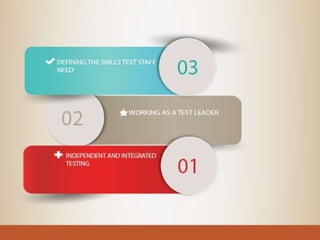
5.1.1 Independent and integrated testing
The approaches to organizing a test team vary, as do the places in
the organ-ization structure where the test team fits. Since testing is
an assessment of quality, and since that assessment is not always
positive, many organizations strive to create an organizational
climate where testers can deliver an inde-pendent, objective
assessment of quality.
When thinking about how independent the test team is, recognize
that inde-pendence is not an either/or condition, but a continuum.
At one end of the continuum lies the absence of independence,
where the programmer performs testing within the programming
team.
common cause is the failure of the test manager to
effectively manage the risks of independence listed above.
Some test teams succumb to the temptation to adopt a 'no
can do' attitude, coming up with reasons why the project
should bend to their needs rather than each side being
flexible so as to enable project success. Testers take to acting
as enforcers of process or as auditors without a proper
management mandate and support. Resentments and
pressures build, until at last the organization decides that the
independent test team causes more problems than it solves.
It's espe-cially important for testers and test managers to understand the
mission they serve and the reasons why the organization wants an
independent test team. Often, the entire test team must realize that,
whether they are part of the project team or independent, they exist to
provide a service to the project team.
There is no one right approach to organizing testing. For each project,
you must consider whether to use an independent test team, based on the
project, the application domain, and the levels of risk, among other
factors. As the size, complexity, and criticality of the project increases, it
is important to have inde-pendence in later levels of testing (like
integration test, system test and accept-ance test), though some testing is
often best done by other people such as project managers, quality
managers, developers, business and domain experts or infrastructure or
IT operations experts.
5.1.2 Working as a test leader
Test leaders tend to be involved in the planning, monitoring, and control
of the testing activities and tasks discussed in Section 1.5 on the
fundamental test process. At the outset of the project, test leaders, in
collaboration with the other stakeholders, devise the test objectives,
organizational test policies (if not already in place), test strategies and
test plans. They estimate the testing to be done and negotiate with
management to acquire the necessary resources. They recognize when
test automation is appropriate and, if it is, they plan the effort, select the
tools, and ensure training of the team. They may consult with other
groups - e.g., programmers - to help them with their testing. They lead,
guide and monitor the analysis, design, implementation and execution of
the test cases, test procedures and test suites. They ensure proper
configuration management of the testware produced and traceability of
the tests to the test basis.
As test execution comes near, they make sure the test environment is put
into place before test execution and managed during test execution. They
schedule the tests for execution and then they monitor, measure, control
and report on the test progress, the product quality status and the test
results, adapting the test plan and compensating as needed to adjust to
evolving con-ditions. During test execution and as the project winds
down, they write summary reports on test status.
Sometimes test leaders wear different titles, such as test manager or test
coordinator. Alternatively, the test leader role may wind up assigned to a
project manager, a development manager or a quality assurance manager.
(Regarding the first two people on this list, warning bells about
independence should be ringing in your head now, in addition to thoughts
about how we can ensure that such non-testers gain the knowledge and
outlook needed to manage testing.) Whoever is playing the role, expect
them to plan, monitor and control the testing work.
5.1.3 Working as a tester
As with test leaders, projects should include testers at the outset, though it is
often the case that project doesn't need a full complement of testers until the test
execution period. In the planning and preparation phases of the testing, testers
should review and contribute to test plans, as well as analyzing, review-ing and
assessing requirements and design specifications. They may be involved in or
even be the primary people identifying test conditions and cre-ating test designs,
test cases, test procedure specifications and test data, and may automate or help
to automate the tests. They often set up the test envi-ronments or assist system
administration and network management staff in doing so.
As test execution begins, the number of testers often increases, starting with the
work required to implement tests in the test environment. (They may play such a
role on all test levels, even those not under the direct control of the test group;
e.g., they might implement unit tests which were designed by program-mers.)
Testers execute and log the tests, evaluate the results and document problems
found. They monitor the testing and the test environment, often using tools for
this task, and often gather performance metrics. Throughout the testing life cycle,
they review each other's work, including test specifica-tions, defect reports and
test results.
5.1.4 Defining the skills test
staff need
Doing testing properly requires more than defining the right
positions and number of people for those positions. Good
test teams have the right mix of skills based on the tasks and
activities they need to carry out, and people outside the test
team who are in charge of test tasks need the right skills, too.
People involved in testing need basic professional and social
qualifications such as literacy, the ability to prepare and
deliver written and verbal reports, the ability to
communicate effectively, and so on. Going beyond that,
when we think of the skills that testers need, three main
areas come to mind:
• Application or business domain: A tester must understand the intended
behavior, the problem the system will solve, the process it will automate
and so forth, in order to spot improper behavior while testing and
recognize the 'must work' functions and features.
• Technology: A tester must be aware of issues, limitations and
capabilities of the chosen implementation technology, in order to
effectively and effi ciently locate problems and recognize the 'likely to
fail' functions and features.
• Testing: A tester must know the testing topics discussed in this book -
and often more advanced testing topics - in order to effectively and
efficiently carry out the test tasks assigned.
The set of testing tasks and activities are many and varied, and so too are
the skills required, so we often see specialization of skills and separation
of roles. For example, due to the special knowledge required in the areas
of testing, technology and business domain, respectively, test tool experts
may handle automating the regression tests, programmers may perform
compo-nent and integration tests and users and operators may be
involved in acceptance tests
All types of projects tend to underestimate the testing knowledge
required. We have seen a project fail in part because people without
proper testing skills tested critical components, leading to the disastrous
discovery of fundamental architectural problems later. Most projects can
benefit from the participation of professional testers, as amateur testing
alone will usually not suffice.

Test management

  • 1.
    Test management RIDO RANDIKAPUTRA 11453101593 SIF 7 C Program Studi S1 Sistem Informasi Fakultas Sains dan Teknologi Universitas Islam Negeri Sultan Syarif Kasim Riau http://sif.uin-suska.ac.id/ http://fst.uin-suska.ac.id/ http://www.uin-suska.ac.id/ Referensi Graham et.al (2006)
  • 3.
    5.1 TEST ORGANIZATION 5.1.1Independent and integrated testing The approaches to organizing a test team vary, as do the places in the organ-ization structure where the test team fits. Since testing is an assessment of quality, and since that assessment is not always positive, many organizations strive to create an organizational climate where testers can deliver an inde-pendent, objective assessment of quality. When thinking about how independent the test team is, recognize that inde-pendence is not an either/or condition, but a continuum. At one end of the continuum lies the absence of independence, where the programmer performs testing within the programming team.
  • 4.
    common cause isthe failure of the test manager to effectively manage the risks of independence listed above. Some test teams succumb to the temptation to adopt a 'no can do' attitude, coming up with reasons why the project should bend to their needs rather than each side being flexible so as to enable project success. Testers take to acting as enforcers of process or as auditors without a proper management mandate and support. Resentments and pressures build, until at last the organization decides that the independent test team causes more problems than it solves.
  • 5.
    It's espe-cially importantfor testers and test managers to understand the mission they serve and the reasons why the organization wants an independent test team. Often, the entire test team must realize that, whether they are part of the project team or independent, they exist to provide a service to the project team. There is no one right approach to organizing testing. For each project, you must consider whether to use an independent test team, based on the project, the application domain, and the levels of risk, among other factors. As the size, complexity, and criticality of the project increases, it is important to have inde-pendence in later levels of testing (like integration test, system test and accept-ance test), though some testing is often best done by other people such as project managers, quality managers, developers, business and domain experts or infrastructure or IT operations experts.
  • 6.
    5.1.2 Working asa test leader Test leaders tend to be involved in the planning, monitoring, and control of the testing activities and tasks discussed in Section 1.5 on the fundamental test process. At the outset of the project, test leaders, in collaboration with the other stakeholders, devise the test objectives, organizational test policies (if not already in place), test strategies and test plans. They estimate the testing to be done and negotiate with management to acquire the necessary resources. They recognize when test automation is appropriate and, if it is, they plan the effort, select the tools, and ensure training of the team. They may consult with other groups - e.g., programmers - to help them with their testing. They lead, guide and monitor the analysis, design, implementation and execution of the test cases, test procedures and test suites. They ensure proper configuration management of the testware produced and traceability of the tests to the test basis.
  • 7.
    As test executioncomes near, they make sure the test environment is put into place before test execution and managed during test execution. They schedule the tests for execution and then they monitor, measure, control and report on the test progress, the product quality status and the test results, adapting the test plan and compensating as needed to adjust to evolving con-ditions. During test execution and as the project winds down, they write summary reports on test status. Sometimes test leaders wear different titles, such as test manager or test coordinator. Alternatively, the test leader role may wind up assigned to a project manager, a development manager or a quality assurance manager. (Regarding the first two people on this list, warning bells about independence should be ringing in your head now, in addition to thoughts about how we can ensure that such non-testers gain the knowledge and outlook needed to manage testing.) Whoever is playing the role, expect them to plan, monitor and control the testing work.
  • 8.
    5.1.3 Working asa tester As with test leaders, projects should include testers at the outset, though it is often the case that project doesn't need a full complement of testers until the test execution period. In the planning and preparation phases of the testing, testers should review and contribute to test plans, as well as analyzing, review-ing and assessing requirements and design specifications. They may be involved in or even be the primary people identifying test conditions and cre-ating test designs, test cases, test procedure specifications and test data, and may automate or help to automate the tests. They often set up the test envi-ronments or assist system administration and network management staff in doing so. As test execution begins, the number of testers often increases, starting with the work required to implement tests in the test environment. (They may play such a role on all test levels, even those not under the direct control of the test group; e.g., they might implement unit tests which were designed by program-mers.) Testers execute and log the tests, evaluate the results and document problems found. They monitor the testing and the test environment, often using tools for this task, and often gather performance metrics. Throughout the testing life cycle, they review each other's work, including test specifica-tions, defect reports and test results.
  • 9.
    5.1.4 Defining theskills test staff need Doing testing properly requires more than defining the right positions and number of people for those positions. Good test teams have the right mix of skills based on the tasks and activities they need to carry out, and people outside the test team who are in charge of test tasks need the right skills, too. People involved in testing need basic professional and social qualifications such as literacy, the ability to prepare and deliver written and verbal reports, the ability to communicate effectively, and so on. Going beyond that, when we think of the skills that testers need, three main areas come to mind:
  • 10.
    • Application orbusiness domain: A tester must understand the intended behavior, the problem the system will solve, the process it will automate and so forth, in order to spot improper behavior while testing and recognize the 'must work' functions and features. • Technology: A tester must be aware of issues, limitations and capabilities of the chosen implementation technology, in order to effectively and effi ciently locate problems and recognize the 'likely to fail' functions and features. • Testing: A tester must know the testing topics discussed in this book - and often more advanced testing topics - in order to effectively and efficiently carry out the test tasks assigned.
  • 11.
    The set oftesting tasks and activities are many and varied, and so too are the skills required, so we often see specialization of skills and separation of roles. For example, due to the special knowledge required in the areas of testing, technology and business domain, respectively, test tool experts may handle automating the regression tests, programmers may perform compo-nent and integration tests and users and operators may be involved in acceptance tests All types of projects tend to underestimate the testing knowledge required. We have seen a project fail in part because people without proper testing skills tested critical components, leading to the disastrous discovery of fundamental architectural problems later. Most projects can benefit from the participation of professional testers, as amateur testing alone will usually not suffice.