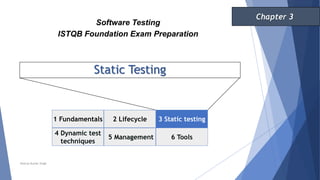
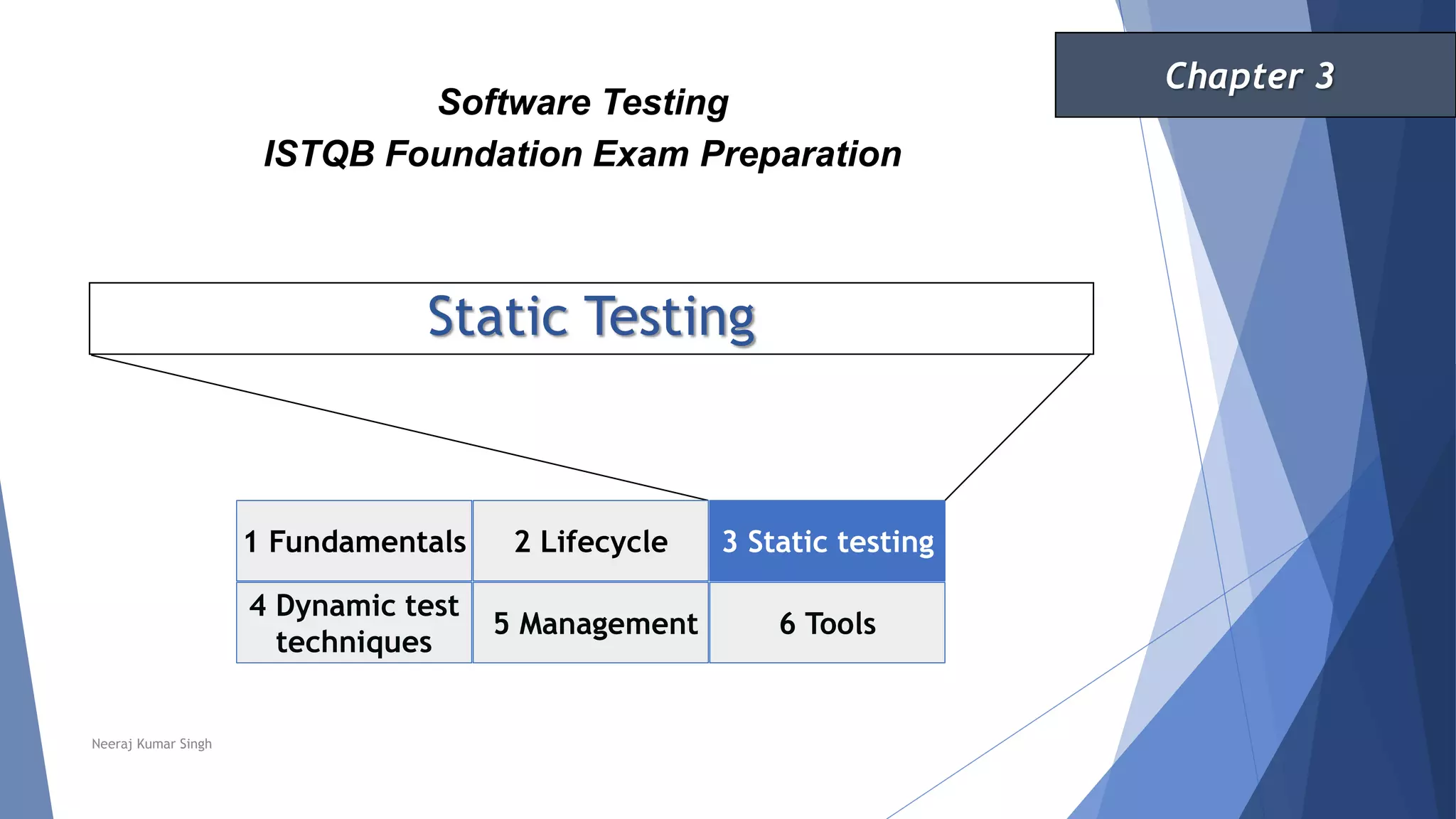
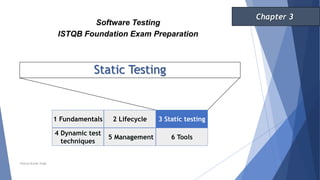
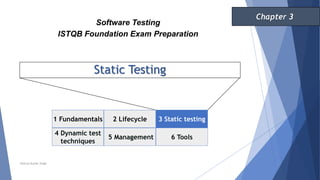
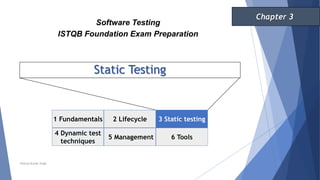
Static Testing
1 Fundamentals 2 Lifecycle
4 Dynamic test
techniques
3 Static testing
5 Management 6 Tools
Software Testing
ISTQB Foundation Exam Preparation
Chapter 3
Neeraj Kumar Singh
Static techniques
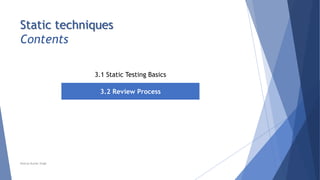
Contents
3.1 Static Testing Basics
3.2 Review Process
Neeraj Kumar Singh
Static Testing Basics
Work Products Examined by Static Testing
Almost any work product can be examined using static testing (reviews and/or static
analysis), for example:
 Specifications, including business requirements, functional requirements, and security
requirements
 Epics, user stories, and acceptance criteria
 Architecture and design specifications
 Code
 Testware, including test plans, test cases, test procedures, and automated test scripts
 User guides
 Web pages
 Contracts, project plans, schedules, and budgets
 Models, such as activity diagrams, which may be used for Model-Based testing
Neeraj Kumar Singh
Static Testing Basics
Benefits of Static Testing
 When applied early in the software development lifecycle, static testing enables the
early detection of defects before dynamic testing is performed.
 E.g., in requirements or design specifications reviews, product backlog refinement,
etc.
 Defects found early are often much cheaper to remove than defects found later in the
lifecycle, especially compared to defects found after the software is deployed and in
active use.
Neeraj Kumar Singh
Static Testing Basics
Benefits of Static Testing
Additional benefits of static testing may include:
 Detecting and correcting defects more efficiently, and prior to dynamic test execution
 Identifying defects which are not easily found by dynamic testing
 Preventing defects in design or coding by uncovering inconsistencies, ambiguities,
contradictions, omissions, inaccuracies, and redundancies in requirements
 Increasing development productivity (e.g., due to improved design, more maintainable code)
 Reducing development cost and time
 Reducing testing cost and time
 Reducing total cost of quality over the software’s lifetime, due to fewer failures later in the
lifecycle or after delivery into operation
 Improving communication between team members in the course of participating in reviews
Neeraj Kumar Singh
Static Testing Basics
Static Testing vs Dynamic Testing
One main distinction is that static testing finds defects in work products directly rather than identifying
failures caused by defects when the software is run.
Compared with dynamic testing, typical defects that are easier and cheaper to find and fix through
static testing include:
 Requirement defects (e.g., inconsistencies, ambiguities, contradictions, omissions, inaccuracies, and
redundancies)
 Design defects (e.g., inefficient algorithms or database structures, high coupling, low cohesion)
 Coding defects (e.g., variables with undefined values, variables that are declared but never used,
unreachable code, duplicate code)
 Deviations from standards (e.g., lack of adherence to coding standards)
 Incorrect interface specifications (e.g., different units of measurement used by the calling system
than by the called system)
 Security vulnerabilities (e.g., susceptibility to buffer overflows)
 Gaps or inaccuracies in test basis traceability or coverage (e.g., missing tests for an acceptance
criterion)
Neeraj Kumar Singh
Static Testing
1 Fundamentals 2 Lifecycle
4 Dynamic test
techniques
3 Static testing
5 Management 6 Tools
Software Testing
ISTQB Foundation Exam Preparation
Chapter 3
Neeraj Kumar Singh
Static techniques
Contents
3.1 Static Testing Basics
3.2 Review Process
Neeraj Kumar Singh
Review Process
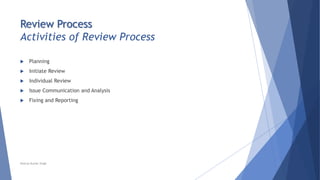
Activities of Review Process
 Planning
 Initiate Review
 Individual Review
 Issue Communication and Analysis
 Fixing and Reporting
Neeraj Kumar Singh
Review Process
Activities of Review Process
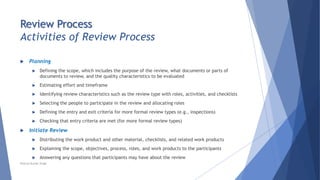
 Planning
 Defining the scope, which includes the purpose of the review, what documents or parts of
documents to review, and the quality characteristics to be evaluated
 Estimating effort and timeframe
 Identifying review characteristics such as the review type with roles, activities, and checklists
 Selecting the people to participate in the review and allocating roles
 Defining the entry and exit criteria for more formal review types (e.g., inspections)
 Checking that entry criteria are met (for more formal review types)
 Initiate Review
 Distributing the work product and other material, checklists, and related work products
 Explaining the scope, objectives, process, roles, and work products to the participants
 Answering any questions that participants may have about the review
Neeraj Kumar Singh
Review Process
Activities of Review Process
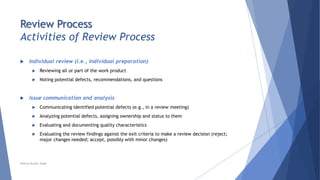
 Individual review (i.e., individual preparation)
 Reviewing all or part of the work product
 Noting potential defects, recommendations, and questions
 Issue communication and analysis
 Communicating identified potential defects (e.g., in a review meeting)
 Analyzing potential defects, assigning ownership and status to them
 Evaluating and documenting quality characteristics
 Evaluating the review findings against the exit criteria to make a review decision (reject;
major changes needed; accept, possibly with minor changes)
Neeraj Kumar Singh
Review Process
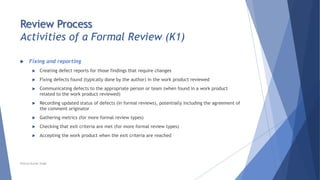
Activities of a Formal Review (K1)
 Fixing and reporting
 Creating defect reports for those findings that require changes
 Fixing defects found (typically done by the author) in the work product reviewed
 Communicating defects to the appropriate person or team (when found in a work product
related to the work product reviewed)
 Recording updated status of defects (in formal reviews), potentially including the agreement of
the comment originator
 Gathering metrics (for more formal review types)
 Checking that exit criteria are met (for more formal review types)
 Accepting the work product when the exit criteria are reached
Neeraj Kumar Singh
Review Process
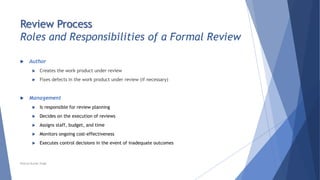
Roles and Responsibilities of a Formal Review
 Author
 Creates the work product under review
 Fixes defects in the work product under review (if necessary)
 Management
 Is responsible for review planning
 Decides on the execution of reviews
 Assigns staff, budget, and time
 Monitors ongoing cost-effectiveness
 Executes control decisions in the event of inadequate outcomes
Neeraj Kumar Singh
Review Process
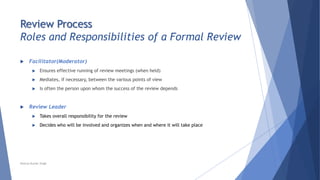
Roles and Responsibilities of a Formal Review
 Facilitator(Moderator)
 Ensures effective running of review meetings (when held)
 Mediates, if necessary, between the various points of view
 Is often the person upon whom the success of the review depends
 Review Leader
 Takes overall responsibility for the review
 Decides who will be involved and organizes when and where it will take place
Neeraj Kumar Singh
Review Process
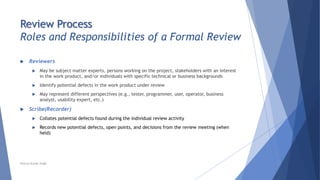
Roles and Responsibilities of a Formal Review
 Reviewers
 May be subject matter experts, persons working on the project, stakeholders with an interest
in the work product, and/or individuals with specific technical or business backgrounds
 Identify potential defects in the work product under review
 May represent different perspectives (e.g., tester, programmer, user, operator, business
analyst, usability expert, etc.)
 Scribe(Recorder)
 Collates potential defects found during the individual review activity
 Records new potential defects, open points, and decisions from the review meeting (when
held)
Neeraj Kumar Singh
Static Testing
1 Fundamentals 2 Lifecycle
4 Dynamic test
techniques
3 Static testing
5 Management 6 Tools
Software Testing
ISTQB Foundation Exam Preparation
Chapter 3
Neeraj Kumar Singh
Static Techniques
Contents
3.1 Static Testing Basics
3.2 Review Process
In Continuation of Tutorial 13….
Neeraj Kumar Singh
Review Process
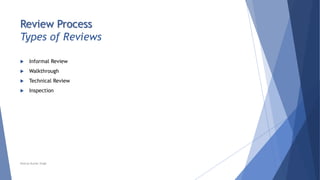
Types of Reviews
 Informal Review
 Walkthrough
 Technical Review
 Inspection
Neeraj Kumar Singh
Review Process – Types of Review
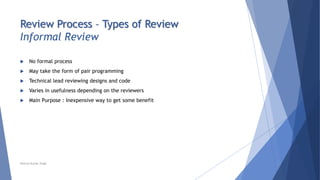
Informal Review
 No formal process
 May take the form of pair programming
 Technical lead reviewing designs and code
 Varies in usefulness depending on the reviewers
 Main Purpose : Inexpensive way to get some benefit
Neeraj Kumar Singh
Review Process – Types of Review
Walkthrough
 Meeting led by author
 May take the form of scenarios, dry runs, peer group participation
 Open ended session
 Optional pre-meeting preparation
 Optional preparation of review report
 Scribe is Optional
 May vary in practice from quite informal to formal
 Main Purpose : Learning, gaining understanding, finding defects
Neeraj Kumar Singh
Review Process – Types of Review
Technical Review
 Documented, defined defect-detection process
 Includes peers and technical experts(with optional management participation)
 May be performed as peer review
 Ideally lead by trained moderator
 Pre-meeting preparation by reviewers
 Optional use of checklist
 Preparation of review report by scribe
 May vary in practice from quite informal to formal
 Main Purpose : Discussing, making decision, evaluating alternatives, finding defects,
solving technical problems and checking conformance to specification, plans,
regulation and standards
Neeraj Kumar Singh
Review Process – Types of Review
Inspection
 Led by trained moderator
 Usually conducted as peer examination
 Defined roles
 Includes metrics gathering
 Formal process based on rules and checklist
 Specified entry and exit criteria
 Pre-meeting preparation
 Inspection report including list of findings
 Formal Follow-up process
 Main Purpose : Finding Defects
Neeraj Kumar Singh
Static Testing
1 Fundamentals 2 Lifecycle
4 Dynamic test
techniques
3 Static testing
5 Management 6 Tools
Software Testing
ISTQB Foundation Exam Preparation
Chapter 3
Neeraj Kumar Singh
Static Testing
Contents
3.1 Static Testing Basics
3.2 Review Process
In Continuation of Tutorial 14….
Neeraj Kumar Singh
Review Process
Applying Review Techniques
Ad hoc
 In an ad hoc review, reviewers are provided with little or no guidance on how this task
should be performed.
 Reviewers often read the work product sequentially, identifying and documenting issues
as they encounter them.
 Ad hoc reviewing is a commonly used technique needing little preparation.
 This technique is highly dependent on reviewer skills and may lead to many duplicate
issues being reported by different reviewers.
Neeraj Kumar Singh
Review Process
Applying Review Techniques
Checklist Based
 A checklist-based review is a systematic technique, whereby the reviewers detect
issues based on checklists that are distributed at review initiation.
 A review checklist consists of a set of questions based on potential defects, which may
be derived from experience.
 The main advantage of the checklist-based technique is a systematic coverage of
typical defect types.
 Care should be taken not to simply follow the checklist in individual reviewing, but also
to look for defects outside the checklist.
Neeraj Kumar Singh
Review Process
Applying Review Techniques
Scenario and Dry Runs
 In a scenario-based review, reviewers are provided with structured guidelines on how
to read through the work product.
 A scenario-based approach supports reviewers in performing “dry runs” on the work
product based on expected usage of the work product (if the work product is
documented in a suitable format such as use cases).
Role Based
 A role-based review is a technique in which the reviewers evaluate the work product
from the perspective of individual stakeholder roles.
 Typical roles include specific end user types (experienced, inexperienced, senior, child,
etc.), and specific roles in the organization (user administrator, system administrator,
performance tester, etc.).
Neeraj Kumar Singh
Review Process
Applying Review Techniques
Perspective Based
 In perspective-based reading, similar to a role-based review, reviewers take on
different stakeholder viewpoints in individual reviewing. Typical stakeholder viewpoints
include end user, marketing, designer, tester, or operations.
 In addition, perspective-based reading also requires the reviewers to attempt to use
the work product under review to generate the product they would derive from it.
 Empirical studies have shown perspective-based reading to be the most effective
general technique for reviewing requirements and technical work products.
Neeraj Kumar Singh
Success Factors for Review
Organizational Success Factors
 Each review has clear objectives, defined during review planning, and used as
measurable exit criteria
 Review types are applied which are suitable to achieve the objectives and are
appropriate to the type and level of software work products and participants
 Any review techniques used, such as checklist-based or role-based reviewing, are
suitable for effective defect identification in the work product to be reviewed
 Any checklists used address the main risks and are up to date
 Large documents are written and reviewed in small chunks, so that quality control is
exercised by providing authors early and frequent feedback on defects
 Participants have adequate time to prepare
 Reviews are scheduled with adequate notice
 Management supports the review process
Neeraj Kumar Singh
Success Factors for Review
People Success Factors
 The right people are involved to meet the review objectives, for example, people with
different skill sets or perspectives, who may use the document as a work input.
 Testers are seen as valued reviewers who contribute to the review and learn about the
work product, which enables them to prepare more effective tests, and to prepare
those tests earlier.
 Participants dedicate adequate time and attention to detail.
 The review is conducted in an atmosphere of trust; the outcome will not be used for
the evaluation of the participants.
 Participants avoid body language and behaviors that might indicate boredom,
exasperation, or hostility to other participants.
 Adequate training is provided, especially for more formal review types such as
inspections.
 A culture of learning and process improvement is promoted.
Neeraj Kumar Singh
Static Testing
1 Fundamentals 2 Lifecycle
4 Dynamic test
techniques
3 Static testing
5 Management 6 Tools
Software Testing
ISTQB Foundation Exam Preparation
Chapter 3
Neeraj Kumar Singh
Static Testing
Sample Questions
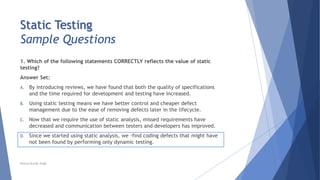
1. Which of the following statements CORRECTLY reflects the value of static
testing?
Answer Set:
A. By introducing reviews, we have found that both the quality of specifications
and the time required for development and testing have increased.
B. Using static testing means we have better control and cheaper defect
management due to the ease of removing defects later in the lifecycle.
C. Now that we require the use of static analysis, missed requirements have
decreased and communication between testers and developers has improved.
D. Since we started using static analysis, we -find coding defects that might have
not been found by performing only dynamic testing.
Neeraj Kumar Singh
Static Testing
Sample Questions
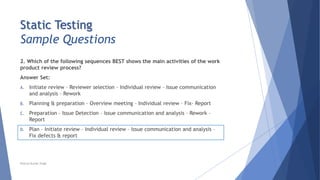
2. Which of the following sequences BEST shows the main activities of the work
product review process?
Answer Set:
A. Initiate review – Reviewer selection – Individual review – Issue communication
and analysis – Rework
B. Planning & preparation – Overview meeting – Individual review – Fix– Report
C. Preparation – Issue Detection – Issue communication and analysis – Rework –
Report
D. Plan – Initiate review – Individual review – Issue communication and analysis –
Fix defects & report
Neeraj Kumar Singh
Static Testing
Sample Questions
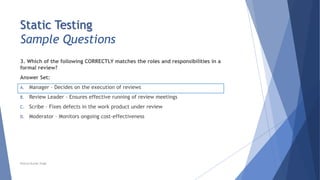
3. Which of the following CORRECTLY matches the roles and responsibilities in a
formal review?
Answer Set:
A. Manager – Decides on the execution of reviews
B. Review Leader - Ensures effective running of review meetings
C. Scribe – Fixes defects in the work product under review
D. Moderator – Monitors ongoing cost-effectiveness
Neeraj Kumar Singh
Static Testing
Sample Questions
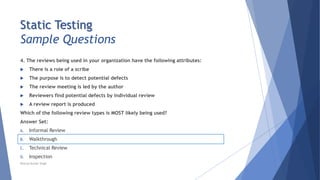
4. The reviews being used in your organization have the following attributes:
 There is a role of a scribe
 The purpose is to detect potential defects
 The review meeting is led by the author
 Reviewers find potential defects by individual review
 A review report is produced
Which of the following review types is MOST likely being used?
Answer Set:
A. Informal Review
B. Walkthrough
C. Technical Review
D. Inspection
Neeraj Kumar Singh
Static Testing
Sample Questions
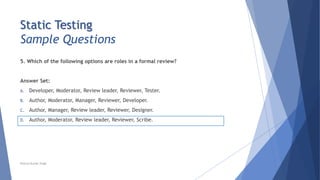
5. Which of the following options are roles in a formal review?
Answer Set:
A. Developer, Moderator, Review leader, Reviewer, Tester.
B. Author, Moderator, Manager, Reviewer, Developer.
C. Author, Manager, Review leader, Reviewer, Designer.
D. Author, Moderator, Review leader, Reviewer, Scribe.
Neeraj Kumar Singh

Chapter 3 - Static Testing

  • 1.
    Static Testing 1 Fundamentals2 Lifecycle 4 Dynamic test techniques 3 Static testing 5 Management 6 Tools Software Testing ISTQB Foundation Exam Preparation Chapter 3 Neeraj Kumar Singh
  • 2.
    Static techniques Contents 3.1 StaticTesting Basics 3.2 Review Process Neeraj Kumar Singh
  • 3.
    Static Testing Basics WorkProducts Examined by Static Testing Almost any work product can be examined using static testing (reviews and/or static analysis), for example:  Specifications, including business requirements, functional requirements, and security requirements  Epics, user stories, and acceptance criteria  Architecture and design specifications  Code  Testware, including test plans, test cases, test procedures, and automated test scripts  User guides  Web pages  Contracts, project plans, schedules, and budgets  Models, such as activity diagrams, which may be used for Model-Based testing Neeraj Kumar Singh
  • 4.
    Static Testing Basics Benefitsof Static Testing  When applied early in the software development lifecycle, static testing enables the early detection of defects before dynamic testing is performed.  E.g., in requirements or design specifications reviews, product backlog refinement, etc.  Defects found early are often much cheaper to remove than defects found later in the lifecycle, especially compared to defects found after the software is deployed and in active use. Neeraj Kumar Singh
  • 5.
    Static Testing Basics Benefitsof Static Testing Additional benefits of static testing may include:  Detecting and correcting defects more efficiently, and prior to dynamic test execution  Identifying defects which are not easily found by dynamic testing  Preventing defects in design or coding by uncovering inconsistencies, ambiguities, contradictions, omissions, inaccuracies, and redundancies in requirements  Increasing development productivity (e.g., due to improved design, more maintainable code)  Reducing development cost and time  Reducing testing cost and time  Reducing total cost of quality over the software’s lifetime, due to fewer failures later in the lifecycle or after delivery into operation  Improving communication between team members in the course of participating in reviews Neeraj Kumar Singh
  • 6.
    Static Testing Basics StaticTesting vs Dynamic Testing One main distinction is that static testing finds defects in work products directly rather than identifying failures caused by defects when the software is run. Compared with dynamic testing, typical defects that are easier and cheaper to find and fix through static testing include:  Requirement defects (e.g., inconsistencies, ambiguities, contradictions, omissions, inaccuracies, and redundancies)  Design defects (e.g., inefficient algorithms or database structures, high coupling, low cohesion)  Coding defects (e.g., variables with undefined values, variables that are declared but never used, unreachable code, duplicate code)  Deviations from standards (e.g., lack of adherence to coding standards)  Incorrect interface specifications (e.g., different units of measurement used by the calling system than by the called system)  Security vulnerabilities (e.g., susceptibility to buffer overflows)  Gaps or inaccuracies in test basis traceability or coverage (e.g., missing tests for an acceptance criterion) Neeraj Kumar Singh
  • 7.
    Static Testing 1 Fundamentals2 Lifecycle 4 Dynamic test techniques 3 Static testing 5 Management 6 Tools Software Testing ISTQB Foundation Exam Preparation Chapter 3 Neeraj Kumar Singh
  • 8.
    Static techniques Contents 3.1 StaticTesting Basics 3.2 Review Process Neeraj Kumar Singh
  • 9.
    Review Process Activities ofReview Process  Planning  Initiate Review  Individual Review  Issue Communication and Analysis  Fixing and Reporting Neeraj Kumar Singh
  • 10.
    Review Process Activities ofReview Process  Planning  Defining the scope, which includes the purpose of the review, what documents or parts of documents to review, and the quality characteristics to be evaluated  Estimating effort and timeframe  Identifying review characteristics such as the review type with roles, activities, and checklists  Selecting the people to participate in the review and allocating roles  Defining the entry and exit criteria for more formal review types (e.g., inspections)  Checking that entry criteria are met (for more formal review types)  Initiate Review  Distributing the work product and other material, checklists, and related work products  Explaining the scope, objectives, process, roles, and work products to the participants  Answering any questions that participants may have about the review Neeraj Kumar Singh
  • 11.
    Review Process Activities ofReview Process  Individual review (i.e., individual preparation)  Reviewing all or part of the work product  Noting potential defects, recommendations, and questions  Issue communication and analysis  Communicating identified potential defects (e.g., in a review meeting)  Analyzing potential defects, assigning ownership and status to them  Evaluating and documenting quality characteristics  Evaluating the review findings against the exit criteria to make a review decision (reject; major changes needed; accept, possibly with minor changes) Neeraj Kumar Singh
  • 12.
    Review Process Activities ofa Formal Review (K1)  Fixing and reporting  Creating defect reports for those findings that require changes  Fixing defects found (typically done by the author) in the work product reviewed  Communicating defects to the appropriate person or team (when found in a work product related to the work product reviewed)  Recording updated status of defects (in formal reviews), potentially including the agreement of the comment originator  Gathering metrics (for more formal review types)  Checking that exit criteria are met (for more formal review types)  Accepting the work product when the exit criteria are reached Neeraj Kumar Singh
  • 13.
    Review Process Roles andResponsibilities of a Formal Review  Author  Creates the work product under review  Fixes defects in the work product under review (if necessary)  Management  Is responsible for review planning  Decides on the execution of reviews  Assigns staff, budget, and time  Monitors ongoing cost-effectiveness  Executes control decisions in the event of inadequate outcomes Neeraj Kumar Singh
  • 14.
    Review Process Roles andResponsibilities of a Formal Review  Facilitator(Moderator)  Ensures effective running of review meetings (when held)  Mediates, if necessary, between the various points of view  Is often the person upon whom the success of the review depends  Review Leader  Takes overall responsibility for the review  Decides who will be involved and organizes when and where it will take place Neeraj Kumar Singh
  • 15.
    Review Process Roles andResponsibilities of a Formal Review  Reviewers  May be subject matter experts, persons working on the project, stakeholders with an interest in the work product, and/or individuals with specific technical or business backgrounds  Identify potential defects in the work product under review  May represent different perspectives (e.g., tester, programmer, user, operator, business analyst, usability expert, etc.)  Scribe(Recorder)  Collates potential defects found during the individual review activity  Records new potential defects, open points, and decisions from the review meeting (when held) Neeraj Kumar Singh
  • 16.
    Static Testing 1 Fundamentals2 Lifecycle 4 Dynamic test techniques 3 Static testing 5 Management 6 Tools Software Testing ISTQB Foundation Exam Preparation Chapter 3 Neeraj Kumar Singh
  • 17.
    Static Techniques Contents 3.1 StaticTesting Basics 3.2 Review Process In Continuation of Tutorial 13…. Neeraj Kumar Singh
  • 18.
    Review Process Types ofReviews  Informal Review  Walkthrough  Technical Review  Inspection Neeraj Kumar Singh
  • 19.
    Review Process –Types of Review Informal Review  No formal process  May take the form of pair programming  Technical lead reviewing designs and code  Varies in usefulness depending on the reviewers  Main Purpose : Inexpensive way to get some benefit Neeraj Kumar Singh
  • 20.
    Review Process –Types of Review Walkthrough  Meeting led by author  May take the form of scenarios, dry runs, peer group participation  Open ended session  Optional pre-meeting preparation  Optional preparation of review report  Scribe is Optional  May vary in practice from quite informal to formal  Main Purpose : Learning, gaining understanding, finding defects Neeraj Kumar Singh
  • 21.
    Review Process –Types of Review Technical Review  Documented, defined defect-detection process  Includes peers and technical experts(with optional management participation)  May be performed as peer review  Ideally lead by trained moderator  Pre-meeting preparation by reviewers  Optional use of checklist  Preparation of review report by scribe  May vary in practice from quite informal to formal  Main Purpose : Discussing, making decision, evaluating alternatives, finding defects, solving technical problems and checking conformance to specification, plans, regulation and standards Neeraj Kumar Singh
  • 22.
    Review Process –Types of Review Inspection  Led by trained moderator  Usually conducted as peer examination  Defined roles  Includes metrics gathering  Formal process based on rules and checklist  Specified entry and exit criteria  Pre-meeting preparation  Inspection report including list of findings  Formal Follow-up process  Main Purpose : Finding Defects Neeraj Kumar Singh
  • 23.
    Static Testing 1 Fundamentals2 Lifecycle 4 Dynamic test techniques 3 Static testing 5 Management 6 Tools Software Testing ISTQB Foundation Exam Preparation Chapter 3 Neeraj Kumar Singh
  • 24.
    Static Testing Contents 3.1 StaticTesting Basics 3.2 Review Process In Continuation of Tutorial 14…. Neeraj Kumar Singh
  • 25.
    Review Process Applying ReviewTechniques Ad hoc  In an ad hoc review, reviewers are provided with little or no guidance on how this task should be performed.  Reviewers often read the work product sequentially, identifying and documenting issues as they encounter them.  Ad hoc reviewing is a commonly used technique needing little preparation.  This technique is highly dependent on reviewer skills and may lead to many duplicate issues being reported by different reviewers. Neeraj Kumar Singh
  • 26.
    Review Process Applying ReviewTechniques Checklist Based  A checklist-based review is a systematic technique, whereby the reviewers detect issues based on checklists that are distributed at review initiation.  A review checklist consists of a set of questions based on potential defects, which may be derived from experience.  The main advantage of the checklist-based technique is a systematic coverage of typical defect types.  Care should be taken not to simply follow the checklist in individual reviewing, but also to look for defects outside the checklist. Neeraj Kumar Singh
  • 27.
    Review Process Applying ReviewTechniques Scenario and Dry Runs  In a scenario-based review, reviewers are provided with structured guidelines on how to read through the work product.  A scenario-based approach supports reviewers in performing “dry runs” on the work product based on expected usage of the work product (if the work product is documented in a suitable format such as use cases). Role Based  A role-based review is a technique in which the reviewers evaluate the work product from the perspective of individual stakeholder roles.  Typical roles include specific end user types (experienced, inexperienced, senior, child, etc.), and specific roles in the organization (user administrator, system administrator, performance tester, etc.). Neeraj Kumar Singh
  • 28.
    Review Process Applying ReviewTechniques Perspective Based  In perspective-based reading, similar to a role-based review, reviewers take on different stakeholder viewpoints in individual reviewing. Typical stakeholder viewpoints include end user, marketing, designer, tester, or operations.  In addition, perspective-based reading also requires the reviewers to attempt to use the work product under review to generate the product they would derive from it.  Empirical studies have shown perspective-based reading to be the most effective general technique for reviewing requirements and technical work products. Neeraj Kumar Singh
  • 29.
    Success Factors forReview Organizational Success Factors  Each review has clear objectives, defined during review planning, and used as measurable exit criteria  Review types are applied which are suitable to achieve the objectives and are appropriate to the type and level of software work products and participants  Any review techniques used, such as checklist-based or role-based reviewing, are suitable for effective defect identification in the work product to be reviewed  Any checklists used address the main risks and are up to date  Large documents are written and reviewed in small chunks, so that quality control is exercised by providing authors early and frequent feedback on defects  Participants have adequate time to prepare  Reviews are scheduled with adequate notice  Management supports the review process Neeraj Kumar Singh
  • 30.
    Success Factors forReview People Success Factors  The right people are involved to meet the review objectives, for example, people with different skill sets or perspectives, who may use the document as a work input.  Testers are seen as valued reviewers who contribute to the review and learn about the work product, which enables them to prepare more effective tests, and to prepare those tests earlier.  Participants dedicate adequate time and attention to detail.  The review is conducted in an atmosphere of trust; the outcome will not be used for the evaluation of the participants.  Participants avoid body language and behaviors that might indicate boredom, exasperation, or hostility to other participants.  Adequate training is provided, especially for more formal review types such as inspections.  A culture of learning and process improvement is promoted. Neeraj Kumar Singh
  • 31.
    Static Testing 1 Fundamentals2 Lifecycle 4 Dynamic test techniques 3 Static testing 5 Management 6 Tools Software Testing ISTQB Foundation Exam Preparation Chapter 3 Neeraj Kumar Singh
  • 32.
    Static Testing Sample Questions 1.Which of the following statements CORRECTLY reflects the value of static testing? Answer Set: A. By introducing reviews, we have found that both the quality of specifications and the time required for development and testing have increased. B. Using static testing means we have better control and cheaper defect management due to the ease of removing defects later in the lifecycle. C. Now that we require the use of static analysis, missed requirements have decreased and communication between testers and developers has improved. D. Since we started using static analysis, we -find coding defects that might have not been found by performing only dynamic testing. Neeraj Kumar Singh
  • 33.
    Static Testing Sample Questions 2.Which of the following sequences BEST shows the main activities of the work product review process? Answer Set: A. Initiate review – Reviewer selection – Individual review – Issue communication and analysis – Rework B. Planning & preparation – Overview meeting – Individual review – Fix– Report C. Preparation – Issue Detection – Issue communication and analysis – Rework – Report D. Plan – Initiate review – Individual review – Issue communication and analysis – Fix defects & report Neeraj Kumar Singh
  • 34.
    Static Testing Sample Questions 3.Which of the following CORRECTLY matches the roles and responsibilities in a formal review? Answer Set: A. Manager – Decides on the execution of reviews B. Review Leader - Ensures effective running of review meetings C. Scribe – Fixes defects in the work product under review D. Moderator – Monitors ongoing cost-effectiveness Neeraj Kumar Singh
  • 35.
    Static Testing Sample Questions 4.The reviews being used in your organization have the following attributes:  There is a role of a scribe  The purpose is to detect potential defects  The review meeting is led by the author  Reviewers find potential defects by individual review  A review report is produced Which of the following review types is MOST likely being used? Answer Set: A. Informal Review B. Walkthrough C. Technical Review D. Inspection Neeraj Kumar Singh
  • 36.
    Static Testing Sample Questions 5.Which of the following options are roles in a formal review? Answer Set: A. Developer, Moderator, Review leader, Reviewer, Tester. B. Author, Moderator, Manager, Reviewer, Developer. C. Author, Manager, Review leader, Reviewer, Designer. D. Author, Moderator, Review leader, Reviewer, Scribe. Neeraj Kumar Singh