Test Management
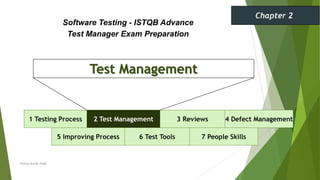
1 Testing Process 2 Test Management 3 Reviews
Software Testing - ISTQB Advance
Test Manager Exam Preparation
Chapter 2
Neeraj Kumar Singh
4 Defect Management
5 Improving Process 6 Test Tools 7 People Skills
Test Management
Contents
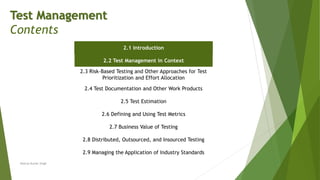
2.1 Introduction
2.2 Test Management in Context
2.3 Risk-Based Testing and Other Approaches for Test
Prioritization and Effort Allocation
2.4 Test Documentation and Other Work Products
2.5 Test Estimation
2.6 Defining and Using Test Metrics
2.7 Business Value of Testing
2.8 Distributed, Outsourced, and Insourced Testing
2.9 Managing the Application of Industry Standards
Neeraj Kumar Singh
Test Management
Contents
2.2.1 Understanding Testing Stakeholders
2.2.2 Additional Software Development Lifecycle
Activities and Work Products
2.2.3 Alignment of Test Activities and Other Lifecycle
Activities
2.2.4 Managing Non-Functional Testing
2.2.5 Managing Experience-Based Testing
2.6 Defining and Using Test Metrics
Neeraj Kumar Singh
At the Advanced Level, career specialization has begun to occur for the test professional.
This chapter focuses on areas of knowledge required by test professionals as they move into Test Leader, Test
Manager, and Test Director positions.
In this syllabus, we refer collectively to these professionals as Test Managers, understanding that different
organizations will have different definitions for the titles and levels of responsibility of people in such positions.
Neeraj Kumar Singh
Test Management
Introduction
 A central responsibility of a manager is to secure and utilize resources (people, software, hardware,
infrastructure, etc.) to carry out value-adding processes.
 For software and IT managers, the processes are often part of a project or a program aimed at delivering
software or a system for internal or external use.
 For Test Managers, the processes are those involved with testing, specifically the fundamental test process
activities. Since test processes add value only by contributing to the overall success of the project or program
(or by preventing a more severe type of failure), the Test Manager must plan and control the test processes
accordingly.
 In other words, the Test Manager must appropriately arrange the test processes, including the associated
activities and work products, according to the needs and circumstances of the other stakeholders, their
activities (e.g., the software development lifecycle in which testing occurs), and their work products (e.g.,
requirements specifications).
Neeraj Kumar Singh
Test Management
Test Management in Context
People are stakeholders of testing when they have an interest in the testing activities, the testing work products,
or the quality of the final system or deliverable. The stakeholder’s interest can be direct or indirect involvement in
the testing activities, direct or indirect receipt of testing work products, or direct or indirect effect by the quality
of the deliverables produced by the project or program.
While the testing stakeholders vary, depending on the project, the product, the organization, and other factors,
they can include the following roles:
 Developers, development leads, and development managers. These stakeholders implement the software
under test, receive test results, and often must take action based on those results (e.g., fix reported defects).
 Database architects, system architects, and designers. These stakeholders design the software, receive test
results, and often must take action on those results.
 Marketing and business analysts. These stakeholders determine the features, and the level of quality inherent
in those features, that must be present in the software. They are also often involved in defining needed test
coverage, reviewing test results, and making decisions based on test results.
 Senior management, product managers and project sponsors. These stakeholders are often involved in
defining needed test coverage, reviewing test results, and making decisions based on test results.
Neeraj Kumar Singh
Test Management
Understanding Testing Stakeholders
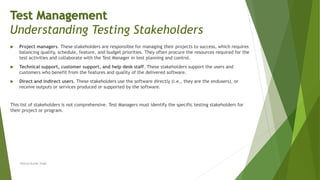
 Project managers. These stakeholders are responsible for managing their projects to success, which requires
balancing quality, schedule, feature, and budget priorities. They often procure the resources required for the
test activities and collaborate with the Test Manager in test planning and control.
 Technical support, customer support, and help desk staff. These stakeholders support the users and
customers who benefit from the features and quality of the delivered software.
 Direct and indirect users. These stakeholders use the software directly (i.e., they are the endusers), or
receive outputs or services produced or supported by the software.
This list of stakeholders is not comprehensive. Test Managers must identify the specific testing stakeholders for
their project or program.
Neeraj Kumar Singh
Test Management
Understanding Testing Stakeholders
Test Management
Contents
2.1 Introduction
2.2 Test Management in Context
2.3 Risk-Based Testing and Other Approaches for Test
Prioritization and Effort Allocation
2.4 Test Documentation and Other Work Products
2.5 Test Estimation
2.6 Defining and Using Test Metrics
2.7 Business Value of Testing
2.8 Distributed, Outsourced, and Insourced Testing
2.9 Managing the Application of Industry Standards
Neeraj Kumar Singh
Test Management
Contents
2.2.1 Understanding Testing Stakeholders
2.2.2 Additional Software Development Lifecycle
Activities and Work Products
2.2.3 Alignment of Test Activities and Other Lifecycle
Activities
2.2.4 Managing Non-Functional Testing
2.2.5 Managing Experience-Based Testing
Neeraj Kumar Singh
Since software testing is an evaluation of the quality of one or more work products produced outside of the testing
activities, it usually exists in the context of a larger set of software development lifecycle activities.
The Test Manager must plan and guide the testing activities with an understanding of how these other activities
and their work products affect testing and how testing affects these other activities and their work products.
For example, in organizations using Agile development practices, developers often perform test-driven
development, create automated unit tests, and continuously integrate code (along with the tests for that code)
into the configuration management system.
The Test Manager should work with the development manager to ensure that testers are integrated into and
aligned with these activities.
Testers may review the unit tests both to contribute suggestions for increased coverage and effectiveness of these
tests and to gain a deeper understanding of the software and its implementation.
Neeraj Kumar Singh
Test Management
Additional SDLC Activities and Work Products
While the specific relationship between testing activities, the other test stakeholders, software development
lifecycle work activities, and work products varies depending on the project, the chosen software development
lifecycle and a variety of other factors, testing is closely interconnected and related to the following:
 Requirements engineering and management.
 Project management.
 Configuration management, release management, and change management.
 Software development and maintenance.
 Technical support.
 Production of technical documentation.
In addition to identifying the test stakeholders as described above, the Test Manager must identify the other
software development lifecycle activities and work products that affect testing and/or are affected by testing.
If not, the testing process will not achieve optimal effectiveness and efficiency.
Neeraj Kumar Singh
Test Management
Additional SDLC Activities and Work Products
Test Management
Contents
2.2.1 Understanding Testing Stakeholders
2.2.2 Additional Software Development Lifecycle
Activities and Work Products
2.2.3 Alignment of Test Activities and Other
Lifecycle Activities
2.2.4 Managing Non-Functional Testing
2.2.5 Managing Experience-Based Testing
Neeraj Kumar Singh
Testing should be an integral part of the project, regardless of the software development models used. This
includes:
 Sequential models, such as the waterfall model, V-model and W-model.
 Iterative or incremental models, such as Rapid Application Development (RAD) and the Rational Unified
Process (RUP).
 Agile, such as SCRUM and Extreme Programming (XP).
 Spiral.
Neeraj Kumar Singh
Test Management
Alignment of Test Activities & Other Lifecycle Activities
In order to properly align testing activities within the lifecycle, the Test Manager must have a detailed
understanding of the lifecycle models used in their organization. For example, in the V-model, the ISTQB
fundamental test process applied to the system test level could align as follows:
 System test planning activities occur concurrently with project planning, and test control continues until
system test execution and closure are complete. System test analysis and design activities occur concurrently
with requirements specification, system and architectural (high-level) design specification, and component
(low-level) design specification.
 System test implementation activities might start during system design, though the bulk of these activities
would typically occur concurrently with coding and component test, with work on system test implementation
activities stretching often until just days before the start of system test execution.
 System test execution activities begin when the system test entry criteria are all met (or waived), which
typically means that at least component testing and often also component integration testing are complete.
System test execution continues until the system test exit criteria are met.
 Evaluation of the system test exit criteria and reporting of system test results occur throughout system test
execution, generally with greater frequency and urgency as project deadlines approach.
 System test closure activities occur after the system test exit criteria are met and system test execution is
declared complete, though they can sometimes be delayed until after acceptance testing is over and all
project activities are finished.
Neeraj Kumar Singh
Test Management
Alignment of Test Activities & Other Lifecycle Activities
Test Management
Contents
2.2.1 Understanding Testing Stakeholders
2.2.2 Additional Software Development Lifecycle
Activities and Work Products
2.2.3 Alignment of Test Activities and
Other Lifecycle Activities
2.2.4 Managing Non-Functional Testing
2.2.5 Managing Experience-Based Testing
Neeraj Kumar Singh
Failure to plan for non-functional tests can result in the discovery of serious, sometimes disastrous, quality
problems in a system after release.
However, many types of non-functional tests are expensive so the Test Manager must select which non-functional
tests to perform based on risk and constraints. In addition, there are many different types of non-functional tests,
some of which might not be appropriate to a given application.
Since the Test Manager may not have sufficient expertise to handle all the planning considerations, the Test
Manager needs to delegate some of test planning responsibilities to the Technical Test Analysts (and in some cases
Test Analysts) assigned to the non-functional testing activities.
The Test Manager should ask the analysts to consider the following general factors:
 Stakeholder requirements
 Required tooling
 Test environment
 Organizational factors
 Security
Neeraj Kumar Singh
Test Management
Managing Non-Functional Testing
Another important consideration for test managers is how to integrate non-functional tests into the software
development lifecycle.
A common mistake is to wait until all functional tests are complete prior to starting non-functional tests, which
can result in the late discovery of critical non-functional defects. Instead, non-functional tests should be
prioritized and sequenced according to risk. There are often ways to mitigate non-functional risks during early
levels of testing or even during development.
For example, usability reviews of user interface prototypes during system design can be quite effective at
identifying usability defects that would create significant schedule problems if discovered toward the end of
system testing.
In iterative lifecycles, the pace of change and of iterations can make it difficult to focus on certain nonfunctional
tests that require construction of sophisticated test frameworks. Test design and implementation activities that
take longer than the timescales of a single iteration should be organized as separate work activities outside of the
iterations.
Neeraj Kumar Singh
Test Management
Managing Non-Functional Testing
Test Management
Contents
2.2.1 Understanding Testing Stakeholders
2.2.2 Additional Software Development Lifecycle
Activities and Work Products
2.2.3 Alignment of Test Activities and
Other Lifecycle Activities
2.2.4 Managing Non-Functional Testing
2.2.5 Managing Experience-Based Testing
Neeraj Kumar Singh
While experience-based testing provides benefits by efficiently finding defects that other test techniques may miss
and serving as a check on the completeness of those techniques, it provides some challenges for test management.
The Test Manager should be aware of the challenges as well as the benefits of the experience-based techniques,
particularly exploratory testing. It is difficult to determine the coverage attained during such testing, given the
typical light-weight logging and minimal advanced preparation of tests.
Reproducibility of the test results requires particular management attention, especially when multiple testers are
involved.
One way to manage experience-based testing, especially exploratory testing, is to break the testing work into
small, 30 to 120 minute periods sometimes called test sessions. This time boxing limits and focuses the work to be
done in a session and provides a level of monitoring and scheduling.
Each session covers a test charter, which is communicated in writing or verbally to the tester by the test manager.
The test charter gives the test condition(s) to be covered in the test session, which further helps to maintain focus
and prevent overlap if multiple people are carrying out exploratory testing simultaneously.
Neeraj Kumar Singh
Test Management
Managing Experience-Based Testing
Another technique to manage experience-based testing is by integrating such self-directed and spontaneous testing
into more traditional pre-designed testing sessions.
For example, testers can be given permission (and allocated time) to explore beyond the explicit steps, inputs, and
expected results in their pre-defined tests.
Testers may also be assigned such self-directed testing sessions as part of their daily testing, before, during, or
after a day of running pre-defined tests. If such testing sessions identify defects or interesting areas for future
testing, the pre-defined tests may be updated.
 At the beginning of the exploratory session, the tester ascertains and performs the necessary set up tasks for
the tests.
 During the session, the tester learns about the application being tested, designs and executes tests according
to the technique being applied and what has been learned about the application, investigates any defects, and
captures the results of the test in a log.
 After the session, a debriefing may occur, which sets the direction for subsequent sessions.
Neeraj Kumar Singh
Test Management
Managing Experience-Based Testing
Test Management
Contents
2.1 Introduction
2.2 Test Management in Context
2.3 Risk-Based Testing and Other Approaches for Test
Prioritization and Effort Allocation
2.4 Test Documentation and Other Work Products
2.5 Test Estimation
2.6 Defining and Using Test Metrics
2.7 Business Value of Testing
2.8 Distributed, Outsourced, and Insourced Testing
2.9 Managing the Application of Industry Standards
Neeraj Kumar Singh
Test Management
Contents
2.3.1 Risk-Based Testing
2.3.2 Risk-Based Testing Techniques
2.3.3 Other Techniques for Test Selection
2.3.4 Test Prioritization and Effort Allocation
in the Test Process
Neeraj Kumar Singh
Risk is the possibility of a negative or undesirable outcome or event. Risks exist whenever some problem may occur
which would decrease customer, user, participant, or stakeholder perceptions of product quality or project
success.
Where the primary effect of the potential problem is on product quality, potential problems are referred to as
quality risks, product risks, or product quality risks.
Where the primary effect of the potential problem is on project success, potential problems are referred to as
project risks or planning risks.
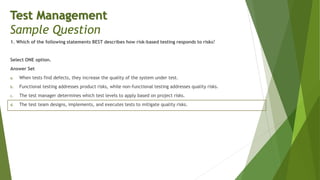
In risk-based testing, quality risks are identified and assessed during a product quality risk analysis with the
stakeholders. The test team then designs, implements, and executes tests to mitigate the quality risks.
Quality includes the totality of features, behaviors, characteristics, and attributes that affect customer, user, and
stakeholder satisfaction. Therefore, a quality risk is a potential situation where quality problems might exist in a
product.
Risk-based testing consists of four main activities:
 Risk identification
 Risk assessment
 Risk mitigation
 Risk management
Neeraj Kumar Singh
Test Management
Risk Based Testing
Stakeholders can identify risks through one or more of the following techniques:
 Expert interviews
 Independent assessments
 Use of risk templates
 Project retrospectives
 Risk workshops
 Brainstorming
 Checklists
 Calling on past experience
By involving the broadest possible sample of stakeholders, the risk identification process is most likely to identify most of
the significant product quality risks.
The risk identification often produces by-products, i.e., identification of issues which are not product quality risks.
Examples include general questions or issues about the product or project, or problems in referenced documents such as
requirements and design specifications.
Project risks are also often identified as a by-product of quality risk identification but are not the main focus of risk-based
testing.
Neeraj Kumar Singh
Test Management
Risk Identification
Once risk identification has occurred, risk assessment can begin, being the study of these identified risks.
Specifically, risk assessment involves categorizing each risk and determining the likelihood and impact associated
with each risk. Risk assessment may also involve evaluating or assigning other properties of each risk, such as risk
owner.
Categorization of risk means placing each risk into an appropriate type, such as performance, reliability,
functionality, and so forth.
Determining the level of risk typically involves assessing, for each risk item, the likelihood of occurrence and the
impact upon occurrence. The likelihood of occurrence is the probability that the potential problem exists in the
system under test. In other words, likelihood is an assessment of the level of technical risk.
The level of risk can be assessed either quantitatively or qualitatively.
If likelihood and impact can be ascertained quantitatively, one can multiply the two values together to calculate a
quantitative risk priority number.
If likelihood and impact can be ascertained quantitatively, one can multiply the two values together to calculate a
quantitative risk priority number.
Qualitative assessments of risk levels are often combined, through multiplication or addition, to create an
aggregate risk score. This aggregate risk score may be expressed as a risk priority number but should be
interpreted as a qualitative, relative rating on an ordinal scale.
Neeraj Kumar Singh
Test Management
Risk Assessment
Factors influencing likelihood for product and project risks
include:
 Complexity of technology and teams
 Personnel and training issues among the business analysts,
designers, and programmers
 Conflict within the team
 Contractual problems with suppliers
 Geographically distributed team
 Legacy versus new approaches
 Tools and technology
 Weak managerial or technical leadership
 Time, resource, budget and management pressure
 Lack of earlier quality assurance activities
 High change rates High earlier defect rates
 Interfacing and integration issues
Neeraj Kumar Singh
Test Management
Risk Assessment
The impact upon occurrence is the severity of the effect on
the users, customers, or other stakeholders. Factors
influencing impact in project and product risks include:
 Frequency of use of the affected feature
 Criticality of the feature to accomplishing a business
goal
 Damage to reputation
 Loss of business
 Potential financial, ecological or social losses or liability
 Civil or criminal legal sanctions
 Loss of license
 Lack of reasonable workarounds
 Visibility of failure leading to negative publicity
 Safety
Risk-based testing starts with a quality risk analysis (identifying and assessing product quality risks). This analysis is
the foundation of the master test plan and the other test plans.
As specified in the plan(s), tests are designed, implemented, and executed in order to cover the risks. The effort
associated with developing and executing a test is proportional to the level of risk, which means that more
meticulous test techniques (such as pairwise testing) are used for higher risks, while less meticulous test
techniques (such as equivalence partitioning or time-boxed exploratory testing) are used for lower risks. In
addition, the priority of the development and execution of the test is based on the level of risk.
Some safety related standards (e.g., FAA DO-178B/ED 12B, IEC 61508), prescribe the test techniques and degree of
coverage based on the level of risk. In addition, the level of risk should influence decisions such as the use of
reviews of project work products (including tests), the level of independence, the level of experience of the
tester, and the degree of confirmation testing (retesting) and regression testing performed.
During the project, the test team should remain aware of additional information that changes the set of quality
risks and/or the level of risk associated with known quality risks.
Periodic adjustment of the quality risk analysis, which results in adjustments to the tests, should occur. These
adjustments should occur at least at major project milestones. Adjustments include identifying new risks, re-
assessing the level of existing risks, and evaluating the effectiveness of risk mitigation activities.
To take one example, if a risk identification and assessment session occurred based on the requirements
specification during the requirements phase, once the design specification is finalized, a re-evaluation of the risks
should occur.
Neeraj Kumar Singh
Test Management
Risk Mitigation
Ideally, risk management occurs throughout the entire lifecycle. If an organization has a test policy document
and/or test strategy document, then these should describe the general process by which product and project risks
are managed in testing, and show how risk management is integrated into and affects all stages of testing.
In a mature organization where risk awareness pervades the project team, risk management takes place at many
levels, and not just for testing. Important risks are not only addressed earlier in particular test levels, but also in
earlier test levels.
Mature organizations not only identify risks, but also the sources of risk and the consequence of those risks should
they become outcomes. For those defects that do occur, root cause analysis is used to understand sources of risk
more deeply and to implement process improvements that prevent defects in the first place.
Most risk-based testing methods also include techniques for using the level of risk to sequence and prioritize the
testing, thus ensuring early coverage of the most important areas and discovery of the most important defects
during test execution. In some cases, all of the highest-risk tests are run before any lower risk tests, and tests are
run in strict risk order (often called “depth-first”); in other cases, a sampling approach is used to select a sample
of tests across all the identified risk items using risk to weight the selection while at the same time ensuring
coverage of every risk item at least once (often called “breadth-first”).
Whether risk-based testing proceeds depth-first or breadth-first, it is possible that the time allocated for testing
might be consumed without all tests being run.
Neeraj Kumar Singh
Test Management
Risk Management in the Lifecycle
Test Management
Contents
2.1 Introduction
2.2 Test Management in Context
2.3 Risk-Based Testing and Other Approaches for Test
Prioritization and Effort Allocation
2.4 Test Documentation and Other Work Products
2.5 Test Estimation
2.6 Defining and Using Test Metrics
2.7 Business Value of Testing
2.8 Distributed, Outsourced, and Insourced Testing
2.9 Managing the Application of Industry Standards
Neeraj Kumar Singh
Test Management
Contents
2.3.1 Risk-Based Testing
2.3.2 Risk-Based Testing Techniques
2.3.3 Other Techniques for Test Selection
2.3.4 Test Prioritization and Effort Allocation
in the Test Process
Neeraj Kumar Singh
There are a number of techniques for risk-based testing. Some of these techniques are highly informal. Examples
include approaches where the tester analyzes quality risks during exploratory testing. This can help guide the
testing, but can lead to an excessive focus on the likelihood of defects, not their impact, and does not include
cross-functional stakeholder input. In addition, such approaches are subjective and dependent on the skills,
experience, and preferences of the individual tester.
Examples of lightweight approaches include: Pragmatic Risk Analysis and Management (PRAM), Systematic Software
Testing (SST), and Product Risk Management (PRisMa). In addition to the usual attributes of risk-based testing,
these techniques typically have the following attributes:
 Evolved over time based on industry experience with risk-based testing, especially in industries where
questions of efficiency are important
 Predicated on the extensive involvement of a cross-functional team of stakeholders, representing both
business and technical perspectives, during the initial risk identification and assessment
 Optimized when introduced during the earliest phases of a project, when the options to mitigate quality risks
are maximized and when main work products and by-products of the risk analysis can help to influence the
specification and implementation of the product in a way that minimizes risk
 Use the generated output (the risk matrix or risk analysis table) as the basis for the test plan and the test
conditions, and thus all subsequent test management and analysis activities
 Support the reporting of test results in terms of residual risk to all levels of testing stakeholders
Neeraj Kumar Singh
Test Management
Risk Based Testing Techniques
Like more formal techniques, lightweight techniques allow the use of weighting of the likelihood and impact factors to
emphasize business or technical risks (depending on the level of testing, for example). Unlike more formal techniques,
though, lightweight techniques:
 use only two factors, likelihood and impact; and,
 use simple, qualitative judgments and scales.
At the formal, heavy-weight end of the scale, the Test Manager has a number of options available:
 Hazard analysis, which extends the analytical process upstream, attempting to identify the hazards that underlie each
risk.
 Cost of exposure, where the risk assessment process involves determining, for each quality risk item, three factors: 1)
the likelihood (expressed as a percentage) of a failure related to the risk item; 2) the cost of a loss (expressed as a
financial quantity) associated with a typical failure related to the risk item, should it occur in production; and, 3) the
cost of testing for such failures.
 Failure Mode and Effect Analysis (FMEA) and its variants, where quality risks, their potential causes, and their likely
effects are identified and then severity, priority and detection ratings are assigned.
 Quality Function Deployment (QFD), which is a quality risk management technique with testing implications,
specifically, being concerned with quality risks that arise from an incorrect or insufficient understanding of the
customers’ or users’ requirements.
 Fault Tree Analysis (FTA), where various actual observed failures (from testing or from production), or potential
failures (quality risks), are subjected to a root cause analysis starting with defects that could cause the failure, then
with errors or defects that could cause those defects, continuing on until the various root causes are identified.
Neeraj Kumar Singh
Test Management
Risk Based Testing Techniques
Usually the most critical success factor for risk-based testing is the involvement of the right team of stakeholders
in the risk identification and assessment. All stakeholders have their own understanding of what constitutes quality
for the product, and their own set of priorities and concerns about quality.
Business stakeholders include customers, users, operation staff, help desk and technical support staff, among
others. These stakeholders understand the customer and user, and thus can identify risks and assess impact from a
business perspective.
Technical stakeholders include developers, architects, database administrators, and network administrators,
among others. These stakeholders understand the underlying ways in which software can fail, and thus can identify
risks and assess likelihood from a technical perspective.
Some stakeholders have both a business and a technical perspective. For example, subject matter experts who are
in testing or business analysis roles often have a broader view on the risks due to their technical and business
expertise.
The process of identifying risk items is one that generates a substantial list of risks. There is no need for
stakeholders to argue about the risk items; so long as one stakeholder perceives something as a risk to the quality
of the system, it is a risk item. However, it is important that stakeholders achieve consensus on their ratings for
the level of risk.
If risk-based testing is to be used long-term, then the Test Manager must successfully advocate and initiate risk-
based testing with the stakeholders. The cross-functional group must see the value of the risk analysis to ensure
on-going use of the technique. This requires that the Test Manager understand the stakeholders’ needs,
expectations, and time availability to participate in the process.
Neeraj Kumar Singh
Test Management
Risk Based Testing Techniques
Good stakeholder engagement with the quality risk analysis process offers an important benefit to the Test
Manager. This benefit is that, on under-specified projects with weak or missing requirements, the stakeholders can
still identify risks when guided with the proper checklist.
This benefit can be seen when, after the implementation of risk-based testing, the defect detection effectiveness
of the test team improves. This happens because a more complete test basis—in this case the list of quality risk
items—is being used.
During test closure for risk-based testing, test teams should measure the extent to which they realized the
benefits. In many cases, this involves answering some or all of the following four questions through metrics and
consultation with the team:
 Did the test team detect a greater percentage of important defects than of less-important defects?
 Did the test team find most of the important defects early in the test execution period?
 Was the test team able to explain the test results to stakeholders in terms of risk?
 Did the tests the test team skipped (if any) have a lower level of associated risk than those executed?
Neeraj Kumar Singh
Test Management
Risk Based Testing Techniques
Test Management
Contents
2.3.1 Risk-Based Testing
2.3.2 Risk-Based Testing Techniques
2.3.3 Other Techniques for Test Selection
2.3.4 Test Prioritization and Effort Allocation
in the Test Process
Neeraj Kumar Singh
While many Test Managers employ risk-based testing as one element of their test strategy, many also include other
techniques.
One of the most prominent alternative techniques for developing and prioritizing test conditions is requirements-
based testing. Requirements based testing may utilize several techniques, such as ambiguity reviews, test
condition analysis, and cause-effect graphing. Ambiguity reviews identify and eliminate ambiguities in the
requirements (which serve as the test basis), often by using a checklist of common requirements defects.
test condition analysis involves a close reading of the requirements specification to identify the test conditions to
cover. If those requirements have an assigned priority, this can be used to allocate effort and prioritize the test
cases. In the absence of an assigned priority, it is difficult to determine the appropriate effort and order of testing
without blending requirements-based testing with risk-based testing.
Cause-effect graphing is discussed in the Advanced Test Analyst module in the context of covering combinations of
test conditions as part of test analysis. However, it has a broader usage in that it can reduce an extremely large
testing problem to a manageable number of test cases and still provide 100% functional coverage of the test basis.
A general obstacle to requirements-based testing is that often the requirements specifications are ambiguous,
untestable, incomplete, or non-existent. Not all organizations are motivated to solve these problems, so testers
confronted with such situations must select another test strategy.
Neeraj Kumar Singh
Test Management
Other Techniques for Test Selection
Another method which is sometimes used to augment the use of the existing requirements is the creation of usage
or operational profiles, a model-based approach, which utilizes a mix of use cases, users (sometimes called
personas), inputs, and outputs, so as to accurately depict the real-world use of the system. This allows testing not
only of functionality but also of usability, interoperability, reliability, security and performance.
During test analysis and planning, the test team identifies the usage profiles and attempts to cover them with test
cases. The usage profile is an estimate, based on available information, of realistic usage of the software. This
means that, as with risk-based testing, the usage profiles may not perfectly model the eventual reality.
Some Test Managers also apply methodical approaches such as checklists to determine what to test, how much,
and in what order. For products that are very stable, a checklist of major functional and non-functional areas to
test, combined with a repository of existing test cases, can be sufficient.
Finally, another common method is to use a reactive approach. In a reactive approach, very few test analysis,
design, or implementation tasks occur prior to test execution. The test team is focused on reacting to the product
as actually delivered.
Bug clusters, as discovered, become the focus of further testing. Prioritization and allocation are completely
dynamic. The reactive approach can work as a complement to other approaches, but when employed exclusively
the reactive approach tends to miss major areas of the application that are important but not suffering from a
large number of bugs.
Neeraj Kumar Singh
Test Management
Other Techniques for Test Selection
Test Management
Contents
2.3.1 Risk-Based Testing
2.3.2 Risk-Based Testing Techniques
2.3.3 Other Techniques for Test Selection
2.3.4 Test Prioritization and Effort Allocation
in the Test Process
Neeraj Kumar Singh
Whatever technique—or, better yet, mix of techniques—that a Test Manager uses, the Test Manager must
incorporate that technique into the project and test processes.
For example, in sequential lifecycles (e.g., V-model), the test team selects tests, allocates test effort, and initially
prioritizes tests during the requirements phase, with periodic adjustments, whereas iterative or Agile lifecycles
require an iteration-by-iteration approach.
Test planning and control must consider the degree to which the risks, requirements, and/or usage profiles will
evolve, and respond accordingly.
During test analysis, design, and implementation, the allocation and prioritization determined during test planning
must be applied. It is a common breakdown in the test process for careful analysis and/or modeling to occur, only
for that information not to be used to guide the test process going forward. This breakdown typically occurs during
design and implementation.
In test execution, the prioritization determined during test planning should be carried out, although it is important
to update the prioritization periodically based on information gained after the plan was initially written.
When evaluating and reporting the test results and exit criteria status, the Test Manager must also evaluate and
report in terms of the risks, requirements, usage profiles, checklists, and other guides used to select and prioritize
tests. If necessary, test triage should occur based on the test prioritization scheme.
Neeraj Kumar Singh
Test Management
Test Prioritization and Effort Allocation
As part of results reporting and exit criteria evaluation, the Test Manager can measure the degree to which testing
is complete. This should include tracing test cases and discovered defects back to the relevant test basis.
For example, in risk-based testing, as tests are run and defects found, testers can examine the remaining, residual
level of risk. This supports the use of risk-based testing in determining the right moment to release.
Test reporting should address risks covered and still open, as well as benefits achieved and not yet achieved. For
an example of reporting test results based on risk coverage.
Finally, during test closure, the Test Manager should evaluate metrics and success criteria which are pertinent to
the needs and expectations of the testing stakeholders, including the customers’ and users’ needs and expectations
in terms of quality.
Only when testing satisfies these needs and expectations can a test team claim to be truly effective.
Neeraj Kumar Singh
Test Management
Test Prioritization and Effort Allocation
Test Management
Contents
2.1 Introduction
2.2 Test Management in Context
2.3 Risk-Based Testing and Other Approaches for Test
Prioritization and Effort Allocation
2.4 Test Documentation and Other Work Products
2.5 Test Estimation
2.6 Defining and Using Test Metrics
2.7 Business Value of Testing
2.8 Distributed, Outsourced, and Insourced Testing
2.9 Managing the Application of Industry Standards
Neeraj Kumar Singh
Test Management
Contents
2.4.1 Test Policy
2.4.2 Test Strategy
2.4.3 Master Test Plan
2.4.4 Level Test Plan
2.4.5 Project Risk Management
2.4.6 Other Test Work Products
Neeraj Kumar Singh
Documentation is often produced as part of the test management activities. While the specific names of the test
management documents and the scope of each document tend to vary, the following are common types of test
management documents found in organizations and on projects:
 Test policy - describes the organization’s objectives and goals for testing
 Test strategy - describes the organization’s general, project-independent methods for testing
 Master test plan (or project test plan) - describes the implementation of the test strategy for a particular
project
 Level test plan (or phase test plan) - describes the particular activities to be carried out within each test level
In some organizations and on some projects, they may be combined into a single document; in others, they may be
found in separate documents; and in some, their contents may be manifested as intuitive, unwritten, or traditional
methodologies for testing.
Larger and more formal organizations and projects tend to have all of these types of documents as written work
products, while smaller and less formal organizations and projects tend to have fewer such written work products
Neeraj Kumar Singh
Test Management
Test Documentation and Other Work Products
The test policy describes why the organization tests. It defines the overall objectives for testing that the
organization wants to achieve. This policy should be developed by senior test management staff in the organization
in collaboration with senior managers for the testing stakeholder groups.
In some cases, the test policy will be complementary to or a component of a broader quality policy. This quality
policy describes the overall values and goals of management related to quality.
Where a written test policy exists, it may be a short, high-level document that:
 Summarizes the value that the organization derives from testing
 Defines the objectives of testing, such as building confidence in the software, detecting defects in the
software, and reducing the level of quality risk
 Describes how to evaluate the effectiveness and efficiency of testing in meeting these objectives
 Outlines the typical test process, perhaps using the ISTQB fundamental test process as a basis
 Specifies how the organization will improve its test processes
The test policy should address test activities for new development as well as for maintenance. It may also
reference internal and/or external standards for the testing work products and terminology to be used throughout
the organization.
Neeraj Kumar Singh
Test Management
Test Policy
Test Management
Contents
2.4.1 Test Policy
2.4.2 Test Strategy
2.4.3 Master Test Plan
2.4.4 Level Test Plan
2.4.5 Project Risk Management
2.4.6 Other Test Work Products
Neeraj Kumar Singh
The test strategy describes the organization’s general test methodology. This includes the way in which testing is
used to manage product and project risks, the division of testing into levels, and the high-level activities
associated with testing.
The same organization may have different strategies for different situations, such as different software
development lifecycles, different levels of risk, or different regulatory requirements.
The test strategy, and the processes and activities described in it, should be consistent with the test policy. It
should provide the generic test entry and exit criteria for the organization or for one or more programs.
As mentioned above, test strategies describe general test methodologies, which typically include:
 Analytical strategies, such as risk-based testing, where the test team analyzes the test basis to identify the
test conditions to cover.
 Model-based strategies, such as operational profiling, where the test team develops a model (based on actual
or anticipated situations) of the environment in which the system exists, the inputs and conditions to which
the system is subjected, and how the system should behave.
 Methodical strategies, such as quality characteristic-based, where the test team uses a predetermined set of
test conditions, such as a quality standard, a checklist or a collection of generalized, logical test conditions
which may relate to a particular domain, application or type of testing (e.g., security testing), and uses that
set of test conditions from one iteration to the next or from one release to the next.
Neeraj Kumar Singh
Test Management
Test Strategy
 Reactive strategies, such as using defect-based attacks, where the test team waits to design and implement
tests until the software is received, reacting to the actual system under test.
 Consultative strategies, such as user-directed testing, where the test team relies on the input of one or more
key stakeholders to determine the test conditions to cover.
 Regression-averse testing strategies, such as extensive automation, where the test team uses various
techniques to manage the risk of regression, especially functional and/or nonfunctional regression test
automation at one or more levels.
 Process- or standard-compliant strategies, such as medical systems subject to U.S. Food and Drug
Administration standards, where the test team follows a set of processes defined by a standards committee or
other panel of experts, where the processes address documentation, the proper identification and use of the
test basis and test oracle(s), and the organization of the test team
Different strategies may be combined. The specific strategies selected should be appropriate to the organization’s
needs and means, and organizations may tailor strategies to fit particular operations and projects.
The test strategy may describe the test levels to be carried out. In such cases, it should give guidance on the entry
criteria and exit criteria for each level and the relationships among the levels (e.g., division of test coverage
objectives).
Neeraj Kumar Singh
Test Management
Test Strategy
The test strategy may also describe the following:
 Integration procedures
 Test specification techniques
 Independence of testing (which may vary depending on level)
 Mandatory and optional standards
 Test environments
 Test automation
 Test tools
 Reusability of software work products and test work products
 Confirmation testing (re-testing) and regression testing
 Test control and reporting
 Test measurements and metrics
 Defect management
 Configuration management approach for testware
 Roles and responsibilities
Neeraj Kumar Singh
Test Management
Test Strategy
Test Management
Contents
2.4.1 Test Policy
2.4.2 Test Strategy
2.4.3 Master Test Plan
2.4.4 Level Test Plan
2.4.5 Project Risk Management
2.4.6 Other Test Work Products
Neeraj Kumar Singh
The master test plan covers all of the testing work to be done on a particular project, including the particular
levels to be carried out and the relationships among those levels, and between test levels and corresponding
development activities.
The master test plan should discuss how the testers will implement the test strategy for this project (i.e., the test
approach). The master test plan should be consistent with the test policy and strategy, and, in specific areas where
it is not, should explain those deviations and exceptions, including any potential impact resulting from the
deviations.
For example, if it is an organization's testing strategy to conduct one complete pass of regression testing on an
unchanging system immediately prior to release, but the current project will have no regression testing, the test
plan should explain why this is planned and what will be done to mitigate any risk due to this variance from the
usual strategy.
The test plan should also include an explanation of any other effects that are expected from this variance.
On smaller projects or operations, where only one level of testing is formalized, the master test plan and the test
plan for that formalized level will often be combined into one document.
Neeraj Kumar Singh
Test Management
Master Test Plan
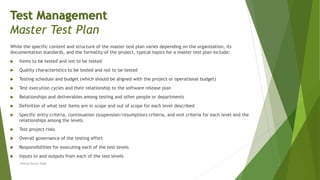
While the specific content and structure of the master test plan varies depending on the organization, its
documentation standards, and the formality of the project, typical topics for a master test plan include:
 Items to be tested and not to be tested
 Quality characteristics to be tested and not to be tested
 Testing schedule and budget (which should be aligned with the project or operational budget)
 Test execution cycles and their relationship to the software release plan
 Relationships and deliverables among testing and other people or departments
 Definition of what test items are in scope and out of scope for each level described
 Specific entry criteria, continuation (suspension/resumption) criteria, and exit criteria for each level and the
relationships among the levels
 Test project risks
 Overall governance of the testing effort
 Responsibilities for executing each of the test levels
 Inputs to and outputs from each of the test levels
Neeraj Kumar Singh
Test Management
Master Test Plan
Test Management
Contents
2.4.1 Test Policy
2.4.2 Test Strategy
2.4.3 Master Test Plan
2.4.4 Level Test Plan
2.4.5 Project Risk Management
2.4.6 Other Test Work Products
Neeraj Kumar Singh
Level test plans describe the particular activities to be carried out within each test level or, in some cases, test
type.
Level test plans expand, where necessary, on the master test plan for the specific level or test type being
documented. They provide schedule, task, and milestone details not necessarily covered in the master test plan.
In addition, to the extent that different standards and templates apply to specification of tests at different levels,
these details would be covered in level test plans.
On less formal projects or operations, a single test plan is often the only test management document written. In
such situations, some of the informational elements mentioned earlier in this section could be covered in this test
plan document.
For Agile projects, sprint or iteration test plans may take the place of level test plans.
Neeraj Kumar Singh
Test Management
Level Test Plan
Test Management
Contents
2.4.1 Test Policy
2.4.2 Test Strategy
2.4.3 Master Test Plan
2.4.4 Level Test Plan
2.4.5 Project Risk Management
2.4.6 Other Test Work Products
Neeraj Kumar Singh
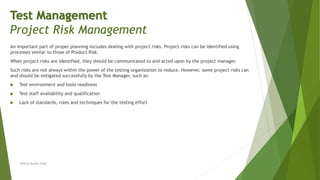
An important part of proper planning includes dealing with project risks. Project risks can be identified using
processes similar to those of Product Risk.
When project risks are identified, they should be communicated to and acted upon by the project manager.
Such risks are not always within the power of the testing organization to reduce. However, some project risks can
and should be mitigated successfully by the Test Manager, such as:
 Test environment and tools readiness
 Test staff availability and qualification
 Lack of standards, rules and techniques for the testing effort
Neeraj Kumar Singh
Test Management
Project Risk Management
Approaches to project risk management include preparing the testware earlier, pre-testing of test environments,
pre-testing of early versions of the product, applying tougher entry criteria to testing, enforcing requirements for
testability, participating in reviews of early project work products, participating in change management, and
monitoring the project progress and quality.
Once a project risk has been identified and analyzed, there are four main options to manage that risk:
1. Mitigate the risk through preventive measures to reduce likelihood and/or impact
2. Make contingency plans to reduce impact if the risk becomes an actuality
3. Transfer the risk to some other party to handle
4. Ignore or accept the risk
Selecting the best option depends on the benefits and opportunities created by the option, as well as the cost and,
potentially, any additional risks associated with the option. When a contingency plan is identified for a project
risk, the best practice is to identify a trigger (which will determine when and how the contingency plan is invoked)
and an owner (who will carry out the contingency plan).
Neeraj Kumar Singh
Test Management
Project Risk Management
Test Management
Contents
2.4.1 Test Policy
2.4.2 Test Strategy
2.4.3 Master Test Plan
2.4.4 Level Test Plan
2.4.5 Project Risk Management
2.4.6 Other Test Work Products
Neeraj Kumar Singh
Testing involves the creation of a number of other work products, such as defect reports, test case specifications,
and test logs. Most of these work products are produced by Test Analysts and Technical Test Analysts.
The Test Manager should ensure consistency and quality of these work products through the following activities:
 Establishing and monitoring metrics that monitor the quality of these work products, such as the percentage of
rejected defect reports
 Working with the Test Analysts and Technical Test Analysts to select and customize appropriate templates for
these work products
 Working with the Test Analysts and Technical Test Analysts to establish standards for these work products, such
as the degree of detail necessary in tests, logs, and reports
 Reviewing testing work products using the appropriate techniques and by the appropriate participants and
stakeholders
The extent, type, and specificity of test documentation can be influenced by the chosen software development
lifecycle, applicable standards and regulations, and the product quality and project risks associated with the
particular system being developed, among other considerations.
There are various sources of templates for testing work products, such as IEEE 829
Neeraj Kumar Singh
Test Management
Other Test Work Products
Test Management
Contents
2.1 Introduction
2.2 Test Management in Context
2.3 Risk-Based Testing and Other Approaches for Test
Prioritization and Effort Allocation
2.4 Test Documentation and Other Work Products
2.5 Test Estimation
2.6 Defining and Using Test Metrics
2.7 Business Value of Testing
2.8 Distributed, Outsourced, and Insourced Testing
2.9 Managing the Application of Industry Standards
Neeraj Kumar Singh
Estimation, as a management activity, is the creation of an approximate target for costs and completion dates
associated with the activities involved in a particular operation or project. The best estimates:
 Represent the collective wisdom of experienced practitioners and have the support of the participants
involved
 Provide specific, detailed catalogs of the costs, resources, tasks, and people involved
 Present, for each activity estimated, the most likely cost, effort and duration
Estimation of software and system engineering has long been known to be fraught with difficulties, both technical
and political, though project management best practices for estimation are well established. Test estimation is the
application of these best practices to the testing activities associated with a project or operation.
Test estimation should cover all activities involved in the test process. The estimated cost, effort, and, especially,
duration of test execution is often of the most interest to management, as test execution is typically on the
project’s critical path. However, test execution estimates tend to be difficult to generate and unreliable when the
overall quality of the software is low or unknown. In addition, familiarity and experience with the system will
likely affect the quality of the estimate.
Neeraj Kumar Singh
Test Management
Test Estimation
Test estimation should consider all factors that can influence the cost, effort, and duration of the testing
activities. These factors include (but are not limited to) the following:
 Required level of quality of the system
 Size of the system to be tested
 Historical data from testing for previous test projects which may be augmented with industry data or
benchmark data from other organizations
 Process factors, including the test strategy, development or maintenance lifecycle and process maturity, and
the accuracy of the project estimate
 Material factors, including test automation and tools, test environment(s), test data, development
environment(s), project documentation (e.g., requirements, designs, etc.), and reusable test work products
 People factors, including managers and technical leaders, executive and senior management commitment and
expectations, skills, experience, and attitudes in the project team, stability of the project team, project team
relationships, test and debugging environment support, availability of skilled contractors and consultants, and
domain knowledge
Neeraj Kumar Singh
Test Management
Test Estimation
 Complexity of the process, technology, organization, number of testing stakeholders, composition and location
of sub teams
 Significant ramp up, training, and orientation needs
 Assimilation or development of new tools, technology, processes, techniques, custom hardware, or a large
quantity of testware
 Requirements for a high degree of detailed test specification, especially to comply with an unfamiliar standard
of documentation
 Complex timing of component arrival, especially for integration testing and test development
 Fragile test data (e.g., data that is time sensitive)
The quality of the software delivered for testing is also a major factor that Test Managers should consider in their
estimation.
Neeraj Kumar Singh
Test Management
Test Estimation
Estimation can be done either bottom-up or top-down. Techniques which can be used in test estimation, singly or
in combination, include the following:
 Intuition, guesses, and past experience
 Work Breakdown Structures (WBS)
 Team estimation sessions (e.g., Wide Band Delphi)
 Company standards and norms
 Percentages of the overall project effort or staffing levels (e.g., tester-developer ratios)
 Organizational history and metrics, including metrics-derived models that estimate the number of defects, the
number of test cycles, the number of test cases, each test's average effort, and the number of regression
cycles involved
 Industry averages and predictive models such as function points, lines of code, estimated developer effort, or
other project parameters
Neeraj Kumar Singh
Test Management
Test Estimation
In most cases, the estimate, once prepared, must be delivered to management, along with a justification.
Frequently, some negotiation ensues, often resulting in a reworking of the estimate.
Ideally, the final test estimate represents the best-possible balance of organizational and project goals in the areas
of quality, schedule, budget, and features.
It is important to remember that any estimate is based on the information available at the time it was prepared.
Early in a project, the information may be quite limited.
In addition, information that is available early in a project may change over time. In order to remain accurate,
estimates should be updated to reflect new and changed information.
Neeraj Kumar Singh
Test Management
Test Estimation
Test Management
Contents
2.1 Introduction
2.2 Test Management in Context
2.3 Risk-Based Testing and Other Approaches for Test
Prioritization and Effort Allocation
2.4 Test Documentation and Other Work Products
2.5 Test Estimation
2.6 Defining and Using Test Metrics
2.7 Business Value of Testing
2.8 Distributed, Outsourced, and Insourced Testing
2.9 Managing the Application of Industry Standards
Neeraj Kumar Singh
A management cliché says that what gets measured gets done. In addition, what does not get measured does not
get done, because what does not get measured is easy to ignore. Therefore, it is important that the proper set of
metrics be established for any endeavor, including testing.
Testing metrics can be classified as belonging to one or more of the following categories:
 Project metrics, which measure progress toward established project exit criteria, such as the percentage of
test cases executed, passed, and failed
 Product metrics, which measure some attribute of the product, such as the extent to which it has been tested
or the defect density
 Process metrics, which measure the capability of the testing or development process, such as the percentage
of defects detected by testing
 People metrics, which measure the capability of individuals or groups, such as the implementation of test
cases within a given schedule
Any given metric may belong in two, three, or even four categories. For example, a trend chart showing the daily
arrival rate of defects can be associated with an exit criterion (zero new defects found for one week), the quality
of the product (testing cannot locate further defects in it), and the capability of the test process (testing finds a
large number of defects early in the test execution period).
Neeraj Kumar Singh
Test Management
Defining and Using Test Metrics
Using metrics enables testers to report results in a consistent way and enables coherent tracking of progress over
time. Test Managers are frequently required to present metrics at various meetings which may be attended by
multiple levels of stakeholders, ranging from technical staff to executive management.
Because metrics are sometimes used to determine the overall success of a project, great care should be taken
when determining what to track, how often to report it, and the method to be used to present the information. In
particular, a Test Manager must consider the following:
 Definition of metrics. A limited set of useful metrics should be defined.
 Tracking of metrics. Reporting and merging metrics should be as automated as possible to reduce the time
spent in taking and processing measurements.
 Reporting of metrics. The objective is to provide an immediate understanding of the information, for
management purposes. Presentations may show a snapshot of a metric at a certain time or show the evolution
of a metric over time so that trends can be evaluated.
 Validity of metrics. A Test Manager must also verify the information that is being reported. The measurements
taken for a metric may not reflect the true status of a project or may convey an overly positive or negative
trend. Before any data is presented, the Test Manager must review it for both accuracy and for the message
that it is likely to convey.
Neeraj Kumar Singh
Test Management
Defining and Using Test Metrics
There are five primary dimensions on which test progress is monitored:
 Product (quality) risks
 Defects
 Tests
 Coverage
 Confidence
Product risks, defects, tests, and coverage can be and often are measured and reported in specific ways during the
project or operation.
If these measurements are related to defined exit criteria in the test plan, they can provide an objective standard
by which to judge completion of the test effort.
Confidence is measurable through surveys or by using coverage as a surrogate metric; however, confidence is often
reported subjectively as well.
Neeraj Kumar Singh
Test Management
Defining and Using Test Metrics
Metrics related to product risks include:
 Percentage of risks completely covered by passing tests
 Percentage of risks for which some or all tests fail
 Percentage of risk not yet completely tested
 Percentage of risks covered, sorted by risk category
 Percentage of risks identified after the initial quality risk analysis
Test Management
Defining and Using Test Metrics
Neeraj Kumar Singh
Metrics related to defects include:
 Cumulative number reported (found) versus cumulative number resolved (fixed)
 Mean time between failure or failure arrival rate
 Breakdown of the number or percentage of defects categorized by the following:
 Particular test items or components
 Root causes
 Source of defect (e.g., requirement specification, new feature, regression, etc.)
 Test releases
 Phase introduced, detected, and removed
 Priority/severity
 Reports rejected or duplicated
 Trends in the lag time from defect reporting to resolution
 Number of defect fixes that introduced new defects (sometimes called daughter bugs)
Test Management
Defining and Using Test Metrics
Neeraj Kumar Singh
Metrics related to tests include:
 Total number of tests planned, specified (implemented), run, passed, failed, blocked, and skipped
 Regression and confirmation test status, including trends and totals for regression test and confirmation test
failures
 Hours of testing planned per day versus actual hours achieved
 Availability of the test environment (percentage of planned test hours when the test environment is usable by
the test team)
Metrics related to test coverage include:
 Requirements and design elements coverage
 Risk coverage
 Environment/configuration coverage
 Code coverage
It is important that Test Managers understand how to interpret and use coverage metrics in order to understand
and report test status.
Test Management
Defining and Using Test Metrics
Neeraj Kumar Singh
Metrics can also be linked to the activities of the fundamental test process (described in the Foundation syllabus
and in this syllabus).
By doing so, metrics can be used throughout the testing process to monitor the test process itself as well as
progress toward project objectives.
Metrics to monitor test planning and control activities may include:
 Risk, requirements, and other test basis element coverage
 Defect discovery
 Planned versus actual hours to develop testware and execute test cases
Metrics to monitor test analysis activities may include:
 Number of test conditions identified
 Number of defects found during test analysis (e.g., by identifying risks or other test conditions using the test
basis)
Test Management
Defining and Using Test Metrics
Neeraj Kumar Singh
Metrics to monitor test design activities may include:
 Percentage of test conditions covered by test cases
 Number of defects found during test design (e.g., by developing tests against the test basis)
Metrics to monitor test implementation activities may include:
 Percentage of test environments configured
 Percentage of test data records loaded
 Percentage of test cases automated
Metrics to monitor test execution activities may include:
 Percentage of planned test cases executed, passed, and failed
 Percentage of test conditions covered by executed (and/or passed) test cases
 Planned versus actual defects reported/resolved
 Planned versus actual coverage achieved
Test Management
Defining and Using Test Metrics
Neeraj Kumar Singh
Metrics to monitor test progress and completion activities will include a mapping to the milestones, entry criteria,
and exit criteria (defined and approved in test planning), which may include the following:
 Number of test conditions, test cases or test specifications planned and those executed broken down by
whether they passed or failed
 Total defects, often broken down by severity, priority, current state, affected subsystem, or other
classification
 Number of changes required, accepted, built, and tested
 Planned versus actual cost
 Planned versus actual duration
 Planned versus actual dates for testing milestones
 Planned versus actual dates for test-related project milestones (e.g., code freeze)
 Product (quality) risk status, often broken down by those mitigated versus unmitigated, major risk areas, new
risks discovered after test analysis, etc.
 Percentage loss of test effort, cost, or time due to blocking events or planned changes
 Confirmation and regression test status
Test Management
Defining and Using Test Metrics
Neeraj Kumar Singh
Metrics to monitor test closure activities may include:
 Percentage of test cases executed, passed, failed, blocked, and skipped during test execution
 Percentage of test cases checked into re-usable test case repository
 Percentage of test cases automated, or planned versus actual test cases automated
 Percentage of test cases integrated into the regression tests
 Percentage of defect reports resolved/not resolved
 Percentage of test work products identified and archived
Test Management
Defining and Using Test Metrics
Neeraj Kumar Singh
In addition, standard project management techniques such as work breakdown structures are often used to
monitor the test process. In Agile teams, testing is part of a user story’s progress on the burndown chart. Where
Lean management techniques are used, testing progress on a story-by-story basis is often monitored by having the
user story card move through a column on the Kanban board.
Given a defined set of metrics, measurements may be reported verbally in narrative form, numerically in tables,
or pictorially in graphs. The measurements may be used for a number of purposes, including:
 Analysis, to discover what trends and causes may be discernible via the test results
 Reporting, to communicate test findings to interested project participants and stakeholders
 Control, to change the course of the testing or the project as a whole and to monitor the results of that
course correction
Proper ways to gather, analyze, and report these test measures depend on the specific information needs, goals,
and abilities of the people who will use the measurements. In addition, the specific content of test reports should
vary based on the audience.
Test Management
Defining and Using Test Metrics
Neeraj Kumar Singh
For purposes of test control, it is essential that metrics throughout the test process (once test planning is
complete) provide the Test Manager with the information needed to guide the test effort toward successful
completion of the test mission, strategies, and objectives.
Test control must respond to information generated by the testing as well as to changing conditions in which a
project or endeavor exists.
If divergence from the test plan is discovered via the test progress report, test control should be performed. Test
control is aimed at redirecting the project and/or the testing in a more successful direction. When using test
results to influence or measure control efforts on the project, the following options should be considered:
 Revising the quality risk analysis, test priorities, and/or test plans
 Adding resources or otherwise increasing the project or test effort
 Delaying the release date
 Relaxing or strengthening the test exit criteria
 Changing the scope (functional and/or non-functional) of the project
Implementing such options typically requires consensus among project or operation stakeholders and consent by
project or operation managers.
The information delivered in a test report should depend largely on the information needs of the target audience,
e.g., project management or business management.
Test Management
Defining and Using Test Metrics
Neeraj Kumar Singh
Test Management
Contents
2.1 Introduction
2.2 Test Management in Context
2.3 Risk-Based Testing and Other Approaches for Test
Prioritization and Effort Allocation
2.4 Test Documentation and Other Work Products
2.5 Test Estimation
2.6 Defining and Using Test Metrics
2.7 Business Value of Testing
2.8 Distributed, Outsourced, and Insourced Testing
2.9 Managing the Application of Industry Standards
Neeraj Kumar Singh
The Test Manager must work to optimize testing so that good business value is delivered.
Testing excessively does not deliver good business value, because the testing will impose unreasonable delays and
cost more than it saves.
Testing too little does not deliver good business value because too many defects will be delivered to users. The
optimum lies between those two extremes.
The Test Manager must help testing stakeholders understand this optimum and the value delivered by testing.
While most organizations consider testing valuable in some sense, few managers, including Test Managers, can
quantify, describe, or articulate that value.
In addition, many Test Managers, test leads, and testers focus on the tactical details of testing (aspects specific to
the task or test level), while ignoring the larger strategic (higher level) issues related to testing that other project
participants, especially managers, care about.
Testing delivers value to the organization, project, and/or operation in both quantitative and qualitative ways:
 Quantitative values include finding defects that are prevented or fixed prior to release, finding defects that
are known prior to release (not fixed but documented, perhaps with workarounds), reducing risk by running
tests, and delivering information on project, process, and product status.
 Qualitative values include improved reputation for quality, smoother and more-predictable releases,
increased confidence, protection from legal liability, and reducing risk of loss of whole missions or even lives.
Neeraj Kumar Singh
Test Management
Business Value of Testing
Test Managers should understand which of these values apply for their organization, project, and/or operation, and
be able to communicate about testing in terms of these values.
A well-established method for measuring the quantitative value and efficiency of testing is called cost of quality
(or, sometimes, cost of poor quality).
Cost of quality involves classifying project and operational costs into four categories related to product defect
costs:
 Costs of prevention, e.g., training developers to write more maintainable or secure code
 Costs of detection, e.g., writing test cases, configuring test environments, and reviewing requirements
 Costs of internal failure, e.g., fixing defects detected during testing or reviews, prior to delivery
 Costs of external failure, e.g., support costs associated with defective software delivered to customers
A portion of the testing budget is a cost of detection (i.e., money that would be spent even if testers find no
defects, such as money spent developing tests), while the remainder is a cost of internal failure (i.e., the actual
cost associated with the found defects).
The total costs of detection and internal failure are typically well below the costs of external failure, which makes
testing an excellent value. By determining the costs in these four categories, Test Managers can create a
convincing business case for testing.
Neeraj Kumar Singh
Test Management
Business Value of Testing
Test Management
Contents
2.1 Introduction
2.2 Test Management in Context
2.3 Risk-Based Testing and Other Approaches for Test
Prioritization and Effort Allocation
2.4 Test Documentation and Other Work Products
2.5 Test Estimation
2.6 Defining and Using Test Metrics
2.7 Business Value of Testing
2.8 Distributed, Outsourced, and Insourced Testing
2.9 Managing the Application of Industry Standards
Neeraj Kumar Singh
In many cases, some or perhaps even all of the test effort is done by people in different locations, employed by
different companies, or separated from the project team.
 If the test effort occurs at multiple locations, that test effort is Distributed.
 If the test effort is carried out at one or more locations by people who are not employees of the company and
who are not co-located with the project team, that test effort is Outsourced.
 If the test effort is carried out by people who are co-located with the project team but who are not fellow
employees, that test effort is Insourced.
Common across all such test efforts is the need for clear channels of communication and well-defined expectations
for missions, tasks, and deliverables. The project team must rely less on informal communication channels such as
hallway conversations and colleagues spending social time together.
It is important to have defined ways in which communication should occur, including addressing topics such as
escalation of problems, types of information to be communicated, and methods of communication to be used.
Everyone, on all sides of the team relationships, must have a clear understanding of their roles and responsibilities
as well as the other parties’ roles and responsibilities to avoid misunderstandings and unrealistic expectations.
Location, time zone, cultural and language differences make communication and expectation issues even more
likely to arise.
Neeraj Kumar Singh
Test Management
Distributed, Outsourced and Insourced Testing
Also common across all such test efforts is the need for alignment of methodologies. While misalignment of
methodologies can occur in any project, it is more likely to arise in situations where the work is distributed and/or
performed by outside entities.
If two testing groups use different methodologies or the testing group uses a different methodology than
development or project management, this can result in significant problems, especially during test execution.
For distributed testing, the division of the test work across the multiple locations must be explicit and intelligently
decided. Without such guidance, the most competent group may not do the test work for which they are qualified.
In addition, if each team doesn’t know what they are responsible for, they may not do what they are supposed to
do.
Finally, for all such test efforts, it is critical that the entire project team develop and maintain trust that all of the
test team(s) will carry out their roles properly in spite of organizational, cultural, language, and geographical
boundaries. Lack of trust leads to inefficiencies and delays associated with verifying activities, apportioning blame
for problems, and playing organizational politics.
Neeraj Kumar Singh
Test Management
Distributed, Outsourced and Insourced Testing
Test Management
Contents
2.1 Introduction
2.2 Test Management in Context
2.3 Risk-Based Testing and Other Approaches for Test
Prioritization and Effort Allocation
2.4 Test Documentation and Other Work Products
2.5 Test Estimation
2.6 Defining and Using Test Metrics
2.7 Business Value of Testing
2.8 Distributed, Outsourced, and Insourced Testing
2.9 Managing the Application of Industry Standards
Neeraj Kumar Singh
Test Managers should be aware of standards, their organization’s policy on the use of standards, and whether or
not standards are required, necessary or useful for them to use.
Standards can come from different sources, such as:
 International or with international objectives
 National, such as national applications of international standards
 Domain specific, such as when international or national standards are adapted to particular domains, or
developed for specific domains
International standards bodies include ISO and IEEE. ISO is the International Standards Organization, also called
IOS, the International Organization for Standardization. It is made up of members representing, for their country,
the national body most relevant to the area being standardized. This international body has promoted a number of
standards useful for software testers, such as ISO 9126 (being replaced by ISO 25000), ISO 12207 [ISO12207], and
ISO 15504 [ISO15504].
IEEE is the Institute of Electrical and Electronics Engineers, a professional organization based in the U.S., but with
national representatives in more than one hundred countries. This organization has proposed a number of
standards that are useful for software testers, such as IEEE 829 [IEEE829] and IEEE 1028 [IEEE 1028].
Neeraj Kumar Singh
Test Management
Managing the Application of Industry Standards
Many countries have their own national standards. Some of these standards are useful for software testing. One
example is the UK standard BS 7925-2 [BS7925-2], that provides information related to many of the test design
techniques described in the Advanced Test Analyst and Advanced Technical Test Analyst syllabi.
Some standards are specific to particular domains, and some of these standards have implications for software
testing, software quality and software development. For example, in the avionics domain, the U.S. Federal
Aviation Administration’s standard DO-178B (and its EU equivalent ED 12B) applies to software used in civilian
aircraft. This standard prescribes certain levels of structural coverage criteria based on the level of criticality of
the software being tested.
Another example of a domain-specific standard is found in medical systems with the U.S. Food and Drug
Administration’s Title 21 CFR Part 820 [FDA21]. This standard recommends certain structural and functional test
techniques.
Three other important examples are PMI’s PMBOK, PRINCE2®, and ITIL®. PMI and PRINCE2 are commonly used
project management frameworks in North America and Europe, respectively. ITIL is a framework for ensuring that
an IT group delivers valuable services to the organization in which it exists.
Whatever standards or methodologies are being adopted, it is important to remember that they are created by
groups of professionals. Standards reflect the source group’s collective experience and wisdom, but also their
weaknesses, too. Test Managers should be aware of the standards that apply to their environment and context,
whether formal standards (international, national or domain specific) or in-house standards and recommended
practices.
Neeraj Kumar Singh
Test Management
Managing the Application of Industry Standards
Test Management
1 Testing Process 2 Test Management 3 Reviews
Software Testing - ISTQB Advance
Test Manager Exam Preparation
Chapter 2
Neeraj Kumar Singh
4 Defect Management
5 Improving Process 6 Test Tools 7 People Skills
Neeraj Kumar Singh
Test Management
Sample Questions Pattern
Source : istqb.org
1. Which of the following statements BEST describes how risk-based testing responds to risks?
Select ONE option.
Answer Set
a. When tests find defects, they increase the quality of the system under test.
b. Functional testing addresses product risks, while non-functional testing addresses quality risks.
c. The test manager determines which test levels to apply based on project risks.
d. The test team designs, implements, and executes tests to mitigate quality risks.
Test Management
Sample Question
2. Consider the following test strategies:
1. Analytical test strategy
2. Methodical test strategy
3. Process-compliant test strategy
4. Consultative test strategy
Which of the following correctly matches test strategies with an example of a test activity appropriate for that
strategy?
Select ONE option.
Answer Set
a. 1 – A 2 – B 3 – C 4 – D
b. 1 – C 2 – D 3 – B 4 – A
c. 1 – D 2 – C 3 – B 4 – A
d. 1 – C 2 – B 3 – D 4 – A
Test Management
Sample Question
Consider the following examples of test activities:
A. Testing a user-provided list of Internet browsers
B. Defining acceptance criteria for a user story
C. Executing the highest-risk tests as early as possible
D. Clicking through all the navigational links on a web page
3. Assume you are a test manager on a project which is following an Agile lifecycle. The testing strategy is a blend
of risk-based testing, process-compliant testing, and reactive testing. Developers are following known Agile best
practices, including automated unit testing and continuous integration.
You are estimating the system test effort required for a particular iteration by your test team. Which of the
following statements correctly describe how you should carry out estimation in this scenario?
Select TWO options.
Answer Set
a. Consider the average effort required per identified risk in past iterations.
b. Allocate time-boxed test sessions for each identified test charter.
c. Estimate that most defects will be found during system test execution.
d. Include effort to create detailed test work product documentation.
e. Assume that system tests can reuse unit test data and environments.
Test Management
Sample Question

Chapter 2 - Test Management

  • 1.
    Test Management 1 TestingProcess 2 Test Management 3 Reviews Software Testing - ISTQB Advance Test Manager Exam Preparation Chapter 2 Neeraj Kumar Singh 4 Defect Management 5 Improving Process 6 Test Tools 7 People Skills
  • 2.
    Test Management Contents 2.1 Introduction 2.2Test Management in Context 2.3 Risk-Based Testing and Other Approaches for Test Prioritization and Effort Allocation 2.4 Test Documentation and Other Work Products 2.5 Test Estimation 2.6 Defining and Using Test Metrics 2.7 Business Value of Testing 2.8 Distributed, Outsourced, and Insourced Testing 2.9 Managing the Application of Industry Standards Neeraj Kumar Singh
  • 3.
    Test Management Contents 2.2.1 UnderstandingTesting Stakeholders 2.2.2 Additional Software Development Lifecycle Activities and Work Products 2.2.3 Alignment of Test Activities and Other Lifecycle Activities 2.2.4 Managing Non-Functional Testing 2.2.5 Managing Experience-Based Testing 2.6 Defining and Using Test Metrics Neeraj Kumar Singh
  • 4.
    At the AdvancedLevel, career specialization has begun to occur for the test professional. This chapter focuses on areas of knowledge required by test professionals as they move into Test Leader, Test Manager, and Test Director positions. In this syllabus, we refer collectively to these professionals as Test Managers, understanding that different organizations will have different definitions for the titles and levels of responsibility of people in such positions. Neeraj Kumar Singh Test Management Introduction
  • 5.
     A centralresponsibility of a manager is to secure and utilize resources (people, software, hardware, infrastructure, etc.) to carry out value-adding processes.  For software and IT managers, the processes are often part of a project or a program aimed at delivering software or a system for internal or external use.  For Test Managers, the processes are those involved with testing, specifically the fundamental test process activities. Since test processes add value only by contributing to the overall success of the project or program (or by preventing a more severe type of failure), the Test Manager must plan and control the test processes accordingly.  In other words, the Test Manager must appropriately arrange the test processes, including the associated activities and work products, according to the needs and circumstances of the other stakeholders, their activities (e.g., the software development lifecycle in which testing occurs), and their work products (e.g., requirements specifications). Neeraj Kumar Singh Test Management Test Management in Context
  • 6.
    People are stakeholdersof testing when they have an interest in the testing activities, the testing work products, or the quality of the final system or deliverable. The stakeholder’s interest can be direct or indirect involvement in the testing activities, direct or indirect receipt of testing work products, or direct or indirect effect by the quality of the deliverables produced by the project or program. While the testing stakeholders vary, depending on the project, the product, the organization, and other factors, they can include the following roles:  Developers, development leads, and development managers. These stakeholders implement the software under test, receive test results, and often must take action based on those results (e.g., fix reported defects).  Database architects, system architects, and designers. These stakeholders design the software, receive test results, and often must take action on those results.  Marketing and business analysts. These stakeholders determine the features, and the level of quality inherent in those features, that must be present in the software. They are also often involved in defining needed test coverage, reviewing test results, and making decisions based on test results.  Senior management, product managers and project sponsors. These stakeholders are often involved in defining needed test coverage, reviewing test results, and making decisions based on test results. Neeraj Kumar Singh Test Management Understanding Testing Stakeholders
  • 7.
     Project managers.These stakeholders are responsible for managing their projects to success, which requires balancing quality, schedule, feature, and budget priorities. They often procure the resources required for the test activities and collaborate with the Test Manager in test planning and control.  Technical support, customer support, and help desk staff. These stakeholders support the users and customers who benefit from the features and quality of the delivered software.  Direct and indirect users. These stakeholders use the software directly (i.e., they are the endusers), or receive outputs or services produced or supported by the software. This list of stakeholders is not comprehensive. Test Managers must identify the specific testing stakeholders for their project or program. Neeraj Kumar Singh Test Management Understanding Testing Stakeholders
  • 8.
    Test Management Contents 2.1 Introduction 2.2Test Management in Context 2.3 Risk-Based Testing and Other Approaches for Test Prioritization and Effort Allocation 2.4 Test Documentation and Other Work Products 2.5 Test Estimation 2.6 Defining and Using Test Metrics 2.7 Business Value of Testing 2.8 Distributed, Outsourced, and Insourced Testing 2.9 Managing the Application of Industry Standards Neeraj Kumar Singh
  • 9.
    Test Management Contents 2.2.1 UnderstandingTesting Stakeholders 2.2.2 Additional Software Development Lifecycle Activities and Work Products 2.2.3 Alignment of Test Activities and Other Lifecycle Activities 2.2.4 Managing Non-Functional Testing 2.2.5 Managing Experience-Based Testing Neeraj Kumar Singh
  • 10.
    Since software testingis an evaluation of the quality of one or more work products produced outside of the testing activities, it usually exists in the context of a larger set of software development lifecycle activities. The Test Manager must plan and guide the testing activities with an understanding of how these other activities and their work products affect testing and how testing affects these other activities and their work products. For example, in organizations using Agile development practices, developers often perform test-driven development, create automated unit tests, and continuously integrate code (along with the tests for that code) into the configuration management system. The Test Manager should work with the development manager to ensure that testers are integrated into and aligned with these activities. Testers may review the unit tests both to contribute suggestions for increased coverage and effectiveness of these tests and to gain a deeper understanding of the software and its implementation. Neeraj Kumar Singh Test Management Additional SDLC Activities and Work Products
  • 11.
    While the specificrelationship between testing activities, the other test stakeholders, software development lifecycle work activities, and work products varies depending on the project, the chosen software development lifecycle and a variety of other factors, testing is closely interconnected and related to the following:  Requirements engineering and management.  Project management.  Configuration management, release management, and change management.  Software development and maintenance.  Technical support.  Production of technical documentation. In addition to identifying the test stakeholders as described above, the Test Manager must identify the other software development lifecycle activities and work products that affect testing and/or are affected by testing. If not, the testing process will not achieve optimal effectiveness and efficiency. Neeraj Kumar Singh Test Management Additional SDLC Activities and Work Products
  • 12.
    Test Management Contents 2.2.1 UnderstandingTesting Stakeholders 2.2.2 Additional Software Development Lifecycle Activities and Work Products 2.2.3 Alignment of Test Activities and Other Lifecycle Activities 2.2.4 Managing Non-Functional Testing 2.2.5 Managing Experience-Based Testing Neeraj Kumar Singh
  • 13.
    Testing should bean integral part of the project, regardless of the software development models used. This includes:  Sequential models, such as the waterfall model, V-model and W-model.  Iterative or incremental models, such as Rapid Application Development (RAD) and the Rational Unified Process (RUP).  Agile, such as SCRUM and Extreme Programming (XP).  Spiral. Neeraj Kumar Singh Test Management Alignment of Test Activities & Other Lifecycle Activities
  • 14.
    In order toproperly align testing activities within the lifecycle, the Test Manager must have a detailed understanding of the lifecycle models used in their organization. For example, in the V-model, the ISTQB fundamental test process applied to the system test level could align as follows:  System test planning activities occur concurrently with project planning, and test control continues until system test execution and closure are complete. System test analysis and design activities occur concurrently with requirements specification, system and architectural (high-level) design specification, and component (low-level) design specification.  System test implementation activities might start during system design, though the bulk of these activities would typically occur concurrently with coding and component test, with work on system test implementation activities stretching often until just days before the start of system test execution.  System test execution activities begin when the system test entry criteria are all met (or waived), which typically means that at least component testing and often also component integration testing are complete. System test execution continues until the system test exit criteria are met.  Evaluation of the system test exit criteria and reporting of system test results occur throughout system test execution, generally with greater frequency and urgency as project deadlines approach.  System test closure activities occur after the system test exit criteria are met and system test execution is declared complete, though they can sometimes be delayed until after acceptance testing is over and all project activities are finished. Neeraj Kumar Singh Test Management Alignment of Test Activities & Other Lifecycle Activities
  • 15.
    Test Management Contents 2.2.1 UnderstandingTesting Stakeholders 2.2.2 Additional Software Development Lifecycle Activities and Work Products 2.2.3 Alignment of Test Activities and Other Lifecycle Activities 2.2.4 Managing Non-Functional Testing 2.2.5 Managing Experience-Based Testing Neeraj Kumar Singh
  • 16.
    Failure to planfor non-functional tests can result in the discovery of serious, sometimes disastrous, quality problems in a system after release. However, many types of non-functional tests are expensive so the Test Manager must select which non-functional tests to perform based on risk and constraints. In addition, there are many different types of non-functional tests, some of which might not be appropriate to a given application. Since the Test Manager may not have sufficient expertise to handle all the planning considerations, the Test Manager needs to delegate some of test planning responsibilities to the Technical Test Analysts (and in some cases Test Analysts) assigned to the non-functional testing activities. The Test Manager should ask the analysts to consider the following general factors:  Stakeholder requirements  Required tooling  Test environment  Organizational factors  Security Neeraj Kumar Singh Test Management Managing Non-Functional Testing
  • 17.
    Another important considerationfor test managers is how to integrate non-functional tests into the software development lifecycle. A common mistake is to wait until all functional tests are complete prior to starting non-functional tests, which can result in the late discovery of critical non-functional defects. Instead, non-functional tests should be prioritized and sequenced according to risk. There are often ways to mitigate non-functional risks during early levels of testing or even during development. For example, usability reviews of user interface prototypes during system design can be quite effective at identifying usability defects that would create significant schedule problems if discovered toward the end of system testing. In iterative lifecycles, the pace of change and of iterations can make it difficult to focus on certain nonfunctional tests that require construction of sophisticated test frameworks. Test design and implementation activities that take longer than the timescales of a single iteration should be organized as separate work activities outside of the iterations. Neeraj Kumar Singh Test Management Managing Non-Functional Testing
  • 18.
    Test Management Contents 2.2.1 UnderstandingTesting Stakeholders 2.2.2 Additional Software Development Lifecycle Activities and Work Products 2.2.3 Alignment of Test Activities and Other Lifecycle Activities 2.2.4 Managing Non-Functional Testing 2.2.5 Managing Experience-Based Testing Neeraj Kumar Singh
  • 19.
    While experience-based testingprovides benefits by efficiently finding defects that other test techniques may miss and serving as a check on the completeness of those techniques, it provides some challenges for test management. The Test Manager should be aware of the challenges as well as the benefits of the experience-based techniques, particularly exploratory testing. It is difficult to determine the coverage attained during such testing, given the typical light-weight logging and minimal advanced preparation of tests. Reproducibility of the test results requires particular management attention, especially when multiple testers are involved. One way to manage experience-based testing, especially exploratory testing, is to break the testing work into small, 30 to 120 minute periods sometimes called test sessions. This time boxing limits and focuses the work to be done in a session and provides a level of monitoring and scheduling. Each session covers a test charter, which is communicated in writing or verbally to the tester by the test manager. The test charter gives the test condition(s) to be covered in the test session, which further helps to maintain focus and prevent overlap if multiple people are carrying out exploratory testing simultaneously. Neeraj Kumar Singh Test Management Managing Experience-Based Testing
  • 20.
    Another technique tomanage experience-based testing is by integrating such self-directed and spontaneous testing into more traditional pre-designed testing sessions. For example, testers can be given permission (and allocated time) to explore beyond the explicit steps, inputs, and expected results in their pre-defined tests. Testers may also be assigned such self-directed testing sessions as part of their daily testing, before, during, or after a day of running pre-defined tests. If such testing sessions identify defects or interesting areas for future testing, the pre-defined tests may be updated.  At the beginning of the exploratory session, the tester ascertains and performs the necessary set up tasks for the tests.  During the session, the tester learns about the application being tested, designs and executes tests according to the technique being applied and what has been learned about the application, investigates any defects, and captures the results of the test in a log.  After the session, a debriefing may occur, which sets the direction for subsequent sessions. Neeraj Kumar Singh Test Management Managing Experience-Based Testing
  • 21.
    Test Management Contents 2.1 Introduction 2.2Test Management in Context 2.3 Risk-Based Testing and Other Approaches for Test Prioritization and Effort Allocation 2.4 Test Documentation and Other Work Products 2.5 Test Estimation 2.6 Defining and Using Test Metrics 2.7 Business Value of Testing 2.8 Distributed, Outsourced, and Insourced Testing 2.9 Managing the Application of Industry Standards Neeraj Kumar Singh
  • 22.
    Test Management Contents 2.3.1 Risk-BasedTesting 2.3.2 Risk-Based Testing Techniques 2.3.3 Other Techniques for Test Selection 2.3.4 Test Prioritization and Effort Allocation in the Test Process Neeraj Kumar Singh
  • 23.
    Risk is thepossibility of a negative or undesirable outcome or event. Risks exist whenever some problem may occur which would decrease customer, user, participant, or stakeholder perceptions of product quality or project success. Where the primary effect of the potential problem is on product quality, potential problems are referred to as quality risks, product risks, or product quality risks. Where the primary effect of the potential problem is on project success, potential problems are referred to as project risks or planning risks. In risk-based testing, quality risks are identified and assessed during a product quality risk analysis with the stakeholders. The test team then designs, implements, and executes tests to mitigate the quality risks. Quality includes the totality of features, behaviors, characteristics, and attributes that affect customer, user, and stakeholder satisfaction. Therefore, a quality risk is a potential situation where quality problems might exist in a product. Risk-based testing consists of four main activities:  Risk identification  Risk assessment  Risk mitigation  Risk management Neeraj Kumar Singh Test Management Risk Based Testing
  • 24.
    Stakeholders can identifyrisks through one or more of the following techniques:  Expert interviews  Independent assessments  Use of risk templates  Project retrospectives  Risk workshops  Brainstorming  Checklists  Calling on past experience By involving the broadest possible sample of stakeholders, the risk identification process is most likely to identify most of the significant product quality risks. The risk identification often produces by-products, i.e., identification of issues which are not product quality risks. Examples include general questions or issues about the product or project, or problems in referenced documents such as requirements and design specifications. Project risks are also often identified as a by-product of quality risk identification but are not the main focus of risk-based testing. Neeraj Kumar Singh Test Management Risk Identification
  • 25.
    Once risk identificationhas occurred, risk assessment can begin, being the study of these identified risks. Specifically, risk assessment involves categorizing each risk and determining the likelihood and impact associated with each risk. Risk assessment may also involve evaluating or assigning other properties of each risk, such as risk owner. Categorization of risk means placing each risk into an appropriate type, such as performance, reliability, functionality, and so forth. Determining the level of risk typically involves assessing, for each risk item, the likelihood of occurrence and the impact upon occurrence. The likelihood of occurrence is the probability that the potential problem exists in the system under test. In other words, likelihood is an assessment of the level of technical risk. The level of risk can be assessed either quantitatively or qualitatively. If likelihood and impact can be ascertained quantitatively, one can multiply the two values together to calculate a quantitative risk priority number. If likelihood and impact can be ascertained quantitatively, one can multiply the two values together to calculate a quantitative risk priority number. Qualitative assessments of risk levels are often combined, through multiplication or addition, to create an aggregate risk score. This aggregate risk score may be expressed as a risk priority number but should be interpreted as a qualitative, relative rating on an ordinal scale. Neeraj Kumar Singh Test Management Risk Assessment
  • 26.
    Factors influencing likelihoodfor product and project risks include:  Complexity of technology and teams  Personnel and training issues among the business analysts, designers, and programmers  Conflict within the team  Contractual problems with suppliers  Geographically distributed team  Legacy versus new approaches  Tools and technology  Weak managerial or technical leadership  Time, resource, budget and management pressure  Lack of earlier quality assurance activities  High change rates High earlier defect rates  Interfacing and integration issues Neeraj Kumar Singh Test Management Risk Assessment The impact upon occurrence is the severity of the effect on the users, customers, or other stakeholders. Factors influencing impact in project and product risks include:  Frequency of use of the affected feature  Criticality of the feature to accomplishing a business goal  Damage to reputation  Loss of business  Potential financial, ecological or social losses or liability  Civil or criminal legal sanctions  Loss of license  Lack of reasonable workarounds  Visibility of failure leading to negative publicity  Safety
  • 27.
    Risk-based testing startswith a quality risk analysis (identifying and assessing product quality risks). This analysis is the foundation of the master test plan and the other test plans. As specified in the plan(s), tests are designed, implemented, and executed in order to cover the risks. The effort associated with developing and executing a test is proportional to the level of risk, which means that more meticulous test techniques (such as pairwise testing) are used for higher risks, while less meticulous test techniques (such as equivalence partitioning or time-boxed exploratory testing) are used for lower risks. In addition, the priority of the development and execution of the test is based on the level of risk. Some safety related standards (e.g., FAA DO-178B/ED 12B, IEC 61508), prescribe the test techniques and degree of coverage based on the level of risk. In addition, the level of risk should influence decisions such as the use of reviews of project work products (including tests), the level of independence, the level of experience of the tester, and the degree of confirmation testing (retesting) and regression testing performed. During the project, the test team should remain aware of additional information that changes the set of quality risks and/or the level of risk associated with known quality risks. Periodic adjustment of the quality risk analysis, which results in adjustments to the tests, should occur. These adjustments should occur at least at major project milestones. Adjustments include identifying new risks, re- assessing the level of existing risks, and evaluating the effectiveness of risk mitigation activities. To take one example, if a risk identification and assessment session occurred based on the requirements specification during the requirements phase, once the design specification is finalized, a re-evaluation of the risks should occur. Neeraj Kumar Singh Test Management Risk Mitigation
  • 28.
    Ideally, risk managementoccurs throughout the entire lifecycle. If an organization has a test policy document and/or test strategy document, then these should describe the general process by which product and project risks are managed in testing, and show how risk management is integrated into and affects all stages of testing. In a mature organization where risk awareness pervades the project team, risk management takes place at many levels, and not just for testing. Important risks are not only addressed earlier in particular test levels, but also in earlier test levels. Mature organizations not only identify risks, but also the sources of risk and the consequence of those risks should they become outcomes. For those defects that do occur, root cause analysis is used to understand sources of risk more deeply and to implement process improvements that prevent defects in the first place. Most risk-based testing methods also include techniques for using the level of risk to sequence and prioritize the testing, thus ensuring early coverage of the most important areas and discovery of the most important defects during test execution. In some cases, all of the highest-risk tests are run before any lower risk tests, and tests are run in strict risk order (often called “depth-first”); in other cases, a sampling approach is used to select a sample of tests across all the identified risk items using risk to weight the selection while at the same time ensuring coverage of every risk item at least once (often called “breadth-first”). Whether risk-based testing proceeds depth-first or breadth-first, it is possible that the time allocated for testing might be consumed without all tests being run. Neeraj Kumar Singh Test Management Risk Management in the Lifecycle
  • 29.
    Test Management Contents 2.1 Introduction 2.2Test Management in Context 2.3 Risk-Based Testing and Other Approaches for Test Prioritization and Effort Allocation 2.4 Test Documentation and Other Work Products 2.5 Test Estimation 2.6 Defining and Using Test Metrics 2.7 Business Value of Testing 2.8 Distributed, Outsourced, and Insourced Testing 2.9 Managing the Application of Industry Standards Neeraj Kumar Singh
  • 30.
    Test Management Contents 2.3.1 Risk-BasedTesting 2.3.2 Risk-Based Testing Techniques 2.3.3 Other Techniques for Test Selection 2.3.4 Test Prioritization and Effort Allocation in the Test Process Neeraj Kumar Singh
  • 31.
    There are anumber of techniques for risk-based testing. Some of these techniques are highly informal. Examples include approaches where the tester analyzes quality risks during exploratory testing. This can help guide the testing, but can lead to an excessive focus on the likelihood of defects, not their impact, and does not include cross-functional stakeholder input. In addition, such approaches are subjective and dependent on the skills, experience, and preferences of the individual tester. Examples of lightweight approaches include: Pragmatic Risk Analysis and Management (PRAM), Systematic Software Testing (SST), and Product Risk Management (PRisMa). In addition to the usual attributes of risk-based testing, these techniques typically have the following attributes:  Evolved over time based on industry experience with risk-based testing, especially in industries where questions of efficiency are important  Predicated on the extensive involvement of a cross-functional team of stakeholders, representing both business and technical perspectives, during the initial risk identification and assessment  Optimized when introduced during the earliest phases of a project, when the options to mitigate quality risks are maximized and when main work products and by-products of the risk analysis can help to influence the specification and implementation of the product in a way that minimizes risk  Use the generated output (the risk matrix or risk analysis table) as the basis for the test plan and the test conditions, and thus all subsequent test management and analysis activities  Support the reporting of test results in terms of residual risk to all levels of testing stakeholders Neeraj Kumar Singh Test Management Risk Based Testing Techniques
  • 32.
    Like more formaltechniques, lightweight techniques allow the use of weighting of the likelihood and impact factors to emphasize business or technical risks (depending on the level of testing, for example). Unlike more formal techniques, though, lightweight techniques:  use only two factors, likelihood and impact; and,  use simple, qualitative judgments and scales. At the formal, heavy-weight end of the scale, the Test Manager has a number of options available:  Hazard analysis, which extends the analytical process upstream, attempting to identify the hazards that underlie each risk.  Cost of exposure, where the risk assessment process involves determining, for each quality risk item, three factors: 1) the likelihood (expressed as a percentage) of a failure related to the risk item; 2) the cost of a loss (expressed as a financial quantity) associated with a typical failure related to the risk item, should it occur in production; and, 3) the cost of testing for such failures.  Failure Mode and Effect Analysis (FMEA) and its variants, where quality risks, their potential causes, and their likely effects are identified and then severity, priority and detection ratings are assigned.  Quality Function Deployment (QFD), which is a quality risk management technique with testing implications, specifically, being concerned with quality risks that arise from an incorrect or insufficient understanding of the customers’ or users’ requirements.  Fault Tree Analysis (FTA), where various actual observed failures (from testing or from production), or potential failures (quality risks), are subjected to a root cause analysis starting with defects that could cause the failure, then with errors or defects that could cause those defects, continuing on until the various root causes are identified. Neeraj Kumar Singh Test Management Risk Based Testing Techniques
  • 33.
    Usually the mostcritical success factor for risk-based testing is the involvement of the right team of stakeholders in the risk identification and assessment. All stakeholders have their own understanding of what constitutes quality for the product, and their own set of priorities and concerns about quality. Business stakeholders include customers, users, operation staff, help desk and technical support staff, among others. These stakeholders understand the customer and user, and thus can identify risks and assess impact from a business perspective. Technical stakeholders include developers, architects, database administrators, and network administrators, among others. These stakeholders understand the underlying ways in which software can fail, and thus can identify risks and assess likelihood from a technical perspective. Some stakeholders have both a business and a technical perspective. For example, subject matter experts who are in testing or business analysis roles often have a broader view on the risks due to their technical and business expertise. The process of identifying risk items is one that generates a substantial list of risks. There is no need for stakeholders to argue about the risk items; so long as one stakeholder perceives something as a risk to the quality of the system, it is a risk item. However, it is important that stakeholders achieve consensus on their ratings for the level of risk. If risk-based testing is to be used long-term, then the Test Manager must successfully advocate and initiate risk- based testing with the stakeholders. The cross-functional group must see the value of the risk analysis to ensure on-going use of the technique. This requires that the Test Manager understand the stakeholders’ needs, expectations, and time availability to participate in the process. Neeraj Kumar Singh Test Management Risk Based Testing Techniques
  • 34.
    Good stakeholder engagementwith the quality risk analysis process offers an important benefit to the Test Manager. This benefit is that, on under-specified projects with weak or missing requirements, the stakeholders can still identify risks when guided with the proper checklist. This benefit can be seen when, after the implementation of risk-based testing, the defect detection effectiveness of the test team improves. This happens because a more complete test basis—in this case the list of quality risk items—is being used. During test closure for risk-based testing, test teams should measure the extent to which they realized the benefits. In many cases, this involves answering some or all of the following four questions through metrics and consultation with the team:  Did the test team detect a greater percentage of important defects than of less-important defects?  Did the test team find most of the important defects early in the test execution period?  Was the test team able to explain the test results to stakeholders in terms of risk?  Did the tests the test team skipped (if any) have a lower level of associated risk than those executed? Neeraj Kumar Singh Test Management Risk Based Testing Techniques
  • 35.
    Test Management Contents 2.3.1 Risk-BasedTesting 2.3.2 Risk-Based Testing Techniques 2.3.3 Other Techniques for Test Selection 2.3.4 Test Prioritization and Effort Allocation in the Test Process Neeraj Kumar Singh
  • 36.
    While many TestManagers employ risk-based testing as one element of their test strategy, many also include other techniques. One of the most prominent alternative techniques for developing and prioritizing test conditions is requirements- based testing. Requirements based testing may utilize several techniques, such as ambiguity reviews, test condition analysis, and cause-effect graphing. Ambiguity reviews identify and eliminate ambiguities in the requirements (which serve as the test basis), often by using a checklist of common requirements defects. test condition analysis involves a close reading of the requirements specification to identify the test conditions to cover. If those requirements have an assigned priority, this can be used to allocate effort and prioritize the test cases. In the absence of an assigned priority, it is difficult to determine the appropriate effort and order of testing without blending requirements-based testing with risk-based testing. Cause-effect graphing is discussed in the Advanced Test Analyst module in the context of covering combinations of test conditions as part of test analysis. However, it has a broader usage in that it can reduce an extremely large testing problem to a manageable number of test cases and still provide 100% functional coverage of the test basis. A general obstacle to requirements-based testing is that often the requirements specifications are ambiguous, untestable, incomplete, or non-existent. Not all organizations are motivated to solve these problems, so testers confronted with such situations must select another test strategy. Neeraj Kumar Singh Test Management Other Techniques for Test Selection
  • 37.
    Another method whichis sometimes used to augment the use of the existing requirements is the creation of usage or operational profiles, a model-based approach, which utilizes a mix of use cases, users (sometimes called personas), inputs, and outputs, so as to accurately depict the real-world use of the system. This allows testing not only of functionality but also of usability, interoperability, reliability, security and performance. During test analysis and planning, the test team identifies the usage profiles and attempts to cover them with test cases. The usage profile is an estimate, based on available information, of realistic usage of the software. This means that, as with risk-based testing, the usage profiles may not perfectly model the eventual reality. Some Test Managers also apply methodical approaches such as checklists to determine what to test, how much, and in what order. For products that are very stable, a checklist of major functional and non-functional areas to test, combined with a repository of existing test cases, can be sufficient. Finally, another common method is to use a reactive approach. In a reactive approach, very few test analysis, design, or implementation tasks occur prior to test execution. The test team is focused on reacting to the product as actually delivered. Bug clusters, as discovered, become the focus of further testing. Prioritization and allocation are completely dynamic. The reactive approach can work as a complement to other approaches, but when employed exclusively the reactive approach tends to miss major areas of the application that are important but not suffering from a large number of bugs. Neeraj Kumar Singh Test Management Other Techniques for Test Selection
  • 38.
    Test Management Contents 2.3.1 Risk-BasedTesting 2.3.2 Risk-Based Testing Techniques 2.3.3 Other Techniques for Test Selection 2.3.4 Test Prioritization and Effort Allocation in the Test Process Neeraj Kumar Singh
  • 39.
    Whatever technique—or, betteryet, mix of techniques—that a Test Manager uses, the Test Manager must incorporate that technique into the project and test processes. For example, in sequential lifecycles (e.g., V-model), the test team selects tests, allocates test effort, and initially prioritizes tests during the requirements phase, with periodic adjustments, whereas iterative or Agile lifecycles require an iteration-by-iteration approach. Test planning and control must consider the degree to which the risks, requirements, and/or usage profiles will evolve, and respond accordingly. During test analysis, design, and implementation, the allocation and prioritization determined during test planning must be applied. It is a common breakdown in the test process for careful analysis and/or modeling to occur, only for that information not to be used to guide the test process going forward. This breakdown typically occurs during design and implementation. In test execution, the prioritization determined during test planning should be carried out, although it is important to update the prioritization periodically based on information gained after the plan was initially written. When evaluating and reporting the test results and exit criteria status, the Test Manager must also evaluate and report in terms of the risks, requirements, usage profiles, checklists, and other guides used to select and prioritize tests. If necessary, test triage should occur based on the test prioritization scheme. Neeraj Kumar Singh Test Management Test Prioritization and Effort Allocation
  • 40.
    As part ofresults reporting and exit criteria evaluation, the Test Manager can measure the degree to which testing is complete. This should include tracing test cases and discovered defects back to the relevant test basis. For example, in risk-based testing, as tests are run and defects found, testers can examine the remaining, residual level of risk. This supports the use of risk-based testing in determining the right moment to release. Test reporting should address risks covered and still open, as well as benefits achieved and not yet achieved. For an example of reporting test results based on risk coverage. Finally, during test closure, the Test Manager should evaluate metrics and success criteria which are pertinent to the needs and expectations of the testing stakeholders, including the customers’ and users’ needs and expectations in terms of quality. Only when testing satisfies these needs and expectations can a test team claim to be truly effective. Neeraj Kumar Singh Test Management Test Prioritization and Effort Allocation
  • 41.
    Test Management Contents 2.1 Introduction 2.2Test Management in Context 2.3 Risk-Based Testing and Other Approaches for Test Prioritization and Effort Allocation 2.4 Test Documentation and Other Work Products 2.5 Test Estimation 2.6 Defining and Using Test Metrics 2.7 Business Value of Testing 2.8 Distributed, Outsourced, and Insourced Testing 2.9 Managing the Application of Industry Standards Neeraj Kumar Singh
  • 42.
    Test Management Contents 2.4.1 TestPolicy 2.4.2 Test Strategy 2.4.3 Master Test Plan 2.4.4 Level Test Plan 2.4.5 Project Risk Management 2.4.6 Other Test Work Products Neeraj Kumar Singh
  • 43.
    Documentation is oftenproduced as part of the test management activities. While the specific names of the test management documents and the scope of each document tend to vary, the following are common types of test management documents found in organizations and on projects:  Test policy - describes the organization’s objectives and goals for testing  Test strategy - describes the organization’s general, project-independent methods for testing  Master test plan (or project test plan) - describes the implementation of the test strategy for a particular project  Level test plan (or phase test plan) - describes the particular activities to be carried out within each test level In some organizations and on some projects, they may be combined into a single document; in others, they may be found in separate documents; and in some, their contents may be manifested as intuitive, unwritten, or traditional methodologies for testing. Larger and more formal organizations and projects tend to have all of these types of documents as written work products, while smaller and less formal organizations and projects tend to have fewer such written work products Neeraj Kumar Singh Test Management Test Documentation and Other Work Products
  • 44.
    The test policydescribes why the organization tests. It defines the overall objectives for testing that the organization wants to achieve. This policy should be developed by senior test management staff in the organization in collaboration with senior managers for the testing stakeholder groups. In some cases, the test policy will be complementary to or a component of a broader quality policy. This quality policy describes the overall values and goals of management related to quality. Where a written test policy exists, it may be a short, high-level document that:  Summarizes the value that the organization derives from testing  Defines the objectives of testing, such as building confidence in the software, detecting defects in the software, and reducing the level of quality risk  Describes how to evaluate the effectiveness and efficiency of testing in meeting these objectives  Outlines the typical test process, perhaps using the ISTQB fundamental test process as a basis  Specifies how the organization will improve its test processes The test policy should address test activities for new development as well as for maintenance. It may also reference internal and/or external standards for the testing work products and terminology to be used throughout the organization. Neeraj Kumar Singh Test Management Test Policy
  • 45.
    Test Management Contents 2.4.1 TestPolicy 2.4.2 Test Strategy 2.4.3 Master Test Plan 2.4.4 Level Test Plan 2.4.5 Project Risk Management 2.4.6 Other Test Work Products Neeraj Kumar Singh
  • 46.
    The test strategydescribes the organization’s general test methodology. This includes the way in which testing is used to manage product and project risks, the division of testing into levels, and the high-level activities associated with testing. The same organization may have different strategies for different situations, such as different software development lifecycles, different levels of risk, or different regulatory requirements. The test strategy, and the processes and activities described in it, should be consistent with the test policy. It should provide the generic test entry and exit criteria for the organization or for one or more programs. As mentioned above, test strategies describe general test methodologies, which typically include:  Analytical strategies, such as risk-based testing, where the test team analyzes the test basis to identify the test conditions to cover.  Model-based strategies, such as operational profiling, where the test team develops a model (based on actual or anticipated situations) of the environment in which the system exists, the inputs and conditions to which the system is subjected, and how the system should behave.  Methodical strategies, such as quality characteristic-based, where the test team uses a predetermined set of test conditions, such as a quality standard, a checklist or a collection of generalized, logical test conditions which may relate to a particular domain, application or type of testing (e.g., security testing), and uses that set of test conditions from one iteration to the next or from one release to the next. Neeraj Kumar Singh Test Management Test Strategy
  • 47.
     Reactive strategies,such as using defect-based attacks, where the test team waits to design and implement tests until the software is received, reacting to the actual system under test.  Consultative strategies, such as user-directed testing, where the test team relies on the input of one or more key stakeholders to determine the test conditions to cover.  Regression-averse testing strategies, such as extensive automation, where the test team uses various techniques to manage the risk of regression, especially functional and/or nonfunctional regression test automation at one or more levels.  Process- or standard-compliant strategies, such as medical systems subject to U.S. Food and Drug Administration standards, where the test team follows a set of processes defined by a standards committee or other panel of experts, where the processes address documentation, the proper identification and use of the test basis and test oracle(s), and the organization of the test team Different strategies may be combined. The specific strategies selected should be appropriate to the organization’s needs and means, and organizations may tailor strategies to fit particular operations and projects. The test strategy may describe the test levels to be carried out. In such cases, it should give guidance on the entry criteria and exit criteria for each level and the relationships among the levels (e.g., division of test coverage objectives). Neeraj Kumar Singh Test Management Test Strategy
  • 48.
    The test strategymay also describe the following:  Integration procedures  Test specification techniques  Independence of testing (which may vary depending on level)  Mandatory and optional standards  Test environments  Test automation  Test tools  Reusability of software work products and test work products  Confirmation testing (re-testing) and regression testing  Test control and reporting  Test measurements and metrics  Defect management  Configuration management approach for testware  Roles and responsibilities Neeraj Kumar Singh Test Management Test Strategy
  • 49.
    Test Management Contents 2.4.1 TestPolicy 2.4.2 Test Strategy 2.4.3 Master Test Plan 2.4.4 Level Test Plan 2.4.5 Project Risk Management 2.4.6 Other Test Work Products Neeraj Kumar Singh
  • 50.
    The master testplan covers all of the testing work to be done on a particular project, including the particular levels to be carried out and the relationships among those levels, and between test levels and corresponding development activities. The master test plan should discuss how the testers will implement the test strategy for this project (i.e., the test approach). The master test plan should be consistent with the test policy and strategy, and, in specific areas where it is not, should explain those deviations and exceptions, including any potential impact resulting from the deviations. For example, if it is an organization's testing strategy to conduct one complete pass of regression testing on an unchanging system immediately prior to release, but the current project will have no regression testing, the test plan should explain why this is planned and what will be done to mitigate any risk due to this variance from the usual strategy. The test plan should also include an explanation of any other effects that are expected from this variance. On smaller projects or operations, where only one level of testing is formalized, the master test plan and the test plan for that formalized level will often be combined into one document. Neeraj Kumar Singh Test Management Master Test Plan
  • 51.
    While the specificcontent and structure of the master test plan varies depending on the organization, its documentation standards, and the formality of the project, typical topics for a master test plan include:  Items to be tested and not to be tested  Quality characteristics to be tested and not to be tested  Testing schedule and budget (which should be aligned with the project or operational budget)  Test execution cycles and their relationship to the software release plan  Relationships and deliverables among testing and other people or departments  Definition of what test items are in scope and out of scope for each level described  Specific entry criteria, continuation (suspension/resumption) criteria, and exit criteria for each level and the relationships among the levels  Test project risks  Overall governance of the testing effort  Responsibilities for executing each of the test levels  Inputs to and outputs from each of the test levels Neeraj Kumar Singh Test Management Master Test Plan
  • 52.
    Test Management Contents 2.4.1 TestPolicy 2.4.2 Test Strategy 2.4.3 Master Test Plan 2.4.4 Level Test Plan 2.4.5 Project Risk Management 2.4.6 Other Test Work Products Neeraj Kumar Singh
  • 53.
    Level test plansdescribe the particular activities to be carried out within each test level or, in some cases, test type. Level test plans expand, where necessary, on the master test plan for the specific level or test type being documented. They provide schedule, task, and milestone details not necessarily covered in the master test plan. In addition, to the extent that different standards and templates apply to specification of tests at different levels, these details would be covered in level test plans. On less formal projects or operations, a single test plan is often the only test management document written. In such situations, some of the informational elements mentioned earlier in this section could be covered in this test plan document. For Agile projects, sprint or iteration test plans may take the place of level test plans. Neeraj Kumar Singh Test Management Level Test Plan
  • 54.
    Test Management Contents 2.4.1 TestPolicy 2.4.2 Test Strategy 2.4.3 Master Test Plan 2.4.4 Level Test Plan 2.4.5 Project Risk Management 2.4.6 Other Test Work Products Neeraj Kumar Singh
  • 55.
    An important partof proper planning includes dealing with project risks. Project risks can be identified using processes similar to those of Product Risk. When project risks are identified, they should be communicated to and acted upon by the project manager. Such risks are not always within the power of the testing organization to reduce. However, some project risks can and should be mitigated successfully by the Test Manager, such as:  Test environment and tools readiness  Test staff availability and qualification  Lack of standards, rules and techniques for the testing effort Neeraj Kumar Singh Test Management Project Risk Management
  • 56.
    Approaches to projectrisk management include preparing the testware earlier, pre-testing of test environments, pre-testing of early versions of the product, applying tougher entry criteria to testing, enforcing requirements for testability, participating in reviews of early project work products, participating in change management, and monitoring the project progress and quality. Once a project risk has been identified and analyzed, there are four main options to manage that risk: 1. Mitigate the risk through preventive measures to reduce likelihood and/or impact 2. Make contingency plans to reduce impact if the risk becomes an actuality 3. Transfer the risk to some other party to handle 4. Ignore or accept the risk Selecting the best option depends on the benefits and opportunities created by the option, as well as the cost and, potentially, any additional risks associated with the option. When a contingency plan is identified for a project risk, the best practice is to identify a trigger (which will determine when and how the contingency plan is invoked) and an owner (who will carry out the contingency plan). Neeraj Kumar Singh Test Management Project Risk Management
  • 57.
    Test Management Contents 2.4.1 TestPolicy 2.4.2 Test Strategy 2.4.3 Master Test Plan 2.4.4 Level Test Plan 2.4.5 Project Risk Management 2.4.6 Other Test Work Products Neeraj Kumar Singh
  • 58.
    Testing involves thecreation of a number of other work products, such as defect reports, test case specifications, and test logs. Most of these work products are produced by Test Analysts and Technical Test Analysts. The Test Manager should ensure consistency and quality of these work products through the following activities:  Establishing and monitoring metrics that monitor the quality of these work products, such as the percentage of rejected defect reports  Working with the Test Analysts and Technical Test Analysts to select and customize appropriate templates for these work products  Working with the Test Analysts and Technical Test Analysts to establish standards for these work products, such as the degree of detail necessary in tests, logs, and reports  Reviewing testing work products using the appropriate techniques and by the appropriate participants and stakeholders The extent, type, and specificity of test documentation can be influenced by the chosen software development lifecycle, applicable standards and regulations, and the product quality and project risks associated with the particular system being developed, among other considerations. There are various sources of templates for testing work products, such as IEEE 829 Neeraj Kumar Singh Test Management Other Test Work Products
  • 59.
    Test Management Contents 2.1 Introduction 2.2Test Management in Context 2.3 Risk-Based Testing and Other Approaches for Test Prioritization and Effort Allocation 2.4 Test Documentation and Other Work Products 2.5 Test Estimation 2.6 Defining and Using Test Metrics 2.7 Business Value of Testing 2.8 Distributed, Outsourced, and Insourced Testing 2.9 Managing the Application of Industry Standards Neeraj Kumar Singh
  • 60.
    Estimation, as amanagement activity, is the creation of an approximate target for costs and completion dates associated with the activities involved in a particular operation or project. The best estimates:  Represent the collective wisdom of experienced practitioners and have the support of the participants involved  Provide specific, detailed catalogs of the costs, resources, tasks, and people involved  Present, for each activity estimated, the most likely cost, effort and duration Estimation of software and system engineering has long been known to be fraught with difficulties, both technical and political, though project management best practices for estimation are well established. Test estimation is the application of these best practices to the testing activities associated with a project or operation. Test estimation should cover all activities involved in the test process. The estimated cost, effort, and, especially, duration of test execution is often of the most interest to management, as test execution is typically on the project’s critical path. However, test execution estimates tend to be difficult to generate and unreliable when the overall quality of the software is low or unknown. In addition, familiarity and experience with the system will likely affect the quality of the estimate. Neeraj Kumar Singh Test Management Test Estimation
  • 61.
    Test estimation shouldconsider all factors that can influence the cost, effort, and duration of the testing activities. These factors include (but are not limited to) the following:  Required level of quality of the system  Size of the system to be tested  Historical data from testing for previous test projects which may be augmented with industry data or benchmark data from other organizations  Process factors, including the test strategy, development or maintenance lifecycle and process maturity, and the accuracy of the project estimate  Material factors, including test automation and tools, test environment(s), test data, development environment(s), project documentation (e.g., requirements, designs, etc.), and reusable test work products  People factors, including managers and technical leaders, executive and senior management commitment and expectations, skills, experience, and attitudes in the project team, stability of the project team, project team relationships, test and debugging environment support, availability of skilled contractors and consultants, and domain knowledge Neeraj Kumar Singh Test Management Test Estimation
  • 62.
     Complexity ofthe process, technology, organization, number of testing stakeholders, composition and location of sub teams  Significant ramp up, training, and orientation needs  Assimilation or development of new tools, technology, processes, techniques, custom hardware, or a large quantity of testware  Requirements for a high degree of detailed test specification, especially to comply with an unfamiliar standard of documentation  Complex timing of component arrival, especially for integration testing and test development  Fragile test data (e.g., data that is time sensitive) The quality of the software delivered for testing is also a major factor that Test Managers should consider in their estimation. Neeraj Kumar Singh Test Management Test Estimation
  • 63.
    Estimation can bedone either bottom-up or top-down. Techniques which can be used in test estimation, singly or in combination, include the following:  Intuition, guesses, and past experience  Work Breakdown Structures (WBS)  Team estimation sessions (e.g., Wide Band Delphi)  Company standards and norms  Percentages of the overall project effort or staffing levels (e.g., tester-developer ratios)  Organizational history and metrics, including metrics-derived models that estimate the number of defects, the number of test cycles, the number of test cases, each test's average effort, and the number of regression cycles involved  Industry averages and predictive models such as function points, lines of code, estimated developer effort, or other project parameters Neeraj Kumar Singh Test Management Test Estimation
  • 64.
    In most cases,the estimate, once prepared, must be delivered to management, along with a justification. Frequently, some negotiation ensues, often resulting in a reworking of the estimate. Ideally, the final test estimate represents the best-possible balance of organizational and project goals in the areas of quality, schedule, budget, and features. It is important to remember that any estimate is based on the information available at the time it was prepared. Early in a project, the information may be quite limited. In addition, information that is available early in a project may change over time. In order to remain accurate, estimates should be updated to reflect new and changed information. Neeraj Kumar Singh Test Management Test Estimation
  • 65.
    Test Management Contents 2.1 Introduction 2.2Test Management in Context 2.3 Risk-Based Testing and Other Approaches for Test Prioritization and Effort Allocation 2.4 Test Documentation and Other Work Products 2.5 Test Estimation 2.6 Defining and Using Test Metrics 2.7 Business Value of Testing 2.8 Distributed, Outsourced, and Insourced Testing 2.9 Managing the Application of Industry Standards Neeraj Kumar Singh
  • 66.
    A management clichésays that what gets measured gets done. In addition, what does not get measured does not get done, because what does not get measured is easy to ignore. Therefore, it is important that the proper set of metrics be established for any endeavor, including testing. Testing metrics can be classified as belonging to one or more of the following categories:  Project metrics, which measure progress toward established project exit criteria, such as the percentage of test cases executed, passed, and failed  Product metrics, which measure some attribute of the product, such as the extent to which it has been tested or the defect density  Process metrics, which measure the capability of the testing or development process, such as the percentage of defects detected by testing  People metrics, which measure the capability of individuals or groups, such as the implementation of test cases within a given schedule Any given metric may belong in two, three, or even four categories. For example, a trend chart showing the daily arrival rate of defects can be associated with an exit criterion (zero new defects found for one week), the quality of the product (testing cannot locate further defects in it), and the capability of the test process (testing finds a large number of defects early in the test execution period). Neeraj Kumar Singh Test Management Defining and Using Test Metrics
  • 67.
    Using metrics enablestesters to report results in a consistent way and enables coherent tracking of progress over time. Test Managers are frequently required to present metrics at various meetings which may be attended by multiple levels of stakeholders, ranging from technical staff to executive management. Because metrics are sometimes used to determine the overall success of a project, great care should be taken when determining what to track, how often to report it, and the method to be used to present the information. In particular, a Test Manager must consider the following:  Definition of metrics. A limited set of useful metrics should be defined.  Tracking of metrics. Reporting and merging metrics should be as automated as possible to reduce the time spent in taking and processing measurements.  Reporting of metrics. The objective is to provide an immediate understanding of the information, for management purposes. Presentations may show a snapshot of a metric at a certain time or show the evolution of a metric over time so that trends can be evaluated.  Validity of metrics. A Test Manager must also verify the information that is being reported. The measurements taken for a metric may not reflect the true status of a project or may convey an overly positive or negative trend. Before any data is presented, the Test Manager must review it for both accuracy and for the message that it is likely to convey. Neeraj Kumar Singh Test Management Defining and Using Test Metrics
  • 68.
    There are fiveprimary dimensions on which test progress is monitored:  Product (quality) risks  Defects  Tests  Coverage  Confidence Product risks, defects, tests, and coverage can be and often are measured and reported in specific ways during the project or operation. If these measurements are related to defined exit criteria in the test plan, they can provide an objective standard by which to judge completion of the test effort. Confidence is measurable through surveys or by using coverage as a surrogate metric; however, confidence is often reported subjectively as well. Neeraj Kumar Singh Test Management Defining and Using Test Metrics
  • 69.
    Metrics related toproduct risks include:  Percentage of risks completely covered by passing tests  Percentage of risks for which some or all tests fail  Percentage of risk not yet completely tested  Percentage of risks covered, sorted by risk category  Percentage of risks identified after the initial quality risk analysis Test Management Defining and Using Test Metrics Neeraj Kumar Singh
  • 70.
    Metrics related todefects include:  Cumulative number reported (found) versus cumulative number resolved (fixed)  Mean time between failure or failure arrival rate  Breakdown of the number or percentage of defects categorized by the following:  Particular test items or components  Root causes  Source of defect (e.g., requirement specification, new feature, regression, etc.)  Test releases  Phase introduced, detected, and removed  Priority/severity  Reports rejected or duplicated  Trends in the lag time from defect reporting to resolution  Number of defect fixes that introduced new defects (sometimes called daughter bugs) Test Management Defining and Using Test Metrics Neeraj Kumar Singh
  • 71.
    Metrics related totests include:  Total number of tests planned, specified (implemented), run, passed, failed, blocked, and skipped  Regression and confirmation test status, including trends and totals for regression test and confirmation test failures  Hours of testing planned per day versus actual hours achieved  Availability of the test environment (percentage of planned test hours when the test environment is usable by the test team) Metrics related to test coverage include:  Requirements and design elements coverage  Risk coverage  Environment/configuration coverage  Code coverage It is important that Test Managers understand how to interpret and use coverage metrics in order to understand and report test status. Test Management Defining and Using Test Metrics Neeraj Kumar Singh
  • 72.
    Metrics can alsobe linked to the activities of the fundamental test process (described in the Foundation syllabus and in this syllabus). By doing so, metrics can be used throughout the testing process to monitor the test process itself as well as progress toward project objectives. Metrics to monitor test planning and control activities may include:  Risk, requirements, and other test basis element coverage  Defect discovery  Planned versus actual hours to develop testware and execute test cases Metrics to monitor test analysis activities may include:  Number of test conditions identified  Number of defects found during test analysis (e.g., by identifying risks or other test conditions using the test basis) Test Management Defining and Using Test Metrics Neeraj Kumar Singh
  • 73.
    Metrics to monitortest design activities may include:  Percentage of test conditions covered by test cases  Number of defects found during test design (e.g., by developing tests against the test basis) Metrics to monitor test implementation activities may include:  Percentage of test environments configured  Percentage of test data records loaded  Percentage of test cases automated Metrics to monitor test execution activities may include:  Percentage of planned test cases executed, passed, and failed  Percentage of test conditions covered by executed (and/or passed) test cases  Planned versus actual defects reported/resolved  Planned versus actual coverage achieved Test Management Defining and Using Test Metrics Neeraj Kumar Singh
  • 74.
    Metrics to monitortest progress and completion activities will include a mapping to the milestones, entry criteria, and exit criteria (defined and approved in test planning), which may include the following:  Number of test conditions, test cases or test specifications planned and those executed broken down by whether they passed or failed  Total defects, often broken down by severity, priority, current state, affected subsystem, or other classification  Number of changes required, accepted, built, and tested  Planned versus actual cost  Planned versus actual duration  Planned versus actual dates for testing milestones  Planned versus actual dates for test-related project milestones (e.g., code freeze)  Product (quality) risk status, often broken down by those mitigated versus unmitigated, major risk areas, new risks discovered after test analysis, etc.  Percentage loss of test effort, cost, or time due to blocking events or planned changes  Confirmation and regression test status Test Management Defining and Using Test Metrics Neeraj Kumar Singh
  • 75.
    Metrics to monitortest closure activities may include:  Percentage of test cases executed, passed, failed, blocked, and skipped during test execution  Percentage of test cases checked into re-usable test case repository  Percentage of test cases automated, or planned versus actual test cases automated  Percentage of test cases integrated into the regression tests  Percentage of defect reports resolved/not resolved  Percentage of test work products identified and archived Test Management Defining and Using Test Metrics Neeraj Kumar Singh
  • 76.
    In addition, standardproject management techniques such as work breakdown structures are often used to monitor the test process. In Agile teams, testing is part of a user story’s progress on the burndown chart. Where Lean management techniques are used, testing progress on a story-by-story basis is often monitored by having the user story card move through a column on the Kanban board. Given a defined set of metrics, measurements may be reported verbally in narrative form, numerically in tables, or pictorially in graphs. The measurements may be used for a number of purposes, including:  Analysis, to discover what trends and causes may be discernible via the test results  Reporting, to communicate test findings to interested project participants and stakeholders  Control, to change the course of the testing or the project as a whole and to monitor the results of that course correction Proper ways to gather, analyze, and report these test measures depend on the specific information needs, goals, and abilities of the people who will use the measurements. In addition, the specific content of test reports should vary based on the audience. Test Management Defining and Using Test Metrics Neeraj Kumar Singh
  • 77.
    For purposes oftest control, it is essential that metrics throughout the test process (once test planning is complete) provide the Test Manager with the information needed to guide the test effort toward successful completion of the test mission, strategies, and objectives. Test control must respond to information generated by the testing as well as to changing conditions in which a project or endeavor exists. If divergence from the test plan is discovered via the test progress report, test control should be performed. Test control is aimed at redirecting the project and/or the testing in a more successful direction. When using test results to influence or measure control efforts on the project, the following options should be considered:  Revising the quality risk analysis, test priorities, and/or test plans  Adding resources or otherwise increasing the project or test effort  Delaying the release date  Relaxing or strengthening the test exit criteria  Changing the scope (functional and/or non-functional) of the project Implementing such options typically requires consensus among project or operation stakeholders and consent by project or operation managers. The information delivered in a test report should depend largely on the information needs of the target audience, e.g., project management or business management. Test Management Defining and Using Test Metrics Neeraj Kumar Singh
  • 78.
    Test Management Contents 2.1 Introduction 2.2Test Management in Context 2.3 Risk-Based Testing and Other Approaches for Test Prioritization and Effort Allocation 2.4 Test Documentation and Other Work Products 2.5 Test Estimation 2.6 Defining and Using Test Metrics 2.7 Business Value of Testing 2.8 Distributed, Outsourced, and Insourced Testing 2.9 Managing the Application of Industry Standards Neeraj Kumar Singh
  • 79.
    The Test Managermust work to optimize testing so that good business value is delivered. Testing excessively does not deliver good business value, because the testing will impose unreasonable delays and cost more than it saves. Testing too little does not deliver good business value because too many defects will be delivered to users. The optimum lies between those two extremes. The Test Manager must help testing stakeholders understand this optimum and the value delivered by testing. While most organizations consider testing valuable in some sense, few managers, including Test Managers, can quantify, describe, or articulate that value. In addition, many Test Managers, test leads, and testers focus on the tactical details of testing (aspects specific to the task or test level), while ignoring the larger strategic (higher level) issues related to testing that other project participants, especially managers, care about. Testing delivers value to the organization, project, and/or operation in both quantitative and qualitative ways:  Quantitative values include finding defects that are prevented or fixed prior to release, finding defects that are known prior to release (not fixed but documented, perhaps with workarounds), reducing risk by running tests, and delivering information on project, process, and product status.  Qualitative values include improved reputation for quality, smoother and more-predictable releases, increased confidence, protection from legal liability, and reducing risk of loss of whole missions or even lives. Neeraj Kumar Singh Test Management Business Value of Testing
  • 80.
    Test Managers shouldunderstand which of these values apply for their organization, project, and/or operation, and be able to communicate about testing in terms of these values. A well-established method for measuring the quantitative value and efficiency of testing is called cost of quality (or, sometimes, cost of poor quality). Cost of quality involves classifying project and operational costs into four categories related to product defect costs:  Costs of prevention, e.g., training developers to write more maintainable or secure code  Costs of detection, e.g., writing test cases, configuring test environments, and reviewing requirements  Costs of internal failure, e.g., fixing defects detected during testing or reviews, prior to delivery  Costs of external failure, e.g., support costs associated with defective software delivered to customers A portion of the testing budget is a cost of detection (i.e., money that would be spent even if testers find no defects, such as money spent developing tests), while the remainder is a cost of internal failure (i.e., the actual cost associated with the found defects). The total costs of detection and internal failure are typically well below the costs of external failure, which makes testing an excellent value. By determining the costs in these four categories, Test Managers can create a convincing business case for testing. Neeraj Kumar Singh Test Management Business Value of Testing
  • 81.
    Test Management Contents 2.1 Introduction 2.2Test Management in Context 2.3 Risk-Based Testing and Other Approaches for Test Prioritization and Effort Allocation 2.4 Test Documentation and Other Work Products 2.5 Test Estimation 2.6 Defining and Using Test Metrics 2.7 Business Value of Testing 2.8 Distributed, Outsourced, and Insourced Testing 2.9 Managing the Application of Industry Standards Neeraj Kumar Singh
  • 82.
    In many cases,some or perhaps even all of the test effort is done by people in different locations, employed by different companies, or separated from the project team.  If the test effort occurs at multiple locations, that test effort is Distributed.  If the test effort is carried out at one or more locations by people who are not employees of the company and who are not co-located with the project team, that test effort is Outsourced.  If the test effort is carried out by people who are co-located with the project team but who are not fellow employees, that test effort is Insourced. Common across all such test efforts is the need for clear channels of communication and well-defined expectations for missions, tasks, and deliverables. The project team must rely less on informal communication channels such as hallway conversations and colleagues spending social time together. It is important to have defined ways in which communication should occur, including addressing topics such as escalation of problems, types of information to be communicated, and methods of communication to be used. Everyone, on all sides of the team relationships, must have a clear understanding of their roles and responsibilities as well as the other parties’ roles and responsibilities to avoid misunderstandings and unrealistic expectations. Location, time zone, cultural and language differences make communication and expectation issues even more likely to arise. Neeraj Kumar Singh Test Management Distributed, Outsourced and Insourced Testing
  • 83.
    Also common acrossall such test efforts is the need for alignment of methodologies. While misalignment of methodologies can occur in any project, it is more likely to arise in situations where the work is distributed and/or performed by outside entities. If two testing groups use different methodologies or the testing group uses a different methodology than development or project management, this can result in significant problems, especially during test execution. For distributed testing, the division of the test work across the multiple locations must be explicit and intelligently decided. Without such guidance, the most competent group may not do the test work for which they are qualified. In addition, if each team doesn’t know what they are responsible for, they may not do what they are supposed to do. Finally, for all such test efforts, it is critical that the entire project team develop and maintain trust that all of the test team(s) will carry out their roles properly in spite of organizational, cultural, language, and geographical boundaries. Lack of trust leads to inefficiencies and delays associated with verifying activities, apportioning blame for problems, and playing organizational politics. Neeraj Kumar Singh Test Management Distributed, Outsourced and Insourced Testing
  • 84.
    Test Management Contents 2.1 Introduction 2.2Test Management in Context 2.3 Risk-Based Testing and Other Approaches for Test Prioritization and Effort Allocation 2.4 Test Documentation and Other Work Products 2.5 Test Estimation 2.6 Defining and Using Test Metrics 2.7 Business Value of Testing 2.8 Distributed, Outsourced, and Insourced Testing 2.9 Managing the Application of Industry Standards Neeraj Kumar Singh
  • 85.
    Test Managers shouldbe aware of standards, their organization’s policy on the use of standards, and whether or not standards are required, necessary or useful for them to use. Standards can come from different sources, such as:  International or with international objectives  National, such as national applications of international standards  Domain specific, such as when international or national standards are adapted to particular domains, or developed for specific domains International standards bodies include ISO and IEEE. ISO is the International Standards Organization, also called IOS, the International Organization for Standardization. It is made up of members representing, for their country, the national body most relevant to the area being standardized. This international body has promoted a number of standards useful for software testers, such as ISO 9126 (being replaced by ISO 25000), ISO 12207 [ISO12207], and ISO 15504 [ISO15504]. IEEE is the Institute of Electrical and Electronics Engineers, a professional organization based in the U.S., but with national representatives in more than one hundred countries. This organization has proposed a number of standards that are useful for software testers, such as IEEE 829 [IEEE829] and IEEE 1028 [IEEE 1028]. Neeraj Kumar Singh Test Management Managing the Application of Industry Standards
  • 86.
    Many countries havetheir own national standards. Some of these standards are useful for software testing. One example is the UK standard BS 7925-2 [BS7925-2], that provides information related to many of the test design techniques described in the Advanced Test Analyst and Advanced Technical Test Analyst syllabi. Some standards are specific to particular domains, and some of these standards have implications for software testing, software quality and software development. For example, in the avionics domain, the U.S. Federal Aviation Administration’s standard DO-178B (and its EU equivalent ED 12B) applies to software used in civilian aircraft. This standard prescribes certain levels of structural coverage criteria based on the level of criticality of the software being tested. Another example of a domain-specific standard is found in medical systems with the U.S. Food and Drug Administration’s Title 21 CFR Part 820 [FDA21]. This standard recommends certain structural and functional test techniques. Three other important examples are PMI’s PMBOK, PRINCE2®, and ITIL®. PMI and PRINCE2 are commonly used project management frameworks in North America and Europe, respectively. ITIL is a framework for ensuring that an IT group delivers valuable services to the organization in which it exists. Whatever standards or methodologies are being adopted, it is important to remember that they are created by groups of professionals. Standards reflect the source group’s collective experience and wisdom, but also their weaknesses, too. Test Managers should be aware of the standards that apply to their environment and context, whether formal standards (international, national or domain specific) or in-house standards and recommended practices. Neeraj Kumar Singh Test Management Managing the Application of Industry Standards
  • 87.
    Test Management 1 TestingProcess 2 Test Management 3 Reviews Software Testing - ISTQB Advance Test Manager Exam Preparation Chapter 2 Neeraj Kumar Singh 4 Defect Management 5 Improving Process 6 Test Tools 7 People Skills
  • 88.
    Neeraj Kumar Singh TestManagement Sample Questions Pattern Source : istqb.org
  • 89.
    1. Which ofthe following statements BEST describes how risk-based testing responds to risks? Select ONE option. Answer Set a. When tests find defects, they increase the quality of the system under test. b. Functional testing addresses product risks, while non-functional testing addresses quality risks. c. The test manager determines which test levels to apply based on project risks. d. The test team designs, implements, and executes tests to mitigate quality risks. Test Management Sample Question
  • 90.
    2. Consider thefollowing test strategies: 1. Analytical test strategy 2. Methodical test strategy 3. Process-compliant test strategy 4. Consultative test strategy Which of the following correctly matches test strategies with an example of a test activity appropriate for that strategy? Select ONE option. Answer Set a. 1 – A 2 – B 3 – C 4 – D b. 1 – C 2 – D 3 – B 4 – A c. 1 – D 2 – C 3 – B 4 – A d. 1 – C 2 – B 3 – D 4 – A Test Management Sample Question Consider the following examples of test activities: A. Testing a user-provided list of Internet browsers B. Defining acceptance criteria for a user story C. Executing the highest-risk tests as early as possible D. Clicking through all the navigational links on a web page
  • 91.
    3. Assume youare a test manager on a project which is following an Agile lifecycle. The testing strategy is a blend of risk-based testing, process-compliant testing, and reactive testing. Developers are following known Agile best practices, including automated unit testing and continuous integration. You are estimating the system test effort required for a particular iteration by your test team. Which of the following statements correctly describe how you should carry out estimation in this scenario? Select TWO options. Answer Set a. Consider the average effort required per identified risk in past iterations. b. Allocate time-boxed test sessions for each identified test charter. c. Estimate that most defects will be found during system test execution. d. Include effort to create detailed test work product documentation. e. Assume that system tests can reuse unit test data and environments. Test Management Sample Question