Test Techniques
1 Fundamentals 2 Lifecycle
4 Dynamic test
techniques
3 Static testing
5 Management 6 Tools
Software Testing
ISTQB Foundation Exam Preparation
Chapter 4
Neeraj Kumar Singh
Test Design Techniques
Contents
4.1 Categories of Test Design Techniques
4.2 Black Box Test Techniques
4.3 White Box Test Techniques
4.4 Experience-Based Test Techniques
Neeraj Kumar Singh
Categories of Test Techniques
Black Box Techniques
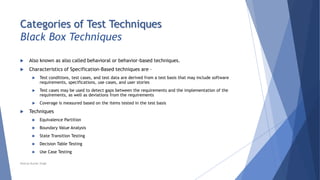
 Also known as also called behavioral or behavior-based techniques.
 Characteristics of Specification-Based techniques are –
 Test conditions, test cases, and test data are derived from a test basis that may include software
requirements, specifications, use cases, and user stories
 Test cases may be used to detect gaps between the requirements and the implementation of the
requirements, as well as deviations from the requirements
 Coverage is measured based on the items tested in the test basis
 Techniques
 Equivalence Partition
 Boundary Value Analysis
 State Transition Testing
 Decision Table Testing
 Use Case Testing
Neeraj Kumar Singh
Categories of Test Techniques
White Box Techniques
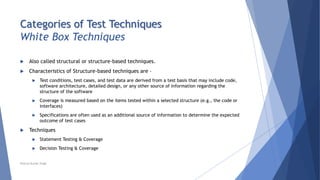
 Also called structural or structure-based techniques.
 Characteristics of Structure-based techniques are –
 Test conditions, test cases, and test data are derived from a test basis that may include code,
software architecture, detailed design, or any other source of information regarding the
structure of the software
 Coverage is measured based on the items tested within a selected structure (e.g., the code or
interfaces)
 Specifications are often used as an additional source of information to determine the expected
outcome of test cases
 Techniques
 Statement Testing & Coverage
 Decision Testing & Coverage
Neeraj Kumar Singh
Categories of Test Techniques
Experience Based Techniques
 Characteristics of Experience-Based techniques are –
 Test conditions, test cases, and test data are derived from a test basis that may include
knowledge and experience of testers, developers, users and other stakeholders
 Techniques
 Error Guessing
 Exploratory Testing
 Checklist Based Testing
Neeraj Kumar Singh
Test Techniques
1 Fundamentals 2 Lifecycle
4 Dynamic test
techniques
3 Static testing
5 Management 6 Tools
Software Testing
ISTQB Foundation Exam Preparation
Chapter 4
Neeraj Kumar Singh
Test Techniques
Contents
4.1 Categories of Test Design Techniques
4.2 Black Box Test Techniques
4.3 White Box Test Techniques
4.4 Experience-Based Test Techniques
Neeraj Kumar Singh
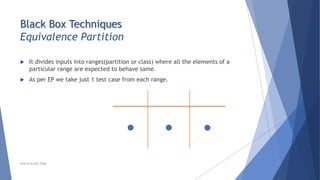
Black Box Techniques
Equivalence Partition
 It divides inputs into ranges(partition or class) where all the elements of a
particular range are expected to behave same.
 As per EP we take just 1 test case from each range.
Neeraj Kumar Singh
Black Box Techniques
Equivalence Partition
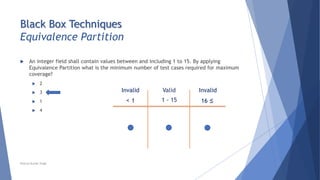
 An integer field shall contain values between and including 1 to 15. By applying
Equivalence Partition what is the minimum number of test cases required for maximum
coverage?
 2
 3
 1
 4
Invalid Valid Invalid
< 1 1 - 15 16 ≤
Neeraj Kumar Singh
Black Box Techniques
Equivalence Partition
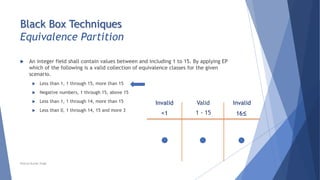
 An integer field shall contain values between and including 1 to 15. By applying EP
which of the following is a valid collection of equivalence classes for the given
scenario.
 Less than 1, 1 through 15, more than 15
 Negative numbers, 1 through 15, above 15
 Less than 1, 1 through 14, more than 15
 Less than 0, 1 through 14, 15 and more 3
Invalid Valid Invalid
<1 1 - 15 16≤
Neeraj Kumar Singh
Black Box Techniques
Equivalence Partition
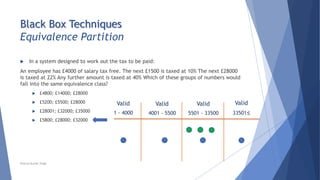
 In a system designed to work out the tax to be paid:
An employee has £4000 of salary tax free. The next £1500 is taxed at 10% The next £28000
is taxed at 22% Any further amount is taxed at 40% Which of these groups of numbers would
fall into the same equivalence class?
 £4800; £14000; £28000
 £5200; £5500; £28000
 £28001; £32000; £35000
 £5800; £28000; £32000
Valid
5501 - 33500
Valid
33501≤
Valid
4001 - 5500
Valid
1 - 4000
Neeraj Kumar Singh
Test Techniques
1 Fundamentals 2 Lifecycle
4 Dynamic test
techniques
3 Static testing
5 Management 6 Tools
Software Testing
ISTQB Foundation Exam Preparation
Chapter 4
Neeraj Kumar Singh
Test Techniques
Contents
4.1 Categories of Test Design Techniques
4.2 Black Box Test Techniques
4.3 White Box Test Techniques
4.4 Experience-Based Test Techniques
Neeraj Kumar Singh
Black Box Techniques
Boundary Value Analysis
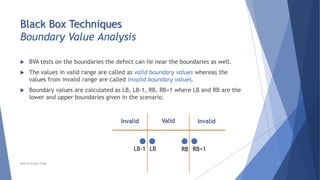
 BVA tests on the boundaries the defect can lie near the boundaries as well.
 The values in valid range are called as valid boundary values whereas the
values from invalid range are called invalid boundary values.
 Boundary values are calculated as LB, LB-1, RB, RB+1 where LB and RB are the
lower and upper boundaries given in the scenario.
Invalid Valid Invalid
Neeraj Kumar Singh
LB RBLB-1 RB+1
Black Box Techniques
Boundary Value Analysis
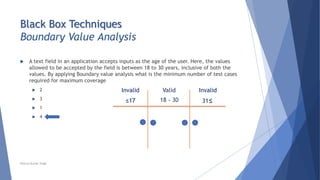
 A text field in an application accepts inputs as the age of the user. Here, the values
allowed to be accepted by the field is between 18 to 30 years, inclusive of both the
values. By applying Boundary value analysis what is the minimum number of test cases
required for maximum coverage
 2
 3
 1
 4
Invalid Valid Invalid
≤17 18 - 30 31≤
Neeraj Kumar Singh
Black Box Techniques
Boundary Value Analysis
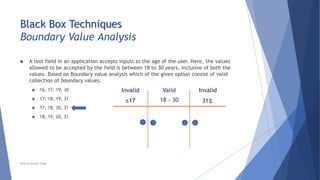
 A text field in an application accepts inputs as the age of the user. Here, the values
allowed to be accepted by the field is between 18 to 30 years, inclusive of both the
values. Based on Boundary value analysis which of the given option consist of valid
collection of boundary values.
 16, 17, 19, 30
 17, 18, 19, 31
 17, 18, 30, 31
 18, 19, 20, 31
Invalid Valid Invalid
≤17 18 - 30 31≤
Neeraj Kumar Singh
Black Box Techniques
Boundary Value Analysis
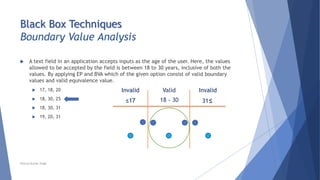
 A text field in an application accepts inputs as the age of the user. Here, the values
allowed to be accepted by the field is between 18 to 30 years, inclusive of both the
values. By applying EP and BVA which of the given option consist of valid boundary
values and valid equivalence value.
 17, 18, 20
 18, 30, 25
 18, 30, 31
 19, 20, 31
Invalid Valid Invalid
≤17 18 - 30 31≤
Neeraj Kumar Singh
Test Techniques
1 Fundamentals 2 Lifecycle
4 Dynamic test
techniques
3 Static testing
5 Management 6 Tools
Software Testing
ISTQB Foundation Exam Preparation
Chapter 4
Neeraj Kumar Singh
Test Techniques
Contents
4.1 Categories of Test Design Techniques
4.2 Black Box Test Techniques
4.3 White Box Test Techniques
4.4 Experience-Based Test Techniques
Neeraj Kumar Singh
Black Box Techniques
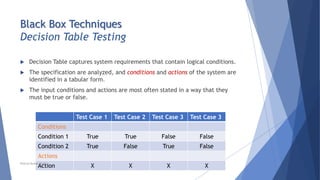
Decision Table Testing
 Decision Table captures system requirements that contain logical conditions.
 The specification are analyzed, and conditions and actions of the system are
identified in a tabular form.
 The input conditions and actions are most often stated in a way that they
must be true or false.
Test Case 1 Test Case 2 Test Case 3 Test Case 3
Conditions
Condition 1 True True False False
Condition 2 True False True False
Actions
Action X X X X
Neeraj Kumar Singh
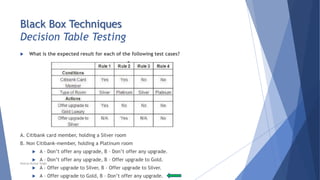
 What is the expected result for each of the following test cases?
A. Citibank card member, holding a Silver room
B. Non Citibank-member, holding a Platinum room
 A – Don’t offer any upgrade, B – Don’t offer any upgrade.
 A – Don’t offer any upgrade, B – Offer upgrade to Gold.
 A – Offer upgrade to Silver, B – Offer upgrade to Silver.
 A – Offer upgrade to Gold, B – Don’t offer any upgrade.
Black Box Techniques
Decision Table Testing
Neeraj Kumar Singh
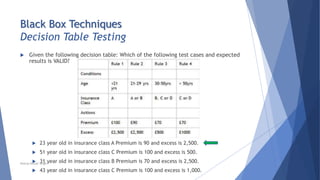
 Given the following decision table: Which of the following test cases and expected
results is VALID?
 23 year old in insurance class A Premium is 90 and excess is 2,500.
 51 year old in insurance class C Premium is 100 and excess is 500.
 31 year old in insurance class B Premium is 70 and excess is 2,500.
 43 year old in insurance class C Premium is 100 and excess is 1,000.
Black Box Techniques
Decision Table Testing
Neeraj Kumar Singh
Test Techniques
1 Fundamentals 2 Lifecycle
4 Dynamic test
techniques
3 Static testing
5 Management 6 Tools
Software Testing
ISTQB Foundation Exam Preparation
Chapter 4
Neeraj Kumar Singh
Test Techniques
Contents
4.1 Categories of Test Design Techniques
4.2 Black Box Test Techniques
4.3 White Box Test Techniques
4.4 Experience-Based Test Techniques
Neeraj Kumar Singh
Black Box Techniques
State Transition Testing
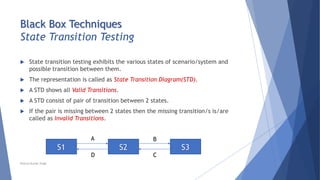
 State transition testing exhibits the various states of scenario/system and
possible transition between them.
 The representation is called as State Transition Diagram(STD).
 A STD shows all Valid Transitions.
 A STD consist of pair of transition between 2 states.
 If the pair is missing between 2 states then the missing transition/s is/are
called as Invalid Transitions.
S1 S2 S3
A
D C
B
Neeraj Kumar Singh
Black Box Techniques
State Transition Testing
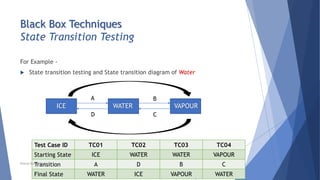
For Example -
 State transition testing and State transition diagram of Water
ICE WATER VAPOUR
A
D C
B
Test Case ID TC01 TC02 TC03 TC04
Starting State ICE WATER WATER VAPOUR
Transition A D B C
Final State WATER ICE VAPOUR WATER
Neeraj Kumar Singh
Black Box Techniques
State Transition Testing(K3)
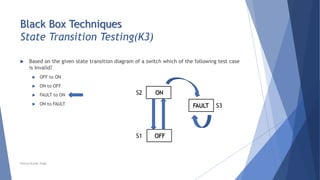
 Based on the given state transition diagram of a switch which of the following test case
is Invalid?
 OFF to ON
 ON to OFF
 FAULT to ON
 ON to FAULT
ON
OFF
FAULT
S1
S2
S3
Neeraj Kumar Singh
Test Techniques
1 Fundamentals 2 Lifecycle
4 Dynamic test
techniques
3 Static testing
5 Management 6 Tools
Software Testing
ISTQB Foundation Exam Preparation
Chapter 4
Neeraj Kumar Singh
Test Techniques
Contents
4.1 Categories of Test Design Techniques
4.2 Black Box Test Techniques
4.3 White Box Test Techniques
4.4 Experience-Based Test Techniques
Neeraj Kumar Singh
Black Box Techniques
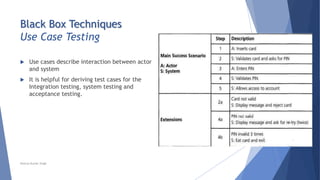
Use Case Testing
 Use cases describe interaction between actor
and system
 It is helpful for deriving test cases for the
Integration testing, system testing and
acceptance testing.
Neeraj Kumar Singh
Black Box Techniques
Use Case Testing
 Use case describes the “process flows” through a system based on its actual
use.
 Use cases help to uncover defects in process flow during real-world use of the
system.
 It also helps uncover integration defects caused by the interaction and
interference of different components.
 Use case are described at the abstract level (business use case, business
process level)
 Use case may also be described at the system level (system use cases on the
system functionality level)
Neeraj Kumar Singh
Black Box Techniques
Use Case Testing
 Use case describes the “process flows” through a system based on its actual
use.
 Use cases help to uncover defects in process flow during real-world use of the
system.
 It also helps uncover integration defects caused by the interaction and
interference of different components.
 Use case are described at the abstract level (business use case, business
process level)
 Use case may also be described at the system level (system use cases on the
system functionality level)
Neeraj Kumar Singh
Black Box Techniques
Use Case Testing
Which of the following statements about the benefits of deriving test cases from use cases
are true and which are false?
A. Deriving test cases from use cases is helpful for system and acceptance testing.
B. Deriving test cases from use cases is helpful only for automated testing.
C. Deriving test cases from use cases is helpful for component testing.
D. Deriving test cases from use cases is helpful for integration testing.
Answer Set:
A. A and D are true; B and C are false
B. A is true; B, C, and D are false
C. B and D are true; A and C are false
D. A, C, and D are true; B is false
Neeraj Kumar Singh
Test Techniques
1 Fundamentals 2 Lifecycle
4 Dynamic test
techniques
3 Static testing
5 Management 6 Tools
Software Testing
ISTQB Foundation Exam Preparation
Chapter 4
Neeraj Kumar Singh
Test Techniques
Contents
4.1 Categories of Test Design Techniques
4.2 Black Box Test Techniques
4.3 White Box Test Techniques
4.4 Experience-Based Test Techniques
Neeraj Kumar Singh
White Box Techniques
Introduction
 Statement Testing or Statement Coverage tests the statement for a given
fragment of code.
 Whereas Decision Testing or Decision Coverage tests the decisions made
within a given fragment of code.
 Decision Testing is also known as Branch Testing or Branch Coverage.
 Decision Testing is stronger than Statement Testing.
 100% Decision Coverage guarantees 100% Statement Coverage but not vice
versa.
Neeraj Kumar Singh
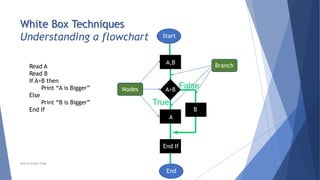
White Box Techniques
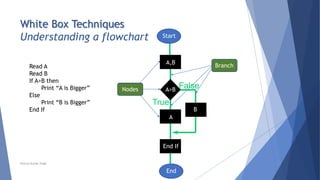
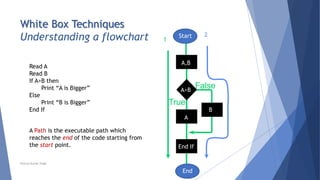
Understanding a flowchart
True
False?
Read A
Read B
If A>B then
Print “A is Bigger”
Else
Print “B is Bigger”
End If
Start
End
Branch
Nodes
A,B
A>B
A
B
End If
Neeraj Kumar Singh
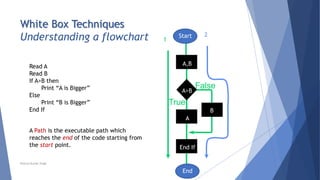
White Box Techniques
Understanding a flowchart
True
False?
Read A
Read B
If A>B then
Print “A is Bigger”
Else
Print “B is Bigger”
End If
Start
End
A Path is the executable path which
reaches the end of the code starting from
the start point.
2
1
Neeraj Kumar Singh
A,B
A>B
A
B
End If
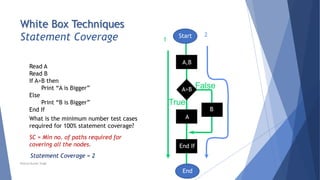
White Box Techniques
Statement Coverage
True
False?
Read A
Read B
If A>B then
Print “A is Bigger”
Else
Print “B is Bigger”
End If
Start
End
2
1
What is the minimum number test cases
required for 100% statement coverage?
SC = Min no. of paths required for
covering all the nodes.
Statement Coverage = 2
Neeraj Kumar Singh
A,B
A>B
A
B
End If
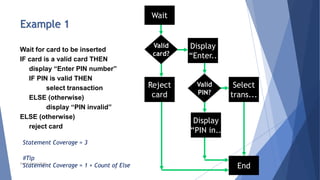
Example 1
End
Select
trans...
Yes
Display
“Enter..
Yes
Valid
PIN?
No
Reject
card
Display
“PIN in..
No
Wait for card to be inserted
IF card is a valid card THEN
display “Enter PIN number”
IF PIN is valid THEN
select transaction
ELSE (otherwise)
display “PIN invalid”
ELSE (otherwise)
reject card
Valid
card?
Wait
Statement Coverage = 3
#Tip
Statement Coverage = 1 + Count of ElseNeeraj Kumar Singh
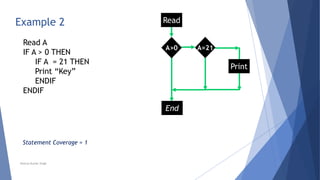
Read A
IF A > 0 THEN
IF A = 21 THEN
Print “Key”
ENDIF
ENDIF
Example 2
Print
Yes
A=21
Yes
No
End
A>0
No
Read
Statement Coverage = 1
Neeraj Kumar Singh
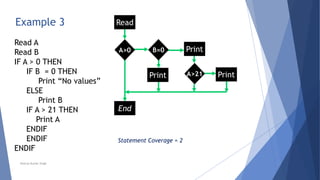
Example 3
Read A
Read B
IF A > 0 THEN
IF B = 0 THEN
Print “No values”
ELSE
Print B
IF A > 21 THEN
Print A
ENDIF
ENDIF
ENDIF
Print
Yes
Print
A>21
No
No
B=0
Print
Yes
Yes
Read
A>0
End
No
Statement Coverage = 2
Neeraj Kumar Singh
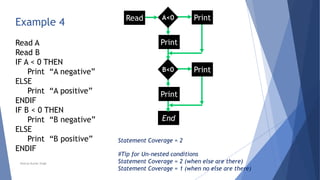
Read A
Read B
IF A < 0 THEN
Print “A negative”
ELSE
Print “A positive”
ENDIF
IF B < 0 THEN
Print “B negative”
ELSE
Print “B positive”
ENDIF
Example 4 Read
End
Print
No
Print
Yes
B<0
Print
No
Print
Yes
A<0
Statement Coverage = 2
#Tip for Un-nested conditions
Statement Coverage = 2 (when else are there)
Statement Coverage = 1 (when no else are there)
Neeraj Kumar Singh
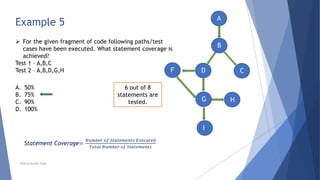
 For the given fragment of code following paths/test
cases have been executed. What statement coverage is
achieved?
Test 1 – A,B,C
Test 2 – A,B,D,G,H
Example 5
A. 50%
B. 75%
C. 90%
D. 100%
Statement Coverage=
𝑁𝑢𝑚𝑏𝑒𝑟 𝑜𝑓 𝑆𝑡𝑎𝑡𝑒𝑚𝑒𝑛𝑡𝑠 𝐸𝑥𝑒𝑐𝑢𝑡𝑒𝑑
𝑇𝑜𝑡𝑎𝑙 𝑁𝑢𝑚𝑏𝑒𝑟 𝑜𝑓 𝑆𝑡𝑎𝑡𝑒𝑚𝑒𝑛𝑡𝑠
D
B
A
C
G
F
I
H
6 out of 8
statements are
tested.
Neeraj Kumar Singh
Test Techniques
1 Fundamentals 2 Lifecycle
4 Dynamic test
techniques
3 Static testing
5 Management 6 Tools
Software Testing
ISTQB Foundation Exam Preparation
Chapter 4
Neeraj Kumar Singh
Test Techniques
Contents
4.1 Categories of Test Design Techniques
4.2 Black Box Test Techniques
4.3 White Box Test Techniques
4.4 Experience-Based Test Techniques
Neeraj Kumar Singh
White Box Techniques
Introduction
 Statement Testing or Statement Coverage tests the statement for a given
fragment of code.
 Whereas Decision Testing or Decision Coverage tests the decisions made
within a given fragment of code.
 Decision Testing is also known as Branch Testing or Branch Coverage.
 Decision Testing is stronger than Statement Testing.
 100% Decision Coverage guarantees 100% Statement Coverage but not vice
versa.
Neeraj Kumar Singh
White Box Techniques
Understanding a flowchart
True
False?
Read A
Read B
If A>B then
Print “A is Bigger”
Else
Print “B is Bigger”
End If
Start
End
Branch
Nodes
A,B
A>B
A
B
End If
Neeraj Kumar Singh
White Box Techniques
Understanding a flowchart
True
False?
Read A
Read B
If A>B then
Print “A is Bigger”
Else
Print “B is Bigger”
End If
Start
End
A Path is the executable path which
reaches the end of the code starting from
the start point.
2
1
Neeraj Kumar Singh
A,B
A>B
A
B
End If
White Box Techniques
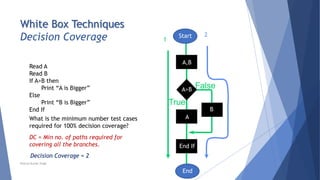
Decision Coverage
True
False?
Read A
Read B
If A>B then
Print “A is Bigger”
Else
Print “B is Bigger”
End If
Start
End
2
1
What is the minimum number test cases
required for 100% decision coverage?
DC = Min no. of paths required for
covering all the branches.
Decision Coverage = 2
Neeraj Kumar Singh
A,B
A>B
A
B
End If
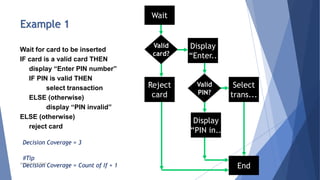
Example 1
End
Select
trans...
Yes
Display
“Enter..
Yes
Valid
PIN?
No
Reject
card
Display
“PIN in..
No
Wait for card to be inserted
IF card is a valid card THEN
display “Enter PIN number”
IF PIN is valid THEN
select transaction
ELSE (otherwise)
display “PIN invalid”
ELSE (otherwise)
reject card
Valid
card?
Wait
Decision Coverage = 3
#Tip
Decision Coverage = Count of If + 1Neeraj Kumar Singh
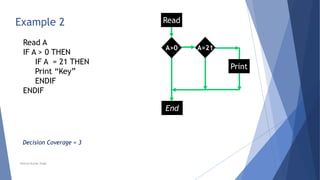
Read A
IF A > 0 THEN
IF A = 21 THEN
Print “Key”
ENDIF
ENDIF
Example 2
Print
Yes
A=21
Yes
No
End
A>0
No
Read
Decision Coverage = 3
Neeraj Kumar Singh
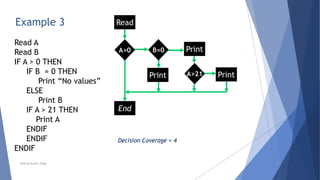
Example 3
Read A
Read B
IF A > 0 THEN
IF B = 0 THEN
Print “No values”
ELSE
Print B
IF A > 21 THEN
Print A
ENDIF
ENDIF
ENDIF
Print
Yes
Print
A>21
No
No
B=0
Print
Yes
Yes
Read
A>0
End
No
Decision Coverage = 4
Neeraj Kumar Singh
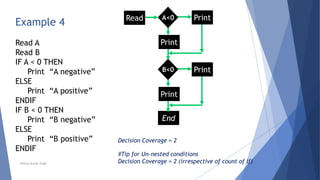
Read A
Read B
IF A < 0 THEN
Print “A negative”
ELSE
Print “A positive”
ENDIF
IF B < 0 THEN
Print “B negative”
ELSE
Print “B positive”
ENDIF
Example 4 Read
End
Print
No
Print
Yes
B<0
Print
No
Print
Yes
A<0
Decision Coverage = 2
#Tip for Un-nested conditions
Decision Coverage = 2 (irrespective of count of if)Neeraj Kumar Singh
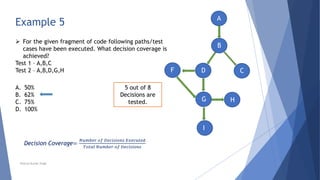
 For the given fragment of code following paths/test
cases have been executed. What decision coverage is
achieved?
Test 1 – A,B,C
Test 2 – A,B,D,G,H
Example 5
A. 50%
B. 62%
C. 75%
D. 100%
Decision Coverage=
𝑁𝑢𝑚𝑏𝑒𝑟 𝑜𝑓 𝐷𝑒𝑐𝑖𝑠𝑖𝑜𝑛𝑠 𝐸𝑥𝑒𝑐𝑢𝑡𝑒𝑑
𝑇𝑜𝑡𝑎𝑙 𝑁𝑢𝑚𝑏𝑒𝑟 𝑜𝑓 𝐷𝑒𝑐𝑖𝑠𝑖𝑜𝑛𝑠
D
B
A
C
G
F
I
H
5 out of 8
Decisions are
tested.
Neeraj Kumar Singh
Test Techniques
1 Fundamentals 2 Lifecycle
4 Dynamic test
techniques
3 Static testing
5 Management 6 Tools
Software Testing
ISTQB Foundation Exam Preparation
Chapter 4
Neeraj Kumar Singh
Test Techniques
Contents
4.1 Categories of Test Design Techniques
4.2 Black Box Test Techniques
4.3 White Box Test Techniques
4.4 Experience-Based Test Techniques
Neeraj Kumar Singh
Experience Based Techniques
Introduction
 Experience Based techniques uses tester’s skill, intuition and experience of
similar application and technologies.
 These techniques are useful in identifying special tests which are not easily
captured by formal techniques.
 These techniques are usually applied after applying formal techniques.
 There are few scenarios where these are the only option to applied.
 Specifications are poorly defined.
 Time Pressure.
 Testing team is not formally trained on testing fundamentals.
Neeraj Kumar Singh
Experience Based Techniques
Error Guessing
 This techniques requires knowledge of defects and experience of application.
 Is to enumerate possible defects and design tests that attack these defects.
 This systematic approach is called fault attack.
 These defect and failure list can be built based on experience, typical defect
and failure data.
 Updating the result of execution and evaluating further need of tests and
their execution.
 Error guessing based on
 How the application has worked in the past
 What types of mistakes the developers tend to make
 Failures that have occurred in other applications
Neeraj Kumar Singh
Test Techniques
1 Fundamentals 2 Lifecycle
4 Dynamic test
techniques
3 Static testing
5 Management 6 Tools
Software Testing
ISTQB Foundation Exam Preparation
Chapter 4
Neeraj Kumar Singh
Test Techniques
Contents
4.1 Categories of Test Design Techniques
4.2 Black Box Test Techniques
4.3 White Box Test Techniques
4.4 Experience-Based Test Techniques
Neeraj Kumar Singh
Experience Based Techniques
Introduction
 Experience Based techniques uses tester’s skill, intuition and experience of
similar application and technologies.
 These techniques are useful in identifying special tests which are not easily
captured by formal techniques.
 These techniques are usually applied after applying formal techniques.
 There are few scenarios where these are the only option to applied.
 Specifications are poorly defined.
 Time Pressure.
 Testing team is not formally trained on testing fundamentals.
Neeraj Kumar Singh
Experience Based Techniques
Exploratory Testing
 Here it includes allocation of a part of the application which supposed to be
explored.
 In exploratory testing, informal (not pre-defined) tests are designed,
executed, logged, and evaluated dynamically during test execution.
 These doesn’t require preparation of test cases instead a random or ADHOC
approach is followed.
 Test charter containing test objectives are the basis to be followed for
execution.
 The execution are time boxed with a range between 30 min to 120 min,
depending on the size of the application.
 Executions are called as test sessions or time boxed test sessions.
Neeraj Kumar Singh
Test Techniques
1 Fundamentals 2 Lifecycle
4 Dynamic test
techniques
3 Static testing
5 Management 6 Tools
Software Testing
ISTQB Foundation Exam Preparation
Chapter 4
Neeraj Kumar Singh
Test Techniques
Contents
4.1 Categories of Test Design Techniques
4.2 Black Box Test Techniques
4.3 White Box Test Techniques
4.4 Experience-Based Test Techniques
Neeraj Kumar Singh
Experience Based Techniques
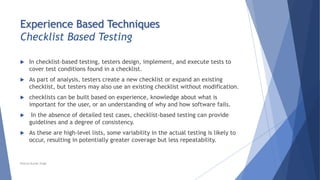
Checklist Based Testing
 In checklist-based testing, testers design, implement, and execute tests to
cover test conditions found in a checklist.
 As part of analysis, testers create a new checklist or expand an existing
checklist, but testers may also use an existing checklist without modification.
 checklists can be built based on experience, knowledge about what is
important for the user, or an understanding of why and how software fails.
 In the absence of detailed test cases, checklist-based testing can provide
guidelines and a degree of consistency.
 As these are high-level lists, some variability in the actual testing is likely to
occur, resulting in potentially greater coverage but less repeatability.
Neeraj Kumar Singh
Test Techniques
1 Fundamentals 2 Lifecycle
4 Dynamic test
techniques
3 Static testing
5 Management 6 Tools
Software Testing
ISTQB Foundation Exam Preparation
Chapter 4
Neeraj Kumar Singh
Test Techniques
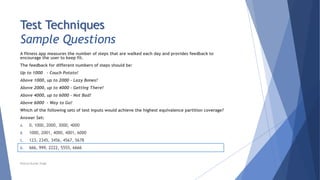
Sample Questions
A fitness app measures the number of steps that are walked each day and provides feedback to
encourage the user to keep fit.
The feedback for different numbers of steps should be:
Up to 1000 - Couch Potato!
Above 1000, up to 2000 - Lazy Bones!
Above 2000, up to 4000 - Getting There!
Above 4000, up to 6000 - Not Bad!
Above 6000 - Way to Go!
Which of the following sets of test inputs would achieve the highest equivalence partition coverage?
Answer Set:
A. 0, 1000, 2000, 3000, 4000
B. 1000, 2001, 4000, 4001, 6000
C. 123, 2345, 3456, 4567, 5678
D. 666, 999, 2222, 5555, 6666
Neeraj Kumar Singh
Test Techniques
Sample Questions
A smart home app measures the average temperature in the house over the previous week and
provides feedback to the occupants on their environmental-friendliness based on this temperature.
The feedback for different average temperature ranges (to the nearest °C) should be:
Up to 10°C - Icy Cool!
11°C to 15°C - Chilled Out!
16°C to 19°C - Cool Man!
20°C to 22°C - Too Warm!
Above 22°C - Hot & Sweaty!
Using two-point BVA, which of the following sets of test inputs provides the highest level of
boundary coverage?
a) Answer Set:
A. 0°C, 11°C, 20°C, 22°C, 23°C
B. 9°C, 15°C, 19°C, 23°C, 100°C
C. 10°C, 16°C, 19°C, 22°C, 23°C
D. 14°C, 15°C, 18°C, 19°C, 21°C, 22°C
Neeraj Kumar Singh
Test Techniques
Sample Questions
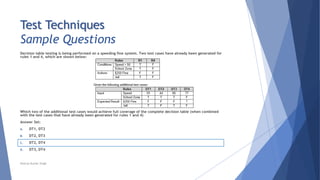
Decision table testing is being performed on a speeding fine system. Two test cases have already been generated for
rules 1 and 4, which are shown below:
Which two of the additional test cases would achieve full coverage of the complete decision table (when combined
with the test cases that have already been generated for rules 1 and 4)
Answer Set:
A. DT1, DT2
B. DT2, DT3
C. DT2, DT4
D. DT3, DT4
Neeraj Kumar Singh
Test Techniques
Sample Questions
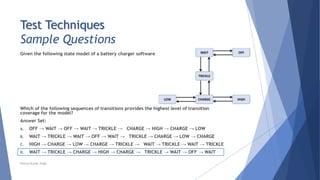
Given the following state model of a battery charger software
Which of the following sequences of transitions provides the highest level of transition
coverage for the model?
Answer Set:
A. OFF → WAIT → OFF → WAIT → TRICKLE → CHARGE → HIGH → CHARGE → LOW
B. WAIT → TRICKLE → WAIT → OFF → WAIT → TRICKLE → CHARGE → LOW → CHARGE
C. HIGH → CHARGE → LOW → CHARGE → TRICKLE → WAIT → TRICKLE → WAIT → TRICKLE
D. WAIT → TRICKLE → CHARGE → HIGH → CHARGE → TRICKLE → WAIT → OFF → WAIT
Neeraj Kumar Singh

Chapter 4 - Test Design Techniques

  • 1.
    Test Techniques 1 Fundamentals2 Lifecycle 4 Dynamic test techniques 3 Static testing 5 Management 6 Tools Software Testing ISTQB Foundation Exam Preparation Chapter 4 Neeraj Kumar Singh
  • 2.
    Test Design Techniques Contents 4.1Categories of Test Design Techniques 4.2 Black Box Test Techniques 4.3 White Box Test Techniques 4.4 Experience-Based Test Techniques Neeraj Kumar Singh
  • 3.
    Categories of TestTechniques Black Box Techniques  Also known as also called behavioral or behavior-based techniques.  Characteristics of Specification-Based techniques are –  Test conditions, test cases, and test data are derived from a test basis that may include software requirements, specifications, use cases, and user stories  Test cases may be used to detect gaps between the requirements and the implementation of the requirements, as well as deviations from the requirements  Coverage is measured based on the items tested in the test basis  Techniques  Equivalence Partition  Boundary Value Analysis  State Transition Testing  Decision Table Testing  Use Case Testing Neeraj Kumar Singh
  • 4.
    Categories of TestTechniques White Box Techniques  Also called structural or structure-based techniques.  Characteristics of Structure-based techniques are –  Test conditions, test cases, and test data are derived from a test basis that may include code, software architecture, detailed design, or any other source of information regarding the structure of the software  Coverage is measured based on the items tested within a selected structure (e.g., the code or interfaces)  Specifications are often used as an additional source of information to determine the expected outcome of test cases  Techniques  Statement Testing & Coverage  Decision Testing & Coverage Neeraj Kumar Singh
  • 5.
    Categories of TestTechniques Experience Based Techniques  Characteristics of Experience-Based techniques are –  Test conditions, test cases, and test data are derived from a test basis that may include knowledge and experience of testers, developers, users and other stakeholders  Techniques  Error Guessing  Exploratory Testing  Checklist Based Testing Neeraj Kumar Singh
  • 6.
    Test Techniques 1 Fundamentals2 Lifecycle 4 Dynamic test techniques 3 Static testing 5 Management 6 Tools Software Testing ISTQB Foundation Exam Preparation Chapter 4 Neeraj Kumar Singh
  • 7.
    Test Techniques Contents 4.1 Categoriesof Test Design Techniques 4.2 Black Box Test Techniques 4.3 White Box Test Techniques 4.4 Experience-Based Test Techniques Neeraj Kumar Singh
  • 8.
    Black Box Techniques EquivalencePartition  It divides inputs into ranges(partition or class) where all the elements of a particular range are expected to behave same.  As per EP we take just 1 test case from each range. Neeraj Kumar Singh
  • 9.
    Black Box Techniques EquivalencePartition  An integer field shall contain values between and including 1 to 15. By applying Equivalence Partition what is the minimum number of test cases required for maximum coverage?  2  3  1  4 Invalid Valid Invalid < 1 1 - 15 16 ≤ Neeraj Kumar Singh
  • 10.
    Black Box Techniques EquivalencePartition  An integer field shall contain values between and including 1 to 15. By applying EP which of the following is a valid collection of equivalence classes for the given scenario.  Less than 1, 1 through 15, more than 15  Negative numbers, 1 through 15, above 15  Less than 1, 1 through 14, more than 15  Less than 0, 1 through 14, 15 and more 3 Invalid Valid Invalid <1 1 - 15 16≤ Neeraj Kumar Singh
  • 11.
    Black Box Techniques EquivalencePartition  In a system designed to work out the tax to be paid: An employee has £4000 of salary tax free. The next £1500 is taxed at 10% The next £28000 is taxed at 22% Any further amount is taxed at 40% Which of these groups of numbers would fall into the same equivalence class?  £4800; £14000; £28000  £5200; £5500; £28000  £28001; £32000; £35000  £5800; £28000; £32000 Valid 5501 - 33500 Valid 33501≤ Valid 4001 - 5500 Valid 1 - 4000 Neeraj Kumar Singh
  • 12.
    Test Techniques 1 Fundamentals2 Lifecycle 4 Dynamic test techniques 3 Static testing 5 Management 6 Tools Software Testing ISTQB Foundation Exam Preparation Chapter 4 Neeraj Kumar Singh
  • 13.
    Test Techniques Contents 4.1 Categoriesof Test Design Techniques 4.2 Black Box Test Techniques 4.3 White Box Test Techniques 4.4 Experience-Based Test Techniques Neeraj Kumar Singh
  • 14.
    Black Box Techniques BoundaryValue Analysis  BVA tests on the boundaries the defect can lie near the boundaries as well.  The values in valid range are called as valid boundary values whereas the values from invalid range are called invalid boundary values.  Boundary values are calculated as LB, LB-1, RB, RB+1 where LB and RB are the lower and upper boundaries given in the scenario. Invalid Valid Invalid Neeraj Kumar Singh LB RBLB-1 RB+1
  • 15.
    Black Box Techniques BoundaryValue Analysis  A text field in an application accepts inputs as the age of the user. Here, the values allowed to be accepted by the field is between 18 to 30 years, inclusive of both the values. By applying Boundary value analysis what is the minimum number of test cases required for maximum coverage  2  3  1  4 Invalid Valid Invalid ≤17 18 - 30 31≤ Neeraj Kumar Singh
  • 16.
    Black Box Techniques BoundaryValue Analysis  A text field in an application accepts inputs as the age of the user. Here, the values allowed to be accepted by the field is between 18 to 30 years, inclusive of both the values. Based on Boundary value analysis which of the given option consist of valid collection of boundary values.  16, 17, 19, 30  17, 18, 19, 31  17, 18, 30, 31  18, 19, 20, 31 Invalid Valid Invalid ≤17 18 - 30 31≤ Neeraj Kumar Singh
  • 17.
    Black Box Techniques BoundaryValue Analysis  A text field in an application accepts inputs as the age of the user. Here, the values allowed to be accepted by the field is between 18 to 30 years, inclusive of both the values. By applying EP and BVA which of the given option consist of valid boundary values and valid equivalence value.  17, 18, 20  18, 30, 25  18, 30, 31  19, 20, 31 Invalid Valid Invalid ≤17 18 - 30 31≤ Neeraj Kumar Singh
  • 18.
    Test Techniques 1 Fundamentals2 Lifecycle 4 Dynamic test techniques 3 Static testing 5 Management 6 Tools Software Testing ISTQB Foundation Exam Preparation Chapter 4 Neeraj Kumar Singh
  • 19.
    Test Techniques Contents 4.1 Categoriesof Test Design Techniques 4.2 Black Box Test Techniques 4.3 White Box Test Techniques 4.4 Experience-Based Test Techniques Neeraj Kumar Singh
  • 20.
    Black Box Techniques DecisionTable Testing  Decision Table captures system requirements that contain logical conditions.  The specification are analyzed, and conditions and actions of the system are identified in a tabular form.  The input conditions and actions are most often stated in a way that they must be true or false. Test Case 1 Test Case 2 Test Case 3 Test Case 3 Conditions Condition 1 True True False False Condition 2 True False True False Actions Action X X X X Neeraj Kumar Singh
  • 21.
     What isthe expected result for each of the following test cases? A. Citibank card member, holding a Silver room B. Non Citibank-member, holding a Platinum room  A – Don’t offer any upgrade, B – Don’t offer any upgrade.  A – Don’t offer any upgrade, B – Offer upgrade to Gold.  A – Offer upgrade to Silver, B – Offer upgrade to Silver.  A – Offer upgrade to Gold, B – Don’t offer any upgrade. Black Box Techniques Decision Table Testing Neeraj Kumar Singh
  • 22.
     Given thefollowing decision table: Which of the following test cases and expected results is VALID?  23 year old in insurance class A Premium is 90 and excess is 2,500.  51 year old in insurance class C Premium is 100 and excess is 500.  31 year old in insurance class B Premium is 70 and excess is 2,500.  43 year old in insurance class C Premium is 100 and excess is 1,000. Black Box Techniques Decision Table Testing Neeraj Kumar Singh
  • 23.
    Test Techniques 1 Fundamentals2 Lifecycle 4 Dynamic test techniques 3 Static testing 5 Management 6 Tools Software Testing ISTQB Foundation Exam Preparation Chapter 4 Neeraj Kumar Singh
  • 24.
    Test Techniques Contents 4.1 Categoriesof Test Design Techniques 4.2 Black Box Test Techniques 4.3 White Box Test Techniques 4.4 Experience-Based Test Techniques Neeraj Kumar Singh
  • 25.
    Black Box Techniques StateTransition Testing  State transition testing exhibits the various states of scenario/system and possible transition between them.  The representation is called as State Transition Diagram(STD).  A STD shows all Valid Transitions.  A STD consist of pair of transition between 2 states.  If the pair is missing between 2 states then the missing transition/s is/are called as Invalid Transitions. S1 S2 S3 A D C B Neeraj Kumar Singh
  • 26.
    Black Box Techniques StateTransition Testing For Example -  State transition testing and State transition diagram of Water ICE WATER VAPOUR A D C B Test Case ID TC01 TC02 TC03 TC04 Starting State ICE WATER WATER VAPOUR Transition A D B C Final State WATER ICE VAPOUR WATER Neeraj Kumar Singh
  • 27.
    Black Box Techniques StateTransition Testing(K3)  Based on the given state transition diagram of a switch which of the following test case is Invalid?  OFF to ON  ON to OFF  FAULT to ON  ON to FAULT ON OFF FAULT S1 S2 S3 Neeraj Kumar Singh
  • 28.
    Test Techniques 1 Fundamentals2 Lifecycle 4 Dynamic test techniques 3 Static testing 5 Management 6 Tools Software Testing ISTQB Foundation Exam Preparation Chapter 4 Neeraj Kumar Singh
  • 29.
    Test Techniques Contents 4.1 Categoriesof Test Design Techniques 4.2 Black Box Test Techniques 4.3 White Box Test Techniques 4.4 Experience-Based Test Techniques Neeraj Kumar Singh
  • 30.
    Black Box Techniques UseCase Testing  Use cases describe interaction between actor and system  It is helpful for deriving test cases for the Integration testing, system testing and acceptance testing. Neeraj Kumar Singh
  • 31.
    Black Box Techniques UseCase Testing  Use case describes the “process flows” through a system based on its actual use.  Use cases help to uncover defects in process flow during real-world use of the system.  It also helps uncover integration defects caused by the interaction and interference of different components.  Use case are described at the abstract level (business use case, business process level)  Use case may also be described at the system level (system use cases on the system functionality level) Neeraj Kumar Singh
  • 32.
    Black Box Techniques UseCase Testing  Use case describes the “process flows” through a system based on its actual use.  Use cases help to uncover defects in process flow during real-world use of the system.  It also helps uncover integration defects caused by the interaction and interference of different components.  Use case are described at the abstract level (business use case, business process level)  Use case may also be described at the system level (system use cases on the system functionality level) Neeraj Kumar Singh
  • 33.
    Black Box Techniques UseCase Testing Which of the following statements about the benefits of deriving test cases from use cases are true and which are false? A. Deriving test cases from use cases is helpful for system and acceptance testing. B. Deriving test cases from use cases is helpful only for automated testing. C. Deriving test cases from use cases is helpful for component testing. D. Deriving test cases from use cases is helpful for integration testing. Answer Set: A. A and D are true; B and C are false B. A is true; B, C, and D are false C. B and D are true; A and C are false D. A, C, and D are true; B is false Neeraj Kumar Singh
  • 34.
    Test Techniques 1 Fundamentals2 Lifecycle 4 Dynamic test techniques 3 Static testing 5 Management 6 Tools Software Testing ISTQB Foundation Exam Preparation Chapter 4 Neeraj Kumar Singh
  • 35.
    Test Techniques Contents 4.1 Categoriesof Test Design Techniques 4.2 Black Box Test Techniques 4.3 White Box Test Techniques 4.4 Experience-Based Test Techniques Neeraj Kumar Singh
  • 36.
    White Box Techniques Introduction Statement Testing or Statement Coverage tests the statement for a given fragment of code.  Whereas Decision Testing or Decision Coverage tests the decisions made within a given fragment of code.  Decision Testing is also known as Branch Testing or Branch Coverage.  Decision Testing is stronger than Statement Testing.  100% Decision Coverage guarantees 100% Statement Coverage but not vice versa. Neeraj Kumar Singh
  • 37.
    White Box Techniques Understandinga flowchart True False? Read A Read B If A>B then Print “A is Bigger” Else Print “B is Bigger” End If Start End Branch Nodes A,B A>B A B End If Neeraj Kumar Singh
  • 38.
    White Box Techniques Understandinga flowchart True False? Read A Read B If A>B then Print “A is Bigger” Else Print “B is Bigger” End If Start End A Path is the executable path which reaches the end of the code starting from the start point. 2 1 Neeraj Kumar Singh A,B A>B A B End If
  • 39.
    White Box Techniques StatementCoverage True False? Read A Read B If A>B then Print “A is Bigger” Else Print “B is Bigger” End If Start End 2 1 What is the minimum number test cases required for 100% statement coverage? SC = Min no. of paths required for covering all the nodes. Statement Coverage = 2 Neeraj Kumar Singh A,B A>B A B End If
  • 40.
    Example 1 End Select trans... Yes Display “Enter.. Yes Valid PIN? No Reject card Display “PIN in.. No Waitfor card to be inserted IF card is a valid card THEN display “Enter PIN number” IF PIN is valid THEN select transaction ELSE (otherwise) display “PIN invalid” ELSE (otherwise) reject card Valid card? Wait Statement Coverage = 3 #Tip Statement Coverage = 1 + Count of ElseNeeraj Kumar Singh
  • 41.
    Read A IF A> 0 THEN IF A = 21 THEN Print “Key” ENDIF ENDIF Example 2 Print Yes A=21 Yes No End A>0 No Read Statement Coverage = 1 Neeraj Kumar Singh
  • 42.
    Example 3 Read A ReadB IF A > 0 THEN IF B = 0 THEN Print “No values” ELSE Print B IF A > 21 THEN Print A ENDIF ENDIF ENDIF Print Yes Print A>21 No No B=0 Print Yes Yes Read A>0 End No Statement Coverage = 2 Neeraj Kumar Singh
  • 43.
    Read A Read B IFA < 0 THEN Print “A negative” ELSE Print “A positive” ENDIF IF B < 0 THEN Print “B negative” ELSE Print “B positive” ENDIF Example 4 Read End Print No Print Yes B<0 Print No Print Yes A<0 Statement Coverage = 2 #Tip for Un-nested conditions Statement Coverage = 2 (when else are there) Statement Coverage = 1 (when no else are there) Neeraj Kumar Singh
  • 44.
     For thegiven fragment of code following paths/test cases have been executed. What statement coverage is achieved? Test 1 – A,B,C Test 2 – A,B,D,G,H Example 5 A. 50% B. 75% C. 90% D. 100% Statement Coverage= 𝑁𝑢𝑚𝑏𝑒𝑟 𝑜𝑓 𝑆𝑡𝑎𝑡𝑒𝑚𝑒𝑛𝑡𝑠 𝐸𝑥𝑒𝑐𝑢𝑡𝑒𝑑 𝑇𝑜𝑡𝑎𝑙 𝑁𝑢𝑚𝑏𝑒𝑟 𝑜𝑓 𝑆𝑡𝑎𝑡𝑒𝑚𝑒𝑛𝑡𝑠 D B A C G F I H 6 out of 8 statements are tested. Neeraj Kumar Singh
  • 45.
    Test Techniques 1 Fundamentals2 Lifecycle 4 Dynamic test techniques 3 Static testing 5 Management 6 Tools Software Testing ISTQB Foundation Exam Preparation Chapter 4 Neeraj Kumar Singh
  • 46.
    Test Techniques Contents 4.1 Categoriesof Test Design Techniques 4.2 Black Box Test Techniques 4.3 White Box Test Techniques 4.4 Experience-Based Test Techniques Neeraj Kumar Singh
  • 47.
    White Box Techniques Introduction Statement Testing or Statement Coverage tests the statement for a given fragment of code.  Whereas Decision Testing or Decision Coverage tests the decisions made within a given fragment of code.  Decision Testing is also known as Branch Testing or Branch Coverage.  Decision Testing is stronger than Statement Testing.  100% Decision Coverage guarantees 100% Statement Coverage but not vice versa. Neeraj Kumar Singh
  • 48.
    White Box Techniques Understandinga flowchart True False? Read A Read B If A>B then Print “A is Bigger” Else Print “B is Bigger” End If Start End Branch Nodes A,B A>B A B End If Neeraj Kumar Singh
  • 49.
    White Box Techniques Understandinga flowchart True False? Read A Read B If A>B then Print “A is Bigger” Else Print “B is Bigger” End If Start End A Path is the executable path which reaches the end of the code starting from the start point. 2 1 Neeraj Kumar Singh A,B A>B A B End If
  • 50.
    White Box Techniques DecisionCoverage True False? Read A Read B If A>B then Print “A is Bigger” Else Print “B is Bigger” End If Start End 2 1 What is the minimum number test cases required for 100% decision coverage? DC = Min no. of paths required for covering all the branches. Decision Coverage = 2 Neeraj Kumar Singh A,B A>B A B End If
  • 51.
    Example 1 End Select trans... Yes Display “Enter.. Yes Valid PIN? No Reject card Display “PIN in.. No Waitfor card to be inserted IF card is a valid card THEN display “Enter PIN number” IF PIN is valid THEN select transaction ELSE (otherwise) display “PIN invalid” ELSE (otherwise) reject card Valid card? Wait Decision Coverage = 3 #Tip Decision Coverage = Count of If + 1Neeraj Kumar Singh
  • 52.
    Read A IF A> 0 THEN IF A = 21 THEN Print “Key” ENDIF ENDIF Example 2 Print Yes A=21 Yes No End A>0 No Read Decision Coverage = 3 Neeraj Kumar Singh
  • 53.
    Example 3 Read A ReadB IF A > 0 THEN IF B = 0 THEN Print “No values” ELSE Print B IF A > 21 THEN Print A ENDIF ENDIF ENDIF Print Yes Print A>21 No No B=0 Print Yes Yes Read A>0 End No Decision Coverage = 4 Neeraj Kumar Singh
  • 54.
    Read A Read B IFA < 0 THEN Print “A negative” ELSE Print “A positive” ENDIF IF B < 0 THEN Print “B negative” ELSE Print “B positive” ENDIF Example 4 Read End Print No Print Yes B<0 Print No Print Yes A<0 Decision Coverage = 2 #Tip for Un-nested conditions Decision Coverage = 2 (irrespective of count of if)Neeraj Kumar Singh
  • 55.
     For thegiven fragment of code following paths/test cases have been executed. What decision coverage is achieved? Test 1 – A,B,C Test 2 – A,B,D,G,H Example 5 A. 50% B. 62% C. 75% D. 100% Decision Coverage= 𝑁𝑢𝑚𝑏𝑒𝑟 𝑜𝑓 𝐷𝑒𝑐𝑖𝑠𝑖𝑜𝑛𝑠 𝐸𝑥𝑒𝑐𝑢𝑡𝑒𝑑 𝑇𝑜𝑡𝑎𝑙 𝑁𝑢𝑚𝑏𝑒𝑟 𝑜𝑓 𝐷𝑒𝑐𝑖𝑠𝑖𝑜𝑛𝑠 D B A C G F I H 5 out of 8 Decisions are tested. Neeraj Kumar Singh
  • 56.
    Test Techniques 1 Fundamentals2 Lifecycle 4 Dynamic test techniques 3 Static testing 5 Management 6 Tools Software Testing ISTQB Foundation Exam Preparation Chapter 4 Neeraj Kumar Singh
  • 57.
    Test Techniques Contents 4.1 Categoriesof Test Design Techniques 4.2 Black Box Test Techniques 4.3 White Box Test Techniques 4.4 Experience-Based Test Techniques Neeraj Kumar Singh
  • 58.
    Experience Based Techniques Introduction Experience Based techniques uses tester’s skill, intuition and experience of similar application and technologies.  These techniques are useful in identifying special tests which are not easily captured by formal techniques.  These techniques are usually applied after applying formal techniques.  There are few scenarios where these are the only option to applied.  Specifications are poorly defined.  Time Pressure.  Testing team is not formally trained on testing fundamentals. Neeraj Kumar Singh
  • 59.
    Experience Based Techniques ErrorGuessing  This techniques requires knowledge of defects and experience of application.  Is to enumerate possible defects and design tests that attack these defects.  This systematic approach is called fault attack.  These defect and failure list can be built based on experience, typical defect and failure data.  Updating the result of execution and evaluating further need of tests and their execution.  Error guessing based on  How the application has worked in the past  What types of mistakes the developers tend to make  Failures that have occurred in other applications Neeraj Kumar Singh
  • 60.
    Test Techniques 1 Fundamentals2 Lifecycle 4 Dynamic test techniques 3 Static testing 5 Management 6 Tools Software Testing ISTQB Foundation Exam Preparation Chapter 4 Neeraj Kumar Singh
  • 61.
    Test Techniques Contents 4.1 Categoriesof Test Design Techniques 4.2 Black Box Test Techniques 4.3 White Box Test Techniques 4.4 Experience-Based Test Techniques Neeraj Kumar Singh
  • 62.
    Experience Based Techniques Introduction Experience Based techniques uses tester’s skill, intuition and experience of similar application and technologies.  These techniques are useful in identifying special tests which are not easily captured by formal techniques.  These techniques are usually applied after applying formal techniques.  There are few scenarios where these are the only option to applied.  Specifications are poorly defined.  Time Pressure.  Testing team is not formally trained on testing fundamentals. Neeraj Kumar Singh
  • 63.
    Experience Based Techniques ExploratoryTesting  Here it includes allocation of a part of the application which supposed to be explored.  In exploratory testing, informal (not pre-defined) tests are designed, executed, logged, and evaluated dynamically during test execution.  These doesn’t require preparation of test cases instead a random or ADHOC approach is followed.  Test charter containing test objectives are the basis to be followed for execution.  The execution are time boxed with a range between 30 min to 120 min, depending on the size of the application.  Executions are called as test sessions or time boxed test sessions. Neeraj Kumar Singh
  • 64.
    Test Techniques 1 Fundamentals2 Lifecycle 4 Dynamic test techniques 3 Static testing 5 Management 6 Tools Software Testing ISTQB Foundation Exam Preparation Chapter 4 Neeraj Kumar Singh
  • 65.
    Test Techniques Contents 4.1 Categoriesof Test Design Techniques 4.2 Black Box Test Techniques 4.3 White Box Test Techniques 4.4 Experience-Based Test Techniques Neeraj Kumar Singh
  • 66.
    Experience Based Techniques ChecklistBased Testing  In checklist-based testing, testers design, implement, and execute tests to cover test conditions found in a checklist.  As part of analysis, testers create a new checklist or expand an existing checklist, but testers may also use an existing checklist without modification.  checklists can be built based on experience, knowledge about what is important for the user, or an understanding of why and how software fails.  In the absence of detailed test cases, checklist-based testing can provide guidelines and a degree of consistency.  As these are high-level lists, some variability in the actual testing is likely to occur, resulting in potentially greater coverage but less repeatability. Neeraj Kumar Singh
  • 67.
    Test Techniques 1 Fundamentals2 Lifecycle 4 Dynamic test techniques 3 Static testing 5 Management 6 Tools Software Testing ISTQB Foundation Exam Preparation Chapter 4 Neeraj Kumar Singh
  • 68.
    Test Techniques Sample Questions Afitness app measures the number of steps that are walked each day and provides feedback to encourage the user to keep fit. The feedback for different numbers of steps should be: Up to 1000 - Couch Potato! Above 1000, up to 2000 - Lazy Bones! Above 2000, up to 4000 - Getting There! Above 4000, up to 6000 - Not Bad! Above 6000 - Way to Go! Which of the following sets of test inputs would achieve the highest equivalence partition coverage? Answer Set: A. 0, 1000, 2000, 3000, 4000 B. 1000, 2001, 4000, 4001, 6000 C. 123, 2345, 3456, 4567, 5678 D. 666, 999, 2222, 5555, 6666 Neeraj Kumar Singh
  • 69.
    Test Techniques Sample Questions Asmart home app measures the average temperature in the house over the previous week and provides feedback to the occupants on their environmental-friendliness based on this temperature. The feedback for different average temperature ranges (to the nearest °C) should be: Up to 10°C - Icy Cool! 11°C to 15°C - Chilled Out! 16°C to 19°C - Cool Man! 20°C to 22°C - Too Warm! Above 22°C - Hot & Sweaty! Using two-point BVA, which of the following sets of test inputs provides the highest level of boundary coverage? a) Answer Set: A. 0°C, 11°C, 20°C, 22°C, 23°C B. 9°C, 15°C, 19°C, 23°C, 100°C C. 10°C, 16°C, 19°C, 22°C, 23°C D. 14°C, 15°C, 18°C, 19°C, 21°C, 22°C Neeraj Kumar Singh
  • 70.
    Test Techniques Sample Questions Decisiontable testing is being performed on a speeding fine system. Two test cases have already been generated for rules 1 and 4, which are shown below: Which two of the additional test cases would achieve full coverage of the complete decision table (when combined with the test cases that have already been generated for rules 1 and 4) Answer Set: A. DT1, DT2 B. DT2, DT3 C. DT2, DT4 D. DT3, DT4 Neeraj Kumar Singh
  • 71.
    Test Techniques Sample Questions Giventhe following state model of a battery charger software Which of the following sequences of transitions provides the highest level of transition coverage for the model? Answer Set: A. OFF → WAIT → OFF → WAIT → TRICKLE → CHARGE → HIGH → CHARGE → LOW B. WAIT → TRICKLE → WAIT → OFF → WAIT → TRICKLE → CHARGE → LOW → CHARGE C. HIGH → CHARGE → LOW → CHARGE → TRICKLE → WAIT → TRICKLE → WAIT → TRICKLE D. WAIT → TRICKLE → CHARGE → HIGH → CHARGE → TRICKLE → WAIT → OFF → WAIT Neeraj Kumar Singh