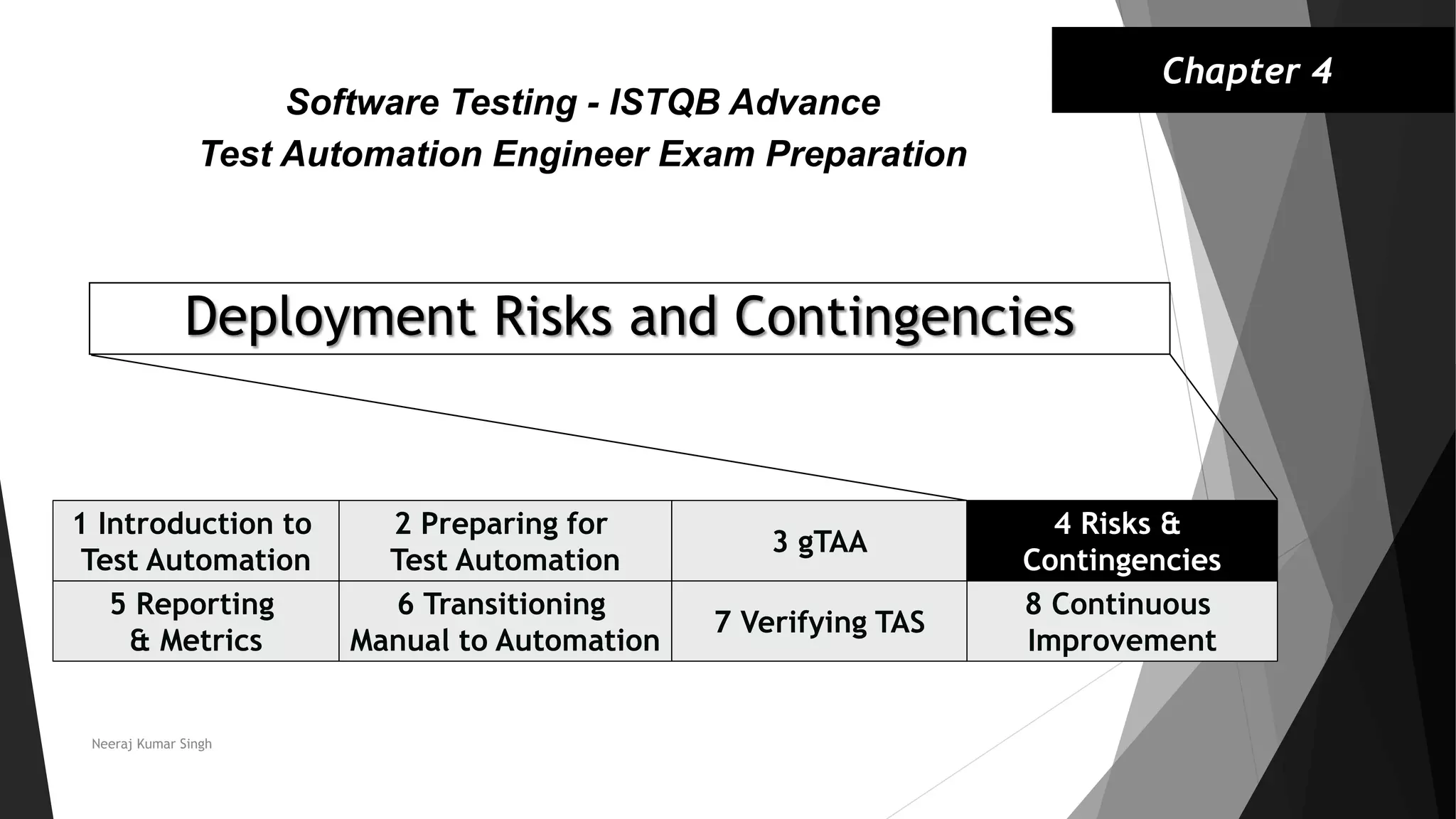
Deployment Risks and Contingencies
1 Introduction to
Test Automation
2 Preparing for
Test Automation
3 gTAA
Software Testing - ISTQB Advance
Test Automation Engineer Exam Preparation
Chapter 4
Neeraj Kumar Singh
5 Reporting
& Metrics
6 Transitioning
Manual to Automation
7 Verifying TAS
8 Continuous
Improvement
4 Risks &
Contingencies
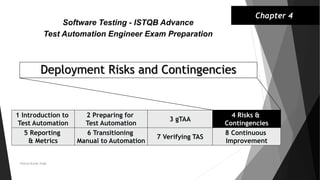
Deployment Risks and Contingencies
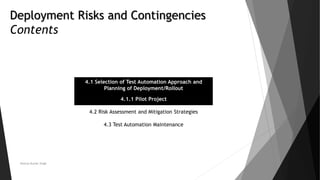
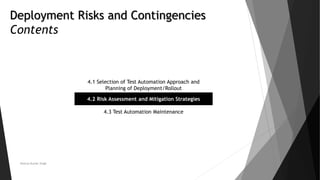
Contents
4.1 Selection of Test Automation Approach and
Planning of Deployment/Rollout
4.1.1 Pilot Project
4.2 Risk Assessment and Mitigation Strategies
4.3 Test Automation Maintenance
Neeraj Kumar Singh
Test Automation Approach and Deployment
Introduction
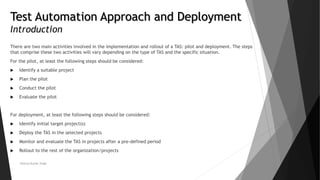
There are two main activities involved in the implementation and rollout of a TAS: pilot and deployment. The steps
that comprise these two activities will vary depending on the type of TAS and the specific situation.
For the pilot, at least the following steps should be considered:
 Identify a suitable project
 Plan the pilot
 Conduct the pilot
 Evaluate the pilot
For deployment, at least the following steps should be considered:
 Identify initial target project(s)
 Deploy the TAS in the selected projects
 Monitor and evaluate the TAS in projects after a pre-defined period
 Rollout to the rest of the organization/projects
Neeraj Kumar Singh
Test Automation Approach and Deployment
Pilot Project
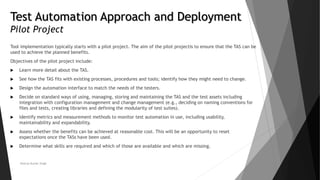
Tool implementation typically starts with a pilot project. The aim of the pilot projectis to ensure that the TAS can be
used to achieve the planned benefits.
Objectives of the pilot project include:
 Learn more detail about the TAS.
 See how the TAS fits with existing processes, procedures and tools; identify how they might need to change.
 Design the automation interface to match the needs of the testers.
 Decide on standard ways of using, managing, storing and maintaining the TAS and the test assets including
integration with configuration management and change management (e.g., deciding on naming conventions for
files and tests, creating libraries and defining the modularity of test suites).
 Identify metrics and measurement methods to monitor test automation in use, including usability,
maintainability and expandability.
 Assess whether the benefits can be achieved at reasonable cost. This will be an opportunity to reset
expectations once the TASs have been used.
 Determine what skills are required and which of those are available and which are missing.
Neeraj Kumar Singh
Test Automation Approach and Deployment
Pilot Project
Identify a suitable project
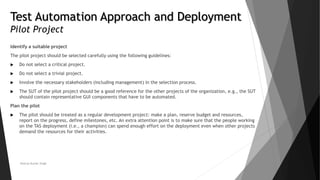
The pilot project should be selected carefully using the following guidelines:
 Do not select a critical project.
 Do not select a trivial project.
 Involve the necessary stakeholders (including management) in the selection process.
 The SUT of the pilot project should be a good reference for the other projects of the organization, e.g., the SUT
should contain representative GUI components that have to be automated.
Plan the pilot
 The pilot should be treated as a regular development project: make a plan, reserve budget and resources,
report on the progress, define milestones, etc. An extra attention point is to make sure that the people working
on the TAS deployment (i.e., a champion) can spend enough effort on the deployment even when other projects
demand the resources for their activities.
Neeraj Kumar Singh
Test Automation Approach and Deployment
Pilot Project
Conduct the pilot
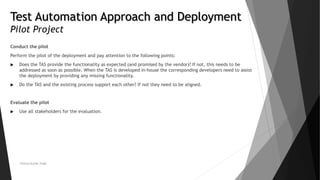
Perform the pilot of the deployment and pay attention to the following points:
 Does the TAS provide the functionality as expected (and promised by the vendor)? If not, this needs to be
addressed as soon as possible. When the TAS is developed in-house the corresponding developers need to assist
the deployment by providing any missing functionality.
 Do the TAS and the existing process support each other? If not they need to be aligned.
Evaluate the pilot
 Use all stakeholders for the evaluation.
Neeraj Kumar Singh
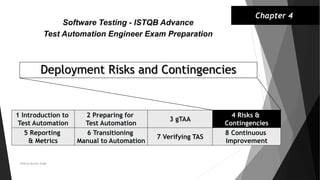
Deployment Risks and Contingencies
1 Introduction to
Test Automation
2 Preparing for
Test Automation
3 gTAA
Software Testing - ISTQB Advance
Test Automation Engineer Exam Preparation
Chapter 4
Neeraj Kumar Singh
5 Reporting
& Metrics
6 Transitioning
Manual to Automation
7 Verifying TAS
8 Continuous
Improvement
4 Risks &
Contingencies
Deployment Risks and Contingencies
Contents
4.1 Selection of Test Automation Approach and
Planning of Deployment/Rollout
4.1.2 Deployment
4.1.3 Deployment of the TAS
4.2 Risk Assessment and Mitigation Strategies
4.3 Test Automation Maintenance
Neeraj Kumar Singh
Test Automation Approach and Deployment
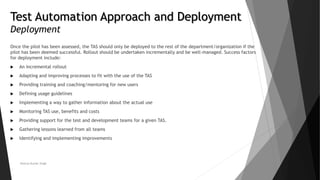
Deployment
Once the pilot has been assessed, the TAS should only be deployed to the rest of the department/organization if the
pilot has been deemed successful. Rollout should be undertaken incrementally and be well-managed. Success factors
for deployment include:
 An incremental rollout
 Adapting and improving processes to fit with the use of the TAS
 Providing training and coaching/mentoring for new users
 Defining usage guidelines
 Implementing a way to gather information about the actual use
 Monitoring TAS use, benefits and costs
 Providing support for the test and development teams for a given TAS.
 Gathering lessons learned from all teams
 Identifying and implementing improvements
Neeraj Kumar Singh
Test Automation Approach and Deployment
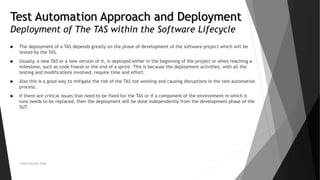
Deployment of The TAS within the Software Lifecycle
 The deployment of a TAS depends greatly on the phase of development of the software project which will be
tested by the TAS.
 Usually, a new TAS or a new version of it, is deployed either in the beginning of the project or when reaching a
milestone, such as code freeze or the end of a sprint. This is because the deployment activities, with all the
testing and modifications involved, require time and effort.
 Also this is a good way to mitigate the risk of the TAS not working and causing disruptions in the test automation
process.
 If there are critical issues that need to be fixed for the TAS or if a component of the environment in which it
runs needs to be replaced, then the deployment will be done independently from the development phase of the
SUT.
Neeraj Kumar Singh
Deployment Risks and Contingencies
1 Introduction to
Test Automation
2 Preparing for
Test Automation
3 gTAA
Software Testing - ISTQB Advance
Test Automation Engineer Exam Preparation
Chapter 4
Neeraj Kumar Singh
5 Reporting
& Metrics
6 Transitioning
Manual to Automation
7 Verifying TAS
8 Continuous
Improvement
4 Risks &
Contingencies
Deployment Risks and Contingencies
Contents
4.1 Selection of Test Automation Approach and
Planning of Deployment/Rollout
4.2 Risk Assessment and Mitigation Strategies
4.3 Test Automation Maintenance
Neeraj Kumar Singh
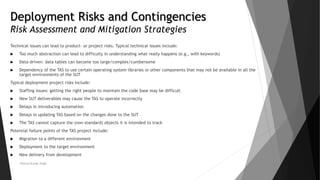
Deployment Risks and Contingencies
Risk Assessment and Mitigation Strategies
Technical issues can lead to product- or project risks. Typical technical issues include:
 Too much abstraction can lead to difficulty in understanding what really happens (e.g., with keywords)
 Data-driven: data tables can become too large/complex/cumbersome
 Dependency of the TAS to use certain operating system libraries or other components that may not be available in all the
target environments of the SUT
Typical deployment project risks include:
 Staffing issues: getting the right people to maintain the code base may be difficult
 New SUT deliverables may cause the TAS to operate incorrectly
 Delays in introducing automation
 Delays in updating TAS based on the changes done to the SUT
 The TAS cannot capture the (non-standard) objects it is intended to track
Potential failure points of the TAS project include:
 Migration to a different environment
 Deployment to the target environment
 New delivery from development
Neeraj Kumar Singh
Deployment Risks and Contingencies
Risk Assessment and Mitigation Strategies
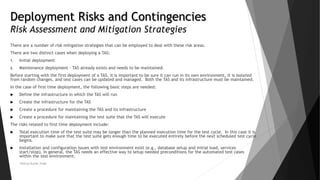
There are a number of risk mitigation strategies that can be employed to deal with these risk areas.
There are two distinct cases when deploying a TAS:
1. Initial deployment
2. Maintenance deployment - TAS already exists and needs to be maintained.
Before starting with the first deployment of a TAS, it is important to be sure it can run in its own environment, it is isolated
from random changes, and test cases can be updated and managed. Both the TAS and its infrastructure must be maintained.
In the case of first time deployment, the following basic steps are needed:
 Define the infrastructure in which the TAS will run
 Create the infrastructure for the TAS
 Create a procedure for maintaining the TAS and its infrastructure
 Create a procedure for maintaining the test suite that the TAS will execute
The risks related to first time deployment include:
 Total execution time of the test suite may be longer than the planned execution time for the test cycle. In this case it is
important to make sure that the test suite gets enough time to be executed entirely before the next scheduled test cycle
begins.
 Installation and configuration issues with test environment exist (e.g., database setup and initial load, services
start/stop). In general, the TAS needs an effective way to setup needed preconditions for the automated test cases
within the test environment.
Neeraj Kumar Singh
Deployment Risks and Contingencies
Risk Assessment and Mitigation Strategies
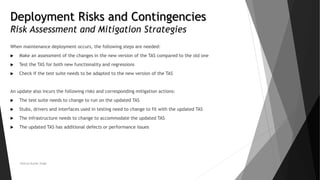
When maintenance deployment occurs, the following steps are needed:
 Make an assessment of the changes in the new version of the TAS compared to the old one
 Test the TAS for both new functionality and regressions
 Check if the test suite needs to be adapted to the new version of the TAS
An update also incurs the following risks and corresponding mitigation actions:
 The test suite needs to change to run on the updated TAS
 Stubs, drivers and interfaces used in testing need to change to fit with the updated TAS
 The infrastructure needs to change to accommodate the updated TAS
 The updated TAS has additional defects or performance issues
Neeraj Kumar Singh
Deployment Risks and Contingencies
1 Introduction to
Test Automation
2 Preparing for
Test Automation
3 gTAA
Software Testing - ISTQB Advance
Test Automation Engineer Exam Preparation
Chapter 4
Neeraj Kumar Singh
5 Reporting
& Metrics
6 Transitioning
Manual to Automation
7 Verifying TAS
8 Continuous
Improvement
4 Risks &
Contingencies
Deployment Risks and Contingencies
Contents
4.1 Selection of Test Automation Approach and
Planning of Deployment/Rollout
4.2 Risk Assessment and Mitigation Strategies
4.3 Test Automation Maintenance
4.3.1 Types of Maintenance
Neeraj Kumar Singh
Test Automation Maintenance
Types of Maintenance
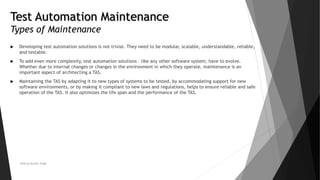
 Developing test automation solutions is not trivial. They need to be modular, scalable, understandable, reliable,
and testable.
 To add even more complexity, test automation solutions – like any other software system, have to evolve.
Whether due to internal changes or changes in the environment in which they operate, maintenance is an
important aspect of architecting a TAS.
 Maintaining the TAS by adapting it to new types of systems to be tested, by accommodating support for new
software environments, or by making it compliant to new laws and regulations, helps to ensure reliable and safe
operation of the TAS. It also optimizes the life span and the performance of the TAS.
Neeraj Kumar Singh
Test Automation Maintenance
Types of Maintenance
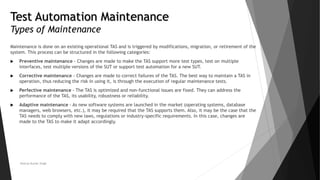
Maintenance is done on an existing operational TAS and is triggered by modifications, migration, or retirement of the
system. This process can be structured in the following categories:
 Preventive maintenance - Changes are made to make the TAS support more test types, test on multiple
interfaces, test multiple versions of the SUT or support test automation for a new SUT.
 Corrective maintenance - Changes are made to correct failures of the TAS. The best way to maintain a TAS in
operation, thus reducing the risk in using it, is through the execution of regular maintenance tests.
 Perfective maintenance - The TAS is optimized and non-functional issues are fixed. They can address the
performance of the TAS, its usability, robustness or reliability.
 Adaptive maintenance - As new software systems are launched in the market (operating systems, database
managers, web browsers, etc.), it may be required that the TAS supports them. Also, it may be the case that the
TAS needs to comply with new laws, regulations or industry-specific requirements. In this case, changes are
made to the TAS to make it adapt accordingly.
Neeraj Kumar Singh
Deployment Risks and Contingencies
1 Introduction to
Test Automation
2 Preparing for
Test Automation
3 gTAA
Software Testing - ISTQB Advance
Test Automation Engineer Exam Preparation
Chapter 4
Neeraj Kumar Singh
5 Reporting
& Metrics
6 Transitioning
Manual to Automation
7 Verifying TAS
8 Continuous
Improvement
4 Risks &
Contingencies
Deployment Risks and Contingencies
Contents
4.1 Selection of Test Automation Approach and
Planning of Deployment/Rollout
4.2 Risk Assessment and Mitigation Strategies
4.3 Test Automation Maintenance
4.3.2 Scope and Approach
Neeraj Kumar Singh
Test Automation Maintenance
Scope and Approach
Maintenance is a process that can affect all layers and components of a TAS. The scope of it depends on:
 The size and complexity of the TAS
 The size of the change
 The risk of the change
Given the fact that maintenance refers to TAS in operation, an impact analysis is necessary to determine how the
system may be affected by the changes. Depending on the impact, the changes need to be introduced incrementally
and tests need to be carried out after each step to ensure the continuous functioning of the TAS.
Note: maintaining the TAS can be difficult if its specifications and documentation are outdated.
Neeraj Kumar Singh
Test Automation Maintenance
Scope and Approach
Because time efficiency is the main contributing factor to the success of test automation, it becomes critical to have
good practices for maintaining the TAS including:
 The deployment procedures and usage of the TAS must be clear and documented
 The third party dependencies must be documented, together with drawbacks and known issues
 The TAS must be modular, so parts of it can be easily replaced
 The TAS must run in an environment that is replaceable or with replaceable components
 The TAS must separate test scripts from the TAF itself
 The TAS must run isolated from the development environment, so that changes to the TAS will not adversely
affect the test environment
 The TAS together with the environment, test suite and testware artifacts must be under configuration
management
Neeraj Kumar Singh
Test Automation Maintenance
Scope and Approach
There are also considerations for the maintenance of the third party components and other libraries as follows:
 Very often it is the case that the TAS will use third party components to run the tests. It may also be the case
that the TAS depends on third party libraries (e.g., the UI automation libraries). All the third party component
parts of the TAS must be documented and under configuration management.
 It is necessary to have a plan in case these external components need to be modified or fixed. The person
responsible for the TAS maintenance needs to know who to contact or where to submit an issue.
 There must be documentation regarding the license under which the third party components are used, so that
there is information on whether they can be modified, to what degree and by whom.
 For each of the third party components, it is necessary to get information about updates and new versions.
Keeping the third party components and libraries up to date is a preventive action that pays off the investment
in the long-term.
Neeraj Kumar Singh
Deployment Risks and Contingencies
1 Introduction to
Test Automation
2 Preparing for
Test Automation
3 gTAA
Software Testing - ISTQB Advance
Test Automation Engineer Exam Preparation
Chapter 4
Neeraj Kumar Singh
5 Reporting
& Metrics
6 Transitioning
Manual to Automation
7 Verifying TAS
8 Continuous
Improvement
4 Risks &
Contingencies
Deployment Risks and Contingencies
Contents
4.1 Selection of Test Automation Approach and
Planning of Deployment/Rollout
4.2 Risk Assessment and Mitigation Strategies
4.3 Test Automation Maintenance
4.3.2 Scope and Approach
Neeraj Kumar Singh
Test Automation Maintenance
Scope and Approach
Considerations for naming standards and other conventions include:
 The idea of naming standards and other conventions has a simple reason: the test suite and the TAS itself has to
be easy to read, understand, change and maintain. This saves time in the maintenance process and also
minimizes the risk of introducing regressions or wrong fixes that could otherwise be easily avoided.
 It is easier to introduce new people to the test automation project when standard naming conventions are used.
 The naming standards can refer to variables and files, test scenarios, keywords and keyword parameters. Other
conventions refer to pre-requisites and post-actions for test execution, the content of the test data, the test
environment, status of test execution, and execution logs and reports.
 All the standards and conventions must be agreed upon and documented when starting a test automation
project.
Neeraj Kumar Singh
Test Automation Maintenance
Scope and Approach
Documentation considerations include:
 The need for good and current documentation for both the test scenarios and the TAS is quite clear, but there
are two issues related to this: someone has to write it and someone has to maintain it.
 While the code of the test tool can be either self-documenting or semi-automatically documented, all the
design, components, integrations with third parties, dependencies and deployment procedures need to be
documented by someone.
 It is a good practice to introduce the writing of documentation as part of the development process. A task should
not be considered as done unless it is documented or the documentation is updated.
Neeraj Kumar Singh
Test Automation Maintenance
Scope and Approach
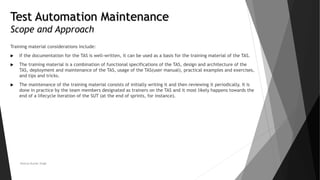
Training material considerations include:
 If the documentation for the TAS is well-written, it can be used as a basis for the training material of the TAS.
 The training material is a combination of functional specifications of the TAS, design and architecture of the
TAS, deployment and maintenance of the TAS, usage of the TAS(user manual), practical examples and exercises,
and tips and tricks.
 The maintenance of the training material consists of initially writing it and then reviewing it periodically. It is
done in practice by the team members designated as trainers on the TAS and it most likely happens towards the
end of a lifecycle iteration of the SUT (at the end of sprints, for instance).
Neeraj Kumar Singh
Deployment Risks and Contingencies
1 Introduction to
Test Automation
2 Preparing for
Test Automation
3 gTAA
Software Testing - ISTQB Advance
Test Automation Engineer Exam Preparation
Chapter 4
Neeraj Kumar Singh
5 Reporting
& Metrics
6 Transitioning
Manual to Automation
7 Verifying TAS
8 Continuous
Improvement
4 Risks &
Contingencies
Deployment Risks and Contingencies
Sample Questions
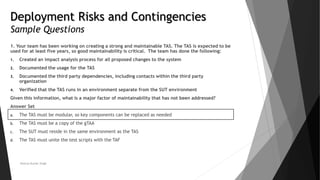
1. Your team has been working on creating a strong and maintainable TAS. The TAS is expected to be
used for at least five years, so good maintainability is critical. The team has done the following:
1. Created an impact analysis process for all proposed changes to the system
2. Documented the usage for the TAS
3. Documented the third party dependencies, including contacts within the third party
organization
4. Verified that the TAS runs in an environment separate from the SUT environment
Given this information, what is a major factor of maintainability that has not been addressed?
Answer Set
a. The TAS must be modular, so key components can be replaced as needed
b. The TAS must be a copy of the gTAA
c. The SUT must reside in the same environment as the TAS
d. The TAS must unite the test scripts with the TAF
Neeraj Kumar Singh
Deployment Risks and Contingencies
Sample Questions
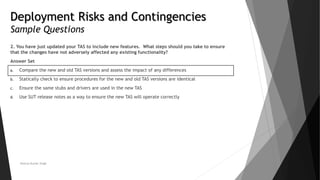
2. You have just updated your TAS to include new features. What steps should you take to ensure
that the changes have not adversely affected any existing functionality?
Answer Set
a. Compare the new and old TAS versions and assess the impact of any differences
b. Statically check to ensure procedures for the new and old TAS versions are identical
c. Ensure the same stubs and drivers are used in the new TAS
d. Use SUT release notes as a way to ensure the new TAS will operate correctly
Neeraj Kumar Singh
Deployment Risks and Contingencies
Sample Questions
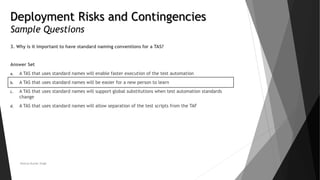
3. Why is it important to have standard naming conventions for a TAS?
Answer Set
a. A TAS that uses standard names will enable faster execution of the test automation
b. A TAS that uses standard names will be easier for a new person to learn
c. A TAS that uses standard names will support global substitutions when test automation standards
change
d. A TAS that uses standard names will allow separation of the test scripts from the TAF
Neeraj Kumar Singh

Chapter 4 - Deployment Risks and Contingencies

  • 1.
    Deployment Risks andContingencies 1 Introduction to Test Automation 2 Preparing for Test Automation 3 gTAA Software Testing - ISTQB Advance Test Automation Engineer Exam Preparation Chapter 4 Neeraj Kumar Singh 5 Reporting & Metrics 6 Transitioning Manual to Automation 7 Verifying TAS 8 Continuous Improvement 4 Risks & Contingencies
  • 2.
    Deployment Risks andContingencies Contents 4.1 Selection of Test Automation Approach and Planning of Deployment/Rollout 4.1.1 Pilot Project 4.2 Risk Assessment and Mitigation Strategies 4.3 Test Automation Maintenance Neeraj Kumar Singh
  • 3.
    Test Automation Approachand Deployment Introduction There are two main activities involved in the implementation and rollout of a TAS: pilot and deployment. The steps that comprise these two activities will vary depending on the type of TAS and the specific situation. For the pilot, at least the following steps should be considered:  Identify a suitable project  Plan the pilot  Conduct the pilot  Evaluate the pilot For deployment, at least the following steps should be considered:  Identify initial target project(s)  Deploy the TAS in the selected projects  Monitor and evaluate the TAS in projects after a pre-defined period  Rollout to the rest of the organization/projects Neeraj Kumar Singh
  • 4.
    Test Automation Approachand Deployment Pilot Project Tool implementation typically starts with a pilot project. The aim of the pilot projectis to ensure that the TAS can be used to achieve the planned benefits. Objectives of the pilot project include:  Learn more detail about the TAS.  See how the TAS fits with existing processes, procedures and tools; identify how they might need to change.  Design the automation interface to match the needs of the testers.  Decide on standard ways of using, managing, storing and maintaining the TAS and the test assets including integration with configuration management and change management (e.g., deciding on naming conventions for files and tests, creating libraries and defining the modularity of test suites).  Identify metrics and measurement methods to monitor test automation in use, including usability, maintainability and expandability.  Assess whether the benefits can be achieved at reasonable cost. This will be an opportunity to reset expectations once the TASs have been used.  Determine what skills are required and which of those are available and which are missing. Neeraj Kumar Singh
  • 5.
    Test Automation Approachand Deployment Pilot Project Identify a suitable project The pilot project should be selected carefully using the following guidelines:  Do not select a critical project.  Do not select a trivial project.  Involve the necessary stakeholders (including management) in the selection process.  The SUT of the pilot project should be a good reference for the other projects of the organization, e.g., the SUT should contain representative GUI components that have to be automated. Plan the pilot  The pilot should be treated as a regular development project: make a plan, reserve budget and resources, report on the progress, define milestones, etc. An extra attention point is to make sure that the people working on the TAS deployment (i.e., a champion) can spend enough effort on the deployment even when other projects demand the resources for their activities. Neeraj Kumar Singh
  • 6.
    Test Automation Approachand Deployment Pilot Project Conduct the pilot Perform the pilot of the deployment and pay attention to the following points:  Does the TAS provide the functionality as expected (and promised by the vendor)? If not, this needs to be addressed as soon as possible. When the TAS is developed in-house the corresponding developers need to assist the deployment by providing any missing functionality.  Do the TAS and the existing process support each other? If not they need to be aligned. Evaluate the pilot  Use all stakeholders for the evaluation. Neeraj Kumar Singh
  • 7.
    Deployment Risks andContingencies 1 Introduction to Test Automation 2 Preparing for Test Automation 3 gTAA Software Testing - ISTQB Advance Test Automation Engineer Exam Preparation Chapter 4 Neeraj Kumar Singh 5 Reporting & Metrics 6 Transitioning Manual to Automation 7 Verifying TAS 8 Continuous Improvement 4 Risks & Contingencies
  • 8.
    Deployment Risks andContingencies Contents 4.1 Selection of Test Automation Approach and Planning of Deployment/Rollout 4.1.2 Deployment 4.1.3 Deployment of the TAS 4.2 Risk Assessment and Mitigation Strategies 4.3 Test Automation Maintenance Neeraj Kumar Singh
  • 9.
    Test Automation Approachand Deployment Deployment Once the pilot has been assessed, the TAS should only be deployed to the rest of the department/organization if the pilot has been deemed successful. Rollout should be undertaken incrementally and be well-managed. Success factors for deployment include:  An incremental rollout  Adapting and improving processes to fit with the use of the TAS  Providing training and coaching/mentoring for new users  Defining usage guidelines  Implementing a way to gather information about the actual use  Monitoring TAS use, benefits and costs  Providing support for the test and development teams for a given TAS.  Gathering lessons learned from all teams  Identifying and implementing improvements Neeraj Kumar Singh
  • 10.
    Test Automation Approachand Deployment Deployment of The TAS within the Software Lifecycle  The deployment of a TAS depends greatly on the phase of development of the software project which will be tested by the TAS.  Usually, a new TAS or a new version of it, is deployed either in the beginning of the project or when reaching a milestone, such as code freeze or the end of a sprint. This is because the deployment activities, with all the testing and modifications involved, require time and effort.  Also this is a good way to mitigate the risk of the TAS not working and causing disruptions in the test automation process.  If there are critical issues that need to be fixed for the TAS or if a component of the environment in which it runs needs to be replaced, then the deployment will be done independently from the development phase of the SUT. Neeraj Kumar Singh
  • 11.
    Deployment Risks andContingencies 1 Introduction to Test Automation 2 Preparing for Test Automation 3 gTAA Software Testing - ISTQB Advance Test Automation Engineer Exam Preparation Chapter 4 Neeraj Kumar Singh 5 Reporting & Metrics 6 Transitioning Manual to Automation 7 Verifying TAS 8 Continuous Improvement 4 Risks & Contingencies
  • 12.
    Deployment Risks andContingencies Contents 4.1 Selection of Test Automation Approach and Planning of Deployment/Rollout 4.2 Risk Assessment and Mitigation Strategies 4.3 Test Automation Maintenance Neeraj Kumar Singh
  • 13.
    Deployment Risks andContingencies Risk Assessment and Mitigation Strategies Technical issues can lead to product- or project risks. Typical technical issues include:  Too much abstraction can lead to difficulty in understanding what really happens (e.g., with keywords)  Data-driven: data tables can become too large/complex/cumbersome  Dependency of the TAS to use certain operating system libraries or other components that may not be available in all the target environments of the SUT Typical deployment project risks include:  Staffing issues: getting the right people to maintain the code base may be difficult  New SUT deliverables may cause the TAS to operate incorrectly  Delays in introducing automation  Delays in updating TAS based on the changes done to the SUT  The TAS cannot capture the (non-standard) objects it is intended to track Potential failure points of the TAS project include:  Migration to a different environment  Deployment to the target environment  New delivery from development Neeraj Kumar Singh
  • 14.
    Deployment Risks andContingencies Risk Assessment and Mitigation Strategies There are a number of risk mitigation strategies that can be employed to deal with these risk areas. There are two distinct cases when deploying a TAS: 1. Initial deployment 2. Maintenance deployment - TAS already exists and needs to be maintained. Before starting with the first deployment of a TAS, it is important to be sure it can run in its own environment, it is isolated from random changes, and test cases can be updated and managed. Both the TAS and its infrastructure must be maintained. In the case of first time deployment, the following basic steps are needed:  Define the infrastructure in which the TAS will run  Create the infrastructure for the TAS  Create a procedure for maintaining the TAS and its infrastructure  Create a procedure for maintaining the test suite that the TAS will execute The risks related to first time deployment include:  Total execution time of the test suite may be longer than the planned execution time for the test cycle. In this case it is important to make sure that the test suite gets enough time to be executed entirely before the next scheduled test cycle begins.  Installation and configuration issues with test environment exist (e.g., database setup and initial load, services start/stop). In general, the TAS needs an effective way to setup needed preconditions for the automated test cases within the test environment. Neeraj Kumar Singh
  • 15.
    Deployment Risks andContingencies Risk Assessment and Mitigation Strategies When maintenance deployment occurs, the following steps are needed:  Make an assessment of the changes in the new version of the TAS compared to the old one  Test the TAS for both new functionality and regressions  Check if the test suite needs to be adapted to the new version of the TAS An update also incurs the following risks and corresponding mitigation actions:  The test suite needs to change to run on the updated TAS  Stubs, drivers and interfaces used in testing need to change to fit with the updated TAS  The infrastructure needs to change to accommodate the updated TAS  The updated TAS has additional defects or performance issues Neeraj Kumar Singh
  • 16.
    Deployment Risks andContingencies 1 Introduction to Test Automation 2 Preparing for Test Automation 3 gTAA Software Testing - ISTQB Advance Test Automation Engineer Exam Preparation Chapter 4 Neeraj Kumar Singh 5 Reporting & Metrics 6 Transitioning Manual to Automation 7 Verifying TAS 8 Continuous Improvement 4 Risks & Contingencies
  • 17.
    Deployment Risks andContingencies Contents 4.1 Selection of Test Automation Approach and Planning of Deployment/Rollout 4.2 Risk Assessment and Mitigation Strategies 4.3 Test Automation Maintenance 4.3.1 Types of Maintenance Neeraj Kumar Singh
  • 18.
    Test Automation Maintenance Typesof Maintenance  Developing test automation solutions is not trivial. They need to be modular, scalable, understandable, reliable, and testable.  To add even more complexity, test automation solutions – like any other software system, have to evolve. Whether due to internal changes or changes in the environment in which they operate, maintenance is an important aspect of architecting a TAS.  Maintaining the TAS by adapting it to new types of systems to be tested, by accommodating support for new software environments, or by making it compliant to new laws and regulations, helps to ensure reliable and safe operation of the TAS. It also optimizes the life span and the performance of the TAS. Neeraj Kumar Singh
  • 19.
    Test Automation Maintenance Typesof Maintenance Maintenance is done on an existing operational TAS and is triggered by modifications, migration, or retirement of the system. This process can be structured in the following categories:  Preventive maintenance - Changes are made to make the TAS support more test types, test on multiple interfaces, test multiple versions of the SUT or support test automation for a new SUT.  Corrective maintenance - Changes are made to correct failures of the TAS. The best way to maintain a TAS in operation, thus reducing the risk in using it, is through the execution of regular maintenance tests.  Perfective maintenance - The TAS is optimized and non-functional issues are fixed. They can address the performance of the TAS, its usability, robustness or reliability.  Adaptive maintenance - As new software systems are launched in the market (operating systems, database managers, web browsers, etc.), it may be required that the TAS supports them. Also, it may be the case that the TAS needs to comply with new laws, regulations or industry-specific requirements. In this case, changes are made to the TAS to make it adapt accordingly. Neeraj Kumar Singh
  • 20.
    Deployment Risks andContingencies 1 Introduction to Test Automation 2 Preparing for Test Automation 3 gTAA Software Testing - ISTQB Advance Test Automation Engineer Exam Preparation Chapter 4 Neeraj Kumar Singh 5 Reporting & Metrics 6 Transitioning Manual to Automation 7 Verifying TAS 8 Continuous Improvement 4 Risks & Contingencies
  • 21.
    Deployment Risks andContingencies Contents 4.1 Selection of Test Automation Approach and Planning of Deployment/Rollout 4.2 Risk Assessment and Mitigation Strategies 4.3 Test Automation Maintenance 4.3.2 Scope and Approach Neeraj Kumar Singh
  • 22.
    Test Automation Maintenance Scopeand Approach Maintenance is a process that can affect all layers and components of a TAS. The scope of it depends on:  The size and complexity of the TAS  The size of the change  The risk of the change Given the fact that maintenance refers to TAS in operation, an impact analysis is necessary to determine how the system may be affected by the changes. Depending on the impact, the changes need to be introduced incrementally and tests need to be carried out after each step to ensure the continuous functioning of the TAS. Note: maintaining the TAS can be difficult if its specifications and documentation are outdated. Neeraj Kumar Singh
  • 23.
    Test Automation Maintenance Scopeand Approach Because time efficiency is the main contributing factor to the success of test automation, it becomes critical to have good practices for maintaining the TAS including:  The deployment procedures and usage of the TAS must be clear and documented  The third party dependencies must be documented, together with drawbacks and known issues  The TAS must be modular, so parts of it can be easily replaced  The TAS must run in an environment that is replaceable or with replaceable components  The TAS must separate test scripts from the TAF itself  The TAS must run isolated from the development environment, so that changes to the TAS will not adversely affect the test environment  The TAS together with the environment, test suite and testware artifacts must be under configuration management Neeraj Kumar Singh
  • 24.
    Test Automation Maintenance Scopeand Approach There are also considerations for the maintenance of the third party components and other libraries as follows:  Very often it is the case that the TAS will use third party components to run the tests. It may also be the case that the TAS depends on third party libraries (e.g., the UI automation libraries). All the third party component parts of the TAS must be documented and under configuration management.  It is necessary to have a plan in case these external components need to be modified or fixed. The person responsible for the TAS maintenance needs to know who to contact or where to submit an issue.  There must be documentation regarding the license under which the third party components are used, so that there is information on whether they can be modified, to what degree and by whom.  For each of the third party components, it is necessary to get information about updates and new versions. Keeping the third party components and libraries up to date is a preventive action that pays off the investment in the long-term. Neeraj Kumar Singh
  • 25.
    Deployment Risks andContingencies 1 Introduction to Test Automation 2 Preparing for Test Automation 3 gTAA Software Testing - ISTQB Advance Test Automation Engineer Exam Preparation Chapter 4 Neeraj Kumar Singh 5 Reporting & Metrics 6 Transitioning Manual to Automation 7 Verifying TAS 8 Continuous Improvement 4 Risks & Contingencies
  • 26.
    Deployment Risks andContingencies Contents 4.1 Selection of Test Automation Approach and Planning of Deployment/Rollout 4.2 Risk Assessment and Mitigation Strategies 4.3 Test Automation Maintenance 4.3.2 Scope and Approach Neeraj Kumar Singh
  • 27.
    Test Automation Maintenance Scopeand Approach Considerations for naming standards and other conventions include:  The idea of naming standards and other conventions has a simple reason: the test suite and the TAS itself has to be easy to read, understand, change and maintain. This saves time in the maintenance process and also minimizes the risk of introducing regressions or wrong fixes that could otherwise be easily avoided.  It is easier to introduce new people to the test automation project when standard naming conventions are used.  The naming standards can refer to variables and files, test scenarios, keywords and keyword parameters. Other conventions refer to pre-requisites and post-actions for test execution, the content of the test data, the test environment, status of test execution, and execution logs and reports.  All the standards and conventions must be agreed upon and documented when starting a test automation project. Neeraj Kumar Singh
  • 28.
    Test Automation Maintenance Scopeand Approach Documentation considerations include:  The need for good and current documentation for both the test scenarios and the TAS is quite clear, but there are two issues related to this: someone has to write it and someone has to maintain it.  While the code of the test tool can be either self-documenting or semi-automatically documented, all the design, components, integrations with third parties, dependencies and deployment procedures need to be documented by someone.  It is a good practice to introduce the writing of documentation as part of the development process. A task should not be considered as done unless it is documented or the documentation is updated. Neeraj Kumar Singh
  • 29.
    Test Automation Maintenance Scopeand Approach Training material considerations include:  If the documentation for the TAS is well-written, it can be used as a basis for the training material of the TAS.  The training material is a combination of functional specifications of the TAS, design and architecture of the TAS, deployment and maintenance of the TAS, usage of the TAS(user manual), practical examples and exercises, and tips and tricks.  The maintenance of the training material consists of initially writing it and then reviewing it periodically. It is done in practice by the team members designated as trainers on the TAS and it most likely happens towards the end of a lifecycle iteration of the SUT (at the end of sprints, for instance). Neeraj Kumar Singh
  • 30.
    Deployment Risks andContingencies 1 Introduction to Test Automation 2 Preparing for Test Automation 3 gTAA Software Testing - ISTQB Advance Test Automation Engineer Exam Preparation Chapter 4 Neeraj Kumar Singh 5 Reporting & Metrics 6 Transitioning Manual to Automation 7 Verifying TAS 8 Continuous Improvement 4 Risks & Contingencies
  • 31.
    Deployment Risks andContingencies Sample Questions 1. Your team has been working on creating a strong and maintainable TAS. The TAS is expected to be used for at least five years, so good maintainability is critical. The team has done the following: 1. Created an impact analysis process for all proposed changes to the system 2. Documented the usage for the TAS 3. Documented the third party dependencies, including contacts within the third party organization 4. Verified that the TAS runs in an environment separate from the SUT environment Given this information, what is a major factor of maintainability that has not been addressed? Answer Set a. The TAS must be modular, so key components can be replaced as needed b. The TAS must be a copy of the gTAA c. The SUT must reside in the same environment as the TAS d. The TAS must unite the test scripts with the TAF Neeraj Kumar Singh
  • 32.
    Deployment Risks andContingencies Sample Questions 2. You have just updated your TAS to include new features. What steps should you take to ensure that the changes have not adversely affected any existing functionality? Answer Set a. Compare the new and old TAS versions and assess the impact of any differences b. Statically check to ensure procedures for the new and old TAS versions are identical c. Ensure the same stubs and drivers are used in the new TAS d. Use SUT release notes as a way to ensure the new TAS will operate correctly Neeraj Kumar Singh
  • 33.
    Deployment Risks andContingencies Sample Questions 3. Why is it important to have standard naming conventions for a TAS? Answer Set a. A TAS that uses standard names will enable faster execution of the test automation b. A TAS that uses standard names will be easier for a new person to learn c. A TAS that uses standard names will support global substitutions when test automation standards change d. A TAS that uses standard names will allow separation of the test scripts from the TAF Neeraj Kumar Singh