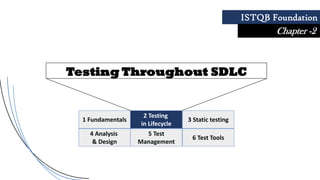
Testing Throughout SDLC
1 Fundamentals
2 Testing
in Lifecycle
4 Analysis
& Design
3 Static testing
5 Test
Management
6 Test Tools
ISTQB Foundation
Chapter -2
TM
© 2023. All Rights Reserved
Testing Throughout the SDLC
Content
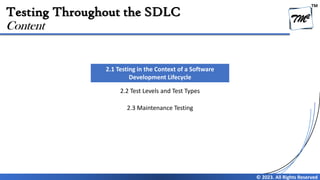
2.1 Testing in the Context of a Software
Development Lifecycle
2.2 Test Levels and Test Types
2.3 Maintenance Testing
TM
© 2023. All Rights Reserved
Testing Throughout the SDLC
Content
2.1.1. Impact of the Software Development
Lifecycle on Testing
2.1.2. Software Development Lifecycle and
Good Testing Practices
2.1.3. Testing as a Driver for Software
Development
2.1.4. DevOps and Testing
2.1.5. Shift-Left Approach
2.1.6. Retrospectives and Process Improvement
TM
© 2023. All Rights Reserved
Testing Throughout the SDLC
 A software development lifecycle (SDLC) model is an abstract, high-level representation of the software development
process. A SDLC model defines how different development phases and types of activities performed within this process
relate to each other, both logically and chronologically.
 Examples of SDLC models include: sequential development models (e.g., waterfall model, V-model), iterative
development models (e.g., spiral model, prototyping), and incremental development models (e.g., Unified Process).
 Some activities within software development processes can also be described by more detailed software development
methods and Agile practices.
 Examples include: acceptance test-driven development (ATDD), behavior-driven development (BDD), domain-driven
design (DDD), extreme programming (XP), feature-driven development (FDD), Kanban, Lean IT, Scrum, and test-driven
development (TDD). in release.
Testing in the Context of SDLC
TM
© 2023. All Rights Reserved
Testing Throughout the SDLC
Testing must be adapted to the SDLC to succeed. The choice of the SDLC impacts on the:
 Scope and timing of test activities (e.g., test levels and test types)
 Level of detail of test documentation
 Choice of test techniques and test approach
 Extent of test automation
 Role and responsibilities of a tester
Impact of SDLC on Testing
TM
© 2023. All Rights Reserved
Testing Throughout the SDLC
 In sequential development models, in the initial phases testers typically participate in requirement reviews, test
analysis, and test design. The executable code is usually created in the later phases, so typically dynamic testing cannot
be performed early in the SDLC.
 In some iterative and incremental development models, it is assumed that each iteration delivers a working prototype
or product increment. This implies that in each iteration both static and dynamic testing may be performed at all test
levels. Frequent delivery of increments requires fast feedback and extensive regression testing.
 Agile software development assumes that change may occur throughout the project. Therefore, lightweight work
product documentation and extensive test automation to make regression testing easier are favored in agile projects.
Also, most of the manual testing tends to be done using experience-based test techniques that do not require extensive
prior test analysis and design.
Impact of SDLC on Testing
TM
© 2023. All Rights Reserved
Testing Throughout the SDLC
Good testing practices, independent of the chosen SDLC model, include the following:
 For every software development activity, there is a corresponding test activity, so that all development activities are
subject to quality control
 Different test levels have specific and different test objectives, which allows for testing to be appropriately
comprehensive while avoiding redundancy
 Test analysis and design for a given test level begins during the corresponding development phase of the SDLC, so that
testing can adhere to the principle of early testing
 Testers are involved in reviewing work products as soon as drafts of this documentation are available, so that this
earlier testing and defect detection can support the shift-left strategy
SDLC and Good Testing Practices
TM
© 2023. All Rights Reserved
Testing Throughout the SDLC
Content
2.1.1. Impact of the Software Development
Lifecycle on Testing
2.1.2. Software Development Lifecycle and
Good Testing Practices
2.1.3. Testing as a Driver for Software
Development
2.1.4. DevOps and Testing
2.1.5. Shift-Left Approach
2.1.6. Retrospectives and Process Improvement
TM
© 2023. All Rights Reserved
Testing Throughout the SDLC
TDD, ATDD and BDD are similar development approaches, where tests are defined as a means of directing development.
Each of these approaches implements the principle of early testing and follows a shift-left approach, since the tests are
defined before the code is written. They support an iterative development model. These approaches are characterized as
follows:
Test-Driven Development (TDD):
 Directs the coding through test cases (instead of extensive software design)
 Tests are written first, then the code is written to satisfy the tests, and then the tests and code are refactored
Acceptance Test-Driven Development (ATDD):
 Derives tests from acceptance criteria as part of the system design process
 Tests are written before the part of the application is developed to satisfy the tests
Behavior-Driven Development (BDD):
 Expresses the desired behavior of an application with test cases written in a simple form of natural language, which is
easy to understand by stakeholders – usually using the Given/When/Then format.
 Test cases are then automatically translated into executable tests
Testing as a Driver for Software Development
TM
© 2023. All Rights Reserved
Testing Throughout the SDLC
Content
2.1.1. Impact of the Software Development
Lifecycle on Testing
2.1.2. Software Development Lifecycle and
Good Testing Practices
2.1.3. Testing as a Driver for Software
Development
2.1.4. DevOps and Testing
2.1.5. Shift-Left Approach
2.1.6. Retrospectives and Process Improvement
TM
© 2023. All Rights Reserved
Testing Throughout the SDLC
DevOps is an organizational approach aiming to create synergy by getting development (including testing) and operations
to work together to achieve a set of common goals.
DevOps requires a cultural shift within an organization to bridge the gaps between development (including testing) and
operations while treating their functions with equal value.
DevOps promotes team autonomy, fast feedback, integrated toolchains, and technical practices like continuous integration
(CI) and continuous delivery (CD).
This enables the teams to build, test and release high-quality code faster through a DevOps delivery pipeline
DevOps and Testing
TM
© 2023. All Rights Reserved
Testing Throughout the SDLC
From the testing perspective, some of the benefits of DevOps are:
 Fast feedback on the code quality, and whether changes adversely affect existing code
 CI promotes a shift-left approach in testing by encouraging developers to submit high quality code accompanied by
component tests and static analysis
 Promotes automated processes like CI/CD that facilitate establishing stable test environments
 Increases the view on non-functional quality characteristics (e.g., performance, reliability)
 Automation through a delivery pipeline reduces the need for repetitive manual testing
 The risk in regression is minimized due to the scale and range of automated regression tests
DevOps is not without its risks and challenges, which include:
 The DevOps delivery pipeline must be defined and established
 CI / CD tools must be introduced and maintained
 Test automation requires additional resources and may be difficult to establish and maintain
DevOps and Testing
TM
© 2023. All Rights Reserved
Testing Throughout the SDLC
Content
2.1.1. Impact of the Software Development
Lifecycle on Testing
2.1.2. Software Development Lifecycle and
Good Testing Practices
2.1.3. Testing as a Driver for Software
Development
2.1.4. DevOps and Testing
2.1.5. Shift-Left Approach
2.1.6. Retrospectives and Process Improvement
TM
© 2023. All Rights Reserved
Testing Throughout the SDLC
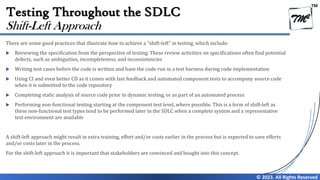
There are some good practices that illustrate how to achieve a “shift-left” in testing, which include:
 Reviewing the specification from the perspective of testing. These review activities on specifications often find potential
defects, such as ambiguities, incompleteness, and inconsistencies
 Writing test cases before the code is written and have the code run in a test harness during code implementation
 Using CI and even better CD as it comes with fast feedback and automated component tests to accompany source code
when it is submitted to the code repository
 Completing static analysis of source code prior to dynamic testing, or as part of an automated process
 Performing non-functional testing starting at the component test level, where possible. This is a form of shift-left as
these non-functional test types tend to be performed later in the SDLC when a complete system and a representative
test environment are available
A shift-left approach might result in extra training, effort and/or costs earlier in the process but is expected to save efforts
and/or costs later in the process.
For the shift-left approach it is important that stakeholders are convinced and bought into this concept.
Shift-Left Approach
TM
© 2023. All Rights Reserved
Testing Throughout the SDLC
Content
2.1.1. Impact of the Software Development
Lifecycle on Testing
2.1.2. Software Development Lifecycle and
Good Testing Practices
2.1.3. Testing as a Driver for Software
Development
2.1.4. DevOps and Testing
2.1.5. Shift-Left Approach
2.1.6. Retrospectives and Process Improvement
TM
© 2023. All Rights Reserved
Testing Throughout the SDLC
Retrospectives (also known as “post-project meetings” and project retrospectives) are often held at the end of a project or
an iteration, at a release milestone, or can be held when needed.
The timing and organization of the retrospectives depend on the particular SDLC model being followed.
In these meetings the participants (not only testers, but also e.g., developers, architects, product owner, business analysts)
discuss:
 What was successful, and should be retained?
 What was not successful and could be improved?
 How to incorporate the improvements and retain the successes in the future?
Retrospective and Process Improvement
TM
© 2023. All Rights Reserved
Testing Throughout the SDLC
The results should be recorded and are normally part of the test completion report.
Retrospectives are critical for the successful implementation of continuous improvement and it is important that any
recommended improvements are followed up.
Typical benefits for testing include:
 Increased test effectiveness / efficiency (e.g., by implementing suggestions for process improvement)
 Increased quality of testware (e.g., by jointly reviewing the test processes)
 Team bonding and learning (e.g., as a result of the opportunity to raise issues and propose improvement points)
 Improved quality of the test basis (e.g., as deficiencies in the extent and quality of the requirements could be addressed
and solved)
 Better cooperation between development and testing (e.g., as collaboration is reviewed and optimized regularly)
Retrospective and Process Improvement
TM
© 2023. All Rights Reserved
Testing Throughout the SDLC
Content
2.1 Testing in the Context of a Software
Development Lifecycle
2.2 Test Levels and Test Types
2.3 Maintenance Testing
TM
© 2023. All Rights Reserved
Testing Throughout the SDLC
Content
2.2.1. Test Levels
2.2.2. Test Types
2.2.3. Confirmation Testing and
Regression Testing
TM
© 2023. All Rights Reserved
Testing Throughout the SDLC
 Test levels are groups of test activities that are organized and managed together.
 Each test level is an instance of the test process, performed in relation to software at a given stage of development, from
individual components to complete systems or, where applicable, systems of systems.
 Test levels are related to other activities within the SDLC.
 In sequential SDLC models, the test levels are often defined such that the exit criteria of one level are part of the entry
criteria for the next level. In some iterative models, this may not apply. Development activities may span through
multiple test levels. Test levels may overlap in time.
 Test types are groups of test activities related to specific quality characteristics and most of those test activities can be
performed at every test level.
Test levels and Test Types
TM
© 2023. All Rights Reserved
Testing Throughout the SDLC
 Component testing (also known as unit testing) focuses on testing components in isolation.
 Component Testing is also known as Unit, Program, Class, Code, Structure, Module Testing
 It often requires specific support, such as test harnesses or unit test frameworks.
 Component testing is normally performed by developers in their development environments.
 Will be performed as White Box Testing Approach
Component Testing
TM
© 2023. All Rights Reserved
Testing Throughout the SDLC
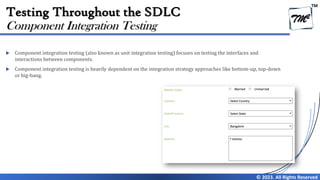
 Component integration testing (also known as unit integration testing) focuses on testing the interfaces and
interactions between components.
 Component integration testing is heavily dependent on the integration strategy approaches like bottom-up, top-down
or big-bang.
Component Integration Testing
TM
© 2023. All Rights Reserved
Testing Throughout the SDLC
 System testing focuses on the overall behavior and capabilities of an entire system or product, often including
functional testing of end-to-end tasks and the non-functional testing of quality characteristics.
 For some non-functional quality characteristics, it is preferable to test them on a complete system in a representative
test environment (e.g., usability).
 Using simulations of sub-systems is also possible. System testing may be performed by an independent test team, and is
related to specifications for the system.
 System testing might be required to address incomplete requirements and Product Risk.
System Testing
TM
© 2023. All Rights Reserved
Testing Throughout the SDLC
 System integration testing focuses on testing the interfaces of the system under test and other systems and external
services .
 System integration testing requires suitable test environments preferably similar to the operational environment.
 System Integration is possible in following combinations
 Software – Software
 Software – Hardware
 Hardware – Hardware
System Integration Testing
TM
© 2023. All Rights Reserved
Testing Throughout the SDLC
 Acceptance testing focuses on validation and on demonstrating readiness for deployment, which means that the system
fulfills the user’s business needs.
 Ideally, acceptance testing should be performed by the intended users.
 The main forms of acceptance testing are:
 User acceptance testing (UAT)
 Operational acceptance testing,
 Contractual and regulatory acceptance testing
 Acceptance testing is conducted in two Sub-Levels
 Alpha testing and
 Beta testing.
Acceptance Testing
TM
© 2023. All Rights Reserved
Testing Throughout the SDLC
Content
2.2.1. Test Levels
2.2.2. Test Types
2.2.3. Confirmation Testing and
Regression Testing
TM
© 2023. All Rights Reserved
Testing Throughout the SDLC
Functional Testing
 Functional testing is all about testing the core features of testing.
 The functions are “WHAT” the system does.
 The general levels like – Unit Testing, Integration Testing, System Testing and Acceptance Testing are conducted as
Functional level of testing.
Non-Functional Testing
 Non-Functional testing is about enhancing the quality characteristics of the system.
 The non-functions are “HOW” the system works.
 The non-functional testing includes, but not limited to, performance testing, stress testing, load testing, usability
testing, maintainability testing, reliability testing and portability testing.
Functional Vs Non- Functional
TM
© 2023. All Rights Reserved
Testing Throughout the SDLC
White Box Testing
 White-box testing is structure-based and derives tests from the system's implementation or internal structure (e.g.,
code, architecture, work flows, and data flows).
 The main objective of white-box testing is to cover the underlying structure by the tests to the acceptable level
Black Box Testing
 Black-box testing is specification-based and derives tests from documentation external to the test object.
 The main objective of black-box testing is checking the system's behavior against its specifications.
 Typically Conducted by Testers
All the four above mentioned test types can be applied to all test levels, although the focus will be different at each level.
Different test techniques can be used to derive test conditions and test cases for all the mentioned test types.
White Box vs Black Box Testing
TM
© 2023. All Rights Reserved
Testing Throughout the SDLC
Content
2.2.1. Test Levels
2.2.2. Test Types
2.2.3. Confirmation Testing and
Regression Testing
TM
© 2023. All Rights Reserved
Testing Throughout the SDLC
Changes are typically made to a component or system to either enhance it by adding a new feature or to fix it by removing a
defect. Testing should then also include confirmation testing and regression testing.
Confirmation Testing (Retesting)
 Confirmation testing confirms that an original defect has been successfully fixed. Depending on the risk, one can test
the fixed version of the software in several ways, including:
 executing all test cases that previously have failed due to the defect, or, also by
 adding new tests to cover any changes that were needed to fix the defect
However, when time or money is short when fixing defects, confirmation testing might be restricted to simply exercising
the steps that should reproduce the failure caused by the defect and checking that the failure does not occur.
Confirmation & Regression Testing
TM
© 2023. All Rights Reserved
Testing Throughout the SDLC
Regression Testing
 Regression testing confirms that no adverse consequences have been caused by a change, including a fix that has
already been confirmation tested. These adverse consequences could affect the same component where the change was
made, other components in the same system, or even other connected systems.
 Regression testing may not be restricted to the test object itself but can also be related to the environment. It is
advisable first to perform an impact analysis to optimize the extent of the regression testing. Impact analysis shows
which parts of the software could be affected.
 Regression test suites are run many times and generally the number of regression test cases will increase with each
iteration or release, so regression testing is a strong candidate for automation.
 Automation of these tests should start early in the project. Where CI is used, such as in DevOps, it is good practice to
also include automated regression tests. Depending on the situation, this may include regression tests on different
levels.
Confirmation testing and/or regression testing for the test object are needed on all test levels if defects are fixed and/or
changes are made on these test levels.
Confirmation & Regression Testing
TM
© 2023. All Rights Reserved
Testing Throughout the SDLC
Content
2.1 Testing in the Context of a Software
Development Lifecycle
2.2 Test Levels and Test Types
2.3 Maintenance Testing
TM
© 2023. All Rights Reserved
Testing Throughout the SDLC
 There are different categories of maintenance, it can be corrective, adaptive to changes in the environment or improve
performance or maintainability, so maintenance can involve planned releases/deployments and unplanned
releases/deployments (hot fixes).
 Impact analysis may be done before a change is made, to help decide if the change should be made, based on the
potential consequences in other areas of the system.
 Testing the changes to a system in production includes both evaluating the success of the implementation of the change
and the checking for possible regressions in parts of the system that remain unchanged (which is usually most of the
system).
The scope of maintenance testing typically depends on:
 The degree of risk of the change
 The size of the existing system
 The size of the change
Maintenance Testing
TM
© 2023. All Rights Reserved
Testing Throughout the SDLC
The triggers for maintenance and maintenance testing can be classified as follows:
 Modifications, such as planned enhancements (i.e., release-based), corrective changes or hot fixes.
 Upgrades or migrations of the operational environment, such as from one platform to another, which can require
tests associated with the new environment as well as of the changed software, or tests of data conversion when data
from another application is migrated into the system being maintained.
 Retirement, such as when an application reaches the end of its life. When a system is retired, this can require testing of
data archiving if long data-retention periods are required. Testing of restore and retrieval procedures after archiving
may also be needed in the event that certain data is required during the archiving period.
Maintenance Testing
TM
© 2023. All Rights Reserved
Testing Throughout the SDLC
1. Consider the following rule: “for every SDLC activity there is a corresponding test activity”. In which SDLC models
does this rule hold?
Answer Set
A. Only in sequential SDLC models
B. Only in iterative SDLC models
C. Only in iterative and incremental SDLC models
D. In sequential, incremental, and iterative SDLC models
Sample Questions
TM
© 2023. All Rights Reserved
Testing Throughout the SDLC
2. Which of the following is NOT an example of the shift left approach?
Answer Set
A. Reviewing the user requirements before they are formally accepted by the stakeholders
B. Writing a component test before the corresponding code is written
C. Executing a performance efficiency test for a component during component testing
D. Writing a test script before setting up the configuration management process
Sample Questions
TM
© 2023. All Rights Reserved
Testing Throughout the SDLC
3. You are testing a user story with three acceptance criteria: AC1, AC2 and AC3. AC1 is covered by test case TC1,
AC2 by TC2, and AC3 by TC3. The test execution history had three test runs on three consecutive versions of the
software as follows:
Tests are repeated once you are informed that all defects found in the test run are corrected and a new version of
the software is available. Which of the above tests are executed as regression tests?
Answer Set
A. Only 4, 7, 8, 9
B. Only 5, 7
C. Only 4, 6, 8, 9
D. Only 5, 6
Sample Questions

Chapter 2 - Testing Throughout SDLC V4.0

  • 1.
    Testing Throughout SDLC 1Fundamentals 2 Testing in Lifecycle 4 Analysis & Design 3 Static testing 5 Test Management 6 Test Tools ISTQB Foundation Chapter -2
  • 2.
    TM © 2023. AllRights Reserved Testing Throughout the SDLC Content 2.1 Testing in the Context of a Software Development Lifecycle 2.2 Test Levels and Test Types 2.3 Maintenance Testing
  • 3.
    TM © 2023. AllRights Reserved Testing Throughout the SDLC Content 2.1.1. Impact of the Software Development Lifecycle on Testing 2.1.2. Software Development Lifecycle and Good Testing Practices 2.1.3. Testing as a Driver for Software Development 2.1.4. DevOps and Testing 2.1.5. Shift-Left Approach 2.1.6. Retrospectives and Process Improvement
  • 4.
    TM © 2023. AllRights Reserved Testing Throughout the SDLC  A software development lifecycle (SDLC) model is an abstract, high-level representation of the software development process. A SDLC model defines how different development phases and types of activities performed within this process relate to each other, both logically and chronologically.  Examples of SDLC models include: sequential development models (e.g., waterfall model, V-model), iterative development models (e.g., spiral model, prototyping), and incremental development models (e.g., Unified Process).  Some activities within software development processes can also be described by more detailed software development methods and Agile practices.  Examples include: acceptance test-driven development (ATDD), behavior-driven development (BDD), domain-driven design (DDD), extreme programming (XP), feature-driven development (FDD), Kanban, Lean IT, Scrum, and test-driven development (TDD). in release. Testing in the Context of SDLC
  • 5.
    TM © 2023. AllRights Reserved Testing Throughout the SDLC Testing must be adapted to the SDLC to succeed. The choice of the SDLC impacts on the:  Scope and timing of test activities (e.g., test levels and test types)  Level of detail of test documentation  Choice of test techniques and test approach  Extent of test automation  Role and responsibilities of a tester Impact of SDLC on Testing
  • 6.
    TM © 2023. AllRights Reserved Testing Throughout the SDLC  In sequential development models, in the initial phases testers typically participate in requirement reviews, test analysis, and test design. The executable code is usually created in the later phases, so typically dynamic testing cannot be performed early in the SDLC.  In some iterative and incremental development models, it is assumed that each iteration delivers a working prototype or product increment. This implies that in each iteration both static and dynamic testing may be performed at all test levels. Frequent delivery of increments requires fast feedback and extensive regression testing.  Agile software development assumes that change may occur throughout the project. Therefore, lightweight work product documentation and extensive test automation to make regression testing easier are favored in agile projects. Also, most of the manual testing tends to be done using experience-based test techniques that do not require extensive prior test analysis and design. Impact of SDLC on Testing
  • 7.
    TM © 2023. AllRights Reserved Testing Throughout the SDLC Good testing practices, independent of the chosen SDLC model, include the following:  For every software development activity, there is a corresponding test activity, so that all development activities are subject to quality control  Different test levels have specific and different test objectives, which allows for testing to be appropriately comprehensive while avoiding redundancy  Test analysis and design for a given test level begins during the corresponding development phase of the SDLC, so that testing can adhere to the principle of early testing  Testers are involved in reviewing work products as soon as drafts of this documentation are available, so that this earlier testing and defect detection can support the shift-left strategy SDLC and Good Testing Practices
  • 8.
    TM © 2023. AllRights Reserved Testing Throughout the SDLC Content 2.1.1. Impact of the Software Development Lifecycle on Testing 2.1.2. Software Development Lifecycle and Good Testing Practices 2.1.3. Testing as a Driver for Software Development 2.1.4. DevOps and Testing 2.1.5. Shift-Left Approach 2.1.6. Retrospectives and Process Improvement
  • 9.
    TM © 2023. AllRights Reserved Testing Throughout the SDLC TDD, ATDD and BDD are similar development approaches, where tests are defined as a means of directing development. Each of these approaches implements the principle of early testing and follows a shift-left approach, since the tests are defined before the code is written. They support an iterative development model. These approaches are characterized as follows: Test-Driven Development (TDD):  Directs the coding through test cases (instead of extensive software design)  Tests are written first, then the code is written to satisfy the tests, and then the tests and code are refactored Acceptance Test-Driven Development (ATDD):  Derives tests from acceptance criteria as part of the system design process  Tests are written before the part of the application is developed to satisfy the tests Behavior-Driven Development (BDD):  Expresses the desired behavior of an application with test cases written in a simple form of natural language, which is easy to understand by stakeholders – usually using the Given/When/Then format.  Test cases are then automatically translated into executable tests Testing as a Driver for Software Development
  • 10.
    TM © 2023. AllRights Reserved Testing Throughout the SDLC Content 2.1.1. Impact of the Software Development Lifecycle on Testing 2.1.2. Software Development Lifecycle and Good Testing Practices 2.1.3. Testing as a Driver for Software Development 2.1.4. DevOps and Testing 2.1.5. Shift-Left Approach 2.1.6. Retrospectives and Process Improvement
  • 11.
    TM © 2023. AllRights Reserved Testing Throughout the SDLC DevOps is an organizational approach aiming to create synergy by getting development (including testing) and operations to work together to achieve a set of common goals. DevOps requires a cultural shift within an organization to bridge the gaps between development (including testing) and operations while treating their functions with equal value. DevOps promotes team autonomy, fast feedback, integrated toolchains, and technical practices like continuous integration (CI) and continuous delivery (CD). This enables the teams to build, test and release high-quality code faster through a DevOps delivery pipeline DevOps and Testing
  • 12.
    TM © 2023. AllRights Reserved Testing Throughout the SDLC From the testing perspective, some of the benefits of DevOps are:  Fast feedback on the code quality, and whether changes adversely affect existing code  CI promotes a shift-left approach in testing by encouraging developers to submit high quality code accompanied by component tests and static analysis  Promotes automated processes like CI/CD that facilitate establishing stable test environments  Increases the view on non-functional quality characteristics (e.g., performance, reliability)  Automation through a delivery pipeline reduces the need for repetitive manual testing  The risk in regression is minimized due to the scale and range of automated regression tests DevOps is not without its risks and challenges, which include:  The DevOps delivery pipeline must be defined and established  CI / CD tools must be introduced and maintained  Test automation requires additional resources and may be difficult to establish and maintain DevOps and Testing
  • 13.
    TM © 2023. AllRights Reserved Testing Throughout the SDLC Content 2.1.1. Impact of the Software Development Lifecycle on Testing 2.1.2. Software Development Lifecycle and Good Testing Practices 2.1.3. Testing as a Driver for Software Development 2.1.4. DevOps and Testing 2.1.5. Shift-Left Approach 2.1.6. Retrospectives and Process Improvement
  • 14.
    TM © 2023. AllRights Reserved Testing Throughout the SDLC There are some good practices that illustrate how to achieve a “shift-left” in testing, which include:  Reviewing the specification from the perspective of testing. These review activities on specifications often find potential defects, such as ambiguities, incompleteness, and inconsistencies  Writing test cases before the code is written and have the code run in a test harness during code implementation  Using CI and even better CD as it comes with fast feedback and automated component tests to accompany source code when it is submitted to the code repository  Completing static analysis of source code prior to dynamic testing, or as part of an automated process  Performing non-functional testing starting at the component test level, where possible. This is a form of shift-left as these non-functional test types tend to be performed later in the SDLC when a complete system and a representative test environment are available A shift-left approach might result in extra training, effort and/or costs earlier in the process but is expected to save efforts and/or costs later in the process. For the shift-left approach it is important that stakeholders are convinced and bought into this concept. Shift-Left Approach
  • 15.
    TM © 2023. AllRights Reserved Testing Throughout the SDLC Content 2.1.1. Impact of the Software Development Lifecycle on Testing 2.1.2. Software Development Lifecycle and Good Testing Practices 2.1.3. Testing as a Driver for Software Development 2.1.4. DevOps and Testing 2.1.5. Shift-Left Approach 2.1.6. Retrospectives and Process Improvement
  • 16.
    TM © 2023. AllRights Reserved Testing Throughout the SDLC Retrospectives (also known as “post-project meetings” and project retrospectives) are often held at the end of a project or an iteration, at a release milestone, or can be held when needed. The timing and organization of the retrospectives depend on the particular SDLC model being followed. In these meetings the participants (not only testers, but also e.g., developers, architects, product owner, business analysts) discuss:  What was successful, and should be retained?  What was not successful and could be improved?  How to incorporate the improvements and retain the successes in the future? Retrospective and Process Improvement
  • 17.
    TM © 2023. AllRights Reserved Testing Throughout the SDLC The results should be recorded and are normally part of the test completion report. Retrospectives are critical for the successful implementation of continuous improvement and it is important that any recommended improvements are followed up. Typical benefits for testing include:  Increased test effectiveness / efficiency (e.g., by implementing suggestions for process improvement)  Increased quality of testware (e.g., by jointly reviewing the test processes)  Team bonding and learning (e.g., as a result of the opportunity to raise issues and propose improvement points)  Improved quality of the test basis (e.g., as deficiencies in the extent and quality of the requirements could be addressed and solved)  Better cooperation between development and testing (e.g., as collaboration is reviewed and optimized regularly) Retrospective and Process Improvement
  • 18.
    TM © 2023. AllRights Reserved Testing Throughout the SDLC Content 2.1 Testing in the Context of a Software Development Lifecycle 2.2 Test Levels and Test Types 2.3 Maintenance Testing
  • 19.
    TM © 2023. AllRights Reserved Testing Throughout the SDLC Content 2.2.1. Test Levels 2.2.2. Test Types 2.2.3. Confirmation Testing and Regression Testing
  • 20.
    TM © 2023. AllRights Reserved Testing Throughout the SDLC  Test levels are groups of test activities that are organized and managed together.  Each test level is an instance of the test process, performed in relation to software at a given stage of development, from individual components to complete systems or, where applicable, systems of systems.  Test levels are related to other activities within the SDLC.  In sequential SDLC models, the test levels are often defined such that the exit criteria of one level are part of the entry criteria for the next level. In some iterative models, this may not apply. Development activities may span through multiple test levels. Test levels may overlap in time.  Test types are groups of test activities related to specific quality characteristics and most of those test activities can be performed at every test level. Test levels and Test Types
  • 21.
    TM © 2023. AllRights Reserved Testing Throughout the SDLC  Component testing (also known as unit testing) focuses on testing components in isolation.  Component Testing is also known as Unit, Program, Class, Code, Structure, Module Testing  It often requires specific support, such as test harnesses or unit test frameworks.  Component testing is normally performed by developers in their development environments.  Will be performed as White Box Testing Approach Component Testing
  • 22.
    TM © 2023. AllRights Reserved Testing Throughout the SDLC  Component integration testing (also known as unit integration testing) focuses on testing the interfaces and interactions between components.  Component integration testing is heavily dependent on the integration strategy approaches like bottom-up, top-down or big-bang. Component Integration Testing
  • 23.
    TM © 2023. AllRights Reserved Testing Throughout the SDLC  System testing focuses on the overall behavior and capabilities of an entire system or product, often including functional testing of end-to-end tasks and the non-functional testing of quality characteristics.  For some non-functional quality characteristics, it is preferable to test them on a complete system in a representative test environment (e.g., usability).  Using simulations of sub-systems is also possible. System testing may be performed by an independent test team, and is related to specifications for the system.  System testing might be required to address incomplete requirements and Product Risk. System Testing
  • 24.
    TM © 2023. AllRights Reserved Testing Throughout the SDLC  System integration testing focuses on testing the interfaces of the system under test and other systems and external services .  System integration testing requires suitable test environments preferably similar to the operational environment.  System Integration is possible in following combinations  Software – Software  Software – Hardware  Hardware – Hardware System Integration Testing
  • 25.
    TM © 2023. AllRights Reserved Testing Throughout the SDLC  Acceptance testing focuses on validation and on demonstrating readiness for deployment, which means that the system fulfills the user’s business needs.  Ideally, acceptance testing should be performed by the intended users.  The main forms of acceptance testing are:  User acceptance testing (UAT)  Operational acceptance testing,  Contractual and regulatory acceptance testing  Acceptance testing is conducted in two Sub-Levels  Alpha testing and  Beta testing. Acceptance Testing
  • 26.
    TM © 2023. AllRights Reserved Testing Throughout the SDLC Content 2.2.1. Test Levels 2.2.2. Test Types 2.2.3. Confirmation Testing and Regression Testing
  • 27.
    TM © 2023. AllRights Reserved Testing Throughout the SDLC Functional Testing  Functional testing is all about testing the core features of testing.  The functions are “WHAT” the system does.  The general levels like – Unit Testing, Integration Testing, System Testing and Acceptance Testing are conducted as Functional level of testing. Non-Functional Testing  Non-Functional testing is about enhancing the quality characteristics of the system.  The non-functions are “HOW” the system works.  The non-functional testing includes, but not limited to, performance testing, stress testing, load testing, usability testing, maintainability testing, reliability testing and portability testing. Functional Vs Non- Functional
  • 28.
    TM © 2023. AllRights Reserved Testing Throughout the SDLC White Box Testing  White-box testing is structure-based and derives tests from the system's implementation or internal structure (e.g., code, architecture, work flows, and data flows).  The main objective of white-box testing is to cover the underlying structure by the tests to the acceptable level Black Box Testing  Black-box testing is specification-based and derives tests from documentation external to the test object.  The main objective of black-box testing is checking the system's behavior against its specifications.  Typically Conducted by Testers All the four above mentioned test types can be applied to all test levels, although the focus will be different at each level. Different test techniques can be used to derive test conditions and test cases for all the mentioned test types. White Box vs Black Box Testing
  • 29.
    TM © 2023. AllRights Reserved Testing Throughout the SDLC Content 2.2.1. Test Levels 2.2.2. Test Types 2.2.3. Confirmation Testing and Regression Testing
  • 30.
    TM © 2023. AllRights Reserved Testing Throughout the SDLC Changes are typically made to a component or system to either enhance it by adding a new feature or to fix it by removing a defect. Testing should then also include confirmation testing and regression testing. Confirmation Testing (Retesting)  Confirmation testing confirms that an original defect has been successfully fixed. Depending on the risk, one can test the fixed version of the software in several ways, including:  executing all test cases that previously have failed due to the defect, or, also by  adding new tests to cover any changes that were needed to fix the defect However, when time or money is short when fixing defects, confirmation testing might be restricted to simply exercising the steps that should reproduce the failure caused by the defect and checking that the failure does not occur. Confirmation & Regression Testing
  • 31.
    TM © 2023. AllRights Reserved Testing Throughout the SDLC Regression Testing  Regression testing confirms that no adverse consequences have been caused by a change, including a fix that has already been confirmation tested. These adverse consequences could affect the same component where the change was made, other components in the same system, or even other connected systems.  Regression testing may not be restricted to the test object itself but can also be related to the environment. It is advisable first to perform an impact analysis to optimize the extent of the regression testing. Impact analysis shows which parts of the software could be affected.  Regression test suites are run many times and generally the number of regression test cases will increase with each iteration or release, so regression testing is a strong candidate for automation.  Automation of these tests should start early in the project. Where CI is used, such as in DevOps, it is good practice to also include automated regression tests. Depending on the situation, this may include regression tests on different levels. Confirmation testing and/or regression testing for the test object are needed on all test levels if defects are fixed and/or changes are made on these test levels. Confirmation & Regression Testing
  • 32.
    TM © 2023. AllRights Reserved Testing Throughout the SDLC Content 2.1 Testing in the Context of a Software Development Lifecycle 2.2 Test Levels and Test Types 2.3 Maintenance Testing
  • 33.
    TM © 2023. AllRights Reserved Testing Throughout the SDLC  There are different categories of maintenance, it can be corrective, adaptive to changes in the environment or improve performance or maintainability, so maintenance can involve planned releases/deployments and unplanned releases/deployments (hot fixes).  Impact analysis may be done before a change is made, to help decide if the change should be made, based on the potential consequences in other areas of the system.  Testing the changes to a system in production includes both evaluating the success of the implementation of the change and the checking for possible regressions in parts of the system that remain unchanged (which is usually most of the system). The scope of maintenance testing typically depends on:  The degree of risk of the change  The size of the existing system  The size of the change Maintenance Testing
  • 34.
    TM © 2023. AllRights Reserved Testing Throughout the SDLC The triggers for maintenance and maintenance testing can be classified as follows:  Modifications, such as planned enhancements (i.e., release-based), corrective changes or hot fixes.  Upgrades or migrations of the operational environment, such as from one platform to another, which can require tests associated with the new environment as well as of the changed software, or tests of data conversion when data from another application is migrated into the system being maintained.  Retirement, such as when an application reaches the end of its life. When a system is retired, this can require testing of data archiving if long data-retention periods are required. Testing of restore and retrieval procedures after archiving may also be needed in the event that certain data is required during the archiving period. Maintenance Testing
  • 35.
    TM © 2023. AllRights Reserved Testing Throughout the SDLC 1. Consider the following rule: “for every SDLC activity there is a corresponding test activity”. In which SDLC models does this rule hold? Answer Set A. Only in sequential SDLC models B. Only in iterative SDLC models C. Only in iterative and incremental SDLC models D. In sequential, incremental, and iterative SDLC models Sample Questions
  • 36.
    TM © 2023. AllRights Reserved Testing Throughout the SDLC 2. Which of the following is NOT an example of the shift left approach? Answer Set A. Reviewing the user requirements before they are formally accepted by the stakeholders B. Writing a component test before the corresponding code is written C. Executing a performance efficiency test for a component during component testing D. Writing a test script before setting up the configuration management process Sample Questions
  • 37.
    TM © 2023. AllRights Reserved Testing Throughout the SDLC 3. You are testing a user story with three acceptance criteria: AC1, AC2 and AC3. AC1 is covered by test case TC1, AC2 by TC2, and AC3 by TC3. The test execution history had three test runs on three consecutive versions of the software as follows: Tests are repeated once you are informed that all defects found in the test run are corrected and a new version of the software is available. Which of the above tests are executed as regression tests? Answer Set A. Only 4, 7, 8, 9 B. Only 5, 7 C. Only 4, 6, 8, 9 D. Only 5, 6 Sample Questions