People Skills – Team Composition
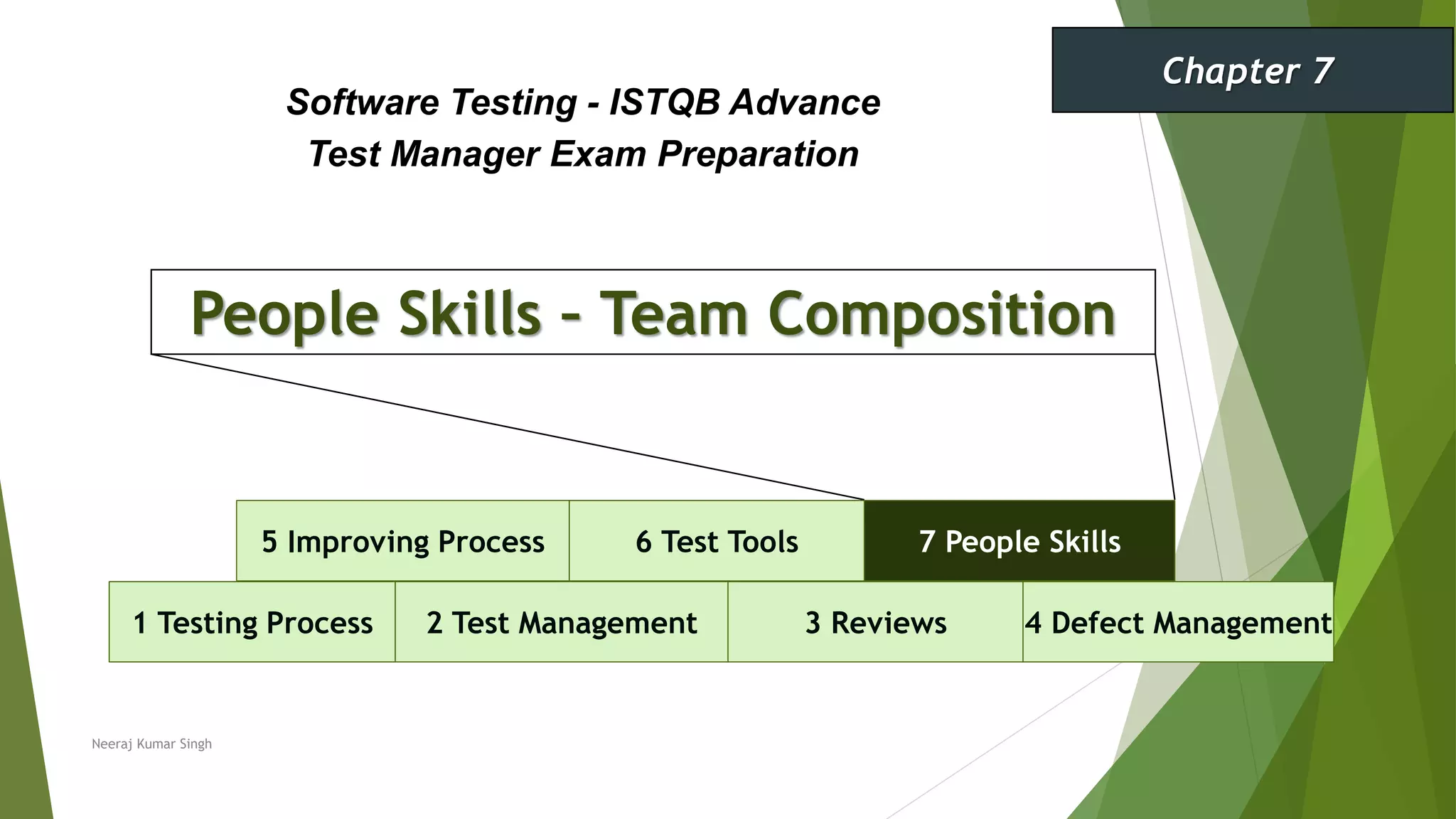
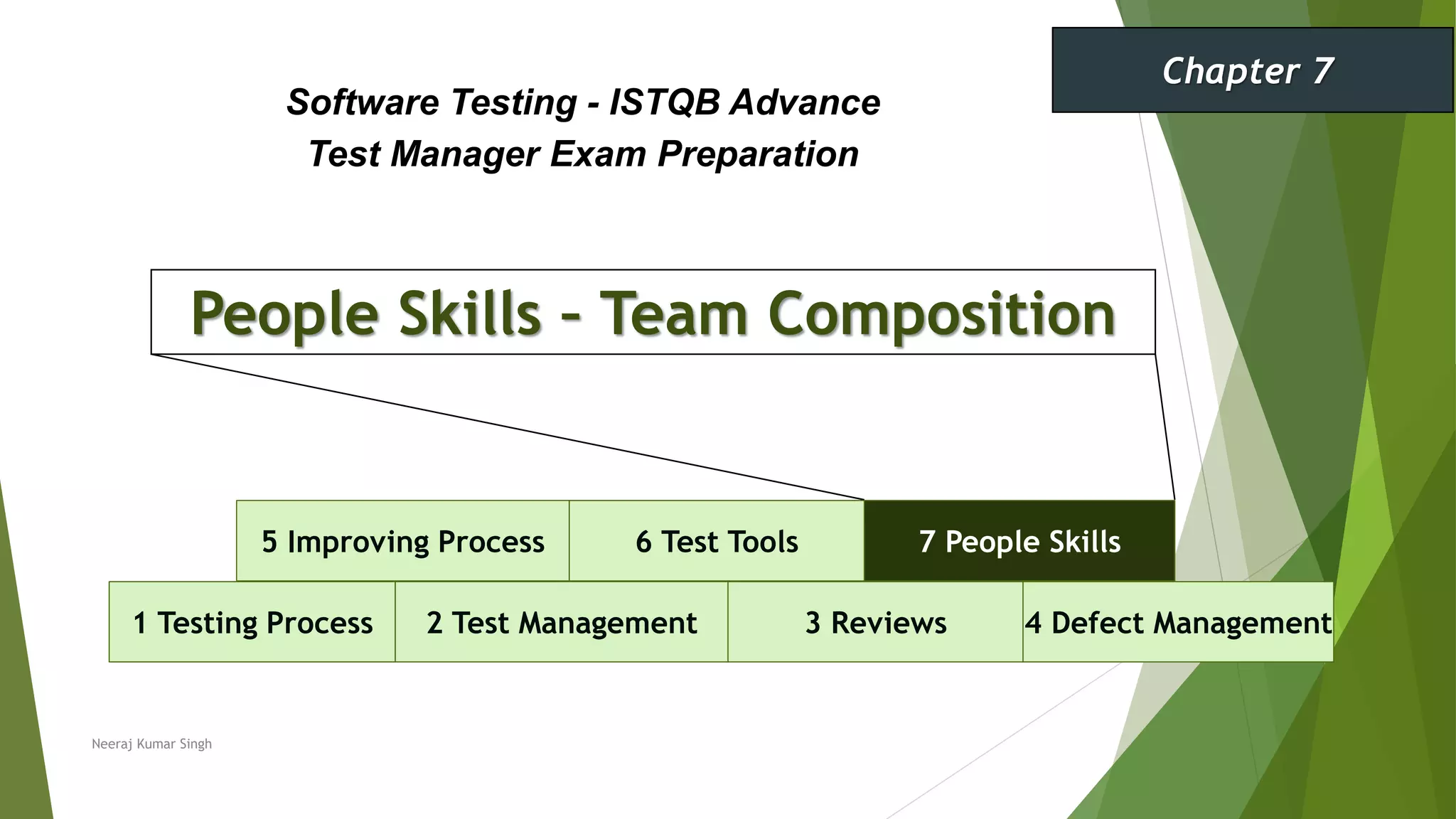
1 Testing Process 2 Test Management 3 Reviews
Software Testing - ISTQB Advance
Test Manager Exam Preparation
Chapter 7
Neeraj Kumar Singh
4 Defect Management
5 Improving Process 6 Test Tools 7 People Skills
People Skills – Team Composition
Contents
7.1 Introduction
7.2 Individual Skills
7.3 Test Team Dynamics
7.4 Fitting Testing Within an Organization
7.5 Motivation
7.6 Communication
Neeraj Kumar Singh
Successful Test Managers recruit, hire and maintain teams with the proper mix of skills. Skills requirements may change
over time, so in addition to hiring the right people in the first place, providing adequate training and growth
opportunities are important in order to retain the test team and maintain it at a level of peak performance.
In addition to the skills of the team, the Test Manager must also maintain a set of skills that will allow effective
functioning in a high pressure, fast-paced environment.
This chapter looks at how to assess skills, how to fill in the gaps to create a synergistic team that is internally cohesive
and is effective in an organization, and also how to motivate that team and how to communicate effectively.
People Skills – Team Composition
Introduction
People Skills – Team Composition
Contents
7.1 Introduction
7.2 Individual Skills
7.3 Test Team Dynamics
7.4 Fitting Testing Within an Organization
7.5 Motivation
7.6 Communication
Neeraj Kumar Singh
An individual's ability to test software can be obtained through experience or by education and training. Each of the
following can contribute to the tester's knowledge base:
 Use of software systems
 Knowledge of the domain or business
 Participation in various phases of the software development process activities including analysis, development and
technical support
 Participation in software testing activities
End-users of software systems have a good understanding of how the system works, where failures would have the
greatest impact, and how the system should react in various situations. Users with domain expertise know which areas
are of most importance to the business and how those areas affect the ability of the business to meet its requirements.
Knowledge of the software development process (requirements analysis, architecture, design and coding) gives insight
into how errors lead to the introduction of defects, where defects can be detected and how to prevent the introduction
of defects in the first place.
Specific software testing skills include the capabilities discussed in the Foundation, Advanced Test Analyst, and
Advanced Technical Test Analyst syllabi, such as the ability to analyze a specification, participate in risk analysis, design
test cases, and the diligence for running tests and recording the results.
People Skills – Team Composition
Individual Skills
Neeraj Kumar Singh
Specifically for Test Managers, having knowledge, skills and experience in project management is important since test
management includes many project management activities, e.g., making a plan, tracking progress and reporting to
stakeholders.
In addition to technical skills, interpersonal skills, such as giving and receiving constructive criticism, influencing, and
negotiating, are all important in the role of testing. Technically competent testers are likely to fail unless they also
possess and employ the necessary soft skills.
The ideal test team has a mix of skills and experience levels, and the team members should have a willingness and
ability to teach and learn from their peers. In some environments, some skills will be more important or more respected
than others.
The Test Manager should list all the skills that are important to the job as well as being appropriate to the position.
Once those skills are itemized, each individual in the team can be assessed against a scoring system.
People should be hired for the long term, not for their contribution on a single project. When the Test Manager invests
in the testers and creates an environment of continuous learning, the team members will be motivated to increase their
skills and knowledge so they will be ready for the next opportunity.
A Test Manager will rarely be able to hire the perfect team members. And, even if the team members are perfect for
the current project, they may not be the perfect mix for the next project. The Test Manager should hire people who are
intelligent, curious, adaptable, willing to work, able to work effectively as part of a team, and willing and able to learn.
People Skills – Team Composition
Individual Skills
Neeraj Kumar Singh
People Skills – Team Composition
Contents
7.1 Introduction
7.2 Individual Skills
7.3 Test Team Dynamics
7.4 Fitting Testing Within an Organization
7.5 Motivation
7.6 Communication
Neeraj Kumar Singh
To build the best team possible, staff selection is one of the most important functions of a management role in the
organization. There are many items to consider in addition to the specific individual skills required for the job.
When selecting an individual to join the team, the dynamics of the team must be considered. Will this person
complement the skills and personality types that already exist within the test team? It is important to consider the
advantages of having a variety of personality types on the test team as well as a mix of technical skills.
A strong test team is able to deal with multiple projects of varying complexity while also successfully handling the
interpersonal interactions with the other project team members.
Testing is often a high pressure activity. Software development schedules are often compressed, even unrealistic.
Stakeholders have high expectations of the test team, sometimes unreasonably so.
The Test Manager must hire people who will deal well with high pressure situations, who can deflect frustration and who
can concentrate on the work even when the schedules seem impossible. It is up to the Test Manager to deal with
schedule and expectation issues, but the Test Manager must also understand that these pressures are felt by the team
members as well.
When the Test Manager is acquiring people for the team, it is important to consider the working environment and to
match the personality types to that environment. In an environment where there is more work than time, the Test
Manager should be seeking people who finish their tasks and ask what they can do next.
People Skills – Team Composition
Test Team Dynamics
Neeraj Kumar Singh
When determining whom to hire or add to the test team, an objective assessment of skills can be helpful. This can be done via
interviewing, testing the candidate, reviewing work samples and by verifying references. Skills that should be assessed include:
Technical skills (hard skills) can be demonstrated by:
 Deriving test cases from a requirements document
 Reviewing technical documentation (requirements, code, etc.)
 Writing review comments in a clear, understandable and objective way
 Applying various testing techniques appropriately to given scenarios (e.g., using decision tables to test a set of business
rules)
 Assessing a failure and documenting it accurately
 Demonstrating an understanding of defect classification information
 Demonstrating an understanding of root causes of defects
 Using a tool to test a given API, including positive and negative tests
 Using SQL to find and alter database information to test a given scenario
 Designing a test automation harness that will execute multiple tests and gather test results
 Executing automated tests and troubleshooting failures
 Writing test plans/specifications
 Writing a test summary reports that includes an assessment of the test results
People Skills – Team Composition
Test Team Dynamics
Neeraj Kumar Singh
Interpersonal skills (soft skills) can be demonstrated by:
 Presenting information regarding a test project that is behind schedule
 Explaining a defect report to a developer who thinks there is no defect
 Training a co-worker
 Presenting a problem to management regarding a process that is not effective
 Reviewing a test case created by a co-worker and presenting the comments to that person
 Interviewing a co-worker
 Complimenting a developer
While this is not a complete list and the specific desired skills will vary between environments and organizations, it is a
list of skills that are commonly needed. By creating effective interview questions and allowing skills demonstrations, the
Test Manager can assess the skills of the candidate and determine areas of strength and weakness.
In addition to the skills needed by the individual contributors, the Test Manager must also possess excellent
communication and diplomatic skills. The Test Manager must be able to defuse controversial situations, must know the
correct media to use for the necessary communication and must be able to focus on building and maintaining
relationships within the organization.
People Skills – Team Composition
Test Team Dynamics
Neeraj Kumar Singh
People Skills – Team Composition
Contents
7.1 Introduction
7.2 Individual Skills
7.3 Test Team Dynamics
7.4 Fitting Testing Within an Organization
7.5 Motivation
7.6 Communication
Neeraj Kumar Singh
Organizations have many ways to fit testing into the organizational structure. While quality is everyone's responsibility
throughout the software development lifecycle, an independent test team can contribute significantly to a quality
product. Independence of the testing function varies widely in practice, as seen from the following list, ordered from
least to most independence:
No independent testers
 In this case there is no independence and the code is being tested by the developer who wrote it
 The developer, if allowed time to do the testing, will determine that the code works as intended, which may or may
not match the actual requirements
 The developer can fix any found defects quickly
Testing is done by a developer other than the one who wrote the code
 There is little independence between the developer and the tester
 A developer testing another developer's code may be reluctant to report defects
 A developer mind set toward testing is usually focused on positive test cases
People Skills – Team Composition
Fitting Testing Within an Organization
Neeraj Kumar Singh
Testing is done by a tester (or test team) that is part of the development team
 The tester (or test team) may report to project management or may report to the development manager
 The tester mind set is focused more on verifying adherence to requirements
 Because the tester is a member of the development team, the tester may have development responsibilities in
addition to testing
 The tester’s manager may be more focused on meeting schedule than achieving quality goals
 Testing may be given a lower status in the team than development
 The tester may have no authority to influence the quality goals or the adherence to those goals
Testing is done by test specialists from the business organization, user community, or other non-development technical
organization
 Test results information is reported objectively to the stakeholders
 Quality is the primary focus of this team
 Skills development and training are focused on testing
 Testing is seen as a career path
 There is specific management devoted to the testing group that is quality-focused
People Skills – Team Composition
Fitting Testing Within an Organization
Neeraj Kumar Singh
External test specialists perform testing on specific test types
 Expertise is applied to specific areas where generalized testing is likely to be insufficient
 Test types could be usability, security, performance or other areas where specialization is necessary
 Quality should be the focus of these individuals, but their view is limited to their areas of specialty. A product that
performs well may not meet its functional requirements, but that may go undetected by the performance
specialist.
Testing is done by an organization external to the company
 This model achieves the maximum independence between the tester and the developer
 Knowledge transfer may not be sufficient for the tester to test competently
 Clear requirements and a well-defined communication structure will be needed
 Quality of the external organization must be audited regularly
This list is based on the typical focus of the individuals, but that may not be true in a particular organization. A position
and title do not necessarily determine a person’s focus.
There are varying degrees of independence between the development and testing organizations. It is important to
understand that there may be a tradeoff where more independence results in more isolation and less knowledge
transfer. A lower level of independence may increase knowledge, but can also introduce conflicting goals. The level of
independence will also be determined by the software development model being used, e.g., within Agile development
the testers are most often part of the development team.
People Skills – Team Composition
Fitting Testing Within an Organization
Neeraj Kumar Singh
People Skills – Team Composition
Contents
7.1 Introduction
7.2 Individual Skills
7.3 Test Team Dynamics
7.4 Fitting Testing Within an Organization
7.5 Motivation
7.6 Communication
Neeraj Kumar Singh
There are many ways to motivate an individual in a testing position. These include:
 Recognition for the job accomplished
 Approval by management
 Respect within the project team and among peers
 Increased responsibility and autonomy
 Adequate rewards for the work done (including salary, increased responsibility, recognition)
There are project influences that can make these motivational tools difficult to apply. For example, a tester can work
very hard on a project that has an impossible deadline. The tester can do everything possible to drive the quality focus
of the team, put in extra hours and effort, and yet the product may ship before it should due to external influences.
The result may be a poor quality product despite the best efforts of the tester. This can easily be a demotivator if the
tester's contribution is not understood and measured, regardless of whether the end product is successful.
The test team must ensure that it is tracking the appropriate metrics to prove that a good job was done to accomplish
the testing, mitigate risks and accurately record the results. Unless this data is gathered and published, it is easy for a
team to become demotivated when they do not receive the recognition they feel is due for a job well-done.
People Skills – Team Composition
Motivation
Neeraj Kumar Singh
Recognition is not just determined in the intangibles of respect and approval, it is also apparent in promotion
opportunities, increased responsibility and merit increases. If the testing group is not respected, these opportunities
may not be available.
Recognition and respect are acquired when it is clear that the tester contributes to the incremental value of the
project. In an individual project this is best achieved by involving the tester at the beginning of the project and with
continuing involvement throughout the lifecycle.
Over time the testers will win respect of the other project stakeholders by their positive contribution to the project.
This contribution should also be quantified in terms of cost of quality reductions and risk mitigation.
The Test Manager plays an important part in motivating the individuals in a test team as well as acting as a champion of
the test team to the larger organization.
The Test Manager should recognize the achievements of the individual testers, and must also give fair and honest
appraisals of mistakes.
A fair and consistent Test Manager will motivate the team members by example.
People Skills – Team Composition
Motivation
Neeraj Kumar Singh
People Skills – Team Composition
Contents
7.1 Introduction
7.2 Individual Skills
7.3 Test Team Dynamics
7.4 Fitting Testing Within an Organization
7.5 Motivation
7.6 Communication
Neeraj Kumar Singh
Test team communication primarily takes place by the following means:
 Documentation of test products - test strategy, test plan, test cases, test summary reports, defect reports, etc.
 Feedback provided on reviewed documents - requirements, functional specifications, use cases, component test
documentation, etc.
 Information gathering and dissemination - interaction with developers, other test team members, management,
etc.
The communication between testers and other stakeholders must be professional, objective and effective in order to
build and maintain respect for the test team. Diplomacy and objectivity are required when providing feedback,
particularly constructive feedback, on the work products of others.
In addition, communication should be focused on achieving test objectives and on improving quality both in products
and the processes used to produce the software systems.
Test Managers communicate with a wide audience, including users, project team members, management, external
testing groups and customers. Communication must be effective for the target audience.
With any communication, but particularly during presentations, it is important to understand the message that is being
sent, the ways in which the message may be received and the explanation that is needed to create the correct
environment for the message to be accepted. Since the Test Manager is often in a position of presenting project status
information, it is important that this information be at an appropriate level of detail and be presented in a way that is
clearly stated and easily understood.
People Skills – Team Composition
Communication
Neeraj Kumar Singh
Communicating efficiently helps to keep the attention of the audience while still conveying the correct message. Each
presentation should be viewed by the Test Manager as an opportunity to promote quality and quality processes.
A Test Manager is not only communicating with people external to the department (Outward communication). An
important part of a Test Manager’s job is to communicate effectively within the testing group (Inward communication)
to pass on news, instructions, changes in priorities and other standard information that is imparted in the normal
process of testing.
A Test Manager may also communicate to specific individuals both up (Upward communication) and down (Downward
communication) the management chain in the organization.
Test Managers must be masters of the various means of communication. Much information is communicated via e-mail,
verbal interactions, formal or informal meetings, formal or informal reports and even through the use of the test
management tools such as defect management tools. All communication must be professional and objective.
Proofreading, both for quality and content, is a necessary step even in the most urgent communication. Written
communication often lives long beyond the actual project. It is important for the Test Manager to produce professional
quality documentation that is representative of an organization that promotes quality.
People Skills – Team Composition
Communication
Neeraj Kumar Singh
People Skills – Team Composition
1 Testing Process 2 Test Management 3 Reviews
Software Testing - ISTQB Advance
Test Manager Exam Preparation
Chapter 7
Neeraj Kumar Singh
4 Defect Management
5 Improving Process 6 Test Tools 7 People Skills
Neeraj Kumar Singh
People Skills – Team Composition
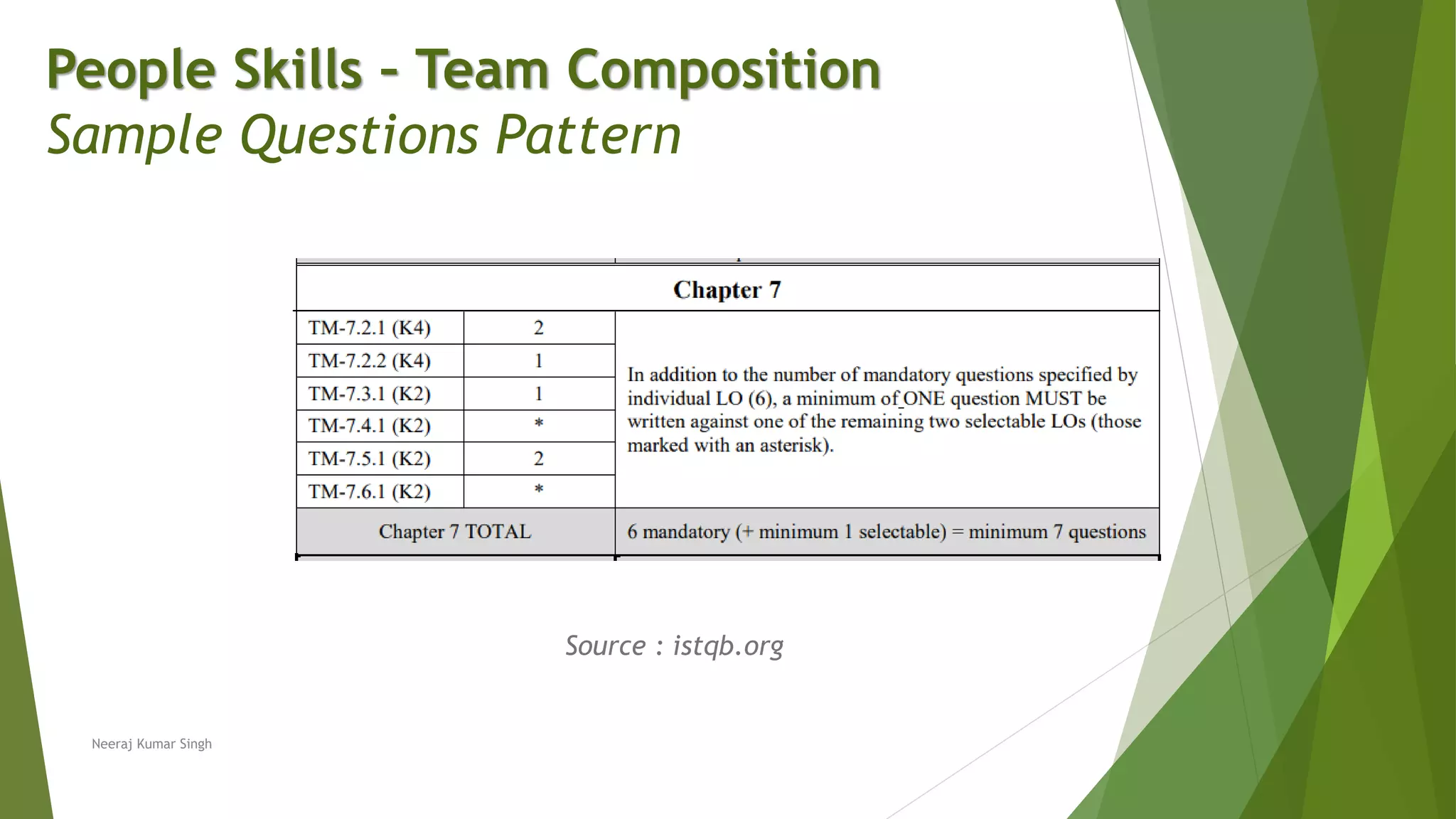
Sample Questions Pattern
Source : istqb.org
1. Assume that you are managing a test team of six people, that you have identified critical skills in three
categories for a team: testing, technology, and business knowledge. You have performed a skills assessment for
each test team member against each critical skill, using a 1 to 5 scale, with 1 representing the lowest level of skill
and 5 representing the highest level of skill. Assume that you have the following average scores for your team in
each category:
 Testing 3.25
 Technology 1.17
 Business knowledge 3.75
You are now planning actions to take in order to develop your team. Which of the following actions should be in
your plan?
Select TWO Options.
Answer Set
A. If a hiring opportunity presents itself, favor candidates with relevant technological skills.
B. Retain a company to deliver ISTQB Foundation training to all testers.
C. Make an employee skill ranking and plan to lay off those employees at the bottom.
D. Identify the most critical specific skills weaknesses and ways to address those weaknesses.
E. Try to rotate people with business knowledge out of your team, in favor of people with stronger technology skills.
People Skills – Team Composition
Sample Question
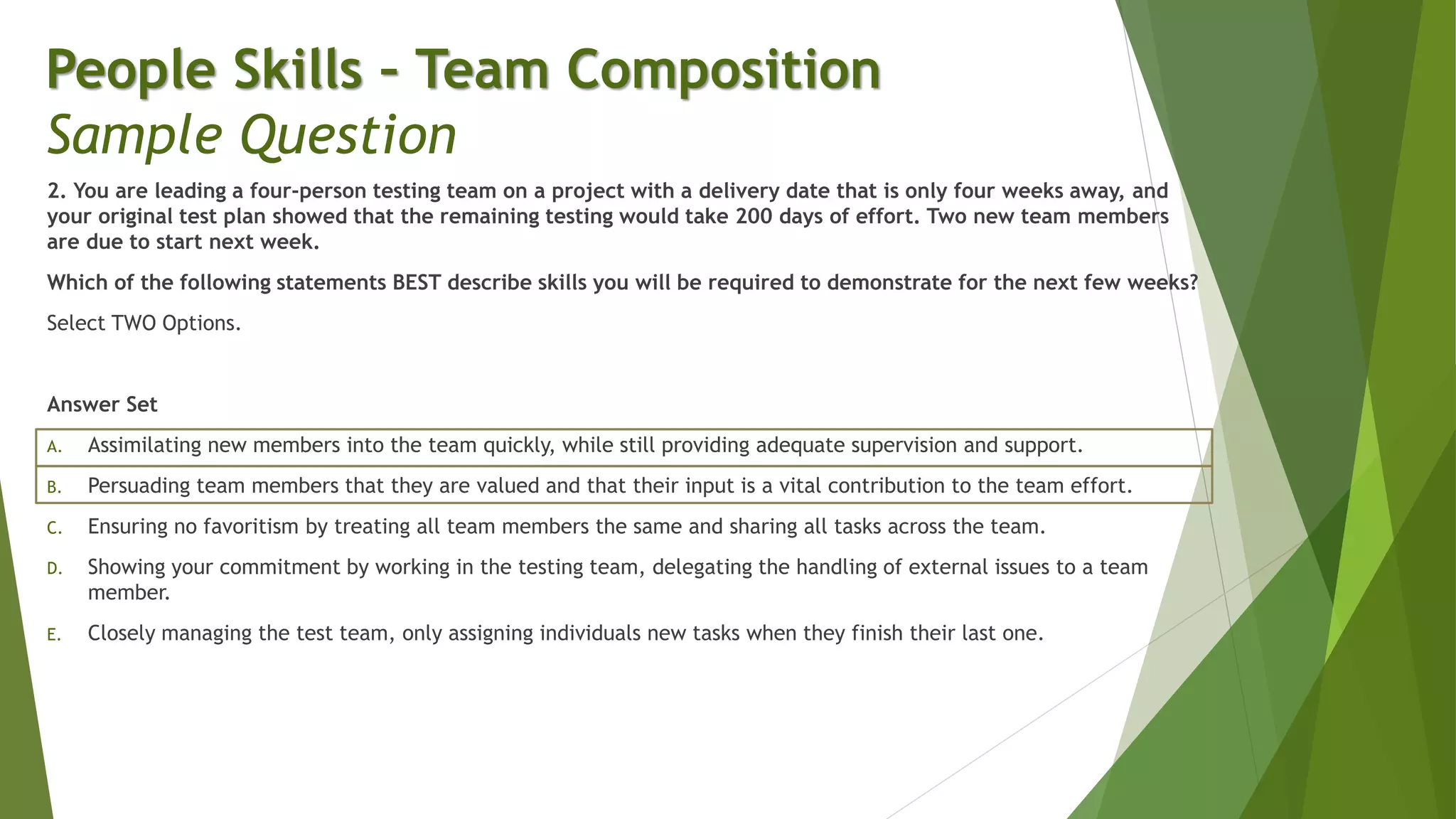
2. You are leading a four-person testing team on a project with a delivery date that is only four weeks away, and
your original test plan showed that the remaining testing would take 200 days of effort. Two new team members
are due to start next week.
Which of the following statements BEST describe skills you will be required to demonstrate for the next few weeks?
Select TWO Options.
Answer Set
A. Assimilating new members into the team quickly, while still providing adequate supervision and support.
B. Persuading team members that they are valued and that their input is a vital contribution to the team effort.
C. Ensuring no favoritism by treating all team members the same and sharing all tasks across the team.
D. Showing your commitment by working in the testing team, delegating the handling of external issues to a team
member.
E. Closely managing the test team, only assigning individuals new tasks when they finish their last one.
People Skills – Team Composition
Sample Question
3. You have been recently appointed as the Test Manager working on a large web-based project that currently is
not meeting customer expectations. You have become aware that the testers are unhappy, and that the retention
rate is low, with testers leaving for other jobs on a regular basis.
Which of the following situations is MOST likely to be demotivating the testers?
Select ONE Option.
Answer Set
A. There appears to be mutual respect between the testing team members and the web developers.
B. The testers' bonus payments are aligned with the perceived quality of delivered web services.
C. The testers have been given increased responsibility and are expected to manage their own time.
D. Management are providing visible recognition for the work being done by the testers.
People Skills – Team Composition
Sample Question
By
Neeraj Kumar Singh
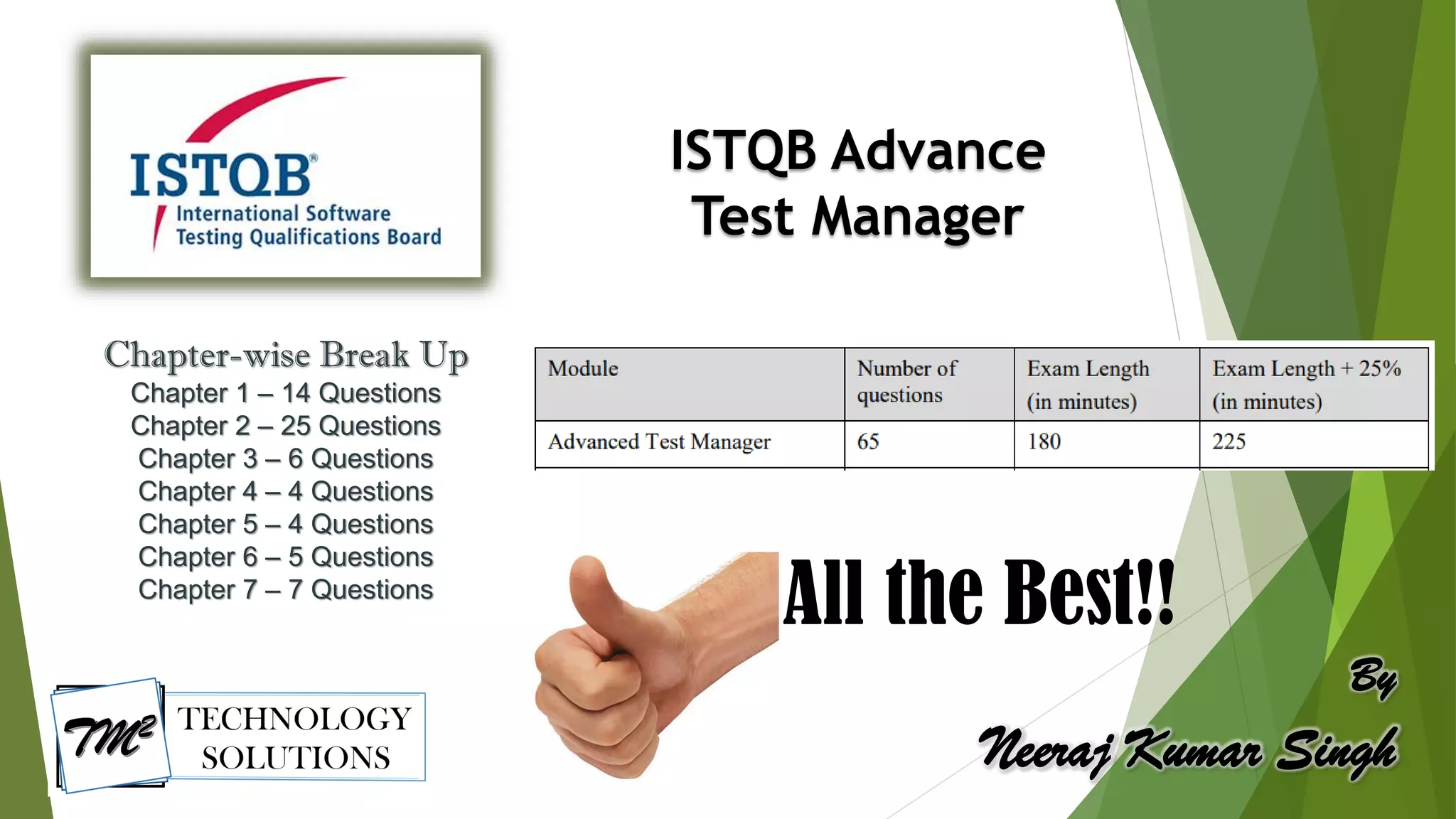
Chapter-wise Break Up
Chapter 1 – 14 Questions
Chapter 2 – 25 Questions
Chapter 3 – 6 Questions
Chapter 4 – 4 Questions
Chapter 5 – 4 Questions
Chapter 6 – 5 Questions
Chapter 7 – 7 Questions
ISTQB Advance
Test Manager
All the Best!!

Chapter 7 - People Skills and Team Composition

  • 1.
    People Skills –Team Composition 1 Testing Process 2 Test Management 3 Reviews Software Testing - ISTQB Advance Test Manager Exam Preparation Chapter 7 Neeraj Kumar Singh 4 Defect Management 5 Improving Process 6 Test Tools 7 People Skills
  • 2.
    People Skills –Team Composition Contents 7.1 Introduction 7.2 Individual Skills 7.3 Test Team Dynamics 7.4 Fitting Testing Within an Organization 7.5 Motivation 7.6 Communication Neeraj Kumar Singh
  • 3.
    Successful Test Managersrecruit, hire and maintain teams with the proper mix of skills. Skills requirements may change over time, so in addition to hiring the right people in the first place, providing adequate training and growth opportunities are important in order to retain the test team and maintain it at a level of peak performance. In addition to the skills of the team, the Test Manager must also maintain a set of skills that will allow effective functioning in a high pressure, fast-paced environment. This chapter looks at how to assess skills, how to fill in the gaps to create a synergistic team that is internally cohesive and is effective in an organization, and also how to motivate that team and how to communicate effectively. People Skills – Team Composition Introduction
  • 4.
    People Skills –Team Composition Contents 7.1 Introduction 7.2 Individual Skills 7.3 Test Team Dynamics 7.4 Fitting Testing Within an Organization 7.5 Motivation 7.6 Communication Neeraj Kumar Singh
  • 5.
    An individual's abilityto test software can be obtained through experience or by education and training. Each of the following can contribute to the tester's knowledge base:  Use of software systems  Knowledge of the domain or business  Participation in various phases of the software development process activities including analysis, development and technical support  Participation in software testing activities End-users of software systems have a good understanding of how the system works, where failures would have the greatest impact, and how the system should react in various situations. Users with domain expertise know which areas are of most importance to the business and how those areas affect the ability of the business to meet its requirements. Knowledge of the software development process (requirements analysis, architecture, design and coding) gives insight into how errors lead to the introduction of defects, where defects can be detected and how to prevent the introduction of defects in the first place. Specific software testing skills include the capabilities discussed in the Foundation, Advanced Test Analyst, and Advanced Technical Test Analyst syllabi, such as the ability to analyze a specification, participate in risk analysis, design test cases, and the diligence for running tests and recording the results. People Skills – Team Composition Individual Skills Neeraj Kumar Singh
  • 6.
    Specifically for TestManagers, having knowledge, skills and experience in project management is important since test management includes many project management activities, e.g., making a plan, tracking progress and reporting to stakeholders. In addition to technical skills, interpersonal skills, such as giving and receiving constructive criticism, influencing, and negotiating, are all important in the role of testing. Technically competent testers are likely to fail unless they also possess and employ the necessary soft skills. The ideal test team has a mix of skills and experience levels, and the team members should have a willingness and ability to teach and learn from their peers. In some environments, some skills will be more important or more respected than others. The Test Manager should list all the skills that are important to the job as well as being appropriate to the position. Once those skills are itemized, each individual in the team can be assessed against a scoring system. People should be hired for the long term, not for their contribution on a single project. When the Test Manager invests in the testers and creates an environment of continuous learning, the team members will be motivated to increase their skills and knowledge so they will be ready for the next opportunity. A Test Manager will rarely be able to hire the perfect team members. And, even if the team members are perfect for the current project, they may not be the perfect mix for the next project. The Test Manager should hire people who are intelligent, curious, adaptable, willing to work, able to work effectively as part of a team, and willing and able to learn. People Skills – Team Composition Individual Skills Neeraj Kumar Singh
  • 7.
    People Skills –Team Composition Contents 7.1 Introduction 7.2 Individual Skills 7.3 Test Team Dynamics 7.4 Fitting Testing Within an Organization 7.5 Motivation 7.6 Communication Neeraj Kumar Singh
  • 8.
    To build thebest team possible, staff selection is one of the most important functions of a management role in the organization. There are many items to consider in addition to the specific individual skills required for the job. When selecting an individual to join the team, the dynamics of the team must be considered. Will this person complement the skills and personality types that already exist within the test team? It is important to consider the advantages of having a variety of personality types on the test team as well as a mix of technical skills. A strong test team is able to deal with multiple projects of varying complexity while also successfully handling the interpersonal interactions with the other project team members. Testing is often a high pressure activity. Software development schedules are often compressed, even unrealistic. Stakeholders have high expectations of the test team, sometimes unreasonably so. The Test Manager must hire people who will deal well with high pressure situations, who can deflect frustration and who can concentrate on the work even when the schedules seem impossible. It is up to the Test Manager to deal with schedule and expectation issues, but the Test Manager must also understand that these pressures are felt by the team members as well. When the Test Manager is acquiring people for the team, it is important to consider the working environment and to match the personality types to that environment. In an environment where there is more work than time, the Test Manager should be seeking people who finish their tasks and ask what they can do next. People Skills – Team Composition Test Team Dynamics Neeraj Kumar Singh
  • 9.
    When determining whomto hire or add to the test team, an objective assessment of skills can be helpful. This can be done via interviewing, testing the candidate, reviewing work samples and by verifying references. Skills that should be assessed include: Technical skills (hard skills) can be demonstrated by:  Deriving test cases from a requirements document  Reviewing technical documentation (requirements, code, etc.)  Writing review comments in a clear, understandable and objective way  Applying various testing techniques appropriately to given scenarios (e.g., using decision tables to test a set of business rules)  Assessing a failure and documenting it accurately  Demonstrating an understanding of defect classification information  Demonstrating an understanding of root causes of defects  Using a tool to test a given API, including positive and negative tests  Using SQL to find and alter database information to test a given scenario  Designing a test automation harness that will execute multiple tests and gather test results  Executing automated tests and troubleshooting failures  Writing test plans/specifications  Writing a test summary reports that includes an assessment of the test results People Skills – Team Composition Test Team Dynamics Neeraj Kumar Singh
  • 10.
    Interpersonal skills (softskills) can be demonstrated by:  Presenting information regarding a test project that is behind schedule  Explaining a defect report to a developer who thinks there is no defect  Training a co-worker  Presenting a problem to management regarding a process that is not effective  Reviewing a test case created by a co-worker and presenting the comments to that person  Interviewing a co-worker  Complimenting a developer While this is not a complete list and the specific desired skills will vary between environments and organizations, it is a list of skills that are commonly needed. By creating effective interview questions and allowing skills demonstrations, the Test Manager can assess the skills of the candidate and determine areas of strength and weakness. In addition to the skills needed by the individual contributors, the Test Manager must also possess excellent communication and diplomatic skills. The Test Manager must be able to defuse controversial situations, must know the correct media to use for the necessary communication and must be able to focus on building and maintaining relationships within the organization. People Skills – Team Composition Test Team Dynamics Neeraj Kumar Singh
  • 11.
    People Skills –Team Composition Contents 7.1 Introduction 7.2 Individual Skills 7.3 Test Team Dynamics 7.4 Fitting Testing Within an Organization 7.5 Motivation 7.6 Communication Neeraj Kumar Singh
  • 12.
    Organizations have manyways to fit testing into the organizational structure. While quality is everyone's responsibility throughout the software development lifecycle, an independent test team can contribute significantly to a quality product. Independence of the testing function varies widely in practice, as seen from the following list, ordered from least to most independence: No independent testers  In this case there is no independence and the code is being tested by the developer who wrote it  The developer, if allowed time to do the testing, will determine that the code works as intended, which may or may not match the actual requirements  The developer can fix any found defects quickly Testing is done by a developer other than the one who wrote the code  There is little independence between the developer and the tester  A developer testing another developer's code may be reluctant to report defects  A developer mind set toward testing is usually focused on positive test cases People Skills – Team Composition Fitting Testing Within an Organization Neeraj Kumar Singh
  • 13.
    Testing is doneby a tester (or test team) that is part of the development team  The tester (or test team) may report to project management or may report to the development manager  The tester mind set is focused more on verifying adherence to requirements  Because the tester is a member of the development team, the tester may have development responsibilities in addition to testing  The tester’s manager may be more focused on meeting schedule than achieving quality goals  Testing may be given a lower status in the team than development  The tester may have no authority to influence the quality goals or the adherence to those goals Testing is done by test specialists from the business organization, user community, or other non-development technical organization  Test results information is reported objectively to the stakeholders  Quality is the primary focus of this team  Skills development and training are focused on testing  Testing is seen as a career path  There is specific management devoted to the testing group that is quality-focused People Skills – Team Composition Fitting Testing Within an Organization Neeraj Kumar Singh
  • 14.
    External test specialistsperform testing on specific test types  Expertise is applied to specific areas where generalized testing is likely to be insufficient  Test types could be usability, security, performance or other areas where specialization is necessary  Quality should be the focus of these individuals, but their view is limited to their areas of specialty. A product that performs well may not meet its functional requirements, but that may go undetected by the performance specialist. Testing is done by an organization external to the company  This model achieves the maximum independence between the tester and the developer  Knowledge transfer may not be sufficient for the tester to test competently  Clear requirements and a well-defined communication structure will be needed  Quality of the external organization must be audited regularly This list is based on the typical focus of the individuals, but that may not be true in a particular organization. A position and title do not necessarily determine a person’s focus. There are varying degrees of independence between the development and testing organizations. It is important to understand that there may be a tradeoff where more independence results in more isolation and less knowledge transfer. A lower level of independence may increase knowledge, but can also introduce conflicting goals. The level of independence will also be determined by the software development model being used, e.g., within Agile development the testers are most often part of the development team. People Skills – Team Composition Fitting Testing Within an Organization Neeraj Kumar Singh
  • 15.
    People Skills –Team Composition Contents 7.1 Introduction 7.2 Individual Skills 7.3 Test Team Dynamics 7.4 Fitting Testing Within an Organization 7.5 Motivation 7.6 Communication Neeraj Kumar Singh
  • 16.
    There are manyways to motivate an individual in a testing position. These include:  Recognition for the job accomplished  Approval by management  Respect within the project team and among peers  Increased responsibility and autonomy  Adequate rewards for the work done (including salary, increased responsibility, recognition) There are project influences that can make these motivational tools difficult to apply. For example, a tester can work very hard on a project that has an impossible deadline. The tester can do everything possible to drive the quality focus of the team, put in extra hours and effort, and yet the product may ship before it should due to external influences. The result may be a poor quality product despite the best efforts of the tester. This can easily be a demotivator if the tester's contribution is not understood and measured, regardless of whether the end product is successful. The test team must ensure that it is tracking the appropriate metrics to prove that a good job was done to accomplish the testing, mitigate risks and accurately record the results. Unless this data is gathered and published, it is easy for a team to become demotivated when they do not receive the recognition they feel is due for a job well-done. People Skills – Team Composition Motivation Neeraj Kumar Singh
  • 17.
    Recognition is notjust determined in the intangibles of respect and approval, it is also apparent in promotion opportunities, increased responsibility and merit increases. If the testing group is not respected, these opportunities may not be available. Recognition and respect are acquired when it is clear that the tester contributes to the incremental value of the project. In an individual project this is best achieved by involving the tester at the beginning of the project and with continuing involvement throughout the lifecycle. Over time the testers will win respect of the other project stakeholders by their positive contribution to the project. This contribution should also be quantified in terms of cost of quality reductions and risk mitigation. The Test Manager plays an important part in motivating the individuals in a test team as well as acting as a champion of the test team to the larger organization. The Test Manager should recognize the achievements of the individual testers, and must also give fair and honest appraisals of mistakes. A fair and consistent Test Manager will motivate the team members by example. People Skills – Team Composition Motivation Neeraj Kumar Singh
  • 18.
    People Skills –Team Composition Contents 7.1 Introduction 7.2 Individual Skills 7.3 Test Team Dynamics 7.4 Fitting Testing Within an Organization 7.5 Motivation 7.6 Communication Neeraj Kumar Singh
  • 19.
    Test team communicationprimarily takes place by the following means:  Documentation of test products - test strategy, test plan, test cases, test summary reports, defect reports, etc.  Feedback provided on reviewed documents - requirements, functional specifications, use cases, component test documentation, etc.  Information gathering and dissemination - interaction with developers, other test team members, management, etc. The communication between testers and other stakeholders must be professional, objective and effective in order to build and maintain respect for the test team. Diplomacy and objectivity are required when providing feedback, particularly constructive feedback, on the work products of others. In addition, communication should be focused on achieving test objectives and on improving quality both in products and the processes used to produce the software systems. Test Managers communicate with a wide audience, including users, project team members, management, external testing groups and customers. Communication must be effective for the target audience. With any communication, but particularly during presentations, it is important to understand the message that is being sent, the ways in which the message may be received and the explanation that is needed to create the correct environment for the message to be accepted. Since the Test Manager is often in a position of presenting project status information, it is important that this information be at an appropriate level of detail and be presented in a way that is clearly stated and easily understood. People Skills – Team Composition Communication Neeraj Kumar Singh
  • 20.
    Communicating efficiently helpsto keep the attention of the audience while still conveying the correct message. Each presentation should be viewed by the Test Manager as an opportunity to promote quality and quality processes. A Test Manager is not only communicating with people external to the department (Outward communication). An important part of a Test Manager’s job is to communicate effectively within the testing group (Inward communication) to pass on news, instructions, changes in priorities and other standard information that is imparted in the normal process of testing. A Test Manager may also communicate to specific individuals both up (Upward communication) and down (Downward communication) the management chain in the organization. Test Managers must be masters of the various means of communication. Much information is communicated via e-mail, verbal interactions, formal or informal meetings, formal or informal reports and even through the use of the test management tools such as defect management tools. All communication must be professional and objective. Proofreading, both for quality and content, is a necessary step even in the most urgent communication. Written communication often lives long beyond the actual project. It is important for the Test Manager to produce professional quality documentation that is representative of an organization that promotes quality. People Skills – Team Composition Communication Neeraj Kumar Singh
  • 21.
    People Skills –Team Composition 1 Testing Process 2 Test Management 3 Reviews Software Testing - ISTQB Advance Test Manager Exam Preparation Chapter 7 Neeraj Kumar Singh 4 Defect Management 5 Improving Process 6 Test Tools 7 People Skills
  • 22.
    Neeraj Kumar Singh PeopleSkills – Team Composition Sample Questions Pattern Source : istqb.org
  • 23.
    1. Assume thatyou are managing a test team of six people, that you have identified critical skills in three categories for a team: testing, technology, and business knowledge. You have performed a skills assessment for each test team member against each critical skill, using a 1 to 5 scale, with 1 representing the lowest level of skill and 5 representing the highest level of skill. Assume that you have the following average scores for your team in each category:  Testing 3.25  Technology 1.17  Business knowledge 3.75 You are now planning actions to take in order to develop your team. Which of the following actions should be in your plan? Select TWO Options. Answer Set A. If a hiring opportunity presents itself, favor candidates with relevant technological skills. B. Retain a company to deliver ISTQB Foundation training to all testers. C. Make an employee skill ranking and plan to lay off those employees at the bottom. D. Identify the most critical specific skills weaknesses and ways to address those weaknesses. E. Try to rotate people with business knowledge out of your team, in favor of people with stronger technology skills. People Skills – Team Composition Sample Question
  • 24.
    2. You areleading a four-person testing team on a project with a delivery date that is only four weeks away, and your original test plan showed that the remaining testing would take 200 days of effort. Two new team members are due to start next week. Which of the following statements BEST describe skills you will be required to demonstrate for the next few weeks? Select TWO Options. Answer Set A. Assimilating new members into the team quickly, while still providing adequate supervision and support. B. Persuading team members that they are valued and that their input is a vital contribution to the team effort. C. Ensuring no favoritism by treating all team members the same and sharing all tasks across the team. D. Showing your commitment by working in the testing team, delegating the handling of external issues to a team member. E. Closely managing the test team, only assigning individuals new tasks when they finish their last one. People Skills – Team Composition Sample Question
  • 25.
    3. You havebeen recently appointed as the Test Manager working on a large web-based project that currently is not meeting customer expectations. You have become aware that the testers are unhappy, and that the retention rate is low, with testers leaving for other jobs on a regular basis. Which of the following situations is MOST likely to be demotivating the testers? Select ONE Option. Answer Set A. There appears to be mutual respect between the testing team members and the web developers. B. The testers' bonus payments are aligned with the perceived quality of delivered web services. C. The testers have been given increased responsibility and are expected to manage their own time. D. Management are providing visible recognition for the work being done by the testers. People Skills – Team Composition Sample Question
  • 26.
    By Neeraj Kumar Singh Chapter-wiseBreak Up Chapter 1 – 14 Questions Chapter 2 – 25 Questions Chapter 3 – 6 Questions Chapter 4 – 4 Questions Chapter 5 – 4 Questions Chapter 6 – 5 Questions Chapter 7 – 7 Questions ISTQB Advance Test Manager All the Best!!