The American
Revolution
1775-1783
The main actors
ENGLAND
 Wanted to maintain power in North
America
 Economic Interests
 Mercantilism
 Established colonies between 1607
(Virginia) and 1732 (Georgia)
 King George the 3rd was England´s
king at the time
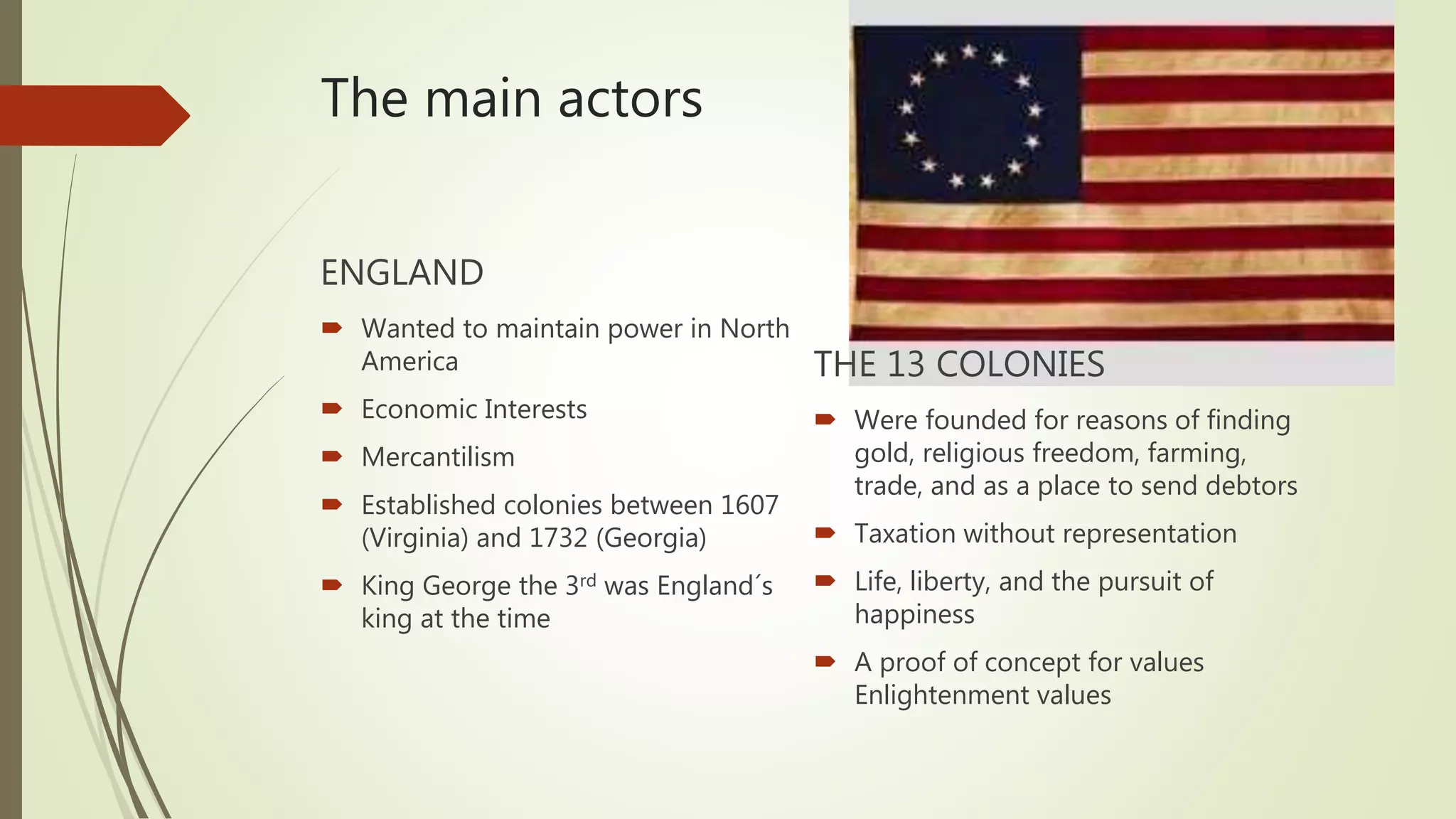
THE 13 COLONIES
 Were founded for reasons of finding
gold, religious freedom, farming,
trade, and as a place to send debtors
 Taxation without representation
 Life, liberty, and the pursuit of
happiness
 A proof of concept for values
Enlightenment values
Main causes
 The Seven Years War/ French and Indian War (1754-1763)
 Stamp Act
 Townshend Acts
 Boston Massacre
 Boston Tea Party  Intolerable Acts
 Continental Congress
 Thomas Paine’s Common Sense
 The Declaration of Independence (July 4th, 1776)
Humble beginnings and growing dissent
The seven years war (1756-
1763)
 AKA: The French and Indian War
 Because Indians mostly fought on the
side of the French
 A war between England and France
over territory in the Ohio River Valley
 English troops trained and enlisted
colonists to help fight in the war,
many of whom died.
 This also cost England much money
to wage war for this long
The stamp act (1765)
 Along with the Sugar act of 1764, this
act was passed to make up for all of
England’s wartime expenses.
 Taxes were imposed, in the form of the
stamp, on essentially all paper products,
certificates, and licenses.
 These taxes, along with the quartering
act (1765) enraged colonists.
 Sparked the formation of the Sons of
Liberty to stand up against British
taxation.
Igniting the revolution
Townshend acts
 Although the stamp act was repealed,
British Parliament was still trying to
cover their expanses from the 7 years
war.
 This new act imposed taxes on glass,
lead, paper, paint, and tea.
 Massachusetts began leading the
boycott of British goods.
 This caused royal British governors to
call for hundreds of soldiers to patrol
the streets of Boston.
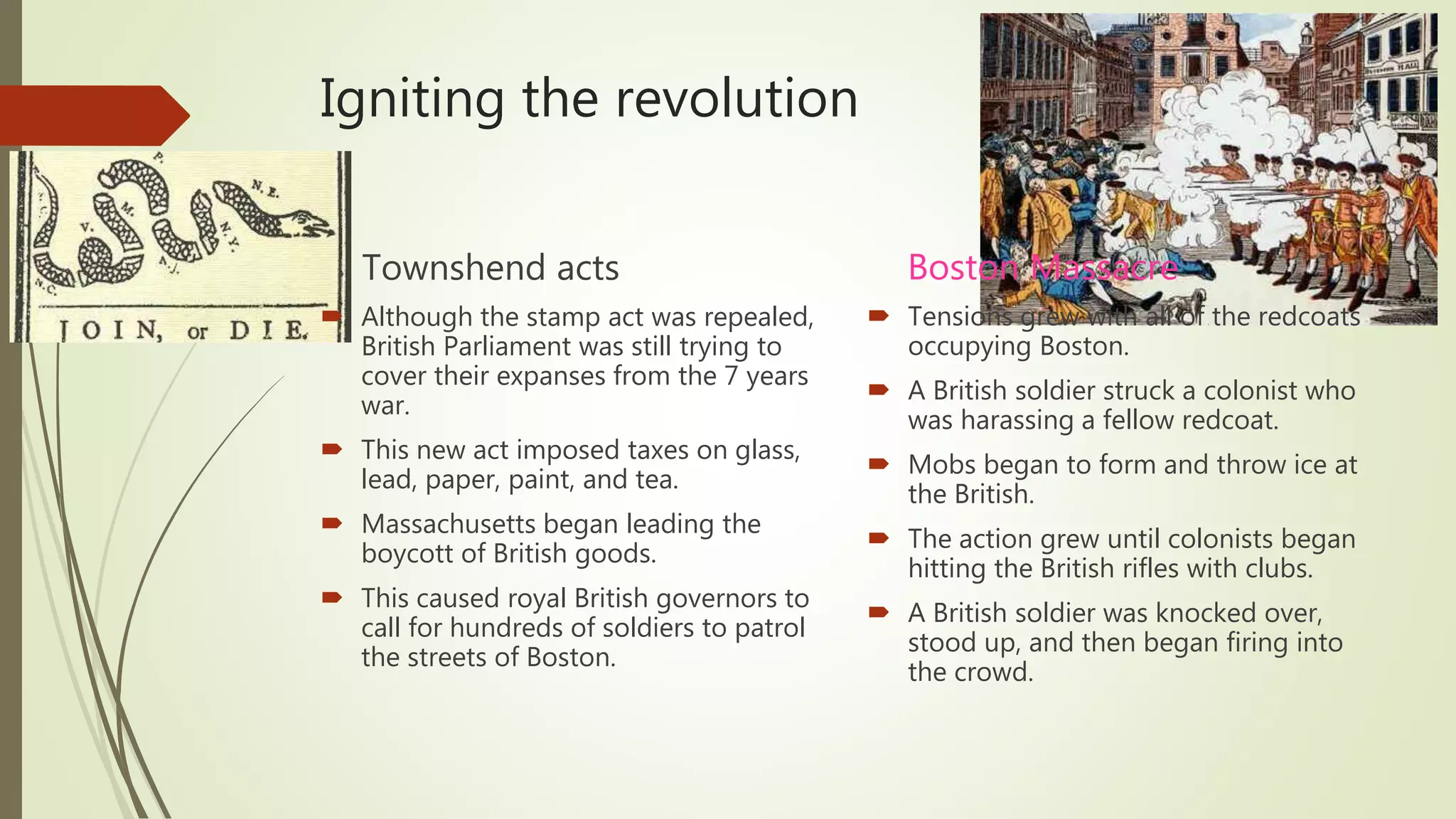
Boston Massacre
 Tensions grew with all of the redcoats
occupying Boston.
 A British soldier struck a colonist who
was harassing a fellow redcoat.
 Mobs began to form and throw ice at
the British.
 The action grew until colonists began
hitting the British rifles with clubs.
 A British soldier was knocked over,
stood up, and then began firing into
the crowd.
The last straw
Intolerable Acts
 After the Boston Massacre and the
Tea Act, the Sons of Liberty, led by
Samuel Adams, dressed up as Indians
and held the Boston Tea Party (Dec
1773).
 The British parliament responded by
passing the Intolerable acts!
 These closed Boston harbor, ended
self-rule by the colonies, stripped
land from some colonies, and let
British officials return to Britain if they
were tried of a crime.
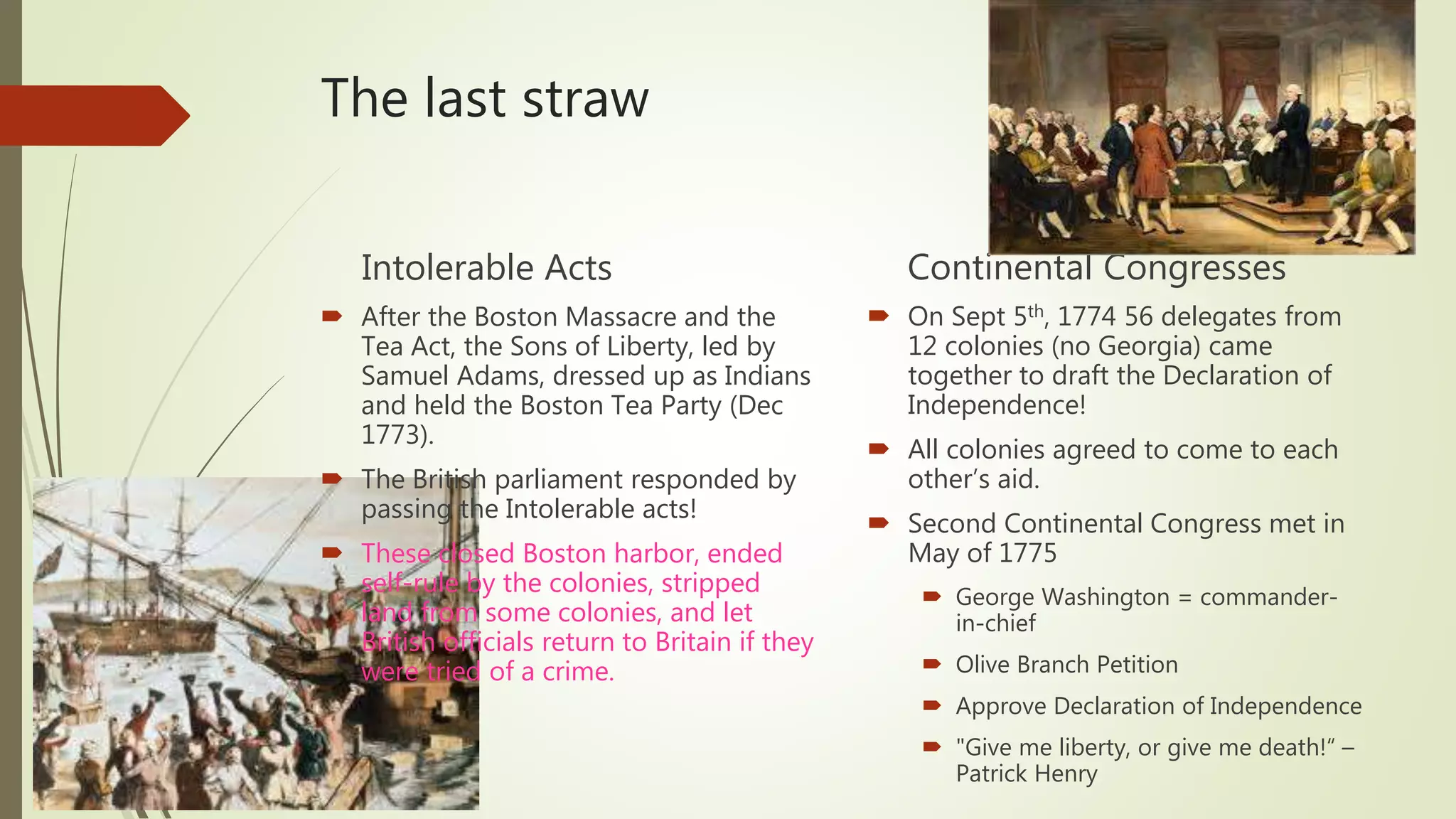
Continental Congresses
 On Sept 5th, 1774 56 delegates from
12 colonies (no Georgia) came
together to draft the Declaration of
Independence!
 All colonies agreed to come to each
other’s aid.
 Second Continental Congress met in
May of 1775
 George Washington = commander-
in-chief
 Olive Branch Petition
 Approve Declaration of Independence
 "Give me liberty, or give me death!“ –
Patrick Henry
Independence declared
Common Sense
 Thomas Payne moved to the colonies
from England on November 30th,
1774.
 In January of 1776, he released his
pro-independence pamphlet:
Common Sense.
 This pamphlet spread throughout all
the colonies and sparked the
colonists initiative to stand up to
Britain
Declaration of
Independence
 Although the Revolutionary War had
already begun, the Declaration of
Independence was released on July 4th,
1776 to explain to the rest of the world
why the colonies were breaking away
from England.
 “We hold these Truths to be self-
evident, that all Men are created equal,
that they are endowed by their Creator
with certain unalienable Rights, that
among these are Life, Liberty and the
Pursuit of Happiness ”
The Revolutionary War
1775-1783
The Most important stuff
 Battles of Lexington and Concord (1775)
 Battles of Saratoga
 Winter at Valley Forge
 Siege of Yorktown
Battles of Lexington and Concord
 Fought on April 19th, 1775 in Massachusetts
 This happened in response to the Colonial government ignoring Parliament’s orders,
and the colonists began training militiamen
 Paul Revere’s midnight ride! “The British are Coming!” and "one if by land, two if by
sea".
 British soldiers had been sent in to steal colonial supplies (“disarm and imprison”), but
Patriot leaders had heard of this plan and sent the supplies elsewhere.
 70 minutemen vs. 700 redcoats
 “The shot heard ‘round the world” was fired in Concord at the North Bridge, which
caused British troops to march back to Boston
 https://www.youtube.com/watch?v=Y6ikO6LMxF4
Battles of Saratoga
 Up until this point in the war, the colonists were not doing the greatest. They had
been struggling to maintain their fight against the British and had lowered morale.
 The two battles took place on the same battlefield, where British soldiers
attempted to break through the Continental army’s lines (September 19 and
October 7, 1777)
 The combined forces of Generals Arnold and Gates overtook and exhausted British
supplies and troops, causing a British surrender.
 The Colonial victory here is often known as the turning point of the war, because it
renewed the morale of the American public, and convinced foreign partners such
as France to ally with the colonists.
 France declared war on Britain in 1778, and allied with America, sending guns,
ships, troops, and money to the colonists.
Winter (1777-1778) at Valley Forge
 George Washington chose to take up winter encampments at Valley Forge, 18
miles west of Philadelphia to be a safe distance away from the British.
 But a poor continental army meant that they were not equipped to endure such
harsh conditions.
 Of the 12,000 soldiers, many lacked necessary supplies such as blankets, clothes,
and shoes. This left them largely unprotected from the elements. There was also
very little food available.
 This led to the spread of diseases and over 2,000 soldiers died..
 However, in Feb of 1778 a former German General Von Steuben came and trained
the Americans how to become soldiers, although he did it mostly in French.
Siege of Yorktown!
(September-October 17th)
 The last battle of the Revolutionary war which forced the British
surrender
 Rather than attack the British in New York, where the French and
American forced grouped up, the colonists took them by surprise and
surrounded them in Yorktown, Virginia.
 General Washington and French General Rochambeau marched by land
(over 320km over two weeks), while another French naval commander
cut the British off at sea.
 Once they arrived, Washington’s troops began digging trenches so they
could drag cannons in to position to fire at British forces.
 By October 14th, Alexander Hamilton led more American troops to
storm British fortifications.
 On October 17th British General Cornwallis surrendered
After the War
 Treaty of Paris ratified in 1783 to officially declare the British surrender
 Articles of Confederation
 The first attempt at a U.S. constitution that gave the states to much individual power
 No president up until now
 Constitution and Bill of Rights
 What would eventually be ratified in order to balance the power between state and
federal governments.
 Freedom of speech, freedom of press, right to bare arms, and other essential liberties
 After the ratification of the Constitution, George Washington was elected as the first
President in 1788-1789
 Federalists vs Republicans
 Although finally free from Britain, not all colonists agreed amongst themselves
 French Revolution of the 1790’s
Other important
events/facts!
 Washington’s crossing of the Delaware,
Christmas of 1776
 June 21st, 1779 – Spain declares war on
Britain, refusing to recognize American
Independence, but willing to join the France
in naval battles against Britain.
 Not all colonists were on the side of
independence. Some colonists called
themselves Loyalists and wanted to remain
loyal to Britain. The majority of colonists were
Separatists.
An activity!?
 https://www.playfactile.com/edit/amrevjeopesp

The american revolution

  • 1.
  • 2.
    The main actors ENGLAND Wanted to maintain power in North America  Economic Interests  Mercantilism  Established colonies between 1607 (Virginia) and 1732 (Georgia)  King George the 3rd was England´s king at the time THE 13 COLONIES  Were founded for reasons of finding gold, religious freedom, farming, trade, and as a place to send debtors  Taxation without representation  Life, liberty, and the pursuit of happiness  A proof of concept for values Enlightenment values
  • 3.
    Main causes  TheSeven Years War/ French and Indian War (1754-1763)  Stamp Act  Townshend Acts  Boston Massacre  Boston Tea Party  Intolerable Acts  Continental Congress  Thomas Paine’s Common Sense  The Declaration of Independence (July 4th, 1776)
  • 4.
    Humble beginnings andgrowing dissent The seven years war (1756- 1763)  AKA: The French and Indian War  Because Indians mostly fought on the side of the French  A war between England and France over territory in the Ohio River Valley  English troops trained and enlisted colonists to help fight in the war, many of whom died.  This also cost England much money to wage war for this long The stamp act (1765)  Along with the Sugar act of 1764, this act was passed to make up for all of England’s wartime expenses.  Taxes were imposed, in the form of the stamp, on essentially all paper products, certificates, and licenses.  These taxes, along with the quartering act (1765) enraged colonists.  Sparked the formation of the Sons of Liberty to stand up against British taxation.
  • 5.
    Igniting the revolution Townshendacts  Although the stamp act was repealed, British Parliament was still trying to cover their expanses from the 7 years war.  This new act imposed taxes on glass, lead, paper, paint, and tea.  Massachusetts began leading the boycott of British goods.  This caused royal British governors to call for hundreds of soldiers to patrol the streets of Boston. Boston Massacre  Tensions grew with all of the redcoats occupying Boston.  A British soldier struck a colonist who was harassing a fellow redcoat.  Mobs began to form and throw ice at the British.  The action grew until colonists began hitting the British rifles with clubs.  A British soldier was knocked over, stood up, and then began firing into the crowd.
  • 6.
    The last straw IntolerableActs  After the Boston Massacre and the Tea Act, the Sons of Liberty, led by Samuel Adams, dressed up as Indians and held the Boston Tea Party (Dec 1773).  The British parliament responded by passing the Intolerable acts!  These closed Boston harbor, ended self-rule by the colonies, stripped land from some colonies, and let British officials return to Britain if they were tried of a crime. Continental Congresses  On Sept 5th, 1774 56 delegates from 12 colonies (no Georgia) came together to draft the Declaration of Independence!  All colonies agreed to come to each other’s aid.  Second Continental Congress met in May of 1775  George Washington = commander- in-chief  Olive Branch Petition  Approve Declaration of Independence  "Give me liberty, or give me death!“ – Patrick Henry
  • 7.
    Independence declared Common Sense Thomas Payne moved to the colonies from England on November 30th, 1774.  In January of 1776, he released his pro-independence pamphlet: Common Sense.  This pamphlet spread throughout all the colonies and sparked the colonists initiative to stand up to Britain Declaration of Independence  Although the Revolutionary War had already begun, the Declaration of Independence was released on July 4th, 1776 to explain to the rest of the world why the colonies were breaking away from England.  “We hold these Truths to be self- evident, that all Men are created equal, that they are endowed by their Creator with certain unalienable Rights, that among these are Life, Liberty and the Pursuit of Happiness ”
  • 8.
  • 9.
    The Most importantstuff  Battles of Lexington and Concord (1775)  Battles of Saratoga  Winter at Valley Forge  Siege of Yorktown
  • 10.
    Battles of Lexingtonand Concord  Fought on April 19th, 1775 in Massachusetts  This happened in response to the Colonial government ignoring Parliament’s orders, and the colonists began training militiamen  Paul Revere’s midnight ride! “The British are Coming!” and "one if by land, two if by sea".  British soldiers had been sent in to steal colonial supplies (“disarm and imprison”), but Patriot leaders had heard of this plan and sent the supplies elsewhere.  70 minutemen vs. 700 redcoats  “The shot heard ‘round the world” was fired in Concord at the North Bridge, which caused British troops to march back to Boston  https://www.youtube.com/watch?v=Y6ikO6LMxF4
  • 11.
    Battles of Saratoga Up until this point in the war, the colonists were not doing the greatest. They had been struggling to maintain their fight against the British and had lowered morale.  The two battles took place on the same battlefield, where British soldiers attempted to break through the Continental army’s lines (September 19 and October 7, 1777)  The combined forces of Generals Arnold and Gates overtook and exhausted British supplies and troops, causing a British surrender.  The Colonial victory here is often known as the turning point of the war, because it renewed the morale of the American public, and convinced foreign partners such as France to ally with the colonists.  France declared war on Britain in 1778, and allied with America, sending guns, ships, troops, and money to the colonists.
  • 12.
    Winter (1777-1778) atValley Forge  George Washington chose to take up winter encampments at Valley Forge, 18 miles west of Philadelphia to be a safe distance away from the British.  But a poor continental army meant that they were not equipped to endure such harsh conditions.  Of the 12,000 soldiers, many lacked necessary supplies such as blankets, clothes, and shoes. This left them largely unprotected from the elements. There was also very little food available.  This led to the spread of diseases and over 2,000 soldiers died..  However, in Feb of 1778 a former German General Von Steuben came and trained the Americans how to become soldiers, although he did it mostly in French.
  • 13.
    Siege of Yorktown! (September-October17th)  The last battle of the Revolutionary war which forced the British surrender  Rather than attack the British in New York, where the French and American forced grouped up, the colonists took them by surprise and surrounded them in Yorktown, Virginia.  General Washington and French General Rochambeau marched by land (over 320km over two weeks), while another French naval commander cut the British off at sea.  Once they arrived, Washington’s troops began digging trenches so they could drag cannons in to position to fire at British forces.  By October 14th, Alexander Hamilton led more American troops to storm British fortifications.  On October 17th British General Cornwallis surrendered
  • 14.
    After the War Treaty of Paris ratified in 1783 to officially declare the British surrender  Articles of Confederation  The first attempt at a U.S. constitution that gave the states to much individual power  No president up until now  Constitution and Bill of Rights  What would eventually be ratified in order to balance the power between state and federal governments.  Freedom of speech, freedom of press, right to bare arms, and other essential liberties  After the ratification of the Constitution, George Washington was elected as the first President in 1788-1789  Federalists vs Republicans  Although finally free from Britain, not all colonists agreed amongst themselves  French Revolution of the 1790’s
  • 15.
    Other important events/facts!  Washington’scrossing of the Delaware, Christmas of 1776  June 21st, 1779 – Spain declares war on Britain, refusing to recognize American Independence, but willing to join the France in naval battles against Britain.  Not all colonists were on the side of independence. Some colonists called themselves Loyalists and wanted to remain loyal to Britain. The majority of colonists were Separatists.
  • 16.