0101 –– Facility Management :0101 Facility Management :Facility Management :
Definition and Scope
Ir. Arya Wirabhuana, M.Sc, CMPM
Facility management is a profession that encompasses multiple
disciplines to ensure functionality of the built environment by
integrating people, place, process and technology –
International Facility Management Association (IFMA)
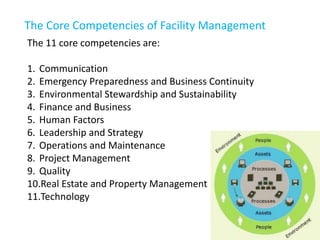
The Core Competencies of Facility Management
The 11 core competencies are:
1. Communication
2. Emergency Preparedness and Business Continuity
3. Environmental Stewardship and Sustainability
4. Finance and Business
5. Human Factors
6. Leadership and Strategy
7. Operations and Maintenance
8. Project Management
9. Quality
10.Real Estate and Property Management
11.Technology
Communication—Communication plans and processes
for both internal and external stakeholders
Emergency Preparedness and Business Continuity—
Emergency and risk management plans and procedures
Environmental Stewardship and Sustainability—
Sustainable management of built and natural
environments
Finance & Business—Strategic plans, budgets, financial
analyses, procurement
Human Factors—Healthy and safe environment,
security, FM employee development
Leadership and Strategy—Strategic planning, organize
staff and lead organization
Operations and Maintenance—Building operations and
maintenance, occupant services
Project Management—Foresight in management of all projects
and related contracts
Quality—Best practices, process improvements, audits and
measurements
Real Estate and Property Management—Real estate planning,
acquisition and disposition
Technology—Facility management technology, workplace
management systems
The definition of facility management, EN15221-1,
provided by the European Committee for Standardization
(CEN) and ratified by 31 European countries is:
"(the) integration of processes within an organization
to maintain and develop the agreed services which
support and improve the effectiveness of its primary
activities."
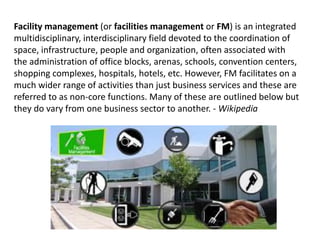
Facility management (or facilities management or FM) is an integrated
multidisciplinary, interdisciplinary field devoted to the coordination of
space, infrastructure, people and organization, often associated with
the administration of office blocks, arenas, schools, convention centers,
shopping complexes, hospitals, hotels, etc. However, FM facilitates on a
much wider range of activities than just business services and these are
referred to as non-core functions. Many of these are outlined below but
they do vary from one business sector to another. - Wikipedia
The discipline of facility management and the role of facility
managers in particular are evolving to the extent that many
managers have to operate at two levels:
strategic-tactical and operational.
In the former case, clients, customers and end-users need to
be informed about the potential impact of their decisions on
the provision of space, services, cost and business risk.
In the latter, it is the role of a facility manager to ensure
corporate and regulatory compliance plus the proper
operation of all aspects of a building to create an optimal,
safe and cost effective environment for the occupants to
function. This is accomplished by managing the following
activities:
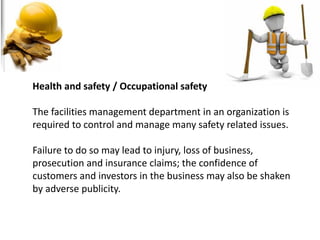
Health and safety / Occupational safety
The facilities management department in an organization is
required to control and manage many safety related issues.
Failure to do so may lead to injury, loss of business,
prosecution and insurance claims; the confidence of
customers and investors in the business may also be shaken
by adverse publicity.
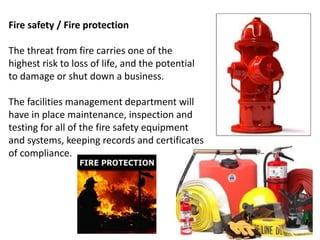
Fire safety / Fire protection
The threat from fire carries one of the
highest risk to loss of life, and the potential
to damage or shut down a business.
The facilities management department will
have in place maintenance, inspection and
testing for all of the fire safety equipment
and systems, keeping records and certificates
of compliance.
Security / Physical security
Security to any organization is necessary to protect the
employees and the business and this often comes under the
control of the facilities management department, in particular
the maintenance of the hardware.
Manned guarding may be under the control of a separate
department.
Maintenance, testing and inspection /
Maintenance, repair, and operations
Maintenance, testing and inspection schedules are required to
ensure that the facility is operating safely and efficiently, to
maximize the life of equipment and reduce the risk of failure. There
are also statutory obligations to be met. The work is planned, often
using a Computer-aided facility management system.
Cleaning / Commercial cleaning
Cleaning operations are often undertaken out of business
hours, but provision may be made during times of
occupations for the cleaning of toilets, replenishing
consumables (toilet rolls, soap, etc.) plus litter picking and
reactive response.
Cleaning is scheduled as a series of "periodic" tasks: daily,
weekly, monthly, etc
Operational / Operations management
The facilities management department has responsibilities for the
day to day running of the building; these tasks may be outsourced
or carried out by directly employed staff. This is a policy issue, but
due to the immediacy of the response required in many of the
activities involved the facilities manager will need to keep tight
control, often requiring daily reports or an escalation procedure.
Some issues require more than just periodic maintenance, for example
those that can stop or hamper the productivity of the business or that
have safety implications. Many of these are managed by the facilities
management "help desk" that staff are able to be contacted either by
telephone or email. The response to help desk calls are prioritized but
may be as simple as too hot or too cold, lights not working, photocopier
jammed, coffee spills, vending machine problems, etc.
Help desks may be used to book meeting rooms, car parking spaces and
many other services, but this often depends on how the facilities
department is organized.
It may be split into two sections often referred to as "soft" and "hard"
services. Soft would include reception, post room, cleaning, etc. and hard
the mechanical and electrical services.
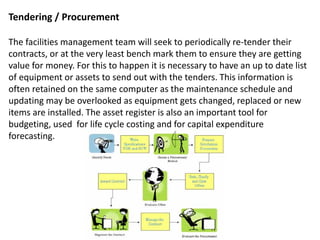
Tendering / Procurement
The facilities management team will seek to periodically re-tender their
contracts, or at the very least bench mark them to ensure they are getting
value for money. For this to happen it is necessary to have an up to date list
of equipment or assets to send out with the tenders. This information is
often retained on the same computer as the maintenance schedule and
updating may be overlooked as equipment gets changed, replaced or new
items are installed. The asset register is also an important tool for
budgeting, used for life cycle costing and for capital expenditure
forecasting.
Commercial property management / Leasing
Building may be owned by the occupier or
leased. Leased properties will be subject to
periodic rent reviews.
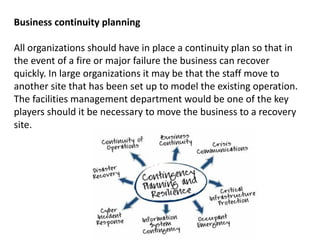
Business continuity planning
All organizations should have in place a continuity plan so that in
the event of a fire or major failure the business can recover
quickly. In large organizations it may be that the staff move to
another site that has been set up to model the existing operation.
The facilities management department would be one of the key
players should it be necessary to move the business to a recovery
site.
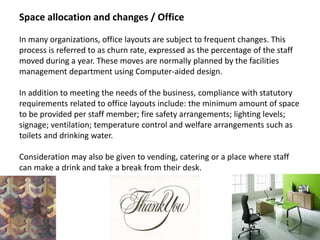
Space allocation and changes / Office
In many organizations, office layouts are subject to frequent changes. This
process is referred to as churn rate, expressed as the percentage of the staff
moved during a year. These moves are normally planned by the facilities
management department using Computer-aided design.
In addition to meeting the needs of the business, compliance with statutory
requirements related to office layouts include: the minimum amount of space
to be provided per staff member; fire safety arrangements; lighting levels;
signage; ventilation; temperature control and welfare arrangements such as
toilets and drinking water.
Consideration may also be given to vending, catering or a place where staff
can make a drink and take a break from their desk.
EVERY Facilities Manager
SHOULD KNOW
SHOCKING
STATISTICS
®
CHANGES IN TODAY'S WORKFORCE ARE FORCING FACILITY
MANAGERS REINVENT THE WORKSPACE ENVIRONMENT.
THESE CHANGES HAVE BROUGHT THE INEVITABLE
GROWTH OF THE FACILITY MANAGEMENT FIELD, AS WELL
AS FM SOFTWARE.
THOSE WHO DO NOT EMBRACE TECHNOLOGY AND ALL OF
ITS TOOLS ARE BEING LEFT BEHIND.
WE ROUNDED UP A FEW STATISTICS THAT ARE SURE
TO GET YOU THINKING, IF NOT TOTALLY CONVINCE YOU,
THAT THE WORKFORCE IS CHANGING,
AND WE ALL HAVE TO ADAPT.
ONE WORKSPACE
FOR AN INDIVIDUAL
EMPLOYEE CAN COST
AN ORGANIZATION UP TO
#1
$14,000 PER YEAR.
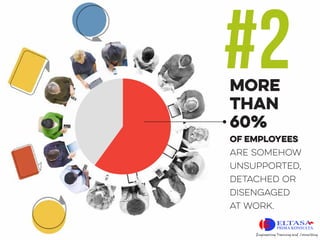
#2
OF EMPLOYEES
ARE SOMEHOW
UNSUPPORTED,
DETACHED OR
DISENGAGED
AT WORK.
MORE
THAN
60%
REGARDING WORK-LIFE BALANCE
IN A POLL CONDUCTED BY OECD.
(OUT OF 23 COUNTRIES)
#3
DEAD LAST
THE UNITED STATES IS
THE TYPICAL BUSINESS COULD SAVE
#4$11,000 PER PERSON PER YEAR
WITH TELECOMMUTING
UP TO $7,000 THEMSELVES
AND EMPLOYEES COULD SAVE
WILL BE
MILLENNIALS
WHO ARE
TECHNOLOGY
NATIVES &
EXPECT IT IN
THE WORKPLACE.
#5BY
2025
OF THE
WORKFORCE
75%
#6THE AVERAGE AMERICAN SPENDS
PER DAY ONLINE,
&
81% OF NORTH AMERICA
USES THE INTERNET
5.2 HOURS
#7
ALMOST
OF PROFESSIONALS
USE THEIR MOBILE
DEVICE TO
CHECK EMAIL,
OF THE UNITED STATES
IS ON A MOBILE DEVICE.
WHILE
80%
101%
#8#8
maintaining a social network presence.
NEARLY 1.8 BILLION PEOPLE GLOBALLY
utilize at least one social network,
WITH
56%
OF AMERICANS
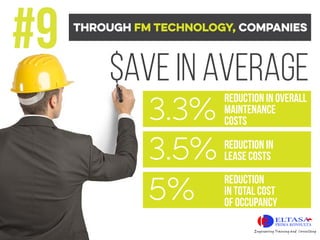
THROUGH FM TECHNOLOGY, COMPANIES
REDUCTION IN OVERALL
MAINTENANCE
COSTS
REDUCTION IN
LEASE COSTS
REDUCTION
IN TOTAL COST
OF OCCUPANCY
#9
5%
3.5%
3.3%
$AVE IN AVERAGE
ACCORDING TO A
GLOBAL INDUSTRIES ANALYTICS REPORT,
THE FM INDUSTRY IS EXPECTED TO GROW
#10
BEFORE 2019.
$400 BILLION
BY ALMOST
#11 IWMS SOFTWARE SALES BY 2018
ARE EXPECTED TO HIT REVENUES
OF ALMOST $1.7 BILLION WORLDWIDE.
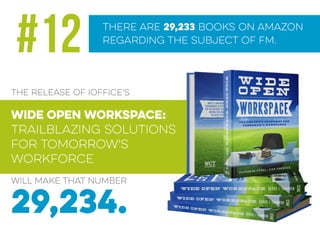
#12 THERE ARE 29,233 BOOKS ON AMAZON
REGARDING THE SUBJECT OF FM.
THE RELEASE OF IOFFICE'S
WIDE OPEN WORKSPACE:
TRAILBLAZING SOLUTIONS
FOR TOMORROW'S
WORKFORCE
WILL MAKE THAT NUMBER
TRAILBLAZING SOLUTIONS
29,234.
Thank You

01 facility management definition and scope opt

  • 1.
    0101 –– FacilityManagement :0101 Facility Management :Facility Management : Definition and Scope Ir. Arya Wirabhuana, M.Sc, CMPM
  • 2.
    Facility management isa profession that encompasses multiple disciplines to ensure functionality of the built environment by integrating people, place, process and technology – International Facility Management Association (IFMA)
  • 5.
    The Core Competenciesof Facility Management The 11 core competencies are: 1. Communication 2. Emergency Preparedness and Business Continuity 3. Environmental Stewardship and Sustainability 4. Finance and Business 5. Human Factors 6. Leadership and Strategy 7. Operations and Maintenance 8. Project Management 9. Quality 10.Real Estate and Property Management 11.Technology
  • 6.
    Communication—Communication plans andprocesses for both internal and external stakeholders Emergency Preparedness and Business Continuity— Emergency and risk management plans and procedures Environmental Stewardship and Sustainability— Sustainable management of built and natural environments Finance & Business—Strategic plans, budgets, financial analyses, procurement Human Factors—Healthy and safe environment, security, FM employee development Leadership and Strategy—Strategic planning, organize staff and lead organization
  • 7.
    Operations and Maintenance—Buildingoperations and maintenance, occupant services Project Management—Foresight in management of all projects and related contracts Quality—Best practices, process improvements, audits and measurements Real Estate and Property Management—Real estate planning, acquisition and disposition Technology—Facility management technology, workplace management systems
  • 8.
    The definition offacility management, EN15221-1, provided by the European Committee for Standardization (CEN) and ratified by 31 European countries is: "(the) integration of processes within an organization to maintain and develop the agreed services which support and improve the effectiveness of its primary activities."
  • 9.
    Facility management (orfacilities management or FM) is an integrated multidisciplinary, interdisciplinary field devoted to the coordination of space, infrastructure, people and organization, often associated with the administration of office blocks, arenas, schools, convention centers, shopping complexes, hospitals, hotels, etc. However, FM facilitates on a much wider range of activities than just business services and these are referred to as non-core functions. Many of these are outlined below but they do vary from one business sector to another. - Wikipedia
  • 10.
    The discipline offacility management and the role of facility managers in particular are evolving to the extent that many managers have to operate at two levels: strategic-tactical and operational. In the former case, clients, customers and end-users need to be informed about the potential impact of their decisions on the provision of space, services, cost and business risk. In the latter, it is the role of a facility manager to ensure corporate and regulatory compliance plus the proper operation of all aspects of a building to create an optimal, safe and cost effective environment for the occupants to function. This is accomplished by managing the following activities:
  • 11.
    Health and safety/ Occupational safety The facilities management department in an organization is required to control and manage many safety related issues. Failure to do so may lead to injury, loss of business, prosecution and insurance claims; the confidence of customers and investors in the business may also be shaken by adverse publicity.
  • 12.
    Fire safety /Fire protection The threat from fire carries one of the highest risk to loss of life, and the potential to damage or shut down a business. The facilities management department will have in place maintenance, inspection and testing for all of the fire safety equipment and systems, keeping records and certificates of compliance.
  • 13.
    Security / Physicalsecurity Security to any organization is necessary to protect the employees and the business and this often comes under the control of the facilities management department, in particular the maintenance of the hardware. Manned guarding may be under the control of a separate department.
  • 14.
    Maintenance, testing andinspection / Maintenance, repair, and operations Maintenance, testing and inspection schedules are required to ensure that the facility is operating safely and efficiently, to maximize the life of equipment and reduce the risk of failure. There are also statutory obligations to be met. The work is planned, often using a Computer-aided facility management system.
  • 15.
    Cleaning / Commercialcleaning Cleaning operations are often undertaken out of business hours, but provision may be made during times of occupations for the cleaning of toilets, replenishing consumables (toilet rolls, soap, etc.) plus litter picking and reactive response. Cleaning is scheduled as a series of "periodic" tasks: daily, weekly, monthly, etc
  • 16.
    Operational / Operationsmanagement The facilities management department has responsibilities for the day to day running of the building; these tasks may be outsourced or carried out by directly employed staff. This is a policy issue, but due to the immediacy of the response required in many of the activities involved the facilities manager will need to keep tight control, often requiring daily reports or an escalation procedure.
  • 17.
    Some issues requiremore than just periodic maintenance, for example those that can stop or hamper the productivity of the business or that have safety implications. Many of these are managed by the facilities management "help desk" that staff are able to be contacted either by telephone or email. The response to help desk calls are prioritized but may be as simple as too hot or too cold, lights not working, photocopier jammed, coffee spills, vending machine problems, etc. Help desks may be used to book meeting rooms, car parking spaces and many other services, but this often depends on how the facilities department is organized. It may be split into two sections often referred to as "soft" and "hard" services. Soft would include reception, post room, cleaning, etc. and hard the mechanical and electrical services.
  • 18.
    Tendering / Procurement Thefacilities management team will seek to periodically re-tender their contracts, or at the very least bench mark them to ensure they are getting value for money. For this to happen it is necessary to have an up to date list of equipment or assets to send out with the tenders. This information is often retained on the same computer as the maintenance schedule and updating may be overlooked as equipment gets changed, replaced or new items are installed. The asset register is also an important tool for budgeting, used for life cycle costing and for capital expenditure forecasting.
  • 19.
    Commercial property management/ Leasing Building may be owned by the occupier or leased. Leased properties will be subject to periodic rent reviews.
  • 20.
    Business continuity planning Allorganizations should have in place a continuity plan so that in the event of a fire or major failure the business can recover quickly. In large organizations it may be that the staff move to another site that has been set up to model the existing operation. The facilities management department would be one of the key players should it be necessary to move the business to a recovery site.
  • 21.
    Space allocation andchanges / Office In many organizations, office layouts are subject to frequent changes. This process is referred to as churn rate, expressed as the percentage of the staff moved during a year. These moves are normally planned by the facilities management department using Computer-aided design. In addition to meeting the needs of the business, compliance with statutory requirements related to office layouts include: the minimum amount of space to be provided per staff member; fire safety arrangements; lighting levels; signage; ventilation; temperature control and welfare arrangements such as toilets and drinking water. Consideration may also be given to vending, catering or a place where staff can make a drink and take a break from their desk.
  • 22.
    EVERY Facilities Manager SHOULDKNOW SHOCKING STATISTICS ®
  • 23.
    CHANGES IN TODAY'SWORKFORCE ARE FORCING FACILITY MANAGERS REINVENT THE WORKSPACE ENVIRONMENT. THESE CHANGES HAVE BROUGHT THE INEVITABLE GROWTH OF THE FACILITY MANAGEMENT FIELD, AS WELL AS FM SOFTWARE. THOSE WHO DO NOT EMBRACE TECHNOLOGY AND ALL OF ITS TOOLS ARE BEING LEFT BEHIND. WE ROUNDED UP A FEW STATISTICS THAT ARE SURE TO GET YOU THINKING, IF NOT TOTALLY CONVINCE YOU, THAT THE WORKFORCE IS CHANGING, AND WE ALL HAVE TO ADAPT.
  • 24.
    ONE WORKSPACE FOR ANINDIVIDUAL EMPLOYEE CAN COST AN ORGANIZATION UP TO #1 $14,000 PER YEAR.
  • 25.
    #2 OF EMPLOYEES ARE SOMEHOW UNSUPPORTED, DETACHEDOR DISENGAGED AT WORK. MORE THAN 60%
  • 26.
    REGARDING WORK-LIFE BALANCE INA POLL CONDUCTED BY OECD. (OUT OF 23 COUNTRIES) #3 DEAD LAST THE UNITED STATES IS
  • 27.
    THE TYPICAL BUSINESSCOULD SAVE #4$11,000 PER PERSON PER YEAR WITH TELECOMMUTING UP TO $7,000 THEMSELVES AND EMPLOYEES COULD SAVE
  • 28.
    WILL BE MILLENNIALS WHO ARE TECHNOLOGY NATIVES& EXPECT IT IN THE WORKPLACE. #5BY 2025 OF THE WORKFORCE 75%
  • 29.
    #6THE AVERAGE AMERICANSPENDS PER DAY ONLINE, & 81% OF NORTH AMERICA USES THE INTERNET 5.2 HOURS
  • 30.
    #7 ALMOST OF PROFESSIONALS USE THEIRMOBILE DEVICE TO CHECK EMAIL, OF THE UNITED STATES IS ON A MOBILE DEVICE. WHILE 80% 101%
  • 31.
    #8#8 maintaining a socialnetwork presence. NEARLY 1.8 BILLION PEOPLE GLOBALLY utilize at least one social network, WITH 56% OF AMERICANS
  • 32.
    THROUGH FM TECHNOLOGY,COMPANIES REDUCTION IN OVERALL MAINTENANCE COSTS REDUCTION IN LEASE COSTS REDUCTION IN TOTAL COST OF OCCUPANCY #9 5% 3.5% 3.3% $AVE IN AVERAGE
  • 33.
    ACCORDING TO A GLOBALINDUSTRIES ANALYTICS REPORT, THE FM INDUSTRY IS EXPECTED TO GROW #10 BEFORE 2019. $400 BILLION BY ALMOST
  • 34.
    #11 IWMS SOFTWARESALES BY 2018 ARE EXPECTED TO HIT REVENUES OF ALMOST $1.7 BILLION WORLDWIDE.
  • 35.
    #12 THERE ARE29,233 BOOKS ON AMAZON REGARDING THE SUBJECT OF FM. THE RELEASE OF IOFFICE'S WIDE OPEN WORKSPACE: TRAILBLAZING SOLUTIONS FOR TOMORROW'S WORKFORCE WILL MAKE THAT NUMBER TRAILBLAZING SOLUTIONS 29,234.
  • 36.