Chapter #2
Communication & Perception

SYED KHURSHEED BUKHARI
M.COM (final)
GOVERNMENT COLLEGE
OF MANAGEMENT
SCIENCES
PESHAWAR
Contact # : 03452460252
khursheed9491@yahoo.com
prepared by: Syed Khursheed Bukhari
1
Communication




Origin: the word communication has been
derived from Latin word “communis” which
means to share the experience.
Definition: the exchange of idea’s between
human beings is known as communication.
We can exchange our idea’s through words,
pictures, signs or body language.

prepared by: Syed Khursheed Bukhari
2
Perception


The dynamic psychological process
responsible for attending to organizing
and interpreting sensory data.

prepared by: Syed Khursheed Bukhari
3
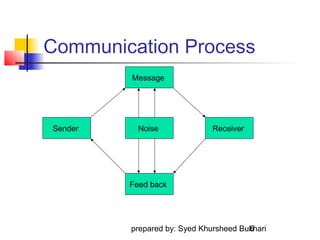
Communication Process
1.
2.
3.
4.
5.
6.
7.
8.

Sender: a person who sends the message.
Encoding: putting your idea’s in some codes.
Message: it is the actual physical product from the sender.
Channel: it is a medium, selected by the sender through which he
sends the message.
Receiver: he is a person who receives the message. He may be a
listener, viewer or reader.
Decoding: it is the art or process of getting idea’s out of the
message.
Noise: it represents the communication barrier that distort the
clarity of the message.
Feed Back: it is the response of the receiver which indicates
success or failure if the communication.
prepared by: Syed Khursheed Bukhari
4
Communication Process
Message

Sender

Noise

Receiver

Feed back

prepared by: Syed Khursheed Bukhari
5
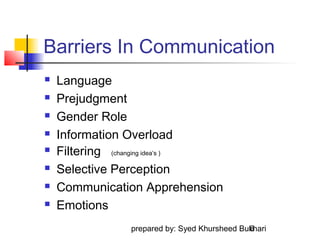
Barriers In Communication









Language
Prejudgment
Gender Role
Information Overload
Filtering (changing idea’s )
Selective Perception
Communication Apprehension
Emotions
prepared by: Syed Khursheed Bukhari
6
The Significance Of
Non-verbal Communication






Non-verbal communication is the process of
coding meaning through behavior that do not
involve the use of words.
It is neglected area but, it is true that 75% of
our communication comes through this area.
Gesture, posture, thoughts, signs and body
language are the examples of non verbal
communication.
prepared by: Syed Khursheed Bukhari
7
Gurdham Behavior Categories
136 in 9

Eye brow
Eye gaze
9

Head moment
Arm moment

Mouth moment

Limb moment

Trunk moment

Face expression

Other body moment
prepared by: Syed Khursheed Bukhari
8
Selectivity Attention


It is the ability to choose from the
stream of sensory data, to concentrate
on particular elements and to ignore
others.

prepared by: Syed Khursheed Bukhari
9
Perceptual Organization




It is the process through which incoming
stimuli are organized or patterned in
systematic and meaningful ways.
OR
An unconscious process of mind through
which we organized or make groups and give
shape to meaningful data.

prepared by: Syed Khursheed Bukhari
10
Impression Management


Impression management is the process
where by people seeks to control the
image, others have of them.

prepared by: Syed Khursheed Bukhari
11
Perceptual Sets


A perceptual set is an individual’s
predisposition to respond to particular
events in a particular manner. It is also
known as mental set. As we tend to
perceive, this can also be called
perceptual expectation.

prepared by: Syed Khursheed Bukhari
12
Perceptual World


The individual perceptual world is
simply their personal image, map or
picture of their social, physical and
organizational enviroment.

prepared by: Syed Khursheed Bukhari
13
Principles Of Perceptual
Organization


1.
2.
3.

There are three principles through
which one perceptual organization
operates
Proximity Principle
Similarity Principle
Principle of closure

prepared by: Syed Khursheed Bukhari
14
Proximity Principle


This principle notes that we tend to
group together or to classify stimuli that
are physically close to each other and
which thus appear to belong together.
For example often we assume that
people are similar just because of that
they live in same neighborhood or work
in same section of factory.
prepared by: Syed Khursheed Bukhari
15
Similarity Principle


This principle notes that we classify or
group together stimuli that resemble
each other in appearance in some
respect.
for example if we assume that they are
similar just because they wear same
clothes etc.
prepared by: Syed Khursheed Bukhari
16
Principle Of Closure


The fact that we are able to make use of
incomplete or ambiguous information by
“filling in gaps” from our own knowledge or
experience.
for example if we take incomplete information
about some one and draw influence from this
incomplete information, is called the principle
of closure.
prepared by: Syed Khursheed Bukhari
17
Perceptual Set And Assumption
About Human Behavior
1.

2.

Halo Effect: A halo effect is a judgment of
someone based on the striking
characteristics such as an aspect of their
dress, speech or posture. It can be positive
or negative.
Stereotyping: A stereotyping is a category
or personality type, to which we consign
people on the bases of their membership of
some known groups.
prepared by: Syed Khursheed Bukhari
18
Errors In Person Perception











The main errors in the person perception are as
under:
Not collecting enough information about other
people.
Basing our judgment on information that is
irrelevant or insignificance.
We judge people on our own characteristics.
Accepting stereotype uncritically.
Self bias.
Prejudices.
prepared by: Syed Khursheed Bukhari
19
Avoidance Of Errors In
Perception


Following are the remedies of such errors:
Take more time in judgment about others.
Get out your self from stereotyping.
Avoid halo effect.
Get out bias from your judgment.
Collecting more relevant information about
others.
Avoid attributions such as sex appearance
etc.
prepared by: Syed Khursheed Bukhari
20

Chapter #2 COMMUNICATION AND PERCEPTION

  • 1.
    Chapter #2 Communication &Perception SYED KHURSHEED BUKHARI M.COM (final) GOVERNMENT COLLEGE OF MANAGEMENT SCIENCES PESHAWAR Contact # : 03452460252 khursheed9491@yahoo.com prepared by: Syed Khursheed Bukhari 1
  • 2.
    Communication   Origin: the wordcommunication has been derived from Latin word “communis” which means to share the experience. Definition: the exchange of idea’s between human beings is known as communication. We can exchange our idea’s through words, pictures, signs or body language. prepared by: Syed Khursheed Bukhari 2
  • 3.
    Perception  The dynamic psychologicalprocess responsible for attending to organizing and interpreting sensory data. prepared by: Syed Khursheed Bukhari 3
  • 4.
    Communication Process 1. 2. 3. 4. 5. 6. 7. 8. Sender: aperson who sends the message. Encoding: putting your idea’s in some codes. Message: it is the actual physical product from the sender. Channel: it is a medium, selected by the sender through which he sends the message. Receiver: he is a person who receives the message. He may be a listener, viewer or reader. Decoding: it is the art or process of getting idea’s out of the message. Noise: it represents the communication barrier that distort the clarity of the message. Feed Back: it is the response of the receiver which indicates success or failure if the communication. prepared by: Syed Khursheed Bukhari 4
  • 5.
  • 6.
    Barriers In Communication         Language Prejudgment GenderRole Information Overload Filtering (changing idea’s ) Selective Perception Communication Apprehension Emotions prepared by: Syed Khursheed Bukhari 6
  • 7.
    The Significance Of Non-verbalCommunication    Non-verbal communication is the process of coding meaning through behavior that do not involve the use of words. It is neglected area but, it is true that 75% of our communication comes through this area. Gesture, posture, thoughts, signs and body language are the examples of non verbal communication. prepared by: Syed Khursheed Bukhari 7
  • 8.
    Gurdham Behavior Categories 136in 9 Eye brow Eye gaze 9 Head moment Arm moment Mouth moment Limb moment Trunk moment Face expression Other body moment prepared by: Syed Khursheed Bukhari 8
  • 9.
    Selectivity Attention  It isthe ability to choose from the stream of sensory data, to concentrate on particular elements and to ignore others. prepared by: Syed Khursheed Bukhari 9
  • 10.
    Perceptual Organization   It isthe process through which incoming stimuli are organized or patterned in systematic and meaningful ways. OR An unconscious process of mind through which we organized or make groups and give shape to meaningful data. prepared by: Syed Khursheed Bukhari 10
  • 11.
    Impression Management  Impression managementis the process where by people seeks to control the image, others have of them. prepared by: Syed Khursheed Bukhari 11
  • 12.
    Perceptual Sets  A perceptualset is an individual’s predisposition to respond to particular events in a particular manner. It is also known as mental set. As we tend to perceive, this can also be called perceptual expectation. prepared by: Syed Khursheed Bukhari 12
  • 13.
    Perceptual World  The individualperceptual world is simply their personal image, map or picture of their social, physical and organizational enviroment. prepared by: Syed Khursheed Bukhari 13
  • 14.
    Principles Of Perceptual Organization  1. 2. 3. Thereare three principles through which one perceptual organization operates Proximity Principle Similarity Principle Principle of closure prepared by: Syed Khursheed Bukhari 14
  • 15.
    Proximity Principle  This principlenotes that we tend to group together or to classify stimuli that are physically close to each other and which thus appear to belong together. For example often we assume that people are similar just because of that they live in same neighborhood or work in same section of factory. prepared by: Syed Khursheed Bukhari 15
  • 16.
    Similarity Principle  This principlenotes that we classify or group together stimuli that resemble each other in appearance in some respect. for example if we assume that they are similar just because they wear same clothes etc. prepared by: Syed Khursheed Bukhari 16
  • 17.
    Principle Of Closure  Thefact that we are able to make use of incomplete or ambiguous information by “filling in gaps” from our own knowledge or experience. for example if we take incomplete information about some one and draw influence from this incomplete information, is called the principle of closure. prepared by: Syed Khursheed Bukhari 17
  • 18.
    Perceptual Set AndAssumption About Human Behavior 1. 2. Halo Effect: A halo effect is a judgment of someone based on the striking characteristics such as an aspect of their dress, speech or posture. It can be positive or negative. Stereotyping: A stereotyping is a category or personality type, to which we consign people on the bases of their membership of some known groups. prepared by: Syed Khursheed Bukhari 18
  • 19.
    Errors In PersonPerception        The main errors in the person perception are as under: Not collecting enough information about other people. Basing our judgment on information that is irrelevant or insignificance. We judge people on our own characteristics. Accepting stereotype uncritically. Self bias. Prejudices. prepared by: Syed Khursheed Bukhari 19
  • 20.
    Avoidance Of ErrorsIn Perception  Following are the remedies of such errors: Take more time in judgment about others. Get out your self from stereotyping. Avoid halo effect. Get out bias from your judgment. Collecting more relevant information about others. Avoid attributions such as sex appearance etc. prepared by: Syed Khursheed Bukhari 20