News and Reality
    (Potter, Ch. 12)


     10/20/09
Overview
•   some ideas on news and framing reality
•   Exercise: define framing…
•   8 news framing influences
•   problems with objectivity
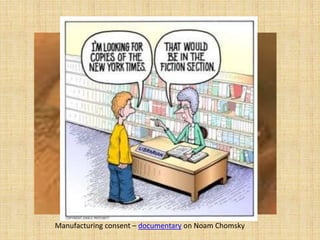
Manufacturing consent – documentary on Noam Chomsky
Key Idea (Potter)
• News is not a reflection of actual events;
• It is a construction by news workers who are
  subjected to many influences and constraints.
Reflection or a Construction?
                > Constraints

•   Deadlines
•   Geographical focus
•   Resource limitations
•   Story formula (WWWWW)
“Character”
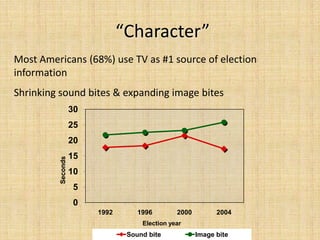
Most Americans (68%) use TV as #1 source of election
information
Shrinking sound bites & expanding image bites
                   30
                   25
                   20
                   15
         Seconds


                   10
                   5
                   0
                        1992       1996        2000         2004
                                    Election year
                                Sound bite            Image bite
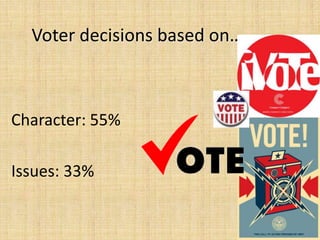
Voter decisions based on…


Character: 55%

Issues: 33%
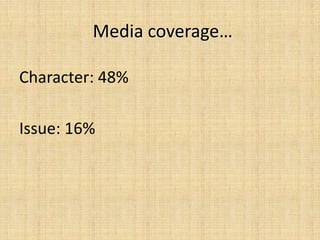
Media coverage…

Character: 48%

Issue: 16%
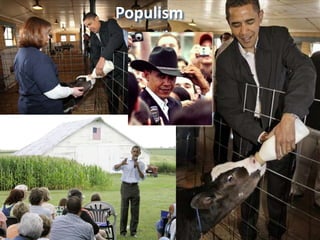
Populism
Family
Family & patriotism
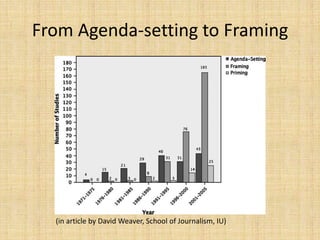
From Agenda-setting to Framing


  (in article by David Weaver, School of Journalism, IU)
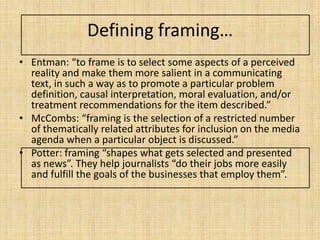
Defining framing…
• Entman: “to frame is to select some aspects of a perceived
  reality and make them more salient in a communicating
  text, in such a way as to promote a particular problem
  definition, causal interpretation, moral evaluation, and/or
  treatment recommendations for the item described.”
• McCombs: “framing is the selection of a restricted number
  of thematically related attributes for inclusion on the media
  agenda when a particular object is discussed.”
• Potter: framing “shapes what gets selected and presented
  as news”. They help journalists “do their jobs more easily
  and fulfill the goals of the businesses that employ them”.
Reflection or a Construction?
              > News-Framing

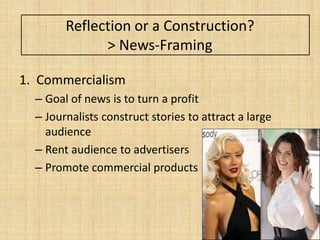
1. Commercialism
  – Goal of news is to turn a profit
  – Journalists construct stories to attract a large
    audience
  – Rent audience to advertisers
  – Promote commercial products
Reflection or a Construction?
              -Framing > News
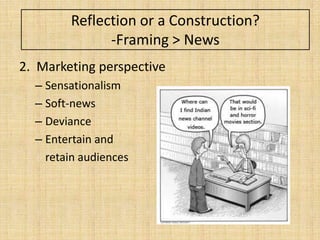
2. Marketing perspective
  – Sensationalism
  – Soft-news
  – Deviance
  – Entertain and
    retain audiences
Reflection or a Construction?
              >News-Framing

3. Ownership
  – Pressure to turn a profit
  – Reinforces marketing perspective
Reflection or a Construction?
               >News-Framing

4. Organizational structures
  – Small, flexible, entrepreneurial, quick adaptation
  – Compartmentalized, specialized functions, staff of
    technical people
Reflection or a Construction?
               >News-Framing

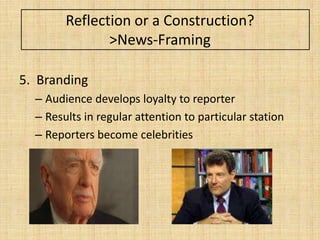
5. Branding
  – Audience develops loyalty to reporter
  – Results in regular attention to particular station
  – Reporters become celebrities
Reflection or a Construction?
             > News-Framing
6. Use of sources
  – Based on appearance of expertise
  – Willingness to tell a good story
  – Used repeatedly by multiple organizations
  – Incestuous relationship
Reflection or a Construction?
             > News-Framing

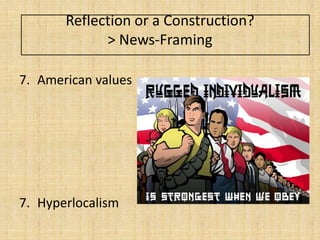
7. American values


7. Hyperlocalism
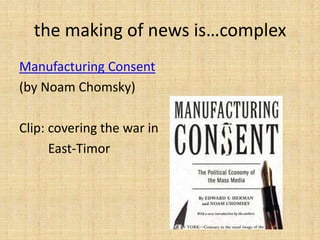
the making of news is…complex
Manufacturing Consent
(by Noam Chomsky)

Clip: covering the war in
      East-Timor
Objectivity
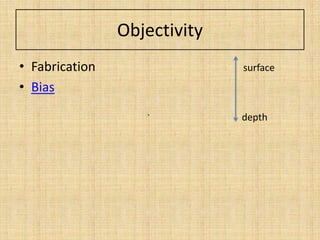
• Fabrication                 surface
• Bias

                   `          depth
Objectivity
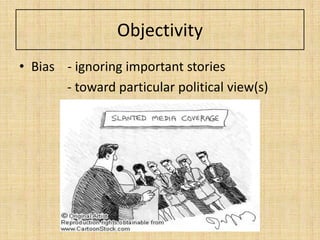
• Bias - ignoring important stories
       - toward particular political view(s)
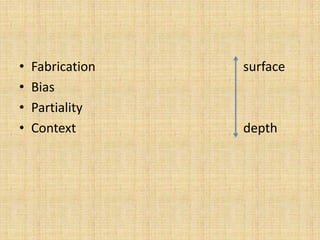
•   Fabrication   surface
•   Bias
•   Partiality
•   Context       depth
Objectivity


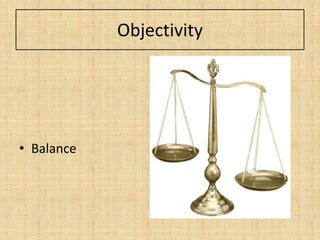
• Balance                 depth
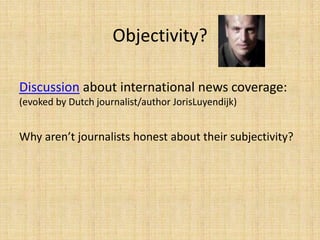
Objectivity?

Discussion about international news coverage:
(evoked by Dutch journalist/author JorisLuyendijk)


Why aren’t journalists honest about their subjectivity?
Now, how do I deal with news?
• Potter (p. 187): to be well informed,(…) you
need to pay attention to messages and really
think about them”, in terms of your
  • knowledge structures
  • higher order skills


•www.fair.org: blog with insights in structural
news functioning
Now, how do I deal with news?

It’s not: what is the case, what surrounds us as world
and as society?
It’s rather: how is it possible to accept information
about the world and about society as information
about reality when one knows how it is produced?
(from: The Reality of the Mass Media – N. Luhmann)
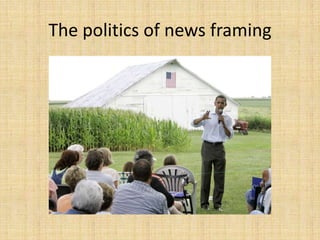
The politics of news framing
The Gutenberg legacy

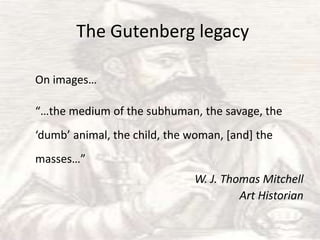
On images…

“…the medium of the subhuman, the savage, the
‘dumb’ animal, the child, the woman, *and+ the
masses…”
                              W. J. Thomas Mitchell
                                       Art Historian
Evolutionary History
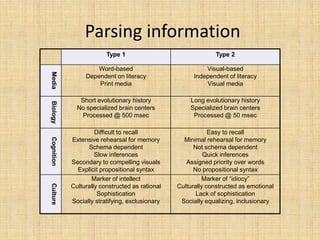
Parsing information
                         Type 1                                Type 2

                     Word-based                            Visual-based
Media


                 Dependent on literacy                 Independent of literacy
                     Print media                           Visual media

               Short evolutionary history            Long evolutionary history
Biology


              No specialized brain centers           Specialized brain centers
               Processed @ 500 msec                   Processed @ 50 msec

                     Difficult to recall                     Easy to recall
Cognition


            Extensive rehearsal for memory         Minimal rehearsal for memory
                  Schema dependent                     Not schema dependent
                     Slow inferences                       Quick inferences
            Secondary to compelling visuals         Assigned priority over words
              Explicit propositional syntax            No propositional syntax
                   Marker of intellect                    Marker of “idiocy”
Culture


            Culturally constructed as rational   Culturally constructed as emotional
                      Sophistication                    Lack of sophistication
            Socially stratifying, exclusionary    Socially equalizing, inclusionary
Visualization = Banalization?
Rick Roderick and the banalization by mass
  media (4/5 – 1:40 - 3:25 and 4:27 – 6:34) )

News Frames

  • 1.
    News and Reality (Potter, Ch. 12) 10/20/09
  • 2.
    Overview • some ideas on news and framing reality • Exercise: define framing… • 8 news framing influences • problems with objectivity
  • 3.
    Manufacturing consent –documentary on Noam Chomsky
  • 4.
    Key Idea (Potter) •News is not a reflection of actual events; • It is a construction by news workers who are subjected to many influences and constraints.
  • 5.
    Reflection or aConstruction? > Constraints • Deadlines • Geographical focus • Resource limitations • Story formula (WWWWW)
  • 6.
    “Character” Most Americans (68%)use TV as #1 source of election information Shrinking sound bites & expanding image bites 30 25 20 15 Seconds 10 5 0 1992 1996 2000 2004 Election year Sound bite Image bite
  • 7.
    Voter decisions basedon… Character: 55% Issues: 33%
  • 8.
  • 9.
  • 10.
  • 11.
  • 12.
    From Agenda-setting toFraming (in article by David Weaver, School of Journalism, IU)
  • 13.
    Defining framing… • Entman:“to frame is to select some aspects of a perceived reality and make them more salient in a communicating text, in such a way as to promote a particular problem definition, causal interpretation, moral evaluation, and/or treatment recommendations for the item described.” • McCombs: “framing is the selection of a restricted number of thematically related attributes for inclusion on the media agenda when a particular object is discussed.” • Potter: framing “shapes what gets selected and presented as news”. They help journalists “do their jobs more easily and fulfill the goals of the businesses that employ them”.
  • 14.
    Reflection or aConstruction? > News-Framing 1. Commercialism – Goal of news is to turn a profit – Journalists construct stories to attract a large audience – Rent audience to advertisers – Promote commercial products
  • 15.
    Reflection or aConstruction? -Framing > News 2. Marketing perspective – Sensationalism – Soft-news – Deviance – Entertain and retain audiences
  • 16.
    Reflection or aConstruction? >News-Framing 3. Ownership – Pressure to turn a profit – Reinforces marketing perspective
  • 17.
    Reflection or aConstruction? >News-Framing 4. Organizational structures – Small, flexible, entrepreneurial, quick adaptation – Compartmentalized, specialized functions, staff of technical people
  • 18.
    Reflection or aConstruction? >News-Framing 5. Branding – Audience develops loyalty to reporter – Results in regular attention to particular station – Reporters become celebrities
  • 19.
    Reflection or aConstruction? > News-Framing 6. Use of sources – Based on appearance of expertise – Willingness to tell a good story – Used repeatedly by multiple organizations – Incestuous relationship
  • 20.
    Reflection or aConstruction? > News-Framing 7. American values 7. Hyperlocalism
  • 21.
    the making ofnews is…complex Manufacturing Consent (by Noam Chomsky) Clip: covering the war in East-Timor
  • 22.
    Objectivity • Fabrication surface • Bias ` depth
  • 23.
    Objectivity • Bias -ignoring important stories - toward particular political view(s)
  • 24.
    Fabrication surface • Bias • Partiality • Context depth
  • 25.
  • 26.
    Objectivity? Discussion about internationalnews coverage: (evoked by Dutch journalist/author JorisLuyendijk) Why aren’t journalists honest about their subjectivity?
  • 27.
    Now, how doI deal with news? • Potter (p. 187): to be well informed,(…) you need to pay attention to messages and really think about them”, in terms of your • knowledge structures • higher order skills •www.fair.org: blog with insights in structural news functioning
  • 28.
    Now, how doI deal with news? It’s not: what is the case, what surrounds us as world and as society? It’s rather: how is it possible to accept information about the world and about society as information about reality when one knows how it is produced? (from: The Reality of the Mass Media – N. Luhmann)
  • 29.
    The politics ofnews framing
  • 30.
    The Gutenberg legacy Onimages… “…the medium of the subhuman, the savage, the ‘dumb’ animal, the child, the woman, *and+ the masses…” W. J. Thomas Mitchell Art Historian
  • 31.
  • 32.
    Parsing information Type 1 Type 2 Word-based Visual-based Media Dependent on literacy Independent of literacy Print media Visual media Short evolutionary history Long evolutionary history Biology No specialized brain centers Specialized brain centers Processed @ 500 msec Processed @ 50 msec Difficult to recall Easy to recall Cognition Extensive rehearsal for memory Minimal rehearsal for memory Schema dependent Not schema dependent Slow inferences Quick inferences Secondary to compelling visuals Assigned priority over words Explicit propositional syntax No propositional syntax Marker of intellect Marker of “idiocy” Culture Culturally constructed as rational Culturally constructed as emotional Sophistication Lack of sophistication Socially stratifying, exclusionary Socially equalizing, inclusionary
  • 33.
    Visualization = Banalization? RickRoderick and the banalization by mass media (4/5 – 1:40 - 3:25 and 4:27 – 6:34) )

Editor's Notes

  • #2 In this lecture I want to review some of the basic principles of news media. They are mostly based on the book we make our way through, but they also stem from other scientific books on the subject, as well as from my own experience. I let myself be guided – and I think we all let ourselves be guided in our media use – by my previous experiences in the field of journalism and found some great examples that will hopefully be as insightful to you as they were to me. We will see several aspects enter the stage:
  • #4 http://www.youtube.com/watch?v=jj4jtvihnvo&hl=nl
  • #6 Geogr. 1 local news, few newspaper not have own geog territory 2. geograf area’s are more importantResource: always more events, handheld devicesEnd: criminal trials, press could illuminate the complexity of issues more and educate the public about the underlying nature of the problem
  • #16 News workers pay careful attention to what kinds of stories and presentation formats generate the largest audience. Had led news workers to believe that the public wants more soft news items than stories about thhe government, economy and political matters2 types of deviance: statistical deviance or norm breaking deviance (person goes into a bank and withdraws money from ohterpeople’s accounts at gunpoint, 700.000 scheringa)
  • #20 Appearance : Lack experience or education to evaluate credentialsIncestuous lagerhuis
  • #21 Am values, individualism – people who do things their own way, moderatism, fanatism of any kind arouses skepticism; social order, where peace and order are valued. People who deviate are wrongdoers. Leadership, responsible capitalismHyper: overall audience shrinks for newspapers, tv-news and even the internet. audience is fragmented in sports-focused news shows such as SportsCenter, celebrity-focusedd news such as E!, comedy news shows such as theDaily Show or The Colbert report and personality-driven news shows such as Bill O’Reilly. These news seekers are less interested in global or national issues and more in
  • #22 (1:24:00 – 1:29:00) The documentary gives a one sided view on news media structures in the United States in the say 70-80 and 90s of the bygone century, and I didn’t want to withhold this little fragment with some paramount examples of how we are deluded by the workings of news media in general. When I was your age and studied in Amsterdam, writings by Mr Chomsky would always spread among the students and I’m quite certain he had a lot of supporters among dutch students in general in his days, and I guess I think it’s a shame that your generation seems in my view to not have been blessed with an outspoken and broadly supported maybe even popular scientific mediacritic such as Chomsky. It also seems that Chomsky’s reputation here, was a lot less popular than oversees, and he has made that claim himself more often than not, precisely because he wasn’t granted access to a mass media audience in his own country. There are of course several reasons to sum up as to what caused that circumstance. Now, I’m not saying please listen very carefully to what mr. Chomsky has to say here as it’s one-sided and probably polarizing,
  • #23 Fab: Jayson blair
  • #27 political and financial interests have huge effect in the ‘media war’ there is no such thing as THE Arabic worldmost CNN, BBC and New York Times journalists don’t speak Arabic languagelength/size of broadcast news coverage or paper article keep news agencies from bringing news with sufficient background, history and nuance