Role of Perception in Negotiation
Made by: Shivani Rathore
Ujjwal Vaish
Amit Godiyal
Girish Wadhwa
Vidhi Makker
Viplove Sinena
Mohit Chauhan
INTRODUCTION
• Perception is the process by which individuals connect to
their environment. In layman’s terms, it is a sense-making
process where people interpret their environment so to
respond appropriately. As perception depends on the
perceiver’s current state of mind, role and comprehension,
here could always be errors in the interpretation and
subsequent communication.
The Role of Perception
• Negotiators approach each negotiation guided by
their perceptions...
• Determine exactly what is being said and what is
meant.
• Defined as “the process of screening, selecting,
and interpreting stimuli so that they have
meaning to the individual.”
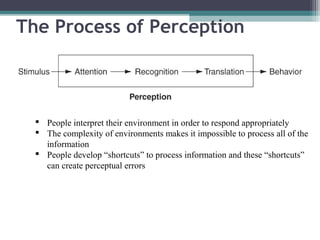
The Process of Perception
 People interpret their environment in order to respond appropriately
 The complexity of environments makes it impossible to process all of the
information
 People develop “shortcuts” to process information and these “shortcuts”
can create perceptual errors
Perceptual Errors/Distortions in
Negotiation
• Generalization
▫ Stereotyping
▫ Halo effect
▫ Selective Perception
▫ Projection
Stereotyping
• One individual assigns attributes to another solely on the basis of the
other’s membership in a particular social or demographic group.
▫ For example
 Age
 Gender
 Race
 Religion
• Eg: He is an Italian so he must know so much about Rome.
• Very common, highly resistant to change once formed
Halo Effects
• People generalize about a variety of attributes based on the knowledge of
one attribute of an individual.
▫ For example
 Positive halo effect
 Smiling person is honest.
 Negative halo effect
 Frowning person is dishonest.
• Reasons for occurrence
▫ Very little experience with the other party
▫ When the person is well known
▫ When the qualities have strong moral implications
▫ Eg: He is smiling so he must be telling the truth!
Selective Perception
• Occurs when the perceiver singles out certain
information that supports or reinforces a prior
belief, and filters out information that does not
confirm that belief.
▫ For example
 Smiling
 Frowning
Projection
• Occurs when people ascribe to others the characteristics or feelings that
they possess themselves.
▫ For example
 Frustration
 Delays
• Assign to others the characteristics or feelings that they possess themselves.
• Eg: I feel upset to postpone things, so he also will probably get frustrated if I
tell him to delay our meeting.
Framing
• Frames:
▫ Represent the subjective mechanism through
which people evaluate and make sense out of
situations
▫ Lead people to pursue or avoid subsequent actions
▫ Focus, shape and organize the world around us
▫ Make sense of complex realities
▫ Define a person, event or process
▫ Impart meaning and significance
Types of Disputes used in Frames
• Type of Frames Used in Disputes
1)Substantive
• Disposition about key issue and concern in the conflict
• Neglects how parties will resolve the dispute
2)Outcome
• Predisposition to achieving a specific result or outcome from the
negotiation
• Primarily used by distributive negotiators
3)Aspiration
• Predisposition to a broader set of interests, needs and concern other than a
specific outcome.
• Primarily used by integrative negotiators
Cont..
4)Process
• Procedure on how parties will resolve their dispute.
• Does not care much about specific key issues and concern in the conflict
5)Identity
• Definition of oneself, based on membership of a number of different social
groups such as gender, religion, ethnic origin, etc
• Used to differentiate themselves from others and tend to be positive
6)Characterization
• One’s definition of the other parties, shaped by prior or early experience
and knowledge about others.
• Tend to be negative in conflicts
• the transaction as a monetary cost of the purchase (loss) or the value (gain)
of the item.
Cont..
7)Loss/ Gain
• Definition of risk and reward associated with different outcomes
• Can frame the outcome as loss or reward based on risk preference of other
parties
• For instance, a car buyer can view the transaction as a monetary cost of the
purchase (loss) or the value (gain) of the item.
How Frames Work in Negotiation
Negotiators can use more than one frame
• Mismatches in frames between parties are sources of conflict
• Different types of frames or content from the two parties can cause
misunderstanding and conflict escalation
• Can reframe the conflict into the frame that is more compatible for
both parties3. Particular types of frames may lead to particular types
of agreements
▫ Aspiration frames lead to integrative agreement
▫ Outcome or negative frames can lead to distributive agreement
• Specific frames may be likely to be used with certain types of issues
▫ People discussing salary may be likely to use outcome frame.
▫ People discussing relationship may be likely to use
characterization frame
Cont..
• Parties are likely to assume a particular frame because of various factors
▫ Differences in personality
• Value differences
▫ Power differences
▫ Differences in background
▫ Social context
Individual Biases in Negotiation
Researchers identified the systematic ways in which people depart from rationality, to
identify the barriers to the focal negotiator and to identify what could be expected from
other parties. The concept of rationality did not make any assumptions about what the
negotiator valued, only that they optimally pursued their own objectives.
Negotiators tend to be inappropriately affected by the positive or negative frame in which
they view risks (Neale and Bazerman 1985; Bazerman, Magliozzi, and Neale 1985), to
anchor their numeric estimates in negotiations on irrelevant information such as arbitrary
numbers or manipulated listing prices to rely
disproportionately on readily available information at the expense of critical but less salient
information and to be overconfident about the likelihood of attaining outcomes that favor
themselves.
Competitive Biases in Negotiation
Negotiators tend to assume that negotiation tasks are fixed sum (fixed-pie), to miss
opportunities for mutually beneficial tradeoffs between the parties (Bazerman, Magliozzi, and
Neale 1985); to escalate commitment to a previously selected course of action when it is no
longer the most reasonable alternative (Bazerman and Neale 1983); to overlook valuable,
available information by failing to consider the opponent’s cognitive perspective (Samuelson
and Bazerman 1985; Bazerman and Carroll 1987) and strengths and weaknesses (Radzevick
and Moore 2008), and devalue any concession made by one’s opponent (Ross and Stillenger
1991).
Egocentrism in Negotiation
When parties disagree about what is fair, each side assumes that the other party is
intentionally overstating its case. It is extremely common and predictable for parties to
overweight views that favor themselves, (Babcock and Loewenstein 1997; Diekmann et al. 1997)
to perceive what is fair through a self-serving lens. Negotiators are egocentric and the more
egocentric parties are, the higher the likelihood of impasse. The provision of additional
information actually increases egocentrism. Participants who received more information tended
to make more extreme estimates about what would be a fair outcome.
Positive moods increased negotiators’ tendency to select a cooperative strategy (Forgas
1998), increased their frequency of arriving at agreements that enhance joint gains
(Barsade 2002), enhanced their ability to find integrative gains (Carnevale and Isen
1986), and helped negotiators avoid the development of hostility and conflict (Isen and
Baron 1991). Angry negotiators were found to be less accurate than other negotiators at
judging the interests of opponent negotiators and achieved lower joint gains (Allred et
al. 1997). Some research also suggested that emotions played a functional role in
negotiations (Damasio 1994; Keltner and Kring 1999; Barry 1999; Thompson et al.
1999). Anger makes negotiators more self-centered in their preferences (Loewenstein et
al. 1989) and increases the likelihood that they will reject profitable offers in ultimatum
games (Pillutla and Murnighan 1996).
Emotions
References
• Journal of Experimental Social Psychology(Volume 27,Issue 2,march
1991 page 161-179)
• Book- Negotiation Theory & Research by Leign L. thompson
• Research paper from Harvard university profressor Kathleen L.
Mclinn on Information Exchange in Negotiation
• www.hbs.edu/facultypages/profile
• The Bittersweet Feeling of success: An Examination of Social Perception in
Negotiation- L.Thompson, K.L Mcginn
• The Reality & Myth of Sacred Isuues in Negotiations – A.E Tenbrunsel
• Warmth & Competence as universal dimension of social Perception: The
Stereotype Content Model and the BIAS Map.
Cont..
• YOU TUBE Videos- The Role of perception in human Relations –Matthew
waynelyons.
• The Role of Perception – Alanis Business Academy.
• Articles- 15 by Maaja Vadi,University of Tartu, Estonia on
• Perception of Negotiation Partner: Cultural Differences from Perspective of
Estonians.
Questions

Negotiation final ppt

  • 1.
    Role of Perceptionin Negotiation Made by: Shivani Rathore Ujjwal Vaish Amit Godiyal Girish Wadhwa Vidhi Makker Viplove Sinena Mohit Chauhan
  • 2.
    INTRODUCTION • Perception isthe process by which individuals connect to their environment. In layman’s terms, it is a sense-making process where people interpret their environment so to respond appropriately. As perception depends on the perceiver’s current state of mind, role and comprehension, here could always be errors in the interpretation and subsequent communication.
  • 3.
    The Role ofPerception • Negotiators approach each negotiation guided by their perceptions... • Determine exactly what is being said and what is meant. • Defined as “the process of screening, selecting, and interpreting stimuli so that they have meaning to the individual.”
  • 4.
    The Process ofPerception  People interpret their environment in order to respond appropriately  The complexity of environments makes it impossible to process all of the information  People develop “shortcuts” to process information and these “shortcuts” can create perceptual errors
  • 5.
    Perceptual Errors/Distortions in Negotiation •Generalization ▫ Stereotyping ▫ Halo effect ▫ Selective Perception ▫ Projection
  • 6.
    Stereotyping • One individualassigns attributes to another solely on the basis of the other’s membership in a particular social or demographic group. ▫ For example  Age  Gender  Race  Religion • Eg: He is an Italian so he must know so much about Rome. • Very common, highly resistant to change once formed
  • 7.
    Halo Effects • Peoplegeneralize about a variety of attributes based on the knowledge of one attribute of an individual. ▫ For example  Positive halo effect  Smiling person is honest.  Negative halo effect  Frowning person is dishonest. • Reasons for occurrence ▫ Very little experience with the other party ▫ When the person is well known ▫ When the qualities have strong moral implications ▫ Eg: He is smiling so he must be telling the truth!
  • 8.
    Selective Perception • Occurswhen the perceiver singles out certain information that supports or reinforces a prior belief, and filters out information that does not confirm that belief. ▫ For example  Smiling  Frowning
  • 9.
    Projection • Occurs whenpeople ascribe to others the characteristics or feelings that they possess themselves. ▫ For example  Frustration  Delays • Assign to others the characteristics or feelings that they possess themselves. • Eg: I feel upset to postpone things, so he also will probably get frustrated if I tell him to delay our meeting.
  • 10.
    Framing • Frames: ▫ Representthe subjective mechanism through which people evaluate and make sense out of situations ▫ Lead people to pursue or avoid subsequent actions ▫ Focus, shape and organize the world around us ▫ Make sense of complex realities ▫ Define a person, event or process ▫ Impart meaning and significance
  • 11.
    Types of Disputesused in Frames • Type of Frames Used in Disputes 1)Substantive • Disposition about key issue and concern in the conflict • Neglects how parties will resolve the dispute 2)Outcome • Predisposition to achieving a specific result or outcome from the negotiation • Primarily used by distributive negotiators 3)Aspiration • Predisposition to a broader set of interests, needs and concern other than a specific outcome. • Primarily used by integrative negotiators
  • 12.
    Cont.. 4)Process • Procedure onhow parties will resolve their dispute. • Does not care much about specific key issues and concern in the conflict 5)Identity • Definition of oneself, based on membership of a number of different social groups such as gender, religion, ethnic origin, etc • Used to differentiate themselves from others and tend to be positive 6)Characterization • One’s definition of the other parties, shaped by prior or early experience and knowledge about others. • Tend to be negative in conflicts • the transaction as a monetary cost of the purchase (loss) or the value (gain) of the item.
  • 13.
    Cont.. 7)Loss/ Gain • Definitionof risk and reward associated with different outcomes • Can frame the outcome as loss or reward based on risk preference of other parties • For instance, a car buyer can view the transaction as a monetary cost of the purchase (loss) or the value (gain) of the item.
  • 14.
    How Frames Workin Negotiation Negotiators can use more than one frame • Mismatches in frames between parties are sources of conflict • Different types of frames or content from the two parties can cause misunderstanding and conflict escalation • Can reframe the conflict into the frame that is more compatible for both parties3. Particular types of frames may lead to particular types of agreements ▫ Aspiration frames lead to integrative agreement ▫ Outcome or negative frames can lead to distributive agreement • Specific frames may be likely to be used with certain types of issues ▫ People discussing salary may be likely to use outcome frame. ▫ People discussing relationship may be likely to use characterization frame
  • 15.
    Cont.. • Parties arelikely to assume a particular frame because of various factors ▫ Differences in personality • Value differences ▫ Power differences ▫ Differences in background ▫ Social context
  • 16.
    Individual Biases inNegotiation Researchers identified the systematic ways in which people depart from rationality, to identify the barriers to the focal negotiator and to identify what could be expected from other parties. The concept of rationality did not make any assumptions about what the negotiator valued, only that they optimally pursued their own objectives. Negotiators tend to be inappropriately affected by the positive or negative frame in which they view risks (Neale and Bazerman 1985; Bazerman, Magliozzi, and Neale 1985), to anchor their numeric estimates in negotiations on irrelevant information such as arbitrary numbers or manipulated listing prices to rely disproportionately on readily available information at the expense of critical but less salient information and to be overconfident about the likelihood of attaining outcomes that favor themselves.
  • 17.
    Competitive Biases inNegotiation Negotiators tend to assume that negotiation tasks are fixed sum (fixed-pie), to miss opportunities for mutually beneficial tradeoffs between the parties (Bazerman, Magliozzi, and Neale 1985); to escalate commitment to a previously selected course of action when it is no longer the most reasonable alternative (Bazerman and Neale 1983); to overlook valuable, available information by failing to consider the opponent’s cognitive perspective (Samuelson and Bazerman 1985; Bazerman and Carroll 1987) and strengths and weaknesses (Radzevick and Moore 2008), and devalue any concession made by one’s opponent (Ross and Stillenger 1991). Egocentrism in Negotiation When parties disagree about what is fair, each side assumes that the other party is intentionally overstating its case. It is extremely common and predictable for parties to overweight views that favor themselves, (Babcock and Loewenstein 1997; Diekmann et al. 1997) to perceive what is fair through a self-serving lens. Negotiators are egocentric and the more egocentric parties are, the higher the likelihood of impasse. The provision of additional information actually increases egocentrism. Participants who received more information tended to make more extreme estimates about what would be a fair outcome.
  • 18.
    Positive moods increasednegotiators’ tendency to select a cooperative strategy (Forgas 1998), increased their frequency of arriving at agreements that enhance joint gains (Barsade 2002), enhanced their ability to find integrative gains (Carnevale and Isen 1986), and helped negotiators avoid the development of hostility and conflict (Isen and Baron 1991). Angry negotiators were found to be less accurate than other negotiators at judging the interests of opponent negotiators and achieved lower joint gains (Allred et al. 1997). Some research also suggested that emotions played a functional role in negotiations (Damasio 1994; Keltner and Kring 1999; Barry 1999; Thompson et al. 1999). Anger makes negotiators more self-centered in their preferences (Loewenstein et al. 1989) and increases the likelihood that they will reject profitable offers in ultimatum games (Pillutla and Murnighan 1996). Emotions
  • 19.
    References • Journal ofExperimental Social Psychology(Volume 27,Issue 2,march 1991 page 161-179) • Book- Negotiation Theory & Research by Leign L. thompson • Research paper from Harvard university profressor Kathleen L. Mclinn on Information Exchange in Negotiation • www.hbs.edu/facultypages/profile • The Bittersweet Feeling of success: An Examination of Social Perception in Negotiation- L.Thompson, K.L Mcginn • The Reality & Myth of Sacred Isuues in Negotiations – A.E Tenbrunsel • Warmth & Competence as universal dimension of social Perception: The Stereotype Content Model and the BIAS Map.
  • 20.
    Cont.. • YOU TUBEVideos- The Role of perception in human Relations –Matthew waynelyons. • The Role of Perception – Alanis Business Academy. • Articles- 15 by Maaja Vadi,University of Tartu, Estonia on • Perception of Negotiation Partner: Cultural Differences from Perspective of Estonians.
  • 21.