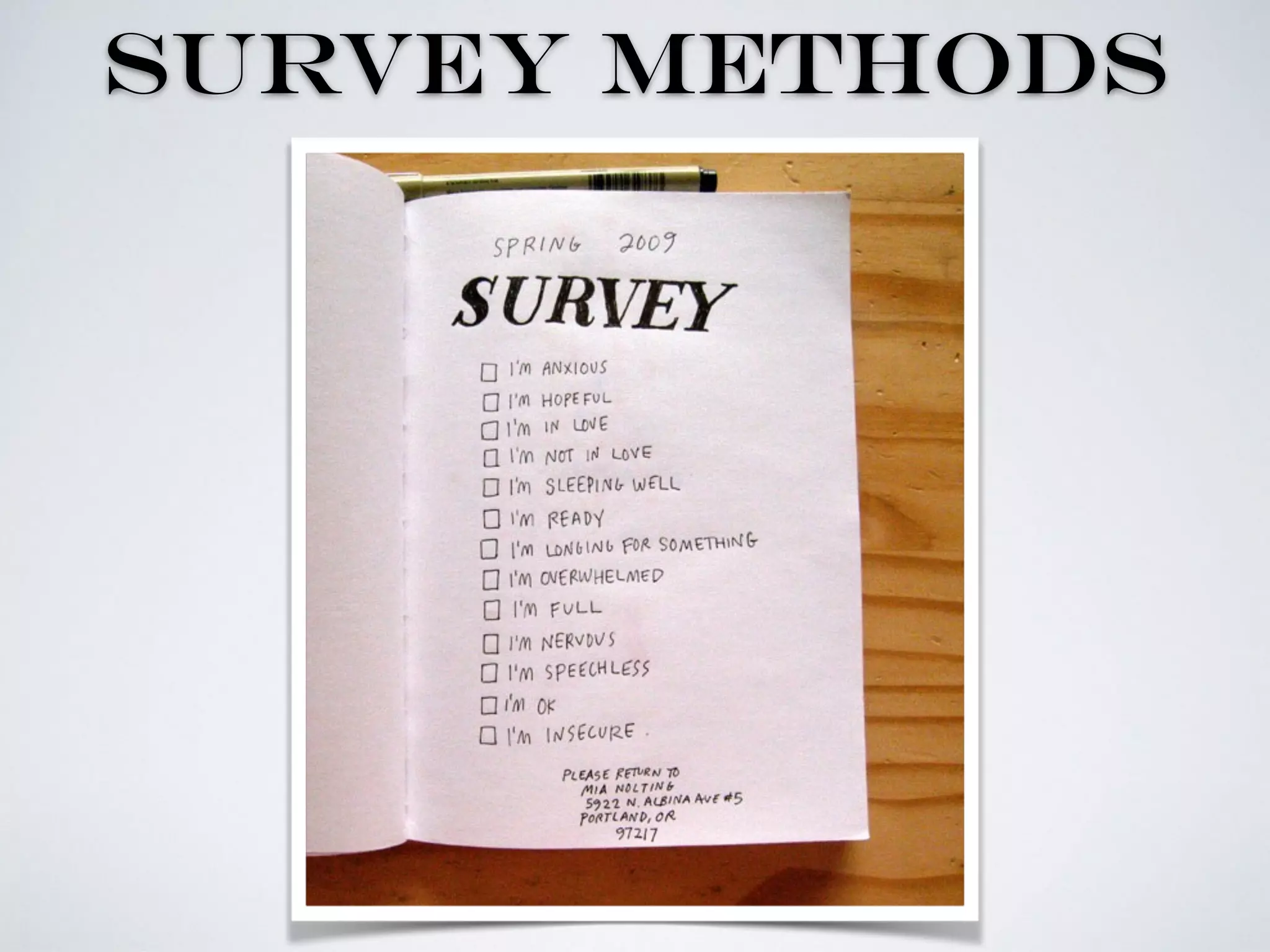
survey methods
Why?
1. Measure behaviors,
attitudes, or a construct
2. Collect relatively large
amounts of data
3. Efficiency (cost vs.
output)
Steps in survey process
• Step 1: Selecting/developing questions
• Step 2: Select method of administration
• Step 3: Pilot testing
• Step 4: Sampling
• Step 5: Writing up results
Selecting /
Developing
Questions
What to look for in a good
measure
•Published
•Used in a similar study
•Good psychometric properties
•Internal consistency estimates (𝛂 >.80)
•Good factor structure
•Evidence of validity
What is Factor Analysis?
•Factor analysis is all about simplification
•Allows us to understand large quantities of
observable variables in terms of a smaller
number of unobservable variables
•These unobservable variables are called “latent
variables”
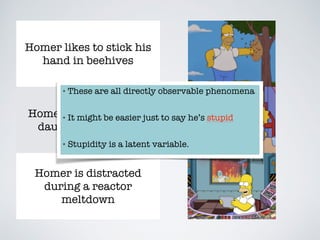
What is Homer Simpson like?
Homer likes to stick his
hand in beehives
Homer encourages his
daughter to smoke
Homer is distracted
during a reactor
meltdown
• These are all directly observable phenomena
• It might be easier just to say he’s stupid
• Stupidity is a latent variable.
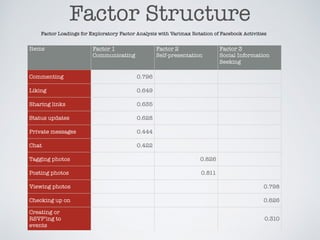
Factor Structure
Factor Loadings for Exploratory Factor Analysis with Varimax Rotation of Facebook Activities
Items Factor 1
Communicating
Factor 2
Self-presentation
Factor 3
Social Information
Seeking
Commenting 0.796
Liking 0.649
Sharing links 0.635
Status updates 0.628
Private messages 0.444
Chat 0.422
Tagging photos 0.826
Posting photos 0.811
Viewing photos 0.798
Checking up on 0.626
Creating or
RSVP’ing to
events
0.310
Developing
Questions
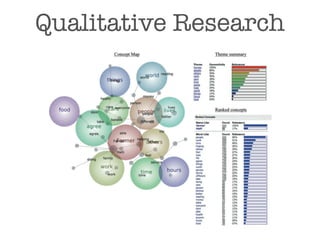
Qualitative Research
Survey Mode
1.Mail
2.Phone
3.In Person
4.Online
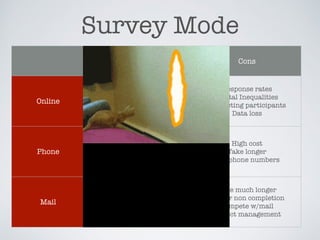
Survey Mode
Pros Cons
Online
Lower cost
Quickly collect data
Easy to modify
Review results
Branching
Response rates
Digital Inequalities
Contacting participants
Data loss
Phone
High response rates
Interact with real person
Diverse sampling
High cost
Take longer
Cell phone numbers
Mail
Convenient
Detailed responses
Lower cost
Efficient
Take much longer
Higher non completion
Compete w/mail
Project management
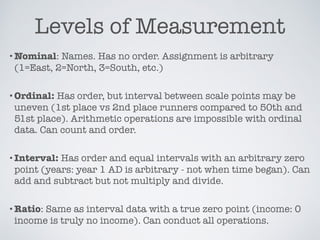
Levels of Measurement
•Nominal: Names. Has no order. Assignment is arbitrary
(1=East, 2=North, 3=South, etc.)
•Ordinal: Has order, but interval between scale points may be
uneven (1st place vs 2nd place runners compared to 50th and
51st place). Arithmetic operations are impossible with ordinal
data. Can count and order.
•Interval: Has order and equal intervals with an arbitrary zero
point (years: year 1 AD is arbitrary - not when time began). Can
add and subtract but not multiply and divide.
•Ratio: Same as interval data with a true zero point (income: 0
income is truly no income). Can conduct all operations.
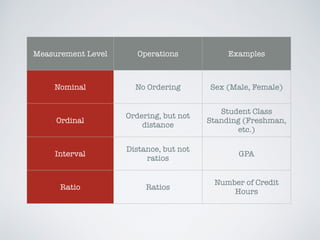
Measurement Level Operations Examples
Nominal No Ordering Sex (Male, Female)
Ordinal
Ordering, but not
distance
Student Class
Standing (Freshman,
etc.)
Interval
Distance, but not
ratios
GPA
Ratio Ratios
Number of Credit
Hours
Clarity and
Usability
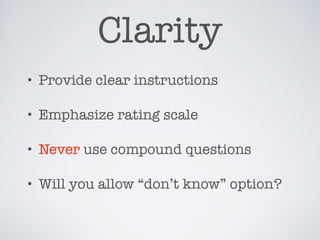
Clarity
• Provide clear instructions
• Emphasize rating scale
• Never use compound questions
• Will you allow “don’t know” option?
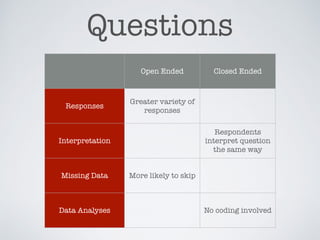
Questions
Open Ended Closed Ended
Responses
Greater variety of
responses
Interpretation
Respondents
interpret question
the same way
Missing Data More likely to skip
Data Analyses No coding involved
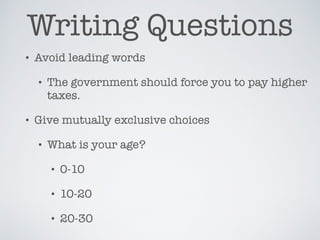
Writing Questions
• Avoid leading words
• The government should force you to pay higher
taxes.
• Give mutually exclusive choices
• What is your age?
• 0-10
• 10-20
• 20-30
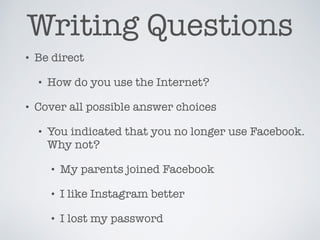
Writing Questions
• Be direct
• How do you use the Internet?
• Cover all possible answer choices
• You indicated that you no longer use Facebook.
Why not?
• My parents joined Facebook
• I like Instagram better
• I lost my password
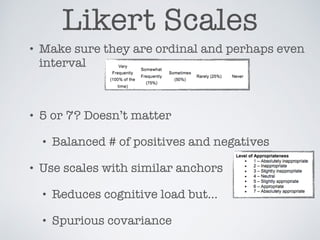
Likert Scales
• Make sure they are ordinal and perhaps even
interval
• 5 or 7? Doesn’t matter
• Balanced # of positives and negatives
• Use scales with similar anchors
• Reduces cognitive load but…
• Spurious covariance
Question Order
• Easy/fun/engaging questions first
• Sensitive & demographics last
• Counterbalance
Counterbalancing
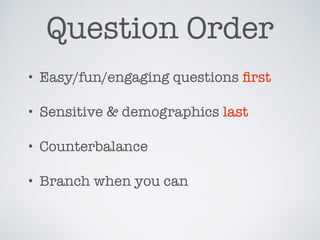
Question Order
• Easy/fun/engaging questions first
• Sensitive & demographics last
• Counterbalance
• Branch when you can
Pilot Testing
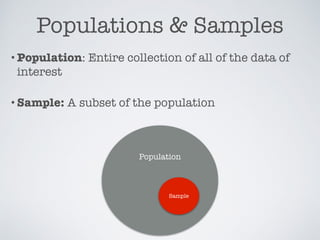
Populations & Samples
•Population: Entire collection of all of the data of
interest
•Sample: A subset of the population
Population
Sample
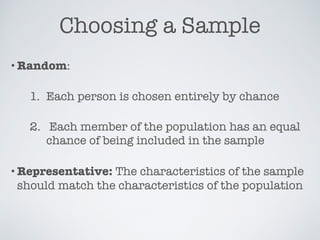
Choosing a Sample
•Random:
1. Each person is chosen entirely by chance
2. Each member of the population has an equal
chance of being included in the sample
•Representative: The characteristics of the sample
should match the characteristics of the population
Population: All college students who use Facebook
Sample: All students in an introductory
psychology course who use Facebook
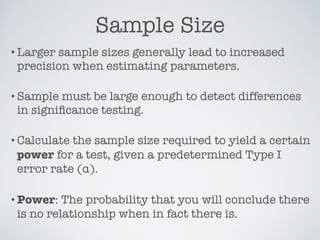
Sample Size
•Larger sample sizes generally lead to increased
precision when estimating parameters.
•Sample must be large enough to detect differences
in significance testing.
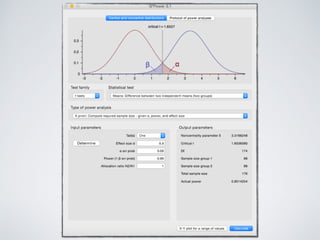
•Calculate the sample size required to yield a certain
power for a test, given a predetermined Type I
error rate (ử).
•Power: The probability that you will conclude there
is no relationship when in fact there is.
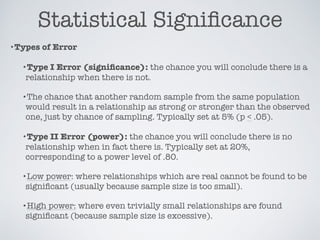
Statistical Significance
•Types of Error
•Type I Error (significance): the chance you will conclude there is a
relationship when there is not.
•The chance that another random sample from the same population
would result in a relationship as strong or stronger than the observed
one, just by chance of sampling. Typically set at 5% (p < .05).
•Type II Error (power): the chance you will conclude there is no
relationship when in fact there is. Typically set at 20%,
corresponding to a power level of .80.
•Low power: where relationships which are real cannot be found to be
significant (usually because sample size is too small).
•High power: where even trivially small relationships are found
significant (because sample size is excessive).
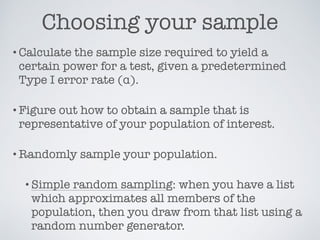
Choosing your sample
•Calculate the sample size required to yield a
certain power for a test, given a predetermined
Type I error rate (ử).
•Figure out how to obtain a sample that is
representative of your population of interest.
•Randomly sample your population.
•Simple random sampling: when you have a list
which approximates all members of the
population, then you draw from that list using a
random number generator.
Size Doesn’t
Matter
Representativeness
Does
and so do
effect sizes
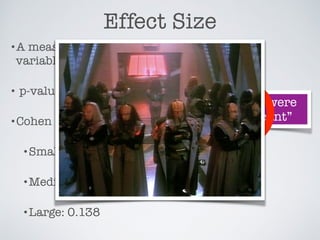
Effect Size
•A measure of how strongly the independent
variables affect the dependent variables.
• p-value is not effect size!
•Cohen suggested:
•Small: 0.01
•Medium: 0.059
•Large: 0.138
“These results were
highly significant”
Convenience
Samples
•Understand your population
•Offer congruent incentives
•Appeal to intrinsic altruism
•Personalize
Data
Analyses
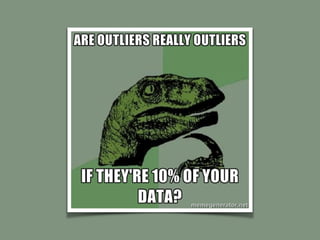
Outliers
168 hours/week
Contradicting
Results
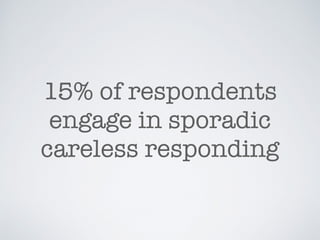
15% of respondents
engage in sporadic
careless responding
Use data quality
indicators?
What does act of giving survey
do to future evaluations?
Writing up
results
I’m done
Survey Methods - OIISDP 2015

Survey Methods - OIISDP 2015

  • 1.
  • 2.
  • 3.
    1. Measure behaviors, attitudes,or a construct 2. Collect relatively large amounts of data 3. Efficiency (cost vs. output)
  • 4.
    Steps in surveyprocess • Step 1: Selecting/developing questions • Step 2: Select method of administration • Step 3: Pilot testing • Step 4: Sampling • Step 5: Writing up results
  • 5.
  • 7.
    What to lookfor in a good measure •Published •Used in a similar study •Good psychometric properties •Internal consistency estimates (𝛂 >.80) •Good factor structure •Evidence of validity
  • 8.
    What is FactorAnalysis? •Factor analysis is all about simplification •Allows us to understand large quantities of observable variables in terms of a smaller number of unobservable variables •These unobservable variables are called “latent variables”
  • 9.
    What is HomerSimpson like?
  • 10.
    Homer likes tostick his hand in beehives Homer encourages his daughter to smoke Homer is distracted during a reactor meltdown • These are all directly observable phenomena • It might be easier just to say he’s stupid • Stupidity is a latent variable.
  • 11.
    Factor Structure Factor Loadingsfor Exploratory Factor Analysis with Varimax Rotation of Facebook Activities Items Factor 1 Communicating Factor 2 Self-presentation Factor 3 Social Information Seeking Commenting 0.796 Liking 0.649 Sharing links 0.635 Status updates 0.628 Private messages 0.444 Chat 0.422 Tagging photos 0.826 Posting photos 0.811 Viewing photos 0.798 Checking up on 0.626 Creating or RSVP’ing to events 0.310
  • 12.
  • 13.
  • 14.
  • 15.
    Survey Mode Pros Cons Online Lowercost Quickly collect data Easy to modify Review results Branching Response rates Digital Inequalities Contacting participants Data loss Phone High response rates Interact with real person Diverse sampling High cost Take longer Cell phone numbers Mail Convenient Detailed responses Lower cost Efficient Take much longer Higher non completion Compete w/mail Project management
  • 16.
    Levels of Measurement •Nominal:Names. Has no order. Assignment is arbitrary (1=East, 2=North, 3=South, etc.) •Ordinal: Has order, but interval between scale points may be uneven (1st place vs 2nd place runners compared to 50th and 51st place). Arithmetic operations are impossible with ordinal data. Can count and order. •Interval: Has order and equal intervals with an arbitrary zero point (years: year 1 AD is arbitrary - not when time began). Can add and subtract but not multiply and divide. •Ratio: Same as interval data with a true zero point (income: 0 income is truly no income). Can conduct all operations.
  • 17.
    Measurement Level OperationsExamples Nominal No Ordering Sex (Male, Female) Ordinal Ordering, but not distance Student Class Standing (Freshman, etc.) Interval Distance, but not ratios GPA Ratio Ratios Number of Credit Hours
  • 18.
  • 19.
    Clarity • Provide clearinstructions • Emphasize rating scale • Never use compound questions • Will you allow “don’t know” option?
  • 20.
    Questions Open Ended ClosedEnded Responses Greater variety of responses Interpretation Respondents interpret question the same way Missing Data More likely to skip Data Analyses No coding involved
  • 21.
    Writing Questions • Avoidleading words • The government should force you to pay higher taxes. • Give mutually exclusive choices • What is your age? • 0-10 • 10-20 • 20-30
  • 22.
    Writing Questions • Bedirect • How do you use the Internet? • Cover all possible answer choices • You indicated that you no longer use Facebook. Why not? • My parents joined Facebook • I like Instagram better • I lost my password
  • 23.
    Likert Scales • Makesure they are ordinal and perhaps even interval • 5 or 7? Doesn’t matter • Balanced # of positives and negatives • Use scales with similar anchors • Reduces cognitive load but… • Spurious covariance
  • 24.
    Question Order • Easy/fun/engagingquestions first • Sensitive & demographics last • Counterbalance
  • 25.
  • 26.
    Question Order • Easy/fun/engagingquestions first • Sensitive & demographics last • Counterbalance • Branch when you can
  • 27.
  • 28.
    Populations & Samples •Population:Entire collection of all of the data of interest •Sample: A subset of the population Population Sample
  • 29.
    Choosing a Sample •Random: 1.Each person is chosen entirely by chance 2. Each member of the population has an equal chance of being included in the sample •Representative: The characteristics of the sample should match the characteristics of the population
  • 30.
    Population: All collegestudents who use Facebook Sample: All students in an introductory psychology course who use Facebook
  • 31.
    Sample Size •Larger samplesizes generally lead to increased precision when estimating parameters. •Sample must be large enough to detect differences in significance testing. •Calculate the sample size required to yield a certain power for a test, given a predetermined Type I error rate (ử). •Power: The probability that you will conclude there is no relationship when in fact there is.
  • 32.
    Statistical Significance •Types ofError •Type I Error (significance): the chance you will conclude there is a relationship when there is not. •The chance that another random sample from the same population would result in a relationship as strong or stronger than the observed one, just by chance of sampling. Typically set at 5% (p < .05). •Type II Error (power): the chance you will conclude there is no relationship when in fact there is. Typically set at 20%, corresponding to a power level of .80. •Low power: where relationships which are real cannot be found to be significant (usually because sample size is too small). •High power: where even trivially small relationships are found significant (because sample size is excessive).
  • 34.
    Choosing your sample •Calculatethe sample size required to yield a certain power for a test, given a predetermined Type I error rate (ử). •Figure out how to obtain a sample that is representative of your population of interest. •Randomly sample your population. •Simple random sampling: when you have a list which approximates all members of the population, then you draw from that list using a random number generator.
  • 35.
  • 36.
  • 37.
  • 38.
    Effect Size •A measureof how strongly the independent variables affect the dependent variables. • p-value is not effect size! •Cohen suggested: •Small: 0.01 •Medium: 0.059 •Large: 0.138 “These results were highly significant”
  • 39.
  • 40.
    •Understand your population •Offercongruent incentives •Appeal to intrinsic altruism •Personalize
  • 41.
  • 42.
  • 44.
  • 45.
  • 46.
    15% of respondents engagein sporadic careless responding
  • 47.
  • 48.
    What does actof giving survey do to future evaluations?
  • 50.
  • 52.