Chapter 4

Ethics in Research
Roadmap
• Reminder: Exam 2 on Tuesday!
  – Chapters 5, 6, 4
  – Format: MC, short answer, maybe matching
  – Good study guide: outlines at beginning of
    chapters

• Quick review

• Chapter 4: Ethics in Research (cover all today)
Announcement
• Association for Psychological Science
• Discounted membership rates through Oct. 6

• Rate for undergrads: $25

• www.joinaps.org/?p=PCR13&s=join
  – Membership application
  – Promo code at bottom of page

• www.psychologicalscience.org
Quick Review
• Research Validity
  – Statistical Conclusion
  – Construct: threats
  – Internal: threats
  – External: types


• Internal vs. External
Research Ethics
• 3 areas of ethical concerns
  – Relationship between society and science
  – Professional issues
  – Treatment of research participants
Relationship Between Society and Science

• How do scientists choose their research
  topics?

• Funding for scientific research

• Public interpretation of science
Relationship Between Society and Science

• Senator Tom Coburn, NSF oversight report
Professional Issues
• Research misconduct: fabricating, falsifying
  or plagiarizing the proposal, conduction, or
  reporting of research

• You make ethical choices at each stage of the
  research process
Professional Issues
• Less obvious forms of research misconduct
  – Overlooking flawed data
  – Failing to present/consider work contradicting
    your own
  – Changing your work to meet demands of funding
    sources
Professional Issues
• Institutional Review Boards (IRB) require
  information to ensure professionalism in research:
  –   Purpose
  –   Background & Rationale
  –   Population
  –   Design
  –   Incentives
  –   Risks/Benefits
  –   Privacy/Confidentiality
Treatment of Research Participants
• Fundamental to ethical research
• Ethical dilemma
  – Balance risk and benefit
• IRB determines if balance is appropriate
Ethical Guidelines—History
• Nuremberg Code
  – Valid research designs
  – Inform participants; freedom to choose


• Tuskegee Experiment – p. 106
  – Accurate reporting of results; coercion


• Led to creation of ethical guidelines for
  research
APA’s Ethical Guidelines for Research

5 Basic Moral Principles
• Respect for persons and their autonomy
• Beneficence and nonmaleficence
• Justice
• Trust
• Fidelity and scientific integrity
Respect for Persons and Their
              Autonomy
• Giving people the right to choose to
  participate (or not)
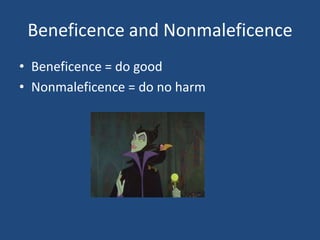
Beneficence and Nonmaleficence
• Beneficence = do good
• Nonmaleficence = do no harm
Justice
• Who should benefit, who should bear burdens
  of research
• Fairness of benefit distribution
Trust
• Researchers should establish and maintain
  trust with research participants
Fidelity and Scientific Integrity
• Truthful reporting of results
• Quality research
  – Valid designs
APA Ethical Standards for Research

• Exhibit 4.5, pp. 110-112
• Researchers must comply with the following
  standards
Institutional Approval
• Via IRB
Informed Consent
•   Must do this
•   Forgoing consent—rare
•   Consent vs. Assent
•   Active vs. Passive consent
Deception
• Misleading participants about nature of study
  or omitting details of experiment
• Only use when necessary
• Can’t use it when harm or severe stress is
  involved
Debriefing
• Post-experimental discussion about the details
  of a study
• Dehoaxing
• Desensitizing
Coercion
• Can’t exploit people
• Must be free to decline or leave study
Confidentiality
• Very important in research with humans
• Anonymity
• Confidentiality
Animal Research
• Separate board to review animal research
• Institutional Animal Care & Use Committee
• (IACUC)

Chapter 4 class version(1)

  • 1.
  • 2.
    Roadmap • Reminder: Exam2 on Tuesday! – Chapters 5, 6, 4 – Format: MC, short answer, maybe matching – Good study guide: outlines at beginning of chapters • Quick review • Chapter 4: Ethics in Research (cover all today)
  • 3.
    Announcement • Association forPsychological Science • Discounted membership rates through Oct. 6 • Rate for undergrads: $25 • www.joinaps.org/?p=PCR13&s=join – Membership application – Promo code at bottom of page • www.psychologicalscience.org
  • 4.
    Quick Review • ResearchValidity – Statistical Conclusion – Construct: threats – Internal: threats – External: types • Internal vs. External
  • 5.
    Research Ethics • 3areas of ethical concerns – Relationship between society and science – Professional issues – Treatment of research participants
  • 6.
    Relationship Between Societyand Science • How do scientists choose their research topics? • Funding for scientific research • Public interpretation of science
  • 7.
    Relationship Between Societyand Science • Senator Tom Coburn, NSF oversight report
  • 8.
    Professional Issues • Researchmisconduct: fabricating, falsifying or plagiarizing the proposal, conduction, or reporting of research • You make ethical choices at each stage of the research process
  • 9.
    Professional Issues • Lessobvious forms of research misconduct – Overlooking flawed data – Failing to present/consider work contradicting your own – Changing your work to meet demands of funding sources
  • 10.
    Professional Issues • InstitutionalReview Boards (IRB) require information to ensure professionalism in research: – Purpose – Background & Rationale – Population – Design – Incentives – Risks/Benefits – Privacy/Confidentiality
  • 11.
    Treatment of ResearchParticipants • Fundamental to ethical research • Ethical dilemma – Balance risk and benefit • IRB determines if balance is appropriate
  • 12.
    Ethical Guidelines—History • NurembergCode – Valid research designs – Inform participants; freedom to choose • Tuskegee Experiment – p. 106 – Accurate reporting of results; coercion • Led to creation of ethical guidelines for research
  • 13.
    APA’s Ethical Guidelinesfor Research 5 Basic Moral Principles • Respect for persons and their autonomy • Beneficence and nonmaleficence • Justice • Trust • Fidelity and scientific integrity
  • 14.
    Respect for Personsand Their Autonomy • Giving people the right to choose to participate (or not)
  • 15.
    Beneficence and Nonmaleficence •Beneficence = do good • Nonmaleficence = do no harm
  • 16.
    Justice • Who shouldbenefit, who should bear burdens of research • Fairness of benefit distribution
  • 17.
    Trust • Researchers shouldestablish and maintain trust with research participants
  • 18.
    Fidelity and ScientificIntegrity • Truthful reporting of results • Quality research – Valid designs
  • 19.
    APA Ethical Standardsfor Research • Exhibit 4.5, pp. 110-112 • Researchers must comply with the following standards
  • 20.
  • 21.
    Informed Consent • Must do this • Forgoing consent—rare • Consent vs. Assent • Active vs. Passive consent
  • 22.
    Deception • Misleading participantsabout nature of study or omitting details of experiment • Only use when necessary • Can’t use it when harm or severe stress is involved
  • 23.
    Debriefing • Post-experimental discussionabout the details of a study • Dehoaxing • Desensitizing
  • 24.
    Coercion • Can’t exploitpeople • Must be free to decline or leave study
  • 25.
    Confidentiality • Very importantin research with humans • Anonymity • Confidentiality
  • 26.
    Animal Research • Separateboard to review animal research • Institutional Animal Care & Use Committee • (IACUC)