Supply Chain
Management:
PURCHASINGPURCHASING
MANAGEMENTMANAGEMENT
Chapter 2Chapter 2
Prepared by Mark A. Jacobs, PhD
©2012 Cengage Learning. All Rights Reserved. May not be scanned, copied or
duplicated, or posted to a publicly accessible website, in whole or in part.
©2012 Cengage Learning. All Rights Reserved. May not be scanned, copied or duplicated, or posted to a publicly accessible website, in whole or in part.
2
LEARNING OBJECTIVESLEARNING OBJECTIVES
You should be able to:
• Understand the role of supply management and its
strategic impact on an organization’s competitive advantage
• Have a basic knowledge of the manual purchasing
process, e-procurement, public procurement, and green
purchasing
• Understand and know how to handle small value purchase
orders
• Understand sourcing decisions and the factors impacting
supplier selection
©2012 Cengage Learning. All Rights Reserved. May not be scanned, copied or duplicated, or posted to a publicly accessible website, in whole or in part.
3
LEARNING OBJECTIVESLEARNING OBJECTIVES
(Continued)(Continued)
You should be able to:
• Understand the pros and cons of single sourcing
versus multiple sourcing
• Understand the pros and cons of single versus
multiple sourcing
• Describe opportunities and challenges of global
sourcing and its impacts on supply management
• Understand and compute total cost of ownership
©2012 Cengage Learning. All Rights Reserved. May not be scanned, copied or duplicated, or posted to a publicly accessible website, in whole or in part.
4
CHAPTER OUTLINECHAPTER OUTLINE
• Introduction
• A Brief History of Purchasing Terms
• The Role of Supply Management in an Organization
• The Purchasing Process
• Sourcing Decisions – The Make or Buy Decision
• Roles of Supply Base
• Supplier Selection
• How Many Suppliers to Use
• Purchasing Organization
• International Purchasing/Global Sourcing
• Procurement for Government/Non-Profits Agencies
Purchasing – Obtaining merchandise, capital equipment;
raw materials, services, or maintenance, repair, and
operating (MRO) supplies in exchange for money or its
equivalent
Merchants – Wholesalers and retailers who purchase for
resale
Industrial Buyers – Purchase raw materials for
conversion, services, capital equipment, & MRO supplies
A Brief History ofA Brief History of
Purchasing TermsPurchasing Terms
©2012 Cengage Learning. All Rights Reserved. May not be scanned, copied or duplicated, or posted to a publicly accessible website, in whole or in part.
5
A Brief History ofA Brief History of
Purchasing TermsPurchasing Terms ((ContinuedContinued))
Purchasing - key business function for acquiring
materials, services, & equipment
Contracting - term often used for the acquisition of
services
Supply Management - a newer term that encompasses
all acquisition activities
 Institute of Supply management defined supply
management as the “Identification, acquisition,
access, positioning, and management of resources
an organization needs or potentially needs in the
attainment of its strategic objectives.”
©2012 Cengage Learning. All Rights Reserved. May not be scanned, copied or duplicated, or posted to a publicly accessible website, in whole or in part.
6
The Role of SupplyThe Role of Supply
Management in anManagement in an
OrganizationOrganizationThe primary goals of purchasing are:
 Ensure uninterrupted flows of raw materials at the lowest total
cost,
 Improve quality of the finished goods produced, and
 Optimize customer satisfaction.
Purchasing contributes to these objectives by:
 Actively seeking better materials and reliable suppliers,
 Work closely with and exploiting the expertise of strategic
suppliers to improve quality and materials
 Involving suppliers and purchasing personnel in new product
design and development efforts.
©2012 Cengage Learning. All Rights Reserved. May not be scanned, copied or duplicated, or posted to a publicly accessible website, in whole or in part.
7
The Role of SupplyThe Role of Supply
Management in anManagement in an
OrganizationOrganization ((ContinuedContinued))The Financial Significance of Supply Management
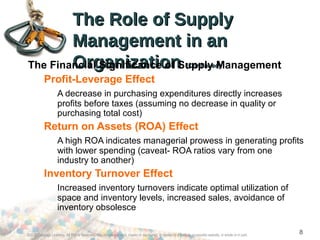
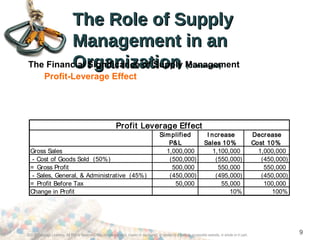
Profit-Leverage Effect
A decrease in purchasing expenditures directly increases
profits before taxes (assuming no decrease in quality or
purchasing total cost)
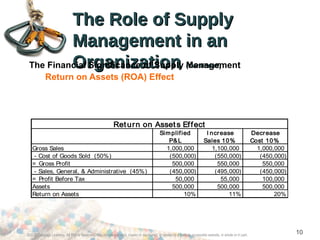
Return on Assets (ROA) Effect
A high ROA indicates managerial prowess in generating profits
with lower spending (caveat- ROA ratios vary from one
industry to another)
Inventory Turnover Effect
Increased inventory turnovers indicate optimal utilization of
space and inventory levels, increased sales, avoidance of
inventory obsolesce
©2012 Cengage Learning. All Rights Reserved. May not be scanned, copied or duplicated, or posted to a publicly accessible website, in whole or in part.
8
The Role of SupplyThe Role of Supply
Management in anManagement in an
OrganizationOrganization ((ContinuedContinued))The Financial Significance of Supply Management
Profit-Leverage Effect
Simplified
P&L
I ncrease
Sales 10%
Decrease
Cost 10%
Gross Sales 1,000,000 1,100,000 1,000,000
- Cost of Goods Sold (50%) (500,000) (550,000) (450,000)
= Gross Profit 500,000 550,000 550,000
- Sales, General, & Administrative (45%) (450,000) (495,000) (450,000)
= Profit Before Tax 50,000 55,000 100,000
Change in Profit 10% 100%
Profit Leverage Effect
©2012 Cengage Learning. All Rights Reserved. May not be scanned, copied or duplicated, or posted to a publicly accessible website, in whole or in part.
9
The Role of SupplyThe Role of Supply
Management in anManagement in an
OrganizationOrganization ((ContinuedContinued))The Financial Significance of Supply Management
Return on Assets (ROA) Effect
Simplified
P&L
I ncrease
Sales 10%
Decrease
Cost 10%
Gross Sales 1,000,000 1,100,000 1,000,000
- Cost of Goods Sold (50%) (500,000) (550,000) (450,000)
= Gross Profit 500,000 550,000 550,000
- Sales, General, & Administrative (45%) (450,000) (495,000) (450,000)
= Profit Before Tax 50,000 55,000 100,000
Assets 500,000 500,000 500,000
Return on Assets 10% 11% 20%
Return on Asset s Effect
©2012 Cengage Learning. All Rights Reserved. May not be scanned, copied or duplicated, or posted to a publicly accessible website, in whole or in part.
10
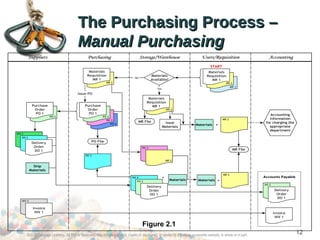
The Purchasing Process –The Purchasing Process –
Manual PurchasingManual Purchasing (older system)(older system)
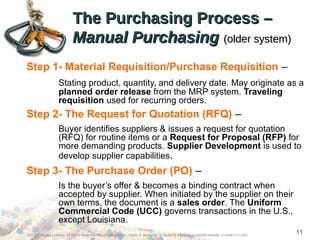
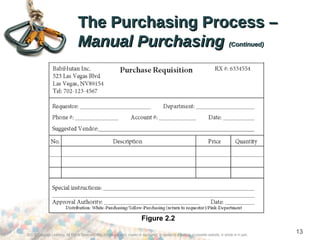
Step 1- Material Requisition/Purchase Requisition –
Stating product, quantity, and delivery date. May originate as a
planned order release from the MRP system. Traveling
requisition used for recurring orders.
Step 2- The Request for Quotation (RFQ) –
Buyer identifies suppliers & issues a request for quotation
(RFQ) for routine items or a Request for Proposal (RFP) for
more demanding products. Supplier Development is used to
develop supplier capabilities.
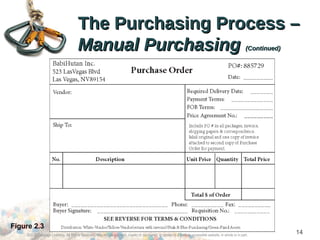
Step 3- The Purchase Order (PO) –
Is the buyer’s offer & becomes a binding contract when
accepted by supplier. When initiated by the supplier on their
own terms, the document is a sales order. The Uniform
Commercial Code (UCC) governs transactions in the U.S.,
except Louisiana.
©2012 Cengage Learning. All Rights Reserved. May not be scanned, copied or duplicated, or posted to a publicly accessible website, in whole or in part.
11
The Purchasing Process –The Purchasing Process –
Manual PurchasingManual Purchasing
+
Materials
Available?
Yes
Issue
Materials
MR File
Materials
PO 3
MR 2
Accounting
Information
for charging the
appropriate
department
Accounts Payable
+
MR File
Materials
MR 2
+Materials
MR 2
Ship
Materials
DO 3
DO 2
Delivery
Order
DO 1
PO 2
Purchase
Order
PO 1
INV 2
Invoice
INV 1
Storage/Warehouse AccountingUsers/RequisitionSuppliers Purchasing
PO 4
PO 3
PO 2
Purchase
Order
PO 1
PO File
MR 2
Materials
Requisition
MR 1
MR 3
MR 2
Materials
Requisition
MR 1
START
No
MR 2
Materials
Requisition
MR 1
Issue PO
PO 2
Delivery
Order
DO 1
Invoice
INV 1
DO 2
PO 2
Delivery
Order
DO 1
DO 2
+
Materials
Available?
Yes
Issue
Materials
Issue
Materials
MR FileMR File
MaterialsMaterials
PO 3
MR 2
PO 3PO 3
MR 2MR 2
Accounting
Information
for charging the
appropriate
department
Accounting
Information
for charging the
appropriate
department
Accounts Payable
+
MR FileMR File
MaterialsMaterials
MR 2MR 2
+MaterialsMaterials
MR 2MR 2
Ship
Materials
Ship
Materials
DO 3
DO 2
Delivery
Order
DO 1
DO 3DO 3
DO 2DO 2
Delivery
Order
DO 1
Delivery
Order
DO 1
PO 2
Purchase
Order
PO 1
PO 2PO 2
Purchase
Order
PO 1
Purchase
Order
PO 1
INV 2
Invoice
INV 1
INV 2INV 2
Invoice
INV 1
Invoice
INV 1
Storage/Warehouse AccountingUsers/RequisitionSuppliers Purchasing Storage/Warehouse AccountingUsers/RequisitionSuppliers Purchasing
PO 4
PO 3
PO 2
Purchase
Order
PO 1
PO 4PO 4
PO 3PO 3
PO 2PO 2
Purchase
Order
PO 1
Purchase
Order
PO 1
PO FilePO File
MR 2
Materials
Requisition
MR 1
MR 2MR 2
Materials
Requisition
MR 1
Materials
Requisition
MR 1
MR 3
MR 2
Materials
Requisition
MR 1
MR 3MR 3
MR 2MR 2
Materials
Requisition
MR 1
START
No
MR 2
Materials
Requisition
MR 1
MR 2MR 2
Materials
Requisition
MR 1
Materials
Requisition
MR 1
Issue PO
PO 2
Delivery
Order
DO 1
PO 2PO 2
Delivery
Order
DO 1
Delivery
Order
DO 1
Invoice
INV 1
Invoice
INV 1
DO 2
PO 2
Delivery
Order
DO 1
DO 2DO 2
PO 2PO 2
Delivery
Order
DO 1
Delivery
Order
DO 1
DO 2DO 2
Figure 2.1
©2012 Cengage Learning. All Rights Reserved. May not be scanned, copied or duplicated, or posted to a publicly accessible website, in whole or in part.
12
The Purchasing Process –The Purchasing Process –
Manual PurchasingManual Purchasing (Continued)(Continued)
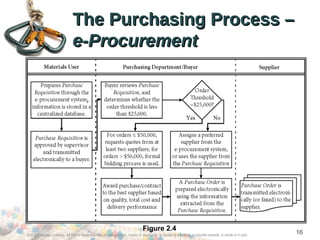
Figure 2.2
©2012 Cengage Learning. All Rights Reserved. May not be scanned, copied or duplicated, or posted to a publicly accessible website, in whole or in part.
13
Figure 2.3
The Purchasing Process –The Purchasing Process –
Manual PurchasingManual Purchasing (Continued)(Continued)
©2012 Cengage Learning. All Rights Reserved. May not be scanned, copied or duplicated, or posted to a publicly accessible website, in whole or in part.
14
The Purchasing Process –The Purchasing Process –
e-Procuremente-Procurement
Step 1- Material user inputs a materials requisition –
Relevant information such as quantity and date needed.
Step 2- Materials requisition submitted to buyer –
At purchasing department (hardcopy or electronically).
Step 3- Buyer assigns qualified suppliers to bid –
Product description, closing date, & conditions are given.
Step 4- Buyer reviews closed bids & selects a supplier
©2012 Cengage Learning. All Rights Reserved. May not be scanned, copied or duplicated, or posted to a publicly accessible website, in whole or in part.
15
Figure 2.4
The Purchasing Process –The Purchasing Process –
e-Procuremente-Procurement
©2012 Cengage Learning. All Rights Reserved. May not be scanned, copied or duplicated, or posted to a publicly accessible website, in whole or in part.
16
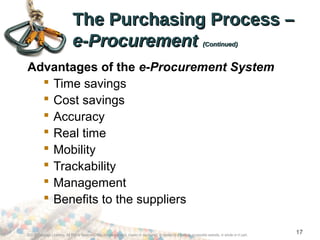
Advantages of the e-Procurement System
 Time savings
 Cost savings
 Accuracy
 Real time
 Mobility
 Trackability
 Management
 Benefits to the suppliers
The Purchasing Process –The Purchasing Process –
e-Procuremente-Procurement (Continued)(Continued)
©2012 Cengage Learning. All Rights Reserved. May not be scanned, copied or duplicated, or posted to a publicly accessible website, in whole or in part.
17
Small Value PurchaseSmall Value Purchase
OrdersOrders
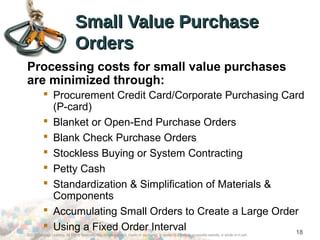
Processing costs for small value purchases
are minimized through:
 Procurement Credit Card/Corporate Purchasing Card
(P-card)
 Blanket or Open-End Purchase Orders
 Blank Check Purchase Orders
 Stockless Buying or System Contracting
 Petty Cash
 Standardization & Simplification of Materials &
Components
 Accumulating Small Orders to Create a Large Order
 Using a Fixed Order Interval
©2012 Cengage Learning. All Rights Reserved. May not be scanned, copied or duplicated, or posted to a publicly accessible website, in whole or in part.
18
Sourcing Decisions –Sourcing Decisions – TheThe
Make or Buy DecisionMake or Buy Decision
Outsourcing –
Buying materials and components from
suppliers instead of making them in-house. The
trend has moved toward outsourcing.
Backward vertical integration –
Refers to acquiring sources of supply
Forward vertical integration –
Refers to acquiring customer’s operations.
The Make or Buy decision is a strategic decision
©2012 Cengage Learning. All Rights Reserved. May not be scanned, copied or duplicated, or posted to a publicly accessible website, in whole or in part.
19
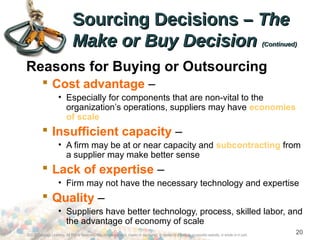
Reasons for Buying or Outsourcing
 Cost advantage –
• Especially for components that are non-vital to the
organization’s operations, suppliers may have economies
of scale
 Insufficient capacity –
• A firm may be at or near capacity and subcontracting from
a supplier may make better sense
 Lack of expertise –
• Firm may not have the necessary technology and expertise
 Quality –
• Suppliers have better technology, process, skilled labor, and
the advantage of economy of scale
Sourcing Decisions –Sourcing Decisions – TheThe
Make or Buy DecisionMake or Buy Decision (Continued)(Continued)
©2012 Cengage Learning. All Rights Reserved. May not be scanned, copied or duplicated, or posted to a publicly accessible website, in whole or in part.
20
Reasons for Making
 Protect proprietary technology
 No competent supplier
 Better quality control
 Use existing idle capacity
 Control of lead-time transportation, and
warehousing cost
 Lower cost
Sourcing Decisions –Sourcing Decisions – TheThe
Make or Buy DecisionMake or Buy Decision (Continued)(Continued)
©2012 Cengage Learning. All Rights Reserved. May not be scanned, copied or duplicated, or posted to a publicly accessible website, in whole or in part.
21
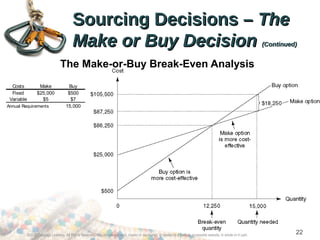
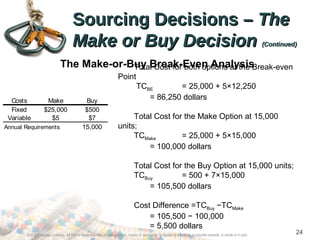
The Make-or-Buy Break-Even Analysis
Costs Make Buy
Fixed $25,000 $500
Variable $5 $7
Annual Requirements 15,000
Sourcing Decisions –Sourcing Decisions – TheThe
Make or Buy DecisionMake or Buy Decision (Continued)(Continued)
©2012 Cengage Learning. All Rights Reserved. May not be scanned, copied or duplicated, or posted to a publicly accessible website, in whole or in part.
22
The Make-or-Buy Break-Even Analysis
Costs Make Buy
Fixed $25,000 $500
Variable $5 $7
Annual Requirements 15,000
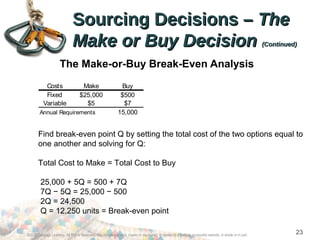
Find break-even point Q by setting the total cost of the two options equal to
one another and solving for Q:
Total Cost to Make = Total Cost to Buy
25,000 + 5Q = 500 + 7Q
7Q − 5Q = 25,000 − 500
2Q = 24,500
Q = 12,250 units = Break-even point
Sourcing Decisions –Sourcing Decisions – TheThe
Make or Buy DecisionMake or Buy Decision (Continued)(Continued)
©2012 Cengage Learning. All Rights Reserved. May not be scanned, copied or duplicated, or posted to a publicly accessible website, in whole or in part.
23
The Make-or-Buy Break-Even Analysis
Costs Make Buy
Fixed $25,000 $500
Variable $5 $7
Annual Requirements 15,000
Total Cost for both options at the Break-even
Point
TCBE = 25,000 + 5×12,250
= 86,250 dollars
Total Cost for the Make Option at 15,000
units;
TCMake = 25,000 + 5×15,000
= 100,000 dollars
Total Cost for the Buy Option at 15,000 units;
TCBuy = 500 + 7×15,000
= 105,500 dollars
Cost Difference =TCBuy −TCMake
= 105,500 − 100,000
= 5,500 dollars
Sourcing Decisions –Sourcing Decisions – TheThe
Make or Buy DecisionMake or Buy Decision (Continued)(Continued)
©2012 Cengage Learning. All Rights Reserved. May not be scanned, copied or duplicated, or posted to a publicly accessible website, in whole or in part.
24
Roles of Supply BaseRoles of Supply Base
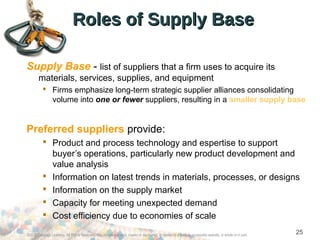
Supply Base - list of suppliers that a firm uses to acquire its
materials, services, supplies, and equipment
 Firms emphasize long-term strategic supplier alliances consolidating
volume into one or fewer suppliers, resulting in a smaller supply base
Preferred suppliers provide:
 Product and process technology and espertise to support
buyer’s operations, particularly new product development and
value analysis
 Information on latest trends in materials, processes, or designs
 Information on the supply market
 Capacity for meeting unexpected demand
 Cost efficiency due to economies of scale
©2012 Cengage Learning. All Rights Reserved. May not be scanned, copied or duplicated, or posted to a publicly accessible website, in whole or in part.
25
Supplier SelectionSupplier Selection
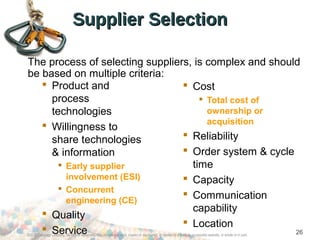
 Product and
process
technologies
 Willingness to
share technologies
& information
 Early supplier
involvement (ESI)
 Concurrent
engineering (CE)
 Quality
 Service
 Cost
 Total cost of
ownership or
acquisition
 Reliability
 Order system & cycle
time
 Capacity
 Communication
capability
 Location
The process of selecting suppliers, is complex and should
be based on multiple criteria:
©2012 Cengage Learning. All Rights Reserved. May not be scanned, copied or duplicated, or posted to a publicly accessible website, in whole or in part.
26
Supplier SelectionSupplier Selection ((ContinuedContinued))
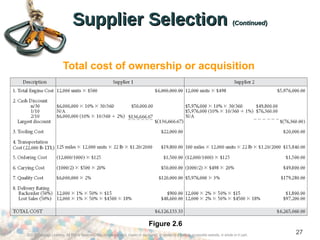
Total cost of ownership or acquisition
Figure 2.6
©2012 Cengage Learning. All Rights Reserved. May not be scanned, copied or duplicated, or posted to a publicly accessible website, in whole or in part.
27
How Many Suppliers to UseHow Many Suppliers to Use
Reasons Favoring a
Single Supplier
 To establish a good
relationship
 Less quality variability
 Lower cost
 Transportation economies
 Proprietary product or
process
 Volume too small to split
Reasons Favoring
Multiple Suppliers
 Need capacity
 Spread risk of supply
interruption
 Create competition
 Information
 Dealing with special kinds
of business
Single-source - a risky proposition. Current trends favor
fewer sources.
©2012 Cengage Learning. All Rights Reserved. May not be scanned, copied or duplicated, or posted to a publicly accessible website, in whole or in part.
28
Purchasing –Purchasing – CentralizedCentralized
vs. Decentralizedvs. Decentralized
Purchasing Organization is dependent on
many factors, such as market conditions & types
of materials required
 Centralized Purchasing - purchasing
department located at the firm’s corporate office
makes all the purchasing decisions
 Decentralized Purchasing - individual, local
purchasing departments, such as plant level, make
their own purchasing decisions
©2012 Cengage Learning. All Rights Reserved. May not be scanned, copied or duplicated, or posted to a publicly accessible website, in whole or in part.
29
Advantages -
Centralization
 Concentrated volume-
 Leveraging purchase volume
 Avoid duplication
 Specialization
 Lower transportation costs
 No competition within units
 Common supply base
Advantages -
Decentralization
 Closer knowledge
of requirements
 Local sourcing
 Less bureaucracy
A hybrid purchasing organization
 Decentralized-centralized (large multiunit org)- decentralized
corporate and centralized at business unit
 Centralized-decentralized (large org w/centralized control)
centralized large national contracts at corporate level and
decentralized items specific to business unit
Purchasing –Purchasing – CentralizedCentralized
vs. Decentralizedvs. Decentralized (Continued)(Continued)
©2012 Cengage Learning. All Rights Reserved. May not be scanned, copied or duplicated, or posted to a publicly accessible website, in whole or in part.
30
InternationalInternational
Purchasing/Global SourcingPurchasing/Global Sourcing
Reasons for Global Sourcing –
Opportunity to improve quality, cost, and delivery
performance
Potential Challenges –
Requires additional skills and knowledge to deal
with international suppliers, logistics,
communication, political environment, and other
issues
©2012 Cengage Learning. All Rights Reserved. May not be scanned, copied or duplicated, or posted to a publicly accessible website, in whole or in part.
31
Procurement forProcurement for
Government &Government &
Non-Profit AgenciesNon-Profit AgenciesPublic Procurement or Public Purchasing – purchasing
& supply function for government & non-profit sector.
Public Procurement is characterized by:
 Competitive bidding - contract is usually awarded to lowest priced
responsive & responsible bidder
 Sealed Bids are used to satisfy the Invitation for Bid (IFB) and are
opened in public display
 Performance Bonds - incentive to fulfill contract
 Bid or Surety Bonds - successful bidder will accept contract
 Performance Bonds - work will be on time and meet specifications
 Payment Bonds - protection against 3rd
party liens not fulfilled by
bidder
©2012 Cengage Learning. All Rights Reserved. May not be scanned, copied or duplicated, or posted to a publicly accessible website, in whole or in part.
32
Procurement forProcurement for
Government &Government &
Non-Profit AgenciesNon-Profit Agencies ((ContinuedContinued))Rules that often govern Government & Non-Profit
Procurement:
Federal Acquisition Streamlining Act (1994) –
Removed restrictions on bids less than $100,000. Micro
purchases (less than $2,500) can be made without bidding
Buy American Act (1933) –
US government purchases and 3rd
party purchases using federal
funds must buy if the US good is not more than a certain
differential above the foreign good
Green Purchases –
Variety of federal, state, and local initiatives to include
environmental and human health considerations when making
purchases
©2012 Cengage Learning. All Rights Reserved. May not be scanned, copied or duplicated, or posted to a publicly accessible website, in whole or in part.
33

Chapter 2 3rd_ed

  • 1.
    Supply Chain Management: PURCHASINGPURCHASING MANAGEMENTMANAGEMENT Chapter 2Chapter2 Prepared by Mark A. Jacobs, PhD ©2012 Cengage Learning. All Rights Reserved. May not be scanned, copied or duplicated, or posted to a publicly accessible website, in whole or in part.
  • 2.
    ©2012 Cengage Learning.All Rights Reserved. May not be scanned, copied or duplicated, or posted to a publicly accessible website, in whole or in part. 2 LEARNING OBJECTIVESLEARNING OBJECTIVES You should be able to: • Understand the role of supply management and its strategic impact on an organization’s competitive advantage • Have a basic knowledge of the manual purchasing process, e-procurement, public procurement, and green purchasing • Understand and know how to handle small value purchase orders • Understand sourcing decisions and the factors impacting supplier selection
  • 3.
    ©2012 Cengage Learning.All Rights Reserved. May not be scanned, copied or duplicated, or posted to a publicly accessible website, in whole or in part. 3 LEARNING OBJECTIVESLEARNING OBJECTIVES (Continued)(Continued) You should be able to: • Understand the pros and cons of single sourcing versus multiple sourcing • Understand the pros and cons of single versus multiple sourcing • Describe opportunities and challenges of global sourcing and its impacts on supply management • Understand and compute total cost of ownership
  • 4.
    ©2012 Cengage Learning.All Rights Reserved. May not be scanned, copied or duplicated, or posted to a publicly accessible website, in whole or in part. 4 CHAPTER OUTLINECHAPTER OUTLINE • Introduction • A Brief History of Purchasing Terms • The Role of Supply Management in an Organization • The Purchasing Process • Sourcing Decisions – The Make or Buy Decision • Roles of Supply Base • Supplier Selection • How Many Suppliers to Use • Purchasing Organization • International Purchasing/Global Sourcing • Procurement for Government/Non-Profits Agencies
  • 5.
    Purchasing – Obtainingmerchandise, capital equipment; raw materials, services, or maintenance, repair, and operating (MRO) supplies in exchange for money or its equivalent Merchants – Wholesalers and retailers who purchase for resale Industrial Buyers – Purchase raw materials for conversion, services, capital equipment, & MRO supplies A Brief History ofA Brief History of Purchasing TermsPurchasing Terms ©2012 Cengage Learning. All Rights Reserved. May not be scanned, copied or duplicated, or posted to a publicly accessible website, in whole or in part. 5
  • 6.
    A Brief HistoryofA Brief History of Purchasing TermsPurchasing Terms ((ContinuedContinued)) Purchasing - key business function for acquiring materials, services, & equipment Contracting - term often used for the acquisition of services Supply Management - a newer term that encompasses all acquisition activities  Institute of Supply management defined supply management as the “Identification, acquisition, access, positioning, and management of resources an organization needs or potentially needs in the attainment of its strategic objectives.” ©2012 Cengage Learning. All Rights Reserved. May not be scanned, copied or duplicated, or posted to a publicly accessible website, in whole or in part. 6
  • 7.
    The Role ofSupplyThe Role of Supply Management in anManagement in an OrganizationOrganizationThe primary goals of purchasing are:  Ensure uninterrupted flows of raw materials at the lowest total cost,  Improve quality of the finished goods produced, and  Optimize customer satisfaction. Purchasing contributes to these objectives by:  Actively seeking better materials and reliable suppliers,  Work closely with and exploiting the expertise of strategic suppliers to improve quality and materials  Involving suppliers and purchasing personnel in new product design and development efforts. ©2012 Cengage Learning. All Rights Reserved. May not be scanned, copied or duplicated, or posted to a publicly accessible website, in whole or in part. 7
  • 8.
    The Role ofSupplyThe Role of Supply Management in anManagement in an OrganizationOrganization ((ContinuedContinued))The Financial Significance of Supply Management Profit-Leverage Effect A decrease in purchasing expenditures directly increases profits before taxes (assuming no decrease in quality or purchasing total cost) Return on Assets (ROA) Effect A high ROA indicates managerial prowess in generating profits with lower spending (caveat- ROA ratios vary from one industry to another) Inventory Turnover Effect Increased inventory turnovers indicate optimal utilization of space and inventory levels, increased sales, avoidance of inventory obsolesce ©2012 Cengage Learning. All Rights Reserved. May not be scanned, copied or duplicated, or posted to a publicly accessible website, in whole or in part. 8
  • 9.
    The Role ofSupplyThe Role of Supply Management in anManagement in an OrganizationOrganization ((ContinuedContinued))The Financial Significance of Supply Management Profit-Leverage Effect Simplified P&L I ncrease Sales 10% Decrease Cost 10% Gross Sales 1,000,000 1,100,000 1,000,000 - Cost of Goods Sold (50%) (500,000) (550,000) (450,000) = Gross Profit 500,000 550,000 550,000 - Sales, General, & Administrative (45%) (450,000) (495,000) (450,000) = Profit Before Tax 50,000 55,000 100,000 Change in Profit 10% 100% Profit Leverage Effect ©2012 Cengage Learning. All Rights Reserved. May not be scanned, copied or duplicated, or posted to a publicly accessible website, in whole or in part. 9
  • 10.
    The Role ofSupplyThe Role of Supply Management in anManagement in an OrganizationOrganization ((ContinuedContinued))The Financial Significance of Supply Management Return on Assets (ROA) Effect Simplified P&L I ncrease Sales 10% Decrease Cost 10% Gross Sales 1,000,000 1,100,000 1,000,000 - Cost of Goods Sold (50%) (500,000) (550,000) (450,000) = Gross Profit 500,000 550,000 550,000 - Sales, General, & Administrative (45%) (450,000) (495,000) (450,000) = Profit Before Tax 50,000 55,000 100,000 Assets 500,000 500,000 500,000 Return on Assets 10% 11% 20% Return on Asset s Effect ©2012 Cengage Learning. All Rights Reserved. May not be scanned, copied or duplicated, or posted to a publicly accessible website, in whole or in part. 10
  • 11.
    The Purchasing Process–The Purchasing Process – Manual PurchasingManual Purchasing (older system)(older system) Step 1- Material Requisition/Purchase Requisition – Stating product, quantity, and delivery date. May originate as a planned order release from the MRP system. Traveling requisition used for recurring orders. Step 2- The Request for Quotation (RFQ) – Buyer identifies suppliers & issues a request for quotation (RFQ) for routine items or a Request for Proposal (RFP) for more demanding products. Supplier Development is used to develop supplier capabilities. Step 3- The Purchase Order (PO) – Is the buyer’s offer & becomes a binding contract when accepted by supplier. When initiated by the supplier on their own terms, the document is a sales order. The Uniform Commercial Code (UCC) governs transactions in the U.S., except Louisiana. ©2012 Cengage Learning. All Rights Reserved. May not be scanned, copied or duplicated, or posted to a publicly accessible website, in whole or in part. 11
  • 12.
    The Purchasing Process–The Purchasing Process – Manual PurchasingManual Purchasing + Materials Available? Yes Issue Materials MR File Materials PO 3 MR 2 Accounting Information for charging the appropriate department Accounts Payable + MR File Materials MR 2 +Materials MR 2 Ship Materials DO 3 DO 2 Delivery Order DO 1 PO 2 Purchase Order PO 1 INV 2 Invoice INV 1 Storage/Warehouse AccountingUsers/RequisitionSuppliers Purchasing PO 4 PO 3 PO 2 Purchase Order PO 1 PO File MR 2 Materials Requisition MR 1 MR 3 MR 2 Materials Requisition MR 1 START No MR 2 Materials Requisition MR 1 Issue PO PO 2 Delivery Order DO 1 Invoice INV 1 DO 2 PO 2 Delivery Order DO 1 DO 2 + Materials Available? Yes Issue Materials Issue Materials MR FileMR File MaterialsMaterials PO 3 MR 2 PO 3PO 3 MR 2MR 2 Accounting Information for charging the appropriate department Accounting Information for charging the appropriate department Accounts Payable + MR FileMR File MaterialsMaterials MR 2MR 2 +MaterialsMaterials MR 2MR 2 Ship Materials Ship Materials DO 3 DO 2 Delivery Order DO 1 DO 3DO 3 DO 2DO 2 Delivery Order DO 1 Delivery Order DO 1 PO 2 Purchase Order PO 1 PO 2PO 2 Purchase Order PO 1 Purchase Order PO 1 INV 2 Invoice INV 1 INV 2INV 2 Invoice INV 1 Invoice INV 1 Storage/Warehouse AccountingUsers/RequisitionSuppliers Purchasing Storage/Warehouse AccountingUsers/RequisitionSuppliers Purchasing PO 4 PO 3 PO 2 Purchase Order PO 1 PO 4PO 4 PO 3PO 3 PO 2PO 2 Purchase Order PO 1 Purchase Order PO 1 PO FilePO File MR 2 Materials Requisition MR 1 MR 2MR 2 Materials Requisition MR 1 Materials Requisition MR 1 MR 3 MR 2 Materials Requisition MR 1 MR 3MR 3 MR 2MR 2 Materials Requisition MR 1 START No MR 2 Materials Requisition MR 1 MR 2MR 2 Materials Requisition MR 1 Materials Requisition MR 1 Issue PO PO 2 Delivery Order DO 1 PO 2PO 2 Delivery Order DO 1 Delivery Order DO 1 Invoice INV 1 Invoice INV 1 DO 2 PO 2 Delivery Order DO 1 DO 2DO 2 PO 2PO 2 Delivery Order DO 1 Delivery Order DO 1 DO 2DO 2 Figure 2.1 ©2012 Cengage Learning. All Rights Reserved. May not be scanned, copied or duplicated, or posted to a publicly accessible website, in whole or in part. 12
  • 13.
    The Purchasing Process–The Purchasing Process – Manual PurchasingManual Purchasing (Continued)(Continued) Figure 2.2 ©2012 Cengage Learning. All Rights Reserved. May not be scanned, copied or duplicated, or posted to a publicly accessible website, in whole or in part. 13
  • 14.
    Figure 2.3 The PurchasingProcess –The Purchasing Process – Manual PurchasingManual Purchasing (Continued)(Continued) ©2012 Cengage Learning. All Rights Reserved. May not be scanned, copied or duplicated, or posted to a publicly accessible website, in whole or in part. 14
  • 15.
    The Purchasing Process–The Purchasing Process – e-Procuremente-Procurement Step 1- Material user inputs a materials requisition – Relevant information such as quantity and date needed. Step 2- Materials requisition submitted to buyer – At purchasing department (hardcopy or electronically). Step 3- Buyer assigns qualified suppliers to bid – Product description, closing date, & conditions are given. Step 4- Buyer reviews closed bids & selects a supplier ©2012 Cengage Learning. All Rights Reserved. May not be scanned, copied or duplicated, or posted to a publicly accessible website, in whole or in part. 15
  • 16.
    Figure 2.4 The PurchasingProcess –The Purchasing Process – e-Procuremente-Procurement ©2012 Cengage Learning. All Rights Reserved. May not be scanned, copied or duplicated, or posted to a publicly accessible website, in whole or in part. 16
  • 17.
    Advantages of thee-Procurement System  Time savings  Cost savings  Accuracy  Real time  Mobility  Trackability  Management  Benefits to the suppliers The Purchasing Process –The Purchasing Process – e-Procuremente-Procurement (Continued)(Continued) ©2012 Cengage Learning. All Rights Reserved. May not be scanned, copied or duplicated, or posted to a publicly accessible website, in whole or in part. 17
  • 18.
    Small Value PurchaseSmallValue Purchase OrdersOrders Processing costs for small value purchases are minimized through:  Procurement Credit Card/Corporate Purchasing Card (P-card)  Blanket or Open-End Purchase Orders  Blank Check Purchase Orders  Stockless Buying or System Contracting  Petty Cash  Standardization & Simplification of Materials & Components  Accumulating Small Orders to Create a Large Order  Using a Fixed Order Interval ©2012 Cengage Learning. All Rights Reserved. May not be scanned, copied or duplicated, or posted to a publicly accessible website, in whole or in part. 18
  • 19.
    Sourcing Decisions –SourcingDecisions – TheThe Make or Buy DecisionMake or Buy Decision Outsourcing – Buying materials and components from suppliers instead of making them in-house. The trend has moved toward outsourcing. Backward vertical integration – Refers to acquiring sources of supply Forward vertical integration – Refers to acquiring customer’s operations. The Make or Buy decision is a strategic decision ©2012 Cengage Learning. All Rights Reserved. May not be scanned, copied or duplicated, or posted to a publicly accessible website, in whole or in part. 19
  • 20.
    Reasons for Buyingor Outsourcing  Cost advantage – • Especially for components that are non-vital to the organization’s operations, suppliers may have economies of scale  Insufficient capacity – • A firm may be at or near capacity and subcontracting from a supplier may make better sense  Lack of expertise – • Firm may not have the necessary technology and expertise  Quality – • Suppliers have better technology, process, skilled labor, and the advantage of economy of scale Sourcing Decisions –Sourcing Decisions – TheThe Make or Buy DecisionMake or Buy Decision (Continued)(Continued) ©2012 Cengage Learning. All Rights Reserved. May not be scanned, copied or duplicated, or posted to a publicly accessible website, in whole or in part. 20
  • 21.
    Reasons for Making Protect proprietary technology  No competent supplier  Better quality control  Use existing idle capacity  Control of lead-time transportation, and warehousing cost  Lower cost Sourcing Decisions –Sourcing Decisions – TheThe Make or Buy DecisionMake or Buy Decision (Continued)(Continued) ©2012 Cengage Learning. All Rights Reserved. May not be scanned, copied or duplicated, or posted to a publicly accessible website, in whole or in part. 21
  • 22.
    The Make-or-Buy Break-EvenAnalysis Costs Make Buy Fixed $25,000 $500 Variable $5 $7 Annual Requirements 15,000 Sourcing Decisions –Sourcing Decisions – TheThe Make or Buy DecisionMake or Buy Decision (Continued)(Continued) ©2012 Cengage Learning. All Rights Reserved. May not be scanned, copied or duplicated, or posted to a publicly accessible website, in whole or in part. 22
  • 23.
    The Make-or-Buy Break-EvenAnalysis Costs Make Buy Fixed $25,000 $500 Variable $5 $7 Annual Requirements 15,000 Find break-even point Q by setting the total cost of the two options equal to one another and solving for Q: Total Cost to Make = Total Cost to Buy 25,000 + 5Q = 500 + 7Q 7Q − 5Q = 25,000 − 500 2Q = 24,500 Q = 12,250 units = Break-even point Sourcing Decisions –Sourcing Decisions – TheThe Make or Buy DecisionMake or Buy Decision (Continued)(Continued) ©2012 Cengage Learning. All Rights Reserved. May not be scanned, copied or duplicated, or posted to a publicly accessible website, in whole or in part. 23
  • 24.
    The Make-or-Buy Break-EvenAnalysis Costs Make Buy Fixed $25,000 $500 Variable $5 $7 Annual Requirements 15,000 Total Cost for both options at the Break-even Point TCBE = 25,000 + 5×12,250 = 86,250 dollars Total Cost for the Make Option at 15,000 units; TCMake = 25,000 + 5×15,000 = 100,000 dollars Total Cost for the Buy Option at 15,000 units; TCBuy = 500 + 7×15,000 = 105,500 dollars Cost Difference =TCBuy −TCMake = 105,500 − 100,000 = 5,500 dollars Sourcing Decisions –Sourcing Decisions – TheThe Make or Buy DecisionMake or Buy Decision (Continued)(Continued) ©2012 Cengage Learning. All Rights Reserved. May not be scanned, copied or duplicated, or posted to a publicly accessible website, in whole or in part. 24
  • 25.
    Roles of SupplyBaseRoles of Supply Base Supply Base - list of suppliers that a firm uses to acquire its materials, services, supplies, and equipment  Firms emphasize long-term strategic supplier alliances consolidating volume into one or fewer suppliers, resulting in a smaller supply base Preferred suppliers provide:  Product and process technology and espertise to support buyer’s operations, particularly new product development and value analysis  Information on latest trends in materials, processes, or designs  Information on the supply market  Capacity for meeting unexpected demand  Cost efficiency due to economies of scale ©2012 Cengage Learning. All Rights Reserved. May not be scanned, copied or duplicated, or posted to a publicly accessible website, in whole or in part. 25
  • 26.
    Supplier SelectionSupplier Selection Product and process technologies  Willingness to share technologies & information  Early supplier involvement (ESI)  Concurrent engineering (CE)  Quality  Service  Cost  Total cost of ownership or acquisition  Reliability  Order system & cycle time  Capacity  Communication capability  Location The process of selecting suppliers, is complex and should be based on multiple criteria: ©2012 Cengage Learning. All Rights Reserved. May not be scanned, copied or duplicated, or posted to a publicly accessible website, in whole or in part. 26
  • 27.
    Supplier SelectionSupplier Selection((ContinuedContinued)) Total cost of ownership or acquisition Figure 2.6 ©2012 Cengage Learning. All Rights Reserved. May not be scanned, copied or duplicated, or posted to a publicly accessible website, in whole or in part. 27
  • 28.
    How Many Suppliersto UseHow Many Suppliers to Use Reasons Favoring a Single Supplier  To establish a good relationship  Less quality variability  Lower cost  Transportation economies  Proprietary product or process  Volume too small to split Reasons Favoring Multiple Suppliers  Need capacity  Spread risk of supply interruption  Create competition  Information  Dealing with special kinds of business Single-source - a risky proposition. Current trends favor fewer sources. ©2012 Cengage Learning. All Rights Reserved. May not be scanned, copied or duplicated, or posted to a publicly accessible website, in whole or in part. 28
  • 29.
    Purchasing –Purchasing –CentralizedCentralized vs. Decentralizedvs. Decentralized Purchasing Organization is dependent on many factors, such as market conditions & types of materials required  Centralized Purchasing - purchasing department located at the firm’s corporate office makes all the purchasing decisions  Decentralized Purchasing - individual, local purchasing departments, such as plant level, make their own purchasing decisions ©2012 Cengage Learning. All Rights Reserved. May not be scanned, copied or duplicated, or posted to a publicly accessible website, in whole or in part. 29
  • 30.
    Advantages - Centralization  Concentratedvolume-  Leveraging purchase volume  Avoid duplication  Specialization  Lower transportation costs  No competition within units  Common supply base Advantages - Decentralization  Closer knowledge of requirements  Local sourcing  Less bureaucracy A hybrid purchasing organization  Decentralized-centralized (large multiunit org)- decentralized corporate and centralized at business unit  Centralized-decentralized (large org w/centralized control) centralized large national contracts at corporate level and decentralized items specific to business unit Purchasing –Purchasing – CentralizedCentralized vs. Decentralizedvs. Decentralized (Continued)(Continued) ©2012 Cengage Learning. All Rights Reserved. May not be scanned, copied or duplicated, or posted to a publicly accessible website, in whole or in part. 30
  • 31.
    InternationalInternational Purchasing/Global SourcingPurchasing/Global Sourcing Reasonsfor Global Sourcing – Opportunity to improve quality, cost, and delivery performance Potential Challenges – Requires additional skills and knowledge to deal with international suppliers, logistics, communication, political environment, and other issues ©2012 Cengage Learning. All Rights Reserved. May not be scanned, copied or duplicated, or posted to a publicly accessible website, in whole or in part. 31
  • 32.
    Procurement forProcurement for Government&Government & Non-Profit AgenciesNon-Profit AgenciesPublic Procurement or Public Purchasing – purchasing & supply function for government & non-profit sector. Public Procurement is characterized by:  Competitive bidding - contract is usually awarded to lowest priced responsive & responsible bidder  Sealed Bids are used to satisfy the Invitation for Bid (IFB) and are opened in public display  Performance Bonds - incentive to fulfill contract  Bid or Surety Bonds - successful bidder will accept contract  Performance Bonds - work will be on time and meet specifications  Payment Bonds - protection against 3rd party liens not fulfilled by bidder ©2012 Cengage Learning. All Rights Reserved. May not be scanned, copied or duplicated, or posted to a publicly accessible website, in whole or in part. 32
  • 33.
    Procurement forProcurement for Government&Government & Non-Profit AgenciesNon-Profit Agencies ((ContinuedContinued))Rules that often govern Government & Non-Profit Procurement: Federal Acquisition Streamlining Act (1994) – Removed restrictions on bids less than $100,000. Micro purchases (less than $2,500) can be made without bidding Buy American Act (1933) – US government purchases and 3rd party purchases using federal funds must buy if the US good is not more than a certain differential above the foreign good Green Purchases – Variety of federal, state, and local initiatives to include environmental and human health considerations when making purchases ©2012 Cengage Learning. All Rights Reserved. May not be scanned, copied or duplicated, or posted to a publicly accessible website, in whole or in part. 33