Supply Chain Management
isthe process of strategically managing the
procurement, Movement and storage of materials,
parts and finished inventory (and the related
information) through the organization and its
marketing channels in such a way that current and
future profitability are maximized through the cost –
effective fulfillment of order.
2
3.
SCM strategically means:
•SCM is defined as the systematic, strategic
coordination of the traditional business functions
and the tactics across these functions, within a
particular company and across business within the
supply chain, for the purpose of improving the long
term performance of the individual companies in
the supply chain and the supply chain members
collectively
4.
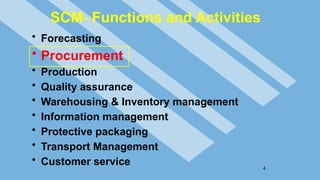
SCM- Functions andActivities
• Forecasting
• Procurement
• Production
• Quality assurance
• Warehousing & Inventory management
• Information management
• Protective packaging
• Transport Management
• Customer service 4
5.
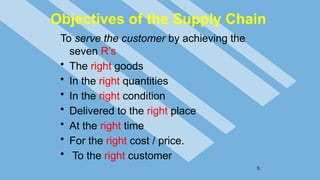
Objectives of theSupply Chain
To serve the customer by achieving the
seven R’s
• The right goods
• In the right quantities
• In the right condition
• Delivered to the right place
• At the right time
• For the right cost / price.
• To the right customer
5
7
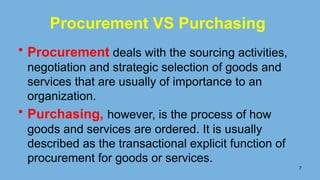
Procurement VS Purchasing
•Procurement deals with the sourcing activities,
negotiation and strategic selection of goods and
services that are usually of importance to an
organization.
• Purchasing, however, is the process of how
goods and services are ordered. It is usually
described as the transactional explicit function of
procurement for goods or services.
8.
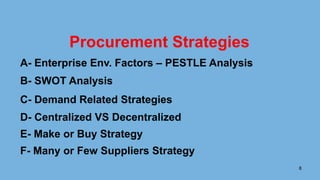
Procurement Strategies
A- EnterpriseEnv. Factors – PESTLE Analysis
B- SWOT Analysis
C- Demand Related Strategies
D- Centralized VS Decentralized
E- Make or Buy Strategy
F- Many or Few Suppliers Strategy
8
9.
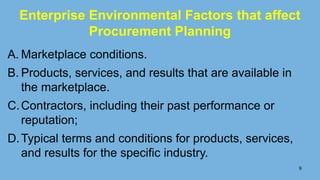
Enterprise Environmental Factorsthat affect
Procurement Planning
A. Marketplace conditions.
B. Products, services, and results that are available in
the marketplace.
C.Contractors, including their past performance or
reputation;
D.Typical terms and conditions for products, services,
and results for the specific industry.
9
10.
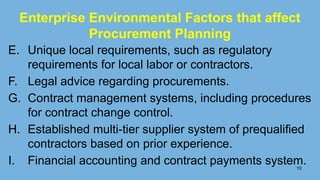
Enterprise Environmental Factorsthat affect
Procurement Planning
E. Unique local requirements, such as regulatory
requirements for local labor or contractors.
F. Legal advice regarding procurements.
G. Contract management systems, including procedures
for contract change control.
H. Established multi-tier supplier system of prequalified
contractors based on prior experience.
I. Financial accounting and contract payments system.
10
11.
11
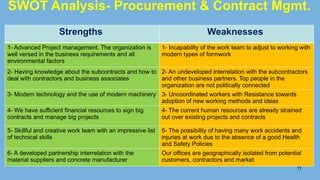
Strengths Weaknesses
1- AdvancedProject management. The organization is
well versed in the business requirements and all
environmental factors
1- Incapability of the work team to adjust to working with
modern types of formwork
2- Having knowledge about the subcontracts and how to
deal with contractors and business associates
2- An undeveloped interrelation with the subcontractors
and other business partners. Top people in the
organization are not politically connected
3- Modern technology and the use of modern machinery 3- Uncoordinated workers with Resistance towards
adoption of new working methods and ideas
4- We have sufficient financial resources to sign big
contracts and manage big projects
4- The current human resources are already strained
out over existing projects and contracts
5- Skillful and creative work team with an impressive list
of technical skills
5- The possibility of having many work accidents and
injuries at work due to the absence of a good Health
and Safety Policies
6- A developed partnership interrelation with the
material suppliers and concrete manufacturer
Our offices are geographically isolated from potential
customers, contractors and market
SWOT Analysis- Procurement & Contract Mgmt.
12.
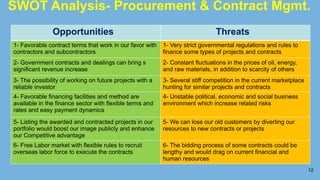
Opportunities Threats
1- Favorablecontract terms that work in our favor with
contractors and subcontractors
1- Very strict governmental regulations and rules to
finance some types of projects and contracts
2- Government contracts and dealings can bring s
significant revenue increase
2- Constant fluctuations in the prices of oil, energy,
and raw materials, in addition to scarcity of others
3- The possibility of working on future projects with a
reliable investor
3- Several stiff competition in the current marketplace
hunting for similar projects and contracts
4- Favorable financing facilities and method are
available in the finance sector with flexible terms and
rates and easy payment dynamics
4- Unstable political, economic and social business
environment which increase related risks
5- Listing the awarded and contracted projects in our
portfolio would boost our image publicly and enhance
our Competitive advantage
5- We can lose our old customers by diverting our
resources to new contracts or projects
6- Free Labor market with flexible rules to recruit
overseas labor force to execute the contracts
6- The bidding process of some contracts could be
lengthy and would drag on current financial and
human resources
12
SWOT Analysis- Procurement & Contract Mgmt.
13.
13
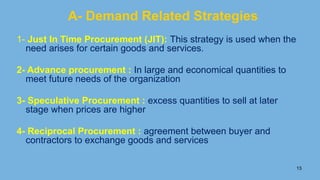
A- Demand RelatedStrategies
1- Just In Time Procurement (JIT): This strategy is used when the
need arises for certain goods and services.
2- Advance procurement : In large and economical quantities to
meet future needs of the organization
3- Speculative Procurement : excess quantities to sell at later
stage when prices are higher
4- Reciprocal Procurement : agreement between buyer and
contractors to exchange goods and services
14.
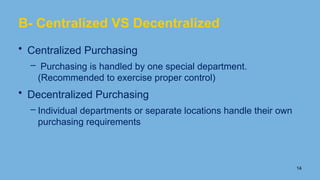
B- Centralized VSDecentralized
14
• Centralized Purchasing
– Purchasing is handled by one special department.
(Recommended to exercise proper control)
• Decentralized Purchasing
– Individual departments or separate locations handle their own
purchasing requirements
15.
15
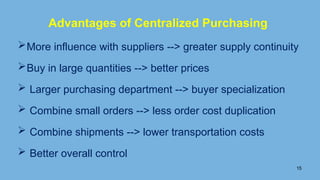
Advantages of CentralizedPurchasing
More influence with suppliers --> greater supply continuity
Buy in large quantities --> better prices
Larger purchasing department --> buyer specialization
Combine small orders --> less order cost duplication
Combine shipments --> lower transportation costs
Better overall control
16.
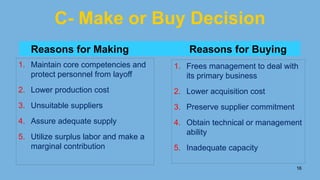
C- Make orBuy Decision
1. Maintain core competencies and
protect personnel from layoff
2. Lower production cost
3. Unsuitable suppliers
4. Assure adequate supply
5. Utilize surplus labor and make a
marginal contribution
1. Frees management to deal with
its primary business
2. Lower acquisition cost
3. Preserve supplier commitment
4. Obtain technical or management
ability
5. Inadequate capacity
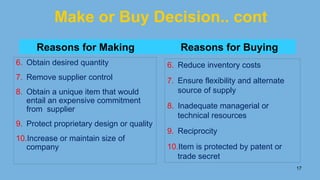
Reasons for Making Reasons for Buying
16
17.
Make or BuyDecision.. cont
6. Obtain desired quantity
7. Remove supplier control
8. Obtain a unique item that would
entail an expensive commitment
from supplier
9. Protect proprietary design or quality
10.Increase or maintain size of
company
6. Reduce inventory costs
7. Ensure flexibility and alternate
source of supply
8. Inadequate managerial or
technical resources
9. Reciprocity
10.Item is protected by patent or
trade secret
Reasons for Making Reasons for Buying
17
18.
Many Suppliers:
• Manysources per item
• Adversarial relationship
• Short-term
• Little openness
• Negotiated, sporadic PO’s
• High prices
• Infrequent, large lots
• Delivery to receiving dock
D- Many or Few Suppliers Strategy
18
19.
• 1 orfew sources per item
• Partnership (JIT)
• Long-term, stable
• On-site audits & visits
• Exclusive contracts
• Low prices (large orders)
• Frequent, small lots
• Delivery to point of use
Few Suppliers:
19
D- Many or Few Suppliers Strategy
20.
20
Call-Off Procurement Contract
•A call-off contract, also known as a blanket order, is a purchase order
which enables bulk orders over a period of time. This is a form of
framework agreement that is often used long lasting projects.
• The benefit of using a call-off contract is that it allows the supply of
materials to be secured over multiple delivery dates, meaning that a
customer does not have to hold excess stock instead they can ‘call off’
stock as and when it is required.
• This also reduces the amount of administration required to process
multiple purchase orders. Instead, sales orders and invoice items are
raised as they are needed until the point at which the contract is
fulfilled, the end of the order period is reached, or the maximum order
value (which is pre-determined) has been reached.
What Is ProcurementManagement?
• Procurement Management includes the processes necessary to
purchase or acquire products, services, or results needed from
outside the project team.
• Procurement Management includes the management and control
processes required to develop and administer agreements such as
contracts, purchase orders, memoranda of agreements (MOAs), or
internal service level agreements (SLAs).
• The personnel authorized to procure the goods and/or services
required for the project may be members of the project team
management, or part of the organization’s purchasing department if
applicable. 22
23.
• The purposeof procurement and contract management is to
establish and maintain relationships with vendors of goods
and services during the project life cycle.
• This unique function is an essential part of any project, which
is concerned with overseeing designated sets of temporary
operations. The purposes of procurement management is an
essential part of Supply Chain Management.
23
What Is Procurement Management?
24.
Key Concepts ForProcurement Management
• More than most other project management processes,
there can be significant legal obligations and penalties
tied to the procurement process
• The project manager does not have to be a trained expert
in procurement management laws and regulations but
should be familiar enough with the procurement process
to make intelligent decisions regarding contracts and
contractual relationships
24
25.
Key Concepts ForProcurement Management
• The Procurement Management processes involve
agreements that describe the relationship between two
parties—a buyer and a contractor
• The contracting approach and the contract itself should
reflect the simplicity or complexity of the deliverables or
required effort and should be written in a manner that
complies with local, national, and international laws
regarding contracts.
25
26.
• A purchasingcontract includes terms and conditions and may
incorporate other buyer specifics as to what the contractor is
to perform or provide.
• It is the project management team’s responsibility to make
certain that all procurements meet the specific needs of the
project while working with the procurement office to ensure
organizational procurement policies are followed.
• Depending on the application area, an agreement can be a
contract, an SLA, an understanding, an MOA, or a purchase
order.
26
Key Concepts For Procurement Management
27.
Factors to Considerfor Procurement Mgmt.
Complexity of procurement. Is there one main
procurement or are there multiple procurements at different
times with different contractors that add to the complexity of
the procurements.
Physical location. Are the buyers and contractors in the
same location, or reasonably close, or in different time
zones, countries, or continents?
27
28.
Factors to Considerfor Procurement Mgmt.
Governance and regulatory environment. Are local
laws and regulations regarding procurement activities
integrated with the organization’s procurement policies?
How does this affect contract auditing requirements?
Availability of contractors. Are there available
contractors who are capable of performing the work?
28
29.
Team Role &Responsibilities in Procurement
Management
1. Prepare the procurement statement of work (SOW) or
terms of reference (TOR).
2. Prepare a high-level cost estimate to determine the
budget.
3. Advertise the opportunity.
4. Identify a short list of qualified contractors.
5. Prepare and issue bid documents.
29
30.
6. Prepare andsubmit proposals to the contractor.
7. Conduct a technical evaluation of the proposals
including quality.
8. Perform a cost evaluation of the proposals.
9. Prepare the final combined quality and cost evaluation to
select the winning proposal.
10. Finalize negotiations and sign contract between the
buyer and the contractor. 30
Team Role & Responsibilities in Procurement
Management
#5 In order to assure customer service, and enable the clients to select and use the method they want, the supply chain must guarantee logisticians call the SIX RIGHTS.
The right goods
in the right quantities
in the right condition
delivered
to the right place
at the right time
for the right cost
If you have a hard time remembering this, take a look at the pens you have been given.
Unless ALL the six rights are satisfied, customer service will fail, to the detriment of the individual and the program.
#16 Ask students to consider the product characteristics which might cause a company to choose one or the other of the make/buy options.
#17 Ask students to consider the product characteristics which might cause a company to choose one or the other of the make/buy options.
#18 We read in the management literature more and more about “managing relationships.” If you use the “many supplier” strategy, how do you develop useful relationships?
#19 The risk of having only a single supplier will probably be obvious to most students. What nature of relationship must you have with your supplier to reduce this risk?