Importance of theprocurement
management
• Procurement is a crucial business function responsible for acquiring goods
and services required by an organization to operate efficiently. It involves
sourcing, purchasing, and managing supplier relationships to ensure
quality, cost-effectiveness, and timely delivery.
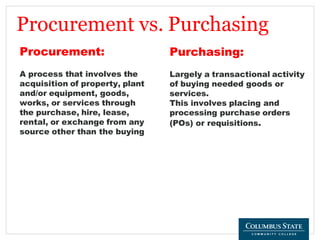
Procurement vs. Purchasing
Procurement:
Aprocess that involves the
acquisition of property, plant
and/or equipment, goods,
works, or services through
the purchase, hire, lease,
rental, or exchange from any
source other than the buying
Purchasing:
Largely a transactional activity
of buying needed goods or
services.
This involves placing and
processing purchase orders
(POs) or requisitions.
7.
Roles/ functions ofprocurement
i. Supply market monitoring, and identifying potential sources of supply
ii. Supplier evaluation and selection
iii. Processing procurement or stock replenishment requests (requisitions)
iv. Providing input to the preparation of specifications (definition of requirements) for
new purchases
8.
v. Negotiation ,buying and developing contracts
vi. Contract management – ensuring that suppliers deliver according to
contract
vii. Record keeping, report generation, processing of documentation through
all the above activities
9.
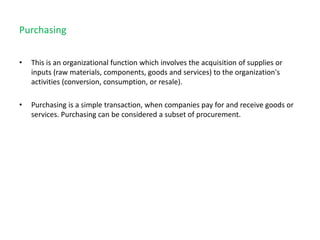
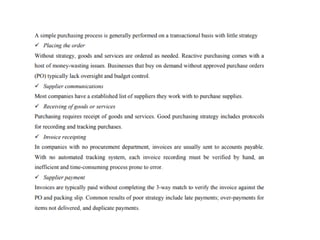
Purchasing
• This isan organizational function which involves the acquisition of supplies or
inputs (raw materials, components, goods and services) to the organization's
activities (conversion, consumption, or resale).
• Purchasing is a simple transaction, when companies pay for and receive goods or
services. Purchasing can be considered a subset of procurement.
10.
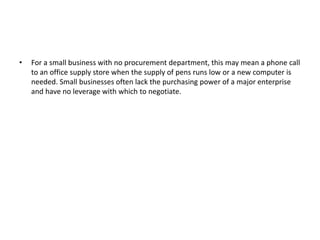
• For asmall business with no procurement department, this may mean a phone call
to an office supply store when the supply of pens runs low or a new computer is
needed. Small businesses often lack the purchasing power of a major enterprise
and have no leverage with which to negotiate.
12.
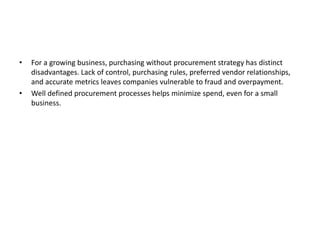
• For agrowing business, purchasing without procurement strategy has distinct
disadvantages. Lack of control, purchasing rules, preferred vendor relationships,
and accurate metrics leaves companies vulnerable to fraud and overpayment.
• Well defined procurement processes helps minimize spend, even for a small
business.
13.
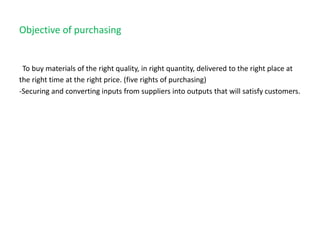
Objective of purchasing
Tobuy materials of the right quality, in right quantity, delivered to the right place at
the right time at the right price. (five rights of purchasing)
-Securing and converting inputs from suppliers into outputs that will satisfy customers.
14.
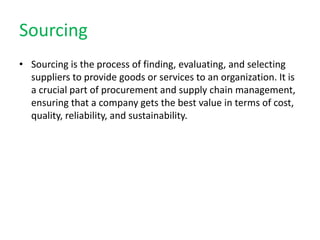
Sourcing
• Sourcing isthe process of finding, evaluating, and selecting
suppliers to provide goods or services to an organization. It is
a crucial part of procurement and supply chain management,
ensuring that a company gets the best value in terms of cost,
quality, reliability, and sustainability.
15.
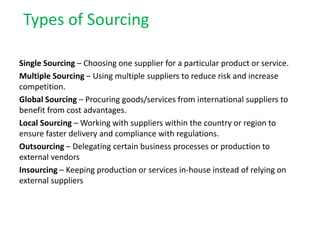
Types of Sourcing
SingleSourcing – Choosing one supplier for a particular product or service.
Multiple Sourcing – Using multiple suppliers to reduce risk and increase
competition.
Global Sourcing – Procuring goods/services from international suppliers to
benefit from cost advantages.
Local Sourcing – Working with suppliers within the country or region to
ensure faster delivery and compliance with regulations.
Outsourcing – Delegating certain business processes or production to
external vendors
Insourcing – Keeping production or services in-house instead of relying on
external suppliers
16.
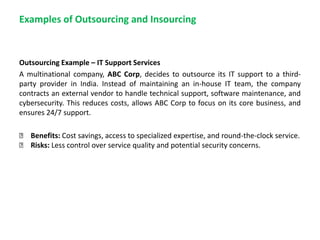
Examples of Outsourcingand Insourcing
Outsourcing Example – IT Support Services
A multinational company, ABC Corp, decides to outsource its IT support to a third-
party provider in India. Instead of maintaining an in-house IT team, the company
contracts an external vendor to handle technical support, software maintenance, and
cybersecurity. This reduces costs, allows ABC Corp to focus on its core business, and
ensures 24/7 support.
✅ Benefits: Cost savings, access to specialized expertise, and round-the-clock service.
✅ Risks: Less control over service quality and potential security concerns.
17.
Insourcing Example –Manufacturing Operations
A clothing brand, XYZ Fashion, previously outsourced its production to factories
in China. However, due to rising labor costs and supply chain disruptions, the
company decides to bring manufacturing back in-house by setting up its own
factory in the U.S. This allows XYZ Fashion to have better quality control, faster
production times, and greater flexibility in responding to market demand.
✅ Benefits: More control over quality, reduced dependency on third parties,
and faster delivery.
✅ Risks: Higher initial investment and operational costs.
18.
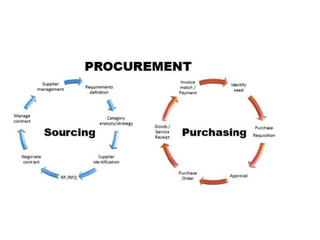
Steps in theSourcing Process
1) Identifying Needs – Understanding the company’s requirements for
materials or services.
2) Market Research – Analyzing the supplier market, costs, risks, and
opportunities.
3) Supplier Identification – Finding potential vendors that can meet the
requirements.
4) Supplier Evaluation – Assessing suppliers based on price, quality,
capacity, reputation, and financial stability.
5) Request for Proposal (RFP) or Request for Quotation (RFQ) – Sending
official requests to shortlisted suppliers for detailed offers.
6) Negotiation – Discussing terms, prices, and conditions with suppliers.
7) Supplier Selection – Choosing the most suitable supplier based on
evaluation criteria.
8) Contracting – Finalizing agreements and signing contracts.
9) Performance Monitoring – Regularly assessing supplier performance to
ensure compliance and continuous improvement.