Purchasing and Supply Chain Management
                          by W.C. Benton


 Chapter One
  Purchasing and Supply
      Management
Learning Objectives
1. To understand the purchasing function’s contribution to
     profitability.

2. To identify the relationship between the purchasing function
     and other functional areas.

3. To understand the evolution of the basic materials
     management concept.

4. To differentiate between purchasing, materials management,
     and supply chain management.

5. To explore the basic historical development of the purchasing
     function.
                               1-2
Learning Objectives
6. To understand the relationship between the purchasing
   function and inventory, ordering and transportation costs.

7. To learn the advantages and disadvantages of centralized
   purchasing organizational designs.

8. To identify various purchasing organizational designs.

9. To learn about purchasing careers


                                1-3
Markets in Transition
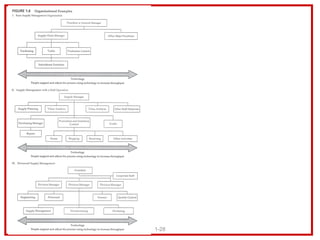
• In certain industries, Asian manufacturers dominate the
  United States’ consumer market. Third-world nations
  continue to attract U.S. manufacturers seeking low wages for
  laborious tasks.

• In addition to significant events that have impacted the
  world’s business environment, individual firms have had to
  change radically in response to burgeoning technologies


                              1-4
Background
• Historically, the management of materials and component
  parts has been the most neglected element in the production
  process.
• In the past businesses emphasized minimizing the cost of
  capital and labor.
• The focus on labor was logical because the industrial
  revolution had generated many labor-intensive
  manufacturers.
• Producing large standardized batches represented the norm
  for some manufacturers.


                              1-5
Setting the Stage

• As a functional area within a firm, purchasing and supply
  management grappled with the stigma of being labeled a
  clerical function.

• However, in the past 30 years, purchasing has made many
  strides toward shedding this label and has emerged as a
  viable professional career path.


                               1-6
Setting the Stage for Change

• Businesses have had to change radically in response to
  burgeoning technologies

• The reality is that technology is rapidly displacing labor.

• During the next decade, the supply management function is
  likely to contribute to profits more than any other function
  in the company.

• See the next two slides

                                 1-7
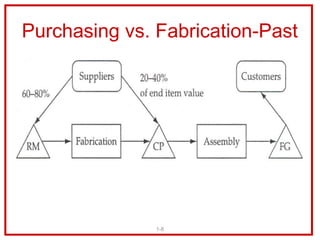
Purchasing vs. Fabrication-Past


RM = Raw Materials
FG = Finished Goods
CP = Component Parts
Triangle = Inventory Storage

                               1-8
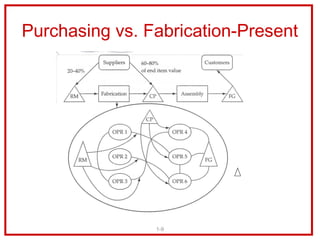
Purchasing vs. Fabrication-Present


                         RM = Raw Materials
                         OPR 1 = Operation 1
                         FG = Finished Goods
                         CP = Component Parts
                           = Inventory Storage


                1-9
Purchasing Managers, Buyers, and
          Purchasing Agents
• Seek to obtain the highest-quality merchandise at the lowest
  possible purchase cost for their employers.

• Purchasers buy goods and services for use by their business
  organization.

• Buyers typically buy items for resale.


                               1-10
Purchasers and Buyers:
• determine the best value,

• choose the appropriate suppliers

• negotiate the best price, and

• award contracts that ensure that the correct amount
  of the product or service is received at the
  appropriate time.

                          1-11
Purchasers and Buyers
• Purchasing managers, buyers, and agents must become
  experts on the services, materials, and products they
  purchase.

• Purchasing managers, buyers, and purchasing agents evaluate
  suppliers on the basis of price, quality, service support,
  availability, reliability, and selection.

• Once all of the necessary information on suppliers is
  gathered, orders are placed and contracts are awarded to
  those suppliers who meet the purchaser’s needs.


                             1-12
Factors That Influence


• Changing economic and political environments, emerging
  technology versus labor, and the changing nature of
  purchasing and supply chain management as a discipline—
  must influence the role of purchasing and supply
  management .


                            1-13
The Supply Management Process

• In most firms, functional managers within each area make
  independent decisions using similar techniques.

• The objective is to provide high-quality customer service
  while minimizing the cost of producing the service.

• Purpose of supply management is to support the
  transformation of raw materials and component parts into
  shipped or inventory goods.


                               1-14
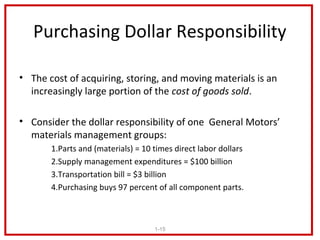
Purchasing Dollar Responsibility

• The cost of acquiring, storing, and moving materials is an
  increasingly large portion of the cost of goods sold.

• Consider the dollar responsibility of one General Motors’
  materials management groups:
       1.Parts and (materials) = 10 times direct labor dollars
       2.Supply management expenditures = $100 billion
       3.Transportation bill = $3 billion
       4.Purchasing buys 97 percent of all component parts.


                                    1-15
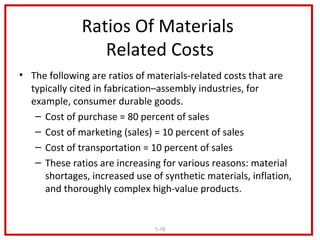
Ratios Of Materials
                 Related Costs
• The following are ratios of materials-related costs that are
  typically cited in fabrication–assembly industries, for
  example, consumer durable goods.
   – Cost of purchase = 80 percent of sales
   – Cost of marketing (sales) = 10 percent of sales
   – Cost of transportation = 10 percent of sales
   – These ratios are increasing for various reasons: material
     shortages, increased use of synthetic materials, inflation,
     and thoroughly complex high-value products.


                               1-16
Ratios Of Materials
                  Related Costs
• These ratios are increasing for various reasons:
   –   Material shortages
   –   Increased use of synthetic materials
   –   Inflation
   –   Complex high-value products.
   –   Where else is the potential for cost reduction and
       competitive advantage so great?


                                1-17
Potential For Profit
• All supply management activities have potential for cost
  reduction and hence increased profit.

• Many opportunities exist to reduce the cost of purchases.

• If the firm’s sales remained the same, the effect on profit,
  given the 2 percent reduction of material cost, would look like
  that in Figure 1.4.

• For each $1 reduction of material cost, there is a $1 increase
  in profit. The ratio is 1:1.


                               1-18
Potential For Profit

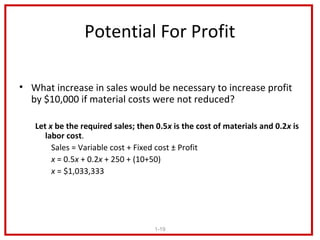
• What increase in sales would be necessary to increase profit
  by $10,000 if material costs were not reduced?

   Let x be the required sales; then 0.5x is the cost of materials and 0.2x is
      labor cost.
        Sales = Variable cost + Fixed cost ± Profit
        x = 0.5x + 0.2x + 250 + (10+50)
        x = $1,033,333


                                    1-19
Integrated Supply Management (ISM)
• Achieving integration is a challenge.
• The decisions of a production-inventory control (PIC) manager
  may maximize utilization of production equipment, yet poorly
  serve the requirements of the marketing manager.
• The decision of the purchasing manager affects not only the
  purchasing function, but other materials functions.
• It is the objective of ISM to manage the related
  considerations. Purchasing should consider the
  nonpurchasing consequences of its decisions.


                              1-20
Integrated Supply Management (ISM)
• Example
     The significance of average inventory is that inventory
      cost is a function of average inventory.

     Inventory is an asset. Working capital is tied up in
      material rather than an alternative asset.

     Opportunity costs as well as costs of storing, insuring,
     and handling are incurred when inventory exists.


                            1-21
Annual Inventory – Ordering
           Transportation Costs
• How can the best decision be made—one that provides the
  desired customer service at minimum cost?

• The customers are manufacturing, sales, distribution, the final
  consumer, and, of course, purchasing, which is the supplier’s
  customer.

• The costs of satisfactory customer service are only partly
  identifiable and quantifiable.


                               1-22
Annual Inventory – Ordering
         Transportation Costs
• The opportunity costs of poor customer
  service is also incomplete. Yet decisions must
  be made while recognizing that system wide
  decision criteria are
     1.Multiple
     2.Complex
     3.Conflicting


                       1-23
A Developing Discipline
• Supply management is a developing discipline and an
  area of management specialization.

• Measures of customer service are usually expressed in
  terms of the availability of material.

• Did the plant ship on time? Was the product on the shelf
  when the customer entered the shop?

• While important, availability is only one dimension of
  customer service.
                            1-24
A Developing Discipline.

• As these areas develop, purchasing and distribution cost
  accounting will become part of the accounting-information
  system. Standard costs to create the time and place utilities
  will be calculable.

• Budgeting for materials management activities will have the
  detail and reliability of budgeting in manufacturing.

• When supply management costs become more visible, their
  control becomes more feasible


                               1-25
Organizing for Purchasing
• Supply coordination involves both structure and design
  of the organization.

• In any purchasing organization, two major problems
  must first be considered.
   1. The first issue has to do with where the purchasing function
      should be located in the organization.

   2. The second issue is, what level of authority should the
      purchasing function have? Given the evolution of outsourcing,
      the purchasing function is expected to gain authority in the
      corporate hierarchy


                                 1-26
CENTRALIZED VERSUS
DECENTRALIZED PURCHASING


          1-27
1-28
Advantages of Centralized Purchasing

• Centralized purchasing results in lower costs because of the
  availability of purchase quantity discounts.

• If all material uses are coordinated into one major purchase,
  the supplier will work harder to service the buying firm.

• Large dollar purchase quantities equals buying power.


                              1-29
Advantages of Centralized Purchasing
• Centralized purchasing promotes the effective use of
  purchasing professionals because it allows the materials
  manager more authority and credibility.

• Each buyer can easily become an expert on associated buys
  (commodities and non-commodities) Expertise will be
  developed when there is a critical mass.

• Toyota, Dell, Wal-Mart, and IBM all use centralized
  purchasing and have in-house expertise ranging from engine
  parts to rental cars to office equipment to pharmaceuticals


                              1-30
Advantages of Centralized Purchasing

• Centralized purchasing enables the buying firm to do a better
  job monitoring various changes throughout the industry.

• Centralized purchasing also lends itself to periodic (1) reviews
  of purchasing activities, (2) evaluation of suppliers, and
  (3) the development of purchasing training programs.


                                1-31
Disadvantages of Centralized
             Purchasing
• High engineering involvement in procurement decision
  making

• High need to coordinate purchased parts with production
  schedules

• High need to buy from local community.


                             1-32
The Future Organization Concept
• The future outlook is that the majority of significant dollar-
  valued purchases will continue to be centralized.

• This trend also will be the result of increased computer-based
  management information systems.
   – As firms become lean, centralized purchasing will become a major
     focus. Long-term agreements will be more frequently negotiated to
     stabilize prices.

• Honda of America is an excellent example of a firm that uses
  centralized procurement as a competitive weapon.
  Approximately 75 percent of the sales dollar for each
  automobile manufactured in Marysville, Ohio, is purchased
  from Japanese firms.
                                  1-33
Reporting Assignment
•   The status of the purchasing professional in an organization is determined
    by the capacity structure. In the majority of the Fortune 500 firms, the
    purchasing professional reports directly to the manufacturing vice
    president.

•   The purchasing organizational structure also should be different for
    service-based firms.

•   A Center for Advanced Purchasing (CAPs) study found that in 16 percent
    of the firms surveyed, purchasing managers reported directly to the
    president.

•   In smaller firms, more than one-third of the purchasing professionals
    report to the V.P. of manufacturing. What’s more, in firms with sales
    between 5.1 and 10 billion dollars, 61 percent report to either the
    president or executive V.P.

                                      1-34
The Supply Management Concept

• To summarize The supply management concept is a
  formal organizational concept that is involved with the
  flow of materials through a manufacturing firm.

• The functional areas affected include

             (1) purchasing,
             (2) inventory control,
             (3) traffic,
             (4) production control, and
             (5) stores

                            1-35
Careers in Purchasing
         and Supply Management
• This is the best time for the next generation of
  managers to pursue a career in purchasing supply

• Supply professionals must possess a comprehensive
  skill set

• The average salary for a supply management
  professional is $92,165.


                         1-36

Purchasing and Supply Management

  • 1.
    Purchasing and SupplyChain Management by W.C. Benton Chapter One Purchasing and Supply Management
  • 2.
    Learning Objectives 1. Tounderstand the purchasing function’s contribution to profitability. 2. To identify the relationship between the purchasing function and other functional areas. 3. To understand the evolution of the basic materials management concept. 4. To differentiate between purchasing, materials management, and supply chain management. 5. To explore the basic historical development of the purchasing function. 1-2
  • 3.
    Learning Objectives 6. Tounderstand the relationship between the purchasing function and inventory, ordering and transportation costs. 7. To learn the advantages and disadvantages of centralized purchasing organizational designs. 8. To identify various purchasing organizational designs. 9. To learn about purchasing careers 1-3
  • 4.
    Markets in Transition •In certain industries, Asian manufacturers dominate the United States’ consumer market. Third-world nations continue to attract U.S. manufacturers seeking low wages for laborious tasks. • In addition to significant events that have impacted the world’s business environment, individual firms have had to change radically in response to burgeoning technologies 1-4
  • 5.
    Background • Historically, themanagement of materials and component parts has been the most neglected element in the production process. • In the past businesses emphasized minimizing the cost of capital and labor. • The focus on labor was logical because the industrial revolution had generated many labor-intensive manufacturers. • Producing large standardized batches represented the norm for some manufacturers. 1-5
  • 6.
    Setting the Stage •As a functional area within a firm, purchasing and supply management grappled with the stigma of being labeled a clerical function. • However, in the past 30 years, purchasing has made many strides toward shedding this label and has emerged as a viable professional career path. 1-6
  • 7.
    Setting the Stagefor Change • Businesses have had to change radically in response to burgeoning technologies • The reality is that technology is rapidly displacing labor. • During the next decade, the supply management function is likely to contribute to profits more than any other function in the company. • See the next two slides 1-7
  • 8.
    Purchasing vs. Fabrication-Past RM= Raw Materials FG = Finished Goods CP = Component Parts Triangle = Inventory Storage 1-8
  • 9.
    Purchasing vs. Fabrication-Present RM = Raw Materials OPR 1 = Operation 1 FG = Finished Goods CP = Component Parts = Inventory Storage 1-9
  • 10.
    Purchasing Managers, Buyers,and Purchasing Agents • Seek to obtain the highest-quality merchandise at the lowest possible purchase cost for their employers. • Purchasers buy goods and services for use by their business organization. • Buyers typically buy items for resale. 1-10
  • 11.
    Purchasers and Buyers: •determine the best value, • choose the appropriate suppliers • negotiate the best price, and • award contracts that ensure that the correct amount of the product or service is received at the appropriate time. 1-11
  • 12.
    Purchasers and Buyers •Purchasing managers, buyers, and agents must become experts on the services, materials, and products they purchase. • Purchasing managers, buyers, and purchasing agents evaluate suppliers on the basis of price, quality, service support, availability, reliability, and selection. • Once all of the necessary information on suppliers is gathered, orders are placed and contracts are awarded to those suppliers who meet the purchaser’s needs. 1-12
  • 13.
    Factors That Influence •Changing economic and political environments, emerging technology versus labor, and the changing nature of purchasing and supply chain management as a discipline— must influence the role of purchasing and supply management . 1-13
  • 14.
    The Supply ManagementProcess • In most firms, functional managers within each area make independent decisions using similar techniques. • The objective is to provide high-quality customer service while minimizing the cost of producing the service. • Purpose of supply management is to support the transformation of raw materials and component parts into shipped or inventory goods. 1-14
  • 15.
    Purchasing Dollar Responsibility •The cost of acquiring, storing, and moving materials is an increasingly large portion of the cost of goods sold. • Consider the dollar responsibility of one General Motors’ materials management groups: 1.Parts and (materials) = 10 times direct labor dollars 2.Supply management expenditures = $100 billion 3.Transportation bill = $3 billion 4.Purchasing buys 97 percent of all component parts. 1-15
  • 16.
    Ratios Of Materials Related Costs • The following are ratios of materials-related costs that are typically cited in fabrication–assembly industries, for example, consumer durable goods. – Cost of purchase = 80 percent of sales – Cost of marketing (sales) = 10 percent of sales – Cost of transportation = 10 percent of sales – These ratios are increasing for various reasons: material shortages, increased use of synthetic materials, inflation, and thoroughly complex high-value products. 1-16
  • 17.
    Ratios Of Materials Related Costs • These ratios are increasing for various reasons: – Material shortages – Increased use of synthetic materials – Inflation – Complex high-value products. – Where else is the potential for cost reduction and competitive advantage so great? 1-17
  • 18.
    Potential For Profit •All supply management activities have potential for cost reduction and hence increased profit. • Many opportunities exist to reduce the cost of purchases. • If the firm’s sales remained the same, the effect on profit, given the 2 percent reduction of material cost, would look like that in Figure 1.4. • For each $1 reduction of material cost, there is a $1 increase in profit. The ratio is 1:1. 1-18
  • 19.
    Potential For Profit •What increase in sales would be necessary to increase profit by $10,000 if material costs were not reduced? Let x be the required sales; then 0.5x is the cost of materials and 0.2x is labor cost. Sales = Variable cost + Fixed cost ± Profit x = 0.5x + 0.2x + 250 + (10+50) x = $1,033,333 1-19
  • 20.
    Integrated Supply Management(ISM) • Achieving integration is a challenge. • The decisions of a production-inventory control (PIC) manager may maximize utilization of production equipment, yet poorly serve the requirements of the marketing manager. • The decision of the purchasing manager affects not only the purchasing function, but other materials functions. • It is the objective of ISM to manage the related considerations. Purchasing should consider the nonpurchasing consequences of its decisions. 1-20
  • 21.
    Integrated Supply Management(ISM) • Example The significance of average inventory is that inventory cost is a function of average inventory. Inventory is an asset. Working capital is tied up in material rather than an alternative asset. Opportunity costs as well as costs of storing, insuring, and handling are incurred when inventory exists. 1-21
  • 22.
    Annual Inventory –Ordering Transportation Costs • How can the best decision be made—one that provides the desired customer service at minimum cost? • The customers are manufacturing, sales, distribution, the final consumer, and, of course, purchasing, which is the supplier’s customer. • The costs of satisfactory customer service are only partly identifiable and quantifiable. 1-22
  • 23.
    Annual Inventory –Ordering Transportation Costs • The opportunity costs of poor customer service is also incomplete. Yet decisions must be made while recognizing that system wide decision criteria are 1.Multiple 2.Complex 3.Conflicting 1-23
  • 24.
    A Developing Discipline •Supply management is a developing discipline and an area of management specialization. • Measures of customer service are usually expressed in terms of the availability of material. • Did the plant ship on time? Was the product on the shelf when the customer entered the shop? • While important, availability is only one dimension of customer service. 1-24
  • 25.
    A Developing Discipline. •As these areas develop, purchasing and distribution cost accounting will become part of the accounting-information system. Standard costs to create the time and place utilities will be calculable. • Budgeting for materials management activities will have the detail and reliability of budgeting in manufacturing. • When supply management costs become more visible, their control becomes more feasible 1-25
  • 26.
    Organizing for Purchasing •Supply coordination involves both structure and design of the organization. • In any purchasing organization, two major problems must first be considered. 1. The first issue has to do with where the purchasing function should be located in the organization. 2. The second issue is, what level of authority should the purchasing function have? Given the evolution of outsourcing, the purchasing function is expected to gain authority in the corporate hierarchy 1-26
  • 27.
  • 28.
  • 29.
    Advantages of CentralizedPurchasing • Centralized purchasing results in lower costs because of the availability of purchase quantity discounts. • If all material uses are coordinated into one major purchase, the supplier will work harder to service the buying firm. • Large dollar purchase quantities equals buying power. 1-29
  • 30.
    Advantages of CentralizedPurchasing • Centralized purchasing promotes the effective use of purchasing professionals because it allows the materials manager more authority and credibility. • Each buyer can easily become an expert on associated buys (commodities and non-commodities) Expertise will be developed when there is a critical mass. • Toyota, Dell, Wal-Mart, and IBM all use centralized purchasing and have in-house expertise ranging from engine parts to rental cars to office equipment to pharmaceuticals 1-30
  • 31.
    Advantages of CentralizedPurchasing • Centralized purchasing enables the buying firm to do a better job monitoring various changes throughout the industry. • Centralized purchasing also lends itself to periodic (1) reviews of purchasing activities, (2) evaluation of suppliers, and (3) the development of purchasing training programs. 1-31
  • 32.
    Disadvantages of Centralized Purchasing • High engineering involvement in procurement decision making • High need to coordinate purchased parts with production schedules • High need to buy from local community. 1-32
  • 33.
    The Future OrganizationConcept • The future outlook is that the majority of significant dollar- valued purchases will continue to be centralized. • This trend also will be the result of increased computer-based management information systems. – As firms become lean, centralized purchasing will become a major focus. Long-term agreements will be more frequently negotiated to stabilize prices. • Honda of America is an excellent example of a firm that uses centralized procurement as a competitive weapon. Approximately 75 percent of the sales dollar for each automobile manufactured in Marysville, Ohio, is purchased from Japanese firms. 1-33
  • 34.
    Reporting Assignment • The status of the purchasing professional in an organization is determined by the capacity structure. In the majority of the Fortune 500 firms, the purchasing professional reports directly to the manufacturing vice president. • The purchasing organizational structure also should be different for service-based firms. • A Center for Advanced Purchasing (CAPs) study found that in 16 percent of the firms surveyed, purchasing managers reported directly to the president. • In smaller firms, more than one-third of the purchasing professionals report to the V.P. of manufacturing. What’s more, in firms with sales between 5.1 and 10 billion dollars, 61 percent report to either the president or executive V.P. 1-34
  • 35.
    The Supply ManagementConcept • To summarize The supply management concept is a formal organizational concept that is involved with the flow of materials through a manufacturing firm. • The functional areas affected include (1) purchasing, (2) inventory control, (3) traffic, (4) production control, and (5) stores 1-35
  • 36.
    Careers in Purchasing and Supply Management • This is the best time for the next generation of managers to pursue a career in purchasing supply • Supply professionals must possess a comprehensive skill set • The average salary for a supply management professional is $92,165. 1-36

Editor's Notes