Supply Chain 
Management: 
Chapter 11 
LOCATION DECISIONS 
Prepared by Mark A. Jacobs, PhD 
©2012 Cengage Learning. All Rights Reserved. May not be scanned, copied or 
duplicated, or posted to a publicly accessible website, in whole or in part.
LEARNING OBJECTIVES 
You should be able to: 
 Explain the impact of global location decisions on a 
supply chain. 
 Identify the factors influencing location decisions. 
 Understand the impact of the Regional Trade 
Agreements on location decisions. 
 Use several location evaluation models. 
 Understand the advantages of business clusters. 
 Understand the importance of sustainable 
development 
©2012 Cengage Learning. All Rights Reserved. May not be scanned, copied or duplicated, or posted to a publicly accessible website, in whole or in part. 2
CHAPTER OUTLINE 
• Introduction 
• Global Location Strategies 
• Critical Location Factors 
• Facility Location Techniques 
• Helpful On-Line Information for Location 
Analysis 
• Business Clusters 
• Sustainable Development 
©2012 Cengage Learning. All Rights Reserved. May not be scanned, copied or duplicated, or posted to a publicly accessible website, in whole or in part. 3
Introduction 
Facility location must be part of the firm’s supply chain 
strategy. 
Companies can locate anywhere in the world due to 
increased globalization, technology, transportation, & open 
markets. 
Location still matters- industry clusters show that 
innovation & competition are geographically concentrated. 
Global location decisions involve location of the facility, 
defining its strategic role, & identifying the markets it 
serves 
©2012 Cengage Learning. All Rights Reserved. May not be scanned, copied or duplicated, or posted to a publicly accessible website, in whole or in part. 4
Location Strategies 
Dr. Kasra Ferdows suggests 6 location types 
 Offshore factory - low cost investment & labor costs. 
 Source factory - plant mgmt involved in supplier 
selection & production planning. 
 Server factory - firm uses government incentives & low 
exchange risk & tariff barriers to reduce taxes & 
logistics costs. 
 Contributor factory - firm involved in product 
development, production planning, procurement 
decisions, & developing suppliers. 
 Outpost factory - embedded network of suppliers, 
competitors, research facilities for materials, 
components & products. 
 Lead factory - firm is source of innovation & competitive 
advantage of the organization. 
©2012 Cengage Learning. All Rights Reserved. May not be scanned, copied or duplicated, or posted to a publicly accessible website, in whole or in part. 5
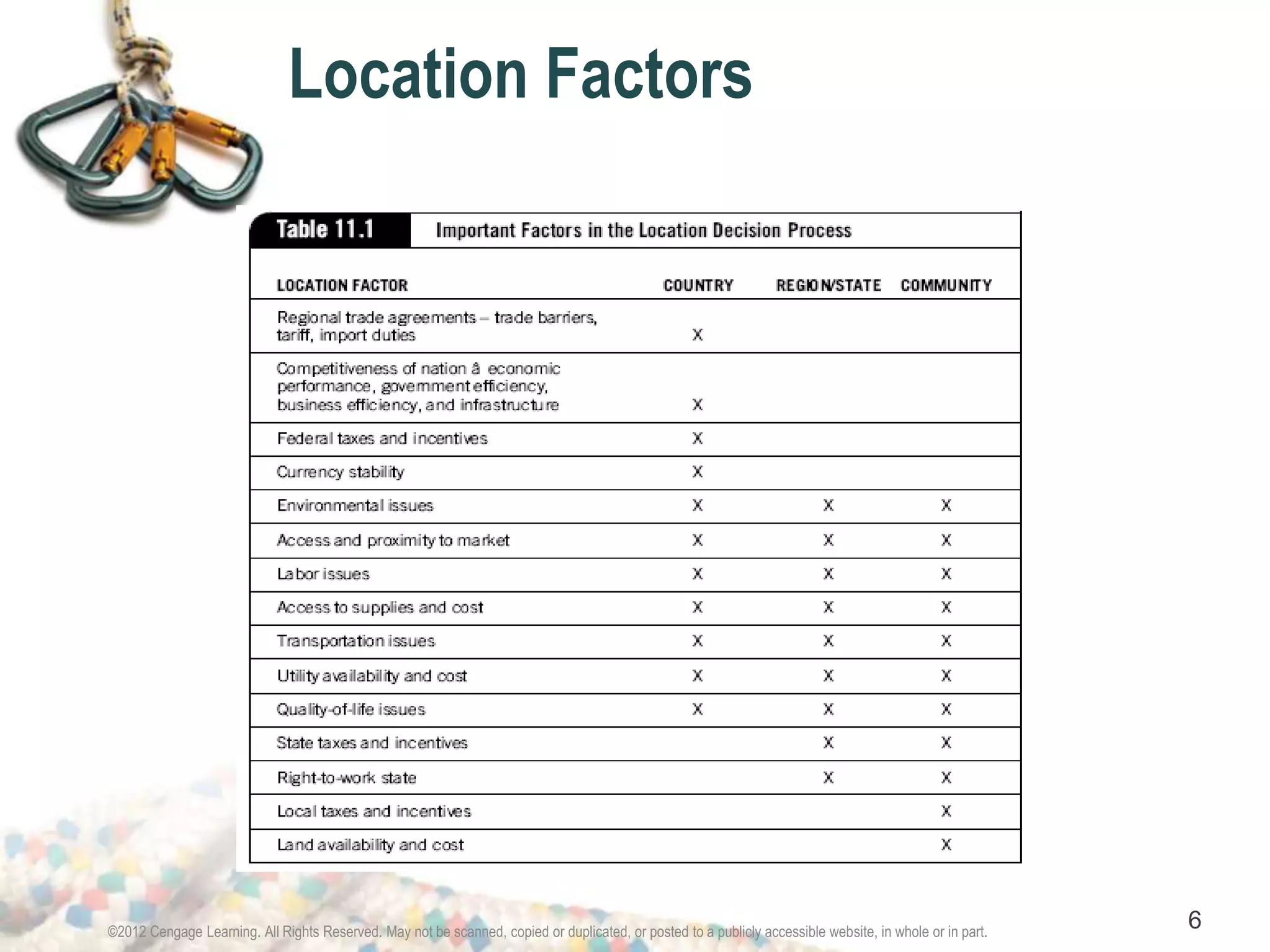
Location Factors 
©2012 Cengage Learning. All Rights Reserved. May not be scanned, copied or duplicated, or posted to a publicly accessible website, in whole or in part. 6
Location Factors (Continued) 
Regional Trade Agreements (RTA) & WTO 
World Trade Organization (WTO) successor to the 
General Agreement on Tariffs/Trade (GATT). 
Functions include: 
 Administering agreements, 
 Forum for trade negotiations, 
 Trade disputes, 
 Monitor trade policies, 
 Aid for Developing countries 
 International organizations. 
©2012 Cengage Learning. All Rights Reserved. May not be scanned, copied or duplicated, or posted to a publicly accessible website, in whole or in part. 7
Location Factors (Continued) 
RTA & the WTO (Continued) 
European Union (EU): [1950] Set up after the WWII, the 
EU consists of 27 members 
North American Free Trade Agreement (NAFTA): 
[1994] among the U.S., Canada, & Mexico 
Southern Common Market (MERCOSUR): [1991] 
among Argentina, Brazil, Paraguay, & Uruguay 
Association of Southeast Asian Nations (ASEAN): 
[1967] in SE Asia 
Common Market of Eastern and Southern Africa 
(COMESA) 
©2012 Cengage Learning. All Rights Reserved. May not be scanned, copied or duplicated, or posted to a publicly accessible website, in whole or in part. 8
Location Factors (Continued) 
Competitiveness of Nations 
Degree to which a country produces goods & 
services which meet the needs of international 
markets, while maintaining or expanding personal 
real income over time. Made up of 323 criteria, 
grouped into 4 factors – 
1. Economic performance (79 criteria) 
2. Government efficiency (72 criteria) 
3. Business efficiency (71 criteria) 
4. Infrastructure (101 criteria) 
©2012 Cengage Learning. All Rights Reserved. May not be scanned, copied or duplicated, or posted to a publicly accessible website, in whole or in part. 9
Location Factors (Continued) 
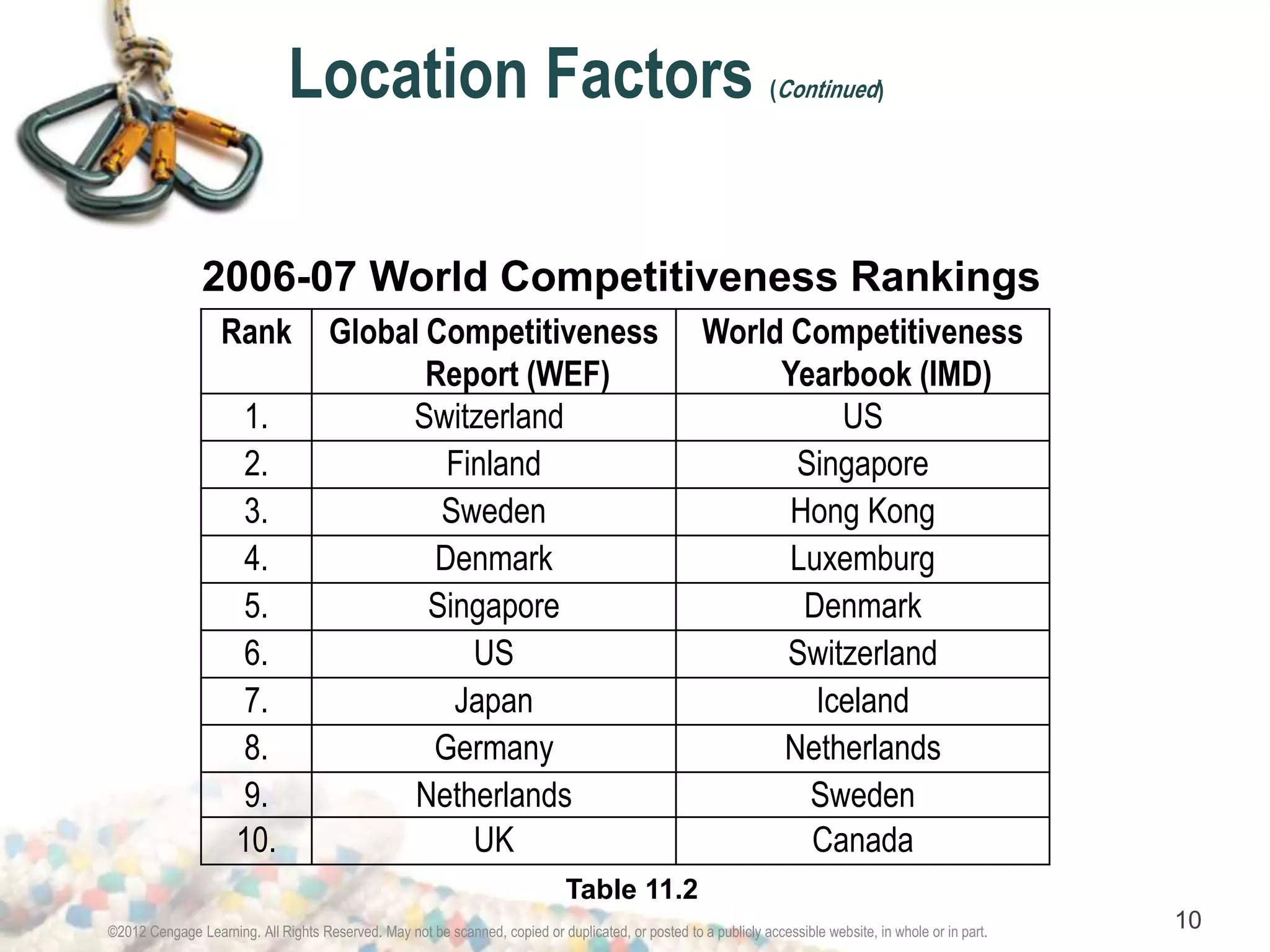
2006-07 World Competitiveness Rankings 
Rank Global Competitiveness 
Report (WEF) 
World Competitiveness 
Yearbook (IMD) 
1. Switzerland US 
2. Finland Singapore 
3. Sweden Hong Kong 
4. Denmark Luxemburg 
5. Singapore Denmark 
6. US Switzerland 
7. Japan Iceland 
8. Germany Netherlands 
9. Netherlands Sweden 
10. UK Canada 
Table 11.2 
©2012 Cengage Learning. All Rights Reserved. May not be scanned, copied or duplicated, or posted to a publicly accessible website, in whole or in part. 10
Location Factors (Continued) 
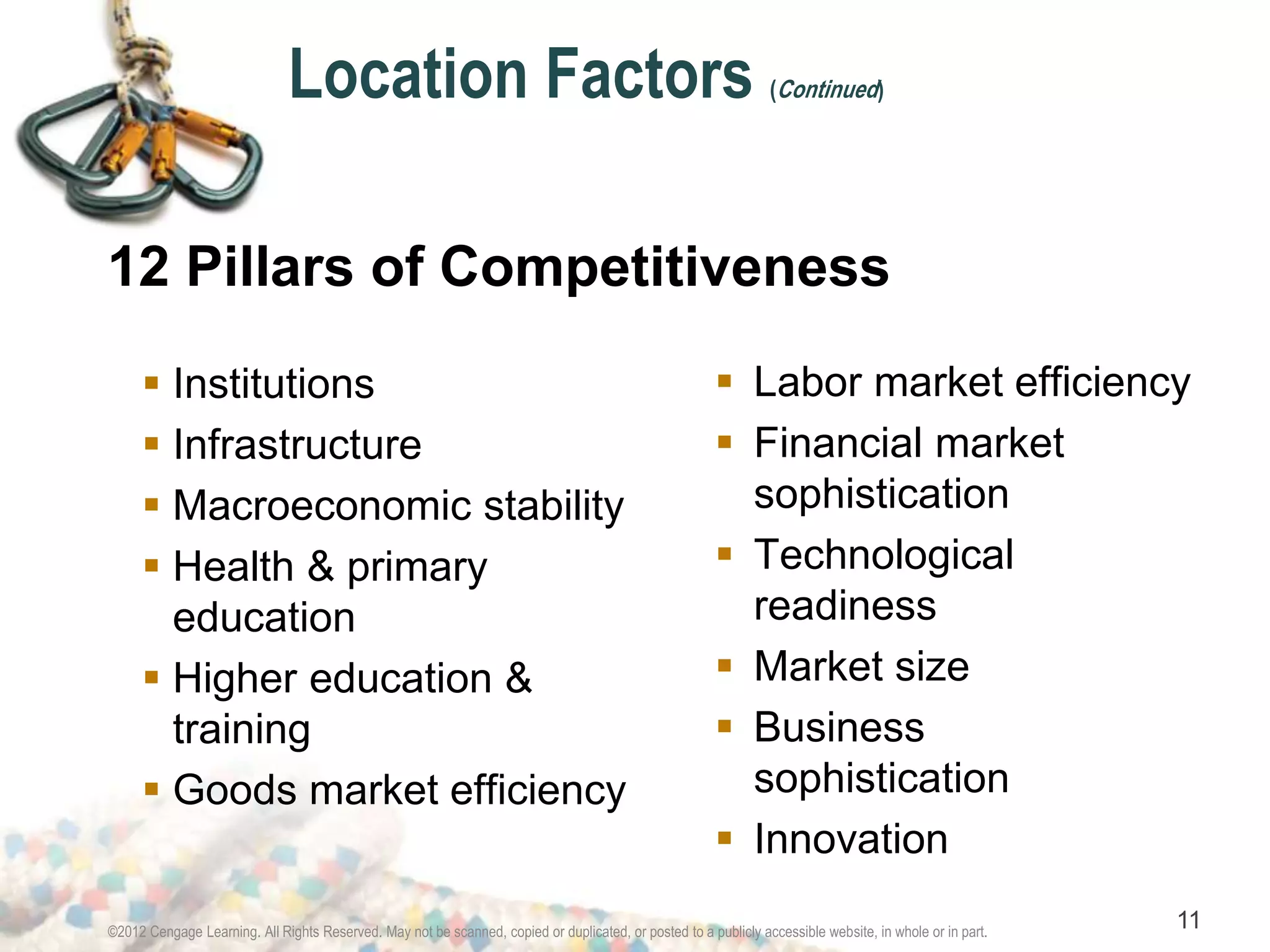
12 Pillars of Competitiveness 
 Institutions 
 Infrastructure 
 Macroeconomic stability 
 Health & primary 
education 
 Higher education & 
training 
 Goods market efficiency 
 Labor market efficiency 
 Financial market 
sophistication 
 Technological 
readiness 
 Market size 
 Business 
sophistication 
 Innovation 
©2012 Cengage Learning. All Rights Reserved. May not be scanned, copied or duplicated, or posted to a publicly accessible website, in whole or in part. 11
Location Factors (Continued) 
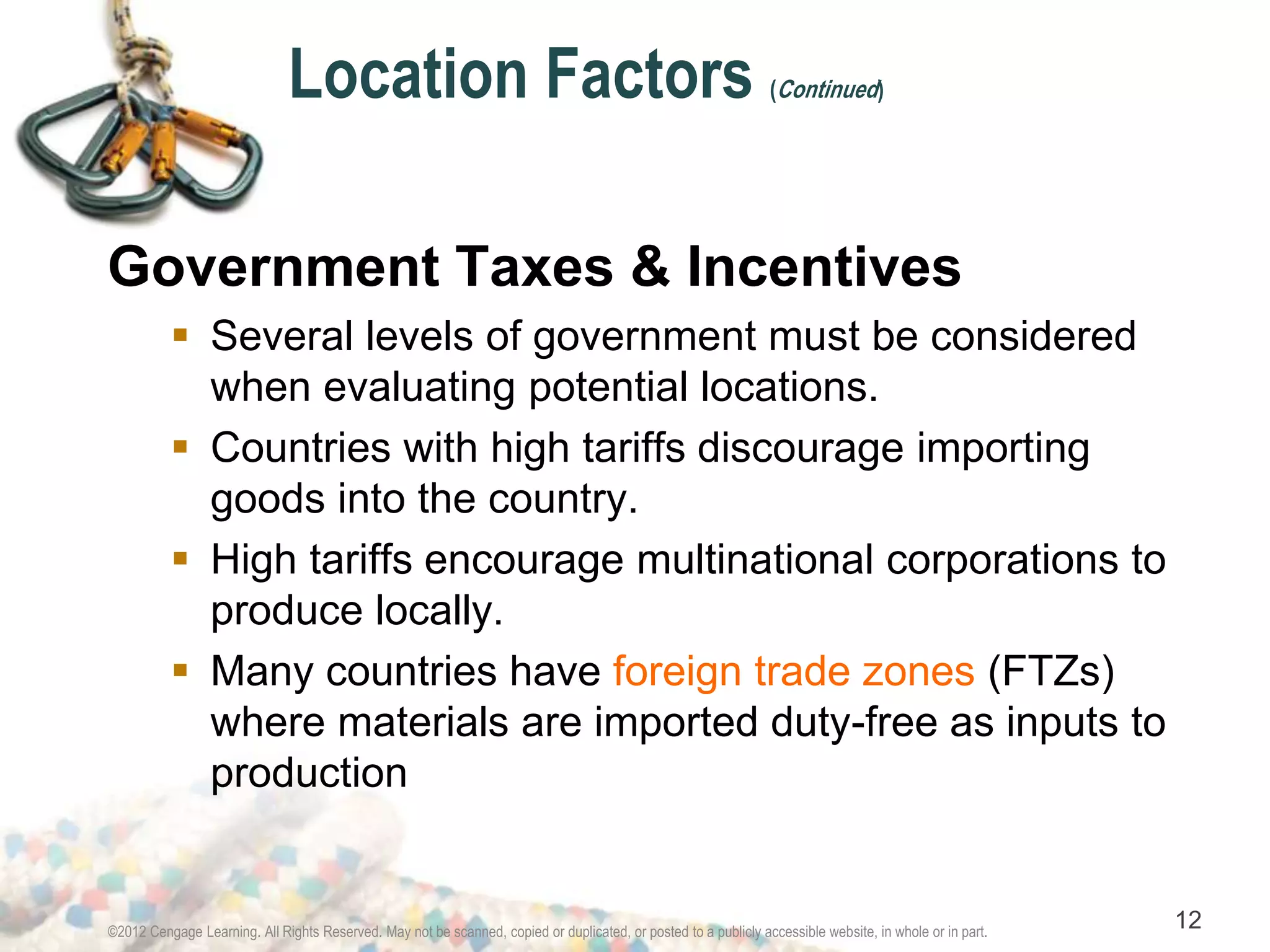
Government Taxes & Incentives 
 Several levels of government must be considered 
when evaluating potential locations. 
 Countries with high tariffs discourage importing 
goods into the country. 
 High tariffs encourage multinational corporations to 
produce locally. 
 Many countries have foreign trade zones (FTZs) 
where materials are imported duty-free as inputs to 
production 
©2012 Cengage Learning. All Rights Reserved. May not be scanned, copied or duplicated, or posted to a publicly accessible website, in whole or in part. 12
Location Factors (Continued) 
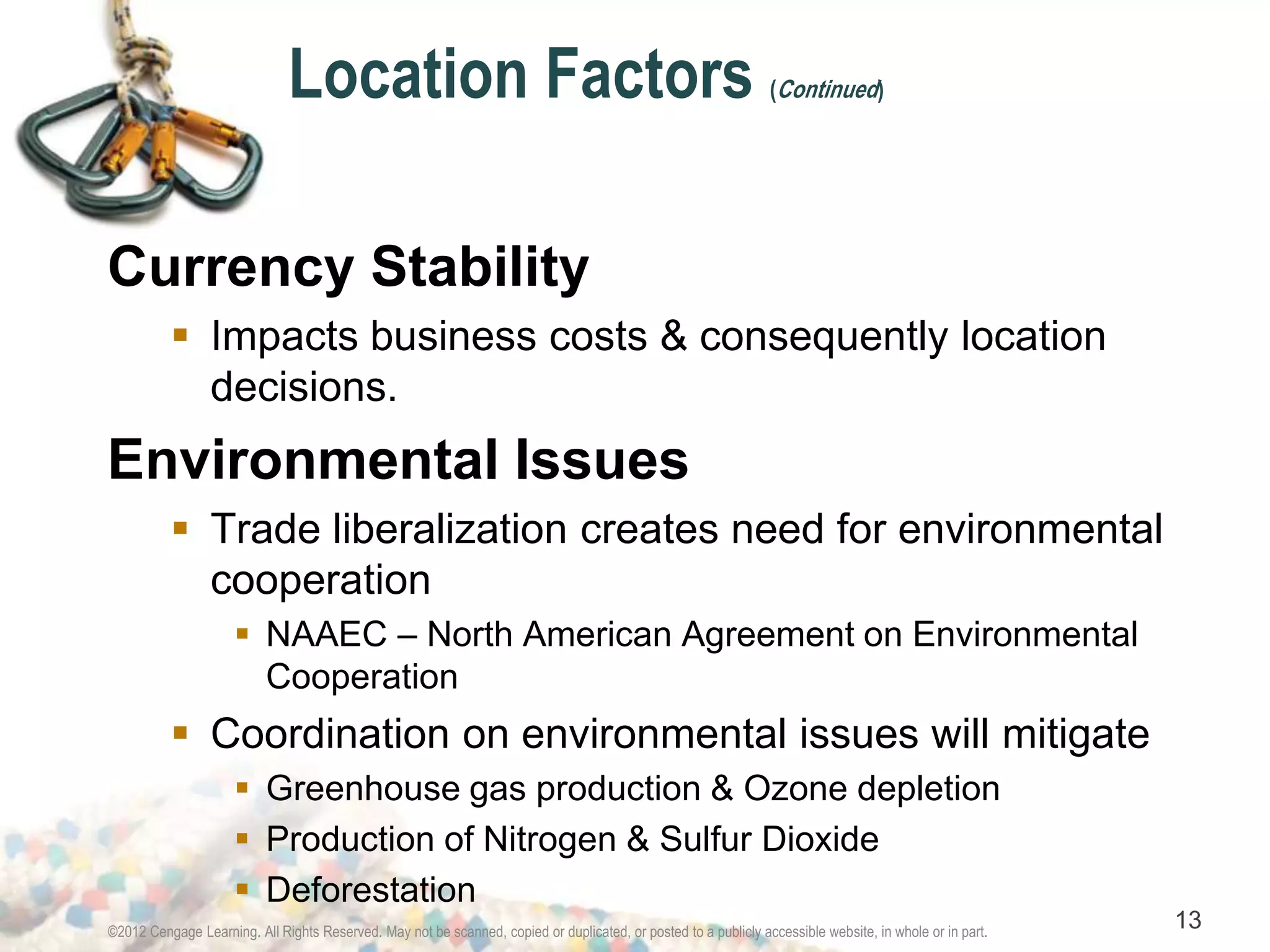
Currency Stability 
 Impacts business costs & consequently location 
decisions. 
Environmental Issues 
 Trade liberalization creates need for environmental 
cooperation 
 NAAEC – North American Agreement on Environmental 
Cooperation 
 Coordination on environmental issues will mitigate 
 Greenhouse gas production & Ozone depletion 
 Production of Nitrogen & Sulfur Dioxide 
 Deforestation 
©2012 Cengage Learning. All Rights Reserved. May not be scanned, copied or duplicated, or posted to a publicly accessible website, in whole or in part. 13
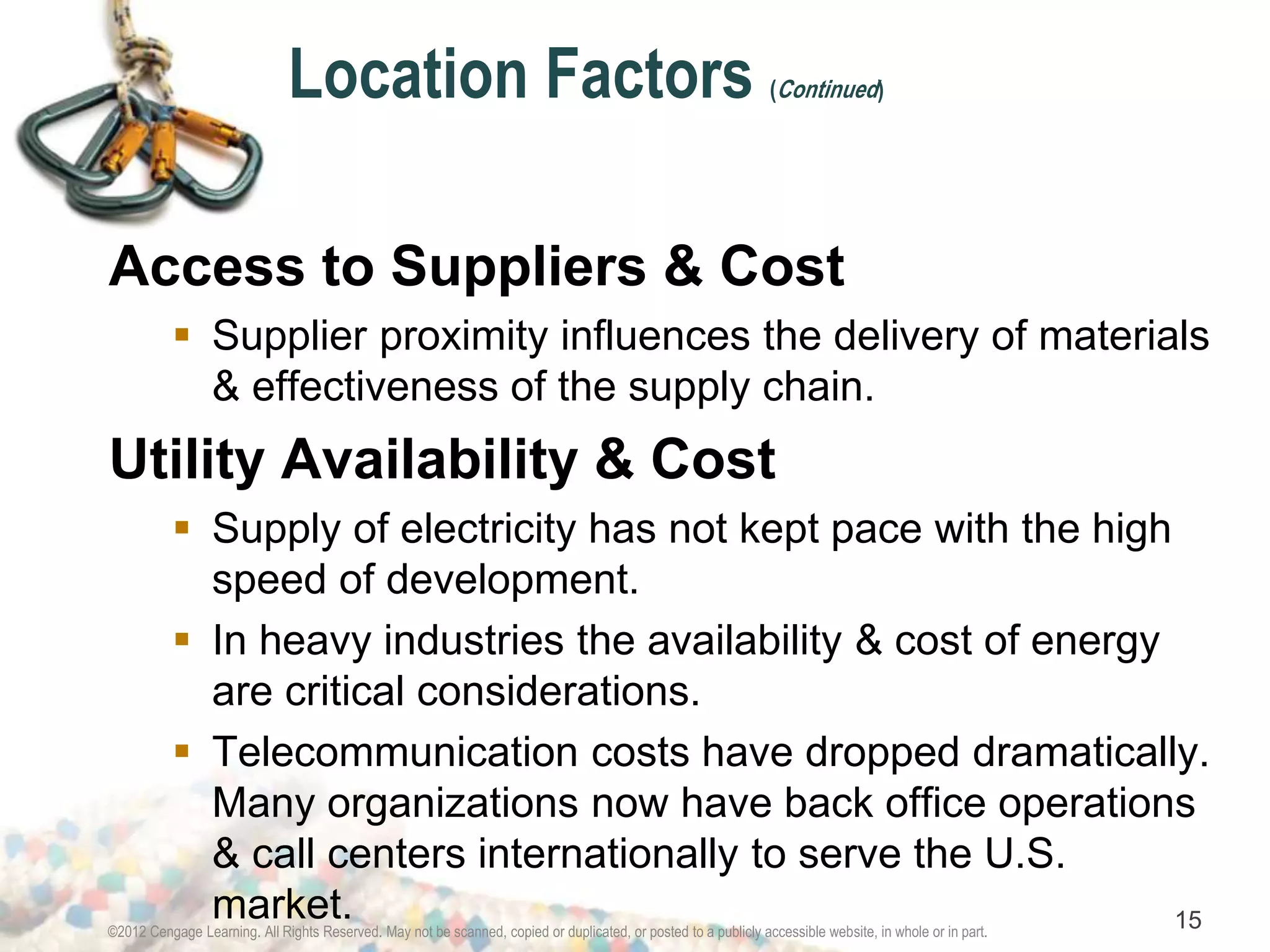
Location Factors (Continued) 
Access & Proximity to Markets 
 Relocation to China not just for cheap labor but for 
access to the market 
 In the service industry, proximity to customers is 
even more critical 
 Convenience is a factor in consumer choice 
Labor Issues 
 Labor availability, productivity, & skill 
 Unemployment & underemployment rates 
 Wage rates; turnover rates; labor force competitors 
 Right-to-work laws 
©2012 Cengage Learning. All Rights Reserved. May not be scanned, copied or duplicated, or posted to a publicly accessible website, in whole or in part. 14
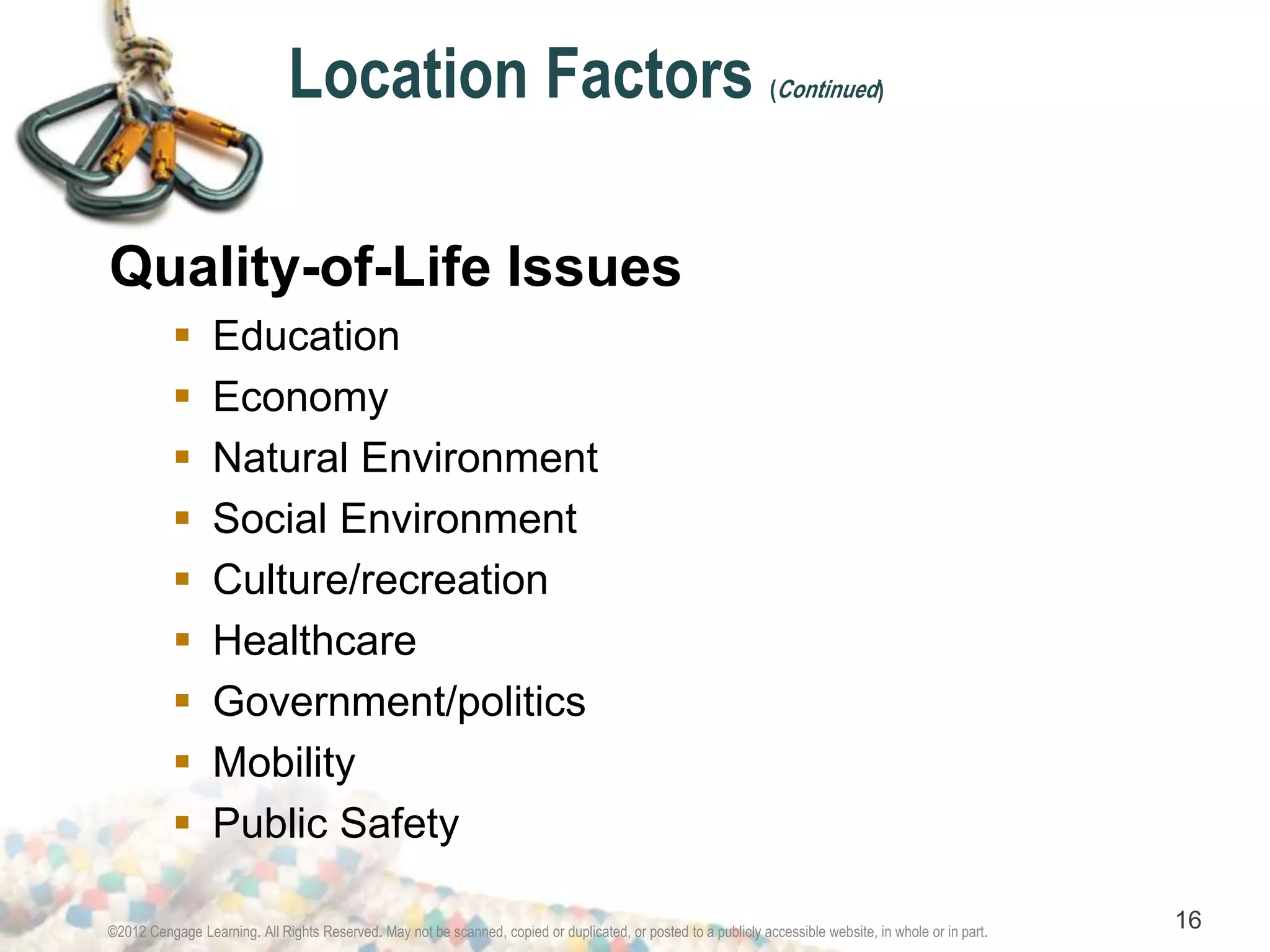
Location Factors (Continued) 
Access to Suppliers & Cost 
 Supplier proximity influences the delivery of materials 
& effectiveness of the supply chain. 
Utility Availability & Cost 
 Supply of electricity has not kept pace with the high 
speed of development. 
 In heavy industries the availability & cost of energy 
are critical considerations. 
 Telecommunication costs have dropped dramatically. 
Many organizations now have back office operations 
& call centers internationally to serve the U.S. 
market. 
©2012 Cengage Learning. All Rights Reserved. May not be scanned, copied or duplicated, or posted to a publicly accessible website, in whole or in part. 15
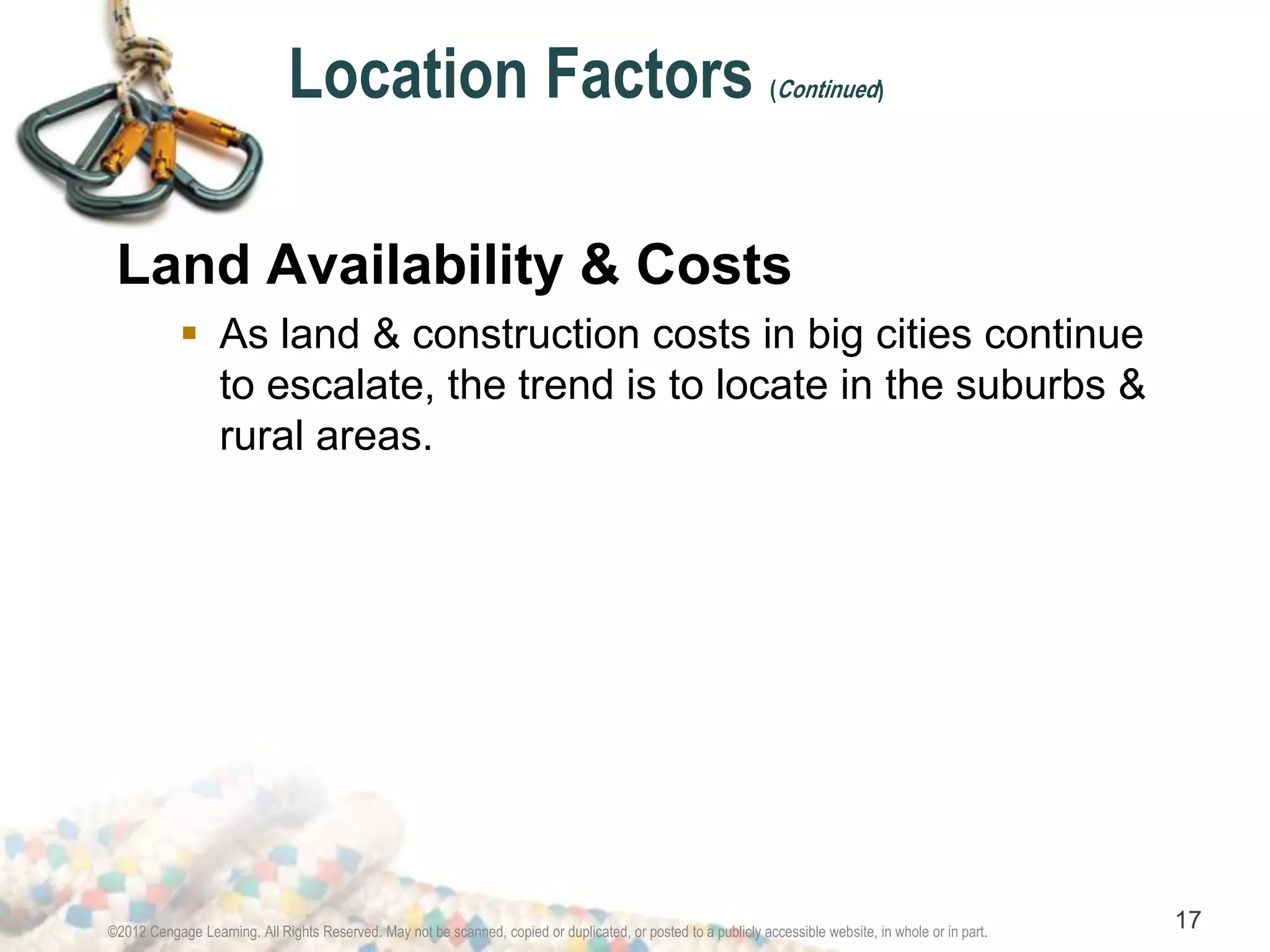
Location Factors (Continued) 
Quality-of-Life Issues 
 Education 
 Economy 
 Natural Environment 
 Social Environment 
 Culture/recreation 
 Healthcare 
 Government/politics 
 Mobility 
 Public Safety 
©2012 Cengage Learning. All Rights Reserved. May not be scanned, copied or duplicated, or posted to a publicly accessible website, in whole or in part. 16
Location Factors (Continued) 
Land Availability & Costs 
 As land & construction costs in big cities continue 
to escalate, the trend is to locate in the suburbs & 
rural areas. 
©2012 Cengage Learning. All Rights Reserved. May not be scanned, copied or duplicated, or posted to a publicly accessible website, in whole or in part. 17
Location Techniques 
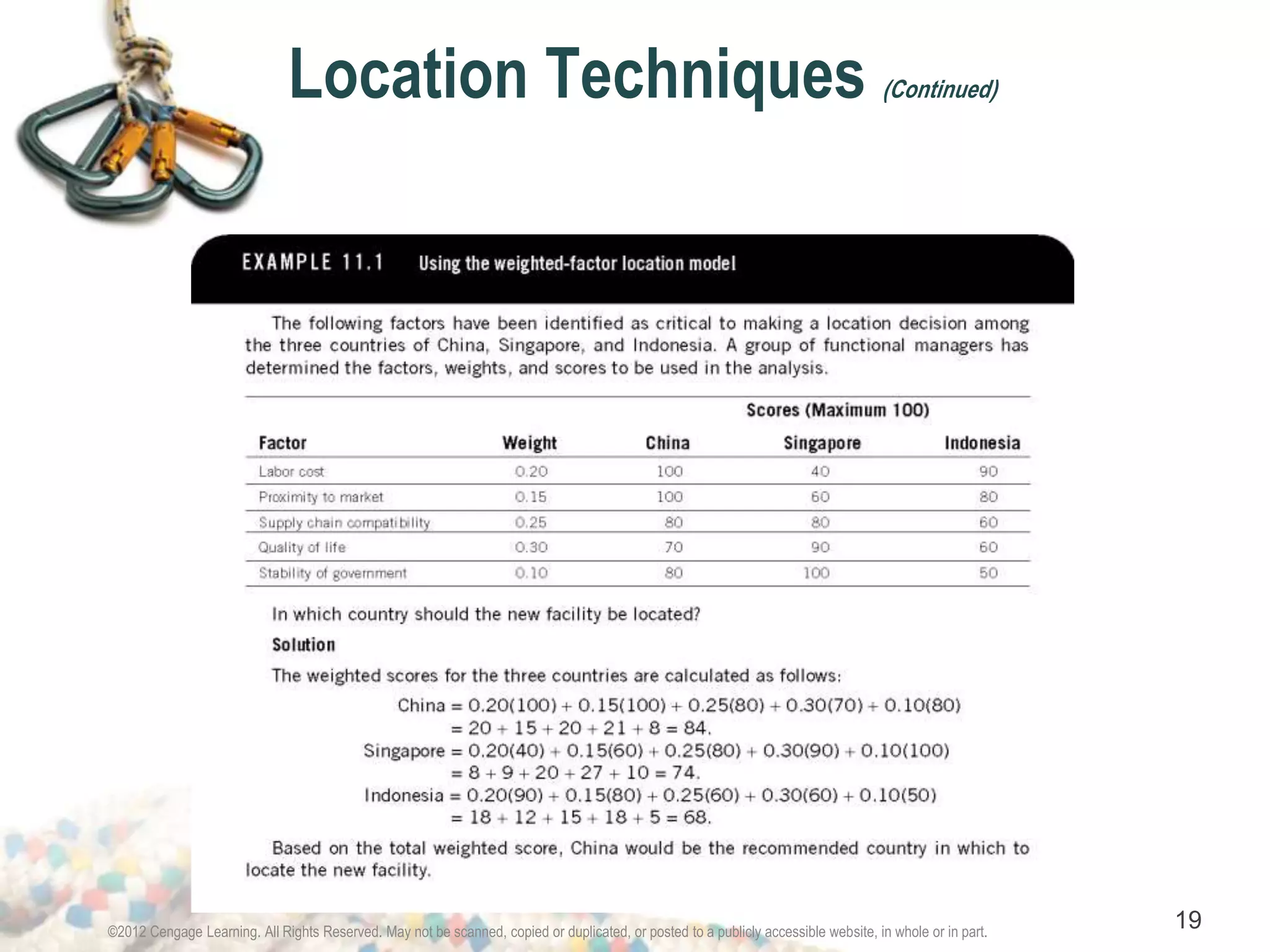
The Weighted-Factor Rating Model 
Compares the attractiveness of several 
locations along a number of quantitative & 
qualitative dimensions. 
 Identify the factors 
 Assign weights to each factor. The weights 
sum to 1. 
 Determine a score for each factor. 
 Multiply the factor score by the weight, then 
sum the weighted scores 
 The location with the highest total weighted 
score is the recommended location. 
©2012 Cengage Learning. All Rights Reserved. May not be scanned, copied or duplicated, or posted to a publicly accessible website, in whole or in part. 18
Location Techniques (Continued) 
©2012 Cengage Learning. All Rights Reserved. May not be scanned, copied or duplicated, or posted to a publicly accessible website, in whole or in part. 19
Location Techniques (Continued) 
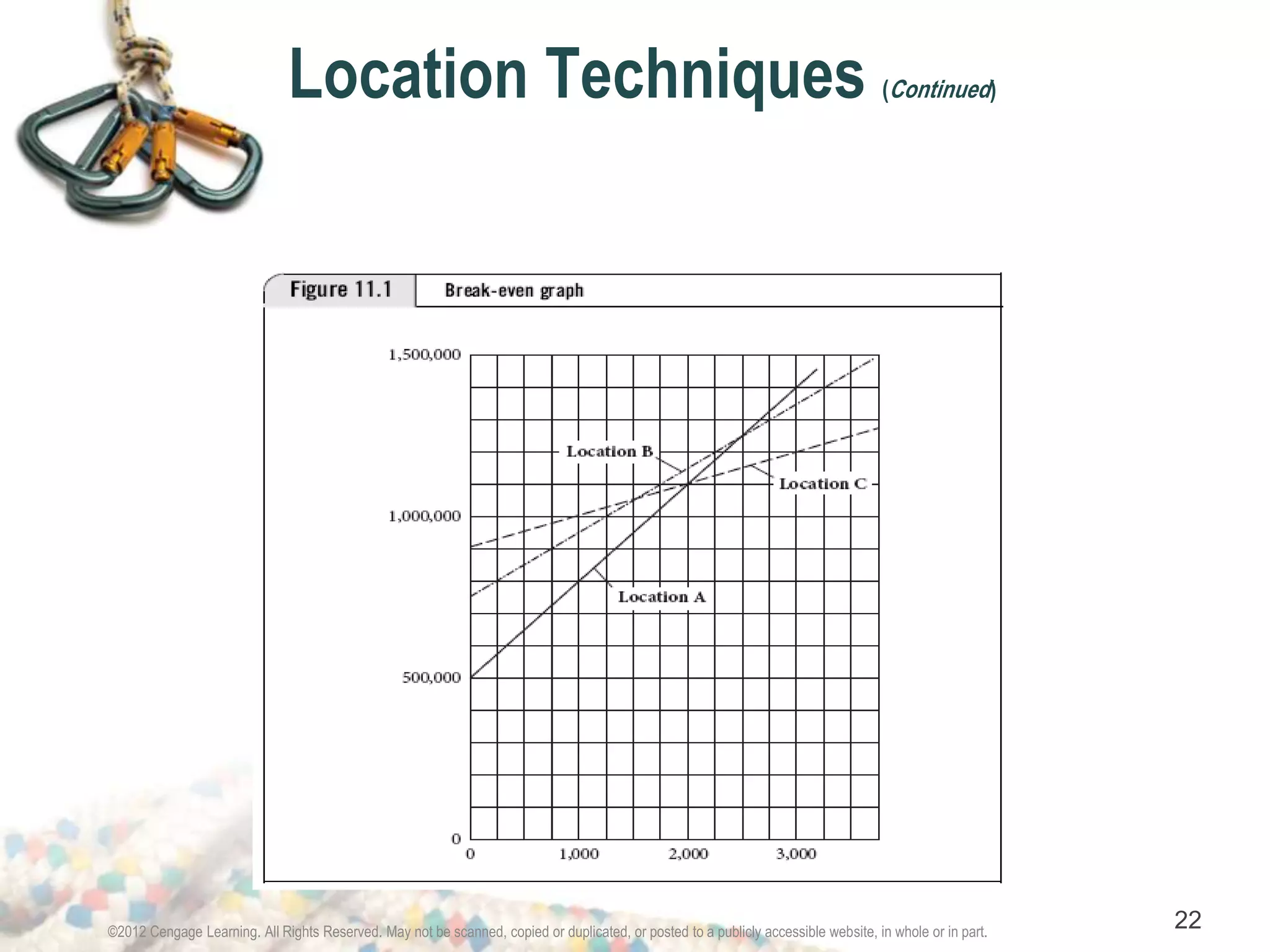
Break even model 
Useful location analysis technique when fixed & 
variable costs can be determined 
 Identify the locations to be considered. 
 Determine the fixed cost of land, property taxes, 
insurance, equipment, & buildings. 
 Determine the unit variable cost, materials, utilities, & 
transportation costs. 
 Construct the total cost lines. 
 Determine the break-even points on the graph. 
 Identify the range over which each location has the 
lower cost. 
©2012 Cengage Learning. All Rights Reserved. May not be scanned, copied or duplicated, or posted to a publicly accessible website, in whole or in part. 20
Location Techniques (Continued) 
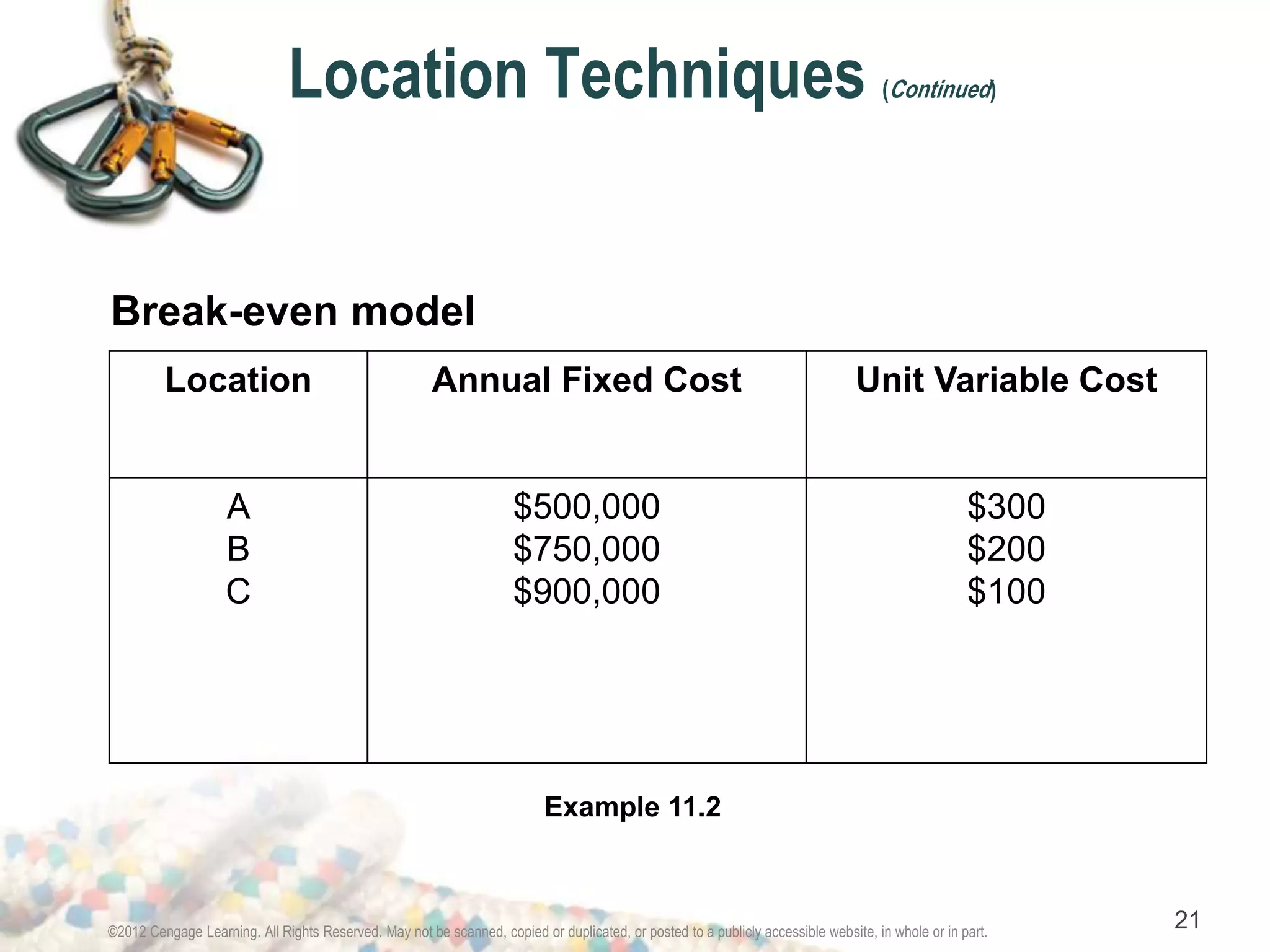
Break-even model 
Location Annual Fixed Cost Unit Variable Cost 
A 
B 
C 
$500,000 
$750,000 
$900,000 
$300 
$200 
$100 
Example 11.2 
©2012 Cengage Learning. All Rights Reserved. May not be scanned, copied or duplicated, or posted to a publicly accessible website, in whole or in part. 21
Location Techniques (Continued) 
©2012 Cengage Learning. All Rights Reserved. May not be scanned, copied or duplicated, or posted to a publicly accessible website, in whole or in part. 22
Helpful Online Information for 
Location Analysis 
Web sites that provide useful information for use 
in location analysis: 
 www.developmentalliance.com was developed by 
the International Economic Development council 
& Conway Data, Inc 
 www.mappinganalytics.com was developed to aid 
in site selection for a wide array of businesses 
©2012 Cengage Learning. All Rights Reserved. May not be scanned, copied or duplicated, or posted to a publicly accessible website, in whole or in part. 23
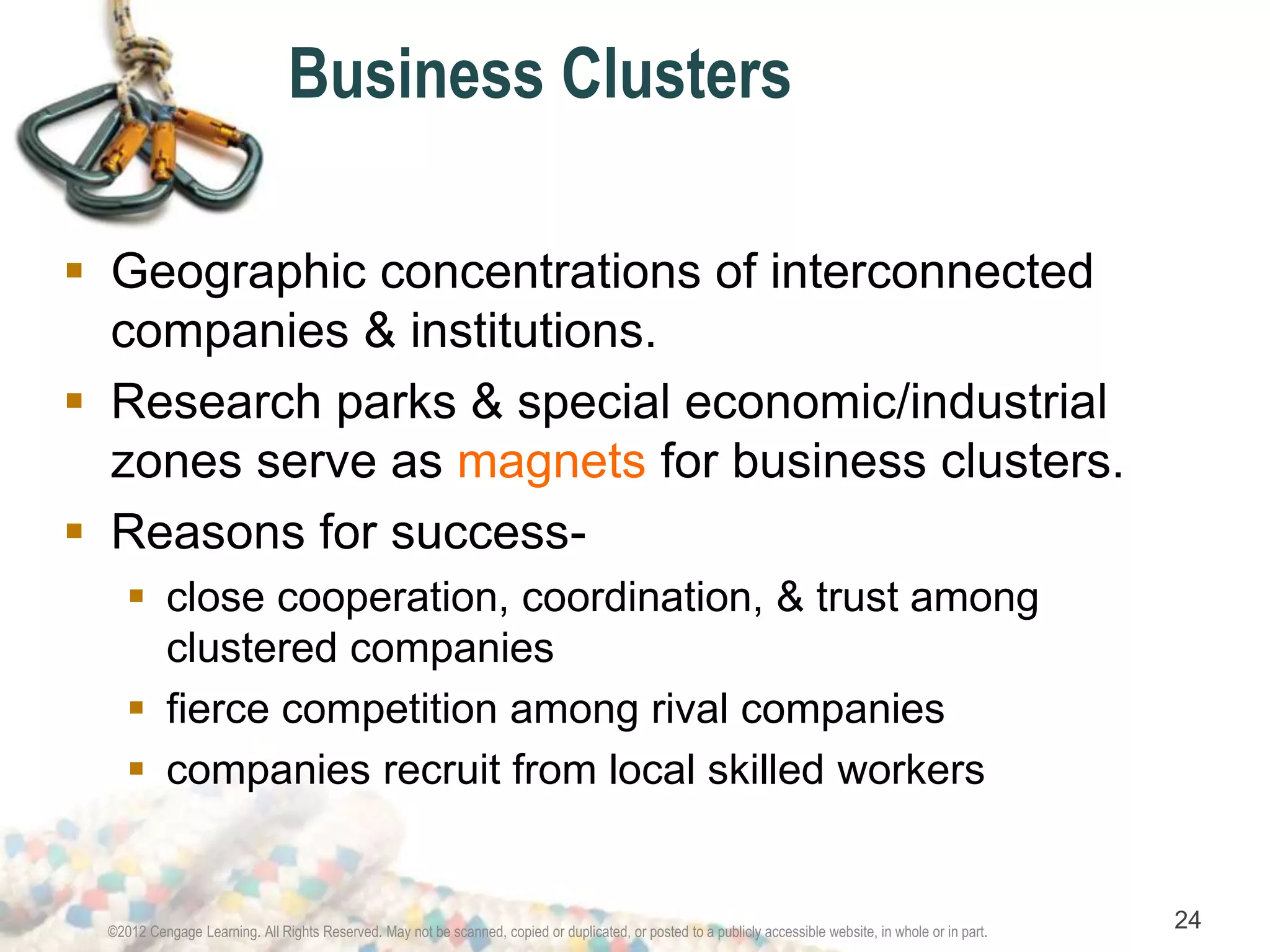
Business Clusters 
 Geographic concentrations of interconnected 
companies & institutions. 
 Research parks & special economic/industrial 
zones serve as magnets for business clusters. 
 Reasons for success- 
 close cooperation, coordination, & trust among 
clustered companies 
 fierce competition among rival companies 
 companies recruit from local skilled workers 
©2012 Cengage Learning. All Rights Reserved. May not be scanned, copied or duplicated, or posted to a publicly accessible website, in whole or in part. 24
Sustainable Development 
Sustainable Development – “development that meets 
the needs of the present without compromising the ability of 
future generations to meet their own needs” 
Green Development – “prioritizes what its proponents 
consider to be environmental sustainability over economic 
and cultural considerations” 
 Resource ranking and technology innovation are keys to 
reducing cost and increasing competitiveness 
 United Nations Framework Convention on Climate 
Change (UNFCCC) 
©2012 Cengage Learning. All Rights Reserved. May not be scanned, copied or duplicated, or posted to a publicly accessible website, in whole or in part. 25

Chapter 11 3rd edition

  • 1.
    Supply Chain Management: Chapter 11 LOCATION DECISIONS Prepared by Mark A. Jacobs, PhD ©2012 Cengage Learning. All Rights Reserved. May not be scanned, copied or duplicated, or posted to a publicly accessible website, in whole or in part.
  • 2.
    LEARNING OBJECTIVES Youshould be able to:  Explain the impact of global location decisions on a supply chain.  Identify the factors influencing location decisions.  Understand the impact of the Regional Trade Agreements on location decisions.  Use several location evaluation models.  Understand the advantages of business clusters.  Understand the importance of sustainable development ©2012 Cengage Learning. All Rights Reserved. May not be scanned, copied or duplicated, or posted to a publicly accessible website, in whole or in part. 2
  • 3.
    CHAPTER OUTLINE •Introduction • Global Location Strategies • Critical Location Factors • Facility Location Techniques • Helpful On-Line Information for Location Analysis • Business Clusters • Sustainable Development ©2012 Cengage Learning. All Rights Reserved. May not be scanned, copied or duplicated, or posted to a publicly accessible website, in whole or in part. 3
  • 4.
    Introduction Facility locationmust be part of the firm’s supply chain strategy. Companies can locate anywhere in the world due to increased globalization, technology, transportation, & open markets. Location still matters- industry clusters show that innovation & competition are geographically concentrated. Global location decisions involve location of the facility, defining its strategic role, & identifying the markets it serves ©2012 Cengage Learning. All Rights Reserved. May not be scanned, copied or duplicated, or posted to a publicly accessible website, in whole or in part. 4
  • 5.
    Location Strategies Dr.Kasra Ferdows suggests 6 location types  Offshore factory - low cost investment & labor costs.  Source factory - plant mgmt involved in supplier selection & production planning.  Server factory - firm uses government incentives & low exchange risk & tariff barriers to reduce taxes & logistics costs.  Contributor factory - firm involved in product development, production planning, procurement decisions, & developing suppliers.  Outpost factory - embedded network of suppliers, competitors, research facilities for materials, components & products.  Lead factory - firm is source of innovation & competitive advantage of the organization. ©2012 Cengage Learning. All Rights Reserved. May not be scanned, copied or duplicated, or posted to a publicly accessible website, in whole or in part. 5
  • 6.
    Location Factors ©2012Cengage Learning. All Rights Reserved. May not be scanned, copied or duplicated, or posted to a publicly accessible website, in whole or in part. 6
  • 7.
    Location Factors (Continued) Regional Trade Agreements (RTA) & WTO World Trade Organization (WTO) successor to the General Agreement on Tariffs/Trade (GATT). Functions include:  Administering agreements,  Forum for trade negotiations,  Trade disputes,  Monitor trade policies,  Aid for Developing countries  International organizations. ©2012 Cengage Learning. All Rights Reserved. May not be scanned, copied or duplicated, or posted to a publicly accessible website, in whole or in part. 7
  • 8.
    Location Factors (Continued) RTA & the WTO (Continued) European Union (EU): [1950] Set up after the WWII, the EU consists of 27 members North American Free Trade Agreement (NAFTA): [1994] among the U.S., Canada, & Mexico Southern Common Market (MERCOSUR): [1991] among Argentina, Brazil, Paraguay, & Uruguay Association of Southeast Asian Nations (ASEAN): [1967] in SE Asia Common Market of Eastern and Southern Africa (COMESA) ©2012 Cengage Learning. All Rights Reserved. May not be scanned, copied or duplicated, or posted to a publicly accessible website, in whole or in part. 8
  • 9.
    Location Factors (Continued) Competitiveness of Nations Degree to which a country produces goods & services which meet the needs of international markets, while maintaining or expanding personal real income over time. Made up of 323 criteria, grouped into 4 factors – 1. Economic performance (79 criteria) 2. Government efficiency (72 criteria) 3. Business efficiency (71 criteria) 4. Infrastructure (101 criteria) ©2012 Cengage Learning. All Rights Reserved. May not be scanned, copied or duplicated, or posted to a publicly accessible website, in whole or in part. 9
  • 10.
    Location Factors (Continued) 2006-07 World Competitiveness Rankings Rank Global Competitiveness Report (WEF) World Competitiveness Yearbook (IMD) 1. Switzerland US 2. Finland Singapore 3. Sweden Hong Kong 4. Denmark Luxemburg 5. Singapore Denmark 6. US Switzerland 7. Japan Iceland 8. Germany Netherlands 9. Netherlands Sweden 10. UK Canada Table 11.2 ©2012 Cengage Learning. All Rights Reserved. May not be scanned, copied or duplicated, or posted to a publicly accessible website, in whole or in part. 10
  • 11.
    Location Factors (Continued) 12 Pillars of Competitiveness  Institutions  Infrastructure  Macroeconomic stability  Health & primary education  Higher education & training  Goods market efficiency  Labor market efficiency  Financial market sophistication  Technological readiness  Market size  Business sophistication  Innovation ©2012 Cengage Learning. All Rights Reserved. May not be scanned, copied or duplicated, or posted to a publicly accessible website, in whole or in part. 11
  • 12.
    Location Factors (Continued) Government Taxes & Incentives  Several levels of government must be considered when evaluating potential locations.  Countries with high tariffs discourage importing goods into the country.  High tariffs encourage multinational corporations to produce locally.  Many countries have foreign trade zones (FTZs) where materials are imported duty-free as inputs to production ©2012 Cengage Learning. All Rights Reserved. May not be scanned, copied or duplicated, or posted to a publicly accessible website, in whole or in part. 12
  • 13.
    Location Factors (Continued) Currency Stability  Impacts business costs & consequently location decisions. Environmental Issues  Trade liberalization creates need for environmental cooperation  NAAEC – North American Agreement on Environmental Cooperation  Coordination on environmental issues will mitigate  Greenhouse gas production & Ozone depletion  Production of Nitrogen & Sulfur Dioxide  Deforestation ©2012 Cengage Learning. All Rights Reserved. May not be scanned, copied or duplicated, or posted to a publicly accessible website, in whole or in part. 13
  • 14.
    Location Factors (Continued) Access & Proximity to Markets  Relocation to China not just for cheap labor but for access to the market  In the service industry, proximity to customers is even more critical  Convenience is a factor in consumer choice Labor Issues  Labor availability, productivity, & skill  Unemployment & underemployment rates  Wage rates; turnover rates; labor force competitors  Right-to-work laws ©2012 Cengage Learning. All Rights Reserved. May not be scanned, copied or duplicated, or posted to a publicly accessible website, in whole or in part. 14
  • 15.
    Location Factors (Continued) Access to Suppliers & Cost  Supplier proximity influences the delivery of materials & effectiveness of the supply chain. Utility Availability & Cost  Supply of electricity has not kept pace with the high speed of development.  In heavy industries the availability & cost of energy are critical considerations.  Telecommunication costs have dropped dramatically. Many organizations now have back office operations & call centers internationally to serve the U.S. market. ©2012 Cengage Learning. All Rights Reserved. May not be scanned, copied or duplicated, or posted to a publicly accessible website, in whole or in part. 15
  • 16.
    Location Factors (Continued) Quality-of-Life Issues  Education  Economy  Natural Environment  Social Environment  Culture/recreation  Healthcare  Government/politics  Mobility  Public Safety ©2012 Cengage Learning. All Rights Reserved. May not be scanned, copied or duplicated, or posted to a publicly accessible website, in whole or in part. 16
  • 17.
    Location Factors (Continued) Land Availability & Costs  As land & construction costs in big cities continue to escalate, the trend is to locate in the suburbs & rural areas. ©2012 Cengage Learning. All Rights Reserved. May not be scanned, copied or duplicated, or posted to a publicly accessible website, in whole or in part. 17
  • 18.
    Location Techniques TheWeighted-Factor Rating Model Compares the attractiveness of several locations along a number of quantitative & qualitative dimensions.  Identify the factors  Assign weights to each factor. The weights sum to 1.  Determine a score for each factor.  Multiply the factor score by the weight, then sum the weighted scores  The location with the highest total weighted score is the recommended location. ©2012 Cengage Learning. All Rights Reserved. May not be scanned, copied or duplicated, or posted to a publicly accessible website, in whole or in part. 18
  • 19.
    Location Techniques (Continued) ©2012 Cengage Learning. All Rights Reserved. May not be scanned, copied or duplicated, or posted to a publicly accessible website, in whole or in part. 19
  • 20.
    Location Techniques (Continued) Break even model Useful location analysis technique when fixed & variable costs can be determined  Identify the locations to be considered.  Determine the fixed cost of land, property taxes, insurance, equipment, & buildings.  Determine the unit variable cost, materials, utilities, & transportation costs.  Construct the total cost lines.  Determine the break-even points on the graph.  Identify the range over which each location has the lower cost. ©2012 Cengage Learning. All Rights Reserved. May not be scanned, copied or duplicated, or posted to a publicly accessible website, in whole or in part. 20
  • 21.
    Location Techniques (Continued) Break-even model Location Annual Fixed Cost Unit Variable Cost A B C $500,000 $750,000 $900,000 $300 $200 $100 Example 11.2 ©2012 Cengage Learning. All Rights Reserved. May not be scanned, copied or duplicated, or posted to a publicly accessible website, in whole or in part. 21
  • 22.
    Location Techniques (Continued) ©2012 Cengage Learning. All Rights Reserved. May not be scanned, copied or duplicated, or posted to a publicly accessible website, in whole or in part. 22
  • 23.
    Helpful Online Informationfor Location Analysis Web sites that provide useful information for use in location analysis:  www.developmentalliance.com was developed by the International Economic Development council & Conway Data, Inc  www.mappinganalytics.com was developed to aid in site selection for a wide array of businesses ©2012 Cengage Learning. All Rights Reserved. May not be scanned, copied or duplicated, or posted to a publicly accessible website, in whole or in part. 23
  • 24.
    Business Clusters Geographic concentrations of interconnected companies & institutions.  Research parks & special economic/industrial zones serve as magnets for business clusters.  Reasons for success-  close cooperation, coordination, & trust among clustered companies  fierce competition among rival companies  companies recruit from local skilled workers ©2012 Cengage Learning. All Rights Reserved. May not be scanned, copied or duplicated, or posted to a publicly accessible website, in whole or in part. 24
  • 25.
    Sustainable Development SustainableDevelopment – “development that meets the needs of the present without compromising the ability of future generations to meet their own needs” Green Development – “prioritizes what its proponents consider to be environmental sustainability over economic and cultural considerations”  Resource ranking and technology innovation are keys to reducing cost and increasing competitiveness  United Nations Framework Convention on Climate Change (UNFCCC) ©2012 Cengage Learning. All Rights Reserved. May not be scanned, copied or duplicated, or posted to a publicly accessible website, in whole or in part. 25