Course: MBA
Subject: Production & Operation
Management
Unit:2.6
Purchase Management
Purchase Management
•Businesses need to get the best possible
products or materials for the price.
•Making smart spending decisions can result in
better values for customers and larger profits for
the business.
Planning Purchase
• Purchasing decisions mean the difference
between success and failure for the
entrepreneur.
• purchasing also known as procurement, the
buying of all the materials needed by the
organization
Factors: Purchasing’s Position
• History
• Type of industry
• Total value of goods and services
• Other
– Founding philosophy
– Type of purchased materials
– Ability to influence company performance
Organizing the Purchasing Function
• Specialization within purchasing
– Sourcing and negotiating
– Purchasing research
– Operational support and order follow-up
– Administration and support
Sourcing and Negotiating
• Identifies potential suppliers
• Negotiates with selected suppliers
• Performs the buying of goods and services
– By specific items
– By commodity family
– By service categories
Purchasing Research
• Developing long-term material forecasts
• Conducting value analysis programs
• Assessing supplier capabilities
• Analyzing supplier cost structures
Operational Support and Follow-up
• Supporting day-to-day operations including
expediting
• Preparation and transfer of material releases
• Strategic vs. tactical purchasing
Administration and Support
• Developing policies and procedures
• Administering and maintaining the purchasing
information system and database
• Determining required staffing levels
• Developing departmental plans
• Organizing training and development
• Developing measurement systems
Purchasing Department Activities
• Buying
• Expediting
• Inventory control
• Transportation
• Managing countertrade arrangements
• Insourcing -outsourcing
• Value analysis
• Purchasing research
• Material forecasting
• Supply management
• Other
Other Department Activities
• Receiving and warehousing
• Managing travel expenses
• Production planning and control
• Commodity futures trading
• Global transportation and materials
management
• Economic forecasting
• Subcontracting
Strategic Activities
• Manage relationships with critical suppliers
• Develop electronic purchasing systems
• Implement companywide best practices
• Negotiate companywide supply contracts
• Manage critical commodities
Operational Activities
• Manage transactions with suppliers
• Use e-systems to source standard and direct
items in electronic catalogs
• Source unique items
• Generate and forward material releases
• Provide supplier performance feedback
Placement of Purchasing Authority
• Centralized
• Decentralized
• Hybrid combination
Size of Purchasing Staff
• Type of company
• Nature or complexity of products and services
produced
• Physical number of items procured
• Scope of purchasing responsibility
– Strategic sourcing
– Market research and analysis
– Extent of involvement in services
Factors Influencing Authority
• Organizational business strategy
– Responsiveness vs. efficiency
• Total purchase dollar expenditures
– Cost savings required
– Geographic dispersion
• Overall philosophy of management
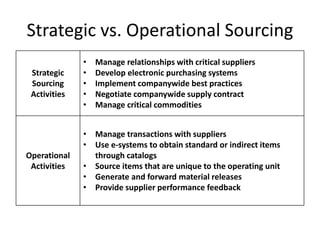
Strategic vs. Operational Sourcing
Strategic
Sourcing
Activities
• Manage relationships with critical suppliers
• Develop electronic purchasing systems
• Implement companywide best practices
• Negotiate companywide supply contract
• Manage critical commodities
Operational
Activities
• Manage transactions with suppliers
• Use e-systems to obtain standard or indirect items
through catalogs
• Source items that are unique to the operating unit
• Generate and forward material releases
• Provide supplier performance feedback
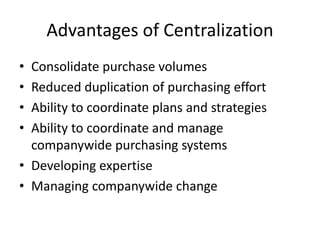
Advantages of Centralization
• Consolidate purchase volumes
• Reduced duplication of purchasing effort
• Ability to coordinate plans and strategies
• Ability to coordinate and manage
companywide purchasing systems
• Developing expertise
• Managing companywide change
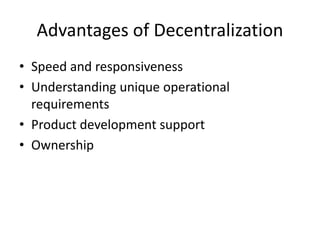
Advantages of Decentralization
• Speed and responsiveness
• Understanding unique operational
requirements
• Product development support
• Ownership
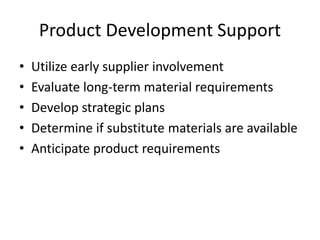
Product Development Support
• Utilize early supplier involvement
• Evaluate long-term material requirements
• Develop strategic plans
• Determine if substitute materials are available
• Anticipate product requirements
Hybrid Purchasing Structures
• Lead buying division
• Regional buying groups
• Global buying committees
• Corporate purchasing councils
• Corporate steering committees
Make or Buy Decision
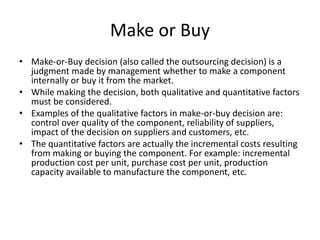
Make or Buy
• Make-or-Buy decision (also called the outsourcing decision) is a
judgment made by management whether to make a component
internally or buy it from the market.
• While making the decision, both qualitative and quantitative factors
must be considered.
• Examples of the qualitative factors in make-or-buy decision are:
control over quality of the component, reliability of suppliers,
impact of the decision on suppliers and customers, etc.
• The quantitative factors are actually the incremental costs resulting
from making or buying the component. For example: incremental
production cost per unit, purchase cost per unit, production
capacity available to manufacture the component, etc.
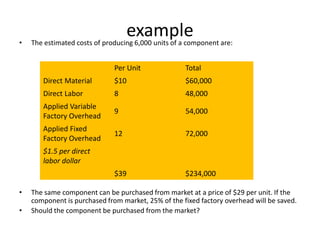
example• The estimated costs of producing 6,000 units of a component are:
• The same component can be purchased from market at a price of $29 per unit. If the
component is purchased from market, 25% of the fixed factory overhead will be saved.
• Should the component be purchased from the market?
Per Unit Total
Direct Material $10 $60,000
Direct Labor 8 48,000
Applied Variable
Factory Overhead
9 54,000
Applied Fixed
Factory Overhead
12 72,000
$1.5 per direct
labor dollar
$39 $234,000
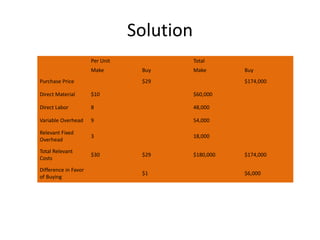
Solution
Per Unit Total
Make Buy Make Buy
Purchase Price $29 $174,000
Direct Material $10 $60,000
Direct Labor 8 48,000
Variable Overhead 9 54,000
Relevant Fixed
Overhead
3 18,000
Total Relevant
Costs
$30 $29 $180,000 $174,000
Difference in Favor
of Buying
$1 $6,000
Insourcing vs. Outsourcing
• Insourcing – producing goods or services
within an organization
• Outsourcing – purchasing goods or services
from outside vendors
• Also called the “Make or Buy” decision
• Decision Rule: Select the that option will
provide the firm with the lowest cost, and
therefore the highest profit.
Qualitative Factors
• Non-quantitative factors may be extremely
important in an evaluation process, yet do not
show up directly in calculations:
– Quality Requirements
– Reputation of Outsourcer
– Employee Morale
– Logistical Considerations – distance from plant, etc
Opportunity Costs
• Opportunity Cost is the contribution to operating
income that is foregone by not using a limited resource
in it’s next-best alternative use
– “How much profit did the firm ‘lose out on’ by not selecting this
alternative?”
• Special type of Opportunity Cost: Holding Cost for
Inventory. Funds tied up in inventory are not available
for investment elsewhere
Product-Mix Decisions
• The decisions made by a company about
which products to sell and in what quantities
• Decision Rule (with a constraint): choose the
product that produces the highest
contribution margin per unit of the
constraining resource
Adding or Dropping Customers
• Decision Rule: Does adding or dropping a
customer add operating income to the firm?
– Yes – add or don’t drop
– No – drop or don’t add
• Decision is based on profitability of the
customer, not how much revenue a customer
generates
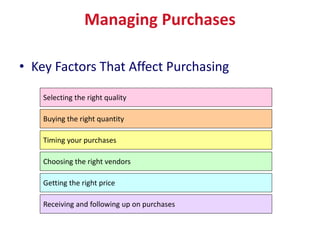
Managing Purchases
• Key Factors That Affect Purchasing
Selecting the right quality
Buying the right quantity
Timing your purchases
Choosing the right vendors
Getting the right price
Receiving and following up on purchases
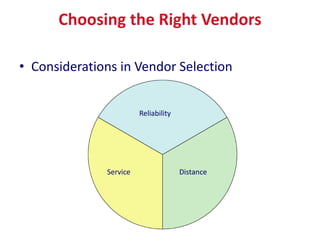
Choosing the Right Vendors
• Considerations in Vendor Selection
DistanceService
Reliability
Getting the Right Price
Contact several vendors to find the best price.
A purchase discount, such as a trade discount,
can affect prices.
• trade discount: a discount from the list price
of an item allowed by a manufacturer or
wholesaler to a merchant
Getting the Right Price
• An entrepreneur/ firm may be able to take
advantage of a quantity discount or a cash
discount.
• quantity discount a discount that a vendor
gives to a buyer who places large orders
• cash discount an amount deducted from the
selling price for payment within a specified
time period
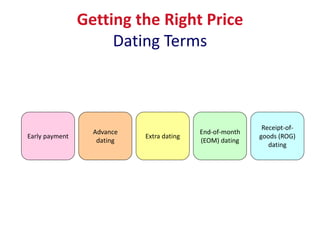
Getting the Right Price
Dating Terms
Early payment
Advance
dating
Extra dating
End-of-month
(EOM) dating
Receipt-of-
goods (ROG)
dating
Getting the Right Price
• Until you establish a good working
relationship, your new vendor may request
secured funds.
• secured funds a form of guaranteed
payment, such as a credit card, a cashier’s
check, a wire transfer, or cash
Receiving and Following Up on
Purchases
• When you receive a shipment from a vendor,
it should be accompanied by an invoice,
indicating size, cost, selling price, and other
similar information.
• invoice an itemized statement of money
owed for goods shipped or services rendered
Key Terms
• financing cost
• opportunity cost
• storage cost
• insurance cost
• shrinkage cost
• obsolescence cost
• warehousing
• lead time
• usage rate
• safety stock
Reference
• http://accountingexplained.com/managerial/r
elevant-costing/make-or-buy-decision
• www.csus.edu

Mba ii pmom_unit-2.6 purchase management a

  • 1.
    Course: MBA Subject: Production& Operation Management Unit:2.6 Purchase Management
  • 2.
    Purchase Management •Businesses needto get the best possible products or materials for the price. •Making smart spending decisions can result in better values for customers and larger profits for the business.
  • 3.
    Planning Purchase • Purchasingdecisions mean the difference between success and failure for the entrepreneur. • purchasing also known as procurement, the buying of all the materials needed by the organization
  • 4.
    Factors: Purchasing’s Position •History • Type of industry • Total value of goods and services • Other – Founding philosophy – Type of purchased materials – Ability to influence company performance
  • 5.
    Organizing the PurchasingFunction • Specialization within purchasing – Sourcing and negotiating – Purchasing research – Operational support and order follow-up – Administration and support
  • 6.
    Sourcing and Negotiating •Identifies potential suppliers • Negotiates with selected suppliers • Performs the buying of goods and services – By specific items – By commodity family – By service categories
  • 7.
    Purchasing Research • Developinglong-term material forecasts • Conducting value analysis programs • Assessing supplier capabilities • Analyzing supplier cost structures
  • 8.
    Operational Support andFollow-up • Supporting day-to-day operations including expediting • Preparation and transfer of material releases • Strategic vs. tactical purchasing
  • 9.
    Administration and Support •Developing policies and procedures • Administering and maintaining the purchasing information system and database • Determining required staffing levels • Developing departmental plans • Organizing training and development • Developing measurement systems
  • 10.
    Purchasing Department Activities •Buying • Expediting • Inventory control • Transportation • Managing countertrade arrangements • Insourcing -outsourcing • Value analysis • Purchasing research • Material forecasting • Supply management • Other
  • 11.
    Other Department Activities •Receiving and warehousing • Managing travel expenses • Production planning and control • Commodity futures trading • Global transportation and materials management • Economic forecasting • Subcontracting
  • 12.
    Strategic Activities • Managerelationships with critical suppliers • Develop electronic purchasing systems • Implement companywide best practices • Negotiate companywide supply contracts • Manage critical commodities
  • 13.
    Operational Activities • Managetransactions with suppliers • Use e-systems to source standard and direct items in electronic catalogs • Source unique items • Generate and forward material releases • Provide supplier performance feedback
  • 14.
    Placement of PurchasingAuthority • Centralized • Decentralized • Hybrid combination
  • 15.
    Size of PurchasingStaff • Type of company • Nature or complexity of products and services produced • Physical number of items procured • Scope of purchasing responsibility – Strategic sourcing – Market research and analysis – Extent of involvement in services
  • 16.
    Factors Influencing Authority •Organizational business strategy – Responsiveness vs. efficiency • Total purchase dollar expenditures – Cost savings required – Geographic dispersion • Overall philosophy of management
  • 17.
    Strategic vs. OperationalSourcing Strategic Sourcing Activities • Manage relationships with critical suppliers • Develop electronic purchasing systems • Implement companywide best practices • Negotiate companywide supply contract • Manage critical commodities Operational Activities • Manage transactions with suppliers • Use e-systems to obtain standard or indirect items through catalogs • Source items that are unique to the operating unit • Generate and forward material releases • Provide supplier performance feedback
  • 18.
    Advantages of Centralization •Consolidate purchase volumes • Reduced duplication of purchasing effort • Ability to coordinate plans and strategies • Ability to coordinate and manage companywide purchasing systems • Developing expertise • Managing companywide change
  • 19.
    Advantages of Decentralization •Speed and responsiveness • Understanding unique operational requirements • Product development support • Ownership
  • 20.
    Product Development Support •Utilize early supplier involvement • Evaluate long-term material requirements • Develop strategic plans • Determine if substitute materials are available • Anticipate product requirements
  • 21.
    Hybrid Purchasing Structures •Lead buying division • Regional buying groups • Global buying committees • Corporate purchasing councils • Corporate steering committees
  • 22.
    Make or BuyDecision
  • 23.
    Make or Buy •Make-or-Buy decision (also called the outsourcing decision) is a judgment made by management whether to make a component internally or buy it from the market. • While making the decision, both qualitative and quantitative factors must be considered. • Examples of the qualitative factors in make-or-buy decision are: control over quality of the component, reliability of suppliers, impact of the decision on suppliers and customers, etc. • The quantitative factors are actually the incremental costs resulting from making or buying the component. For example: incremental production cost per unit, purchase cost per unit, production capacity available to manufacture the component, etc.
  • 24.
    example• The estimatedcosts of producing 6,000 units of a component are: • The same component can be purchased from market at a price of $29 per unit. If the component is purchased from market, 25% of the fixed factory overhead will be saved. • Should the component be purchased from the market? Per Unit Total Direct Material $10 $60,000 Direct Labor 8 48,000 Applied Variable Factory Overhead 9 54,000 Applied Fixed Factory Overhead 12 72,000 $1.5 per direct labor dollar $39 $234,000
  • 25.
    Solution Per Unit Total MakeBuy Make Buy Purchase Price $29 $174,000 Direct Material $10 $60,000 Direct Labor 8 48,000 Variable Overhead 9 54,000 Relevant Fixed Overhead 3 18,000 Total Relevant Costs $30 $29 $180,000 $174,000 Difference in Favor of Buying $1 $6,000
  • 26.
    Insourcing vs. Outsourcing •Insourcing – producing goods or services within an organization • Outsourcing – purchasing goods or services from outside vendors • Also called the “Make or Buy” decision • Decision Rule: Select the that option will provide the firm with the lowest cost, and therefore the highest profit.
  • 27.
    Qualitative Factors • Non-quantitativefactors may be extremely important in an evaluation process, yet do not show up directly in calculations: – Quality Requirements – Reputation of Outsourcer – Employee Morale – Logistical Considerations – distance from plant, etc
  • 28.
    Opportunity Costs • OpportunityCost is the contribution to operating income that is foregone by not using a limited resource in it’s next-best alternative use – “How much profit did the firm ‘lose out on’ by not selecting this alternative?” • Special type of Opportunity Cost: Holding Cost for Inventory. Funds tied up in inventory are not available for investment elsewhere
  • 29.
    Product-Mix Decisions • Thedecisions made by a company about which products to sell and in what quantities • Decision Rule (with a constraint): choose the product that produces the highest contribution margin per unit of the constraining resource
  • 30.
    Adding or DroppingCustomers • Decision Rule: Does adding or dropping a customer add operating income to the firm? – Yes – add or don’t drop – No – drop or don’t add • Decision is based on profitability of the customer, not how much revenue a customer generates
  • 31.
    Managing Purchases • KeyFactors That Affect Purchasing Selecting the right quality Buying the right quantity Timing your purchases Choosing the right vendors Getting the right price Receiving and following up on purchases
  • 32.
    Choosing the RightVendors • Considerations in Vendor Selection DistanceService Reliability
  • 33.
    Getting the RightPrice Contact several vendors to find the best price. A purchase discount, such as a trade discount, can affect prices. • trade discount: a discount from the list price of an item allowed by a manufacturer or wholesaler to a merchant
  • 34.
    Getting the RightPrice • An entrepreneur/ firm may be able to take advantage of a quantity discount or a cash discount. • quantity discount a discount that a vendor gives to a buyer who places large orders • cash discount an amount deducted from the selling price for payment within a specified time period
  • 35.
    Getting the RightPrice Dating Terms Early payment Advance dating Extra dating End-of-month (EOM) dating Receipt-of- goods (ROG) dating
  • 36.
    Getting the RightPrice • Until you establish a good working relationship, your new vendor may request secured funds. • secured funds a form of guaranteed payment, such as a credit card, a cashier’s check, a wire transfer, or cash
  • 37.
    Receiving and FollowingUp on Purchases • When you receive a shipment from a vendor, it should be accompanied by an invoice, indicating size, cost, selling price, and other similar information. • invoice an itemized statement of money owed for goods shipped or services rendered
  • 38.
    Key Terms • financingcost • opportunity cost • storage cost • insurance cost • shrinkage cost • obsolescence cost • warehousing • lead time • usage rate • safety stock
  • 39.