1
INTERNAL ANALYSIS
Dr.L.Prakash Sai
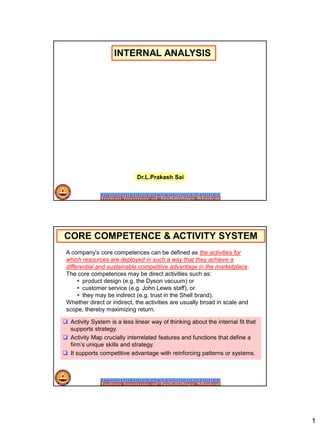
 Activity System is a less linear way of thinking about the internal fit that
supports strategy.
 Activity Map crucially interrelated features and functions that define a
firm‟s unique skills and strategy.
 It supports competitive advantage with reinforcing patterns or systems.
CORE COMPETENCE & ACTIVITY SYSTEM
A company‟s core competences can be defined as the activities for
which resources are deployed in such a way that they achieve a
differential and sustainable competitive advantage in the marketplace.
The core competences may be direct activities such as:
 product design (e.g. the Dyson vacuum) or
 customer service (e.g. John Lewis staff), or
 they may be indirect (e.g. trust in the Shell brand).
Whether direct or indirect, the activities are usually broad in scale and
scope, thereby maximizing return.
2
Limited
Customer
Service
Modular
Designs
Low Mfg
Cost
Self-
service
Selection
Self-
transport
Limited
sales staff
Customer
loyalty
Self -
assembly
Suburban
Location
Most
items in
stock
Design
focused
on low
cost
Explanatory
labeling
Easy
transport
Flat
packing
kits
Wide
variety
Long-term
suppliers
Year-
round
stocking
On-site
inventory
Impulse
buying
High-
traffic
store
layout
Easy to
make
Ikea’s Activity System
Value-Chain Analysis
• Sequential process of value-creating activities
• The amount that buyers are willing to pay for what a firm
provides them
• Value is measured by total revenue
• Firm is profitable to the extent the value it receives
exceeds the total costs involved in creating its product or
service
3
The Value Chain (Manufacturing)
General administration / Firm Infrastructure
Human resource management
Technology development
Procurement
Inbound
logistics
Operations
Outbound
logistics
Marketing
and sales
Service
Relationship with Suppliers Relationship with Buyers
Primary Activities
Associated with receiving, storing
and distributing inputs to the product
– Location of distribution facilities
– Material and inventory control systems
– Systems to reduce time to send “returns”
to suppliers
– Warehouse layout and designs
Inbound
Logistics
4
Associated with transforming inputs
into the final product form
– Efficient plant operations
– Appropriate level of automation in
manufacturing
– Quality production control systems
– Efficient plant layout and workflow
design
Inbound
Logistics
Operations
Primary Activities
Primary Activities
Associated with collecting, storing,
and distributing the product or
service to buyers
– Effective shipping processes
– Efficient finished goods warehousing
processes
– Shipping of goods in large lot sizes
– Quality material handling equipment
Inbound
Logistics
Operations
Outbound
Logistics
5
Associated with purchases of products
and services by end users and the
inducements used to get them to
make purchases
– Highly motivated and competent sales
force
– Innovative approaches to promotion and
advertising
– Selection of most appropriate distribution
channels
– Proper identification of customer segments
and needs
– Effective pricing strategies
Inbound
Logistics
Operations
Outbound
Logistics
Marketing and
Sales
Primary Activities
Associated with providing
service to enhance or maintain
the value of the product
– Effective use of procedures to solicit
customer feedback and to act on
information
– Quick response to customer needs and
emergencies
– Ability to furnish replacement parts
– Effective management of parts and
equipment inventory
– Quality of service personnel and
ongoing training
– Warranty and guarantee policies
Inbound
Logistics
Operations
Outbound
Logistics
Marketing and
Sales
Service
Primary Activities
6
Typically supports the entire value
chain and not individual activities
– Effective planning systems
– Ability of top management to anticipate
and act on key environmental trends
and events
– Ability to obtain low-cost funds for
capital expenditures and working capital
– Excellent relationships with diverse
stakeholder groups
– Ability to coordinate and integrate
activities across the value chain
– Highly visible to inculcate organizational
culture, reputation, and values
General
Administration
Support Activities
Support Activities
Activities involved in the
recruiting, hiring, training,
development, and compensation
of all types of personnel
– Effective recruiting, development, and
retention mechanisms for employees
– Quality relations with trade unions
– Quality work environment to maximize
overall employee performance and
minimize absenteeism
– Reward and incentive programs to
motivate all employees
General
Administration
Human
Resource
Management
7
Related to a wide range of
activities and those embodied
in processes and equipment
and the product itself
– Effective R&D activities for process and
product initiatives
– Positive collaborative relationships
between R&D and other departments
– State-of-the art facilities and equipment
– Culture to enhance creativity and
innovation
– Excellent professional qualifications of
personnel
– Ability to meet critical deadlines
General
Administration
Human Resource
Management
Technology
Development
Support Activities
Function of purchasing inputs
used in the firm‟s value chain
– Procurement of raw material inputs
– Development of collaborative “win-win”
relationships with suppliers
– Effective procedures to purchase
advertising and media services
– Analysis and selection of alternate
sources of inputs to minimize
dependence on one supplier
– Ability to make proper lease versus buy
decisions
General
Administration
Human Resource
Management
Technology
Development
Procurement
Support Activities
8
Strategic decisions in the value chain
Firm Infrastructure: cost-effective management information
systems, few managerial layers, simplified planning practices.
Human Resources: consistent policies to reduce turnover,
intense focus on training employees to be efficient and multi-skilled.
Technology: Easy-to-use production technologies,
investment in technology that improves production efficiencies.
Procurement: procedures to find the lowest cost inputs, frequent
evaluation of suppliers‟ performances.
Inbound
Logistics
Efficient
systems
to link
supplier
products
with
production
processes.
Operations
Use of
Economies of
scale.
Construction of
efficient scale
facilities.
Outbound
Logistics
Delivery
schedule that
reduces costs.
Selection of
low-cost
carriers.
Marketing
& Sales
Small, highly
trained sales
force.
Products
priced to
generate sales
volume.
Service
Efficient quality
control to
reduce buyer
complaints.
The Value Chain for a Low Cost Strategy
9
Firm Infrastructure: Highly developed MIS to capture
customer preferences, firm-wide focus on high-quality products.
Human Resources: Compensation encourages creativity,
subjective performance measures, superior training.
Technology: Strong capability in basic research, investment in
technologies that allow for production of highly differentiated products.
Procurement: Procedures to find the highest quality inputs, purchase of
highest quality replacement parts, strict standards for suppliers.
Inbound
Logistics
Superior
handling to
minimize
damage &
improve
quality.
Operations
Consistent
production of
attractive
products.
Rapid response
to customers‟
production
demands.
Outbound
Logistics
Accurate and
responsive
order
processing.
Rapid and
timely
deliveries.
Marketing
& Sales
Extensive
granting of
credit buying.
Extensive
personal
relationships
with buyers.
Service
Extensive buyer
training to
assure max.
value from
Product.
The Value Chain for a Differentiation Strategy
INBOUND
LOGISTICS
OPERATIONS OUTBOUND
LOGISTICS
MARKETING
AND SALES
SERVICE
PROCUREMENT
TECHNOLOGY
DEVELOPMENT
HUMAN
RESOURCE
MANAGEMENT
FIRM
INFRASTRUCTURE
Financial Policy – Accounting - Regulatory Compliance - Legal - Community Affairs
Pilot Training
Safety Training
Agent Training In-flight
Training
Baggage Tracking
System
• Promotion
• Advertising
• Advantage
Program
• Travel Agent
Programs
• Group Sales
• Ticket Counter
Operations
• Gate
Operations
• Aircraft
Operations
• On-board
Service
• Baggage
Handling
• Ticket Offices
• Route Selection
• Passenger
Service System
• Yield Mgmt
System (Pricing)
• Fuel
• Flight and Crew
Scheduling
• Facilities
Planning
• Aircraft
Acquisition
Information Technology
Communications
Product
Development
Market Research
• Lost
Baggage
Service
• Complaint
Follow-up
• Baggage
System
• Flight
Connections
• Rental Car and
• Hotel
Reservation
System
Computer Reservation System, In-flight System,
Flight Scheduling System, Yield Management System
Baggage
Handling
Training
Flight, route and
yield analyst
training
Airline Industry: Value Chain
10
Resource-Based View (RBV) of the Firm
• Two perspectives
– The internal analysis of phenomena within a company
– An external analysis of the industry and its
competitive environment
• Resources and Capabilities
– Tangible resources
– Intangible resources
– Organizational capabilities
Types of Resources
Relatively easy to identify, and
include physical and financial assets
used to create value for customers
– Financial resources
• Firm‟s cash accounts
• Firm‟s capacity to raise equity
• Firm‟s borrowing capacity
– Physical resources
• Modern plant and facilities
• Favorable manufacturing locations
• State-of-the-art machinery and
equipment
Tangible
Resources
11
– Technological resources
• Trade secrets
• Innovative production processes
• Patents, copyrights, trademarks
– Organizational resources
• Effective strategic planning
processes
• Excellent evaluation and control
systems
Types of Resources
Tangible
Resources
Relatively easy to identify, and
include physical and financial assets
used to create value for customers
Types of Resources
Difficult for competitors (and the firm itself) to
account for or imitate, typically embedded in
unique routines and practices that have evolved
over time:
– Human
• Experience and capabilities of employees
• Trust
• Managerial skills
• Firm-specific practices and procedures
– Innovation and creativity
• Technical and scientific skills
• Innovation capacities
– Reputation
• Effective strategic planning processes
• Excellent evaluation and control systems
Tangible
Resources
Intangible
Resources
12
Capabilities
Competencies or skills that a firm
employs to transform inputs to
outputs, and capacity to combine
tangible and intangible resources to
attain desired end
– Outstanding customer service
– Excellent product development
capabilities
– Innovativeness of products and services
– Ability to hire, motivate, and retain
human capital
Tangible
Resources
Intangible
Resources
Organizational
Capabilities
Capabilities
FUNCTION CAPABILITY EXAMPLE
Corporate HQ Expertise in management of
multi-business corporation
GE
ABB
R&D Speed of new product
development
Canon
Sony
Manufacturing Continual improvements in
production or assembly
process
Toyota
Komatsu
Dell
Marketing Brand management P&G
Coke
13
The resource-based view (RBV)
• What explains differences in firms‟ profitability and
sustainable advantage?
– Decisions about products, markets, positioning are important –
but too easy to copy
– Environments affect profits – but performance differs between
firms in similar environments
• RBV: individual resources are basis of competitive
strength if properly exploited
– Developed over time (path dependent)
– Dependent on tacit knowledge
– Generate “economic rents”
The VRIO Framework
If a firm has resources that are:
• valuable,
• rare, and
• costly to imitate, and…
• the firm is organized to exploit these resources,
then the firm can expect to enjoy a sustained
competitive advantage.
14
Applying the VRIO Framework
The Question of Value
 in theory: Does the resource enable the firm to
exploit an external opportunity or neutralize an
external threat?
 the practical: Does the resource result in an
increase in revenues, a decrease in costs, or
some combination of the two?
(Levi’s reputation allows it to charge a
premium for its Docker’s pants)
Applying the VRIO Framework
The Question of Rarity
 if a resource is not rare, then perfect competition
dynamics are likely to be observed (i.e., no
competitive advantage, no above normal profits)
 a resource must be rare enough that perfect
competition has not set in
 thus, there may be other firms that possess the
resource, but still few enough that there is scarcity
(several pharmaceuticals sell cholesterol-lowering drugs,
but the drugs are still scarce — look at prices)
15
Applying the VRIO Framework
Valuable and Rare
If a firm‟s resources are: The firm can expect:
Not Valuable Competitive Disadvantage
Valuable, but Not Rare Competitive Parity
Valuable and Rare
Competitive Advantage
(at least temporarily)
The Question of Imitability
• the temporary competitive advantage of valuable
and rare resources can be sustained only if
competitors face a cost disadvantage in imitating
the resource
» intangible resources are usually more
costly to imitate than tangible resources
and bundles of resources are more costly than
single resources
Applying the VRIO Framework
(Harley-Davidson’s bikes’ styles – bikes may be easily imitated,
but its reputation cannot be)
16
Costs of Imitation
• Unique Historical Conditions
– First mover advantages
– Path dependence
• Causal Ambiguity
– Causal links between resources and competitive advantage may not be
understood
– Bundles of resources fog these causal links
• Social Complexity
– The social relationships entailed in resources may be so complex that
managers cannot really manage or replicate them
• Patents
– Offer a period of protection if the firms is able to defend its patent rights
– Can be a two-edged sword as firms disclosure may decrease costs of
imitation by other firms
Applying the VRIO Framework
The Question of Organization
 a firm‟s structure and control mechanisms must be
aligned so as to give people ability and incentive to
exploit the firm‟s resources
 examples: formal and informal reporting structures,
management controls, compensation policies,
relationships, etc.
 these structure and control mechanisms complement
other firm resources taken together, they can help a firm
achieve sustained competitive advantage
(3M Company – rewards innovation and risk-taking)
17
The VRIO Framework
Valuable? Rare?
Costly to
Imitate?
Exploited by
Organization?
Competitive
Implications
No
Yes
Yes
Yes
Yes
Yes Yes Yes
No
No
No Disadvantage
Parity
Temporary
Advantage
Sustained
Advantage
Economic
Implications
Below
Normal
Normal
Above
Normal
Above
Normal
‘Strategic’ resources meet the VIRUS criteria
Valuable - makes appreciable difference to:
– cost and/or differentiation advantage
– capacity to adapt or innovate
– (otherwise, just represents wasted effort)
Inimitable (otherwise will be copied/bought)
Rare (= distinctive) in the industry
– (otherwise, it is only a threshold resource)
UnSubstitutable (or firms will use alternatives)
Few resources satisfy ALL these criteria
18
Different types of resource
• Assets: things a firm has
– Reputation, infrastructure, database
– „Strategic assets‟ if it meets VIRUS test
• Things a firm does with assets are:
– Capabilities: contribute directly to competitiveness
– Competences: deeper understanding of specialist field
– Incorporate routines developed over time
– Distinctive capabilities or core competences if it meets
VIRUS criteria
Dynamic capabilities
 Dynamic capabilities allow an organization to upgrade its
resources in response to environmental change
 Include the ability to:
– detect and assess environmental change,
– Learn, exploit knowledge, innovate
– manage across multiple product development
schedules
– transcend technology cycles and integrate
technologies across disparate units
19
Dell: Competitive Advantage
Competitive Dynamics of Resource Imitation
Competitive Dynamics:
• the strategic decisions and actions of firms in
response to the strategic decisions and actions
of other firms
Firm A
(strategy decisions
lead to competitive
advantage)
Firm B‟s Possible Responses
No Response
Change Tactics
Change Strategy
20
Competitive Dynamics
 the other firm is serving a different market
 a response may hurt its own competitive
advantage
 it does not have the resources and capabilities
to mount an effective response
 it wants to reduce or manage rivalry in the market
through tacit collusion
A firm may decide to take no action because:
“No Action” Response (Rolex Casio)
Competitive Dynamics
“Change” Responses
Tactics (Tide) Strategy (Monsanto)
specific actions
tweaking product
characteristics
usually imitated so quickly that
there is no advantage
a „leapfrog‟ move may create
advantage
 a fundamental change in a
firm‟s theory
 may be necessary if current
strategy becomes obsolete
 a mimetic change may
achieve parity, but not
advantage
21
The Resource-Based View
Resources &
Capabilities
Competitive
Advantage
• Valuable
• Rare
• Costly to Imitate
• Organized to Exploit
CA will be sustained if:
• other firms‟ costs of
imitation are greater
than benefit of imitation
• the firm is organized
to exploit advantages
Managers‟ Job:
• bundle resources and capabilities to
achieve competitive advantage
Internal Analysis
Tells us:
• what the firm should do, given the relative
strengths and weaknesses of resources and
capabilities
VRIO Framework Helps Managers Recognize
Sources of Competitive Advantage

5 internal analysis

  • 1.
    1 INTERNAL ANALYSIS Dr.L.Prakash Sai Activity System is a less linear way of thinking about the internal fit that supports strategy.  Activity Map crucially interrelated features and functions that define a firm‟s unique skills and strategy.  It supports competitive advantage with reinforcing patterns or systems. CORE COMPETENCE & ACTIVITY SYSTEM A company‟s core competences can be defined as the activities for which resources are deployed in such a way that they achieve a differential and sustainable competitive advantage in the marketplace. The core competences may be direct activities such as:  product design (e.g. the Dyson vacuum) or  customer service (e.g. John Lewis staff), or  they may be indirect (e.g. trust in the Shell brand). Whether direct or indirect, the activities are usually broad in scale and scope, thereby maximizing return.
  • 2.
    2 Limited Customer Service Modular Designs Low Mfg Cost Self- service Selection Self- transport Limited sales staff Customer loyalty Self- assembly Suburban Location Most items in stock Design focused on low cost Explanatory labeling Easy transport Flat packing kits Wide variety Long-term suppliers Year- round stocking On-site inventory Impulse buying High- traffic store layout Easy to make Ikea’s Activity System Value-Chain Analysis • Sequential process of value-creating activities • The amount that buyers are willing to pay for what a firm provides them • Value is measured by total revenue • Firm is profitable to the extent the value it receives exceeds the total costs involved in creating its product or service
  • 3.
    3 The Value Chain(Manufacturing) General administration / Firm Infrastructure Human resource management Technology development Procurement Inbound logistics Operations Outbound logistics Marketing and sales Service Relationship with Suppliers Relationship with Buyers Primary Activities Associated with receiving, storing and distributing inputs to the product – Location of distribution facilities – Material and inventory control systems – Systems to reduce time to send “returns” to suppliers – Warehouse layout and designs Inbound Logistics
  • 4.
    4 Associated with transforminginputs into the final product form – Efficient plant operations – Appropriate level of automation in manufacturing – Quality production control systems – Efficient plant layout and workflow design Inbound Logistics Operations Primary Activities Primary Activities Associated with collecting, storing, and distributing the product or service to buyers – Effective shipping processes – Efficient finished goods warehousing processes – Shipping of goods in large lot sizes – Quality material handling equipment Inbound Logistics Operations Outbound Logistics
  • 5.
    5 Associated with purchasesof products and services by end users and the inducements used to get them to make purchases – Highly motivated and competent sales force – Innovative approaches to promotion and advertising – Selection of most appropriate distribution channels – Proper identification of customer segments and needs – Effective pricing strategies Inbound Logistics Operations Outbound Logistics Marketing and Sales Primary Activities Associated with providing service to enhance or maintain the value of the product – Effective use of procedures to solicit customer feedback and to act on information – Quick response to customer needs and emergencies – Ability to furnish replacement parts – Effective management of parts and equipment inventory – Quality of service personnel and ongoing training – Warranty and guarantee policies Inbound Logistics Operations Outbound Logistics Marketing and Sales Service Primary Activities
  • 6.
    6 Typically supports theentire value chain and not individual activities – Effective planning systems – Ability of top management to anticipate and act on key environmental trends and events – Ability to obtain low-cost funds for capital expenditures and working capital – Excellent relationships with diverse stakeholder groups – Ability to coordinate and integrate activities across the value chain – Highly visible to inculcate organizational culture, reputation, and values General Administration Support Activities Support Activities Activities involved in the recruiting, hiring, training, development, and compensation of all types of personnel – Effective recruiting, development, and retention mechanisms for employees – Quality relations with trade unions – Quality work environment to maximize overall employee performance and minimize absenteeism – Reward and incentive programs to motivate all employees General Administration Human Resource Management
  • 7.
    7 Related to awide range of activities and those embodied in processes and equipment and the product itself – Effective R&D activities for process and product initiatives – Positive collaborative relationships between R&D and other departments – State-of-the art facilities and equipment – Culture to enhance creativity and innovation – Excellent professional qualifications of personnel – Ability to meet critical deadlines General Administration Human Resource Management Technology Development Support Activities Function of purchasing inputs used in the firm‟s value chain – Procurement of raw material inputs – Development of collaborative “win-win” relationships with suppliers – Effective procedures to purchase advertising and media services – Analysis and selection of alternate sources of inputs to minimize dependence on one supplier – Ability to make proper lease versus buy decisions General Administration Human Resource Management Technology Development Procurement Support Activities
  • 8.
    8 Strategic decisions inthe value chain Firm Infrastructure: cost-effective management information systems, few managerial layers, simplified planning practices. Human Resources: consistent policies to reduce turnover, intense focus on training employees to be efficient and multi-skilled. Technology: Easy-to-use production technologies, investment in technology that improves production efficiencies. Procurement: procedures to find the lowest cost inputs, frequent evaluation of suppliers‟ performances. Inbound Logistics Efficient systems to link supplier products with production processes. Operations Use of Economies of scale. Construction of efficient scale facilities. Outbound Logistics Delivery schedule that reduces costs. Selection of low-cost carriers. Marketing & Sales Small, highly trained sales force. Products priced to generate sales volume. Service Efficient quality control to reduce buyer complaints. The Value Chain for a Low Cost Strategy
  • 9.
    9 Firm Infrastructure: Highlydeveloped MIS to capture customer preferences, firm-wide focus on high-quality products. Human Resources: Compensation encourages creativity, subjective performance measures, superior training. Technology: Strong capability in basic research, investment in technologies that allow for production of highly differentiated products. Procurement: Procedures to find the highest quality inputs, purchase of highest quality replacement parts, strict standards for suppliers. Inbound Logistics Superior handling to minimize damage & improve quality. Operations Consistent production of attractive products. Rapid response to customers‟ production demands. Outbound Logistics Accurate and responsive order processing. Rapid and timely deliveries. Marketing & Sales Extensive granting of credit buying. Extensive personal relationships with buyers. Service Extensive buyer training to assure max. value from Product. The Value Chain for a Differentiation Strategy INBOUND LOGISTICS OPERATIONS OUTBOUND LOGISTICS MARKETING AND SALES SERVICE PROCUREMENT TECHNOLOGY DEVELOPMENT HUMAN RESOURCE MANAGEMENT FIRM INFRASTRUCTURE Financial Policy – Accounting - Regulatory Compliance - Legal - Community Affairs Pilot Training Safety Training Agent Training In-flight Training Baggage Tracking System • Promotion • Advertising • Advantage Program • Travel Agent Programs • Group Sales • Ticket Counter Operations • Gate Operations • Aircraft Operations • On-board Service • Baggage Handling • Ticket Offices • Route Selection • Passenger Service System • Yield Mgmt System (Pricing) • Fuel • Flight and Crew Scheduling • Facilities Planning • Aircraft Acquisition Information Technology Communications Product Development Market Research • Lost Baggage Service • Complaint Follow-up • Baggage System • Flight Connections • Rental Car and • Hotel Reservation System Computer Reservation System, In-flight System, Flight Scheduling System, Yield Management System Baggage Handling Training Flight, route and yield analyst training Airline Industry: Value Chain
  • 10.
    10 Resource-Based View (RBV)of the Firm • Two perspectives – The internal analysis of phenomena within a company – An external analysis of the industry and its competitive environment • Resources and Capabilities – Tangible resources – Intangible resources – Organizational capabilities Types of Resources Relatively easy to identify, and include physical and financial assets used to create value for customers – Financial resources • Firm‟s cash accounts • Firm‟s capacity to raise equity • Firm‟s borrowing capacity – Physical resources • Modern plant and facilities • Favorable manufacturing locations • State-of-the-art machinery and equipment Tangible Resources
  • 11.
    11 – Technological resources •Trade secrets • Innovative production processes • Patents, copyrights, trademarks – Organizational resources • Effective strategic planning processes • Excellent evaluation and control systems Types of Resources Tangible Resources Relatively easy to identify, and include physical and financial assets used to create value for customers Types of Resources Difficult for competitors (and the firm itself) to account for or imitate, typically embedded in unique routines and practices that have evolved over time: – Human • Experience and capabilities of employees • Trust • Managerial skills • Firm-specific practices and procedures – Innovation and creativity • Technical and scientific skills • Innovation capacities – Reputation • Effective strategic planning processes • Excellent evaluation and control systems Tangible Resources Intangible Resources
  • 12.
    12 Capabilities Competencies or skillsthat a firm employs to transform inputs to outputs, and capacity to combine tangible and intangible resources to attain desired end – Outstanding customer service – Excellent product development capabilities – Innovativeness of products and services – Ability to hire, motivate, and retain human capital Tangible Resources Intangible Resources Organizational Capabilities Capabilities FUNCTION CAPABILITY EXAMPLE Corporate HQ Expertise in management of multi-business corporation GE ABB R&D Speed of new product development Canon Sony Manufacturing Continual improvements in production or assembly process Toyota Komatsu Dell Marketing Brand management P&G Coke
  • 13.
    13 The resource-based view(RBV) • What explains differences in firms‟ profitability and sustainable advantage? – Decisions about products, markets, positioning are important – but too easy to copy – Environments affect profits – but performance differs between firms in similar environments • RBV: individual resources are basis of competitive strength if properly exploited – Developed over time (path dependent) – Dependent on tacit knowledge – Generate “economic rents” The VRIO Framework If a firm has resources that are: • valuable, • rare, and • costly to imitate, and… • the firm is organized to exploit these resources, then the firm can expect to enjoy a sustained competitive advantage.
  • 14.
    14 Applying the VRIOFramework The Question of Value  in theory: Does the resource enable the firm to exploit an external opportunity or neutralize an external threat?  the practical: Does the resource result in an increase in revenues, a decrease in costs, or some combination of the two? (Levi’s reputation allows it to charge a premium for its Docker’s pants) Applying the VRIO Framework The Question of Rarity  if a resource is not rare, then perfect competition dynamics are likely to be observed (i.e., no competitive advantage, no above normal profits)  a resource must be rare enough that perfect competition has not set in  thus, there may be other firms that possess the resource, but still few enough that there is scarcity (several pharmaceuticals sell cholesterol-lowering drugs, but the drugs are still scarce — look at prices)
  • 15.
    15 Applying the VRIOFramework Valuable and Rare If a firm‟s resources are: The firm can expect: Not Valuable Competitive Disadvantage Valuable, but Not Rare Competitive Parity Valuable and Rare Competitive Advantage (at least temporarily) The Question of Imitability • the temporary competitive advantage of valuable and rare resources can be sustained only if competitors face a cost disadvantage in imitating the resource » intangible resources are usually more costly to imitate than tangible resources and bundles of resources are more costly than single resources Applying the VRIO Framework (Harley-Davidson’s bikes’ styles – bikes may be easily imitated, but its reputation cannot be)
  • 16.
    16 Costs of Imitation •Unique Historical Conditions – First mover advantages – Path dependence • Causal Ambiguity – Causal links between resources and competitive advantage may not be understood – Bundles of resources fog these causal links • Social Complexity – The social relationships entailed in resources may be so complex that managers cannot really manage or replicate them • Patents – Offer a period of protection if the firms is able to defend its patent rights – Can be a two-edged sword as firms disclosure may decrease costs of imitation by other firms Applying the VRIO Framework The Question of Organization  a firm‟s structure and control mechanisms must be aligned so as to give people ability and incentive to exploit the firm‟s resources  examples: formal and informal reporting structures, management controls, compensation policies, relationships, etc.  these structure and control mechanisms complement other firm resources taken together, they can help a firm achieve sustained competitive advantage (3M Company – rewards innovation and risk-taking)
  • 17.
    17 The VRIO Framework Valuable?Rare? Costly to Imitate? Exploited by Organization? Competitive Implications No Yes Yes Yes Yes Yes Yes Yes No No No Disadvantage Parity Temporary Advantage Sustained Advantage Economic Implications Below Normal Normal Above Normal Above Normal ‘Strategic’ resources meet the VIRUS criteria Valuable - makes appreciable difference to: – cost and/or differentiation advantage – capacity to adapt or innovate – (otherwise, just represents wasted effort) Inimitable (otherwise will be copied/bought) Rare (= distinctive) in the industry – (otherwise, it is only a threshold resource) UnSubstitutable (or firms will use alternatives) Few resources satisfy ALL these criteria
  • 18.
    18 Different types ofresource • Assets: things a firm has – Reputation, infrastructure, database – „Strategic assets‟ if it meets VIRUS test • Things a firm does with assets are: – Capabilities: contribute directly to competitiveness – Competences: deeper understanding of specialist field – Incorporate routines developed over time – Distinctive capabilities or core competences if it meets VIRUS criteria Dynamic capabilities  Dynamic capabilities allow an organization to upgrade its resources in response to environmental change  Include the ability to: – detect and assess environmental change, – Learn, exploit knowledge, innovate – manage across multiple product development schedules – transcend technology cycles and integrate technologies across disparate units
  • 19.
    19 Dell: Competitive Advantage CompetitiveDynamics of Resource Imitation Competitive Dynamics: • the strategic decisions and actions of firms in response to the strategic decisions and actions of other firms Firm A (strategy decisions lead to competitive advantage) Firm B‟s Possible Responses No Response Change Tactics Change Strategy
  • 20.
    20 Competitive Dynamics  theother firm is serving a different market  a response may hurt its own competitive advantage  it does not have the resources and capabilities to mount an effective response  it wants to reduce or manage rivalry in the market through tacit collusion A firm may decide to take no action because: “No Action” Response (Rolex Casio) Competitive Dynamics “Change” Responses Tactics (Tide) Strategy (Monsanto) specific actions tweaking product characteristics usually imitated so quickly that there is no advantage a „leapfrog‟ move may create advantage  a fundamental change in a firm‟s theory  may be necessary if current strategy becomes obsolete  a mimetic change may achieve parity, but not advantage
  • 21.
    21 The Resource-Based View Resources& Capabilities Competitive Advantage • Valuable • Rare • Costly to Imitate • Organized to Exploit CA will be sustained if: • other firms‟ costs of imitation are greater than benefit of imitation • the firm is organized to exploit advantages Managers‟ Job: • bundle resources and capabilities to achieve competitive advantage Internal Analysis Tells us: • what the firm should do, given the relative strengths and weaknesses of resources and capabilities VRIO Framework Helps Managers Recognize Sources of Competitive Advantage