Chapter 1
The Progression to
Professional
Supply
Management
1-1
Key Concepts
• Purchasing, Supply Management, and
Supply Chain Management Defined
» Increasing Importance of Purchased Materials.
• Supply Management’s Impact on the
Bottom Line
» Increased Sales
» Faster to Market or Time-Based Competition
• Supply Management and Return on
Investment
• The Progression to Proactive Supply
Management
1-2
What Is a Profession?
• A calling requiring specialized knowledge and
often long and intensive preparation
• including instruction in skills and methods as
well as in the scientific, historical, or scholarly
principles underlying such skills and methods,
• maintaining by force of organization or concerted
opinion high standards of achievement and
conduct,
• and committing its members to continued study
and to a kind of work which has for its prime
purpose the rendering of a public service.
(Source: Webster's Third International Edition)
1-3
Purchasing: A Dynamic Profession
• Is purchasing a profession?
• Do the required skills have a historic
foundation?
• Does the supply management profession
render a public service?
• Is the profession undergoing changes?
1-4
Six Key Business Functions
(Supply Management’s Role in Business)
1. Creation, the idea or design function, frequently
based on research and development
2. Finance, the capital acquisition, financial
planning and control function
3. Personnel, the human resources and labor
relations function
4. Supply, the acquisition of required materials,
services, and equipment
5. Conversion, the transformation of materials into
economic goods and services
6. Distribution, the marketing and selling of goods
and services produced
1-5
Evolution of Purchasing Function
• Purchasing: a Dynamic Profession
• Origins of Purchasing and Supply
Management
• Transition to Supply Management
» Wider in Scope
» Value-Adding Benefits
» Strategic Focus
• Value-Adding Benefits
• Strategic Focus
1-6
Supply Management
• A Five Stage Process
» Identification of item or service required
» Identification of best supplier
» Establishment of a fair and reasonable price
» Creation of an enforceable agreement
» Management of the relationship
• Supply Management utilizes Strategic
Sourcing
1-7
Strategic Sourcing
• Strategic sourcing is understanding the markets
you're purchasing from inside and out…
• …and learning from your own organization and
your suppliers' organizational processes,…
• …working as a mediator between suppliers and
your organization,…
• …and capturing information and using it to
improve relationships.
• Strategic sourcing requires two-way continuous
improvement process work from each
organization
1-8
Four Principles of Strategic Sourcing
1. Define the total value of the relationship
between purchaser and suppler,
2. Develop solutions based on a deep
understanding of the supplier's economics and
business dynamics,
3. Use differentiated purchasing tactics in order to
optimize the economic relationship for both
purchaser and suppliers, and
4. Imbed the required changes in the organization
so the purchaser achieves not only a near-term
measurable performance improvement but also
the ability to continuously improve
1-9
Four Step Process of Implementation
• Research the industry economics and
dynamics of the team's assigned
commodity;
• Evaluate sourcing strategies and
suppliers' capabilities;
• Structure the supply relationship jointly
with suppliers and develop action plans to
build the required infrastructure;
• Implement the plan and organize for
continuous improvement
1-10
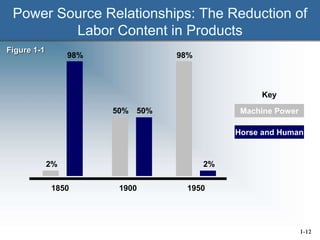
Increasing Importance of Purchased Materials
• The Five Ms of Business: Machines,
Man/Womanpower, Material, Money,
Management
» Materials costs have increased
– As a percentage of the cost of goods sold
» Labor costs have decreased
» Machine power has replaced much of human
(and horse) labor over the last 150 years
• The result?
» Materials costs are increasingly the focus of
management
1-11
Power Source Relationships: The Reduction of
Labor Content in Products
Figure 1-1
1850 1900 1950
2% 2%
50% 50%
98% 98%
Machine Power
Horse and Human
Key
1-12
Supply Management and the Bottom Line
• Purchased items account for a large
percentage of the cost of goods sold.
• Outsourcing allows firms to focus on their
core competencies.
» Organizations outsource when they decide to
purchase something they had been making in-
house.
• A dollar saved in materials cost is usually
considered a dollar increase in profit
1-13
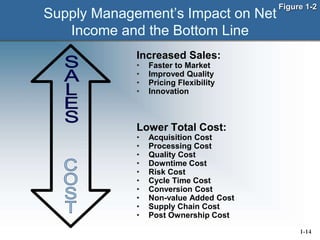
Supply Management’s Impact on Net
Income and the Bottom Line
Increased Sales:
• Faster to Market
• Improved Quality
• Pricing Flexibility
• Innovation
Lower Total Cost:
• Acquisition Cost
• Processing Cost
• Quality Cost
• Downtime Cost
• Risk Cost
• Cycle Time Cost
• Conversion Cost
• Non-value Added Cost
• Supply Chain Cost
• Post Ownership Cost
Figure 1-2
1-14
Return on
Investments
10.0%
Total assets
$4,000,000
Sales
$5,000,000
Divided by
Profit
margin
8%
Asset turnover
rate
1.25
Multiply
Cash
$300,000
Account
receivable
$300,000
Inventories
$500,000
Assets
Labor
$700,000
Materials
$2,300,000
Overhead
$800,000
Operatingcostelements
($515,000)
($3,685,000)($2,185,000)
(10.3%)
(1.26)
($3,975,000)
($1,075,000)
($475,000)
(13.0%)
What if we
decrease
materials cost
by 5%?
(or $115,000)
Sales
$5,000,000
Net income
$400,000
Divided by
Fixed assets
$2,900,000
Current assets
$1,100,000
Plus
Other costs
$800,000
Sales
$5,000,000
Cost of
Goods Sold
$3,800,000
Minus
Plus
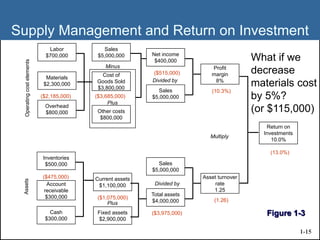
Supply Management and Return on Investment
Figure 1-3
1-15
The Impact on ROI of Reducing Materials Costs
vs. Increasing Sales
• If the same profit increase were to be
generated by increasing sales, what sales
increase would be required?
• At the existing 8% profit margin, the
following calculation provides the
answer…
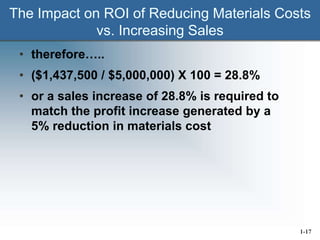
• Profit increase = new sales X .08
• $115,000 = new sales X .08
• new sales = $1,437,500
1-16
The Impact on ROI of Reducing Materials Costs
vs. Increasing Sales
• therefore…..
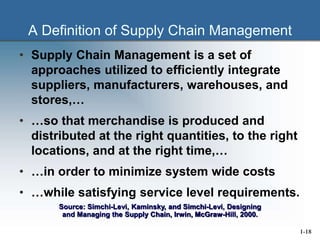
• ($1,437,500 / $5,000,000) X 100 = 28.8%
• or a sales increase of 28.8% is required to
match the profit increase generated by a
5% reduction in materials cost
1-17
A Definition of Supply Chain Management
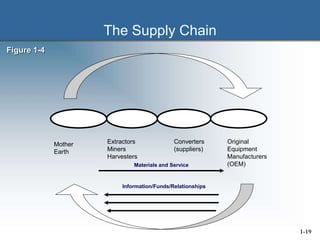
• Supply Chain Management is a set of
approaches utilized to efficiently integrate
suppliers, manufacturers, warehouses, and
stores,…
• …so that merchandise is produced and
distributed at the right quantities, to the right
locations, and at the right time,…
• …in order to minimize system wide costs
• …while satisfying service level requirements.
1-18
Source: Simchi-Levi, Kaminsky, and Simchi-Levi, Designing
and Managing the Supply Chain, Irwin, McGraw-Hill, 2000.
The Supply Chain
Mother
Earth
Original
Equipment
Manufacturers
(OEM)
Extractors
Miners
Harvesters
Converters
(suppliers)
Figure 1-4
Materials and Service
Information/Funds/Relationships
1-19
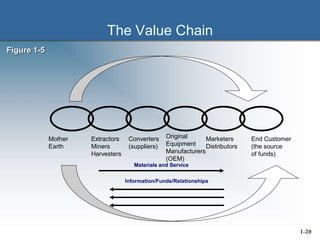
The Value Chain
Mother
Earth
Original
Equipment
Manufacturers
(OEM)
Extractors
Miners
Harvesters
Converters
(suppliers)
Marketers
Distributors
End Customer
(the source
of funds)
Figure 1-5
Materials and Service
Information/Funds/Relationships
1-20
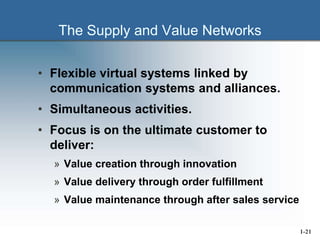
The Supply and Value Networks
• Flexible virtual systems linked by
communication systems and alliances.
• Simultaneous activities.
• Focus is on the ultimate customer to
deliver:
» Value creation through innovation
» Value delivery through order fulfillment
» Value maintenance through after sales service
1-21
The Extended Enterprise
• When a group or network of firms
collaborate in partnership (alliance)
fashion, this is sometimes referred to as a
strategic network, virtual corporation, or
extended enterprise
• When the group of firms view each other
as partners and collaborate effectively for
the good of the larger group, then they
leave established an extended enterprise
characterized by virtual integration
1-22
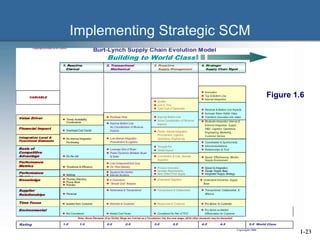
Implementing Strategic SCM
Strategic Supply Management Institute and The Warren Company
Copyright 2006
12
 Pro-Active To Customer Responsive to Customer Reactive to Customer Isolated from CustomerTime Focus
Performance
Metrics
 Speed & Integration,
 Design Supply Base
 Integrated Supply Strategy
 Process Innovation,
 Develop Requirements,
 Near Defect Free Supply
 Squeeze the Vendor
 Internet Auctions Nothing
Basis of
Competitive
Advantage
Performance
Metrics  Timeliness & Efficiency
 Low Component/Unit Cost,
 On Time Delivery
 Speed, Effectiveness, Monitor
Supply Environment
 Coordination & Synchronicity
 Interconnectedness
 Relationships & Trust
 Coordination & Cost, Develop
Suppliers
 Through-Put
 Global Impact Leverage Size of Buyer
 Power Dynamics Between Buyer
& Seller Do the Job
 Moderate Integration Internal &
External Integration: Supply ,
R&D, Logistics, Operations,
Engineering, Marketing,
Customer Service
 Partial Internal Integration
Procurement, Logistics,
Operations, Engineering Low Internal Integration
Procurement & Logistics
 No Internal Integration
Purchasing
Integration Level &
Functional Elements
 Revenue & Bottom Line Impacts
 Increase Share Holder Value
 Transform Innovation into Value Improve Bottom Line
 Some Consideration of Revenue
Impacts Improve Bottom Line
No Consideration of Revenue
Impacts Overhead-Cost Center
Financial Impact
 Innovation
 Top & Bottom Line
 Internal Integration
 Quality,
 Just In Time
 Total Cost of Ownership
 Purchase Price
 Timely Availability,
Convenience
Value Driver
4. Strategic
Supply Chain Mgmt
3. Proactive
Supply Management
2. Transactional
Mechanical
1. Reactive
Clerical
BurtBurt--Lynch Supply Chain Evolution ModelLynch Supply Chain Evolution Model
5.0 World Class4.0 4.53.0 3.52.0 2.51.0 1.5Rating
 Transactional & Collaborative  Transactional, Collaborative, &
Alliance
 Adversarial & Transactional
 Personal
Supplier
Relationships
 e-Commerce
 “Should Cost” Analysis
 Thomas Directory,
 Phone Book
 Rolodex
 Understand Industries, Supply
Base
 Understand SuppliersKnowledge
VARIABLE
Building to World Class
Note: Some Elements of an Earlier Stage are Carried as a Foundation into the next stage, while other elements may be discarded
CopyrightD.N.Burt & R.P.Lynch
 Pro-Active as Market
Differentiator for Customer Considered As Part of TCO Added Cost Factor Not Considered
Environmental
Figure 1.6
1-23
Concluding Remarks
• Purchasing is the foundation of Supply
Management and a basic activity common
to all organizations.
• Effective Supply Management has an
overwhelming impact on the firm’s bottom
line giving organizations a competitive
edge.
• Supply Management provides tremendous
career opportunities
1-24

Chapter 1 The Progression to Professional Supply Management

  • 1.
    Chapter 1 The Progressionto Professional Supply Management 1-1
  • 2.
    Key Concepts • Purchasing,Supply Management, and Supply Chain Management Defined » Increasing Importance of Purchased Materials. • Supply Management’s Impact on the Bottom Line » Increased Sales » Faster to Market or Time-Based Competition • Supply Management and Return on Investment • The Progression to Proactive Supply Management 1-2
  • 3.
    What Is aProfession? • A calling requiring specialized knowledge and often long and intensive preparation • including instruction in skills and methods as well as in the scientific, historical, or scholarly principles underlying such skills and methods, • maintaining by force of organization or concerted opinion high standards of achievement and conduct, • and committing its members to continued study and to a kind of work which has for its prime purpose the rendering of a public service. (Source: Webster's Third International Edition) 1-3
  • 4.
    Purchasing: A DynamicProfession • Is purchasing a profession? • Do the required skills have a historic foundation? • Does the supply management profession render a public service? • Is the profession undergoing changes? 1-4
  • 5.
    Six Key BusinessFunctions (Supply Management’s Role in Business) 1. Creation, the idea or design function, frequently based on research and development 2. Finance, the capital acquisition, financial planning and control function 3. Personnel, the human resources and labor relations function 4. Supply, the acquisition of required materials, services, and equipment 5. Conversion, the transformation of materials into economic goods and services 6. Distribution, the marketing and selling of goods and services produced 1-5
  • 6.
    Evolution of PurchasingFunction • Purchasing: a Dynamic Profession • Origins of Purchasing and Supply Management • Transition to Supply Management » Wider in Scope » Value-Adding Benefits » Strategic Focus • Value-Adding Benefits • Strategic Focus 1-6
  • 7.
    Supply Management • AFive Stage Process » Identification of item or service required » Identification of best supplier » Establishment of a fair and reasonable price » Creation of an enforceable agreement » Management of the relationship • Supply Management utilizes Strategic Sourcing 1-7
  • 8.
    Strategic Sourcing • Strategicsourcing is understanding the markets you're purchasing from inside and out… • …and learning from your own organization and your suppliers' organizational processes,… • …working as a mediator between suppliers and your organization,… • …and capturing information and using it to improve relationships. • Strategic sourcing requires two-way continuous improvement process work from each organization 1-8
  • 9.
    Four Principles ofStrategic Sourcing 1. Define the total value of the relationship between purchaser and suppler, 2. Develop solutions based on a deep understanding of the supplier's economics and business dynamics, 3. Use differentiated purchasing tactics in order to optimize the economic relationship for both purchaser and suppliers, and 4. Imbed the required changes in the organization so the purchaser achieves not only a near-term measurable performance improvement but also the ability to continuously improve 1-9
  • 10.
    Four Step Processof Implementation • Research the industry economics and dynamics of the team's assigned commodity; • Evaluate sourcing strategies and suppliers' capabilities; • Structure the supply relationship jointly with suppliers and develop action plans to build the required infrastructure; • Implement the plan and organize for continuous improvement 1-10
  • 11.
    Increasing Importance ofPurchased Materials • The Five Ms of Business: Machines, Man/Womanpower, Material, Money, Management » Materials costs have increased – As a percentage of the cost of goods sold » Labor costs have decreased » Machine power has replaced much of human (and horse) labor over the last 150 years • The result? » Materials costs are increasingly the focus of management 1-11
  • 12.
    Power Source Relationships:The Reduction of Labor Content in Products Figure 1-1 1850 1900 1950 2% 2% 50% 50% 98% 98% Machine Power Horse and Human Key 1-12
  • 13.
    Supply Management andthe Bottom Line • Purchased items account for a large percentage of the cost of goods sold. • Outsourcing allows firms to focus on their core competencies. » Organizations outsource when they decide to purchase something they had been making in- house. • A dollar saved in materials cost is usually considered a dollar increase in profit 1-13
  • 14.
    Supply Management’s Impacton Net Income and the Bottom Line Increased Sales: • Faster to Market • Improved Quality • Pricing Flexibility • Innovation Lower Total Cost: • Acquisition Cost • Processing Cost • Quality Cost • Downtime Cost • Risk Cost • Cycle Time Cost • Conversion Cost • Non-value Added Cost • Supply Chain Cost • Post Ownership Cost Figure 1-2 1-14
  • 15.
    Return on Investments 10.0% Total assets $4,000,000 Sales $5,000,000 Dividedby Profit margin 8% Asset turnover rate 1.25 Multiply Cash $300,000 Account receivable $300,000 Inventories $500,000 Assets Labor $700,000 Materials $2,300,000 Overhead $800,000 Operatingcostelements ($515,000) ($3,685,000)($2,185,000) (10.3%) (1.26) ($3,975,000) ($1,075,000) ($475,000) (13.0%) What if we decrease materials cost by 5%? (or $115,000) Sales $5,000,000 Net income $400,000 Divided by Fixed assets $2,900,000 Current assets $1,100,000 Plus Other costs $800,000 Sales $5,000,000 Cost of Goods Sold $3,800,000 Minus Plus Supply Management and Return on Investment Figure 1-3 1-15
  • 16.
    The Impact onROI of Reducing Materials Costs vs. Increasing Sales • If the same profit increase were to be generated by increasing sales, what sales increase would be required? • At the existing 8% profit margin, the following calculation provides the answer… • Profit increase = new sales X .08 • $115,000 = new sales X .08 • new sales = $1,437,500 1-16
  • 17.
    The Impact onROI of Reducing Materials Costs vs. Increasing Sales • therefore….. • ($1,437,500 / $5,000,000) X 100 = 28.8% • or a sales increase of 28.8% is required to match the profit increase generated by a 5% reduction in materials cost 1-17
  • 18.
    A Definition ofSupply Chain Management • Supply Chain Management is a set of approaches utilized to efficiently integrate suppliers, manufacturers, warehouses, and stores,… • …so that merchandise is produced and distributed at the right quantities, to the right locations, and at the right time,… • …in order to minimize system wide costs • …while satisfying service level requirements. 1-18 Source: Simchi-Levi, Kaminsky, and Simchi-Levi, Designing and Managing the Supply Chain, Irwin, McGraw-Hill, 2000.
  • 19.
  • 20.
    The Value Chain Mother Earth Original Equipment Manufacturers (OEM) Extractors Miners Harvesters Converters (suppliers) Marketers Distributors EndCustomer (the source of funds) Figure 1-5 Materials and Service Information/Funds/Relationships 1-20
  • 21.
    The Supply andValue Networks • Flexible virtual systems linked by communication systems and alliances. • Simultaneous activities. • Focus is on the ultimate customer to deliver: » Value creation through innovation » Value delivery through order fulfillment » Value maintenance through after sales service 1-21
  • 22.
    The Extended Enterprise •When a group or network of firms collaborate in partnership (alliance) fashion, this is sometimes referred to as a strategic network, virtual corporation, or extended enterprise • When the group of firms view each other as partners and collaborate effectively for the good of the larger group, then they leave established an extended enterprise characterized by virtual integration 1-22
  • 23.
    Implementing Strategic SCM StrategicSupply Management Institute and The Warren Company Copyright 2006 12  Pro-Active To Customer Responsive to Customer Reactive to Customer Isolated from CustomerTime Focus Performance Metrics  Speed & Integration,  Design Supply Base  Integrated Supply Strategy  Process Innovation,  Develop Requirements,  Near Defect Free Supply  Squeeze the Vendor  Internet Auctions Nothing Basis of Competitive Advantage Performance Metrics  Timeliness & Efficiency  Low Component/Unit Cost,  On Time Delivery  Speed, Effectiveness, Monitor Supply Environment  Coordination & Synchronicity  Interconnectedness  Relationships & Trust  Coordination & Cost, Develop Suppliers  Through-Put  Global Impact Leverage Size of Buyer  Power Dynamics Between Buyer & Seller Do the Job  Moderate Integration Internal & External Integration: Supply , R&D, Logistics, Operations, Engineering, Marketing, Customer Service  Partial Internal Integration Procurement, Logistics, Operations, Engineering Low Internal Integration Procurement & Logistics  No Internal Integration Purchasing Integration Level & Functional Elements  Revenue & Bottom Line Impacts  Increase Share Holder Value  Transform Innovation into Value Improve Bottom Line  Some Consideration of Revenue Impacts Improve Bottom Line No Consideration of Revenue Impacts Overhead-Cost Center Financial Impact  Innovation  Top & Bottom Line  Internal Integration  Quality,  Just In Time  Total Cost of Ownership  Purchase Price  Timely Availability, Convenience Value Driver 4. Strategic Supply Chain Mgmt 3. Proactive Supply Management 2. Transactional Mechanical 1. Reactive Clerical BurtBurt--Lynch Supply Chain Evolution ModelLynch Supply Chain Evolution Model 5.0 World Class4.0 4.53.0 3.52.0 2.51.0 1.5Rating  Transactional & Collaborative  Transactional, Collaborative, & Alliance  Adversarial & Transactional  Personal Supplier Relationships  e-Commerce  “Should Cost” Analysis  Thomas Directory,  Phone Book  Rolodex  Understand Industries, Supply Base  Understand SuppliersKnowledge VARIABLE Building to World Class Note: Some Elements of an Earlier Stage are Carried as a Foundation into the next stage, while other elements may be discarded CopyrightD.N.Burt & R.P.Lynch  Pro-Active as Market Differentiator for Customer Considered As Part of TCO Added Cost Factor Not Considered Environmental Figure 1.6 1-23
  • 24.
    Concluding Remarks • Purchasingis the foundation of Supply Management and a basic activity common to all organizations. • Effective Supply Management has an overwhelming impact on the firm’s bottom line giving organizations a competitive edge. • Supply Management provides tremendous career opportunities 1-24