PURCHASING MANAGEMENT
Week11
Prepared by Mark A. Jacobs, PhD
©2012 Cengage Learning. All Rights Reserved. May not be scanned, copied or
duplicated, or posted to a publicly accessible website, in whole or in part.
1
©2012 Cengage Learning. All Rights Reserved. May not be scanned, copied or duplicated, or posted to a publicly accessible website, in whole or in part.
2
LEARNING OBJECTIVES
You should be able to:
• Understand the role of supply management and its
strategic impact on an organization’s competitive advantage
• Have a basic knowledge of the manual purchasing
process, e-procurement, public procurement, and green
purchasing
• Understand and know how to handle small value purchase
orders
• Understand sourcing decisions and the factors impacting
supplier selection
©2012 Cengage Learning. All Rights Reserved. May not be scanned, copied or duplicated, or posted to a publicly accessible website, in whole or in part.
3
LEARNING OBJECTIVES (Continued)
You should be able to:
• Understand the pros and cons of single sourcing
versus multiple sourcing
• Understand the pros and cons of single versus
multiple sourcing
• Describe opportunities and challenges of global
sourcing and its impacts on supply management
• Understand and compute total cost of ownership
©2012 Cengage Learning. All Rights Reserved. May not be scanned, copied or duplicated, or posted to a publicly accessible website, in whole or in part.
4
CHAPTER OUTLINE
• Introduction
• A Brief History of Purchasing Terms
• The Role of Supply Management in an Organization
• The Purchasing Process
• Sourcing Decisions – The Make or Buy Decision
• Roles of Supply Base
• Supplier Selection
• How Many Suppliers to Use
• Purchasing Organization
• International Purchasing/Global Sourcing
• Procurement for Government/Non-Profits Agencies
Purchasing – Obtaining merchandise, capital equipment;
raw materials, services, or maintenance, repair, and
operating (MRO) supplies in exchange for money or its
equivalent
Merchants – Wholesalers and retailers who purchase for
resale
Industrial Buyers – Purchase raw materials for
conversion, services, capital equipment, & MRO supplies
A Brief History of Purchasing
Terms
A Brief History of Purchasing
Terms (Continued)
Purchasing - key business function for acquiring
materials, services, & equipment
Contracting - term often used for the acquisition of
services
Supply Management - a newer term that encompasses
all acquisition activities
 Institute of Supply management defined supply
management as the “Identification, acquisition,
access, positioning, and management of resources
an organization needs or potentially needs in the
attainment of its strategic objectives.”
The Role of Supply Management
in an Organization
The primary goals of purchasing are:
 Ensure uninterrupted flows of raw materials at the lowest total
cost,
 Improve quality of the finished goods produced, and
 Optimize customer satisfaction.
Purchasing contributes to these objectives by:
 Actively seeking better materials and reliable suppliers,
 Work closely with and exploiting the expertise of strategic
suppliers to improve quality and materials
 Involving suppliers and purchasing personnel in new product
design and development efforts.
The Role of Supply Management
in an Organization (Continued)
The Financial Significance of Supply Management
Profit-Leverage Effect
A decrease in purchasing expenditures directly increases
profits before taxes (assuming no decrease in quality or
purchasing total cost)
Return on Assets (ROA) Effect
A high ROA indicates managerial prowess in generating profits
with lower spending (caveat- ROA ratios vary from one
industry to another)
Inventory Turnover Effect
Increased inventory turnovers indicate optimal utilization of
space and inventory levels, increased sales, avoidance of
inventory obsolesce
The Purchasing Process – Manual
Purchasing (older system)
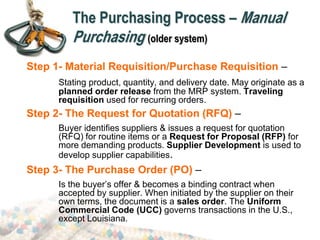
Step 1- Material Requisition/Purchase Requisition –
Stating product, quantity, and delivery date. May originate as a
planned order release from the MRP system. Traveling
requisition used for recurring orders.
Step 2- The Request for Quotation (RFQ) –
Buyer identifies suppliers & issues a request for quotation
(RFQ) for routine items or a Request for Proposal (RFP) for
more demanding products. Supplier Development is used to
develop supplier capabilities.
Step 3- The Purchase Order (PO) –
Is the buyer’s offer & becomes a binding contract when
accepted by supplier. When initiated by the supplier on their
own terms, the document is a sales order. The Uniform
Commercial Code (UCC) governs transactions in the U.S.,
except Louisiana.
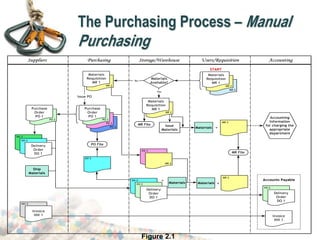
The Purchasing Process – Manual
Purchasing
+
Materials
Available?
Yes
Issue
Materials
MR File
Materials
PO 3
MR 2
Accounting
Information
for charging the
appropriate
department
Accounts Payable
+
MR File
Materials
MR 2
+
Materials
MR 2
Ship
Materials
DO 3
DO 2
Delivery
Order
DO 1
PO 2
Purchase
Order
PO 1
INV 2
Invoice
INV 1
Storage/Warehouse Accounting
Users/Requisition
Suppliers Purchasing
PO 4
PO 3
PO 2
Purchase
Order
PO 1
PO File
MR 2
Materials
Requisition
MR 1
MR 3
MR 2
Materials
Requisition
MR 1
START
No
MR 2
Materials
Requisition
MR 1
Issue PO
PO 2
Delivery
Order
DO 1
Invoice
INV 1
DO 2
PO 2
Delivery
Order
DO 1
DO 2
+
Materials
Available?
Yes
Issue
Materials
Issue
Materials
MR File
MR File
Materials
Materials
PO 3
MR 2
PO 3
PO 3
MR 2
MR 2
Accounting
Information
for charging the
appropriate
department
Accounting
Information
for charging the
appropriate
department
Accounts Payable
+
MR File
MR File
Materials
Materials
MR 2
MR 2
+
Materials
Materials
MR 2
MR 2
Ship
Materials
Ship
Materials
DO 3
DO 2
Delivery
Order
DO 1
DO 3
DO 3
DO 2
DO 2
Delivery
Order
DO 1
Delivery
Order
DO 1
PO 2
Purchase
Order
PO 1
PO 2
PO 2
Purchase
Order
PO 1
Purchase
Order
PO 1
INV 2
Invoice
INV 1
INV 2
INV 2
Invoice
INV 1
Invoice
INV 1
Storage/Warehouse Accounting
Users/Requisition
Suppliers Purchasing Storage/Warehouse Accounting
Users/Requisition
Suppliers Purchasing
PO 4
PO 3
PO 2
Purchase
Order
PO 1
PO 4
PO 4
PO 3
PO 3
PO 2
PO 2
Purchase
Order
PO 1
Purchase
Order
PO 1
PO File
PO File
MR 2
Materials
Requisition
MR 1
MR 2
MR 2
Materials
Requisition
MR 1
Materials
Requisition
MR 1
MR 3
MR 2
Materials
Requisition
MR 1
MR 3
MR 3
MR 2
MR 2
Materials
Requisition
MR 1
START
No
MR 2
Materials
Requisition
MR 1
MR 2
MR 2
Materials
Requisition
MR 1
Materials
Requisition
MR 1
Issue PO
PO 2
Delivery
Order
DO 1
PO 2
PO 2
Delivery
Order
DO 1
Delivery
Order
DO 1
Invoice
INV 1
Invoice
INV 1
DO 2
PO 2
Delivery
Order
DO 1
DO 2
DO 2
PO 2
PO 2
Delivery
Order
DO 1
Delivery
Order
DO 1
DO 2
DO 2
Figure 2.1
The Purchasing Process – Manual
Purchasing (Continued)
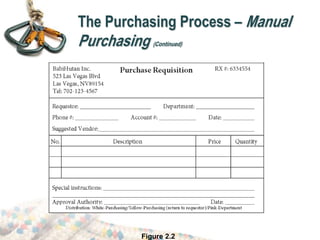
Figure 2.2
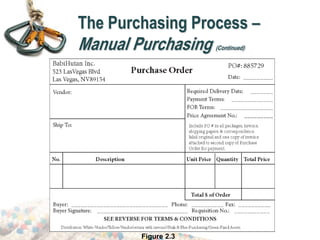
Figure 2.3
The Purchasing Process –
Manual Purchasing (Continued)
The Purchasing Process –
e-Procurement
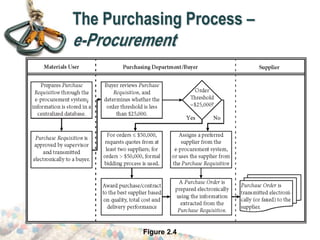
Step 1- Material user inputs a materials requisition –
Relevant information such as quantity and date needed.
Step 2- Materials requisition submitted to buyer –
At purchasing department (hardcopy or electronically).
Step 3- Buyer assigns qualified suppliers to bid –
Product description, closing date, & conditions are given.
Step 4- Buyer reviews closed bids & selects a supplier
Figure 2.4
The Purchasing Process –
e-Procurement
Advantages of the e-Procurement System
 Time savings
 Cost savings
 Accuracy
 Real time
 Mobility
 Trackability
 Management
 Benefits to the suppliers
The Purchasing Process –
e-Procurement (Continued)
Small Value Purchase Orders
Processing costs for small value purchases
are minimized through:
 Procurement Credit Card/Corporate Purchasing Card
(P-card)
 Blanket or Open-End Purchase Orders
 Blank Check Purchase Orders
 Stockless Buying or System Contracting
 Petty Cash
 Standardization & Simplification of Materials &
Components
 Accumulating Small Orders to Create a Large Order
 Using a Fixed Order Interval
Sourcing Decisions – The Make or
Buy Decision
Outsourcing –
Buying materials and components from
suppliers instead of making them in-house. The
trend has moved toward outsourcing.
Backward vertical integration –
Refers to acquiring sources of supply
Forward vertical integration –
Refers to acquiring customer’s operations.
The Make or Buy decision is a strategic decision
Reasons for Buying or Outsourcing
 Cost advantage –
• Especially for components that are non-vital to the
organization’s operations, suppliers may have economies
of scale
 Insufficient capacity –
• A firm may be at or near capacity and subcontracting from
a supplier may make better sense
 Lack of expertise –
• Firm may not have the necessary technology and expertise
 Quality –
• Suppliers have better technology, process, skilled labor, and
the advantage of economy of scale
Sourcing Decisions – The Make or
Buy Decision (Continued)
Reasons for Making
 Protect proprietary technology
 No competent supplier
 Better quality control
 Use existing idle capacity
 Control of lead-time transportation, and
warehousing cost
 Lower cost
Sourcing Decisions – The Make or
Buy Decision (Continued)
Roles of Supply Base
Supply Base - list of suppliers that a firm uses to acquire its
materials, services, supplies, and equipment
 Firms emphasize long-term strategic supplier alliances consolidating
volume into one or fewer suppliers, resulting in a smaller supply
base
Preferred suppliers provide:
 Product and process technology and espertise to support
buyer’s operations, particularly new product development and
value analysis
 Information on latest trends in materials, processes, or designs
 Information on the supply market
 Capacity for meeting unexpected demand
 Cost efficiency due to economies of scale
Supplier Selection
 Product and
process
technologies
 Willingness to
share technologies
& information
 Early supplier
involvement (ESI)
 Concurrent
engineering (CE)
 Quality
 Service
 Cost
 Total cost of
ownership or
acquisition
 Reliability
 Order system & cycle
time
 Capacity
 Communication
capability
 Location
The process of selecting suppliers, is complex and
should be based on multiple criteria:
How Many Suppliers to Use
Reasons Favoring a
Single Supplier
 To establish a good
relationship
 Less quality variability
 Lower cost
 Transportation economies
 Proprietary product or
process
 Volume too small to split
Reasons Favoring
Multiple Suppliers
 Need capacity
 Spread risk of supply
interruption
 Create competition
 Information
 Dealing with special kinds
of business
Single-source - a risky proposition. Current trends favor
fewer sources.
Purchasing – Centralized vs.
Decentralized
Purchasing Organization is dependent on
many factors, such as market conditions & types
of materials required
 Centralized Purchasing - purchasing
department located at the firm’s corporate office
makes all the purchasing decisions
 Decentralized Purchasing - individual, local
purchasing departments, such as plant level, make
their own purchasing decisions
Advantages -
Centralization
 Concentrated volume-
 Leveraging purchase volume
 Avoid duplication
 Specialization
 Lower transportation costs
 No competition within units
 Common supply base
Advantages -
Decentralization
 Closer knowledge
of requirements
 Local sourcing
 Less bureaucracy
A hybrid purchasing organization
 Decentralized-centralized (large multiunit org)- decentralized
corporate and centralized at business unit
 Centralized-decentralized (large org w/centralized control)
centralized large national contracts at corporate level and
decentralized items specific to business unit
Purchasing – Centralized vs.
Decentralized (Continued)
International Purchasing/Global
Sourcing
Reasons for Global Sourcing –
Opportunity to improve quality, cost, and
delivery performance
Potential Challenges –
Requires additional skills and knowledge to deal
with international suppliers, logistics,
communication, political environment, and other
issues
Procurement for Government &
Non-Profit Agencies
Public Procurement or Public Purchasing – purchasing
& supply function for government & non-profit sector.
Public Procurement is characterized by:
 Competitive bidding - contract is usually awarded to lowest priced
responsive & responsible bidder
 Sealed Bids are used to satisfy the Invitation for Bid (IFB) and are
opened in public display
 Performance Bonds - incentive to fulfill contract
 Bid or Surety Bonds - successful bidder will accept contract
 Performance Bonds - work will be on time and meet specifications
 Payment Bonds - protection against 3rd party liens not fulfilled by
bidder
Procurement for Government &
Non-Profit Agencies (Continued)
Rules that often govern Government & Non-Profit
Procurement:
Federal Acquisition Streamlining Act (1994) –
Removed restrictions on bids less than $100,000. Micro
purchases (less than $2,500) can be made without bidding
Buy American Act (1933) –
US government purchases and 3rd party purchases using
federal funds must buy if the US good is not more than a certain
differential above the foreign good
Green Purchases –
Variety of federal, state, and local initiatives to include
environmental and human health considerations when making
purchases

Week11-Purchasing Managementtttttttttttt

  • 1.
    PURCHASING MANAGEMENT Week11 Prepared byMark A. Jacobs, PhD ©2012 Cengage Learning. All Rights Reserved. May not be scanned, copied or duplicated, or posted to a publicly accessible website, in whole or in part. 1
  • 2.
    ©2012 Cengage Learning.All Rights Reserved. May not be scanned, copied or duplicated, or posted to a publicly accessible website, in whole or in part. 2 LEARNING OBJECTIVES You should be able to: • Understand the role of supply management and its strategic impact on an organization’s competitive advantage • Have a basic knowledge of the manual purchasing process, e-procurement, public procurement, and green purchasing • Understand and know how to handle small value purchase orders • Understand sourcing decisions and the factors impacting supplier selection
  • 3.
    ©2012 Cengage Learning.All Rights Reserved. May not be scanned, copied or duplicated, or posted to a publicly accessible website, in whole or in part. 3 LEARNING OBJECTIVES (Continued) You should be able to: • Understand the pros and cons of single sourcing versus multiple sourcing • Understand the pros and cons of single versus multiple sourcing • Describe opportunities and challenges of global sourcing and its impacts on supply management • Understand and compute total cost of ownership
  • 4.
    ©2012 Cengage Learning.All Rights Reserved. May not be scanned, copied or duplicated, or posted to a publicly accessible website, in whole or in part. 4 CHAPTER OUTLINE • Introduction • A Brief History of Purchasing Terms • The Role of Supply Management in an Organization • The Purchasing Process • Sourcing Decisions – The Make or Buy Decision • Roles of Supply Base • Supplier Selection • How Many Suppliers to Use • Purchasing Organization • International Purchasing/Global Sourcing • Procurement for Government/Non-Profits Agencies
  • 5.
    Purchasing – Obtainingmerchandise, capital equipment; raw materials, services, or maintenance, repair, and operating (MRO) supplies in exchange for money or its equivalent Merchants – Wholesalers and retailers who purchase for resale Industrial Buyers – Purchase raw materials for conversion, services, capital equipment, & MRO supplies A Brief History of Purchasing Terms
  • 6.
    A Brief Historyof Purchasing Terms (Continued) Purchasing - key business function for acquiring materials, services, & equipment Contracting - term often used for the acquisition of services Supply Management - a newer term that encompasses all acquisition activities  Institute of Supply management defined supply management as the “Identification, acquisition, access, positioning, and management of resources an organization needs or potentially needs in the attainment of its strategic objectives.”
  • 7.
    The Role ofSupply Management in an Organization The primary goals of purchasing are:  Ensure uninterrupted flows of raw materials at the lowest total cost,  Improve quality of the finished goods produced, and  Optimize customer satisfaction. Purchasing contributes to these objectives by:  Actively seeking better materials and reliable suppliers,  Work closely with and exploiting the expertise of strategic suppliers to improve quality and materials  Involving suppliers and purchasing personnel in new product design and development efforts.
  • 8.
    The Role ofSupply Management in an Organization (Continued) The Financial Significance of Supply Management Profit-Leverage Effect A decrease in purchasing expenditures directly increases profits before taxes (assuming no decrease in quality or purchasing total cost) Return on Assets (ROA) Effect A high ROA indicates managerial prowess in generating profits with lower spending (caveat- ROA ratios vary from one industry to another) Inventory Turnover Effect Increased inventory turnovers indicate optimal utilization of space and inventory levels, increased sales, avoidance of inventory obsolesce
  • 9.
    The Purchasing Process– Manual Purchasing (older system) Step 1- Material Requisition/Purchase Requisition – Stating product, quantity, and delivery date. May originate as a planned order release from the MRP system. Traveling requisition used for recurring orders. Step 2- The Request for Quotation (RFQ) – Buyer identifies suppliers & issues a request for quotation (RFQ) for routine items or a Request for Proposal (RFP) for more demanding products. Supplier Development is used to develop supplier capabilities. Step 3- The Purchase Order (PO) – Is the buyer’s offer & becomes a binding contract when accepted by supplier. When initiated by the supplier on their own terms, the document is a sales order. The Uniform Commercial Code (UCC) governs transactions in the U.S., except Louisiana.
  • 10.
    The Purchasing Process– Manual Purchasing + Materials Available? Yes Issue Materials MR File Materials PO 3 MR 2 Accounting Information for charging the appropriate department Accounts Payable + MR File Materials MR 2 + Materials MR 2 Ship Materials DO 3 DO 2 Delivery Order DO 1 PO 2 Purchase Order PO 1 INV 2 Invoice INV 1 Storage/Warehouse Accounting Users/Requisition Suppliers Purchasing PO 4 PO 3 PO 2 Purchase Order PO 1 PO File MR 2 Materials Requisition MR 1 MR 3 MR 2 Materials Requisition MR 1 START No MR 2 Materials Requisition MR 1 Issue PO PO 2 Delivery Order DO 1 Invoice INV 1 DO 2 PO 2 Delivery Order DO 1 DO 2 + Materials Available? Yes Issue Materials Issue Materials MR File MR File Materials Materials PO 3 MR 2 PO 3 PO 3 MR 2 MR 2 Accounting Information for charging the appropriate department Accounting Information for charging the appropriate department Accounts Payable + MR File MR File Materials Materials MR 2 MR 2 + Materials Materials MR 2 MR 2 Ship Materials Ship Materials DO 3 DO 2 Delivery Order DO 1 DO 3 DO 3 DO 2 DO 2 Delivery Order DO 1 Delivery Order DO 1 PO 2 Purchase Order PO 1 PO 2 PO 2 Purchase Order PO 1 Purchase Order PO 1 INV 2 Invoice INV 1 INV 2 INV 2 Invoice INV 1 Invoice INV 1 Storage/Warehouse Accounting Users/Requisition Suppliers Purchasing Storage/Warehouse Accounting Users/Requisition Suppliers Purchasing PO 4 PO 3 PO 2 Purchase Order PO 1 PO 4 PO 4 PO 3 PO 3 PO 2 PO 2 Purchase Order PO 1 Purchase Order PO 1 PO File PO File MR 2 Materials Requisition MR 1 MR 2 MR 2 Materials Requisition MR 1 Materials Requisition MR 1 MR 3 MR 2 Materials Requisition MR 1 MR 3 MR 3 MR 2 MR 2 Materials Requisition MR 1 START No MR 2 Materials Requisition MR 1 MR 2 MR 2 Materials Requisition MR 1 Materials Requisition MR 1 Issue PO PO 2 Delivery Order DO 1 PO 2 PO 2 Delivery Order DO 1 Delivery Order DO 1 Invoice INV 1 Invoice INV 1 DO 2 PO 2 Delivery Order DO 1 DO 2 DO 2 PO 2 PO 2 Delivery Order DO 1 Delivery Order DO 1 DO 2 DO 2 Figure 2.1
  • 11.
    The Purchasing Process– Manual Purchasing (Continued) Figure 2.2
  • 12.
    Figure 2.3 The PurchasingProcess – Manual Purchasing (Continued)
  • 13.
    The Purchasing Process– e-Procurement Step 1- Material user inputs a materials requisition – Relevant information such as quantity and date needed. Step 2- Materials requisition submitted to buyer – At purchasing department (hardcopy or electronically). Step 3- Buyer assigns qualified suppliers to bid – Product description, closing date, & conditions are given. Step 4- Buyer reviews closed bids & selects a supplier
  • 14.
    Figure 2.4 The PurchasingProcess – e-Procurement
  • 15.
    Advantages of thee-Procurement System  Time savings  Cost savings  Accuracy  Real time  Mobility  Trackability  Management  Benefits to the suppliers The Purchasing Process – e-Procurement (Continued)
  • 16.
    Small Value PurchaseOrders Processing costs for small value purchases are minimized through:  Procurement Credit Card/Corporate Purchasing Card (P-card)  Blanket or Open-End Purchase Orders  Blank Check Purchase Orders  Stockless Buying or System Contracting  Petty Cash  Standardization & Simplification of Materials & Components  Accumulating Small Orders to Create a Large Order  Using a Fixed Order Interval
  • 17.
    Sourcing Decisions –The Make or Buy Decision Outsourcing – Buying materials and components from suppliers instead of making them in-house. The trend has moved toward outsourcing. Backward vertical integration – Refers to acquiring sources of supply Forward vertical integration – Refers to acquiring customer’s operations. The Make or Buy decision is a strategic decision
  • 18.
    Reasons for Buyingor Outsourcing  Cost advantage – • Especially for components that are non-vital to the organization’s operations, suppliers may have economies of scale  Insufficient capacity – • A firm may be at or near capacity and subcontracting from a supplier may make better sense  Lack of expertise – • Firm may not have the necessary technology and expertise  Quality – • Suppliers have better technology, process, skilled labor, and the advantage of economy of scale Sourcing Decisions – The Make or Buy Decision (Continued)
  • 19.
    Reasons for Making Protect proprietary technology  No competent supplier  Better quality control  Use existing idle capacity  Control of lead-time transportation, and warehousing cost  Lower cost Sourcing Decisions – The Make or Buy Decision (Continued)
  • 20.
    Roles of SupplyBase Supply Base - list of suppliers that a firm uses to acquire its materials, services, supplies, and equipment  Firms emphasize long-term strategic supplier alliances consolidating volume into one or fewer suppliers, resulting in a smaller supply base Preferred suppliers provide:  Product and process technology and espertise to support buyer’s operations, particularly new product development and value analysis  Information on latest trends in materials, processes, or designs  Information on the supply market  Capacity for meeting unexpected demand  Cost efficiency due to economies of scale
  • 21.
    Supplier Selection  Productand process technologies  Willingness to share technologies & information  Early supplier involvement (ESI)  Concurrent engineering (CE)  Quality  Service  Cost  Total cost of ownership or acquisition  Reliability  Order system & cycle time  Capacity  Communication capability  Location The process of selecting suppliers, is complex and should be based on multiple criteria:
  • 22.
    How Many Suppliersto Use Reasons Favoring a Single Supplier  To establish a good relationship  Less quality variability  Lower cost  Transportation economies  Proprietary product or process  Volume too small to split Reasons Favoring Multiple Suppliers  Need capacity  Spread risk of supply interruption  Create competition  Information  Dealing with special kinds of business Single-source - a risky proposition. Current trends favor fewer sources.
  • 23.
    Purchasing – Centralizedvs. Decentralized Purchasing Organization is dependent on many factors, such as market conditions & types of materials required  Centralized Purchasing - purchasing department located at the firm’s corporate office makes all the purchasing decisions  Decentralized Purchasing - individual, local purchasing departments, such as plant level, make their own purchasing decisions
  • 24.
    Advantages - Centralization  Concentratedvolume-  Leveraging purchase volume  Avoid duplication  Specialization  Lower transportation costs  No competition within units  Common supply base Advantages - Decentralization  Closer knowledge of requirements  Local sourcing  Less bureaucracy A hybrid purchasing organization  Decentralized-centralized (large multiunit org)- decentralized corporate and centralized at business unit  Centralized-decentralized (large org w/centralized control) centralized large national contracts at corporate level and decentralized items specific to business unit Purchasing – Centralized vs. Decentralized (Continued)
  • 25.
    International Purchasing/Global Sourcing Reasons forGlobal Sourcing – Opportunity to improve quality, cost, and delivery performance Potential Challenges – Requires additional skills and knowledge to deal with international suppliers, logistics, communication, political environment, and other issues
  • 26.
    Procurement for Government& Non-Profit Agencies Public Procurement or Public Purchasing – purchasing & supply function for government & non-profit sector. Public Procurement is characterized by:  Competitive bidding - contract is usually awarded to lowest priced responsive & responsible bidder  Sealed Bids are used to satisfy the Invitation for Bid (IFB) and are opened in public display  Performance Bonds - incentive to fulfill contract  Bid or Surety Bonds - successful bidder will accept contract  Performance Bonds - work will be on time and meet specifications  Payment Bonds - protection against 3rd party liens not fulfilled by bidder
  • 27.
    Procurement for Government& Non-Profit Agencies (Continued) Rules that often govern Government & Non-Profit Procurement: Federal Acquisition Streamlining Act (1994) – Removed restrictions on bids less than $100,000. Micro purchases (less than $2,500) can be made without bidding Buy American Act (1933) – US government purchases and 3rd party purchases using federal funds must buy if the US good is not more than a certain differential above the foreign good Green Purchases – Variety of federal, state, and local initiatives to include environmental and human health considerations when making purchases