BITES AND STINGS
1Brought to you by your Telcom Insurance Risk Management Team
PURPOSE
We would like to familiarize our
customers with potential bites and stings
from animals and how to avoid and treat
those cases when/if they occur.
Occupational exposure to animals and
insects should be managed and
controlled like any other hazards you
employees encounter.
2
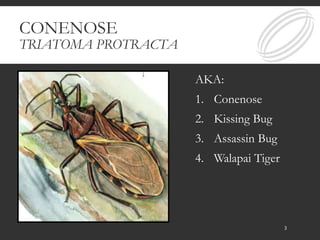
CONENOSE
TRIATOMA PROTRACTA
AKA:
1. Conenose
2. Kissing Bug
3. Assassin Bug
4. Walapai Tiger
3
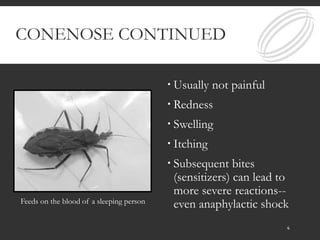
CONENOSE CONTINUED
 Usually not painful
 Redness
 Swelling
 Itching
 Subsequent bites
(sensitizers) can lead to
more severe reactions--
even anaphylactic shockFeeds on the blood of a sleeping person
4
IF BITTEN
If possible, it is recommended that you
attempt to capture the bug for
confirmation
It is best to call EMS or Poison Control
when bitten for advice as to what must
be done as each case can be different
5
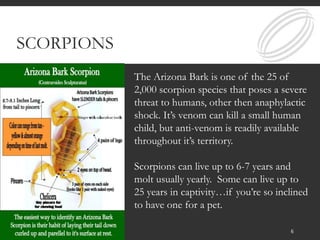
SCORPIONS
6
The Arizona Bark is one of the 25 of
2,000 scorpion species that poses a severe
threat to humans, other then anaphylactic
shock. It’s venom can kill a small human
child, but anti-venom is readily available
throughout it’s territory.
Scorpions can live up to 6-7 years and
molt usually yearly. Some can live up to
25 years in captivity…if you’re so inclined
to have one for a pet.
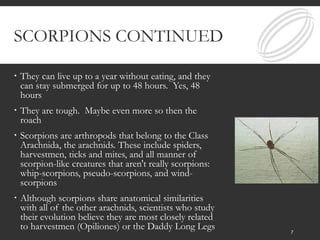
SCORPIONS CONTINUED
 They can live up to a year without eating, and they
can stay submerged for up to 48 hours. Yes, 48
hours
 They are tough. Maybe even more so then the
roach
 Scorpions are arthropods that belong to the Class
Arachnida, the arachnids. These include spiders,
harvestmen, ticks and mites, and all manner of
scorpion-like creatures that aren't really scorpions:
whip-scorpions, pseudo-scorpions, and wind-
scorpions
 Although scorpions share anatomical similarities
with all of the other arachnids, scientists who study
their evolution believe they are most closely related
to harvestmen (Opiliones) or the Daddy Long Legs 7
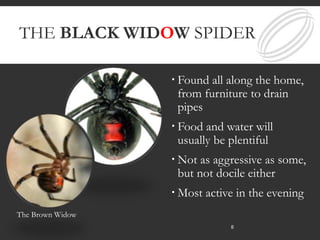
THE BLACK WIDOW SPIDER
 Found all along the home,
from furniture to drain
pipes
 Food and water will
usually be plentiful
 Not as aggressive as some,
but not docile either
 Most active in the evening
The Brown Widow
8
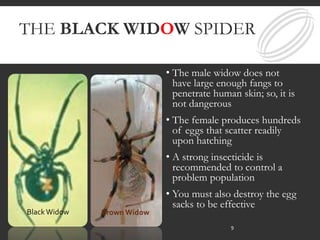
THE BLACK WIDOW SPIDER
• The male widow does not
have large enough fangs to
penetrate human skin; so, it is
not dangerous
• The female produces hundreds
of eggs that scatter readily
upon hatching
• A strong insecticide is
recommended to control a
problem population
• You must also destroy the egg
sacks to be effective
BlackWidow Brown Widow
9
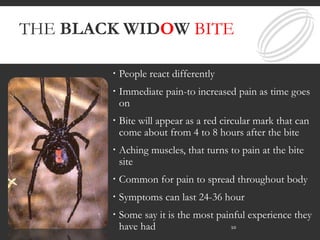
THE BLACK WIDOW BITE
 People react differently
 Immediate pain-to increased pain as time goes
on
 Bite will appear as a red circular mark that can
come about from 4 to 8 hours after the bite
 Aching muscles, that turns to pain at the bite
site
 Common for pain to spread throughout body
 Symptoms can last 24-36 hour
 Some say it is the most painful experience they
have had 10
WHAT TO DO!
 If bitten by Black Widow, call EMT or Poison
Control Center for help in determining whether you
can treat it yourself or will need medical attention
 In some sever cases, antivenin may have to be
administered
 As with all bites, ibuprofen and acetaminophen can
be taken orally along with an ice pack to relieve
swelling
11
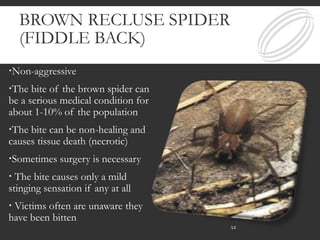
BROWN RECLUSE SPIDER
(FIDDLE BACK)
Non-aggressive
The bite of the brown spider can
be a serious medical condition for
about 1-10% of the population
The bite can be non-healing and
causes tissue death (necrotic)
Sometimes surgery is necessary
 The bite causes only a mild
stinging sensation if any at all
 Victims often are unaware they
have been bitten
12
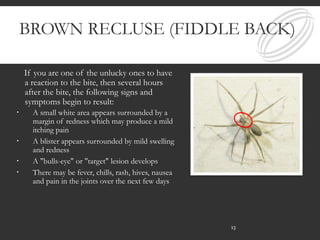
BROWN RECLUSE (FIDDLE BACK)
If you are one of the unlucky ones to have
a reaction to the bite, then several hours
after the bite, the following signs and
symptoms begin to result:
 A small white area appears surrounded by a
margin of redness which may produce a mild
itching pain
 A blister appears surrounded by mild swelling
and redness
 A "bulls-eye" or "target" lesion develops
 There may be fever, chills, rash, hives, nausea
and pain in the joints over the next few days
13
THE GOOD NEWS
 Most people are not going to react to the venom of the brown
recluse as described in these slides. These are the worst case
scenario that we all need to be made aware.
 The fiddle back is called a recluse for a reason. They do not like
humans and are mainly trying to hunt and ambush their prey.
 Watch for paper and wood build up debris piles and mind where
you place your hands.
 Most bites take place on the torso and legs due to getting dressed
and a recluse had climbed into the clothes.
 They must use your clothing to push against to deliver a bite. They
do not have adequate fangs.
14
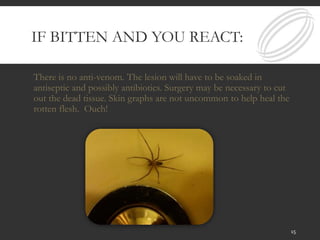
IF BITTEN AND YOU REACT:
There is no anti-venom. The lesion will have to be soaked in
antiseptic and possibly antibiotics. Surgery may be necessary to cut
out the dead tissue. Skin graphs are not uncommon to help heal the
rotten flesh. Ouch!
15
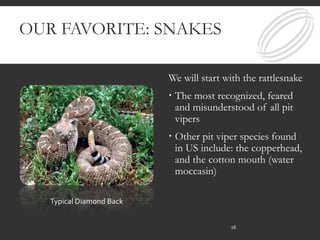
OUR FAVORITE: SNAKES
We will start with the rattlesnake
 The most recognized, feared
and misunderstood of all pit
vipers
 Other pit viper species found
in US include: the copperhead,
and the cotton mouth (water
moccasin)
Typical Diamond Back
16
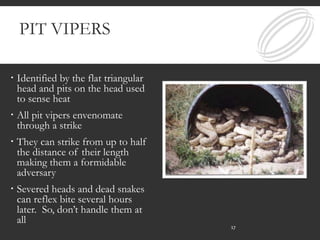
PIT VIPERS
 Identified by the flat triangular
head and pits on the head used
to sense heat
 All pit vipers envenomate
through a strike
 They can strike from up to half
the distance of their length
making them a formidable
adversary
 Severed heads and dead snakes
can reflex bite several hours
later. So, don’t handle them at
all
17
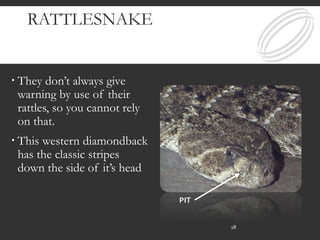
RATTLESNAKE
 They don’t always give
warning by use of their
rattles, so you cannot rely
on that.
 This western diamondback
has the classic stripes
down the side of it’s head
PIT
18
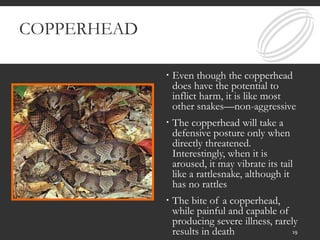
COPPERHEAD
 Even though the copperhead
does have the potential to
inflict harm, it is like most
other snakes—non-aggressive
 The copperhead will take a
defensive posture only when
directly threatened.
Interestingly, when it is
aroused, it may vibrate its tail
like a rattlesnake, although it
has no rattles
 The bite of a copperhead,
while painful and capable of
producing severe illness, rarely
results in death 19
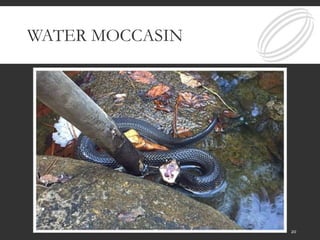
WATER MOCCASIN
20
SNAKE ACTIVITY THAT WE ALL
KNOW
• Being cold blooded, snakes require the sun. So as the
weather gets warmer, snake activity increases, obviously
• As the temperature reaches the low 80’s, be very
mindful
• March and April rattlesnake begin to become active
with August and September being their most active
months
21
ENVENOMATION
Contrary to popular belief….
Not all strikes deliver poison, however, don’t rely on that
fact and neglect getting help.
What is in the venom of a rattlesnake:
 Enzymes that attack tissue at the site that causes sever
damage
 Blood thinners (anti-coagulants) to further injury their
prey
 Side note on the Mohave Rattlesnake: Their venom
contains a neurotoxin that weakens their victims
muscles, this may prevent you from getting help if the
bite is severe enough
22
IF BITTEN BY RATTLESNAKE OR
ANY PIT VIPER
What you are likely to experience:
 Intense and immediate pain at bite site
 You may taste metal (copper) to a latex or rubber flavor
 The limb that was bitten will swell quickly (remove any
jewelry as soon as possible)
 You may feel:
 Weak
 Nauseous (you may vomit)
 You may sweat and/or have chills
23
WHAT TO DO!
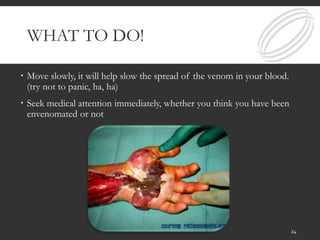
 Move slowly, it will help slow the spread of the venom in your blood.
(try not to panic, ha, ha)
 Seek medical attention immediately, whether you think you have been
envenomated or not
24
WHAT NOT TO DO!
Do not:
Apply ice or ice water
Apply a tourniquet to restrict blood flow
Cut the site
Suck the blood
Apply an electric shock
25
COTTON MOUTH AND COPPERHEAD
Black Tail
Eastern and Western Diamond
Back
Lower Californian
Massasauga
Mojave (Neurotoxin)
Pigmy
Red Diamond
Ridgenose
Rock
Sidewinder
Speckled
Tiger
Timber
Twin-spotted
Western (Prairie, Great Basin
These two are the only pit vipers that do not have rattles, all the other’s do:
26
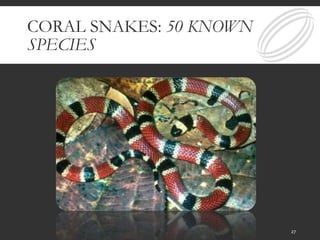
CORAL SNAKES: 50 KNOWN
SPECIES
27
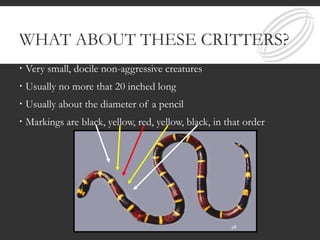
WHAT ABOUT THESE CRITTERS?
 Very small, docile non-aggressive creatures
 Usually no more that 20 inched long
 Usually about the diameter of a pencil
 Markings are black, yellow, red, yellow, black, in that order
28
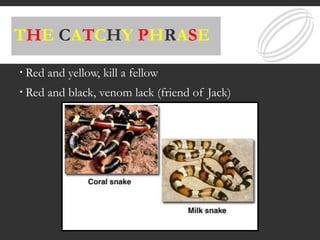
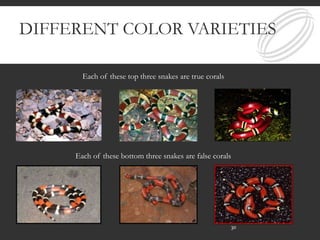
THE CATCHY PHRASE
 Red and yellow, kill a fellow
 Red and black, venom lack (friend of Jack)
29
DIFFERENT COLOR VARIETIES
Each of these top three snakes are true corals
Each of these bottom three snakes are false corals
30
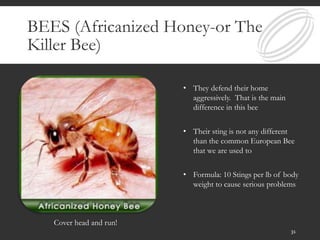
BEES (Africanized Honey-or The
Killer Bee)
• They defend their home
aggressively. That is the main
difference in this bee
• Their sting is not any different
than the common European Bee
that we are used to
• Formula: 10 Stings per lb of body
weight to cause serious problems
Cover head and run!
31
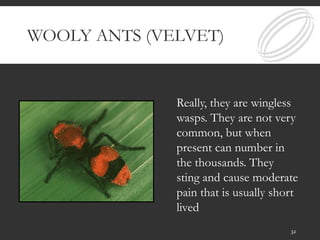
WOOLY ANTS (VELVET)
Really, they are wingless
wasps. They are not very
common, but when
present can number in
the thousands. They
sting and cause moderate
pain that is usually short
lived
32
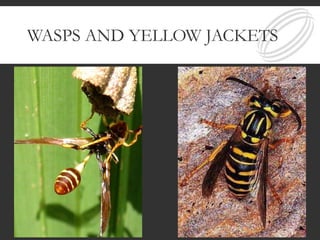
WASPS AND YELLOW JACKETS
33
IF BITTEN BY AN ANT, BEE, WASP,
OR A YELLOW JACKET
Reactions can be different, however, watch for:
 Tightness in the chest
 Problems breathing
 Tongue swelling
 Swelling and redness beyond the bite sting
 Hives
 Drop in blood pressure
 Cardiac arrest (unconsciousness)
We are concerned about anaphylactic shock!
34
BITE AND STING AVOIDANCE
 Always keep your hand where you can see them
 Where long pants
 Where boots that protect your ankles
 Do not pick up any critter if you can avoid it
 Carrying a long stick is a good idea, it can keep snakes
away
 Leave the cologne at home
 Do not disturb nests, hives, etc.
 First aid kits are a must, however, snake bite kits are really
not needed. They usually consist of a blade and alcohol.
35
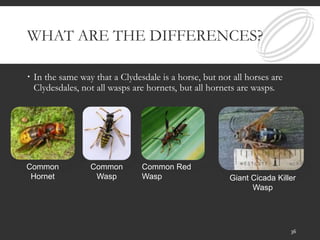
WHAT ARE THE DIFFERENCES?
 In the same way that a Clydesdale is a horse, but not all horses are
Clydesdales, not all wasps are hornets, but all hornets are wasps.
36
Common
Hornet
Common
Wasp
Common Red
Wasp Giant Cicada Killer
Wasp
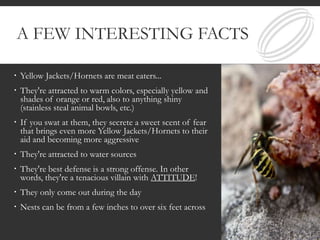
A FEW INTERESTING FACTS
 Yellow Jackets/Hornets are meat eaters...
 They're attracted to warm colors, especially yellow and
shades of orange or red, also to anything shiny
(stainless steal animal bowls, etc.)
 If you swat at them, they secrete a sweet scent of fear
that brings even more Yellow Jackets/Hornets to their
aid and becoming more aggressive
 They're attracted to water sources
 They're best defense is a strong offense. In other
words, they're a tenacious villain with ATTITUDE!
 They only come out during the day
 Nests can be from a few inches to over six feet across
37
MORE FACTS
 Nests can contain up to 45 levels and contain 20,000 adult workers
 Wasps and bees can start stinging in mass if they smell venom. So, move
away quickly
 Approximately 10% of any population of humans will develop an allergy
to wasp venom if stung a few times
 Carrying an antihistamine in both a tablet and a topical cream in your first
aid kit is considered to be a wise choice
 If you are at risk of systemic hypersensitivity reaction to venom, then an
immediate visit to the doctor may and most likely will be necessary
(adrenaline will be provided)
 Wasps, Bees and ants are all the order of “Hymenoptera” (They’re family)
38
WASPS IN GENERAL
 They can be either social or solitary
 Each individual dictates which class it will fall under
based on it’s own physiology and behavior
 Solitary wasps are beneficial, pollinating plants and
acting in a good parasitical role by laying eggs inside
other insect pests hat helps to control populations
39
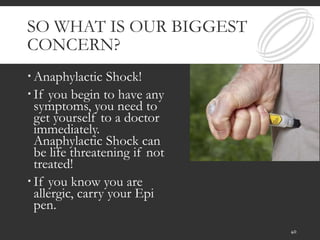
SO WHAT IS OUR BIGGEST
CONCERN?
 Anaphylactic Shock!
 If you begin to have any
symptoms, you need to
get yourself to a doctor
immediately.
Anaphylactic Shock can
be life threatening if not
treated!
 If you know you are
allergic, carry your Epi
pen.
40
OK, WHAT SHOULD I REALLY DO
IF I’M STUNG?
 Apply a cold compress to the area for about 20-30 minutes. DO NOT
put ice directly on the flesh!
 Bathe area in mild solution of vinegar or lemon juice to help neutralize
the venom, and then apply calamine lotion
 If swelling persists, take an antihistamine. You can also take ibuprofen
to help inflammation
 Be extra cautious if stung in mouth, suck on ice or sip cold water to
reduce swelling
 Monitor patient for signs of allergic reaction
41
RABIES
What is Rabies?
Rabies is a preventable viral disease of mammals most often
transmitted through the bite (or scratch) of a rabid animal. The vast
majority of rabies cases reported to the Centers for Disease Control
and Prevention (CDC) each year occur in wild animals like raccoons,
skunks, bats, and foxes. Domestic animals account for less than 10%
of the reported rabies cases, with cats, cattle, and dogs most often
reported rabid
42
HOW QUICKLY DOES THE
RABIES VIRUS WORK?
Rabies virus infects the central nervous system, causing
encephalopathy and ultimately death. Early symptoms of rabies in
humans are nonspecific, consisting of fever, headache, and general
malaise. As the disease progresses, neurological symptoms appear
and may include insomnia, anxiety, confusion, slight or partial
paralysis, excitation, hallucinations, agitation, hypersalivation,
difficulty swallowing, and hydrophobia (fear of water). (Rabies
treatment may be started after the bite or scratch, as determined by
the doctor. It can take days before the virus reached the brain.)
Death usually occurs within days of (after) the onset of symptoms
43
HOW MANY PEOPLE GET RABIES?
Over the last 100 years, rabies in the United States has
changed dramatically. More than 90% of all animal cases
reported annually to CDC now occur in wildlife; before 1960
the majority were in domestic animals. The principal rabies
hosts today are wild carnivores and bats. The number of
rabies-related human deaths in the United States has declined
from more than 100 annually at the turn of the century to
one or two per year in the1990's. Modern day prophylaxis
has proven nearly 100% successful. In the United States,
human fatalities associated with rabies occur in people who
fail to seek medical assistance, usually because they were
unaware of their exposure.
44
WHAT ANIMALS CAN CAUSE
RABIES?
Rabies virus causes an acute encephalitis in all warm-
blooded hosts, including humans, and the outcome is
almost always fatal. Although all species of mammals are
susceptible to rabies virus infection, only a few species are
important as reservoirs for the disease. In the United
States, several distinct rabies virus variants have been
identified in terrestrial mammals, including:
Raccoons, skunks, foxes, and coyotes. In addition to these
terrestrial reservoirs, several species of insectivorous bats
are also reservoirs for rabies. Raccoons continued to be
the most frequently reported rabid wildlife species at
37.2% of all animal cases, followed by skunks at 30.7%,
bats at 17.2%, foxes at 5.9%, and other wild animals,
including rodents and lagomorphs at only 0.7%.
A lagomorph is a bunny. For those who know the scene to
the right, click the this link for a quick laugh.
Deadly Lagomorph
45
REMEMBER
 It’s important to know your animals
 Report any strange animal
 Watch where you place your hands
 Leave the cologne at home
 Watch where you put your hands
 Wear bug repellant
 Keep a lid on your sweet drinks or better yet drink
water. Remember that sports drinks are usually sweet
46
WE’RE HERE FOR YOU, BECAUSE
IT’S ABOUT RELATIONSHIPS
Marilyn Blake
301.220.1085
MAB@telcominsgrp.com
Craig Rapp
903.424.7453
CSR@telcominsgrp.com
47

Bites and stings April 2019

  • 1.
    BITES AND STINGS 1Broughtto you by your Telcom Insurance Risk Management Team
  • 2.
    PURPOSE We would liketo familiarize our customers with potential bites and stings from animals and how to avoid and treat those cases when/if they occur. Occupational exposure to animals and insects should be managed and controlled like any other hazards you employees encounter. 2
  • 3.
    CONENOSE TRIATOMA PROTRACTA AKA: 1. Conenose 2.Kissing Bug 3. Assassin Bug 4. Walapai Tiger 3
  • 4.
    CONENOSE CONTINUED  Usuallynot painful  Redness  Swelling  Itching  Subsequent bites (sensitizers) can lead to more severe reactions-- even anaphylactic shockFeeds on the blood of a sleeping person 4
  • 5.
    IF BITTEN If possible,it is recommended that you attempt to capture the bug for confirmation It is best to call EMS or Poison Control when bitten for advice as to what must be done as each case can be different 5
  • 6.
    SCORPIONS 6 The Arizona Barkis one of the 25 of 2,000 scorpion species that poses a severe threat to humans, other then anaphylactic shock. It’s venom can kill a small human child, but anti-venom is readily available throughout it’s territory. Scorpions can live up to 6-7 years and molt usually yearly. Some can live up to 25 years in captivity…if you’re so inclined to have one for a pet.
  • 7.
    SCORPIONS CONTINUED  Theycan live up to a year without eating, and they can stay submerged for up to 48 hours. Yes, 48 hours  They are tough. Maybe even more so then the roach  Scorpions are arthropods that belong to the Class Arachnida, the arachnids. These include spiders, harvestmen, ticks and mites, and all manner of scorpion-like creatures that aren't really scorpions: whip-scorpions, pseudo-scorpions, and wind- scorpions  Although scorpions share anatomical similarities with all of the other arachnids, scientists who study their evolution believe they are most closely related to harvestmen (Opiliones) or the Daddy Long Legs 7
  • 8.
    THE BLACK WIDOWSPIDER  Found all along the home, from furniture to drain pipes  Food and water will usually be plentiful  Not as aggressive as some, but not docile either  Most active in the evening The Brown Widow 8
  • 9.
    THE BLACK WIDOWSPIDER • The male widow does not have large enough fangs to penetrate human skin; so, it is not dangerous • The female produces hundreds of eggs that scatter readily upon hatching • A strong insecticide is recommended to control a problem population • You must also destroy the egg sacks to be effective BlackWidow Brown Widow 9
  • 10.
    THE BLACK WIDOWBITE  People react differently  Immediate pain-to increased pain as time goes on  Bite will appear as a red circular mark that can come about from 4 to 8 hours after the bite  Aching muscles, that turns to pain at the bite site  Common for pain to spread throughout body  Symptoms can last 24-36 hour  Some say it is the most painful experience they have had 10
  • 11.
    WHAT TO DO! If bitten by Black Widow, call EMT or Poison Control Center for help in determining whether you can treat it yourself or will need medical attention  In some sever cases, antivenin may have to be administered  As with all bites, ibuprofen and acetaminophen can be taken orally along with an ice pack to relieve swelling 11
  • 12.
    BROWN RECLUSE SPIDER (FIDDLEBACK) Non-aggressive The bite of the brown spider can be a serious medical condition for about 1-10% of the population The bite can be non-healing and causes tissue death (necrotic) Sometimes surgery is necessary  The bite causes only a mild stinging sensation if any at all  Victims often are unaware they have been bitten 12
  • 13.
    BROWN RECLUSE (FIDDLEBACK) If you are one of the unlucky ones to have a reaction to the bite, then several hours after the bite, the following signs and symptoms begin to result:  A small white area appears surrounded by a margin of redness which may produce a mild itching pain  A blister appears surrounded by mild swelling and redness  A "bulls-eye" or "target" lesion develops  There may be fever, chills, rash, hives, nausea and pain in the joints over the next few days 13
  • 14.
    THE GOOD NEWS Most people are not going to react to the venom of the brown recluse as described in these slides. These are the worst case scenario that we all need to be made aware.  The fiddle back is called a recluse for a reason. They do not like humans and are mainly trying to hunt and ambush their prey.  Watch for paper and wood build up debris piles and mind where you place your hands.  Most bites take place on the torso and legs due to getting dressed and a recluse had climbed into the clothes.  They must use your clothing to push against to deliver a bite. They do not have adequate fangs. 14
  • 15.
    IF BITTEN ANDYOU REACT: There is no anti-venom. The lesion will have to be soaked in antiseptic and possibly antibiotics. Surgery may be necessary to cut out the dead tissue. Skin graphs are not uncommon to help heal the rotten flesh. Ouch! 15
  • 16.
    OUR FAVORITE: SNAKES Wewill start with the rattlesnake  The most recognized, feared and misunderstood of all pit vipers  Other pit viper species found in US include: the copperhead, and the cotton mouth (water moccasin) Typical Diamond Back 16
  • 17.
    PIT VIPERS  Identifiedby the flat triangular head and pits on the head used to sense heat  All pit vipers envenomate through a strike  They can strike from up to half the distance of their length making them a formidable adversary  Severed heads and dead snakes can reflex bite several hours later. So, don’t handle them at all 17
  • 18.
    RATTLESNAKE  They don’talways give warning by use of their rattles, so you cannot rely on that.  This western diamondback has the classic stripes down the side of it’s head PIT 18
  • 19.
    COPPERHEAD  Even thoughthe copperhead does have the potential to inflict harm, it is like most other snakes—non-aggressive  The copperhead will take a defensive posture only when directly threatened. Interestingly, when it is aroused, it may vibrate its tail like a rattlesnake, although it has no rattles  The bite of a copperhead, while painful and capable of producing severe illness, rarely results in death 19
  • 20.
  • 21.
    SNAKE ACTIVITY THATWE ALL KNOW • Being cold blooded, snakes require the sun. So as the weather gets warmer, snake activity increases, obviously • As the temperature reaches the low 80’s, be very mindful • March and April rattlesnake begin to become active with August and September being their most active months 21
  • 22.
    ENVENOMATION Contrary to popularbelief…. Not all strikes deliver poison, however, don’t rely on that fact and neglect getting help. What is in the venom of a rattlesnake:  Enzymes that attack tissue at the site that causes sever damage  Blood thinners (anti-coagulants) to further injury their prey  Side note on the Mohave Rattlesnake: Their venom contains a neurotoxin that weakens their victims muscles, this may prevent you from getting help if the bite is severe enough 22
  • 23.
    IF BITTEN BYRATTLESNAKE OR ANY PIT VIPER What you are likely to experience:  Intense and immediate pain at bite site  You may taste metal (copper) to a latex or rubber flavor  The limb that was bitten will swell quickly (remove any jewelry as soon as possible)  You may feel:  Weak  Nauseous (you may vomit)  You may sweat and/or have chills 23
  • 24.
    WHAT TO DO! Move slowly, it will help slow the spread of the venom in your blood. (try not to panic, ha, ha)  Seek medical attention immediately, whether you think you have been envenomated or not 24
  • 25.
    WHAT NOT TODO! Do not: Apply ice or ice water Apply a tourniquet to restrict blood flow Cut the site Suck the blood Apply an electric shock 25
  • 26.
    COTTON MOUTH ANDCOPPERHEAD Black Tail Eastern and Western Diamond Back Lower Californian Massasauga Mojave (Neurotoxin) Pigmy Red Diamond Ridgenose Rock Sidewinder Speckled Tiger Timber Twin-spotted Western (Prairie, Great Basin These two are the only pit vipers that do not have rattles, all the other’s do: 26
  • 27.
    CORAL SNAKES: 50KNOWN SPECIES 27
  • 28.
    WHAT ABOUT THESECRITTERS?  Very small, docile non-aggressive creatures  Usually no more that 20 inched long  Usually about the diameter of a pencil  Markings are black, yellow, red, yellow, black, in that order 28
  • 29.
    THE CATCHY PHRASE Red and yellow, kill a fellow  Red and black, venom lack (friend of Jack) 29
  • 30.
    DIFFERENT COLOR VARIETIES Eachof these top three snakes are true corals Each of these bottom three snakes are false corals 30
  • 31.
    BEES (Africanized Honey-orThe Killer Bee) • They defend their home aggressively. That is the main difference in this bee • Their sting is not any different than the common European Bee that we are used to • Formula: 10 Stings per lb of body weight to cause serious problems Cover head and run! 31
  • 32.
    WOOLY ANTS (VELVET) Really,they are wingless wasps. They are not very common, but when present can number in the thousands. They sting and cause moderate pain that is usually short lived 32
  • 33.
    WASPS AND YELLOWJACKETS 33
  • 34.
    IF BITTEN BYAN ANT, BEE, WASP, OR A YELLOW JACKET Reactions can be different, however, watch for:  Tightness in the chest  Problems breathing  Tongue swelling  Swelling and redness beyond the bite sting  Hives  Drop in blood pressure  Cardiac arrest (unconsciousness) We are concerned about anaphylactic shock! 34
  • 35.
    BITE AND STINGAVOIDANCE  Always keep your hand where you can see them  Where long pants  Where boots that protect your ankles  Do not pick up any critter if you can avoid it  Carrying a long stick is a good idea, it can keep snakes away  Leave the cologne at home  Do not disturb nests, hives, etc.  First aid kits are a must, however, snake bite kits are really not needed. They usually consist of a blade and alcohol. 35
  • 36.
    WHAT ARE THEDIFFERENCES?  In the same way that a Clydesdale is a horse, but not all horses are Clydesdales, not all wasps are hornets, but all hornets are wasps. 36 Common Hornet Common Wasp Common Red Wasp Giant Cicada Killer Wasp
  • 37.
    A FEW INTERESTINGFACTS  Yellow Jackets/Hornets are meat eaters...  They're attracted to warm colors, especially yellow and shades of orange or red, also to anything shiny (stainless steal animal bowls, etc.)  If you swat at them, they secrete a sweet scent of fear that brings even more Yellow Jackets/Hornets to their aid and becoming more aggressive  They're attracted to water sources  They're best defense is a strong offense. In other words, they're a tenacious villain with ATTITUDE!  They only come out during the day  Nests can be from a few inches to over six feet across 37
  • 38.
    MORE FACTS  Nestscan contain up to 45 levels and contain 20,000 adult workers  Wasps and bees can start stinging in mass if they smell venom. So, move away quickly  Approximately 10% of any population of humans will develop an allergy to wasp venom if stung a few times  Carrying an antihistamine in both a tablet and a topical cream in your first aid kit is considered to be a wise choice  If you are at risk of systemic hypersensitivity reaction to venom, then an immediate visit to the doctor may and most likely will be necessary (adrenaline will be provided)  Wasps, Bees and ants are all the order of “Hymenoptera” (They’re family) 38
  • 39.
    WASPS IN GENERAL They can be either social or solitary  Each individual dictates which class it will fall under based on it’s own physiology and behavior  Solitary wasps are beneficial, pollinating plants and acting in a good parasitical role by laying eggs inside other insect pests hat helps to control populations 39
  • 40.
    SO WHAT ISOUR BIGGEST CONCERN?  Anaphylactic Shock!  If you begin to have any symptoms, you need to get yourself to a doctor immediately. Anaphylactic Shock can be life threatening if not treated!  If you know you are allergic, carry your Epi pen. 40
  • 41.
    OK, WHAT SHOULDI REALLY DO IF I’M STUNG?  Apply a cold compress to the area for about 20-30 minutes. DO NOT put ice directly on the flesh!  Bathe area in mild solution of vinegar or lemon juice to help neutralize the venom, and then apply calamine lotion  If swelling persists, take an antihistamine. You can also take ibuprofen to help inflammation  Be extra cautious if stung in mouth, suck on ice or sip cold water to reduce swelling  Monitor patient for signs of allergic reaction 41
  • 42.
    RABIES What is Rabies? Rabiesis a preventable viral disease of mammals most often transmitted through the bite (or scratch) of a rabid animal. The vast majority of rabies cases reported to the Centers for Disease Control and Prevention (CDC) each year occur in wild animals like raccoons, skunks, bats, and foxes. Domestic animals account for less than 10% of the reported rabies cases, with cats, cattle, and dogs most often reported rabid 42
  • 43.
    HOW QUICKLY DOESTHE RABIES VIRUS WORK? Rabies virus infects the central nervous system, causing encephalopathy and ultimately death. Early symptoms of rabies in humans are nonspecific, consisting of fever, headache, and general malaise. As the disease progresses, neurological symptoms appear and may include insomnia, anxiety, confusion, slight or partial paralysis, excitation, hallucinations, agitation, hypersalivation, difficulty swallowing, and hydrophobia (fear of water). (Rabies treatment may be started after the bite or scratch, as determined by the doctor. It can take days before the virus reached the brain.) Death usually occurs within days of (after) the onset of symptoms 43
  • 44.
    HOW MANY PEOPLEGET RABIES? Over the last 100 years, rabies in the United States has changed dramatically. More than 90% of all animal cases reported annually to CDC now occur in wildlife; before 1960 the majority were in domestic animals. The principal rabies hosts today are wild carnivores and bats. The number of rabies-related human deaths in the United States has declined from more than 100 annually at the turn of the century to one or two per year in the1990's. Modern day prophylaxis has proven nearly 100% successful. In the United States, human fatalities associated with rabies occur in people who fail to seek medical assistance, usually because they were unaware of their exposure. 44
  • 45.
    WHAT ANIMALS CANCAUSE RABIES? Rabies virus causes an acute encephalitis in all warm- blooded hosts, including humans, and the outcome is almost always fatal. Although all species of mammals are susceptible to rabies virus infection, only a few species are important as reservoirs for the disease. In the United States, several distinct rabies virus variants have been identified in terrestrial mammals, including: Raccoons, skunks, foxes, and coyotes. In addition to these terrestrial reservoirs, several species of insectivorous bats are also reservoirs for rabies. Raccoons continued to be the most frequently reported rabid wildlife species at 37.2% of all animal cases, followed by skunks at 30.7%, bats at 17.2%, foxes at 5.9%, and other wild animals, including rodents and lagomorphs at only 0.7%. A lagomorph is a bunny. For those who know the scene to the right, click the this link for a quick laugh. Deadly Lagomorph 45
  • 46.
    REMEMBER  It’s importantto know your animals  Report any strange animal  Watch where you place your hands  Leave the cologne at home  Watch where you put your hands  Wear bug repellant  Keep a lid on your sweet drinks or better yet drink water. Remember that sports drinks are usually sweet 46
  • 47.
    WE’RE HERE FORYOU, BECAUSE IT’S ABOUT RELATIONSHIPS Marilyn Blake 301.220.1085 MAB@telcominsgrp.com Craig Rapp 903.424.7453 CSR@telcominsgrp.com 47