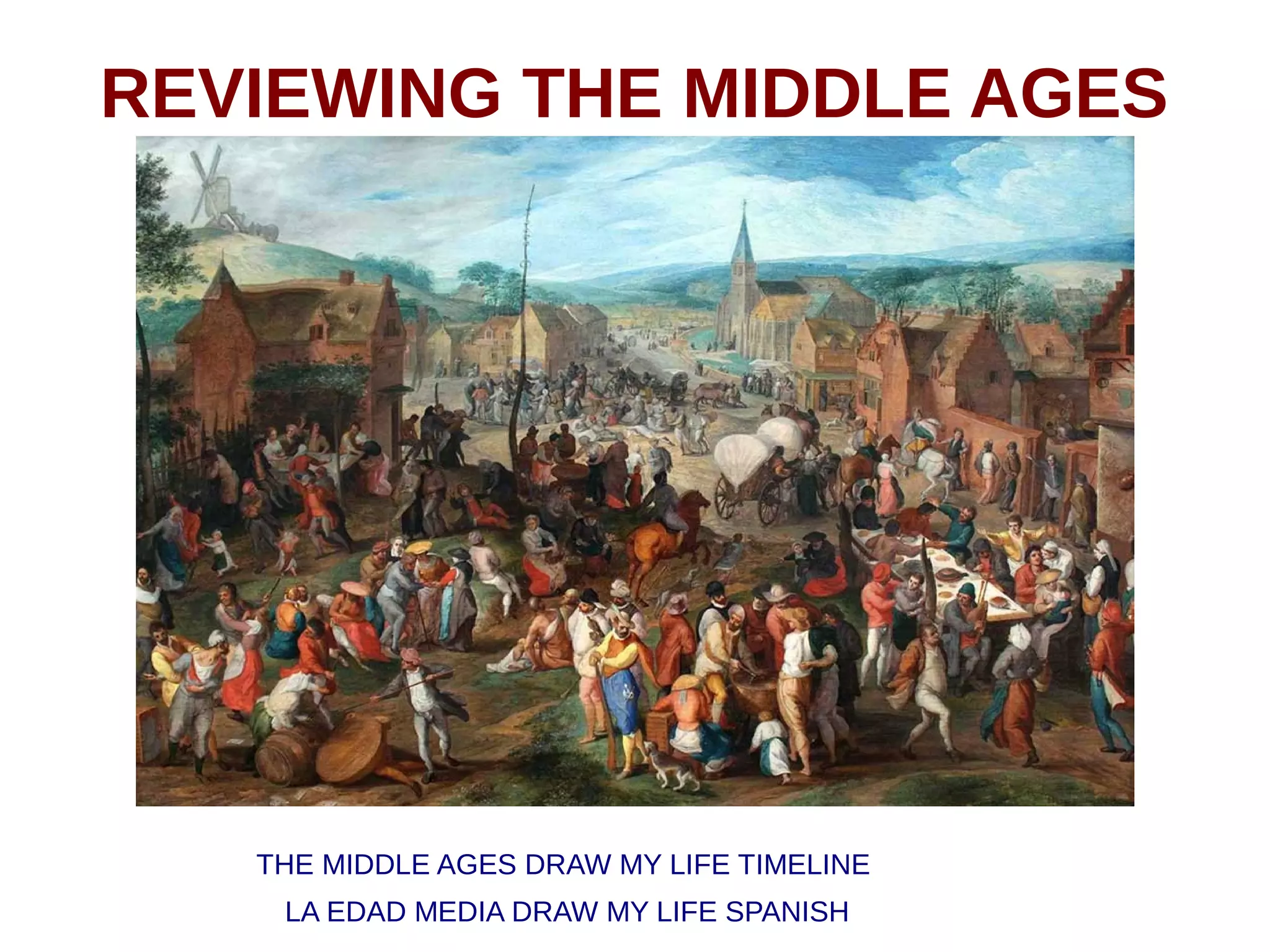
REVIEWING THE MIDDLE AGES
THE MIDDLE AGES DRAW MY LIFE TIMELINE
LA EDAD MEDIA DRAW MY LIFE SPANISH
THE MIDDLE AGES
POLITICS SOCIETY ECONOMY CULTURE
Do you remember
many things about
the Middle Ages??? I passed the exams last year
But no idea about all of thesw...
Plase...No more history....
(YES/NO).
Yes. Perfect. You will know how is not going to be
the lifestyle in the following ages... (THE MODERN
AGES
No, it doesn't really matter... because most aspects
of society, economy, politics, even religion will
change...
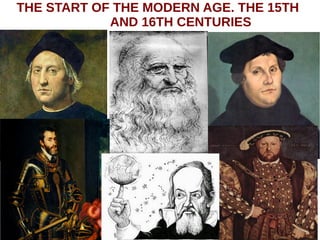
THE START OF THE MODERN AGE. THE 15TH
AND 16TH CENTURIES
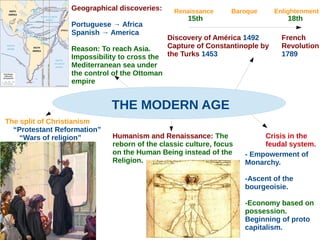
THE MODERN AGE
15th 18th
Discovery of América 1492
Capture of Constantinople by
the Turks 1453
French
Revolution:
1789
Geographical discoveries:
Portuguese → Africa
Spanish → America
Reason: To reach Asia.
Impossibility to cross the
Mediterranean sea under
the control of the Ottoman
empire
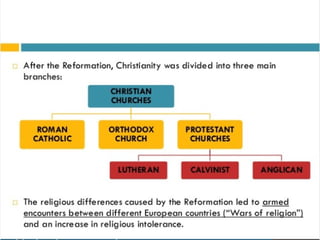
The split of Christianism
“Protestant Reformation”
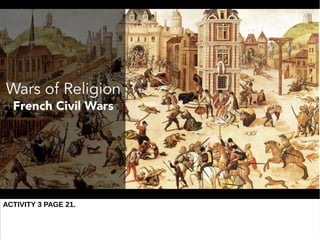
“Wars of religion” Humanism and Renaissance: The
reborn of the classic culture, focus
on the Human Being instead of the
Religion.
Crisis in the
feudal system.
- Empowerment of
Monarchy.
-Ascent of the
bourgeoisie.
-Economy based on
possession.
Beginning of proto
capitalism.
Renaissance Baroque Enlightenment
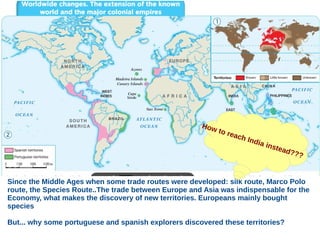
Since the Middle Ages when some trade routes were developed: silk route, Marco Polo
route, the Species Route..The trade between Europe and Asia was indispensable for the
Economy, what makes the discovery of new territories. Europeans mainly bought
species
But... why some portuguese and spanish explorers discovered these territories?
How to reach India instead???
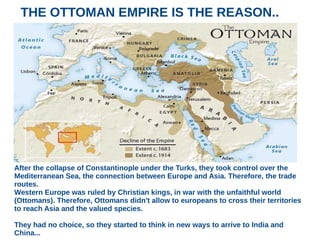
THE OTTOMAN EMPIRE IS THE REASON..
After the collapse of Constantinople under the Turks, they took control over the
Mediterranean Sea, the connection between Europe and Asia. Therefore, the trade
routes.
Western Europe was ruled by Christian kings, in war with the unfaithful world
(Ottomans). Therefore, Ottomans didn't allow to europeans to cross their territories
to reach Asia and the valued species.
They had no choice, so they started to think in new ways to arrive to India and
China...
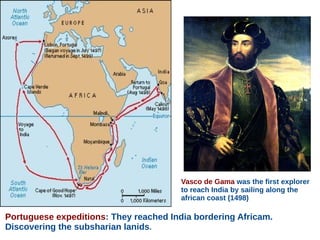
Portuguese expeditions: They reached India bordering Africam.
Discovering the subsharian lanids.
Vasco de Gama was the first explorer
to reach India by sailing along the
african coast (1498)
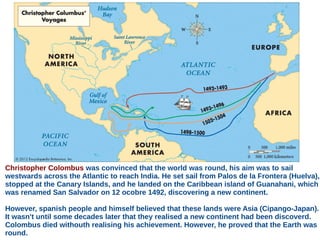
Christopher Colombus was convinced that the world was round, his aim was to sail
westwards across the Atlantic to reach India. He set sail from Palos de la Frontera (Huelva),
stopped at the Canary Islands, and he landed on the Caribbean island of Guanahani, which
was renamed San Salvador on 12 ocobre 1492, discovering a new continent.
However, spanish people and himself believed that these lands were Asia (Cipango-Japan).
It wasn't until some decades later that they realised a new continent had been discoverd.
Colombus died withouth realising his achievement. However, he proved that the Earth was
round.
THE MODERN AGE
FROM THE FEUDAL SYSTEM TO THE MODERN
WORLD
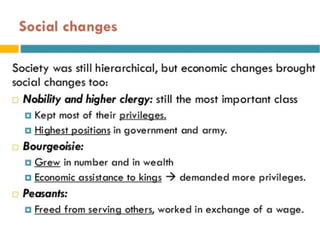
● In political terms, MONARCHS ruled over nobility and city
goverments.
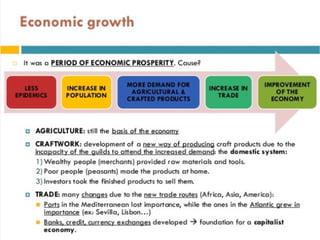
● Commerce became the main economic activity, more
important than agriculture (the base of the feudalism and the
feudal relations).
● The bourgeoisie made considerable fortunes due to the
commerce. Therefore, they increased their social status.
● It's the ending of the theocentrism (the belief that God is the
central aspect to our existence) replaced by the
anthropocentrism (The Human Being is the most significant
entity of the universe)
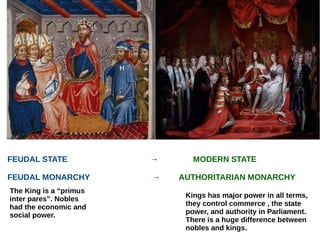
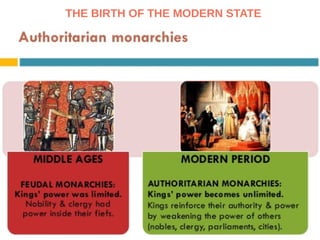
FEUDAL STATE → MODERN STATE
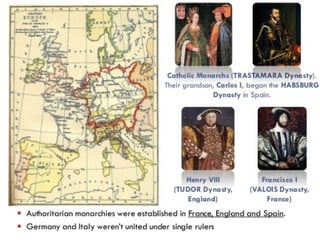
FEUDAL MONARCHY → AUTHORITARIAN MONARCHY
The King is a “primus
inter pares”. Nobles
had the economic and
social power.
Kings has major power in all terms,
they control commerce , the state
power, and authority in Parliament.
There is a huge difference between
nobles and kings.
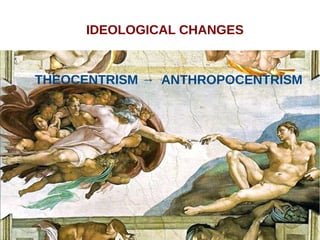
IDEOLOGICAL CHANGES
THEOCENTRISM → ANTHROPOCENTRISM
THE BIRTH OF THE MODERN STATE
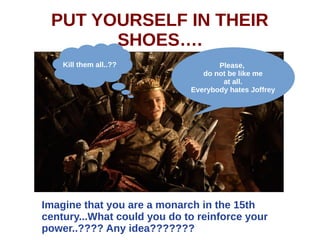
PUT YOURSELF IN THEIR
SHOES….
Imagine that you are a monarch in the 15th
century...What could you do to reinforce your
power..???? Any idea???????
Please,
do not be like me
at all.
Everybody hates Joffrey
Kill them all..??
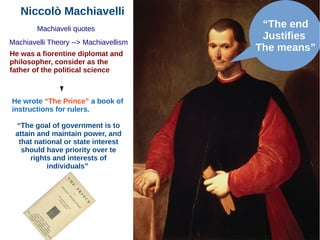
Niccolò Machiavelli
Machiaveli quotes
He was a fiorentine diplomat and
philosopher, consider as the
father of the political science
Machiavelli Theory --> Machiavellism
He wrote “The Prince” a book of
instructions for rulers.
“The goal of government is to
attain and maintain power, and
that national or state interest
should have priority over te
rights and interests of
individuals”
“The end
Justifies
The means”
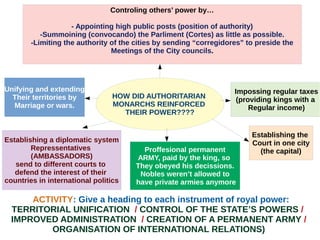
HOW DID AUTHORITARIAN
MONARCHS REINFORCED
THEIR POWER????
Controling others’ power by…
- Appointing high public posts (position of authority)
-Summoining (convocando) the Parliment (Cortes) as little as possible.
-Limiting the authority of the cities by sending “corregidores” to preside the
Meetings of the City councils.
Unifying and extending
Their territories by
Marriage or wars.
Impossing regular taxes
(providing kings with a
Regular income)
Establishing a diplomatic system
Repressentatives
(AMBASSADORS)
send to different courts to
defend the interest of their
countries in international politics
Proffesional permanent
ARMY, paid by the king, so
They obeyed his decissions.
Nobles weren’t allowed to
have private armies anymore
Establishing the
Court in one city
(the capital)
ACTIVITY: Give a heading to each instrument of royal power:
TERRITORIAL UNIFICATION / CONTROL OF THE STATE’S POWERS /
IMPROVED ADMINISTRATION / CREATION OF A PERMANENT ARMY /
ORGANISATION OF INTERNATIONAL RELATIONS)
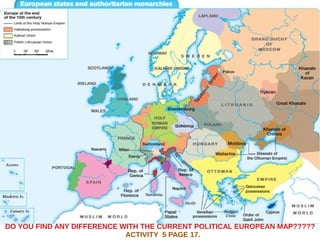
DO YOU FIND ANY DIFFERENCE WITH THE CURRENT POLITICAL EUROPEAN MAP?????
ACTIVITY 5 PAGE 17.
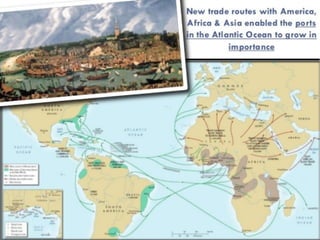
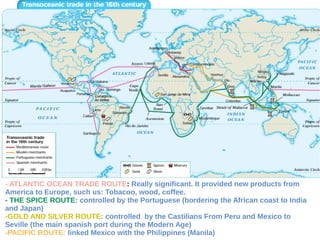
- ATLANTIC OCEAN TRADE ROUTE: Really significant. It provided new products from
America to Europe, such us: Tobacoo, wood, coffee.
- THE SPICE ROUTE: controlled by the Portuguese (bordering the African coast to India
and Japan)
-GOLD AND SILVER ROUTE: controlled by the Castilians From Peru and Mexico to
Seville (the main spanish port during the Modern Age)
-PACIFIC ROUTE: linked Mexico with the Philippines (Manila)
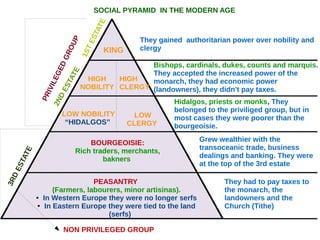
SOCIAL PYRAMID IN THE MODERN AGE
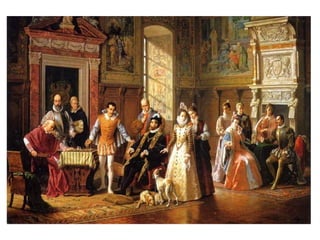
KING
They gained authoritarian power over nobility and
clergy
HIGH
NOBILITY
LOW NOBILITY
“HIDALGOS”
LOW
CLERGY
HIGH
CLERGY
Bishops, cardinals, dukes, counts and marquis.
They accepted the increased power of the
monarch, they had economic power
(landowners), they didn't pay taxes.
Hidalgos, priests or monks, They
belonged to the priviliged group, but in
most cases they were poorer than the
bourgeoisie.
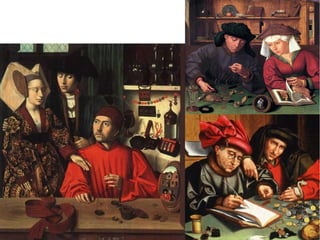
BOURGEOISIE:
Rich traders, merchants,
bakners
Grew wealthier with the
transoceanic trade, business
dealings and banking. They were
at the top of the 3rd estate
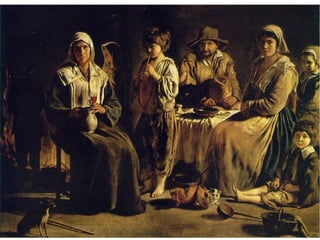
PEASANTRY
(Farmers, labourers, minor artisinas).
● In Western Europe they were no longer serfs
● In Eastern Europe they were tied to the land
(serfs)
They had to pay taxes to
the monarch, the
landowners and the
Church (Tithe)
PRIVILEGEDGROUP
1STESTATE
2ND
ESTATE
3RDESTATE
NON PRIVILEGED GROUP
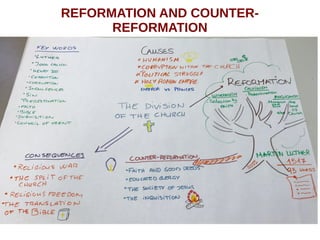
REFORMATION AND COUNTER-
REFORMATION
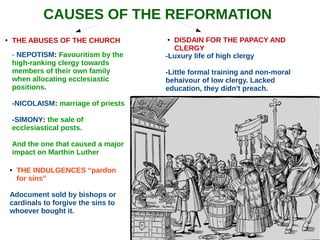
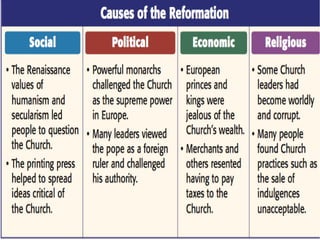
CAUSES OF THE REFORMATION
● THE ABUSES OF THE CHURCH
- NEPOTISM: Favouritism by the
high-ranking clergy towards
members of their own family
when allocating ecclesiastic
positions.
-NICOLAISM: marriage of priests
-SIMONY: the sale of
ecclesiastical posts.
And the one that caused a major
impact on Marthin Luther
● THE INDULGENCES “pardon
for sins”
Adocument sold by bishops or
cardinals to forgive the sins to
whoever bought it.
-Luxury life of high clergy
-Little formal training and non-moral
behaivour of low clergy. Lacked
education, they didn't preach.
● DISDAIN FOR THE PAPACY AND
CLERGY
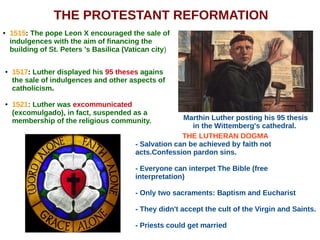
THE PROTESTANT REFORMATION
Marthin Luther posting his 95 thesis
in the Wittemberg's cathedral.
● 1515: The pope Leon X encouraged the sale of
indulgences with the aim of financing the
building of St. Peters 's Basilica (Vatican city)
● 1517: Luther displayed his 95 theses agains
the sale of indulgences and other aspects of
catholicism.
● 1521: Luther was excommunicated
(excomulgado), in fact, suspended as a
membership of the religious community.
THE LUTHERAN DOGMA
- Salvation can be achieved by faith not
acts.Confession pardon sins.
- Everyone can interpet The Bible (free
interpretation)
- Only two sacraments: Baptism and Eucharist
- They didn't accept the cult of the Virgin and Saints.
- Priests could get married
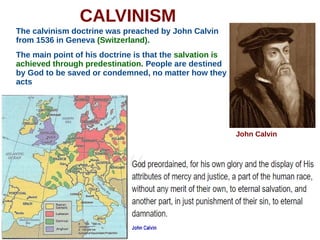
CALVINISM
The calvinism doctrine was preached by John Calvin
from 1536 in Geneva (Switzerland).
The main point of his doctrine is that the salvation is
achieved through predestination. People are destined
by God to be saved or condemned, no matter how they
acts
John Calvin
HENRY VIII - THE SIMPSONS
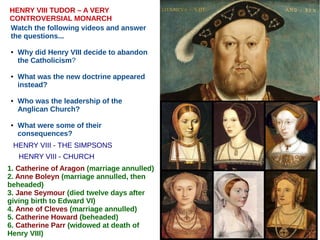
HENRY VIII TUDOR – A VERY
CONTROVERSIAL MONARCH
Watch the following videos and answer
the questions...
● Why did Henry VIII decide to abandon
the Catholicism?
● What was the new doctrine appeared
instead?
● Who was the leadership of the
Anglican Church?
● What were some of their
consequences?
1. Catherine of Aragon (marriage annulled)
2. Anne Boleyn (marriage annulled, then
beheaded)
3. Jane Seymour (died twelve days after
giving birth to Edward VI)
4. Anne of Cleves (marriage annulled)
5. Catherine Howard (beheaded)
6. Catherine Parr (widowed at death of
Henry VIII)
HENRY VIII - CHURCH
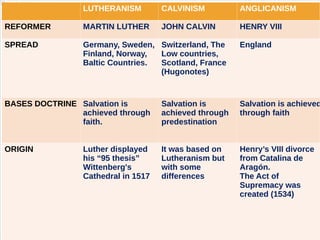
LUTHERANISM CALVINISM ANGLICANISM
REFORMER MARTIN LUTHER JOHN CALVIN HENRY VIII
SPREAD Germany, Sweden,
Finland, Norway,
Baltic Countries.
Switzerland, The
Low countries,
Scotland, France
(Hugonotes)
England
BASES DOCTRINE Salvation is
achieved through
faith.
Salvation is
achieved through
predestination
Salvation is achieved
through faith
ORIGIN Luther displayed
his “95 thesis”
Wittenberg's
Cathedral in 1517
It was based on
Lutheranism but
with some
differences
Henry’s VIII divorce
from Catalina de
Aragón.
The Act of
Supremacy was
created (1534)
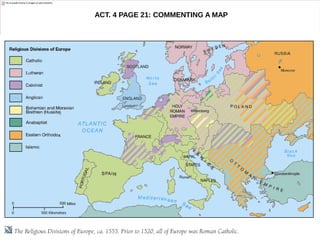
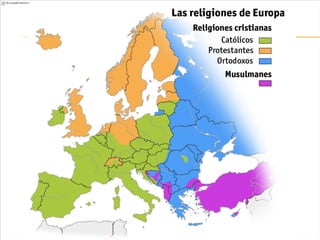
ACT. 4 PAGE 21: COMMENTING A MAP
ACTIVITY 3 PAGE 21.
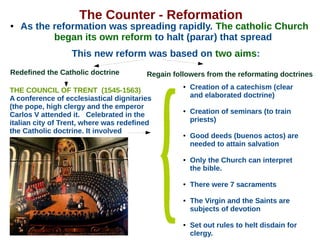
The Counter - Reformation
● As the reformation was spreading rapidly. The catholic Church
began its own reform to halt (parar) that spread
This new reform was based on two aims:
THE COUNCIL OF TRENT (1545-1563)
A conference of ecclesiastical dignitaries
(the pope, high clergy and the emperor
Carlos V attended it. Celebrated in the
italian city of Trent, where was redefined
the Catholic doctrine. It involved
● Creation of a catechism (clear
and elaborated doctrine)
● Creation of seminars (to train
priests)
● Good deeds (buenos actos) are
needed to attain salvation
● Only the Church can interpret
the bible.
● There were 7 sacraments
● The Virgin and the Saints are
subjects of devotion
● Set out rules to helt disdain for
clergy.
Regain followers from the reformating doctrinesRedefined the Catholic doctrine
THE CATHOLIC COUNTER- REFORMATION
● What it was?
● Why did it happen?
● When and Where did it happen?
● What were their consequences?
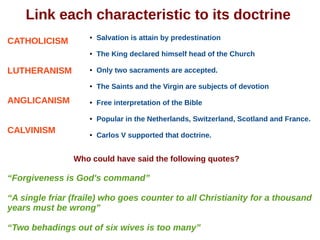
Link each characteristic to its doctrine
CATHOLICISM
LUTHERANISM
ANGLICANISM
CALVINISM
● Salvation is attain by predestination
● The King declared himself head of the Church
● Only two sacraments are accepted.
● The Saints and the Virgin are subjects of devotion
● Free interpretation of the Bible
● Popular in the Netherlands, Switzerland, Scotland and France.
● Carlos V supported that doctrine.
Who could have said the following quotes?
“Forgiveness is God's command”
“A single friar (fraile) who goes counter to all Christianity for a thousand
years must be wrong”
“Two behadings out of six wives is too many”
VOCABULARY
● Humanism: intellectual movement that admired
the Classical Age, considered human beings to
be the centre of the universe and used reason
to explain reality,. It was developed during the
Renaissance in Europe.
● Renaissance: it is a historical period between
the 15th and 16th century, considered the
bridge between the Middle Ages and Modern
Age. It started in Italy as a cultural movement
derived from the rediscovery of classical Greek
and Romans culture. It is in real conection with
the humanism. It was also an artistic style.
● Reformation: religious movement begun by
Martin Luther in the 16th century as a result
of corruption in the church. It led to the split
of the Church into Protestantism and
Catholicism.
● Counter-Reformation: internal reform of the
Catholic Church to combat the rise of
Protestantism and also to improve the
catholic doctrine.

The modern age

  • 1.
    REVIEWING THE MIDDLEAGES THE MIDDLE AGES DRAW MY LIFE TIMELINE LA EDAD MEDIA DRAW MY LIFE SPANISH
  • 2.
    THE MIDDLE AGES POLITICSSOCIETY ECONOMY CULTURE
  • 3.
    Do you remember manythings about the Middle Ages??? I passed the exams last year But no idea about all of thesw... Plase...No more history.... (YES/NO). Yes. Perfect. You will know how is not going to be the lifestyle in the following ages... (THE MODERN AGES No, it doesn't really matter... because most aspects of society, economy, politics, even religion will change...
  • 4.
    THE START OFTHE MODERN AGE. THE 15TH AND 16TH CENTURIES
  • 5.
    THE MODERN AGE 15th18th Discovery of América 1492 Capture of Constantinople by the Turks 1453 French Revolution: 1789 Geographical discoveries: Portuguese → Africa Spanish → America Reason: To reach Asia. Impossibility to cross the Mediterranean sea under the control of the Ottoman empire The split of Christianism “Protestant Reformation” “Wars of religion” Humanism and Renaissance: The reborn of the classic culture, focus on the Human Being instead of the Religion. Crisis in the feudal system. - Empowerment of Monarchy. -Ascent of the bourgeoisie. -Economy based on possession. Beginning of proto capitalism. Renaissance Baroque Enlightenment
  • 6.
    Since the MiddleAges when some trade routes were developed: silk route, Marco Polo route, the Species Route..The trade between Europe and Asia was indispensable for the Economy, what makes the discovery of new territories. Europeans mainly bought species But... why some portuguese and spanish explorers discovered these territories? How to reach India instead???
  • 7.
    THE OTTOMAN EMPIREIS THE REASON.. After the collapse of Constantinople under the Turks, they took control over the Mediterranean Sea, the connection between Europe and Asia. Therefore, the trade routes. Western Europe was ruled by Christian kings, in war with the unfaithful world (Ottomans). Therefore, Ottomans didn't allow to europeans to cross their territories to reach Asia and the valued species. They had no choice, so they started to think in new ways to arrive to India and China...
  • 8.
    Portuguese expeditions: Theyreached India bordering Africam. Discovering the subsharian lanids. Vasco de Gama was the first explorer to reach India by sailing along the african coast (1498)
  • 9.
    Christopher Colombus wasconvinced that the world was round, his aim was to sail westwards across the Atlantic to reach India. He set sail from Palos de la Frontera (Huelva), stopped at the Canary Islands, and he landed on the Caribbean island of Guanahani, which was renamed San Salvador on 12 ocobre 1492, discovering a new continent. However, spanish people and himself believed that these lands were Asia (Cipango-Japan). It wasn't until some decades later that they realised a new continent had been discoverd. Colombus died withouth realising his achievement. However, he proved that the Earth was round.
  • 10.
    THE MODERN AGE FROMTHE FEUDAL SYSTEM TO THE MODERN WORLD ● In political terms, MONARCHS ruled over nobility and city goverments. ● Commerce became the main economic activity, more important than agriculture (the base of the feudalism and the feudal relations). ● The bourgeoisie made considerable fortunes due to the commerce. Therefore, they increased their social status. ● It's the ending of the theocentrism (the belief that God is the central aspect to our existence) replaced by the anthropocentrism (The Human Being is the most significant entity of the universe)
  • 11.
    FEUDAL STATE →MODERN STATE FEUDAL MONARCHY → AUTHORITARIAN MONARCHY The King is a “primus inter pares”. Nobles had the economic and social power. Kings has major power in all terms, they control commerce , the state power, and authority in Parliament. There is a huge difference between nobles and kings.
  • 12.
  • 13.
    THE BIRTH OFTHE MODERN STATE
  • 14.
    PUT YOURSELF INTHEIR SHOES…. Imagine that you are a monarch in the 15th century...What could you do to reinforce your power..???? Any idea??????? Please, do not be like me at all. Everybody hates Joffrey Kill them all..??
  • 15.
    Niccolò Machiavelli Machiaveli quotes Hewas a fiorentine diplomat and philosopher, consider as the father of the political science Machiavelli Theory --> Machiavellism He wrote “The Prince” a book of instructions for rulers. “The goal of government is to attain and maintain power, and that national or state interest should have priority over te rights and interests of individuals” “The end Justifies The means”
  • 16.
    HOW DID AUTHORITARIAN MONARCHSREINFORCED THEIR POWER???? Controling others’ power by… - Appointing high public posts (position of authority) -Summoining (convocando) the Parliment (Cortes) as little as possible. -Limiting the authority of the cities by sending “corregidores” to preside the Meetings of the City councils. Unifying and extending Their territories by Marriage or wars. Impossing regular taxes (providing kings with a Regular income) Establishing a diplomatic system Repressentatives (AMBASSADORS) send to different courts to defend the interest of their countries in international politics Proffesional permanent ARMY, paid by the king, so They obeyed his decissions. Nobles weren’t allowed to have private armies anymore Establishing the Court in one city (the capital) ACTIVITY: Give a heading to each instrument of royal power: TERRITORIAL UNIFICATION / CONTROL OF THE STATE’S POWERS / IMPROVED ADMINISTRATION / CREATION OF A PERMANENT ARMY / ORGANISATION OF INTERNATIONAL RELATIONS)
  • 17.
    DO YOU FINDANY DIFFERENCE WITH THE CURRENT POLITICAL EUROPEAN MAP????? ACTIVITY 5 PAGE 17.
  • 21.
    - ATLANTIC OCEANTRADE ROUTE: Really significant. It provided new products from America to Europe, such us: Tobacoo, wood, coffee. - THE SPICE ROUTE: controlled by the Portuguese (bordering the African coast to India and Japan) -GOLD AND SILVER ROUTE: controlled by the Castilians From Peru and Mexico to Seville (the main spanish port during the Modern Age) -PACIFIC ROUTE: linked Mexico with the Philippines (Manila)
  • 25.
    SOCIAL PYRAMID INTHE MODERN AGE KING They gained authoritarian power over nobility and clergy HIGH NOBILITY LOW NOBILITY “HIDALGOS” LOW CLERGY HIGH CLERGY Bishops, cardinals, dukes, counts and marquis. They accepted the increased power of the monarch, they had economic power (landowners), they didn't pay taxes. Hidalgos, priests or monks, They belonged to the priviliged group, but in most cases they were poorer than the bourgeoisie. BOURGEOISIE: Rich traders, merchants, bakners Grew wealthier with the transoceanic trade, business dealings and banking. They were at the top of the 3rd estate PEASANTRY (Farmers, labourers, minor artisinas). ● In Western Europe they were no longer serfs ● In Eastern Europe they were tied to the land (serfs) They had to pay taxes to the monarch, the landowners and the Church (Tithe) PRIVILEGEDGROUP 1STESTATE 2ND ESTATE 3RDESTATE NON PRIVILEGED GROUP
  • 29.
  • 30.
    CAUSES OF THEREFORMATION ● THE ABUSES OF THE CHURCH - NEPOTISM: Favouritism by the high-ranking clergy towards members of their own family when allocating ecclesiastic positions. -NICOLAISM: marriage of priests -SIMONY: the sale of ecclesiastical posts. And the one that caused a major impact on Marthin Luther ● THE INDULGENCES “pardon for sins” Adocument sold by bishops or cardinals to forgive the sins to whoever bought it. -Luxury life of high clergy -Little formal training and non-moral behaivour of low clergy. Lacked education, they didn't preach. ● DISDAIN FOR THE PAPACY AND CLERGY
  • 32.
    THE PROTESTANT REFORMATION MarthinLuther posting his 95 thesis in the Wittemberg's cathedral. ● 1515: The pope Leon X encouraged the sale of indulgences with the aim of financing the building of St. Peters 's Basilica (Vatican city) ● 1517: Luther displayed his 95 theses agains the sale of indulgences and other aspects of catholicism. ● 1521: Luther was excommunicated (excomulgado), in fact, suspended as a membership of the religious community. THE LUTHERAN DOGMA - Salvation can be achieved by faith not acts.Confession pardon sins. - Everyone can interpet The Bible (free interpretation) - Only two sacraments: Baptism and Eucharist - They didn't accept the cult of the Virgin and Saints. - Priests could get married
  • 33.
    CALVINISM The calvinism doctrinewas preached by John Calvin from 1536 in Geneva (Switzerland). The main point of his doctrine is that the salvation is achieved through predestination. People are destined by God to be saved or condemned, no matter how they acts John Calvin
  • 34.
    HENRY VIII -THE SIMPSONS HENRY VIII TUDOR – A VERY CONTROVERSIAL MONARCH Watch the following videos and answer the questions... ● Why did Henry VIII decide to abandon the Catholicism? ● What was the new doctrine appeared instead? ● Who was the leadership of the Anglican Church? ● What were some of their consequences? 1. Catherine of Aragon (marriage annulled) 2. Anne Boleyn (marriage annulled, then beheaded) 3. Jane Seymour (died twelve days after giving birth to Edward VI) 4. Anne of Cleves (marriage annulled) 5. Catherine Howard (beheaded) 6. Catherine Parr (widowed at death of Henry VIII) HENRY VIII - CHURCH
  • 35.
    LUTHERANISM CALVINISM ANGLICANISM REFORMERMARTIN LUTHER JOHN CALVIN HENRY VIII SPREAD Germany, Sweden, Finland, Norway, Baltic Countries. Switzerland, The Low countries, Scotland, France (Hugonotes) England BASES DOCTRINE Salvation is achieved through faith. Salvation is achieved through predestination Salvation is achieved through faith ORIGIN Luther displayed his “95 thesis” Wittenberg's Cathedral in 1517 It was based on Lutheranism but with some differences Henry’s VIII divorce from Catalina de Aragón. The Act of Supremacy was created (1534)
  • 36.
    ACT. 4 PAGE21: COMMENTING A MAP
  • 39.
  • 40.
    The Counter -Reformation ● As the reformation was spreading rapidly. The catholic Church began its own reform to halt (parar) that spread This new reform was based on two aims: THE COUNCIL OF TRENT (1545-1563) A conference of ecclesiastical dignitaries (the pope, high clergy and the emperor Carlos V attended it. Celebrated in the italian city of Trent, where was redefined the Catholic doctrine. It involved ● Creation of a catechism (clear and elaborated doctrine) ● Creation of seminars (to train priests) ● Good deeds (buenos actos) are needed to attain salvation ● Only the Church can interpret the bible. ● There were 7 sacraments ● The Virgin and the Saints are subjects of devotion ● Set out rules to helt disdain for clergy. Regain followers from the reformating doctrinesRedefined the Catholic doctrine
  • 41.
    THE CATHOLIC COUNTER-REFORMATION ● What it was? ● Why did it happen? ● When and Where did it happen? ● What were their consequences?
  • 42.
    Link each characteristicto its doctrine CATHOLICISM LUTHERANISM ANGLICANISM CALVINISM ● Salvation is attain by predestination ● The King declared himself head of the Church ● Only two sacraments are accepted. ● The Saints and the Virgin are subjects of devotion ● Free interpretation of the Bible ● Popular in the Netherlands, Switzerland, Scotland and France. ● Carlos V supported that doctrine. Who could have said the following quotes? “Forgiveness is God's command” “A single friar (fraile) who goes counter to all Christianity for a thousand years must be wrong” “Two behadings out of six wives is too many”
  • 43.
    VOCABULARY ● Humanism: intellectualmovement that admired the Classical Age, considered human beings to be the centre of the universe and used reason to explain reality,. It was developed during the Renaissance in Europe. ● Renaissance: it is a historical period between the 15th and 16th century, considered the bridge between the Middle Ages and Modern Age. It started in Italy as a cultural movement derived from the rediscovery of classical Greek and Romans culture. It is in real conection with the humanism. It was also an artistic style.
  • 44.
    ● Reformation: religiousmovement begun by Martin Luther in the 16th century as a result of corruption in the church. It led to the split of the Church into Protestantism and Catholicism. ● Counter-Reformation: internal reform of the Catholic Church to combat the rise of Protestantism and also to improve the catholic doctrine.