Lecture # 9
Cost Estimation
Taxes and Economic Value
added (EVA)
17-1 Dr. A. Alim
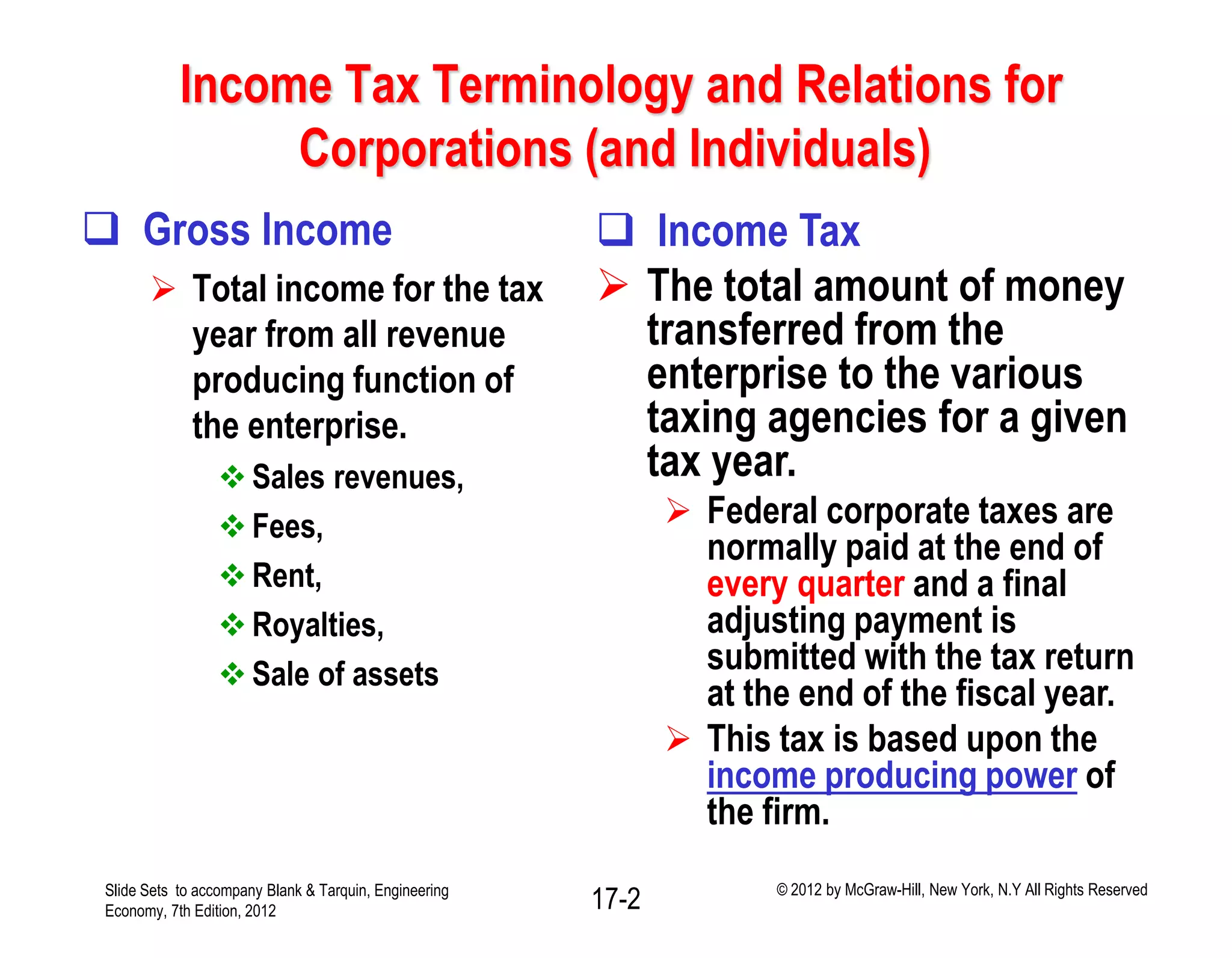
Income Tax Terminology and Relations for
Corporations (and Individuals)
 Gross Income
 Total income for the tax
year from all revenue
producing function of
the enterprise.
 Sales revenues,
 Fees,
 Rent,
 Royalties,
 Sale of assets
 Income Tax
 The total amount of money
transferred from the
enterprise to the various
taxing agencies for a given
tax year.
 Federal corporate taxes are
normally paid at the end of
every quarter and a final
adjusting payment is
submitted with the tax return
at the end of the fiscal year.
 This tax is based upon the
income producing power of
the firm.
Slide Sets to accompany Blank & Tarquin, Engineering
Economy, 7th Edition, 2012 17-2 © 2012 by McGraw-Hill, New York, N.Y All Rights Reserved
Terms - continued
 Operating Expenses
 All legally recognized
costs associated with
doing business for the tax
year.
 Real cash flows.
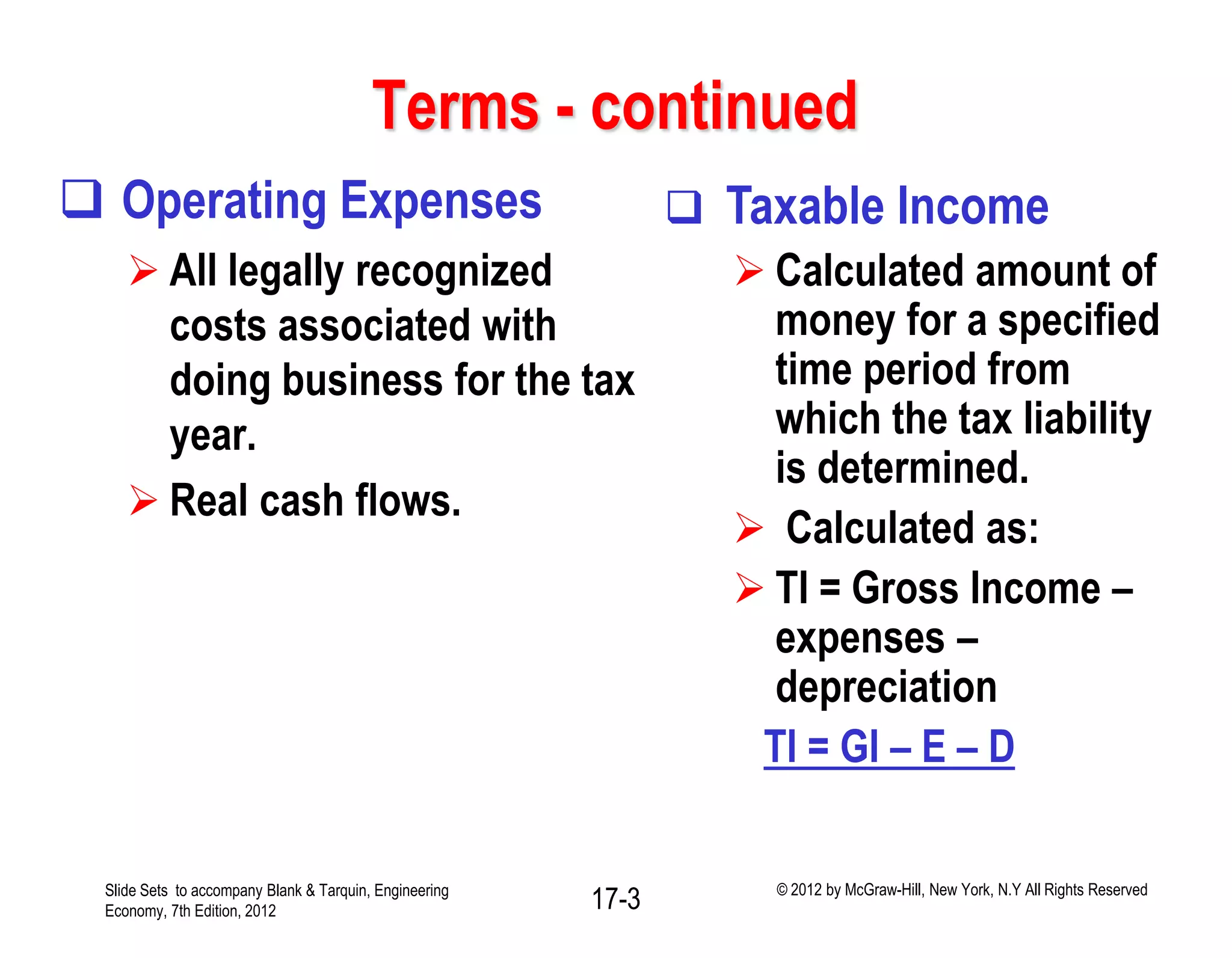
 Taxable Income
 Calculated amount of
money for a specified
time period from
which the tax liability
is determined.
 Calculated as:
 TI = Gross Income –
expenses –
depreciation
TI = GI – E – D
Slide Sets to accompany Blank & Tarquin, Engineering
Economy, 7th Edition, 2012 17-3 © 2012 by McGraw-Hill, New York, N.Y All Rights Reserved
Terms - continued
 Tax rate T
 A percentage or decimal
equivalent of TI.
 For Federal corporate income
tax T is represented by a series
of tax rates.
 The applicable tax rate depends
upon the total amount of TI.
 Taxes owed equals:
 Taxes = (taxable income) x
(applicable rate)
 = (TI)(T).
 Net Profit After Tax (NPAT)
 Amount of money remaining each year
when income taxes are subtracted from
taxable income.
NPAT = TI – {(TI)(T)}
= (TI)(1-T)
 Effective tax rate Te combines federal and local
rates:
Total Tax = Federal tax + State tax
State tax is deductable from taxable federal
income, hence : if Tf is federal tax rate, Ts is
state tax rate, and Te is total effective tax rate:
TI (Te ) = TI(Ts) + [TI - TI(Ts)] (Tf)
Te = Tf + Ts – TfTs or Te = Ts + (1-Ts) Tf
Te = Tf + (1-Tf) Ts
Slide Sets to accompany Blank & Tarquin, Engineering
Economy, 7th Edition, 2012 17-4 © 2012 by McGraw-Hill, New York, N.Y All Rights Reserved
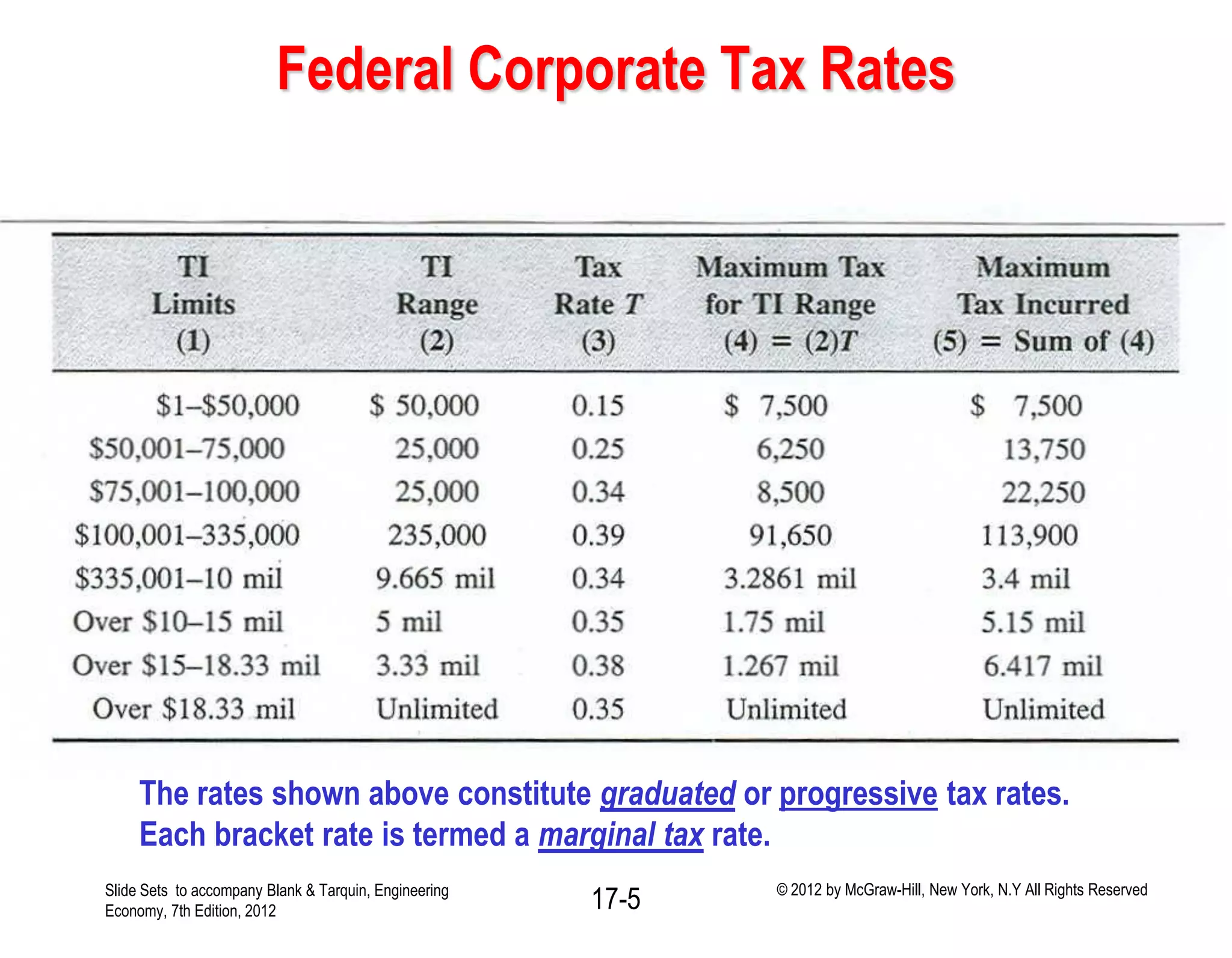
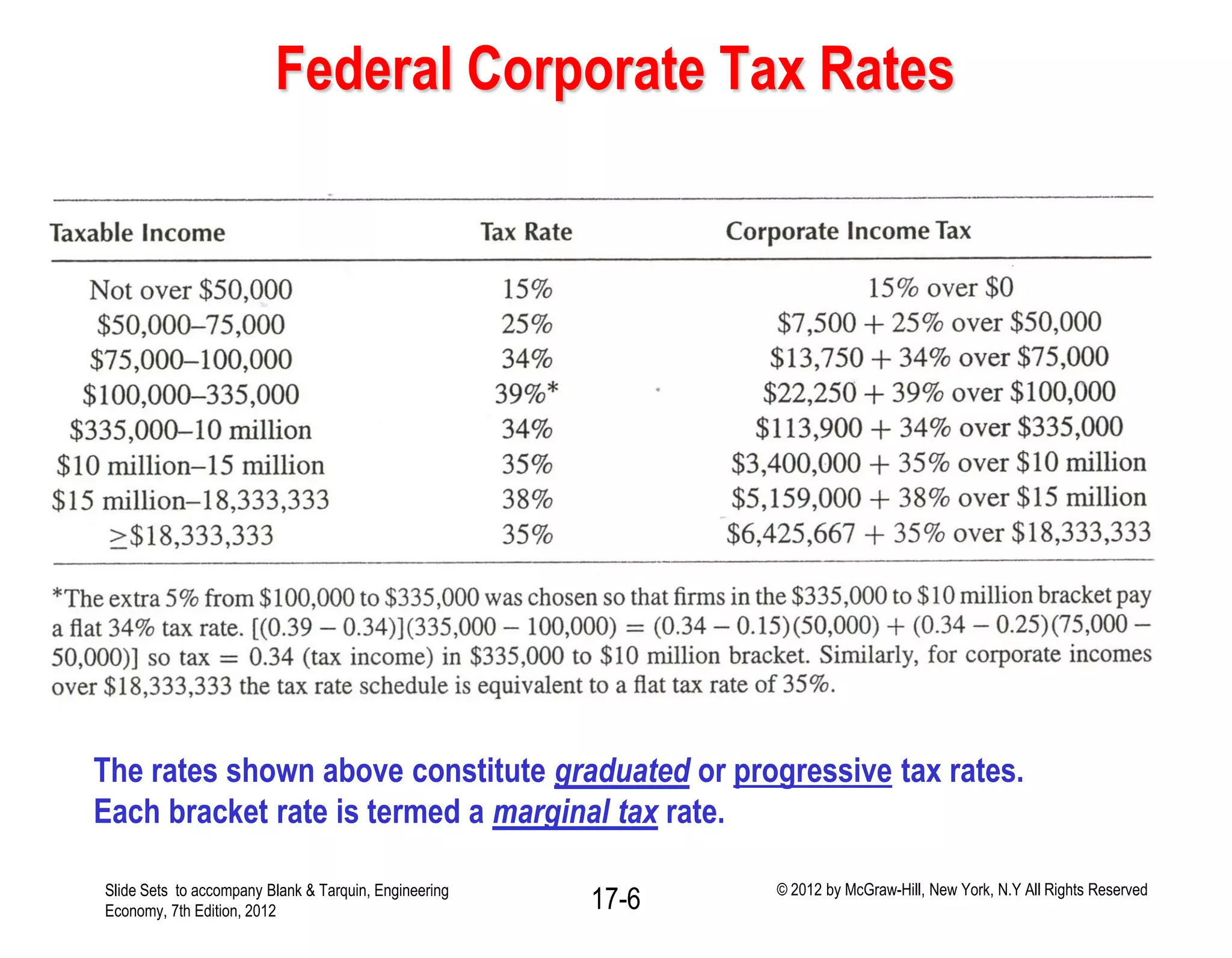
Federal Corporate Tax Rates
The rates shown above constitute graduated or progressive tax rates.
Each bracket rate is termed a marginal tax rate.
Slide Sets to accompany Blank & Tarquin, Engineering
Economy, 7th Edition, 2012 17-5 © 2012 by McGraw-Hill, New York, N.Y All Rights Reserved
Federal Corporate Tax Rates
The rates shown above constitute graduated or progressive tax rates.
Each bracket rate is termed a marginal tax rate.
Slide Sets to accompany Blank & Tarquin, Engineering
Economy, 7th Edition, 2012 17-6 © 2012 by McGraw-Hill, New York, N.Y All Rights Reserved
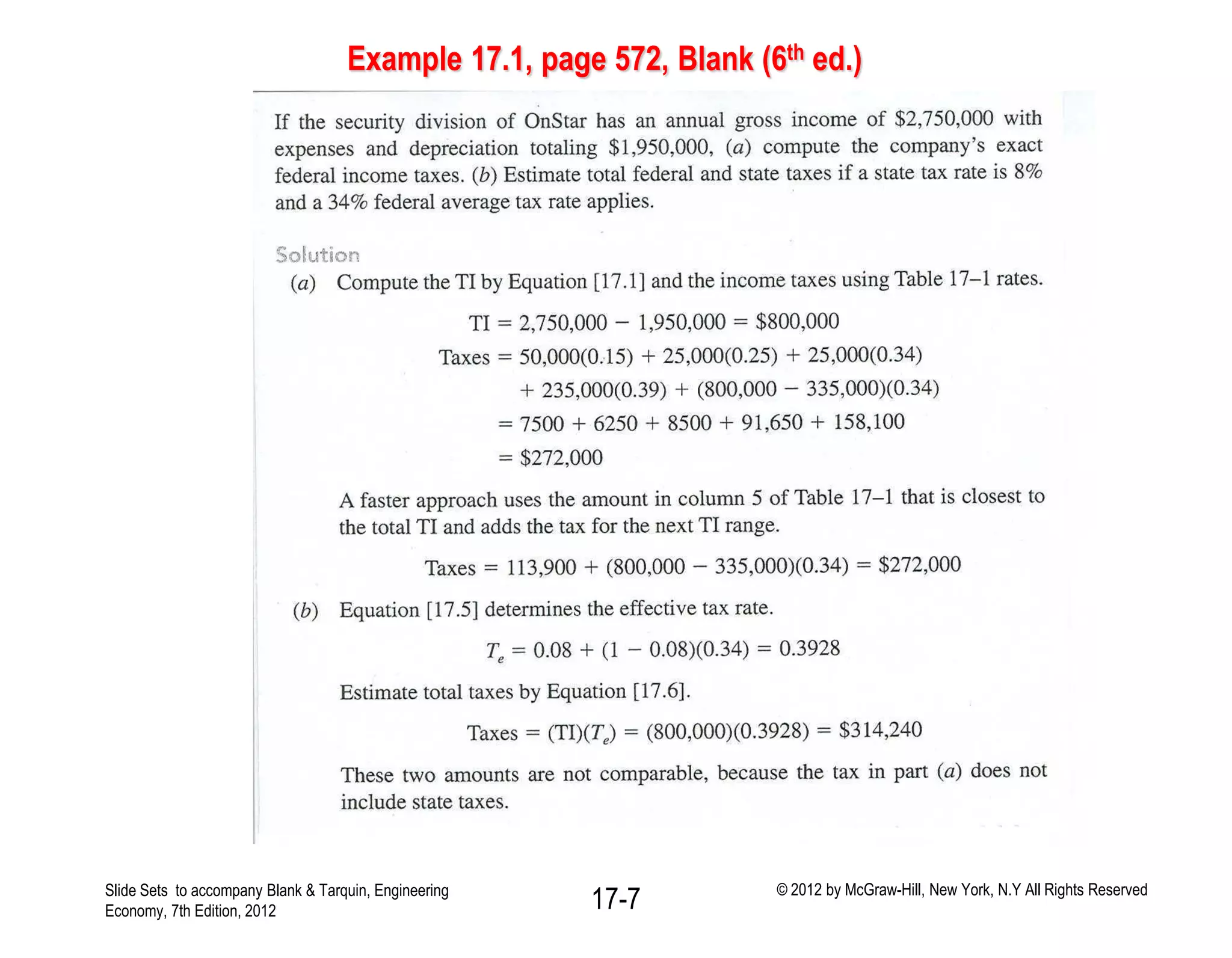
Example 17.1, page 572, Blank (6th ed.)
Slide Sets to accompany Blank & Tarquin, Engineering
Economy, 7th Edition, 2012 17-7 © 2012 by McGraw-Hill, New York, N.Y All Rights Reserved
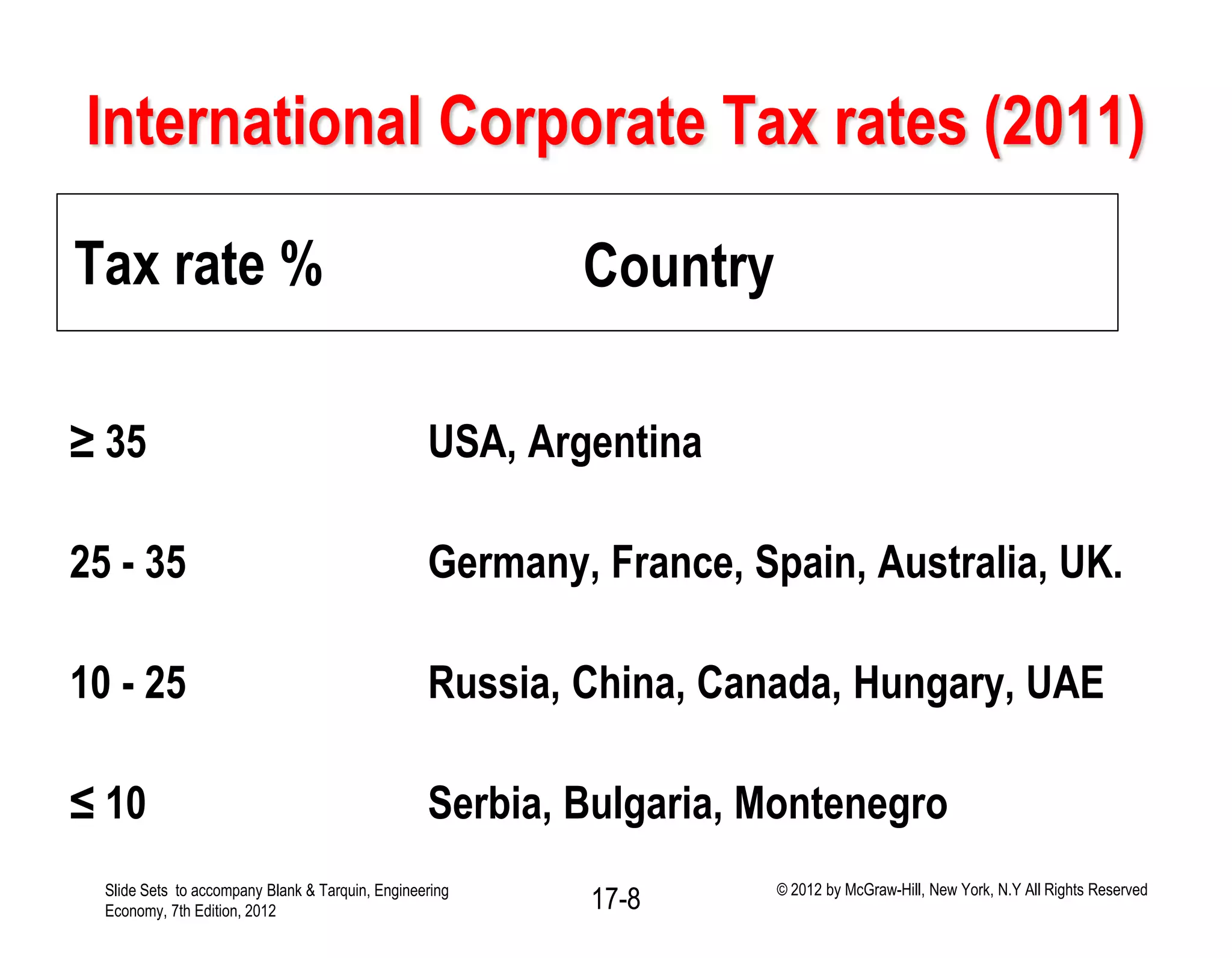
International Corporate Tax rates (2011)
Tax rate %
≥ 35
25 - 35
10 - 25
≤ 10
Country
USA, Argentina
Germany, France, Spain, Australia, UK.
Russia, China, Canada, Hungary, UAE
Serbia, Bulgaria, Montenegro
Slide Sets to accompany Blank & Tarquin, Engineering
Economy, 7th Edition, 2012 17-8 © 2012 by McGraw-Hill, New York, N.Y All Rights Reserved
Slide Sets to accompany Blank & Tarquin, Engineering
Economy, 7th Edition, 2012
© 2012 by McGraw-Hill, New York, N.Y All Rights Reserved
17-9
Cash Flow Analysis
Before Taxes and After Taxes
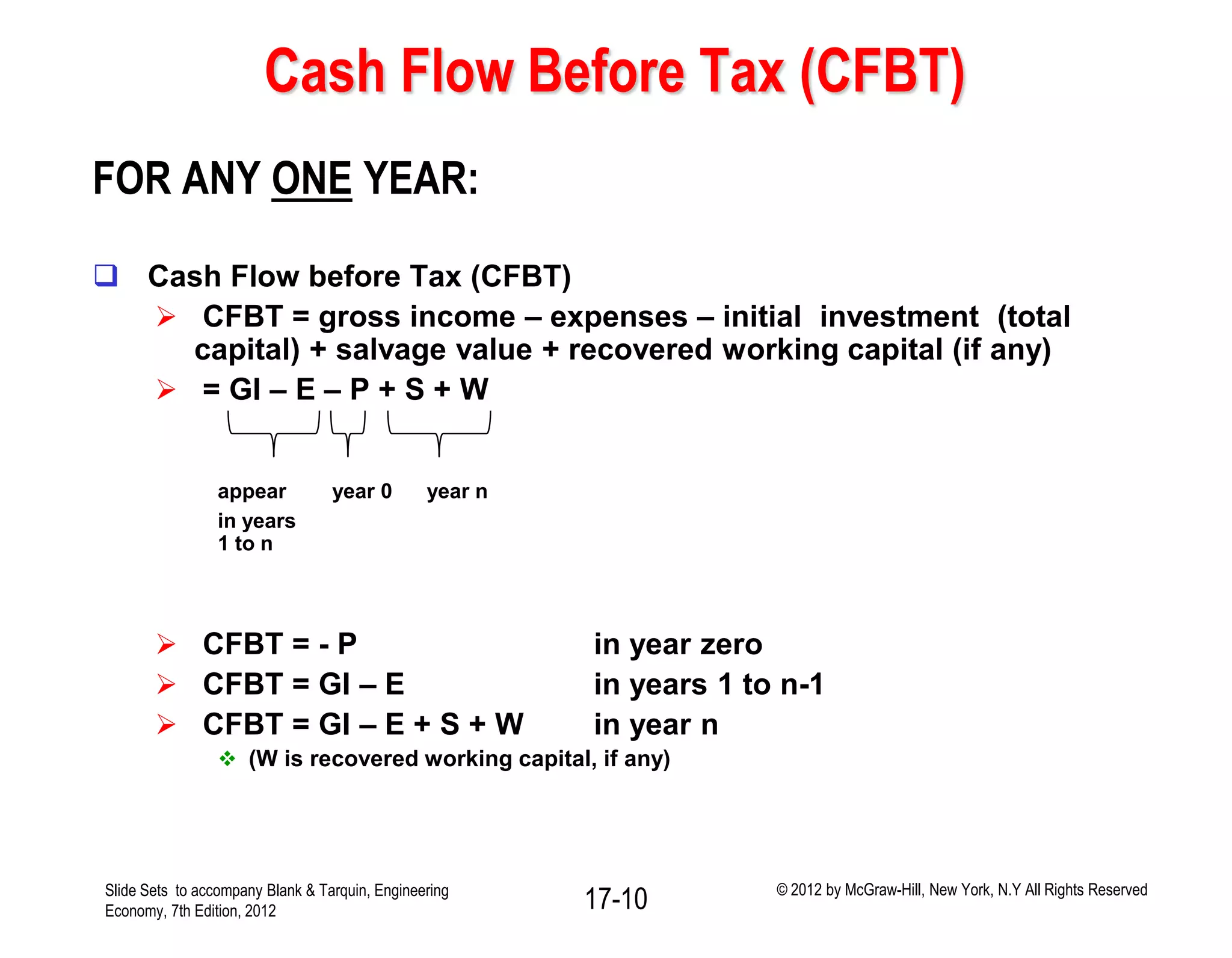
Cash Flow Before Tax (CFBT)
FOR ANY ONE YEAR:
 Cash Flow before Tax (CFBT)
 CFBT = gross income – expenses – initial investment (total
capital) + salvage value + recovered working capital (if any)
 = GI – E – P + S + W
appear year 0 year n
in years
1 to n
 CFBT = - P in year zero
 CFBT = GI – E in years 1 to n-1
 CFBT = GI – E + S + W in year n
 (W is recovered working capital, if any)
Slide Sets to accompany Blank & Tarquin, Engineering
Economy, 7th Edition, 2012 17-10 © 2012 by McGraw-Hill, New York, N.Y All Rights Reserved
Cash Flow After Tax (CFAT)
FOR ANY ONE YEAR:
 Cash Flow After Tax (CFAT)
 CFAT = CFBT – taxes
 CFAT = [GI – E – P + S + W] – (GI – E – D)(Te)
 CFAT = NPAT + D Valid for all years except years 0 and n !
Note: only fixed capital is depreciable, if there is no working capital
then by definition total capital is fixed and is depreciable.
 An evaluation format:
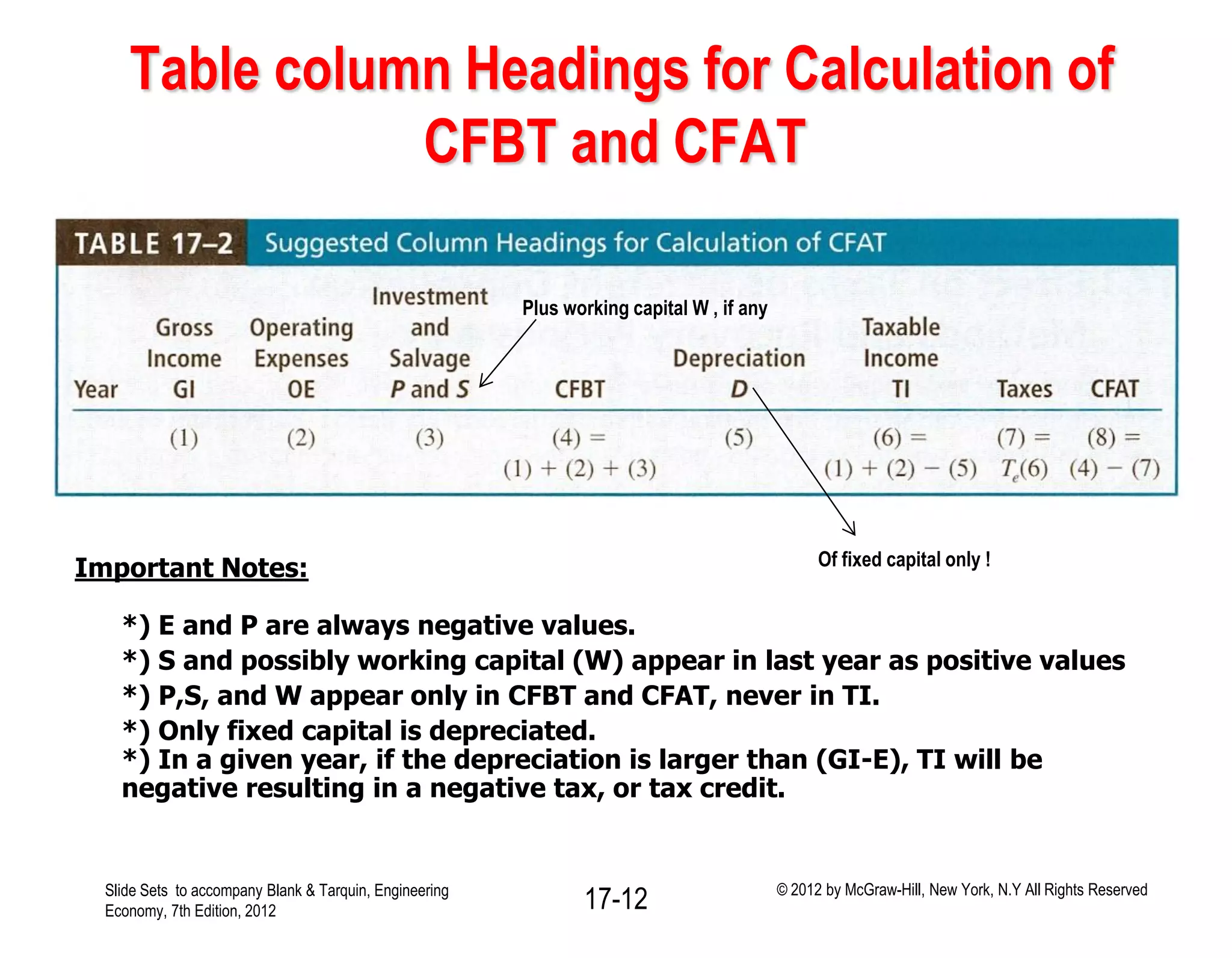
 Table 17.2 , p. 449, Blank (7th ed.)
Slide Sets to accompany Blank & Tarquin, Engineering
Economy, 7th Edition, 2012 17-11 © 2012 by McGraw-Hill, New York, N.Y All Rights Reserved
Table column Headings for Calculation of
CFBT and CFAT
Important Notes:
*) E and P are always negative values.
*) S and possibly working capital (W) appear in last year as positive values
*) P,S, and W appear only in CFBT and CFAT, never in TI.
*) Only fixed capital is depreciated.
*) In a given year, if the depreciation is larger than (GI-E), TI will be
negative resulting in a negative tax, or tax credit.
Slide Sets to accompany Blank & Tarquin, Engineering
Economy, 7th Edition, 2012 17-12 © 2012 by McGraw-Hill, New York, N.Y All Rights Reserved
Plus working capital W , if any
Of fixed capital only !
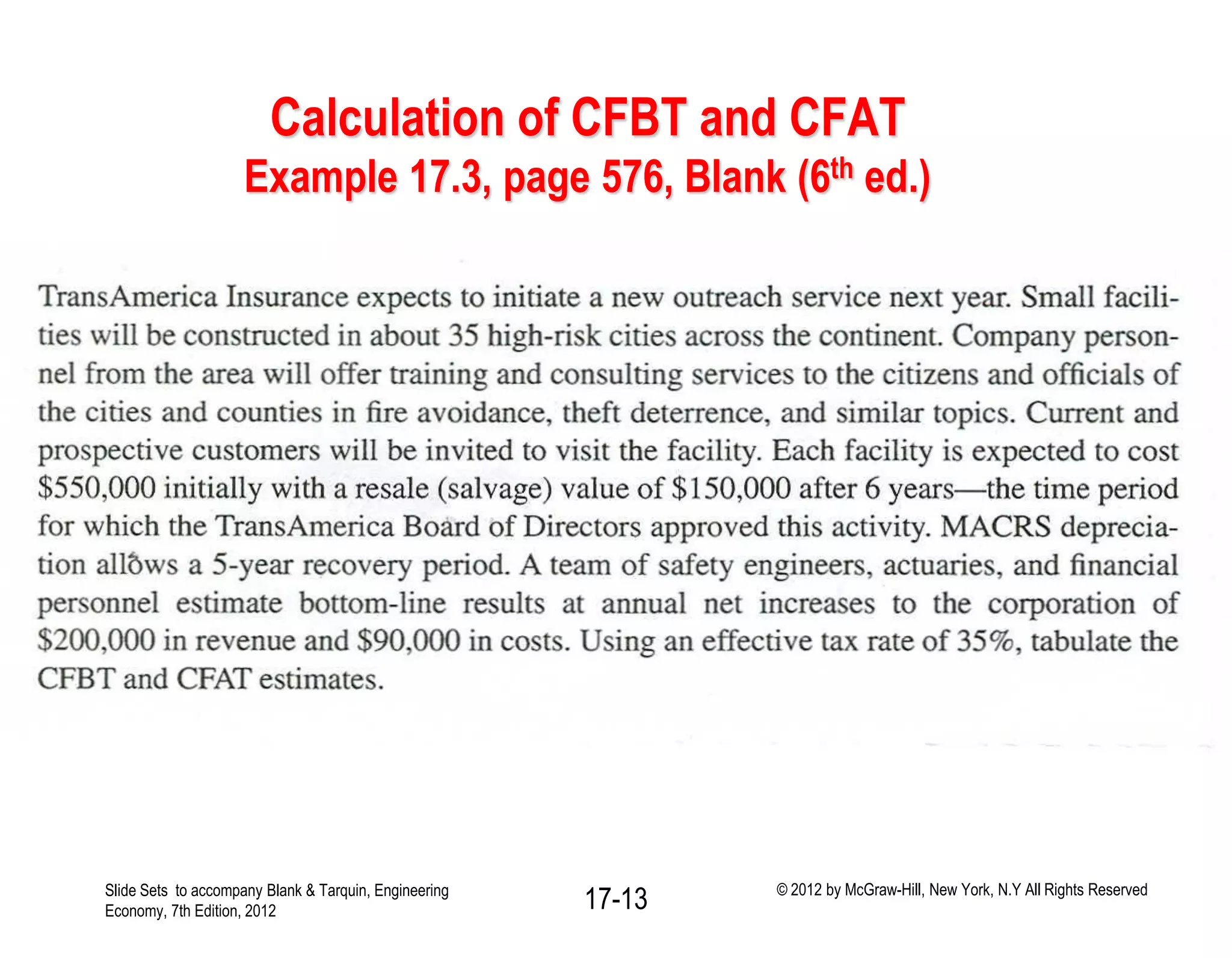
Calculation of CFBT and CFAT
Example 17.3, page 576, Blank (6th ed.)
Slide Sets to accompany Blank & Tarquin, Engineering
Economy, 7th Edition, 2012 17-13 © 2012 by McGraw-Hill, New York, N.Y All Rights Reserved
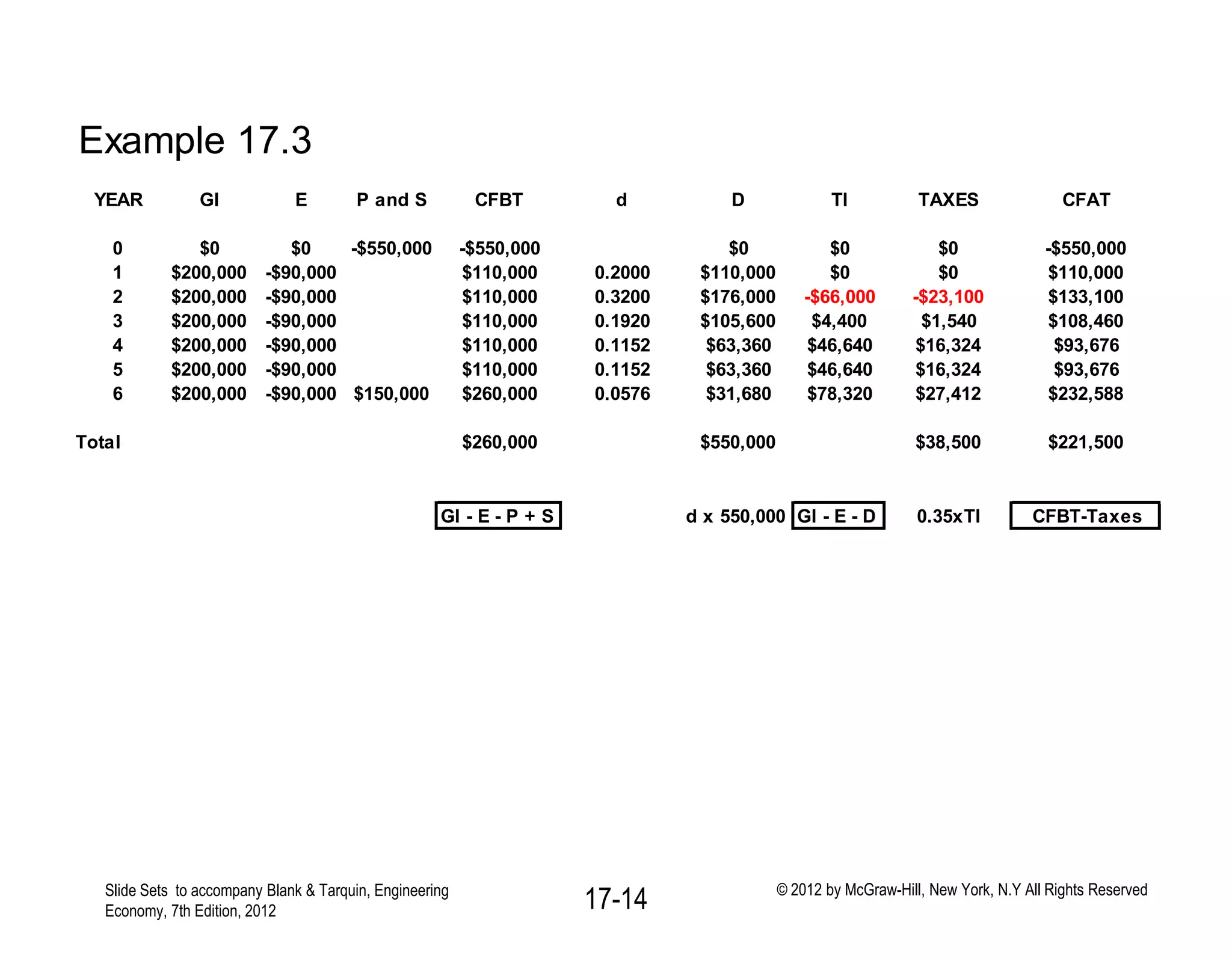
Example 17.3
YEAR GI E P and S CFBT d D TI TAXES CFAT
0 $0 $0 -$550,000 -$550,000 $0 $0 $0 -$550,000
1 $200,000 -$90,000 $110,000 0.2000 $110,000 $0 $0 $110,000
2 $200,000 -$90,000 $110,000 0.3200 $176,000 -$66,000 -$23,100 $133,100
3 $200,000 -$90,000 $110,000 0.1920 $105,600 $4,400 $1,540 $108,460
4 $200,000 -$90,000 $110,000 0.1152 $63,360 $46,640 $16,324 $93,676
5 $200,000 -$90,000 $110,000 0.1152 $63,360 $46,640 $16,324 $93,676
6 $200,000 -$90,000 $150,000 $260,000 0.0576 $31,680 $78,320 $27,412 $232,588
Total $260,000 $550,000 $38,500 $221,500
GI - E - P + S d x 550,000 GI - E - D 0.35xTI CFBT-Taxes
Slide Sets to accompany Blank & Tarquin, Engineering
Economy, 7th Edition, 2012 17-14 © 2012 by McGraw-Hill, New York, N.Y All Rights Reserved
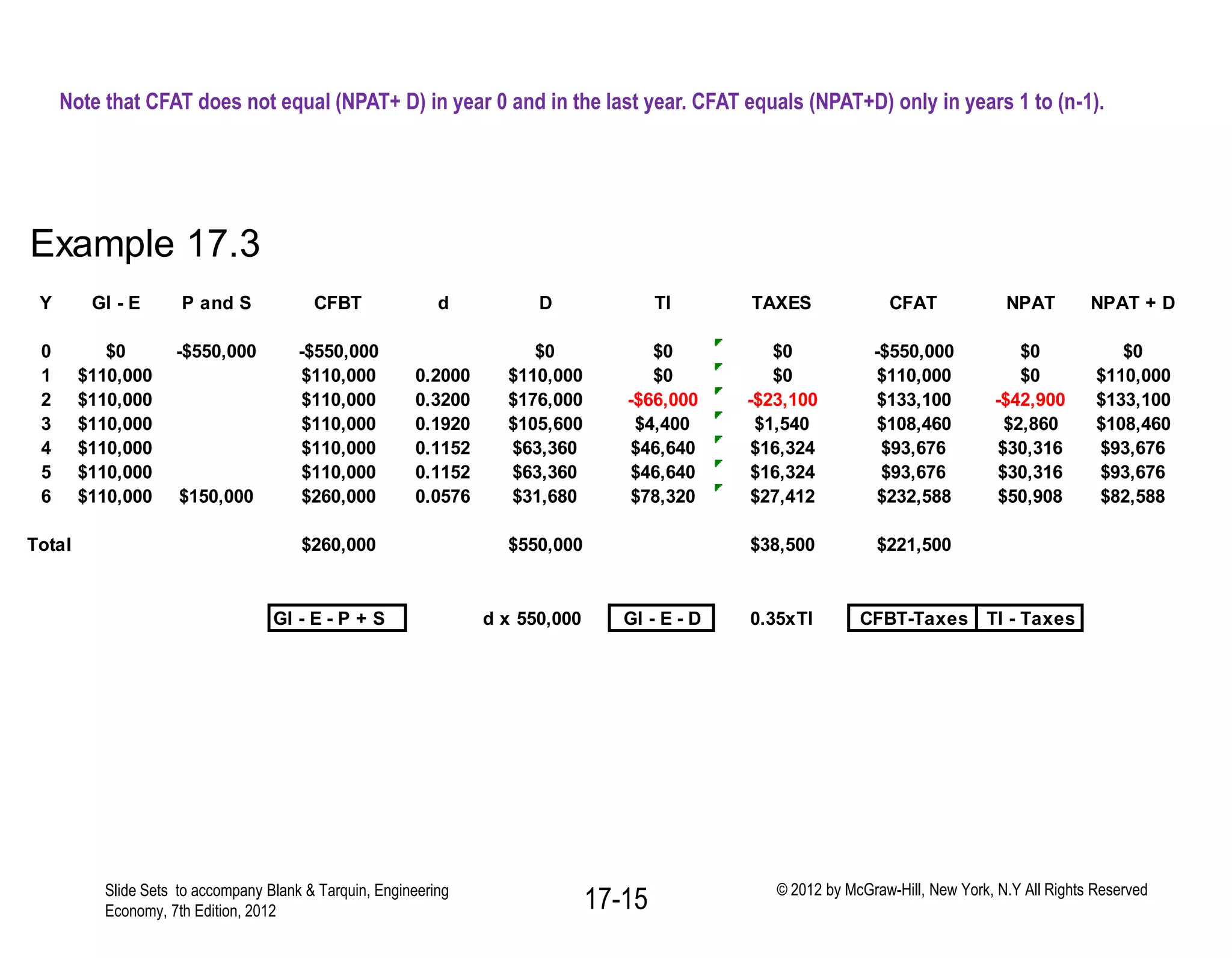
Example 17.3
Y GI - E P and S CFBT d D TI TAXES CFAT NPAT NPAT + D
0 $0 -$550,000 -$550,000 $0 $0 $0 -$550,000 $0 $0
1 $110,000 $110,000 0.2000 $110,000 $0 $0 $110,000 $0 $110,000
2 $110,000 $110,000 0.3200 $176,000 -$66,000 -$23,100 $133,100 -$42,900 $133,100
3 $110,000 $110,000 0.1920 $105,600 $4,400 $1,540 $108,460 $2,860 $108,460
4 $110,000 $110,000 0.1152 $63,360 $46,640 $16,324 $93,676 $30,316 $93,676
5 $110,000 $110,000 0.1152 $63,360 $46,640 $16,324 $93,676 $30,316 $93,676
6 $110,000 $150,000 $260,000 0.0576 $31,680 $78,320 $27,412 $232,588 $50,908 $82,588
Total $260,000 $550,000 $38,500 $221,500
GI - E - P + S d x 550,000 GI - E - D 0.35xTI CFBT-Taxes TI - Taxes
Slide Sets to accompany Blank & Tarquin, Engineering
Economy, 7th Edition, 2012 17-15 © 2012 by McGraw-Hill, New York, N.Y All Rights Reserved
Note that CFAT does not equal (NPAT+ D) in year 0 and in the last year. CFAT equals (NPAT+D) only in years 1 to (n-1).
Effect on Taxes of Different Depreciation
Methods and Recovery Periods
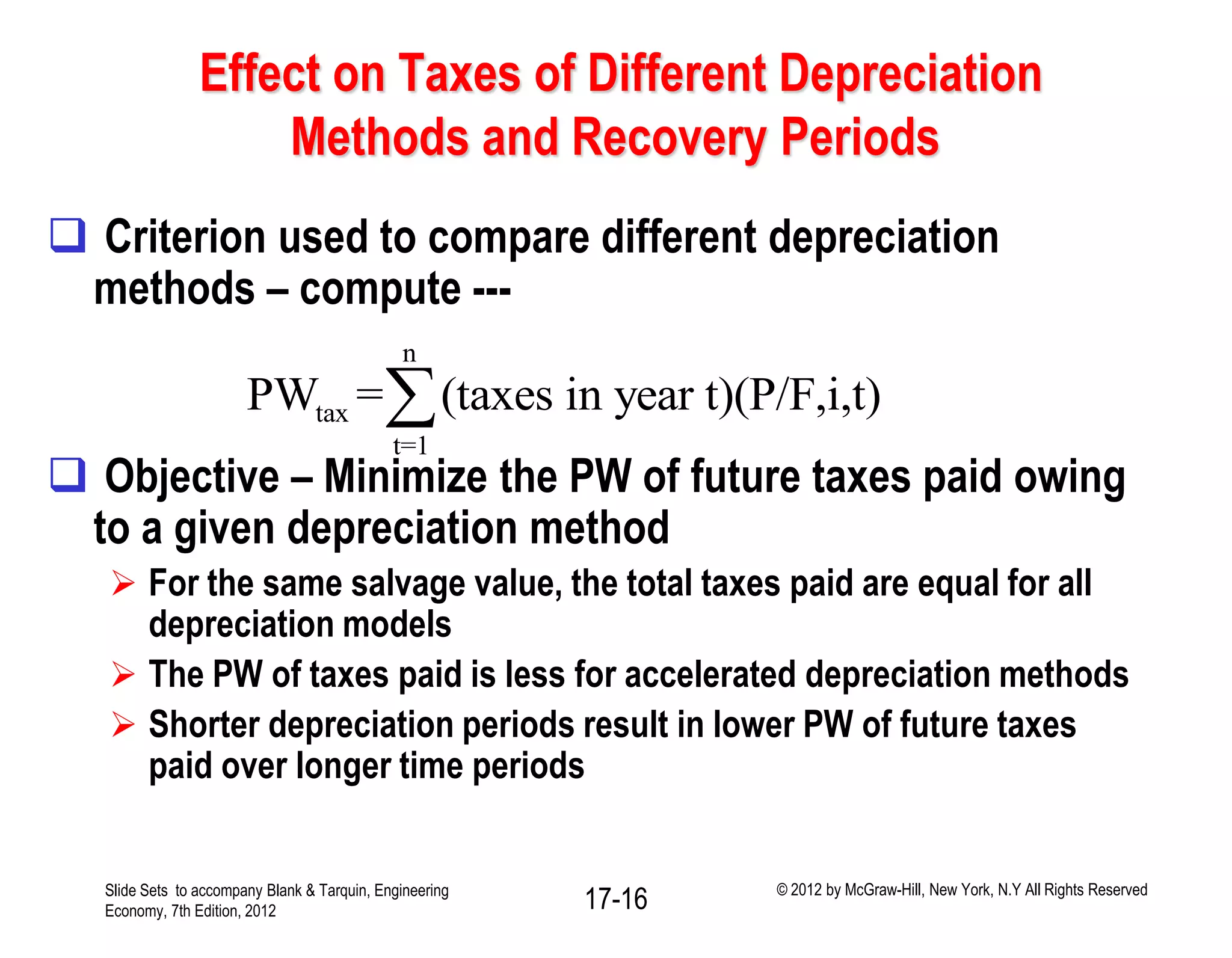
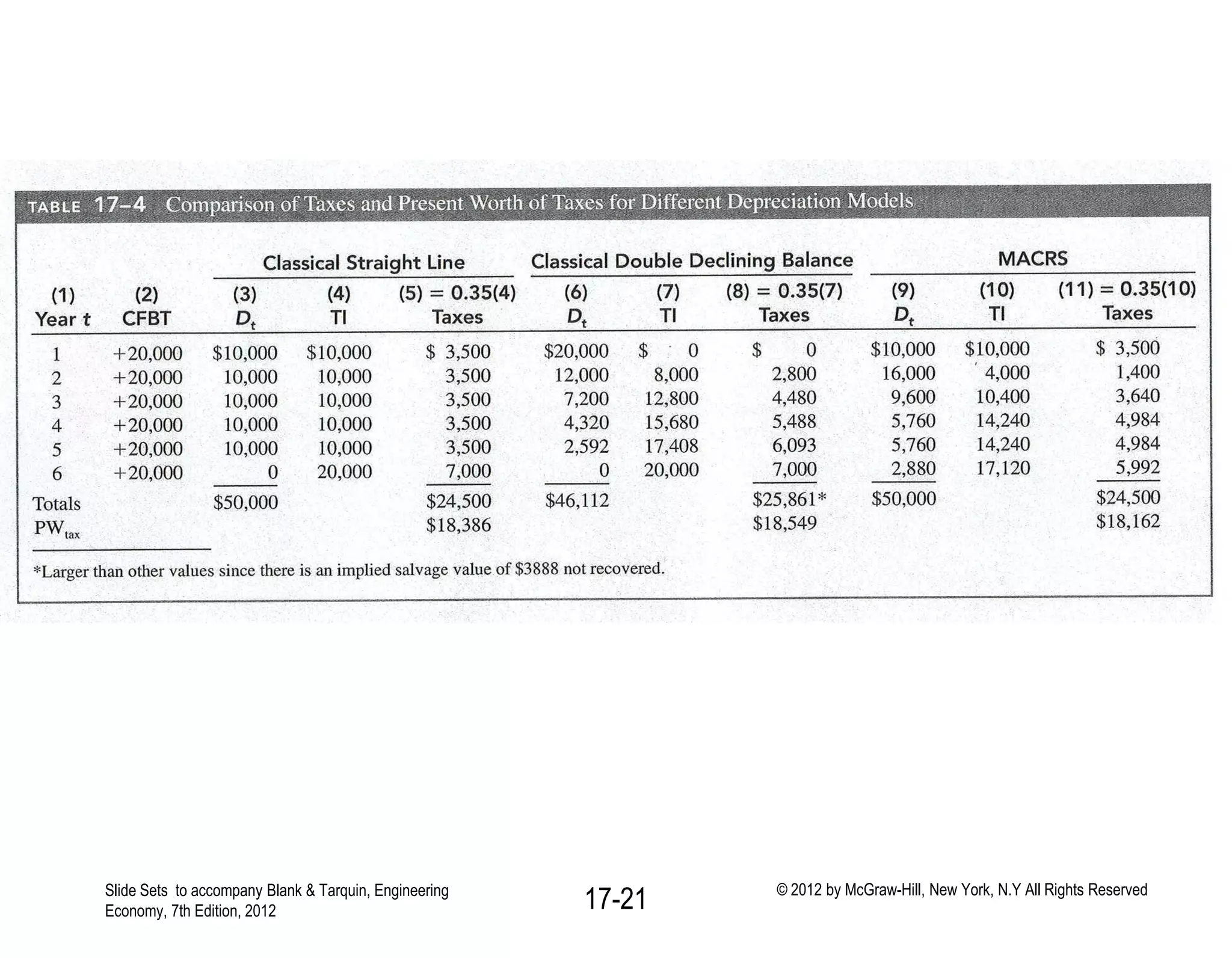
 Criterion used to compare different depreciation
methods – compute ---
 Objective – Minimize the PW of future taxes paid owing
to a given depreciation method
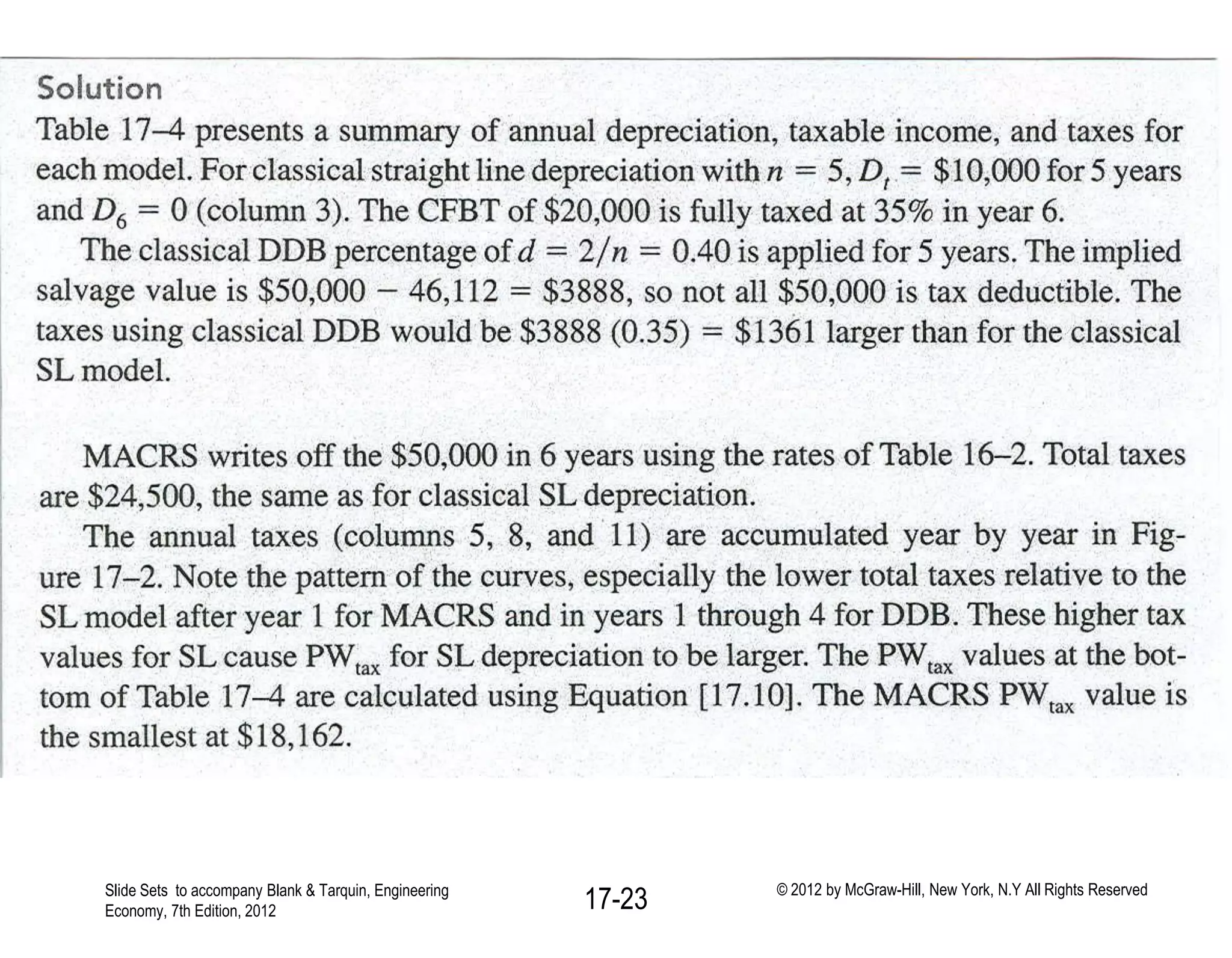
 For the same salvage value, the total taxes paid are equal for all
depreciation models
 The PW of taxes paid is less for accelerated depreciation methods
 Shorter depreciation periods result in lower PW of future taxes
paid over longer time periods
n
tax
t=1
PW = (taxes in year t)(P/F,i,t)
Slide Sets to accompany Blank & Tarquin, Engineering
Economy, 7th Edition, 2012 17-16 © 2012 by McGraw-Hill, New York, N.Y All Rights Reserved
Effect on Taxes of Different Depreciation
Methods and Recovery Periods
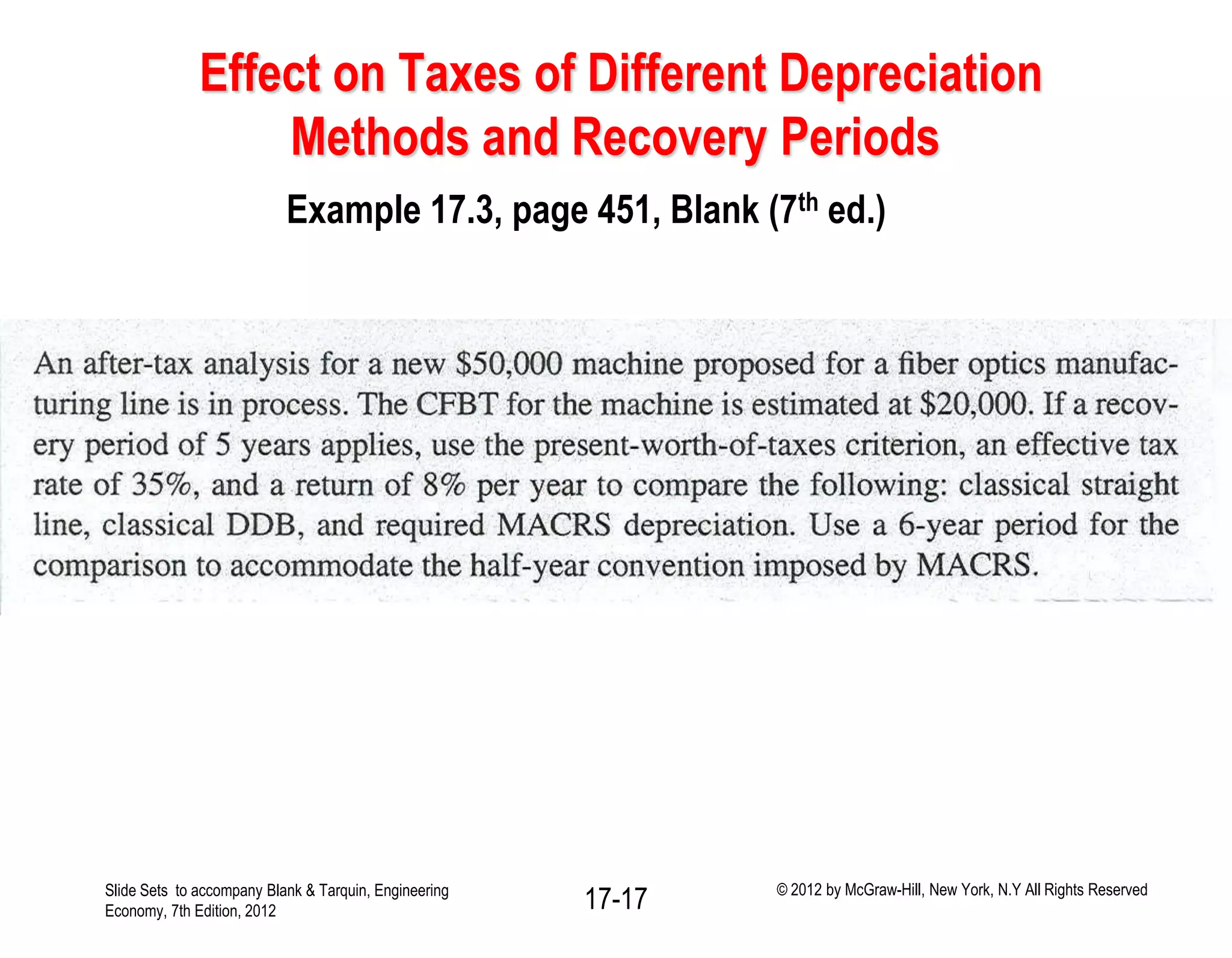
Example 17.3, page 451, Blank (7th ed.)
Slide Sets to accompany Blank & Tarquin, Engineering
Economy, 7th Edition, 2012 17-17 © 2012 by McGraw-Hill, New York, N.Y All Rights Reserved
Slide Sets to accompany Blank & Tarquin, Engineering
Economy, 7th Edition, 2012
© 2012 by McGraw-Hill, New York, N.Y All Rights Reserved
17-18
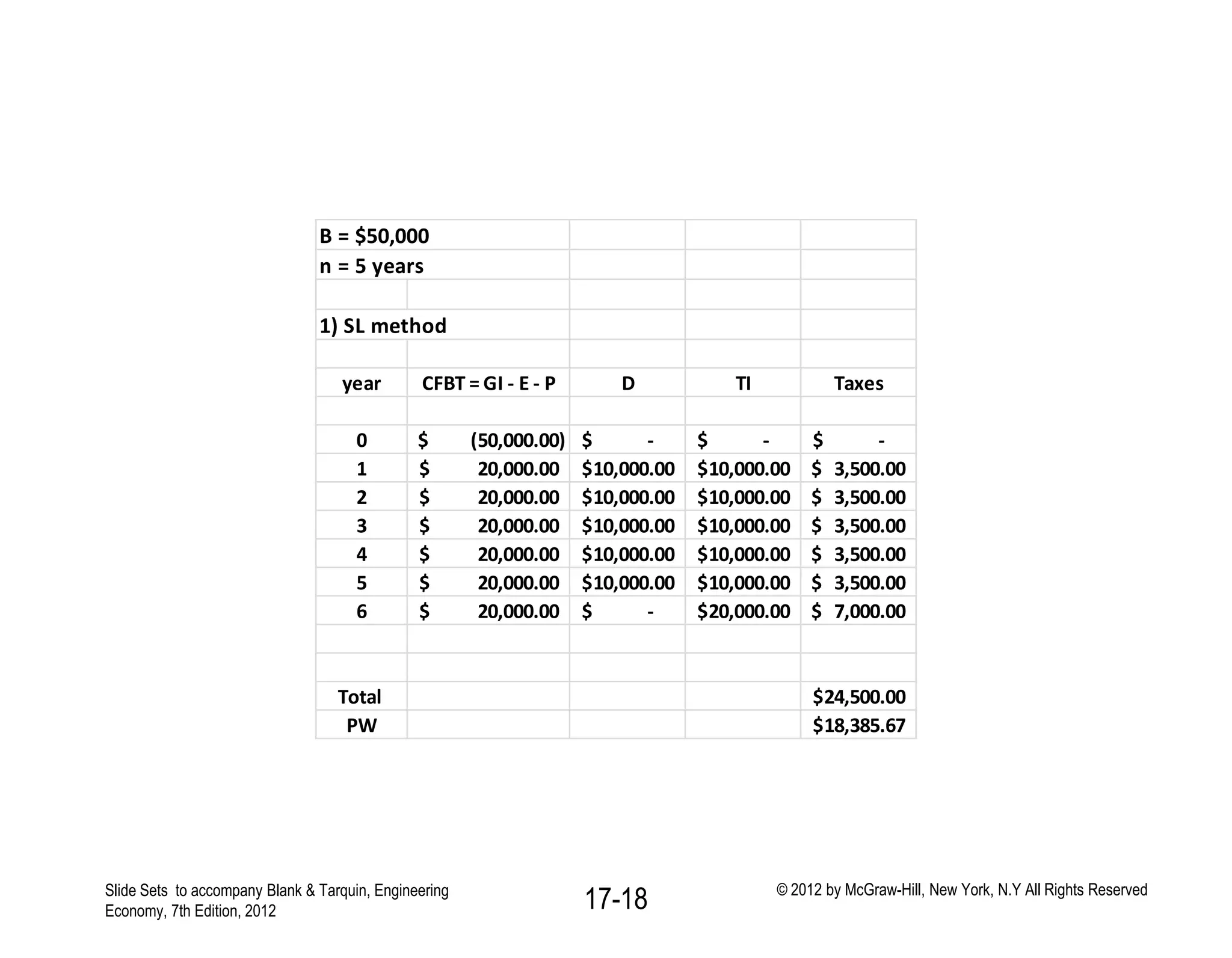
B = $50,000
n = 5 years
1) SL method
year CFBT = GI - E - P D TI Taxes
0 (50,000.00)$ -$ -$ -$
1 20,000.00$ 10,000.00$ 10,000.00$ 3,500.00$
2 20,000.00$ 10,000.00$ 10,000.00$ 3,500.00$
3 20,000.00$ 10,000.00$ 10,000.00$ 3,500.00$
4 20,000.00$ 10,000.00$ 10,000.00$ 3,500.00$
5 20,000.00$ 10,000.00$ 10,000.00$ 3,500.00$
6 20,000.00$ -$ 20,000.00$ 7,000.00$
Total 24,500.00$
PW 18,385.67$
Slide Sets to accompany Blank & Tarquin, Engineering
Economy, 7th Edition, 2012
© 2012 by McGraw-Hill, New York, N.Y All Rights Reserved
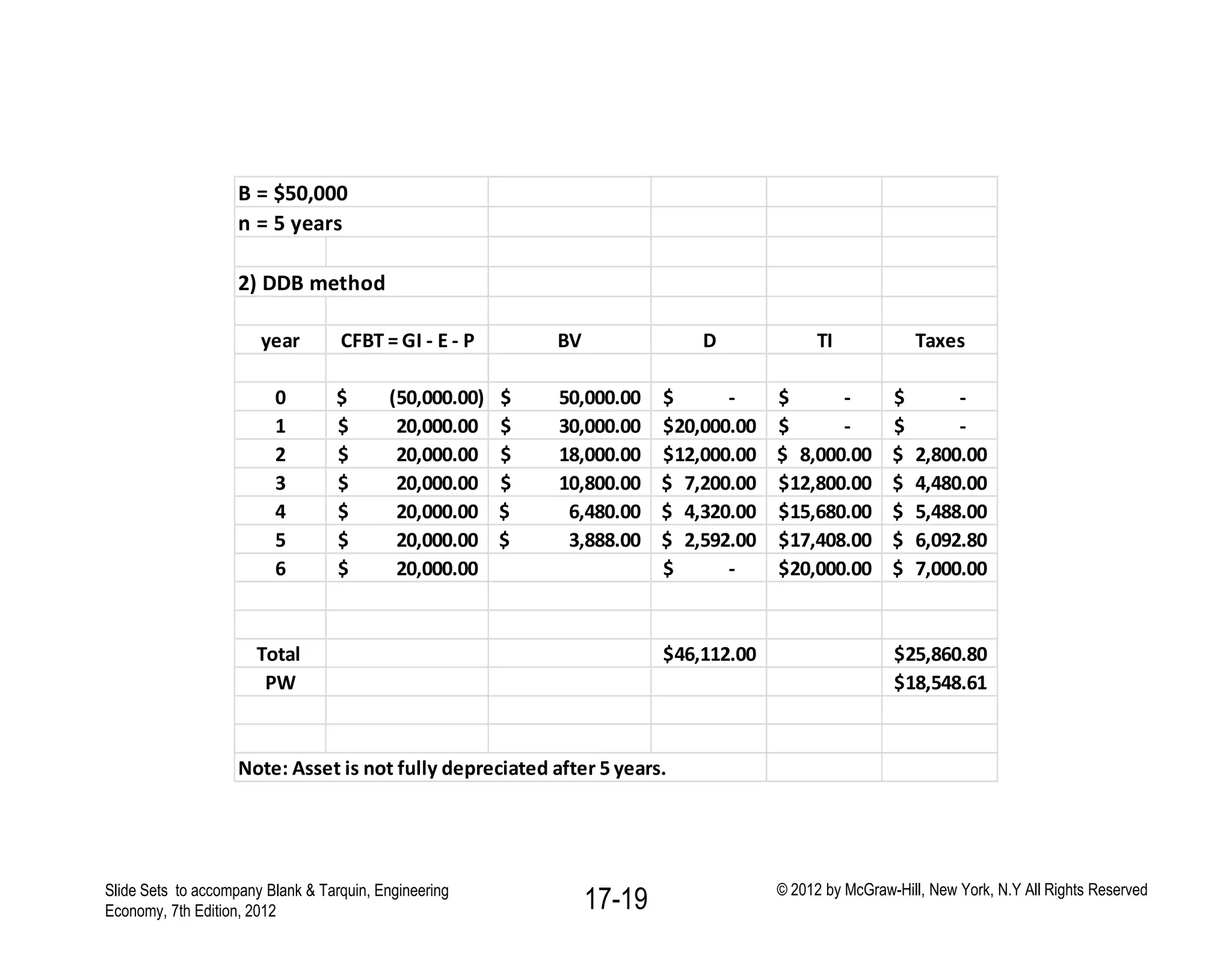
17-19
B = $50,000
n = 5 years
2) DDB method
year CFBT = GI - E - P BV D TI Taxes
0 (50,000.00)$ 50,000.00$ -$ -$ -$
1 20,000.00$ 30,000.00$ 20,000.00$ -$ -$
2 20,000.00$ 18,000.00$ 12,000.00$ 8,000.00$ 2,800.00$
3 20,000.00$ 10,800.00$ 7,200.00$ 12,800.00$ 4,480.00$
4 20,000.00$ 6,480.00$ 4,320.00$ 15,680.00$ 5,488.00$
5 20,000.00$ 3,888.00$ 2,592.00$ 17,408.00$ 6,092.80$
6 20,000.00$ -$ 20,000.00$ 7,000.00$
Total 46,112.00$ 25,860.80$
PW 18,548.61$
Note: Asset is not fully depreciated after 5 years.
Slide Sets to accompany Blank & Tarquin, Engineering
Economy, 7th Edition, 2012
© 2012 by McGraw-Hill, New York, N.Y All Rights Reserved
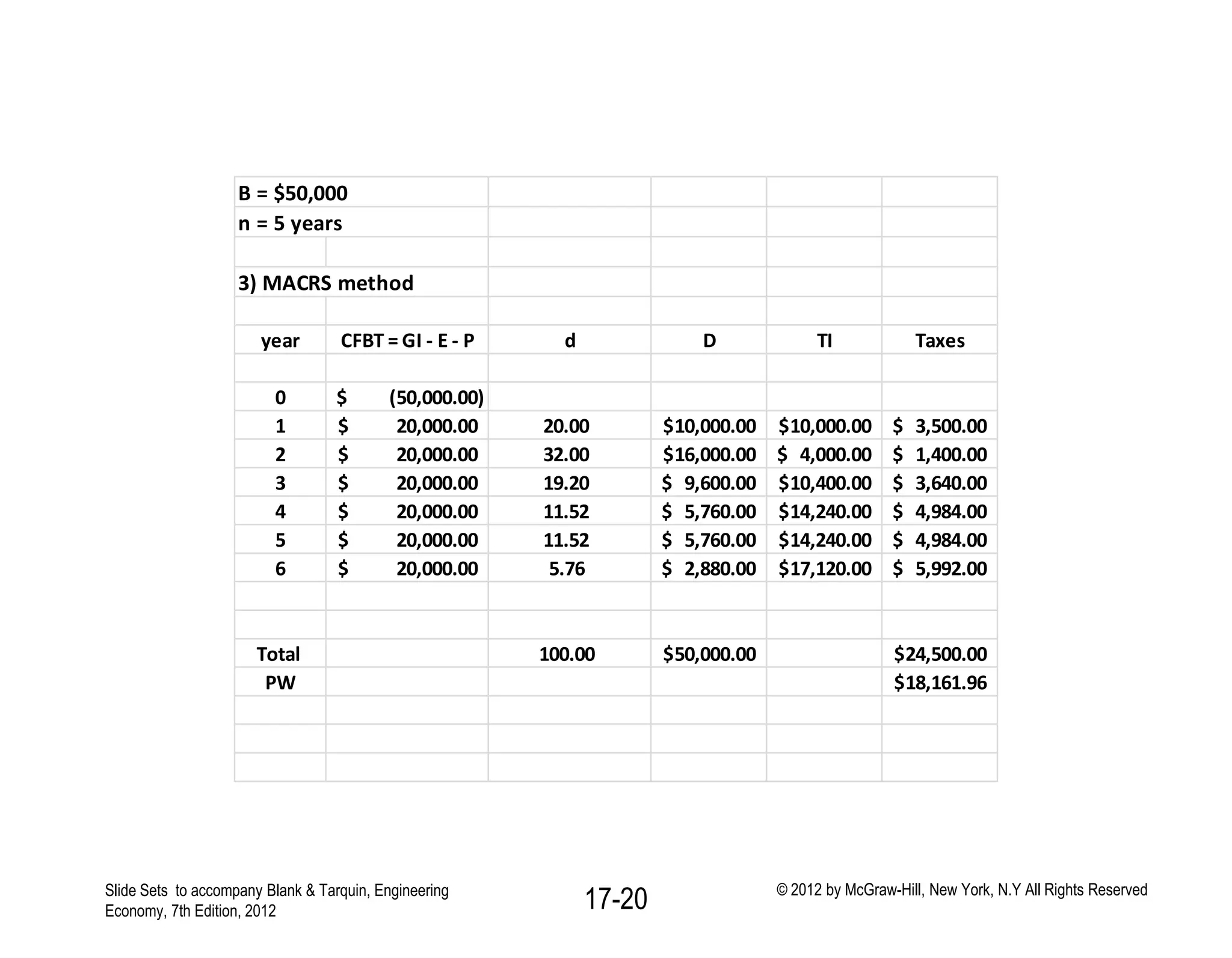
17-20
B = $50,000
n = 5 years
3) MACRS method
year CFBT = GI - E - P d D TI Taxes
0 (50,000.00)$
1 20,000.00$ 20.00 10,000.00$ 10,000.00$ 3,500.00$
2 20,000.00$ 32.00 16,000.00$ 4,000.00$ 1,400.00$
3 20,000.00$ 19.20 9,600.00$ 10,400.00$ 3,640.00$
4 20,000.00$ 11.52 5,760.00$ 14,240.00$ 4,984.00$
5 20,000.00$ 11.52 5,760.00$ 14,240.00$ 4,984.00$
6 20,000.00$ 5.76 2,880.00$ 17,120.00$ 5,992.00$
Total 100.00 50,000.00$ 24,500.00$
PW 18,161.96$
Slide Sets to accompany Blank & Tarquin, Engineering
Economy, 7th Edition, 2012 17-21 © 2012 by McGraw-Hill, New York, N.Y All Rights Reserved
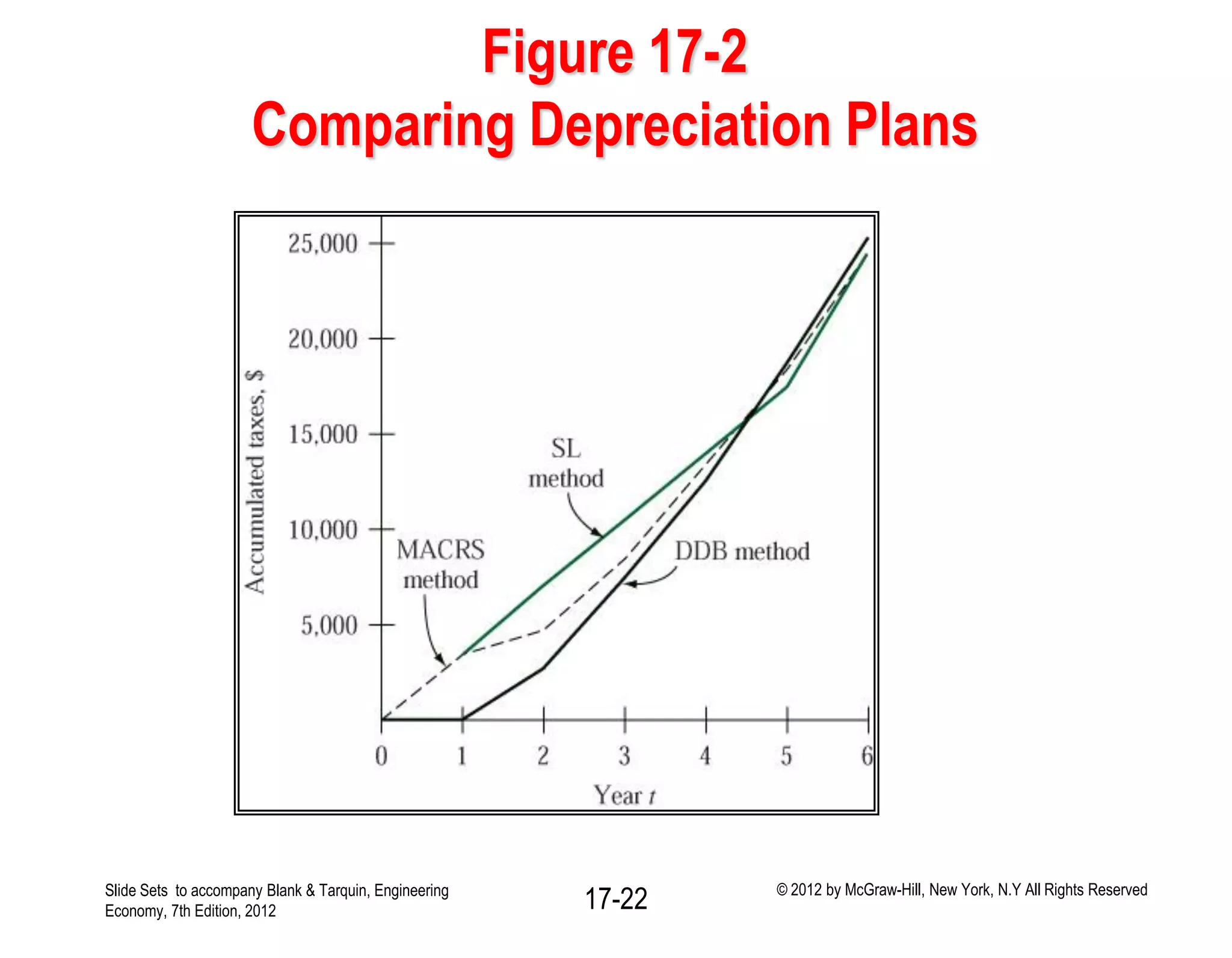
Figure 17-2
Comparing Depreciation Plans
Slide Sets to accompany Blank & Tarquin, Engineering
Economy, 7th Edition, 2012 17-22 © 2012 by McGraw-Hill, New York, N.Y All Rights Reserved
Slide Sets to accompany Blank & Tarquin, Engineering
Economy, 7th Edition, 2012 17-23 © 2012 by McGraw-Hill, New York, N.Y All Rights Reserved
Cash flow analysis is important in calculating ROR Before tax and
After tax
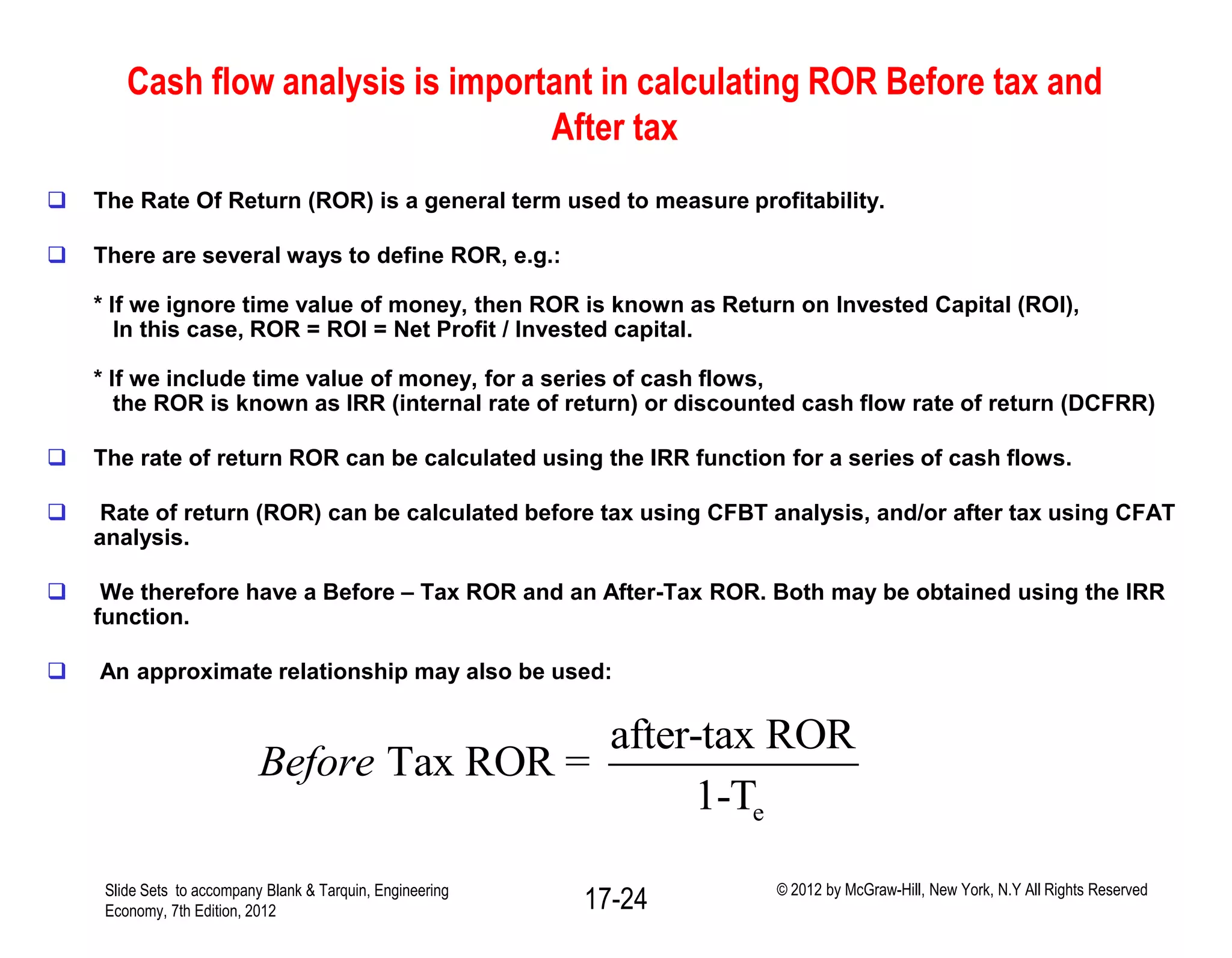
 The Rate Of Return (ROR) is a general term used to measure profitability.
 There are several ways to define ROR, e.g.:
* If we ignore time value of money, then ROR is known as Return on Invested Capital (ROI),
In this case, ROR = ROI = Net Profit / Invested capital.
* If we include time value of money, for a series of cash flows,
the ROR is known as IRR (internal rate of return) or discounted cash flow rate of return (DCFRR)
 The rate of return ROR can be calculated using the IRR function for a series of cash flows.
 Rate of return (ROR) can be calculated before tax using CFBT analysis, and/or after tax using CFAT
analysis.
 We therefore have a Before – Tax ROR and an After-Tax ROR. Both may be obtained using the IRR
function.
 An approximate relationship may also be used:
e
after-tax ROR
Tax ROR =
1-T
Before
Slide Sets to accompany Blank & Tarquin, Engineering
Economy, 7th Edition, 2012 17-24 © 2012 by McGraw-Hill, New York, N.Y All Rights Reserved
Example:
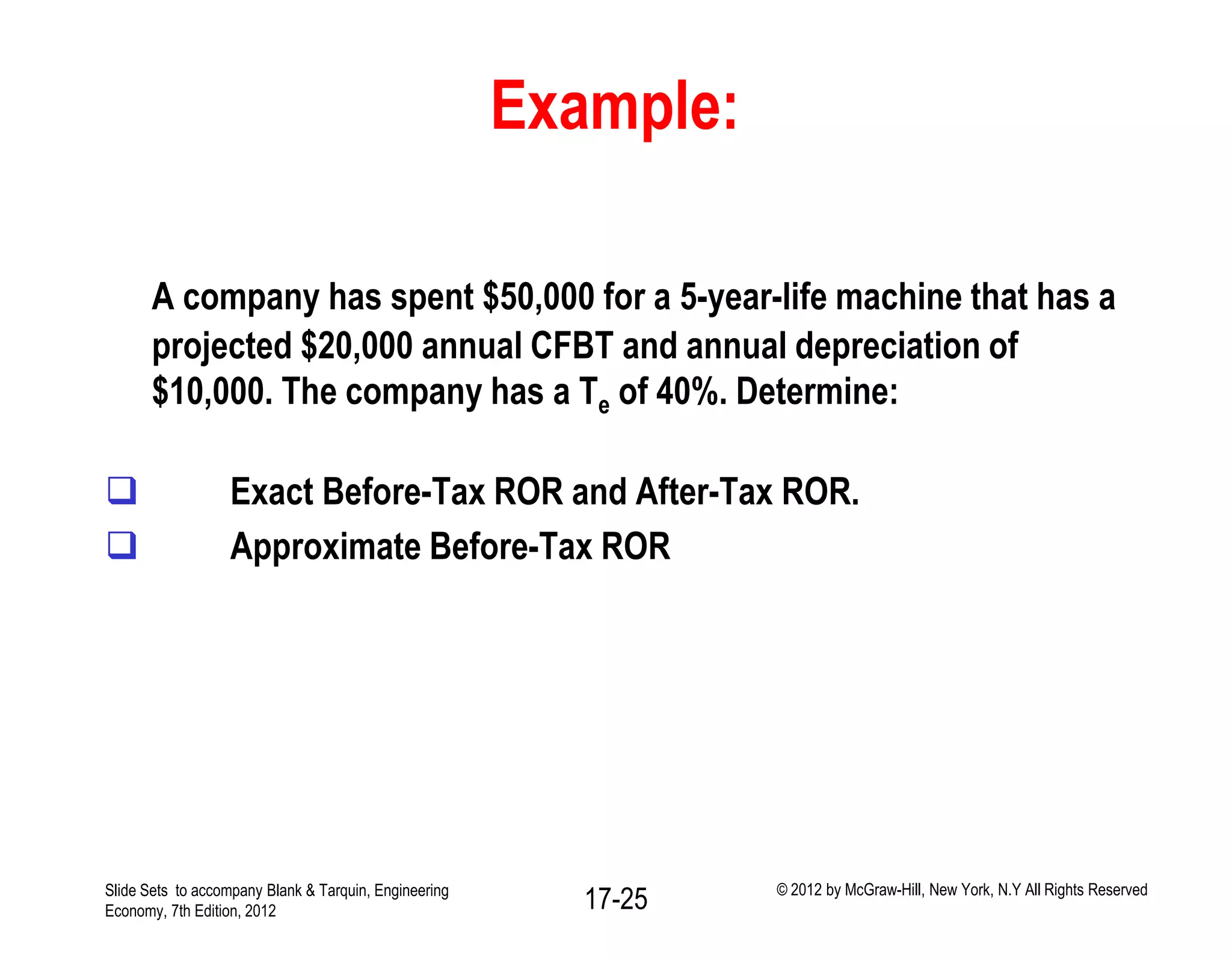
A company has spent $50,000 for a 5-year-life machine that has a
projected $20,000 annual CFBT and annual depreciation of
$10,000. The company has a Te of 40%. Determine:
 Exact Before-Tax ROR and After-Tax ROR.
 Approximate Before-Tax ROR
Slide Sets to accompany Blank & Tarquin, Engineering
Economy, 7th Edition, 2012 17-25 © 2012 by McGraw-Hill, New York, N.Y All Rights Reserved
Slide Sets to accompany Blank & Tarquin, Engineering
Economy, 7th Edition, 2012
© 2012 by McGraw-Hill, New York, N.Y All Rights Reserved
17-26
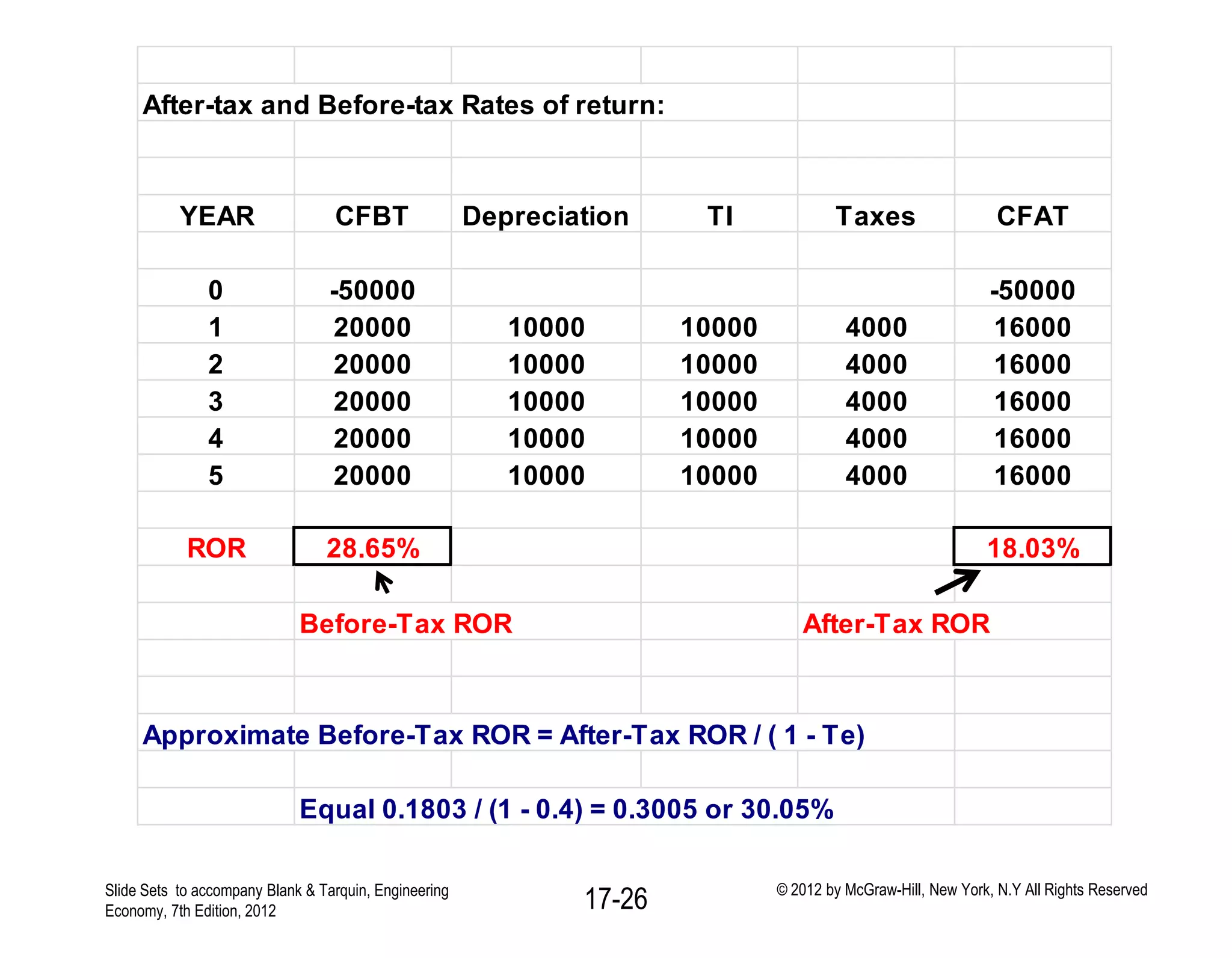
After-tax and Before-tax Rates of return:
YEAR CFBT Depreciation TI Taxes CFAT
0 -50000 -50000
1 20000 10000 10000 4000 16000
2 20000 10000 10000 4000 16000
3 20000 10000 10000 4000 16000
4 20000 10000 10000 4000 16000
5 20000 10000 10000 4000 16000
ROR 28.65% 18.03%
Before-Tax ROR After-Tax ROR
Approximate Before-Tax ROR = After-Tax ROR / ( 1 - Te)
Equal 0.1803 / (1 - 0.4) = 0.3005 or 30.05%
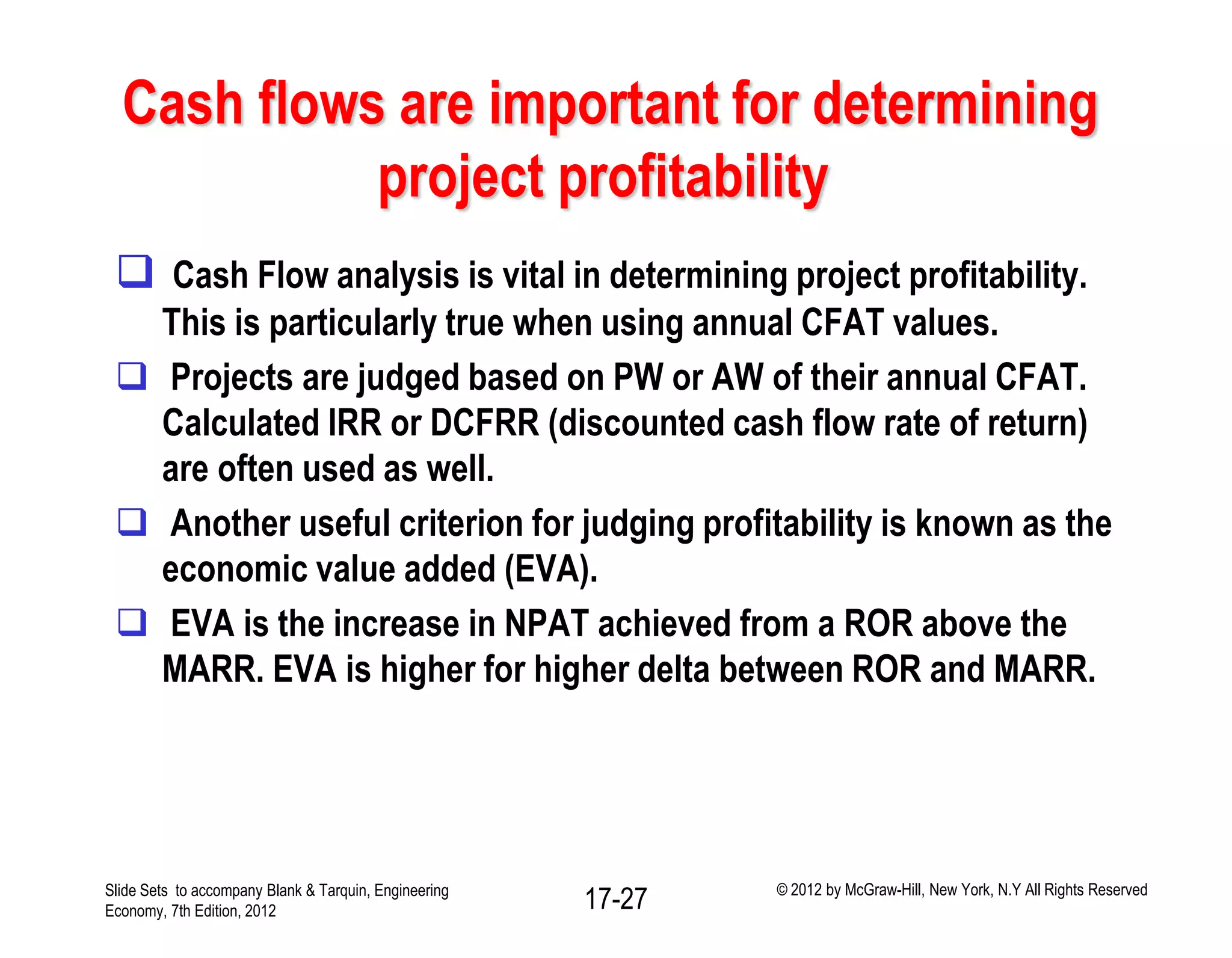
Cash flows are important for determining
project profitability
 Cash Flow analysis is vital in determining project profitability.
This is particularly true when using annual CFAT values.
 Projects are judged based on PW or AW of their annual CFAT.
Calculated IRR or DCFRR (discounted cash flow rate of return)
are often used as well.
 Another useful criterion for judging profitability is known as the
economic value added (EVA).
 EVA is the increase in NPAT achieved from a ROR above the
MARR. EVA is higher for higher delta between ROR and MARR.
Slide Sets to accompany Blank & Tarquin, Engineering
Economy, 7th Edition, 2012 17-27 © 2012 by McGraw-Hill, New York, N.Y All Rights Reserved

Lecture # 9 taxes and eva

  • 1.
    Lecture # 9 CostEstimation Taxes and Economic Value added (EVA) 17-1 Dr. A. Alim
  • 2.
    Income Tax Terminologyand Relations for Corporations (and Individuals)  Gross Income  Total income for the tax year from all revenue producing function of the enterprise.  Sales revenues,  Fees,  Rent,  Royalties,  Sale of assets  Income Tax  The total amount of money transferred from the enterprise to the various taxing agencies for a given tax year.  Federal corporate taxes are normally paid at the end of every quarter and a final adjusting payment is submitted with the tax return at the end of the fiscal year.  This tax is based upon the income producing power of the firm. Slide Sets to accompany Blank & Tarquin, Engineering Economy, 7th Edition, 2012 17-2 © 2012 by McGraw-Hill, New York, N.Y All Rights Reserved
  • 3.
    Terms - continued Operating Expenses  All legally recognized costs associated with doing business for the tax year.  Real cash flows.  Taxable Income  Calculated amount of money for a specified time period from which the tax liability is determined.  Calculated as:  TI = Gross Income – expenses – depreciation TI = GI – E – D Slide Sets to accompany Blank & Tarquin, Engineering Economy, 7th Edition, 2012 17-3 © 2012 by McGraw-Hill, New York, N.Y All Rights Reserved
  • 4.
    Terms - continued Tax rate T  A percentage or decimal equivalent of TI.  For Federal corporate income tax T is represented by a series of tax rates.  The applicable tax rate depends upon the total amount of TI.  Taxes owed equals:  Taxes = (taxable income) x (applicable rate)  = (TI)(T).  Net Profit After Tax (NPAT)  Amount of money remaining each year when income taxes are subtracted from taxable income. NPAT = TI – {(TI)(T)} = (TI)(1-T)  Effective tax rate Te combines federal and local rates: Total Tax = Federal tax + State tax State tax is deductable from taxable federal income, hence : if Tf is federal tax rate, Ts is state tax rate, and Te is total effective tax rate: TI (Te ) = TI(Ts) + [TI - TI(Ts)] (Tf) Te = Tf + Ts – TfTs or Te = Ts + (1-Ts) Tf Te = Tf + (1-Tf) Ts Slide Sets to accompany Blank & Tarquin, Engineering Economy, 7th Edition, 2012 17-4 © 2012 by McGraw-Hill, New York, N.Y All Rights Reserved
  • 5.
    Federal Corporate TaxRates The rates shown above constitute graduated or progressive tax rates. Each bracket rate is termed a marginal tax rate. Slide Sets to accompany Blank & Tarquin, Engineering Economy, 7th Edition, 2012 17-5 © 2012 by McGraw-Hill, New York, N.Y All Rights Reserved
  • 6.
    Federal Corporate TaxRates The rates shown above constitute graduated or progressive tax rates. Each bracket rate is termed a marginal tax rate. Slide Sets to accompany Blank & Tarquin, Engineering Economy, 7th Edition, 2012 17-6 © 2012 by McGraw-Hill, New York, N.Y All Rights Reserved
  • 7.
    Example 17.1, page572, Blank (6th ed.) Slide Sets to accompany Blank & Tarquin, Engineering Economy, 7th Edition, 2012 17-7 © 2012 by McGraw-Hill, New York, N.Y All Rights Reserved
  • 8.
    International Corporate Taxrates (2011) Tax rate % ≥ 35 25 - 35 10 - 25 ≤ 10 Country USA, Argentina Germany, France, Spain, Australia, UK. Russia, China, Canada, Hungary, UAE Serbia, Bulgaria, Montenegro Slide Sets to accompany Blank & Tarquin, Engineering Economy, 7th Edition, 2012 17-8 © 2012 by McGraw-Hill, New York, N.Y All Rights Reserved
  • 9.
    Slide Sets toaccompany Blank & Tarquin, Engineering Economy, 7th Edition, 2012 © 2012 by McGraw-Hill, New York, N.Y All Rights Reserved 17-9 Cash Flow Analysis Before Taxes and After Taxes
  • 10.
    Cash Flow BeforeTax (CFBT) FOR ANY ONE YEAR:  Cash Flow before Tax (CFBT)  CFBT = gross income – expenses – initial investment (total capital) + salvage value + recovered working capital (if any)  = GI – E – P + S + W appear year 0 year n in years 1 to n  CFBT = - P in year zero  CFBT = GI – E in years 1 to n-1  CFBT = GI – E + S + W in year n  (W is recovered working capital, if any) Slide Sets to accompany Blank & Tarquin, Engineering Economy, 7th Edition, 2012 17-10 © 2012 by McGraw-Hill, New York, N.Y All Rights Reserved
  • 11.
    Cash Flow AfterTax (CFAT) FOR ANY ONE YEAR:  Cash Flow After Tax (CFAT)  CFAT = CFBT – taxes  CFAT = [GI – E – P + S + W] – (GI – E – D)(Te)  CFAT = NPAT + D Valid for all years except years 0 and n ! Note: only fixed capital is depreciable, if there is no working capital then by definition total capital is fixed and is depreciable.  An evaluation format:  Table 17.2 , p. 449, Blank (7th ed.) Slide Sets to accompany Blank & Tarquin, Engineering Economy, 7th Edition, 2012 17-11 © 2012 by McGraw-Hill, New York, N.Y All Rights Reserved
  • 12.
    Table column Headingsfor Calculation of CFBT and CFAT Important Notes: *) E and P are always negative values. *) S and possibly working capital (W) appear in last year as positive values *) P,S, and W appear only in CFBT and CFAT, never in TI. *) Only fixed capital is depreciated. *) In a given year, if the depreciation is larger than (GI-E), TI will be negative resulting in a negative tax, or tax credit. Slide Sets to accompany Blank & Tarquin, Engineering Economy, 7th Edition, 2012 17-12 © 2012 by McGraw-Hill, New York, N.Y All Rights Reserved Plus working capital W , if any Of fixed capital only !
  • 13.
    Calculation of CFBTand CFAT Example 17.3, page 576, Blank (6th ed.) Slide Sets to accompany Blank & Tarquin, Engineering Economy, 7th Edition, 2012 17-13 © 2012 by McGraw-Hill, New York, N.Y All Rights Reserved
  • 14.
    Example 17.3 YEAR GIE P and S CFBT d D TI TAXES CFAT 0 $0 $0 -$550,000 -$550,000 $0 $0 $0 -$550,000 1 $200,000 -$90,000 $110,000 0.2000 $110,000 $0 $0 $110,000 2 $200,000 -$90,000 $110,000 0.3200 $176,000 -$66,000 -$23,100 $133,100 3 $200,000 -$90,000 $110,000 0.1920 $105,600 $4,400 $1,540 $108,460 4 $200,000 -$90,000 $110,000 0.1152 $63,360 $46,640 $16,324 $93,676 5 $200,000 -$90,000 $110,000 0.1152 $63,360 $46,640 $16,324 $93,676 6 $200,000 -$90,000 $150,000 $260,000 0.0576 $31,680 $78,320 $27,412 $232,588 Total $260,000 $550,000 $38,500 $221,500 GI - E - P + S d x 550,000 GI - E - D 0.35xTI CFBT-Taxes Slide Sets to accompany Blank & Tarquin, Engineering Economy, 7th Edition, 2012 17-14 © 2012 by McGraw-Hill, New York, N.Y All Rights Reserved
  • 15.
    Example 17.3 Y GI- E P and S CFBT d D TI TAXES CFAT NPAT NPAT + D 0 $0 -$550,000 -$550,000 $0 $0 $0 -$550,000 $0 $0 1 $110,000 $110,000 0.2000 $110,000 $0 $0 $110,000 $0 $110,000 2 $110,000 $110,000 0.3200 $176,000 -$66,000 -$23,100 $133,100 -$42,900 $133,100 3 $110,000 $110,000 0.1920 $105,600 $4,400 $1,540 $108,460 $2,860 $108,460 4 $110,000 $110,000 0.1152 $63,360 $46,640 $16,324 $93,676 $30,316 $93,676 5 $110,000 $110,000 0.1152 $63,360 $46,640 $16,324 $93,676 $30,316 $93,676 6 $110,000 $150,000 $260,000 0.0576 $31,680 $78,320 $27,412 $232,588 $50,908 $82,588 Total $260,000 $550,000 $38,500 $221,500 GI - E - P + S d x 550,000 GI - E - D 0.35xTI CFBT-Taxes TI - Taxes Slide Sets to accompany Blank & Tarquin, Engineering Economy, 7th Edition, 2012 17-15 © 2012 by McGraw-Hill, New York, N.Y All Rights Reserved Note that CFAT does not equal (NPAT+ D) in year 0 and in the last year. CFAT equals (NPAT+D) only in years 1 to (n-1).
  • 16.
    Effect on Taxesof Different Depreciation Methods and Recovery Periods  Criterion used to compare different depreciation methods – compute ---  Objective – Minimize the PW of future taxes paid owing to a given depreciation method  For the same salvage value, the total taxes paid are equal for all depreciation models  The PW of taxes paid is less for accelerated depreciation methods  Shorter depreciation periods result in lower PW of future taxes paid over longer time periods n tax t=1 PW = (taxes in year t)(P/F,i,t) Slide Sets to accompany Blank & Tarquin, Engineering Economy, 7th Edition, 2012 17-16 © 2012 by McGraw-Hill, New York, N.Y All Rights Reserved
  • 17.
    Effect on Taxesof Different Depreciation Methods and Recovery Periods Example 17.3, page 451, Blank (7th ed.) Slide Sets to accompany Blank & Tarquin, Engineering Economy, 7th Edition, 2012 17-17 © 2012 by McGraw-Hill, New York, N.Y All Rights Reserved
  • 18.
    Slide Sets toaccompany Blank & Tarquin, Engineering Economy, 7th Edition, 2012 © 2012 by McGraw-Hill, New York, N.Y All Rights Reserved 17-18 B = $50,000 n = 5 years 1) SL method year CFBT = GI - E - P D TI Taxes 0 (50,000.00)$ -$ -$ -$ 1 20,000.00$ 10,000.00$ 10,000.00$ 3,500.00$ 2 20,000.00$ 10,000.00$ 10,000.00$ 3,500.00$ 3 20,000.00$ 10,000.00$ 10,000.00$ 3,500.00$ 4 20,000.00$ 10,000.00$ 10,000.00$ 3,500.00$ 5 20,000.00$ 10,000.00$ 10,000.00$ 3,500.00$ 6 20,000.00$ -$ 20,000.00$ 7,000.00$ Total 24,500.00$ PW 18,385.67$
  • 19.
    Slide Sets toaccompany Blank & Tarquin, Engineering Economy, 7th Edition, 2012 © 2012 by McGraw-Hill, New York, N.Y All Rights Reserved 17-19 B = $50,000 n = 5 years 2) DDB method year CFBT = GI - E - P BV D TI Taxes 0 (50,000.00)$ 50,000.00$ -$ -$ -$ 1 20,000.00$ 30,000.00$ 20,000.00$ -$ -$ 2 20,000.00$ 18,000.00$ 12,000.00$ 8,000.00$ 2,800.00$ 3 20,000.00$ 10,800.00$ 7,200.00$ 12,800.00$ 4,480.00$ 4 20,000.00$ 6,480.00$ 4,320.00$ 15,680.00$ 5,488.00$ 5 20,000.00$ 3,888.00$ 2,592.00$ 17,408.00$ 6,092.80$ 6 20,000.00$ -$ 20,000.00$ 7,000.00$ Total 46,112.00$ 25,860.80$ PW 18,548.61$ Note: Asset is not fully depreciated after 5 years.
  • 20.
    Slide Sets toaccompany Blank & Tarquin, Engineering Economy, 7th Edition, 2012 © 2012 by McGraw-Hill, New York, N.Y All Rights Reserved 17-20 B = $50,000 n = 5 years 3) MACRS method year CFBT = GI - E - P d D TI Taxes 0 (50,000.00)$ 1 20,000.00$ 20.00 10,000.00$ 10,000.00$ 3,500.00$ 2 20,000.00$ 32.00 16,000.00$ 4,000.00$ 1,400.00$ 3 20,000.00$ 19.20 9,600.00$ 10,400.00$ 3,640.00$ 4 20,000.00$ 11.52 5,760.00$ 14,240.00$ 4,984.00$ 5 20,000.00$ 11.52 5,760.00$ 14,240.00$ 4,984.00$ 6 20,000.00$ 5.76 2,880.00$ 17,120.00$ 5,992.00$ Total 100.00 50,000.00$ 24,500.00$ PW 18,161.96$
  • 21.
    Slide Sets toaccompany Blank & Tarquin, Engineering Economy, 7th Edition, 2012 17-21 © 2012 by McGraw-Hill, New York, N.Y All Rights Reserved
  • 22.
    Figure 17-2 Comparing DepreciationPlans Slide Sets to accompany Blank & Tarquin, Engineering Economy, 7th Edition, 2012 17-22 © 2012 by McGraw-Hill, New York, N.Y All Rights Reserved
  • 23.
    Slide Sets toaccompany Blank & Tarquin, Engineering Economy, 7th Edition, 2012 17-23 © 2012 by McGraw-Hill, New York, N.Y All Rights Reserved
  • 24.
    Cash flow analysisis important in calculating ROR Before tax and After tax  The Rate Of Return (ROR) is a general term used to measure profitability.  There are several ways to define ROR, e.g.: * If we ignore time value of money, then ROR is known as Return on Invested Capital (ROI), In this case, ROR = ROI = Net Profit / Invested capital. * If we include time value of money, for a series of cash flows, the ROR is known as IRR (internal rate of return) or discounted cash flow rate of return (DCFRR)  The rate of return ROR can be calculated using the IRR function for a series of cash flows.  Rate of return (ROR) can be calculated before tax using CFBT analysis, and/or after tax using CFAT analysis.  We therefore have a Before – Tax ROR and an After-Tax ROR. Both may be obtained using the IRR function.  An approximate relationship may also be used: e after-tax ROR Tax ROR = 1-T Before Slide Sets to accompany Blank & Tarquin, Engineering Economy, 7th Edition, 2012 17-24 © 2012 by McGraw-Hill, New York, N.Y All Rights Reserved
  • 25.
    Example: A company hasspent $50,000 for a 5-year-life machine that has a projected $20,000 annual CFBT and annual depreciation of $10,000. The company has a Te of 40%. Determine:  Exact Before-Tax ROR and After-Tax ROR.  Approximate Before-Tax ROR Slide Sets to accompany Blank & Tarquin, Engineering Economy, 7th Edition, 2012 17-25 © 2012 by McGraw-Hill, New York, N.Y All Rights Reserved
  • 26.
    Slide Sets toaccompany Blank & Tarquin, Engineering Economy, 7th Edition, 2012 © 2012 by McGraw-Hill, New York, N.Y All Rights Reserved 17-26 After-tax and Before-tax Rates of return: YEAR CFBT Depreciation TI Taxes CFAT 0 -50000 -50000 1 20000 10000 10000 4000 16000 2 20000 10000 10000 4000 16000 3 20000 10000 10000 4000 16000 4 20000 10000 10000 4000 16000 5 20000 10000 10000 4000 16000 ROR 28.65% 18.03% Before-Tax ROR After-Tax ROR Approximate Before-Tax ROR = After-Tax ROR / ( 1 - Te) Equal 0.1803 / (1 - 0.4) = 0.3005 or 30.05%
  • 27.
    Cash flows areimportant for determining project profitability  Cash Flow analysis is vital in determining project profitability. This is particularly true when using annual CFAT values.  Projects are judged based on PW or AW of their annual CFAT. Calculated IRR or DCFRR (discounted cash flow rate of return) are often used as well.  Another useful criterion for judging profitability is known as the economic value added (EVA).  EVA is the increase in NPAT achieved from a ROR above the MARR. EVA is higher for higher delta between ROR and MARR. Slide Sets to accompany Blank & Tarquin, Engineering Economy, 7th Edition, 2012 17-27 © 2012 by McGraw-Hill, New York, N.Y All Rights Reserved