8-1
Lecture slides to accompany
Engineering Economy
7th
edition
Leland Blank
Anthony Tarquin
Chapter 8Chapter 8
Rate of ReturnRate of Return
MultipleMultiple
AlternativesAlternatives
© 2012 by McGraw-Hill All Rights Reserved
8-2
LEARNINGLEARNING OUTCOMESOUTCOMES
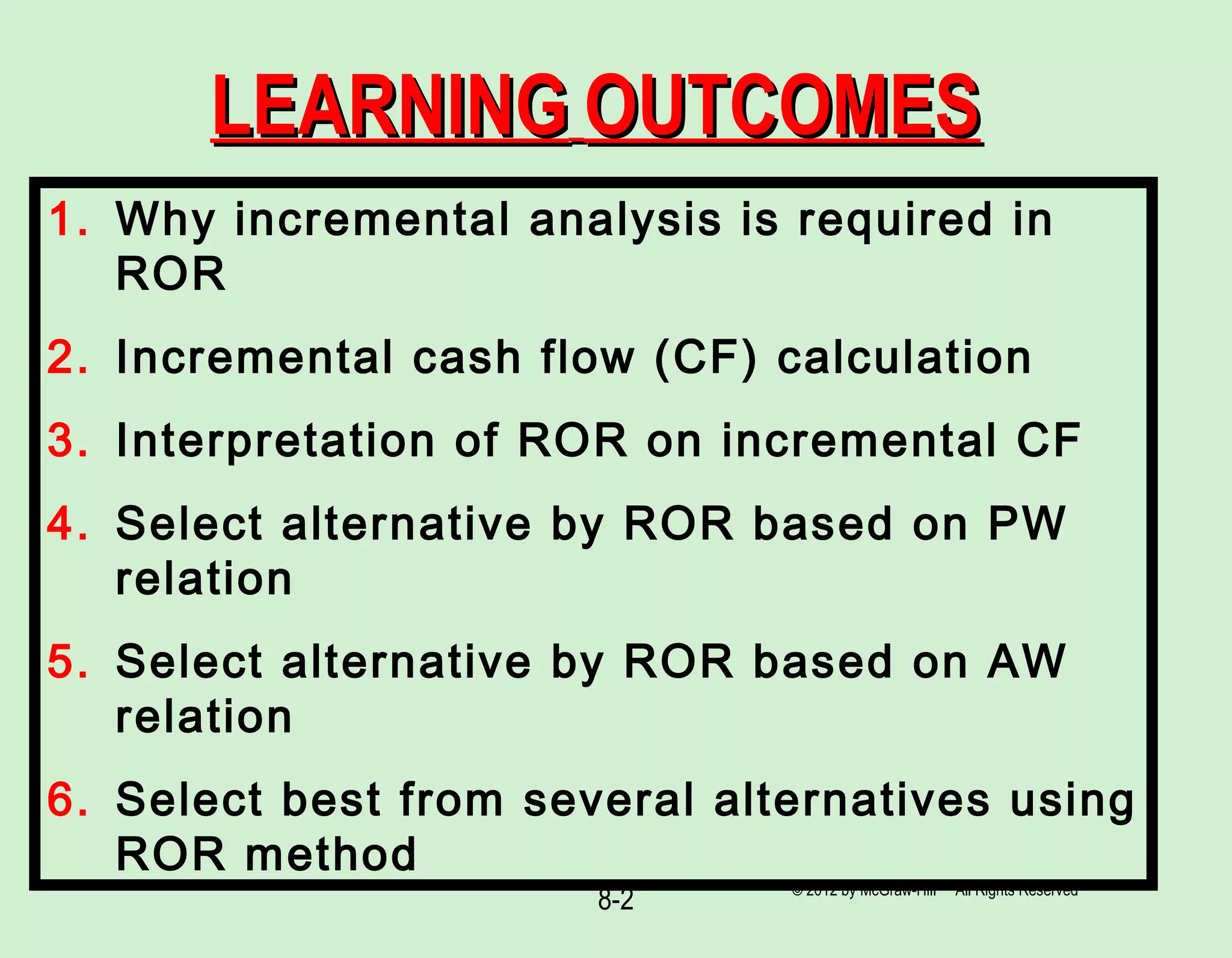
1. Why incremental analysis is required in
ROR
2. Incremental cash flow (CF) calculation
3. Interpretation of ROR on incremental CF
4. Select alternative by ROR based on PW
relation
5. Select alternative by ROR based on AW
relation
6. Select best from several alternatives using
ROR method
© 2012 by McGraw-Hill All Rights Reserved
8-3
Why Incremental Analysis is NecessaryWhy Incremental Analysis is Necessary
Selecting the alternative with highest ROR may not
yield highest return on available capital
Must consider weighted average of total capital available
Capital not invested in a project is assumed to earn at MARR
Example: Assume $90,000 is available for investment and MARR = 16%
per year. If alternative A would earn 35% per year on investment of $50,000, and
B would earn 29% per year on investment of $85,000, the weighted averages are:
Overall RORA = [50,000(0.35) + 40,000(0.16)]/90,000 = 26.6%
Overall RORB = [85,000(0.29) + 5,000(0.16)]/90,000 = 28.3%
Which investment is better, economically?
© 2012 by McGraw-Hill All Rights Reserved
Why Incremental Analysis is NecessaryWhy Incremental Analysis is Necessary
© 2012 by McGraw-Hill All Rights Reserved
8-4
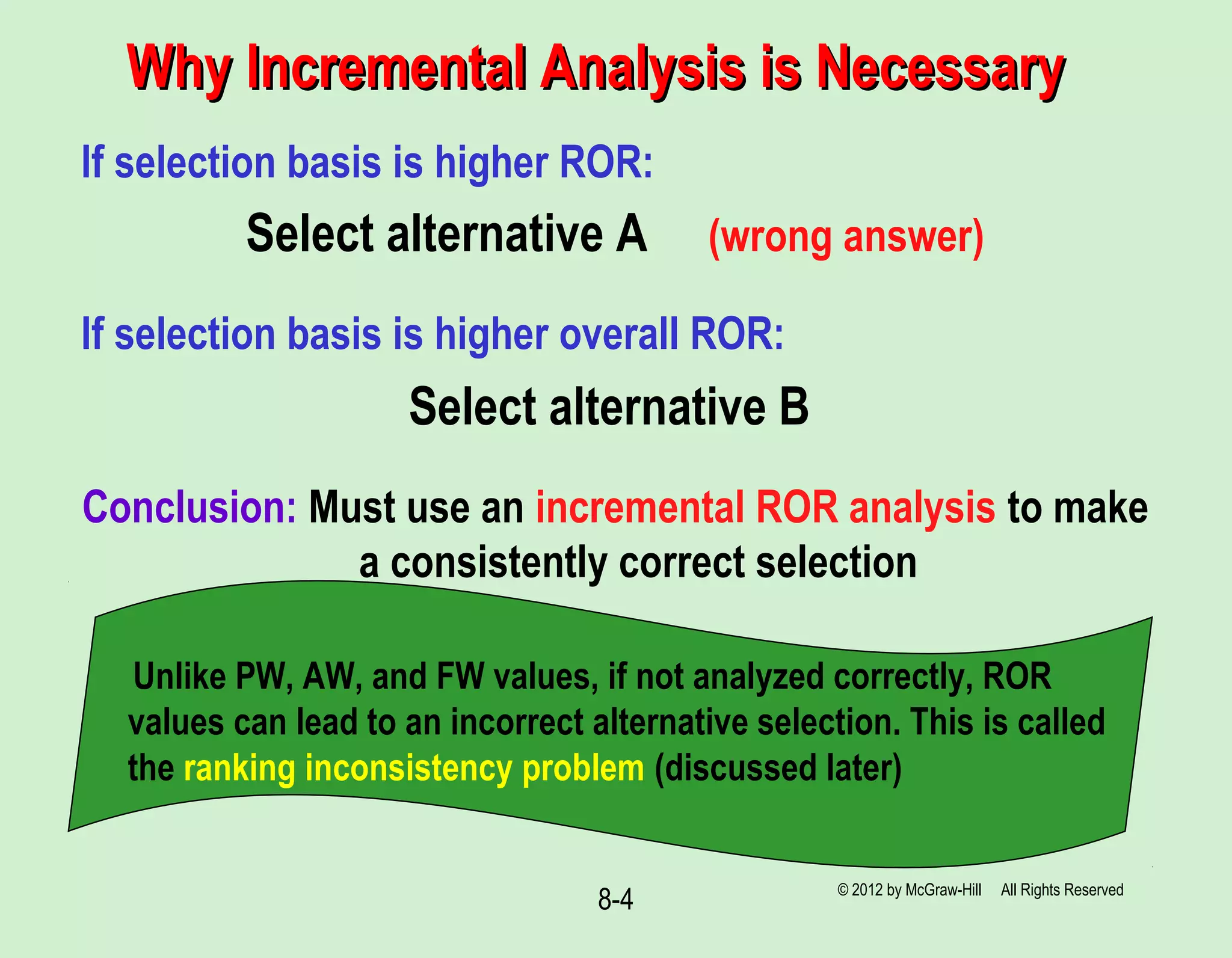
If selection basis is higher ROR:
Select alternative A (wrong answer)
If selection basis is higher overall ROR:
Select alternative B
Conclusion: Must use an incremental ROR analysis to make
a consistently correct selection
Unlike PW, AW, and FW values, if not analyzed correctly, ROR
values can lead to an incorrect alternative selection. This is called
the ranking inconsistency problem (discussed later)
8-5
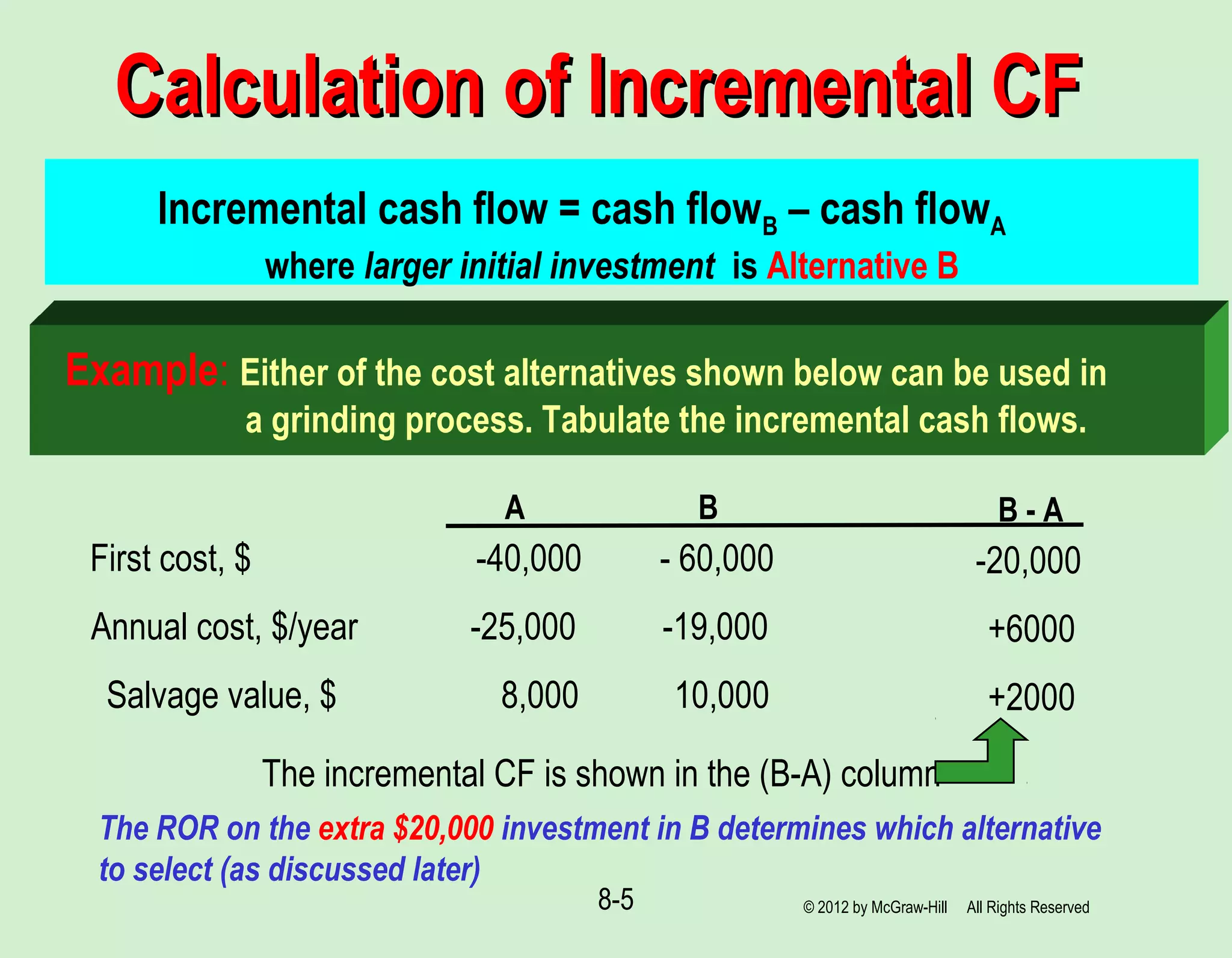
Incremental cash flow = cash flowB – cash flowA
where larger initial investment is Alternative B
Calculation of Incremental CFCalculation of Incremental CF
Example: Either of the cost alternatives shown below can be used in
a grinding process. Tabulate the incremental cash flows.
BA
First cost, $ -40,000 - 60,000
Annual cost, $/year -25,000 -19,000
Salvage value, $ 8,000 10,000
The ROR on the extra $20,000 investment in B determines which alternative
to select (as discussed later)
The incremental CF is shown in the (B-A) column
-20,000
+6000
+2000
B - A
© 2012 by McGraw-Hill All Rights Reserved
8-6
Interpretation of ROR on Extra InvestmentInterpretation of ROR on Extra Investment
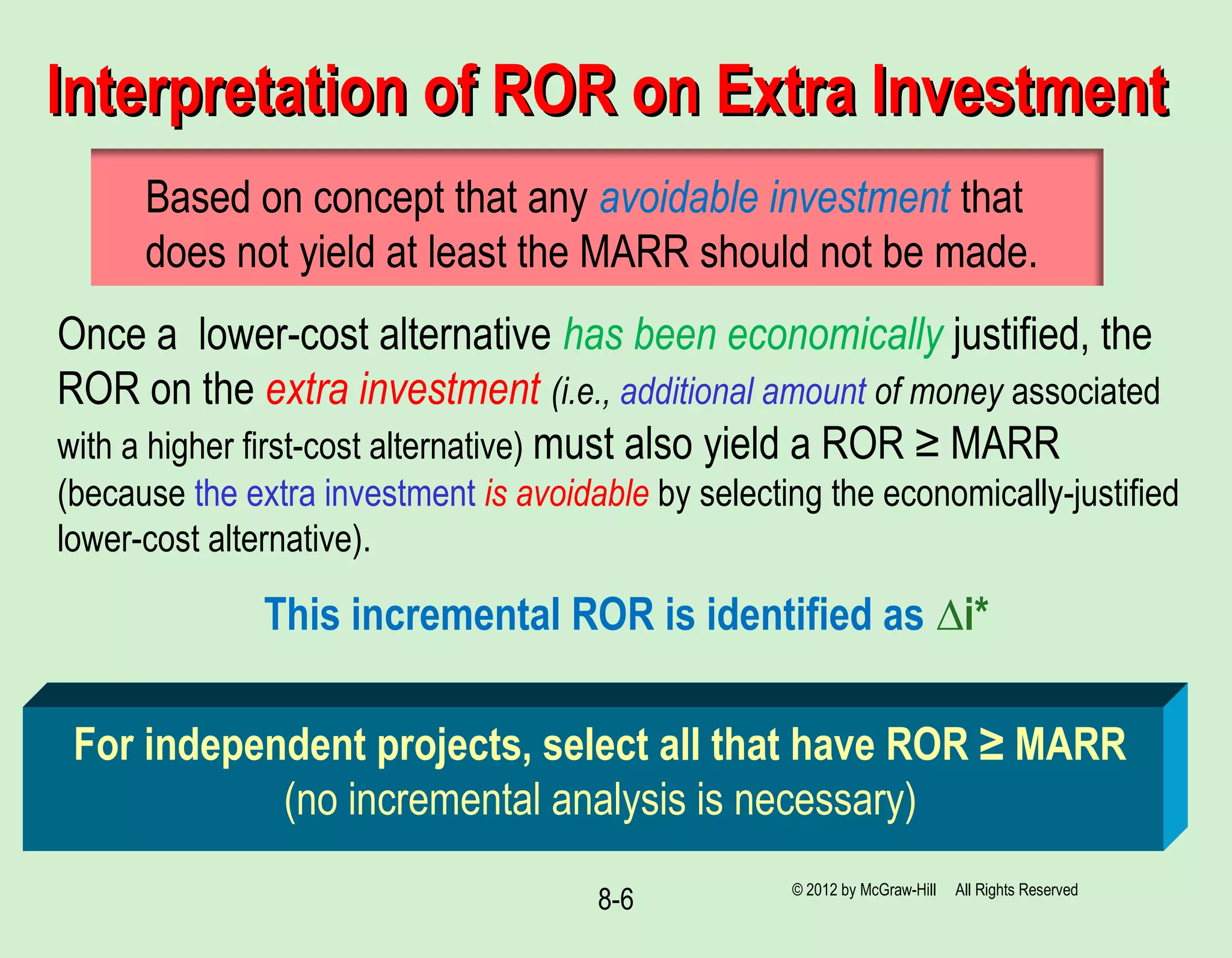
For independent projects, select all that have ROR ≥ MARR
(no incremental analysis is necessary)
Based on concept that any avoidable investment that
does not yield at least the MARR should not be made.
Once a lower-cost alternative has been economically justified, the
ROR on the extra investment (i.e., additional amount of money associated
with a higher first-cost alternative) must also yield a ROR ≥ MARR
(because the extra investment is avoidable by selecting the economically-justified
lower-cost alternative).
This incremental ROR is identified as ∆i*
© 2012 by McGraw-Hill All Rights Reserved
8-7
ROR Evaluation for Two ME AlternativesROR Evaluation for Two ME Alternatives
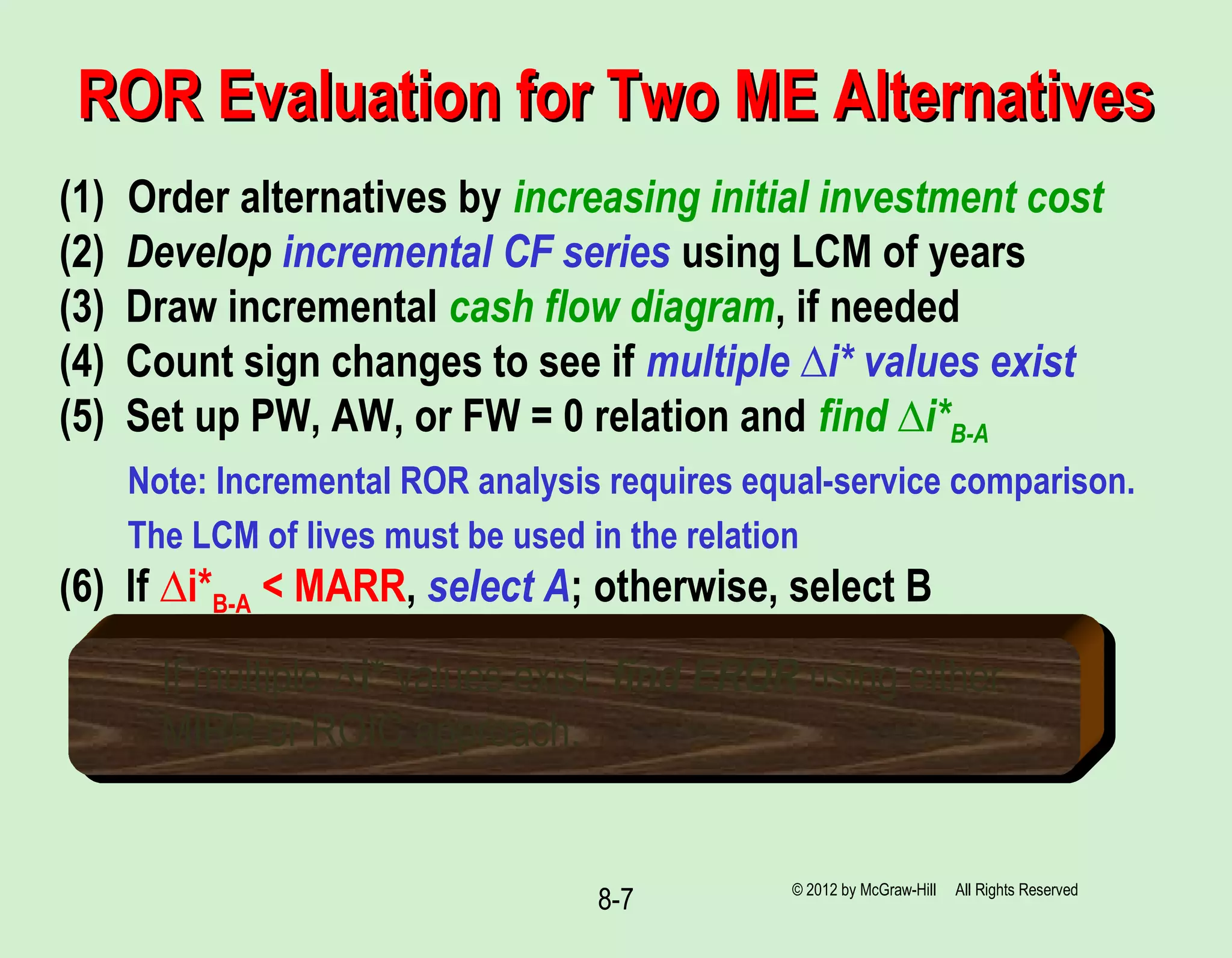
(1) Order alternatives by increasing initial investment cost
(2) Develop incremental CF series using LCM of years
(3) Draw incremental cash flow diagram, if needed
(4) Count sign changes to see if multiple ∆i* values exist
(5) Set up PW, AW, or FW = 0 relation and find ∆i*B-A
Note: Incremental ROR analysis requires equal-service comparison.
The LCM of lives must be used in the relation
(6) If ∆i*B-A < MARR, select A; otherwise, select B
If multiple ∆i* values exist, find EROR using either
MIRR or ROIC approach.
© 2012 by McGraw-Hill All Rights Reserved
8-8
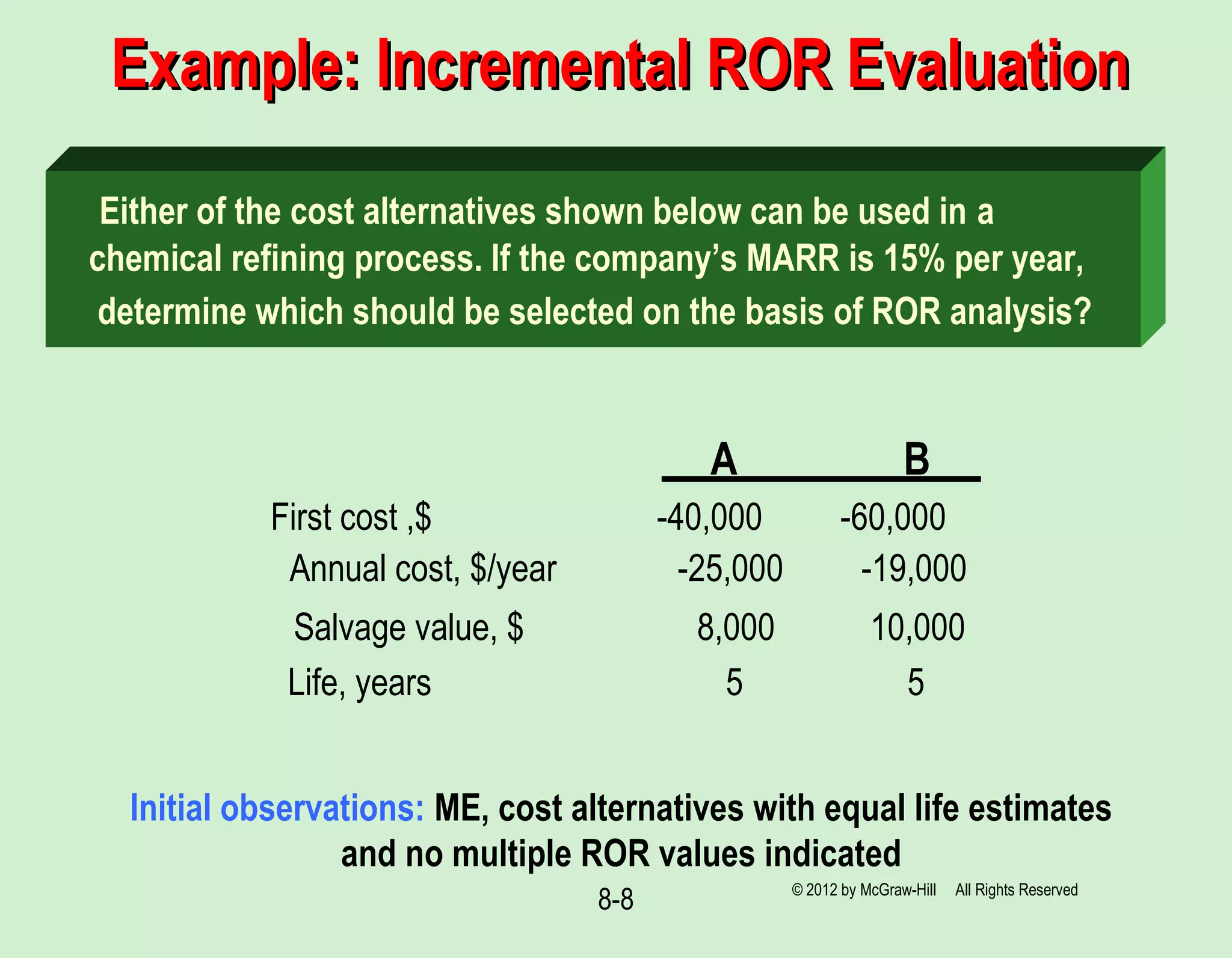
Example: Incremental ROR EvaluationExample: Incremental ROR Evaluation
Either of the cost alternatives shown below can be used in a
chemical refining process. If the company’s MARR is 15% per year,
determine which should be selected on the basis of ROR analysis?
BA
First cost ,$ -40,000 -60,000
Annual cost, $/year -25,000 -19,000
Salvage value, $ 8,000 10,000
Life, years 5 5
© 2012 by McGraw-Hill All Rights Reserved
Initial observations: ME, cost alternatives with equal life estimates
and no multiple ROR values indicated
8-9
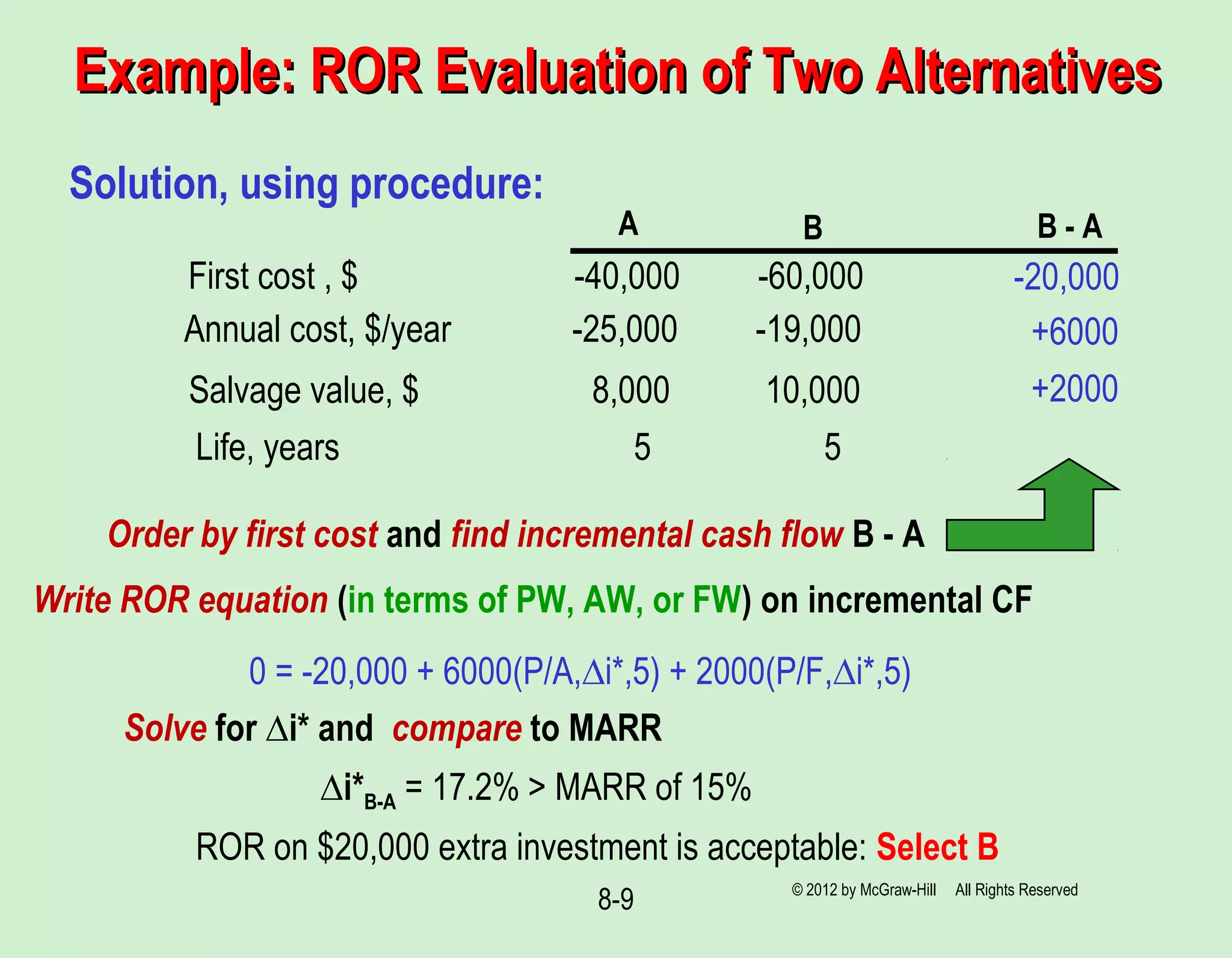
Example: ROR Evaluation of Two AlternativesExample: ROR Evaluation of Two Alternatives
BA
First cost , $ -40,000 -60,000
Annual cost, $/year -25,000 -19,000
Salvage value, $ 8,000 10,000
Life, years 5 5
Solution, using procedure:
Order by first cost and find incremental cash flow B - A
-20,000
+6000
+2000
B - A
0 = -20,000 + 6000(P/A,∆i*,5) + 2000(P/F,∆i*,5)
∆i*B-A = 17.2% > MARR of 15%
ROR on $20,000 extra investment is acceptable: Select B
Write ROR equation (in terms of PW, AW, or FW) on incremental CF
Solve for ∆i* and compare to MARR
© 2012 by McGraw-Hill All Rights Reserved
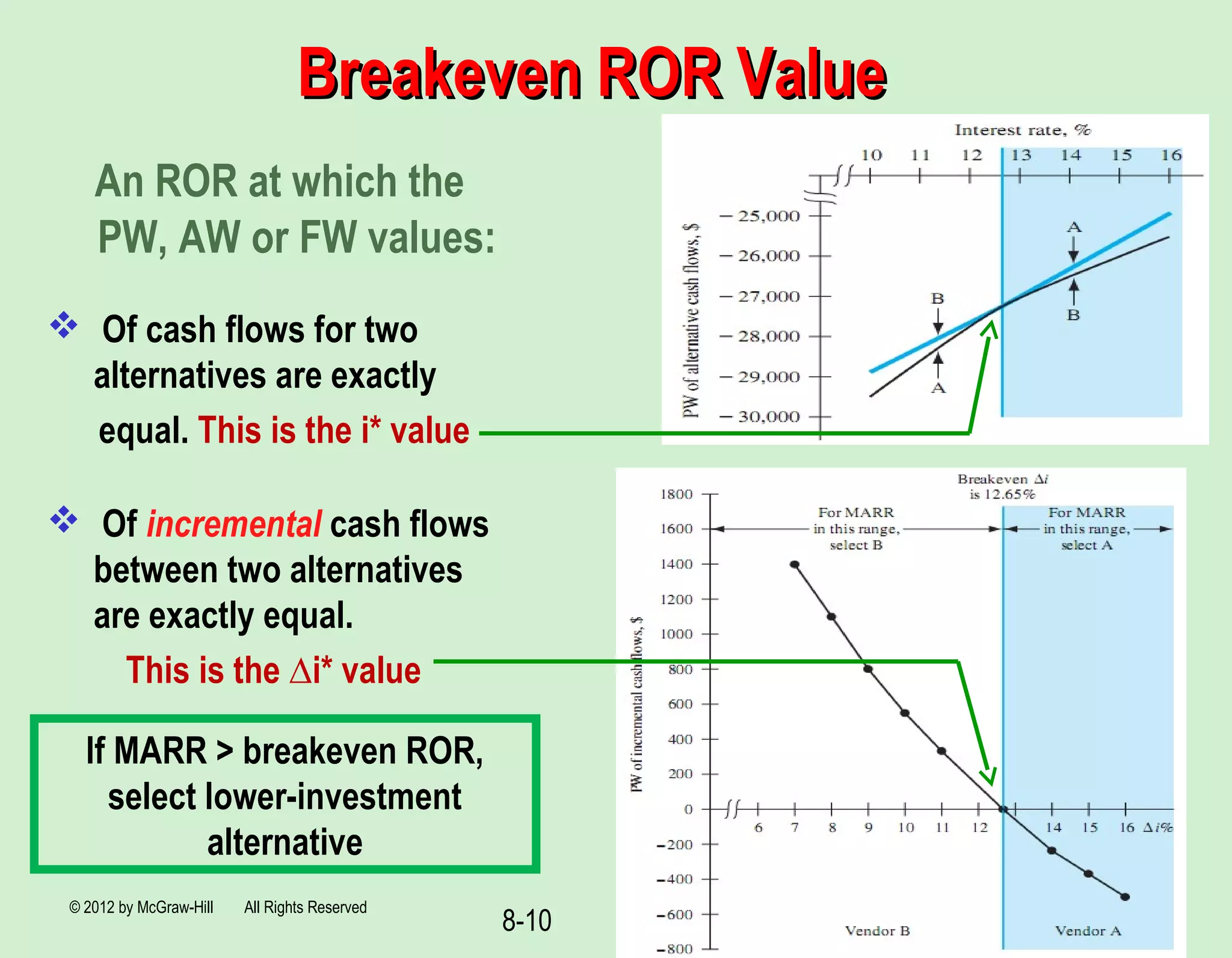
Breakeven ROR ValueBreakeven ROR Value
An ROR at which the
PW, AW or FW values:
 Of cash flows for two
alternatives are exactly
equal. This is the i* value
 Of incremental cash flows
between two alternatives
are exactly equal.
This is the ∆i* value
© 2012 by McGraw-Hill All Rights Reserved
8-10
If MARR > breakeven ROR,
select lower-investment
alternative
8-11
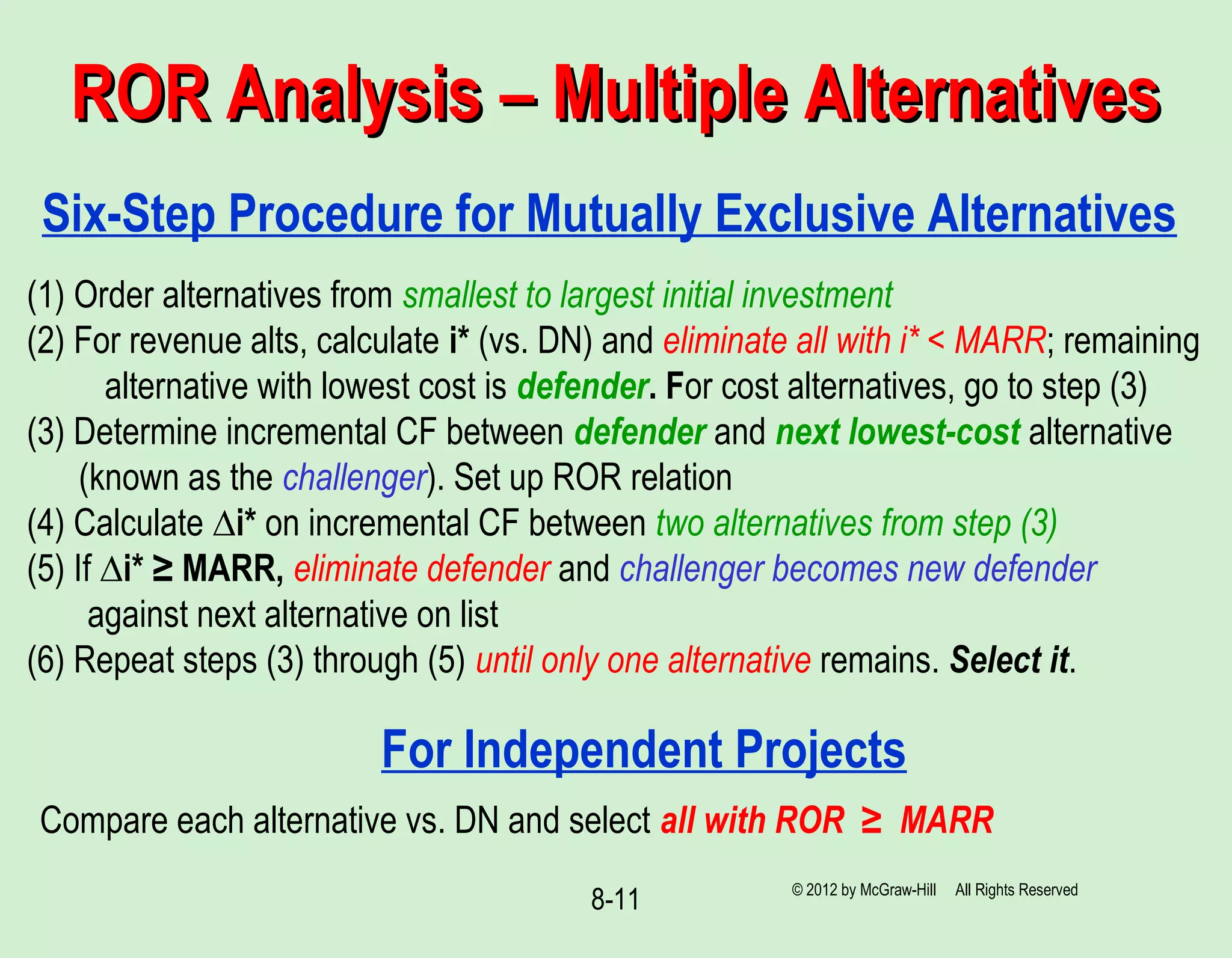
ROR Analysis – Multiple AlternativesROR Analysis – Multiple Alternatives
Six-Step Procedure for Mutually Exclusive Alternatives
(1) Order alternatives from smallest to largest initial investment
(2) For revenue alts, calculate i* (vs. DN) and eliminate all with i* < MARR; remaining
alternative with lowest cost is defender. For cost alternatives, go to step (3)
(3) Determine incremental CF between defender and next lowest-cost alternative
(known as the challenger). Set up ROR relation
(4) Calculate ∆i* on incremental CF between two alternatives from step (3)
(5) If ∆i* ≥ MARR, eliminate defender and challenger becomes new defender
against next alternative on list
(6) Repeat steps (3) through (5) until only one alternative remains. Select it.
For Independent Projects
Compare each alternative vs. DN and select all with ROR ≥ MARR
© 2012 by McGraw-Hill All Rights Reserved
8-12
Example: ROR for Multiple AlternativesExample: ROR for Multiple Alternatives
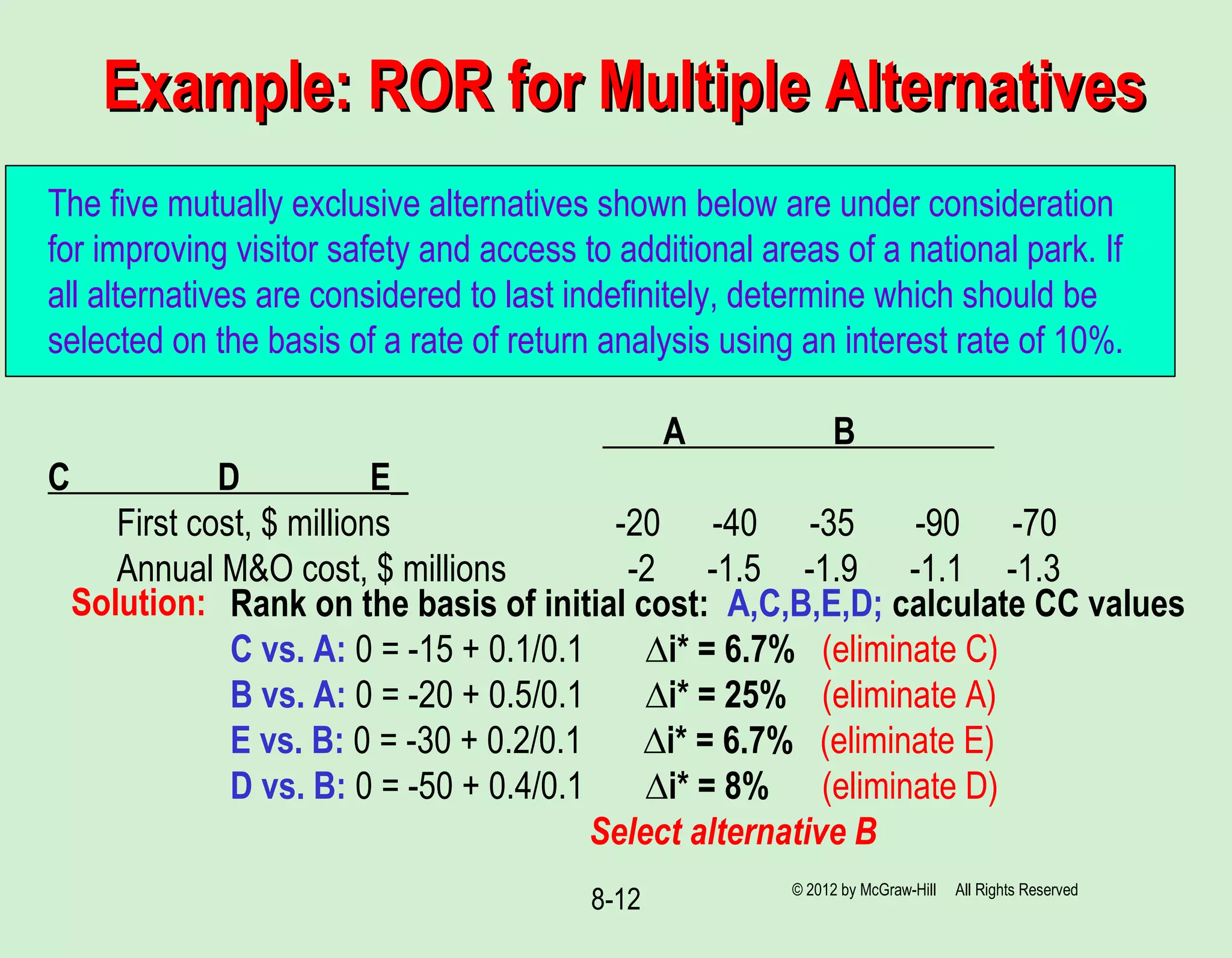
The five mutually exclusive alternatives shown below are under consideration
for improving visitor safety and access to additional areas of a national park. If
all alternatives are considered to last indefinitely, determine which should be
selected on the basis of a rate of return analysis using an interest rate of 10%.
    A         B        
C         D        E_
First cost, $ millions -20 -40 -35 -90 -70
Annual M&O cost, $ millions -2 -1.5 -1.9 -1.1 -1.3
Solution: Rank on the basis of initial cost: A,C,B,E,D; calculate CC values
C vs. A: 0 = -15 + 0.1/0.1 ∆i* = 6.7% (eliminate C)
B vs. A: 0 = -20 + 0.5/0.1 ∆i* = 25% (eliminate A)
E vs. B: 0 = -30 + 0.2/0.1 ∆i* = 6.7% (eliminate E)
D vs. B: 0 = -50 + 0.4/0.1 ∆i* = 8% (eliminate D)
Select alternative B
© 2012 by McGraw-Hill All Rights Reserved
8-13
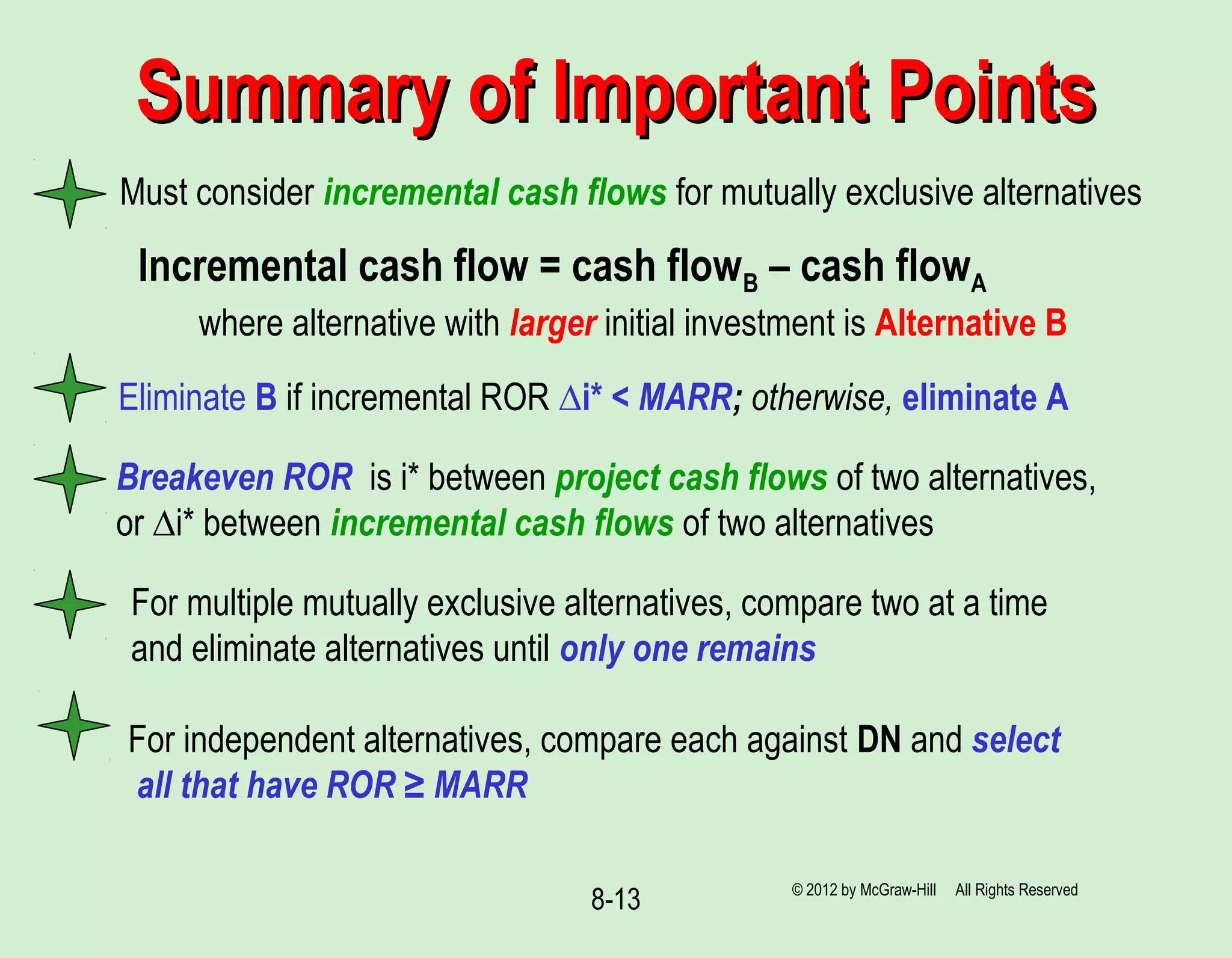
Must consider incremental cash flows for mutually exclusive alternatives
Summary of Important PointsSummary of Important Points
Incremental cash flow = cash flowB – cash flowA
where alternative with larger initial investment is Alternative B
Eliminate B if incremental ROR ∆i* < MARR; otherwise, eliminate A
For multiple mutually exclusive alternatives, compare two at a time
and eliminate alternatives until only one remains
For independent alternatives, compare each against DN and select
all that have ROR ≥ MARR
© 2012 by McGraw-Hill All Rights Reserved
Breakeven ROR is i* between project cash flows of two alternatives,
or ∆i* between incremental cash flows of two alternatives

Chapter 8 ror analysis for multiple alternatives

  • 1.
    8-1 Lecture slides toaccompany Engineering Economy 7th edition Leland Blank Anthony Tarquin Chapter 8Chapter 8 Rate of ReturnRate of Return MultipleMultiple AlternativesAlternatives © 2012 by McGraw-Hill All Rights Reserved
  • 2.
    8-2 LEARNINGLEARNING OUTCOMESOUTCOMES 1. Whyincremental analysis is required in ROR 2. Incremental cash flow (CF) calculation 3. Interpretation of ROR on incremental CF 4. Select alternative by ROR based on PW relation 5. Select alternative by ROR based on AW relation 6. Select best from several alternatives using ROR method © 2012 by McGraw-Hill All Rights Reserved
  • 3.
    8-3 Why Incremental Analysisis NecessaryWhy Incremental Analysis is Necessary Selecting the alternative with highest ROR may not yield highest return on available capital Must consider weighted average of total capital available Capital not invested in a project is assumed to earn at MARR Example: Assume $90,000 is available for investment and MARR = 16% per year. If alternative A would earn 35% per year on investment of $50,000, and B would earn 29% per year on investment of $85,000, the weighted averages are: Overall RORA = [50,000(0.35) + 40,000(0.16)]/90,000 = 26.6% Overall RORB = [85,000(0.29) + 5,000(0.16)]/90,000 = 28.3% Which investment is better, economically? © 2012 by McGraw-Hill All Rights Reserved
  • 4.
    Why Incremental Analysisis NecessaryWhy Incremental Analysis is Necessary © 2012 by McGraw-Hill All Rights Reserved 8-4 If selection basis is higher ROR: Select alternative A (wrong answer) If selection basis is higher overall ROR: Select alternative B Conclusion: Must use an incremental ROR analysis to make a consistently correct selection Unlike PW, AW, and FW values, if not analyzed correctly, ROR values can lead to an incorrect alternative selection. This is called the ranking inconsistency problem (discussed later)
  • 5.
    8-5 Incremental cash flow= cash flowB – cash flowA where larger initial investment is Alternative B Calculation of Incremental CFCalculation of Incremental CF Example: Either of the cost alternatives shown below can be used in a grinding process. Tabulate the incremental cash flows. BA First cost, $ -40,000 - 60,000 Annual cost, $/year -25,000 -19,000 Salvage value, $ 8,000 10,000 The ROR on the extra $20,000 investment in B determines which alternative to select (as discussed later) The incremental CF is shown in the (B-A) column -20,000 +6000 +2000 B - A © 2012 by McGraw-Hill All Rights Reserved
  • 6.
    8-6 Interpretation of RORon Extra InvestmentInterpretation of ROR on Extra Investment For independent projects, select all that have ROR ≥ MARR (no incremental analysis is necessary) Based on concept that any avoidable investment that does not yield at least the MARR should not be made. Once a lower-cost alternative has been economically justified, the ROR on the extra investment (i.e., additional amount of money associated with a higher first-cost alternative) must also yield a ROR ≥ MARR (because the extra investment is avoidable by selecting the economically-justified lower-cost alternative). This incremental ROR is identified as ∆i* © 2012 by McGraw-Hill All Rights Reserved
  • 7.
    8-7 ROR Evaluation forTwo ME AlternativesROR Evaluation for Two ME Alternatives (1) Order alternatives by increasing initial investment cost (2) Develop incremental CF series using LCM of years (3) Draw incremental cash flow diagram, if needed (4) Count sign changes to see if multiple ∆i* values exist (5) Set up PW, AW, or FW = 0 relation and find ∆i*B-A Note: Incremental ROR analysis requires equal-service comparison. The LCM of lives must be used in the relation (6) If ∆i*B-A < MARR, select A; otherwise, select B If multiple ∆i* values exist, find EROR using either MIRR or ROIC approach. © 2012 by McGraw-Hill All Rights Reserved
  • 8.
    8-8 Example: Incremental ROREvaluationExample: Incremental ROR Evaluation Either of the cost alternatives shown below can be used in a chemical refining process. If the company’s MARR is 15% per year, determine which should be selected on the basis of ROR analysis? BA First cost ,$ -40,000 -60,000 Annual cost, $/year -25,000 -19,000 Salvage value, $ 8,000 10,000 Life, years 5 5 © 2012 by McGraw-Hill All Rights Reserved Initial observations: ME, cost alternatives with equal life estimates and no multiple ROR values indicated
  • 9.
    8-9 Example: ROR Evaluationof Two AlternativesExample: ROR Evaluation of Two Alternatives BA First cost , $ -40,000 -60,000 Annual cost, $/year -25,000 -19,000 Salvage value, $ 8,000 10,000 Life, years 5 5 Solution, using procedure: Order by first cost and find incremental cash flow B - A -20,000 +6000 +2000 B - A 0 = -20,000 + 6000(P/A,∆i*,5) + 2000(P/F,∆i*,5) ∆i*B-A = 17.2% > MARR of 15% ROR on $20,000 extra investment is acceptable: Select B Write ROR equation (in terms of PW, AW, or FW) on incremental CF Solve for ∆i* and compare to MARR © 2012 by McGraw-Hill All Rights Reserved
  • 10.
    Breakeven ROR ValueBreakevenROR Value An ROR at which the PW, AW or FW values:  Of cash flows for two alternatives are exactly equal. This is the i* value  Of incremental cash flows between two alternatives are exactly equal. This is the ∆i* value © 2012 by McGraw-Hill All Rights Reserved 8-10 If MARR > breakeven ROR, select lower-investment alternative
  • 11.
    8-11 ROR Analysis –Multiple AlternativesROR Analysis – Multiple Alternatives Six-Step Procedure for Mutually Exclusive Alternatives (1) Order alternatives from smallest to largest initial investment (2) For revenue alts, calculate i* (vs. DN) and eliminate all with i* < MARR; remaining alternative with lowest cost is defender. For cost alternatives, go to step (3) (3) Determine incremental CF between defender and next lowest-cost alternative (known as the challenger). Set up ROR relation (4) Calculate ∆i* on incremental CF between two alternatives from step (3) (5) If ∆i* ≥ MARR, eliminate defender and challenger becomes new defender against next alternative on list (6) Repeat steps (3) through (5) until only one alternative remains. Select it. For Independent Projects Compare each alternative vs. DN and select all with ROR ≥ MARR © 2012 by McGraw-Hill All Rights Reserved
  • 12.
    8-12 Example: ROR forMultiple AlternativesExample: ROR for Multiple Alternatives The five mutually exclusive alternatives shown below are under consideration for improving visitor safety and access to additional areas of a national park. If all alternatives are considered to last indefinitely, determine which should be selected on the basis of a rate of return analysis using an interest rate of 10%.     A         B         C         D        E_ First cost, $ millions -20 -40 -35 -90 -70 Annual M&O cost, $ millions -2 -1.5 -1.9 -1.1 -1.3 Solution: Rank on the basis of initial cost: A,C,B,E,D; calculate CC values C vs. A: 0 = -15 + 0.1/0.1 ∆i* = 6.7% (eliminate C) B vs. A: 0 = -20 + 0.5/0.1 ∆i* = 25% (eliminate A) E vs. B: 0 = -30 + 0.2/0.1 ∆i* = 6.7% (eliminate E) D vs. B: 0 = -50 + 0.4/0.1 ∆i* = 8% (eliminate D) Select alternative B © 2012 by McGraw-Hill All Rights Reserved
  • 13.
    8-13 Must consider incrementalcash flows for mutually exclusive alternatives Summary of Important PointsSummary of Important Points Incremental cash flow = cash flowB – cash flowA where alternative with larger initial investment is Alternative B Eliminate B if incremental ROR ∆i* < MARR; otherwise, eliminate A For multiple mutually exclusive alternatives, compare two at a time and eliminate alternatives until only one remains For independent alternatives, compare each against DN and select all that have ROR ≥ MARR © 2012 by McGraw-Hill All Rights Reserved Breakeven ROR is i* between project cash flows of two alternatives, or ∆i* between incremental cash flows of two alternatives